Liposuction techniques come with a dense vocabulary: tumescent, SAL, PAL, UAL, LAL, RFAL, WAL, plus brand names such as “power lipo,” “water lipo” and “HD lipo.” A consultation can sound as though you are choosing among six different operations. In practice, most of these names describe one of three things: how the tissue is prepared with fluid, how the fat is loosened, and how it is removed.
The American Society of Plastic Surgeons (ASPS) counted 349,728 liposuction procedures in its 2024 statistics, up 1% from 2023, which made it the most common cosmetic surgical procedure that year. Those counts say how many operations were done, not which method was used or whether the method mattered. This page covers six liposuction techniques, what published comparisons show, what FDA clearance does and does not mean for a device, and how to ask a surgeon why one was chosen. For what the operation changes and cannot fix, start with the liposuction overview.
How Liposuction Techniques Are Built: Fluid, Loosening, Removal
Think of any of the liposuction techniques as a stack of separate decisions. A technique name usually settles only one of them, which is why the same label can describe quite different operations in different offices.
Tumescent fluid sits under almost every method
Dry, wet, superwet and tumescent are fluid ratios
The ASPS Committee on Patient Safety defined four infiltration approaches in a practice advisory published in 2004. In the dry technique nothing is infiltrated, and the aspirate was reported to be 20% to 45% blood. The wet technique adds a modest, set amount of fluid. The superwet technique uses roughly 1 mL of fluid for each 1 mL of fat expected to come out, and the tumescent technique uses roughly 3 to 4 mL per planned 1 mL of aspirate.
With superwet and tumescent infiltration, the advisory summarized blood loss as roughly 1% of the aspirate or less. It limits the dry technique to cases with 100 cc or less of aspirate, and says it must never be combined with ultrasound.
Why tumescent is a fluid method, not a rival to suction
In 1987, Jeffrey Klein reported that very large volumes of dilute anesthetic solution could numb fat well enough to remove it under local anesthesia, with epinephrine limiting bleeding. That history comes from a 2017 review in Annals of Medicine and Surgery. The advisory describes the usual solution as lidocaine at 0.025% to 0.1% with epinephrine at 1:1,000,000.
So when a clinic advertises “tumescent liposuction,” it is naming the fluid, one layer shared by most liposuction techniques. The tool that follows could be a plain cannula, a motor, ultrasound or a laser fiber. A 2020 Cleveland Clinic Journal of Medicine review says removals up to about 1,000 mL can be done under local anesthesia, while the ASPS advisory also covers sedation and general anesthesia.
Fluid changes the safety conversation too. The advisory notes that blood lidocaine levels can peak 10 to 12 hours after infiltration when epinephrine is used. Dosing is a calculation for one person’s weight and health history, so it is a question for the surgical team, not a number to compare between clinics. Give the team a full list of medications and supplements, because the Cleveland Clinic authors list drugs that affect lidocaine metabolism as a relative concern.
Cannulas, incisions and other parts no brand name changes
Cannula size and entry points shape how much tissue is disturbed
Cannulas are hollow, blunt tubes that the ASPS advisory describes as typically 2 to 6 mm wide. The Cleveland Clinic authors list ways surgeons lower the chance of dents and ridges: smaller cannulas, avoiding superficial suction, criss-crossing passes from different entry points, slight undercorrection and early walking. None of those changes with the choice among liposuction techniques.
Energy devices add one more consideration at the entry points. The ASPS advisory says an ultrasound probe must keep moving and needs a sheath or skin protector to prevent thermal injury, so the question “how is my skin protected where the instrument enters?” is fair for any heat-based method.
Marketing names map to categories, not to results
“Power lipo” is power-assisted, “water lipo” is water-assisted, VASER is a brand of ultrasound-assisted equipment and SmartLipo is a brand of laser-assisted equipment. “HD” or “high-definition” liposuction, as surgeons use the term, describes a sculpting plan that can be carried out with several devices, so ask what the surgeon means by it. Learning the categories makes advertising for liposuction techniques much easier to decode.
If an office uses a trademarked name, ask which category it belongs to and who manufactures it. The FDA lists cleared devices by manufacturer and clearance number, which gives you something checkable. What surgeons assess about your own anatomy matters more than the equipment name.

Mechanical Liposuction Techniques: Suction, Power and Water
Three liposuction techniques rely on motion or fluid rather than added heat or sound: suction-assisted (SAL), power-assisted (PAL) and water-assisted (WAL) liposuction. They share the same tumescent base and differ in how the cannula is driven.
Suction-assisted liposuction is the comparator everyone measures against
How conventional suction works
The surgeon moves a blunt cannula through the fat in a fan or crisscross pattern while suction removes the loosened tissue. The Cleveland Clinic authors call suction-assisted lipectomy the most common technique. In research it plays the control role: when a paper says an energy device was better, or no different, the reference point is nearly always SAL.
That makes SAL the best-documented of the liposuction techniques, although “best documented” does not mean the documentation is high quality. Many comparisons are small, and the operator’s skill is hard to separate from the device.
Where manual effort becomes the limit
Dense, fibrous fat in the upper back, flanks or male chest, and large-volume removal, are where hand-driven suction is described as slow and tiring. The Cleveland Clinic review lists those areas as places where ultrasound or power assistance is used. A 2025 pooled analysis in the European Journal of Plastic Surgery (23 studies comparing liposuction techniques in isolated cosmetic cases) gave SAL the highest rate of skin irregularities, 3.36%, compared with 0.12% for ultrasound.
Do not read that as proof that ultrasound avoids dents. The authors report wide heterogeneity and likely publication bias, and the figures combine different surgeons, areas and definitions. The Cleveland Clinic authors call contour deformity the most common complication of liposuction overall, up to 9% in one report they cite, and name superficial suctioning as a cause. Surgeon judgment about depth probably matters at least as much as the device.
Power-assisted and water-assisted variants add speed or fluid
Power-assisted liposuction: a motor moves the cannula
In power-assisted liposuction a motor drives a cannula tip of about 2 to 4 mm back and forth. The ASPS advisory lists vibration and noise as the main drawbacks. The Cleveland Clinic authors say it can reduce operator fatigue in large-volume or fibrous areas.
A 2005 pilot study in Aesthetic Plastic Surgery measured output in 15 healthy women and found average per-area aspirate 17.41% higher with PAL than with SAL over one minute, in every area tested except the inner thigh. That figure describes speed of removal. It says nothing about contour, satisfaction or safety, and 15 women is a small sample. In the 2025 pooled analysis, PAL had a higher seroma rate than SAL (2.7% against 1.06%), with the same caveats about pooling.
Water-assisted liposuction: a fluid jet loosens the fat
In water-assisted liposuction, a pressurized spray of fluid separates fat while the cannula aspirates. The FDA cleared the body-jet system in a determination dated August 13, 2008, under 21 CFR 878.5040, the suction lipoplasty system regulation, with an infiltration pump, an aspiration pump and aspiration cannulas as predicates. Regulators judged it equivalent to existing equipment for aesthetic body contouring; equivalence is not the same as being shown to work better.
A randomized trial published in 2007 enrolled 60 patients with a BMI of 25 to 30 (28 traditional, 32 water-assisted). It found less postoperative pain and less bruising with the water-assisted method; at day four, 87% of that group reported no pain, against 3.6% of the traditional group. One trial of a pain endpoint in patients without much excess weight is thin evidence, and its abstract does not report long-term contour results.
Energy-Assisted Liposuction Techniques: Ultrasound, Laser and Radiofrequency
Energy-assisted liposuction techniques add vibration or heat before suction. The stated reasons are easier removal from tough tissue, less bleeding, or tighter-looking skin. The price of the extra step is thermal risk, more equipment and, for several devices, evidence that is thinner or manufacturer-linked.
Ultrasound-assisted liposuction fragments fat with vibration
Fibrous tissue and gynecomastia are the usual reasons to consider it
The ASPS advisory describes ultrasound probes as titanium, solid or hollow, which need infiltrate and constant motion. A 2018 review in Annals of Plastic Surgery screened 9,972 articles and kept 25 randomized or blinded direct comparisons with objective outcomes. It credited ultrasound with two advantages over suction alone: better results for gynecomastia, and a smaller drop in hemoglobin and hematocrit when large volumes were removed.
The Cleveland Clinic authors add the trade-offs: larger incisions, longer operations and a higher risk of thermal injury to the tissue just under the skin. For chest tissue in men, the operation can also involve gland, which is covered on the gynecomastia surgery page.
Generations matter, and the newer evidence is not independent
A 2002 pilot study of the VASER device in Aesthetic Surgery Journal followed 77 patients treated by three clinicians. Access incisions were 3 to 4 mm, skin ports and wet towels protected the incision edges, and the authors reported no major complications. They contrasted that with a 7.9% complication rate (median 4.9%) that they derived from the literature on first- and second-generation ultrasound devices.
That is a pilot with no control group, run by people who used the device. A 2023 consensus paper in Plastic and Reconstructive Surgery Global Open reduced 32 statements to 18 among five US surgeons. The sponsor, Solta Medical, makes VASER and reviewed the draft statements. That does not make the recommendations wrong, but it does make them expert opinion with a funder.
Laser and radiofrequency add heat for bleeding and skin claims
Laser-assisted lipolysis heats fat before removal
A thin laser fiber delivers heat to fat through a small incision. Many protocols follow with suction, and some studies used the laser without it. The FDA cleared Cynosure’s SmartLipo in a 510(k) decided in October 2006 under 21 CFR 878.4810, for incision, excision, vaporization, ablation and coagulation of soft tissue and, in the document’s words, “further indicated for laser assisted lipolysis.”
Two reviews published in 2018 read the same literature differently. One, a systematic review, screened 80 studies, kept 7, and found that 5 reported benefits from laser (more fat reduction, better skin retraction, higher satisfaction), but its authors said high bias prevented a reliable conclusion. The Annals of Plastic Surgery review above limited the laser advantage to skin tightening under the chin and a smaller blood-count drop in high-volume cases. The chin liposuction and neck lift comparison covers that area.
More recent work is no firmer. A 2025 meta-analysis of laser lipolysis of the arms pooled 7 studies and 199 patients, with follow-up from 2 weeks to 6 months, and found a pooled reduction in arm circumference of 2.95 cm (95% confidence interval 1.50 to 4.41). Only one study was randomized, and the analysis measured change from baseline, not laser against standard liposuction. A 2025 narrative review calling laser “promising” is labeled level V evidence and notes variable laser settings, higher cost and limited reuse of the removed fat for grafting.
Radiofrequency-assisted liposuction heats tissue under temperature monitoring
Radiofrequency-assisted liposuction passes bipolar energy through subcutaneous tissue before suction, with temperature monitoring and an automatic cutoff. A 2009 uncontrolled series of 20 patients and 40 treatment zones in Aesthetic Plastic Surgery described rapid fat liquefaction, vessel coagulation and reduced bruising. Its acknowledgments disclose that the chief of the medical advisory board received fees and options from the manufacturer.
In the 2025 pooled analysis, radiofrequency had the highest seroma rate (3.93%) and the highest burn or blistering rate (1.64%) of the five liposuction techniques compared, again with publication-bias and heterogeneity warnings. The honest reading is that independent, controlled data on radiofrequency are scarce, so the claims for it deserve the questions in the claim audit later on this page.
| Technique | How fat is loosened or removed | Intended advantage | Main limitation or risk | Evidence picture |
|---|---|---|---|---|
| Suction-assisted (SAL) | Blunt cannula moved by hand; suction removes fat | Longest track record; the reference method in studies | Effort in dense tissue; dents if done too superficially | Largest body of data; the comparator in most trials |
| Power-assisted (PAL) | Motor drives the cannula back and forth | Faster removal; less surgeon fatigue in dense areas | Vibration and noise; higher pooled seroma rate in one 2025 analysis | Small output study (15 women, 2005); no clear contour benefit shown |
| Water-assisted (WAL) | Pressurized fluid spray loosens fat while the cannula aspirates | Less early pain and bruising in one trial | Few studies; the trial enrolled 60 patients with BMI 25 to 30 | One randomized pain trial (2007); contour outcomes not in its abstract |
| Ultrasound-assisted (UAL) | Probe vibration fragments fat before suction; infiltrate required | Helpful in fibrous tissue; gynecomastia advantage in a 2018 review | Thermal injury risk; larger incisions and longer operations | Mixed: narrow advantages; key device studies not independent |
| Laser-assisted (LAL) | Laser fiber heats fat before removal | Possible skin retraction, mainly under the chin | Heat injury; limited reuse of the fat for grafting | Two 2018 reviews disagree; high bias; newer reviews low level |
| Radiofrequency-assisted (RFAL) | Bipolar energy heats tissue with temperature monitoring, then suction | Possible tissue contraction; vessel coagulation | Highest pooled seroma and burn rates in a 2025 analysis | Small uncontrolled series with manufacturer ties; thin independent data |

What the Evidence Says About Liposuction Techniques
A fair reading of the literature comparing liposuction techniques is modest: for most patients and most areas, the labeled differences between methods look smaller than the differences in how the operation is planned and performed. That reading is an inference from the reviews, not a measured result, and the details below show where it is weakest.
Reading comparative studies without over-trusting them
The strongest summary found narrow advantages and no general winner
The 2018 Annals of Plastic Surgery review is the cleanest filter in the sources reviewed for comparing liposuction techniques: it excluded animal work, opinion pieces without data and industry-sponsored publications, and kept only randomized or blinded direct comparisons with objective outcomes. From 9,972 articles, 25 qualified. It found three situations favoring a newer method: ultrasound for gynecomastia, ultrasound or laser for a smaller blood-count drop in high-volume aspirates, and laser for skin tightening under the chin.
Outside those, it concluded there was “no demonstrable added benefit” from adding ultrasound or laser. Devices cleared after that search are not covered, which is a limit, but it also means any claim for a newer device rests on later and often smaller studies.
Pooled complication rates are not head-to-head tests
The 2025 European Journal of Plastic Surgery meta-analysis searched three databases, began with 15,182 records and ended with 23 studies. It reported pooled rates for each of the liposuction techniques, including seroma of 1.06% for suction, 2.34% for ultrasound, 2.7% for power-assisted and 3.93% for radiofrequency. Laser appeared lowest, at 0.13% for hemorrhage, infection, seroma, burns and necrosis alike.
Seeing one identical figure across five different complications is a reason for a skeptical look at how many events and studies sit behind it. The authors state that heterogeneity was high, that one study reporting an 80% infection rate drove the 91.4% heterogeneity for ultrasound infection, and that publication bias suggests complication rates may be overestimated. The pooled rates are low for every technique, and they cannot show that one method carries the least risk for you.
FDA clearance versus what the brochure says
A 510(k) clearance establishes equivalence for a stated use
The FDA’s 510(k) pathway asks whether a device is substantially equivalent to a legally marketed predicate: the same intended use, and either the same technology or differences that do not raise new questions of safety and effectiveness. Performance data can include clinical data, but the device does not need to be identical to the predicate. The agency “clears” such a device; it does not rank it against other liposuction techniques.
The record shows how broad cleared uses can be. The VASERlipo System was cleared on May 1, 2019 under 21 CFR 878.5040 for fragmentation and emulsification of subcutaneous fatty tissue for aesthetic body contouring, and the same document lists fragmentation, emulsification and aspiration of soft tissue across surgical fields such as neurosurgery, urology and orthopedics. Its predicate was an earlier VASERlipo System. A cleared use defines what the maker may say the device is for; it is not evidence about results in your area.
A claim audit: phrases to decode before you pay a premium
Advertising for liposuction techniques tends to compress a study, a clearance letter and a mechanism into a single adjective. The table pairs common phrases with what they may legitimately mean and the question that tests them. None of these phrases is false by default; they are incomplete.
| Phrase | What it may mean | What it does not prove | Question to ask |
|---|---|---|---|
| “FDA-approved device” | Cleared through 510(k) as equivalent to an earlier device | Better results, or clearance for your exact use | What is the clearance number and cleared indication? |
| “Skin-tightening lipo” | Heat is applied under the skin; some studies note retraction | Tightening that is enough for loose skin, or that lasts | What skin quality do your example results start from? |
| “Melts” or “liquefies” fat | Heat or ultrasound emulsifies tissue before suction | Less bleeding, less swelling or a shorter recovery | Is fat still suctioned out, and how is skin protected? |
| “Gentler” or “less downtime” | A trial found less early pain or bruising for one method | Faster return for your volume and number of areas | How does downtime change with the areas planned? |
| “Exclusive” or “newest” technology | Few offices own the brand | Independent evidence that it outperforms suction | Which studies not funded by the maker support it for my area? |
| “HD” or “4D” lipo | A detailed, shallow sculpting plan around muscle lines | That a defined outline will show on your anatomy | Can I see consult-album results for a similar body at similar timing? |
On the photo question in the last row, the liposuction before-and-after guide explains timing and angle effects. Treat any single result as a question to ask, not a forecast.
Matching Liposuction Techniques to Skin, Area and Volume
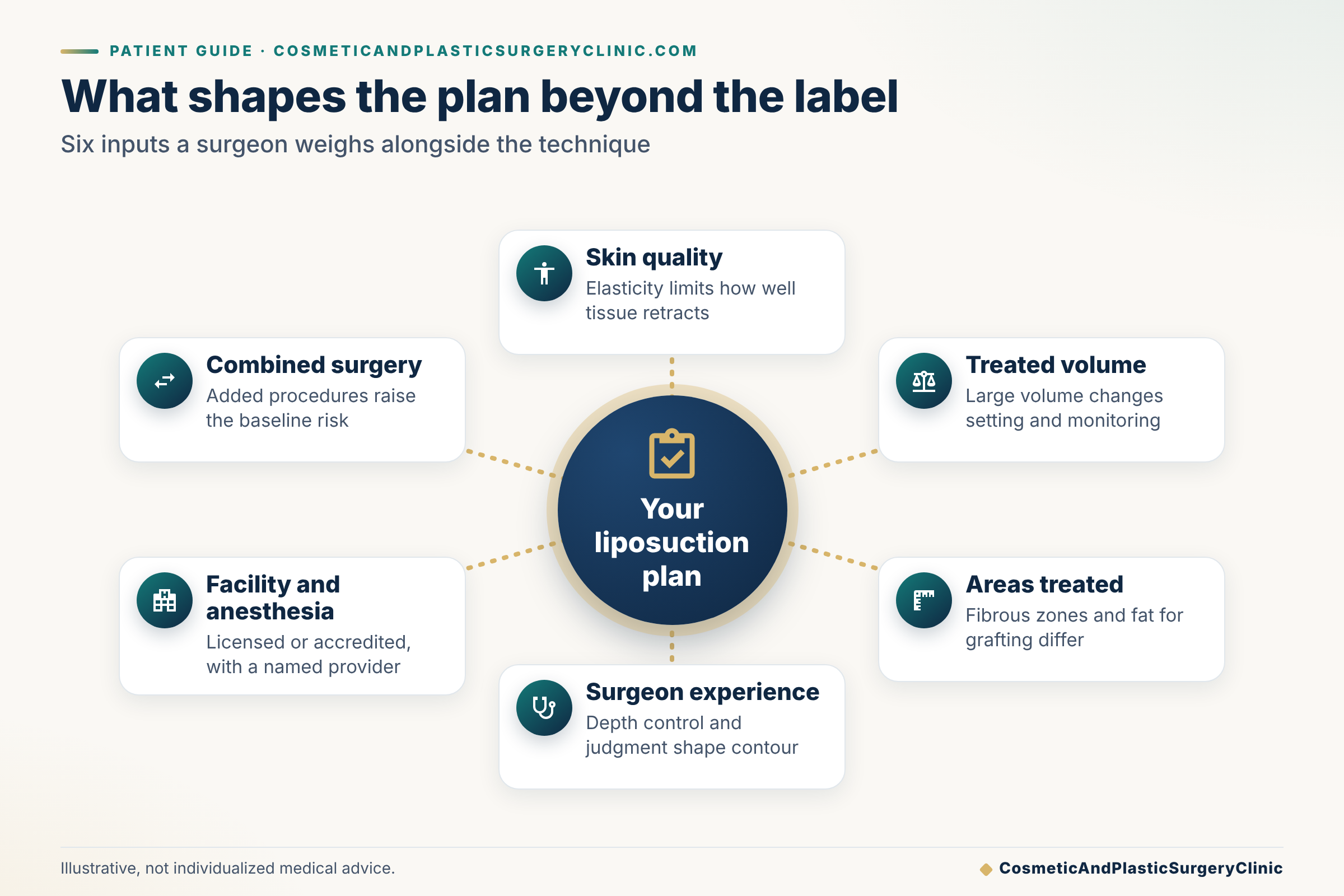
Once the labels are decoded, three practical variables decide most of the plan: the quality of the skin, which tissue is being treated and how much total volume is involved. The choice among liposuction techniques is made inside those limits.
Skin and tissue set the ceiling before any device does
Elastic skin is what retraction depends on
The ASPS patient page says liposuction gives better results in people with firm, elastic skin, and that soft, thin skin from stretch marks, weight loss or aging will not reshape as well, so extra skin may need removal. It also states that liposuction is not a treatment for cellulite or obesity. An Aesthetic Society (ASAPS) patient page says plainly that liposuction removes fat but does not tighten skin.
This is why skin-tightening claims for energy-assisted liposuction techniques deserve scrutiny: the evidence summarized above mostly concerns small to moderate areas and, in the strongest review, the area under the chin. When skin is the main problem, the liposuction versus tummy tuck comparison explains how surgeons separate excess fat from excess skin and abdominal wall laxity.
Fibrous zones and male chest tissue are where methods genuinely diverge
The comparative review found its clearest advantage for ultrasound in gynecomastia, and the Cleveland Clinic review names the back, upper flank and chest as fibrous areas where ultrasound or power assistance is used. These tissues resist plain suction, which is a physical reason to consider a different tool, not a marketing one.
Even here, the choice follows the tissue. Chest enlargement in men may involve gland as well as fat, and gland is not removed by suction alone, so the technique question becomes part of a larger operative plan.
Volume, areas and combined procedures change risk more than the device
Large-volume work moves the setting, not just the method
The ASPS advisory defines large volume as removal of 5,000 cc or more of total aspirate (fat plus fluid) in one session, although its own recommendations section says “greater than 5000 cc.” It recommends that such cases be done in an acute-care hospital or an accredited or licensed facility with overnight monitoring of vital signs and urine output.
The Cleveland Clinic authors note that no maximum volume is defined and that seroma and fluid-balance risks rise with volume. Whichever of the liposuction techniques is used, a plan to treat many areas or remove a large volume should come with a named facility, a named anesthesia provider and an overnight plan. The liposuction recovery page describes how treated volume shapes the recovery timeline.
Combining liposuction with other surgery raises the baseline
The same Cleveland Clinic review cites a complication rate of 0.7% for liposuction alone and 3.5% when combined with other procedures, from a single cited report that this page could not review in full. Treat the direction as the useful signal rather than the exact figures.
No label among the liposuction techniques removes that difference. When a quote bundles liposuction with another operation, ask for the plan for each part, the total anesthesia time and what would lead the team to stage the surgery instead.
Fat harvested for grafting adds a second goal
Technique and graft survival: no settled answer
When fat is removed to be injected elsewhere, the choice among liposuction techniques becomes a graft question too. A 2018 review of harvesting techniques found evidence that was mixed and depended on the outcome measured. High vacuum pressure was often considered more traumatic to fat cells, but some studies found no meaningful difference, and the authors state that the optimal cannula size lacks consensus.
The review also notes that no standard viability assay exists and that laboratory cell-count endpoints have not been shown to predict graft survival in humans. A surgeon who claims one harvest method yields more durable grafts is claiming more than this literature supports.
Where firm safety rules exist: gluteal fat placement
A June 2019 advisory from ASPS, ASAPS, ISAPS, ISPRES and IFATS said their research suggests risk is lowest when gluteal fat stays in the subcutaneous space and does not cross the gluteus maximus fascia. The societies said they estimated the mortality rate to be the highest known for any cosmetic procedure and urged extreme caution. Florida’s emergency rule of June 17, 2019 required subcutaneous-only placement.
For that operation, where the injection location matters more than the harvesting device, see the Brazilian butt lift guide.
| Situation | Techniques often discussed | Trade-off to ask about |
|---|---|---|
| Moderate, localized fat with firm skin | Suction-assisted with tumescent fluid | Little added by devices in reviews; depth control and surgeon judgment matter most |
| Dense, fibrous tissue in the back or flank | Power-assisted or ultrasound-assisted | Less effort for the surgeon; thermal protection and longer set-up with ultrasound |
| Male chest enlargement | Ultrasound-assisted, sometimes alongside gland excision | Best-supported ultrasound advantage; larger incisions possible |
| Small area under the chin | Laser-assisted or suction-assisted | Possible skin retraction; heat injury risk; neck anatomy may point elsewhere |
| Loose skin after weight change | Liposuction alone may not address it | Surgeon may discuss skin removal; heat-based tightening claims need evidence |
| Large volume or several zones | Suction or power-assisted, in a monitored setting | Facility level, anesthesia and overnight plan matter more than the device |
| Fat needed for grafting | Surgeon’s preferred harvest method | No proven best method; placement technique drives the safety questions |
Choosing Between Liposuction Techniques: Questions, Scenarios and Credentials
A good consultation turns the name of one of the liposuction techniques into a reason. The aim is not to out-argue the surgeon; it is to hear a rationale specific enough that you could repeat it to a second surgeon and get a sensible reply. The consultation questions guide covers the visit as a whole.
Questions that separate a rationale from a brand name
Six questions about the technique itself
The table lists six questions that apply to any of the liposuction techniques above, with what a clear answer contains and what should make you slow down. Write the answers down; vague answers are easier to spot on paper a day later.
| Question | A clear answer includes | Reason to pause or get a second opinion |
|---|---|---|
| Which technique do you plan for my areas, and why? | The category, the device name and the tissue or goal it serves | A brand name only, or “this is what we do for everyone” |
| What does it add compared with suction alone? | A named advantage, the evidence behind it and its limits | Claims of tightening or less downtime with no source |
| What device-related risks apply, and how is skin protected? | Specific risks such as burns or fluid collections and how they are managed | Risks dismissed, or the question deflected |
| How much volume, how many areas, and will it be staged? | A planned total, the setting and an overnight plan if the volume is large | No volume estimate, or large volume planned in an unaccredited setting |
| Who gives anesthesia, where is it done and who covers complications? | A named provider, a licensed or accredited facility and follow-up terms | Vague answers about the provider, facility or after-hours care |
| What happens if the result needs a touch-up? | A written policy on timing, fees and who pays for the facility | “We’ll see” with no terms in writing |
Two hypothetical scenarios
Consider a hypothetical adult with moderate fat over the flanks, firm skin and no other planned surgery. One office quotes suction-assisted liposuction. Another quotes laser-assisted liposuction at a higher price, citing skin tightening. This is an illustration, not an assessment of anyone. Useful questions for the second office: what does laser add for this area and this skin, which studies support it, how is the skin protected, and which line of the quote pays for the device?
Now consider a hypothetical man with firm, dense chest enlargement whose surgeon plans ultrasound-assisted liposuction. Here the technique choice has some comparative support, so the questions shift: how are the entry points protected from heat, does the plan include removing gland, and how many similar operations does the surgeon perform? In both cases a clear, specific answer is a reason to continue. A vague one is a reason to ask someone else.
Who operates, where, and what it costs
Credentials and setting often matter more than the device list
An FDA consumer update from August 2007 noted that any licensed physician may perform liposuction and that no standardized training is required, though some societies recommend it. Rules and practices change, so check your state’s current requirements. Board certification in plastic surgery is voluntary and can be verified on the American Board of Plastic Surgery site; the board says it is separate from state licensure, which has its own lookup.
For the setting, the ASPS advisory says procedures under anesthesia beyond minor local or minimal oral sedation should take place in an accredited, Medicare-certified or state-licensed facility, and that a physician should be primarily responsible for anesthesia and present in the operating room. The step-by-step lookup is in how to choose a plastic surgeon.
Why a technique name is not a price
I found no reliable, sourced price comparison by technique, so none appears here. Quotes for liposuction vary with the number of areas, operating time, facility, anesthesia and follow-up, and an energy device may or may not add a line item. Ask for a quote that separates surgeon, facility, anesthesia, device and garment fees so that two offers can be compared like for like.
The liposuction cost page breaks down those components and the traps in per-area pricing.
Frequently asked questions
Can more than one of the liposuction techniques be used in the same operation?
Yes, and an energy step followed by suction is common. The ASPS advisory describes ultrasound as fragmenting fat that is then aspirated, and the 2025 arm meta-analysis included laser protocols both with and without suction. The practical issue is accounting: ask which instrument is used on which area, for how long, and whether each device carries its own fee. Every added device adds exposure to heat or a different set of risks, so a combination should come with a reason you can repeat back.
Do liposuction techniques change the size of scars?
Scars follow the incisions, their size, number and location, and how your skin heals. The 2002 VASER pilot reported access incisions of 3 to 4 mm with skin ports, while the Cleveland Clinic authors say ultrasound often needs larger incisions. Those are averages from different sources, not a promise for your skin. Ask where each incision will go, whether protectors are used with heat devices, and how irritation or pigment change at entry sites is handled. A small incision is not a reason to skip questions about the plan.
Is laser liposuction safer than traditional liposuction?
No source reviewed shows that. Pooled rates look low for every one of the liposuction techniques, but the 2025 meta-analysis warns of publication bias, and the two 2018 reviews found either high bias or an advantage limited to skin tightening under the chin and a smaller blood-count drop. Heat adds its own risks, such as burns. For the same area and the same patient, the honest answer is that the data cannot rank laser against suction on safety. Ask what protects your skin and what the surgeon’s own experience with laser has been.
Why would two surgeons recommend different liposuction techniques for the same area?
Because the comparative evidence leaves room for judgment. When 25 qualifying head-to-head studies find mostly no added benefit, training, equipment and habit legitimately drive the choice, and anatomy or a fat-grafting goal can tilt it. A different recommendation is not a red flag by itself; an unexplained one is. Ask each surgeon to state, in plain terms, what their method offers over the other’s. A second opinion is routine, and a surgeon who resists one is giving you information.
How can I check whether a liposuction device is FDA cleared?
Ask the clinic for the device name, manufacturer and 510(k) number, then look it up in the FDA’s premarket notification database, which lists the decision date, the regulation and usually a summary with the indications for use. The records for the 2006 SmartLipo laser and the 2019 VASERlipo system, for example, sit under different regulations and use different wording. Compare the cleared indication with what you are being told. Product codes can be updated after clearance, so a code that differs from an older listing is not necessarily a problem.
Do liposuction techniques change how long swelling and bruising last?
None of the sources reviewed shows a method that removes the recovery period. The ASPS advisory says bruising and swelling are expected for at least 48 to 72 hours and describes compression garments worn for several weeks; those are general ranges, and your surgeon’s instructions govern. Individual trials, such as the 2007 water-assisted study, report less early pain or bruising for one method, but they measured days, not final contour. Treated volume and number of areas are likely to matter more than the label.
Is VASER the same as ultrasound-assisted liposuction?
VASER is a brand of ultrasound-assisted equipment, not a separate category. The FDA cleared the VASERlipo System on May 1, 2019 under the suction lipoplasty regulation, 21 CFR 878.5040, citing an earlier VASERlipo as its predicate. Earlier generations of ultrasound devices had higher reported complication rates, which the 2002 pilot used as its comparison, so generation matters. Ask which settings and skin protection your surgeon uses; the brand alone answers neither.
Sources and further reading
- American Society of Plastic Surgeons — Practice Advisory on Liposuction, Plast Reconstr Surg 2004 (accessed 2026-11-12) — infiltration definitions, large-volume threshold, facility and anesthesia recommendations, device notes
- American Society of Plastic Surgeons — Liposuction procedure page (accessed 2026-11-12) — skin elasticity, cellulite and obesity statements
- American Society of Plastic Surgeons — Plastic Surgery Statistics Report 2024 (accessed 2026-11-12) — 349,728 liposuction procedures in 2024 and survey method
- U.S. Food and Drug Administration — Premarket Notification 510(k) (accessed 2026-11-12) — substantial equivalence and what clearance means
- U.S. Food and Drug Administration — 510(k) K190551, VASERlipo System, 2019 (accessed 2026-11-12) — cleared indications, regulation and predicate
- U.S. Food and Drug Administration — 510(k) K062321, SmartLipo laser, 2006 (accessed 2026-11-12) — cleared indications including laser-assisted lipolysis
- U.S. Food and Drug Administration — 510(k) K082025, body-jet, 2008 (accessed 2026-11-12) — water-assisted device clearance, regulation and predicates
- U.S. Food and Drug Administration — Update: Use of Renuvion/J-Plasma devices in certain aesthetic procedures, safety communication (accessed 2026-11-12) — 2022 warning and later cleared handpieces
- U.S. Food and Drug Administration — Consumer Update on liposuction, August 2007, archived copy (accessed 2026-11-12) — who may perform liposuction and questions to ask
- American Board of Plastic Surgery — Verify certification (accessed 2026-11-12) — voluntary certification and its separation from licensure
- Annals of Plastic Surgery — Evidence-Based Practice in Liposuction, 2018 (accessed 2026-11-12) — 25 direct comparisons of ultrasound and laser versus suction
- European Journal of Plastic Surgery — Comparison of complications in isolated aesthetic liposuction across techniques, 2025 (accessed 2026-11-12) — pooled complication rates and limitations
- Aesthetic Plastic Surgery — Laser-assisted liposuction versus traditional liposuction: systematic review, 2018 (accessed 2026-11-12) — seven included studies and risk of bias
- Aesthetic Plastic Surgery — Laser-Assisted Lipolysis: A Promising Alternative to Traditional Liposuction, 2025 (accessed 2026-11-12) — level V narrative review and stated limits
- Aesthetic Surgery Journal Open Forum — Laser lipolysis and arm circumference: systematic review and meta-analysis, 2025 (accessed 2026-11-12) — 7 studies, 199 patients, short follow-up
- Aesthetic Plastic Surgery — Power-assisted versus suction-assisted lipoplasty, 2005 (accessed 2026-11-12) — 15-woman output pilot
- Aesthetic Plastic Surgery — Power water-assisted versus traditional liposuction: randomized trial of postoperative pain, 2007 (accessed 2026-11-12) — 60-patient trial
- Aesthetic Plastic Surgery — Radiofrequency-assisted liposuction, 2009 (accessed 2026-11-12) — 20-patient uncontrolled series and disclosure
- Aesthetic Surgery Journal — Clinical application of VASER-assisted lipoplasty: a pilot clinical study, 2002 (accessed 2026-11-12) — 77 patients and comparison with earlier ultrasound devices
- Plastic and Reconstructive Surgery Global Open — Consensus-based recommendations for VASER ultrasound-assisted liposuction, 2023 (accessed 2026-11-12) — five-surgeon panel and sponsor disclosure
- Annals of Medicine and Surgery — A journey through liposuction and liposculpture: review, 2017 (accessed 2026-11-12) — Klein’s 1987 tumescent report
- Cleveland Clinic Journal of Medicine — Liposuction: concepts, safety, and techniques in body-contouring surgery, 2020 (accessed 2026-11-12) — technique descriptions, volume and combined-procedure figures
- Cleveland Clinic Consult QD — Liposuction: common techniques and complications, 2020 (accessed 2026-11-12) — abridged version of the review above
- Fontes et al. — Autologous fat grafting: harvesting techniques, 2018 (accessed 2026-11-12) — mixed evidence on harvest variables
- ASPS and partner societies — Gluteal Fat Grafting Safety Advisory, June 2019 (accessed 2026-11-12) — subcutaneous-only placement guidance
- The Aesthetic Society — Liposuction patient page (accessed 2026-11-12) — liposuction removes fat but does not tighten skin