A soft, protruding lower abdomen can come from three different tissues, and the liposuction vs tummy tuck question is really a question about which of them is doing the work. Fat sits between the skin and the muscle wall. Skin can stretch past the point where it recoils. The muscle wall itself can separate or loosen, pushing the belly forward even when there is little fat to pinch. Liposuction addresses the first of these; a tummy tuck is built mainly for the second and third.
This page sorts out how surgeons tell those problems apart, where each operation stops being useful, and what changes when both are done together. This liposuction vs tummy tuck comparison cannot say which operation fits your body, because that takes an in-person exam by a qualified plastic surgeon. For the full procedure pages, see the liposuction overview and the tummy tuck guide; the focus here is the decision between them.
Liposuction vs tummy tuck starts with three tissues, not two procedures
Before comparing operations, it helps to name what each one is aimed at. Most disagreement between a patient’s expectation and a surgeon’s recommendation comes from a mismatch at this stage.
What sits between your skin and your organs
Subcutaneous fat is the only fat liposuction can reach
Anatomy references describe the front abdominal wall as skin, then superficial fascia, then the rectus abdominis muscles inside their sheath, with a fibrous midline called the linea alba. Below the navel the superficial fascia has two layers: a fatty one (Camper’s fascia) and a thin membranous one beneath it (Scarpa’s fascia). Harvard Health describes subcutaneous fat as the kind you can grasp with your hand, and visceral fat as lying out of reach, deep in the abdominal cavity where it pads the spaces between organs.
That distinction decides what suction can do. In a 2018 ASPS blog post, Wayne Carman, MD, writes that liposuction removes fat below the skin and above the muscle, that visceral fat “will not be improved with liposuction,” and that most patients lose only about two to five pounds in total. A belly that feels firm and round rather than pinchable may not be a liposuction problem at all, which is a good reason to ask a surgeon what they think the bulge is made of.
Skin and the muscle wall are separate problems with separate fixes
Skin either recoils or it doesn’t, and fat removal does not change that. The ASPS liposuction page says people with firm, elastic skin get better results, and that skin which is soft and thin from stretch marks, weight loss or aging “will not reshape as well.” Mayo Clinic makes the same point from the other direction: in thin, inelastic skin, the treated area may look loose. The operation built to remove that skin is the tummy tuck, which ASPS describes as removing excess fat and skin and, in most cases, restoring weakened or separated muscles.
The muscle wall is the third variable. MedlinePlus defines diastasis recti as a noticeable separation between the left and right rectus abdominis muscles, where the connective tissue of the linea alba thins and widens. In a prospective cohort of 300 first-time mothers in Norway (Sperstad and colleagues, British Journal of Sports Medicine, 2016), a palpable gap of at least two fingerbreadths was found in 60.0% at six weeks, 45.4% at six months and 32.6% at twelve months after birth. Separation is common and often narrows on its own, so it is not automatically a surgical problem.
A classification that turns anatomy into a starting plan
The four-type system surgeons still cite
In 1997, Alan and Sherry Matarasso reviewed more than 300 abdominal contouring patients in Dermatologic Surgery and described four types of abdominal deformity. Liposuction alone suited most of their patients; the rest needed an open abdominoplasty variant for muscle reinforcement or skin reduction. In a 2021 perspective, Matarasso, Suri and Stein present the same system as a table and call it the most commonly used for its practicality and simplicity.
| Type | Skin laxity | Muscle separation | Operation named for that type |
|---|---|---|---|
| I | Minimal | Minimal | Suction-assisted lipectomy (liposuction) |
| II | Mild | Lower abdomen | Mini abdominoplasty |
| III | Moderate | Lower and upper abdomen | Modified abdominoplasty |
| IV | Severe | Complete | Standard abdominoplasty, with or without liposuction |
What matters is not the labels. Skin laxity and muscle separation climb together down the table while fat stays variable, which is why the amount of fat alone says so little about which operation someone needs. The system comes from plastic surgeons describing their own approach, so treat it as a teaching framework rather than a rule proven in trials.
Why one abdomen can need parts of both
In a 2018 ASPS blog post, Laura Gowen, MD, names three things a surgeon assesses: skin quality, how tight or united the muscles are, and how much protruding fat is present. She notes that these vary with genetics, age, diet and exercise, and pregnancy history. A person can have thick fat over firm skin, thin tissue over a separated wall, or any mix in between. The mix is what pushes some people toward a combined plan, discussed further below.

The case for liposuction alone, and where it quietly stops working
When fat is the main problem, liposuction vs tummy tuck tilts toward suction
Localized fat over firm skin and a flat wall
ASPS describes liposuction as a way to contour localized fat that diet and exercise haven’t shifted, and says it works for people of normal weight who carry some extra fat. A 2018 ASPS blog post by Dr. Gowen adds that it suits abdominal fat when patients have appropriate muscle tone and skin elasticity. In liposuction vs tummy tuck terms, this is the situation where the smaller operation isn’t a compromise: nothing else needs removing or repairing.
It also helps to know what the operation is not. ASPS says it is not a treatment for obesity or cellulite, and Mayo Clinic adds that it does not treat stretch marks. Results generally last if weight stays stable. Removed fat cells don’t return, Dr. Carman writes, but the cells that remain can still enlarge, and Mayo notes that weight gain can add fat to the abdomen even where nothing was treated.
What the operation involves compared with a tummy tuck
A surgeon passes thin suction tubes through small incisions; one ASPS blog author describes four to six, “as small as a grain of rice.” Mayo Clinic says anesthesia ranges from local or regional numbing with sedation to general anesthesia, that small removals may be done in a clinic while larger ones may need a hospital, and that compression garments are typically worn for a few weeks. Return to work is often a few days, and usual activity and exercise a few weeks.
Contour irregularity is described as the most common complication of abdominal liposuction in the 2021 Matarasso perspective, and Mayo lists fluid pockets, numbness, infection and rare internal injuries among others. The liposuction risks page goes through them. Which suction method a surgeon prefers is a separate question from the one on this page.
Where liposuction alone stops being the right tool
Skin that cannot shrink onto the new shape
Liposuction removes volume; it does not remove skin. The ASPS tummy tuck page says in a video summary that skin “can only contract so much” and that extra skin “might require excision with an abdominoplasty.” Dr. Carman warns that liposuction alone may leave a deflated appearance when sagging is present. In liposuction vs tummy tuck terms, taking away the volume beneath a lax lower-abdominal fold can leave the same skin looking looser.
How much retraction to expect is hard to predict before surgery. Age, earlier stretching from pregnancy or weight loss, and genetics all play a part. Tarick Smaili, MD, writing on the ASPS blog in 2016, suggests that some patients try liposuction first and then wait at least three to four months before deciding about further surgery. The cost of that approach is plain: if the skin does not settle, a second operation and a second recovery follow. The liposuction candidacy page covers who is more likely to be advised to wait.
A bulge that comes from the muscle wall or from deep fat
Dr. Smaili notes that pregnancy and major weight loss can loosen the abdominal wall and cause a bulge, and that a physical exam is needed to tell whether loose muscle or fat is responsible. Suctioning fat from a belly whose projection comes from a separated wall thins the pinch but not the forward push. The same reasoning applies to deep fat: if the bulk is inside the abdominal cavity, a cannula working under the skin cannot reach it.
What a tummy tuck adds, and what it asks in return
Changes only a tummy tuck can make
Removing lower-abdominal skin and tightening the wall: the tummy tuck side of liposuction vs tummy tuck
A tummy tuck removes excess skin, usually below the navel, and in most cases tightens the fascia over separated muscles. A 2024 ASPS article by Daisy Brumby, quoting two surgeons, says a tummy tuck is the only way to get rid of excess skin, while exercise can reduce belly fat but not loose skin. Mayo Clinic describes the result as an abdomen that looks flatter and more toned, usually long lasting if weight stays stable.
Muscle repair is where claims tend to outrun evidence. The surgeons in that 2024 article say back pain and posture may improve, but their other examples are anecdotal, and most patients, the article says, have the surgery for the cosmetic result. MedlinePlus notes that exercise may help diastasis recti and that surgery is not usually performed for the condition itself. Mayo says tightening the core may ease low back pain.
A fair reading of the liposuction vs tummy tuck evidence is that the repair is a genuine part of the operation, and functional benefit is plausible but less firmly established. The tummy tuck techniques page explains how the repair is done.
Panniculectomy: the skin-only relative
An ASPS article from 2025, built around an interview with Orlando Llorente, MD, explains that a panniculectomy removes an apron of skin and tissue without touching the muscles and without shaping a new navel. It is described as reconstructive, with benefits that can include mobility and hygiene, and it is typically offered to people for whom a full abdominoplasty is not suitable, such as after massive weight loss. Both operations use a horizontal incision, usually waist to waist, and recovery is about two weeks with lifting limits for roughly six.
In liposuction vs tummy tuck conversations, it is easy to assume that any skin-removal operation is a tummy tuck by another name. It isn’t, and the difference affects scar, muscle repair, insurance rules and what the surgeon is aiming for. The tummy tuck candidacy page explains who surgeons tend to ask to wait or consider alternatives.
The price of the larger operation
Scar, drains and a longer recovery
Mayo Clinic says the operation often takes under four hours, usually in a hospital or surgical center under general anesthesia. Drains may stay for a few days, an abdominal binder may be worn for about six to eight weeks, and lifting, straining and sudden bending are limited for the first six weeks. Sports wait at least eight weeks. Many people return to work in about two to four weeks, depending on how physical the job is, and the scar along the swimsuit line can take up to a year to fade as far as it will.
Those are published ranges, not instructions; a surgical team’s written plan overrides them, and logistics such as a driver and help at home need planning well before the day.

Complication numbers from one insurance database
Two studies drew on the same source: CosmetAssure, an insurance program covering complications of cosmetic surgery, for 2008 to 2013. Kaoutzanis and colleagues (Aesthetic Surgery Journal, 2017) analyzed 31,010 liposuction procedures, 11,490 of them done alone, and found a major complication rate of 0.7% for solitary liposuction. The most frequent events were hematoma (0.15%), pulmonary complications and infection (0.1% each) and confirmed venous thromboembolism (0.06%).
Winocour and colleagues (Plastic and Reconstructive Surgery, 2015) studied nearly 25,000 abdominoplasties in the same program and reported 3.1% for abdominoplasty alone. For the liposuction vs tummy tuck choice, those numbers point in a direction: the larger operation carries a higher chance of a serious problem than suction alone. They cannot predict one person’s risk. The groups differed, “major complication” is the program’s own definition, and insured patients from 2008 to 2013 are not everyone. The plastic surgery risks page explains how to read such figures.
Doing both at once: lipoabdominoplasty and the staging question
Pairing suction with a tummy tuck is a modern habit. A 2016 historical chapter by Blugerman and colleagues dates the shift from belt lipectomy toward suction-assisted lipectomy to about 1980, and the lipoabdominoplasty concept of Avelar and Saldanha to the early 2000s.
Why surgeons add suction to a tummy tuck
Flanks, waist shape and the boxy look
In a 2023 ASPS article, two surgeons explain the appeal. One says that when excess skin and muscle separation are corrected but the flanks are left alone, the flanks look disproportionately larger. The other says liposuction helps avoid a “boxy,” rectangular shape. In a 2018 ASPS blog post, Frank Campanile, MD, adds that a combined operation means one surgery and one recovery for people who have extra fat, loose skin and a stretched wall together. These are clinical opinions, not trial results.
What the evidence says about added risk
The evidence points in two directions. A 2019 meta-analysis in Aesthetic Plastic Surgery (Xia, Zhao and Cao) pooled 17 studies with 14,061 adults and found lower seroma (relative risk 0.69) and fewer overall complications (0.85) with lipoabdominoplasty than with abdominoplasty, concluding there was no evidence of higher complication rates. In the CosmetAssure data, by contrast, abdominoplasty combined with other body contouring plus liposuction reached up to 10.4% major complications, and the adjusted risk was about 50% higher for combined procedures.
The two findings can both be true. Published surgical series may reflect selected patients and refined techniques, while an insurance database captures many surgeons and many combinations, including large ones. Neither tells you what one surgeon’s combined operation carries. Reasonable consultation questions are how many combined operations the surgeon performs, how they decide how much to suction when skin is also being removed, and how they track their own complications.
One operation or two
Staging when large volumes are involved
Dr. Gowen writes that in younger, healthy patients a simultaneous operation may be possible, while for many others a staged approach may be more prudent to reduce surgical trauma and bleeding. Dr. Smaili says the consensus, when large fat volumes need removal, is to stage the operations. Dr. Smaili adds that the ideal sequence depends on anatomy, goals and the surgeon’s experience, which is why no article can set it for you. Once both are on the table, liposuction vs tummy tuck becomes a sequencing question as much as a choice.
Liposuction first, then reassess: the trade-off
Dr. Smaili describes a split among surgeons. Some do liposuction first and some the tummy tuck first; one caveat is that suction can create scar tissue in the fat layer that may complicate a later tuck, while others find that removing fat first makes skin excision and muscle repair quicker. Staging also means two anesthetics, two recoveries and two sets of facility charges, so the money-and-time argument for combining runs against the caution argument for splitting.
Liposuction vs tummy tuck side by side: the matrix, the calendar and the money
Reading the comparison without over-reading it
The liposuction vs tummy tuck decision matrix
The table below lines up the two operations on the factors patients ask about most. Where a time range appears, it comes from Mayo Clinic’s patient pages and describes what is typical, not what your surgeon will set.
| Factor | Liposuction | Tummy tuck (abdominoplasty) |
|---|---|---|
| Main target | Fat between the skin and the muscle wall | Excess skin and the fascia over separated muscles; some fat comes out with the skin |
| Skin removed | None | Lower-abdominal skin, usually below the navel |
| Muscle-wall repair | Not part of the operation | Often, when a separation is present |
| Incisions and scars | Several small incisions (four to six in one surgeon’s description) | One long low scar along the swimsuit line; the navel is reshaped |
| Typical downtime | Work often within a few days; usual activity within a few weeks | Work often in about 2 to 4 weeks; sports after at least 8 weeks |
| Reversibility and upkeep | Cannot be undone; removed fat cells don’t return, but remaining cells can enlarge with weight gain | Cannot be undone; usually long lasting at a stable weight, though pregnancy or large weight change can undo the repair |
| Risks Mayo names | Uneven contours, fluid pockets, numbness, infection, rare internal injury | Fluid pockets, poor wound healing, fat tissue damage, scarring, bleeding, infection |
| Cost logic | Fee tied to areas and volume treated; shorter operating time | One larger operation: longer operating time, usually a hospital or surgical center |
One row deserves a second look. In liposuction vs tummy tuck terms, “cannot be undone” applies to both, which is the quiet argument for taking the smaller step first when the tissue problem is truly fat, and the quiet argument for not repeating a smaller step when the real problem is skin.
When the shape can be judged, and why that takes months
Mayo Clinic says liposuction swelling usually resolves within a few weeks and the area typically looks slimmer within several months, while final shape can take weeks to months to settle. A tummy tuck scar may keep fading for up to a year. That calendar matters for the liposuction vs tummy tuck decision because skin retraction, the very thing that separates the two, can’t be judged on day ten. It is also why Dr. Smaili’s three-to-four-month pause is a minimum rather than a deadline.
Judging too early cuts both ways. A swollen abdomen can look worse than the eventual result, and a surgeon’s photos taken at three months may not match a patient’s at twelve. How to read those albums is covered on the liposuction before-and-after page. If a contour still looks uneven once swelling has settled, the liposuction revision page explains what surgeons consider next.
The money side of liposuction vs tummy tuck
What the ASPS average fees leave out
The ASPS procedure pages give an average of $4,711 for liposuction and $8,174 for a tummy tuck. Neither page states the year of its data (both were read on 2026-11-12), and each says the figure excludes anesthesia, operating room facility and other related expenses. For a tummy tuck, ASPS names medical tests, post-surgery garments and prescriptions as possible extras.
So, for a liposuction vs tummy tuck budget, these are national averages of a surgeon’s fee, not local quotes and not totals. A practice in a high-cost city, a larger treated volume or a longer operating time can move a quote well away from the average in either direction.
Comparing quotes for two different operations
In a liposuction vs tummy tuck price comparison, liposuction quotes are often built around the number of areas or the volume treated, while a tummy tuck quote covers one larger operation, so the two can’t be compared line by line. Ask each office for the same itemized list: surgeon’s fee, facility, anesthesia, garments, medications, follow-up visits, and what happens if a revision is needed. A combined operation can look cheaper than two separate ones because facility and anesthesia charges are shared, and that saving has to be weighed against the added risk described above.
ASPS says most health insurance plans do not cover a tummy tuck or its complications, which means a complication can arrive as a bill you own. Ask any plan in writing what it covers before relying on it. The liposuction cost page and the tummy tuck cost page itemize each side.
Liposuction vs tummy tuck in practice: scenarios, mismatches and the option to wait
Five hypothetical liposuction vs tummy tuck scenarios and what could overturn each
Using scenarios as a thinking tool
The table below invents five abdomens to show how the reasoning runs. They are not patients, not a screening tool and not a prediction; the last column matters most, because every preference has a finding that can reverse it.
| Hypothetical anatomy and goal | Option often discussed | Why | Finding that could reverse it |
|---|---|---|---|
| Pinchable fat above the waistband, firm skin, no bulge when sitting up | Liposuction alone | Fat is the main tissue; nothing needs removing or repairing | An exam showing muscle separation, or skin unlikely to retract |
| Hanging lower skin after large weight loss, weight now stable | Skin excision: tummy tuck or panniculectomy | Suction cannot remove skin and may leave it looking looser | Health conditions or wound-healing risks that lead a surgeon to advise waiting |
| Midline bulge that rises when sitting up, little fat, after pregnancies | Tummy tuck with muscle repair, or exercise first | The wall, not fat, is pushing outward | Plans for another pregnancy, which can undo the repair |
| Flank fat plus loose lower skin and a separated wall | Combined or staged operations | All three tissues are involved | Large fat volume or health factors that favor staging |
| Firm, rounded belly with little pinchable fat | Neither may fit | Fat inside the abdomen is out of reach of both | A medical assessment finding another cause, or a separate skin issue |
Three mismatches to avoid
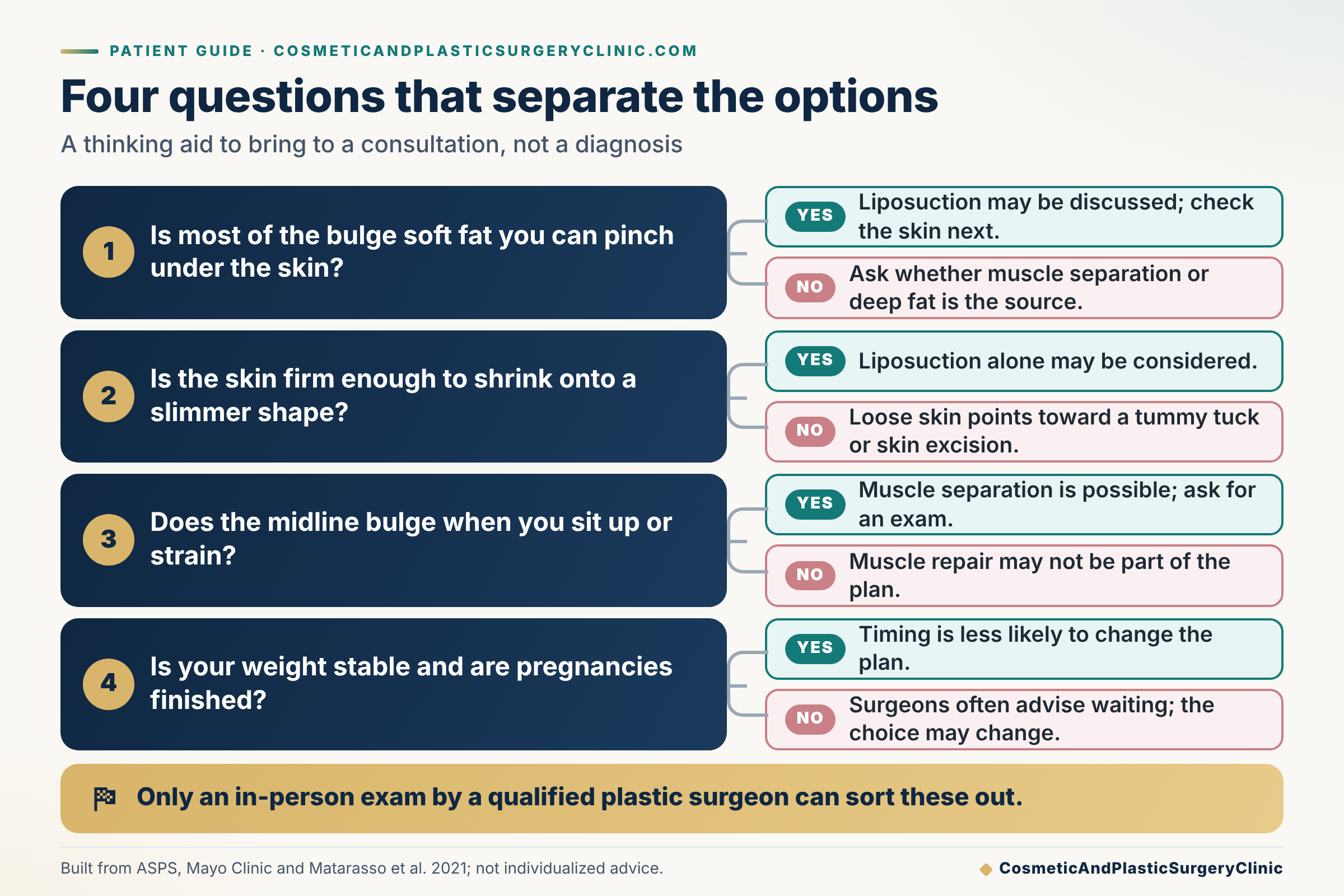
One way the liposuction vs tummy tuck decision goes wrong is aiming a well-chosen operation at the wrong tissue. Three mismatches follow from the sources above.
- Choosing liposuction to fix loose skin. Suction removes volume, and ASPS says extra skin may need excision with an abdominoplasty. If skin is the main complaint, ask what the surgeon expects the skin to do and what the plan is if it doesn’t retract.
- Choosing a tummy tuck for a belly that is mostly deep fat. The operation works on skin, subcutaneous fat and fascia; fat around the organs stays. Mayo Clinic lists a BMI of 30 or higher among the reasons a surgeon may advise against it.
- Treating a combined operation as two small ones added together. In the CosmetAssure data, abdominoplasty combined with other body contouring plus liposuction had the highest major complication rate. Ask for the reasoning behind combining or staging.
Alternatives, timing and the consultation
What nonsurgical contouring can and cannot do
The FDA’s page on non-invasive body contouring (current as of October 2025) says these methods do not remove any tissue, fat or skin, and do not treat obesity or improve health. It names paradoxical adipose hyperplasia after fat freezing: fatty tissue grows instead of shrinking, producing a firm, raised bulge two to five months later that does not resolve on its own and may need surgery. It also advises against home fat-freezing devices.
So devices sit outside the liposuction vs tummy tuck choice, in a different lane. They are a conversation to have with a qualified clinician about small areas, not a substitute for removing skin or repairing the wall. A person with loose skin has few effective options besides surgery, which is the uncomfortable center of the ASPS statement that a tummy tuck is the only way to remove excess skin.
Weight, pregnancy plans and the popularity trap
Mayo Clinic says surgeons may advise against a tummy tuck for people planning major weight loss or a future pregnancy, and suggests holding a stable weight for 6 to 12 months beforehand. The 2025 ASPS article on panniculectomy likewise advises postpartum patients to finish future pregnancies first, since another pregnancy could undo the muscle repair. Weight changes matter to liposuction vs tummy tuck planning on both sides, because fat can return to untreated areas.
ASPS’s 2025 statistics report counts 317,196 liposuction procedures (down 1% from 2024) and 173,251 tummy tucks (up 2%). It adds that surgeons most often reported GLP-1-related consultations for tummy tucks, at 88 percent, while volume held steady, which the report suggests may reflect patients weighing timing, recovery or cost. In liposuction vs tummy tuck data, volume shows demand, not suitability: neither number tells you which operation matches your tissue.
Questions to ask about liposuction vs tummy tuck that make the surgeon show their reasoning
A consultation is most useful when the surgeon has to explain a conclusion rather than recite a menu. These questions work for either operation and are worth writing down beforehand:
- Which of the three tissues, fat, skin or muscle wall, is responsible for my main concern, and how did you decide?
- How do you expect my skin to respond after fat removal, and what is the plan if it doesn’t retract?
- Is there a muscle separation or a hernia, and does it change the operation?
- If you suggest combining, why, how often do you do that combination, and what would staging look like?
- What does each line of the quote cover, including facility, anesthesia, garments and revisions?
Checking who operates, and where
Both operations involve anesthesia and a surgical facility, so verification belongs before price comparisons. The page on choosing a plastic surgeon walks through board certification, state license lookups, facility accreditation and the anesthesia provider. The consultation questions page covers what to bring and how to judge answers, and it is fine to book a second opinion on a decision this large.
Frequently asked questions
Can liposuction tighten loose stomach skin, or does that settle liposuction vs tummy tuck?
Liposuction is not designed to tighten skin. Some skin shrinks on its own after fat is removed, and how much depends on age, prior stretching and genetics. Energy-based devices are marketed for tightening, but the FDA’s body contouring page says non-invasive methods do not remove skin, and claims vary by device. Ask any surgeon who mentions skin tightening which device or technique is meant, what it is cleared for, and what the plan is if the skin stays loose.
If I choose liposuction first, will I need a tummy tuck later?
Not necessarily, and not predictably. Some people are happy with the result of suction alone; others find that the skin has not retracted enough and ask about excision. One ASPS blog author suggests waiting at least three to four months before deciding, partly to let the skin contract as far as it will. A later tummy tuck is a separate operation with its own anesthesia, recovery and cost, so ask the surgeon beforehand how they would judge whether suction alone is likely to be enough.
Does a tummy tuck remove the fat deep inside my belly?
No. A tummy tuck works on skin, fat under the skin and the fascia over the muscles. Visceral fat lies inside the abdominal cavity, around the organs, and Harvard Health describes it as out of reach. ASPS blog author Wayne Carman writes that only exercise and diet are effective against it. A belly that is firm and rounded from the inside is a reason for a medical conversation about health and weight before any liposuction vs tummy tuck discussion.
Does insurance treat liposuction vs tummy tuck differently?
Both operations are generally elective when done for appearance. ASPS says most health plans do not cover a tummy tuck or its complications. A panniculectomy is described by ASPS as reconstructive, and coverage criteria for reconstructive skin removal can differ by plan and usually need documentation. Ask the insurer, in writing, which procedure codes and conditions it covers before scheduling anything, and keep the reply with your quote.
Does the liposuction vs tummy tuck choice change if I want another pregnancy?
It can. Mayo Clinic lists a planned pregnancy among the reasons a surgeon may advise against a tummy tuck, and ASPS notes that another pregnancy could undo the muscle repair. Liposuction involves no muscle repair, but weight changes in pregnancy can still alter the contour. Many surgeons prefer to wait until childbearing is finished. Tell any surgeon about future plans up front, since that single fact can change which operation is discussed.
How does weight change after liposuction vs tummy tuck affect the result?
Results hold best at a stable weight. Mayo Clinic says tummy tuck results are usually long lasting if weight stays stable, and that weight gain can add fat to the abdomen even where liposuction wasn’t done. ASPS says significant weight changes can greatly reduce a tummy tuck’s benefit. Removed fat cells do not return, but remaining cells can enlarge. Surgeons often prefer a settled weight beforehand for exactly this reason, so discuss your recent history candidly.
Where does a mini tummy tuck sit between the two?
Where a mini tummy tuck sits in the liposuction vs tummy tuck choice depends on definitions. In the Matarasso system, a mini abdominoplasty is the operation named for type II: mild skin laxity and separation limited to the lower abdomen, with fat that varies. It uses a shorter incision than a full tummy tuck and addresses mainly the area below the navel. Surgeons define the term differently, so ask exactly what will be removed, whether the muscles will be tightened, and where the scar will sit before comparing quotes.
How long should I wait before judging liposuction results?
Longer than most people expect after liposuction. Mayo Clinic says swelling usually resolves within a few weeks, the area typically looks slimmer within several months, and final shape can take weeks to months to settle. If a contour looks uneven or skin looks lax once swelling has passed, the revision page for this cluster explains what surgeons weigh next. Photographs taken at the same angle and lighting every few weeks help you and your surgeon see real change.
Sources and further reading
- American Society of Plastic Surgeons — Tummy tuck (abdominoplasty) (accessed 2026-11-12) — what the operation changes; liposuction comparison
- American Society of Plastic Surgeons — Liposuction (accessed 2026-11-12) — what suction does and does not do; skin elasticity
- American Society of Plastic Surgeons — Liposuction cost (accessed 2026-11-12) — $4,711 average, exclusions
- American Society of Plastic Surgeons — Tummy tuck cost (accessed 2026-11-12) — $8,174 average, exclusions, insurance note
- American Society of Plastic Surgeons — Plastic surgery statistics report 2025 (accessed 2026-11-12) — procedure counts; GLP-1 consultation note
- American Society of Plastic Surgeons — 2025 plastic surgery by the numbers (accessed 2026-11-12) — 2025 volumes for both procedures
- American Society of Plastic Surgeons — Tummy tuck or liposuction? (Smaili, 2016) (accessed 2026-11-12) — skin retraction, muscle laxity, staging, wait period
- American Society of Plastic Surgeons — What is the best abdominal procedure for your goals? (Gowen, 2018) (accessed 2026-11-12) — three tissue factors; simultaneous vs staged
- American Society of Plastic Surgeons — Should you add liposuction to your tummy tuck? (Campanile, 2018) (accessed 2026-11-12) — rationale for combining
- American Society of Plastic Surgeons — Ten common misconceptions about liposuction (Carman, 2018) (accessed 2026-11-12) — visceral fat, weight loss, skin, fat cells
- American Society of Plastic Surgeons — Sculpt and tuck: the all-in-one approach to body contouring (2023) (accessed 2026-11-12) — flanks, waist shape
- American Society of Plastic Surgeons — Abdominoplasty or panniculectomy (2025) (accessed 2026-11-12) — panniculectomy definition; pregnancy timing
- American Society of Plastic Surgeons — How can a tummy tuck help with separated abdominal muscles? (2024) (accessed 2026-11-12) — muscle repair, excess skin, cosmetic vs functional
- American Society of Plastic Surgeons — Tummy tuck complications: study looks at rates and risk factors (2015 press release on Winocour et al.) (accessed 2026-11-12) — 3.1% alone; up to 10.4% combined
- Kaoutzanis et al. — Cosmetic liposuction: preoperative risk factors, major complication rates, and safety of combined procedures, Aesthetic Surgery Journal 2017 (abstract, accessed 2026-11-12) — 0.7% for solitary liposuction
- Xia, Zhao and Cao — Safety of lipoabdominoplasty versus abdominoplasty: a systematic review and meta-analysis, Aesthetic Plastic Surgery 2019 (abstract, accessed 2026-11-12) — pooled complication comparison
- Matarasso, Suri and Stein — Lipoabdominoplasty technique, Plastic and Aesthetic Research 2021 (accessed 2026-11-12) — four-type classification; contour irregularity
- Matarasso and Matarasso — When does your liposuction patient require an abdominoplasty? Dermatologic Surgery 1997 (Europe PMC record, accessed 2026-11-12) — review of more than 300 patients
- Sperstad et al. — Diastasis recti abdominis during pregnancy and 12 months after childbirth, British Journal of Sports Medicine 2016 (accessed 2026-11-12) — prevalence at 6 weeks, 6 and 12 months
- MedlinePlus — Diastasis recti (accessed 2026-11-12) — definition, exercise, surgery not usually performed
- Mayo Clinic — Tummy tuck (accessed 2026-11-12) — recovery ranges, risks, reasons to advise against
- Mayo Clinic — Liposuction (accessed 2026-11-12) — recovery ranges, risks, skin elasticity
- U.S. Food and Drug Administration — Non-invasive body contouring technologies (current as of 2025-10-15, accessed 2026-11-12) — no tissue removed; paradoxical adipose hyperplasia
- Harvard Health Publishing — Abdominal fat and what to do about it (accessed 2026-11-12) — subcutaneous vs visceral fat (summary text only)
- TeachMeAnatomy — The anterolateral abdominal wall (accessed 2026-11-12) — layers, Camper’s and Scarpa’s fascia, linea alba
- Balkovic and Jankovic — The history of body contouring surgery, in Body Contouring and Sculpting, IntechOpen 2016 (accessed 2026-11-12) — Kelly, Peters, Thorek
- Blugerman et al. — New concepts on safer abdominoplasty, in Body Contouring and Sculpting, IntechOpen 2016 (accessed 2026-11-12) — timeline of suction-assisted lipectomy and lipoabdominoplasty