

Gynecomastia surgery, also called male breast reduction, is an operation that removes excess fat, glandular breast tissue, or both from the chest and, in some cases, trims extra skin or adjusts the nipple and areola. People usually start researching it after months or years of living with chest fullness that doesn’t respond to exercise, that feels tender, or that affects how they dress, swim, or exercise around other people. If that describes you, or someone you’re helping, this guide is meant to give you the full picture before any consultation: what gynecomastia is, why it develops, how surgeons approach it, what recovery involves, what can go wrong, and what the numbers do and don’t tell you.
It also covers the step that often gets skipped. Enlarged male breast tissue is usually benign, but it should be looked at by a clinician before anyone plans an operation, because a small share of breast changes in men have other causes that matter. We’ll cover that calmly and in plain terms, along with cost, insurance, alternatives, and how to check a surgeon’s credentials.
A note on language. Clinicians say gynecomastia (pronounced roughly guy-neh-koh-MAS-tee-uh) for enlarged male breast tissue, and patients often say “man boobs,” “chest fat,” or simply “gyno.” This guide uses the medical term and “male breast reduction” for the operation, because those are the terms you’ll see on consent forms, in insurance paperwork, and in the surgical literature. Nothing here is meant to suggest that a man’s chest needs to change. Whether to pursue surgery is a personal decision, and many men with gynecomastia choose not to.
The sections below follow the order most people make decisions in: understanding the condition, getting evaluated, working out whether surgery fits, learning how it’s done, planning for recovery, weighing risks, pricing it, comparing alternatives, and choosing a surgeon. Where a statistic appears, the source and year are stated in the sentence, and where the evidence is thin or mixed, we say so.
What Gynecomastia Is and Why It Happens
Before comparing techniques or prices, it helps to be precise about what is being treated. “Gynecomastia” covers more than one kind of chest change, and the kind you have shapes which operation, if any, makes sense.
Defining Gynecomastia and Its Look-Alikes
Every person is born with a small amount of breast tissue, and in males it normally stays quiet. Gynecomastia is the term for benign growth of that tissue. The StatPearls clinical review defines it as any condition in which male breast volume is enlarged because of an increase in ductal tissue, stroma, or fat. That definition is deliberately broad, and it explains why two men with the same diagnosis can look very different on exam.
Glandular, fatty, and mixed gynecomastia: a terminology map
Three words come up constantly in consultations, and they describe what the enlarged tissue is made of rather than how large it is. Glandular tissue is the firm, rubbery disk of breast gland that sits directly under the nipple and areola. Men with true glandular enlargement often feel a distinct button or plate of tissue, and it may be tender, especially early on. Fatty tissue is ordinary adipose tissue that has collected across the chest; it feels soft and is spread out rather than centered under the nipple. Mixed enlargement, which is common, has both: a gland at the center surrounded by a layer of fat.
Why does the distinction matter? Because fat and gland respond differently to treatment. Fat can be removed with liposuction, and it may also shrink with overall weight loss. Gland generally does not respond to diet or chest exercises, and it is typically removed with direct excision rather than suction. The StatPearls review also describes how the gland changes over time: in the first months it is more cellular and vascular, and with longer duration it becomes denser and more fibrous. That fibrous tissue is tougher to suction, which is one reason surgeons often add excision when enlargement has been present for a long time.
Surgeons also grade severity, mostly by size and by how much excess skin is present. StatPearls describes a four-step scheme running from small enlargement with no skin excess (grade I) up to marked enlargement with excess skin (grade III), with an intermediate step for moderate enlargement plus extra skin. Other classification systems exist, and no single one is universal. For you, the practical point is that grading is a planning tool. It helps predict whether liposuction alone may be enough or whether skin removal may need to be discussed.
| Term | What it describes | Typical feel and look | Why it matters for planning |
|---|---|---|---|
| Glandular gynecomastia | Growth of breast gland tissue behind the nipple | Firm disk under the areola; may be tender; sometimes one side more than the other | Usually not reduced by weight loss or exercise; surgical planning generally includes gland removal |
| Fatty enlargement (pseudogynecomastia) | Excess fat over the chest without true gland growth | Soft, diffuse fullness; usually both sides; often accompanies overall weight gain | May respond to weight change; liposuction is the usual surgical tool if it persists |
| Mixed gynecomastia | Gland plus surrounding fat | Firm center with softer surrounding tissue | Often addressed with a combination of liposuction and excision |
| Excess skin or drooping | Stretched skin or nipple position that sits low | Skin that doesn’t retract after volume is reduced; lower fold | Can affect whether larger-incision techniques are discussed |
| Asymmetric or one-sided enlargement | Different amounts of tissue on each side, or one side only | Visible difference between chests | One-sided hard enlargement calls for clinical evaluation before any cosmetic planning |
Pseudogynecomastia, chest-wall variation, and other look-alikes
The first job in any workup is to decide whether true gland is present at all. Pseudogynecomastia, sometimes called lipomastia, is fat over the chest without gland growth. Clinicians typically tell the two apart with a hands-on exam: a patient lies back, the examiner gently squeezes the tissue between thumb and forefinger around the nipple, and a palpable disk of firm tissue points toward true gynecomastia while an absence of that disk points toward fat. Imaging such as ultrasound is sometimes used when the exam is unclear. The Mayo Clinic Proceedings review notes that ruling out pseudogynecomastia by careful history and examination is the initial step in evaluation.
Other things can mimic or accompany the problem. A prominent chest wall or rib cage shape can create the impression of fullness. Well-developed pectoral muscle, particularly in men who lift, can look like volume when it isn’t breast tissue. Skin excess after substantial weight loss can create a hanging contour that has little gland in it. And a localized lump that is firm, fixed, or off-center is a different category altogether: that is something to have examined, not something to assume is ordinary gynecomastia. We return to that distinction in the evaluation section.
If you’ve lost a lot of weight, the picture is more specific still, because skin behavior and residual fat distribution change what a surgeon might recommend. That situation has its own planning questions, worth raising explicitly with a surgeon, and the remainder of this guide assumes you have already had your chest examined by a clinician rather than self-diagnosed from photos.
Why Gynecomastia Develops
Gynecomastia reflects a shift in the balance between estrogen and androgen (testosterone-type) activity at the breast tissue. Men produce estrogen too, in smaller amounts, and breast tissue responds to both hormones. When estrogen activity rises, androgen activity falls, or tissue sensitivity changes, the gland can grow. In many people no single cause is ever identified. The American Family Physician review reports that roughly a quarter of cases have no identifiable cause, and the StatPearls review similarly describes most cases as idiopathic.
Life stages: newborns, puberty, and later adulthood
Gynecomastia is common enough at certain ages that clinicians call it physiologic, meaning it is a recognized variation of normal development. It follows a pattern with three peaks. In newborns, maternal estrogen crosses the placenta, and the American Family Physician review reports that up to 90 percent of newborn boys have palpable breast tissue, which typically fades within weeks.
The second peak is puberty. Hormone levels fluctuate while the body is changing quickly, and the same review reports that about half of adolescent boys experience some gynecomastia, often beginning around ages 13 to 14. Mayo Clinic notes that it often disappears within six months to two years. A 2017 review in Acta Biomedica describes pubertal gynecomastia as self-limited in 75 to 90 percent of adolescents, typically regressing over one to three years. Those figures are why clinicians commonly recommend watchful waiting for teenagers, and why a surgeon who proposes an operation early in puberty should be able to explain exactly why waiting isn’t appropriate.
The third peak is later adulthood. Testosterone levels tend to decline with age, body fat often increases, and more medications enter the picture. The American Family Physician review reports that around 65 percent of men aged 50 to 80 have some degree of gynecomastia, while Mayo Clinic gives a range of 24 to 65 percent for the same age band. The spread between those numbers reflects different definitions: studies that count any palpable tissue find far more than studies that count only enlargement a man notices or finds bothersome. Gynecomastia in an older man is therefore common, but a new, one-sided, or firm change at any age is a reason to be examined.
Medications, substances, and medical conditions linked to gynecomastia
Three groups of influences appear repeatedly in the clinical literature. The first is medications. The American Family Physician review estimates that drug effects account for 10 to 25 percent of gynecomastia cases and lists many drug classes, including some used for heart conditions, prostate conditions, acid reduction, infections, mood, and cancer treatment. StatPearls names several better-recognized examples, among them spironolactone, cimetidine, ketoconazole, and finasteride. A long list does not mean that any particular medication is the cause for any particular person, and it is never a reason to stop a prescription on your own. If a medication might be involved, that is a conversation for the prescriber who knows your full health picture.
The second group is substances. Anabolic steroids are a well-known association, and the American Family Physician review notes that steroid-related enlargement is often not reversible. Alcohol, marijuana, and certain other recreational drugs appear in the StatPearls and Mayo Clinic lists. Some herbal and topical products, including lavender and tea tree oils, have been reported in association with breast enlargement in boys, though the evidence there is mostly case reports. Being open about supplements and substances at an evaluation isn’t an admission of anything; it’s information that changes what the clinician looks for and, for surgery, what anesthesia and wound-healing risks look like.
The third group is medical conditions. These include low testosterone (hypogonadism), thyroid disease, liver disease and cirrhosis, kidney failure, malnutrition, and uncommon tumors of the testicle, adrenal gland, or pituitary that alter hormone levels. Obesity is also listed among associated conditions, and it adds fat over the chest regardless of gland size. Klinefelter syndrome, a chromosomal condition, is also associated with gynecomastia and with a higher relative risk of male breast cancer. MedlinePlus, reviewed in October 2024, describes hormone imbalance as the central mechanism and notes that long-standing gynecomastia is less likely to resolve on its own.
Here is the key caution. These are population-level associations. Reading a list and concluding “that must be why mine started” is how people end up blaming a harmless medication or missing something that actually deserves attention. The more useful takeaway is that a thorough history of what you take, what changed, and when, is the foundation of any evaluation. That is exactly where the next section begins.
Medical Evaluation First: Red Flags, Watchful Waiting, and Medical Options
Most men who have their chests examined for enlargement turn out to have benign gynecomastia. Still, evaluation comes first for two reasons: it can uncover a contributor that is treatable without surgery, and it can catch the uncommon situations where a breast change in a man is something other than gynecomastia. A plastic surgeon may order or coordinate some of this, but a primary care clinician or an endocrinologist is often the one who does the broader medical workup.
Why Evaluation Comes Before a Surgical Plan
Think of the evaluation as answering three questions. Is this gynecomastia, pseudogynecomastia, or something else? If it is gynecomastia, is there an identifiable and addressable contributor? And has it been stable long enough that surgery would be a sensible next step if the person wants it? Each question can change the plan.
What a medical evaluation typically involves
The starting point is a conversation. A clinician will usually ask when the enlargement began, whether it’s changing, whether it hurts or is tender, whether one or both sides are affected, and whether there has been any nipple discharge or skin change. They’ll ask about every prescription, over-the-counter product, supplement, and recreational substance, plus family history and other health conditions. The American Family Physician review lists history and examination as the foundation, with the examination covering breast symmetry and tissue character, skin and nipple findings, and the lymph nodes in the armpit.
The physical exam often extends beyond the chest. StatPearls describes checking the thyroid and testicles and looking for signs of liver disease or low testosterone, because those are the organ systems most often linked to hormone-driven breast growth. Laboratory testing is not automatic. The reviews describe blood work as something ordered when the history or exam raises a question; typical panels can include liver and kidney function, thyroid function, and sex-hormone levels such as testosterone, estradiol, and luteinizing hormone. Imaging is also selective: breast ultrasound or mammography is used when the exam raises concern about a mass, and testicular ultrasound is considered in some circumstances.
There is also a reassuring practical point. StatPearls describes a clinical decision rule under which a healthy man with isolated, long-standing gynecomastia (more than 12 months) and a normal physical examination may need no further testing. That doesn’t mean a quick glance is enough. It means the extent of testing scales with the findings. A person with a classic presentation and a clean history may have a short visit, while a person with an unusual finding may have a longer workup, and both approaches are appropriate for their circumstances.
If you’re preparing for such a visit, a short written timeline helps: when you first noticed the change, what medications or supplements you took around that time, any changes in weight, and any other symptoms. That list does more for the clinician than a long description of how you feel about your chest, although that matters too, and good clinicians will ask about it.
Breast lump, skin changes, nipple discharge, or a hard one-sided mass: why these need prompt evaluation
This is the part of the topic that deserves a direct, calm explanation. Gynecomastia is not cancer, and having it doesn’t mean cancer is likely. But male breast cancer exists, it can look like a lump near the nipple, and the way to tell the difference is an examination, not a guess.
The numbers help keep this in proportion. The American Cancer Society estimates that about 2,670 men in the United States will be diagnosed with invasive breast cancer in 2026 and about 530 will die of it, that fewer than 1 percent of U.S. breast cancers occur in men, and that a man’s average lifetime risk is about 1 in 755. The typical age at diagnosis is between 60 and 70. It is rare, and rare is not the same as never.
The signs that call for prompt attention are the ones that don’t fit the usual picture of benign gynecomastia. The American Cancer Society describes the most common symptom as a lump, usually firm and often painless, frequently under or near the nipple or areola. Other signs include skin dimpling or puckering, a nipple that turns inward, redness or scaling of the nipple or breast skin, nipple discharge (which may be bloody), and a lump or swelling in the armpit or near the collarbone. The American Family Physician review adds warning features such as a hard, immobile mass, rapid enlargement, and enlargement on one side only, and it notes that men with Klinefelter syndrome have a substantially higher relative risk, which is why imaging is recommended for them even when an exam looks reassuring. MedlinePlus similarly lists one-sided growth, firm lumps attached to underlying tissue, skin sores, and bloody discharge as findings suggestive of something other than ordinary gynecomastia.
Two practical notes. First, none of this means a tender, button-like lump under the nipple of a teenager signals cancer; tenderness and bilateral firmness under the nipple are a typical way gynecomastia shows up. Second, a clinician is the right person to decide which category a given finding falls into, and the American Cancer Society’s own guidance is to have changes checked as soon as possible. A firm lump isn’t something to monitor at home on your own. Waiting to see whether tender, symmetric enlargement settles can be a legitimate plan, but only after someone has examined it.
The same logic applies at surgery. Some surgical authors recommend that tissue removed during gynecomastia surgery be examined by a pathologist, because an unexpected finding can occasionally turn up in tissue that appeared benign. A small single-center series published in Breast Disease in 2016 made that case. Whether your surgeon sends tissue for pathology is a reasonable item to raise at a consultation.
| What is noticed | Why it gets attention | What commonly follows |
|---|---|---|
| Tender, symmetric enlargement under both nipples, recent onset, in a teenager | Fits the familiar pattern of pubertal gynecomastia, which often resolves on its own | Examination; often observation with follow-up |
| Firm or hard lump, especially one that feels fixed to underlying tissue | A hard, immobile mass is a recognized warning feature | Prompt clinical evaluation, often with breast imaging |
| Enlargement on one side only, or a mass that sits off-center from the nipple | One-sided change is more worrisome than symmetric change | Prompt examination; imaging at the clinician’s discretion |
| Skin dimpling, nipple turning inward, redness or scaling | Skin and nipple changes are described among signs of male breast cancer | Prompt clinical evaluation |
| Nipple discharge, particularly bloody or dark | Discharge is not typical of ordinary gynecomastia | Prompt clinical evaluation |
| Lump or swelling in the armpit | Can reflect lymph node involvement | Prompt clinical evaluation |
| Rapid change over weeks, or new enlargement alongside other symptoms | Speed of change and systemic symptoms widen the list of possible causes | Medical evaluation, possibly including hormone and organ-function testing |
Observation and Medical Management Before Surgery
For many people, the right first step is neither an operation nor a prescription but time, plus attention to anything that might be contributing. The reasoning depends heavily on how long the enlargement has been present, and on the person’s age.
Watchful waiting and addressing contributors
Watchful waiting means scheduled follow-up rather than doing nothing. The American Family Physician review describes observation with periodic reassessment as a reasonable approach for physiologic gynecomastia that isn’t causing distress and has no concerning features. StatPearls suggests observation for enlargement present for less than a year when the history and exam are otherwise normal, since spontaneous resolution is possible in that window.
Addressing contributors is the other half. If a medication is thought to be involved, the prescriber may weigh alternatives; the American Family Physician review notes, for example, that breast tissue often regresses within about three months after spironolactone is stopped. That is a statement about a drug class in studies, not advice to stop any medication, and stopping a heart, liver, or hormone medication without guidance can cause real harm. Likewise, when a thyroid or testosterone problem is found and treated, breast tissue may improve; the same review says that correcting hypothyroidism can reverse gynecomastia within one to two months. When anabolic steroids or other substances are involved, stopping may allow some regression, though the review cautions that steroid-related enlargement is often irreversible.
Weight is the other lever, and it works only for the fat component. Losing weight can reduce chest fat, which may help men whose enlargement is mostly fatty. It will not shrink a firm glandular disk. Men sometimes lose weight, find that the chest hasn’t changed in the way they hoped, and conclude they did something wrong. They didn’t; the tissue simply wasn’t fat.
The clock matters because gland changes over time. StatPearls describes early, more cellular and vascular tissue that gives way to fibrous tissue after about a year. Medications and observation have their best chance early, while chronic, fibrotic gynecomastia is the version least likely to resolve on its own. That is the main reason surgeons often wait roughly a year before operating on tissue that is not obviously changing, which we discuss in the candidacy section.
Medication options: what the evidence looks like
Medications are sometimes used in selected cases, particularly early, painful, or recent-onset gynecomastia. The review literature describes several families: selective estrogen receptor modulators such as tamoxifen and raloxifene, aromatase inhibitors such as anastrozole, and a handful of hormonal agents such as danazol or clomiphene. This guide won’t give doses or recommend a drug, because that is individual medical care.
What is worth knowing is how strong the evidence is. The Mayo Clinic Proceedings review states plainly that the evidence in this area is mainly observational and of lower quality. The American Family Physician review summarizes small studies and retrospective reports suggesting benefit with tamoxifen and raloxifene, mostly in pubertal or drug-related cases, while noting that a randomized trial of an aromatase inhibitor in boys found no statistically significant difference versus placebo and that treatment works best when started soon after symptoms begin. StatPearls describes medical therapy as having limited efficacy in chronic cases and carrying adverse effects with variable success.
Two further points deserve a place in your question list. Many of these drugs were developed for other conditions, so ask the prescriber whether use for gynecomastia is on-label or off-label and what side effects to watch for. And ask what a realistic endpoint is: partial shrinkage, pain relief, or no change are all possible, and none of them is a promise.
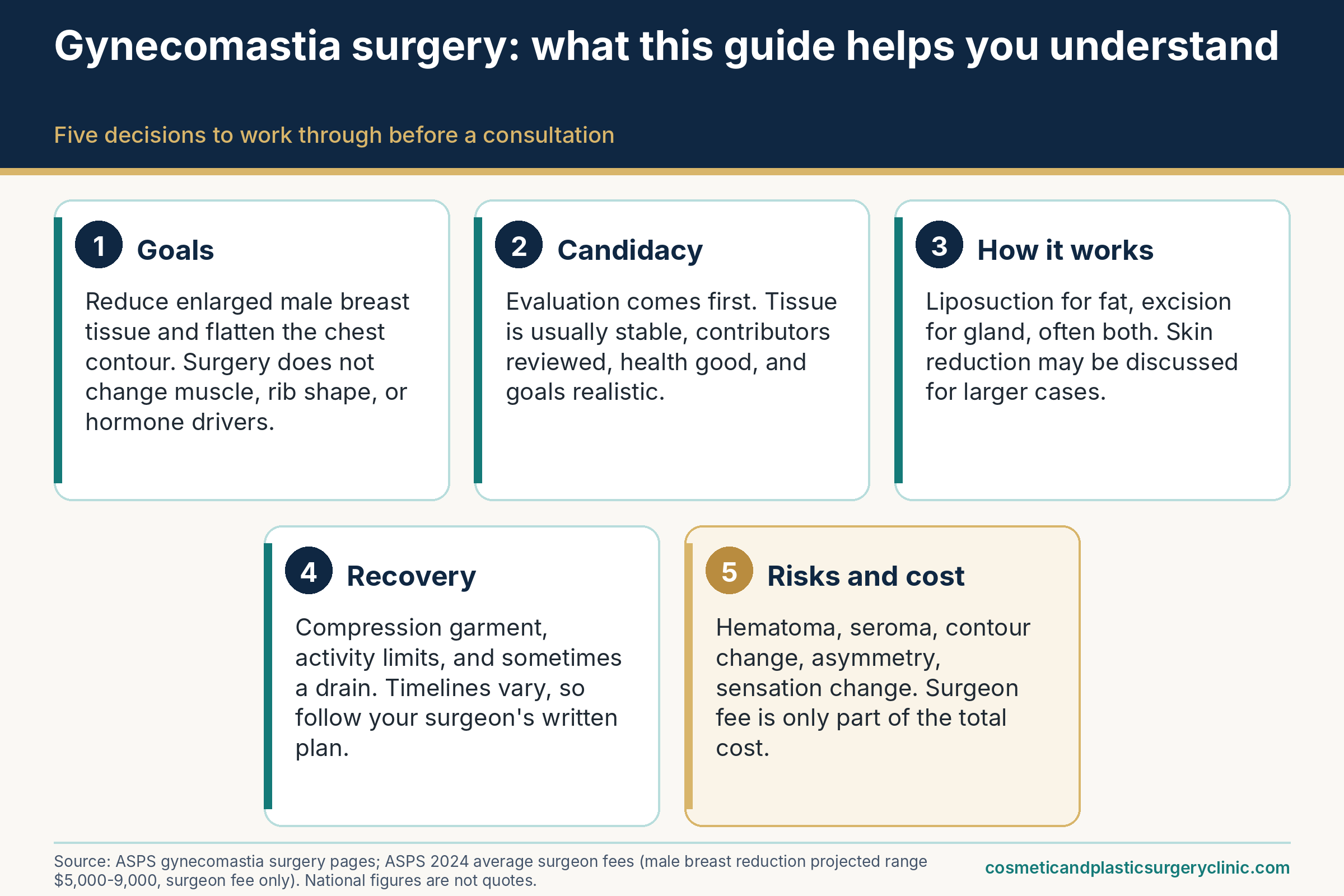
If medication doesn’t help, or if the tissue has been present long enough that medication is unlikely to, surgery becomes the main option for men who want a change. The figure below previews how the rest of this guide is organized around that decision.
Who May Suit Gynecomastia Surgery: Candidacy and Timing
Candidacy is a judgment a surgeon makes after examining you, and no article can make it for you. What an article can do is explain the factors that go into that judgment, so the conversation at a consultation is more specific. Our planned candidacy and red-flag checklist for gynecomastia surgery goes deeper on the screening questions; here the focus is on how surgeons think about it.
Candidacy Factors Surgeons Commonly Consider
The American Society of Plastic Surgeons (ASPS) summarizes the typical candidate in broad terms: a man whose condition cannot be corrected through alternative medical treatments, who is physically healthy without conditions that impair healing, and who has realistic expectations and specific goals. Those broad terms hide several practical questions.
Tissue type, goals, and general health
The first practical question is what the tissue is. As covered earlier, a firm glandular disk, a layer of fat, or a mix of both leads to different operations. A surgeon will often check by exam, sometimes with imaging, and will usually want to know how long the enlargement has been present, because duration influences how fibrous the tissue has become and how much liposuction alone can accomplish.
The second question is the goal. People pursue surgery for different reasons, and the reasons shape the plan. Some want a flatter chest contour in a T-shirt or at the pool. Some are bothered more by the firm, sometimes tender tissue behind the nipple than by overall size. Some mostly want to stop feeling self-conscious in locker rooms, at the gym, or in relationships. Others are bothered by nipple or areola appearance, which can change the technique. A useful exercise before a consultation is to write down the one or two things you most want to change and the things you’d consider acceptable trade-offs, such as a scar of a particular length or a longer recovery.
It also helps to know what surgery does not change. Gynecomastia surgery doesn’t alter the size of the pectoral muscle, the shape of the rib cage or breastbone, or fat in other areas of the body, and it cannot make the two sides identical if the underlying chest wall is asymmetric. Surgeons often point out that a small amount of asymmetry exists in most people’s chests before any treatment.
Finally, general health. ASPS says candidates should be healthy people without life-threatening illness or conditions that can impair healing. In practice, a preoperative assessment looks at heart and lung health, blood-clotting history, current medications (including blood thinners and supplements that affect bleeding), and whether any medical condition behind the gynecomastia has been identified and managed. Men with liver, kidney, or hormone disorders may need those conditions assessed and stabilized first, and the surgeon may coordinate with their other physicians.
Weight, smoking, substances, and expectations
ASPS says nonsmokers and people who don’t use drugs are preferred candidates, and describes the ideal as someone of relatively normal weight. These preferences aren’t moral judgments. They track what happens in healing tissue. Smoking and nicotine products are generally discouraged around surgery because they interfere with the circulation that skin and wound edges rely on, and surgeons typically ask patients to stop for a defined period before and after. The exact length is a surgeon-specific instruction, so ask for it in writing at your visit.
Weight stability matters for a related reason. If body weight is still changing, the fat component of the chest changes with it, and a result that looked right at one weight may not at another. Many surgeons prefer a stable weight for a period before surgery, and some will suggest weight loss first for men with a high percentage of fatty tissue. After surgery, the ASPS recovery page notes that results are often long-lasting but depend on avoiding causative factors such as certain prescription medications, drugs including steroids, or weight gain.
Substances need an honest conversation. If anabolic steroids, cannabis, or other products are part of your life, your surgeon needs to know, both because they may be linked to the enlargement and because they affect anesthesia planning and healing. A surgeon can only plan around what they’re told. There’s also a direct implication for results: if a continuing exposure was contributing to gland growth, surgery may remove the existing tissue but won’t prevent new growth if the exposure continues.
Expectations round out the picture. A good-faith expectation is a flatter, more natural-looking chest contour, a scar that is usually small and placed at the edge of the areola or elsewhere on the chest wall, and a real chance of some residual asymmetry or minor contour irregularity. An expectation to be told “your chest will look like a fitness model’s” is a warning sign about either the source of the information or the surgeon’s candor. Our planned guide on how to evaluate gynecomastia before-and-after photos explains how to read photo galleries realistically.
| Factor | Often supports moving toward a surgical consultation | Often supports waiting or more workup first |
|---|---|---|
| Duration | Enlargement present for a year or more with no change | Recent onset (months), especially in puberty, when spontaneous improvement is common |
| Cause | Evaluation completed; contributors addressed or none found | Evaluation not done, or a possible medication or hormone cause not yet reviewed |
| Tissue | Persistent glandular tissue or skin excess that medical options are unlikely to change | Mostly fat in someone still gaining or losing weight |
| Breast findings | Symmetric, soft-to-firm disk with a normal exam | Hard, fixed, one-sided, or skin or nipple changes: evaluation comes before any cosmetic planning |
| Substances | No ongoing exposures linked to breast growth | Continuing anabolic steroid or other relevant substance use |
| Health and healing | Stable health, nonsmoker, medications reviewed | Uncontrolled medical condition, current nicotine use, or medications needing adjustment |
| Goals and expectations | Specific, realistic goals; understands scars and limits | Expectation of a guaranteed shape or a fix for unrelated body concerns |
Timing and Life Stage
When to operate is one of the most debated questions in gynecomastia care, and the honest answer depends on age, duration, and how much the condition is affecting daily life. Our planned guide to the best age for gynecomastia surgery covers the timing factors in more depth.
Adolescents and young adults: stability, evidence, and psychosocial context
For teenagers, the central issue is stability. ASPS states that breast development should stabilize before surgery and that additional procedures may be needed later if development continues. Combined with the observation that pubertal gynecomastia often resolves over one to three years, this is why many clinicians wait, monitor, and rule out contributing medical causes before recommending an operation.
Waiting isn’t always easy, and the cost of waiting isn’t zero. Adolescents with gynecomastia can face teasing, avoid swimming and team sports, wear layered clothing in hot weather, and feel isolated at a stage when peer acceptance matters. A June 2022 study in Plastic and Reconstructive Surgery, summarized by ASPS, followed 145 males aged 12 to 21 with persistent gynecomastia and found improvements in seven of eight quality-of-life domains after surgery, including physical, social, and emotional functioning. That is encouraging, though it came from a specific group of patients treated by specific surgical teams, and the same study documented a meaningful rate of complications, which we cover in the risks section.
The decision belongs to the teen as much as to the parents. Surgeons who work with adolescents generally want to hear directly from the patient about what bothers them and what they’re hoping for, and a good consultation includes the parent or guardian without speaking over the teen. Screening for mood, anxiety, bullying, and body-image distress belongs in this conversation, because those problems may need support whether or not surgery happens. If a teen is struggling emotionally, a counselor or pediatrician can help in parallel with the surgical discussion.
Young adults sit in between. A man in his twenties whose chest has been unchanged for years, whose evaluation was unremarkable, and who has a stable weight is in a different place than a seventeen-year-old whose gland is still growing. In this age range, the main questions are duration, stability, and substance exposure, particularly the use of performance-enhancing products.
Adults, older men, and reasons to postpone or avoid
In adults, gynecomastia that has persisted for a year or more is unlikely to disappear without treatment; MedlinePlus notes that long-standing gynecomastia is less likely to resolve, and StatPearls suggests considering surgery after 12 or more months when the condition persists despite treatment of underlying causes. There is no upper age limit on gynecomastia surgery as such. What changes with age is the health picture: heart and lung conditions, diabetes, blood thinners, and the broader risks of anesthesia carry more weight in older men, and the surgeon and an anesthesia professional will weigh them.
Several situations commonly lead a surgeon to recommend postponing. These include an evaluation that hasn’t been done or isn’t complete, a possible medication cause that hasn’t been reviewed with the prescriber, active steroid use, current smoking or nicotine use, unstable weight, a recent illness, or a mass or other finding that needs workup. Postponing for these reasons can protect the result and reduce risk. It is not the same as being told “no.”
A few illustrative scenarios, all hypothetical, show how the same condition can lead to different plans. A 22-year-old who has had stable, firm tissue behind both nipples for four years, with a normal evaluation, might reasonably be discussing surgical options. A 16-year-old whose tender enlargement began eight months ago might be advised to wait and be re-examined, with a defined point at which to revisit the question. A 54-year-old who started a new prescription shortly before noticing a change might first need a conversation with the prescriber, and a man of any age who notices a hard, one-sided lump needs an examination before anything else.
The last category of reasons to pause is not physical. Surgeons are generally cautious about operating when expectations are unrealistic or when distress seems out of proportion to the finding. Body dysmorphic disorder, a recognized condition in which a person is preoccupied with perceived flaws, is one example, and it isn’t something an article can diagnose. A surgeon who suggests talking with a mental health professional first isn’t dismissing your concern. They’re trying to make sure the operation addresses the actual problem.
How Gynecomastia Surgery Is Performed: Techniques and Surgery Day
There isn’t one gynecomastia operation. Surgeons choose among a handful of building blocks and combine them according to what the tissue is, how large it is, how much skin there is, and what the patient is willing to trade. Reading about the building blocks makes consultation vocabulary much easier to follow.
Technique Options and How Surgeons Choose
ASPS describes three broad categories: liposuction when the enlargement is mostly fat, excision when glandular tissue or excess skin has to be removed (or the areola needs to be reduced or the nipple repositioned), and a combination of both. Within those categories sit a number of variations that surgeons name after themselves or their devices, so it’s useful to focus on principles rather than brand names.
Liposuction-based approaches and energy-assisted adjuncts
In liposuction for the chest, the surgeon makes one or more small incisions and passes a thin hollow tube called a cannula through the fatty layer, moving it back and forth to loosen fat that is then suctioned out. ASPS describes this approach for cases in which fatty tissue is the main problem. If you want the general mechanics of liposuction, our complete liposuction guide explains cannulas, fluids, and healing in detail; the chest is simply one area where the same principles apply.
Two variations come up often. Power-assisted liposuction uses a cannula that vibrates or oscillates mechanically, which some surgeons feel makes it easier to move through denser tissue. Ultrasound-assisted liposuction uses ultrasonic energy intended to help loosen fat and fibrous tissue before suction. A 2025 retrospective report in a Thieme journal described combining both through a single lateral chest incision in 967 patients treated at several centers in India, with the authors reporting high satisfaction, a low seroma rate, and no tissue death. That is a single series from the developers of a technique, without a comparison group, so it tells you the approach is in use and has been reported as feasible, not that it is better than alternatives.
Where liposuction runs into limits is dense, fibrous gland. StatPearls notes that fibrosis in longstanding gynecomastia may limit how well liposuction works and may call for open excision. This is why a surgeon who proposes liposuction alone for firm glandular tissue should be able to explain what they expect to happen to the gland and what the plan is if some remains. Residual firm tissue is one of the most common reasons for a second procedure.
The advantage of liposuction-only approaches is that the incisions are small and can be placed away from the areola. The disadvantage is that they may not fully address gland or excess skin, and the skin must retract on its own afterward. Skin elasticity varies with age, genetics, and weight history, and no technique can fully predict it.
Gland excision, combined approaches, and skin or nipple techniques for larger cases
Direct excision means removing glandular tissue under direct vision. The usual route is a small incision, and ASPS notes that incision patterns vary with individual circumstances and surgeon preference. Many surgeons use an incision along the lower edge of the areola, where the pigmentation difference can help camouflage the scar. Others avoid the areola. A report in the European Journal of Plastic Surgery describes a pull-through technique, reviewed after 15 years and 260 patients, in which liposuction is performed in two layers and gland is removed through 1 to 1.5 centimeter incisions hidden in the fold under the chest and behind the armpit-side muscle edge. The authors argue that avoiding incisions in the areola can reduce the risk of retraction, distortion, and sensation problems. They are describing their own experience, which is typical of this literature.
Combining liposuction and excision is common in mixed gynecomastia, since each addresses a different tissue. A 2022 systematic review in Aesthetic Plastic Surgery pooled 94 articles covering 7,294 patients treated between 1987 and 2020. It reported complications in about 15 percent of patients in the aspiration group, about 31 percent in the excision group, and about 12 percent in the combined group, and concluded that combining excision with aspiration seemed to lower complication rates compared with excision alone. The authors themselves caution that the lack of a unified classification and the variety of techniques introduce bias. Those percentages come from very different studies using different definitions of “complication,” and they shouldn’t be read as a prediction for any individual. The more defensible takeaway is that combined approaches are widely used and that no technique is free of complications.
Larger cases bring in skin. When enlargement is marked and the skin has stretched, removing gland and fat may leave loose skin that doesn’t redrape. StatPearls links the more extensive grades with open excision and skin resection when significant drooping is present, and ASPS notes that in severe cases the position and size of the areola can be surgically improved and excess skin reduced. These techniques move scars to longer lines, often on the chest, and sometimes involve repositioning the nipple and areola. The trade-off is straightforward: a flatter, better-fitting contour in exchange for more visible scars and a higher likelihood of changes in nipple sensation or healing complications at the repositioned areola. A 2020 literature review in Plastic and Reconstructive Surgery Global Open of 17 studies (1,112 patients) found that skin-sparing mastectomy with or without liposuction was the most frequently used procedure, followed by mastectomy with skin reduction, and concluded that the choice should be tailored to disease grade and patient preference.
| Approach | Mainly addresses | Typical access and scar pattern | Common trade-offs |
|---|---|---|---|
| Liposuction alone | Fatty enlargement, including fat around a small gland | Small incisions, often at the chest edge or armpit side; usually short | May leave dense gland behind; relies on skin retracting afterward |
| Power- or ultrasound-assisted liposuction | Fat plus somewhat denser tissue, as an adjunct to suction | Similar small incisions | Device-specific skills and costs; evidence mostly from case series, so ask about the surgeon’s experience with the device |
| Gland excision | Firm glandular tissue behind the nipple | Small incision, commonly at the areola edge; other sites are used | Contour irregularity or dip if too much is removed; hematoma and nipple sensation changes are discussed risks |
| Liposuction plus excision | Mixed tissue, the most common situation | Combination of small incisions | Two techniques, longer operation; widely used |
| Skin reduction with possible nipple repositioning | Larger enlargement with excess skin or low nipple position | Longer incision lines on the chest; pattern varies by surgeon | More visible scars; higher chance of wound-healing and nipple-area problems; may be staged |
Surgery Day: Anesthesia, Facility, and What Happens
The day of surgery is more predictable than the decision to schedule it, though details still differ from practice to practice. Knowing the sequence helps you ask better logistics questions and plan your support.
Anesthesia, facility, and preparation
ASPS lists intravenous sedation and general anesthesia as the options for gynecomastia surgery, and some reports describe smaller operations under local anesthesia with or without sedation. Which one fits depends on the extent of the surgery, your health, and the surgeon’s and anesthesia team’s practice. Our planned guide to anesthesia for plastic surgery covers the types, who administers them, and the questions worth asking. For this operation, the practical questions are who will provide the anesthesia, what their credentials are, and what monitoring will be in place.
Location matters too. ASPS advises that procedures be performed in accredited, state-licensed, or Medicare-certified surgical facilities. Accreditation doesn’t make a facility error-proof, but it does mean someone has audited standards for equipment, emergency protocols, and personnel. It’s reasonable to ask which facility will be used, whether it is accredited or licensed, and what happens if you need to be transferred to a hospital.
Preparation usually starts a week or two before. Expect a medication and supplement review, with instructions to stop certain products that affect bleeding, plus any preoperative labs your surgeon or anesthesia team requires. You’ll likely be asked to stop nicotine products, arrange a ride home, and follow fasting instructions provided by the anesthesia team. It helps to set up the recovery space before surgery: pillows for sleeping on your back, loose button-front shirts, snacks and water within reach, and a plan for who will help in the first day or two. You’ll also sign informed consent forms, which ASPS says exist so that you fully understand the procedure and its risks, and the best time to ask questions is before signing, not on the morning of surgery.
Typical sequence: marking, incisions, tissue removal, drains, dressings, and compression
On the day, the surgeon commonly marks the chest while you’re standing, since landmarks and asymmetry are easier to see upright. Once anesthesia is established, the surgeon makes the planned incisions, performs liposuction, removes glandular tissue if planned, checks for bleeding, and closes the incisions. When tissue is excised, some surgeons send it for pathologic examination, which is worth asking about. Operating time varies with technique and extent, so rely on your surgeon’s estimate rather than a generic figure.
Drains are a point on which surgeons differ. ASPS describes a small, thin tube temporarily placed under the skin to drain excess blood or fluid. The 2020 literature review found that drain placement was associated with higher hematoma and seroma rates (9.78 percent versus 8.36 percent), but the authors noted that this probably reflected patient severity, since drains tend to be used in bigger operations. In other words, the data can’t tell you whether drains help or harm. If your surgeon plans a drain, ask how long it typically stays and how you’ll be taught to care for it.
At the end of the procedure, dressings and an elastic compression garment are applied to limit swelling, per ASPS. The garment’s purpose is to hold the skin against the chest wall, reduce fluid accumulation, and provide support while tissues settle. Surgeons differ on how long it should be worn each day and for how many weeks, which is why written instructions matter. Our planned guide to compression garments after plastic surgery explains fit, care, and common problems such as skin irritation.
Whether you go home the same day depends on the facility, the anesthesia, and your overall health. Many men go home after a period of observation in a recovery area, but confirm this with your surgeon, and arrange for a responsible adult to drive you and stay with you at least the first night.
Gynecomastia Surgery Recovery, Scars, and Results
Recovery is where general information is least precise, because it depends on technique, extent, individual healing, and the instructions your surgeon gives. ASPS itself doesn’t publish exact day counts on its gynecomastia recovery page. It describes dressings, an elastic support garment, a possible small drain, written instructions on incision care and activity, and follow-up visits. Anyone who tells you recovery takes a fixed number of days is simplifying. The framework below describes common phases and planning considerations, with ranges labeled as variable.
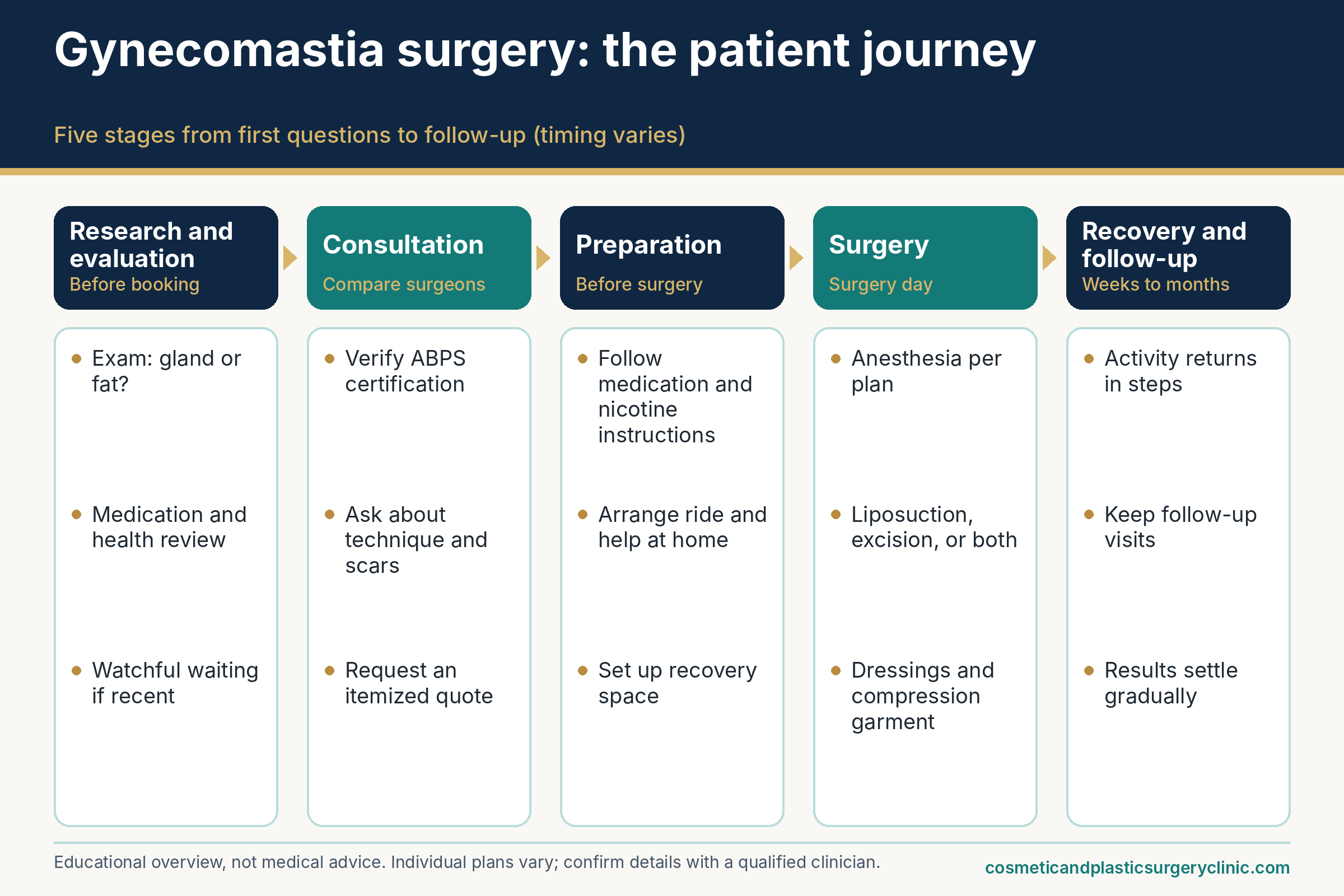
Recovery Timeline and Practical Planning
Good recovery planning means thinking in phases, then fitting your own job, household, and exercise habits into them. The goal is to avoid two common surprises: underestimating the first week, and returning to chest-dominant exercise before the tissue is ready.
A phased view: first days, first weeks, and later healing
The first few days are about swelling, bruising, soreness, and the logistics of the garment and any drain. Many people describe tightness or a pulling sensation across the chest, and numbness or tingling around the incisions or nipples is common. Pain is usually managed with prescribed or recommended medication, and your surgeon will say what to take and what to avoid. This is also the phase when most early complications declare themselves, which is why follow-up visits and a reachable surgical team matter.
Over the following weeks, swelling and bruising gradually ease, drains (if used) are removed on the surgeon’s schedule, and activity widens in steps. Surgeons typically permit walking and light daily activity early and hold back on lifting, pushing, pulling, and upper-body exercise until they confirm that the tissue has healed enough. Compression garments are usually worn for a stretch of weeks, though protocols differ. If your recovery plan feels more restrictive than a friend’s, that doesn’t necessarily mean something is wrong; techniques and tissue differ.
Later healing is slower and less visible. Residual swelling can persist for months, and firmness under the incisions often softens gradually. The chest may look slightly uneven or puffy at intervals during this phase and then settle. Scars typically change color and texture over many months. What you see at one month is not your final result, which is also why decisions about revision are usually deferred until the tissue has had time to settle.
Throughout, one set of symptoms should never be waited out. ASPS directs patients to seek immediate medical attention for shortness of breath, chest pains, or an unusual heartbeat, which can signal serious problems such as a blood clot reaching the lungs. Rapidly increasing swelling or tightness on one side, escalating pain, fever, spreading redness, or foul-smelling drainage are also reasons to contact the surgical team promptly, since they can indicate a collection of blood, infection, or another complication. Your discharge instructions should list who to call, including after hours.
| Phase | Commonly described experiences | Planning notes | Call the surgical team about |
|---|---|---|---|
| First days | Swelling, bruising, soreness, tightness; garment and dressings in place; possible drain | Have help at home; set up sleeping position on the back; keep medications and phone numbers within reach | Fast one-sided swelling, severe or worsening pain, fever, heavy bleeding through dressings |
| First weeks | Gradual easing of swelling and bruising; drain removal if used; wider daily activity | Plan work around your surgeon’s guidance; avoid heavy lifting and upper-body strain until cleared; keep follow-up visits | Increasing redness or drainage at incisions, new fluid collection, wound separation |
| Weeks to a few months | Lingering swelling and firmness; sensation changes; garment use tapering per surgeon | Return to exercise in steps once approved; chest-dominant lifting usually comes last | Persistent lumps, worsening asymmetry, ongoing nipple pain |
| Several months to a year | Contour settles; scars mature and fade; sensation often improves but can remain altered | Judge the result after settling; discuss any concern about residual tissue or contour at follow-up | Any new lump, rapid change, or skin change at any time |
Work, exercise, driving, sleep, and travel: planning scenarios
Four brief, hypothetical scenarios show how the same operation can mean different logistics. Our planned article on returning to work after gynecomastia surgery goes into more depth on jobs and timing.
A desk-based job. Someone who works at a computer may be able to return to work sooner than someone in a physical job, often after the first stretch of discomfort and drain care. Most surgeons still discourage heavy lifting and long reaches, and many ask patients to keep the garment on at the office. Working from home for the first days can smooth the transition, if that’s an option.
A job that involves lifting or arm-intensive work. Construction, warehouse, and some health-care roles put strain on the chest and shoulders. Returning too early risks swelling, bleeding, or wound stress. This person might ask the surgeon for a written work note describing restrictions, ask whether light-duty is possible, and plan on a longer absence than a desk worker.
A regular lifter or athlete. Surgeons usually allow walking early, then reintroduce lower-body and cardiovascular activity before chest, shoulder, and arm exercise. Sudden return to bench presses and push-ups is a common source of setbacks. A reasonable plan is to ask what the surgeon’s milestones for each category of exercise are rather than guessing.
A student, including a teenager. Backpacks, gym class, and team sports each need clearance. Schools can often accommodate a note, and planning surgery around a break in the academic calendar can reduce stress. Parents typically manage medications, drains, and follow-up visits in the first days.
Some general planning points apply to everyone. Driving is usually off the table while taking opioid pain medication or when arm movement is restricted, and the surgeon will set the standard. Sleeping on your back with the upper body slightly elevated is a common instruction, and a few extra pillows can help. Showering rules vary with dressings and drains. And travel deserves a conversation: long trips in the early period raise the question of blood clot risk, so ask about flying or long car rides before booking anything non-refundable. A planned guide on week-by-week gynecomastia surgery recovery expands on each phase.
Scars, Sensation, and Results
Two things follow surgery for months and, in some cases, years: the scars and the final shape. Both deserve realistic expectations.
Scars and nipple sensation
Scar location depends on technique. Liposuction-only approaches leave very small marks at cannula entry points. Excision typically adds a short scar near the areola or elsewhere on the chest, depending on the surgeon. Larger-case techniques leave longer scars. All scars start out red or pink, may be raised or firm for a while, and typically fade and flatten as they mature over many months, though outcomes vary with skin type, tension on the wound, genetics, and sun exposure. ASPS includes “unfavorable scarring” and the possible need for revision among the risks. Our planned guide to gynecomastia surgery scars and scar care covers placement and healing in more detail.
Scar care is a surgeon-specific instruction. Silicone sheets or gels, sun protection, taping, and massage all appear in some protocols and not others, and starting them too early can harm a healing wound. Ask what to do and when, and avoid adding products on your own.
Nipple sensation is its own topic. ASPS lists changes in nipple sensation, temporary or permanent, among the risks. Afterward, some men notice numbness, others hypersensitivity, and many have a mix that evolves. Sensation often changes gradually over months. Techniques that avoid cutting around the areola aim to protect sensation, as the pull-through authors argue, but no technique removes the risk entirely. If preserving erogenous sensation matters to you, say so; it’s a legitimate priority, and surgeons would rather hear it before the operation.
Results, longevity, recurrence, and revision
The final result takes time. Early swelling can mask the contour, and settling usually takes months. ASPS describes results as often permanent, provided the factors that contributed to gynecomastia (certain medications, drugs including steroids, or weight gain) are avoided. That conditional deserves emphasis. Surgery removes tissue that exists today; it doesn’t change hormone levels or prevent future glandular growth if the drivers return. Gynecomastia can recur, particularly after surgery in teenagers whose development hasn’t finished, as ASPS notes, or when weight is gained. Our planned guide to how long gynecomastia surgery results last covers the factors that influence recurrence.
Imperfect results are common enough to plan for. In the 2022 adolescent study summarized by ASPS, 34.3 percent of breasts had at least one complication at a median follow-up of about 8.6 months, including residual tissue in 12.6 percent and contour irregularities in 9.2 percent. The study also found that improvements in self-esteem and quality of life were similar in patients with and without complications. Both findings can be true: minor imperfections are frequent, and many people are still satisfied. This was a specific adolescent and young-adult population, so adults’ numbers may differ.
When a second procedure is discussed, it is usually after healing has settled, because swelling can make early judgments unreliable. Common reasons include residual glandular tissue, a contour dip, asymmetry, or skin laxity. Revision can mean a small touch-up (such as limited liposuction) or a more extensive procedure, and it may come with additional costs. Ask before surgery how the practice handles revisions: whether the surgeon’s fee changes, whether facility and anesthesia costs are separate, and what time frame is typical. The answer tells you a lot about how a practice thinks about outcomes.
Gynecomastia Surgery Risks and Complications
Every surgical procedure carries risk, and gynecomastia surgery is no exception. It is a well-established operation, and many men do well, but “common operation” shouldn’t be read as “no meaningful risk.” This section lists the risks ASPS names, adds what the surgical literature says about how often some of them occur, and explains why those numbers need careful reading. Our planned detailed guide to gynecomastia surgery risks and complications expands on each category.
Common and Procedure-Specific Risks
The risks fall into two groups: problems with the healing process that tend to show up early, and problems with the shape and feel of the chest that show up as swelling settles.
Bleeding, fluid collections, infection, and wound healing
A hematoma is a collection of blood under the skin. It’s among the most frequently discussed complications in gynecomastia surgery because the tissue bed is vascular and the space left after removal can fill with blood. A hematoma may cause rapid swelling, tightness, and bruising, usually on one side, and a large one may need to be drained in a procedure room or operating room. A seroma is a collection of clear fluid, usually less urgent but potentially persistent; it may be monitored, drained with a needle, or treated with additional compression, depending on size and symptoms.
The literature offers some numbers. A 2020 review in Plastic and Reconstructive Surgery Global Open, covering 17 studies and 1,112 patients, reported that hematoma was the most common complication at 5.8 percent, followed by seroma at 2.4 percent, and that major complication rates across the included studies ranged from 0 to 33 percent. In the 2022 adolescent and young-adult study summarized by ASPS, hematomas occurred in 7.8 percent of breasts and minor infections in 2.2 percent of breasts in the early period. A 2025 series using a single combined-device technique reported a seroma rate of 0.8 percent in 967 patients. These figures differ because the studies differ in who was treated, what techniques were used, how complications were defined, and how carefully they were tracked, which is exactly why they shouldn’t be treated as a single expected rate.
Infection and delayed healing are the other early risks. ASPS lists infection and poor wound healing among the possible complications. Signs usually include increasing redness, warmth, swelling, pain that worsens rather than eases, drainage, or fever. Mild wound infections may be treated with antibiotics; deeper ones may need drainage. Skin at the edges of incisions can heal slowly, particularly in people who smoke or have conditions affecting circulation, and after skin-reduction techniques where longer incisions are under tension.
Fat necrosis, listed by ASPS as another potential problem, is the death of fatty tissue, leading to firm lumps that can persist. Because new lumps in the chest need to be assessed regardless of cause, a surgeon will want to examine any firm area that appears after surgery, and the answer is not to massage it hard or assume it’s harmless.
| Risk | What it means | Evidence snapshot | What to report promptly |
|---|---|---|---|
| Hematoma | Collection of blood under the skin | 5.8% in a 2020 review of 17 studies (1,112 patients); 7.8% of breasts early in a 2022 study of 145 males aged 12 to 21 | Rapid, tense swelling, often one-sided, with increasing pain |
| Seroma | Pocket of clear fluid | 2.4% in the same 2020 review | Persistent swelling, fluid sloshing sensation, leaking incision |
| Infection or poor wound healing | Bacterial infection or incision that heals slowly or opens | Minor infections 2.2% of breasts early in the 2022 adolescent study | Redness spreading, warmth, pus, fever, wound opening |
| Contour irregularity or residual tissue | Bumps, dips, or leftover firm gland | Contour irregularities 9.2% and residual tissue 12.6% of breasts at median 8.6 months in the 2022 study | Discuss at follow-up; revision decisions usually wait until swelling settles |
| Nipple or areola changes | Altered sensation, shape, or position; rarely, problems with skin or blood supply | Listed by ASPS as temporary or permanent sensation change; frequency varies by technique | Darkening or color change, severe pain, or skin breakdown at the nipple |
| Blood clots and anesthesia complications | Deep vein thrombosis, pulmonary embolism, reactions to anesthesia | Named by ASPS; individual risk depends on health history | Chest pain, shortness of breath, unusual heartbeat, a swollen painful leg: seek immediate care |
Contour irregularity, asymmetry, residual tissue, nipple changes, and skin laxity
The second group of risks concerns how the chest looks and feels once swelling resolves. ASPS lists asymmetry and irregular contour or shape, along with changes in nipple sensation, among the risks. These are the complications most responsible for dissatisfaction and for revision surgery, and they’re also the ones that are hardest to separate from normal healing in the first weeks.
Contour irregularity includes visible dips where too much tissue was removed, bumps where too little was, and rippling in the skin after liposuction. A dip in the area behind the nipple is sometimes called a “saucer” or “cupped” look, and it’s a recognized hazard of aggressive gland removal. Residual tissue is the opposite problem: a firm disk that wasn’t fully removed, which is more likely when the gland is fibrous or when a surgeon chooses a less extensive approach to limit contour risk. Surgeons are always balancing these two failure modes, which is part of why the technique you choose and the surgeon’s judgment matter more than any single device.
Asymmetry deserves a plain explanation. Most chests are slightly uneven to begin with, and gynecomastia is often more pronounced on one side. Surgery can reduce differences, but it can’t promise identical sides, especially when the rib cage or muscles are themselves uneven. A good surgeon will point out existing asymmetry at the consultation and document it with photos.
Nipple and areola changes include altered sensation, flattened or retracted nipples, changes in position, and, rarely after more extensive techniques, problems with the blood supply to the area. Skin laxity is a related issue: if the skin doesn’t retract after volume is removed, the result may look loose, and a second operation to remove skin may be discussed. This is another reason surgeons examine skin quality before choosing liposuction alone. And a lingering sense of “something’s still different” is quite common in the months after surgery, which is why the timing of any judgment about the result matters.
Serious Risks and Reducing Them
Most complications are manageable, and the serious ones are uncommon. Still, they are why a thorough preoperative assessment, an appropriate facility, and clear discharge instructions are not optional extras.
Anesthesia, blood clots, and urgent warning signs
ASPS lists anesthesia risks, blood clots (including deep vein thrombosis), and damage to deeper structures such as nerves, blood vessels, muscles, and lungs among the risks of gynecomastia surgery. Anesthesia risk depends on the type of anesthesia, the person’s health, and the team providing it. A prior bad reaction to anesthesia, a family history of anesthesia problems, sleep apnea, heart and lung disease, and certain medications all matter and should be volunteered even if they seem unrelated.
Blood clots form in leg veins and can travel to the lungs. The risk rises with a personal or family history of clots, certain medications, prolonged immobility, and surgery itself. Walking early as your surgeon directs, avoiding long periods of immobility, and reporting a swollen, painful, or warm leg are standard practice. If you have a history of clotting problems, make sure the surgeon knows well in advance.
ASPS directs patients to seek immediate medical attention for shortness of breath, chest pains, or an unusual heartbeat. Call emergency services or go to the nearest emergency department for those symptoms, or for coughing blood or fainting. Don’t wait for office hours or try to reach the surgeon first.
How to read complication statistics and how to lower your risk
Complication numbers in the surgical literature are useful but easy to misread. A rate of 5.8 percent for hematoma in a pooled review doesn’t mean a given patient has a 5.8 percent chance. The pooled number mixes small and large operations, expert centers and routine practice, different follow-up periods, and different definitions of what counts. The 2022 systematic review that reported roughly 15, 31, and 12 percent complication rates for aspiration, excision, and combined techniques drew on studies from 1987 to 2020 and acknowledged substantial bias from inconsistent classification. Nobody should choose a technique based on those percentages alone.
More meaningful questions are the ones you can ask a surgeon directly. How many gynecomastia operations do you perform in a typical year? What complications do you see most, and how do you handle them? What is your rate of revision, and how is it handled financially? What do you do if I develop a hematoma at night or on a weekend? There’s no standard national benchmark you can ask for, but a surgeon who answers specifically and without defensiveness is giving you useful information.
You also have real influence over risk. Complete the medical evaluation first. Give an honest list of medications, supplements, and substances. Stop nicotine as directed. Maintain a stable weight. Choose a board-certified plastic surgeon operating in an accredited or licensed facility. Follow the garment, activity, and wound-care instructions as written, and attend follow-up visits even when you feel fine. None of these steps eliminates risk, but together they remove avoidable contributors.
Finally, a note on mood and expectations. A result that is anatomically reasonable can still feel disappointing if expectations were unrealistic or if the emotional weight placed on the operation was too heavy. Talking through what the surgery can change and what it can’t, before the day, is itself a form of risk reduction.
Gynecomastia Surgery Cost, Insurance, and Alternatives
Price and coverage are among the most searched parts of this topic, and also the hardest to answer in the abstract. National figures give a starting frame, but your quote will reflect your region, your surgeon, the facility, the anesthesia, and the extent of the operation. This section lays out what the published figures say, what they exclude, and how to compare quotes. Our planned gynecomastia surgery cost and financing guide goes further into fee components and payment options.
Cost and Insurance
Cost has two layers: what the operation costs in total, and who pays. For most men with gynecomastia, the answer to the second layer is “the patient,” though that isn’t universal.
What national fee data says and what it leaves out
The most widely cited U.S. figures come from ASPS. In its 2024 average surgeon and physician fee table, ASPS lists a projected range of $5,000 to $9,000 for male breast reduction. ASPS explains that it now presents surgeon fees as a projected range rather than a single price, aggregated from averages reported by surveyed member surgeons, to reflect different geographic locations and practice settings. Separately, the ASPS gynecomastia cost page states an average cost of $5,587 and notes that this average is only part of the total price, since it does not include anesthesia, operating room facilities, or other related expenses. The page as reviewed for this guide did not display a year for that single figure, so it should be treated as an older, undated average and not as a current price.
Three cautions apply to both numbers. First, they describe the surgeon’s fee, not the total you will pay. Second, they are national figures drawn from a survey of ASPS member surgeons, so they say little about a specific city, practice, or board-certified surgeon outside that membership. Third, they aren’t offers. A quote from a practice is what counts, and it should be itemized.
For context on volume, ASPS reports that male breast reduction (gynecomastia surgery) was performed 26,430 times in 2024 by ASPS member surgeons, roughly 11 percent more than in 2023; the count covers procedures by ASPS members only and so understates the national total. Popularity doesn’t tell you about price or outcomes, but it does indicate that many surgeons perform this operation regularly.
What changes the total? Extent of surgery is a major factor: liposuction alone, liposuction plus gland excision, and skin-reduction techniques take different amounts of operating time and may involve different supplies. Anesthesia type and the professional providing it add cost. Facility fees depend on whether the operation takes place in a hospital outpatient department, an ambulatory surgery center, or an office-based accredited surgical suite. Geography matters, as does the surgeon’s experience. Garments, medications, preoperative testing, pathology, and follow-up visits may or may not be bundled. And a revision policy, if there is one, can change the real cost of the full course of care.
| Component | What it covers | Often billed separately? | Question to ask |
|---|---|---|---|
| Surgeon’s fee | The surgeon’s professional work, usually including routine post-operative visits for a set period | Usually the anchor number in a quote | What does this fee include, and for how long are follow-up visits covered? |
| Anesthesia | Anesthesia professional and medications | Frequently, yes | Who provides anesthesia and how is it billed? |
| Facility | Operating room, recovery area, nursing, equipment | Frequently, yes (ASPS notes its average excludes operating room facilities) | Which facility, is it accredited or licensed, and what is its fee? |
| Compression garment and supplies | Garments, dressings, drains, and similar supplies | Varies | Is the garment included, and how many are needed? |
| Medications and testing | Prescriptions, preoperative labs, medical clearance | Often yes | What tests are required and who orders them? |
| Pathology | Laboratory examination of removed tissue | Sometimes billed by the laboratory | Will tissue be sent for pathology and who bills for it? |
| Revision or touch-up policy | Terms if further surgery is needed | Policies vary widely | Which parts of a revision are covered, and for how long? |
| Indirect costs | Time off work, travel, lodging, help at home | Not billed, but real | How much time away from work should I plan for? |
Insurance coverage: why it’s usually treated as cosmetic and what can change that
ASPS states that in most cases correction of gynecomastia isn’t eligible for insurance, while noting that policies vary and that ASPS has published position papers defining criteria for reconstructive gynecomastia cases. That mix of “usually not” and “sometimes, depending on the policy” is the honest picture.
The ASPS coverage-criteria document, approved by its board of directors in March 2002, argues that gynecomastia correction can be reconstructive when it addresses an abnormal structure rather than reshaping normal anatomy. It proposes criteria that differ for adolescents and adults and by severity grade. For adolescents with moderate to severe enlargement, it suggests coverage when symptoms persist more than a year after pathological causes have been ruled out, or after six months of unsuccessful medical treatment, with shorter intervals for the most severe grade; for adults with higher grades, it suggests persistence of more than three to four months after pathological causes are excluded. It also treats pain or discomfort from breast distension as relevant and calls for documentation through history, examination, and photographs. These are professional-society recommendations, now more than two decades old, not rules any insurer must follow.
In practice, each plan writes its own medical policy, and many classify gynecomastia surgery as cosmetic or cover it only under narrow conditions. Some require documentation of pain, a medical workup, a minimum duration, failed medical therapy, or specific grade and breast tissue findings. Because these differ by plan, the useful steps are procedural: ask the insurer for its written medical policy on gynecomastia or male breast reduction, ask whether prior authorization or a pre-determination letter is available, and ask the surgeon’s office whether it has experience submitting such requests. A denial is not necessarily the end; most plans have an appeals process. But avoid scheduling surgery on the assumption that coverage will be approved afterward.
If insurance doesn’t apply, ask about payment plans, and read financing terms carefully, including interest, fees, and what happens if the date moves. A lower price can reflect a different anesthesia arrangement, facility, or scope of work, so compare what is included, not only the headline number.
Alternatives to Gynecomastia Surgery
Surgery isn’t the only path, and for many people it isn’t the right first one. Our planned overview of alternatives to gynecomastia surgery compares the options in more detail.
Non-surgical and non-operative options
The simplest alternative is time, with a clinician’s follow-up. For pubertal gynecomastia and recent-onset cases, observation is often the recommended starting point because many cases improve on their own. Next is addressing contributors: reviewing medications with the prescriber, evaluating hormones and organ function when indicated, and reducing or stopping substances associated with breast growth, which in some cases leads to partial or complete regression.
Lifestyle approaches work only on the fatty component. Weight loss can reduce chest fat in men whose enlargement is mainly adipose, and strength training can build the underlying pectoral muscle so the chest looks firmer. Neither changes a glandular disk, and spot-reduction of fat in one area through exercise isn’t how bodies work. Men whose enlargement is mixed may see some improvement and still be left with firm tissue.
Medications are discussed earlier in this guide. They’re used in selected situations, mostly early-stage or painful gynecomastia, and the supporting evidence is largely observational. Compression shirts or binders can change how clothing fits and how the chest looks under a shirt, but they’re camouflage and not treatment, and prolonged tight binding can irritate skin. Therapy or counseling is also a legitimate part of the picture when body image is causing real distress, either as a complement to surgery or as an alternative to it.
You may also see devices and procedures marketed for fat reduction promoted for the male chest. In the sources reviewed for this guide, we did not find high-quality evidence supporting them for glandular gynecomastia, and by design they target fat, not gland. If a practice offers such a service, ask what the device is cleared for, whether it has been studied specifically for gynecomastia, and what the plan is if the gland remains.
Comparing the options side by side
The table below compares the main paths on the points most readers weigh: what they can change, what they can’t, and what they involve. It’s a map for conversation and not a ranking, since the right option depends on tissue type, duration, goals, and risk tolerance.
| Option | What it can change | What it cannot change | Main considerations |
|---|---|---|---|
| Observation with follow-up | Allows natural resolution, common in puberty and recent-onset cases | Established, fibrotic gland or skin excess | No procedure risk; the wait can be emotionally hard |
| Addressing contributors (medication review, hormone or organ treatment, stopping substances) | May reduce enlargement when a driver is found | Tissue that has become fibrous; steroid-related enlargement is often irreversible | Requires medical evaluation; never stop medications without the prescriber |
| Weight loss and training | Chest fat; muscle definition | Glandular tissue | Helps mainly fatty enlargement; needs sustained effort |
| Medication therapy | May reduce pain or size in selected, often early, cases | Chronic gynecomastia in most reports | Largely observational evidence; possible side effects; ask about on-label versus off-label use |
| Liposuction-based surgery | Fatty enlargement; contour | Dense gland; significant skin excess | Small scars; anesthesia and procedural risks; recovery with a garment |
| Excision, alone or combined with liposuction | Glandular tissue plus fat | Hormonal drivers that persist | Larger scars than suction alone; hematoma, contour, and sensation risks |
| Skin-reduction techniques | Large volume with loose skin; nipple position | Scar visibility | Longer scars and higher healing demands; may be staged |
Choosing a Surgeon and Making Your Decision
By this point you know the condition, the evaluation, the techniques, the recovery, the risks, and the price landscape. What remains is deciding whether to proceed and, if so, with whom. This final section covers how to verify a surgeon, what to ask, and how to think about a decision that is partly medical and partly personal.
Verifying Your Surgeon and Setting
Credentials are verifiable facts, and checking them takes minutes. The aim isn’t to doubt anyone, only to confirm the basics before you hand over deposits or medical history.
Board certification, license, and facility checks
The American Board of Plastic Surgery (ABPS) maintains a public tool for confirming board certification. You can search the ABPS verification tool by surgeon name or by location. ABPS describes board certification as a voluntary credential indicating completion of appropriate training and passing comprehensive written and oral examinations. It also notes that certificates issued since 1995 are valid for ten-year periods and are maintained through ongoing self-assessment and practice improvement, and that if a state medical board takes action against a certified surgeon, the verification page displays an alert pointing to the Federation of State Medical Boards. Our planned explainer on what ABPS board certification means goes deeper.
Three distinctions are worth keeping straight. Board certification, state licensure, and society membership are separate things. A license lets a physician practice medicine in a state; it doesn’t indicate training in plastic surgery. Membership in a professional society, including ASPS, is a separate credential from board certification, so verify each one on its own. And titles such as “cosmetic surgeon” aren’t a certification; ASPS warns patients not to be confused by other official-sounding boards and certifications. If you want a plastic surgeon specifically, check that the board is the ABPS.
Next, the facility. ASPS recommends that procedures be performed in accredited, state-licensed, or Medicare-certified surgical facilities. Ask the practice for the facility name and then look up its accreditation or license status yourself. Ask also who the anesthesia professional will be and what the emergency transfer plan is. Whether the surgery occurs in a hospital, an ambulatory surgery center, or an office suite is less important than whether the setting is accredited and staffed for the anesthesia being used.
A few red flags are worth naming without drama. Be cautious about pressure to book quickly, discounts that expire, vague answers about who will operate or administer anesthesia, reluctance to show a facility’s credentials, and before-and-after galleries that don’t clearly show the same lighting, angles, and time since surgery. This guide does not recommend or vouch for any individual surgeon or practice.
Questions to bring to a consultation
A consultation is a two-way interview. Bring a list, take notes or ask to record the key points, and consider bringing someone you trust. Our planned gynecomastia surgery consultation question guide offers a longer list; the prompts below cover the essentials.
- About my chest: What type of tissue do I have, and what is the basis for that assessment? Has anything in the exam made you want further testing, and who should do it?
- About the plan: Which technique do you recommend for me, and why this one instead of the alternatives? Where will the incisions be, and how long will the scars be? Will tissue be sent for pathology?
- About results: What improvement is realistic for my anatomy, and what might remain? How do you handle asymmetry? How often do patients need a second procedure, and what happens financially if I do?
- About anesthesia and setting: Who will provide anesthesia? Where will the surgery take place, and is it accredited or licensed? What is the plan if something goes wrong overnight?
- About recovery: Will I have a drain and a garment, and for how long? When can I return to work, driving, and each type of exercise? Who do I call, and what is the after-hours process?
- About risks: What are the most likely complications in my situation, and how do you manage a hematoma or infection?
- About cost: What is included in the quote, what is billed separately, and what is the policy for revisions or cancellation?
- About me: Is there anything in my medications, substances, weight, or health history that you’d want addressed first?
Listen not only to the answers but to how they’re delivered. A good consultation includes an exam, direct explanation of limits, and willingness to say when an operation isn’t the right next step. If you leave feeling rushed or sold to, a second opinion is normal and reasonable. Surgeons who perform gynecomastia surgery regularly expect it.
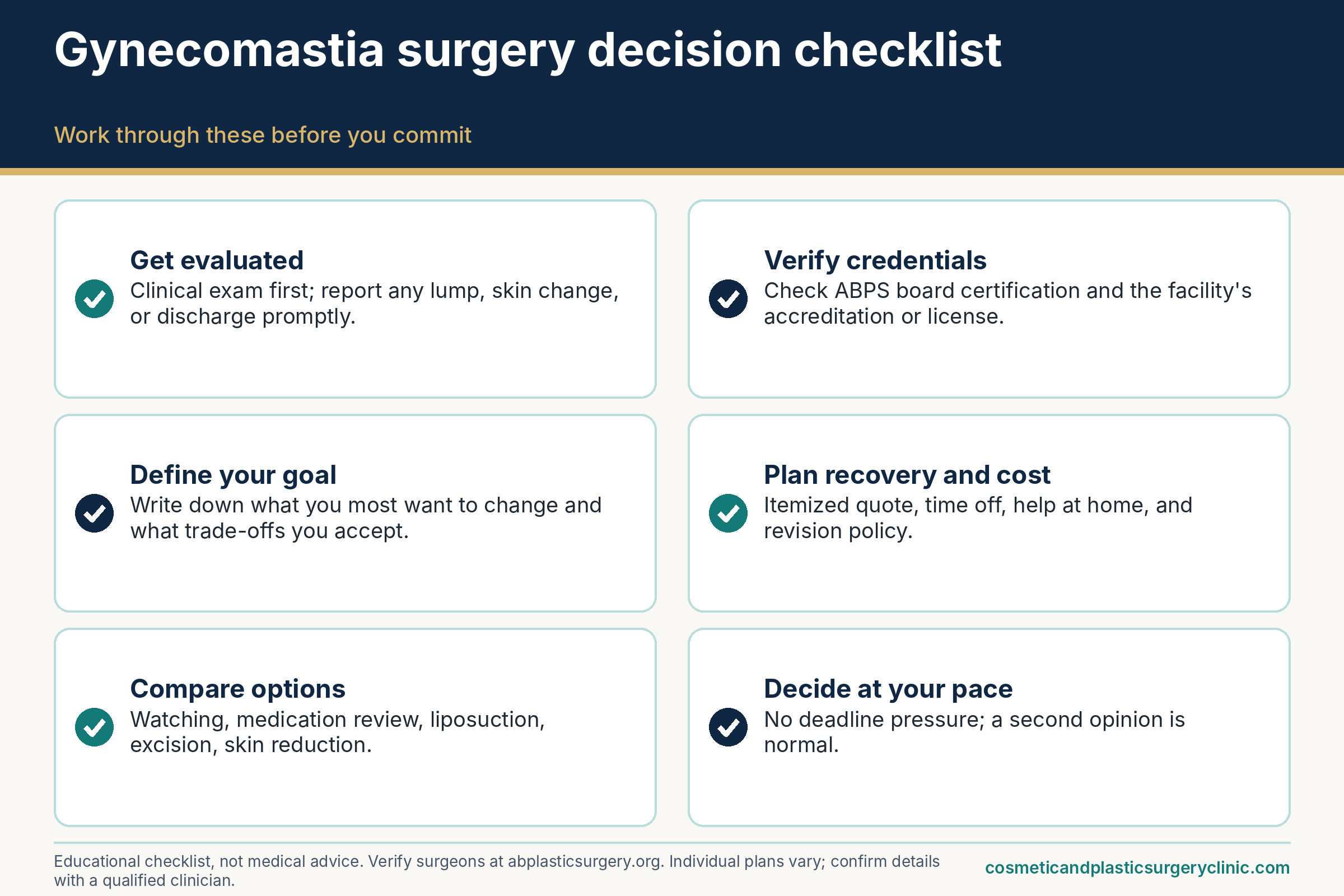
Making the Decision
The remaining questions are personal. They’re not less important for being hard to measure.
Body image, bullying, and mental health: handling the emotional side
Gynecomastia is a medical condition that happens to be visible, and it can carry social weight well out of proportion to its physical effects. StatPearls describes depression, social isolation, avoidance of activities that require removing a shirt, and low self-esteem among its psychological effects, and Mayo Clinic notes that while gynecomastia has few physical complications, it may lead to mental health concerns tied to how the chest looks. Men and boys describe skipping swimming, changing clothes in bathrooms, or avoiding intimacy, and some have been teased or bullied. None of that reflects a character flaw. It reflects a common experience of a common condition.
Two ideas can coexist. It is entirely reasonable to want surgery for gynecomastia that is bothering you, and it is equally reasonable to decide that your chest is fine and you’re not interested in changing it. Neither choice needs to be justified to anyone. What matters is that the decision be yours, informed by accurate information and not pushed by teasing, advertising, or a sense that something is wrong with you.
If distress is significant, consider support that runs alongside the physical question. A primary care clinician, pediatrician, school counselor, or therapist can help with anxiety, low mood, or the effects of bullying, and parents of teens can ask for that support without waiting for a surgical decision. If bullying is happening at school or online, it deserves to be addressed on its own terms. If you or someone you know is thinking about self-harm or suicide, the 988 Suicide & Crisis Lifeline offers free, confidential support by call or text to 988, around the clock in the United States.
One more point for parents and partners. Reassurance such as “it’s not that noticeable” often lands as dismissal. Listening to what is actually bothering the person, and supporting a medical evaluation, usually goes better than debating whether the concern is justified.
A decision framework and planning checklist
A simple sequence can keep the process orderly. The first step is evaluation, because everything else depends on knowing what you’re dealing with. The second is to define your goal in your own words: a flatter contour, relief from tenderness, comfort without a shirt, or something else. The third is to compare options, including watching and waiting, and to put each against your tissue type, duration, and tolerance for scars and recovery. The fourth is to verify credentials and facility. The fifth is to plan the logistics: a recovery calendar, time off, help at home, and a budget that accounts for every line item. The sixth is to decide, without a deadline imposed by a discount or a calendar slot.
It can help to translate these steps into if-then rules for yourself. If the evaluation hasn’t been done or something unusual was found, then evaluation comes before any surgical consultation. If the enlargement is recent and you’re in your teens, then waiting with follow-up is a legitimate option. If the tissue is mostly fatty and your weight is still changing, then stabilizing weight may come first. If you’re still using a substance linked to breast growth, then surgery may not address the cause. If your goals depend on a result no surgeon can promise, then that’s worth discussing before booking. If you’re comfortable with the trade-offs, have verified your surgeon and facility, and have a recovery plan, then moving ahead is a considered choice and not a leap.
Finally, build in a pause. Many people benefit from a week between consultation and commitment, and from a second consultation if the first left unresolved questions. A reputable practice will not penalize that. Take the question list, the quote worksheet in the cost section, and the recovery calendar with you, and decide from there.
Frequently asked questions
Is gynecomastia the same thing as having extra chest fat?
Not always. Fat over the chest without gland growth is called pseudogynecomastia, while true gynecomastia involves glandular tissue, often with fat around it. The two can look similar in photos and in the mirror, which is why a hands-on exam matters. A rough clue is texture: a firm, rubbery disk under the nipple suggests gland, while soft, evenly spread fullness suggests fat. That clue is only a clue, and it shouldn’t replace an examination, particularly if there is a lump on one side only.
Is gynecomastia surgery painful?
Anesthesia keeps you comfortable during the operation, and ASPS lists intravenous sedation and general anesthesia as options. Afterward, soreness, tightness, and tenderness are common, and the amount varies a lot from person to person and by technique. Surgeons generally prescribe or recommend pain medication and tell you which over-the-counter products to avoid because some affect bleeding. Pain that is severe, getting worse after the first days, or paired with rapid swelling on one side should be reported to the surgical team promptly.
Can surgery be done on just one side?
Technically yes, but one-sided enlargement is a special case. Because a firm, one-sided change in a man is something clinicians examine closely, the evaluation should come first, and imaging may be part of it. If the finding turns out to be benign gynecomastia, a surgeon can discuss treating one side, though operating on only one side can make the other look more prominent by comparison, and many surgeons talk through that trade-off before deciding.
Do I need to stop medications or supplements before surgery?
Possibly, but that decision belongs to your surgeon, the anesthesia team, and whoever prescribes the medication. Some products, including certain supplements and pain relievers, can affect bleeding, and nicotine affects healing. Others, like heart or blood-pressure medications, may need to continue. Bring a complete list to the consultation, including over-the-counter products and anything you take for training or recovery. Don’t stop a prescription on your own because of something you read, including this guide.
Does having gynecomastia raise the chance of breast cancer?
Gynecomastia is a benign condition, and in most men it is not a sign of cancer. Some medical conditions, notably Klinefelter syndrome, are linked to both gynecomastia and a higher relative risk of male breast cancer, which is why clinicians screen for them. A separate point is that gynecomastia doesn’t make a new hard lump, skin change, or nipple discharge harmless. Those findings need an exam regardless of whether you already know you have gynecomastia.
Can gynecomastia surgery be combined with other procedures?
Some men have liposuction of other areas, such as the abdomen or flanks, in the same session, and surgeons differ on how much to combine. Longer total anesthesia time, more recovery restrictions, and more potential complications are the trade-offs, and for some people a staged approach makes more sense. It’s reasonable to ask the surgeon what they recommend for your health and goals, what extra cost applies, and how recovery changes when more than one area is treated.
Can gynecomastia come back after surgery?
It can. Tissue removed during surgery is gone, but breast tissue that remains can grow again if the same drivers return. Examples include continued exposure to a substance linked to breast growth, significant weight gain, a medical condition affecting hormones, or surgery during adolescence while development is ongoing. Men sometimes confuse leftover tissue from the first operation with recurrence. The distinction matters because it changes whether the next step is observation, evaluation of a cause, or a revision.
How should I read online before-and-after photos?
Look for consistent angles, lighting, posture, and time since surgery. Ask whether the patient photographed had a similar tissue type and size as you, and whether the images are of the surgeon’s own work. Treat any gallery as a sample selected by the practice, not as a prediction. Be wary of images that look edited, show only the best angle, or don’t state follow-up time. Photos tell you about style and typical contour, but they can’t tell you what will happen with your anatomy.
Who should come with me on surgery day?
Plan for a responsible adult to drive you home and stay with you at least the first night, since anesthesia and pain medication can affect judgment and coordination. If a drain is placed, a second person can help with emptying and recording output until you’re comfortable doing it. For teenagers, a parent or guardian typically attends. Ask the practice whether it requires a particular arrangement, and set up meals, laundry, and rides before the day so help isn’t being improvised.
How much does gynecomastia surgery cost?
For the surgeon’s fee alone, ASPS lists a projected 2024 range of $5,000 to $9,000 for male breast reduction, and states that its separate average of $5,587 excludes anesthesia and operating room facility fees. Your total will depend on the extent of surgery, geography, anesthesia, and facility. Neither figure is a quote, so request an itemized one in writing. If you are weighing practices against each other, compare what each quote includes, not just the headline number.
What if two surgeons recommend different techniques?
That happens, and it doesn’t necessarily mean one is wrong. Techniques overlap, and the literature doesn’t show a single best approach for all patients. Ask each surgeon why they favor their plan, what trade-offs they see, what scars they expect, how they handle residual tissue, and how often they perform the procedure. Bring photos or notes from the first visit to the second. The goal is to understand the reasoning, then choose the plan and the surgeon you trust to carry it out.
Sources and further reading
- American Society of Plastic Surgeons — Gynecomastia surgery overview (accessed 2026-10-03) — definition, causes, 2024 growth statement
- American Society of Plastic Surgeons — Gynecomastia surgery candidates (accessed 2026-10-03) — candidacy and adolescent timing
- American Society of Plastic Surgeons — Gynecomastia surgery procedure (accessed 2026-10-03) — anesthesia options and technique categories
- American Society of Plastic Surgeons — Gynecomastia surgery safety (accessed 2026-10-03) — listed risks and consent
- American Society of Plastic Surgeons — Gynecomastia surgery recovery (accessed 2026-10-03) — dressings, garment, drain, warning symptoms, durability
- American Society of Plastic Surgeons — Gynecomastia surgery cost (accessed 2026-10-03) — average cost figure, exclusions, insurance statement
- American Society of Plastic Surgeons — 2024 average surgeon/physician fees (accessed 2026-10-03) — projected fee range for male breast reduction and method note
- American Society of Plastic Surgeons — 2024 cosmetic procedures in men (accessed 2026-10-03) — 2024 procedure count among ASPS member surgeons
- American Society of Plastic Surgeons — Recommended insurance coverage criteria for gynecomastia (approved March 2002; accessed 2026-10-03) — professional-society coverage criteria
- American Society of Plastic Surgeons — Male breast reduction improves quality of life for teens, even with complications (June 2022 study; accessed 2026-10-03) — adolescent quality-of-life and complication figures
- American Society of Plastic Surgeons — Choose a plastic surgeon you can trust (accessed 2026-10-03) — board certification and accredited facility guidance
- American Board of Plastic Surgery — Verify a surgeon’s certification (accessed 2026-10-03) — public verification tool and certification notes
- MedlinePlus — Breast enlargement in males (reviewed October 1, 2024; accessed 2026-10-03) — causes, symptoms, when to seek care
- Vandeven HA, Pensler JM — Gynecomastia, StatPearls (updated August 8, 2023; accessed 2026-10-03) — definition, causes, grading, evaluation, surgical timing
- Dickson G — Gynecomastia, American Family Physician 2012;85(7):716-722 (accessed 2026-10-03) — age patterns, drug causes, evaluation, treatment
- Gynecomastia: pathophysiology, evaluation, and management, Mayo Clinic Proceedings 2009 (abstract; accessed 2026-10-03) — evaluation approach and evidence quality
- Mayo Clinic — Gynecomastia: symptoms and causes (October 26, 2023; accessed 2026-10-03) — causes, when to see a doctor, mental health effects
- NHS — Gynaecomastia (reviewed May 31, 2024; accessed 2026-10-03) — symptoms, causes, and when to see a doctor
- American Cancer Society — Key statistics for breast cancer in men (2026 estimates; accessed 2026-10-03) — incidence, lifetime risk, age at diagnosis
- American Cancer Society — Signs and symptoms of breast cancer in men (accessed 2026-10-03) — warning signs and advice to have changes checked
- Innocenti A, Melita D, Dreassi E — Incidence of complications for different approaches in gynecomastia correction: a systematic review, Aesthetic Plastic Surgery 2022 (accessed 2026-10-03) — pooled complication figures and their limits
- Holzmer SW, et al. — Surgical management of gynecomastia: a comprehensive review of the literature, Plastic and Reconstructive Surgery Global Open 2020 (accessed 2026-10-03) — hematoma, seroma, and drain findings
- Soliman AT, De Sanctis V, Yassin M — Management of adolescent gynecomastia: an update, Acta Biomedica 2017 (accessed 2026-10-03) — spontaneous resolution in puberty
- Morselli PG, Morellini A — Breast reshaping in gynecomastia by the pull-through technique, European Journal of Plastic Surgery 2012 (accessed 2026-10-03) — dual-plane liposuction with remote-incision excision
- Using ultrasound and power-assisted devices through lateral incision: the OCCULT technique for gynecomastia, Thieme 2025 (accessed 2026-10-03) — single-series report of a combined-device technique
- Shirah BH, Shirah HA — Incidental ductal carcinoma in situ in the surgical management of young male gynecomastia, Breast Disease 2016 (accessed 2026-10-03) — rationale for pathologic examination of removed tissue
- 988 Suicide & Crisis Lifeline (accessed 2026-10-03) — free, confidential U.S. crisis support by call, text, or chat