Liposuction risks usually arrive as a flat list on a consent form: bruising, infection, dents, blood clots, all in the same tone. The list doesn’t say which item belongs to an ordinary second week of recovery and which one belongs in an emergency department. This page sorts them, puts a source and a year on every number, and explains the mechanism behind each problem, whether that is depth, heat, fluid, volume or time.
The American Society of Plastic Surgeons (ASPS) counted 349,728 liposuction procedures in its 2024 statistics report, so the operation is common. Common is not the same as low-risk for you, and this page is general education, not a prediction. For the wider question of what liposuction changes and what it can’t, see the main liposuction guide; for risk-reading skills that apply to every operation, see the general plastic surgery risks page.

Sorting liposuction risks into expected, complicated and urgent
What the operation itself does to the body
Swelling, bruising and soreness are the baseline, not the exception
Liposuction works by passing thin tubes called cannulas back and forth through the fat layer, and each pass is a small tunnel of injury. Fluid from the infiltrated solution and from the body’s own inflammatory response collects in the treated layer. That is why swelling and bruising count as expected effects rather than reportable liposuction risks.
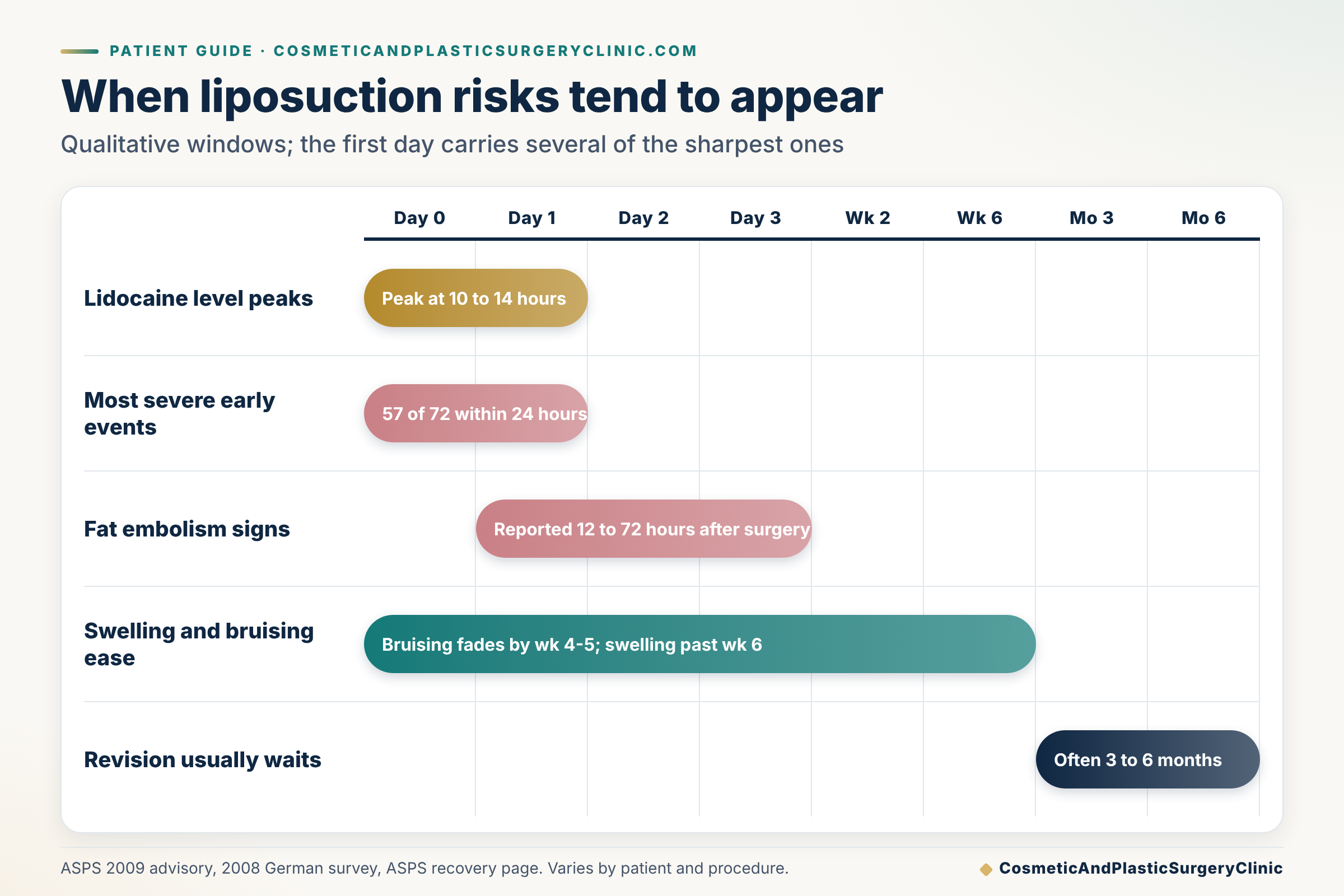
The ASPS recovery page describes bruising as typically gone by weeks 4 to 5, with swelling beginning to subside then and continuing to improve after week 6. Mayo Clinic says to expect pain, swelling and bruising, and compression garments for a few weeks. Your surgeon’s written instructions override any general range. The useful test is the pattern: expected effects ease from day to day and match what your discharge papers describe. The liposuction recovery guide covers the week-by-week arc.
Numbness, tightness and a lumpy feel in the first weeks
Cannulas irritate small sensory nerves in the fat and skin, so numb patches and a tight, pulled feeling are common early on. Mayo Clinic notes that numbness may be temporary or lasting, which is why the question is whether the numb area is shrinking over weeks rather than whether it exists.
Firmness and a rope-like or bumpy texture can also appear while tissue heals. In the first weeks this can’t be separated from a true contour problem by looking or touching, which is one reason surgeons wait before judging a result. The ASPS safety advisory on liposuction says revisions should generally wait 3 to 6 months after the original procedure.
Where the line into complication sits
A complication is a result that needs treatment, a second look or a new plan
Studies define the word differently, and the definition drives the number. The largest data set reviewed here, a 2017 Aesthetic Surgery Journal analysis of the CosmetAssure database, counted a “major complication” only when it led to an emergency room visit, a hospital admission or a reoperation within 30 days. A seroma drained in the office, a dent that appears at month four or a result you’re unhappy with may never register in a count like that.
So a low published figure for liposuction risks tells you about serious early events in a specific group of patients. It says less about the full range of problems, including the ones you can see in a mirror.
Why published liposuction risks vary so much between studies
A 2015 analysis of more than 4,500 liposuction cases in the ASPS surgeon-reported TOPS registry found an overall complication rate of 1.5%, with major complications in fewer than 1 in 1,000 patients; the most common problem was seroma needing drainage. Dermatology researchers have described tumescent series covering more than 100,000 treated body areas without serious complications. A German case-finding survey, by contrast, identified 72 severe complications including 23 deaths across 1998 to 2002.
These figures answer different questions. Registries and single-practice series count what participating surgeons report, while a survey that hunts for severe cases finds what routine reporting misses and can’t give a rate, because it has no denominator. Treat each figure for liposuction risks as a window onto one population, and ask your surgeon for numbers from their own practice, with a definition attached.
| What you notice | Usual category | General action level | Basis |
|---|---|---|---|
| Swelling, bruising and soreness that ease from day to day | Expected effect | Follow written instructions; keep notes | ASPS recovery page; surgeon’s discharge guidance |
| Swelling that is firm, growing or one-sided; a bruise that keeps spreading | Possible hematoma or fluid collection | Same-day call to the surgeon’s office | Mayo Clinic; Aesthetic Surgery Journal 2017 |
| Spreading redness, warmth, cloudy drainage or fever | Possible infection | Call the provider right away | CDC, surgical site infections |
| Blistering, a dusky or darkening skin patch, or burning pain over the treated area | Possible heat injury or skin necrosis | Same-day call; go to emergency care if severe | ASPS risks page; Cleveland Clinic Journal of Medicine 2020 |
| Swelling, pain and warmth in one calf or arm | Possible deep vein clot | Contact a doctor as soon as possible | CDC, blood clots |
| Chest pain, trouble breathing, coughing up blood or fainting | Possible pulmonary embolism, fat embolism or fluid overload | Emergency care: call 911 | CDC; ASPS safety advisory 2009 |
| Metallic taste, ringing in the ears, slurred speech, twitching or a seizure | Possible lidocaine toxicity | Emergency care: call 911 | ASPS safety advisory 2009 |
| Severe, rising abdominal pain far beyond what you were told to expect | Possible internal organ injury or deep infection | Emergency care: call 911 | Mayo Clinic; Plastic and Reconstructive Surgery 2008 |
| Dents, waves, hard areas or uneven sides once swelling has settled | Contour irregularity, fibrosis or asymmetry | Raise at follow-up; judging usually waits months | ASPS safety advisory 2009 |
Contour irregularity, loose skin and color change: the liposuction risks you can see
Why dents, waves and hard areas form
Depth, cannula movement and uneven removal
Suction removes fat cells from the layer the cannula travels through, so the evenness of the final surface depends on how uniformly the surgeon works across depths and directions. Taking too much from one tunnel, working too close to the skin or leaving a ridge between treated and untreated zones can leave a visible step. A 2020 Cleveland Clinic Journal of Medicine review lists smaller cannulas, avoiding the most superficial layer, crisscross passes and slight undercorrection as the usual preventive habits.
How common are these liposuction risks? That review cites contour deformity in up to 9% of patients, calling it the most common complication, and a 2023 systematic review found study-level figures of up to 9% and, in one 50-patient cohort, 12%. A 2025 meta-analysis of 23 studies reported pooled contour-irregularity rates running from 0.12% with ultrasound-assisted liposuction to 3.36% with suction-assisted liposuction, but its authors warn of heavy heterogeneity and publication bias. Don’t use those figures to pick a device.
Healing tissue: fibrosis, fluid pockets and months of change
Early bumps have several look-alike causes: pockets of retained fluid, scar tissue along tunnels and uneven swelling. Some soften as the tissue remodels, and some do not. Which one you have is a judgment made by examining you over time, not something a photo or article can settle.
Timing therefore matters when weighing liposuction risks. The ASPS advisory’s 3-to-6-month guidance for revisions reflects the wait for swelling and firmness to declare themselves. Photos taken at six weeks can look quite different from photos at one year, a point that the guide to liposuction before-and-after photos develops. If a dent persists, the liposuction revision page covers what correction involves and what it adds in risk.
Skin, pigment and sensation
Skin that doesn’t retract: a planning issue as much as a complication
Fat removal leaves the skin to settle over a smaller volume. ASPS says firm, elastic skin gives better results, while soft, thin skin from stretch marks, weight change or aging reshapes less well. An FDA consumer update (2007, archived) puts it plainly: a lack of skin elasticity can leave the area looking baggy. The ASPS risks page lists loose or rippling skin and possibly more visible cellulite, and notes that additional surgery may be recommended to remove excess skin.
Loose skin differs from a dent. A dent is uneven removal under intact skin; looseness is skin that couldn’t follow the volume change. The distinction shapes the plan before surgery, which is why the comparison in liposuction versus tummy tuck treats skin quality as a starting question rather than an afterthought.
Color change and lasting changes in sensation
The ASPS risks page lists skin color changes and lasting changes in skin sensation among liposuction risks. Numbers are thin. One study summarized in the 2023 systematic review reported hyperpigmentation in 0.02% of about 15,000 isolated procedures, which suggests it is uncommon but doesn’t tell you the rate for darker or lighter skin tones, or for energy-assisted techniques.
Sensation is different: nearly everyone has some early numbness, and the open question is how long it lasts. Mayo Clinic describes numbness as temporary or lasting. Ask your surgeon what they tell patients about sun protection, massage and when to report a numb patch that isn’t shrinking, because these are individual instructions this page can’t give.

Fluid, lidocaine and volume: why liposuction risks can show up inside the body
Fluid shifts and the heart, lungs and kidneys
Where the infiltrated fluid goes
Most modern liposuction injects a large volume of dilute solution into the fat before suction. The ASPS safety advisory states that about 70% of the infiltrate isn’t aspirated and is presumed to enter the circulation. For small cases the body copes. Fluid-related liposuction risks grow with volume: Mayo Clinic warns of fluid shifts that can lead to serious kidney, heart or lung problems, in large-volume cases, and a 2017 narrative review of fatal complications lists pulmonary edema from fluid overload among five serious complications that can cause death.
Warning signs of overload in the advisory include rising blood pressure, a cough, shortness of breath and crackling lung sounds. Teams manage this by tracking fluid in and out and, in large cases, observing patients overnight. Ask who does that tracking.
Why an early blood count doesn’t settle the question
Patients often assume a normal hemoglobin result means all is well. The ASPS advisory notes that hemoglobin may be unreliable in the first 24 hours after liposuction, so a single early value can falsely reassure or alarm. Ongoing symptoms and trends over time carry more information than one early value.
This matters for discharge decisions. The German case-finding survey found that 57 of its 72 severe complications were clinically apparent within the first 24 hours, and its authors named discharge too soon after surgery as a risk factor. When the plan involves several areas or a large volume, ask how long you’d be observed and what makes the team comfortable sending you home.
Lidocaine toxicity: a risk with a long fuse
Dose numbers: the label limit versus tumescent practice
Lidocaine toxicity is one of the better-documented liposuction risks. Tumescent solution mixes lidocaine with epinephrine, and the total dose can be far above what ordinary labeling suggests. A 2017 review notes labeled maximums of 4 to 5 mg/kg, or 7 mg/kg with epinephrine. The ASPS advisory says up to 35 mg/kg is generally accepted as safe in tumescent practice, that doses up to 64 mg/kg have been used, and that 35 mg/kg may not be safe in people with low protein levels or conditions that change how lidocaine is metabolized.
The advisory grades its lidocaine-limit recommendation B on a scale where D means expert opinion, so it rests on better evidence than most items in the document. It also lists ways to lower exposure: a weaker concentration, a superwet technique with less lidocaine, or leaving lidocaine out when general or regional anesthesia is used.
Early symptoms are easy to dismiss at home
The advisory describes a ladder. Mild toxicity can feel like light-headedness, ringing in the ears, a metallic taste or slurred speech. Higher levels bring shivering, twitching and tremors, then convulsions and loss of consciousness, and the highest levels can stop breathing and the heart. At 10 hours post-op, a metallic taste or ringing ears could be mistaken for anxiety, a medication effect or tiredness.
That is the reason to know the early signs before surgery and to treat them as urgent, not as something to sleep off. Neck liposuction deserves its own mention because absorption peaks earlier there, a point to raise if chin or neck treatment is part of your plan.
Large volumes and the 5-liter line
A definition, not a cliff
The ASPS advisory defines large-volume liposuction as 5,000 cc or more of total aspirate, and its position is that these cases belong in an acute-care hospital or an accredited or licensed facility, with overnight monitoring of vital signs and urine output. The same document says no scientific maximum safe volume has been identified. State limits on aspirate vary from 1,000 to 5,000 cc in the states it lists, including California, Florida, Kentucky, New York, Ohio and Tennessee.
The 5-liter number is therefore a convention for managing liposuction risks, not a measured point where harm begins. The advisory also says the reported figure should be total aspirate, not fat alone, because the two differ and only the first reflects the load on the body.
How body mass index changes the volume conversation
In the 2015 TOPS analysis of more than 4,500 cases, the average volume was about 2 liters, while patients who had complications averaged 3.4 liters and had higher BMIs. Above 5 liters the complication rate was 3.7%, against 1.1% at lower volumes, mostly because of more seromas. Patients with lower BMIs showed a steeper rise in risk as volume increased, and the authors proposed a BMI-based relative threshold in place of a fixed 5-liter cutoff.
Treat this with care. It’s a surgeon-reported registry summarized in an ASPS news release that doesn’t give the data period, and the authors state that the threshold is not an absolute limit. What it supports is a question for your consultation: what volume does your surgeon expect to remove at your body size, and why is that the plan?
Clots, fat embolism and organ injury: rare liposuction risks with the highest stakes
Venous clots, fat embolism and what mortality figures can say
Blood clots: a small base rate and a large consequence
Blood clots are among the best-documented serious liposuction risks. In the 2017 CosmetAssure analysis, confirmed venous thromboembolism (a clot in a deep vein, or one that travels to the lung) occurred in 0.06% of people having liposuction alone. A 2023 systematic review reported the same study’s rate for combined procedures as 0.6%, ten times higher. Pulmonary embolism, the lung form, accounts for roughly 23% of deaths in a widely cited 2000 survey of board-certified plastic surgeons, as summarized in a 2013 review.
The CDC says about half of people with a deep vein clot have no symptoms, and a lung clot can occur without any leg symptoms, so waiting for a swollen calf is not a safe plan. The ASPS advisory recommends assessing clot risk factors such as factor V Leiden, oral contraceptives and hormone therapy, and lists compression stockings, intermittent pneumatic compression and anticoagulation as options a team may choose. Which ones apply to you is your team’s decision.
Fat embolism: early, uncommon and easy to mistake for a clot
Fat embolism happens when fat droplets from damaged tissue and vessels enter the bloodstream and lodge in the lungs or, rarely, the brain. The ASPS advisory says the inflammatory syndrome typically appears within 24 to 48 hours, with breathing difficulty, altered mental state and a pinpoint skin rash as the classic triad. Telling it apart from a pulmonary clot matters because treatment differs.
The Cleveland Clinic Journal of Medicine review cites at least 17 clinically significant cases in one 2018 study, more than 135 fatal and nonfatal cases worldwide in later data, mostly after gluteal fat grafting, and a mortality of 10% to 15%. Those counts come from case reports and are likely undercounted. For the buttock-focused version of the problem, see the Brazilian butt lift guide.
What published mortality figures can and can’t tell you
The 2000 survey summarized in the 2013 review counted 95 deaths in nearly 500,000 procedures, or 19 per 100,000. The Cleveland Clinic review cites 0.01% from a 26,259-patient series published in 2009. The 2023 systematic review puts the range at 0 to 0.06% across studies and didn’t pool the data. These sources roughly bracket one to two deaths per 10,000 procedures, with some series reporting none.
Every figure has limits: the 2000 estimate relied on surgeons reporting their own cases, the 2009 series may not reflect today’s practice, and none describes you. The German survey found 23 deaths in five years but, lacking a denominator, couldn’t convert them into a rate. Use the figures to see that the most serious liposuction risks are real and uncommon, then ask how your team reduces them.
Deep injury and infection that spreads
Organ and vessel injury: rare, deep and blind
Among the rarest liposuction risks is injury from a cannula guided largely by feel. If it travels deeper than intended, it can injure nerves, vessels, muscle, lung or abdominal organs; the ASPS risks page lists all of these, and Mayo Clinic says an organ puncture may require emergency surgery. The German survey included perforation of abdominal organs among the causes of death. The 2020 Cleveland Clinic review gives no incidence for visceral perforation, which is itself informative: nobody has a reliable denominator.
A history of hernia belongs on your health form, because the ASPS advisory lists hernia risk among reasons a person may be unsuitable. Technique and experience are the practical defenses, so ask about both directly.
Infection: usually early, seldom catastrophic and always time-sensitive
Infection was the most common cause of severe complications in the German survey, including necrotizing fasciitis, gas gangrene and several forms of sepsis. Its authors pointed to poor hygiene, multiple liters of wetting solution, discharge too soon after surgery, unfit patients and inexperienced surgeons. In the CosmetAssure data, infection led to a major event in 0.1% of liposuction-alone cases and 0.7% of combined cases.
The CDC lists redness and pain around the surgical area, cloudy drainage and fever as signs, and says to call your provider right away. When you can’t tell whether redness is spreading, call. Mayo Clinic adds that a severe skin infection can be life-threatening.
Burns, collections and the technique question
Heat injury from energy-assisted devices
How heat reaches the skin
Heat is one of the liposuction risks that depends most on the device. Ultrasound, laser and radiofrequency devices add energy to the tissue before or during suction. Where that energy reaches the underside of the skin, it can burn it. The ASPS risks page lists burns from the ultrasound-assisted technique, and the 2025 meta-analysis of 23 studies notes that energy devices in general are linked to higher rates of thermal injury, seroma and contour irregularities, with radiofrequency-assisted liposuction showing the highest burn and blistering rates in its data.
The same paper reports that, in one cited study, ultrasound-assisted cases had more burns than suction-only cases, and attributes this to prolonged ultrasonic energy time. It also describes protective habits such as keeping skin no warmer than the surgeon’s hand and limiting passes in the subdermal plane. Evidence quality is limited: publication bias was high and most studies didn’t report device power or duration.
FDA clearance is not a safety record
The FDA regulates the devices and anesthetic drugs used in liposuction. Its archived consumer pages explain that a device must be shown to be reasonably safe and effective for its intended use before it can be sold, that a device similar to an existing one can be cleared with less information, and that doctors may use a cleared device for another purpose, called off-label use. They also say any licensed physician may perform liposuction and that no standardized training is required.
Together, these points mean that a marketing claim about liposuction risks, such as “FDA-cleared,” says little about how often burns occur in a particular surgeon’s hands. Ask which device is planned, why it suits your anatomy, how many times the surgeon has used it, and how they monitor skin temperature. The techniques comparison goes through each device family in more detail. The FDA pages used here are archived copies from 2002 and 2007, and current rules may differ.
Blood and fluid collections under the skin
Hematoma: a pocket of blood
A hematoma is a collection of blood outside the vessels. In the CosmetAssure data, hematoma occurred in 0.15% of liposuction-alone cases and 0.60% of combined cases, as the 2023 systematic review reports. The same 2017 study found a lower hematoma risk when other aesthetic procedures were combined with liposuction than when they were done alone (relative risk 0.77), a result its authors called paradoxical and in need of more study.
A hematoma tends to look like swelling that is firm, tense, growing or one-sided, sometimes with a bruise that keeps darkening. Whether it needs drainage, observation or a return to the operating room is a surgeon’s call. What helps you is reporting it early, before pressure harms the overlying skin.
Seroma: a pocket of fluid
A seroma is a collection of clear or straw-colored fluid, and both kinds of collection rank among the commonest liposuction risks. The TOPS registry analysis found seroma needing drainage was the most common complication, and Mayo Clinic notes that fluid pockets may need to be drained with a needle. Reported rates swing widely: the 2023 systematic review lists about 2% in isolated liposuction in one study, 10% in another cohort and 2% to 19% in combined procedures.
That spread illustrates why you shouldn’t anchor on one number. Seroma risk also rises with the volume removed, and the 2020 Cleveland Clinic review notes progressive tension sutures lowered abdominoplasty seroma from 9% to 2%, evidence from abdominal surgery rather than liposuction alone. If you have drains or a garment plan, ask what the team looks for at each visit.
| Complication | Reported figure | Source, year and population | Main limit |
|---|---|---|---|
| Contour irregularity | Up to 9%; 12% in one 50-patient cohort | Cleveland Clinic Journal of Medicine 2020; systematic review 2023 | Definitions and follow-up times differ; no pooled estimate |
| Seroma | About 2% alone (one study); 2% to 19% combined | Systematic review 2023, study-level values | Wide spread; drainage thresholds differ |
| Hematoma | 0.15% alone; 0.60% combined | CosmetAssure, 2008 to 2013, 31,010 procedures | Counts only major events within 30 days |
| Infection | 0.1% alone; 0.7% combined | CosmetAssure, 2008 to 2013 | Severe cases are rarer than this and not separated out |
| Heat injury (burns) | No reliable overall rate | Meta-analysis 2025, 23 studies | High publication bias; device power and time seldom reported |
| Fluid overload | No reliable rate found | ASPS advisory 2009; narrative review 2017 | Evidence is case-based and expert opinion |
| Lidocaine toxicity | No incidence given | ASPS advisory 2009; Cleveland Clinic review 2020 | Reviews describe it but don’t count it |
| Venous thromboembolism | 0.06% alone; 0.6% combined | CosmetAssure, 2008 to 2013 | Confirmed events only; 30-day window |
| Fat embolism | At least 17 significant cases in one 2018 study | Cleveland Clinic review 2020, case counts | Case-based and likely undercounted |
| Internal organ injury | No incidence given | Cleveland Clinic review 2020; German survey 2008 | No denominator; rare events reported as cases |
Why your liposuction risks differ from the average
What you bring to the operating table
Body mass index, health conditions and clot history
Several traits shift liposuction risks, and two have numbers behind them. In the CosmetAssure model, age (relative risk 1.01) and BMI (1.05) were independent risk factors for major complications in liposuction patients, with the figures applying to each added year or BMI point. Small per-unit effects add up across decades or across a large BMI gap. The ASPS advisory classes a BMI of 35 or higher as severe obesity, with higher risks of wound-healing problems, infection, deep vein thrombosis and sleep apnea.
Mayo Clinic says people with poor blood flow, coronary artery disease, diabetes or a weak immune system may not be candidates, and the FDA’s 2007 consumer update names conditions or medications that affect wound healing. A personal or family history of clots, hormone therapy or an oral contraceptive belongs on the history form because the team uses it to plan clot prevention. Nicotine and other modifiers that apply across operations are covered on the general risk page linked in the introduction.
Medications and supplements: disclose them, don’t self-adjust
Two kinds of medicine matter especially. Blood thinners affect bleeding and clotting, and some drugs interfere with how the liver processes lidocaine, which is relevant to toxicity. The 2020 Cleveland Clinic review says anticoagulants and lidocaine-interfering drugs should be stopped beforehand; Mayo Clinic says the same about blood thinners and anti-inflammatory drugs.
Whether, when and how to stop any prescription is a decision for the prescriber and surgeon together. Nobody should stop a heart or clot medication on the strength of an article. Bring the complete list, including over-the-counter products and supplements, and ask for the change plan in writing.
What the plan and the setting add
Combined operations multiply the unknowns
Combining operations raised liposuction risks more than any other factor in the CosmetAssure model, with a relative risk of 4.81 for major complications among liposuction patients. Added to another aesthetic operation, liposuction was associated with a higher risk of clots (relative risk 5.65), lung complications (2.72) and infection (2.41), compared with those other procedures done alone. The advisory reports serious complications when large-volume liposuction is combined with abdominoplasty, and notes state caps on combined cases (1,000 cc of supernatant fat in Florida, 2,000 cc in Tennessee).
If your plan includes a combination such as liposuction with a tummy tuck, the tummy tuck guide covers the added operation’s own risks.
Where the surgery happens and who watches afterward
In the CosmetAssure data, procedures performed in hospitals carried a relative risk of 1.36. The abstract doesn’t explain it, and hospitals may take sicker patients or longer operations, so it is not evidence that hospitals are less safe or that other settings are safer.
What the advisory emphasizes is fit: ASPS members must operate in accredited facilities and meet state rules, some states limit ambulatory surgery duration to between 2 and 8 hours, and large-volume cases belong in a hospital or accredited or licensed facility with overnight monitoring. The FDA’s consumer pages note that any licensed physician may perform liposuction, so verifying credentials matters; the surgeon verification guide shows how to do it. If you’re considering surgery abroad, follow-up care at home becomes a risk factor of its own.
| Factor | Why it matters | Question to ask | What is uncertain |
|---|---|---|---|
| Higher BMI or chronic illness | Linked to more major complications, wound and clot problems | How do my health conditions change the plan or the setting? | Per-unit effects are small; thresholds vary by study |
| Clot history, hormones | Clot risk is the most-cited cause of death | What clot-prevention steps will you use, and when? | Evidence on prophylaxis in liposuction is mostly expert opinion |
| Combined procedures | Associated with several-fold higher clot, lung and infection risk | Why combine, and what would you separate? | Observational data; cause not proven |
| Total aspirate volume | Complications rise with volume, especially at low BMI | What volume do you expect, and what is your cap? | No scientific maximum; 5 liters is a convention |
| Setting and monitoring | Determines who can respond to fluid, drug or clot problems | Who monitors me, for how long, and where do I go if there is trouble? | Setting data are confounded by patient mix |
| Surgeon training and device experience | Training in liposuction isn’t standardized for all licensed physicians | What training and case volume do you have with this technique? | No reliable public complication rates per surgeon |
Turning liposuction risks into consultation questions and a decision
Questions that expose the plan
Volume, areas and technique: ask for the reasoning
Specific questions about liposuction risks get better answers than “is it safe?” Ask how many areas are planned, what total aspirate you should expect, whether the plan includes energy devices, and what would make the surgeon stop or stage the operation. The answer to “what is your largest typical volume at my body size?” tells you more than any brochure. Price questions come second, and a lower quote shouldn’t tip a safety decision.
Ask also how the surgeon handles a contour problem; a revision plan and its cost in writing show that the team has considered the less dramatic risks too.
Anesthesia, monitoring and the first night
Ask who provides the anesthesia and what credentials they hold, what the plan for lidocaine dosing and fluid tracking is, and whether someone will stay with you overnight. Ask which facility will treat you if you need admission, whether it is the same place where surgery occurs, and how to reach a clinician after hours.
Mayo Clinic advises arranging a driver and someone to stay with you at least the first night. Those logistics are risk controls, since the hours after discharge are when lidocaine levels peak and when many early complications declare themselves. The consultation guide gives a longer list of questions and a way to judge the answers.
Weighing risk against waiting
Answers that inform versus answers that deflect
An informative answer names a specific risk, gives a number or a range with its source, says what the team does to lower it, and admits what is unknown. A deflecting answer sounds like “we’ve never had a problem,” “it’s very safe” or “that won’t happen to you.” A surgeon who can’t discuss complications they’ve treated, or who rushes your consent, is giving you information about the practice.
Bring the numbers on liposuction risks you’ve collected from this page and ask whether they match the surgeon’s experience. A second opinion on the plan, the volume and the setting is a reasonable request, and a confident surgeon will not resent it.
When “not yet” or “not at all” is a sound answer
Some patients decide that their liposuction risks outweigh what the operation can offer: a combined plan that feels too large, a health issue that needs stabilizing first, a body-weight trajectory that is still changing, or simply discomfort with the answers they got. The FDA’s consumer update lists diet, exercise, clothing and accepting your body as alternatives, and the ASPS says liposuction is not a treatment for obesity.
Waiting has a cost, mainly time, but it keeps every option open. If you do proceed, the candidacy page describes what surgeons weigh, and the sort of person who is told to wait.
Frequently asked questions
Do liposuction risks drop automatically with local anesthesia?
Not automatically. Local or tumescent anesthesia avoids some general-anesthesia concerns but adds others, since liposuction risks also come from lidocaine dose and fluid load, and dermatology researchers have reported more than 100,000 treated body areas without serious complications in tumescent series. But the German case-finding survey recorded four deaths in cases it classed as true tumescent anesthesia, and lidocaine dose, fluid load, hygiene and discharge timing still matter. The setting, the team’s monitoring and the volume carry as much weight as the anesthesia label. Ask your surgeon how they manage lidocaine limits and fluid in your specific plan.
When do liposuction risks show up: hours, days or weeks?
It depends on the risk, because liposuction risks follow different clocks. In the German survey, 57 of 72 severe complications were apparent within 24 hours. Lidocaine levels peak roughly 10 to 14 hours after infiltration, and fat embolism syndrome typically appears within 24 to 48 hours, according to the ASPS advisory. Dents and firmness take months to judge, and swelling keeps improving past week 6. Clot timing isn’t pinned down in the sources used here, so watch for symptoms throughout recovery and follow your written instructions.
Can I fly or take a long car trip soon after liposuction?
That is a surgeon-specific decision, and no source reviewed here gives a safe interval. The reasoning is about clots: the CDC says people confined to bed after surgery should move as soon as they can, and a 2020 review encourages same-day walking after liposuction. Long periods seated or flying are the opposite of movement. If your surgery is far from home, the medical tourism page explains why the return trip needs planning before booking.
What should I tell emergency staff if something goes wrong?
Say what operation you had, the date, what anesthesia and numbing medicine were used, roughly how much fluid or fat was removed if you know, and which medicines you take. Bring your discharge papers and the surgeon’s after-hours number. Mention tumescent lidocaine explicitly if the surgery was in the last day or two, since a metallic taste, ringing ears, twitching or confusion can look like anxiety to someone who doesn’t know the history. Ask the surgeon’s office beforehand which hospital they’d want you to use.
Do compression garments or walking lower the chance of a clot?
Sources describe both as part of clot prevention, without giving a figure for how much. The ASPS advisory lists graduated compression stockings and intermittent pneumatic compression among prophylaxis options and says compression garments are generally worn for several weeks; a 2020 review encourages same-day walking. Fit and wear time are surgeon-directed, so follow your surgeon’s instructions rather than improvising.
Do newer devices lower liposuction risks?
Not reliably. Liposuction risks differ by technique in the data, but a 2025 meta-analysis of 23 studies found different complication rates across suction, power, ultrasound, laser and radiofrequency methods, but with wide heterogeneity, high publication bias and little reporting of volume or device settings. Energy devices were linked to more heat injury in general. The techniques page linked earlier covers the comparison in more depth.
Does age or sex change liposuction risks?
Age did change liposuction risks in the CosmetAssure model, modestly: a relative risk of 1.01 for each added year, alongside BMI at 1.05 per point. No source opened for this page gives a verified, sex-specific complication rate, so none is offered here. Whatever your age or sex, the larger drivers in the data were combined procedures, body size and volume. Your surgeon can explain how your own health history shifts the picture.
Sources and further reading
- American Society of Plastic Surgeons — Evidence-Based Patient Safety Advisory: Liposuction (Haeck et al., Plastic and Reconstructive Surgery 2009) (accessed 2026-11-12) — lidocaine dosing and timing, volume definitions, fluid, clots, fat embolism, revision timing
- American Society of Plastic Surgeons — Liposuction risks and safety (accessed 2026-11-12) — risk list including burns with ultrasound-assisted technique
- American Society of Plastic Surgeons — Liposuction recovery (accessed 2026-11-12) — bruising and swelling timeline
- American Society of Plastic Surgeons — Liposuction overview (accessed 2026-11-12) — skin elasticity, not a treatment for obesity
- American Society of Plastic Surgeons — 2024 Plastic Surgery Statistics Report (accessed 2026-11-12) — 349,728 liposuction procedures in 2024
- Aesthetic Surgery Journal (2017) via QxMD — Cosmetic Liposuction: Preoperative Risk Factors, Major Complication Rates, and Safety of Combined Procedures (accessed 2026-11-12) — CosmetAssure data, 31,010 procedures, 2008 to 2013
- EurekAlert / American Society of Plastic Surgeons (2015) — news release on liposuction volume and BMI, TOPS registry analysis (accessed 2026-11-12) — complication rates by volume and BMI
- Plastic and Reconstructive Surgery Global Open (2013) — Advances in Liposuction: Five Key Principles with Emphasis on Patient Safety and Outcomes (accessed 2026-11-12) — 2000 mortality survey as summarized
- Plastic and Reconstructive Surgery (2008) via QxMD — Major and Lethal Complications of Liposuction: A Review of 72 Cases in Germany between 1998 and 2002 (accessed 2026-11-12) — severe complications, deaths, timing and risk factors
- Revista Brasileira de Cirurgia Plástica (2023) — Complications in liposuction: systematic review (accessed 2026-11-12) — study-level rates for seroma, contour, pigment, VTE and mortality
- European Journal of Plastic Surgery (2025) — Comparison of complications in isolated aesthetic liposuction procedures across different techniques: a systematic review and meta-analysis (accessed 2026-11-12) — technique comparison and limits
- Plastic and Reconstructive Surgery Global Open (2017) — Strategies for Reducing Fatal Complications in Liposuction (accessed 2026-11-12) — five serious complication categories, labeled lidocaine limits
- Cleveland Clinic Journal of Medicine (2020) — Liposuction: Concepts, safety, and techniques in body-contouring surgery (accessed 2026-11-12) — contour deformity, fat embolism, mortality and prevention habits
- Western Journal of Emergency Medicine (2020) — Plastic Surgery Complications: A Review for Emergency Clinicians (accessed 2026-11-12) — complication categories seen in emergency departments
- Journal of Drugs in Dermatology (2011) — Safety of Tumescent and Laser-Assisted Liposuction: Review of the Literature (accessed 2026-11-12) — tumescent series without serious complications
- Mayo Clinic — Liposuction (accessed 2026-11-12) — risks, fluid shifts, who may not be a candidate, what to expect
- Centers for Disease Control and Prevention — About blood clots (accessed 2026-11-12) — DVT and PE symptoms and when to seek care
- Centers for Disease Control and Prevention — About surgical site infections (accessed 2026-11-12) — infection signs and when to call
- U.S. Food and Drug Administration — The Skinny on Liposuction, FDA Consumer Update, 2007 (archived copy) (accessed 2026-11-12) — training, device regulation, candidacy cautions
- U.S. Food and Drug Administration — Liposuction page, 2002 (archived copy) (accessed 2026-11-12) — device clearance and off-label use