A gynecomastia consultation is the visit where a clinician works out what the enlarged chest is made of, checks whether anything else needs attention first, and only then asks whether an operation is worth discussing. It is also the first real look at how a particular surgeon thinks. The same chest can be firm glandular tissue, soft fat, or a mix of the two, and the questions that matter change with each.
This page walks through a gynecomastia consultation from both sides of the exam table: what to prepare, what is examined and sometimes ordered, which questions bring out a surgeon’s actual plan, and how to compare two offices without pressure. It describes general practice and never tells any reader what he needs. The condition and the operations themselves are covered in gynecomastia surgery, and the general consultation checklist for any procedure lives on the plastic surgery consultation page.
Preparing for a gynecomastia consultation: the history that shapes the plan
Most of the useful information at a gynecomastia consultation comes from the patient, not from the exam. Chest enlargement in men reflects a balance between estrogen and testosterone signaling, and that balance can be shifted by medicines, substances, illness and age. A surgeon who does not know your history is guessing about the cause, and the cause decides whether surgery is the next step or the wrong one.
What to write down before the appointment
Medicines, supplements and substances, including the awkward ones
The American Society of Plastic Surgeons (ASPS) asks patients to be ready to discuss everything they take or use: prescriptions, vitamins, herbal supplements, alcohol, tobacco, recreational drugs and steroids. Bring that as a written list with names and approximate dates, not a recollection. Mayo Clinic lists several medicine groups linked with gynecomastia, among them anti-androgens, anabolic steroids, some HIV medicines, some antidepressants and ulcer drugs, along with alcohol, marijuana, amphetamines and opioids.
An association on such a list is not proof that a given medicine caused a given chest. It is a reason for the clinician to look. MedlinePlus is blunt about one point worth repeating here: do not stop taking any medicine before talking to the provider who prescribed it. The consultation is a place to raise the question, not to settle it alone.
Past anabolic steroid or other substance use belongs on the list too. Surgeons hear this history routinely, and it affects whether the tissue is likely to keep growing and how recurrence is discussed. A 2007 patient brochure from ASPS and the American Society for Aesthetic Plastic Surgery (now the Aesthetic Society) says results often last only if the underlying cause, such as a medicine, drug use or weight gain, is controlled.
Timeline: when it began, how it changed, whether it hurts
Duration is one of the first things a clinician asks at a gynecomastia consultation. In adolescents, gynecomastia often settles on its own: Mayo Clinic gives a window of six months to two years, and a 2017 review in Acta Biomedica reports that 75% to 90% of pubertal cases are self-limited, regressing over one to three years. A 2012 American Family Physician review advises further evaluation when enlargement persists beyond two years or past age 17.
In adults, a timeline helps separate a long-standing, stable chest from one that appeared recently or is changing. Write down the month it started, whether one side came first, whether it is tender, and any link to a new medicine, weight change or illness.
Records and goals to bring
Prior records, photos and weight history
If a primary care doctor, endocrinologist or urologist has already looked at the chest, bring those notes and any blood work, ultrasound or mammogram reports. The U.S. Department of Health and Human Services (HHS) says patients can obtain copies of their records, that providers may charge a reasonable copying fee but not for searching or retrieving them, and cannot refuse copies over an unpaid bill. Ask for records before the gynecomastia consultation, not during it.
Dated photos from earlier years, taken without flexing, show how the chest has changed. So does a weight history: highest and lowest adult weights and roughly when. A surgeon reading a history of recent large weight loss, for example, plans differently from one reading a stable weight, because skin and fat behave differently afterward. Those differences are explored in gynecomastia vs chest fat.
Turning “I want this gone” into specific concerns
Goals stated as “flat” or “normal” are hard to plan around. For a gynecomastia consultation, concrete versions are easier: a puffy nipple that shows through a T-shirt, a firm disc behind one areola, tenderness during exercise, avoiding the pool, a chest that looks different from side to side. Each points to a different tissue problem and a different operation, so naming the specific concern lets the surgeon say what can change and what cannot.
Photos from the internet are fine for showing a goal at a gynecomastia consultation, as long as they stay a communication aid. A surgeon cannot promise to reproduce another man’s chest. The useful question is what shape is realistic for your tissue, skin and nipple position, and how many operations that may take. The same 2007 brochure states that a single procedure may not achieve optimal results.

What happens in the room: the gynecomastia consultation exam and the tests that may follow
The examination at a gynecomastia consultation is short, and it carries more weight than most patients expect. The ASPS consultation page lists what a surgeon may do: review overall health, order diagnostic tests to look for an underlying cause, examine the breasts with measurements of size and shape, skin quality and nipple and areola position, take photographs for the record, and then discuss options, outcomes, risks and anesthesia. A good gynecomastia consultation covers all of it, in roughly that order.
The hands-on exam, step by step
Palpation: firm gland, soft fat, or both
The 2012 American Family Physician review describes the central distinction. True gynecomastia is a firm, rubbery disc of glandular tissue arranged concentrically around the nipple-areola complex, usually on both sides. Pseudogynecomastia, which Mayo Clinic defines as extra breast fat without added gland, shows up as increased fat around and behind the nipple instead. The same review says the exam also covers height and weight, the genitals, liver, lymph nodes and thyroid, and the symmetry and consistency of the tissue.
Why does this matter at a gynecomastia consultation before any question about price? The Aesthetic Society states that liposuction-assisted reduction does not correct glandular gynecomastia, so the surgeon must first assess the fatty and glandular components. A hand that cannot find a firm disc points toward fat, and one that does points toward excision or a combination. The tissue question gets its own full treatment in the sibling article on telling gland from chest fat.
Measurements, skin, nipple position and photographs
Size, skin quality, areola diameter and how low the nipple sits determine how much extra skin the surgeon expects to deal with. StatPearls describes a four-step grading scheme that runs from small enlargement without extra skin, through moderate enlargement with and without extra skin, to marked enlargement with extra skin, and links the higher grades to open excision with possible skin removal. Other grading systems exist, so ask which one is used.
Photographs are normally taken at the gynecomastia consultation for the record. Ask how they are stored, who can see them, and whether any could appear in marketing, and whether that permission is requested separately from consent for treatment.
Tests: when they appear and when they do not
Blood tests and the endocrine question
The need for tests at a gynecomastia consultation depends on the history and exam, not on a fixed checklist. StatPearls says healthy men with long-standing gynecomastia of more than 12 months and no associated symptoms or physical abnormalities may need no further workup. The AFP review lists liver enzymes, serum creatinine and thyroid-stimulating hormone as baseline tests for everyone evaluated, with hormone panels such as testosterone, estradiol, LH and FSH added when the picture calls for them.
Plastic surgeons vary in how much they order themselves and how much they refer out to a primary care doctor or endocrinologist. A reasonable question is: “Which of these do you want before surgery, and who reviews the results with me?” An office that never mentions the cause and moves straight to a surgery date has skipped a step.
Imaging and the red-flag findings that change the route
Imaging is not routine for every case. The AFP review reserves breast imaging for exam findings that raise suspicion of malignancy, and suggests testicular ultrasound for a palpable testicular mass, gynecomastia larger than 5 cm, or unexplained cases. A teaching page from the University of Washington notes that, under American College of Radiology criteria, a man aged 25 or older with an indeterminate palpable breast mass is generally sent first for a diagnostic mammogram, with ultrasound added for any mass.
The AFP review names the findings that raise concern: nipple discharge, skin changes, rapidly enlarging firm masses, a hard immobile mass, bloody discharge, enlarged lymph nodes in the armpit and a mass that does not hurt. If an examiner finds any of them, the sensible next step is a breast evaluation, and the gynecomastia consultation becomes secondary.
That is not a reason for alarm. The American Cancer Society estimates about 2,670 new cases of invasive breast cancer in U.S. men in 2026, with a lifetime risk of about 1 in 755, and fewer than 1% of U.S. breast cancers occur in men. Sources differ on whether gynecomastia itself changes that risk, which is one more reason to let the clinician decide what to image.
| Situation at the visit | Pathway often discussed | What it offers | Trade-off | Key question |
|---|---|---|---|---|
| Recent onset, or a likely medicine or substance link | Clinician review of the cause; observation | The tissue may shrink if the cause is addressed | Waiting delays surgery with no certainty about size | What would you want checked before we decide? |
| Soft, diffuse fullness, no firm disc | Weight-focused plan or liposuction discussion | Fat can be reduced through small incisions | Fat removal does not treat gland | How did you tell fat from gland on my exam? |
| Stable, firm glandular disc | Gland excision, often with liposuction | Removes the tissue that suction cannot | Scar near the areola; possible contour irregularity | Where will the incision sit, and why? |
| Large breast with extra skin or low nipple | Excision with skin removal or nipple repositioning | Addresses skin that will not retract | Longer scars; higher reported early complication rate in one series | How long will the scars be, and what if skin stays loose? |
| Firm one-sided lump, discharge or skin change | Breast evaluation before any cosmetic plan | Rules in or out a different diagnosis | Surgical planning pauses | Who will evaluate this and when? |
The skin-removal row reflects a 2022 report in Plastic and Reconstructive Surgery on 145 males aged 12 to 21 (270 breasts), in which patients who had skin removed were 2.5 times more likely to have early complications. That series involved teenagers and young men, mostly with higher grades, so it is context for a question, not a rate for any adult reader. Complications are covered in gynecomastia surgery risks.

Gynecomastia consultation questions about technique, anesthesia, scars, and pathology
ASPS publishes a downloadable checklist of 15 questions for gynecomastia patients. It covers certification, training, hospital privileges, facility accreditation, technique, recovery, risks, how complications are handled, results over time and what happens if you are dissatisfied. The list is generic across procedures (one item even asks about appearance after pregnancy), so the gynecomastia consultation questions below add the points that depend on gland, fat, skin and the nipple.
Technique and tissue: matching the operation to what the exam found
Why this technique for my tissue, and what is the alternative
ASPS describes three approaches: liposuction, used when the enlargement is mainly fat, with a thin cannula through small incisions; excision, used when glandular tissue or excess skin must be removed or the areola reduced; and a combination. The Aesthetic Society adds that most patients need excision, usually through an incision along the lower half of the areola, and that minimal cases may suit a pull-through technique with an incision of about 5 mm at the areolar edge.
A good answer to “why this one for me” at a gynecomastia consultation refers back to the exam: “You have a firm disc behind the left nipple, so suction alone would leave it.” A weaker answer is a name without a reason. Then ask what the second-choice approach would be and what finding would make the surgeon switch. For the full comparison, see gynecomastia lipo vs excision, and for how suction devices differ, liposuction techniques.
Newer or branded variants deserve one extra gynecomastia consultation question: what evidence supports this approach, and how many has the surgeon done? One large insurer’s policy (Aetna, last reviewed 2026) lists several newer variants as experimental or unproven for coverage purposes, among them mastoscopic subcutaneous mastectomy and a combined arthroscopic shaver with liposuction. That is a coverage statement, not a safety verdict, but it shows why novelty should be explained.
What if gland remains, asymmetry appears, or skin does not tighten
Residual tissue and contour irregularity are the outcomes most worth asking about up front in a gynecomastia consultation. In the 2022 report of 145 patients aged 12 to 21, residual tissue was found in 12.6% of breasts and contour irregularities in 9.2% at a median follow-up of 8.6 months (reported through an ASPS press release; a young, mostly higher-grade group). Adult figures differ, and one series is not a forecast, but revision is clearly an ordinary topic, not an insult to the surgeon.
Ask these in sequence: how much asymmetry is expected, how long before the result is judged, what the surgeon does if tissue remains or skin stays loose, and which fees apply to a touch-up in the first year. Ask for the answers in writing. The 2007 ASPS and ASAPS brochure states that additional surgery may be needed for tightening, repositioning or complications. More detail on this is in revision gynecomastia surgery.
Setting, anesthesia and scars: practical questions with safety weight
Where, with whom, and what happens in an emergency
ASPS says anesthesia options include intravenous sedation and general anesthesia, and the 2007 brochure adds that local anesthesia with sedation may also be used. The Aesthetic Society calls gynecomastia surgery typically an outpatient procedure, and the brochure says it may take place in an office-based facility, an ambulatory surgery center or a hospital. Setting and anesthesia provider are safety decisions, so ask who the provider is, what their credentials are, and whether you will meet them beforehand.
In a gynecomastia consultation, ask for the facility’s name and who accredits it. ASPS advises surgery in an accredited, state-licensed or Medicare-certified facility. Two accreditors, AAAHC and QUAD A, each publish a directory of accredited facilities, though both describe their own programs in promotional terms, so confirm the specific facility in the directory instead of accepting a sign. A fair follow-up is: “If something goes wrong here, where do I go, and who takes me?”
The World Health Organization’s Surgical Safety Checklist has 19 items and three team pauses, before anesthesia, before incision and before the patient leaves the operating room. Asking whether the team uses one is reasonable.
Incision, scar, drain and garment questions
The Aesthetic Society ties scars to tissue: for small, fat-only enlargement, scars are tiny, just large enough for a cannula; for firm tissue, a scar is likely under the areola; for an enlarged areola needing reduction, it runs around the areola; and for very large chests, scars may cross the chest. It adds that incision lines are lasting but in most cases fade and improve. Ask the surgeon to point to where each incision would go on you.
Ask to see scar photos from men with similar tissue, taken a year or more after surgery; how to read before and after photos covers the general method, and the same habits apply to chest photos: matching tissue, matching lighting and a fair time since surgery. Then ask whether drains are expected, who removes them, and whether the compression garment is included in the fee. Aftercare questions belong with gynecomastia surgery recovery.
Pathology and records after surgery
Will removed tissue go to a laboratory, and who tells me the result
Gynecomastia is benign, but removed tissue can contain something unexpected. In a 2016 retrospective series in Breast Disease, 74 men with a mean age of 22 (range 17 to 29) all had subcutaneous nipple-preserving mastectomy, and 5 of them (6.76%) had incidental low-grade ductal carcinoma in situ in the specimen. It was one center, with a small group of young men, and the authors still recommended careful histopathology of resected tissue in every patient.
The ASPS pages read for this article do not discuss pathology, so raise it directly. Ask: “Is removed tissue routinely sent to a laboratory? Who reads it? How and when will I be told the result, including a normal one? Is there a separate laboratory fee?” An answer like “we always send it and I will call you with the report” is more reassuring than “it is just fat.”
Operative note, pathology report and your own copy
After a gynecomastia consultation or surgery, keep your own file: the operative report, the pathology report, a note of the anesthesia type, and your photographs. HHS confirms the right to copies of medical records, with a reasonable copying fee allowed. A record in hand makes a later revision or second opinion simpler.
How to judge the answers: what a good reply sounds like and what should slow you down
A list of gynecomastia consultation questions is only half the tool. The other half is hearing the answers for what they are. The tests below are about content: does the reply connect to your exam, name its limits and leave room to decide.
Answers that show a plan
Specific to your tissue, and comfortable with “it depends”
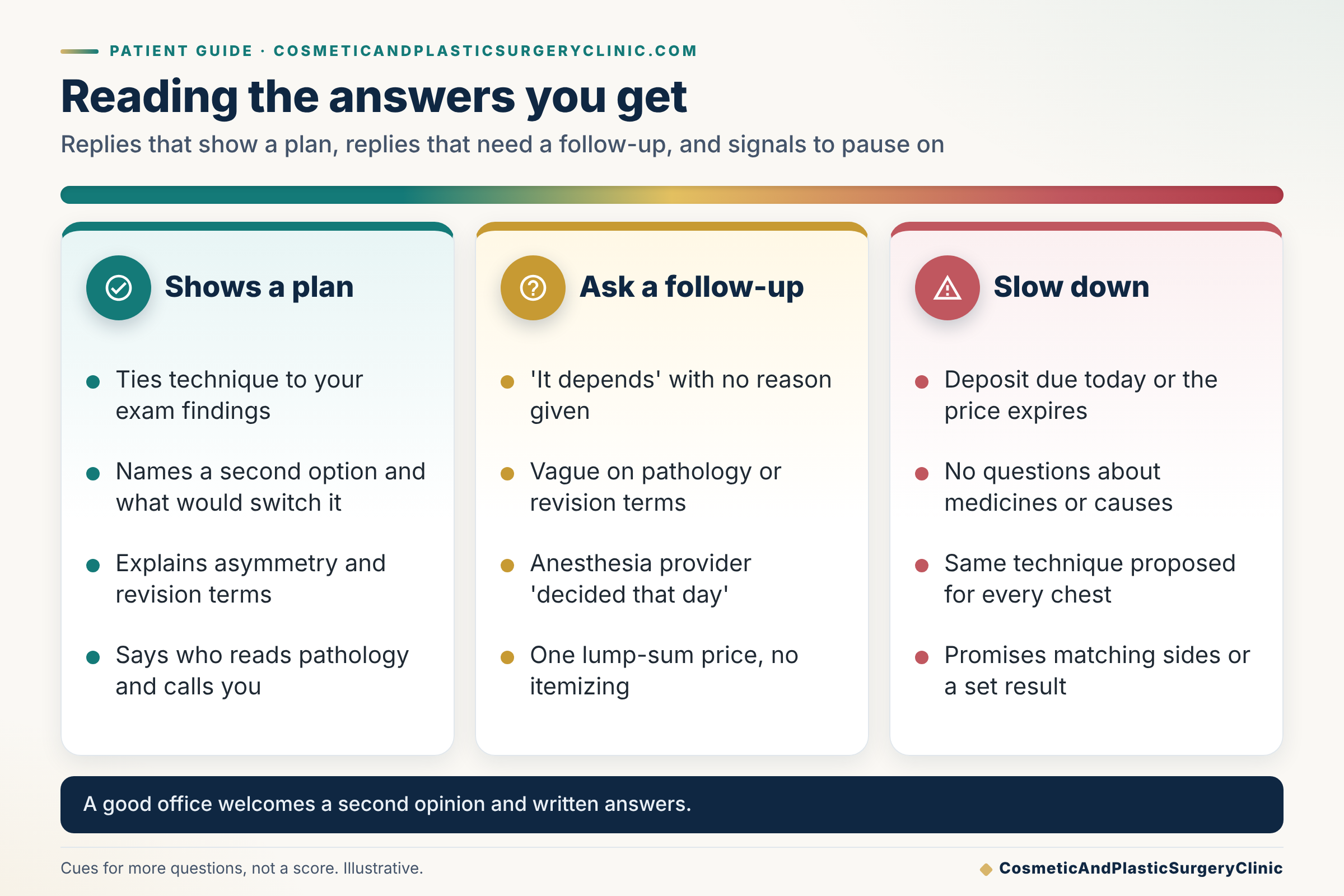
Strong gynecomastia consultation answers refer to something found on your chest. They name the tissue, the technique that fits it, the second option and the finding that would change the plan. They also say when the right answer is to wait: if a medicine, weight change or hormonal cause is still active, the AFP review advises addressing contributing agents first, and StatPearls suggests surgery for gynecomastia that persists more than a year after an underlying condition is treated.
“It depends” is a good sign when it comes with the thing it depends on. A reply such as “it depends on how the skin retracts, so we will know more at three months, and here is what we would do if it does not” is a plan. A reply such as “it depends” and nothing more is a dodge.
Straight about asymmetry, revision and recurrence
Some imbalance between the sides is common even before surgery. Bilateral gynecomastia can be asymmetric, according to the University of Washington teaching page, and ASPS lists uneven breasts or irregular contour among its risks. A surgeon who promises matching sides is promising something no source supports. A surgeon who explains how much difference is typical, and what can be done about it later, is giving an honest answer.
Recurrence has a mechanism. The 2007 brochure ties lasting results to controlling the cause, and it names weight gain alongside medicines and drug use. So the question is not only “will it come back” but “what would make it come back, and what would we do.” The honest answer covers medicines, substances, weight and aging, and ends with a plan for each.
| Factor | Effect on the outcome | Maintenance or revision implication | Review point to raise |
|---|---|---|---|
| Continuing medicine, steroid or substance exposure | Tissue may return if the cause continues | Revision may only repeat the problem until the cause is addressed | Before surgery, and again at any new prescription |
| Weight gain after surgery | Chest contour may change as fat is gained | Contour may change without any surgical flaw | At each follow-up visit when weight shifts |
| Residual gland or contour irregularity | Firmness or a step-off may remain after swelling settles | Touch-up may be offered after healing; fee terms vary | When the surgeon says the result is judged |
| Skin that does not retract | Loose skin can remain after tissue is removed | Skin excision may be discussed as a second stage | At three to six months, per the surgeon’s schedule |
| Nipple and areola position or sensation | ASPS lists temporary or lasting sensation change as a risk | Position problems may need correction; sensation may not return fully | Any change you notice, reported early |
Warning signs inside the consultation room
Pressure, vague pathology and one technique for every chest
Pressure at a gynecomastia consultation shows up as a deposit due the same day, a price that “expires” or a date that “will not come again.” None of these helps a medical decision, and an elective operation for gynecomastia loses nothing by a week of thought. Other signs are quieter: no questions about medicines or substances at all, no mention of why the chest is enlarged, a single technique proposed to every patient, and a shrug when asked about pathology or revision terms.
A gynecomastia consultation that never touches the chest or never looks at it standing and lying down is also thin. Photographs can supplement an exam, but ASPS’s 2002 coverage criteria say photographs do not substantiate symptoms on their own. One insurer’s 2026 policy asks for anterior and lateral photographs plus confirmation of glandular tissue, a reminder that the paperwork assumes a real exam.
Photos, promises and credential claims
Be cautious when every example is a lean chest with a tiny scar, when photos show a different tissue type from yours, or when the result is described as certain. ASPS says no recognized board has “cosmetic surgery” in its name, so a certificate from a board with that wording is not the same thing as certification from the American Board of Plastic Surgery. The differences between titles are a topic of their own.
Comparing two surgeons and reading the estimate after a gynecomastia consultation
One gynecomastia consultation gives one opinion. Two gynecomastia consultations let you see where surgeons agree, which is informative, and where they differ, which is more so. The comparison works best when you collect the same facts from each office and judge them side by side a few days later, not in the parking lot.
Credential and facility checks, kept brief
Board certification and the state license
The American Board of Plastic Surgery (ABPS) lets the public search certification by surgeon name or location. Its page says certification is voluntary, that an active, unrestricted medical license is a requirement, and that a “See FSMB” alert appears when the board has been told of a state medical board action. Certificates issued since 1995 are valid for 10 years, so check that the status is current. ASPS describes the expected training as at least six years of surgical training after medical school, including at least three years of plastic surgery residency.
Also look up the license and any disciplinary history with the state medical board; the full workflow is in how to choose a plastic surgeon.
Experience with this operation, and what volume can and cannot tell you
Ask how often the surgeon performs gynecomastia surgery and how many of those cases involve gland excision, since that differs from a purely liposuction practice. ASPS estimated 23,318 male breast reduction procedures in the United States in 2025, down 8% from 25,351 in 2024. These are statistically extrapolated estimates, and the report’s male-gender table lists a different figure, so treat them as rough scale.
Putting two consultations side by side
A comparison sheet you can fill in after each visit
Notes taken within an hour of each gynecomastia consultation are more accurate than memory a week later. The table below lists what to record, and it is deliberately about content, not friendliness.
| Item to compare | What to write down | Why it matters | A clear answer includes |
|---|---|---|---|
| Tissue assessment | Gland, fat, skin and nipple findings, and the grade used | It sets the technique | Findings tied to your exam, not a generic label |
| Technique and alternative | Proposed approach, second choice, what would change the plan | Shows reasoning | A named alternative and a trigger to switch |
| Facility and anesthesia | Facility name, accreditor, anesthesia provider and type | Safety and emergency access | Names, credentials and a transfer plan |
| Scars and drains | Incision location and length, drain plan, garment | Appearance and aftercare burden | A drawing on your chest and photos of similar tissue |
| Pathology plan | Whether tissue goes to a lab, who reads it, how you are told | Catches unexpected findings | A routine and a named person who reports back |
| Revision terms | Window, which fees apply, who decides | Cost of an imperfect result | Terms in writing, before any deposit |
| Follow-up and contact | Number of visits included, after-hours number | Support when something looks off | A schedule and a person who answers |
Differences between two offices’ gynecomastia consultation advice are a prompt to ask, not a ranking. If one surgeon recommends liposuction alone and the other excision, ask each what was felt on exam that led to the choice. The answer often resolves the disagreement.
The written estimate: what is in it, and what is not
ASPS reports an average cost of $5,587 for gynecomastia surgery, without stating the year, and says that figure excludes anesthesia, operating room facility and other related expenses such as medical tests, garments and prescriptions. A national average is not a quote. Ask for an itemized estimate that lists the surgeon’s fee, facility, anesthesia, pathology, garment and follow-up separately, and that states the revision policy, deposit and cancellation terms. The components are examined in gynecomastia surgery cost.
For patients paying without insurance, the Centers for Medicare & Medicaid Services says providers must usually give a good faith estimate when care is scheduled at least three business days ahead or on request, and that a patient may be able to dispute a bill at least $400 above it.
On coverage, ASPS says correction of gynecomastia is not eligible for insurance in most cases, and Aetna classifies it as cosmetic. Some plans publish criteria, such as grade, glandular confirmation, a documented work-up and photographs. Ask whether the office submits claims and what it needs from you, and read gynecomastia surgery insurance before assuming anything. Breast reduction insurance follows different rules and is a separate topic.
Deciding after the consultation: proceed, wait or decline
A gynecomastia consultation can end in surgery, in a test, in a medication review, in watchful waiting or in no treatment. All five are normal outcomes. The decision does not have to be made in the office, and it does not have to be made by the end of the week.
When waiting or no surgery is the reasonable outcome
Active causes, unsettled development and unstable weight
ASPS lists men whose breast development has leveled off, who are close to a normal weight and who are nonsmokers and non-drug users among those who suit surgery. That is a generalization, never a verdict on a person. If development is still changing, a cause is under investigation or weight is moving, a surgeon may reasonably suggest waiting.
Waiting is not a loss. Mayo Clinic notes that gynecomastia has few physical complications, and for many men the main burden is how it feels to live with. That feeling deserves the same attention as the exam, and it is a different problem from the tissue.
Teens, parents and the patient’s own voice
At a teenager’s gynecomastia consultation, the usual first questions are about time. Pubertal gynecomastia often resolves, so a surgeon will normally ask how long it has been present and whether it has stopped changing. When surgery is discussed, the teen should hear the questions and answer them himself, with a parent present for support, not instead of him.
Evidence on quality of life is encouraging but limited. In the 2022 series, a subset of 51 patients followed for a median of 33.3 months reported improved self-esteem, by about 3 points on a 10-to-40 scale, and improvement in 7 of 8 quality-of-life domains. That is a subset of a 145-patient study reported through a press release, not a promise to any individual.
Consent as a process, not a signature
What informed consent should cover
The American Medical Association’s Code of Medical Ethics describes informed consent as a process in which communication leads to the patient’s agreement to a specific intervention. It says physicians should explain the diagnosis when known, the nature and purpose of the intervention, and the burdens, risks and expected benefits of all options, including forgoing treatment. It adds that patients have the right to ask questions and that the conversation should be documented.
At a gynecomastia consultation, that means the surgeon should be able to say what the diagnosis is, why this operation, what the realistic alternatives are, including doing nothing, and what the main risks are in terms you understand. If a consent form arrives before those conversations have happened, hold it until they have. Because published complication figures come from different series and populations, ask the surgeon for their own numbers and how complications are handled.
A short decision log and what to do next
After each gynecomastia consultation, write three lines: what the surgeon recommended and why, what is still uncertain, and what the estimate covers. Review the logs after at least a day. If they agree, the decision is easier. If they do not, book a third opinion or ask one office a precise follow-up question by message, so the answer is in writing.
Frequently asked questions
Do I need a referral or blood tests before a gynecomastia consultation?
Policies differ, so ask when you book. Some plastic surgery offices see patients directly and order tests themselves, while others prefer that a primary care doctor or endocrinologist reviews the cause first. The AFP review lists liver enzymes, creatinine and thyroid-stimulating hormone as baseline tests, with hormone panels added only when indicated. Bring any existing results, and ask which tests the office wants before a surgery date is set.
What should I wear, and will the gynecomastia consultation exam be uncomfortable?
Wear something easy to remove from the top half, such as a button-up shirt. The examiner will look at the chest standing and usually lying down, and will press on the tissue behind each nipple, which can be tender, especially in recent or fast-changing cases. You can ask for a chaperone or have a companion in the room. The NHS suggests trying not to feel embarrassed, since clinicians discuss this routinely.
Is a gynecomastia consultation fee normal, and is it credited toward surgery?
Practices set their own gynecomastia consultation policies, and the ASPS pages read for this article do not state a standard. Some charge a fee, some credit it toward surgery and some offer a free first visit. Ask when booking whether there is a fee, whether it is credited and whether a virtual first discussion is offered. A fee is not a sign of quality either way; the point is to know the amount before you go.
Should I mention past steroid or recreational drug use?
Yes. At a gynecomastia consultation, ASPS lists steroids and recreational drugs among the things to discuss at the visit, and the 2007 ASPS and ASAPS brochure asks for complete candor about health, medicines, supplements, alcohol, tobacco and drug use. The history helps the clinician judge the cause, whether tissue may keep growing and how to plan. Surgeons hear it routinely and it is part of your medical record, which is protected by privacy rules. A frank answer lets the plan reflect reality instead of guesswork.
How many gynecomastia consultations are reasonable before choosing a surgeon?
None of the sources read sets a number. Two is a common practical minimum for an elective operation, because it shows whether the recommendation is consistent. A third makes sense when the two disagree on technique or one visit felt rushed. Stop when you can say, in your own words, why you chose a surgeon and technique; more opinions than that can delay a decision without adding information.
Can the surgeon tell at the first visit if liposuction alone will be enough?
Often the gynecomastia consultation exam gives a strong indication, because a firm disc behind the nipple suggests gland while soft diffuse fullness suggests fat. A plan can still change during surgery if tissue turns out firmer than expected, so ask what the surgeon would do then and whether you would be asked to consent in advance to adding excision.
Can I bring a parent or partner to a gynecomastia consultation, and should a teenager come alone?
Bringing a companion is common and helpful, because a second person remembers different details and can take notes. For a teenager, a parent or guardian usually attends, but the teen should be asked directly about his goals and concerns. If privacy matters, say so when booking. Write the surgeon’s answers down during the visit and review them together afterward.
What if a gynecomastia consultation ends with advice to wait or skip surgery?
That is a legitimate outcome, not a refusal of care. StatPearls describes observation as appropriate when enlargement has lasted less than a year and the history and exam are normal. Ask what would change the advice, when to return and which symptoms should bring you back sooner. A written note of the reasons helps if you seek a second opinion or if insurance later asks.
Sources and further reading
- American Society of Plastic Surgeons — Gynecomastia surgery consultation (accessed 2026-11-13) — what to discuss and what the surgeon may evaluate
- American Society of Plastic Surgeons — Questions to ask your surgeon checklist (accessed 2026-11-13) — the 15-question patient checklist
- American Society of Plastic Surgeons — Gynecomastia surgery procedure steps (accessed 2026-11-13) — anesthesia, liposuction, excision, combination
- American Society of Plastic Surgeons — Gynecomastia surgery candidates (accessed 2026-11-13) — suitability criteria and adolescents
- American Society of Plastic Surgeons — Gynecomastia surgery risks and safety (accessed 2026-11-13) — listed risks
- American Society of Plastic Surgeons — Gynecomastia surgery cost (accessed 2026-11-13) — $5,587 average, exclusions, insurance statement
- American Society of Plastic Surgeons — 2025 plastic surgery statistics report (accessed 2026-11-13) — male breast reduction estimates, methodology
- ASPS and ASAPS — Breast Reduction for Men patient brochure, 2007 (accessed 2026-11-13) — disclosure, expectations, lasting results
- American Society of Plastic Surgeons — Choose a plastic surgeon you can trust (accessed 2026-11-13) — training, facility, board names
- American Society of Plastic Surgeons — Male breast reduction surgery improves quality of life for teens, press release 2022 (accessed 2026-11-13) — 145-patient series, complications, quality of life
- American Society of Plastic Surgeons — Recommended insurance coverage criteria: gynecomastia, 2002 (accessed 2026-11-13) — photographs and documentation
- The Aesthetic Society — How is gynecomastia surgery performed? (accessed 2026-11-13) — liposuction limits, incisions, pull-through
- The Aesthetic Society — Gynecomastia incisions and scars (accessed 2026-11-13) — scar placement by tissue type
- Mayo Clinic — Gynecomastia symptoms and causes (accessed 2026-11-13) — pseudogynecomastia, causes, when to see a doctor
- Dickson G., American Family Physician 2012 — Gynecomastia (accessed 2026-11-13) — history, exam, labs, imaging, red flags
- StatPearls — Gynecomastia (accessed 2026-11-13) — workup, grading, timing of surgery
- MedlinePlus — Breast enlargement in males (accessed 2026-11-13) — causes, visit, medicine caution
- NHS — Gynaecomastia (accessed 2026-11-13) — when to seek advice, appointment tone
- Acta Biomedica 2017 — Pubertal gynecomastia review, abstract (accessed 2026-11-13) — resolution in 75% to 90%
- Shirah and Shirah, Breast Disease 2016 — Incidental ductal carcinoma in situ in young male gynecomastia, abstract (accessed 2026-11-13) — pathology findings in 74 men
- Henley et al., New England Journal of Medicine 2007 — Prepubertal gynecomastia linked to lavender and tea tree oils (accessed 2026-11-13) — three cases and laboratory findings
- American Cancer Society — Key statistics for breast cancer in men (accessed 2026-11-13) — 2026 estimates and lifetime risk
- University of Washington — Breast imaging teaching file, symptomatic male patient (accessed 2026-11-13) — imaging approach, typical patterns
- American Board of Plastic Surgery — Verify certification (accessed 2026-11-13) — lookup, license requirement, 10-year certificates
- AAAHC — Accreditation (accessed 2026-11-13) — ambulatory surgery accreditation and directory
- QUAD A — Accreditation and facility directory (accessed 2026-11-13) — office-based surgical facility accreditation
- World Health Organization — Surgical Safety Checklist (accessed 2026-11-13) — 19 items and three pauses
- American Medical Association — Code of Medical Ethics, informed consent (accessed 2026-11-13) — consent as a process
- U.S. Department of Health and Human Services — Your medical records (accessed 2026-11-13) — access to copies and fees
- Centers for Medicare & Medicaid Services — Good faith estimates for uninsured and self-pay patients (accessed 2026-11-13) — estimate timing and dispute threshold
- Aetna — Clinical policy bulletin 0017: Gynecomastia (accessed 2026-11-13) — cosmetic classification, unproven techniques
- Blue Shield of California — Surgical treatment of gynecomastia, effective 2026-09-01 (accessed 2026-11-13) — documentation and photograph criteria