

Two people can point at the same spot under the chin, describe the same worry, and need different operations. The shape of that area comes from layers: skin, fat, a thin muscle called the platysma, and the bone and glands beneath. Chin liposuction vs neck lift is really a question about which layer is doing most of the work. Fat can be suctioned out. Loose skin, a separated muscle edge, and a recessed chin cannot.
This page sorts the two operations by what each one treats, then adds the nonsurgical options that sit between them, because the FDA has reviewed several for this exact area. It draws on ASPS statistics for 2025, product labels, and published case series, with the limits of each stated. It cannot tell you which option fits you. For the mechanics of fat removal in general, see the liposuction overview; for the surgery that tightens, see the neck lift guide. Neither is repeated here.
Four tissues decide whether chin liposuction vs neck lift fits
Before comparing operations, it helps to name the possible culprits: superficial fat, the platysma muscle, the skin envelope, and the frame of chin, hyoid bone, and glands. Most necks involve more than one, in different proportions. The chin liposuction vs neck lift comparison only makes sense once you know which proportion you are dealing with.
The layers under the chin, from skin down to the hyoid
A 2013 classification paper from Brazil divides the neck into three lamellae. The anterior lamella is the skin and the fat directly beneath it. The middle lamella is the platysma and its covering fascia. The deep lamella holds the submandibular glands, the digastric muscles, a pocket of fat beneath the platysma, and the hyoid bone (de Sá and colleagues, Revista Brasileira de Cirurgia Plástica, 2013). Liposuction under the chin works mainly in the first lamella. A neck lift is defined by also working on the second, and sometimes the third.

Skin and superficial fat: the layer liposuction can reach
Neck skin is thin. StatPearls, summarizing the surgical literature, puts the epidermis and dermis together at just over 0.25 mm, against more than 1 mm on the cheek, with fewer skin appendages, which is one reason neck skin heals more slowly. Liposuction cannot remove skin at all. ASPS notes that firm, elastic skin gives better results and that extra skin may need separate surgery, which is why surgeons judge how well the skin recoils before they judge how much fat there is.
The platysma and the structures beneath it
The platysma is a broad, thin muscle that continues upward into the SMAS, the layer facelifts work on. With age its inner borders can separate and drift apart, which shows as vertical cords running from jaw toward collarbone (StatPearls). Beneath it sit deeper fat, the digastric muscles, and the submandibular glands. Two nerves matter in this comparison: the marginal mandibular nerve, whose injury affects the smile and lower lip and which lies about 1 to 2 cm below the back of the jaw, and the cervical branch near the hyoid level.
Why a double chin is not always a fat problem
Surgeons describe an aging neck as a ladder rather than a switch. Any rung can produce a soft contour under the chin, and the rungs need different treatments. That is the central reason the chin liposuction vs neck lift decision cannot be made from a mirror.
Fullness that comes from muscle, skin, or frame
The Dedo classification, as summarized by StatPearls, grades neck changes from normal through skin laxity, neck fat, and platysmal banding to a recessed chin or low-lying hyoid, with each step harder to treat than the last. A person with little fat, a muscle edge that has drifted, and a chin set slightly back can look as though they have a double chin. Suctioning a thin layer of fat from that neck changes very little.
The frame matters in a second way. Ellenbogen and Karlin’s 1980 paper in Plastic and Reconstructive Surgery proposed visual criteria for a youthful neck and reported that anterior adjustment of the platysma mattered more than posterior adjustment; they also found most patients, including those with a low-lying hyoid, could meet the criteria.
Later papers summarize the target as a cervicomental angle of roughly 105 to 120 degrees (StatPearls; de Sá 2013). De Sá’s group treated hyoid height, chin projection, and gland ptosis as separate variants and advised against operating directly on the hyoid or gland because of high complication rates.
How surgeons separate fat from muscle, skin, and frame
A 2005 algorithm article by Dr. George Bitar in Plastic Surgery Practice lists five things to assess: skin laxity, platysma tone and banding, fat, chin projection, and the bony structure of the jaw. It also admits a limit: superficial fat and the fat beneath the platysma can be hard to tell apart on examination. That is a real uncertainty, not a detail, because only the first can be suctioned safely.
Bands add a timing wrinkle. The botulinum toxin trials for platysma bands graded severity at maximum contraction, which means cords can be faint at rest and obvious when the muscle tightens. If you bring photographs to a consultation, bring some taken from the front and side with a relaxed face, and some while speaking. See what to bring and ask at a plastic surgery consultation for the wider checklist.
When the smaller operation wins in chin liposuction vs neck lift, and where it stops
In chin liposuction vs neck lift, the fat-removal side is the smaller operation, and for the right anatomy it is also the more direct one. The word “right” carries a lot of weight in that sentence, as the next sections show.
What the operation does and who it tends to suit
ASPS counted 18,842 chin (submental) liposuctions in 2025, up 7% from 17,533 in 2024, and 27,315 neck lifts, up 21% from 22,592. They show that both choices are common. They say nothing about which one suits a particular neck in the chin liposuction vs neck lift choice, because popularity and suitability are different questions.
The mechanism: fat above the muscle, removed through small access points
In submental liposuction a thin cannula removes fat lying between the skin and the platysma. StatPearls advises that the work stay superficial, above the hyoid and below the jaw, and that fat beneath the platysma not be removed blindly because of nearby vessels, nerves, and other structures. In a 987-patient case series of neck liposuction, three dermatologic surgeons used tumescent local anesthesia, a dilute lidocaine and epinephrine solution (Habbema and colleagues, Journal of Drugs in Dermatology, 2018). Anesthesia choice varies by surgeon and facility.
Skin recoil, age, and weight stability as the deciding variables
Bitar describes liposuction alone as the usual choice for a straightforward neck: typically someone in their twenties or thirties with excess fat, good skin elasticity, no major weight fluctuation, and a platysma with good tone and little banding. That is one surgeon’s heuristic from 2005, not a rule, and the useful part is the list of conditions rather than the decade of life. MedlinePlus separately lists loose, “baggy” skin as a possible result of liposuction, especially in older people. The liposuction candidate page covers these screening factors in general terms.
De Sá’s 480-patient series shows how narrow the fat-only group can be. About 12% (11.7%) were grade I, treated with liposuction alone using a 3 mm cannula. Two surgeons rated 78.9% and 84.2% of those results excellent from photographs at 18 to 48 months. Caveats: one surgeon’s practice, retrospective, rated by two surgeons rather than by patients, and not externally validated.
The limits that keep chin liposuction from being the simpler fix for everyone
Simpler to do is not the same as sufficient, and that gap is the heart of chin liposuction vs neck lift. Several independent sources reach the same conclusion from different directions: a tool that removes fat does not fix problems that are not fat.
What it leaves untouched: bands, loose skin, and deeper fat
A 2012 review by Tirbod Fattahi in the Journal of Oral and Maxillofacial Surgery concluded that good submental rejuvenation generally requires platysmaplasty in addition to liposuction, and that isolated liposuction helps only a limited group. The paper is an expert review favoring formal cervicoplasty, not a trial, so weigh it as opinion. StatPearls adds that removing fat beneath the platysma must be combined with midline platysmaplasty.
The deoxycholic acid label points the same way. It tells prescribers to give careful consideration to using the drug in people with excessive skin laxity or prominent platysmal bands. When the surgical literature and a drug label draw the same line, the common thread is anatomy, not marketing.
Over-resection, irregularity, and nerve risks, with the numbers that exist
StatPearls names over-resection of submental fat as a cause of the “cobra neck” deformity, and MedlinePlus lists dents, asymmetry, and lidocaine reactions among general liposuction risks. In the Habbema series, 5 of 987 patients had temporary marginal mandibular nerve dysfunction (about 0.5%), 1 had submandibular gland ptosis, and 1 had arterial bleeding; the authors reported no seroma, skin necrosis, scarring, or hyperpigmentation.
Read that series cautiously. It is a case series from three dermatologic surgeons, with no comparison group, and it cannot give anyone a personal probability. For liposuction-specific risk detail, the liposuction risks page goes further than this comparison needs to.
When a neck lift wins the chin liposuction vs neck lift comparison, and what it asks of you
In chin liposuction vs neck lift, the larger operation makes its case on one idea: some necks have a muscle and skin problem that no amount of fat removal can reach. Whether yours does is an examination finding, not a preference.
What a neck lift adds beyond what chin liposuction removes
Where chin liposuction removes one ingredient of the contour, a neck lift rebuilds the support under it. The sources describe that support in concrete, mechanical terms, which makes the chin liposuction vs neck lift difference easier to judge than a brochure’s language does.
Platysma work and skin redraping: the mechanism that favors surgery
In de Sá’s series, the platysma was treated as the most important structure for neck support. When medial bands were present or contour had been lost, the inner muscle borders were sutured together from the thyroid cartilage up toward the chin through a 3 to 4 cm incision beneath the chin, the outer borders were pulled toward the mastoid, and the skin was undermined and redraped. The chin incision was not used to remove skin.
StatPearls lists the findings where midline platysma repair is considered essential: banding deeper than 1.5 cm that lateral suspension does not correct, removal of fat beneath the muscle, and a type III pattern in which the muscle is split at the midline. A fat-only operation addresses none of those. The approaches themselves, such as midline, corset, and lateral suspension, are compared on the neck lift techniques page.
Where the jawline and the facelift question enter
A neck lift does not lift jowls. Bitar writes that significant jowling or midface laxity points toward a full facelift, and that a neck lift is not the procedure of choice for jowls or nasolabial folds. The Giampapa and Di Bernardo criteria, as listed by StatPearls, describe a neck-lift candidate as having a poorly defined cervicomental angle and jawline, no midfacial laxity, small to moderate jowl and neck fat, and no wish for a full facelift.
De Sá’s series shows how often the lower face joins the plan: only 7% were grade II, a neck lift alone, while about 81% had face-and-neck lifts of increasing extent. That reflects one surgeon’s patients and methods, but it illustrates why a consultation about the neck often turns into a conversation about the jawline. The facelift cost page explains what a larger operation does to a quote.
What keeps a neck lift from being the automatic upgrade
More tissue work means more that can go wrong, more time away from normal routines, and more to decide about scars. None of that makes surgery the wrong answer to chin liposuction vs neck lift; it makes it a trade.
Longer incisions, longer recovery, and more structures in play
StatPearls names three nerves to protect in neck surgery: the marginal mandibular nerve, the cervical branch, and the great auricular nerve, which it calls the most commonly injured nerve in facelift surgery. Early complications it lists include hematoma, seroma, infection, and temporary nerve weakness; late ones include contour irregularity, visible banding, and an over-skeletonized look. A small hematoma may be drained in a clinic, while an expanding one is an emergency that needs operating-room drainage.
In de Sá’s 480 patients, most of whom had combined face and neck lifts, there were 3 hematomas, 4 cases of mandibular paresis, 10 scar alterations, and 15 surgical revisions. Those counts mix operations of different sizes, so they describe that practice, not a standard rate for a neck lift alone. Recovery logistics live on the neck lift recovery page; the point here is only that the burden is larger than for fat removal.
Recurrence and touch-ups: what the literature can and cannot say
StatPearls notes that redundant skin and platysmal bands can recur, sometimes prompting a tuck-up within a year. Ellenbogen and Karlin suggested in 1980 that cutting the platysma, shaping a sling, and removing fat might extend longevity, while stating that only long-term follow-up could confirm it. In the series I could open, follow-up is still measured in a few years: de Sá’s averaged 32 months, with a range of 18 to 48.
No source I opened offers a lifespan figure that applies to an individual. A surgeon who offers one should be asked what it is based on, and what happens, and at whose cost, if the result loosens early.
Nonsurgical options that sit between doing nothing and surgery
Four nonsurgical tools are regulated for the area that chin liposuction vs neck lift both treat, each in a different way: an injectable drug approved for submental fat, a fat-freezing device cleared for the same area, an ultrasound device cleared to lift lax tissue, and a botulinum toxin approved for platysma bands. Drugs are approved; most aesthetic devices are cleared, a different review that rests on comparison with earlier devices. The table lines them up by target, not by brand.
| Option | Regulatory status in the sources | What it targets | Caution to read first |
|---|---|---|---|
| Deoxycholic acid injections | Drug approved in 2015 for moderate to severe submental fullness in adults | Submental fat | Nerve paresis in 4% in trials; label urges care with skin laxity, platysmal bands, or prior treatment |
| Cryolipolysis (fat freezing) | Cleared device; submental use added in 2015 (510(k) K151179) | Pinchable fat under the chin | FDA lists paradoxical adipose hyperplasia, which may need surgery; not a weight-loss treatment |
| Focused ultrasound | Cleared June 2014 to lift lax submental and neck tissue (K134032) | Mild skin laxity | Clearance wording names the use, not the size of the effect; ask for the evidence |
| Botulinum toxin (Botox Cosmetic) | Approved October 2024 for moderate to severe platysma bands in adults | Platysma bands only | Boxed warning on distant toxin spread; temporary; does not change fat or skin |
Treatments aimed at fat: injections and cooling
Both fat-directed options are meant to reduce fat in place, without incisions. Both share a limit with liposuction: they do nothing for skin or muscle.
Deoxycholic acid injections and what the label reports
The Kybella label, approved in 2015 and available through DailyMed, describes injections of 0.2 mL spaced 1 cm apart, up to 50 injections or 10 mL in one treatment, and up to six treatments at least a month apart. The indication is moderate to severe convexity or fullness associated with submental fat in adults, and safety and effectiveness outside that region have not been established.
In the two pooled trials (513 treated, 506 placebo), swelling occurred in 87% versus 43% with placebo, bruising in 72% versus 70%, pain in 70% versus 32%, and numbness in 66% versus 6%. Marginal mandibular nerve paresis, which shows as an asymmetric smile, occurred in 4% versus under 1%; every trial case resolved, over 1 to 298 days with a median of 44.
On benefit, the label reports that a stricter composite of at least two grades of improvement on both clinician and patient scales was met by 13.4% and 18.6% of treated participants in the two trials, versus under 0.1% and 3.0% with placebo. The one-grade standard was met by 70.0% and 66.5%. A fair reading is that many participants improved modestly and fewer improved a lot. The label also cautions about prior surgical or aesthetic treatment of the area, since changed landmarks or scar tissue can make injection less safe.
Fat freezing under the chin: results and the risks FDA lists
Cryolipolysis uses a vacuum applicator that cools pinchable fat for up to an hour, intended to kill fat cells without freezing the skin, according to FDA. In the 60-person pivotal trial published in Lasers in Surgery and Medicine in 2016, ultrasound measured an average 2.0 mm reduction in the submental fat layer, 83% of participants were satisfied, and no serious device-related adverse events were reported.
FDA’s own page sorts the risks by frequency. Common and usually temporary: redness, bruising, swelling, pain, and discoloration. Less common: lasting numbness, nodules, freeze burns, and, under the jawline, nerve damage that can change lip position. Least common: paradoxical adipose hyperplasia, a firm bulge of fat that grows instead of shrinking, which appears two to five months later, does not resolve on its own, and may need surgery. FDA adds that results may be temporary and that multiple treatments may be needed.
Treatments aimed at lift or bands: ultrasound and toxin
These two target different tissues than the fat-directed options, which is why they can complement rather than replace them. ASPS notes that nonsurgical options such as Botox, fillers, and Kybella may help delay surgery or complement its results.
Focused ultrasound for lax tissue under the chin
FDA’s 510(k) record shows that the Ulthera System was cleared on June 20, 2014, to lift lax submental and neck tissue. The wording matters in both directions. It names laxity, not fat, as the target, and a clearance describes an intended use rather than the size of the effect. I did not find an FDA-reviewed lift magnitude in the sources I opened, so ask any provider what evidence they rely on and how results are measured.
Botulinum toxin for platysma bands
On October 18, 2024, Allergan Aesthetics announced FDA approval of Botox Cosmetic for moderate to severe vertical platysma bands in adults, at 26, 31, or 36 units depending on severity. In the two Phase III studies, 32% and 31% of treated participants reached a two-grade improvement at day 14, versus 2% and 0% with placebo, and 65% and 62% were satisfied, versus 12%. Those figures come from the manufacturer’s announcement.
The label carries a boxed warning about distant spread of toxin effect, including swallowing and breathing difficulty. The effect is described as temporary, and it treats the muscle only. StatPearls adds that toxin placed too high can weaken the muscles that pull the lower lip down, a reminder that placement is a skill.
Recovery, scars, reversibility, risk, and cost side by side
The matrix below puts chin liposuction vs neck lift and the nonsurgical routes on one grid. The sections after it unpack the rows that cause the most confusion: what living through each option is like, and what a quote or a risk figure actually means.
| Factor | Chin liposuction | Neck lift | Nonsurgical options |
|---|---|---|---|
| Main indication | Localized fat above the platysma, with skin that recoils | Bands, loose skin, or a weak cervicomental angle, with or without fat | One narrow target per tool: fat, lax skin, or bands |
| Invasiveness | Small access points; a cannula works under the skin | Incisions, dissection, and muscle sutures; larger scope | Injections, applicators, or ultrasound; no incisions |
| Reversibility | Removed fat is not replaced; contour problems need a touch-up or grafting | Muscle and skin changes are surgical; revision is another operation | Toxin wears off; FDA says fat-freezing results may be temporary |
| Scars and downtime | Small access scars; swelling, bruising, and numbness expected | Longer incisions, placed by technique; longer, more visible recovery | No surgical scars; label lists swelling in 87% and numbness in 66% for injections |
| Maintenance | Weight change and aging continue afterward | Aging continues; bands or laxity can recur | Repeat sessions or courses; toxin repeats |
| Material risks | Irregularity, over-resection, temporary nerve weakness, bleeding | Hematoma, nerve injury, scar changes, recurrence, revision | Nerve paresis, nodules, hyperplasia after freezing, toxin spread warning |
| Cost logic | ASPS 2024 surgeon-fee range $3,000–5,500; facility and anesthesia billed separately | ASPS 2024 surgeon-fee range $7,500–13,000; a larger scope raises the total | Priced per session or course; ASPS 2023 category average $1,157, basis unclear |
Downtime, incisions, and what you live with afterward
Downtime is where chin liposuction vs neck lift feel most different in daily life, and where general statements are least reliable. Surgeon technique, anesthesia, and individual healing all move the dates.
Contrasting downtime and follow-up in the chin liposuction vs neck lift choice
General liposuction guidance from MedlinePlus, which is not specific to the neck, says a compression garment is worn for several weeks as the surgeon directs, swelling and bruising usually settle within about three weeks, and some swelling can last for months. Numbness, tingling, and soreness may last for weeks. For the week-by-week arc, see the liposuction recovery page; neck-specific timing varies by surgeon and technique.
A neck lift usually means a longer and more visible recovery, with dressings, tightness, and numbness that the surgeon will describe in detail.
For the nonsurgical options, the label figures are the best guide to social downtime: swelling in 87% and numbness in 66% of injected participants, and FDA’s note that fat freezing under the chin can leave a temporary sensation of fullness at the back of the throat. Freezing also has a long tail, since paradoxical hyperplasia appears two to five months afterward. If an event date is driving the decision, build in margin.
How revisions differ after each route
After fat removal, the usual second-stage problems are residual fullness, dents, or asymmetry; the liposuction revision page covers when surgeons wait and what the options are. After a neck lift, the second-stage question is more often recurrent bands or loose skin, the tuck-up StatPearls mentions. After fat freezing, StatPearls notes that the rare paradoxical hyperplasia may itself need liposuction, and FDA says it may need surgery.
Sequence matters. The injection label’s caution about prior surgical or aesthetic treatment means that a plan to try one route now and another later is a question for every clinician involved, not only the one doing the first step.

Risk, cost, and predictability in the chin liposuction vs neck lift comparison
Two things make this comparison hard to do from the outside: the quotes are built from different parts, and the risk figures come from different kinds of studies.
Material risks and how the quotes are structured
ASPS’s 2024 fee tables give projected surgeon-fee ranges derived from member-submitted averages: $3,000 to $5,500 for submental liposuction, $7,500 to $13,000 for a neck lift, and $12,000 to $19,000 for a facelift. ASPS’s neck lift cost page says its average, listed as $7,885 with no year stated, is only part of the total, leaves out anesthesia, facility, and related expenses, and that most health plans do not cover neck lifts or their complications. National figures are not local quotes.
For injections, ask whether a price is per treatment or per course. The label allows up to six treatments, and ASPS’s 2023 fee survey lists one “noninvasive fat reduction” category at an average of $1,157 without stating how many sessions that covers.
Consider a hypothetical with invented numbers: a practice quotes $1,200 per session and the plan calls for three. That is $3,600 before other charges, inside the surgeon-fee range for submental liposuction, yet a different kind of change. A chin liposuction vs neck lift comparison is fair only when every line is on the table.
Ask each practice for the same items in writing:
- The surgeon or injector fee, and exactly what it covers
- The facility’s name and how it is accredited or licensed
- Who provides anesthesia or sedation, and how it is billed
- Garments, medications, and supplies
- Follow-up visits included, and for how long
- Revision or touch-up terms, and what you owe if you cancel
The plastic surgery cost page explains what each of those lines means.
Why group averages are not a personal forecast
This page has quoted three nerve figures: about 0.5% temporary marginal mandibular dysfunction in the 987-patient neck liposuction series, 4 of 480 (about 0.8%) mandibular paresis in the mixed face-and-neck series, and 4% in the injection trials. They cannot be ranked against each other, a common trap in any chin liposuction vs neck lift comparison. The populations differ, the definitions of nerve weakness differ, and the follow-up differs. The sources are a single-specialty case series, a single-surgeon retrospective review, and placebo-controlled trials.
Each number describes a group under specific conditions; none is anyone’s personal odds. The method for reading risk figures in general is in plastic surgery risks.
Choosing by scenario instead of declaring a winner in chin liposuction vs neck lift
Neither option wins in general. The table shows how changing one variable at a time can move the answer, using hypothetical profiles rather than real people. None of them is a prediction about your neck.
| Goal and anatomy | Option often favored | Reason | Finding that could reverse it |
|---|---|---|---|
| Soft fullness, skin springs back, no cords, stable weight | Chin liposuction, or an injection or freezing treatment if avoiding surgery | Fat above the muscle is the main problem and the skin can follow | Fat found beneath the muscle, or weaker skin recoil than expected |
| Cords on speaking or clenching, skin loose at rest | Neck lift with platysma work | Bands and loose skin do not respond to fat removal | Only mild bands, where toxin might meet the goal |
| Bands only, little fat, firm skin | Botulinum toxin, discussed first | Approved for platysma bands; temporary; no incisions | Deep bands or loose skin that toxin cannot change |
| Jowls forming along with neck fullness | Facelift with neck work | A neck lift alone does not lift jowls | Minimal jowls and a firm midface, so a neck lift alone could suffice |
| Chin set back, little fat or laxity | Evaluation of chin and jaw frame | Frame, not soft tissue, sets the angle | Fat or lax skin also present, which changes the plan |
Scenario one: soft fullness and firm skin
The simplest chin liposuction vs neck lift profile is also the one where the answer is most likely to be the smaller operation. Even here, the answer depends on what the examination finds.
Why the fat-removal route fits this profile
Consider a hypothetical person in their thirties with stable weight, fullness that feels soft under the chin, skin that springs back, no visible cords when speaking or clenching, and a chin that projects in profile. That closely resembles Bitar’s liposuction-alone description. If fat removal is on the table, ask which technique will be used and why; the liposuction techniques page explains the families. A person who prefers to avoid surgery could also discuss injection or cooling, with the trade-offs above.
“Fits” here means “is a reasonable thing to discuss.” It does not mean this person is a candidate. Only an examination can say that.
The finding that would reverse the decision
Three findings change this scenario. The examiner may find that part of the fullness lies beneath the platysma, where suction is not the tool. The skin may recoil less than the photographs suggested. Or weight may be expected to change soon, which alters how any fat-directed result looks. Any one of those moves the conversation toward waiting, toward a muscle-and-skin plan, or toward a smaller goal.
Scenario two: the same fullness with bands and loose skin
This is the profile that explains why so many surgeons caution against fat removal alone in chin liposuction vs neck lift. Nothing about the fat has changed; what has changed is everything around it.
Changing one variable changes the plan
Change the profile: the same fullness, but the person is in their fifties, cords appear on clenching, and the skin hangs when the head is in a neutral position. Removing fat alone would take volume from under a looser envelope and leave the cords alone. Surgeons then discuss muscle tightening and skin redraping and, if jowls are forming, the lower face (Bitar; de Sá). One changed variable, the state of the muscle and skin, flips the answer without altering the fat at all.
Questions that need an in-person examination
No article can answer the chin liposuction vs neck lift questions below. A clinician who has examined the neck can:
- Which tissue do you think is causing most of the fullness, and can you show me on my own photographs?
- Is the fat above or below the muscle, and what is that judgment based on?
- How do you assess my skin’s recoil, and what happens if it recoils less than expected?
- Do I have platysma bands at rest or in motion, and would toxin, a muscle repair, or neither address them?
- Where would the incisions be, which anesthesia would be used, and in which accredited or licensed facility?
- What would you do if the result is uneven, and what would that cost me?
Verify credentials and the facility before comparing techniques; the page on how to choose a plastic surgeon walks through the steps.
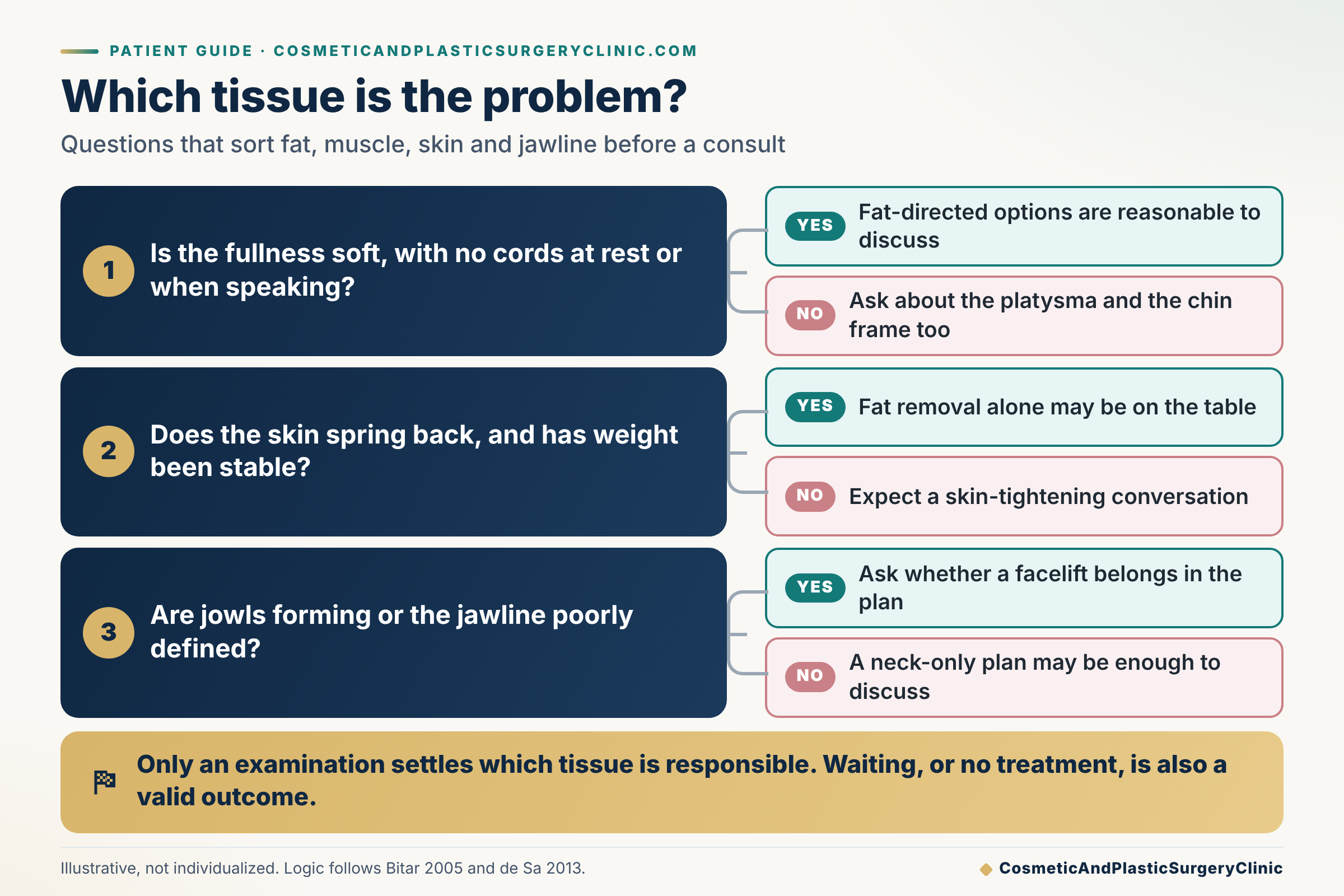
Five common mistakes that distort the comparison
These are patterns in how the chin liposuction vs neck lift comparison goes astray, not criticisms of anyone who has made them. The first three concern anatomy; the last two concern process and price.
Three errors about the anatomy
- Assuming fullness means fat. Muscle, skin, and frame can create the same silhouette, as the layers earlier on this page show.
- Treating skin recoil as a given. Liposuction cannot remove skin, and ASPS says extra skin may need separate surgery.
- Judging from one photograph. Head tilt, chin position, and lighting change how a neck looks, so compare like with like, a skill the liposuction before-and-after page develops for result photos.
Two errors about process and price
- Treating a nonsurgical treatment as a free trial run. The injection label’s caution about prior treatment, and FDA’s note that fat freezing can need surgery to correct a rare complication, show that an earlier treatment can change later options.
- Comparing quotes that cover different scopes. A surgeon-fee range, a facility fee, and a per-session injection price are not the same unit; use the line-item list in the cost section above.
Frequently asked questions
Can chin liposuction be done without general anesthesia?
Some surgeons use tumescent local anesthesia; the 987-patient neck liposuction series cited above did. That does not remove the facility question. ASPS requires its member surgeons to operate in accredited, certified, or state-licensed facilities for procedures other than those needing only local anesthetic or mild oral sedation, so local-only work can fall outside that standard. Ask who monitors you, how an emergency would be handled, and which hospital would receive you.
Is chin liposuction vs neck lift always an either-or decision?
No. StatPearls describes submental fat as treated by liposuction alone or together with a facelift, and Fattahi’s review defines formal cervicoplasty as open liposuction plus platysmaplasty. Many neck lifts therefore include fat removal. The useful question is which combination your anatomy calls for: suction alone, muscle and skin work alone, or both.
How long do deoxycholic acid injections last compared with surgery?
The label sections I read do not state a durability figure. The pivotal trials measured response 12 weeks after the final treatment, which tells you about the early result, not about years later. Weight change and aging continue regardless. In a chin liposuction vs neck lift conversation, ask the provider what follow-up data they can show, and whether a quoted price covers a full course or a single session.
Can I try an injection first and still have surgery later?
Possibly, but it is a conversation, not an assumption. The label cautions about prior surgical or aesthetic treatment of the submental area, because changed landmarks or scar tissue can make injection less safe. The same logic applies in reverse. In chin liposuction vs neck lift planning, tell every clinician about every earlier treatment, and ask the surgeon whether an injection course beforehand would affect the operation.
Does insurance pay for any of these treatments?
ASPS says most health plans do not cover a neck lift or its complications. I did not find a source indicating coverage for cosmetic submental fat treatments either, so assume self-pay for chin liposuction vs neck lift options until your plan says otherwise in writing. Ask for that statement before paying a deposit, and keep it with your itemized estimate.
What do “FDA-approved” and “FDA-cleared” mean on a clinic’s website?
Drugs such as deoxycholic acid and botulinum toxin are approved. Most aesthetic devices are cleared, a different pathway. FDA’s contouring page says it reviews safety and effectiveness for each device’s intended uses and body sites, and that over-the-counter or home fat freezing has not been established as safe or effective. Check that the product and the body area match the clearance, whichever side of chin liposuction vs neck lift you are weighing. Neither word speaks to a clinician’s skill.
Does age change the chin liposuction vs neck lift answer?
Skin condition matters more than the birthday. Bitar’s 2005 description of liposuction alone mentions people in their twenties or thirties, but the conditions that define it are good elasticity, stable weight, and a toned platysma. ASPS says firm, elastic skin gives better results, and MedlinePlus lists baggy skin as a possible result, especially in older people. No source I opened sets an age cutoff.
Sources and further reading
- U.S. Food and Drug Administration — Kybella (deoxycholic acid) prescribing information, 2015 version (accessed 2026-11-12) — dosing, trial adverse reactions, responder rates, cautions
- National Library of Medicine DailyMed — Kybella current label (accessed 2026-11-12) — current wording of indication, warnings, and trial figures
- U.S. Food and Drug Administration — Non-invasive body contouring technologies (accessed 2026-11-12) — fat-freezing risks, paradoxical adipose hyperplasia, prescription-only status
- Innolitics FDA 510(k) database — ZELTIQ CoolSculpting System, K151179 (accessed 2026-11-12) — submental indication and the photo-matching success criterion; third-party mirror of the FDA record
- Lasers in Surgery and Medicine, 2016 — Safety and efficacy of cryolipolysis for non-invasive reduction of submental fat (accessed 2026-11-12) — 60-subject pivotal trial results
- Innolitics FDA 510(k) database — Ulthera System, K134032 (accessed 2026-11-12) — June 2014 clearance wording for lax submental and neck tissue; third-party mirror of the FDA record
- AbbVie — Botox Cosmetic receives FDA approval for platysma bands, October 18, 2024 (accessed 2026-11-12) — indication, doses, Phase III responder rates, boxed warning (manufacturer announcement)
- American Society of Plastic Surgeons — 2025 Plastic Surgery Statistics Report (accessed 2026-11-12) — chin liposuction vs neck lift volume counts for 2025 and 2024
- American Society of Plastic Surgeons — 2024 average surgeon fees (accessed 2026-11-12) — projected fee ranges used for the chin liposuction vs neck lift cost comparison
- American Society of Plastic Surgeons — 2023 average surgeon fees (accessed 2026-11-12) — averages for neck lift, submental liposuction, and noninvasive fat reduction
- American Society of Plastic Surgeons — Neck lift cost (accessed 2026-11-12) — what the average leaves out of a neck lift price; insurance statement
- American Society of Plastic Surgeons — Neck lift (accessed 2026-11-12) — concerns a neck lift addresses; nonsurgical options that may delay or complement surgery
- American Society of Plastic Surgeons — Liposuction (accessed 2026-11-12) — skin elasticity, limits for loose skin
- American Society of Plastic Surgeons — Accreditation (accessed 2026-11-12) — facility standard and the local-anesthesia exemption
- Ellenbogen and Karlin, Plastic and Reconstructive Surgery, 1980 — Visual criteria for success in restoring the youthful neck (accessed 2026-11-12) — platysma-based criteria behind chin liposuction vs neck lift planning
- Fattahi, Journal of Oral and Maxillofacial Surgery, 2012 — Submental liposuction versus formal cervicoplasty (accessed 2026-11-12) — expert review of when liposuction alone is enough
- Bitar, Plastic Surgery Practice, 2005 — Liposuction or lift? (accessed 2026-11-12) — five-factor neck assessment and the liposuction-alone profile in chin liposuction vs neck lift decisions
- Habbema et al., Journal of Drugs in Dermatology, 2018 — Liposuction of the neck: nerve injury and other complications in 987 patients (accessed 2026-11-12) — case-series complication counts for the fat-removal side of chin liposuction vs neck lift
- de Sá et al., Revista Brasileira de Cirurgia Plástica, 2013 — Neck contour alterations: lamellar classification (accessed 2026-11-12) — three-lamella anatomy and a 480-patient series behind neck grading for chin liposuction vs neck lift
- StatPearls — Platysmaplasty facelift, archived chapter (accessed 2026-11-12) — nerves, midline platysmaplasty indications, and complications relevant to chin liposuction vs neck lift
- StatPearls — aging neck evaluation and treatment chapter (accessed 2026-11-12) — Dedo classification, skin thickness, liposuction limits, nonsurgical options
- MedlinePlus — Liposuction (accessed 2026-11-12) — general liposuction risks and recovery; not neck-specific


