Most people meet plastic surgery risks in one of two places: a consent form that lists thirty complications in the same flat tone, or a forum thread where one bad outcome crowds out everything else. Neither format tells you how likely a problem is, how serious it would be, or what you could do about it. This page tries to supply those missing pieces, with a source and a year attached to every number so you can judge it yourself.
It treats plastic surgery risks as a reading skill that carries across procedures. Operation-specific detail lives on dedicated pages, such as the tummy tuck guide and the page on eyelid surgery complications, and the larger question of whether an elective operation is worth its trade-offs belongs to the main plastic surgery decision guide.
Sorting plastic surgery risks into expected, complicated and urgent
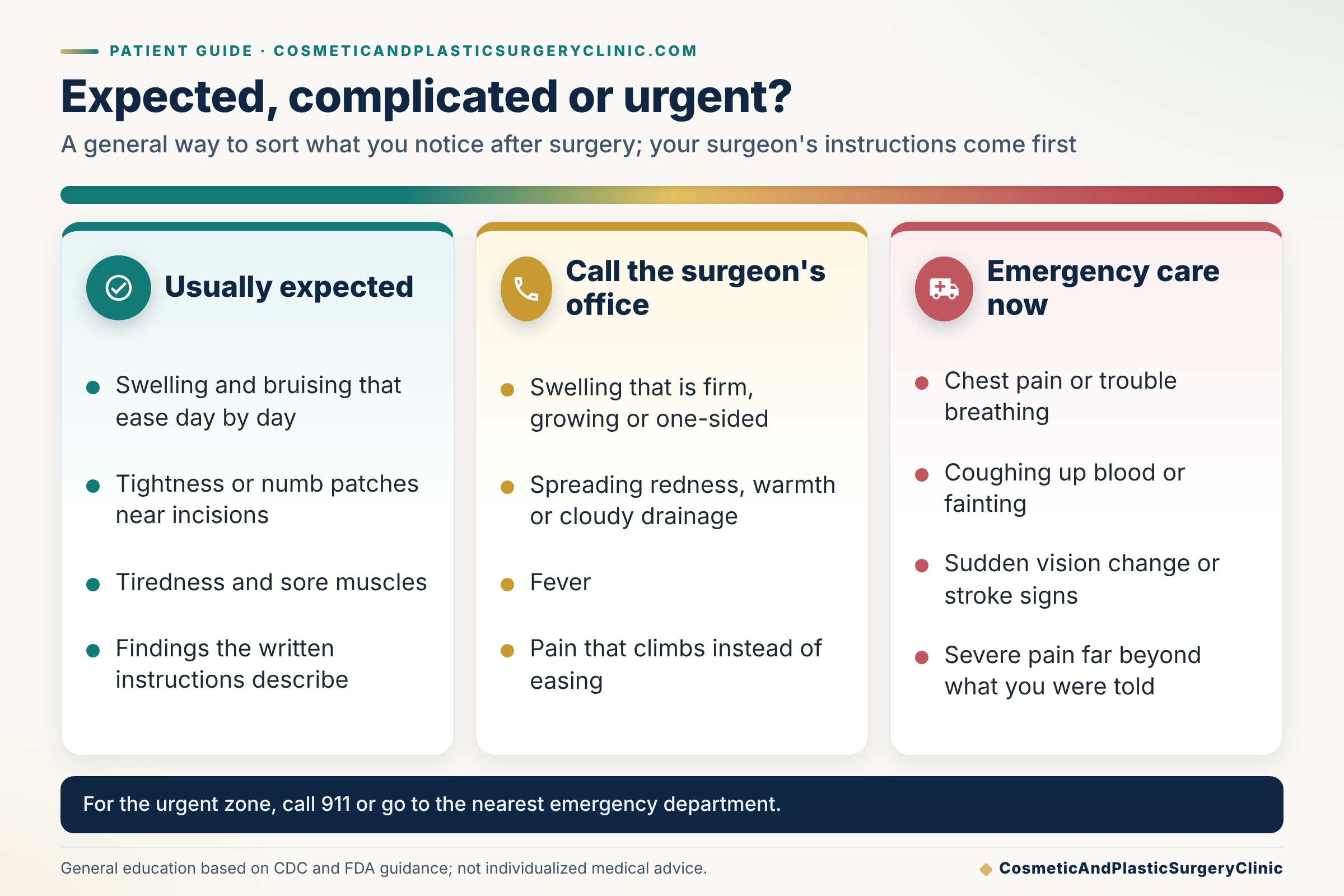
Every consent form lists plastic surgery risks. Fewer documents explain which findings are part of ordinary healing, which are complications, and which need emergency care. The sorting matters because each category calls for a different response: watching, calling, or going now.
What a normal recovery can look like
Swelling, bruising and numbness: common findings with a wide range
Swelling, bruising, tightness, patches of numbness near incisions and a bone-deep tiredness are among the findings surgeons commonly describe as expected after many operations. “Expected” does not mean identical. How long they last and how intense they get depends on the operation, how much tissue was worked on, individual healing, and whether you take anything that affects bleeding.
The practical consequence is that your surgeon’s written instructions, not a timeline from an article, define the normal range for your operation. A practice that is serious about this gives specifics: what bruising may look like, what drainage is typical, which sensations are routine. If the range arrives as “call if you’re worried,” ask for it in writing before surgery. The logistics of those first weeks, from help at home to time off work, are covered on the recovery planning page.
Why severity, one-sidedness and direction of travel matter more than the symptom’s name
Nearly every complication begins by looking like something expected. A hematoma, which is blood collecting where it can’t drain, starts as swelling and bruising. An infection starts as redness and tenderness. A clot can start as a sore calf. The name of the symptom rarely separates the benign from the serious, so three features do more work.
The first is severity: pain well beyond what you were told to expect. The second is asymmetry: one breast, one calf or one side of the face swelling while the other side settles. The third is direction of travel: expected findings tend to plateau and then ease, while problems tend to grow, spread or pick up companions such as fever or drainage. These are rules of thumb for deciding when to call, not diagnostic tests.
General hematoma guidance from the Cleveland Clinic follows the same logic. It suggests calling a provider about bruising that hasn’t healed within two weeks or that comes with numbness, weakness or skin color change, and seeking emergency care for chest or abdominal pain, trouble breathing, or severe pain that seems much worse than expected.
Consider a hypothetical comparison. Two people, a week after the same type of operation, both report “swelling.” One has both sides puffy, with bruises turning yellow-green at the edges. The other has a left side that is tight and getting larger while the right side softens. Same word, different questions. The second pattern belongs in a call to the surgeon’s office that day, not in a wait-and-see pile.
What falls outside routine recovery
Named complications among plastic surgery risks: hematoma, seroma, infection and slow healing
A hematoma is a collection of blood. In one large analysis of 129,007 aesthetic surgery patients enrolled between 2008 and 2013 in a prospective database kept by CosmetAssure, 1,180 patients (0.91%) had a major hematoma, defined as one that led to an emergency visit, hospital admission or reoperation within 30 days (Aesthetic Surgery Journal, 2017). That is a measure of the serious end only; smaller collections handled in the office would not appear in it.
A seroma is a pocket of fluid under the skin. The Cleveland Clinic notes that symptoms usually appear seven to ten days after surgery, that most seromas resolve as the body absorbs the fluid, and that larger or persistent ones may need needle aspiration or a temporary drain.
An infection at the surgical site shows up, per the CDC, as redness and pain around the surgical area, cloudy drainage or fever, and the agency advises calling a provider immediately. Slow wound healing covers edges that separate, skin that darkens or sloughs, and tissue that loses blood supply. It is tied closely to the factors in the third section, especially nicotine.
Plastic surgery risks that belong to one operation or product
Some hazards are not generic at all. For breast implants, the FDA lists local complications that occur in at least 1 percent of patients at some point, including capsular contracture, rupture, asymmetry, infection, hematoma, seroma and changes in nipple or breast sensation, and states plainly that implants are not considered lifetime devices (FDA, current page). For dermal fillers, the FDA calls unintentional injection into a blood vessel the most concerning risk, with reported complications of tissue death, vision problems including blindness, and stroke, which it describes as potentially serious and lasting (FDA, current page).
For gluteal fat grafting, the 2018 ASPS safety advisory attributes the deaths it describes to fat embolism, meaning fat entering the veins after injury to the gluteal veins, and recommends that fat go only into the layer under the skin, never into muscle (ASPS advisory, July 2018). The detail is on the BBL guide. The reason to mention it here is how this changes your reading of a generic list of plastic surgery risks: a long list cannot tell you which three entries are the real hazards of your operation. Ask the surgeon to rank them.
When to call 911 instead of the office line
Routine follow-up fits expected effects and many early complications. Emergency evaluation fits symptoms that suggest a threat to breathing, circulation, the brain, vision or a tissue’s blood supply. The CDC’s list for a pulmonary embolism includes difficulty breathing, a fast or irregular heartbeat, chest pain that worsens with a deep breath or cough, coughing up blood, and lightheadedness or fainting. It also notes that a pulmonary embolism can occur without any leg symptoms, and that about half of people with a deep vein clot have no symptoms at all (CDC, blood clots).
| What you notice | Usual category | General action level | Basis |
|---|---|---|---|
| Mild swelling, bruising and tightness that ease from day to day | Expected effect | Follow written instructions; keep track | Surgeon’s discharge guidance; varies by operation |
| Swelling that is firm, growing or on one side only | Possible hematoma or fluid collection | Same-day call to the surgeon’s office | Cleveland Clinic hematoma and seroma pages |
| Spreading redness, warmth, cloudy drainage or fever | Possible surgical site infection | Call the provider promptly | CDC, surgical site infections |
| Calf or arm swelling, pain and warmth on one side | Possible deep vein clot | Contact a doctor as soon as possible | CDC, blood clots |
| Chest pain, trouble breathing, coughing blood, fainting | Possible pulmonary embolism or other emergency | Emergency care: call 911 | CDC, blood clots |
| After filler: unusual pain, vision change, white, gray or blue skin near the site | Possible blocked blood vessel | Immediate medical attention | FDA, dermal fillers |
Anything your surgeon lists as “call the office,” such as new redness, drainage, fever or growing one-sided swelling, is a same-day call rather than a topic for the next appointment.
Reading any list of plastic surgery risks without being fooled by the numbers
A percentage on a page about plastic surgery risks looks precise, which is exactly why it deserves a second look. Before a figure can guide a decision it needs four attachments: how many people, over what time, defined how, and counted where.
Absolute risk, relative risk and who was counted
One hematoma study, two ways to state the same finding
The 129,007-patient hematoma analysis makes a clean teaching case for reading plastic surgery risks. Among men, 1.4% had a major hematoma; among women, 0.9%. After adjusting for other factors, the study reported a relative risk of 1.98 for male sex, which a headline could compress into “men have double the risk.” Stated in absolute terms, the same data say roughly 14 per 1,000 men versus 9 per 1,000 women, a difference of about 5 per 1,000 (arithmetic from the study’s percentages; Aesthetic Surgery Journal, 2017).
Neither statement is wrong. They answer different questions. Relative risk tells you whether a factor matters; absolute risk tells you how many people are affected. When the baseline is small, a large relative difference can still mean a small number of extra events, and the reverse is true when the baseline is large. Whenever a source on plastic surgery risks gives only a ratio, look for the baseline it sits on.
What “major complication” counted in that data set
That definition, an emergency visit, hospital admission or reoperation within 30 days, shapes everything. A hematoma drained in the office would not count, and neither would a problem that surfaced in week six. The population matters as well: patients enrolled from 2008 to 2013 at accredited facilities, which says little about unaccredited settings.
A companion analysis of 183,914 procedures in the same database reported complication rates of 1.3% in office-based surgery, 1.9% in ambulatory surgery centers and 2.4% in hospitals, all among accredited sites (Gupta et al., Aesthetic Surgery Journal, 2017, as summarized by Clinician.com). Read that carefully. It does not show that hospitals are riskier; the data cannot separate what a setting does from which cases are booked there. It does show that “accredited” was the shared condition for every number in the comparison.
Why a published figure on plastic surgery risks rarely transfers to one person
Numbers move with definitions and years
Gluteal fat grafting shows how risk estimates shift. The July 2018 ASPS advisory described its mortality figure as an estimate, with no year attached, and attributed the deaths to fat embolism. A February 2023 ASPS article quotes one task force member calling the early fatality rate “way too high” for any cosmetic procedure and another pointing to newer survey data suggesting a lower rate; the article does not publish that survey (ASPS, 2023).
These are estimates from different eras and probably different counting methods, and the newer one is quoted secondhand, so this page leaves the figures out. A reader can still draw two sound conclusions: the risk was taken seriously enough to change practice, and no single figure should be treated as settled. The 2018 advisory also states that the risk of death should be discussed during informed consent, which is the right place for any such number to land: in a conversation, with its definition and date.
Shrugging and spiraling are the same mistake in opposite directions
Minimizing treats “rare” as “not me.” Catastrophizing treats “possible” as “likely.” Both skip the denominator. A calibrated reading of plastic surgery risks uses four questions. How often does it happen, out of how many, over what period? How bad is it if it does, and can it be reversed? What changes the odds, and which of those factors are yours to influence? What is the plan for catching it early and treating it?
The second question is the one that most often gets flattened. A common but mild problem and a rare but severe one deserve different responses, and a single blended “risk level” hides the difference. Keep frequency and consequence separate, and the list stops being an undifferentiated wall.

Why the same operation carries different risk for different people
Published rates for plastic surgery risks average over people who differ in health, habits, anatomy and surgical plan. The factors below explain much of the spread in plastic surgery risks, and several can be discussed with your care team well before a date is set. The table summarizes them with the evidence behind each; the sections after it explain the reasoning.
| Factor | Why it matters | Question to ask | How firm is the evidence |
|---|---|---|---|
| Nicotine in any form | Narrows small blood vessels, so raised skin and healing tissue get less oxygen | What is your nicotine policy, and what happens after a lapse? | Consistent across surgical societies; surgeons differ on nicotine replacement |
| Clot history, hormones, long operations | These feed the Caprini score used to judge clot risk | Was my clot risk scored, and what prevention is planned? | Validated scoring; plastic surgery incidence is acknowledged as uncertain |
| Blood thinners and supplements | Some raise bleeding risk; many people never mention supplements | Which of my medications and supplements need a plan? | Strong for prescription drugs; weaker and varied for supplements |
| GLP-1 weight-loss or diabetes drugs | Slowed stomach emptying may raise aspiration risk under anesthesia | Has the anesthesia team seen my current medication list? | Newer; guidance rests mostly on case reports |
| BMI and chronic conditions | Affect healing, infection risk and anesthesia planning | How does my health status change the anesthesia plan? | Moderate; effect size varies by condition and control |
| Combined or lengthy surgery | More time under anesthesia and more tissue worked on | What does staging this change in risk and cost? | Observational data; direction consistent, size varies |
| Facility and anesthesia team | Sets equipment, monitoring and emergency readiness | Who provides anesthesia, and which hospital takes transfers? | Accreditation sets a floor; it does not prove outcomes |
Factors you bring with you
Nicotine in every form, and a timeline counted in weeks
Among modifiable plastic surgery risks, nicotine is the clearest. It narrows small blood vessels, and surgeons lift and move skin in facelifts, tummy tucks and breast procedures, and that skin depends on a thin supply of blood.
A plastic surgeon writing on the ASPS blog in 2016 (her views, not necessarily the society’s) puts the logic simply: smaller vessels mean less blood flow, less oxygen, and in the worst case tissue that dies. She lists gum, patches, snuff, chewing tobacco, cigarettes and e-cigarettes together, suggests quitting three to six weeks before surgery through three to six weeks after, and writes that it is better to delay surgery than risk tissue loss (ASPS blog, 2016).
The broader surgical literature points the same way. The American College of Surgeons’ 2014 statement says smoking-related impairment of wound healing and lung function improves within four to eight weeks and that there is no evidence short-term cessation is harmful around surgery (ACS, 2014). Anesthesiologists add that smoking raises the chance of breathing problems and infection, and that quitting even the day before can help, though sooner is better (ASA patient guidance).
Surgeons do not all handle nicotine replacement the same way, which is a fair question for your consultation. Tell the surgeon about any lapse, however small.
Clot risk, hormones, medications, supplements and GLP-1 drugs
The CDC lists vein injury, slow blood flow from limited movement, chronic illness, older age, family history and higher estrogen levels among the factors behind blood clots. Plastic surgeons use a point-based checklist, the Caprini score, that adds up items like these along with operating time and body mass index.
The ASPS venous thromboembolism task force (July 2011) grouped abdominoplasty and body contouring under general anesthesia for more than 60 minutes among the higher-risk categories, and it acknowledged that the true incidence in plastic surgery patients is unknown (ASPS task force report, 2011). Whether a given patient needs clot-prevention medication, and for how long, is an individualized call.
Medications and supplements add their own plastic surgery risks through bleeding and anesthesia. The American Society of Anesthesiologists says that studies show half of people who use herbal supplements do not tell their doctors before surgery, flags ginkgo, garlic and vitamin E for bleeding risk, and notes that you may be told to stop supplements at least two weeks before a procedure (ASA supplements guide). Bring the bottles to the pre-surgery visit. Stopping or continuing a prescribed blood thinner is a decision for the prescriber and surgical team together, not something to settle alone from an article.
GLP-1 receptor agonist drugs are the newest entry. The ASA’s June 2023 guidance (updated 2024) says delayed stomach emptying may raise the chance of regurgitation and aspiration under general anesthesia or deep sedation, while noting that the supporting evidence is limited, mostly case reports. It describes holding doses before elective procedures in some situations; the specifics belong to your anesthesia team, so mention any GLP-1 use early (ASA, 2023).
Chronic conditions and what an ASA class does and doesn’t say
The CDC notes that health problems such as diabetes and obesity can affect surgery and treatment, and a facelift analysis of 11,300 patients in the same CosmetAssure database found infection risk higher with combined procedures (relative risk 3.5) and with a body mass index of 25 or more (relative risk 2.8) (Aesthetic Surgery Journal, 2016).
Anesthesia teams summarize overall health with the ASA Physical Status classification. Class I is a normal healthy patient; class II includes mild systemic disease such as current smoking, obesity with a BMI of 30 to 40, or well-controlled diabetes or hypertension; class III includes poorly controlled diabetes or hypertension and severe obesity (ASA classification).
Two things stand out. The classes separate well-controlled from poorly controlled disease, so control matters at least as much as the diagnosis. And the classification sorts overall health, not the operation, so it cannot stand alone as a risk number. Prior surgery in the same area is a separate question: scar tissue can change tissue planes and blood supply, which is why surgeons ask for earlier operative records.
Factors in the operation, the team and the building
Operative extent and combined procedures
A 2019 ASPS blog post notes that longer procedures carry greater risk, some of it potentially fatal, and advises against stacking procedures into one operation simply to save money (ASPS blog, 2019). The data on plastic surgery risks bear that out in places. In the facelift analysis, combined procedures had up to a 3.7% complication rate versus 1.5% for facelifts alone.
For clots, the December 2024 ISAPS patient safety update reports deep vein thrombosis risk figures of 0.34% for abdominoplasty alone, 2.17% when an intra-abdominal procedure is added and 3.4% with a belt lipectomy; the update is a secondary summary and does not state the underlying population in the text we reviewed (ISAPS, 2024). Staging lowers the extent of each operation but adds a second anesthetic, a second recovery and often a second set of fees. For how combinations are usually structured, see the mommy makeover guide.
Anesthesia, accreditation and who responds when something goes wrong
MedlinePlus describes anesthesia as generally safe while noting risks that are greater with general anesthesia, including heart rhythm problems, breathing problems, allergic reactions, temporary confusion and, rarely, awareness during the procedure; your health and the operation shape which type is used (MedlinePlus). An ASPS blog post from 2017 suggests asking who provides the anesthesia, with the answer being a physician or a certified registered nurse anesthetist, and whether the surgeon operates in an accredited ambulatory facility (ASPS blog, 2017).
A 2019 ASPS post adds that an accredited facility is expected to have equipment for unexpected emergencies and to be re-accredited every three years, and names AAAASF, AAAHC, IMQ, the Joint Commission and Medicare among accrediting agencies. Accreditation sets a floor for equipment and protocols; it does not promise any single outcome. The checking steps are laid out on the surgeon verification page. A useful addition is a question accreditation papers don’t answer: which hospital would receive you in a transfer, and how far is it?
Experience versus marketing claims
Experience is relevant to plastic surgery risks, and it is hard to read from marketing. The same 2019 ASPS post suggests looking for a surgeon who is honest and responsive about complications and being wary of one who claims never to have any. That is a sound screen because every operating surgeon has had unplanned events; the useful signal is how openly the practice discusses them.
“Thousands of procedures” describes volume, not outcome, unless it comes with a time frame and a way of counting. Ask how often the surgeon performs your specific operation (the 2017 ASPS post lists this question) and whether the practice tracks unplanned returns to the operating room or hospital transfers. Many practices do not track formally, and a plain “we don’t” is more reassuring than an invented figure. Before-and-after galleries show results, not complications, so they cannot answer this question.
Plastic surgery risks that never reach the emergency room but still matter
Most disappointment after cosmetic surgery involves the visible result, not a hospital visit. These plastic surgery risks rarely come with tidy percentages, which makes them easy to wave away at the consultation and hard to ignore a year later.
Scars and sensation: trade-offs built into the incision
Scar quality: location, tension, healing and habits
Scarring is one of the plastic surgery risks every patient accepts: every incision leaves a scar. The surgeon’s choices determine where it sits and how much tension the closure carries, but your own healing biology also decides how it looks, and some of that is out of anyone’s hands. The ASPS blog post on nicotine lists thick or wide scars among the problems linked to nicotine use.
Scars usually take many months to settle, so a picture at six weeks says little about the end state. Ask where the scar will lie, roughly how long it will be, and what the options are if it thickens or widens. If you have had raised, widened or unusually thick scars before, that history belongs in the conversation even if it seems unrelated.
Numbness, tingling and nerve change
Cutting through skin and fat cuts small sensory nerves, so some change in feeling is built into many operations. In the FDA’s list of local complications that occur in at least 1 percent of breast implant patients, nipple and breast sensation changes appear alongside pain, asymmetry and capsular contracture. For plastic surgery risks more broadly, sensation change is among the least predictable: it may improve over months, stay as a patch of reduced feeling, or show up as hypersensitivity.
Useful questions are specific. Which sensory nerves run near the work area? How do patients usually describe sensation at six months and a year? If numbness would affect something you rely on, such as a nipple, the front of the thigh or the skin along the jaw, say so before the plan is set rather than after.
Asymmetry, dissatisfaction and the revision question
Asymmetry and the limits of what surgery can match
Few bodies and faces are symmetrical side to side, and surgery starts from that baseline. Healing also differs between sides: one breast may swell longer, one eyelid may settle sooner. The FDA’s implant list names asymmetry and unsatisfactory style or size as recognized complications, a sign that a mismatch can be a documented risk and not only a matter of taste.
Ask what the surgeon expects to be able to match and what is likely to stay different. Ask to see results from people whose starting anatomy resembles yours, with the caveat that photos are selected and cannot be a forecast; the guide to reading before-and-after photos covers what to look for. Dissatisfaction without a medical complication still counts as a risk worth weighing, because it can lead people to consider a second operation.
Revision: how likely, who pays and what a second operation adds
Revision belongs on the list of plastic surgery risks even when the first operation goes well. For breast implants, the FDA says you may need one or more reoperations over your lifetime, may need the implants removed at some point, and that the chance of complications grows the longer implants stay in.
A second operation brings its own anesthesia, its own recovery and, in operated tissue, changed anatomy that can make the work harder. It also brings a bill. Ask in writing what the original quote covers if a revision is needed: surgeon’s fee, facility, anesthesia, and for how long. The cost page breaks a quote into its components so you can see which line a revision policy would touch. Verbal promises of free touch-ups, with nothing in the contract, are not a policy.
Turning plastic surgery risks into informed consent you can actually use
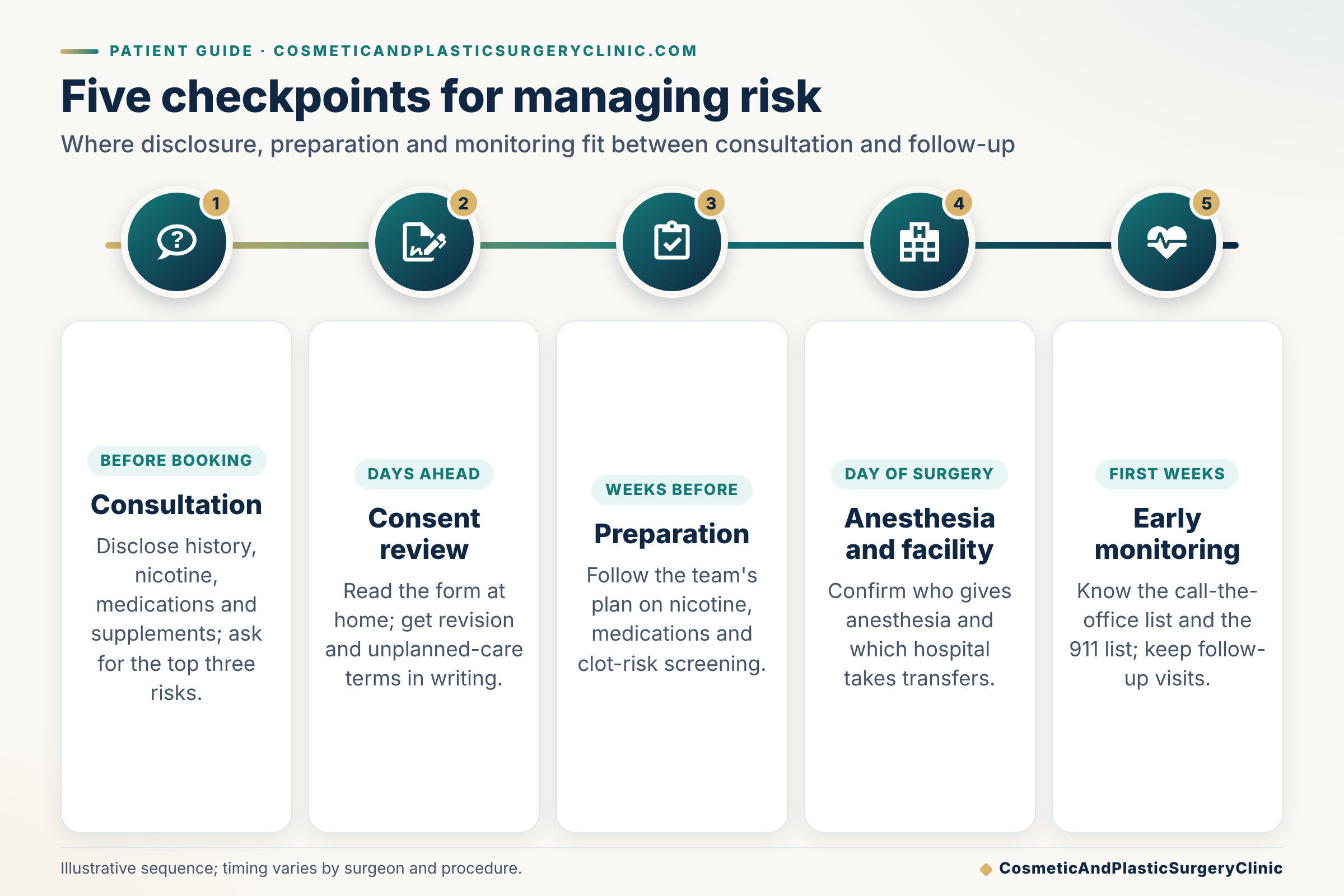
A list of plastic surgery risks helps only if it changes what you ask and what you decide. The goal of this last section is to convert general knowledge into questions that produce specific, checkable answers.
Asking how the team prevents problems and handles them
A consent form is a record; informed consent is a conversation
For plastic surgery risks as for any other, the American Medical Association’s Code of Medical Ethics describes informed consent as a process of communication between patient and physician. It says the physician should present the diagnosis when known, the nature and purpose of recommended interventions, and the burdens, risks and expected benefits of all options, including forgoing treatment (AMA Code of Medical Ethics, Opinion 2.1.1).
A signature collected in a pre-operative bay minutes before sedation is a poor fit for that description. Ask for the form days ahead, read it at home, and mark every line that you could not explain to a friend. The broader consultation, including what to bring and how to judge answers, is the subject of the consultation questions page.
Turning each major risk into a question you can ask
“Is it safe?” invites a reflex answer. Specific questions invite specific ones. A useful opener is to ask the surgeon to name the three risks most relevant to your plan and describe what happens if each occurs. The table converts the major categories into questions, with the shape of a concrete answer and the kind of response that should slow you down.
| Risk | Question to ask | A concrete answer includes | Give-pause response |
|---|---|---|---|
| Bleeding and hematoma | How do you assess my bleeding risk, and what happens if a collection forms? | Medication review, a stated return-to-surgery plan, who is reachable that night | “That doesn’t happen here” |
| Infection | What do you do to lower infection risk, and which symptoms should prompt a call? | A written symptom list, a number that is answered, scheduled follow-up | General reassurance with nothing in writing |
| Blood clots | Was my clot risk scored, and what prevention is planned? | A named screening method and a plan for movement and, where indicated, other measures | “Not an issue for cosmetic cases,” with no reasoning |
| Anesthesia | Who provides anesthesia, and have they reviewed my medications and supplements? | A named physician or CRNA, a pre-operative review, time to ask questions | Provider unnamed until the day of surgery |
| Wound healing | How do my nicotine use, diabetes or scar history change your plan? | Specific conditions, and willingness to postpone | Lapses dismissed as “we’ll work around it” |
| Revision | When might a second operation be needed, and who pays? | Typical reasons, plus fee terms in the contract | Verbal promises with no written terms |
After-hours access and an emergency plan you can say out loud
The most serious plastic surgery risks do not wait for office hours. Before surgery, know who answers the phone at night and on weekends, whether that person is the surgeon or a covering clinician, and what number to call. Know which emergency department you would go to, whether the facility has an arrangement with a nearby hospital, and how long the trip takes. Keep a card in your wallet with the operation, the date, the surgeon, the facility and your medication list; emergency staff cannot act on what they do not know.
Ask what is billed if you need an emergency visit or readmission, a common blind spot in quotes. If the operation is far from home, the same questions get harder: the medical tourism page looks at how distance changes who can treat a complication. Nighttime help at home for the first days is a planning item too.
Knowing when to get another opinion, wait or decline
Pressure, vague answers, unstable health and expectations surgery can’t meet
Four patterns justify slowing down. The first is pressure: a discount that expires this week, a deposit due before you have read the consent form, or a financing offer that must be accepted on the spot. The second is vagueness. Compare two hypothetical answers to a question about hematoma. One says “most patients do great.” The other says what the practice counts, how it detects a collection early and where a patient would be seen that night. Only the second gives you something to check.
The third is unsettled health: a flare of a chronic condition, a recent infection, a recent nicotine lapse, or medication questions that haven’t been answered. Whether to proceed is the surgical team’s judgment, and a good team will sometimes say “not yet.” The fourth is an expectation surgery cannot meet, such as the hope that an operation will resolve something unrelated to anatomy. A second opinion from another board-certified plastic surgeon is a normal step in any of these cases, not a slight on the first.
Choosing no treatment is a legitimate outcome
The AMA’s description of informed consent includes forgoing treatment among the options whose risks and benefits should be explained. Take that literally. Waiting keeps every option open, whereas most operations cannot be undone and each brings its own plastic surgery risks. Nonsurgical alternatives have their own risk profile, as the FDA’s filler warning shows, so “no treatment” and “a different treatment” are separate choices to weigh.
You don’t need a dramatic reason to pause: “I’d like more time with these numbers” is enough, and the response you get tells you something about the practice. For the larger question of whether an elective procedure is worth its trade-offs at all, the cornerstone guide offers a framework for deciding, including how to say “not now.”
Frequently asked questions
Do plastic surgery risks end when the stitches come out?
There is no single end point, because different risks have different windows. The December 2024 ISAPS update says clot risk is highest in the first two weeks and stays elevated for roughly two to three months. The Cleveland Clinic says seroma symptoms usually appear seven to ten days after surgery. The FDA says breast implant complications become more likely the longer implants stay in place. Scars keep changing for months. Ask your surgeon for the window attached to each risk on your list, and keep your follow-up appointments even when you feel well.
Does a normal screening mean my plastic surgery risks are low?
It means the team looked for known problems and found no barrier, which reduces uncertainty without removing it. The ASA classification, for example, places current smokers and people with well-controlled chronic disease in class II, so a “cleared” patient can still carry meaningful modifiers. Some problems are also hard to detect in advance: the ISAPS update notes that deep vein clots are often silent. Treat clearance as a starting point for the risk conversation, and keep disclosing new medications, symptoms or lapses as the date approaches.
Are the plastic surgery risks of a nonsurgical treatment automatically lower?
It usually involves less anesthesia and no large incision, but the risk is different, not absent. The FDA calls accidental injection of a filler into a blood vessel the most concerning filler risk and lists tissue death, vision problems and stroke among reported complications. Ask who performs the injection, what training and credentials that person holds, what the plan is if skin color changes or vision blurs, and who can be reached afterward. Those questions matter more than the word “minimally invasive.”
How honest do I need to be about vaping or an occasional cigar?
Fully honest, because the mechanism does not depend on the delivery method. The ASPS blog author cited above writes that even one puff constricts blood vessels, and the same post groups vaping and nicotine gum with smoking. That is one surgeon’s view, but the underlying concern about blood flow to healing tissue is widely shared. Ask whether the practice verifies nicotine status and what it does about a lapse. Rescheduling is an inconvenience; undisclosed nicotine can turn into a wound-healing problem.
Why does a list of plastic surgery risks mention death if the odds are low?
A consent form lists severe outcomes whether they are common or rare, so inclusion says nothing about frequency. The AMA’s guidance calls for explaining the burdens and risks of all options, and the 2018 ASPS gluteal fat grafting advisory specifically says the risk of death should be discussed in consent. Ask for the frequency, source and year behind any figure the surgeon quotes, and what the practice does to lower that particular risk.
Who pays if I need unplanned care after surgery?
It varies by practice, contract, facility and insurance, so the answer has to come from your paperwork, not from an article. Before surgery, ask in writing what the quote covers if a complication or revision occurs: surgeon’s fee, operating room, anesthesia, and for how long. Also ask what you would owe for an emergency visit elsewhere or a hospital readmission, and check with your health insurer about elective-surgery complications.
How do I stop spiraling after reading a long list of plastic surgery risks?
Convert each worry into a question with a denominator: how often, out of how many, over what period, and what is the plan? Ask the surgeon to rank the three risks that apply most to your operation. Use forums to learn what to ask, not to estimate odds, since posts tend to skew toward the memorable cases. If the anxiety feels hard to manage, talk with your primary care clinician; it is also a legitimate reason to pause.
Sources and further reading
- Aesthetic Surgery Journal (2017) via QxMD — Incidence and Risk Factors for Major Hematomas in Aesthetic Surgery: Analysis of 129,007 Patients (accessed 2026-11-12) — hematoma rates, relative risks, definition of major hematoma
- Aesthetic Surgery Journal (2016) via QxMD — Preoperative Risk Factors and Complication Rates in Facelift: Analysis of 11,300 Patients (accessed 2026-11-12) — combined-procedure and BMI findings
- Clinician.com — Research finds all settings for accredited aesthetic surgery are safe, summarizing Gupta et al., Aesthetic Surgery Journal 2017 (accessed 2026-11-12) — complication rates by facility type (secondary summary)
- Pannucci et al., Journal of the American College of Surgeons (2010), via PubMed Central — Validation of the Caprini Risk Assessment Model in Plastic and Reconstructive Surgery Patients (accessed 2026-11-12) — VTE rates by Caprini group
- American Society of Plastic Surgeons — Evidence-based Practices for Thromboembolism Prevention, VTE Task Force Report (2011) (accessed 2026-11-12) — clot risk factors and procedure grouping
- International Society of Aesthetic Plastic Surgery — Patient Safety Update on DVT and PE (December 2024) (accessed 2026-11-12) — timing of clot risk, abdominoplasty figures
- American Society of Plastic Surgeons — Gluteal Fat Grafting Safety Advisory (July 2018) (accessed 2026-11-12) — fat embolism mechanism, consent recommendation
- American Society of Plastic Surgeons — Improving safety for the Brazilian butt lift (February 2023) (accessed 2026-11-12) — task force comments on mortality estimates
- American Society of Plastic Surgeons blog — How nicotine sabotages plastic surgery (December 2016) (accessed 2026-11-12) — nicotine forms, mechanism and timing (author’s view)
- American Society of Plastic Surgeons blog — Investing in your safety when choosing to have plastic surgery (August 2019) (accessed 2026-11-12) — procedure length, combinations, accreditation
- American Society of Plastic Surgeons blog — Ten things to ask before having plastic surgery (August 2017) (accessed 2026-11-12) — anesthesia provider, facility, volume questions
- Centers for Disease Control and Prevention — About blood clots (accessed 2026-11-12) — DVT and PE symptoms, risk factors, when to seek care
- Centers for Disease Control and Prevention — About surgical site infections (accessed 2026-11-12) — infection symptoms and risk factors
- U.S. Food and Drug Administration — Risks and complications of breast implants (accessed 2026-11-12) — local complications, reoperation, not lifetime devices
- U.S. Food and Drug Administration — Dermal fillers (soft tissue fillers) (accessed 2026-11-12) — blood vessel injection risk and urgent symptoms
- American Society of Anesthesiologists — Smoking and surgery patient guidance (accessed 2026-11-12) — smoking, anesthesia and healing
- American Society of Anesthesiologists — Supplements and anesthesia (accessed 2026-11-12) — disclosure, bleeding, two-week guidance
- American Society of Anesthesiologists — Consensus-based guidance on preoperative management of GLP-1 agonists (June 2023, updated 2024) (accessed 2026-11-12) — aspiration concern and evidence limits
- American Society of Anesthesiologists — ASA Physical Status Classification System (accessed 2026-11-12) — class definitions and examples
- American College of Surgeons — Statement on the Effects of Tobacco Use on Surgical Complications (August 2014) (accessed 2026-11-12) — healing improvement timeline
- MedlinePlus (NIH) — Anesthesia (accessed 2026-11-12) — anesthesia types and risks
- Cleveland Clinic — Hematoma (accessed 2026-11-12) — hematoma warning signs
- Cleveland Clinic — Seroma (accessed 2026-11-12) — timing, course and treatment
- American Medical Association — Code of Medical Ethics, Opinion 2.1.1 Informed Consent (accessed 2026-11-12) — elements of informed consent