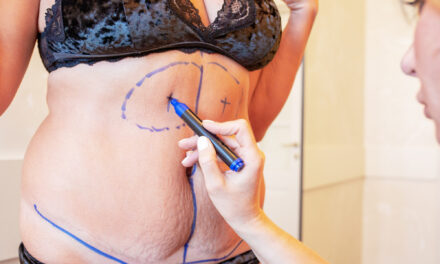
BBL surgery, short for Brazilian butt lift and more formally called gluteal fat grafting, is an operation that removes fat from one part of the body with liposuction, processes it, and injects it into the buttocks to add fullness, projection, and shape. It is a popular body-contouring procedure in the United States, and it is also an operation about which several plastic surgery societies have issued repeated, public safety warnings. This guide is built for people who are still deciding: it explains what the operation involves, who surgeons tend to consider, how techniques and safety standards differ, what recovery asks of you, which risks deserve the most attention, what results can and cannot be, what it costs, and what the alternatives are.
A guide like this one has to carry two ideas at once. Many people who research a BBL are looking for a clear, adult explanation of a procedure that social media tends to flatten into a before-and-after photo. At the same time, the best-documented fact about the operation is that it has a distinctive and serious risk, fat embolism, tied to where the fat is placed. You’ll find that risk discussed in plain language in the middle of the article rather than in a footnote, along with the practical steps that professional societies and published studies point to for reducing it.
The sections run in the order most decisions unfold: definition and limits first, then candidacy, technique and the day of surgery, recovery, risk, results, and finally cost, alternatives, and a decision framework. Two sibling pages go deeper on single topics. The week-by-week BBL recovery guide covers aftercare logistics in detail, and the BBL results guide covers shape, longevity, and expectations; this page summarizes both and links out rather than repeating them. Nothing here is a diagnosis or a recommendation for any individual, and your own surgeon’s written instructions always outrank general information.
What BBL Surgery Is and What It Changes
Before cost, recovery, or risk can make sense, it helps to pin down what the operation actually is, because the name covers a family of practices rather than one fixed technique. This section defines the vocabulary, walks through the mechanism in plain language, and then separates what fat grafting to the buttocks can realistically do from what it can’t.
Definition and Terminology
BBL, gluteal fat grafting, and buttock augmentation: what the names mean
People use several labels for closely related operations, and the differences matter when you’re comparing sources. “Brazilian butt lift” and “BBL” are the popular terms, and they’re what most people type into a search box. “Gluteal fat grafting” or “gluteal fat transfer” is the clinical description: gluteal refers to the buttock region, and grafting means moving living tissue, here fat, from one place to another. “Buttock augmentation with fat grafting” is the phrase ASPS uses in its annual procedure statistics. ASPS describes buttock augmentation as an umbrella that can involve implants, fat grafting, or a combination of the two, and it notes that fat grafting is sometimes called a Brazilian butt lift.
The word “lift” is a little misleading. A BBL adds volume and changes contour; it doesn’t remove excess skin or tighten sagging tissue. ASPS lists a separate operation, the buttock lift, that is designed around loose skin and uses incisions placed according to where the excess sits. People sometimes book a BBL when what they want is a firmer, higher-set look that depends more on skin than on volume, and a clear vocabulary helps you ask the right question at a consultation.
Two other terms come up in safety discussions and are easy to confuse. Fat necrosis means that some of the transferred fat has died locally and may feel like a firm lump; it’s a recognized risk of fat grafting. Fat embolism means that fat has entered the bloodstream and traveled to the lungs or other organs, which is a different and much more dangerous event. The table below sets the vocabulary side by side.
| Term | What it usually refers to | Common mix-up |
|---|---|---|
| BBL / Brazilian butt lift | Liposuction of donor areas plus fat injected into the buttocks | “Lift” suggests tightening, but the operation adds volume and contour |
| Gluteal fat grafting or transfer | The clinical name for the same family of operations; used in safety advisories | Assuming every practice uses the same technique or safety steps |
| Buttock augmentation | Umbrella term covering fat grafting, implants, or both | Assuming it always means implants |
| Buttock lift | Skin-removal surgery with incisions placed by the location of excess skin | Expecting it to add fullness the way fat or implants do |
| Gluteal implants | Silicone implants placed within or above the gluteal muscle (per ASPS) | Assuming they use your own fat |
| Fat necrosis | Local death of some transferred fat, sometimes felt as firm areas | Confusing it with fat embolism |
| Fat embolism | Fat entering blood vessels and traveling to the lungs or heart; a medical emergency | Treating it as a minor healing problem |
Throughout this page, “BBL” and “gluteal fat grafting” mean the same operation, and “buttock augmentation” means the broader category. When a source describes only implants or only a skin-removal lift, the text says so.
How the operation works: harvest, process, place
Every version of a BBL has three stages. The first is harvest: fat is removed from one or more donor areas with liposuction. According to ASPS, a cannula, which is a thin hollow tube, loosens the fat through controlled back-and-forth motion after diluted anesthetic is administered into the area, and the fat is suctioned out. ASPS adds that a surgeon may remove up to about three times as much fat as will actually be injected into the buttocks, which tells you something important: the donor-area work is not a minor add-on, and it’s a real liposuction operation with its own recovery and risks. If you want the technique side of that stage, the complete guide to liposuction and the explainer on how liposuction techniques differ go further.
The second stage is processing. The harvested material contains fat cells but also fluid, blood, and other components, so it’s prepared before reinjection. ASPS says only that the harvested fat is processed; practices vary in how they do it, and the sources reviewed for this article don’t establish that one processing method is better than another for gluteal grafting. That’s a fair question to ask a surgeon, though a confident answer matters less than whether the plan is explained plainly and consistently.
The third stage is placement. Processed fat is injected back through a specialized cannula in many small passes throughout the buttocks, shaped to the area the surgeon and patient planned. This is the step that safety advisories focus on, because the plane where the fat lands determines much of the risk. Multi-society statements since 2018 advise placing fat only in the layer under the skin, above the gluteal muscle, and the statement issued in August 2022 by ASPS, the Plastic Surgery Foundation, The Aesthetic Society, and the Aesthetic Surgery Education and Research Foundation says fat should be injected only into the subcutaneous space above the gluteal fascia. Later sections explain that recommendation in detail.
Transferred fat is living tissue. After it’s placed, the cells that survive have to develop their own blood supply in their new location, as a surgeon explained in an ASPS news article about recovery, and the cells that can’t do so are gradually absorbed by the body. That’s why the volume you see right after surgery isn’t the volume you keep, and it’s the reason results are described over months rather than days.
Scope and Limits
What a BBL can address
ASPS says buttock augmentation can increase fullness, roundness, and projection of the buttocks, improve the balance of the figure, and support self-image and confidence. Those are broad claims, and it’s worth translating them into what a surgeon would actually be trying to change. Volume is the most direct goal: some people have a flatter or smaller buttock shape that they’ve never felt comfortable with, and fat can add soft-tissue volume where it was placed. Shape is the second: fat can be placed more in some regions than others to alter the outline, such as the upper or side portions, which is why surgeons talk about “contour” as much as size.
Proportion is the third goal, and it’s partly a result of the donor-area liposuction. Removing fat from the waist, abdomen, flanks, back, or thighs, depending on where a person carries it, changes the relationship between those regions and the hips and buttocks. In that sense a BBL is two contouring operations that happen in one session, and some people are as interested in the donor-site change as in the buttocks themselves. Asymmetry is a fourth possible goal; ASPS lists correcting asymmetrical buttocks as one reason people consider augmentation, though exactly matched sides aren’t a realistic target for any procedure and the surgeon can explain what is achievable for a given anatomy.
The word “can” matters in every one of these goals. How much of a goal is met depends on how much donor fat is available, how much of the transferred fat survives, how the tissues heal, and what the person’s body does over the following year. Responsible planning treats the first photo-ready impression as a starting point, not the finished outcome.
What a BBL cannot change
The limits are as practical as the benefits. A BBL doesn’t remove loose skin; if the main concern is sagging, a buttock lift is the operation designed around skin, and adding volume beneath loose skin may not produce the look someone expects. It doesn’t change bone structure, so the width of the pelvis and the position of the hips remain what they were. It doesn’t build muscle, which is a separate tissue from the fat layer being treated. And it isn’t a treatment for cellulite; ASPS’s own liposuction safety page lists “worsening of cellulite” among the risks of liposuction, which is relevant because liposuction is the first stage of the operation.
It also can’t override the supply of donor fat. A person with little fat to spare may be offered a smaller change, a different approach, or the suggestion to wait, and a surgeon who describes a goal that can’t be met with the available fat is giving honest information rather than being unhelpful. Finally, a BBL doesn’t stop time. ASPS notes that buttock size and shape continue to change with aging and gravity, that weight change affects transferred fat the way it affects other fat, and that there is no promise that a single procedure will reach the desired result.
One more limit is cultural rather than anatomical. Ideas about the “right” buttock shape shift with fashion and with who is photographed, and an operation done to match a trend can leave a person with a result they feel differently about in a few years. A balanced consultation includes your own reasons for wanting a change, what you’d consider a good outcome in everyday clothes and daily life rather than in a single image, and what you’d do if the result were more modest than you hoped.
Who May Be Considered for BBL Surgery, and When to Wait
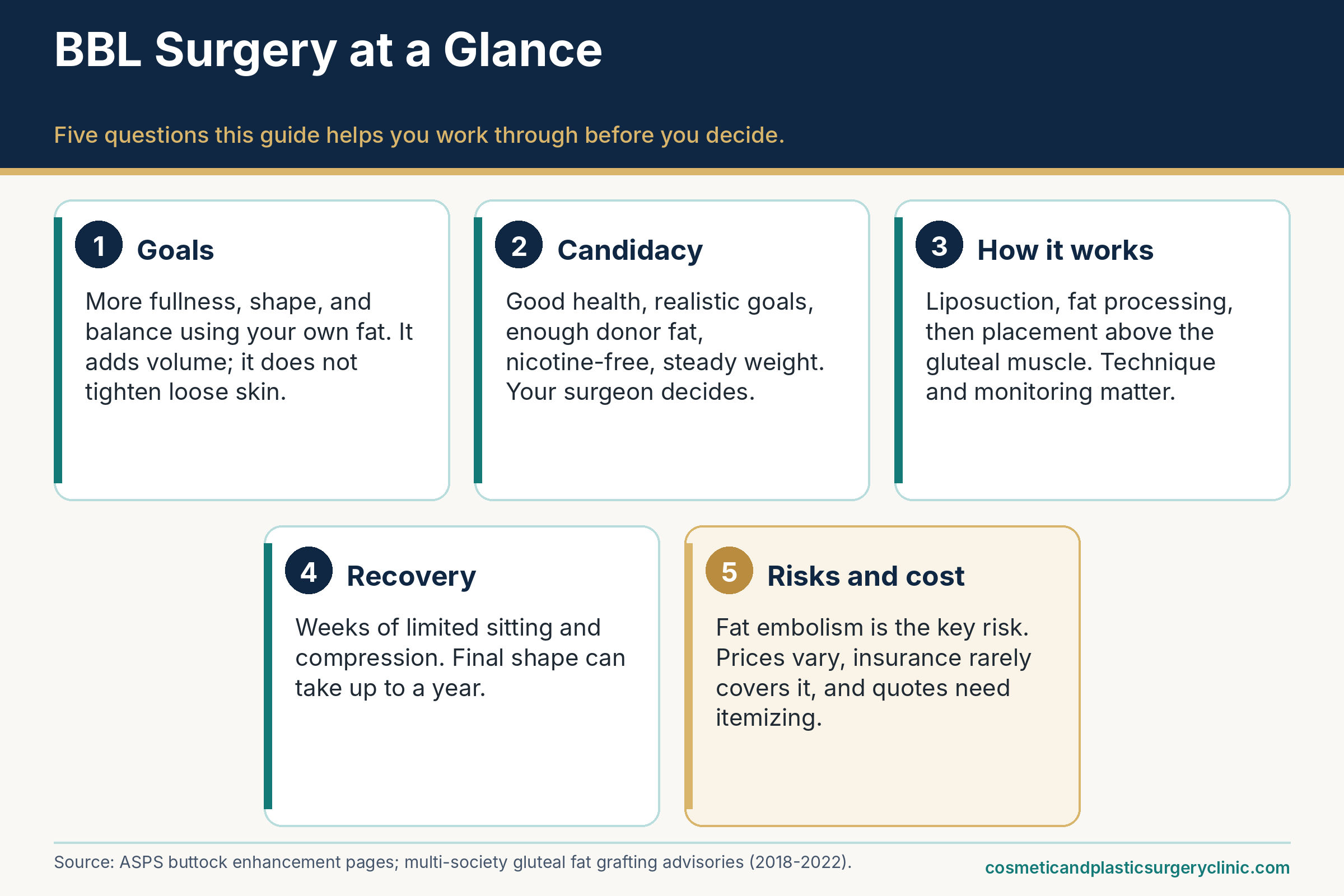
Candidacy is a judgment a surgeon makes with you, after a history, an exam, and a conversation, and no article can make it for you. What an article can do is explain the factors that usually enter that judgment so the consultation isn’t the first time you hear them. The general picture from ASPS is short: a candidate is physically healthy, has realistic expectations, and wants more fullness, a rounder shape, or better symmetry. An ASPS news article on the procedure adds that the typical candidate is near an “ideal” body weight, a phrase worth asking a surgeon to define for your frame, and doesn’t smoke. The details behind those phrases are where decisions are actually made.
Factors Surgeons Weigh
Goals, anatomy, and available donor fat
Start with the goal, because it determines which operation is even on the table. A person who wants more rounded fullness in the upper and side regions and has fat to spare elsewhere is describing something fat grafting can address. A person whose main concern is skin that has lost its firmness is describing something fat grafting doesn’t treat. A person who wants a large and dramatic change in projection with very little donor fat is describing a gap between goal and material, and that gap is a common reason for a surgeon to suggest a smaller change, a different approach, or staging over more than one session. The multi-society advisories mention that alternatives such as implants and staged procedures belong in the consent conversation.
Anatomy comes next. Surgeons look at where you carry fat, how much can be harvested, the shape and size of your pelvis and hips, the quality and elasticity of the skin over the buttocks, and how the underlying muscle shapes the contour. ASPS notes that a surgeon may remove up to about three times as much fat as will be injected, so a plan has to start from how much donor fat exists and from where it can safely and evenly be taken. Surface irregularities from liposuction are a recognized risk, which is one reason an even harvest across a donor area matters as much as the total volume.
Here is a short, invented example, not a patient story. Two people both say they want “more shape.” One is an endurance runner with strong glutes, very little fat on the abdomen or flanks, and a wish for noticeably more projection. The other has fat distributed over the abdomen, back, and thighs, firm skin, and a goal of better balance between waist and hips. The second person’s goal and material line up more naturally than the first person’s. A good surgeon will say so, and will describe what a realistic change looks like for each, including the possibility that the answer for the first person is “not much, and here is why.”
Health, medications, and lifestyle
General health matters because the operation includes liposuction, anesthesia, and a recovery period that limits movement, and ASPS lists anesthesia risk, blood clots, and cardiac and pulmonary complications among the risks of buttock enhancement. A surgeon will ask about heart and lung conditions, diabetes, bleeding or clotting problems, previous clots, anemia, and prior surgeries, and may order blood tests; ASPS’s preparation page mentions a blood test and possible medication adjustments. Medications and supplements matter too. ASPS notes that aspirin and certain anti-inflammatory drugs can increase bleeding and are typically addressed before surgery, but which ones, and for how long, is a decision for your surgical team and prescribing clinicians. Don’t stop or start a prescription on your own because of an article.
Weight-loss medications deserve a specific mention because they’ve become common. In October 2024, five medical societies, including the American Society of Anesthesiologists, published multisociety guidance on GLP-1 receptor agonists and elective procedures. It describes the concern that these drugs slow stomach emptying, which can raise the risk of stomach contents entering the lungs under general anesthesia or deep sedation, and it recommends individualized planning among the anesthesia team, surgeon, and prescriber. If you take one of these medications, say so at the first consultation and again to the anesthesia provider. The site’s guide to GLP-1 medications and plastic surgery covers the topic in more depth.
Lifestyle is the practical half of health. A BBL recovery restricts sitting, positioning, and some kinds of activity, and ASPS asks patients to arrange a ride home and an adult to stay at least the first night. People whose jobs require long periods of sitting, lifting, or driving, people with young children or other caregiving duties, and people who live far from the surgeon’s office all face a heavier planning load than a person with a flexible schedule and a helper at home. That isn’t a reason to rule anyone out, but it’s a reason to plan the recovery before choosing the date. A stable weight matters as well, because transferred fat behaves like other body fat; the guide to weight stability before body contouring explains why surgeons often ask about it.
| Factor | Why surgeons raise it | Question to bring |
|---|---|---|
| Donor fat and body frame | Volume that can be harvested limits how much can be placed | Where would fat come from, and how much is realistic for my body? |
| Skin quality over the buttocks | Fat adds volume but does not tighten loose skin | Would a lift, or a different plan, address my main concern better? |
| Heart, lung, clotting history | Anesthesia, clots, and cardiopulmonary complications are listed risks | Do I need medical clearance or extra testing? |
| Medications and supplements | Some affect bleeding, anesthesia, or stomach emptying | Which of mine need review, and who decides? |
| Nicotine use | Impairs wound healing and raises clot risk | What is your nicotine policy, and how far ahead must I stop? |
| Weight stability | Transferred fat changes with body weight | How long should my weight be steady before surgery? |
| Recovery logistics | Sitting and sleeping limits affect work and home life | What will I need in the first two weeks, and who will help? |
Reasons to Pause, Postpone, or Reconsider
Medical and timing reasons
Some circumstances call for a delay rather than a no. Nicotine tops the list. MedlinePlus advises stopping tobacco at least four weeks before surgery, with ten weeks or longer lowering risk further, because smoking reduces oxygen delivery to healing tissue, slows wound healing, and raises the risk of infection and leg clots. It also says that using nicotine gum around the time of surgery is not encouraged, which surprises people who assume replacement products are neutral. Many surgeons require a nicotine-free period and some test for it; if you use any nicotine product, ask for that surgeon’s rule early, because it determines your earliest realistic date.
Unstable weight is another reason to wait. If you’re actively losing weight, including with medication, the donor fat and the buttock fat will both change, and any volume you place could shrink with the next change on the scale. The 2024 anesthesia guidance also notes that people in a medication dose-escalation phase, or with ongoing stomach symptoms, may be advised to defer elective procedures. Active infection or skin problems at the donor or recipient sites, a recent surgery in the same region, a clotting condition that hasn’t been evaluated, or a chronic condition that isn’t well controlled are other situations where a thoughtful surgeon would pause, treat, or refer first.
Pregnancy plans belong in this conversation too. Pregnancy changes weight, skin, and abdominal and pelvic tissues, and plans for a pregnancy in the near future are something to raise rather than hide, since the timing of an elective body-contouring operation relative to pregnancy is a surgeon-level decision. The same is true of upcoming life events. A BBL result takes months to settle, so scheduling surgery to match a wedding, a vacation, or a photo shoot can set the result up to look worse than it is, and the pressure of the date may nudge decisions that deserve more time.
Motivation, mental health, and outside pressure
ASPS says good candidates have realistic expectations and are motivated by their own wishes rather than external pressure. That’s worth taking literally. Social media feeds, a partner’s preferences, a friend’s results, or an influencer’s discount can each create a feeling that you should do this, and a feeling of should is different from wanting a change for yourself. A useful test is to describe your goal without referring to anyone else or to a particular photo. If you can state it in plain terms and say how you’d feel about a modest result, you’re likely on firm ground; if the explanation keeps returning to someone else’s opinion, a longer pause is reasonable.
Mental health is part of an honest candidacy conversation, and it’s not a judgment about worth. Mayo Clinic describes body dysmorphic disorder as a condition in which a person can’t stop thinking about perceived flaws in appearance that look minor or invisible to others, and it says people with the condition may seek multiple cosmetic procedures and feel only temporary relief before the distress returns. It recommends seeing a health care provider or mental health professional if symptoms sound familiar. Most people considering a BBL don’t have this condition, and wanting a rounder shape is not a symptom of anything. But if appearance worries consume large parts of your day, a conversation with a mental health professional before surgery, not instead of it, can help you decide with a clearer head.
Finally, give yourself a decision window. Nothing in the safety literature suggests that a booked slot has to be filled quickly. A second consultation with a different board-certified plastic surgeon, a few weeks between your first visit and the surgery date, and the freedom to say “not yet” cost little compared with the stakes. The site’s guide to getting a second opinion in plastic surgery describes how that works in practice.
How a BBL Is Performed: Technique, Safety Standards, and the Day of Surgery
Two operations are folded into one session, and the safety conversation attaches mostly to the second. This section explains the choices a surgeon makes during harvest and processing, then devotes careful attention to placement, because that’s where societies have concentrated their warnings. After that, it walks through what the day itself usually involves.
Technique Choices and the Safety Rationale
Harvest and processing choices
The harvest stage uses liposuction, so the technique questions are the familiar ones from liposuction in general: which donor areas, what instruments, how much is removed, and how evenly. Surgeons choose donor areas based on where you carry fat and on contour goals, since treating the waist, abdomen, flanks, or back adds shape in the donor region as well as supplying fat. Some practices use powered or ultrasound-assisted instruments, others use manual cannulas; ASPS’s liposuction safety page lists thermal injury as a risk specific to ultrasound-assisted techniques, and it notes that special precautions apply when large volumes, typically above five liters, are suctioned. The explainer on liposuction techniques compares the methods in detail.
Volume is an easy number to get lost in. A BBL plan that calls for taking a lot of fat to inject a lot of fat can push both stages toward the upper end of what’s comfortable: more liposuction means more swelling and fluid in the donor areas, and more injected volume means more tissue the buttocks must support with blood supply. A 2022 practice advisory in Aesthetic Surgery Journal, written by Daniel Del Vecchio and Jeffrey Kenkel, suggests using a pump rather than hand syringes when large volumes, above about 200 cc per buttock, are being injected; that detail was confirmed only from an abstract-level summary during research for this article, so treat the exact number as something to confirm with a surgeon. The broader point stands: how much, from where, and by what method are choices worth asking about.
Processing is the stage with the least public guidance. Harvested fat contains fluid, blood, and other components along with viable fat cells, and practices differ in how they separate or rinse it before reinjection. The sources reviewed here don’t identify a single processing method that improves safety or retention in the buttocks, and published retention estimates (covered in the results section) don’t separate out technique. If a surgeon says their method produces superior retention, the fair follow-up is: what is that based on, and over what period was it measured?
Placement: why the subcutaneous layer is the focus
To see why placement draws so much attention, picture the layers of the buttock from the surface inward: skin, a layer of fat under the skin called the subcutaneous layer, a thin sheet of connective tissue called the gluteal fascia, and then the gluteal muscles beneath. Large veins run in and beneath the muscle. Fat injected into the muscle, or beneath it, can enter those veins and travel to the heart and lungs, where it can block circulation. This is the mechanism behind the fatal complications that drove the safety campaign.
The January 2018 advisory from the inter-society task force reported that autopsies of patients who died after a BBL had a common pattern: fat within the gluteal muscles, fat beneath them, damage to the superior or inferior gluteal veins, and massive fat emboli in the heart or lungs. It stated that no autopsy at that time had shown a death with fat confined only to the subcutaneous space. Those observations are why every major recommendation since then points the same direction: keep the cannula tip in the subcutaneous layer, keep it moving, and avoid angling it downward toward the muscle. The Florida Board of Medicine wrote a version of this into its rules, which prohibit intramuscular and submuscular fat injections and say fat must never cross the gluteal fascia; the current text of that provision, 64B8-9.009(2)(f), shows an amendment effective in September 2024.
The hard part is that a surgeon can’t see through the skin. In a thin patient the subcutaneous layer may be shallow, the cannula tip is out of sight, and muscle is close. That is the case for real-time ultrasound: a probe lets the team watch the tip and confirm where fat is going. The August 2022 joint statement from ASPS, the Plastic Surgery Foundation, The Aesthetic Society, and ASERF supports real-time imaging during gluteal injection, and Florida’s emergency rule in 2022 required ultrasound. The evidence is still maturing. A 2025 meta-analysis of ultrasound-guided gluteal fat grafting pooled four observational studies covering 6,235 patients and found no reported fat embolism or deaths among them, but it noted that the studies were observational, lacked control groups, and may reflect surgeons with advanced skills. A 2023 survey of 178 board-certified plastic surgeons, a 10 percent response rate, found that roughly 38 percent used ultrasound consistently or occasionally and that most respondents disagreed that ultrasound is always necessary. Both statements can be true at once: imaging looks promising and is supported by societies, and it isn’t universally required or proven in a head-to-head trial.
| Measure | What the guidance says | Who says it | Evidence note |
|---|---|---|---|
| Subcutaneous placement only | Inject above the gluteal fascia; avoid muscle | 2018 advisories; 2022 joint statement; Florida rule | Rests on autopsy findings and expert consensus, not a controlled trial |
| Real-time ultrasound | Image the cannula tip during injection | 2022 joint statement supports it; Florida emergency rule required it in 2022 | Observational data only; many surgeons surveyed in 2023 disagreed it is always needed |
| Cannula size and handling | Larger single-hole cannula (about 4 mm or more); avoid downward angle; inject only while moving | ASERF 2017; 2022 practice advisory | Technique advice from task forces; effect not isolated in trials |
| Cases per day | Limit to three gluteal fat grafting procedures per surgeon per day | 2022 joint statement; Florida emergency rule; 2022 practice advisory | Intended to limit fatigue; supported by consensus and regulation |
| Facility and privileges | Operate at a state-approved or licensed surgery center or hospital | 2022 joint statement | Consensus recommendation; also standard ASPS facility advice |
| Qualified hands for critical steps | Untrained assistants should not perform key portions | 2022 joint statement | Consensus recommendation |
| Informed consent | Discuss death risk and alternatives with every prospective patient | 2018 advisory; ASERF 2017 | Consensus recommendation |
One consequence of strict subcutaneous placement deserves plain language. The subcutaneous layer has limited room, so a plan built around staying out of the muscle may limit the amount of projection a particular body can safely receive in one session. Surgeons sometimes suggest staging a result over more than one procedure, and the multi-society advisories list staging and non-fat alternatives such as implants among the topics a consent conversation should cover. A surgeon who promises large projection from a thin subcutaneous layer in one visit is a surgeon whose reasoning you should ask to hear in full.
The Day of Surgery
Anesthesia, facility, and who is in the room
ASPS says buttock enhancement can be done with intravenous sedation or general anesthesia, and that the choice depends on the surgeon’s recommendation and your situation. The experience differs: with general anesthesia you’re fully asleep and your breathing is managed for you, while sedation lowers awareness and relies on closer monitoring of breathing. Neither is trivial. Anesthesia carries its own risks, listed by ASPS among the risks of buttock enhancement, and the risk profile depends in part on who delivers it. ASPS says accredited facilities employ board-certified anesthesiologists or nurse anesthetists and maintain staff trained in advanced cardiac life support, and that’s a good prompt for the question: who will give and monitor my anesthesia, and will that person be there only for me throughout?
The facility matters as much as the anesthesia. ASPS preparation guidance says the operation may take place in an accredited office-based facility, an ambulatory surgery center, or a hospital. ASPS recognizes accreditation from the Accreditation Association for Ambulatory Health Care, the American Association for Accreditation of Ambulatory Surgery Facilities, the Joint Commission, or Medicare certification, and says state licensing can serve as an alternative when equivalent standards are met. The August 2022 joint statement adds that gluteal fat grafting should be done by surgeons who hold privileges at a state-approved or licensed surgery center or hospital, which implies a credentialing check beyond the surgeon’s own office. The plastic surgery anesthesia checklist and the guide to verifying a surgery center turn these into steps you can follow.
Ask who will actually perform each stage. The joint statement warns against untrained or under-trained surgeons or non-surgeon assistants carrying out critical portions of the operation. In practice that means asking whether the surgeon you met at the consultation will do the liposuction and the fat injection themselves, how many cases they have scheduled that day, and what the plan is if complications arise during or after the procedure, including which hospital takes transfers.
A typical sequence from arrival to discharge
The details vary by practice, but the sequence follows a recognizable arc. You arrive, usually after fasting according to your instructions, and the team confirms your identity, the planned procedure, and your medical history. The surgeon reviews consent with you again; the 2018 inter-society advisory said the risk of death should be discussed with every prospective BBL patient, so that conversation shouldn’t be a surprise on the day. The surgeon often marks the donor areas and the buttocks while you stand, because markings made upright show how tissue falls under gravity.
Anesthesia comes next, followed by the harvest through small access incisions, processing of the fat, and then placement into the buttocks through other small incisions. Positioning during these stages affects both safety and exposure; the 2017 ASERF recommendations specifically included positioning the patient so as to avoid injecting into deep muscle. At the end, incisions are closed or left to drain, dressings are applied, and the compression garment goes on. ASPS says small drainage tubes may be placed temporarily.
ASPS describes patients going home after a few hours of monitoring following surgery. Some practices and facilities arrange overnight observation or a licensed recovery setting instead, and that’s something to learn about before the day, not during it. Before you leave, you should have written instructions covering garments, positioning, medications, wound care, when to call, and the number to reach a clinician after hours; ASPS also asks that an adult drive you home and stay at least the first night. The compression garment checklist helps you prepare the practical side. After that the recovery section takes over, along with the detailed BBL recovery timeline.
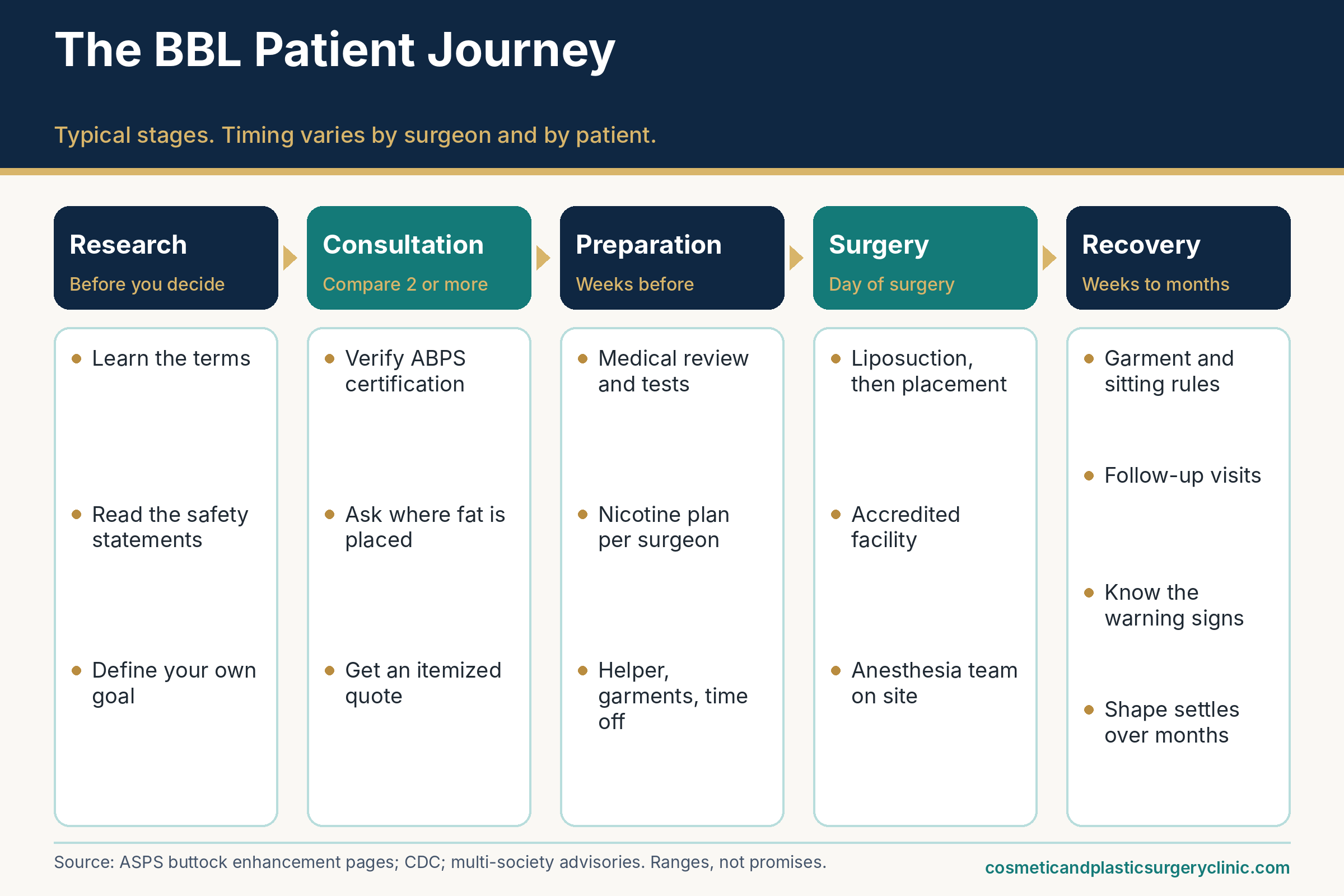
BBL Recovery: What the First Weeks and Months Can Look Like
Recovery is where a BBL differs most from many other cosmetic operations, because the treated area is also the part of the body you sit and lie on. This section gives the overview and the planning logic; the dedicated BBL recovery timeline covers day-by-day logistics, garments, and healing problems at greater length. Every range below comes from published patient education or surgeon commentary and describes common practice, not a prediction for any one person.
Recovery Stages at a Glance
The first days and weeks
You leave the facility in a compression garment with dressings over small incisions, and possibly with drainage tubes, which ASPS says may be placed temporarily. ASPS says patients are instructed to wear a support garment around the clock after surgery. An ASPS news article from 2022, built on a surgeon interview, describes about five days of rest at home with light walking encouraged, and a garment worn at all times except for showering during the first month. Expect soreness, swelling, and bruising in both the donor areas and the buttocks; the donor areas behave like liposuction recovery, where ASPS describes pain, swelling, and bruising in the first week, improvement over weeks two and three, and bruising typically gone by weeks four and five.
The buttock-specific rules are the ones people find surprising. ASPS recovery guidance says to avoid prolonged sitting for about two weeks, with some surgeons recommending longer; to sleep face-down or on your side; and to use a pillow behind the thighs when you must sit so that weight stays off the grafted area. The 2022 interview describes a stricter pattern, with sitting limited to roughly ten-minute intervals for six weeks to avoid pressure on the new fat, and a pool-float style pillow for people who can’t sleep on their stomachs. Both are published by ASPS, and they differ. That gap is not a contradiction so much as a reminder that these are practice-based conventions, and the reasoning behind them is protecting newly placed fat while it develops a blood supply. Follow your surgeon’s version.
From week six to month twelve
ASPS says patients generally resume exercise after about six to eight weeks, though the guidance that applies to your body is the schedule your surgeon gives you; lower-body exercise and activities that load the glutes are often held back longest, so ask for a written step-by-step ladder rather than a single date. Many surgeons also step down garment wear over the second month. In the 2022 ASPS interview, the surgeon described garment wear of at least twelve hours a day during the second month. Walking, desk-type work, and gradual return to routines usually come well before exercise, with the pace set by comfort, swelling, and clearance.
Shape and swelling keep changing for much longer than the restrictions last. The same ASPS interview says results begin to stabilize around month three, when the amount of fat that will last is clearer, and continue refining until about month six. The ASPS procedure page says you won’t see final results until about a year after surgery. Those figures describe the timing of visible change, not a promise of an outcome, and they’re why surgeons ask for patience before judging a result or planning any touch-up. The results section of this guide, and the BBL results guide, say more about shape, retention, and longevity.
Scars from the small incisions mature on their own timeline. The ASPS page on buttock enhancement says that incision scars from a buttock lift can take up to two years to mature; that statement concerns the longer incisions of a lift rather than the small access sites used for fat grafting, so ask your surgeon where your incisions will be and what scar care they recommend. The guide to plastic surgery scar care covers general principles.
Planning Life Around Recovery
Work, sitting, sleeping, and garments
The most useful way to plan is to translate each rule into a daily-life question. Sitting is the biggest one. If your job is at a desk, you need to know whether you can work standing, lying on your side with a laptop, or in short seated intervals on a special cushion, and whether your employer can accommodate that. If your job involves driving, lifting, or standing for long hours, you face different constraints: driving means sitting and is usually cleared later than walking, and lifting loads the core and glutes. Two invented examples show the difference. A remote worker with a flexible schedule may manage a return to partial work within a couple of weeks by working from a recliner or standing desk, if the surgeon permits. A warehouse or delivery worker might be out for much longer, and might need documentation for leave. Ask your surgeon for a work note and a realistic estimate before you commit to a date.
Sleeping needs practice before surgery. If you normally sleep on your back, a side- or stomach-sleeping plan is a real adjustment, and the helpers available to you vary: pillows, wedges, and the pool-float style devices some surgeons mention. Garments need planning too. You’ll typically need more than one so you can wash one while wearing another, and you should know whether the garment is designed to compress the donor areas while leaving the buttocks free; compressing the grafted area may conflict with the surgeon’s goals. The compression garment checklist and the page on returning to work after plastic surgery help you turn these into a list.
Showering, bathroom access, and transfers deserve a moment of thought: how do you sit on a toilet and keep pressure off the buttocks, where will you eat your meals, and how will you get in and out of bed. These are small questions that decide whether the first two weeks feel manageable. A person who answers them in advance, perhaps by setting up a recovery space and borrowing a raised toilet seat or a standing-height table, often finds the first weeks much less stressful than someone who improvises.
Travel, caregivers, and a planning calendar
Travel adds complexity. The CDC advises that people consider delaying air travel for 10 to 14 days after major surgery because flying raises clot risk, and it recommends walking every one to two hours and doing leg exercises on trips longer than four hours. If you live far from the surgeon, the choice of where to stay during recovery is part of the medical plan: ASPS practice guidance from September 2024 says surgeons should agree with traveling patients on how long to stay near the practice, assess clot risk, and identify a local physician for routine postoperative care, and it cautions against unregulated recovery homes without proper licensing or qualified staff. Caregivers matter as well. ASPS asks that an adult drive you home and stay at least the first night, and in practice most people benefit from help for much longer with meals, garments, children, pets, and transport to follow-up visits.
| Phase | What published sources describe | What to line up |
|---|---|---|
| Before surgery | Blood tests and medication review; stop smoking; arrange a ride and an adult for the first night (ASPS) | Second consultation, written quote, helper, time off, sleeping setup, garments |
| Days 1 to 5 | Rest at home with light walking; garment on at all times except showering in one surgeon’s plan (ASPS 2022) | Meals, medications, after-hours number, moving safely in and out of bed |
| Weeks 1 to 2 | Avoid prolonged sitting for about two weeks, longer for some (ASPS); donor-area bruising and swelling peak | Standing or side-lying work setup, follow-up visit, cushion if cleared |
| Weeks 2 to 6 | Sitting in short intervals, up to six weeks in one surgeon’s plan; garment around the clock for the first month | Transport rules, work schedule, who helps with garments and errands |
| Weeks 6 to 8 and beyond | Exercise generally resumes at six to eight weeks (ASPS); garment hours step down | Written exercise ladder; ask about lower-body work and high-impact activity |
| Months 3 to 12 | Results begin to stabilize near month three and refine through month six; final results up to a year (ASPS) | Photos on a schedule, stable weight, patience before judging or planning touch-ups |
Because the calendar assumes common practice, treat it as a prompt for questions. A well-run practice will give you its own version in writing and explain any place it differs from these published ranges.
BBL Risks, Complications, and Safety Context
Risk deserves the same weight as technique and cost, and in a BBL it has two layers. The first is the ordinary set of risks that come with liposuction, fat grafting, anesthesia, and a recovery period of reduced movement. The second is a specific, rare, and severe risk, fat embolism, that professional societies have addressed with repeated safety statements since 2017. This section separates the layers, shows where estimates disagree, and describes what is and isn’t known about reducing risk.
The Risk Picture
Fat embolism and why mortality estimates disagree
Fat embolism happens when fat enters the bloodstream and lodges in blood vessels elsewhere, most dangerously in the lungs and heart. In a BBL, the concern is injected fat entering the large gluteal veins, particularly when it’s placed in or beneath the muscle, as the autopsy findings summarized in the 2018 inter-society advisory suggest. ASPS says in a 2022 news article that severe, life-threatening complications, when they occur, tend to happen during the surgery or within hours afterward. That timing matters: it means most of the highest-stakes risk is concentrated where technique, facility, and monitoring are decided, rather than during the weeks of recovery at home.
How often it kills is the question people most want answered, and the honest answer is that nobody has a reliable national number. There is no complete registry of BBL procedures and outcomes, so estimates come from surgeon surveys, case reports, medical examiner records, and regulatory reviews, all of which can undercount or overcount. The August 2022 joint statement acknowledges that statistics are difficult to obtain. In 2018, a coalition of societies stated that mortality was estimated to be as high as about 1 in 3,000 and described it as far greater than any other cosmetic surgery. In 2022, an ASPS news article quoted a surgeon saying that the rate had since fallen to about 1 in 15,000, similar to a tummy tuck, and a 2023 review in Aesthetic Surgery Journal also reported a revised estimate near 1 in 15,000 while arguing that an earlier, higher figure was derived in a misleading way. Meanwhile, a 2023 survey study published in the same journal carried a title that described the BBL as remaining the deadliest aesthetic surgery procedure, and the joint statement of 2022 describes fatalities as occurring with disturbing frequency.
These statements can’t be reconciled by choosing the one you like. The more careful reading is that estimates span a range, the high end is serious, the low end isn’t negligible for an elective operation, and technique and regulation changed over this period in ways that might reduce risk but have not been proven to do so in a large registry. Even the lowest estimate, about 1 in 15,000, means that deaths are expected in any large group. A lower number is not the same as a low risk for the person it happens to, and elective surgery weighs differently than treatment for an illness.
| Source | Year | What it reported | Limit to keep in mind |
|---|---|---|---|
| Inter-society task force advisory (ASPS-hosted) | January 2018 | About 1 in 3,000, described as the highest of any aesthetic procedure; three Florida deaths in 2017 | Survey-based estimate; method later questioned by others |
| Societies’ joint press release | August 2018 | “As high as 1:3,000,” greater than any other cosmetic surgery | Upper-end estimate; “as high as” signals uncertainty |
| ASPS news article (interviewed surgeon) | March 2022 | Initial 1 in 3,000; now about 1 in 15,000, similar to a tummy tuck | Stated by an interviewee in a news piece, not a data table |
| Florida Board of Medicine emergency rule (news report) | 2022 | Cited 10 verified deaths over three years | One state, one period; reported through a news outlet |
| Joint statement of four organizations | August 2022 | No new rate; says statistics are hard to obtain and deaths are occurring with disturbing frequency | Statement of concern, not an estimate |
| Tillo, Nassab, and Pacifico, Aesthetic Surgery Journal | 2023 | Revised estimate near 1 in 15,000; earlier higher figure called misleading | Review of earlier estimates, not a registry |
| Finkelstein and colleagues, Aesthetic Surgery Journal | 2024 (online 2023) | Title calls BBL the deadliest aesthetic surgery procedure; surveys practice habits | 10 percent survey response; measures what surgeons do, not outcomes |
Other complications and how common they are
Most complications are not life-threatening, but they’re common enough to plan for, and they touch both the donor areas and the buttocks. ASPS lists the following risks for buttock enhancement: anesthesia risks, asymmetries, bleeding (hematoma), blood clots and cardiac and pulmonary complications, death of fat tissue (fat necrosis), fluid accumulation (seroma), infection, numbness or changes in sensation, persistent pain, poor wound healing, the possible need for revision surgery, recurrence of skin laxity, skin discoloration and prolonged swelling, skin loss, suture problems, and unfavorable scarring. Its liposuction risk list adds contour irregularities, rippling or loose skin, worsening of cellulite, and injury to deeper structures. Reading that list is not reassuring, and it isn’t meant to be; it’s the full set of things a consent form should cover.
Published numbers help calibrate, with important caveats. A 2024 retrospective study from two surgeons who used ultrasound guidance in 1,815 patients reported complications in about 4 percent, including seromas in 1.2 percent, local skin ischemia in 1.2 percent, and surgical site infection in 0.8 percent, with no macroscopic fat embolism or deaths; the authors noted the retrospective design and the small number of surgeons as limitations. A 2025 meta-analysis of ultrasound-guided gluteal fat grafting pooled four observational studies covering 6,235 patients and reported about 6.3 minor complications per 100 patients and about 2.9 seromas per 100, again with no reported fat embolism or deaths, while cautioning that the studies lacked control groups. A 2016 conference abstract reviewing 19 older studies of 4,105 patients reported an average complication rate of about 7 percent, and it excluded a study that reported 13 deaths. Those numbers come from published series, often from experienced surgeons and often at single centers. They don’t tell you the rate in a particular practice, and they don’t capture the problems that go unreported.
| Complication | What it means | What sources say to do |
|---|---|---|
| Fat embolism | Fat in the bloodstream reaching the lungs or heart; usually during or soon after surgery | Emergency care; prevention depends on placement technique and monitoring |
| Blood clot (DVT or PE) | A clot in a leg vein that can travel to the lungs; about half of leg clots cause no symptoms | Move as instructed; report leg swelling or pain; chest pain or breathlessness is an emergency |
| Infection | Redness, pain, cloudy drainage, fever at incisions or treated areas | Call the provider immediately (CDC) |
| Seroma or hematoma | A pocket of fluid or blood collecting under the skin | Report increasing swelling or tension; a clinician decides if drainage is needed |
| Fat necrosis | Some transferred fat dies and may feel firm | Have a surgeon evaluate firm areas before assuming they are harmless |
| Asymmetry or irregular contour | Uneven volume or surface texture in donor or grafted areas | Wait for swelling to settle; discuss revision timing with the surgeon |
| Wound healing problems or skin loss | Slow healing, open areas, or loss of skin in pressure areas | Report early; nicotine and pressure are recognized contributors |
Reducing Risk and Responding to Problems
A risk-reduction pathway before surgery
No step eliminates risk, but several steps move it in a favorable direction, and they’re things you can verify before paying a deposit. Start with the surgeon. The 2018 societies’ press release attributed part of the problem to the technical complexity of the operation and to growth in the number of practitioners who are not board-certified plastic surgeons, and urged patients to seek board-certified plastic surgeons with the training to perform the procedure. The American Board of Plastic Surgery (ABPS) offers a public lookup tool where you can check certification, which it describes as a voluntary credential. Certification does not promise any individual outcome, but it’s an independent check that training and examination requirements were met. The guide to verifying ABPS board certification walks through the steps.
Then ask about the safety measures that the table earlier in this article lists. Where will fat be placed, and how will the surgeon know? Is ultrasound used, and if not, why not? How many gluteal fat grafting cases does the surgeon do in a day? What cannula is used? Who performs the liposuction and injection? Which facility, and does it hold accreditation or state licensure? Which anesthesia professional will attend? What happens if a complication occurs, including emergency transfer to a hospital? A surgeon who welcomes these questions and answers them specifically is behaving the way the joint statement says surgeons should. A surgeon who bristles, or who answers with reassurances instead of details, has told you something too.
Several consultation features are common warning flags. Pressure to book quickly or to pay a deposit by a deadline, discount promotions tied to dates, a surgeon you can’t verify, a facility with no accreditation or license information, an unwillingness to discuss death risk, and a surgery slot booked into a day packed with other cases all deserve a pause. A price far below what comparable practices quote is a reason to ask what’s missing, since savings can come from the anesthesia provider, the facility, the number of staff, or follow-up care. The plan should also include a clot assessment and, for anyone traveling, a written plan for care at home; the sections on cost and surgeon selection return to both.
Warning signs, escalation, and where complications get treated
When you reach an emergency department, tell the staff you had a BBL, the date, where it was done, and what anesthesia you received, and bring your discharge papers and medication list if you have them. Emergency teams may not be familiar with the particular risks of gluteal fat grafting unless you mention it. Ask someone to notify your surgeon at the same time, because the operating surgeon remains responsible for continuity of care; ASPS’s 2024 guidance on patients who travel says the surgeon retains responsibility for continuity and should remain available for consultation and record transfer.
If your surgery was far from home, make a decision about where you would go before you travel. The CDC’s medical tourism guidance recommends seeing a health care provider four to six weeks before a trip, bringing copies of records, and arranging U.S. follow-up in advance because treating complications can be expensive and may not be covered by insurance. For more on those trade-offs, see the site’s page on plastic surgery abroad. Complications are rarely anyone’s fault in the moment, but a prepared plan shortens the time between a symptom and a treating clinician.
BBL Results, Longevity, and Revision
Results from a BBL are not a single number you can look up. They depend on how much donor fat existed, how much of the transferred fat survives, what happens to your weight, and how your tissue heals, and they keep changing for months. This section covers the main published figures, the factors that move them, and the reasons a second procedure comes up. The separate BBL results guide goes deeper into shape, longevity, and how to judge outcomes.
What Results Look Like and How Long They Last
Fat survival and the timeline of shape
The most quoted fact about BBL results is that some of the transferred fat doesn’t last. ASPS’s procedure page says patients retain, on average, 60 to 80 percent of the transferred fat, adding that in some cases the figure is higher and in others lower. An ASPS news article from March 2022 says that between 20 and 40 percent of injected fat is absorbed during healing, which is the same range viewed from the other side. A second 2022 ASPS article, based on a surgeon interview, describes about 60 percent of transferred fat surviving. These statements overlap but aren’t identical, and none is a prediction for you; they’re group averages that depend on technique, the surgeon’s way of measuring, and the individual patient.
The practical consequence is that the buttocks usually look larger soon after surgery than they will months later. Swelling and the full injected volume combine early, then swelling resolves and unsupported fat is absorbed. ASPS’s results page says the final result of fat transfer takes up to one year to appear because of this absorption, and the 2022 interview places stabilization near month three and continued refinement through month six. This timing is the main reason you should be skeptical of any before-and-after photo taken within weeks, and equally of any claim about volume that doesn’t say when it was measured.
Evidence on retention is thinner than the confident averages suggest. Published studies measure retention with different tools and over different time periods, and the sources reviewed for this article didn’t include a large, controlled, long-term imaging study that would settle the matter, so the ASPS figures are best understood as ranges that surgeons use for planning rather than as laboratory facts. A useful question for a consultation is how the surgeon accounts for expected loss when planning volume, and how they’d respond if the early shape looks different from the later one. An answer that mentions staging, patience, and honest limits is a good sign.
Weight, aging, pregnancy, and lifestyle
Once the fat has settled, it behaves like the rest of your body fat. ASPS’s results page says that if fat transfer was used, weight fluctuations directly affect results: gaining weight can enlarge the buttock fat, and losing weight can reduce volume as fat cells shrink. It also says results are long-lasting provided you maintain a stable weight and general fitness, and that buttock size and shape continue to change with age and gravity. That language is deliberately careful. It doesn’t say the shape will look the same in ten years; it says most of the initial improvement can persist if conditions are stable.
A short invented illustration shows how this plays out. Imagine two people with similar surgery. One maintains a steady weight and stays active, and the buttock contour stays close to what it looked like at the one-year mark, with gradual age-related change. The other loses a substantial amount of weight over the next two years, including from the buttocks, and the result looks smaller and flatter than at one year. Neither outcome means the surgery “failed”; each reflects what happens to fat when the body changes. This is why surgeons often ask about weight stability and why weight steadiness before body contouring comes up repeatedly in the planning conversation.
Life events can change the picture too. Pregnancy, major illness, large changes in exercise habits, and new medications that alter appetite or body composition may all affect body fat. None of this is a reason to avoid the operation, but it’s a reason to think about whether your life is in a stable phase for a procedure whose result depends on stability, and to ask your surgeon how future pregnancies or weight changes could change what you see.
Revision and Expectation-Setting
When a second procedure is discussed
It’s common for patients and surgeons to discuss a second round of work. The 2022 ASPS recovery article notes that many patients pursue a second BBL to address contour irregularities or asymmetry that develop during healing, or to reach the size they wanted, and the ASPS results page says a second surgery may be needed in some cases and that there is no promise that a single procedure will achieve the desired result. The multi-society advisories likewise list staging among the topics to cover in consent, particularly because the subcutaneous layer can only accept so much volume at once.
A second procedure raises its own questions. Timing is the first: surgeons generally wait until swelling has resolved and the result has settled, which, going by the ASPS timelines, is a matter of many months rather than weeks. Donor fat is the second: someone who needed most of their available fat for the first procedure may have little left, and a second harvest means a second liposuction recovery. Risk is the third. Each additional operation involves anesthesia, liposuction, and the injection step again, and the risks discussed earlier, including the risk that is specific to fat placement, apply to the second round as they did to the first. A fair way to put it: a touch-up is a new operation, not a small adjustment.
Sometimes the better question is whether the original approach should be revisited. If the shape is uneven because of surgeon technique, or if fat survival was low, a different surgeon, a different method such as an implant, or doing nothing further may be reasonable. A second opinion from a board-certified plastic surgeon who is not selling the revision can help distinguish a normal healing pattern from a problem that needs correcting.
Reading before-and-after photos and setting expectations
Before-and-after galleries are persuasive and easy to misread. A reliable gallery shows the same person from consistent angles, with similar lighting and posture, taken at stated intervals, with the “after” photo at least several months and ideally close to a year after surgery. Because swelling and fat loss change the early shape, photos taken at three weeks or six weeks say little about what remains. Ask whether the displayed cases reflect the surgeon’s typical result or best ones, how many patients had a second procedure, and whether any images have been edited or taken with filters.
Choose comparison cases that resemble your starting point: similar body frame, similar donor fat, similar skin. A gallery full of results from people with a very different build tells you little about your own possibilities. And consider whether the outcome in the photo is something you’d want for daily life, not only for a photograph. A single dramatic result may be an outlier, so ask the clinic to show what a typical outcome looks like.
Finally, set your own definition of success before surgery. Write down what you hope to see and feel, what would count as a good enough result, and what you’d do if the result were milder than hoped. Having that plan helps you avoid chasing a changing target, and it gives your surgeon a clearer sense of what to aim for. For many people the most satisfying outcome is a modest, proportionate change; for others, a larger change in more than one stage. Neither is the right answer in the abstract. The right answer is the one you can explain, that your anatomy can support, and that your surgeon can describe in specific terms.
BBL Surgery Cost, Alternatives, and Making the Decision
The last piece of the decision is practical: what it costs, what else could meet the same goal, and how to choose a surgeon and facility when the stakes are as high as they are in this operation. The cost discussion is deliberately cautious, because the national figures that circulate are averages from different surveys, not quotes, and they leave out much of what you’ll actually pay.
What BBL Surgery Costs and What Drives the Price
What national figures say, and what they leave out
Three published sources give a feel for the range, and the differences among them are instructive. ASPS’s buttock enhancement cost page lists an average of $7,264 for a Brazilian butt lift, $7,964 for buttock implants, and $7,062 for a buttock lift. It says the average is only part of the total price and does not include anesthesia, operating room facilities, or other related expenses, and the page doesn’t state which year the figure represents. ASPS’s separate 2024 average surgeon and physician fee document gives a range of $7,000 to $11,500 for buttock augmentation with fat grafting. It describes the ranges as an aggregate projection based on averages submitted by surveyed members and says they reflect ASPS member surgeons only. For context, the same document lists liposuction at $4,300 to $7,500 and abdominoplasty at $8,000 to $13,500.
The Aesthetic Society’s cost page takes a different tack. It states an average of $3,522 for buttock augmentation covering both fat grafting and implants, drawn from its 2022 Aesthetic Plastic Surgery National Databank statistics, and says the number reflects standard procedure costs of surgeon and facility fees without anesthesia, medical tests, prescriptions, garments, or other costs. That figure is far lower than the ASPS numbers, and the page doesn’t explain why, which is the point: surveys count different procedures, include different fees, draw on different surgeons, and may report different years. Treat the $3,522 figure as a reminder that national averages are not comparable with each other, not as a price anyone should expect.
| Source | Figure | Year and scope | Stated inclusions and exclusions |
|---|---|---|---|
| ASPS buttock enhancement cost page | $7,264 average for Brazilian butt lift | “Latest statistics”; year not stated | Excludes anesthesia, operating room or facility, and other related expenses |
| ASPS 2024 average surgeon/physician fees | $7,000 to $11,500, fat grafting to buttocks | 2024; ASPS member surgeons only; aggregate of surveyed members’ averages | Described as surgeon/physician fees; other charges not itemized |
| ASPS 2024 context fees | Liposuction $4,300 to $7,500; tummy tuck $8,000 to $13,500 | 2024; same document and scope | Same limits; a BBL includes liposuction work as one stage |
| The Aesthetic Society cost page | $3,522 average, buttock augmentation (fat grafting and implants) | 2022 national databank statistics | Surgeon and facility fees; excludes anesthesia, tests, prescriptions, garments, extras |
None of these sources, as reviewed here, breaks the numbers down by city or state, and geography is one of the biggest real-world drivers of price. Prices in a high-cost metropolitan area can differ from those in a smaller city for reasons unrelated to quality. For that reason the figures above work best as a way to notice whether a quote is wildly different from what professional societies report, not as a budget. The site’s broader plastic surgery cost guide explains how to read national averages in general.
The fee stack, quote comparison, and financing
ASPS says total costs for buttock enhancement may include the surgeon’s fee, hospital or surgical facility costs, anesthesia fees, prescriptions, post-surgery garments, special recovery pillows, and medical tests. Beyond that list, other costs often show up in real life: follow-up visits that aren’t bundled, additional garments, lymphatic massage if you choose it (ASPS describes it as optional), time away from work, caregiving help, and, for people who travel, lodging and transportation for the full recovery stay. Complications and touch-ups have costs too, and ASPS says most health insurance plans do not cover buttock enhancement or its complications, so ask what the practice does if a revision or a complication treatment is needed and who pays.
When you compare quotes, the same questions apply to each. Does the number include the facility, the anesthesia professional, and the garments? Is it for the full operation including both stages? What happens if a second procedure is needed? A quote that looks lower can leave out items the higher quote includes, and a bundle that looks high may include things you’d otherwise pay separately. A low price deserves a calm question about what’s different, because anesthesia staffing, facility standards, and follow-up care are exactly the areas where savings can come at the cost of safety. The table below turns this into a checklist you can fill in for each quote.
| Line item | Why it matters | What to ask |
|---|---|---|
| Surgeon’s fee | Covers the surgeon’s work only in most quotes | Does it cover both liposuction and fat injection, and follow-up visits? |
| Facility fee | Reflects accreditation, staffing, and equipment | Which facility, what accreditation or license, and is it included? |
| Anesthesia | Who gives it and how it’s monitored affect safety | Who is the provider, and is the fee in the quote? |
| Garments and pillows | Needed for weeks; several may be required | How many, which type, and are they included? |
| Tests and prescriptions | Labs and medications are separate charges | Which are required, and where are they done? |
| Complications and revision | Insurance may not cover them | What does the practice charge if a problem or touch-up arises? |
| Travel and lodging | Staying near the surgeon affects safety and cost | How long must I stay, and who provides local follow-up? |
Financing deserves care. ASPS says many plastic surgeons offer patient financing plans. A May 2023 report from the Consumer Financial Protection Bureau on medical credit cards and financing plans described deferred-interest products that advertise zero or low interest for a promotional period and then charge interest retroactively on the original purchase if the balance is not paid in full. For data covering 2018 through 2020, the report found that roughly one in five healthcare purchases on such products ended up carrying deferred-interest charges, and it noted that patients are often enrolled at the provider’s office without fully understanding the terms. Read any financing agreement away from the front desk, and compare it with other ways of paying. The site’s guide to plastic surgery financing goes through the options.
Alternatives and a Decision Framework
Alternatives to a BBL
Several options address parts of the same goal, and each trades something different. Gluteal implants are the best-known surgical alternative: ASPS describes silicone implants placed within or above the gluteal muscle, with results that ASPS describes as immediately visible and permanent, though any implanted device can still need revision or removal. They don’t depend on donor fat, which makes them an option for people with limited body fat, but they bring their own risks, including those on ASPS’s general buttock enhancement risk list such as infection and poor wound healing, and they’re performed much less often; ASPS’s 2024 statistics list 1,245 buttock implant procedures against 29,466 buttock augmentations with fat grafting. A buttock lift removes excess skin rather than adding volume, and ASPS reports 7,954 of those in 2024. A combination of fat and implants is also possible, as ASPS notes. The multi-society advisories list implants and other alternatives among topics that consent for a BBL should cover.
Nonsurgical routes also exist. Strength training can build gluteal muscle over time, without anesthesia and without the specific risks of fat grafting, though the change depends on your starting point and training and it does not add fat volume. Garments and padded clothing change appearance reversibly. Liposuction on its own contours the donor area but doesn’t add to the buttocks. Waiting is a legitimate choice, and it’s especially sensible if your weight, health, or schedule isn’t stable.
One category needs a firm caution. In November 2017 the FDA warned that injectable silicone for body contouring is not FDA-approved, that injectable silicone is approved only for intraocular (inside the eye) use, and that unlicensed providers who market it for buttocks, hips, and similar areas expose patients to harm, including scarring, tissue death, permanent disfigurement, blood vessel blockage, stroke, and death. It advises seeking immediate care for breathing difficulty, chest pain, or stroke symptoms after such injections. The sources reviewed for this article did not identify an FDA-approved injectable product for buttock augmentation; this is a regulatory area that can change, so ask any provider offering an injectable to show the product’s FDA labeling and the provider’s license.
| Option | What it mainly changes | Main trade-offs | Source note |
|---|---|---|---|
| BBL (gluteal fat grafting) | Adds volume and shape using your fat; contours donor areas | Two recovery areas; fat loss over time; fat embolism risk; needs donor fat | ASPS: 60 to 80 percent average retention; societies’ safety advisories |
| Gluteal implants | Adds volume with silicone implants | Does not need donor fat; implant-related and surgical risks; less commonly performed | ASPS: implants within or above muscle; 1,245 procedures in 2024 |
| Buttock lift | Removes excess skin and tissue; lifts position | Longer incisions and scars; does not add fullness | ASPS: scars mature up to two years; 7,954 procedures in 2024 |
| Fat plus implant | Combines volume sources | More complex plan; both sets of risks | ASPS lists the combination as an option |
| Strength training | Builds muscle gradually | No surgery risk; slower; does not add fat or remove skin | General fitness approach; no study cited here |
| Injectable silicone | Marketed for body contouring; not FDA-approved for this use | FDA warns of serious, possibly permanent harm, including death | FDA safety communication, November 13, 2017 |
Choosing a surgeon and putting the decision together
The framework below mirrors the checklist graphic that follows it. Start by defining your goal in your own words, ideally without a reference photo. Compare options, including doing nothing and the alternatives above. Verify credentials, which means checking board certification and license, the facility, and the anesthesia plan. Plan the recovery, including time off, help, and where you’ll be if something goes wrong. Then make an informed choice, which can include saying no or not yet. None of these steps requires you to hurry.
On credentials, ASPS recommends asking whether the surgeon is certified by the American Board of Plastic Surgery, whether they were trained specifically in plastic surgery, whether they have hospital privileges to perform the procedure, and whether their facility is accredited or state-licensed. It advises that patients not be confused by official-sounding boards and notes that no legitimate board uses the words “cosmetic surgery” in its official name. The ABPS lookup, at abplasticsurgery.org/VerifyCert, lets you check certification, and the ABPS page points to the Federation of State Medical Boards for licensing and complaint information. Certification and licensure are separate checks; one doesn’t replace the other.
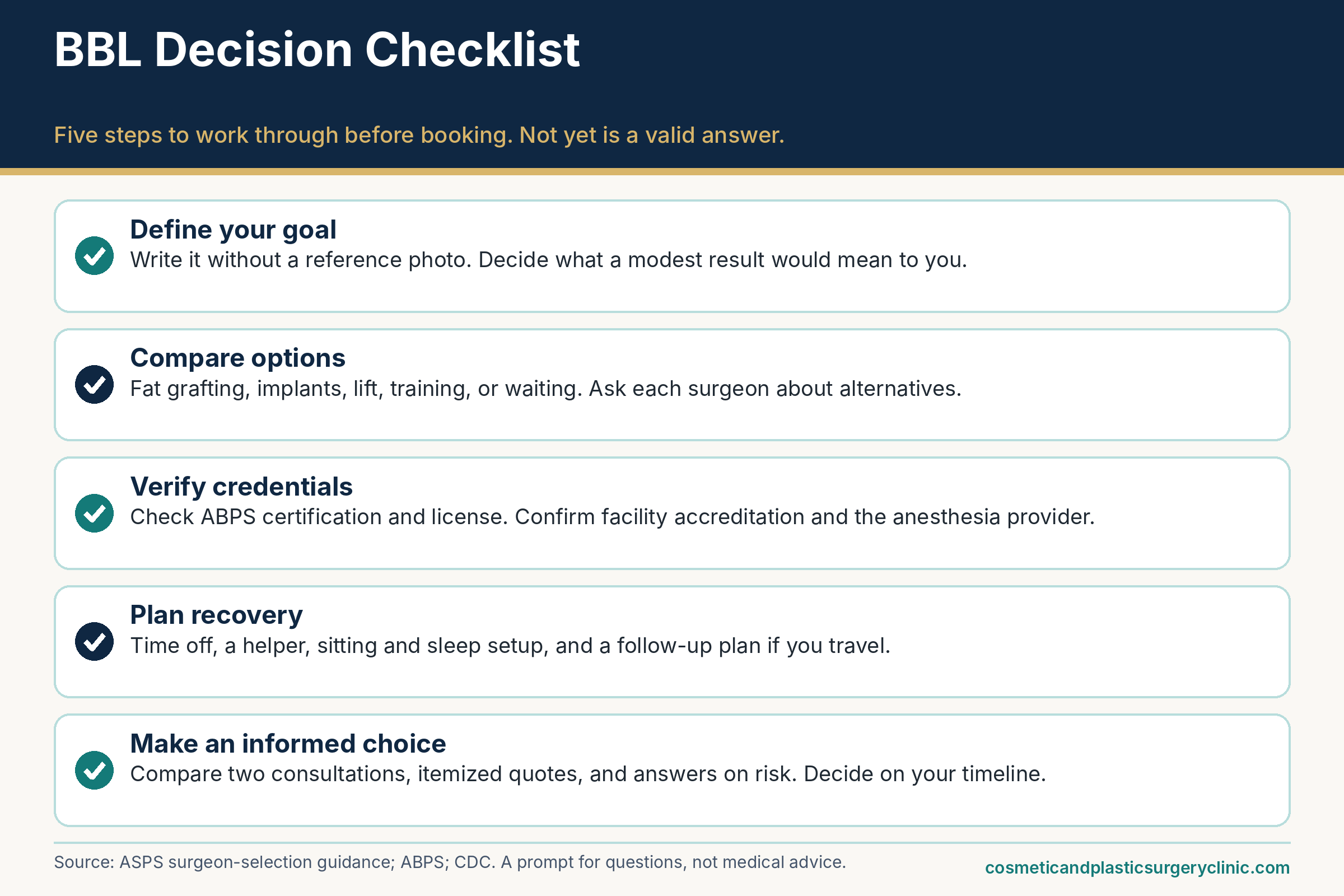
Bring a written list to each consultation, and ask each surgeon the same questions so you can compare answers. Useful items include: How many gluteal fat grafting procedures do you do, and what’s your plan to keep fat above the muscle? Do you use ultrasound, and if not, why? How many cases do you perform in a day? Where will surgery take place, who gives the anesthesia, and what is the plan if I need emergency transfer? What is included in the quote, and what isn’t? What does recovery look like for someone like me, in writing? What happens if I’m unhappy with the result, and who treats complications? The guide to questions to ask in a plastic surgery consultation adds general questions that apply to any procedure.
Some people also ask about combining a BBL with another operation, such as a tummy tuck, in the same session. Every added procedure lengthens the time under anesthesia and adds its own recovery demands, and whether combining is wise is a surgeon-level decision that depends on your health and the procedures involved; the checklist on combining plastic surgery procedures lists what to ask. If you’re considering surgery away from home, the CDC and ASPS guidance discussed earlier applies in full, and the plan for follow-up at home should be written down before you book.
Frequently asked questions about BBL surgery
How long does a BBL operation take?
There is no standard duration, and the sources reviewed for this article don’t give one. Operating time depends on how many donor areas are treated, how much fat is harvested and placed, the technique and monitoring used, and whether another procedure is combined. Longer operations mean longer anesthesia, which is one reason surgeons discuss combining procedures cautiously. Instead of looking for an average, ask the practice for the anticipated operating time for your plan, how many cases the surgeon has scheduled that day, and when you can expect to go home or to a recovery setting.
Does insurance cover a Brazilian butt lift?
Usually not. ASPS says most health insurance plans do not cover buttock enhancement or its complications, and The Aesthetic Society describes a butt lift as elective cosmetic surgery that insurance doesn’t cover. That second point is the one people overlook: the cost of treating a complication may fall on you too. Before you commit, read your plan’s language on elective surgery, ask the practice in writing what it charges if a complication or revision arises, and find out whether any travel or supplemental insurance covers emergency care away from home.
Will a BBL leave visible scars?
Fat grafting uses small access incisions for the liposuction cannula and for the injection cannula, and their number and placement are chosen by the surgeon, so ask where yours will be. ASPS describes the longer incisions of a buttock lift, a different operation, as taking up to two years to mature. Scars vary with skin type, healing, sun exposure, and tension. A surgeon can show where incisions go on your own body and describe the scar care they recommend. If you scar easily, say so at the first visit rather than waiting for the question.
What is a BBL pillow, and do I need one?
A BBL pillow is a cushion shaped to keep weight off the buttocks when you sit or lie down, and ASPS lists special recovery pillows among possible costs. Designs differ, from wedges that raise the thighs to rings with an opening. ASPS recovery guidance says to use a pillow behind the legs when you must sit, and a news article mentions a pool-float style pillow for back sleepers. Whether you need one, and which type, depends on your surgeon’s sitting and sleeping plan, so ask before buying so you don’t pay for something that conflicts with the instructions you’re given.
Can men have a BBL?
Some men do have the procedure, though it is far less common. ASPS’s 2024 data list 29,466 buttock augmentations with fat grafting, of which 29,034 were in women, which leaves roughly 430 in other patients, or well under 2 percent. The same safety questions apply regardless of gender: placement depth, facility, anesthesia, and surgeon training. Anatomy and goals differ, though, so ask the surgeon how many male patients they have treated, what the plan would look like for your frame, and whether the result will fit your goals.
When will I know whether the fat “took”?
Early appearance is misleading because swelling and the full injected volume combine. An ASPS news article from 2022 places the point when the amount of fat that will last becomes clearer near month three, with further refinement to about month six, and the ASPS procedure page says final results take up to a year. If you’re worried that the buttocks are shrinking faster than expected, that one side is changing differently, or that an area feels hard or painful, report it to your surgeon rather than waiting for the milestone. Photos taken on a consistent schedule make those conversations more concrete.
Is a “board-certified cosmetic surgeon” the same as a board-certified plastic surgeon?
Not necessarily. ASPS says the American Board of Plastic Surgery (ABPS) is the only American Board of Medical Specialties member board that certifies in plastic surgery, and that no legitimate board uses “cosmetic surgery” in its official name. Other boards exist, and a physician may be certified in a different specialty entirely. Look up the surgeon on the ABPS verification tool, confirm that the state license is active through the Federation of State Medical Boards, and ask directly about training in gluteal fat grafting.
How can I check whether a surgery center is accredited?
Ask the practice for the name of the accrediting organization and the facility’s legal name, then confirm with the organization. ASPS recognizes accreditation by the American Association for Accreditation of Ambulatory Surgery Facilities, the Accreditation Association for Ambulatory Health Care, and the Joint Commission, plus Medicare certification, and it says state licensing can serve in some cases. Also ask whether the surgeon has privileges at a nearby hospital, where patients go if a transfer is needed, and whether the facility name on your paperwork matches the one where surgery will occur.
Does a BBL affect future pregnancy or breastfeeding?
The sources reviewed for this article don’t address pregnancy or breastfeeding after gluteal fat grafting, so this is a question for your surgeon and your obstetric clinician. What can be said is that pregnancy changes weight, skin, and body fat, and ASPS notes that weight changes affect transferred fat the same way they affect other fat. Mention any pregnancy plans at the consultation so timing can be discussed, and ask how a future pregnancy might alter the result.
What should I do if I already had a BBL and I’m worried about the result?
Separate emergencies from concerns. Chest pain, trouble breathing, confusion, fainting, or a racing heartbeat needs emergency care immediately. For concerns about shape, asymmetry, firm areas, or slow healing, contact the operating surgeon first and ask for an in-person assessment. If you can’t reach them, or you’re not satisfied with the answer, a second opinion from a board-certified plastic surgeon can help distinguish normal healing from a problem. Bring your operative records, photos from before and after, and medication list, and wait for swelling to settle before judging final contour.
Sources and further reading
- American Society of Plastic Surgeons — Buttock enhancement overview (accessed 2026-10-04) — definition of fat grafting, implants, and lifts; fat grafting also called a Brazilian butt lift
- American Society of Plastic Surgeons — Buttock enhancement procedure (accessed 2026-10-04) — anesthesia, liposuction up to three times the injected volume, 60 to 80 percent average retention, results timeline
- American Society of Plastic Surgeons — Buttock enhancement candidates (accessed 2026-10-04) — candidacy criteria and motivation
- American Society of Plastic Surgeons — Buttock enhancement safety (accessed 2026-10-04) — list of recognized risks
- American Society of Plastic Surgeons — Buttock enhancement recovery (accessed 2026-10-04) — garments, sitting, sleeping, exercise timing, emergency symptoms
- American Society of Plastic Surgeons — Buttock enhancement results (accessed 2026-10-04) — longevity, weight change, timing of fat transfer results
- American Society of Plastic Surgeons — Buttock enhancement cost (accessed 2026-10-04) — average figures, exclusions, insurance, financing
- American Society of Plastic Surgeons — 2024 average surgeon/physician fees (accessed 2026-10-04) — 2024 fee ranges, member surgeons only
- American Society of Plastic Surgeons — 2024 cosmetic procedure trends (accessed 2026-10-04) — 2024 and 2023 procedure counts for buttock procedures
- American Society of Plastic Surgeons — 2024 cosmetic procedures, women (accessed 2026-10-04) — share of buttock procedures performed on women
- American Society of Plastic Surgeons — Seven things to know about a Brazilian butt lift (March 28, 2022; accessed 2026-10-04) — fat absorption range, timing of life-threatening complications, mortality estimates
- American Society of Plastic Surgeons — Six things to know about recovering from a Brazilian butt lift (August 11, 2022; accessed 2026-10-04) — garment, sitting, sleeping, and fat survival timeline from a surgeon interview
- American Society of Plastic Surgeons — Plastic surgery societies issue urgent warning about Brazilian butt lifts (August 6, 2018; accessed 2026-10-04) — multi-society mortality estimate and patient advice
- Inter-society Gluteal Fat Grafting Task Force — Safety advisory (January 2018; accessed 2026-10-04) — autopsy findings, subcutaneous placement, death-risk disclosure
- The Aesthetic Society — ASERF outlines recommendations to increase safety of gluteal fat grafting (November 28, 2017; accessed 2026-10-04) — nine technique recommendations
- ASPS, Plastic Surgery Foundation, The Aesthetic Society, and ASERF — Gluteal fat grafting safety statement (August 18, 2022; accessed 2026-10-04) — subcutaneous-only placement, imaging, cases per day, privileges
- Del Vecchio D, Kenkel J — Practice advisory on gluteal fat grafting, Aesthetic Surgery Journal (September 2022; accessed 2026-10-04) — technique recommendations (abstract-level)
- Tillo O, Nassab R, Pacifico M — Gluteal fat grafting safety review, Aesthetic Surgery Journal (June 2023; accessed 2026-10-04) — revised mortality estimate and recommendations
- Finkelstein and colleagues — Brazilian butt lift safety survey, Aesthetic Surgery Journal (2024; accessed 2026-10-04) — survey of surgeons’ ultrasound use and opinions
- Vidal-Laureano and colleagues — Ultrasound-guided gluteal fat transfer, 1,815 patients, Aesthetic Surgery Journal (2024; accessed 2026-10-04) — complication rates in a two-surgeon retrospective series
- Reis and colleagues — Ultrasound-guided gluteal fat grafting systematic review and meta-analysis, Aesthetic Surgery Journal (2025; accessed 2026-10-04) — pooled complication rates from four observational studies
- ASPS annual meeting abstract — Buttocks augmentation with fat grafting: systematic review and meta-analysis (2016; accessed 2026-10-04) — older pooled complication estimate (conference abstract)
- WUSF Public Media — Appeals court upholds safety rules for Brazilian butt lifts (August 11, 2022; accessed 2026-10-04) — Florida emergency rule and deaths cited
- Cornell Legal Information Institute — Florida Administrative Code 64B8-9.009 (accessed 2026-10-04) — fat limited to the subcutaneous space
- U.S. Food and Drug Administration — FDA warns about illegal use of injectable silicone for body contouring (November 13, 2017; accessed 2026-10-04) — injectable silicone not approved for body contouring
- The Aesthetic Society — Butt lift cost (accessed 2026-10-04) — average figure from 2022 databank statistics and exclusions
- Consumer Financial Protection Bureau — Medical credit cards and financing plans (May 2023; accessed 2026-10-04) — deferred-interest mechanics and enrollment concerns
- Centers for Disease Control and Prevention — About blood clots (accessed 2026-10-04) — deep vein thrombosis and pulmonary embolism symptoms
- Centers for Disease Control and Prevention — About surgical site infections (accessed 2026-10-04) — infection symptoms and when to call
- Centers for Disease Control and Prevention — Medical tourism (accessed 2026-10-04) — flying after surgery, records, follow-up planning
- American Society of Plastic Surgeons — Appropriate care of patients traveling for surgery (September 19, 2024; accessed 2026-10-04) — practice reference for travel patients
- American Society of Plastic Surgeons — Accredited surgical facilities (accessed 2026-10-04) — recognized accrediting bodies
- American Society of Plastic Surgeons — Choosing a buttock enhancement surgeon (accessed 2026-10-04) — surgeon qualification guidance
- American Board of Plastic Surgery — Verify certification (accessed 2026-10-04) — public board certification search
- American Society of Plastic Surgeons — Liposuction safety (accessed 2026-10-04) — donor-area liposuction risks
- American Society of Plastic Surgeons — Liposuction recovery (accessed 2026-10-04) — donor-area bruising and swelling timeline
- MedlinePlus — Smoking and surgery (accessed 2026-10-04) — cessation timing and healing
- Mayo Clinic — Body dysmorphic disorder (accessed 2026-10-04) — definition and relation to cosmetic procedures
- American Society of Anesthesiologists — Multi-society GLP-1 guidance (October 2024; accessed 2026-10-04) — perioperative planning for GLP-1 receptor agonists