Dermal filler photos look like the most direct proof in cosmetic medicine: a hollow cheek on the left, a fuller one on the right. But a pair rarely records only the gel. Swelling from the injection, the angle of the light, a half-smile and a retouching app can each add or remove the same impression, and none of them shows up in the caption.
That makes this a topic about reading, not believing. Dermal filler photos can show a placement and a proportion. They cannot show the product, the injector’s training, a lump that appears six weeks later, or the rare blood-vessel injury that sends a person to an emergency department. This page covers the skills specific to filler pairs: what a caption must say, what the date means, which photographic conditions imitate a result, how lips, cheeks and under-eyes differ, and what editing, consent and advertising rules do and do not settle.
The broader rules on ethics and advertising are in the guide to reading before and after photos, and what fillers are and cannot do is in the dermal fillers guide. Photos of muscle-relaxing injections behave differently, as Botox before and after explains.
What a filler photo records, and what it leaves out
Product and area decide what a picture means
The FDA regulates fillers as medical device implants and says that having one injected should be considered a medical procedure, not a cosmetic treatment. That is the right frame for a gallery, because every pair hides a product choice and a placement choice.
Material families look different over time
The FDA separates absorbable fillers, which are approved for moderate to severe wrinkles and folds and for augmenting lips, cheeks, chin and the back of the hand, from non-absorbable fillers, which are approved only for nasolabial folds and cheek acne scars. ASPS’s 2025 statistics report likewise counts hyaluronic acid (HA) fillers apart from non-HA fillers such as Radiesse, Sculptra, Bellafill and Renuva.
Dermal filler photos labeled only “filler” therefore hide the biggest variable. Some products fill space at once, while others are meant to prompt the body’s own collagen over weeks. How the families differ is set out in hyaluronic vs biostimulatory fillers; for photo reading, the point is that a pair of one family tells you little about another.
An approval belongs to a product and a place
The FDA’s filler page, current as of July 2023, lists the periorbital area among sites it recommends against for fillers in general. Yet the agency approved Restylane Eyelight on May 8, 2023 for infraorbital hollowing, the sunken area under the eye. Both statements hold, which is why a caption has to name the product and not only the face area.
The FDA also says approved indications vary by product and that it may not have reviewed filler use in some locations of the body. Ask which indication applies to each pictured case, and treat “under-eye” or “temple” in dermal filler photos as a prompt for that question, not an answer.
The caption test: what a readable pair says
A caption turns a picture into a data point. Without one, dermal filler photos are decoration.
Five facts that belong under every pair
A usable caption states the product, the area, the amount, the number of visits and the days since the last injection. With those five, two cases can be compared like with like. Without them, a “natural” cheek and a “dramatic” cheek may differ only in product, amount or the week the photo was taken.
Amount deserves care. It depends on the product, the depth of placement and the person’s anatomy, so “two syringes” describes one case, not a recipe.
An “after” that follows a touch-up is two treatments
The FDA patient information for Revanesse Lips+ reports that 46 percent (38 of 80) of participants received a touch-up about a month after the first treatment. If a practice plans a second visit as routine, the “after” in its gallery may show two sessions, and one photo of dermal filler results will not say so.
Ask whether each “after” followed one visit or several, and how the practice charges for adjustments. A caption reading “one treatment” or “after touch-up” answers this. Silence leaves you guessing.
| Phrase in a caption | What it may mean | What it leaves out | What to ask |
|---|---|---|---|
| “Natural-looking” | The injector’s own judgment of the result | Product, amount and how the face moves | Can I see this case at rest and smiling? |
| “Fully reversible” | The product is hyaluronic acid, which hyaluronidase can break down | Whether it was dissolved here, and how the face looked meanwhile | Which product, and is hyaluronidase kept on site? |
| “Results at two weeks” | A photo after the usual swelling window in the labels | Any touch-up, and how the result looks later | What do these cases look like at three and six months? |
| “One syringe” | An amount used in one case | Product, syringe size, area and anatomy | What amount did each case receive, and why? |
| “Real patient, unedited” | A claim made by the practice | Filters, consent and any payment or discount | Can I see original files and the consent policy? |
| “Lasts up to a year” | A label maximum for one product in one area | The typical duration and person-to-person variation | What did the study for this product report? |
Table 1 turns the usual captions on dermal filler photos into questions. None of these phrases is false by itself; each is incomplete without the detail in the right-hand columns.
How the date on dermal filler photos changes their meaning
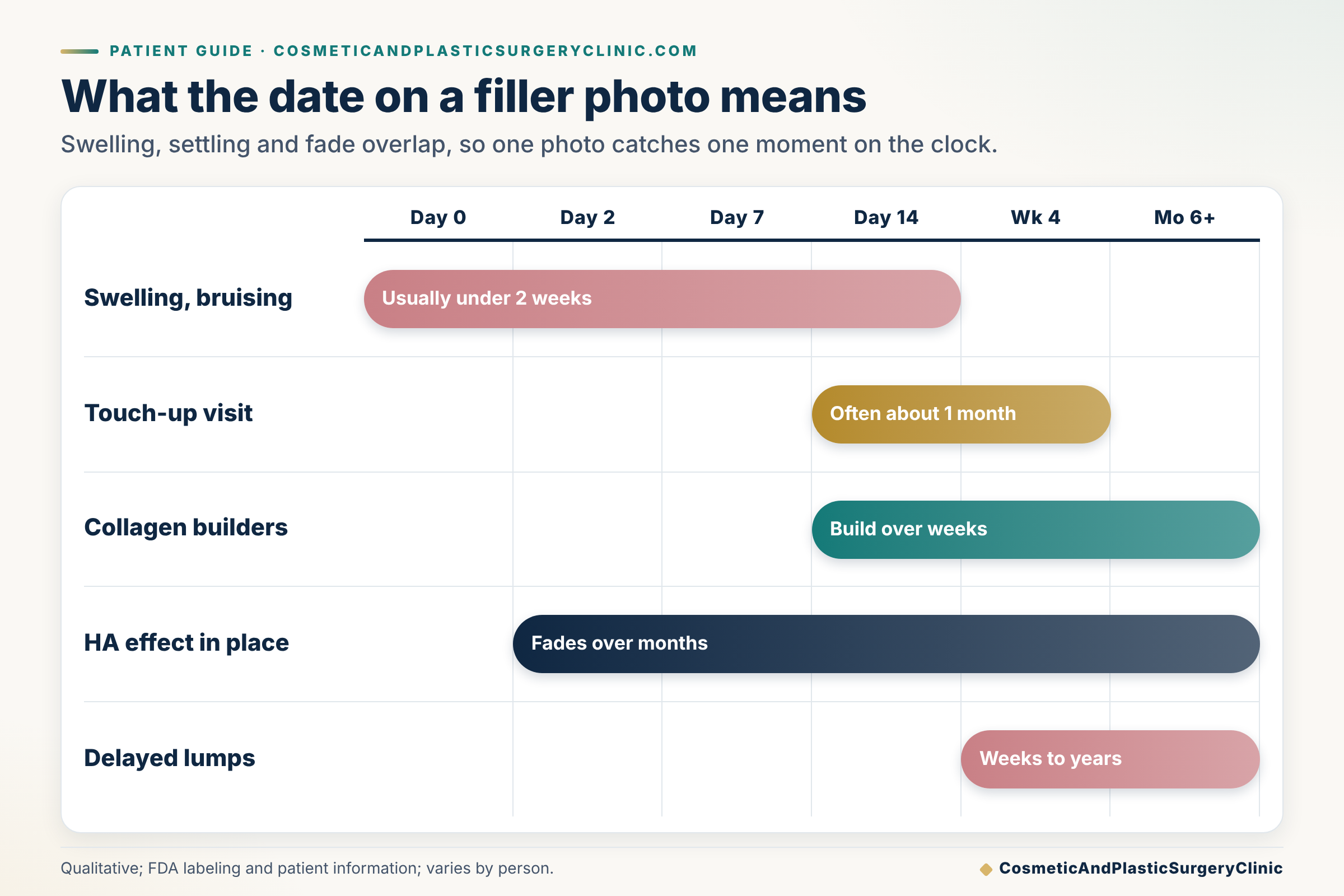
Day 0 to day 14: swelling is part of the picture
An injection changes a face twice: once with the product and once with the body’s reaction to the needle. Early dermal filler photos mix the two.
The first days, as the label studies recorded them
In the FDA’s summary for Restylane Eyelight, a 333-participant under-eye study, swelling (85.0 percent), tenderness (89.7 percent) and bruising (63.1 percent) were common after the first injection. Most were rated tolerable and lasted two to seven days. Participants felt comfortable returning to social activity after a median of 4 hours with a needle and 12 hours with a cannula.
That is one product in one area, in a population that excluded people with rosacea and chronic under-eye swelling, so it does not describe every face. It does show why a photo taken the same day or the next morning shows the most inflated version of a result.
Two weeks: the line the labels draw
The Restylane Lyft patient brochure says most bruising, swelling, pain, tenderness, redness and itching will usually go away within two weeks, and to call a doctor for problems that persist beyond 14 days. The Revanesse Lips+ sheet gives bruising up to a week and swelling of several days to a week. The FDA’s consumer page adds that side effects may also emerge weeks, months or years later.
For reading dermal filler photos, the practical rule is simple. A caption of “day 3” and one of “day 21” show different faces, and swelling that does not settle is a question for the injector, not something a picture can answer.
Weeks to months: settling, slow builders and fade
Once the swelling clears, the picture records the product itself, and then the slow loss of it.
What a trial photo reviewer did, and did not, document
A 2021 randomized trial of a lip filler (Weiss and colleagues, Dermatologic Surgery) had a central photographic reviewer compare randomly paired, blinded baseline and follow-up photos at weeks 8, 24, 40 and 48. The reviewer judged at least 95 percent of participants improved at week 8 and at least 88 percent at week 48.
The study was funded by Galderma, three authors were company employees, and the paper does not describe the lighting, camera or reviewer training or report how reliable the photo method was. Even a trial gallery, chosen by protocol and not by a marketing team, comes with gaps about how the pictures were taken.
Slow builders, fading and why one photo is thin evidence
Some products work gradually. A 2009 MDedge report quoted a clinician who said poly-L-lactic acid acts so slowly that patients forget their baseline, and who suggested adding a 22.5-degree view to show the cheekbone. That was one clinician’s practice, with manufacturer ties disclosed, not controlled data, but the logic holds: dermal filler photos of a slow product need later dates.
Duration claims come from labels and differ by area. The Lyft brochure gives about six months for lines around the nose and mouth, two to twelve months for cheeks and up to twelve for chin. ASPS says results last from several months to several years depending on the filler and the person. A dated series of before, early after and later after shows more than any single pair.
Photography conditions that can imitate a filler result
Light, lens and head position in dermal filler photos
Volume is a shape, and shape depends on shadow. That is why the same cheek can look fuller or flatter between two frames with no injection in between.
Light direction can sculpt a cheek
In a 2021 study in Aesthetic Plastic Surgery, Hernandez and colleagues photographed 51 volunteers with the light raised to 0, 30 and 60 degrees and had 27 blinded raters score all 153 images. At 60 degrees, nasolabial fold severity rated higher and attractiveness lower, while 30 degrees changed little. Raters agreed poorly on two filler-relevant scores, temporal hollowing and lower cheek fullness.
Aesthetics journal’s 2025 photography guidelines ask for soft, even light and no direct flash or strong backlighting. A 2025 photodocumentation review (Barbi and colleagues) says frontal flash flattens an image and hides relief. In dermal filler photos, check that shadows under the cheekbone, beside the nose and below the eye fall in the same places in both frames.
Distance, lens, camera height and chin position
The same 2025 review favors telephoto lenses of about 60 to 110 mm, with a 100 mm lens at roughly 3 meters for full-face shots, because wider lenses distort a face. It describes front, 45-degree and side views, and states plainly that no gold-standard protocol exists in facial photography. The Aesthetics guidelines list frontal, 45-degree and 90-degree views.
A phone held close and low differs from a clinic set-up on every point, which is why home snapshots rarely match dermal filler photos taken in a studio. In an ASPS article on spotting edited images, Dr. Devgan notes that a change in posture, chin or neck position, or camera angle can make an “after” look better without any treatment difference. Under the eyes and along the jaw, that effect is large.
Expression, makeup and what else changed that month
A face is not a fixed object, and filler sits in the parts that move most.
A face in motion: rest, smile and speech
The Aesthetics guidelines tell photographers to keep a neutral expression for a fair comparison. A 2014 pilot study, reported in an ASPS news release, tracked tissue strain in 13 volunteers and found the greatest strain with expression in the midface and lower face. Perioral strain was about 58 percent in people over 40 and 34 percent in younger ones. It measured strain, not volume, but it shows how much those regions move.
Lips talk, cheeks rise with a smile, and folds deepen with one, so dermal filler photos need the expression named. A smiling “after” beside a resting “before” can hand the cheeks a fullness the filler did not supply, and the interesting fact below puts a number on it.
Makeup, tan, hair and other treatments in the same month
An ASPS article quotes Dr. Kim describing a staged pattern: a “before” with poor lighting, a clinical gown and an unhappy look, set against an “after” with makeup, nice clothing and a smile. Foundation can smooth a fold, and a tan changes contrast, so makeup counts as a variable in dermal filler photos. A fringe can hide a temple, and glasses cover the eye.
Treatments also stack. A neuromodulator, a skin treatment or a second filler area in the same month can change the look of the pictured face independently. Ask for a written list of everything done between the two photos. If the practice cannot produce one, the pair says less than it seems to.
| Variable | How it changes appearance | What to compare | Question for the practice |
|---|---|---|---|
| Light direction and flash | Frontal flash flattens relief; side or high light deepens folds and hollows | Shadows under the cheekbone, beside the nose, below the eye | Is the lighting the same at every visit? |
| Lens and distance | Close or wide shots distort the face; fixed set-ups repeat | Face size and outline in the frame | Was a fixed camera position used? |
| Head tilt and chin | A raised or lowered chin shifts jaw, cheek and under-eye shadow | Ear level, chin direction, eyes toward the lens | How is head position set and checked? |
| Expression and speech | Smiling or talking moves cheeks, lips and folds | Same named expression, plus a resting view | What instruction did the person get? |
| Makeup, tan and hair | Foundation, bronzer or a fringe change contrast and visible area | Same makeup state, hair back, no glasses | Are these unedited original files? |
| Days since injection | Early frames include swelling; late frames include fade | A stated interval in each caption, ideally a series | When was each photo taken, and after how many visits? |
| Other treatments | A second filler, neuromodulator or skin treatment alters the result | A written list of everything done between photos | What else was treated that month? |
Table 2 works as an audit sheet for dermal filler photos, not a pass-or-fail test. If most rows match across a pair, the comparison means something. If three or four differ, the photograph is recording the photograph.
Reading the result: lips, cheeks, under-eyes and the overfilled look
Lips and cheeks: two areas, two ways to be misled
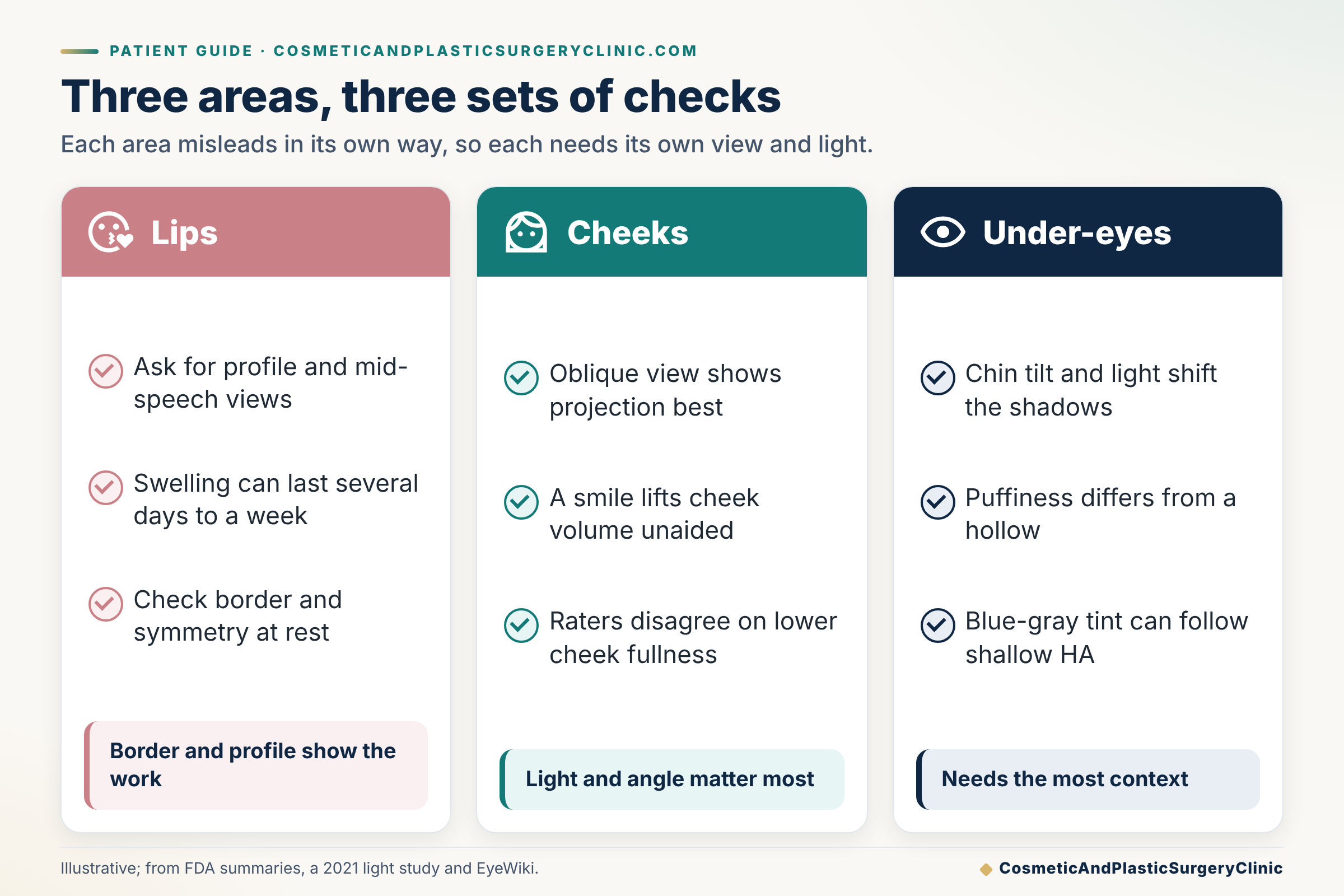
Lips are judged by edge and profile, cheeks by light and angle. Each gallery needs its own checks, and the same pair of dermal filler photos can pass one set and fail the other.
Lips: border, profile and what happens when they move
ASPS’s 2025 report estimates that lip augmentation made up 23 percent of hyaluronic acid filler treatments and facial rejuvenation 70 percent, so lips fill many galleries. The lip trial above scored fullness live on the Medicis Lip Fullness Scale, from 1 (very thin) to 5 (very full), while photos were reviewed separately. A photo is a second opinion on a score, not the score.
In dermal filler photos of lips, look for a clear lip border, an upper and lower lip that look related, and symmetry at rest. Then look at a profile or three-quarter view, since projection is invisible from the front, and at one frame mid-speech or smiling. Revanesse’s sheet says lip swelling may take several days to a week. The treatment itself is covered in lip filler.
Cheeks and midface: the oblique view and the smile
Cheek volume shows best in an oblique view where light skims the cheekbone, and a straight-on frame flattens it. The 22.5-degree view suggested in that 2009 report fits the logic, though no controlled data support it. As the interesting fact showed, a smile moves cheek volume, so a resting frame beside a resting frame is the fair comparison.
The 2021 light-angle study found raters agreed poorly on lower cheek fullness, which is a reminder that trained observers disagree on what a photo shows there. Differences in raters’ judgments are one reason a cheek pair needs several views.
Under-eye photos and the overfilled look
These two cases share a problem: the signs are subtle, and a camera exaggerates or hides them with equal ease.
Under-eye pairs are the easiest to misread
The FDA approved Restylane Eyelight on May 8, 2023 for infraorbital hollowing, based on a 333-participant study in which one or two treatments with multiple injections were needed and effects lasted up to 12 months. The study excluded people with rosacea, chronic under-eye swelling, a tendency to accumulate eyelid edema and lid retraction. An under-eye pair rarely says whether the pictured person would have qualified.
The EyeWiki review by Barmettler and Burkat says tear-trough fillers carry a higher risk of cheek swelling (malar edema), up to 11 percent of cases, and describes a blue-gray tint when too much HA sits too superficially. Light and chin position change under-eye shadows alone, so compare dermal filler photos of this area with extra care. Risks are covered in under eye filler risks.
The overfilled look has no standard score
A 2026 narrative review of facial overfilled syndrome (Zhou and colleagues, Clinical, Cosmetic and Investigational Dermatology) describes an inflated look, altered expression and abnormal midface volume after excessive filler. It names descriptive cues, not validated photographic criteria, and states that no established classification exists and that evaluation lacks objective quantitative standards.
Causes it lists include wrong plane, wrong amount and cumulative load from repeated treatments, but also puffiness that exists without filler. So a single photo cannot label a face. Compare a series: the resting contour, whether expressions look restricted, and whether the change grows with each visit. That is a question to take to a second injector or a plastic surgeon, not a verdict.
| Gallery element | What a strong entry shows | What a weak entry leaves out | Limit on interpretation |
|---|---|---|---|
| Case similarity | Age, skin quality and concern like yours, same area | Only strikingly different faces from yours | Similar is not identical; skin and bone differ |
| Time point | Days since last injection stated; a later follow-up | No date, or only the first week | Early photos include swelling |
| Treatment list | Product, area, amount, visits and other treatments | The word “filler” only | Amount in one case is not a recipe |
| Edits and consent | Statement of no retouching; written consent on file | Smooth skin, cropped frames, no mention of either | Unedited does not mean typical |
| Adjustments disclosed | Cases that needed a touch-up or a dissolve | Every result appears first-time ideal | A practice may not keep count |
| Number of cases | Many pairs across ages, with modest and strong results | One or two standout pairs per area | A selection is not a sample |
Table 3 turns a gallery into a short evidence file for dermal filler photos. Entries in the right-hand column are limits, not accusations: a practice can do everything right and a single pair still cannot predict your face.
What dermal filler photos cannot show: delayed lumps, vessel injury and unapproved products
Problems that arrive after the “after” photo
A gallery is taken at a fixed point. The FDA’s consumer page says side effects may emerge weeks, months or even years after an injection, which is later than almost any gallery photograph.
Delayed lumps and a blue-gray tint
The EyeWiki review puts delayed-onset nodules at about 0.5 percent of HA treatments, typically from four weeks to over a year afterward. A 2021 review in the Journal of Clinical and Aesthetic Dermatology (Convery and colleagues) calls the term descriptive rather than a diagnosis, notes that nodules usually appear at least two weeks after treatment, and says overall prevalence and causes, including possible biofilm and immune triggers, remain largely unknown.
A tint can arrive earlier: the blue-gray look of HA placed too superficially. A January 2026 summary of a Clinical Imaging review adds that granulomatous reactions can show up years later, and that ultrasound can show deposits. Dermal filler photos taken at four weeks cannot show any of this, so ask how delayed problems are handled.
Blood-vessel injury: an emergency no gallery shows
The FDA calls unintentional injection into a blood vessel the most concerning risk and lists skin death, vision abnormalities including blindness, and stroke as possible results. EyeWiki describes early signs as severe prolonged pain and blanching, then a net-like mottled pattern (livedo) and dusky blue-red color, with vision loss possible alongside eye pain or a visual field defect. Arterial blockage usually shows immediately, but venous compression can take many hours; the longest reported interval was 36 hours.
Reversibility, authenticity and the person holding the syringe
Two claims travel with dermal filler photos: that it can be undone, and that it is the real product placed by a qualified person. Neither appears in the frame.
“Reversible” belongs to hyaluronic acid, and it is not a promise
FDA patient information defines hyaluronidase as an enzyme used to break down HA at the injection site. That applies to HA products, not to every filler, and the Convery review cautions that complex complications cannot simply be dissolved. In the Revanesse Lips+ study, three people were treated with hyaluronidase, all had injection-site swelling that was sometimes severe, and two left the study.
So a caption saying “fully reversible” is a mechanism, not an outcome. If a pair shows a result before and after dissolving, ask how long it took and what the face looked like in between. The process is explained in dissolving lip filler.
Genuine product, trained injector
The FDA advises a licensed provider with experience in dermatology or plastic surgery who is trained to inject fillers, asks you to request and read the patient labeling, and says to confirm the product is FDA-approved and in sealed packaging. It cites counterfeit alerts from March 2017, July 2018 and October 2018 and warns that fillers sold directly to the public may be fake or contaminated.
Who may inject depends on the state; a 2023 Dermatology Times commentary notes there is no requirement for training in dermatology or plastic surgery. A photo on a social account verifies none of this. The American Board of Plastic Surgery offers a Verify Certification search, and how to choose a plastic surgeon walks through the checks.

Who made the gallery: selection, editing, consent and advertising rules
A gallery is a selection, and filters can fake a filler result
Every public gallery was chosen by someone with a reason to show it. That is not sinister, but it changes what the pictures can tell you.
Selection and typical results in dermal filler photos
The FTC’s health-products guidance says testimonials reporting results more dramatic than people can generally expect are likely to be deceptive, that “results not typical” does not cure that, and that a clear statement of what a typical person can expect should accompany them. It also notes that before-and-after images can themselves convey a claim.
Compare a gallery with the label evidence. In the Revanesse Lips+ study, 65 percent (46 of 71) of participants rated themselves much or very much improved at month six. A gallery of only striking lip pairs sits above a figure like that, so ask how many treated people look like the featured ones, and look for modest cases among the strong ones in any set of dermal filler photos.
Retouching, filters and AI in dermal filler photos
An October 2026 ASPS article on reading photos in the age of AI says filtering that smooths skin and erases lines does not reflect what a procedure delivers. It lists strange skin texture, warped backgrounds, inconsistent shadows, and wavy lines or pixelation around the face as warning signs, and cautions against relying on visual tells alone.
For fillers, smoothing is a particular problem, since a plump, line-free face is the result being sold. The Aesthetics guidelines list edited or filtered images among problematic imagery. The only dependable test is documentary: ask for the original, unedited files and a written statement of what was changed.
Consent, privacy and paid posts
Behind every pictured face is a person who agreed to something. What they agreed to, and whether they were paid, shapes how much weight a pair deserves.
Consent and who may publish a face
HHS lists full-face photographs and comparable images among identifiers in its de-identification guidance, and says marketing uses of health information generally need written authorization, with limited exceptions. Whether a given business is covered, and whether a specific post of dermal filler photos qualifies, turns on facts a patient cannot see. The Aesthetics guidelines say to obtain written consent before using photographs for marketing and that patients can withdraw consent at any time.
If you are asked to sign a photo release, read where the images may appear and whether you can withdraw. Do not assume a cropped face is anonymous, and do not feel obliged to agree as a condition of treatment.
Free syringes and influencer posts
The FTC’s endorsement guidance says an endorser must disclose a connection that viewers would not expect, including payment or free products given with an expectation of promotion, and that this needs to appear in each post, not in comments or buried among hashtags. Tagging a brand is not a disclosure.
A 2023 study in Aesthetic Surgery Journal (Rothchild and colleagues) analyzed 340 TikTok videos about facial injectables with about 306.6 million views and found overall quality low, with patient-experience clips the most common type. A friendly post by someone who received free or discounted filler is advertising, even when the dermal filler photos look like a personal story, so ask whether the pictured person was paid or treated at a discount.
From photos to a consultation: questions, baselines and the choice to wait
A worksheet to carry into the visit
Photos do their best work as prompts. The consultation is where an injector can look at your face in motion, with your history in front of them, which no gallery can do.
Seven questions to send with three dermal filler photos
Pick three pictured cases that resemble your concern and send these questions with them. A thoughtful answer is useful, and so is an honest “we cannot show that.” The wider list in plastic surgery consultation questions carries over to an injection visit with small changes.
- Which product, area and amount were used for each of these cases?
- How many days after the last injection was each “after” taken, and was it after one visit or several?
- Were light, angle, expression and makeup the same in both frames?
- Has any image been edited, cropped or flipped, and can I see the originals?
- Who injected, with what training, and where is hyaluronidase kept?
- Did the pictured people give written consent, and were any paid or discounted?
- What happened in cases that did not turn out as intended, and what is the adjustment policy?
Your own baseline photos
Baseline photos give a clinician a reference and give you something no gallery can supply. Take them in the same light and at the same distance, without makeup, with a neutral face and a relaxed smile, from the front and from 45 degrees, and date them. The Aesthetics guidelines use the same logic: plain background, neutral expression, standard views.
ASPS says photos may be taken at the first assessment. Ask whether you may have copies of the clinic’s photos of you, and keep the unfiltered originals. Comparing dermal filler photos of your own face over time is the most reliable gallery you will see.
Maintenance, alternatives and a reasonable no
Fillers are not one decision but a series, and photos show only the first.
Maintenance is part of the “after”
ASPS says fillers are temporary and that ongoing treatment is needed to maintain results. A photo of a good result at one month therefore implies a schedule of touch-ups to keep it, and a yearly cost that depends on how fast the product fades in that area. The price mechanics are in dermal filler cost.
Ask what the plan looks like at six and twelve months, since the labels quoted earlier give ranges and not schedules. No source gives a standard interval for any individual.
Other routes, and when waiting is reasonable
ASPS says fillers cannot replicate what a facelift, brow lift or eye lift can do, though they may delay the point at which one is worth considering. Facelift alternatives compares the options. Puffiness and hollows are different problems, which is one reason an injector’s examination matters more than any pair. Lines made by muscle movement belong to a different treatment, a neuromodulator, which behaves differently in photos.
Waiting is sometimes the standard answer. The FDA says safety is not established for fillers in pregnancy or breastfeeding, in people under 22, or in people prone to keloids or hypertrophic scars. FDA patient information also asks you to tell a provider about blood thinners and about a history of facial cold sores. These are reasons for a conversation, not for guessing.
Frequently asked questions
Why do my own dermal filler photos look different from the clinic’s?
Because the conditions differ. A clinic fixes the lens, distance, light and head position, while a phone held low or to one side changes shadows under the cheeks and eyes. Researchers who tested light angle found that moving the light by 60 degrees changed how folds and attractiveness were rated, and shifts up to 30 degrees changed little. Your own photos still work as a dated record if you repeat the same set-up each time.
Can lip filler be photographed on the day it is done?
It can, but the picture will include swelling. The Revanesse Lips+ patient information says lip swelling may take several days to a week to resolve and bruising up to a week. A same-day photo is a record of the visit, not of the result, and dermal filler photos from the first day say little about week two. If a gallery shows only day-zero images, ask whether later photos exist, and how the lips looked at the two-week and later checks.
Should dermal filler photos from the first week look uneven?
Some unevenness from swelling or bruising is expected, and FDA patient information says most side effects settle within about two weeks. What is not expected is sudden severe pain, skin turning pale, gray, blue or mottled, vision changes or fast-spreading swelling, which need emergency care at once. Lumps, redness or tenderness that persist beyond 14 days are a reason to call the injector, according to the Restylane Lyft brochure.
Do dermal filler photos on a brand’s own website show typical results?
Treat them as advertising. A manufacturer’s pairs are chosen to show what the product can do, and FTC guidance says dramatic results should be accompanied by a clear statement of what is typical. The more reliable numbers are in the FDA-hosted labeling and summaries, which report trial outcomes such as responder rates and how long side effects lasted. Use brand photos to learn what a good caption includes, then ask the clinic about its own cases.
Can a clinic post my dermal filler photos without asking?
Generally it should not. HHS says the federal privacy rule requires written authorization for marketing uses of health information, with limited exceptions, and it lists full-face photographs as identifiers. Whether a specific business and post are covered depends on facts you may not see. Read any release you sign, ask where the images may appear and for how long, and ask whether you can withdraw consent later.
How can I tell whether dermal filler photos have been edited?
You often cannot, and ASPS cautions against relying on visual tells alone. Suspicious signs include strange skin texture, warped backgrounds, inconsistent shadows and wavy lines or pixelation near the face. Frames that share the same background, clothing and makeup are more reassuring. The dependable route is to ask the practice for the original files and a written statement of what, if anything, was changed or cropped.
Can I ask a clinic about filler that went wrong?
Yes, though most will not share photos of other patients for privacy reasons. Ask instead about process: how often adjustments are needed, who you call after hours, whether hyaluronidase is stocked, and where a vascular emergency would be sent. The FDA says providers should have a plan for treating vascular complications. A clear, specific answer is a good sign; a claim that nothing ever goes wrong is not.
Do dermal filler photos show whether a filler is hyaluronic acid?
No. Gels of different materials can look alike in a photo, yet they behave differently over time and only HA can be dissolved with hyaluronidase. The FDA advises asking for the patient labeling for the product used, and confirming it is FDA-approved and supplied in sealed packaging. Ask the practice to write the product name and lot details in your treatment record, and keep a copy.
Sources and further reading
- U.S. Food and Drug Administration — Dermal Fillers (Soft Tissue Fillers), content current 07/06/2023 (accessed 2026-11-12) — device status, approved areas, unapproved uses, risks, warning signs, counterfeit alerts
- U.S. Food and Drug Administration — Dermal Filler Do’s and Don’ts for Wrinkles, Lips and More (accessed 2026-11-12) — licensed provider, labeling, timing of swelling, delayed side effects, reading dermal filler photos alongside product facts
- U.S. Food and Drug Administration — Restylane Eyelight (P040024/S135), approved May 8, 2023 (accessed 2026-11-12) — infraorbital hollowing indication, 333-participant study
- U.S. Food and Drug Administration — Restylane Eyelight summary of safety and effectiveness data (accessed 2026-11-12) — swelling, tenderness and bruising rates, return to social activity, study exclusions, 12-month responders
- U.S. Food and Drug Administration — Restylane Lyft patient brochure (accessed 2026-11-12) — two-week side-effect window, duration by area, hyaluronidase definition, what to tell the provider
- U.S. Food and Drug Administration — Revanesse Lips+ patient information (accessed 2026-11-12) — lip swelling and bruising, 46% touch-up, 65% month-6 improvement, hyaluronidase cases
- American Society of Plastic Surgeons — Dermal fillers overview (accessed 2026-11-12) — uses, limits against surgery, temporary effect
- American Society of Plastic Surgeons — Dermal fillers results (accessed 2026-11-12) — immediate results, duration depends on filler and patient
- American Society of Plastic Surgeons — Dermal fillers procedure (accessed 2026-11-12) — assessment, mapping, photos at assessment, numbing
- American Society of Plastic Surgeons — Dermal fillers before and after photos page (accessed 2026-11-12) — gallery labels used for dermal filler photos from ASPS members
- American Society of Plastic Surgeons — What is reality? Determining if a before and after is too good to be true, March 11, 2025 (accessed 2026-11-12) — lighting, makeup, staged before frames
- American Society of Plastic Surgeons — Can you trust that transformation? Reading before and after photos in the age of AI, October 13, 2026 (accessed 2026-11-12) — signs of editing, posture and angle, timing
- American Society of Plastic Surgeons — 2025 Plastic Surgery Statistics Report (accessed 2026-11-12) — hyaluronic acid and non-HA filler shares, lip augmentation share, methodology
- American Society of Plastic Surgeons — 3D imaging technique shows facial soft tissue strain, news release, September 2014 (accessed 2026-11-12) — 13-volunteer pilot study of strain during expressions
- Dermatology Times — Facial expressions affect photo comparability, March 18, 2019 (accessed 2026-11-12) — secondary report of a 2019 Plastic and Reconstructive Surgery study of expression and apparent volume
- MDedge Dermatology News — 22.5-degree photo angle documents filler result, May 1, 2009 (accessed 2026-11-12) — one clinician’s view on angle and slow-building filler
- Hernandez et al. — Influence of different light angles during standardized photographic assessment, Aesthetic Plastic Surgery, 2021 (accessed 2026-11-12) — 51 volunteers, three light angles, limits of comparing dermal filler photos
- Barbi et al. — Photodocumentation in oculoplastic surgery: an up-to-date overview, Arquivos Brasileiros de Oftalmologia, 2025 (accessed 2026-11-12) — lens, distance, flash and head position
- Aesthetics Journal — Aesthetics Before and After Photography Guidelines, April 2025 (accessed 2026-11-12) — lighting, views, expression, consent, edited images
- Weiss et al. — Hyaluronic acid filler in lip fullness augmentation, randomized controlled trial, Dermatologic Surgery, 2021 (accessed 2026-11-12) — Medicis Lip Fullness Scale, blinded photographic review
- Zhou et al. — Facial overfilled syndrome: a narrative clinical review, Clinical, Cosmetic and Investigational Dermatology, 2026 (accessed 2026-11-12) — overfilled cues, no established classification
- American Academy of Ophthalmology EyeWiki — Complications of hyaluronic acid fillers, page edited 2026-11-12 (accessed 2026-11-12) — Tyndall effect, delayed nodules, vascular occlusion signs, hyaluronidase
- Convery et al. — Delayed-onset nodules and considering their treatment following hyaluronic acid fillers, Journal of Clinical and Aesthetic Dermatology, 2021 (accessed 2026-11-12) — timing, causes, uncertainty
- Diagnostic Imaging — Seven takeaways on ultrasound imaging of patients with cosmetic fillers, January 5, 2026 (accessed 2026-11-12) — trade summary of a Clinical Imaging review
- Rothchild et al. — An analysis of cosmetic facial injectable treatment content on TikTok, Aesthetic Surgery Journal, 2023 (accessed 2026-11-12) — 340 videos, creator types, low quality (abstract)
- Federal Trade Commission — Endorsement Guides: what people are asking (accessed 2026-11-12) — disclosing payment and free product in posts that carry dermal filler photos
- Federal Trade Commission — Health products compliance guidance, December 2022 (accessed 2026-11-12) — dramatic testimonials, “results not typical”, images as claims
- U.S. Department of Health and Human Services — Methods for de-identification of protected health information (accessed 2026-11-12) — full-face photographs as identifiers
- U.S. Department of Health and Human Services — Marketing and the privacy rule (accessed 2026-11-12) — written authorization for marketing uses, limited exceptions
- Dermatology Times — Rules and regulations on cosmetic procedures: where are they? May 16, 2023 (accessed 2026-11-12) — who may inject varies by state
- American Board of Plastic Surgery — home page and Verify Certification menu (accessed 2026-11-12) — certification lookup before trusting any dermal filler photos from a surgeon’s page