

Most searches for breast implant alternatives start from one of two places. Some people want fuller or higher breasts and would rather not live with a device that, by FDA labeling, is not meant to last a lifetime. Others are not sure surgery is the answer at all. Both are reasonable starting points, and the honest answer depends on which part of the breast is bothering you: its volume, its position, or how it looks inside clothing.
This page sorts breast implant alternatives by the problem each one actually solves, with the evidence and the limits attached. It covers fit and padding, weight and exercise, breast lift, fat transfer, waiting, and the pills, creams and injections that are marketed as substitutes. It cannot tell you which of the breast implant alternatives suits your body. That judgment needs an examination by a board-certified plastic surgeon.

Start with what you want to change
Three separate problems hide inside “I want bigger breasts”
Volume, skin and position are independent
The National Cancer Institute’s SEER training material describes the breast as fat and glandular tissue resting on the pectoralis major, the large chest muscle, with no muscle of its own. It says the fat layer largely determines breast size and shape, and that estrogen, progesterone and prolactin drive how the tissue develops and changes. That makes three things adjustable in principle: how much tissue there is, how much skin holds it, and where it sits on the chest wall.
Most breast implant alternatives move only one of these. A lift changes position and skin. Fat transfer adds volume. A bra changes none of them but alters the silhouette. Knowing which of the three you are actually unhappy about is what turns a vague wish into a question a surgeon can answer.
Fixing one can make another more visible
The American Society of Plastic Surgeons (ASPS) says a breast lift does not significantly change breast size and does not round out the upper part of the breast. Mayo Clinic says the same in plainer words: a lift will not change size. The reverse is also true. ASPS states that breast augmentation does not correct severely drooping breasts, and that a lift may be needed so that added volume looks lifted rather than just larger.
This is why “volume or lift?” is often the first real question at a consultation. Adding volume to breasts that sit low can leave the position problem intact, and lifting breasts when the main concern is fullness can leave that concern untouched. Some plans use both, either in one operation or in stages, and that choice belongs to the surgeon who examines you.
Why people look for breast implant alternatives
Device-related reasons to consider breast implant alternatives
The FDA says breast implants are not lifetime devices, and that the longer someone has them, the more likely they are to need removal or replacement. Its consumer update adds that many patients have additional operations to change implant size. For silicone gel implants, the agency says screening with MRI or ultrasound may be recommended, and that insurance may not cover those exams. The breast augmentation guide covers the device lifecycle in full.
Those facts do not make implants a poor choice. They make them a long-term commitment, and some people prefer a route with fewer scheduled follow-ups. ASPS counted 45,773 implant removals among augmentation patients in its 2025 member-surgeon statistics, against 304,234 augmentation procedures that year. Removals in a given year include implants placed many years earlier, so the two numbers cannot be turned into a failure rate. They do show that removal is a common enough decision to plan for.
Body and calendar reasons to compare breast implant alternatives
Other people look for alternatives because the timing is wrong. The FDA approves saline implants for cosmetic augmentation at age 18 and older and silicone gel implants at 22 and older. Breasts also keep changing after pregnancy and breastfeeding, and surgeons quoted by ASPS in 2026 say breast surgery should wait until they stop changing, which can take six months to a year.
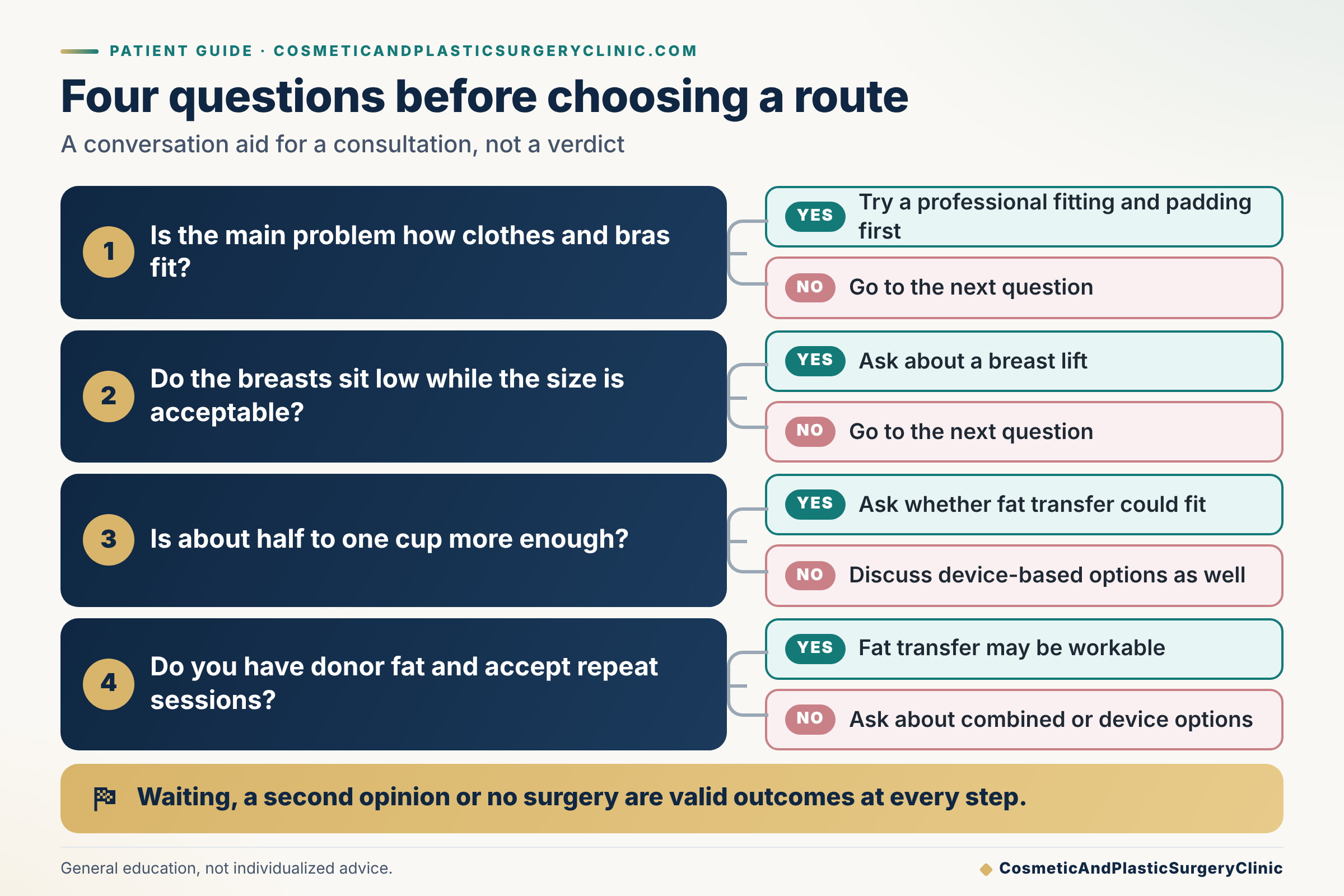
Some people simply want to avoid general anesthesia, a second operation years from now, or the idea of a foreign object. Others are exploring options before committing. All of these are valid reasons to compare, and the table below lines up the situations with the routes that tend to fit them. It is a conversation aid, not a verdict on any individual.
| Situation | Route to discuss | What it offers | Main trade-off | Question to ask |
|---|---|---|---|---|
| Tops and dresses fit badly | Bra fitting, padding, tailoring | Reversible change in silhouette | Changes appearance in clothes only | Have I been fitted and tried padding at the size I imagine? |
| Breasts sit low; size is acceptable | Breast lift | Raises position, tightens skin | Scars; size unchanged; may not last | Which scar pattern would my anatomy need? |
| Wants about half to one cup more, own tissue | Fat transfer | Modest volume, no device | Partial fat loss; donor site; possible repeats | Do I have enough donor fat, and how many sessions? |
| Breasts still changing after pregnancy or weight loss | Waiting, then reassess | Avoids operating on a moving target | Delays a result | What stability should I show before booking? |
| Wants a large, predictable increase | Alternatives may fall short | Implants add more volume in one operation | Device lifecycle and follow-up | Is a device-based plan the better fit for this goal? |
Bras, padding, weight and exercise: changes outside the operating room
Fit, padding and tailoring: the reversible option
What a well-fitted bra can and cannot change
The University of Portsmouth’s Research Group in Breast Health reports that over 80% of women are said to wear the wrong bra size, though a video on the same page says over 70%, so treat the figure as a rough estimate. The group argues that fitting by tape measure alone is not the best approach and teaches five checks: the underband, the cups, the underwire, the center front and the straps.
A well-fitted bra changes how existing tissue sits and is supported. It does not add tissue. It may still be the most efficient of all breast implant alternatives for someone whose real complaint is that clothes pull, gap or ride up. The same group found that 51.5% of 1,659 surveyed women reported breast pain, and says correct fit is linked to less discomfort, which is a separate benefit from appearance.
Padding and inserts as a low-cost preview
Padded bras, removable inserts and shapewear alter the outline you see in the mirror and in photos, and nothing about them is hard to undo. That makes them the cheapest of the breast implant alternatives for testing what a particular fullness or lift would feel like day to day before deciding that surgery is warranted. If you wear padding sized to what you imagine for several weeks and stop noticing it, that tells you something. If it still feels like a costume, that tells you something too.
The preview has limits. Padding sits on top of the breast, so it cannot reproduce how a lift moves the nipple or how added volume changes the chest in a swimsuit or without a bra. For sizing language and the limits of trying sizers on, see the guide to how breast implant size is decided.
Weight and exercise: what moves breast size and what does not
Breast fat follows body fat
Because fat largely determines breast size and shape, changes in body weight tend to change the breasts. ASPS notes on its breast lift page that significant weight loss can reduce breast volume while the skin may not shrink at the same rate, which is one route to the sagging that leads people to consider surgery. Weight gain can increase fullness, but it is not a targeted method and it adds fat elsewhere too.
The practical point is timing. If your weight is still moving, any procedure that sets a shape can be outgrown or outshrunk. Mayo Clinic lists a stable, healthy weight among the things that help a lift last. Stable weight is a planning step for every surgical option among the breast implant alternatives, not only for lifts.
Chest exercise builds the muscle beneath, not the breast
Push-ups, presses and flys train the pectoralis major, which lies under the breast. Since the breast itself contains no muscle, those exercises strengthen the base without adding breast tissue. The National Center for Health Research, summarizing statements by FDA scientists, says exercise systems cannot increase breast size and at most strengthen the supporting muscles. The sources reviewed for this page include no controlled trial showing otherwise.
That does not make exercise pointless. Stronger chest and back muscles can help posture, which changes how clothes sit. It simply is not one of the breast implant alternatives that adds volume, and no one should expect it to behave like one.
Breast lift and fat transfer: the two surgical breast implant alternatives
Breast lift: position and shape, not size
What a lift does and what it leaves alone
A breast lift, or mastopexy, removes excess skin and tightens the surrounding tissue so the breast sits higher and the contour changes. ASPS says it can also reduce an areola that has stretched over time. It lists pregnancy, breastfeeding, weight changes, aging, gravity and heredity among the causes of the changes it addresses. Mayo Clinic notes that a lift can be done together with augmentation or with reduction, depending on whether the goal is fuller or smaller breasts.
The trade-offs are concrete. Mayo lists scarring that usually softens and fades over one to two years, changes in nipple or breast sensation, uneven shape or size that a lift does not usually correct, and, rarely, partial or total loss of the nipple or areola when blood supply is briefly interrupted. Milk production may also be affected. Among surgical breast implant alternatives, a lift is the one that changes position. Costs are covered in the breast lift cost guide, and the scars and shapes are easier to judge from breast lift before-and-after photos.
How long a lift holds
Mayo Clinic states plainly that breast lift results might not last forever, because skin loses elasticity with age, and that larger, heavier breasts are more likely to sag again than smaller ones. A 2022 systematic review in JPRAS Open by Wagner and colleagues looked at 24 studies covering 1,235 patients and 2,235 breasts, and found that superior and superomedial pedicle techniques tended to hold their position better than inferior pedicle techniques. It called mesh and muscular slings promising.
The review also shows how thin the long-term evidence is. Only two of the included studies followed patients for five years or more, the studies measured changes in nipple position rather than reporting a recurrence rate, and the authors could not pool results because the studies differed too much. Their conclusion was that no single technique suits every patient. A surgeon who promises a specific number of years is going beyond that evidence.
Fat transfer: modest volume from your own tissue
The volume ceiling and what fat survival means
In fat transfer, a surgeon removes fat from another area by liposuction and injects it into the breasts. In a November 2024 ASPS article, one surgeon describes the ideal fat grafting patient as someone wanting half a cup to a full cup of increase, and says many women overestimate it. The same article quotes about 50 to 70 percent retention, and says significant volume may take two to three procedures. Among breast implant alternatives, fat transfer is the surgical route that adds volume. The fat transfer versus implants guide compares it with implants.
A 2024 systematic review in Plastic and Reconstructive Surgery (Seth and colleagues) pooled 35 studies and 3,757 women. Mean volume retention was 58%, with a range from 44% to 83%, and mean injected volume was 300 mL. Patient satisfaction averaged 92% at one year. The overall complication rate was 27.8%, with fat necrosis accounting for 43.7% of those complications, and the review rated the included studies as having a moderate risk of bias.
Imaging findings and the donor site
A 2020 review by Ørholt and colleagues in the same journal pooled 22 consecutive-patient studies with 2,073 patients and reported low rates of major complications: hematoma 0.5%, infection 0.6% and seroma 0.1%. Palpable cysts were the commonest minor problem at 2.0%. Imaging changes were more frequent, including oil cysts at 6.5%, calcifications at 4.5% and fat necrosis at 1.2%, and 16.4% of patients were referred for additional imaging and 3.2% for biopsy.
The two reviews of fat transfer count different things and differ in follow-up, so their percentages should not be merged into one figure. What they share is a practical message: fat transfer is not free of follow-up, and breast imaging may need to be read by someone who knows fat was transferred. The fat has to come from somewhere, so recovery includes a liposuction site, which the liposuction recovery guide describes.

Combining breast implant alternatives without adding a device
A lift plus fat, or a lift alone with a plan for later
Some plans pair a lift with fat transfer so that position and a little volume are addressed together. The ASPS fat transfer article describes fat being used to add shape and lift in patients who are having implants removed along with a lift. The operations stack their recovery and risk, though, so a surgeon may split them into stages, with a gap set by how the first one heals.
For readers whose breasts changed after children, the broader picture is in the guide to mommy makeover after pregnancy. It explains why timing and weight stability matter before any of these operations, and why a plan made while the body is still shifting may need to be redone.
When combining stops being an alternative
A lift combined with an implant is no longer one of the breast implant alternatives, because the device is back. ASPS says a lift may be done in the same operation as augmentation or separately, at the surgeon’s decision. The device then brings its own lifecycle, as the next section describes. That is not a reason to avoid the combination, only a reason to be clear about what the plan contains.
If your goal needs more volume than a half-to-one-cup fat increase and a lift together can supply, you are moving toward the implant side of the decision. At that point the questions become size, fill and pocket, which are handled in the saline vs silicone implants comparison and in the guide to implant size.
What implants offer that breast implant alternatives do not, and what they ask in return
Where implants do things the alternatives cannot
Larger, more predictable increases
The honest case for implants is about size range and predictability. Fat transfer is described by surgeons as suited to a subtle change and loses part of its volume over time, while a lift does not add volume. An implant of a chosen volume can add a larger increase in one operation, which is why people whose goal is a large change often end up there after comparing the options.
Predictability is not certainty. Pocket, tissue thickness and the breast’s own shape all affect the final look, and the FDA notes that many patients have later operations to change implant size. Whether implants fit a given goal is a question for the breast augmentation candidate evaluation rather than for this page.
Popularity is not suitability
ASPS reported 304,234 breast augmentation procedures (primary and revision) in 2025 and 156,131 breast lifts, projected from surveys of its member surgeons. Those counts show what is commonly performed, not what is right for any one person. They also do not capture fat transfer to the breast, because the report gives no count for it.
When you compare breast implant alternatives with implants, a large number next to a procedure should be read as a market size. A procedure can be common because many people want what it delivers, because it is heavily marketed, or both. Neither says anything about whether it matches your anatomy and goals.
What the FDA says implants ask of you over time
Not lifetime devices, with a signed checklist
The FDA states that breast implants are not lifetime devices, and says the longer someone has them, the more likely removal or replacement becomes. Reoperation is one of the most frequent complications. Mayo Clinic’s patient page says implants last about 10 years, which is a guide, not a warranty or a schedule. The FDA says no one can predict when more surgery will be needed.
Labeling approved in October 2021 for all legally marketed implants includes a boxed warning and a patient decision checklist. The FDA says the provider must review the checklist with the patient, and that both the patient and the implanting physician sign it. If you are weighing breast implant alternatives against a device, asking to see that checklist before the consultation ends is a fair request.
Imaging, mammography and follow-up
For silicone gel implants, the FDA says MRI is the most effective way to detect silent rupture and ultrasound is an acceptable alternative. Mayo Clinic cites FDA advice for imaging 5 to 6 years after silicone placement and then every 2 to 3 years, and says mammograms of augmented breasts need extra views. The FDA adds that calcifications around implants can be mistaken for cancer on a mammogram and that compression is a possible cause of rupture.
None of that applies in the same way to the breast implant alternatives discussed so far, whether a bra, a lift or fat transfer, although fat transfer has its own imaging questions as described above. The table below sets the long-term demands of each route side by side.
| Route | What changes with time | Maintenance or revision | Review point |
|---|---|---|---|
| Bras and padding | Fit shifts with weight, age and hormones | Replace or refit when support or comfort changes | Fit check after any weight change |
| Breast lift | Skin continues to age; heavier breasts may sag again | A repeat operation is possible if sagging returns | Weight, pregnancy plans and scar healing |
| Fat transfer | Part of the fat is lost; the rest remains | Repeat sessions are common for larger goals | Imaging plan; tell the mammography team |
| Implants (comparison) | Chance of complications rises the longer they stay in | FDA: not lifetime devices; MRI or ultrasound for silicone | Surveillance schedule and symptoms |
Pills, creams, gadgets and injections: products sold as breast implant alternatives
Supplements, creams and devices
What regulators and clinics have said
Mayo Clinic says breast enhancement supplements aren’t likely to work and some may have side effects. It notes that they typically contain herbs such as saw palmetto and wild yam, that manufacturers cite phytoestrogens even though there is no evidence these affect breast growth, and that supplements can interact with medicines such as warfarin. The National Center for Health Research reports that the FDA and the Better Business Bureau say no breast enhancement product has been proven to work.
The Federal Trade Commission has acted against these claims for decades. In January 2003 it announced a settlement with the developer of a supplement-and-cream system whose endorsement claims, including that it significantly increases breast size and is safe, it said lacked support. The order requires competent and reliable scientific evidence before such claims are made, and it was entered for settlement purposes without admitting a violation.
Gadgets, suction and “natural” breast implant alternatives
The National Center for Health Research says FDA scientists have stated that devices or exercise systems cannot increase breast size and at most strengthen the supporting muscles. One device category does appear in the surgical literature, though, and it is easy to misread. A 2018 review in Plastic and Reconstructive Surgery Global Open covered 14 studies and 1,274 patients who used external expansion (mostly a system called Brava) before or after fat grafting.
In those studies the device was worn for roughly 10 to 24 hours a day for weeks around the operation, and fat survival of 53% to 82% was reported. Local swelling occurred in 14.2%, bruising or blisters in 11.3%, and pneumothorax in 0.5%. The authors called the evidence low-level. External expansion in this research was a companion to fat grafting, not a stand-alone way to enlarge breasts, and the review does not discuss its regulatory status.
Injections: silicone, fillers and “nonsurgical breast augmentation”
What the FDA says about injectables
The FDA’s dermal filler page, current as of July 2023, lists increasing breast size among uses that are not approved, and states that the agency recommends against dermal fillers or any injectable filler for body contouring and enhancement. It also says injectable silicone is not approved for any aesthetic procedure, and that silicone injections can lead to long-term pain, infections and serious injuries including permanent disfigurement, blood vessel blockage, stroke and death.
In a November 2017 safety communication the FDA said the only approved use of injectable silicone is inside the eye. It said some people are told they are getting an approved filler when the product is silicone, possibly industrial grade, often injected by unlicensed practitioners in homes or hotels. Breast implants keep silicone inside a shell; injected silicone has no such containment. The FDA says harm can appear immediately or years later.
Spotting an offer to walk away from
An offer among so-called breast implant alternatives deserves a pause if it promises a surgical-size result without surgery, is delivered by someone who cannot show a medical license, takes place outside a clinical setting, or names a product but cannot show FDA approval for the use. The FDA’s “Check Before You Inject” checklist exists for exactly this. Price pressure is another signal: a low quote for a procedure the FDA says is unapproved is not a bargain.
Travel can compound the problem. If a complication appears after an injection abroad, the treating team at home may know little about what was used. The general risks of crossing borders for surgery are covered in the guide to medical tourism for surgery, and the same questions apply to any injection offered along the way.
| Claim in the ad | What the sources say | Question to ask |
|---|---|---|
| Pills or herbal supplements add cup sizes | Mayo: unlikely to work; no evidence phytoestrogens affect growth; possible drug interactions | Which published study supports this, and does it include my medicines? |
| Creams or lotions firm and enlarge | No product proven to work, per FDA and BBB as summarized by NCHR; FTC has pursued such claims | What evidence stands behind the ad’s specific claim? |
| Exercise gadgets or suction devices enlarge | Cannot increase size, at most strengthen muscle (NCHR summary); external expansion studied only around fat grafting | Is this a stand-alone claim or part of a surgical protocol? |
| Filler injections give a nonsurgical boost | FDA: breast enlargement is an unapproved use; recommends against injectable fillers for body enhancement | Is this product approved for this use, and by whom? |
| Silicone injections are a cheap implant substitute | FDA: not approved for any aesthetic use; risks include disfigurement, stroke and death | Is the injector a licensed clinician in a medical setting? |
Waiting, clarifying goals and taking the question to a consultation
Waiting is an active option
Timing by life stage
Waiting is often the most defensible of the breast implant alternatives for people in a period of change. In a June 2026 ASPS article, one surgeon says breast surgery should wait until the breasts stop changing, a period it puts at six months to a year after delivery. Another prefers waiting at least three months after weaning, and says breasts can take four to six months after breastfeeding ends to contract, though they may not fully do so.
Mayo Clinic says surgeons may suggest waiting about six months to a year after stopping breastfeeding before a lift, and that pregnancy can stretch the breasts and offset a lift. Age labeling matters too. The FDA approves saline implants for augmentation from age 18 and silicone gel implants from age 22. Nothing on this page replaces a surgeon’s judgment about timing, and a surgeon who says “wait” is giving advice, not refusing care.
When distress about appearance is the real question
Some people ask about breast implant alternatives while carrying a level of distress about their bodies that surgery is unlikely to settle. Mayo Clinic describes body dysmorphic disorder as a preoccupation with flaws that others cannot see or that seem minor, names breast size as a common focus area, and says people with the disorder often pursue many procedures that bring temporary relief before the anxiety returns. It says treatment, including cognitive behavioral therapy, can help and that the condition usually does not improve alone.
That is not a suggestion that wanting fuller breasts signals a disorder. Mayo also says that for some people, breast augmentation is a way to feel better about themselves. The point is narrower: if distress is intense, constant, or unchanged by every result so far, a mental health clinician belongs in the conversation alongside, or before, a surgeon.
Taking breast implant alternatives to a consultation
Questions that compare routes, not just procedures
Ask a surgeon to describe the plan for each route that could address your goal, not only the one they perform most. Useful questions include: which of volume, position and skin is the main issue in my case; what would each option change and not change; how many operations might this take; what happens to the result with pregnancy or weight change; what imaging will I need and who should read it; and what would a revision involve.
Ask for outcomes in cases with anatomy like yours, and check credentials through the guide to choosing a plastic surgeon. The general structure of a consultation, including what to bring and what pressure tactics look like, is in the plastic surgery consultation guide. A second opinion on a plan that includes injections or a device is not rude. It is ordinary due diligence.
Reading costs across breast implant alternatives
The ASPS 2024 statistics report gives projected surgeon-fee ranges: $4,575 to $8,000 for breast augmentation with implants, $5,500 to $9,500 for augmentation with fat grafting only, $6,500 to $11,000 for a breast lift, and $3,650 to $6,500 for implant removal. These are ranges built from member surveys, not quotes, and the page does not describe them as covering facility or anesthesia charges, so ask for those separately.
Fat transfer is not automatically cheaper than an implant. The November 2024 ASPS article says it is almost always more expensive than a single implant operation, and repeat sessions add to the total. Implants carry costs over time too, such as imaging and possible revision. A full comparison belongs in the breast augmentation cost guide, and the quote should list every component.
Frequently asked questions
Do padded or push-up bras, as breast implant alternatives, change breast shape over time?
Among breast implant alternatives, the sources reviewed for this page describe bras as a way to change support and outline while they are worn, not tissue. A poorly fitted bra may cause discomfort, and the University of Portsmouth group links correct fit to less breast pain. If you are leaning toward surgery mainly because of how clothes fit, a professional fitting is a low-cost step to try first, because it may change what you ask a surgeon for.
Are there breast implant alternatives for very thin people?
Fat transfer needs fat to harvest, typically from the abdomen or flank, though one surgeon in the ASPS article says it can come from anywhere. A very lean person may have little to spare, which limits the volume and may rule the option out. A surgeon can assess donor sites by examination. Some surgeons combine fat with an implant, which changes the plan from one without a device to one with it.
Do I need to tell the mammography team if I choose one of the breast implant alternatives?
Yes, tell the imaging facility about any breast surgery, including each of the breast implant alternatives that involves an operation. Mayo Clinic says a baseline mammogram may be done before a lift and another a few months afterward so future images can be interpreted. For fat transfer, a pooled review found that about 16% of patients were referred for extra imaging, so the radiologist benefits from knowing fat was transferred. The FDA gives similar advice to people with implants.
Are “natural” filler injections safer than silicone among breast implant alternatives?
The FDA does not approve any filler for increasing breast size and recommends against injectable fillers for body contouring and enhancement. Its warning about silicone is stronger, but the filler page puts breast enlargement on the unapproved list too. A product’s label as “natural” or “medical grade” is a marketing term, not an FDA finding. Ask for the product’s approval status for this exact use and the clinician’s license.
Can I breastfeed after a lift or fat transfer chosen over implants?
Mayo Clinic says breastfeeding is usually possible after a breast lift but milk production may be affected, and a lift may be delayed if pregnancy is planned. The sources reviewed for this page do not give a verified answer for fat transfer, so that question should go to the surgeon. If you are breastfeeding now, ASPS advises consulting a member surgeon first, since some procedures have not been studied in nursing women.
What if my breasts are different sizes?
Some asymmetry is common. Mayo Clinic says a lift usually does not correct breasts that were already uneven, while ASPS says augmentation can improve natural size asymmetry. Whether fat transfer is suitable for evening out a volume difference is a question for the surgeon, because no source reviewed here gives data on that use. Tell the surgeon which difference bothers you most, and bring clear photos taken in the same lighting.
Why do my breasts change during the month, and does it matter for planning?
The NCI SEER material says estrogen, progesterone and prolactin act on breast tissue and cause glandular changes across the menstrual cycle. Many people notice fullness or tenderness that comes and goes. For planning, it is reasonable to mention it so measurements and photos are taken at a consistent point in the cycle.
Sources and further reading
- U.S. FDA — FDA warns about illegal use of injectable silicone for body contouring and associated health risks (2017; accessed 2026-11-12) — injectable silicone not approved for body contouring; injuries; advice
- U.S. FDA — Dermal fillers (soft tissue fillers) (current as of 07/06/2023; accessed 2026-11-12) — breast enlargement listed as an unapproved filler use
- U.S. FDA — Types of breast implants (accessed 2026-11-12) — age limits 18 and 22; reoperation; not lifetime devices
- U.S. FDA — Things to consider before getting breast implants (current as of 03/08/2023; accessed 2026-11-12) — boxed warning, decision checklist, MRI/ultrasound
- U.S. FDA — What to know about breast implants (current as of 01/31/2025; accessed 2026-11-12) — size-change reoperations; injectable silicone; mammography advice
- U.S. FDA — Risks and complications of breast implants (current as of 12/15/2023; accessed 2026-11-12) — rupture screening; calcifications; compression
- U.S. FDA — Labeling for approved breast implants (current as of 02/06/2025; accessed 2026-11-12) — October 2021 labeling
- Federal Trade Commission — Marketers of purported breast enhancement system settle FTC charges (December 26, 2002; accessed 2026-11-12) — claims, prices, complaints
- Federal Trade Commission — Developer of purported breast enhancement product settles FTC charges (January 22, 2003; accessed 2026-11-12) — evidence requirement for claims
- National Center for Health Research — Will pills, creams, or other products increase breast size? (modified 2024-01-08; accessed 2026-11-12) — summary of FDA and BBB statements
- Mayo Clinic — Natural breast enhancement: do supplements work? (2024-07-09; accessed 2026-11-12) — supplements unlikely to work; interactions
- Mayo Clinic — Breast lift (2025-11-22; accessed 2026-11-12) — size, risks, durability, timing, mammography
- Mayo Clinic — Breast augmentation (2024-09-10; accessed 2026-11-12) — implant lifespan; imaging advice; expectations
- Mayo Clinic — Body dysmorphic disorder (2022-12-13; accessed 2026-11-12) — preoccupation, procedures, treatment
- American Society of Plastic Surgeons — Breast lift (accessed 2026-11-12) — what a lift does and does not do
- American Society of Plastic Surgeons — Breast augmentation (accessed 2026-11-12) — drooping breasts; lift timing; asymmetry
- American Society of Plastic Surgeons — Fat transfer for breast augmentation: the ins and outs of this implant alternative (2024-11-18; accessed 2026-11-12) — volume, retention, sessions, cost
- American Society of Plastic Surgeons — Post-pregnancy plastic surgery (2026-06-18; accessed 2026-11-12) — timing after pregnancy and breastfeeding
- American Society of Plastic Surgeons — 2025 plastic surgery statistics report (accessed 2026-11-12) — procedure counts
- American Society of Plastic Surgeons — 2024 plastic surgery statistics report (accessed 2026-11-12) — projected surgeon-fee ranges
- Seth et al. — Autologous fat grafting in breast augmentation: a systematic review, Plastic and Reconstructive Surgery 2024 (accessed 2026-11-12) — retention, complications, satisfaction
- Ørholt et al. — Complications after breast augmentation with fat grafting, Plastic and Reconstructive Surgery 2020 (accessed 2026-11-12) — complication and imaging rates
- Wagner et al. — Longevity of ptosis correction in mastopexy and reduction mammaplasty, JPRAS Open 2022 (accessed 2026-11-12) — durability evidence for lifts
- Oranges et al. — The impact of recipient site external expansion in fat grafting surgical outcomes, Plastic and Reconstructive Surgery Global Open 2018 (accessed 2026-11-12) — external expansion review
- University of Portsmouth — Research Group in Breast Health (accessed 2026-11-12) — bra fit and breast pain
- National Cancer Institute SEER Training — Breast anatomy (accessed 2026-11-12) — breast tissue, muscle, hormones


