Liposuction before and after photos look easier to read than most surgical images, because the claim is simple: fat came out and the outline changed. That simplicity is what makes them easy to misread. A torso breathes, eats, slouches and swells. The change being advertised is often a few centimeters of outline, and the layer that surgery actually alters sits under the skin, which is all the camera can see.
This page covers what is particular to liposuction: swelling that outlasts the first follow-up visit, a skin envelope that may or may not draw in, a body that changes shape over a single day, and combined operations that make a waist look smaller for reasons other than fat removal. The general rules for any gallery, including consent, editing and advertising law, are in the guide to reading before and after photos. What the operation changes and what it cannot is in the main liposuction guide.
What liposuction before and after photos can and cannot show
Every liposuction before and after pair squeezes several decisions into two rectangles. Someone chose the areas, the volume and the technique. Someone else chose the camera setup and the follow-up date. The practice then chose this pair, out of everything it has, for the gallery. Reading the pair well starts with separating what is visible on the image from what is only implied by the caption.
Matching the operation and the anatomy
A caption such as “liposuction, abdomen and flanks” is a headline. The details behind it vary widely, and each detail changes how far the pair can inform your own plan.
Ask which zones were treated, with which technique, and what else was done that day
The abdomen, flanks, inner thighs, arms, back and under-chin area behave differently. Each has its own skin thickness, fat depth and way of folding, so a flank result says little about an arm. Ask for the list of every zone treated in the pictured case, not only the one in the frame.
Technique and volume belong on that list too. Tumescent, power-assisted, ultrasound-assisted and laser-assisted approaches are different tools, compared in the page on liposuction techniques. Volume is a caption detail, not a quality score. In one 1999 study of 58 patients over 40, the 30 abdominal cases averaged 1,725 ml of fat removed (Bank and Perez, Dermatologic Surgery). The American Society of Plastic Surgeons (ASPS) notes special considerations when more than about five liters are removed.
Then ask about the rest of the day. If the same operation also included a tummy tuck, breast surgery or fat transfer, the picture shows all of it at once. Those combinations get their own section below.
Compare starting tissue in liposuction before and after photos, not only starting size
Two people with the same waist measurement can have very different tissue. One has soft fat over firm muscle and elastic skin. Another has skin stretched by pregnancy or weight change, or abdominal muscles that have drifted apart. ASPS says firm, elastic skin gives better results, and that thin, soft skin from stretch marks, weight loss or aging “will not reshape as well.” A 2020 review in the Cleveland Clinic Journal of Medicine describes the ideal patient as having adequate skin elasticity and being within roughly 20 to 30 percent of ideal body weight.
Consider a hypothetical reader in her late thirties with two pregnancies, faint stretch marks and a lower belly that folds when she bends forward. A gallery of 25-year-olds with firm skin could be entirely honest and still answer a different question. A useful gallery for her would include cases with her skin and weight history, or the surgeon would say plainly that it does not. What surgeons weigh in this assessment is covered in the liposuction candidate article.
Why a contour change is hard to photograph
The best case for liposuction before and after pictures is also their weakness. What they show is the surface of a body, and surgery works one layer down.
The camera records skin, and the operation changes the layer beneath it
Liposuction thins the fat layer. The picture shows how the skin and the remaining tissue drape over what is left. In a small MRI study of three women who had ultrasonic liposuction of the lower body, the average fat-layer thickness at the measured sites fell by 29.7 percent at one month, 39.4 percent at about three months and 45.6 percent at about nine months (Swanson, ASPS annual meeting abstract, 2011).
Treat those figures carefully. Three women is a very small sample, the abstract is not a full paper, and a thinner layer at a measured site is not the same as an equal change in the outline of the body. The outline also includes skin, muscle, bone and whatever fat remains. The useful point is the direction: the fat layer kept thinning between the first month and the ninth, so a photo from the early months can understate where a result is heading.
What no liposuction before and after photograph can tell you
A liposuction before and after picture cannot show weight loss, because liposuction is not a treatment for obesity or a substitute for diet and exercise, in ASPS’s words. It cannot show a change in cellulite, since ASPS and the Mayo Clinic both say the procedure does not treat the dimpled skin of cellulite. It cannot show numbness, which ASPS lists among the risks and says may persist, or how the recovery felt.
Nor can it show what the operation cost in complications avoided or endured. A tidy contour tells you nothing about the people in the gallery who had fluid collections or needed a second procedure. The liposuction risks page covers those outcomes, and a gallery is not the place to learn about them.
Reading the date on a liposuction before and after photo
The date is the most informative caption a liposuction before and after pair can carry, and the one most often missing or vague. A photograph taken at two weeks and one taken at a year can show the same person, the same camera and the same operation, and still describe two different things. Sources also disagree a little about when swelling is “done,” which is a reason to ask rather than assume.
What each follow-up interval can and cannot tell you
The table below lines up the usual intervals with what a photo from that point can reasonably support. It draws on ASPS recovery and results pages, Mayo Clinic’s patient page and the small MRI study described above. Recovery varies by surgeon, technique, treated area and person, so treat the rows as ranges rather than a schedule.
| Photo date | What the image may show | What it cannot tell you |
|---|---|---|
| Days 1 to 7 | Swelling and bruising at their peak, often under a garment or dressing (ASPS recovery page) | Anything reliable about the eventual contour |
| Weeks 2 to 3 | Noticeably better comfort; some people are back at work; swelling still prominent | Whether the outline has settled or how much firmness remains |
| Weeks 4 to 5 | Bruising should be gone and swelling begins to subside (ASPS) | Fine contour, dents or skin behavior, which swelling can mask |
| About 6 to 12 weeks | Swelling continues to improve; gentle exercise may start, per the surgeon | The final shape; ASPS says full resolution can take several months |
| Around 3 months | Much of the visible change; the three-woman MRI study reported swelling of about 15 percent at 3 months | How skin will behave later or whether fat layer thinning has finished |
| 6 to 12 months and beyond | A more settled outline; a fairer window for judging fine contour, skin and symmetry | How the result holds through weight change and aging |
The first weeks in liposuction before and after photos: swelling, bruising and garments
ASPS describes the first week as a time of significant swelling and bruising with activity sharply restricted, and says that by weeks four and five bruising should be gone and swelling should begin to subside. It also lists an elastic bandage or compression garment worn to minimize swelling, with the surgeon setting how long. Mayo Clinic says swelling typically goes away within a few weeks while the final results take weeks to months.
For a reader of liposuction before and after photos, the practical consequence is garments and marks. A picture taken in a garment shows the garment’s shape, and a picture taken just after one is removed can show its seams and edges pressed into the skin. An “after” image from the first weeks is a progress report on an operated body. If a gallery presents it as a result, ask what the same person looks like later.
Three, six and twelve months: when liposuction before and after photos start to count
ASPS says it may take several months for swelling to fully dissipate and that contour improves as swelling and fluid retention subside. Mayo Clinic says to expect the treated area to look slimmer within several months. Neither source names a single date, and published work draws the line in different places. A 2016 study by the same surgeon behind the MRI abstract chose three months as its minimum follow-up, reasoning from earlier MRI work that little change in fat-layer thickness follows after that point, yet the abstract above still showed thinning between three and nine months.
The sensible reading: three months is informative for a large change and early for fine detail, while six to twelve months is fairer for dents, skin and symmetry. Skin is the slow variable. In a laser-assisted study of three women, measured lower-abdominal skin contraction was 9.1 percent at three months and 7.6 percent at six (Sasaki, Aesthetic Surgery Journal, 2010). The sample is tiny and the technique specific, but it shows that skin behavior is not fixed at the first scheduled visit. The liposuction recovery page follows the full arc.
One dramatic liposuction before and after pair versus a dated series
An ASPS article published in October 2026 warns that a result at six weeks differs from a result at one year. Liposuction before and after galleries are where that difference is largest, because the change is gradual and the fat layer, skin and swelling all move on different clocks. A single pair freezes one moment of that process.
Ask for the same person at several intervals
A short series answers more than a sharper single pair. The useful set is a before photo, an early one, one around three months and one at six months or later, all of the same person under the same setup. The series shows the trajectory, whether early fullness resolved, and whether anything such as an uneven area or a fold became easier to see once the swelling went down. That last point is a possibility rather than a rule, which is exactly why the later photo is worth requesting.
If the practice has only one follow-up image per case, ask what its latest interval is across the whole gallery. A gallery whose newest picture is eight weeks old cannot speak to a year-long outcome, however polished it is.
Warning signs in how timing is labeled
Be cautious with “after” images that carry no date, with labels like “immediate results,” and with a full gallery labeled by a single interval when the poses and clothing vary. Be cautious with galleries where every “after” is a garment-free, well-lit image in the same month range, because that suggests a fixed photo session rather than the varied timing of real follow-up.

How the camera and the body shape liposuction before and after pictures
Photographing a torso for liposuction before and after photos is harder to standardize than photographing a face. The subject is larger, bends in more places and changes with breath and posture. A pair that looks like a surgical difference can come from the camera, the stance or the hour of the day, and the research on abdominal photography treats consistency as the whole point. A 2018 paper in Aesthetic Plastic Surgery on photographic standards for abdominal contouring states the goal as consistent images without distortion or distraction, and notes that such photos carry medicolegal weight (Dietl and Kompatscher).
Camera and pose on a torso
The table lists the variables that matter most when the subject is a waist, flank or thigh. Use it as a set of questions. Real practices vary a little from visit to visit, so a single mismatch is a prompt to ask, while several mismatches in the same direction are an answer. General lighting and expression research is summarized in the general photo-reading guide linked at the start of this page.
| Variable | How it can change a torso photo | What to compare | Question for the practice |
|---|---|---|---|
| Camera height and tilt | A lower or higher viewpoint shifts where the waist, hips and lower belly line up | Navel, hip bone and horizon line within the frame; floor and wall lines | Is each view shot from a marked spot at a fixed height? |
| Distance and lens | Close shots enlarge the nearest body part; distant shots flatten the form | Width of hips against shoulders; how much background shows | Is the same lens and distance used at every visit? |
| Lower-back curve and pelvic tilt | A deeper arch pushes the belly forward; a flatter stance draws it in | Side view: line from ribs to pubic area, position of buttocks | Are patients coached to stand the same way each time? |
| Breath and abdominal tension | A held breath or tightened abdomen can flatten the profile | Rib position, visible muscle lines, fullness below the navel | Is the pose relaxed, with normal breathing, in every image? |
| Arm position | Raised arms can lengthen the flank; lowered arms can let it fold or bunch | Elbow and shoulder height; creases at the sides | Are arms placed identically in the “before” and the “after”? |
| Light direction | Frontal light tends to smooth surface dents; side light deepens shadows | Shadow direction under the ribs, along the hips and thighs | Is the same light setup used at every session? |
| Garments, underwear and tan | Elastic lines, compression marks, a new tan or different underwear can change the apparent outline | Waistband position, skin tone, pressure marks | Are “after” images taken in matching clothing and without a garment? |
Height, distance and tilt change where the waist appears
Perspective works on torsos in liposuction before and after photos as it does on faces. A camera held a little high or low shifts the relationship between ribs, waist and hips, and a short distance enlarges whatever is nearest. A 2005 review of photographic standardization in aesthetic surgery makes the point that lens misalignment changes the size of the subject in the frame, and that the same system should be used before and after (Sen and colleagues, Ankara University Medical Faculty Journal).
A 2016 prospective buttock study shows what a careful protocol looks like: the same room, lighting, camera and lens for every patient (Swanson, Plastic and Reconstructive Surgery Global Open). A gallery rarely documents that much, so verify it yourself with landmarks.
Flip between the two images at the same size and check things surgery cannot move: the navel position relative to the hip bone, a doorframe, the horizon line of the floor tiles, a chair. If those shift, part of the apparent change is the camera or the stance. The Ankara review also names anatomic landmarks such as the umbilicus as a way to reproduce the same pose at follow-up.
Posture, arm position and abdominal tension
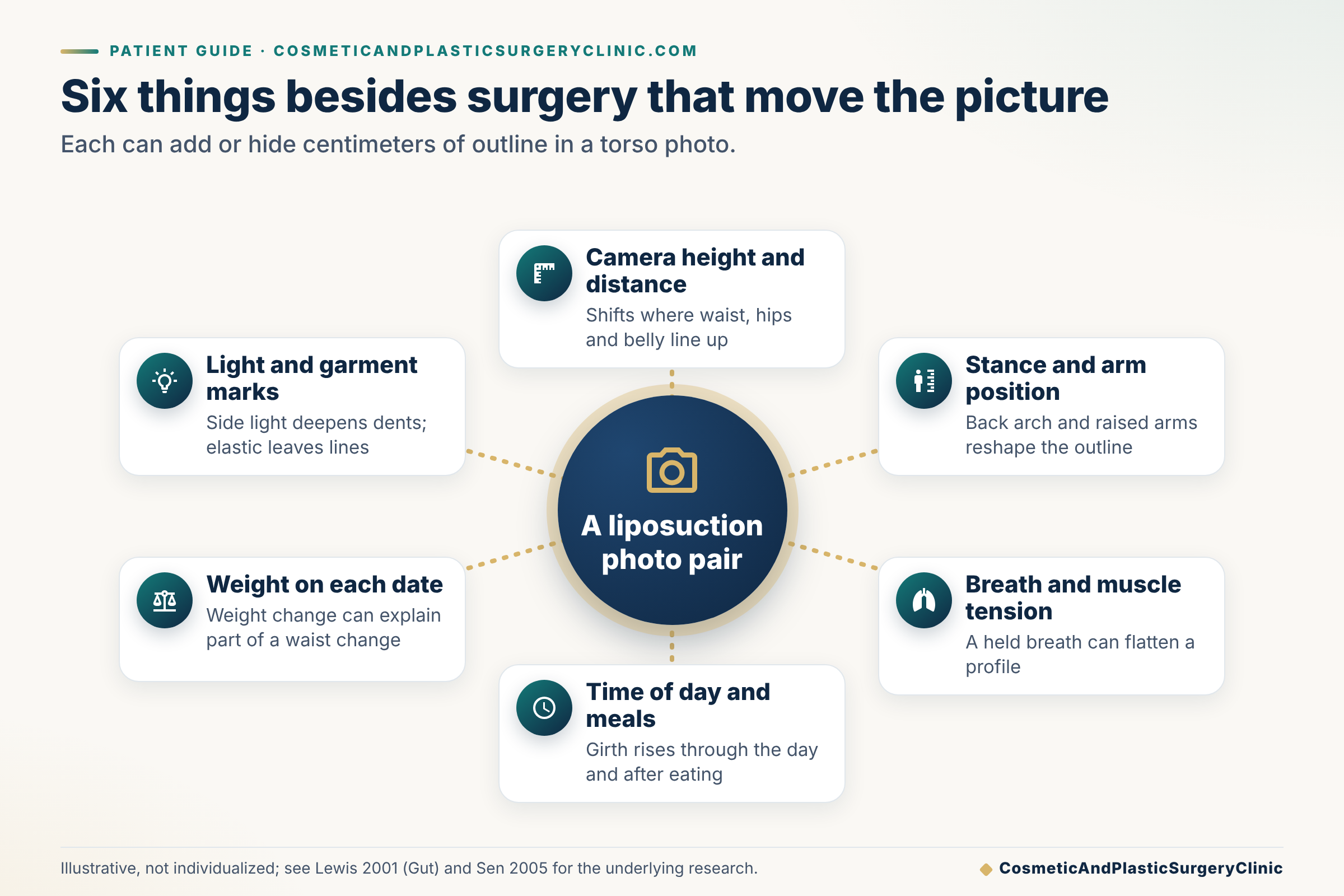
Stance is a bigger lever on a torso than most readers expect. An arched lower back sends the belly forward and tips the pelvis; a flatter stance does the reverse. A breath held in or a lightly tightened abdomen can flatten a profile as well. None of this requires bad intent. Someone who is pleased at a six-month visit may stand taller without noticing.
A front pose is only one of several standard views. The Ankara review describes anterior, lateral and oblique views for abdominal cases, a lateral view with a gentle forward bend to assess muscle laxity and lower-abdominal fat, and, for the buttocks and thighs, a back view with the gluteal muscles first relaxed and then tightened. It also specifies raised arms for these views. Raised arms in both images are therefore acceptable; raised arms in only one are not.
The body in liposuction before and after photos is not constant
Even with an ideal camera setup the person in the frame changes. For liposuction before and after photos, where the claim is a difference of centimeters, several ordinary fluctuations are about the same size as the effect being advertised.
Time of day, meals and bloating
A “before” photo taken at the end of a workday and an “after” taken at a morning appointment, or the other way round, builds an apparent change into the pair before the surgeon has done anything. How much does a normal abdomen vary? The next paragraph gives a measurement.
That figure comes from small studies built for another purpose, and “maximum” means the day’s peak rather than a typical shift. Still, it explains why a good practice shoots at a consistent time of day, and why you may want to ask what time each photo session took place. Hypothetically, a reader who sees a flatter “after” in a gallery should wonder whether the morning or the evening produced it.
Weight, hydration, garments and tan lines
Weight is the confounder that liposuction before and after photos hide best. In the 1999 study of 58 patients over 40 mentioned earlier, the abdominal group lost an average of 5 pounds, with a 3-inch waist reduction at six months (Bank and Perez). The authors tracked circumference and weight together, because part of a waist change can follow a weight change and not the surgery alone. If a gallery gives no weights, ask for them at each date.
Smaller details add up in a pair. Pressure marks from a recently removed garment, the line of a different waistband, a tan that evens out the contrast of the skin, or underwear that rides higher can all change how an outline reads. These do not reveal the surgeon’s work or its limits. They only add noise, which is why the table asks about matching clothing.
Skin, dents and shadows: the cues that belong to liposuction
Facial and breast galleries are mostly about shape. A liposuction before and after gallery is just as much about surface, because the question after fat removal is whether the skin lies smoothly over what remains. Skin quality and surface irregularity are the two areas where a gallery can mislead without a single edited pixel, and both are worth a dedicated look in every pair.
Reading skin retraction in liposuction before and after photos without over-reading it
Retraction is the skin’s tendency to draw in after the fat beneath it is reduced. It is the least predictable part of the result, it cannot be seen clearly in a standing front view, and it is the part a before photo can hint at only partly.
What the measurements say about how skin behaves
Published numbers are scarce and small. The 1999 study of 58 patients over 40 tracked circumference at one, three and six months and reported good to excellent cosmetic results for tumescent liposuction of the abdomen, neck and arms, with average circumference reductions at six months of 3 inches at the waist, 1.3 inches at the neck and 0.5 inch at the arms (Bank and Perez). The neck and arm groups did not change weight, so for them the circumference change was not explained by weight loss.
Those averages say nothing about the individual, and “good to excellent” was the authors’ own rating. ASPS is more cautious in its patient material: it states that it is not possible to improve lax skin tone with liposuction, and that you may need more surgeries to remove and tighten extra skin. Mayo Clinic says thin, inelastic skin may look loose after treatment. The consistent message is that fat removal and skin tightening are different jobs, which is part of the reasoning in liposuction versus tummy tuck.
Be skeptical of liposuction before and after galleries that credit a device for tightening. The laser-assisted study cited earlier is real data, but it involved three women, specific settings and one author, and a photo pair cannot make up the difference.
Forward-bend and close-up views show what a standing front view hides
A person standing straight with arms raised can hide a lot of skin laxity. The Ankara review calls for a lateral view with a gentle forward bend to assess abdominal muscle laxity and lower-abdominal fat, and for a close-up of the abdomen to judge skin quality. In practice that means three views worth asking for in any abdominal pair: bent forward, side-on, and close-up.
Look at the “before” version of those views first. If the starting skin folds or hangs when the person bends, a modest result in the “after” is a fair reflection of tissue that liposuction does not change. If the starting skin is firm and the album shows only front views for everyone, you have learned little about the skin of the people who are not in the album.
Dents, waves and rippling
Surface irregularity is the complication most specific to this operation. It is also the one an album is most likely to hide, deliberately or through the choice of angle.
Why lighting and angle change irregularities in liposuction before and after photos
Dents and waves are shadow features. Flat, frontal light tends to soften them and side light deepens them, which is why a gallery shot under one lamp and a consultation under another can look different on the same body. A pair photographed with an identical light setup is far more informative than one with brighter “after” lighting. A pair with side lighting only on the “before” will exaggerate the improvement.
The numbers behind irregularity are not comfortable to ignore. A 2020 review in the Cleveland Clinic Journal of Medicine calls contour deformity the most common complication, with up to 9 percent of patients reporting soft-tissue depressions or elevations, folds or wrinkles, and it lists smaller cannulas, avoiding the superficial layer and a crisscross pattern as ways surgeons try to prevent it. ASPS lists irregular contours and asymmetries among the risks, and the Mayo Clinic describes skin that can look bumpy, wavy or withered, with changes that may not resolve. The page on liposuction revision covers what is done about it.
Cellulite, asymmetry and what an album rarely labels
ASPS says liposuction is not an effective treatment for cellulite, and its risk list includes “rippling or loose skin, worsening of cellulite.” A gallery of thigh and buttock cases that never mentions dimpling is not necessarily hiding anything, but it is worth asking for a view in neutral light, for the starting texture, and for a statement of what the operation does and does not do to cellulite.
Asymmetry is the easiest cue to check yourself. Compare left and right in each view, then mirror-check by flipping the image. A real difference of a centimeter or two between sides may exist before surgery too, so compare the “before” images of those sides first. Ask whether the album includes cases with visible asymmetry or texture changes, and how the surgeon handles them.
When another procedure shares the credit in a liposuction before and after pair
Liposuction is often one line in a longer operative plan. The ASPS 2024 statistics report counts 349,728 liposuction procedures that year, up 1 percent from 347,782 in 2023, and counts the other operations in the same table as separate procedures, including 29,466 buttock augmentations with fat grafting (the “Brazilian butt lift”). The figures cover ASPS member surgeons only. They matter here because a table that lists operations separately says nothing about how many photographed bodies had more than one.
Combined operations hide the liposuction result
When two procedures share a day, a liposuction before and after picture shows their sum. A reader who wants only one of them has to work out what was subtracted from the other, and the album rarely says.
Liposuction plus fat transfer: a bigger hip makes the waist look smaller
Fat for a Brazilian butt lift or hip augmentation is taken from donor areas by liposuction and placed elsewhere. In the photo, the waist gets smaller while the hips and buttocks get larger, and the eye reads the ratio. A waist that reads dramatically narrower may owe much of that to the added fullness below it, not only to the fat removed from above.
Ask for a clear statement of which zones were donors and which were recipients, and for any cases in which liposuction was done without transfer. If you are considering only contouring, a gallery of transfer cases tells you about a different operation. The page on BBL results explains how that operation’s own timeline and expectations work.
Liposuction plus tummy tuck or breast surgery: what each step did
A tummy tuck removes skin and can tighten the abdominal wall, which liposuction does not, so an abdomen that looks tight and flat in the pictured outcome may owe that to the skin removal. In the combined “mommy makeover” pictures, breast changes alter the apparent torso proportions too. The site’s mommy makeover photo page shows how to read combined cases, and the skin and muscle work it involves is a separate operation from liposuction.
Ask which parts of the visible change the surgeon would attribute to which step. A candid answer sounds like “most of the contour change at the flanks came from the liposuction, and the lower-abdominal skin tightening came from the skin excision.” A vague answer, or one that credits the liposuction for everything, is a reason to ask again.
Pairing pictures with numbers
Photographs are an indirect measurement. A tape measure, a scale and a record of volume removed are cruder but less affected by lighting, and the research that tries to quantify liposuction outcomes usually pairs them.
Circumference, weight and volume next to each photo
A serious practice can tell you the circumference of the waist or thigh and the weight on each photo date. The 1999 study used exactly that: body measurements before the procedure and at one, three and six months. A 2016 prospective study combined standardized photographs with ultrasound measurements of fat thickness. You do not need to see a research protocol, but a gallery that includes weight and a circumference at each date is far easier to trust than one that offers a caption of “lipo.”
Volume removed is useful context but not a score: a larger volume does not make a result better, and it carries its own safety considerations.
What long-term photos can say about weight change
Long-term follow-up images are rare and valuable. A 2012 study published in Plastic and Reconstructive Surgery followed 301 patients after liposuction alone or with a tummy tuck, using standardized photographs and computer-assisted measurements at three months or more. The ASPS summary says the researchers found no evidence of fat returning in treated areas or appearing in untreated upper-body areas, and that hip reductions persisted at a year or longer even in 34 patients who gained five pounds or more. It was presented as a rebuttal to a 2011 report in the journal Obesity that had concluded fat returns elsewhere.
The evidence is therefore contested, and the ASPS release is a summary and not the paper. Mayo Clinic says shape changes usually last if weight stays stable, and that with weight gain fat distribution may change, including more fat around the abdomen even if that area was not treated. For the reader of a gallery, the practical lesson is to ask what happened to weight in the long-term cases. A liposuction before and after pair a year or more apart means little without a weight at each date.
From gallery to consultation: turning liposuction before and after photos into questions
A set of liposuction before and after photos is most useful as a question generator. The pairs cannot tell you what will happen to your body, but they can tell you what to ask the person who will operate on it. The table below turns the seven checks from the quick answer into a form you can carry into an appointment, with the limit of what each check can prove.
Judging the whole liposuction before and after album, not its best pair
| Check | What a sound album shows | Question to ask | Limit of the conclusion |
|---|---|---|---|
| 1. Zones and technique | Each treated area, the technique and any added procedure listed per case | Which areas and technique were used, and was anything else done that day? | Cases with extra procedures cannot be compared with a single-area plan |
| 2. Starting tissue | Skin quality, stretch marks, age and weight history stated or visible | How do this person’s skin and weight compare with mine? | A similar waist size does not mean similar tissue |
| 3. Time point | Dated intervals such as 3, 6 and 12 months for the same person | What is the latest interval in your gallery? | One date cannot show how a result settles |
| 4. Photo conditions | Same distance, height, pose, light and clothing in each pair | Do you use a fixed photo station and a pose script? | Small mismatches are common; several in one direction are informative |
| 5. Body state | Weight and a circumference recorded at each photo date | Were weight and measurements noted, and at what time of day? | Weight change can explain part of an outline change |
| 6. Edits and consent | A statement that images are unretouched and used with written permission | Is any image filtered, retouched or mirrored? | A statement is not proof; visual cues and source still matter |
| 7. Typicality and revisions | Ordinary results, touch-ups and less successful cases are represented | Are these typical results, and how often is revision needed? | Surgeons may not track exact rates; ask how they define them |
How many similar cases are there, and how typical are they?
ASPS reminds readers that practices put their best work forward, and suggests asking directly whether the photos show typical outcomes or the surgeon’s best cases. The number that matters is the count of cases like yours. A handful of pairs with similar anatomy at several intervals is more persuasive than a long scroll of unlike bodies.
The Federal Trade Commission’s guidance on health-product claims is useful here, even though it addresses advertisers and not patients. It says testimonials reporting results more dramatic than users can generally expect are likely to be deceptive, and that adding a note such as “results not typical” does not cure the problem; the advertiser should instead disclose what typical consumers can expect. A gallery that only says “individual results vary” has not told you what typical looks like.
Revision, consent and editing disclosure
Ask whether the gallery includes any case that needed a touch-up, and what that touch-up was. The editorial team found no reliable published revision rates for individual practices, and a surgeon who answers candidly about residual fat, irregularity or asymmetry is giving you more information than one who says it never happens. Revisions and their risks get fuller treatment on the revision page.
Editing is a matter for the general guide, but two quick points belong here. An October 2026 ASPS article quotes a surgeon saying that proportions that seem too good to be true may have been edited, and another warning against relying on visual tells alone. It also suggests checking whether images come from an ASPS member’s own practice site or from social media and people claiming to be patients. Consent, privacy and the endorsement rules are covered in the before and after photos guide.
Using the album in the consultation room
The consultation is where a gallery changes from marketing into evidence, because you can ask the person who took the photos what is behind them. The consultation questions page lists what to bring and how to judge answers in general.
Requests worth making
These requests are specific to liposuction before and after galleries, and a practice that takes the work seriously will usually be able to answer them:
- Cases with similar treated areas, skin quality, age and weight history to yours, not only the best results.
- The same people photographed at early, three-month and six- to twelve-month intervals, with dates.
- Front, oblique, side, back and, for the abdomen, forward-bend and close-up views.
- Liposuction-only cases, separate from combined operations and fat-transfer cases.
- A recorded weight and circumference at each date, and the volume removed.
- At least one case that needed revision, and an explanation of how it was handled.
- The surgeon’s own description of what in your tissue would probably limit the result.
Your own dated photographs, taken the same way each time, give you a record that does not depend on memory or on the practice’s setup.

When the album and the plan do not match
Sometimes the album and your anatomy point in different directions. The gallery may be full of firm-skinned patients while you have lax skin, or the practice may show only combined operations when you want only contouring. That is useful information. It does not mean you must go ahead, and it does not mean you should be talked into the larger operation the pictures happen to feature.
Waiting, getting a second opinion from another board-certified plastic surgeon, or choosing a different route are all reasonable outcomes. The article on how to choose a plastic surgeon covers verifying credentials and facilities, and a plan that includes more than liposuction changes the price too, as explained in the liposuction cost breakdown.
Frequently asked questions
How soon after surgery is a liposuction before and after photo fair to compare?
There is no single date. ASPS says swelling can take several months to fully dissipate, and Mayo Clinic says final results take weeks to months. A three-month picture is informative for a large change, while six to twelve months is fairer for fine contour and skin. Ask the surgeon what interval they treat as settled for your area, and what the latest follow-up in the liposuction before and after gallery is.
Can a liposuction before and after photo hide dents or waviness?
Yes, without any editing. Frontal light tends to soften surface irregularities and side light deepens them, and swelling can mask them early. Ask for views in neutral light, an oblique view and a close-up. A 2020 Cleveland Clinic Journal of Medicine review calls contour deformity the most common complication, so a gallery with no irregularity anywhere deserves a polite question.
Why do some liposuction before and after results look smooth while others show loose skin?
Skin elasticity is a large part of the difference. ASPS says firm, elastic skin gives better results and that liposuction cannot improve lax skin tone. Age, pregnancy, weight loss and stretch marks all change how skin recoils. Compare the starting skin in the “before” view, and look at forward-bend images, not only standing front poses.
Are liposuction before and after photos on social media as reliable as a practice gallery?
Not necessarily, and neither is automatically reliable. An October 2026 ASPS article suggests checking whether images appear on an ASPS member’s own practice site or on social media or posts by people claiming to be patients. Source, dates, consistent views and consent still matter. A credible body of work shows many cases, photographed the same way, over time.
What measurements should accompany liposuction before and after pictures?
Useful companions are weight, a circumference at the relevant site, the date and the volume removed. One 1999 liposuction study recorded circumference alongside weight because weight change can account for part of a waist change. The numbers are less affected by lighting than photographs are, but they come from the practice, so ask how and when they were taken.
Does a flat stomach in liposuction before and after photos mean it worked?
Not by itself. A tummy tuck removes skin and can tighten muscle, a tight stance or held breath flattens a profile, and an early photo may show a garment’s shaping. Check what else was done, how the person stood, and the date. If the aim is skin or muscle, a different operation may be discussed, which is the subject of the liposuction versus tummy tuck comparison.
Should I take my own liposuction before and after photos?
Many people find it helpful. Use the same spot, a plain background, steady light, the same time of day, the same underwear and a relaxed stance, and keep the camera at the same height and distance. Take front, side and back views, and date them. They are a personal record and do not replace the practice’s clinical photographs, which your surgeon’s team will take under their own protocol.
Is it a red flag if a liposuction before and after gallery shows only excellent results?
It is a reason to ask, not proof of a problem. ASPS notes that practices tend to show their best work, so ask whether the images are typical. Look for varied starting anatomy, varied dates and honest labels. If a practice cannot say how common touch-ups are, or avoids showing any, treat the gallery as marketing and weigh your other evidence more heavily.
Sources and further reading
- American Society of Plastic Surgeons — Liposuction (accessed 2026-11-12) — what liposuction treats, firm and elastic skin, cellulite and loose skin limits
- American Society of Plastic Surgeons — Liposuction results (accessed 2026-11-12) — swelling over several months, lax skin tone, stable weight
- American Society of Plastic Surgeons — Liposuction recovery (accessed 2026-11-12) — week-by-week swelling and bruising, compression garments
- American Society of Plastic Surgeons — Liposuction risks and safety (accessed 2026-11-12) — contour irregularities, rippling, sensation change, volume considerations
- Mayo Clinic — Liposuction (accessed 2026-11-12) — cellulite, timeline, garments, bumpy contours, weight regain, emergencies
- Wu, Coombs, Gurunian — Liposuction: Concepts, safety, and techniques in body-contouring surgery, Cleveland Clinic Journal of Medicine, 2020 (accessed 2026-11-12) — patient evaluation, contour deformity frequency
- Swanson — Assessment of reduction in subcutaneous fat thickness after liposuction using MRI, ASPS annual meeting abstract, 2011 (accessed 2026-11-12) — fat-layer thickness and swelling over time in three women
- Swanson — Prospective controlled study of buttock fat transfer using ultrasound and photographic measurements, Plastic and Reconstructive Surgery Global Open, 2016 (accessed 2026-11-12) — controlled photography protocol and follow-up interval
- Bank, Perez — Skin retraction after liposuction in patients over the age of 40, Dermatologic Surgery, 1999 (accessed 2026-11-12) — circumference and weight at 1, 3 and 6 months
- Sasaki — Quantification of abdominal tissue tightening after laser-assisted lipolysis, Aesthetic Surgery Journal, 2010 (accessed 2026-11-12) — measured skin contraction in three women
- American Society of Plastic Surgeons — Fat cells don’t return to treated or untreated areas after liposuction, press release, 2012 (accessed 2026-11-12) — 301-patient photographic study summary
- American Society of Plastic Surgeons — Plastic Surgery Statistics Report 2024 (accessed 2026-11-12) — liposuction and fat-grafting procedure counts
- Dietl, Kompatscher — Basic photographic standards for abdominal contouring procedures, Aesthetic Plastic Surgery, 2018 (accessed 2026-11-12) — photographic standardization abstract
- Sen and colleagues — Photographic standardization in esthetic surgery, Ankara University Faculty of Medicine Journal, 2005 (accessed 2026-11-12) — standard abdominal and body-contour views
- Lewis, Reilly, Houghton, Whorwell — Ambulatory abdominal inductance plethysmography, Gut, 2001 (accessed 2026-11-12) — abdominal girth over 24 hours in healthy women
- Houghton and colleagues — Relationship of abdominal bloating to distention in irritable bowel syndrome, Gastroenterology, 2006 (accessed 2026-11-12) — healthy comparison group girth change
- American Society of Plastic Surgeons — Can you trust that transformation? Reading before and after photos in the age of AI, October 2026 (accessed 2026-11-12) — time points, editing cues, source checks
- American Society of Plastic Surgeons — Can you trust before and after photos? March 2024 (accessed 2026-11-12) — best-work bias and asking for typical results
- American Society of Plastic Surgeons — Determining if a before and after is too good to be true, March 2025 (accessed 2026-11-12) — standardized views and consistency
- Federal Trade Commission — Health Products Compliance Guidance, 2022 (accessed 2026-11-12) — atypical testimonials and “results not typical” disclaimers