Body lift risks follow from one design fact: a circumferential operation is a long wound that runs all the way around the lower trunk, usually in people whose skin, fat stores and nutrition have been through massive weight loss. Wound edges that separate and fluid pockets are therefore common, bleeding and clots count for more than they do after small procedures, and the scar is long. This page sorts body lift risks into expected effects, complications and emergencies, and it gives each number with its source, year and population.
A body lift here means a circumferential lower body lift, also called belt lipectomy: a band of loose skin and fat is removed around the waist and the remaining tissue is lifted and closed. For what the operation treats and why it is planned the way it is, start with the body lift after weight loss overview. For how to read a risk figure on any procedure, plastic surgery risks covers the basics. Nothing below diagnoses a problem, judges whether you are a candidate, or recommends surgery.
Body lift risks in three tiers: expected effects, complications and emergencies
The word “risk” covers very different things. Swelling at the waistline and a clot in the lung both appear on a consent form, yet they call for opposite responses. Sorting body lift risks into three tiers is the quickest way to know whether a symptom means follow the aftercare sheet, call the surgeon today, or go to an emergency department now.
What a circumferential operation asks of the body
Why a belt-line incision is a wound-healing problem first
An abdominoplasty closes one incision across the lower abdomen. A body lift continues that line around the flanks and across the lower back, which means a much longer closure under tension, across the lower back and hips, which are pressed on whenever you sit or lie down. The Aesthetic Plastic Surgery review by Carloni and colleagues (2016) pooled 42 articles covering 1,748 patients and found wound dehiscence, meaning an incision that opens, was the complication reported most often.
Only two of those studies were rated level II evidence, so the body lift risks figures below describe what happened in specific clinics and are not a forecast for yours.
Expected effects that are not complications
Some items on the American Society of Plastic Surgeons (ASPS) list of body lift risks are also ordinary parts of recovery. Thin drainage tubes may be placed under the skin for a time, according to the ASPS body lift recovery page, and dressings cover the incisions. Swelling, bruising and tightness across the trunk are the normal result of a large operation, and a long scar is the intended price of the contour change rather than a surprise.
What turns an expected effect into a complication is direction and size: swelling that is easing versus a firm area that keeps growing, soreness that is improving versus pain that is spreading. Your surgeon’s written instructions set the actual thresholds; the body lift recovery article covers the week-by-week arc.
Complications that need a call to the surgical team
Fluid, wound edges and redness
Cleveland Clinic’s seroma page (updated February 2026) describes a seroma as a pocket of clear, pale-yellow fluid that collects under the skin after surgery, usually showing up 7 to 10 days afterward as a soft, fluid-filled bump. It advises contacting the provider if the bump is uncomfortable, grows, shows signs of infection or has not improved after several weeks, and to call the surgeon if fluid leaks and looks like pus.
A wound edge that has pulled apart a little, new redness that spreads, or tenderness that is rising rather than falling belong in the same call-the-office tier. UMass Memorial Health’s patient page on wound dehiscence lists worsening pain, redness, swelling or bleeding, smelly drainage, an opening wound or a temperature of 100.4°F (38°C) or higher as reasons to call a provider.
Numbness, lumps and swelling that lingers
The ASPS body lift safety page lists numbness or other changes in skin sensation, fat necrosis (fatty tissue under the skin that dies and can form a firm lump), persistent swelling in the legs, sutures that work their way to the surface, and pain that may persist among the possible risks. None of these body lift risks is usually urgent on its own. All of them deserve a mention at a follow-up visit, and a lump that grows, reddens or hurts deserves a call before the next scheduled appointment.
Emergencies among body lift risks: signs that mean emergency care now
The symptoms that should never wait for office hours
MedlinePlus (reviewed October 2025) lists chest pain, fainting, fast heart rate, sudden shortness of breath and leg pain, redness or swelling as symptoms of a pulmonary embolus, a clot that has traveled to the lung, and says to go to the emergency room or call 911 if they appear. The ASPS recovery page gives the same instruction for shortness of breath, chest pains or unusual heartbeats after a body lift.
Why clots and wound crises can appear after discharge
Not every serious event happens in the operating room. In a London review of body-contouring operations after massive weight loss (Griffin and colleagues, 2015), the one patient with a clot developed a leg vein clot on day 14 and a nonfatal pulmonary embolus two days later. That was one patient after an abdominoplasty, so it proves nothing about rates, but it shows why symptoms in week two or three are still taken seriously.
The wound-related body lift risks have their own timetable. Seromas tend to declare themselves in the second week, and UMass Memorial Health notes that stitches can give way when tension on the closure overcomes them, for example with coughing or lifting. Before surgery, ask how early follow-up visits are scheduled and whom to call at night.

Table 1 lays the three tiers side by side. It is a reading aid for the sorting above and a prompt for questions at your pre-operative visit, not a tool for diagnosing yourself.
| What is noticed | Category | General response | Basis |
|---|---|---|---|
| Swelling, bruising and tightness across the trunk, easing over days to weeks | Expected effect | Follow the written aftercare; mention changes at follow-up | ASPS recovery page, 2026 |
| Soft fluid-filled bump near the incision, usually in the second week | Complication | Call the surgical team; drainage or aspiration may be needed | Cleveland Clinic, Feb 2026 |
| Wound edge pulling apart, spreading redness, smelly or pus-like drainage | Complication | Call the same day; it may be urgent | UMass Memorial Health; Cleveland Clinic |
| Numb patches, firm lumps, sutures surfacing | Complication, often minor | Raise at the next visit; call sooner if a lump grows or hurts | ASPS safety page, 2026 |
| Chest pain, breathlessness, fainting, racing heartbeat, painful swollen calf | Emergency | Call emergency services; say you recently had a body lift | MedlinePlus, Oct 2025; Mayo Clinic |
| Skin turning dusky or black, fever with foul drainage, wound open with tissue showing | Emergency | Go to an emergency department | UMass Memorial Health warning list |
What published studies report about body lift risks
Most data on body lift risks come from retrospective chart reviews at single centers, written by the surgeons who did the operations. That does not make them useless, but it shapes how to read them. Complication definitions differ, follow-up is short, and nobody is randomized. The studies below were read at abstract level or better, and each figure carries its year and its population.
Four post-weight-loss series and what each counted
The numbers side by side
Table 2 lines up four series of body lift risks in patients who had lost massive amounts of weight. Read the right-hand column first: it explains why the percentages cannot simply be averaged. A review by Bota and colleagues (Plastic and Aesthetic Research, 2018) summarizes the wider literature by saying early complication rates after post-bariatric body contouring range from 45% to 70%, with wound-healing disorders and seroma the most common.
| Series and year | Patients and design | Figures reported | Main limit |
|---|---|---|---|
| Nemerofsky et al., Plastic and Reconstructive Surgery, 2006 | 200 consecutive body lifts, one surgeon’s charts | 50.0% any complication; dehiscence 32.5%; seroma 16.5% | Older technique; retrospective |
| Kitzinger et al., Journal of Plastic, Reconstructive and Aesthetic Surgery, 2013 | 50 consecutive lower body lifts, followed prospectively | 70% any complication; dehiscence 60%; seroma 34%; 10% major, needing surgical revision | Small; one center |
| Poodt et al., Plastic and Reconstructive Surgery Global Open, 2016 | 100 lower body lifts, Netherlands, 6 months of follow-up | 78% any; 22% major, 56% minor; dehiscence in 61 patients, infection in 44, seroma in 32 | Minor wound events counted |
| Losco et al., Aesthetic Plastic Surgery, 2020 | 323 lower body lifts after bariatric surgery over 10 years | 42% any; seroma 35%; no infections or skin necrosis reported | Retrospective, level IV evidence |
Why the percentages differ so much
Three things move the number. First is what counts: a few millimeters of edge separation that heals with dressings is a “complication” in Poodt’s 78% and may not appear at all in another series. Second is the patient mix: the Kitzinger patients had a mean highest-ever BMI of 49.5 and a mean BMI of 27.8 at surgery. Third is technique and setting, including whether the surgeon undermines tissue and uses liposuction, which Losco’s group reported avoiding.
The practical lesson is to ask a surgeon how complications are defined in their own numbers.
A low-rate series, and how to read it
One surgeon’s 137 selected patients
A 2025 report in Aesthetic Surgery Journal Open Forum (Cabbabe) described 137 consecutive drainless lower body lifts by one surgeon, with a mean age of 44.5 and a mean BMI of 26.8, 98.5% of them women. The reported complication rate was 6.6% with a 0.7% reoperation rate, and the surgeon combined the lift with high-volume liposuction and fat transfer. The author counted no seromas and followed patients for about six months on average.
That is a very different picture from 42% to 78%, and the author lists the caveats: one surgeon, no control group, short follow-up and no patient-reported outcomes. Mean blood loss was 572 cc and hemoglobin fell by an average of 3.66 g/dL, so even this favorable series involved a large physiologic load. Treat it as what a well-selected, experienced practice can report, not a number to expect by default.
Counting volume is not counting outcomes
ASPS’ statistics report for 2025 counts 10,868 lower body lifts for that year, up 4% from the 10,495 it lists for 2024. The 2024 edition had given 10,957 for 2024, a reminder that survey-based tallies are revised. The 2024 edition said its counts covered ASPS member surgeons only, so neither is a count of every body lift in the country. They show the operation is established; they say nothing about body lift risks, because the reports do not track outcomes.
Wound separation, fluid, bleeding and infection in detail
Across the series, four wound-related events produce most of the headline figures for body lift risks. They overlap, since a fluid pocket can become infected and an infected wound can open, so it helps to take them one at a time.
Wound separation and skin loss
What the dehiscence figures mean in practice
Wound dehiscence is the single most frequent entry in these studies: 32.5% in Nemerofsky’s 200 patients (2006), 60% in Kitzinger’s 50 (2013) and 61 of 100 in Poodt’s series (2016). The papers do not agree on how severe these separations were, so the major complication rates (10% in Kitzinger’s, 22% in Poodt’s) are the better guide to how often something more serious happened.
Losco’s group (2020) described major complications and skin dehiscence as relatively uncommon among 323 patients. That spread, from uncommon to over half of patients, is the clearest example of why the definition matters more than the headline.
When an opening is urgent
An opening that is small, dry and not painful is usually handled by the surgical team with dressings and closer follow-up, but you should not make that call yourself. Take a photograph, call the office, and describe color, drainage and pain. Go to an emergency department if the wound opens widely with tissue showing, if the skin around it turns dusky or black, or if fever and foul drainage appear together.
The ASPS safety page lists poor wound healing and skin loss as separate risks, which is a useful distinction. Poor healing means delayed closure of an edge; skin loss means tissue that did not survive and may need removal or reconstruction.
Seroma and hematoma
How a seroma behaves
Seroma was the most common of the body lift risks in the Losco series at 35% of 323 patients (2020) and affected 34% of Kitzinger’s 50 (2013), against 16.5% in Nemerofsky’s 200 (2006). Cleveland Clinic lists risk factors that include large or extensive surgery and overweight or obesity, and says small seromas may shrink in a little over a week while larger ones can take up to six weeks.
Treatment ranges from watching a small collection that causes no discomfort to needle aspiration, a temporary drain for one that keeps refilling, a sclerosing agent, and surgery as a last resort for a thick capsule. Surgeons differ on drains: Cabbabe’s series used none, while the ASPS recovery page says thin tubes may be placed temporarily to drain excess blood and gives no removal timing, which is for your surgeon to set.
Bleeding, blood counts and transfusion
Hematoma, a collection of blood under the skin, is the main bleeding complication. A 2024 study in Plastic and Reconstructive Surgery Global Open (Badran and colleagues) reviewed 472 patients who had abdominoplasty or belt lipectomy at one hospital; the 171 who had previously had obesity surgery lost more blood during surgery (162.2 versus 132.1 mL on average) and more of them needed a return to the operating room for hematoma (4.7% versus 1.7%, a borderline difference at P = 0.05).
In Cabbabe’s 2025 body lift series, two of 137 patients received a transfusion and one needed a return to the operating room for a hematoma. Ask whether iron levels and hemoglobin are checked beforehand, whether blood is available at the facility, and what the plan is if bleeding is heavier than expected.
Infection
Why infection counts range from none to 44 in 100
Poodt’s team counted infection in 44 of 100 patients (2016); Losco’s reported none among 323 (2020). The gap likely reflects definitions, since a superficial redness treated with antibiotics may or may not be labeled infection, and also differences in technique and in patient mix. Neither number is a prediction of your body lift risks.
The American Society of Anesthesiologists notes that smoking reduces blood flow, which slows healing and raises the chance that an incision becomes infected.
Fat necrosis and tissue that does not survive
Skin or fat that loses its blood supply can die. The ASPS lists fat necrosis and skin loss among body lift risks, while Losco’s series of 323 patients (2020) reported no skin necrosis. Dusky, cold or darkening skin near the incision is a reason for same-day contact with the surgeon or emergency care, not a wait-and-see sign.

Clots, long operations and anesthesia: the systemic body lift risks
Wound problems are the most frequent body lift risks. The ones that can threaten life are different: blood clots, heavy bleeding, and the strain of a long operation under anesthesia. They are less common in the published series, and they are the reason the setting, the monitoring and the transfer plan matter.
Venous thromboembolism after a long operation
What the clinical pages and series say
Among body lift risks, venous thromboembolism covers a clot in a deep leg vein and a clot that breaks off and lodges in the lung. The Aesthetic Society’s lower body lift safety page lists deep vein thrombosis and pulmonary embolism as a risk specific to this operation. MedlinePlus (October 2025) says the risk of a pulmonary embolus is highest after abdominal and some other major surgery, and lists obesity and a personal or family history of clots or clotting disorders among the risk factors.
Mayo Clinic lists early walking, compression stockings and pneumatic compression devices as ways to keep blood from pooling in the legs, and says blood thinners are often given before and after surgery. Which measures apply to you is for your surgeon and anesthesia team to decide.
How often did clots occur in the series?
Event counts are small. Poodt’s 100 lower body lifts (2016) had no deep vein thrombosis and one pulmonary embolism. In Cabbabe’s 137 patients (2025) one had a deep vein thrombosis. The London review of 135 contouring operations in 53 patients (Griffin and colleagues, 2015), which included only 14 lower body lifts, recorded a single clot, 0.74% of operations, under a protocol that gave graded compression stockings to everyone and pneumatic devices for operations over four hours.
Silent clots go uncounted in retrospective reviews, as Griffin’s authors note, so read these as lower bounds for clinically obvious events.
Operating time and combined procedures
The six-hour signal
Vasilakis and colleagues (Aesthetic Surgery Journal, 2021) reviewed 632 patients at one institution between August 2014 and February 2020, covering abdominoplasty, circumferential lower body lift and fleur-de-lis variants. Longer procedure time was associated with infection, seroma, necrosis or dehiscence, and reoperation, and the authors concluded that surgery lasting more than six hours was linked to more seroma, infection and minor reoperation. BMI was not an independent risk factor in that study.
The association does not prove that minutes cause complications, since longer cases are often bigger and more complex. It does support asking how long your operation is expected to run and what the surgeon’s rule is for splitting a case.
Why staging enters the risk conversation
Bota and colleagues (2018) report that their group avoids treating more than one body region per procedure and note that staged operations reduce complications compared with long single-stage ones. Cabbabe’s 2025 series reached low complication rates while combining a lift with liposuction and fat transfer in selected patients, so the evidence does not point one way for everyone.
In body lift risks terms, the trade-off is more time under anesthesia once versus several recoveries and several facility fees. The staged body contouring article walks through that decision. If a clinic proposes a body lift plus several other operations in one day, the six-hour finding is a fair reason to ask how they decide that plan is safe for you.
Anesthesia, facility and the people in the room
What the societies list and what to ask
The ASPS lists anesthesia risks among the body lift risks and does not go into detail. The Aesthetic Society says serious complications are uncommon when the operation is done by a board-certified plastic surgeon with experience, in an accredited facility. That is a statement of the society’s position, not a measured rate, and it is worth asking what accreditation the facility holds and who provides the anesthesia.
Overnight monitoring and the transfer plan
Ask whether you will stay overnight, where, and who checks on you through the night. Ask which hospital receives transfers if chest pain, heavy bleeding or breathing trouble develops, and how far away it is. For a long operation with real blood loss, those answers carry weight.
Why body lift risks differ from one person to the next
The same operation carries different body lift risks depending on who is on the table. The studies identify several modifiers, but they do not agree on all of them, and none turns into a personal prediction. Candidacy itself is judged in person; the body lift candidate article covers what surgeons evaluate.
Weight history, nutrition and prior bariatric surgery
How much weight was lost, and how
Constantine, Davis and Kenkel (Aesthetic Surgery Journal, 2014) reviewed 450 body contouring patients, 124 of them after massive weight loss. Massive weight loss status predicted wound problems (odds ratio 2.69). Patients who had lost 50 to 100 pounds did not have a significantly raised risk, while those who lost more than 100 pounds did (odds ratio 3.98).
The method mattered less than you might expect: odds ratios were 3.01 after gastric bypass, 2.72 after diet and exercise and 2.31 after banding or sleeve operations. In other words, the weight lost may count for more than how it was lost. Weight loss with newer medications is outside that study; see skin removal after GLP-1 for what is and is not known.
Body mass index, lifetime maximum weight and the evidence conflict
In Poodt’s 100 patients (2016), complications rose with pre-surgery BMI and with the highest BMI ever reached. Kitzinger’s prospective 50 (2013) also linked complications to maximum BMI and to age. But Vasilakis (2021) found BMI was not an individual risk factor, and the invited commentary on Losco’s 323 patients says complications were not associated with BMI either.
The ASPS candidates page gives no BMI cutoff, so any threshold you hear comes from an individual surgeon’s judgment and is worth asking about.
Protein, albumin and blood counts
Bota and colleagues (2018) note that post-bariatric patients often show low prealbumin and hemoglobin and deficiencies in vitamins and minerals including iron, zinc and selenium, and that some authors recommend extended nutritional evaluation and perioperative supplementation. In a national surgical database analysis of 1,797 body contouring patients from 2005 to 2010 (Wes and colleagues, 2013), lower pre-operative albumin was associated with more minor wound complications. That database did not list body lifts as a category, so treat it as supporting context.
Nutrition targets belong with your own clinicians; you can ask which blood tests the surgeon requires beforehand.
Nicotine, age and medical history
What nicotine does to healing
Among body lift risks, nicotine stands out. The American Society of Anesthesiologists (2015) says smoking reduces blood flow, slows healing and increases the chance an incision becomes infected. ASPS lists nonsmokers as candidates for a body lift. In Poodt’s series the odds ratio for smoking was 7.74, but the 95% confidence interval ran from 0.98 to 61.16, meaning the estimate is imprecise and borderline. In Losco’s 323 patients, tobacco use was statistically associated with complications (P = 0.0336).
Practices differ on nicotine testing and on patches, gum and vaping. Ask what your surgeon’s rule covers and how it is checked.
Age, bleeding conditions and clotting history
Complications were significantly associated with older age in both Losco’s (P = 0.0177) and Kitzinger’s series. The national database analysis found bleeding disorders and multiple comorbidities were associated with wound complications, and Badran’s 2024 data tie prior obesity surgery to more bleeding. A personal or family history of clots is a recognized risk factor for pulmonary embolus, per MedlinePlus.
Tell the surgeon about all of these, including medicines and supplements. Table 3 summarizes the modifiers of body lift risks and how firm each finding is.
| Factor | What was reported | How firm is it |
|---|---|---|
| Weight lost: more than 100 lb | Odds ratio 3.98 for wound problems; 50 to 100 lb not significant (Constantine, 2014; 450 patients) | One center; body contouring broadly |
| Pre-surgery and lifetime-maximum BMI | Higher BMI linked to more complications (Poodt, 2016; Kitzinger, 2013) | Conflicts with Vasilakis, 2021, and the Losco commentary |
| Nicotine | Odds ratio 7.74, wide interval (Poodt); P = 0.0336 (Losco, 2020) | Consistent direction; imprecise size |
| Older age | Associated with complications (Losco, 2020; Kitzinger, 2013) | Two series agree |
| Low albumin or poor nutrition | Lower albumin tied to minor wound complications (Wes, 2013; 1,797 patients) | Database; body lifts not a category |
| Prior obesity surgery | More blood loss and hematoma needing surgery, 4.7% versus 1.7% (Badran, 2024) | Borderline P = 0.05; abdominal procedures |
| Surgery longer than about 6 hours | More seroma, infection and minor reoperation (Vasilakis, 2021; 632 patients) | Association, not proof of cause |
Scars, contour problems and revision after a body lift
Not every risk shows up as a complication in the first month. Some body lift risks that matter most to satisfaction appear later and are about appearance: how the scar looks, whether the contour is even, and whether tissue loosens again.
Scar quality and what the scar costs
Unfavorable scarring and sutures that surface
The ASPS safety page lists unfavorable scarring, along with sutures that spontaneously surface through the skin, become visible or irritate and may need removal. A circumferential scar is the intended trade for the contour change, and none of the series reviewed here gives a reliable rate for scars that patients judged poor. Wound separation during healing is one route to a wider or more visible scar, which is another reason the wound figures above matter.
Scar position is one of the body lift risks that shapes daily life as much as quality: a scar that sits where underwear or swimwear lines fall is a different outcome from one that rides higher. The body lift before and after article explains how to read rear and side photographs to see where scars actually sit.
Satisfaction and what it does and does not tell you
The 2016 systematic review (Carloni and colleagues) found satisfaction and quality-of-life scores were high across the studies, and Losco’s 323 patients (2020) reported high satisfaction with the aesthetic result. That is real information, and it sits beside high complication counts. It still rests on low-level evidence and on patients who completed follow-up.
Contour irregularity, asymmetry and looseness that returns
Asymmetry, dimpling and recurrent looseness
The ASPS lists asymmetries and recurrent looseness of skin among body lift risks, and the Aesthetic Society notes that skin can stay loose if you lose weight after the operation, which is why it advises reaching your goal weight beforehand. A surgeon can only plan for the weight you have; later gain or loss changes how the result sits. The ASPS also lists skin discoloration and persistent swelling in the legs.
These are the body lift risks that photographs can partly show and that studies rarely measure. Ask to see a surgeon’s results at one year or later, from patients with a similar weight history, and ask what they consider an acceptable asymmetry.
Revision: how often, and who pays
Revision rates are reported unevenly. In Kitzinger’s prospective series (2013), 10% of 50 patients had a major complication needing surgical revision. In Cabbabe’s 2025 series the reoperation rate was 0.7% and no revisions were reported, from a selected, lower-BMI group followed for about six months, which is short for judging scars and contour.
Revision is one of the body lift risks that carries a bill, so before you sign, ask what the surgeon’s policy is on revisions for wound problems, scar widening or contour touch-ups, how long after surgery it applies, and whether facility and anesthesia fees for a second operation are yours. The body lift cost article breaks down what is typically in and out of a quote.
Turning body lift risks into decisions: team, setting and the option to wait
Risk figures are most useful when they change what you ask, who you ask and when you decide. The published series support a few concrete checks, and they also support the choice to go slowly or not at all.
Choosing the team and the setting
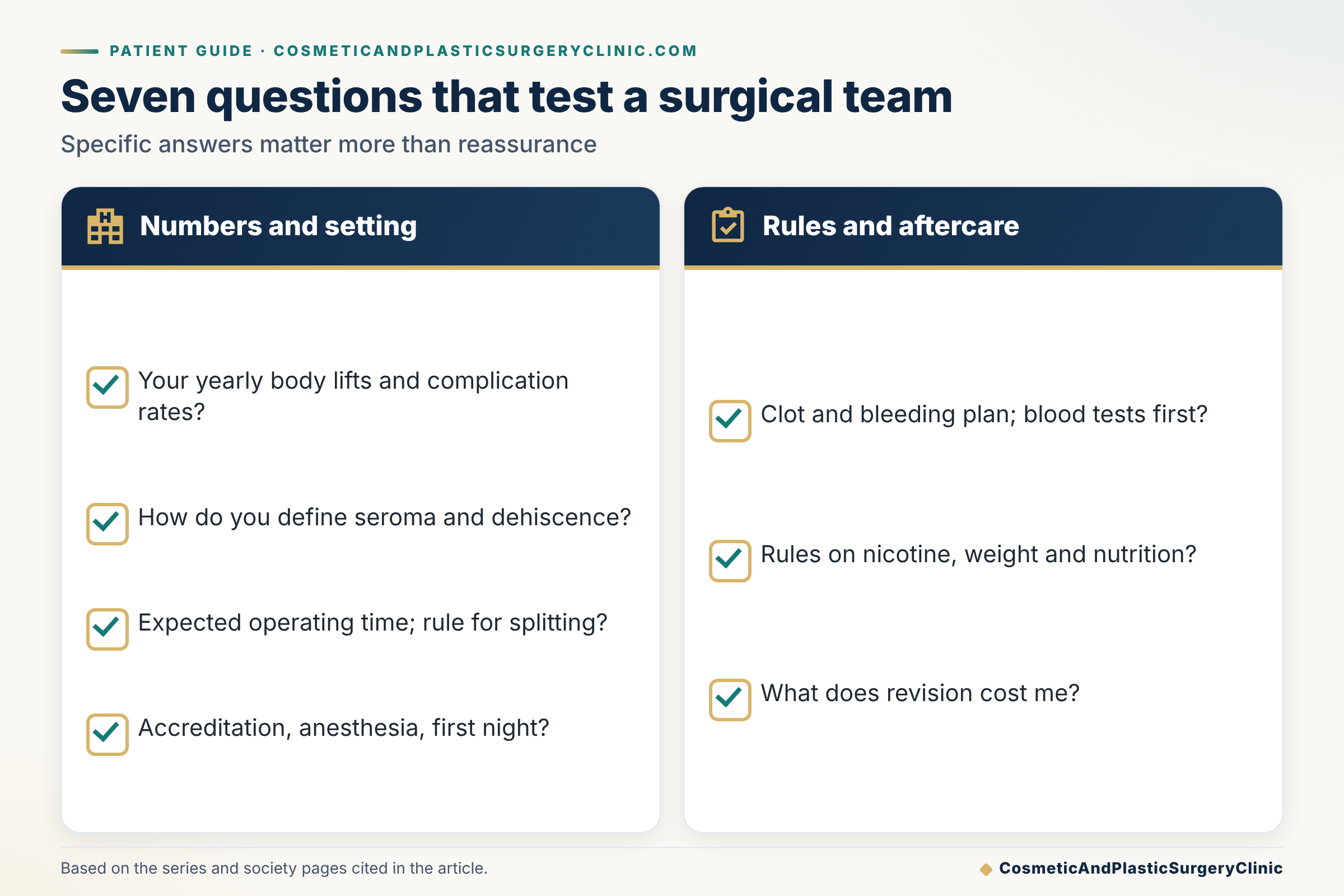
Seven questions that test a surgical team
The questions below turn the findings above into things a surgeon can answer specifically. A reply that cites the surgeon’s own numbers, period and definitions is more useful than an assurance that the operation is safe in good hands.
- How many circumferential body lifts do you and this facility do each year, and what were your complication numbers over what period?
- How do you define seroma, dehiscence and infection in your records?
- How long do you expect my operation to take, and what is your rule about splitting a case?
- Where will it be done, what accreditation does it hold, who gives the anesthesia and where do I spend the first night?
- What are your plans for clot prevention and bleeding, and which blood tests do you require first?
- What are your rules about nicotine, weight stability and nutrition before surgery?
- What does revision cost me, and what happens if a wound problem needs extra visits or procedures?
Credentials, accreditation and what to verify
The American Board of Plastic Surgery runs a public certification lookup, and the Aesthetic Society ties its statement about low serious-complication rates to a board-certified surgeon in an accredited facility. Verify both before booking. The steps are laid out in choosing a plastic surgeon, and body lifting for post-weight-loss patients is a niche where it is fair to ask how much of a surgeon’s practice it is.
Experience with post-weight-loss patients, and with the nutrition and wound-healing issues that come with them, is a legitimate selection criterion. Tummy tuck experience alone is not the same thing; see tummy tuck risks for that operation’s profile.
Surgery far from home and fat transfer add-ons
The CDC’s medical tourism guidance says flying after surgery can raise the risk of blood clots and advises waiting 10 to 14 days after major surgery. It adds that complications abroad can include wound and bloodstream infections, and that follow-up care after you return home can be expensive and may not be covered. For a long operation with a high wound rate, that is a serious cost; medical tourism for surgery covers what to weigh.
Fat transfer to the buttocks is a common add-on to a lower body lift, and it brings distinct risks, including fat embolism, covered in BBL risks. If your plan includes it, the operating-time question above applies.
Waiting, staging, or a smaller operation
Options that lower the wound burden
Depending on anatomy, a surgeon may discuss a panniculectomy that removes a hanging apron of skin without circumferential work, a tummy tuck, or staging the body lift with other procedures. The panniculectomy vs body lift article compares those options. None of them removes risk, but they change which body lift risks apply and how large the wound is.
Waiting is an option too. Weight that is still changing, nicotine use, low protein or iron, and thin support at home are all reasons surgeons postpone, and postponing costs only time. A second opinion costs a consultation fee and can reveal a different plan.
Using the consultation and consent form well
Read the consent document at home, not at the front desk on the morning of surgery. It should name the specific body lift risks discussed here: wound separation, fluid, bleeding, infection, clots, skin loss, numbness, asymmetry and revision. If an item is missing, ask why. If a deposit window or discount expires before you can think, that pressure is information too.
Frequently asked questions
Are body lift risks higher than tummy tuck risks?
None of the sources read for this page compared the two head to head in randomized fashion. A 2021 Aesthetic Surgery Journal analysis (Vasilakis and colleagues) grouped abdominoplasty, circumferential lower body lift and fleur-de-lis variants and reported that longer procedure time tracked with infection, seroma and reoperation. A body lift involves a longer incision and usually a longer operation, so it is reasonable to expect more wound burden, but the size of the difference is not established. Patients also differ, because body lifts are done mostly after massive weight loss.
How long do body lift risks last after the operation?
Each of the body lift risks runs on its own clock, so there is no single end date. Cleveland Clinic says a seroma usually appears 7 to 10 days after surgery and may take up to six weeks to resolve. In a London review, one patient developed a leg clot on day 14 and a lung clot two days later. Scars and contour keep changing for months, and looseness can return if weight changes. Your surgeon’s follow-up schedule sets when each risk is checked; keep every visit, even if you feel well.
Does a body lift cause lasting numbness?
The ASPS lists numbness or other changes in skin sensation among body lift risks, but the sources read here give no published rate for how many patients keep reduced sensation or for how long, so any figure from a clinic should come with its source. Ask your surgeon what they tell patients to expect, report new weakness or numbness in a leg promptly, and treat sensation changes as something to discuss at follow-up.
Can staging reduce body lift risks?
Some surgeons say staging lowers body lift risks. Bota and colleagues (2018) wrote that their group avoids treating more than one body region per procedure and that multi-stage plans reduce complications compared with long single-stage operations. That is a review’s statement of practice, not a trial result, and staging adds more recoveries, more anesthesia exposures and usually more facility fees. Sequencing plans are a separate decision.
Is a drainless body lift lower in risk?
One surgeon’s 2025 series of 137 drainless lower body lifts (Cabbabe) reported a 6.6% complication rate and no seromas, with progressive tension sutures and limited undermining. It had no comparison group, a mean BMI of 26.8 and about six months of follow-up, so it cannot show that drainless technique caused the result. Other series, in different patients, reported seroma in 16.5% to 35%. Ask a surgeon why they use or avoid drains and what their own seroma rate has been.
What do consent forms usually list for body lift risks?
The ASPS body lift safety page names 17 body lift risks, including anesthesia risks, asymmetries, bleeding, deep vein thrombosis with cardiac and pulmonary complications, fat necrosis, fluid accumulation, infection, numbness, persistent pain, persistent leg swelling, poor wound healing, skin discoloration, possible revision, recurrent looseness of skin, skin loss, surfacing sutures and unfavorable scarring. Your form should cover the same ground, with space to write questions. Ask the surgeon which two or three on the list they see most often in their own patients.
How soon can someone fly home after a body lift abroad?
The CDC’s medical tourism page says flying after surgery can raise clot risk and advises waiting 10 to 14 days after major surgery. That is a general travel statement, and your surgeon may set a longer wait for a long operation. Mayo Clinic advises moving about every hour on long trips and flexing the ankles. Ask for written clearance, the surgeon’s after-hours number, and the name of a local clinician who will treat a wound or fluid problem if one develops at home.
Sources and further reading
- ASPS — Body lift risks and safety (page copyright 2026; accessed 2026-11-13) — the 17 listed risks
- ASPS — Body lift candidates (accessed 2026-11-13) — healthy nonsmokers; no BMI range given
- ASPS — Body lift recovery (accessed 2026-11-13) — drains; shortness of breath, chest pain and unusual heartbeat warning
- ASPS — Body lift overview (accessed 2026-11-13) — treatment areas; not intended strictly for fat removal
- ASPS — Plastic Surgery Statistics Report 2025 (accessed 2026-11-13) — 10,868 lower body lifts in 2025; 10,495 for 2024
- ASPS — Plastic Surgery Statistics Report 2024 (accessed 2026-11-13) — 10,957 for 2024 as first reported
- The Aesthetic Society — Lower body lift safety considerations (accessed 2026-11-13) — clots, accredited facility, goal weight
- Carloni et al., Aesthetic Plastic Surgery — Circumferential Contouring of the Lower Trunk: A Systematic Review (2016; abstract read via Europe PMC; accessed 2026-11-13) — 42 articles, 1,748 patients, dehiscence most reported
- Nemerofsky, Oliak and Capella, Plastic and Reconstructive Surgery — Body lift: an account of 200 consecutive cases (2006; abstract; accessed 2026-11-13) — 50.0% complications, dehiscence 32.5%, seroma 16.5%
- Kitzinger et al., Journal of Plastic, Reconstructive and Aesthetic Surgery — Prospective study on complications following a lower body lift (2013; abstract via library catalog; accessed 2026-11-13) — 50 patients, 70% complications
- Poodt et al., Plastic and Reconstructive Surgery Global Open — Complications of Lower Body Lift Surgery in Postbariatric Patients (2016; accessed 2026-11-13) — 100 patients, 78% complications, risk factors
- Losco et al., Aesthetic Plastic Surgery — Lower Body Lift After Bariatric Surgery: 323 Consecutive Cases (2020; abstract; accessed 2026-11-13) — 42% complications, seroma 35%, age and tobacco
- Vasilakis and Hunstad, Aesthetic Plastic Surgery — Invited discussion on the 323-case lower body lift series (2020; accessed 2026-11-13) — BMI, operating time and combined procedures not associated
- Constantine, Davis and Kenkel, Aesthetic Surgery Journal — Effect of Massive Weight Loss Status, Amount and Method of Weight Loss on Body Contouring Outcomes (2014; abstract; accessed 2026-11-13) — odds ratios by amount and method
- Vasilakis et al., Aesthetic Surgery Journal — The Effect of Obesity, Bariatric Surgery, and Operative Time on Abdominal Body Contouring Outcomes (2021; abstract via library catalog; accessed 2026-11-13) — 632 patients, operating time over 6 hours
- Badran et al., Plastic and Reconstructive Surgery Global Open — Impact of Prior Obesity Surgery on Bleeding after Abdominal Body Contouring (2024; accessed 2026-11-13) — 472 patients, hematoma 4.7% versus 1.7%
- Cabbabe, Aesthetic Surgery Journal Open Forum — Drainless Lower Body Lift With Large-Volume Liposuction: 137 Consecutive Patients (2025; accessed 2026-11-13) — 6.6% complications, blood loss, hemoglobin change
- Bota et al., Plastic and Aesthetic Research — Wound healing in postbariatric body contouring surgery (2018; accessed 2026-11-13) — 45% to 70% range, nutrition, staging
- Griffin et al., ePlasty — Risk of Thromboembolism Following Body-Contouring Surgery After Massive Weight Loss (2015; accessed 2026-11-13) — 135 operations, one clot, heparin timing and hematoma
- Plastic and Reconstructive Surgery — Complications in body contouring: 1,797 patients from the ACS NSQIP databases 2005 to 2010 (2013; abstract; accessed 2026-11-13) — albumin, bleeding disorders
- American Society of Anesthesiologists — Stop Smoking for Surgery (2015; accessed 2026-11-13) — blood flow, healing, infection
- MedlinePlus — Pulmonary embolus (reviewed October 21, 2025; accessed 2026-11-13) — symptoms, emergency guidance, risk factors
- Mayo Clinic — Pulmonary embolism: symptoms and causes (accessed 2026-11-13) — leg clot signs, walking, compression
- Cleveland Clinic — Seroma (updated February 11, 2026; accessed 2026-11-13) — timing, treatment, when to call
- UMass Memorial Health — Understanding wound separation after surgery (accessed 2026-11-13) — warning signs and emergency
- CDC Travelers’ Health — Medical tourism (accessed 2026-11-13) — flying after surgery, infections, follow-up costs
- American Board of Plastic Surgery — Verify certification (accessed 2026-11-13) — where to confirm board certification