Body lift recovery is long for a reason that is easy to overlook: the incision does not sit in one place. A body lift (circumferential lower body lift, also called belt lipectomy) removes loose skin and fat in a band around the lower trunk and lifts the tissue of the buttocks, hips and outer thighs, so the wound runs around the body like a belt. Every movement that stretches that line, whether bending, sitting up quickly or climbing out of a car, becomes part of the plan.
This page covers body lift recovery from the hospital bed to the second year: walking, drains, garments, work, driving, exercise, travel, scars and the signs that a problem is not routine. It does not re-explain the operation; the overview of body lifting after weight loss and the lower body lift page do that. The ranges below come from society and hospital pages and are not instructions. Your surgeon’s written plan outranks every number here.
What body lift recovery is healing: a belt-shaped wound on a torso that never stops moving
Most operations leave one wound to look after. A body lift leaves a closed loop of stitches around the waist and buttocks, plus the tissue that was lifted and repositioned behind it. The American Society of Plastic Surgeons (ASPS) counted 10,957 lower body lifts in its 2024 statistics report (10,947 in 2023), a much smaller figure than the 171,064 tummy tucks it counted in 2024.
Why the incision line shapes the whole of body lift recovery
Bending, sitting and standing are the movements that load the scar
The posterior part of the scar sits above the buttocks, where sitting and bending pull on it. The International Society of Aesthetic Plastic Surgery (ISAPS) says patients should avoid bending at the waist for a month and that bending can strain and separate the suture line above the buttocks, which usually leads to a wider scar there. An ASPS article from March 2025, an interview with a surgeon, recommends sitting at an obtuse angle for the first 10 to 14 days to reduce stress on the back scar.
The sources do not agree on one posture. Cleveland Clinic describes spending much of early body lift recovery in a comfortable chair rather than lying in bed, and a second Cleveland Clinic page on skin removal mentions not standing fully upright for a few days after an abdominal procedure and sleeping with pillows under the knees after lower body procedures. The useful question for your surgeon is which positions protect your particular closure, and for how many days.
Why the torso is a demanding place to heal
Cleveland Clinic says complications are more common after a lower body lift than after many other plastic surgery procedures because the torso is in motion all day, and it lists lymphedema, deep vein thrombosis, pulmonary embolism, bleeding, infection, numbness, wound separation, asymmetry, delayed healing and recurrent skin looseness. The ASPS belt lipectomy article calls body lift recovery more physically demanding than recovery from a tummy tuck or panniculectomy.
Numbers back up that contrast only loosely. The Aesthetic Society’s tummy tuck page gives about two weeks off work and four to six weeks without strenuous exercise, while its lower body lift page gives at least two to three weeks off and four to six weeks without heavy lifting, then exercise at about six to eight weeks. The difference lies less in the calendar than in how many movements load the wound. The tummy tuck recovery page shows the abdomen-only version for comparison.
Why healing after major weight loss has its own risk profile
Wound problems rise with the amount of weight lost
A 2014 Aesthetic Surgery Journal chart review by Constantine and colleagues looked at 450 patients who had body contouring procedures, 124 of them after massive weight loss. Massive weight loss status was linked with wound problems (odds ratio 2.69), and losing more than 100 pounds carried a higher association (odds ratio 3.98) than losing 50 to 100 pounds, which was not statistically significant. Gastric bypass patients had the highest association among weight-loss methods.
Read this as a pattern across a retrospective group of mixed procedures, not as a forecast for one person. A 2026 ASPS news release on a Plastic and Reconstructive Surgery review states that complication rates after body contouring in people with major weight loss run from 20 to 70 percent, a wide band that reflects different procedures and definitions. The body lift risks page sorts those figures by complication.
Nutrition belongs in the body lift recovery plan, not only the pre-operative checklist
The same ASPS release describes a review led by J. Peter Rubin of the University of Pittsburgh. It recommends laboratory screening before surgery, attention to protein, B vitamins and vitamin D, supplements that start at least several weeks beforehand, and continued nutrition afterward, with a dietitian where possible. It gives no gram targets, and neither do the other sources opened for this article.
Evidence for protein specifically is small. A 2016 Aesthetic Surgery Journal study compared 23 post-bariatric abdominoplasty patients who received protein supplements before surgery with 23 earlier patients who did not: wound-healing complications were 0.0 percent versus 21.8 percent, though total complications did not differ and the design (historical controls, Level 4 evidence) limits what it proves.
The Aesthetic Society notes that protein deficiency can interfere with healing. Appetite is often low in the first week, so how you will get enough protein is a planning question for the surgical team or a dietitian. Lab thresholds and candidacy sit with the body lift candidate page.
Setting up body lift recovery before the surgery date
Planning for body lift recovery is mostly logistics, and the logistics are heavier than for a face or breast operation because walking, sitting, sleeping and toileting all involve the wound. General recovery planning for any procedure is on the plastic surgery recovery planning page; the points below are specific to a circumferential lift.
The first days: where you wake up and who is with you
Overnight stay, skilled nursing or same-day discharge: what sources describe
Sources describe different settings. The Aesthetic Society says to expect a day or two in a hospital or skilled nursing setting, where drain care and walking are taught, and its procedure page gives one to three days of hospitalization or nursing care at home. ISAPS says an overnight stay is usually required. The 2025 ASPS article recommends going to a credentialed recovery facility for one to two days. Cleveland Clinic notes that surgery may be done at a hospital with an overnight stay or at a surgical facility with same-day discharge.
A small 2022 Aesthetic Plastic Surgery series of 64 post-weight-loss patients (82 procedures, mechanical clot prevention only) reported a mean hospital stay of about 26 hours. These are not rival claims; they describe different centers and protocols. What matters is the plan for your own night one: who monitors you, how pain is controlled, who teaches drain care, and who answers a phone at 2 a.m.
Helper, driver and house set-up
Cleveland Clinic’s skin removal page suggests that someone drive you for at least the first week. The Aesthetic Society says you may not feel like yourself for at least two weeks and advises that anyone with small children arrange for another adult to be fully in charge of them for at least that long. It also suggests asking about pillow positioning to reduce tension on the incisions, and Cleveland Clinic advises against soaking wounds in tubs, pools or the ocean.
A lift that wraps around the body makes everyday tasks awkward: reaching the floor, rising from low seats, dressing around drains. Keep items between waist and shoulder height, and plan for stairs if the bedroom or bathroom is on another floor.
| Situation | Planning issue | Question for the surgical team |
|---|---|---|
| Lives alone | Drain emptying, meals, bathing and getting in and out of bed without bending at the waist | Can a helper stay the first days, or is a recovery facility an option? |
| Small children at home | Lifting and floor play are limited; the Aesthetic Society suggests two weeks of full help | What weight limit applies, and for how many weeks? |
| Desk job | Sitting upright for hours may work against posture advice | Which chair set-up, break interval and return date do you accept? |
| Physical or driving job | Lifting, bending and long drives compete with a healing back scar | Is a modified or staged return acceptable, and with what note? |
| Bedroom upstairs | Stairs several times a day in the first week with drains and a garment | Is a ground-floor bed practical, and how many trips are reasonable? |
| Surgery far from home | Flights, hotel recovery and local follow-up if something changes | Who treats complications at home, and will they speak to you before you travel? |
What the written plan should say
Posture, drains, garment and wound-care rules in one document
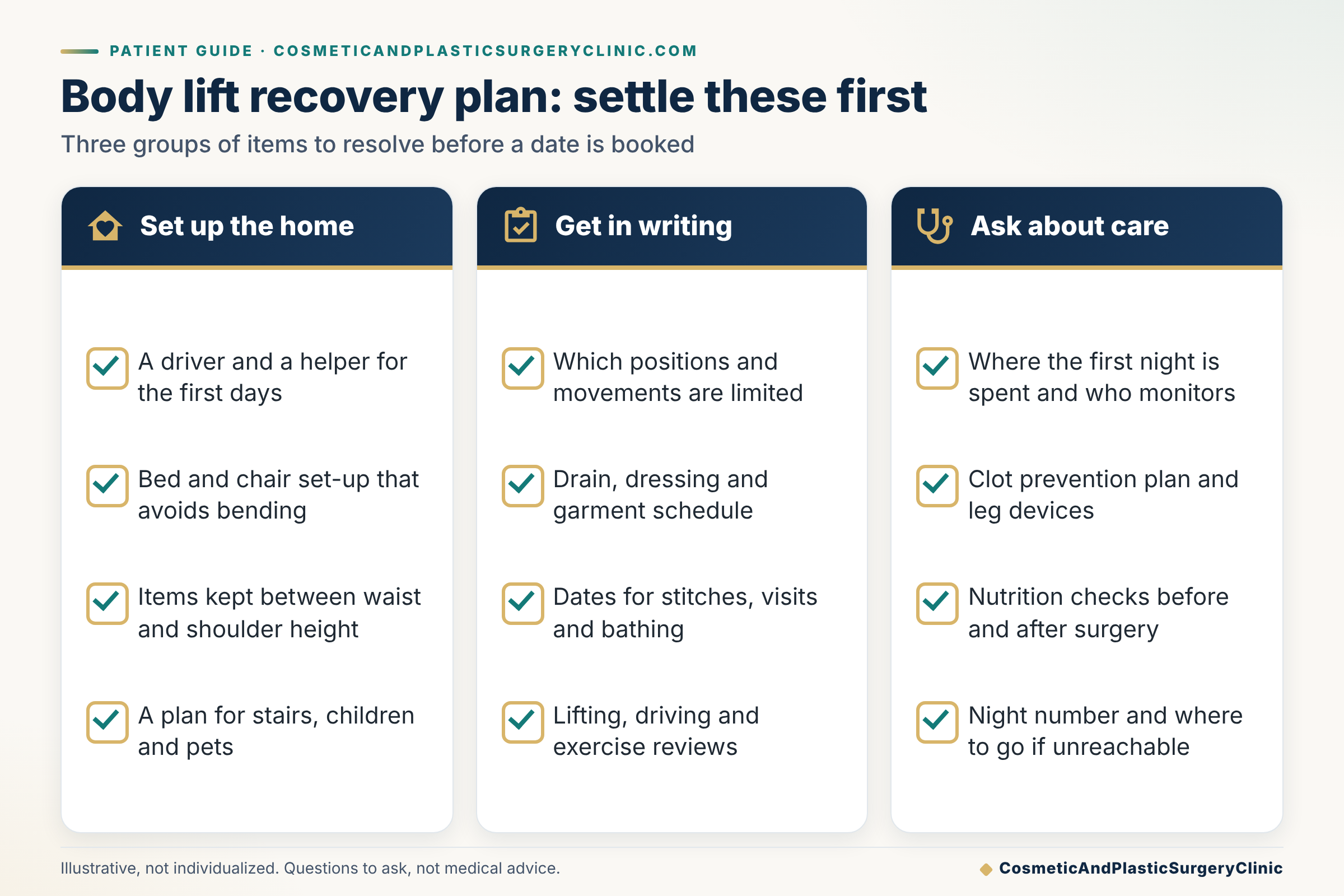
Instructions given while tired or sedated do not survive the car ride home. The ASPS recovery page lists what to ask: where you go after surgery, when dressings come off and when you can bathe, when stitches and drains are removed, when normal activity, driving and exercise resume, and when to return for follow-up. A good body lift recovery plan puts each of these on paper with a date or a condition attached, such as drain output below a stated amount.
It should also name the garment schedule and who checks the fit, the positions to avoid and for how long, the activities that are off limits and when each is reviewed, and the phone number to use at night. If any of these answers is “we will see,” that is information about the practice before the date is booked.
Questions to settle with the surgical team before choosing a date
- Where will I spend the first night, and who monitors me there?
- How will clot prevention work for me, including walking, leg devices and any medicine?
- Which drains, dressings and garments will I go home with, and who removes them?
- Which positions and movements are restricted for the back scar, and until when?
- What nutrition plan and laboratory checks do you want before and after?
- Who do I call at night, and where do I go if I cannot reach anyone?
Body lift recovery week by week: what sources describe and where they disagree
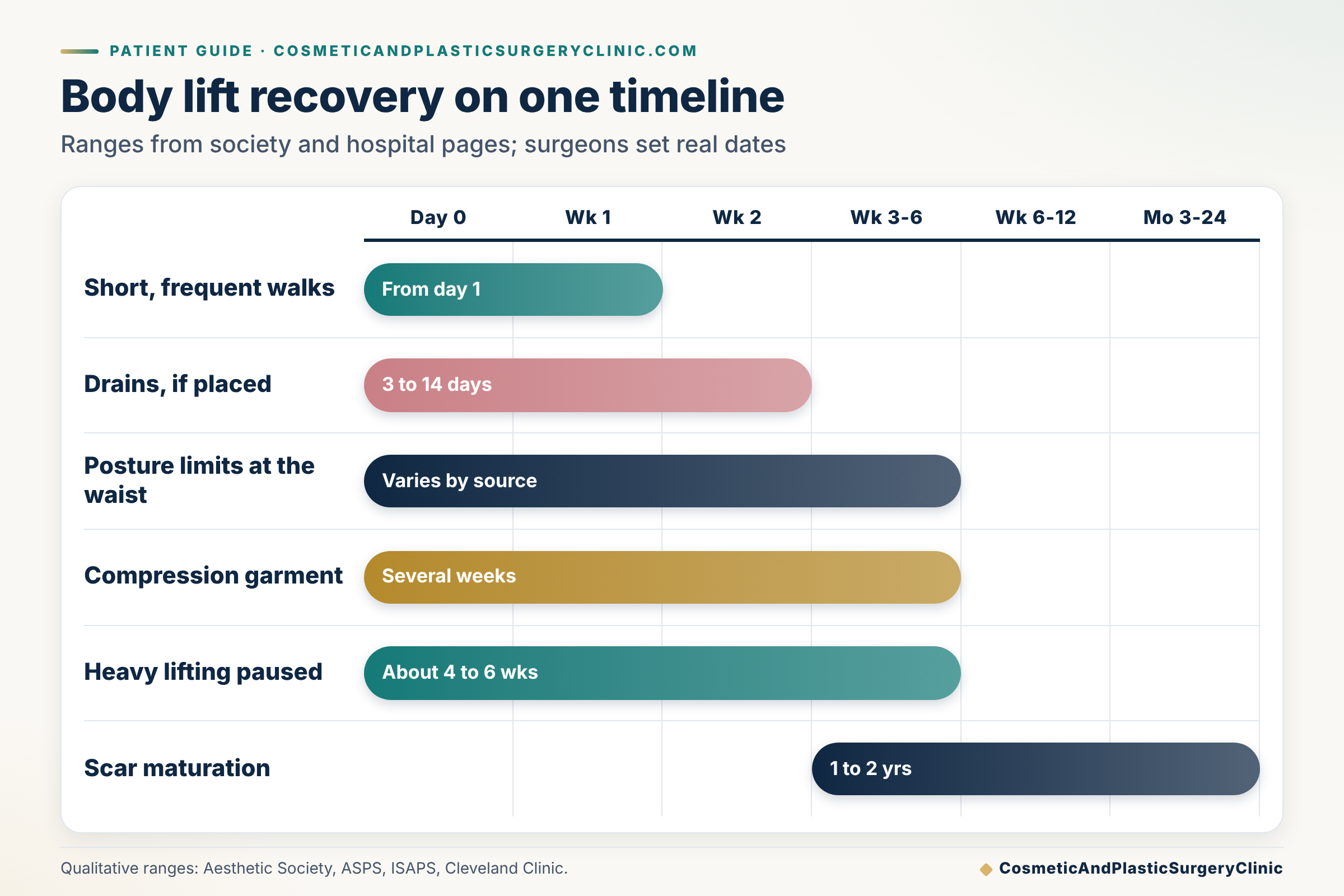
Published timelines for body lift recovery are ranges from society pages and hospital patient guides, not results of controlled comparisons, so they overlap without matching. The table lines them up by phase; the sections after it explain the parts that cause the most questions.
| Phase | Common changes | Limits sources describe | Report promptly |
|---|---|---|---|
| Day 0 to 2 | Tight, sore, swollen trunk; drains and dressings; walking begins the day after surgery | Posture limits; help with turning, toileting and drain care | Chest pain, breathing trouble, fainting, sudden leg swelling |
| Days 3 to 14 | Bruising and swelling peak then ease; drains come out when output falls; sutures out near two weeks | No bending at the waist; obtuse-angle sitting in one source; weekly visits | Fever, spreading redness, foul or heavy drainage, rising pain |
| Weeks 3 to 6 | Energy returns; swelling and redness subside (one to three weeks in one source); fluid pockets may appear | Garment for several weeks; no heavy lifting or strenuous exercise until about four to six weeks | A soft bulge that grows, an incision that opens, skin turning dusky |
| Weeks 6 to 12 | Incisions heal over; exercise resumes in stages if the surgeon agrees (about six to eight weeks in one source) | Gradual return to lifting and workouts; sun protection on scars | Pain that worsens after improving, new drainage, one swollen leg |
| Months 3 to 12 | Scars redden then fade; numbness and tightness change slowly; shape continues to settle | Few activity limits; weight kept stable | A scar that thickens or widens fast, persistent leg swelling |
| Months 12 to 24 | Scar maturation continues in sources that give 18 to 24 months; skin and tissue settle up to a year or more | Routine follow-up; discuss any revision after scars mature | Marked weight change, new pain at the scar line |
Weeks 0 to 2: walking, drains, stitches and sitting angles
Walking from the first day, and why every source mentions it
The Aesthetic Society says to walk the day after surgery, starting slowly, to discourage swelling and prevent blood clots in the legs. Cleveland Clinic’s excess skin page also pairs walking with fluids for the same reason. The Centers for Disease Control and Prevention (CDC) says about half of people with a deep vein thrombosis have no symptoms, which is why early movement is advised rather than waiting to see whether a problem appears.
Early walking in body lift recovery is short, slow and often supported by a helper. If walking feels impossible rather than merely sore, or one calf becomes swollen or painful, that is a call to the surgical team that day.
Drain timing: three days to two weeks, depending on output
Drains are thin tubes under the skin that collect fluid. ASPS says they may be placed temporarily, and sources give three different ranges: three to 14 days after surgery, depending on output (Aesthetic Society); about seven to 10 days (2025 ASPS article); and a week or two (Cleveland Clinic). They do not conflict, because removal follows how much fluid collects, not the date.
That makes drain care a body lift recovery task with a written rule: how often to empty, what to record, and what output or change in color means a call. Whether drains are used at all varies by surgeon and technique, and that choice, along with the thresholds, belongs to your surgeon.
Stitches, follow-up visits and the pain curve
The Aesthetic Society describes stitches removed at about two weeks, weekly follow-up visits, and pain that should ease one to two weeks after surgery. Cleveland Clinic’s excess skin page is less optimistic, describing pain for a few weeks that may worsen with movement, stairs or getting up from furniture. The two fit together if pain is sharpest around the movements that load the incision and fades more slowly than at rest.
Expected soreness does not escalate. The Aesthetic Society says to contact the surgeon for extreme or long-lasting pain; pain that is increasing instead of easing, or that is not relieved by the prescribed medicine, is worth a same-day call.
Weeks 3 to 12: garments, work, lifting and the return of exercise
Compression garments: what the evidence shows and what it does not
Both the Aesthetic Society and Cleveland Clinic say a wide, snug garment is worn to limit swelling and support the skin for several weeks, without a precise number. The evidence behind garments is thinner than their ubiquity suggests. A 2023 review in Plastic and Reconstructive Surgery Global Open by Ormseth and colleagues found evidence of varying quality: the best-supported uses were less swelling and bruising after rhinoplasty and less pain after breast and abdominal procedures, and compression did not lower seroma rates. The authors note costs and risks too, including discomfort, venous stasis and skin defects.
For body lift recovery that means a garment is a surgeon-directed comfort and support tool, not a proven way to prevent fluid collections. Garments that roll, dig in, or leave a groove or numbness need a fit check, and a garment that replaces the walking, positioning and follow-up described elsewhere on this page does not do the same job.
Work, driving and lifting ranges
The Aesthetic Society recommends at least two to three weeks off work, avoiding strenuous exercise and heavy lifting for four to six weeks, and resuming exercise after about six to eight weeks. Cleveland Clinic gives about six weeks without heavy lifting or exercise for a lower body lift, and one to three weeks off work for skin removal procedures in general. For a desk job, the question is less the date than the chair, the breaks and the posture.
No source opened for this article gives a driving rule. Cleveland Clinic’s skin removal page suggests a driver for at least the first week, and the ASPS recovery page lists driving among the questions to ask. Ask whether your surgeon’s criteria include pain-medicine use and being able to turn and brake without hesitation, and get the answer in writing.
When body lift recovery ends: scar maturation and the final shape
Scar timelines differ: one year, 18 to 24 months, or “never disappear”
The Aesthetic Society says scars from a lower body lift are permanent but fade over about 12 months and can usually be hidden by clothing. The 2025 ASPS article says scar maturation takes 18 to 24 months. UW Health’s patient page, written about surgical scars in general, describes remodeling that continues for one to two years. Cleveland Clinic says scars fade but never disappear entirely. All four describe the same slow process with different endpoints, which is why a red, raised scar at month four says little about month twenty.
Scar position matters for how visible they are. The 2025 ASPS article describes the main scar low on the abdomen, running up along the hip bone, with a lower incision meeting the top of the buttock crease, and the Aesthetic Society says it sits in the bikini line. The back portion is the one most affected by early bending and sitting; UW Health adds that a scar rising above the skin and spreading past its borders is a reason to contact the surgeon early.
Scar care the sources mention, and what to ask before starting
UW Health recommends shielding scars from sun, with zinc oxide or high-SPF sunscreen, for at least the first six months; it says silicone sheets and gel have some evidence for early excessive scarring, and describes gentle massage daily for at least four to eight weeks. The 2025 ASPS article calls sun protection vital throughout maturation. Massage and silicone should wait until incisions are fully closed and your surgeon agrees; around a belt-shaped incision with drains, dressings or small openings, the starting date is a surgical decision.
When the shape is judged, and why early photos mislead
Cleveland Clinic says the lower torso looks slimmer immediately after a lower body lift, yet skin and tissue may take up to a year or more to settle, and its excess skin page gives up to two years for final results. Swelling can hide fine contour and asymmetry for months, and a firm, tight waist at week three is typical. A judgment about the final shape, or about a touch-up, made in the first months rests on incomplete information; ask your surgeon when they assess it. Revision is a decision to make with the surgeon once the scars have matured.
Recognizing when body lift recovery stops being routine
A long body lift recovery produces many odd sensations, so the practical skill is sorting them. Three groups help: effects the sources call expected, things to report to the surgical team the same day, and symptoms that call for emergency services. The general framework is on the plastic surgery risks page; the points below are specific to a lift.
Expected effects and the fluid collection that surprises people
Swelling, bruising, tightness, numbness and fatigue
The Aesthetic Society says redness, bruising and swelling usually subside within one to three weeks, while Cleveland Clinic says swelling and bruising take a few weeks, and the tissue itself keeps changing for months. A feeling of tightness is swollen tissue under a garment. Numbness above and sometimes below the incisions is described by ISAPS and listed by ASPS among the risks, and fatigue is why the Aesthetic Society advises help at home for at least two weeks.
Expected effects of body lift recovery get better with time, even slowly. A swelling that is growing, becoming tense or one-sided, or a bruise that spreads after fading, belongs in the next group.
Seroma: why fluid can appear after the drains are out
Seroma is a pocket of clear fluid under the skin. Cleveland Clinic says symptoms usually begin seven to 10 days after surgery, small ones settle in about a week, and larger ones may take up to six weeks to resolve. Management ranges from watching a small seroma that causes no pain, through needle aspiration, a temporary drain if it keeps refilling, or occasionally surgery. Signs that a collection may be infected include warmth, skin discoloration, worsening pain, fever, and thick, milky or foul-smelling fluid.
ASPS lists fluid buildup among the risks of body lifting, so seroma is a recognized part of body lift recovery, not a sign of neglect. Reporting a soft, growing bulge early gives the team more options than waiting until it is tense.
Wound separation and infection
Why wound separation dominates the published numbers
In a prospective study of 50 consecutive lower body lift patients after massive weight loss (Kitzinger and colleagues, Journal of Plastic, Reconstructive and Aesthetic Surgery, 2013), 70 percent had at least one complication and 10 percent had a major one needing surgical revision; wound dehiscence occurred in 60 percent (30 patients) and seroma in 34 percent (17). Higher lifetime body mass index and older age were associated with complications. A 2016 systematic review by Carloni and colleagues of 42 articles and 1,748 patients likewise reported dehiscence as the most frequent complication, and rated most of the evidence as low level.
These are small, single-center and review-level data, and definitions of wound separation vary from a short gap in the stitched line to a larger opening. The Aesthetic Society says wound separations can delay healing but rarely require further surgery, and that full healing of circumferential incisions may take four weeks or longer. Ask a practice what it counts as dehiscence, how it treats small openings, and how often it sees them.
Infection signs and what to do about them
Cleveland Clinic lists fever, redness, and yellow discharge at the incisions among the reasons to call, and its seroma page adds warmth, skin discoloration and worsening pain. Infection after a procedure with drains and long incisions is a same-day call to the surgical team, not something to try to clean up at home or to wait out until the next scheduled visit.
Smoking and nicotine are the modifiable factor most often named. MedlinePlus says most providers advise stopping tobacco at least four weeks before surgery, that stopping at least 10 weeks earlier lowers the risk further, and that nicotine gum around surgery is not encouraged because nicotine still slows wound healing.
Clots, breathing and other emergencies
Why walking, leg devices and the blood-thinner question matter
Clot prevention after a lift is a balance with bleeding. A 2021 systematic review in Plastic and Reconstructive Surgery Global Open (Yin and colleagues, 31 publications on massive weight loss patients) found that venous thromboembolism was too uncommon in the pooled data to separate groups, and that no consensus exists on chemoprophylaxis in people at risk of bleeding after body contouring. A 2022 Aesthetic Plastic Surgery cohort of 64 patients who received only mechanical measures (stockings, compression boots and early walking) reported one deep vein thrombosis among 82 procedures and no pulmonary embolism.
Those small studies cannot say which approach is right for you; they show why the plan differs between surgeons and why it deserves a direct question before the date. MedlinePlus adds that smokers who have surgery are more likely to form leg clots.
Same-day call or emergency services: where the line sits
Tell emergency staff plainly that you had a body lift, give the date, and bring discharge papers, a medication list and the surgeon’s number, so clinicians who did not do the operation can recognize what they are seeing.

Returning to ordinary life after a body lift: travel, sleep, bathing and workouts
Later in body lift recovery, once drains and stitches are gone, the questions shift from wound care to daily life. The table gathers what the sources open for this article say about each area and what to confirm in writing; the sections below add the reasoning the table cannot hold.
| Area | What sources describe | Confirm with your surgeon |
|---|---|---|
| Work | At least two to three weeks off (Aesthetic Society); one to three weeks for skin removal procedures generally (Cleveland Clinic) | Modified duties, breaks, and a note for the employer |
| Driving | A driver for at least the first week (Cleveland Clinic); no source opened gives a driving rule | The written criteria for driving again |
| Lifting and workouts | No heavy lifting or strenuous exercise for about four to six weeks; exercise resumes near six to eight weeks (Aesthetic Society) | What counts as heavy, and which activities return first |
| Travel | The CDC advises delaying air travel 10 to 14 days after major surgeries because flying raises clot risk | Flights, long car rides and hotel stays, and who treats problems away from home |
| Sleep | Pillows under the knees after lower body procedures (Cleveland Clinic); ask about pillow positioning (Aesthetic Society) | Allowed sleep positions and for how long |
| Bathing and wounds | Avoid soaking in tubs, pools or the ocean (Cleveland Clinic); timing of bathing is a question for the surgeon (ASPS) | The date showering starts and when soaking is allowed |
| Garment and scars | Garment for several weeks; sun protection for at least six months; silicone has some evidence (UW Health) | Start dates for silicone or massage, and how the garment should fit |
Work, driving and daily tasks after the first fortnight
Desk work and physical work are different problems
For a desk job, the first obstacle is rarely the date; it is eight hours of upright sitting against a healing back scar when the early advice was an obtuse angle. For jobs that involve lifting, kneeling or long drives, the sources’ lifting limits apply directly, and a staged return with an employer note is a reasonable question to put to the team.
Household tasks, children and the invisible workload
The Aesthetic Society’s two weeks of full childcare help is a floor for body lift recovery, not a ceiling. Lifting a toddler, loading a dishwasher from low shelves or carrying laundry all count as the bending and lifting the other sources restrict. List the tasks that involve bending below the waist or carrying more than the surgeon’s limit, and decide before surgery who does each one.
Travel, sleep and getting back to exercise
Flights, long drives and surgery far from home
The CDC’s medical tourism guidance advises delaying air travel for 10 to 14 days after major surgeries because flying raises clot risk, and warns that complications that appear after return may need care at home that can be costly and may not be covered by insurance. A body lift is a major operation, so the timing of the flight home matters. Anyone planning surgery away from where they live should read the medical tourism page before choosing a date.
Long car rides raise the same clot concern and the seat-angle problem; whether stops or a reclined seat are appropriate is a surgeon’s call, so raise the trip at the consultation.
Sleeping position and the order in which exercise returns
Cleveland Clinic recommends pillows elevating the knees after lower body procedures, and the Aesthetic Society suggests asking about pillow positioning to ease tension on the incisions. Sleep is often interrupted early on because of drains, tight garments and position limits, so a plan for rest, such as a recliner or a wedge, is part of body lift recovery, not a luxury.
The sources describe walking first and formal exercise at about six to eight weeks. They do not give a progression, and none of the pages opened give a program; the order of return (walking, light lower body work, core, running, heavy lifting) is a surgeon-directed sequence, so ask for it in writing and for the signs that mean to pause.
Long-term follow-up after body lift recovery: sensation, weight, revision and who is on call
Body lift recovery ends before the effects of the operation do. Sensation, scars and contour keep changing for a year or more, and a few topics deserve a plan before the first stitches are placed.
What can still be changing after the early months
Numbness, tightness and leg swelling
ISAPS describes numbness above and sometimes below the incisions, and ASPS lists numbness or other changes in skin sensation, ongoing leg swelling, pain that may last, and slow or poor wound healing among the risks of body lifting. Cleveland Clinic names lymphedema. Tightness and patchy numbness that slowly shrink are common topics at follow-up; persistent or new leg swelling that is one-sided or sudden belongs with the clot symptoms above.
Weight change after body lift recovery
Cleveland Clinic says results depend on keeping weight off: regaining a substantial amount stretches the skin, and skin can sag again if more weight is lost. The Aesthetic Society says weight gain afterward may negatively affect results. Weight kept stable before surgery is part of the same logic; the 2025 ASPS article gives 6 to 12 months and the Aesthetic Society at least a year. Any medication, diet or weight-loss change should stay in conversation with the clinician who manages it, and the umbrella article covers what a lift can and cannot do for weight changes.
Revision, staging and who looks after you if something goes wrong
When another operation enters the conversation
ASPS lists the possible need for another surgery, skin that becomes loose again over time, and unfavorable scarring among the risks. Because scars and swelling are still changing for a year or more, a decision about revision made in the first months rests on a result that has not finished forming. A wound that has opened or a collection that keeps refilling is a different matter and needs prompt attention, not a wait for scars to mature.
The 2025 ASPS article notes that staging is common for patients who cannot undergo the full procedure at once, typically starting with an abdominoplasty, which the tummy tuck after weight loss page covers. Each stage brings its own body lift recovery with its own rules, and the staged body contouring page covers how surgeons sequence them.
Verify the team before the date: certification, facility and aftercare access
Body lift recovery depends partly on who is available afterward. The American Board of Plastic Surgery lets you check a surgeon’s certification by name or location, and says an active, unrestricted medical license is required for certification; licensure and complaints are checked separately through the Federation of State Medical Boards directory. The page on choosing a plastic surgeon walks through the full verification workflow, including facility accreditation and anesthesia provider.
Ask how many body lifts the surgeon performs, how complications are handled outside office hours during body lift recovery, and whether the surgeon or practice follows up if the care is delivered at a facility away from home. A consultation is the place to ask, and a second opinion is a reasonable step before committing.
Frequently asked questions
How long does swelling last during body lift recovery?
Sources split the answer into stages. The Aesthetic Society says redness, bruising and swelling usually subside within one to three weeks, Cleveland Clinic says a few weeks, and the same hospital says skin and tissue can take up to a year or more to settle. Its tummy tuck page says swelling should ease within about five weeks. Mild swelling that fades and returns with activity is a conversation for follow-up; swelling that grows, tightens or affects one leg needs a call.
Is body lift recovery harder than tummy tuck recovery?
The ASPS belt lipectomy article describes the lift as more physically demanding afterward than an abdominoplasty or panniculectomy. Numbers overlap: the Aesthetic Society gives about two weeks off for a tummy tuck and at least two to three weeks for a lower body lift, with strenuous activity paused four to six weeks for both. The lift adds a back and buttock scar line and a larger area of healing. The Aesthetic Society’s tummy tuck page sets out the abdomen-only arc.
When can I shower or soak during body lift recovery?
No source opened gives a date for showering. The ASPS recovery page lists “when dressings are removed and when you can bathe” among questions to ask, and Cleveland Clinic advises against soaking wounds in tubs, pools or the ocean. Timing depends on dressings, drains and whether any part of the incision has opened, so get a written date for showering and a separate date for soaking.
Do I need a caregiver for all of body lift recovery?
Sources focus on the early weeks: a driver for at least the first week and, according to the Aesthetic Society, another adult fully in charge of small children for at least two weeks. Many people also need help with drains, bathing and getting up from low seats early in body lift recovery. Ask what help is essential and what can be handled alone.
What if a drain keeps producing fluid during body lift recovery?
In body lift recovery, drain removal follows output, not the date, so a drain may stay longer than the usual ranges: three to 14 days in one source and a week or two in another. Cleveland Clinic says a seroma that keeps refilling may be treated with a temporary drain. Record the output as instructed and report any sudden increase, a change in color or odor, or fever. Do not remove or adjust a drain on your own.
Does each stage restart body lift recovery if my plan is staged?
Yes, each stage is its own body lift recovery, with its own wound and healing period, and sources note that staging is common after major weight loss, often beginning with an abdominoplasty. The interval between stages is a surgeon’s decision based on healing, nutrition, weight stability and how you feel. Ask for a calendar covering time off, driving and workouts for each stage, and ask how the intervals are decided.
Is it normal to feel low or exhausted during body lift recovery?
The Aesthetic Society says you may not feel like yourself for at least two weeks, and fatigue is common after a long operation. If low mood, anxiety or hopelessness lasts or interferes with eating, sleeping or caring for yourself, tell the surgeon or primary care clinician, and seek urgent help if you have thoughts of self-harm. Emotional ups and downs are a normal topic to raise with the team.
What should I tell an emergency department during body lift recovery?
Say plainly that you had a body lift, give the date, and mention drains, any other procedures done at the same time, and when the symptoms began. Bring your discharge papers, medication list and the surgeon’s phone number, and ask staff to contact the surgeon. Clear information helps clinicians who did not do the operation recognize wound, fluid or clot problems, particularly if surgery was done in another city or country.
Sources and further reading
- The Aesthetic Society — Lower body lift aftercare and recovery (accessed 2026-11-13) — hospital stay, drains, garment, walking, work, exercise, swelling, sutures, scars, wound separation
- The Aesthetic Society — Lower body lift (belt lipectomy) (accessed 2026-11-13) — weight stability, nutrition, smoking, bikini-line scar, hospitalization or nursing care
- The Aesthetic Society — Tummy tuck aftercare and recovery (accessed 2026-11-13) — comparison ranges for drains, work, exercise, swelling and scars
- ASPS — Body lift (accessed 2026-11-13) — what a body lift treats and what it is not
- ASPS — Body lift recovery (accessed 2026-11-13) — dressings, drains, instructions, questions to ask, warning signs
- ASPS — Body lift safety (accessed 2026-11-13) — list of 17 risks and consent guidance
- ASPS — The basics of the belt lipectomy (Frankeny, March 2025; accessed 2026-11-13) — sitting angle, drain range, recovery facility, scar maturation, staging
- ASPS — Plastic surgery statistics report 2024 (accessed 2026-11-13) — lower body lift and tummy tuck procedure counts for 2023 and 2024
- ASPS — Nutrition recommendations support healing after body contouring (press release, August 2026; accessed 2026-11-13) — Rubin review in Plastic and Reconstructive Surgery, 20 to 70 percent complication band, laboratory screening
- ASPS — New nutrition recommendations after major weight loss (August 2026; accessed 2026-11-13) — protein, B vitamins, vitamin D, timing, dietitian
- ISAPS — Body lift (accessed 2026-11-13) — overnight stay, avoiding bending, wider posterior scar, numbness
- Cleveland Clinic — Lower body lift (accessed 2026-11-13) — drains, garment, sitting, six-week limits, complications, results timing, warning signs
- Cleveland Clinic — Excess skin removal surgery (accessed 2026-11-13) — setting, driver, work, pillows, results timeline, weight stability, warning signs
- Cleveland Clinic — Seroma (accessed 2026-11-13) — timing, duration, infection signs, treatment options
- UW Health — Better scar care (accessed 2026-11-13) — scar remodeling time, sun protection, silicone, massage
- MedlinePlus — Smoking and surgery (accessed 2026-11-13) — stopping tobacco before surgery, wound healing, leg clots, nicotine gum
- CDC — About blood clots (accessed 2026-11-13) — deep vein thrombosis and pulmonary embolism symptoms
- CDC Travelers’ Health — Medical tourism (accessed 2026-11-13) — delaying air travel after major surgery, care after returning home
- American Board of Plastic Surgery — Verify certification (accessed 2026-11-13) — certification lookup, license requirement, state board resources
- Constantine, Davis, Kenkel — Massive weight loss status, amount and method of weight loss and body contouring outcomes (Aesthetic Surgery Journal, 2014; abstract, accessed 2026-11-13) — wound-problem odds ratios in 450 patients
- Kitzinger et al. — Prospective study on complications following a lower body lift after massive weight loss (Journal of Plastic, Reconstructive and Aesthetic Surgery, 2013; catalog abstract, accessed 2026-11-13) — 50 patients, 70 percent complications, dehiscence and seroma
- Carloni et al. — Circumferential contouring of the lower trunk: a systematic review (Aesthetic Plastic Surgery, 2016; abstract, accessed 2026-11-13) — 42 articles, 1,748 patients, dehiscence most frequent
- Yin et al. — Body contouring in massive weight loss patients receiving venous thromboembolism chemoprophylaxis (Plastic and Reconstructive Surgery Global Open, 2021; accessed 2026-11-13) — systematic review of 31 publications, no consensus on chemoprophylaxis
- Petersen, Vázquez, Mayer — Mechanical thromboprophylaxis alone in body contouring surgery after massive weight loss (Aesthetic Plastic Surgery, 2022; abstract, accessed 2026-11-13) — 64 patients, 82 procedures, mean stay 26.3 hours
- Nuveen et al. — An enhanced recovery after surgery protocol for outpatient bodylift surgery (The American Journal of Cosmetic Surgery, 2020; catalog abstract, accessed 2026-11-13) — 136 outpatient cases over seven years
- Ormseth et al. — The use of postoperative compression garments in plastic surgery: necessary or not? (Plastic and Reconstructive Surgery Global Open, 2023; abstract record, accessed 2026-11-13) — garment evidence, seroma, costs and risks
- Impact of protein nutritional supplementation for massive weight loss patients undergoing abdominoplasty (Aesthetic Surgery Journal, 2016; catalog abstract, accessed 2026-11-13) — 23 versus 23 patients, wound-healing complications