Liposuction is the most commonly performed cosmetic operation in the United States, and one of the most misread. The American Society of Plastic Surgeons (ASPS) estimated 317,196 liposuction procedures in 2025, roughly one in five of the 1.52 million cosmetic surgical procedures in its report and about 1% fewer than in 2024. Popularity tells you little about fit. Liposuction thins the fat beneath the skin in chosen areas. It does not shrink the whole body, smooth cellulite or tighten loose skin.
This page explains what the operation changes, what sits outside its reach and how a surgeon turns “less around my waist” into a plan with markings, tissue layers, volume limits and a safe setting. Separate pages on this site cover cost, recovery, techniques, risks, candidacy, photos, revision and two head-to-head comparisons; this one gives you the frame for using them. Nothing here can say whether liposuction suits you. That takes an in-person examination, and leaving a consultation without booking is a reasonable result.
What liposuction actually does to the body
Before anatomy or technique, it helps to pin down the claim itself. The operation removes fat from selected places. Everything else people hope for, such as a lower scale number, tighter skin or healthier blood tests, is a separate question with a separate answer.
A contouring operation, not a weight-loss method
What the cannula removes, in plain terms
ASPS describes it as a surgical procedure that removes excess fat from specific areas, typically where diet and exercise have not changed a stubborn deposit. The tool is a thin hollow tube called a cannula. It passes through small incisions, loosens fat with a controlled back-and-forth motion, and the fat is drawn out by a vacuum or a syringe.
The target is subcutaneous fat, the layer between skin and muscle. ASPS lists the abdomen and waist, back, chest, hips and buttocks, thighs, upper arms, inner knees, calves and ankles, and the face, chin and neck as treatable areas. Because the fat cells themselves are removed, Mayo Clinic notes that the new shape usually holds for as long as your weight stays the same.
What the metabolic-health trials found
A natural assumption is that removing fat must also improve health numbers. The best-known test says otherwise. In a 2004 New England Journal of Medicine study from Washington University, 15 women with excess abdominal fat, eight with normal glucose tolerance and seven with type 2 diabetes, had about 20% of their body fat removed by liposuction. Ten to twelve weeks later, insulin sensitivity, blood lipids, blood pressure and inflammatory markers had not changed.
The sample was small and the follow-up short, so read it as a caution, not a verdict. A 2020 review in the Cleveland Clinic Journal of Medicine notes that some studies suggest metabolic benefits and that more research is needed. What is not disputed: ASPS says liposuction is not a treatment for obesity or a substitute for diet and exercise, and Mayo Clinic says it is not an overall weight-loss method.
Treatment areas and the extra consideration each one carries
ASPS names the abdomen and waist, back, chest, hips and buttocks, thighs, upper arms, inner knees, calves and ankles, and the face, chin and neck. Skin recoil governs nearly all of them, so the table notes only what is distinctive about each region. Areas also differ in how soon they look settled: Bellini and colleagues report that swelling afterward can persist for weeks, and for six months to a year in the ankles and calves.
| Area | What it adds to the plan | Question to ask |
|---|---|---|
| Abdomen and waist | The muscle wall and skin recoil often decide the result more than fat thickness does. | Is the wall or the skin part of this shape? |
| Hips, buttocks and thighs | Several zones of adherence sit here, and the gluteal crease is protected. | Which zones will be left untouched? |
| Back, chest and upper arms | Skin elasticity governs the contour; in men, chest fullness may involve gland tissue as well as fat. | How will you tell fat from gland? |
| Inner knees, calves and ankles | Swelling may last six months to a year in the lower leg. | How long might swelling last in this area? |
| Face, cheeks, chin and neck | Loose skin and neck bands can matter more than fat; ASPS 2024 lists a lower fee range for chin liposuction. | Is the problem fat, skin or banding? |
The vocabulary you will meet in consultations
Lipo, lipoplasty, liposculpture and body contouring
“Lipo” is the everyday shortening. Journals also say suction lipectomy, lipoplasty or liposculpture, and for a patient they describe the same family of operations: fat removed through cannulas. A 2017 review in the Annals of Medicine and Surgery titled its history of the field “liposuction and liposculture” for that reason.
“Body contouring” is looser. MedlinePlus uses it as another name for liposuction, but the phrase can also stretch to skin-removal operations such as tummy tuck and lifts. When a clinic uses it, ask which operation, in which areas, is actually being described.
Labels that describe a goal, not a device
High-definition liposculpture, credited in a 2022 history review to Colombian surgeon Alfredo Hoyos around 2003, is a styling approach that aims to emphasize muscle outlines. It is a design goal, so the label alone tells you nothing about the tools or the risks. “Lipo 360” similarly has no standard definition; it usually signals treatment around the midsection, and the useful question is which specific areas the quote includes.
Device names such as VASER or SmartLipo refer to ultrasound-assisted and laser-assisted methods respectively, covered later on this page. For now, a good rule: ask any clinic to describe the plan without a brand name, in terms of areas, tissue layer, volume and anesthesia.
Fat anatomy: what the cannula can and cannot reach
Liposuction works in one tissue layer of a layered body. Knowing which layer explains most of what the operation can and cannot do.
The layers between skin and internal organs
Superficial and deep subcutaneous fat
Anatomists describe the subcutaneous tissue of the trunk and legs as two fat layers divided by a thin fascial sheet. In a 1987 study of 8 fresh and 10 embalmed cadavers plus CT scans, Markman and Barton found a superficial layer held in compact, orderly septa and a deeper layer in looser, more widely spaced ones. The deep layer forms bilateral compartments in the abdomen, lower back and gluteal-thigh regions.
The practical consequence is that surgeons generally treat the middle and deeper layers and spare the superficial one. A 2013 review by Tabbal and colleagues in Plastic and Reconstructive Surgery Global Open calls preservation of the superficial layer crucial for preventing skin irregularities, and warns that liposuction in the superficial tissue is more likely to leave a contour deformity. A 2020 Cleveland Clinic Journal of Medicine review adds dimpling and pigment change to that list.

Why fat inside the abdomen stays out of reach
Visceral fat is a different tissue in a different place. The Cleveland Clinic describes it as fat that lines the abdominal walls and wraps organs such as the intestines, liver and pancreas, and links excess amounts to cardiovascular disease and diabetes. A cannula under the skin does not treat it. Entering that space would be a complication, not a technique: ASPS lists injury to abdominal organs among the risks of the operation.
That is why two people with the same waist measurement can get different advice. A belly pushed forward by internal fat or stretched muscles will not flatten the way a pinchable layer of subcutaneous fat can. An examination sorts out which is which, and the planning section below shows how.
Fat cells: removed, remaining and renewed
How many fat cells you have, and when that is settled
A 2008 study in Nature by Spalding and colleagues used carbon-14 from Cold War nuclear testing to date fat cells in living people. It found that the number of fat cells is set during childhood and adolescence, stays stable through adulthood even after marked weight loss, and that about 10% of fat cells are renewed each year at all adult ages and body-mass-index levels.
Liposuction changes that arithmetic locally. Cleveland Clinic states that it removes fat cells permanently, and the 2020 Journal of Medicine review reasons that, because adipocytes are removed, further storage in those areas is limited. Cells everywhere else can still enlarge, which matters in the next section.
What happens to shape when weight changes after surgery
The research disagrees on the details. A randomized trial by Hernandez, Eckel and colleagues at the University of Colorado, published in Obesity in 2011 and summarized here from a university press report, found that fat returned within a year and redistributed to areas such as the upper abdomen, shoulders and triceps, while the women kept their cosmetic shape benefit.
A 2012 study by ASPS member Eric Swanson in 301 patients, described in an ASPS press release, found no regrowth in treated areas and no change in upper-body measurements, and hip reductions held at one year even in 34 patients who gained five pounds or more.
A 2012 trial by Benatti and colleagues in 36 normal-weight women adds a wrinkle: after small-volume abdominal liposuction, visceral fat rose about 10% over six months in women who did not exercise, and a four-month exercise program counteracted that rise. Abstract-level evidence, small groups, different measurements. The consistent message is narrower than any headline: liposuction is not weight control, and weight stability is part of the plan, not an afterthought.
What liposuction cannot fix, and what is used for those problems
The short version fits in one sentence: suction removes fat, so any problem that is not a surplus of subcutaneous fat will remain afterward. The longer version is where most disappointment comes from, so each limit gets its own treatment here.
Skin, muscle and the wall of the abdomen
Loose skin and the limits of retraction
ASPS states that soft, thin skin from stretch marks, weight loss or aging will not reshape as well after fat removal, and that more surgery may be needed to remove and tighten extra skin. Mayo Clinic puts it the same way: if skin is thin and not elastic, the treated area may look loose. The 2020 Journal of Medicine review ties poor skin firmness in older patients to poor draping afterward.
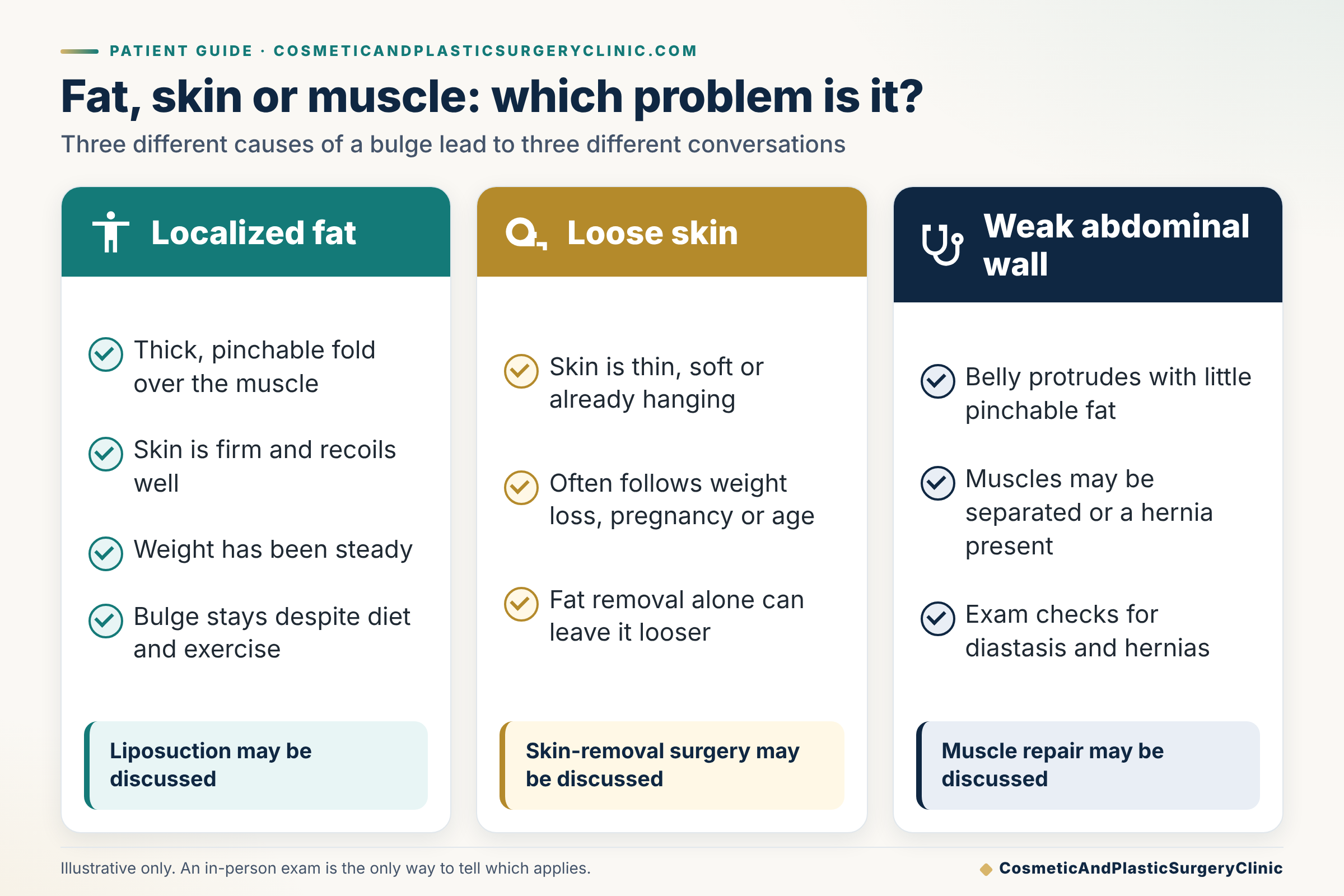
Consider a hypothetical comparison. One person has a thick, pinchable fold over firm skin. Another has lost a lot of weight and has thin skin that already hangs. A surgeon could remove the same volume from both, and the two results would look very different, because the skin has to shrink to fit what remains. The first person is asking suction to do suction’s job; the second needs a conversation about skin.
Energy devices marketed for tightening deserve precise questions. The FDA’s May 2023 safety communication on the Renuvion/J-Plasma system lists one handpiece as cleared for “coagulation of subcutaneous soft tissues following liposuction for aesthetic body contouring” and tells patients to ask which device will be used. What a device is cleared for, and what a brochure implies, are two different things.
Separated muscles, hernias and a belly that protrudes
Fat sits on top of the abdominal muscle wall. If the wall itself is stretched or separated, as can happen after pregnancy or with age, removing the fat in front of it may leave the silhouette nearly unchanged. ASPS says a tummy tuck removes excess fat and skin and, in most cases, restores weakened or separated muscles, and notes that even people of normal weight can develop a protruding or sagging abdomen from aging, heredity, pregnancy, prior surgery or large weight swings.
For that reason, an abdominal exam before fat removal includes looking at the musculo-fascial contour, hernias and rectus diastasis, according to a surgeon-authored continuing-education lecture by Jan Zemplenyi, MD, hosted on the cosmeticsurgery.org education site. When muscle or skin is the main issue, the liposuction vs tummy tuck page lays out the decision, and the tummy tuck guide describes the operation that addresses them.
Cellulite, stretch marks and body weight
Surface texture that suction does not smooth
ASPS says liposuction is not an effective treatment for cellulite. Mayo Clinic says it does not help dimpled skin and does not remove stretch marks. Cleveland Clinic explains why: cellulite sits in fibrous tissue rather than in soft fat, so a cannula has little to act on.
The risk list from ASPS goes a step further and names worsening cellulite and rippling as possible effects of the operation. A smooth-looking result depends on the skin surface the surgeon starts with, and that is worth asking about before treating any area where dimpling is the main concern.
Weight and health goals belong to a different plan
If the goal is a lower weight or better blood sugar, suction is the wrong tool, as the 2004 trial above showed. ASPS describes candidates as adults within about 30% of their ideal weight, and the Journal of Medicine review gives 20% to 30%. Those are screening ideas from two organizations, not cutoffs, and a surgeon decides case by case.
Someone with a larger weight goal usually benefits from starting with a primary-care or medical weight-management conversation. Fat removal can come later, once weight is stable, to refine a proportion that remains. Doing it in the other order tends to produce a result that changes as weight moves.
| What you notice | Why suction does not solve it | What may be discussed instead |
|---|---|---|
| Loose or thin skin | Suction removes fat, not skin; thin, less elastic skin may look looser afterward. | Skin-removal or lift operations, sometimes combined with fat removal. |
| Separated or weak abdominal muscles | The muscle wall lies below the fat layer that a cannula treats. | Muscle tightening as part of a tummy tuck, plus a hernia check. |
| Cellulite dimpling and stretch marks | Dimpling involves fibrous bands and the skin surface, not a thick fat pad. | Surface-focused skin treatments; stretch-marked skin may be removed in a tummy tuck. |
| Fat around internal organs | Visceral fat lies inside the abdominal cavity, beyond the layer suction treats. | Physician-guided nutrition, activity and medical weight management. |
| Overall body weight or obesity | Liposuction removes local volume and did not change metabolic markers in the 2004 trial. | Medical or surgical weight management; fat removal later, if still wanted. |
How surgeons plan a liposuction operation before the first incision
Much of the skill happens before anesthesia. Planning decides which areas, which layer, how much, in what setting, and whether to operate at all.
The evaluation that comes before any marking
History, medicines and the conversation about goals
A consultation covers medical history, a physical exam and, per MedlinePlus, may include a psychological evaluation and blood or urine tests. Mayo Clinic advises telling the surgeon about every medicine, supplement and herb you take, and says surgeons commonly have patients stop blood thinners and anti-inflammatory pain relievers at least a week beforehand. Follow your own surgeon’s written instructions, and never stop a prescribed medicine on your own.
Goals matter as much as health. A surgeon listens for specifics: which area, how it looks in clothes, what change would be enough. The 2020 Journal of Medicine review notes that body dysmorphic disorder may warrant a psychiatric consultation, which is part of why a thoughtful surgeon asks about how long a concern has bothered you and what you expect to feel afterward.
The standing exam: skin, pinch test and photographs
Gravity changes how fat and skin hang, so much of the exam happens standing. The Zemplenyi lecture lists the steps: assess skin quality, stretch marks and cellulite; perform a pinch test to gauge the thickness of fat; evaluate the muscle wall, hernias and prior scars; confirm that weight is stable; and record weight and body-mass index. Tabbal and colleagues recommend standardized medical photographs from front, back, oblique and side views.
The pinch test is simple to understand. A thick fold that lifts away from the muscle is fat a cannula can work on; a thin fold over a firm bulge suggests a different cause. Only an examiner can interpret it, which is why a photo sent online cannot replace the visit.
| Finding | What it suggests | How the plan may change |
|---|---|---|
| Thick, pinchable fat over firm skin | Fat is the main contributor to the bulge. | Liposuction alone may be discussed for that area. |
| Thin, loose or stretched skin | Skin may not redrape over a smaller volume. | Smaller goals, a skin-removal operation, or waiting. |
| Protruding abdomen with little pinchable fat | Muscle separation, a hernia or internal fat may dominate. | Further evaluation; a different operation or a non-surgical plan. |
| Weight still changing | Measurements taken now will not match the body later. | Delay and re-examine once weight has settled. |
| Clotting history, heart, diabetes or immune conditions | Higher anesthesia and clot risks. | Medical clearance, a clot-prevention plan, a hospital setting, or declining surgery. |
| Several areas or a large planned volume | Larger fluid shifts and a longer operation. | Accredited facility or hospital, overnight monitoring, or staged operations. |

Markings, layers and the zones surgeons leave alone
Marking the plan while you stand
Tabbal and colleagues call preoperative marking paramount, and recommend doing it in front of a mirror so the patient remains an active participant. Treatment areas are circled, and hash marks flag places to avoid. Bellini and colleagues describe marking in a topographic pattern, like contour lines on a map, so the surgeon can see where fat is thickest.
This is the best moment to ask questions. Ask what each circle means, which areas are deliberately left untouched, and how the markings relate to the result you described. Marks made standing matter because the body looks different lying on an operating table, and the surgeon is working from a map made upright.
Zones of adherence and the gluteal crease
In certain places the skin is tethered firmly to deeper tissue. Suctioning there risks pulling the surface into a visible depression. Tabbal and colleagues list five such zones: the lateral gluteal depression, the gluteal crease, the distal posterior thigh, the mid-medial thigh and the inferolateral iliotibial tract. Of these they call the gluteal crease the most important and say it should never be violated.
The 2017 review by Bellini and colleagues agrees that suctioning zones of adherence carries a high risk of contour deformity. If an area you care about sits near one of these zones, a surgeon who explains the limit is showing care, not timidity.
Volume, fluid and the ceilings that shape safety
How much fat is too much for one session
There is no universal ceiling. The 2009 ASPS Evidence-Based Patient Safety Advisory defines large-volume liposuction as 5,000 cc or more of total aspirate and states that no scientific data support a specific maximum. It recommends that large-volume cases take place in an acute-care hospital or an accredited or licensed facility and that vital signs and urine output be monitored overnight. ASPS’s patient page likewise says special considerations apply when more than five liters are removed.
At the other end, Tabbal and colleagues note that volumes up to about 1,000 mL can be handled under local anesthesia with a proper wetting solution, while the Journal of Medicine review defines megaliposuction as more than 10% of body weight and says an experienced surgeon should perform it. The right volume is whatever the plan and the patient’s health support, and it is not a measure of result quality.
Fluid, lidocaine and why the numbers differ between sources
Most current techniques use a wetting fluid containing dilute local anesthetic and epinephrine. Bellini and colleagues report that dry technique, with no infused fluid, is associated with blood loss of roughly 25% to 40% of the volume removed, while tumescent and superwet approaches bring it to about 1%.
Lidocaine limits are less settled. The ASPS advisory considers a dose of up to 35 mg/kg safe when epinephrine is included. A 2016 pharmacology study in Anesthesia & Analgesia, with 14 volunteers and 41 infiltrations, kept measured blood levels under the mild-toxicity threshold and estimated maximums of 28 mg/kg without liposuction and 45 mg/kg with it. These are professional dosing questions that the anesthesia team calculates; what you can ask is who calculates them and how levels are monitored afterward.
From anesthesia to final contour: the sequence and the timeline
An operating day is short compared with the months it takes to see the result. Separating the two keeps expectations honest.
The operating-room sequence, step by step
Anesthesia, infiltration and the cannula
ASPS lists intravenous sedation or general anesthesia as the usual choices for liposuction, with the surgeon recommending one. Smaller cases can be done with local anesthesia alone: a 2010 report in the Journal of the American Academy of Dermatology described 3,430 consecutive procedures by one surgeon using tumescent local anesthesia, with a lidocaine concentration of 500 mg/L adequate in all treated areas. One surgeon’s series cannot set a standard, but it shows why the setting varies.
Dilute anesthetic fluid goes in first, which ASPS says reduces bleeding and trauma. Incisions are small; Bellini and colleagues put them at typically 5 to 10 mm, placed in relaxed skin tension lines so scars hide. Body cannulas run 2 to 4.6 mm wide and 15 to 45 cm long, and the deep or intermediate layer is treated first. Fat comes out through the cannula, the incisions are closed or left to drain, and a compression garment goes on.
Technique families in brief
ASPS names five approaches: traditional suction-assisted, power-assisted with a vibrating cannula, ultrasound-assisted including VASER, laser-assisted and water-assisted with pressurized saline. All of them loosen fat before it is removed. The energy-based methods add heat, and ASPS lists heat burns from the ultrasound-assisted method among the risks.
Which one fits depends on the area, the tissue and the surgeon’s experience, and the comparative evidence is thinner than marketing suggests. The liposuction techniques page covers what each adds, what it risks and how to ask which one is planned and why.
Healing, and when the shape can be judged
Weeks one to six: swelling, garments and activity
ASPS describes the first week as significantly limited activity, a return to work in weeks two to three depending on the job, bruising that should be gone by weeks four to five, swelling that starts to subside in the same window, and gentle exercise from about week six. Mayo Clinic says to expect pain, swelling and bruising and to plan for someone to drive you home and stay the first night. MedlinePlus adds numbness or tingling for weeks and stitches removed in 5 to 10 days.
Early walking is encouraged to lower clot risk, according to MedlinePlus and the Journal of Medicine review. Everything else, including garment length, drain care and when to resume exercise, comes from your surgeon’s instructions. The liposuction recovery page breaks the weeks down, and the plastic surgery recovery planning page handles time off, driving and help at home.
Months three to six: why early photos mislead
Sources describe the arc a little differently, which is itself informative. MedlinePlus says bruising and swelling usually fade within about three weeks, with some swelling lingering for months. Cleveland Clinic says swelling can take three to six months to resolve and full healing up to six months. Mayo Clinic says treated areas should look slimmer within several months.
The consistent point is that a photo at three weeks shows swelling and bruising, not the result. When you look at any gallery, the first question is how long after surgery each picture was taken, a skill the liposuction before and after page builds in detail.

Who liposuction tends to suit, and who is pointed toward another route
Candidacy is a clinical judgment made in person. The ideas below describe what surgeons weigh, so you can recognize the logic of their advice. A full treatment sits on the liposuction candidate page.
What surgeons weigh when judging suitability
Localized fat, steady weight and skin that recoils
ASPS says liposuction may be right for people bothered by fat deposits anywhere on the body that do not respond to diet or exercise, and describes candidates as having firm, elastic skin, good muscle tone and weight within about 30% of ideal. Its overview page puts it more simply: it works for people of normal weight who have some extra fat.
ASPS 2025 counts show who actually has it done. The group aged 36 to 45 was largest, but the fastest growth was among older adults. Counts are not a measure of suitability; skin tends to be less firm with age, and Cleveland Clinic notes that age itself is usually not a barrier. Men accounted for 18,938 of the 317,196 total, about 6%.
| Age group | 2025 | 2024 | Change |
|---|---|---|---|
| 18 to 25 | 11,350 | 12,080 | -6% |
| 26 to 35 | 48,661 | 52,310 | -7% |
| 36 to 45 | 95,985 | 103,398 | -7% |
| 46 to 55 | 82,141 | 82,948 | -1% |
| 56 to 65 | 55,735 | 49,344 | +13% |
| 66 and older | 23,325 | 20,074 | +16% |
Health conditions, nicotine and medicines, including GLP-1 drugs
ASPS candidate guidance asks for good general health without conditions that impair healing, and for nonsmokers and non-vapers. Mayo Clinic names blood-flow problems, coronary artery disease, diabetes and a weak immune system as conditions that can affect eligibility. The surgeon needs your full medicine list, including weight-loss injections.
On GLP-1 drugs, ASPS reported that 82% of its member surgeons received related consultation requests in 2025, while stating that its statistics do not establish a causal link to any procedure. The ISAPS Patient Safety Committee says there are no evidence-based guidelines for holding these drugs before surgery, that delayed stomach emptying may raise aspiration risk under general anesthesia, and that elective surgery is generally deferred during the early dose-escalation phase, typically four to eight weeks. It also notes that the effect on skin retraction is not yet fully understood. The anesthesia team decides what applies to you.
Reasons to wait or to choose differently
Weight still moving, or a pregnancy ahead
ASPS’s procedure page says substantial weight gain can alter the results, and Mayo Clinic notes that weight gain can change fat distribution, even in untreated areas. On its tummy tuck page, ASPS advises people planning major weight loss, and women who may become pregnant again, to delay that operation because results can be diminished by large weight fluctuations. The same reasoning is why a surgeon may ask candidates to hold steady first.
No verified standard says how many months of stable weight is enough, so treat any specific number as one surgeon’s preference. After rapid loss, ISAPS notes skin may have a reduced ability to regenerate and stay elastic, which is a reason to let both weight and skin settle before measuring for a plan.
Goals that belong to someone else
ASPS puts it bluntly on its candidate page: do it for yourself, not to satisfy someone else’s wishes or to fit an ideal image. MedlinePlus cautions that the procedure will probably not give you your ideal body shape. A surgeon who senses that the goal is mostly about another person’s opinion may suggest waiting, and that advice is worth taking seriously.
Specific goals, a steady outlook and a willingness to accept a modest change are the common thread in the sources. The wider decision of whether any elective operation is worth its trade-offs is the subject of the plastic surgery decision guide.
Liposuction risks and costs in numbers: what the data can and cannot tell you
Numbers make a decision feel concrete, but risk and price figures come from particular groups, years and definitions. Each number below carries its limits with it.
Reading the risk numbers
What large datasets report for complications
A 2017 analysis by Kaoutzanis and colleagues in the Aesthetic Surgery Journal followed 31,010 liposuction procedures from 2008 to 2013 in the CosmetAssure database. Among 11,490 solitary procedures, major complications were 0.7%, hematoma 0.15%, pulmonary complications 0.1%, infection 0.1% and confirmed venous thromboembolism 0.06%. Combined operations carried a relative risk of 4.81 for major complications and 5.65 for venous thromboembolism.
A 2023 systematic review of 16 studies by Barros and colleagues shows how much the figures vary. Seroma ranged from under 1% to about 19% depending on the study and whether procedures were combined, and venous thromboembolism ran 0.06% for liposuction alone against a mean of 0.56% for combined operations. The Journal of Medicine review says as many as 9% of patients may report soft-tissue depressions or elevations.
A 2024 report in Aesthetic Surgery Journal Open Forum covered 246,119 cases in accredited ambulatory facilities from 2019 to 2021: 984 patients had complications (0.40%), mean age was 44 and median body-mass index 28.7. Unplanned emergency-department visits were the most common single complication, at 24%. None of these figures is your personal risk, and each population differs from the others. The liposuction risks page goes through each complication, and plastic surgery risks explains how to read a risk number in general.
Deaths: older surveys, newer reporting and their limits
The most quoted mortality figure comes from a 2000 survey in Plastic and Reconstructive Surgery by Grazer and de Jong. Of 1,200 board-certified members of the American Society for Aesthetic Plastic Surgery, 917 responded, reporting 95 deaths in 496,245 procedures from 1994 to mid-1998, or 1 in 5,224. Pulmonary thromboembolism was the leading cause, and many deaths happened the first night after discharge.
Later data differ in design. Barros and colleagues found mortality of 0 to 0.06% across studies published from 2016 to 2021, and the accredited-facility report above recorded 21 deaths among 246,119 cases, about 1 in 11,700 by our arithmetic. The designs and populations differ, so these cannot be lined up into a trend. What they support is modest: death after liposuction is rare, clots figure prominently, and the risk is not zero.
Telling expected healing from a problem
Expected effects, and when to call the office
ASPS lists bruising, swelling and fluid buildup among the effects of the operation, and Mayo Clinic says to expect some pain, swelling and bruising. MedlinePlus adds numbness and tingling lasting weeks. These are part of healing, usually improving week by week.
Your surgeon’s discharge sheet defines the call-the-office list. Typical items include fever, redness that spreads, drainage that changes, pain that escalates when it should be easing, skin that looks dusky or blistered, and firm swelling that grows on one side. Treat these as general examples and follow your own instructions.
Emergency signs that should not wait
Clots and fat embolism are the emergencies most associated with this operation. Mayo Clinic calls fat embolism a medical emergency, and the Journal of Medicine review reports onset 12 to 72 hours after surgery. The CDC lists symptoms of pulmonary embolism that call for immediate medical help, and says deep vein thrombosis of a leg or arm can cause swelling, ache, warmth and red skin, although about half of people with it have no symptoms.

The price you see and the price you pay
What the national fee figure covers
ASPS’s 2024 fee table lists a liposuction surgeon or physician fee of $4,300 to $7,500, and $3,000 to $5,500 for chin liposuction, counting procedures by ASPS member surgeons only. A separate ASPS cost page cites an average of $4,711 without naming the year, and says the average does not include anesthesia, operating-room facilities or other related expenses. The 2024 table was the most recent one located as of November 2026.
So a national figure covers one line of a longer bill. ASPS says a surgeon’s cost can reflect experience, the type of procedure and office location. The liposuction cost page breaks the bill into parts, and plastic surgery cost covers how to compare two quotes.
Insurance, financing and the one total to request
ASPS states that most health plans do not cover liposuction or its complications, which makes the question “what happens if I need hospital care afterward” worth asking before you pay anything. Many surgeons offer payment plans; the plastic surgery financing page explains how interest and fees change the total.
Ask for one written, itemized figure covering the surgeon’s fee, facility, anesthesia, garments, follow-up visits and the policy if a revision is needed, plus what happens to your deposit if you postpone. Two quotes are comparable only when those lines match.
Alternatives, combinations and revision: when one operation is not the whole answer
Liposuction answers one question about fat. Other concerns, such as skin, muscle or a combined goal, often sit alongside it.
Other ways to address the same concern
Nonsurgical fat reduction: what the FDA and the studies say
The FDA states that non-invasive body contouring does not treat obesity or improve health, will not result in weight loss, may give temporary results and may require multiple treatments. It lists burns and blisters with radiofrequency devices, and with fat freezing a condition called paradoxical adipose hyperplasia, in which fatty tissue grows instead of shrinking, plus hernia. Some complications can be lasting or need surgery.
A 2015 review in Plastic and Reconstructive Surgery covering 19 cryolipolysis studies found average fat-layer reductions of 14.67% to 28.5% by caliper and 10.3% to 25.5% by ultrasound, with follow-up mostly two to six months. The authors point to few high-quality randomized trials and unknown long-term effects. Fat-layer thickness in a treated spot is not body weight.
For fat under the chin, the FDA says deoxycholic acid (Kybella) is the only fat-dissolving injection it has approved, for that area only, and warns that unapproved fat-dissolving products sold online have been linked to scars, serious infections, skin deformities and cysts. The chin liposuction vs neck lift page compares these options by anatomy.
Operations that treat skin, muscle or the neck
When skin or muscle is the main problem, ASPS’s 2025 report shows demand for lifts: arm lifts and neck lifts each grew 21% and thigh lifts 20%. An ASPS surgeon quoted in the release said that significant weight loss, however achieved, can leave some patients with excess skin. Treating fat only in the neck can leave banding or loose skin behind, which is the problem a neck lift is designed to address.
| Situation | Pathway | Benefit | Trade-off | Key question |
|---|---|---|---|---|
| Defined fat pocket, firm skin, steady weight | Liposuction alone | Treats fat through small incisions | Swelling for months; irregularities possible; no weight change | Which layer and what volume are planned? |
| Fat plus loose abdominal skin or muscle | Tummy tuck, with or without liposuction | Addresses skin and muscle as well as fat | Longer scar and recovery; higher risk when combined | Would you stage the operations? |
| Small fat pocket under the chin, little looseness | Chin liposuction or approved deoxycholic acid injection | Narrower intervention | Injection is approved only for the chin; sagging skin may need more | Is the problem fat, skin or banding? |
| Neck fullness with loose skin or bands | Neck lift, sometimes with liposuction | Treats skin and muscle bands | Longer incisions and recovery | What does each part of the plan add? |
| Goal is a lower body weight | Medical weight management first | Targets health markers that fat removal did not change | Slower; skin may loosen after large loss | Should weight settle before any contouring? |
| Concern fades after months of waiting | No procedure | No surgical risk or cost | The concern may remain | What would change my mind in six months? |
Pairing operations and revising a result
Why surgeons combine liposuction with other procedures
ASPS says liposuction can be done alone or with a facelift, breast reduction or tummy tuck. MedlinePlus lists harvesting fat for grafting as a reason for it, and Mayo Clinic notes it can reduce extra breast tissue in men. The mommy makeover and Brazilian butt lift pages show two packages where fat removal is part of a larger plan.
The appeal is one anesthetic and one recovery. The cost is risk: the figures above show higher complication and clot rates for combined operations, and the ASPS advisory recommends avoiding large-volume liposuction combined with certain other procedures such as abdominoplasty. Whether to combine or stage is a surgeon-and-patient decision, and “can you do it all at once” is not the same question as “should we”.
Revision: when a second look makes sense
ASPS lists a possible need for revision among the risks, and notes that secondary procedures may sometimes be recommended to reduce excess skin. Reasons people seek a second look include residual fullness, a dent or ripple, asymmetry and looseness that became visible after fat came out.
Because Cleveland Clinic puts the final result at three to six months, a revision conversation generally makes sense only after the settling period; judging a contour in the first weeks risks treating swelling. The liposuction revision page covers options, timing and how to choose a surgeon for a second operation.
| Factor | Effect on the outcome | Maintenance or revision implication | Review point |
|---|---|---|---|
| Weight change after surgery | Changes where the body stores fat; the shape benefit may blur. | Steady weight and activity protect the contour. | When weight shifts noticeably. |
| Skin elasticity and aging | Skin loses some firmness with age, as Mayo Clinic notes. | Looseness may later prompt a skin-removal discussion. | When skin laxity starts to bother you. |
| Swelling and scar tissue | Can hide the final contour for up to six months. | Judge after swelling settles; firm areas need evaluation. | Scheduled follow-ups and around month six. |
| Rapid weight loss, including from medication | May reduce skin’s ability to stay elastic, per ISAPS. | Plan after weight stabilizes; tell the surgeon about the medicine. | Before booking and before any revision. |
| Irregularity or asymmetry | Reported by a minority of patients in studies. | Observe first, then discuss options. | After the final contour can be judged. |
Turning the research into a decision you can defend
Everything above leads to a handful of checks and questions. They are easier to apply when the claims you are testing are already clear.
Verify who operates and where
Board certification, license and facility accreditation
The American Board of Plastic Surgery says certification is voluntary, requires an active, unrestricted license, reflects completed training plus written and oral examinations, and is valid for ten years for certificates issued since 1995. Its verification page searches by name or location. A state medical board confirms the license and any discipline.
For the facility, ASPS names three accreditors: AAAASF, AAAHC and the Joint Commission. Medicare certification or a state license also counts, and ASPS requires members to use such facilities except for local anesthesia alone or mild oral sedation. The how to choose a plastic surgeon page walks through the steps, and cosmetic surgeon credentials explains why titles can mislead.
Anesthesia, after-hours care and transfer plans
Accreditation standards, as ASPS summarizes them, typically call for anesthesia by a board-certified or board-eligible anesthesiologist or a certified nurse anesthetist, staff trained in advanced cardiac life support, and surgeons with privileges at a local accredited hospital. Ask who gives your anesthesia, who answers calls overnight and which hospital would receive you in an emergency.
Those questions matter most for larger operations and for any plan involving overnight monitoring, since the 2009 ASPS advisory ties large-volume cases to hospital or accredited settings with monitoring afterward.
Questions to bring, and the option not to proceed
Two hypothetical consultations, one request
Consider a hypothetical 34-year-old who asks about the sides of the waist. The exam finds a thick, pinchable fold over firm skin, steady weight, no medical conditions and a modest planned volume. The conversation may center on small-volume liposuction in an accredited facility, a realistic degree of change and the months the shape takes to settle.
Now consider a hypothetical 52-year-old with the same request after a large weight loss. The skin is thin and hangs, the abdominal wall protrudes and the pinch test finds little fat. Here the conversation may turn to skin and muscle, to waiting for weight and skin to settle, and to whether a larger operation fits at all. The two people asked the same question, and the answers differ because of tissue, not enthusiasm. A surgeon who examines you decides what applies; these sketches only show the logic.
Eight questions that resolve most uncertainty
Bring a written list so the answers can be compared across consultations. The ones below follow the logic of the page; the plastic surgery consultation guide explains how to judge the answers.
- Which tissue is the problem in my case: fat, skin, muscle or a mix?
- Which exact areas, which layer and roughly what volume do you plan to treat?
- Which technique and device will you use, and why that one for me?
- Where will it be done, who gives anesthesia, and what is the overnight plan?
- What are the specific risks given my health history, and how would combining procedures change them?
- Can I see results in people with my skin quality, with the months since surgery labeled?
- What is the itemized total, and what is the policy if a revision is needed?
- What would make you advise against this operation for me?
For photos, the before and after photos guide covers consent and advertising rules; the body-contour viewing skills sit on the liposuction photo page linked in the healing section above.
Waiting, a second opinion or choosing no surgery
A consultation can end four ways: proceed, choose a different operation, wait, or decline surgery. All four are legitimate outcomes. A second opinion often costs a consultation fee and an afternoon, and a surgeon who welcomes one is showing confidence in the plan.
Be cautious about deposits requested on the day of the consultation, and read refund terms before paying. If the concern is still there months later and the plan survives questions about skin, weight and setting, the operation is a considered choice. If it fades, that was useful information too.
Frequently asked questions
Can liposuction treat several areas in one session?
Often yes, but the total matters more than the number of areas. ASPS says special considerations apply when more than five liters are removed, and Mayo Clinic notes complication risk rises when a surgeon works on larger body surfaces. The 2024 accredited-facility report found wound disruption in the longest operations, a median of 261 minutes. Ask the surgeon how many areas, what total volume and how long the operation is expected to run, and whether staging the work across two sessions would be safer for your health history.
How do I show my weight has been stable before liposuction?
No verified standard defines a number of months, but surgeons do confirm that weight is stable and record weight and body-mass index at the exam. Help them by keeping a dated log of home weigh-ins, bringing older photos that show how your shape changed, and mentioning any large swings, pregnancies or new weight-loss medicines. If your weight has been moving, an honest answer may lead to a delay, which is a better outcome than a plan measured against a body that is about to change.
Is liposuction always done under general anesthesia?
No. ASPS lists intravenous sedation or general anesthesia as the usual options, while smaller cases can use tumescent local anesthesia alone. Tabbal and colleagues note that volumes up to about 1,000 mL can be handled under local anesthesia with a wetting solution. The choice depends on volume, areas, health and the facility. Ask who will administer anesthesia, how you will be monitored and what the plan is if the team needs to change approach during the operation.
Can the fat removed during liposuction be used somewhere else?
Sometimes. MedlinePlus lists harvesting fat for grafting to other body areas as a reason for the procedure, and the ASPS 2025 report found facial fat grafting had the largest single-year gain of any tracked procedure, at 39%. Fat transfer is a separate step with its own risks and recovery, and the result does not copy the volume removed. The best-known example is the Brazilian butt lift, and the surgeon should explain whether transfer is part of your plan.
Do men have liposuction too?
Yes, though in smaller numbers. ASPS counted 18,938 procedures in men in 2025, down 8% from 20,684 in 2024, against 298,258 in women. Mayo Clinic notes that it can also reduce extra breast tissue in men. When glandular tissue is involved rather than fat alone, a different operation may be discussed; a gynecomastia evaluation explains how surgeons separate the two.
Is there a minimum or maximum age for liposuction?
The ASPS candidate page lists no age limits. Tabbal and colleagues note that adolescents may not be suitable candidates, and Cleveland Clinic says age in adults is usually not a barrier, though skin may be less firm. ASPS 2025 counted 11,350 procedures in ages 18 to 25 and 23,325 at 66 and older. Skin quality, health conditions and realistic goals shape the advice more than a birthday does, so the conversation is individual.
When can I travel after liposuction?
That depends on your surgeon’s instructions, and no verified general number exists. Blood clots are a recognized risk after fat removal and early walking is encouraged, so ask how and when travel fits your recovery. Distance matters too: a long trip home puts you far from the team that knows your anatomy if a problem appears. The same logic applies to surgery abroad, where follow-up and emergency care are the main questions.
Why does someone need to stay with me the first night?
Mayo Clinic advises having someone drive you home and stay for at least the first night. Sedation and anesthetic effects can linger, and Grazer and de Jong noted that many deaths in their survey happened the first night after discharge, which led them to recommend watching for residual sedative effects. A companion can notice confusion, breathing problems or bleeding and call for help, and can help you with the practical tasks that move slowly in the first hours.
Sources and further reading
- American Society of Plastic Surgeons — Liposuction overview (accessed 2026-11-12) — definition, treatable areas, what it cannot do, combinations
- American Society of Plastic Surgeons — Liposuction procedure (accessed 2026-11-12) — anesthesia, cannula, infiltration, technique names
- American Society of Plastic Surgeons — Liposuction candidates (accessed 2026-11-12) — candidate criteria, nonsmokers, motivation
- American Society of Plastic Surgeons — Liposuction risks and safety (accessed 2026-11-12) — risk list, large-volume statement
- American Society of Plastic Surgeons — Liposuction recovery (accessed 2026-11-12) — week-by-week activity guidance
- American Society of Plastic Surgeons — Liposuction cost (accessed 2026-11-12) — average fee, exclusions, insurance statement
- American Society of Plastic Surgeons — Plastic Surgery Statistics Report 2025 (accessed 2026-11-12) — volumes by age and sex, methodology
- American Society of Plastic Surgeons — 2025 statistics press release (accessed 2026-11-12) — lift growth, GLP-1 consultation requests, fat grafting
- American Society of Plastic Surgeons — Cosmetic procedures average cost 2024 (accessed 2026-11-12) — surgeon fee ranges, including chin
- Haeck et al., Plastic and Reconstructive Surgery — Evidence-Based Patient Safety Advisory: Liposuction (2009) (accessed 2026-11-12) — volume definition, lidocaine and epinephrine limits, facility and monitoring
- American Society of Plastic Surgeons — Tummy tuck (accessed 2026-11-12) — muscle repair, weight fluctuation, comparison with liposuction
- American Society of Plastic Surgeons — Accreditation (accessed 2026-11-12) — accrediting bodies and facility requirement
- American Board of Plastic Surgery — Verify Certification (accessed 2026-11-12) — certification meaning, license requirement, ten-year validity
- U.S. Food and Drug Administration — Non-invasive body contouring technologies (accessed 2026-11-12) — not for weight loss, device risks
- U.S. Food and Drug Administration — Fat-dissolving injections that are not FDA approved (accessed 2026-11-12) — Kybella approval scope, unapproved product harms
- U.S. Food and Drug Administration — Renuvion/J-Plasma safety communication, May 10, 2023 (accessed 2026-11-12) — cleared indication wording, ask which device
- Centers for Disease Control and Prevention — About blood clots (accessed 2026-11-12) — DVT and pulmonary embolism symptoms
- Mayo Clinic — Liposuction (accessed 2026-11-12) — purpose, limits, risks, preparation, results timing
- Cleveland Clinic — Liposuction (accessed 2026-11-12) — fat cell removal, recovery timeline, what it cannot do
- Cleveland Clinic — Visceral fat (accessed 2026-11-12) — location and health relevance of visceral fat
- MedlinePlus — Liposuction (accessed 2026-11-12) — evaluation, aftercare, outlook
- Wu, Coombs and Gurunian, Cleveland Clinic Journal of Medicine — Liposuction: concepts, safety, and techniques in body-contouring surgery (2020) (accessed 2026-11-12) — patient selection, complication rates, megaliposuction definition
- Tabbal, Ahmad, Lista and Rohrich, Plastic and Reconstructive Surgery Global Open — Advances in liposuction: five key principles (2013) (accessed 2026-11-12) — marking, zones of adherence, layers, volume terms
- Bellini, Grieco and Raposio, Annals of Medicine and Surgery — A journey through liposuction and liposculture (2017) (accessed 2026-11-12) — history, incisions, cannulas, wet technique blood loss
- Chittoria and Singh, CosmoDerma — History of liposuction for body contouring (2022) (accessed 2026-11-12) — historical timeline, high-definition liposculpture
- Zemplenyi, continuing-education lecture on cosmeticsurgery.org — Liposuction: review of anatomy, techniques, anesthesia and safety (undated slides; accessed 2026-11-12) — pre-operative exam elements, endpoints
- Markman and Barton, Plastic and Reconstructive Surgery — Anatomy of the subcutaneous tissue of the trunk and lower extremity (1987) (accessed 2026-11-12) — two fat layers and deep compartments
- Washington University — Summary of Klein et al., New England Journal of Medicine, 2004 (accessed 2026-11-12) — metabolic outcomes after large-volume liposuction
- Benatti et al., Journal of Clinical Endocrinology and Metabolism — Liposuction and visceral fat (2012) (accessed 2026-11-12) — abstract of the exercise trial
- American Society of Plastic Surgeons — Press release on Swanson, 2012 (accessed 2026-11-12) — 301-patient study of fat regrowth
- ScienceDaily — Summary of Hernandez et al., Obesity, 2011 (accessed 2026-11-12) — fat redistribution after liposuction, press-level summary
- Spalding et al., Nature — Dynamics of fat cell turnover in humans (2008), Europe PMC record (accessed 2026-11-12) — fat cell number and renewal
- Kaoutzanis et al., Aesthetic Surgery Journal — Liposuction complications in a CosmetAssure cohort (2017) (accessed 2026-11-12) — complication rates and combined-procedure risk
- Valentine et al., Aesthetic Surgery Journal Open Forum — Liposuction complications in the outpatient setting: 246,119 cases (2024) (accessed 2026-11-12) — accredited-facility complication and mortality data
- Barros et al., Revista Brasileira de Cirurgia Plástica — Complications in liposuction: systematic review (2023) (accessed 2026-11-12) — complication ranges, isolated versus combined
- Grazer and de Jong, Plastic and Reconstructive Surgery — Fatal outcomes from liposuction (2000), Europe PMC record (accessed 2026-11-12) — census survey of deaths
- Klein and Jeske, Anesthesia and Analgesia — Estimated maximal safe dosages of tumescent lidocaine (2016) (accessed 2026-11-12) — lidocaine dose study
- Habbema, Journal of the American Academy of Dermatology — Tumescent local anesthesia in 3430 consecutive liposuction cases (2010) (accessed 2026-11-12) — local-anesthesia-only series
- Ingargiola et al., Plastic and Reconstructive Surgery — Cryolipolysis for fat reduction and body contouring (2015) (accessed 2026-11-12) — fat-layer reduction ranges and limitations
- ISAPS Patient Safety Committee — The rise of GLP-1 receptor agonist drugs and plastic surgery, chapter 1 (accessed 2026-11-12) — perioperative considerations, skin elasticity