A lower body lift is one operation that works around the trunk instead of only the front of it. A band of loose skin and fat is removed across the abdomen, waist, hips and buttocks, and the wound is closed so the surrounding tissue is pulled upward. The circumferential version is also called a belt lipectomy, and it sits inside the wider group described on the site’s body lift after weight loss overview. This page stays with the operation itself: how it is designed, how the day runs, and how to question a plan.
Plastic surgeons use “body lift” for several related operations, and “lower body lift” for the one that treats the lower trunk and buttocks together. The design choices are specific: where the incision runs, how much tissue is removed, whether the patient is turned during surgery, and what is done about buttock volume. This is general education, not a judgment about whether any one person should have the operation.
What a lower body lift removes, what it moves, and what it leaves alone
The phrase sounds like a single lift, but two things happen in the same session. Tissue is cut away, and the tissue that remains is moved and fastened. Reading a plan well starts with separating those two actions, because the first explains the scar and the second explains why the result is described as lifting rather than only trimming.
The zones one operation reaches
Abdomen, flanks, back and buttocks in a single band
The American Society of Plastic Surgeons (ASPS) glossary in its 2025 statistics report defines a lower body lift as the surgical removal of excess skin and fat from the abdomen, waist, hips, buttocks and thighs to improve the shape and tone of these areas. ASPS also lists aging, sun damage, pregnancy, significant weight fluctuation and genetics as reasons tissue loses elasticity.
The Pittsburgh Rating Scale, published in 2006 in Seminars in Plastic Surgery, shows why surgeons think in zones. It grades ten body regions from 0 (normal) to 3 (most severe), including abdomen, flank, back, buttocks, mons and hips or lateral thighs. A lower body lift is the operation that can address several of those regions at once.
What stays outside the incision
A lower body lift is not a whole-body operation. The upper arms, breasts, chest and, usually, the inner thighs sit outside it, and each has its own procedure and its own scar. ASPS describes thigh lifts as separate operations for inner, outer or posterior thigh tissue.
ASPS counts upper body lifts as a separate category from lower body lifts in its 2025 statistics, which is a reminder that loose tissue higher on the trunk is a different operation. People with loose tissue in many regions are often offered a series of operations rather than one; the staging section below covers how those series come about.
Cutting away versus holding up
The skin and fat that are removed
ASPS says a circumferential incision removes “an apron of excess skin and fat” and repositions and tightens tissues. The amount removed is the width of that apron, and it is measured on the standing patient before surgery, since skin hangs differently when lying down.
Removed tissue is the reason the scar is as long as it is. The incision has to travel the full length of the band, and ASPS says incision length and pattern depend on how much skin is removed, where it sits and the surgeon’s judgment.
The deep layer that carries the tension
ASPS states that deep sutures within the underlying tissues help form and support the new contours, with the skin closed on top by sutures, adhesives, tapes or clips. In the history literature, Lockwood’s 1993 paper on lower body lift with superficial fascial system suspension is credited with showing how to anchor lifted tissue to this fibrous layer in the fat.
The practical meaning is that a good closure should not rely on the skin alone to hold. How much anchoring a surgeon uses, and in which layers, is a legitimate consultation question; the question table near the end includes it.
Incision design: the route of the scar and the name of the operation
Everything a lower body lift can change, and everything it costs in scar, flows from one drawing made on the standing patient. Two surgeons can both call their operation a lower body lift and draw different lines. Understanding the main variants makes the scar diagrams shown in consultation easier to read.
Reading the markings and the variants
Marking while standing
Both sources that describe the marking step have the patient standing. A 2019 review of 40 outpatient cases in Plastic and Reconstructive Surgery Global Open describes marking immediately before surgery, with the resection running as an ellipse from the groin crease around the side to a point lateral to the midline, below the dimple over the back of the pelvis.
A review from Cleveland Clinic Florida in Bariatric Times adds that the surgeon adjusts lines with a pinch test and that the posterior line sits along the upper margin of the gluteal aesthetic unit, with abdominal lines running from above the mons to just below the iliac crests. Prior scars and port sites are rechecked during the operation.
Belt lipectomy, lower body lift and the near-circumferential version
A 2016 systematic review in Aesthetic Plastic Surgery covered 42 articles and 1,748 operated patients. It found that every described technique derived from either belt lipectomy or lower body lift, and it summarized the trade-off in one sentence each: belt lipectomy leaves a posterior scar at the waistline and corrects hip and back rolls better, while the lower body lift works better for buttock and lateral thigh ptosis.
The 2019 outpatient series used a third design, near-circumferential, in which a midline skin bridge is left uncut and the scar stops short of crossing the lower back. Its author reported no cases of gluteal cleft elongation.

Where the scar lands against clothing
Underwear lines, swimwear and low-rise clothes
ASPS says advanced techniques typically place incisions where most clothing and swimsuits hide them, and for a complete lower body lift it describes a bikini-style pattern. The 2019 series planned the scar to be covered by underwear. The Cleveland Clinic Florida authors note that patients increasingly ask for lower hip scars because of low-rise clothing.
A scar that is hidden by one garment is not hidden by every garment. Bring the clothing you wear most, including swimwear, and ask to see where the planned line falls on you in a mirror while standing.
How long the scar is and what refining it can involve
ASPS lists “unfavorable scarring” and the possible need for revision among the risks of body lift, and it says plainly that these operations require extensive incisions. In one single-surgeon series of 62 patients published in Seminars in Plastic Surgery in 2006, 9 patients (14.5%) needed a scar revision.
That figure comes from one surgeon’s cases and cannot be projected onto another practice. What it shows is that scar refinement is part of the realistic picture for a long wound under tension, not a rare surprise; ask what revision costs and when it is done. The body lift cost page explains how those terms are priced.
| Operation | Tissue it addresses | Typical scar route | What it leaves untreated | Question to ask |
|---|---|---|---|---|
| Tummy tuck (abdominoplasty) | Front abdominal skin and fat; ASPS says it repairs weakened or separated muscle in most cases | Low across the abdomen | Flanks, back and buttocks, which a front-only operation leaves untouched | Is there loose tissue beside and behind me that this scar would not reach? |
| Lower body lift | Abdomen, waist, hips, buttocks and outer thighs in one band | Around the lower trunk, planned to sit under underwear or swimwear | Inner thighs, arms and chest, which need their own operations | Which exact route is my scar planned to take, and where does it end at the back? |
| Thigh lift | Inner, outer or posterior thigh skin and fat | Inner thigh: from the groin crease toward the buttock crease, or down the inseam, by design | The abdomen and the waist; outer-thigh tissue may overlap with a lower body lift | Will thigh work be combined, staged, or left for later? |
The abdomen-only routes after major weight loss, including the extended designs, are covered on tummy tuck after weight loss, and the three-way comparison with panniculectomy sits on panniculectomy vs body lift. This page does not repeat them.
The operating day: turning the patient, hours of surgery and the anesthesia setting
A lower body lift cannot be done from one side of a patient. The front and the back of the trunk both need access, which makes the operation different from most cosmetic surgery in a practical way. Where the patient lies, how often they are moved and how long the team works are design choices with consequences.
How the sequence of positions works
Supine and lateral, or supine and prone
Published descriptions disagree, which is useful information in itself. The Cleveland Clinic Florida authors describe the buttock lift as performed prone and the abdominoplasty supine, with thigh lifts done prone then supine or in a side-lying position. The 2019 outpatient series prepped the patient standing, operated supine and then lateral, and says prone positioning was never used. A 2006 series by Gerut worked supine for the abdomen and prone for the buttock tissue.
No source opened here argues that one sequence is better than another. What a patient can fairly ask is how many times they will be turned, who does the turning, and what monitoring continues while they are positioned on their front or side.
Table flexion, tension and drains
The Cleveland Clinic Florida review notes that bending the operating table or flexing the legs reduces tension on the incision while it is being closed. The 2019 series used a three-layer closure and no drain for outer thigh lifts, with one drain when an abdominoplasty was added. ASPS says small, thin tubes may temporarily be placed under the skin to drain blood that collects.
Some surgeons restrict waist and hip flexion after surgery. In Gerut’s series, patients were told not to sit or flex at the waist and hip for at least 10 days to reduce wound separation, which is one surgeon’s rule rather than a standard. Your own surgeon’s instructions govern; the body lift recovery page covers the weeks after.
Hours, anesthesia and where surgery is done
How long a lower body lift takes
In the 2019 outpatient series of 40 patients, operating time averaged 226 minutes (range 86 to 360 minutes), and that figure includes simultaneous facial or breast procedures. The author puts a lower body lift alone at about three hours and a medial thigh lift at about one hour, and does not plan cases expected to exceed six hours.
The Cleveland Clinic Florida authors say autologous buttock augmentation lengthens operating time. In a 2020 series of 323 bariatric lower body lift patients from Aesthetic Plastic Surgery, operative time was one of the factors tested against complications; only age and tobacco use reached statistical significance there. Time still matters for anesthesia exposure, so ask for the team’s expected range.
Anesthesia, overnight stay and the facility
ASPS lists intravenous sedation and general anesthesia as the options and says the surgeon recommends the choice for each patient. The Cleveland Clinic Florida authors recommend hospitalization for pain control and monitoring, while noting that healthy, low-risk patients may be treated as outpatients with careful follow-up. The 2019 series was entirely outpatient.
The Anesthesia Patient Safety Foundation says hospitals usually have the most resources, surgery centers are often cheaper and more convenient, and office procedure rooms suit short, simple cases. It adds that patients with complex health problems should consider a hospital for outpatient procedures. For a long operation with extensive incisions, those are questions to settle in writing before booking, not on the day.
| Source and year | Patients | Positions and design reported | Time and setting reported | Limit |
|---|---|---|---|---|
| Swanson, PRS Global Open, 2019 | 40 consecutive, 2013 to 2019 | Prepped standing; supine then lateral; near-circumferential with midline skin bridge; no prone | Mean 226 minutes (86 to 360); all outpatient | One surgeon; includes combined facial or breast surgery |
| Gerut, Seminars in Plastic Surgery, 2006 | 62 in the complication table | Supine for abdomen; prone for buttock flap from lower-back tissue | Operative time not reported | One surgeon; no comparison group |
| Rezak, Samson and Newman, Bariatric Times (undated) | Narrative review | Buttock lift prone; abdominoplasty supine; table flexion eases closure | No times given; hospital stay recommended, outpatient possible if low risk | Review article, no case counts |
| Sozer and colleagues, Aesthetic Plastic Surgery, 2005 | 20 consecutive women | Flap from tissue removed in the lift, rotated down to add buttock projection | Authors say it adds little operating time | Abstract only was read |

Shaping flanks and buttocks: what a lower body lift lifts and what it cannot add
The marketing language around lower body lifts often implies a lifted, fuller buttock. The surgical literature is more careful. Lifting moves tissue upward and tightens it; volume is a separate question with separate answers, each with its own trade-offs.
What lifting does and does not change
Flank rolls, waist and back contour
The 2003 University of Iowa belt lipectomy series, 32 patients reported in Plastic and Reconstructive Surgery, described improvements in abdominal contour, abdominal wall laxity, mons pubis ptosis, back rolls, waist contour and buttock contour. The authors also wrote that the operation is not recommended for an obese patient with excessive intra-abdominal content, though the abstract gives no mechanism.
That second point is worth carrying into a consultation. The anatomical logic is that a lower body lift reshapes the skin and fat envelope and does not change what lies beneath the muscle wall, so fullness from that source can limit how flat the abdomen becomes.
Why gluteal projection can be lost
The abstract of a 2005 paper in Aesthetic Plastic Surgery by Sozer and colleagues states that lower body lift often causes loss of gluteal projection. A plausible reason is that tissue from above the buttock is removed and the remaining tissue is drawn upward and flattened, though the abstract does not spell out the mechanism.
The 2016 systematic review, for its part, found that the lower body lift design works better than belt lipectomy for buttock and lateral thigh ptosis. Lifting the buttock and giving it projection are separate goals, and a plan should say which one is intended.
Putting volume back, and the safety conditions that come with it
Autologous flaps from tissue that would be discarded
One approach reuses tissue the operation would otherwise throw away. Sozer’s group rotated a flap of supragluteal tissue downward as an autologous implant in 20 consecutive women. They reported reliable blood supply and no major complications; minor problems were delayed healing and local firmness suggesting fat necrosis, which resolved within a few months.
Gerut used a medially based flap of subcutaneous tissue, sometimes including dermis, from the lower back, sutured to the gluteal fascia while the patient lay prone; the series ran to more than 60 patients with follow-up of up to four years. Both are single-surgeon series without comparison groups. The Cleveland Clinic Florida authors add that autologous augmentation extends operating time.
Fat grafting and how it differs from a BBL
Fat grafting can also be added to a body lift, and it brings a distinct set of safety conditions. In August 2022 ASPS, the Plastic Surgery Foundation, The Aesthetic Society and ASERF issued a joint advisory calling real-time imaging during gluteal injection a common-sense step, supporting subcutaneous placement above the gluteal fascia, and stating that gluteal fat grafting deaths are occurring across medical settings.
A lower body lift with fat grafting is therefore two operations with two sets of risks. The Brazilian butt lift page covers the fat-transfer operation on its own, and none of the sources opened for this page gave complication data for the two combined; that gap is worth naming in a consultation.
Same day or separate days: what gets combined with a lower body lift
A lower body lift rarely travels alone in a post-weight-loss plan. Liposuction, an abdominal operation and thigh work are all common companions, and each addition changes the length of the day. The question is less whether a combination is possible than whether the total load is sensible for one anesthetic.
Operations added to the same session
Liposuction before or alongside the excision
ASPS says liposuction may be added to a body lift to improve contour, and that body lifts are not meant strictly for fat removal; where skin is elastic enough, liposuction alone may be enough. In the 2019 outpatient series, liposuction was used first in most cases, and the excision that followed was done with a scalpel and no undermining.
A 2021 history chapter by Paul and Wirth notes that liposuction has been shown to increase morbidity and mortality when combined with a full abdominoplasty, especially with a high BMI or a high Caprini score (a clot-risk point system). It gives no figures, so treat it as a reason to ask how much liposuction the plan includes and why.
Abdominoplasty and thigh work in the same operation
Twenty-one of the 40 patients in the 2019 series had a lower body lift combined with an abdominoplasty. The Cleveland Clinic Florida authors explain the logic: compared with abdominoplasty alone, a circumferential approach treats the lateral and posterior defects a front-only operation leaves untouched, and it can lift the mons.
Inner thigh lifts are separate operations; the 2019 author describes them as taking about an hour with an inseam scar. For the front-only alternative, see tummy tuck for how that operation works before deciding which area of loose tissue matters most.
When the work is divided into stages
Why many post-weight-loss plans are staged
A 2015 ePlasty report from one London hospital counted 135 operations on 53 patients after massive weight loss, including 55 abdominoplasties, 31 thigh lifts and 14 lower body lifts, and noted that most were staged. That works out to roughly two and a half operations per patient in one center’s practice.
It is a single-hospital retrospective review and cannot say how any one person’s plan should be divided. The reasoning behind splitting work, and the common orders, are covered in staged body contouring.
What staging asks of the patient
Each stage brings its own anesthetic, its own wound and its own recovery period. ASPS says final results of a body lift can take one to two years to develop, so a plan should state the expected interval between operations and who decides when the tissue is ready for the next one.
Staging also means paying facility and anesthesia fees more than once, which is a cost argument against it, set against a shorter anesthetic as the argument for. The body lift candidate page covers the health and weight-history questions surgeons use to make that call.
Reading lower body lift complication figures without being misled
Published complication figures for the lower body lift are high compared with most cosmetic operations, and they are not consistent. The table lists the series opened for this page. The differences between rows come from who was operated on and how events were counted, and the full risk discussion sits on body lift risks.
| Series and year | Patients | Figures reported | Why it differs |
|---|---|---|---|
| Aly and colleagues, Plastic and Reconstructive Surgery, 2003 | 32, belt lipectomy | Seroma 37.5%; pulmonary embolus 9.3%; one wound separation needing reoperation | Early series; patient groups widened beyond weight loss |
| Gerut, Seminars in Plastic Surgery, 2006 | 62, with autologous buttock flaps | Wound separation 8%; seroma needing repeat drainage 6.5%; scar revision 14.5%; no DVT or PE | One surgeon; total seromas including minor ones approached 25% |
| Kitzinger and colleagues, JPRAS, 2013 | 50, prospective, after massive weight loss | Any complication 70%; wound separation 60%; seroma 34%; major, needing revision, 10% | Mean highest lifetime BMI 49.5; mean current BMI 27.8 |
| Losco and colleagues, Aesthetic Plastic Surgery, 2020 | 323 after bariatric surgery, 10 years | Overall 42%; seroma 35%; no infection or skin necrosis recorded | Age and tobacco use were the factors that reached significance |
| Swanson, PRS Global Open, 2019 | 40 outpatient, near-circumferential | Any 35%; scar deformity 13%; seroma 8%; wound separation 5%; one DVT found on screening | One surgeon; skin bridge preserved; selected outpatient group |
Why the published numbers disagree
Different patients and different definitions
Kitzinger’s prospective study found a 70% overall complication rate and linked it to highest lifetime BMI and age at surgery. Losco’s larger series linked complications to age and tobacco. A 2014 chart review of 450 body contouring patients in Aesthetic Surgery Journal found massive weight loss itself raised the odds of wound problems (odds ratio 2.69), and that losing more than 100 pounds raised them further (3.98).
The 2016 systematic review adds that most included studies were level III to V evidence and that wound dehiscence was the most frequently reported complication. In practice that means a figure from one surgeon’s series says more about that surgeon’s patients and counting rules than about the operation in general.
A long wound closed under tension, and the role of nutrition
ASPS lists poor wound healing, fluid accumulation, skin loss and recurrent looseness among the risks of body lift. An August 2026 ASPS summary of a Plastic and Reconstructive Surgery review says complication rates after body contouring in people with major weight loss run roughly 20% to 70% (the two ASPS pages give slightly different lower bounds), and that most are wound-healing problems.
The same review names protein as the most common deficiency, adds B vitamins and vitamin D, and says surgeons should screen with lab tests and delay surgery if results show a patient is not ready. It gives no targets; those belong to the surgeon, the dietitian and the prescribing team, not to an article.
Asking for numbers that apply to you
The figures a surgeon should be able to give
A fair question after a lower body lift is proposed: of your own patients, how many had wound separation, a fluid collection needing drainage, infection, a clot, a scar revision or a return to the operating room? Ask what share had major weight loss and how many had the same design you are being offered.
Surgeons track different things, and some will say they do not keep tidy figures. A clear answer about what they do track, and how they handle a wound that opens, is still informative.
Symptoms that are not routine recovery
Choosing the team and arriving at the consultation prepared
Because a lower body lift is long, wound-heavy and often follows major weight loss, who does it and where matters as much as the design. The checks below are general; they do not replace the surgeon’s own evaluation.
Checking the surgeon and the facility
Board certification and circumferential experience
Look for certification in plastic surgery from the American Board of Plastic Surgery, verified through the board’s own lookup, and ask how many circumferential lower body lifts the surgeon performs and how many are in patients with major weight loss. Some surgeons and centers see many post-bariatric patients, and how much of a practice this is makes a fair question.
The Cleveland Clinic Florida review says smoking status, prior surgery and the type of bariatric procedure (for example, a midline port after gastric banding) should be evaluated, so bring that history. The choosing a plastic surgeon page walks through verification step by step.
Accreditation, anesthesia staff and a transfer plan
ASPS argues that the facility deserves as much scrutiny as the surgeon, and names the Joint Commission, AAAHC and AAAASF as accrediting bodies; it says ASPS-approved centers need one of those, Medicare participation or state licensure. Verify accreditation with the accreditor directly.
The Anesthesia Patient Safety Foundation suggests asking whether the facility has permanent anesthesia staff or temporary staffing, how emergencies are handled, and which hospital it works with, noting that an ambulance crew may pick the hospital at the time of transport.
Questions to bring to the consultation
Questions about the plan on paper
Bring a drawing of the planned incision route and ask the surgeon to show it on you while standing, from the front, side and back. Ask which design this is, why it was chosen over the alternatives for your anatomy, and what will be left untreated.
The plastic surgery consultation page covers the broader visit. For photographs, ask for standing, rear and side views of patients with similar starting anatomy; body lift before and after explains how to read them.
Questions about the day and the weeks after
Ask how many times you will be turned, how long the team expects to operate, who gives the anesthesia, whether you stay overnight, and how clot prevention is handled. Ask what is covered if the wound opens or the scar needs revision.
| Topic | Question to ask | A specific answer includes |
|---|---|---|
| Design | Which incision route do you plan, and where does it end at my back? | A drawing on you standing, and the reason for this design over another |
| Tissue | What is removed, what is moved, and what stays? | Named zones, the anchoring layers, and what remains untreated |
| Buttocks | Is the goal lifting, projection or both, and how will volume be handled? | Flap, fat grafting or neither, with its own risks and added time |
| Positions and time | How often will I be turned, and how long is the expected operation? | The planned sequence and an expected range in hours |
| Setting | Where is it done, who gives the anesthesia, and where do I recover? | Accredited facility, anesthesia provider type, overnight plan, hospital backup |
| Wound and scar | What do you do if the wound opens, and what does scar revision cost? | A written policy covering fees, timing and who to call |
Frequently asked questions
How long is a lower body lift scar, and can it be fully hidden?
The scar travels most of the way around the lower trunk, so it is long, and ASPS says length and pattern depend on how much skin is removed and where. Surgeons aim to place it where underwear or swimwear covers it, as ASPS notes, but no clothing hides every scar line. Scars also mature over many months and may be revised. Ask to see the planned route drawn on you standing, and ask what a revision would cost.
Does a lower body lift lift the inner thighs?
Not as a rule. A lower body lift treats the abdomen, waist, hips, buttocks and outer thighs in one band, while inner thigh lifts are separate operations with their own scars; the 2019 series describes the inner lift as taking about an hour with an inseam scar. Some people have both in a plan, either on the same day or in stages. Ask which thigh zones are included in the quote, and which are left for a later operation.
How many lower body lifts are performed in the United States each year?
ASPS’s 2025 report estimates 10,868 lower body lifts in 2025, up 4% from 10,495 in 2024; its earlier 2024 report had given 10,957 for 2024, so figures get restated. Tummy tucks were 173,251 in 2025, roughly sixteen times as many. ASPS describes these as national estimates extrapolated from member-surgeon, insurer-claims and other data. A count of operations says nothing about whether one is right for any individual.
Do I have to be at a certain weight before a lower body lift?
There is no single rule across sources. The Cleveland Clinic Florida review says surgery should be undertaken cautiously above a BMI of 32, that clot risk is higher above 30, and that results are better at lower BMIs, citing 23 to 27 as favorable. That is one review’s statement, not a cutoff. Surgeons weigh weight history, stability, nutrition, smoking and health conditions together; the candidate page covers those, and only a surgeon can assess you.
Do GLP-1 medicines change how a lower body lift is planned?
They change who is asking. In ASPS’s 2025 report, 62% of surveyed member surgeons reported GLP-1-related consultations for body lifts, though the report says these do not necessarily become completed procedures. An August 2026 ASPS summary says patients should tell their surgeon which weight-loss methods they used. Any question about starting, stopping or changing a medication belongs with the prescribing clinician.
What happens if the wound opens after a lower body lift?
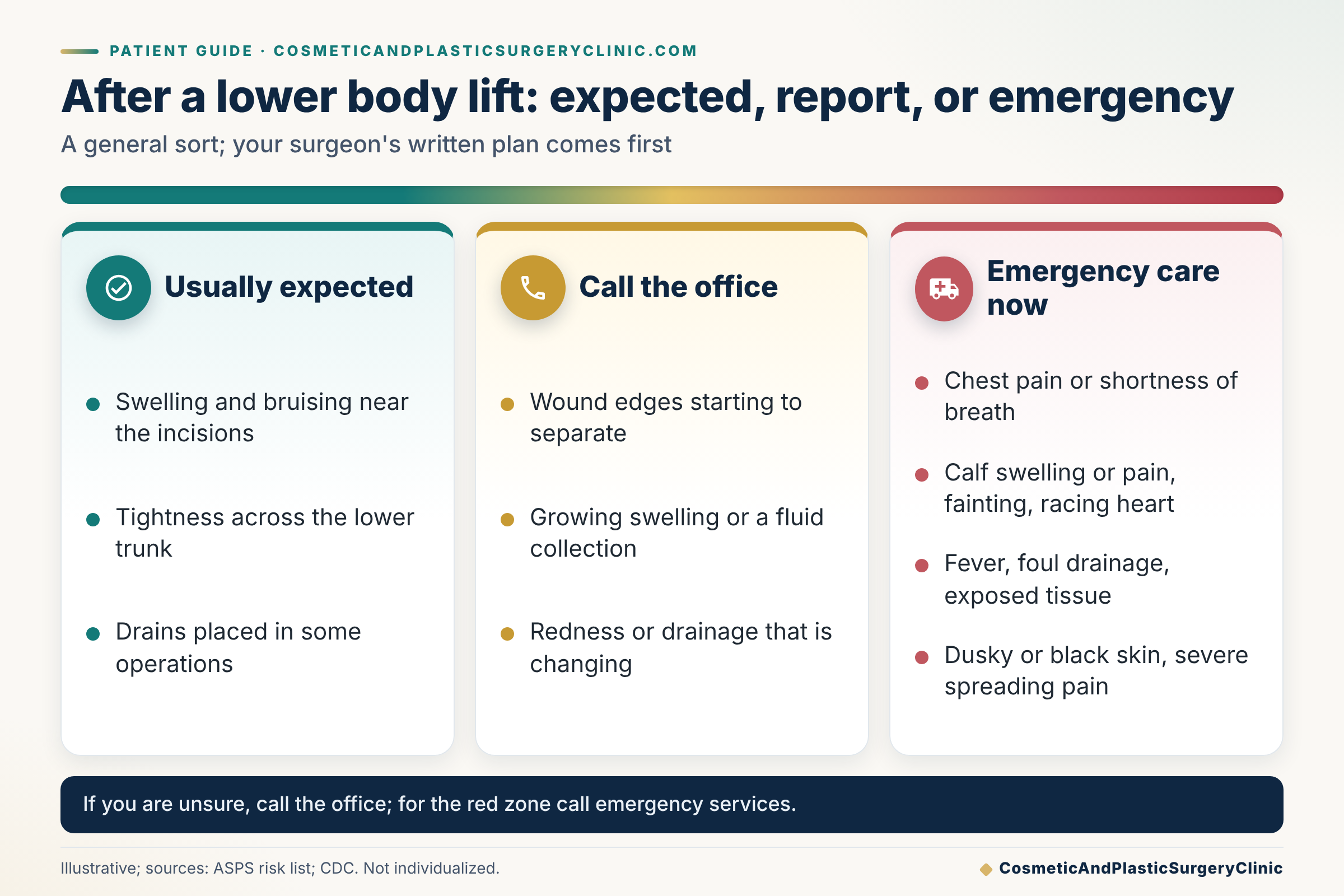
Wound separation is the complication most often reported in the literature, and it ranged from 5% to 60% across the series in the table above, depending on who was studied and what was counted. A small opening is usually managed by the surgical team, so call the office promptly rather than treating it at home. Exposed tissue, spreading redness, fever or foul drainage needs same-day medical evaluation. Ask in advance who answers calls and what the revision policy covers.
Is it normal for two surgeons to propose different scar routes?
Yes. The 2016 systematic review found that all described techniques derived from either belt lipectomy or the lower body lift, with different strengths: belt lipectomy for hip and back rolls, lower body lift for buttock and lateral thigh ptosis. A third design keeps a midline skin bridge. Ask each surgeon why the route fits your anatomy, and compare what each plan leaves untreated, not only how the scars look on paper.
When can the result of a lower body lift be judged?
ASPS says results are visible almost immediately but the final results can take one to two years to fully develop. Early swelling, tightness and scar redness change during that time. Judge the result on the same standing views, from the front, side and back, at similar time points, which is also how to compare any photographs a surgeon shows you. Your surgeon sets the follow-up schedule and the point at which revision is discussed.
Sources and further reading
- American Society of Plastic Surgeons — Body lift (accessed 2026-11-13) — areas treated, contributing factors, liposuction relationship
- American Society of Plastic Surgeons — Body lift procedure steps (accessed 2026-11-13) — anesthesia options, incision patterns, deep sutures, timing of final results
- American Society of Plastic Surgeons — Body lift risks and safety (accessed 2026-11-13) — listed risks and consent statements
- American Society of Plastic Surgeons — Body lift recovery (accessed 2026-11-13) — drains
- American Society of Plastic Surgeons — Body lift candidates (accessed 2026-11-13) — general candidacy criteria
- American Society of Plastic Surgeons — Thigh lift (accessed 2026-11-13) — what a thigh lift treats
- American Society of Plastic Surgeons — Tummy tuck (accessed 2026-11-13) — skin and muscle treated
- American Society of Plastic Surgeons — Plastic surgery statistics report, 2025 (accessed 2026-11-13) — lower body lift counts, glossary definition, GLP-1 consultation survey item
- American Society of Plastic Surgeons — Plastic surgery statistics report, 2024 (accessed 2026-11-13) — earlier lower body lift counts and projection method
- American Society of Plastic Surgeons — New nutrition recommendations after major weight loss, August 2026 (accessed 2026-11-13) — complication range, protein and micronutrient screening, disclosure of weight-loss methods
- American Society of Plastic Surgeons — Nutrition recommendations press release, August 2026 (accessed 2026-11-13) — review title, lower bound of the complication range
- Carloni R et al. — Circumferential contouring of the lower trunk: systematic review, Aesthetic Plastic Surgery, 2016 (accessed 2026-11-13) — belt lipectomy versus lower body lift, evidence levels, dehiscence
- Swanson E — Near-circumferential lower body lift: 40 outpatient procedures, PRS Global Open, 2019 (accessed 2026-11-13) — markings, positions, operating time, complications, scar route
- Gerut ZE — Post-bariatric buttock contouring with autogenous tissue augmentation, Seminars in Plastic Surgery, 2006 (accessed 2026-11-13) — flap technique, 62-patient complications, scar revision
- Sozer SO et al. — Autoprosthesis buttock augmentation during lower body lift, Aesthetic Plastic Surgery, 2005 (accessed 2026-11-13) — abstract on gluteal projection and flap results
- Rezak KM, Samson MC, Newman MI — Body contouring: lower body lift, Bariatric Times (accessed 2026-11-13) — history, markings, positions, BMI, hospital stay
- Aly AS et al. — Belt lipectomy for circumferential truncal excess: the University of Iowa experience, Plastic and Reconstructive Surgery, 2003 (accessed 2026-11-13) — abstract with results and complications
- Losco L et al. — Lower body lift after bariatric surgery: 323 consecutive cases, Aesthetic Plastic Surgery, 2020 (accessed 2026-11-13) — abstract with complication rates and risk factors
- Kitzinger HB et al. — Prospective study on complications following a lower body lift after massive weight loss, JPRAS, 2013 (accessed 2026-11-13) — abstract with 50-patient results
- Constantine RS, Davis KE, Kenkel JM — Effect of massive weight loss on body contouring outcomes, Aesthetic Surgery Journal, 2014 (accessed 2026-11-13) — odds of wound problems by weight-loss amount
- Griffin M et al. — Risk of thromboembolism following body-contouring surgery after massive weight loss, ePlasty, 2015 (accessed 2026-11-13) — operation counts and staging in one hospital
- Balkovic M, Jankovic I — The history of body contouring surgery, InTech, 2016 (accessed 2026-11-13) — Somalo, Gonzalez-Ulloa and Lockwood history
- Paul MD, Wirth G — History of body contouring, IntechOpen, 2021 (accessed 2026-11-13) — belt lipectomy history, liposuction with abdominoplasty statement
- Khan UD — Suction assisted transverse medial thigh lift, IntechOpen, 2021 (accessed 2026-11-13) — medial thigh lift incision and positioning
- Song AY et al. — The Pittsburgh Rating Scale, Seminars in Plastic Surgery, 2006 (copy hosted by a clinic; accessed 2026-11-13) — ten graded body regions
- ASPS, Plastic Surgery Foundation, The Aesthetic Society and ASERF — Gluteal fat grafting safety advisory, August 2022 (accessed 2026-11-13) — ultrasound, subcutaneous placement, deaths across settings
- Anesthesia Patient Safety Foundation — Outpatient surgery: choosing a location (accessed 2026-11-13) — hospital, surgery center and office trade-offs, anesthesia staffing questions
- American Society of Plastic Surgeons — Why an accredited surgery center matters (accessed 2026-11-13) — accrediting bodies and facility questions
- Centers for Disease Control and Prevention — About blood clots (accessed 2026-11-13) — DVT and pulmonary embolism symptoms