

Being a liposuction candidate is not a label you can read off a quiz or a mirror. It is a conclusion a surgeon reaches after examining the tissue, reviewing your health history and hearing what you want to change. Four questions carry most of that conclusion: how well your skin will follow a new contour, how steady your weight has been, which medical conditions and habits affect healing, and whether your goals match what the operation does. This page walks through each one so you can arrive at an exam with better questions.
Liposuction is the most common cosmetic surgical procedure in the United States. The American Society of Plastic Surgeons (ASPS) counted 317,196 procedures in 2025, down 1% from 320,155 in 2024. Popularity says little about suitability, though. Two people can point to the same flank bulge and need different plans, because one has firm skin and a steady weight and the other does not. If you want the full procedure overview first, start with what liposuction changes and what it cannot fix.
Who counts as a liposuction candidate, and who decides?
The word “candidate” sounds like a pass-or-fail result. In practice it works more like a conversation with several possible endings: go ahead, adjust the plan, wait, or choose a different operation. The sections below show what pushes a person toward each ending.
Candidacy is a finding from an examination, not a quiz score
Online checklists can tell a liposuction candidate which questions to expect. They cannot palpate tissue, watch how skin moves, or notice a hernia. Even the professional society’s own advisory on liposuction states that not all patients are appropriate liposuction candidates, and leaves the final judgment to the treating physician for each person.
What the operation is designed to change
Liposuction removes fat from the layer just beneath the skin, using small incisions and thin suction tubes called cannulas. Mayo Clinic lists the abdomen, upper arms, buttocks, calves and ankles, chest and back, hips and thighs, and chin and neck as common treatment areas. The goal is a change in shape, which surgeons call contouring.
It is not a weight-loss method. ASPS says plainly that liposuction is not a treatment for obesity or a substitute for diet and exercise, and Mayo Clinic says people who are overweight can lose more weight through diet, exercise or other surgery. A liposuction candidate, in other words, is usually someone whose weight is not the main issue and whose concern is where a little fat sits.
What a liposuction candidate evaluation looks at
A thorough evaluation usually covers four areas. The surgeon reviews your weight history, pregnancies, prior operations, medicines and nicotine use. The exam looks at skin quality, the depth and firmness of the fat, and symmetry, often with you standing and lying down. Anesthesia and medical clearance come next if the history calls for it. Last is the goals conversation, which is where many plans change.
Consider a hypothetical pair. Both are in their late thirties and bothered by the same lower-flank bulge. One has held a steady weight for years and has firm skin. The other has lost and regained weight twice, with stretch marks over the area. A surgeon could reasonably suggest liposuction to the first, and a different sequence or more waiting to the second. Neither is judged as a liposuction candidate by the bulge alone.
Problems that look like fat but are not
Fullness in the midsection, thighs or neck can come from fat under the skin, from loose skin, from stretched muscle, or from something else. Sorting that out is the first job of the exam, because liposuction treats only one of those.
Skin, muscle, and deep abdominal fat
Fat you can grasp with your hand sits under the skin. Harvard Health describes a different kind, visceral fat, as lying “out of reach, deep within the abdominal cavity,” padding the spaces between organs. Liposuction cannot reach it. A bulge that stays rounded even when the abdominal muscles are tightened can reflect that deeper fat or a stretched muscle wall.
When excess skin or separated muscle is the main story, the discussion usually moves toward an abdominoplasty. Our tummy tuck candidacy article covers that side, and liposuction versus tummy tuck compares the two decisions tissue by tissue.
Cellulite and lipedema: two questions to raise at an exam
Cellulite is surface dimpling, and ASPS states that liposuction is not an effective treatment for it. Mayo Clinic adds that liposuction does not remove stretch marks or treat dimpled skin. If dimples are your main concern, say so early, because the operation may not address them.
Lipedema is a separate matter. The Lipedema Foundation describes it as a clinically diagnosed condition, with a bilateral, symmetrical buildup of fat in the limbs or lower trunk that resists diet and exercise, often with tenderness, easy bruising and small nodules in the tissue. If that description fits you, ask a clinician who evaluates the condition. A diagnosis is a medical question first and a cosmetic one second.

Skin elasticity: the factor a photo cannot show
Fat removal leaves a space, and the skin has to settle into it. How well that happens depends on the skin itself, which is why elasticity sits near the top of every surgeon’s list and why it is the hardest factor to judge from a picture.
How skin quality changes the plan for a liposuction candidate
Think of the skin as a garment cut to fit a larger shape. If the fabric still springs back, a smaller shape underneath looks smooth. If the fabric has lost its snap, it hangs. The details matter more than the metaphor, so here is what the sources actually say.
What “firm and elastic” means in practice
ASPS says people with firm, elastic skin will have better results, and that skin which is soft and thin from stretch marks, weight loss or natural aging will not reshape as well. Its candidate page describes the typical candidate as having firm, elastic skin and good muscle tone. MedlinePlus similarly warns of scarring or “baggy” skin after liposuction, especially in older people.
An older ASPS article on liposuction versus cryolipolysis, from 2017, goes further: liposuction is best suited to minimal skin laxity because it can exacerbate the appearance of loose skin in the treated area. Treat that as a reason for any liposuction candidate to ask, not a verdict. The same body may respond differently at the abdomen, the arms and the inner thighs.
Why age alone is a weak predictor for a liposuction candidate
It is common to hear that skin over 40 will not retract. A 1999 study in Dermatologic Surgery by Bank and Perez tested that belief in 58 patients aged 40 to 75, using tumescent liposuction at the abdomen, neck and arms. At six months the abdominal group averaged about a 3-inch smaller waistline, and cosmetic results were rated good to excellent.
The limits are real. The study was small, mostly women, and measured circumference and weight rather than elasticity directly. It also did not compare age groups. What it does suggest is that a birth date is not a disqualifier. Skin quality at the specific area, which varies by genetics, sun exposure and weight history, is the better question for a liposuction candidate.
When loose skin points to a different plan
Some people discover at the exam that, as a would-be liposuction candidate, their main complaint is skin rather than fat. That finding is useful, not a failure, because it redirects the plan before money and recovery time are spent.
Suction first, skin surgery first, or both
ASPS notes that secondary procedures may sometimes be recommended to reduce excess skin, and that you may need more surgery to remove and tighten it. Surgeons sometimes stage the steps: contour the fat, let the skin settle for months, then judge what remains. Others choose a skin-removing operation that includes some fat contouring. The choice depends on how much skin there is and where the scars would fall.
Neck and jawline are a good example. Fullness under the chin can be fat, a loose platysma muscle band, or skin, and the right answer differs for each. The chin liposuction versus neck lift article works through that anatomy.
Where nonsurgical fat reduction fits and where it stops
In a 2025 ASPS article, a surgeon describes liposuction as always the more dramatic option for fat removal, and nonsurgical options as better for modest changes in a focused area when downtime matters. Cryolipolysis has its own rare complication, paradoxical adipose hyperplasia, in which treated areas produce more fat tissue instead of less.
The same article places radiofrequency devices as a possibility for mild laxity after weight loss or pregnancy. None of these changes the central rule: the less fat and skin laxity involved, the more realistic a lower-intervention option becomes.
| Situation | Pathway often discussed | Benefit | Trade-off | Key question |
|---|---|---|---|---|
| Localized pocket, firm skin, steady weight | Liposuction | Removes more fat in one session than nonsurgical options | Surgical risk, garments, swelling for weeks | Which layer is the fat in, and how much can be removed safely? |
| Small focal pocket, wants no surgery | Nonsurgical fat reduction | No anesthesia, little downtime | Modest change, repeat sessions, rare paradoxical growth | Is my pocket small enough for this to be noticeable? |
| Fat plus mild to moderate loose skin | Staged plan or combined procedure | Addresses both tissue problems | Longer plan, possible scars, more recovery | How will the skin be judged between stages? |
| Marked loose skin or muscle separation | Skin-removing surgery such as a tummy tuck | Treats the tissue causing the shape | Longer scars and recovery | Would suction alone make the skin look worse? |
| Weight still changing | Wait, then reassess | Contours a target that has stopped moving | Delay, and the wait can feel long | What does a stable period look like for me? |
Weight stability: why a steady number matters more than a low one
Surgeons do not ask a liposuction candidate about weight to judge them. They ask because liposuction shapes a body at one moment, and the result is easier to keep when the body is not changing underneath it.
Why surgeons ask whether your weight has settled
A treated area is a snapshot. If weight is still falling, skin may loosen further after the contour is set. If weight is rising, the new shape changes faster than the plan assumed.
Contouring a target that is still moving
An ASPS blog post by a plastic surgeon advises people to reach, or come close to, their target weight and then hold a steady weight long-term before body contouring. The post gives no number of months, and neither does ASPS’s candidate page, so any exact window you are quoted is the surgeon’s own judgment.
One study offers a rough sense of why. In a 2011 retrospective review in Obesity Facts, van der Beek and colleagues looked at 43 patients who had body contouring after bariatric surgery. A stable weight for at least three months before surgery was linked to fewer complications (odds ratio 0.24). That was a different group having different operations, and it was a small sample, so read it as direction rather than a rule for liposuction.
Mayo Clinic puts the after-surgery side simply. Shape changes usually last if weight stays the same, and weight gain may add fat around the abdomen even if that area was not treated.
What studies show about fat after suction
A liposuction candidate often asks whether fat “comes back.” Two small trials give a more textured answer than yes or no, and neither supports the idea that removed cells simply regrow.
A 2012 trial in the Journal of Clinical Endocrinology & Metabolism followed 36 normal-weight women after small-volume abdominal liposuction. The women were randomized two months later to a four-month exercise program or no program. CT scans showed abdominal subcutaneous fat stayed lower at six months. In the group that did not exercise, visceral fat rose by about 10%. Exercise counteracted that rise.
The studies are small and the volumes were modest, so they cannot predict your result. They do explain why surgeons talk about activity and weight maintenance as part of the plan, and why a smaller treated area does not mean a smaller person overall.
Body size, volume, and medicines
Size does not make or break a liposuction candidate by itself, but it shapes how much can be done in one session and in what setting.
BMI as context, not a cutoff
ASPS describes the usual candidate as an adult within 30% of ideal weight, and its older practice advisory calls body mass index a useful way to gauge relative risk and benefit. The same advisory says no scientific data support a specific maximum volume, but recommends an acute-care hospital, or an accredited or licensed facility, for large-volume cases of more than 5,000 cc of total aspirate.
A 2015 analysis in Plastic and Reconstructive Surgery used the ASPS TOPS database of more than 4,500 liposuction patients. Overall complications were 1.5%, with no deaths. Patients with more than 5 liters removed had a 3.7% complication rate versus 1.1% for others, mostly seromas. Lower-BMI patients saw risk climb faster as volume rose, and the authors proposed a BMI-linked volume threshold, not an absolute limit. More detail sits in the liposuction risks article.
Weight-loss medicines and rapid loss
Many adults now take GLP-1 medicines for weight or diabetes. In October 2024, five societies including the American Society of Anesthesiologists published perioperative guidance saying most patients can continue these drugs before elective surgery, while those at high risk of significant stomach and bowel side effects may need a liquid diet beforehand and, rarely, a delay. Individual risk is assessed case by case.
Do not stop or start any medicine on the basis of an article. Tell the surgeon and the anesthesia team exactly what you take. Separately, ASPS notes that significant, rapid weight loss can leave excess, bothersome loose skin, which is a skin-elasticity question as much as a weight one.
| Factor | Effect on the outcome | Maintenance or revision implication | Review point |
|---|---|---|---|
| Weight gain after surgery | Fat can return in other areas, including the abdomen | Treated area may stay smaller while overall shape shifts | Track weight trend at each follow-up |
| Loose skin or aging | Skin may settle less fully than the new contour needs | A later skin-tightening or skin-removal procedure may be discussed | Ask how skin is judged as swelling settles |
| Activity level | In one small trial, women without the exercise program gained visceral fat | Exercise is part of keeping the result, not an extra | Ask what activity plan the surgeon expects |
| Pregnancy | Surgeons quoted by ASPS say a later pregnancy can undo results | Timing usually waits until a family is complete | Raise any pregnancy plans at the first visit |
| Nicotine | Reduced blood flow slows healing and raises infection risk | Relapse during healing can complicate recovery | Disclose all nicotine forms, including vaping |
| Irregularities or asymmetry | Bumps and unevenness can persist after swelling fades | Refinement is judged once healing is complete | See liposuction revision for options |

Health, habits and timing: what can move the date
Skin and weight shape the plan. Health history and life circumstances decide when, or whether, a liposuction candidate should go ahead.
Medical conditions and medicines surgeons review
Liposuction is elective, so a liposuction candidate has room to fix other things first. Surgeons use that room.
Conditions that get reviewed before a date is set
Mayo Clinic says candidates should be in good health without conditions that could make surgery more difficult, and names blood flow problems, coronary artery disease, diabetes and a weak immune system. MedlinePlus lists heart problems, high blood pressure, diabetes, lung problems, allergies, and tobacco, alcohol or drug use as things to have checked and under control before liposuction.
The wording matters. “Under control” is not “absent.” A person with well-managed diabetes may be treated very differently from one with unmanaged diabetes, which is why a primary-care or specialist letter is sometimes requested before a date is set.
Medicines, supplements and the anesthesia conversation
Medicine lists matter for a liposuction candidate because of what the operation involves. Mayo Clinic lists lidocaine toxicity, which can affect the heart and nervous system, among liposuction risks, and notes that larger treatment areas or combined procedures raise the overall risk. Anesthesia choices range from local to general, and the anesthesia provider will ask about everything you take, including supplements and anything bought over the counter.
Bring the actual bottles or a photo of each label. Memory fails on dose and on the supplement you take “only sometimes,” and those are precisely the gaps that cause surprises. For general consultation preparation, see our plastic surgery consultation guide.
Nicotine, pregnancy and your calendar
Two of the most common reasons for a delay have nothing to do with the shape of the body. They are what is in the bloodstream and what is on the family calendar.
Nicotine in every form: a common reason a liposuction candidate waits
ASPS lists nonsmokers and non-vapers as the typical candidate, and a 2017 ASPS article asks liposuction candidates to stop tobacco or nicotine for several weeks before and after surgery. A patient page on the American Society of Anesthesiologists’ site explains the reason: smoking reduces blood flow, which slows healing and makes an incision more likely to become infected.
Nicotine patches and gum still deliver nicotine, and some practices test for it. If you slip during the window, say so promptly. A postponed date is an inconvenience. Treating skin that lost its blood supply is a much larger one.
Pregnancy, breastfeeding and finishing a family
In a June 2026 ASPS article on post-pregnancy surgery, one surgeon says liposuction and body contouring should wait until a patient is fully recovered, hormonally stable and ideally near her goal weight, which typically means at least six months postpartum and longer if breastfeeding. A colleague says the body keeps changing for up to a year after delivery. The first surgeon also advises waiting until the family is complete, because a future pregnancy can undo results.
These are expert opinions, not a trial, and they describe a typical pattern rather than a rule. If you are combining several procedures after childbirth, the mommy makeover guide explains how those plans are built.
Expectations: separating a realistic goal from a promise
A body that qualifies medically can still be a poor match if the goal and the operation do not line up. Expectation fit is a safety topic, not a mood check, because a mismatch between the goal and the operation is something a consultation can catch before surgery.
What a realistic goal sounds like for a liposuction candidate
Specific beats ambitious. The more precisely a prospective liposuction candidate can describe the change, the easier it is for a surgeon to say yes, no, or “differently.”
Specific, local and measurable
ASPS describes the typical liposuction candidate as having a positive outlook and specific goals for body contouring, and says the choice should be made for yourself rather than to meet someone else’s wishes or an ideal image. MedlinePlus is more blunt: liposuction may enhance appearance and self-confidence but will probably not give you your ideal body shape.
Consider a hypothetical goal: “I would like the roll above my waistband to be flatter in fitted trousers.” That names an area, a visible change and a context. Compare it with “I want to look the way I did at 25.” The first can be discussed against anatomy. The second cannot be answered by any operation, and a careful surgeon will say so.
Promises that should slow you down
Several claims should prompt more questions rather than trust. A surgeon who says everyone qualifies has skipped the exam. A result described in exact inches or pounds before an examination has skipped the tissue. Pressure to put down a deposit for a discounted date skips the cooling-off time that an elective decision deserves.
Liposuction results depend on healing, skin and weight, none of which a surgeon controls entirely. Language that treats the outcome as certain tells you about the sales process, not the surgery. The guide to choosing a plastic surgeon covers how to verify credentials and facilities before you get that far.
What surgery cannot control
Every operation has a zone that skill does not reach. Knowing the borders in advance is part of being a realistic liposuction candidate.
Healing, asymmetry, sensation and later weight change
Mayo Clinic lists contour irregularities such as bumpy or wavy skin, seromas that may need needle drainage, numbness that can be temporary or lasting, infection, internal organ puncture and fat embolism, the last two of which need emergency care. ASPS adds changes in pigmentation, uneven contours and the possibility of revision. Bodies also heal asymmetrically, because the two sides of a person were never identical to begin with.
Timing is part of expectation, too. Mayo says swelling typically settles within a few weeks and the area should look slimmer within several months, and an ASPS recovery table places the start of visible swelling subsiding around weeks four to five. The week-by-week picture is in the liposuction recovery article.
Why photos and quiz tools cannot establish candidacy
A photograph flattens depth, hides skin texture, and freezes one posture and one light. Apps that simulate results can draw a contour without any knowledge of your tissue. Photos are useful as a conversation aid, for showing a surgeon what bothers you, and the table below shows what they cannot answer.
| Question | From photos or a quiz | At an in-person exam |
|---|---|---|
| How elastic is the skin? | Surface appearance only | Skin movement, thickness, stretch marks and recoil assessed by hand |
| Is the bulge fat under the skin? | Cannot separate fat, skin and muscle | Layer and depth identified, seated and standing |
| Is there muscle separation or a hernia? | Not reliably visible | Examined with muscles tensed and relaxed |
| How symmetric is the body? | Depends on pose and camera angle | Measured and marked, with differences documented |
| Are medicines or conditions a problem? | Not visible at all | History, medication list and clearance review |
| Has weight been stable? | One moment in time | Weight history discussed, with older photos as support |
Photos of other people cannot show that you are a liposuction candidate, either. Before-and-after galleries show selected results, in selected light, at unknown timing. How to look at them critically is covered in how to read liposuction before-and-after photos.
Motivation, mood and the question of timing
Surgeons often ask a liposuction candidate why they want this now. The question is not an obstacle. Answers shape whether to go ahead, wait or involve another professional.
Doing it for yourself, on your calendar
A wedding, a reunion, a breakup or a comment from a relative can all start the search. They are poor reasons to set a date, because recovery involves swelling and restricted activity that rarely fits a deadline. If the main driver is an event, ask what you would decide without the event. Waiting costs very little with an elective operation, and our broader piece on whether an elective procedure is worth the trade-offs covers how to say “not now.”
Body dysmorphic disorder and when to pause
Body dysmorphic disorder, or BDD, is a recognized mental health condition in which a person is preoccupied with perceived flaws in appearance that others barely notice. A 2024 meta-analysis of 65 studies in the journal Healthcare estimated pooled prevalence at 18.6% (95% confidence interval 15.1% to 22.4%) among patients in aesthetic and reconstructive plastic surgery. The authors list publication bias, differing screening tools and reporting variation among their limits.
The point is not to suspect anyone. It is that BDD is treatable, and cosmetic surgery is not designed to treat it. If you recognize hours of daily distress about one body part, a mental health professional is a reasonable first stop, and any careful surgeon will welcome that step.
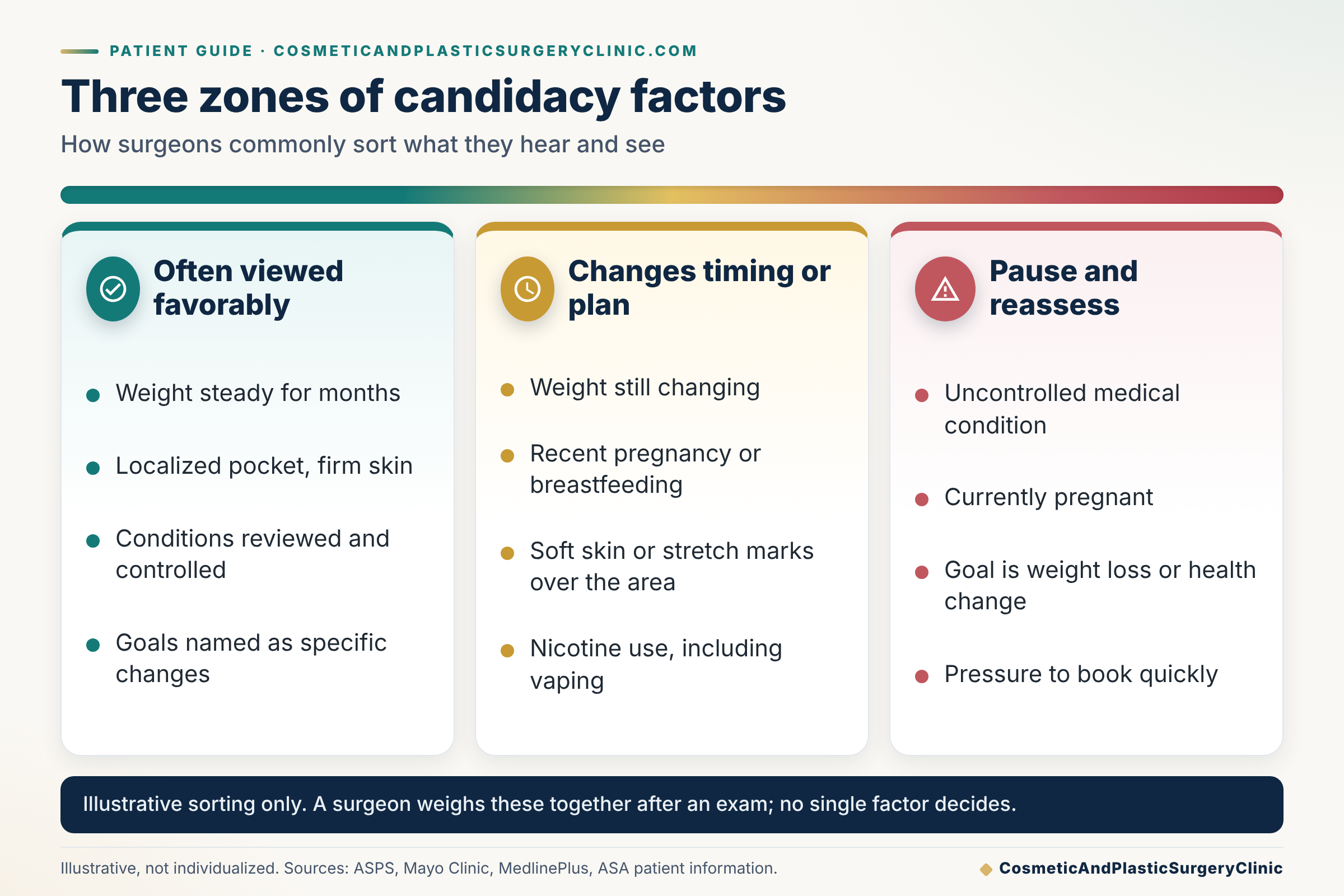
From a liposuction candidate checklist to a consultation decision
The last step is turning understanding into questions that only an exam can answer, and into a decision that you are comfortable owning.
Questions that need an examination
A liposuction candidate should bring questions that produce specific answers about your body, not general reassurance. A good answer names a tissue, a number or a trade-off.
Anatomy, technique and volume
- Which layer is the fat in, and is any of this bulge skin or muscle instead?
- How would you describe my skin elasticity in each area we discussed?
- Roughly how much do you expect to remove, and how does that compare with volume limits for my size?
- Which technique do you use for this area and why? (See liposuction techniques.)
- What would make you stop, stage the plan or recommend a different operation?
Facility, anesthesia, cost and aftercare
The ASPS practice advisory says liposuction under more than minor local anesthesia belongs in an accredited, Medicare-certified or state-licensed facility, and that surgeons who perform it must be trained as surgeons. Ask who gives the anesthesia, where the operation takes place, and what the accreditation is.
On cost, the ASPS liposuction page gives an average surgeon’s fee of $4,711 and states that it does not include anesthesia, operating-room facilities or other related expenses. It does not give the year the average refers to, so treat it as an orientation figure only. The liposuction cost article breaks down the other lines of a quote.
When to wait, get a second opinion, or choose another route
Sometimes the most protective result of a consultation for a liposuction candidate is “not yet.” Seeing that as a good outcome rather than a rejection keeps pressure off the decision.
Seven mistakes a liposuction candidate can avoid before booking
- Treating a BMI or scale number as the only gate, in either direction.
- Assuming skin will tighten without evidence from an exam of your skin.
- Expecting liposuction to work as weight loss or as a health intervention.
- Choosing the body area before the tissue problem is identified.
- Leaving out nicotine in any form, supplements or over-the-counter medicines.
- Letting a filter, an app or someone else’s photos stand in for an exam.
- Booking while weight, pregnancy plans or major life events are unsettled.
Second opinions and saying “not yet”
If two surgeons disagree about whether you are a liposuction candidate, the disagreement is information. One may see enough skin laxity to suggest a skin-removing procedure while another expects suction alone to be enough. Ask each to show you the reasoning on your own body. The article on liposuction versus tummy tuck lays out how that particular fork is usually reasoned through.
Write down the open items from each visit: a medical review, a weight plateau, a pregnancy plan, a cost you cannot yet cover. Treat them as the checklist for returning, not as personal failings. The option to do nothing remains available.
Frequently asked questions
Can a liposuction candidate be over 60?
Age is one input, not a cutoff. ASPS counted 55,735 liposuction procedures in people aged 56 to 65 in 2025, up 13% from 2024, and 23,325 in people 66 and older, up 16%. Those counts show how many people chose the operation, not whether it suited each of them. At that age, surgeons usually put more weight on medical conditions, medicines, anesthesia tolerance and skin quality than on the birth date itself. Your own physician’s view of your general health is part of the assessment.
Could liposuction improve my blood sugar or cholesterol?
One small, well-known study found it did not. In 2004, Klein and colleagues in the New England Journal of Medicine studied 15 obese women, about half with type 2 diabetes, who had roughly 9 to 10.5 kilograms of fat removed. Ten to 12 weeks later, insulin sensitivity, blood lipids, blood pressure and inflammatory markers had not significantly changed. The authors concluded that removing fat alone does not produce the metabolic benefits seen with weight loss. Liposuction is a contouring operation, not a treatment for diabetes or heart risk.
Is a male liposuction candidate evaluated differently?
ASPS candidate criteria are not written separately for men and women. The 2025 ASPS report counted 18,938 liposuction procedures in men, roughly 6% of the 317,196 total, down 8% from 20,684 in 2024. The same questions apply: skin, weight stability, health, nicotine and goals. Mayo Clinic notes liposuction can sometimes reduce extra breast tissue in men, though what is causing the fullness needs a clinical exam before anyone assumes it is fat alone.
What if two surgeons disagree about whether I am a liposuction candidate?
Treat the difference as data. Ask each surgeon which tissue they believe is responsible, which finding drove the recommendation, and what they would do if their first choice did not work. A disagreement often reflects a judgment call about skin laxity or volume rather than a mistake by either one. If you remain unsure, a third opinion from a board-certified plastic surgeon is reasonable, and nothing requires you to decide within a set number of days. Waiting costs little in an elective setting.
Will insurance pay once a surgeon calls me a liposuction candidate?
Generally not. The ASPS liposuction cost page states that most health insurance plans do not cover liposuction or its complications, and that its average surgeon’s fee excludes anesthesia and facility charges. Coverage rules differ by plan, so a written answer from your insurer matters more than a verbal one. Ask the plan for its position in writing before paying a deposit, and ask the practice for an itemized quote.
Can chin or neck fat make someone a liposuction candidate?
Sometimes, but the neck has its own anatomy. Mayo Clinic lists chin and neck among treatment areas, and in the 1999 Bank and Perez study, 20 neck liposuction patients, with a mean age of 57, averaged a 1.3-inch smaller neck circumference at six months. Fullness may also come from a loose platysma band or from skin, which suction does not address. Ask any surgeon you consult how they separate those causes.
What should a liposuction candidate gather before a consultation?
Collect a short weight history with approximate dates, a list of every medicine and supplement with doses, any past operations, and your plans for pregnancy or major weight changes. Photos of the area from a few past points can help, as long as you understand they supplement the exam. Write down two or three specific goals in one sentence each. Having this on paper shortens the history portion and leaves more of the visit for your questions.
Sources and further reading
- American Society of Plastic Surgeons — Liposuction (accessed 2026-11-12) — firm elastic skin, not for obesity or cellulite, possible need for skin surgery
- American Society of Plastic Surgeons — Liposuction candidates (accessed 2026-11-12) — weight, skin, health, nonsmoker and goals criteria
- American Society of Plastic Surgeons — Liposuction safety (accessed 2026-11-12) — risk categories, volume above five liters, secondary skin procedures
- American Society of Plastic Surgeons — Liposuction cost (accessed 2026-11-12) — average surgeon fee, exclusions, insurance statement
- American Society of Plastic Surgeons — Liposuction recovery (accessed 2026-11-12) — swelling timeline and garments
- American Society of Plastic Surgeons — 2025 Plastic Surgery Statistics Report (accessed 2026-11-12) — liposuction volumes by year, sex and age
- American Society of Plastic Surgeons — Executive Summary on Liposuction, practice advisory approved 2003 (accessed 2026-11-12) — patient selection, BMI, facility and volume statements
- American Society of Plastic Surgeons — Post-pregnancy plastic surgery, June 2026 (accessed 2026-11-12) — surgeon opinions on timing after pregnancy
- American Society of Plastic Surgeons — Cryolipolysis vs liposuction, September 2025 (accessed 2026-11-12) — nonsurgical comparison, rare paradoxical adipose hyperplasia
- American Society of Plastic Surgeons — Liposuction or CoolSculpting, September 2017 (accessed 2026-11-12) — skin laxity and nicotine statements (older article)
- American Society of Plastic Surgeons — Body lift candidates (accessed 2026-11-12) — loose skin after rapid weight loss
- American Society of Plastic Surgeons — When is the right time for body contouring after major weight loss, 2018 (accessed 2026-11-12) — steady-weight advice
- Mayo Clinic — Liposuction (accessed 2026-11-12) — treatment areas, risks, conditions, results and weight gain
- MedlinePlus — Liposuction (accessed 2026-11-12) — conditions to control first, baggy skin, outlook
- Wolters Kluwer — How much liposuction is safe, 2015 Plastic and Reconstructive Surgery study (accessed 2026-11-12) — TOPS complication data by volume and BMI
- Hernandez et al., Obesity 2011 — Fat redistribution following suction lipectomy (record, accessed 2026-11-12) — trial design and regional fat results
- ScienceDaily — University of Colorado news on fat return after liposuction, 2011 (accessed 2026-11-12) — authors’ comments on the trial
- Benatti et al., Journal of Clinical Endocrinology & Metabolism 2012 (accessed 2026-11-12) — visceral fat after small-volume liposuction
- Klein et al., New England Journal of Medicine 2004 — record of abstract (accessed 2026-11-12) — no metabolic change after large-volume liposuction
- Bank and Perez, Dermatologic Surgery 1999 — Skin retraction after liposuction in patients over 40 (accessed 2026-11-12) — circumference changes by site
- van der Beek et al., Obesity Facts 2011 — complications after body contouring in post-bariatric patients (accessed 2026-11-12) — stable weight and complications
- American Gastroenterological Association — Multisociety GLP-1 perioperative guidance (accessed 2026-11-12) — continuation and individual risk assessment
- Healthcare 2024 — Body dysmorphic disorder in aesthetic and reconstructive plastic surgery, meta-analysis (accessed 2026-11-12) — pooled prevalence and limits
- American Society of Anesthesiologists — Smoking and surgery (accessed 2026-11-12) — blood flow, healing and infection
- Lipedema Foundation — Diagnosing lipedema (accessed 2026-11-12) — clinical diagnosis and typical signs
- Harvard Health Publishing — Abdominal fat and what to do about it (accessed 2026-11-12) — visceral versus subcutaneous fat


