

Anyone can type “plastic surgeon” into a website bio. That is the first complication in learning how to choose a plastic surgeon: the credentials that carry weight are spread across several different databases, and each one answers a different question. Is this person licensed? Certified by which board? Operating in what kind of room? With whom managing the anesthesia?
This page is a verification manual, not a ranking. It doesn’t name surgeons, and it can’t tell you who suits your face, your body or your goals. Taste, rapport and procedure-specific expectations belong in the room with a clinician, and the consultation questions page covers that conversation. What follows are the checks you can finish at a desk in an evening, before you book anything or pay a deposit.
What the Words on a Website Can and Cannot Prove
Ads and bios lean on a handful of credential words that sound interchangeable. They aren’t, and the differences decide what you should look up.
License, certification and title are three different things
Start by pulling apart the three words that marketing copy tends to blur together.
A license is permission; certification is a specialty credential
A state medical license is what allows a physician to practice medicine in that state. The American Board of Medical Specialties (ABMS) notes that physicians must pass the United States Medical Licensing Examination to be licensed, but a license by itself doesn’t say which specialty someone trained in. The American Society of Plastic Surgeons (ASPS) puts the consequence bluntly: any medical doctor can call themselves a plastic surgeon.
Board certification is the specialty layer. The American Board of Plastic Surgery (ABPS) describes its certification as voluntary and says certified surgeons completed appropriate training and passed written and oral examinations. Voluntary cuts both ways. ABPS lists several reasons a surgeon might not hold its certificate, from not meeting its training requirements to training outside the U.S. or Canada, osteopathic surgical training, or not taking or passing the exam.
So “not certified” is a prompt for a specific question, and some answers are more reassuring than others. For elective surgery under anesthesia, the ASPS practice advisory on office-based surgery says the physician should be board-certified in a surgical specialty recognized by the ABMS, with plastic surgery as its example.
Why a “cosmetic surgery” certificate needs a second look
ASPS states that no ABMS-recognized certifying board has “cosmetic surgery” in its name. ABMS, for context, is the umbrella for 24 member boards covering 38 specialties and 90 subspecialties. A certificate from a board outside that group isn’t automatically meaningless, but it means you can’t assume the training and testing match, and ABPS itself suggests consumers compare other boards’ requirements with its own.
There’s a fair counterpoint. ABPS acknowledges that residencies in other specialties include some plastic surgery, using otolaryngology and head-and-neck work as its example. A surgeon certified by a different ABMS board may be entirely appropriate for an operation within that board’s territory. In practice, how to choose a plastic surgeon is never a question about whether the title is right, but whether the verified training matches the operation you’re considering.
The page on plastic surgeon versus cosmetic surgeon titles works through the vocabulary; here the working rule is simple. If a bio names a board you don’t recognize, get its full name and compare its requirements before you read another word of the website.

What an ABPS certificate stands for
Anyone learning how to choose a plastic surgeon should know what the certificate’s pathway involves, because a certificate is only as informative as the training behind it.
Two training routes that both end in a plastic surgery residency
According to the ABPS 2026-27 training requirements, there are two main routes. In the integrated model, residents match from medical school into a six-year plastic surgery program with 288 clinical weeks. In the independent model, residents first complete prerequisite surgical training, commonly at least five progressive years of general surgery, then enter a three-year plastic surgery program. Plastic surgery training must happen in the United States or Canada, and certification in another specialty doesn’t exempt anyone from the ABPS examination process.
ASPS summarizes the same floor for its members as at least six years of surgical training after medical school, including at least three years of plastic surgery residency. Practical translation: a bio that mentions a general surgery residency, or a one-year aesthetic fellowship, hasn’t yet described a plastic surgery residency. It might exist, and it might not. Ask for the program name and the years.
Exams, the ten-year clock and why status is a snapshot
ABPS says certificates issued since 1995 are valid for ten years, and certified surgeons must meet continuous certification requirements to renew. The same page notes that certification can be suspended or revoked if a medical license is suspended or revoked, because an active, unrestricted license is a condition of holding it. If ABPS learns of a state medical board action, its public status column shows an alert pointing to the Federation of State Medical Boards.
That detail changes how to read a bio. A certificate framed on a wall, or a logo on a website, records a moment. The ABPS search shows the status today, and it’s worth noting the date you looked so you can see later whether anything moved between your consultation and your surgery date.
Running the Lookups: A Sequence That Fits in One Evening
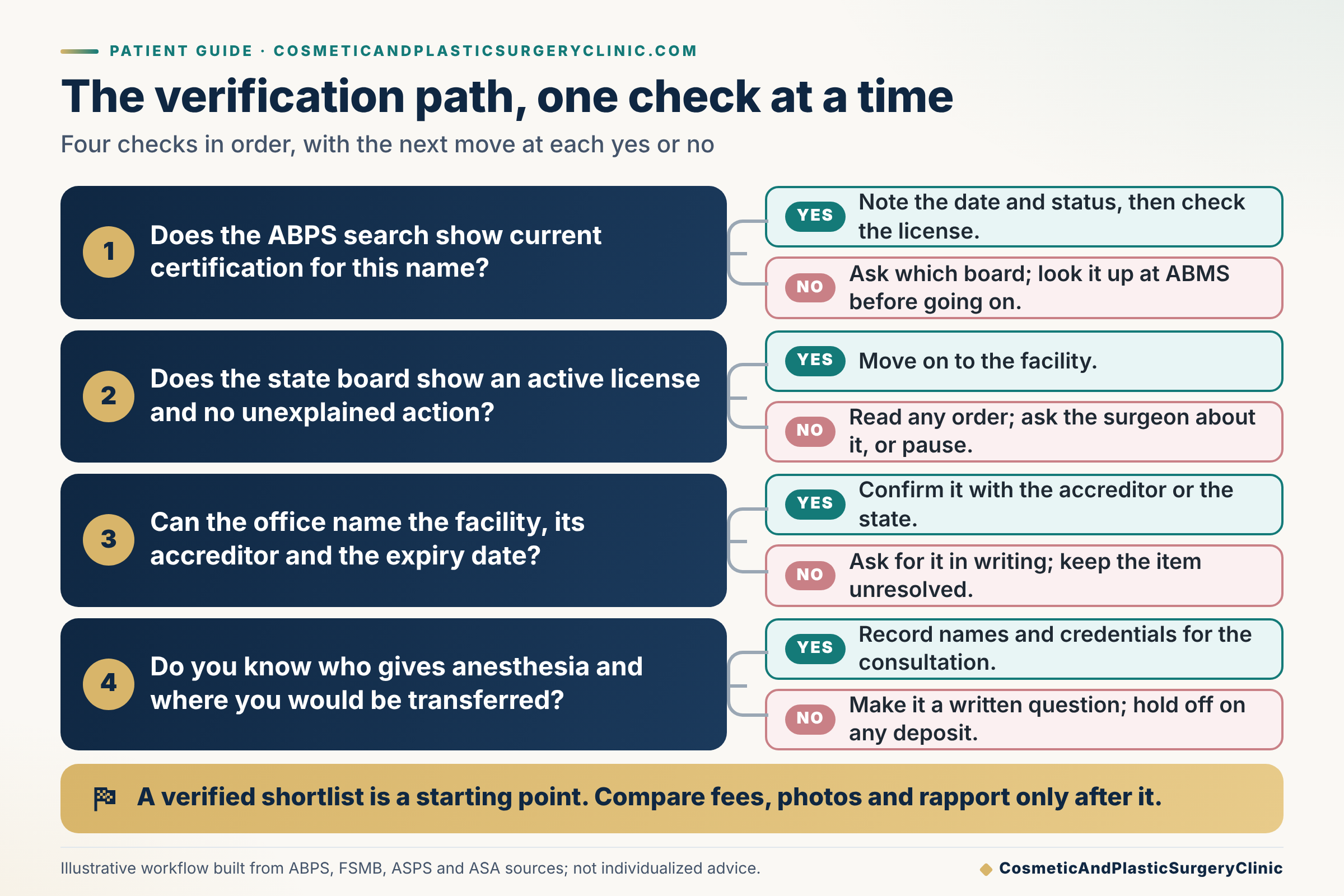
Sequence matters in how to choose a plastic surgeon, because each check can end the search early. There’s little point studying a facility’s accreditation if the plastic surgeon’s license has a problem. Save a screenshot or a note with the date for every lookup; you’ll want them if two shortlist names blur together a week later.
How to choose a plastic surgeon from a shortlist: the two lookups that come first
Both are free, both take minutes per name, and they answer separate questions.
Searching the ABPS directory by name or by location
The ABPS “Is your surgeon certified?” page lets you search by last and first name, or by city, state and country with a ZIP code radius of 0, 5, 10, 20 or 50 miles. The results include a certification status column. ABPS calls itself the primary source of verification for its surgeon records, and for surgeons certified in other specialties it points to the ABMS directory at certificationmatters.org.
ASPS membership offers a second angle. ASPS says U.S. member surgeons must be ABPS-certified when they apply, and its Find a Surgeon tool is a quick cross-check. Treat it as a cross-check only. Membership is a separate organization’s roster, and the status that matters most, today’s certification, lives with the board.
Reading a state license and discipline record
Your state medical board can tell you whether a physician is currently licensed in good standing, whether discipline has ever been imposed, and whether formal charges are pending. The Federation of State Medical Boards describes its DocInfo database as a free national repository covering disciplinary actions, license history, medical school and ABMS specialty. Its consumer guide draws on information from state boards in 2020 and tells readers to contact individual boards for current details, so use the board in the state where the surgery will happen as your final word.
Read the order itself, not just the existence of one. Discipline can range from a paperwork lapse to a finding about patient care, and the difference matters to you. FSMB also cautions that malpractice figures need context, because years in practice, specialty, patient mix and location can all change the number and size of judgments. A clean record, in other words, means no documented problem. It is not a quality score.
When the results don’t line up
Mismatches are common and usually dull. A few are worth a phone call.
Gaps and mismatches that deserve a direct question
Name variants come first: a legal name that differs from the marketing name, a hyphenated surname, a middle name used in one database and not the other. If you can’t find a match, ask the office for the surgeon’s full legal name and license number rather than assuming the worst.
Then there’s the language of “board eligible,” which shows up in some bios and facility rules. The Anesthesia Patient Safety Foundation notes that one major accreditor accepts surgeons who are board certified or board eligible in an ABMS surgical or anesthesia specialty, so eligibility can be a real, temporary status for a recent graduate.
Meanings vary by board, so ask which exam is pending and when it’s scheduled. A fellowship claim also won’t appear in the ABPS search; ask for the program’s name. If a status reads lapsed or carries a “See FSMB” alert, ask about it plainly and then read what the state board shows.
What no database can tell you
None of these records shows how often a surgeon performs your particular operation, how recently, or how their patients fared. Certification is specialty-wide, not procedure-specific. A certified plastic surgeon may spend most of their week on breast reconstruction and rarely do a rhinoplasty, or the reverse. ASPS’s own consultation checklist includes the question how often have you performed this procedure, especially recently, and a second one that gets asked less often: will you perform my procedure, and if not, what do you delegate and why.
Those answers can’t be looked up, which is why the lookups filter a list and don’t answer how to choose a plastic surgeon on their own.
| Lookup | What it confirms | What it leaves open | Question to ask next |
|---|---|---|---|
| ABPS “Is your surgeon certified?” search | Current ABPS certification status; alert if a state board action is known | Skill with a specific operation; volume; outcomes | How often have you done this operation in the past year? |
| ABMS directory (certificationmatters.org) | Certification by any of the 24 member boards | Whether that board’s training covers your procedure | What was your residency, and who trained you in this operation? |
| State medical board profile | License status, discipline history, pending charges | Quality of care; what an order’s wording means in practice | Can you tell me about this action and what changed afterward? |
| FSMB DocInfo | License history across states, school, listed specialty | Anything recent that the state board hasn’t reported yet | Are you licensed in the state where I’ll be treated? |
| ASPS Find a Surgeon | ASPS membership, which requires ABPS certification at application | Today’s certification status; non-members aren’t listed | Does ABPS show the same status today? |
Where the Operation Happens: Facility, Privileges and Anesthesia
A verified surgeon can still be working in a room you know nothing about. The International Society of Aesthetic Plastic Surgery (ISAPS) tells patients to verify that the surgeon uses an accredited hospital or outpatient facility, and ASPS lists an accredited surgical facility among its “nonnegotiable” credentials. The checks in this section are the ones most often skipped, partly because nobody puts them on a billboard.
Accreditation, state licensing and Medicare certification
Three different routes can make a surgical setting acceptable, and they’re easy to mix up.
Who reviews office and surgery-center operating rooms
The ASPS advisory says that plastic surgery beyond minor local anesthesia or minimal oral tranquilization should take place in a facility that is accredited by a national or state-recognized agency, certified for Medicare participation, or licensed by the state. ASPS repeated that three-option structure in its 2024 surgeon credentials checklist. The accrediting organizations you’ll meet most often are summarized below.
| Route | What the sources say | How to confirm it |
|---|---|---|
| Quad A (called AAAASF until 2022) | Traces to 1980; APSF describes a focus on office-based facilities and a three-year accreditation cycle | Ask for the facility’s legal name and expiration date, then confirm with the accreditor |
| The Joint Commission | Office-Based Surgery program introduced in 2001; on-site survey every three years | Ask for the certificate, then confirm directly with the accreditor |
| AAAHC and ACHC | Both appear on California’s list of approved accreditation agencies | Check your state board’s list, if it publishes one, and ask the facility for current dates |
| Medicare certification | Listed by ASPS as an alternative to private accreditation | Ask the facility to state it; confirm with the Medicare program or state health department |
| State license | Rules differ by state; some states don’t license every kind of surgical office | Look up the facility on your state health department’s license search |
Two caveats from the sources keep this from being a simple ranking. Accreditors aren’t interchangeable in what they require: APSF reports that the Joint Commission and AAAHC will not accredit a freestanding surgery center that lacks a state license where the state licenses such centers, while AAAASF doesn’t require one.
And state law is uneven. A 2006 AHRQ PSNet review found only 19 states had statutes, regulations or guidelines for office-based anesthesia, and most states did not then require accreditation of office practices. That is a dated snapshot, and rules have changed since, but it’s the reason to check your state rather than assume.
Confirming that a claim is current, not just printed
“Our accredited surgical suite” on a website is a claim. Ask the office for three things in writing: the facility’s legal name and address, the name of the accrediting or licensing body, and the expiration date. Then confirm with that body or your state.
California illustrates what a good public check looks like. Its law requires an accredited, licensed or certified setting when anesthesia is used at doses with a probability of placing a patient at risk of losing life-preserving protective reflexes, and accrediting agencies must inspect each setting at least once every three years.
The Medical Board of California publishes a searchable outpatient surgery setting database showing status (current, revoked, suspended, on probation or reprimanded), accrediting agency and effective and expiration dates. Even this database carries a caveat, since it does not include every Medicare-certified setting and the page notes updates not yet entered. Other states have different rules, and some have no public lookup, so the paper trail from the facility itself matters.
Privileges, anesthesia and a plan for the bad day
The facility is the building. These checks are about the people and the plan around it.
Hospital privileges as an outside check on the plastic surgeon
The ASPS office-based advisory states that the physician performing a procedure should have approved hospital privileges for the procedure, wherever the facility is located. A hospital’s credentialing process runs separately from the surgeon’s own marketing, which is why it works as an independent check on qualifications. ASPS’s separate 2012 document on clinical privileges adds a useful nuance: board certification is distinct from licensure, and it does not by itself equal total qualification for privileges. In other words, privileges for your exact operation are an additional fact, not a synonym for certification.
Ask which hospital, for which operations, and which hospital would receive you if something went wrong during or after the procedure. Offices don’t always volunteer the second part, and how far away that hospital is matters if you’re recovering at a rural surgery center. The risks page explains what separates an expected effect from a complication; this page only asks whether a transfer plan exists.
Who gives the anesthesia, and who watches you while it does
Anesthesia is its own safety topic with its own staffing. The American Society of Anesthesiologists (ASA) statement on moderate sedation, last amended in October 2021, says the person monitoring the patient should be a different person from the one performing the procedure and calls single-operator sedation unsafe. That statement addresses moderate sedation given by practitioners who aren’t anesthesia professionals, but the principle gives you a useful question: whose attention is entirely on me while the surgeon is operating?
Societies differ on staffing models. ASA has advised patients to make sure their anesthesia care is led by a physician anesthesiologist, while many facilities staff with nurse anesthetists. You don’t have to settle that debate.
Get the provider’s name and credential, ask what monitoring and rescue equipment is in the room, and ask whether the team uses the World Health Organization surgical safety checklist or an equivalent, a step ISAPS encourages patients to ask about. Bring your full medication list to the anesthesia conversation, including supplements. Anything about your own health history or drug choices belongs with your clinicians; an article can’t weigh it.
Reading Ads, Galleries and Reviews Without Being Steered
Verification protects you from false credentials. Marketing literacy protects you from true credentials used as decoration. The two skills overlap less than people expect.
Credential language in bios and ads
Most misleading phrasing isn’t false, just incomplete.
Phrases that sound official and name nothing
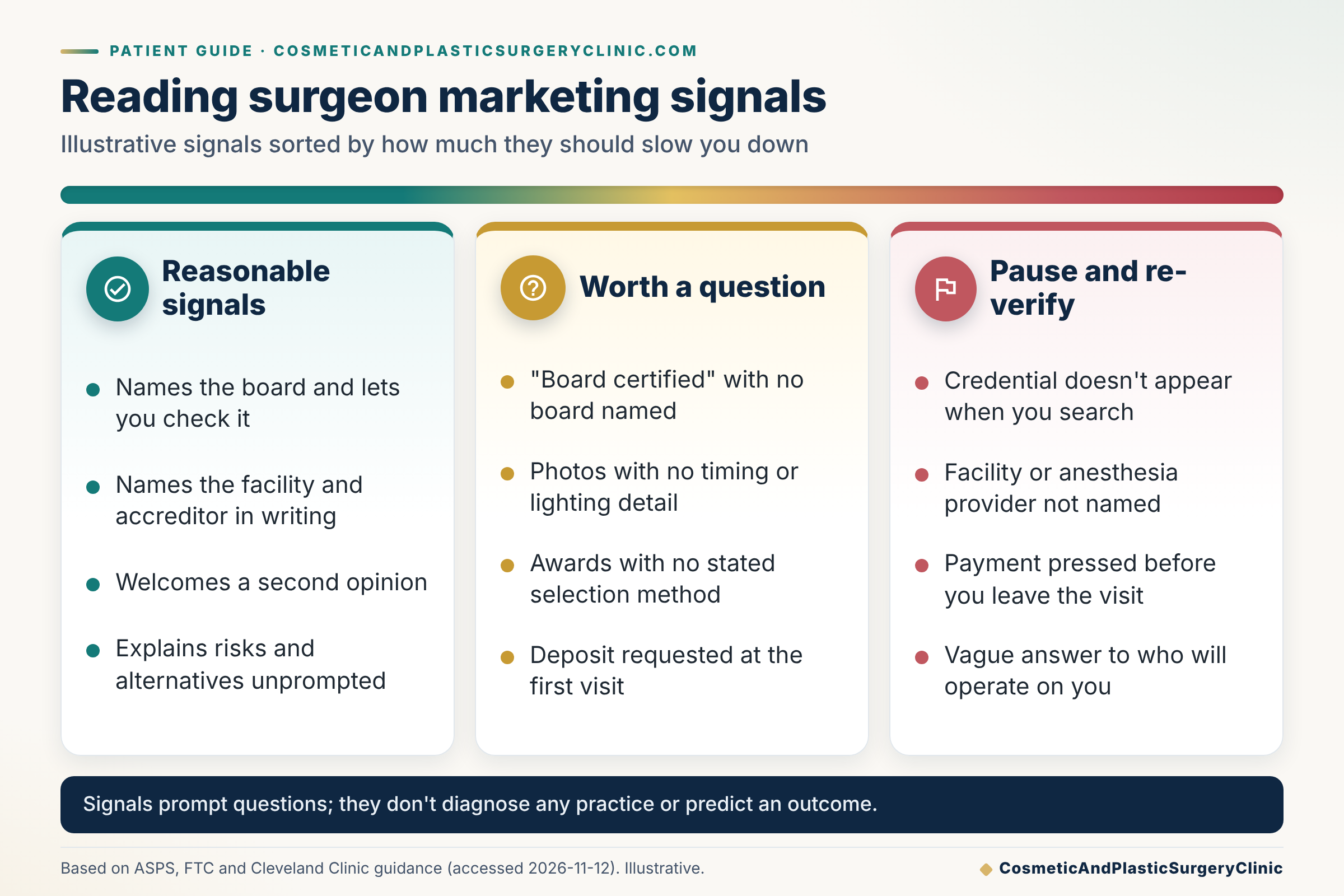
“Board certified” with no board named is the classic. The phrase is only checkable once you know which board, so the first move is always to ask. The same goes for “member of” and “fellow of” lines. Belonging to an organization is not certification, and a fellowship is a training claim you verify by asking for the program. ASPS advises treating other official-sounding boards with skepticism for this reason.
“Top doctor” badges and award logos deserve a different kind of question: who issues it, how were recipients chosen, and did the surgeon pay for the right to display it? Selection methods differ widely, and the answers tell you what the badge is worth. It isn’t a credential, and it doesn’t replace a database lookup.
What a gallery shows and what it leaves out
A before-and-after gallery is a curated set, and it can’t verify anything about the plastic surgeon’s training or the operating room. If you’re using photos to judge technique, the page on reading before-and-after photos covers lighting, angles, timing and selection. From a verification standpoint, two questions are enough.
First, did the plastic surgeon you’ll meet perform the operations pictured, or were they done by an associate or a former colleague? That is the delegation question ASPS recommends asking. Second, can you see results for people with a similar starting anatomy and similar goals, as ASPS suggests, rather than the single most dramatic example?
Reviews, price talk and the clock
Social proof and urgency are where commercial pressure usually enters a medical decision.
What the 2024 FTC rule changed about online reviews
The Federal Trade Commission’s rule on consumer reviews and testimonials went into effect on October 21, 2024. According to the FTC’s explanatory page, it bars businesses from writing, creating or selling fake reviews, requires insiders to disclose their relationship to the business, prohibits buying reviews conditioned on a particular sentiment, and prohibits using intimidation to get reviews removed. Courts can impose civil penalties for knowing violations, but there’s no private right of action, so the rule doesn’t give you a way to sue over a review.
The rule narrows some abuses; it doesn’t turn a review page into a credential check. Patients are well placed to judge scheduling, staff warmth and whether questions were welcomed, and poorly placed to judge technique or sterile practice. Read reviews for the first set of facts, and compare more than one platform, as ASPS recommends. A single outlet can be curated.
Deposits, deadlines and unrequested add-ons
ASPS says plainly that you should never feel pressure to undergo an aesthetic procedure and that there is never a rush. A discount that expires before you can finish verification is a sales fact, not a medical one. Cleveland Clinic’s 2026 consumer guidance lists two further yellow flags: a surgeon who doesn’t ask about your medical history and medications before recommending anything, and one who steers you toward procedures you didn’t ask about, such as proposing thigh liposuction to someone who came in about the nose.
Before any deposit, ask what is refundable and under what conditions, and get the answer in writing. The cost page breaks down what a quote should itemize, and the financing page covers loan terms and what happens if surgery is postponed. Verification should come before payment in how to choose a plastic surgeon, because a nonrefundable deposit turns a pause into a loss, and a pause is sometimes the right answer.
Choosing a Plastic Surgeon After the Checks: Two Hypothetical Searches
Checks produce facts, and facts only matter when they change what you do. Two invented readers show how the same workflow can end in very different places.
Two searches that end differently
Both cases are hypothetical and simplified. They aren’t predictions about any real surgeon or patient.
A strong record paired with an unnamed operating room
Consider a hypothetical reader researching a tummy tuck. The ABPS search shows current certification, and the state board shows an active license with no actions. The office says surgery takes place in “our accredited suite” but can’t say which organization accredited it, and the facility’s name doesn’t appear on the state’s list.
The changed fact here is the facility, not the surgeon. The reader’s next steps are specific: request the legal name, accrediting or licensing body and expiration date in writing, then confirm directly. If the answer is a hospital or a licensed surgery center, the check restarts at that site.
If the office can’t produce anything within a reasonable time, the unresolved item stays unresolved, and the reader can compare a second surgeon or wait. A combined operation such as a mommy makeover tends to put more weight on the facility and anesthesia answers, because more is happening under one anesthetic; that is a reason to ask earlier, not a reason for alarm.
Confident marketing and a board that never gets named
Now picture a second reader looking at rhinoplasty. The surgeon’s site describes a “fellowship-trained cosmetic surgeon” and never names a board. The ABPS search finds no match. That outcome has several possible explanations, and the workflow sorts them. The surgeon might be certified by another ABMS board, such as otolaryngology, where head-and-neck work is part of training. Or there may be no ABMS certification at all.
The changed fact is a single answer to a single question: which board, and what was the residency? If the answer is a verifiable ABMS board and the surgeon can describe their training and recent volume in the nose, the reader has a reasonable consultation candidate. If the office stays vague, or names a board the reader can’t find on the ABMS directory, the search for that surgeon can end there without any judgment of the person’s skill.
Deciding what to do with what’s left unresolved
After verification, most shortlists contain gray items. A rule for sorting them keeps the decision from drifting toward whoever is friendliest or cheapest.
How to choose a plastic surgeon when two records both pass
Split your criteria into two lists. The must-haves are binary and verifiable: certification you confirmed (ABPS, or another ABMS board matched to the operation), an active license with no unexplained action, a named facility with confirmed status, privileges and anesthesia answers you understood. A candidate who misses one is out, or on hold, until the gap closes.
Judgment calls come second: communication style, aesthetic sensibility, logistics, availability for follow-up and price. Two surgeons can pass every must-have and still be a poor or good fit for different people, which is why no single name wins in this article. Compare fees like-for-like using the cost breakdown, and use the consultation questions to test the judgment calls in person.
A second consultation is ordinary; ASPS notes you aren’t obligated to proceed after any visit. These checks also don’t transfer cleanly to a surgeon in another country, where licensing and records differ, and the medical tourism page takes that case on its own.
A slow-down rule, and the facts that stay relevant after surgery
The rule is short: if a must-have is unverified, or you feel a deadline pressing on a medical decision, wait. Waiting costs a few weeks and some patience. It also keeps open the option the decision framework page treats as legitimate, which is deciding against surgery or for a different timing.
Several verification facts keep mattering after the operation, especially if something needs adjusting. Settle them before a deposit, because they’re hard to negotiate later.
| Factor | Why it stays relevant | Revision or follow-up implication | Review point or warning sign |
|---|---|---|---|
| Follow-up access | Early checks happen at the plastic surgeon’s office or facility | Ask who sees you if the surgeon is away; see the recovery planning page for logistics | No named covering clinician or after-hours number |
| Revision policy | Some results need adjustment, and policies differ | Whether a revision is offered, who operates, and which fees apply | Verbal-only promises; terms that change after payment |
| Medical records | A later surgeon will need operative details and implant or device information | Ask how to obtain your operative report and device records | Hesitation about releasing records |
| Certification and license status | Status can change after your consultation | Repeat the ABPS and state board search shortly before surgery | New alert, lapse or restriction |
| Facility accreditation | Accreditation runs on a cycle and can lapse | Re-check the expiration date you were given | Date passed; facility changed without notice |
Frequently asked questions
Is a “board eligible” plastic surgeon good enough?
Eligibility usually means someone has finished training and has not yet completed all of a board’s exams, and what the term means differs by board. For a recent graduate it can be a real, temporary stage. It isn’t certification, though. Ask which exam is pending, when it’s scheduled, and whether the surgeon holds privileges at a hospital while that happens. Then check the facility and anesthesia answers as you would for anyone. Some facility accreditors accept certified or eligible surgeons, so an eligible surgeon operating in a properly accredited room isn’t automatically a red flag.
If a plastic surgeon belongs to ASPS, can I skip the ABPS search?
You can treat membership as strong supporting evidence, since ASPS says U.S. member surgeons must be ABPS-certified when they apply. The search still takes two minutes, and it shows today’s status, which can differ from the status on the day someone joined a society. It also shows whether ABPS has flagged a state medical board action. Think of membership as the reason the search will probably come back clean, and the search as the proof. For surgeons who aren’t members, the ABPS search is the primary check.
Can I verify a plastic surgeon who trained outside the United States?
Partly. ABPS requires plastic surgery training to be completed in the United States or Canada, so a surgeon trained elsewhere may hold other credentials instead, or may have completed additional U.S. training. Start with the state license and DocInfo, then ask what training the surgeon completed and where. A foreign medical degree isn’t a negative on its own, and a U.S. degree isn’t proof of fit either. If you’re considering surgery in another country, licensing records may not be searchable in English, which is covered on the medical tourism page.
I’m having surgery in a hospital. Do I still need to check anything?
Yes, but the list shifts. Ask whether the hospital is accredited or certified, and confirm the plastic surgeon has privileges there for your procedure. ISAPS also advises that healthy aesthetic patients shouldn’t share operating rooms, medical staff or recovery areas with patients who have infectious or other illnesses, which is worth asking about in a large hospital.
The ABPS and state license searches remain the same. Anesthesia questions apply too: who is the provider, and who monitors you. A hospital setting reduces some unknowns, such as emergency transfer, and leaves others, such as the surgeon’s recent volume.
What if my state has no public facility lookup?
Ask the facility for its accreditation or license certificate, which should show the legal name, the issuing body and the dates. Then contact the issuing organization with that legal name and address and ask whether the status is current. If the facility says it’s state licensed, your state health department or medical board can usually tell you how to confirm that. Don’t accept a logo on a website as the answer. If an office is reluctant to show you the certificate, treat the reluctance as information and pause.
Does a past disciplinary action automatically rule a plastic surgeon out?
Not automatically, but it deserves a careful read. Boards act for many reasons, from administrative lapses to findings about patient care, and the order explains which. Check when it happened, what conditions were imposed, and whether they’ve been met. Ask the surgeon about it directly; a clear, specific answer is a good sign, and defensiveness is a different one. If the action involved surgical care, patient safety or anesthesia, many patients reasonably choose to look at other options. That’s a personal risk judgment, and you’re allowed to make it.
Do “top doctor” badges count as verification of a plastic surgeon?
No. A badge is a claim by whoever issued it, and selection methods vary. Ask who runs the program, how recipients are chosen and whether display requires a fee. Even a well-run award speaks to reputation among peers or patients, which isn’t the same as certification, a license or an accredited operating room. If a badge is the only credential visible on a surgeon’s homepage, use that as your cue to run the ABPS and state board searches and see what the primary records say.
How many plastic surgeons should I check when deciding how to choose a plastic surgeon?
There’s no fixed number. A practical approach is to run the lookups on a short list of two to four names, since the checks are quick, and then book consultations only with those that pass. Seeing more than one surgeon helps you compare answers to the same questions, and ASPS notes you aren’t obligated to proceed after any visit. If every name on the list fails a check, widen the list rather than relaxing the criteria.
Sources and further reading
- American Board of Plastic Surgery — Verify Certification (accessed 2026-11-12) — search fields, status column, 10-year certificates, license condition
- American Board of Plastic Surgery — History (accessed 2026-11-12) — 1937 founding, 1938 subsidiary status, 1941 major board
- American Board of Plastic Surgery — Public FAQs (accessed 2026-11-12) — other boards, reasons a surgeon may not be certified
- American Board of Plastic Surgery — 2026-27 Booklet of Information, training requirements (accessed 2026-11-12) — integrated and independent pathways
- American Board of Medical Specialties — Getting board certified (accessed 2026-11-12) — 24 member boards, licensing exam, patient lookup
- American Society of Plastic Surgeons — Finding the plastic surgeon for you (accessed 2026-11-12) — title caveat, privileges, pressure, reviews
- American Society of Plastic Surgeons — Your consultation checklist (accessed 2026-11-12) — recent volume and delegation questions
- American Society of Plastic Surgeons — Member qualifications (accessed 2026-11-12) — training floor, facility standard, no ABMS “cosmetic surgery” board
- American Society of Plastic Surgeons — Surgeon credentials checklist (accessed 2026-11-12) — certification, facility options, fellowship note
- American Society of Plastic Surgeons — Practice advisory, procedures in the office-based surgery setting (2002) (accessed 2026-11-12) — facility criteria, privileges, ABMS certification
- American Society of Plastic Surgeons — A Delineation of Qualifications for Clinical Privileges (2012) (accessed 2026-11-12) — certification versus privileges
- Federation of State Medical Boards — Information for consumers (accessed 2026-11-12) — license status, discipline, DocInfo, malpractice context
- Medical Board of California — Outpatient surgery settings (accessed 2026-11-12) — setting requirement, approved agencies, public database
- Anesthesia Patient Safety Foundation — Three different organizations can accredit office-based anesthesia sites (accessed 2026-11-12) — accreditor differences, history
- The Joint Commission — Facts about office-based surgery accreditation (accessed 2026-11-12) — 2001 program, three-year survey
- Quad A — About us (accessed 2026-11-12) — 2022 rename from AAAASF
- AHRQ PSNet — The wild west of patient safety: office-based anesthesia (2006) (accessed 2026-11-12) — state rule variability, dated snapshot
- American Society of Anesthesiologists — Statement on granting privileges for moderate sedation (amended 2021) (accessed 2026-11-12) — monitor separate from operator
- American Society of Anesthesiologists — Safe, successful surgery starts with anesthesia care (2017) (accessed 2026-11-12) — physician-led anesthesia advice, medication list
- International Society of Aesthetic Plastic Surgery — Safety considerations for patients (accessed 2026-11-12) — facility accreditation, WHO checklist
- Cleveland Clinic — How to find a good plastic surgeon (2026) (accessed 2026-11-12) — consultation yellow flags
- Federal Trade Commission — Consumer reviews and testimonials rule: questions and answers (accessed 2026-11-12) — 2024 rule provisions


