Botox is the brand name of onabotulinumtoxinA, a purified protein that temporarily weakens the muscle it is injected into. In cosmetic use it softens the lines that form when a muscle keeps folding the skin above it: frown lines, forehead lines, crow’s feet. The effect lasts months, not years, and it fades completely. That is the appeal and the catch in one sentence, because the decision to treat is a decision that repeats.
This page is the hub for the cluster. It covers how botulinum toxin works, which lines it treats and which it cannot, what a visit involves, how results build and fade, what can go wrong, who is told to wait, and how to judge an injector and a setting. Price, photographs, side effects, brand differences, duration and specific treatment areas each have their own guide, linked where you would need them next. Nothing here can say whether treatment suits your face; that takes an in-person assessment by a licensed clinician.
What Botox is and how it quiets a muscle
In its 2025 statistics report, the American Society of Plastic Surgeons (ASPS) said neuromodulators made up roughly half of all minimally invasive treatments performed that year and ranked first among them. The report did not publish a procedure count or a fee for the category, so the popularity is clear but the size is not. Popularity also says nothing about whether the treatment fits a particular face, which is why the mechanism is worth a few minutes before any consultation.
From nerve signal to relaxed muscle
One nerve, one chemical messenger, one muscle
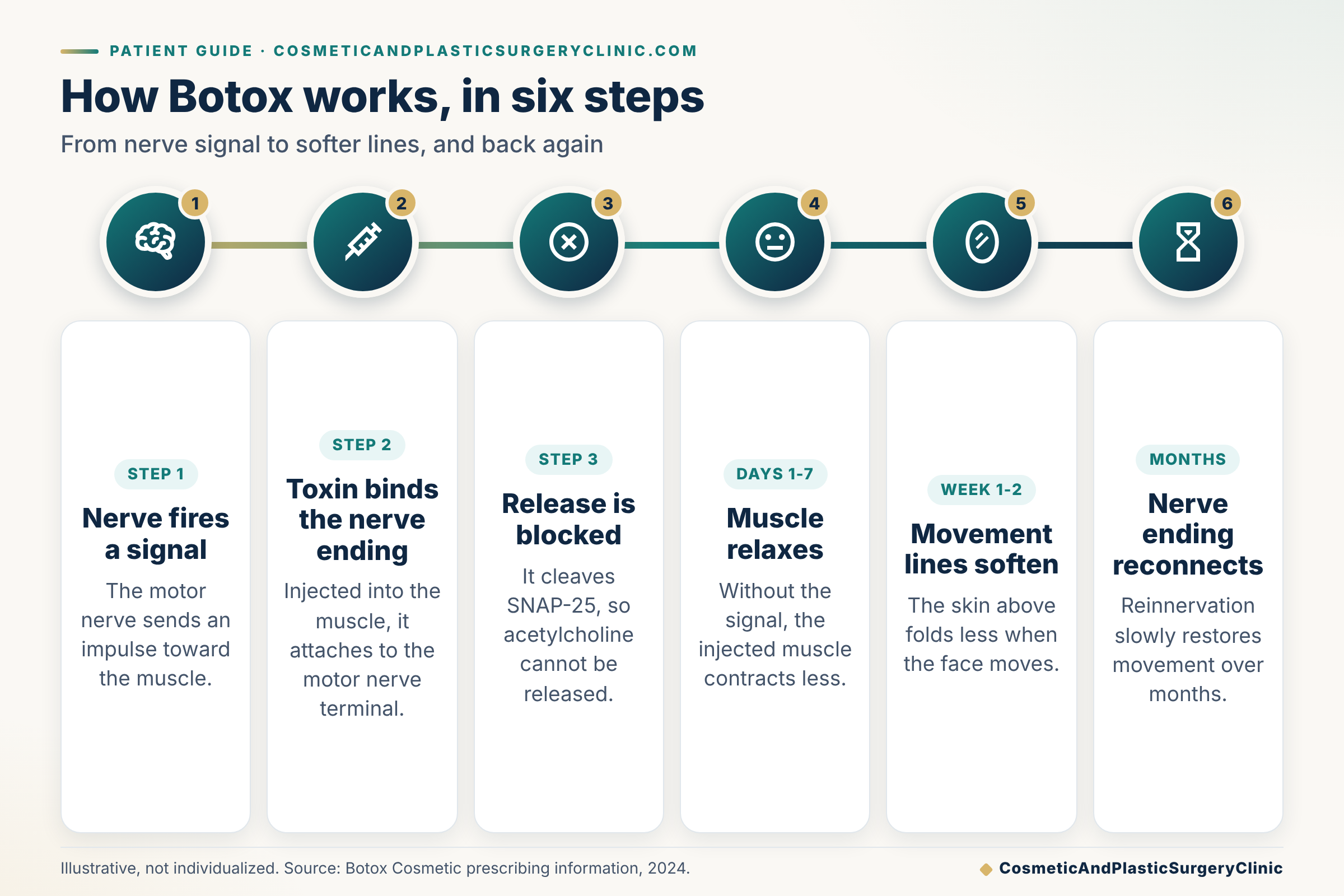
A muscle contracts when a motor nerve releases a chemical messenger, acetylcholine, across a tiny gap onto the muscle fiber. No release, no contraction. Facial expression lines are the visible record of thousands of such contractions: the muscle pulls, the skin above it creases, and over years the crease deepens.
Botulinum toxin type A interrupts the first step. The ASPS describes injections as blocking the nerve signals to the muscle in which the toxin was placed, so the muscle cannot contract. Mayo Clinic gives the same account in plainer words: the shots block certain chemical signals from nerves that cause muscles to contract.
What the label says happens inside the nerve ending
The prescribing information for Botox Cosmetic, revised in October 2024, goes a step further. It says the product binds to acceptor sites on motor nerve terminals, enters them, and cleaves a protein called SNAP-25 that the nerve needs in order to dock and release acetylcholine. The same section notes that an affected muscle may weaken and shrink with prolonged denervation and that nerve endings can sprout.
The label also says reinnervation of the muscle may occur, slowly reversing the blockade. That sentence is the whole reason results fade: the nerve rebuilds its connection, and movement returns. Nothing about the muscle is removed or cut.
Botulinum toxin, neuromodulator, Botox: sorting out the names
A brand name that became the everyday word
Botox is one product made by one manufacturer, in the way Kleenex is one brand of tissue. MedlinePlus describes it as a drug made from a toxin produced by the bacterium Clostridium botulinum, the same organism behind botulism food poisoning, used here in tiny, controlled amounts. Patients often say “Botox” for any wrinkle-relaxing injection, and clinics often do too.
That habit matters when you book. If you ask for Botox, you should expect that product, and if a clinic offers a different one, you should be told which and why. This page uses “Botox” for the brand and “botulinum toxin” or “neuromodulator” for the group.
Why “neuromodulator” is the working word in clinics
Clinicians use neuromodulator as shorthand for the group of FDA-approved botulinum toxin products used on facial muscles. A February 2026 Healio report on a dermatology symposium counted seven FDA-approved products in the wider botulinum toxin family and noted that an eighth, relabotulinumtoxinA, was not yet approved in the U.S. The seven differ in which uses their labels cover.
The differences among cosmetic brands are real but narrower than marketing suggests, and they have their own guide in Botox vs Dysport vs Xeomin. For this page, one rule carries across all of them: every label says its units are specific to that product, so a number of units from one brand cannot be read as an equivalent number of another brand’s units.
Which lines Botox treats, and which it leaves alone
Most disappointment with injectable wrinkle treatment comes from a mismatch between the line and the tool. A neuromodulator acts on muscle movement. If a wrinkle is not caused by movement, relaxing a muscle will not remove it. Sorting your lines into the right category is the first useful thing a consultation does.
Dynamic lines versus static lines
Lines that appear only when the face moves
Dynamic lines show up with expression: the vertical creases between the brows when you frown, horizontal lines across the forehead when you raise your eyebrows, fans at the outer corners of the eyes when you smile. In a 2019 Mayo Clinic article, plastic surgeon Yvonne Pierpont described Botox as a good option for dynamic wrinkles. A 2016 review in Plastic and Reconstructive Surgery, summarized by the ASPS, found the evidence for botulinum toxin strongest for minimally invasive treatment of facial wrinkles.
A simple self-check is to look in a mirror while the face is still and then while it moves. A line that is faint or absent at rest and sharp in motion is behaving dynamically. Your injector will do the same test more carefully, usually with you frowning, raising your brows and squinting on request.
Lines that stay when the face is still
Static lines are present at rest. Pierpont’s Mayo Clinic article attributes them to lost elasticity and collagen plus sun or smoking damage, and notes that the facial silhouette changes with age through volume loss. Many people have both types in the same spot: a forehead crease that deepens with movement and also rests as a faint groove after decades of use.
A neuromodulator can soften the movement component of a mixed line, which may let the skin rest and the crease look shallower, but it does not rebuild the groove. The same article says some providers recommend Botox for static wrinkles, but that fillers are much more effective for them. Treat that as one clinician’s view and ask your own injector how they handle mixed lines.
What neuromodulators do not change
Volume loss, sagging and gravity
Faces age in three dimensions: fat compartments shrink, bone resorbs, ligaments loosen and skin descends. None of that is a muscle-signal problem. A hollow temple, a flattened cheek or a jowl will not respond to a toxin injection, and the Mayo Clinic article names fillers as the tool that lifts skin and restores volume loss. Excess lax skin is a surgical question, which the pages on facelift alternatives and the facelift take up.
The honest limit is that a neuromodulator can change the balance of pulling forces in a few places, but it does not tighten skin. Expect softening of movement lines, not a lifted or redrawn face.
Skin texture, sun damage and pigment
Fine crepey texture, brown spots, redness and enlarged pores come from the skin itself. A toxin works below the skin in the muscle, so it has no direct effect on them. Pierpont’s article lists laser resurfacing as an option for renewing skin texture with minimal downtime, and says Botox and fillers together may give the best results for some people.
The practical point is that skin care, sun protection and resurfacing belong to a different conversation than muscle relaxation, and a good plan can include both without pretending one does the other’s job.

Where the FDA label draws the line for Botox
The four cosmetic areas on the Botox Cosmetic label
The Botox Cosmetic label lists four cosmetic indications for adults: moderate to severe glabellar lines (the frown lines between the brows), lateral canthal lines (crow’s feet), forehead lines and platysma bands (the vertical cords in the front of the neck). A drug-approval history compiled by Drugs.com dates them as follows: first approval in April 2002, crow’s feet in September 2013, forehead lines in October 2017 and platysma bands in October 2024.
The label states the product is not recommended for children under 18. “Moderate to severe” is the wording that matters: an approved indication describes the population studied, which is not the same as every person who has a line.
Off-label areas and why the label still matters
Plenty of common treatments sit outside the labeled areas. The ASPS patient page lists neck bands, thick jaw muscles, lip lines, a gummy smile, chin dimpling and lifting the corners of the mouth among the uses it describes. Off-label does not mean illegal or untested; it means the manufacturer did not seek that specific indication, and the evidence and risk profile may be thinner.
For those areas, ask your injector to tell you plainly that the use is off-label, what the reasoning is, and what the downside looks like. The guides on forehead treatment, masseter Botox and the lip flip compared with lip filler work through three of the most requested examples.
| Situation | Likely pathway | Benefit | Trade-off | Key question |
|---|---|---|---|---|
| Frown lines that deepen with expression, smooth at rest | Neuromodulator in the glabellar muscles | Softens the movement component | Repeat visits; brow or lid droop is possible | Which muscles will be treated, and why? |
| Forehead creases with a low or heavy brow | Careful, conservative toxin plan or a brow assessment first | Avoids dropping an already low brow | Forehead lifts the brow, so weakening it can lower it | How will my brow position be protected? |
| Lines visible at rest from volume and skin change | Filler, resurfacing or skin care, with or without a toxin | Addresses what the toxin cannot | Different products carry different risks | Is this line movement, volume or skin? |
| Vertical neck cords, mild skin laxity | Platysma-band treatment on the label, or an exam for surgery | Softens banding without an incision | Does not tighten loose skin | Are the bands the problem, or the skin? |
| Wide jaw or clenching, no wrinkle concern | Dental review first; off-label muscle treatment is a separate decision | May change contour over months | Off-label, with chewing effects to weigh | Has a dentist looked at bite and jaw? |
| Early fine lines, no deep creases yet | Skin care and sun protection first; toxin only if you choose | Keeps options open | Evidence for starting early is limited | What changes if I wait a year? |
Read the table as a list of questions, not a verdict. Real faces rarely fit one row: someone may have mobile frown lines, a slightly low brow and early volume loss at once, and the order in which those are addressed is part of the plan. Take the last column to a consultation and note which questions get answers based on your face and which get a general reply.
The Botox visit, step by step
A botulinum toxin appointment is short, but the decisions inside it are not. The Aesthetic Society notes that treatment is often done the same day as the consultation, which is convenient and also removes the natural pause in which people reconsider. Knowing the sequence ahead of time lets you slow the parts that deserve it.
Before the needle: history, goals and mapping
What to bring and what to disclose
Bring a full list of medicines and supplements, any earlier neuromodulator or filler treatments with dates, and photographs of your face from years ago if you have them. Mayo Clinic asks patients to say whether they have had any Botox-type injection in the past four months and whether they take blood thinners; it adds that blood thinners may need to be stopped for several days beforehand, but only after checking with the prescribing provider.
The American Society for Dermatologic Surgery (ASDS) lists a wider set to mention: over-the-counter drugs and supplements, previous neuromodulator treatment, injected antibiotics, muscle relaxants, allergy or cold medicine, and sleep medicine. The Botox Cosmetic medication guide adds muscle or nerve disease, swallowing or breathing problems and drooping eyelids. Disclosure is not a formality; several of these change the risk of the treatment.
Mapping: watching your face move
Before any product is drawn up, a careful injector asks you to frown, raise your brows, squint and smile while they watch which muscles do what. They are looking for strength, symmetry, the height and shape of the brow and where the lines fold. Two faces with the same wrinkle can need different plans because the muscles underneath differ.
You can use the mapping step to say what you do and do not want to change. Someone who relies on a very expressive brow at work, or who dislikes a smooth forehead, should say so before the first injection, not after. Marks made with a pencil or photographs taken at this stage also give you a baseline for later comparison.
The injection itself and the first hours
What happens in the chair
The ASPS says botulinum toxin injections usually take less than 15 minutes, using a very thin needle to place small amounts into specific muscles. Crow’s feet commonly need two to three injection points per side, while brow furrows may need five or more, according to the same page. The Aesthetic Society says anesthesia is not needed because the needles are short and thin; Mayo Clinic lists a skin numbing cream, ice or vibration as options if you want one.
Expect pinpricks, a brief sting and small bumps that settle quickly. The ASPS safety page says normal activities can resume immediately, while noting the usual injection-site effects. Ask what product is being used, how it was stored and mixed, and where the lot number will be recorded. The Botox Cosmetic label says to use it within 24 hours after reconstitution.
The first hours: what sources say and where they differ
Aftercare advice varies by source, which is a reason to follow your injector’s written instructions over any single web page. Mayo Clinic says to avoid rubbing the treated area for 24 hours and to avoid lying down for two to four hours. Cleveland Clinic gives 12 hours for rubbing or pressing, three to four hours upright and 24 hours without strenuous exertion. The ASPS says not to rub or massage the area because the toxin can migrate and cause temporary weakness or drooping.
The common thread is simple: do not press on or massage the injected areas, stay upright for a few hours, and hold off on hard exercise until your injector says otherwise. The label’s own patient counseling adds that anyone who notices weakness, blurred vision or drooping eyelids should avoid driving until they have been assessed.
| Stage | What happens | What to bring or ask | Pause if |
|---|---|---|---|
| Booking | You choose a clinic and a clinician | Who injects, their license and training, and the setting | Price is the only thing quoted |
| Consultation | History, medicines, goals and examination | Medicine list, prior treatments, old photographs | No questions about your health are asked |
| Mapping | You move your face while muscles are assessed | Which muscles, how many areas, which brow plan | The plan is identical for everyone |
| Injection | Small injections, usually under 15 minutes | Product name, lot number recorded, how it was mixed | The product cannot be identified |
| First hours | No rubbing, upright posture, easy activity | Written aftercare and an after-hours number | Vision change, trouble swallowing or breathing |
| Follow-up | Review of results and any uneven areas | Photos at the same angles, touch-up policy in writing | No follow-up is offered |
The planner is a template, not a script. A clinic that follows a different order can still be careful, but each row’s last column describes a point where it is reasonable to stop and ask before going on. Declining to proceed on the day is a legitimate outcome of a consultation.
Results, timing and why Botox outcomes vary
No two people get the same result from the same product, and the same person does not get identical results every time. Understanding the label’s own numbers, and the reasons they spread, helps you read both your own result and anyone else’s before-and-after photos.
The timeline in the label and clinic sources
The first week: onset and build
The Botox Cosmetic label says chemical denervation of the injected muscles begins one to two days after injection and intensifies over the first week. Mayo Clinic puts the start at one to three days and says full effect can take a week or more; Cleveland Clinic says most people notice an effect around days three to four, with full results in 10 to 14 days. The sources differ slightly because they describe different products, areas and ways of counting.
In the label’s glabellar-line trials, 74 percent of treated adults (299 of 405) were rated as responders by the investigator at day 7, compared with 6 percent on placebo (8 of 132). By day 30, the investigator-rated figure was 80 percent versus 3 percent, and 89 percent versus 7 percent by participants’ own assessment. These are trial results in adults with moderate to severe lines, not forecasts for any individual.
Fading: the three-month marker and what comes after
The label describes the glabellar effect as lasting approximately three to four months, and in its trial data the investigator-rated responder rate had fallen to 25 percent (102 of 403) by day 120. Mayo Clinic says results often last three to four months. Cleveland Clinic gives three to six months, and MedlinePlus says effects last three to 12 months depending on what is being treated, a spread that reflects different uses and sources.
The label also states that the safety and effectiveness of dosing more often than every three months has not been clinically evaluated, and Mayo Clinic advises follow-up treatments at intervals of at least three months. The guide how long does Botox last covers fading, re-treatment timing and the reasons duration varies by area.

Why results differ from person to person
Muscle, anatomy and the area treated
A strong corrugator muscle between the brows is not the same problem as a thin orbicularis muscle at the corner of the eye. Lines that have been creasing for decades behave differently from newly formed ones. Eyebrow height, forehead length and skin thickness all change how much room there is to soften movement without changing expression.
Different areas also have different label data. The Botox Cosmetic label reports its own trial results for glabellar lines, lateral canthal lines, forehead lines and platysma bands, and those tables are not interchangeable; the duration in the glabellar trials says nothing precise about a platysma band or a masseter muscle, which is not a labeled use.
Product, dilution and technique
The Aesthetic Society says the different brands may vary in dosage, propensity to spread, time of onset and duration of action. A 2024 review in Plastic and Aesthetic Research concluded that volume, concentration and dose, which an injector can change, matter more for spread than molecular size or accessory proteins, with a possible exception for the newest product. In other words, technique is a variable you are paying for.
Head-to-head comparisons are sparse, and duration claims published by manufacturers describe their own trials. That is why a result you saw on a friend, in a clinic’s gallery or on social media tells you little about yours.
When a treatment seems to stop working
Antibodies, in proportion
Some people develop antibodies to botulinum toxin proteins, which can reduce response. The Botox Cosmetic label reports that in the crow’s-feet trials 1.5 percent of 916 treated adults developed binding antibodies, and none developed neutralizing antibodies. The 2024 review in Plastic and Aesthetic Research notes that complexing proteins may promote neutralizing antibodies and cites a meta-analysis in which one product had the lowest rate, which is a reason some clinicians ask about prior response before choosing a product.
Both points come from published summaries, not from your own history. If a treatment that used to work seems weaker, a first step is a conversation with your injector about dose, technique, timing and product, not an assumption about antibodies.
Everyday reasons that look like failure
Before blaming the product, consider simpler explanations: the treated muscle was not the one causing the line, the dose was conservative on purpose, the visit was less than three months after the last, the product was stored or mixed incorrectly, or the line is mostly static and has little movement left to relax. Counterfeit or diluted product is another possible explanation, covered in the sections on safety and injector selection.
A written record from each visit, with product, areas and amounts, turns a vague feeling that it did not work into something your injector can actually analyze. Ask for it at every appointment.
| Factor | Effect on the outcome | Maintenance implication | Review point |
|---|---|---|---|
| Area treated | Different muscles and lines respond and fade differently | Schedules may differ by area | Ask for area-specific timing |
| Line type | Movement lines soften; resting lines change less | May need a second tool for static lines | Compare rest and movement photos |
| Dose and technique | Affect strength, spread and how natural movement looks | A conservative first visit allows adjustment | Check results at one to two weeks |
| Product choice | Brands differ in formulation and reported onset | Switching products changes the plan | Keep a record of product and response |
| Interval between visits | Too close is not evaluated on the label | Label and Mayo Clinic cite at least three months | Do not book from habit alone |
| Changes over time | Skin and volume change while the toxin does not address them | Plan may add or drop other treatments | Reassess goals every year or so |
The table shows why a yearly plan is better thought of as a series of small decisions than a subscription. Each visit is a chance to review what worked, change what did not and decide whether to continue at all. The guide on preventative Botox takes up the related question of starting before lines have set.
Botox safety: expected effects, uncommon problems and emergencies
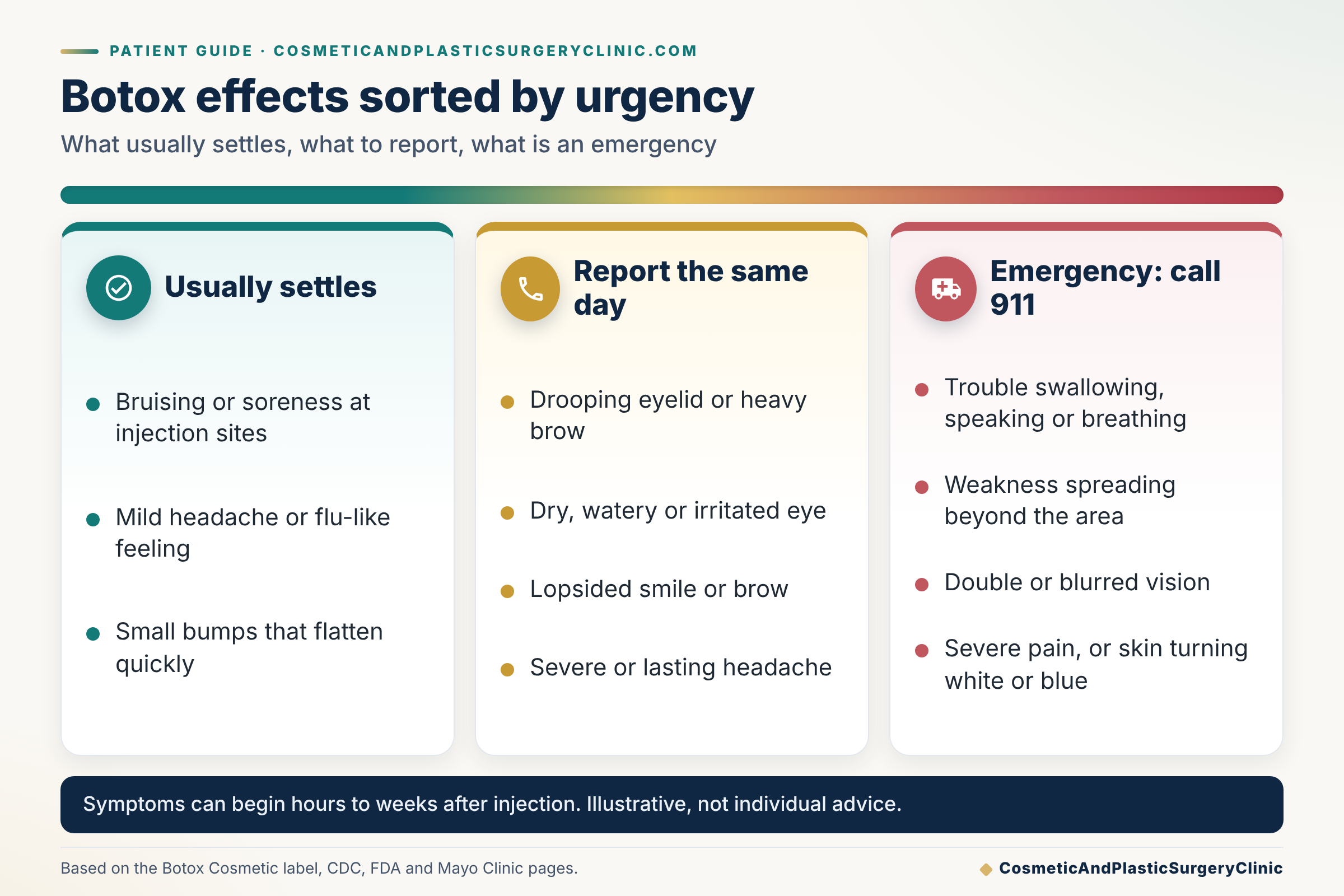
Authentic, FDA-approved botulinum toxin given by a trained clinician has a long record for cosmetic use, and the most common effects are minor. That is a statement about the group, not a promise for you, and it sits beside a boxed warning on the label. The useful skill is sorting what you notice into three piles: expected, report today and emergency. The dedicated guide to Botox side effects goes deeper; this section gives the map. For general risk literacy across cosmetic procedures, see plastic surgery risks.
Effects that commonly settle on their own
Injection-site bruising, soreness and headache
The ASPS safety page lists bruising and pain at the injection site, redness, headache, nausea and flu-like symptoms. Cleveland Clinic describes side effects as usually mild and resolving within a day or two, and adds neck pain and upset stomach to the list. In the label’s Dysport data for glabellar lines, headache was reported by 9 percent of treated adults versus 5 percent on placebo, which gives a sense of scale for a common effect.
Bruising is more likely if you take blood thinners or anti-inflammatory drugs, which is one reason the medicine list matters. Small bumps at injection points flatten quickly. Tell your injector if headache is severe or persists, because that is a different pattern from the passing kind.
Heaviness, asymmetry and the “frozen” look
Over-relaxed muscles can make a face look flat or heavy, and uneven weakness can leave one brow or one side of the smile moving differently. Mayo Clinic lists crooked eyebrows or a crooked smile among the possible effects. Neither is a spread-of-toxin emergency, but both are worth reporting, because a small adjustment is sometimes possible once the full effect has developed.
That is also why many injectors favor a conservative first visit and a review at one to two weeks. If you dislike a very still forehead, say so at the first consultation and again at the review. Effects soften as the toxin fades, which brings relief and also a limit on how quickly any adjustment can be undone.
Problems to report to the injector the same day
Eyelid and brow droop, with the label’s numbers
Eyelid ptosis, a drooping upper lid, was reported in 3 percent of adults treated for glabellar lines in the Botox Cosmetic trials (13 of 405). In the forehead-line trials, brow ptosis occurred in 2 percent of treated adults (13 people) and none on placebo, with eyelid ptosis also at 2 percent versus none. The Dysport label reports eyelid ptosis at 2 percent versus under 1 percent for placebo in its glabellar data.
The percentages are small, but they describe a real, visible effect that can last weeks. Droop usually appears from the toxin affecting a nearby muscle, which is why injection placement near the lifting muscle of the lid matters. Report it promptly; do not treat it at home and do not wait for it to pass.
Dry eye, vision symptoms and changes to the smile
The label notes reports of dry eye with Botox Cosmetic and advises telling patients it may cause eye dryness. Mayo Clinic lists watery or dry eyes among the possible effects. For lower-face treatment, Mayo adds drooling and a crooked smile to the list. Dry eye matters more if you already have it or wear contact lenses, so mention both at the consultation.
Blurred or double vision, a lid that will not open fully, or a smile that is clearly lopsided after treatment deserves a same-day call. The Botox Cosmetic label counsels that anyone with weakness, blurred vision or drooping eyelids should avoid driving or other hazardous activities. Your injector’s after-hours number should be in your aftercare sheet; if it is not, ask for one before you leave.
Spread of toxin effect, counterfeits and true emergencies
The boxed warning in plain language
The Botox Cosmetic label carries a boxed warning: the effects of the product and of all botulinum toxin products may spread from the area of injection, and swallowing and breathing difficulties can be life threatening, with deaths reported. The medication guide says problems swallowing, speaking or breathing can begin hours, days or even weeks after an injection. The ASPS describes spread beyond the treatment area as very unlikely.
Both statements can be true at once: the event is rare for approved cosmetic use, and it is serious enough to be the first thing on the label. Know the symptom list so you can act on it.
Counterfeit and mishandled product, in numbers
In April 2024 the FDA warned that counterfeit versions of Botox had been found in multiple states, with adverse events including hospitalizations, and said there was no indication that the events were linked to authentic, FDA-approved Botox. A CDC Health Alert Network advisory the same month counted 22 people with adverse effects, 11 of them hospitalized, across 11 jurisdictions, with symptom onset between November 2023 and March 2024. All of those injections were given by unlicensed or untrained people or outside health care settings, including homes and spas, and 91 percent were for cosmetic purposes.
A later CDC page, updated in December 2024, lists 17 cases and 13 hospitalizations across nine states and describes the investigation as closed while reports continue. In October 2025 the Louisiana Department of Health issued an alert about two hospitalized residents, one injected with an unlicensed product bought online and one injected by a person of unknown licensure in a non-medical setting. Those counts are small, and the FDA noted that incidents involved both licensed and unlicensed injectors, but the CDC found every case in its April advisory tied to unlicensed or untrained people or non-clinical settings.
Who should wait or talk to a doctor before Botox
Candidacy is never decided from an article, and this section does not decide it. What it can do is list what the labels and clinic sources say about conditions that change the risk, so you know which parts of your history to put on the table.
What the label lists as a stop or a caution
Hard stops: allergy and infection
The Botox Cosmetic label lists two contraindications: known hypersensitivity to any botulinum toxin preparation or any component of the formulation, and infection at the proposed injection site. The Dysport label adds cow’s milk protein among its listed hypersensitivities. If you have had a reaction to a toxin product before, the reaction is something to bring up first, not after.
Infection in the skin near a planned injection point is a reason to postpone, and a careful clinic will look at the skin before drawing up product.
Nerve and muscle disease, swallowing or breathing trouble, drooping lids
The label’s warning on pre-existing neuromuscular disorders says people with them may be at increased risk of clinically significant effects, including generalized muscle weakness, double vision, ptosis and a weak voice, and it names conditions such as amyotrophic lateral sclerosis, myasthenia gravis and Lambert-Eaton syndrome as examples. The label also advises caution with pre-existing cardiovascular disease.
The medication guide asks patients to disclose swallowing problems, breathing problems such as asthma or emphysema, and drooping eyelids. Cleveland Clinic lists neuromuscular disease, ptosis and weak facial muscles among reasons the treatment is not recommended. In every case, the answer comes from a clinician who has examined you and reviewed your history.
Pregnancy, breastfeeding and medicines
What the sources say about pregnancy and nursing
The Botox Cosmetic label says there are no studies or adequate data on developmental risk in pregnant women, and that animal studies showed reduced fetal body weight and delayed skeletal ossification at clinically relevant doses, in the presence of maternal toxicity. On lactation, it says there are no data on the presence of the product in human or animal milk.
MedlinePlus states that you should not use Botox if you are pregnant or breastfeeding, and Mayo Clinic says it is generally not recommended in either situation. These are cautious positions in the face of missing data. If you are pregnant, nursing or planning a pregnancy, say so at booking so the decision is made with that fact in view.
Medicines that change bruising or muscle effects
The label says that giving the product together with aminoglycoside antibiotics or other agents that interfere with neuromuscular transmission should be done with caution because the toxin’s effect may be potentiated, and that a muscle relaxant given before or after can exaggerate excessive weakness. The ASDS list of items to mention includes injected antibiotics and muscle relaxants for exactly this reason.
Cleveland Clinic notes that blood thinners and anti-inflammatory drugs raise bruising risk. Never stop a prescribed medicine on your own for a cosmetic injection; Mayo Clinic says any change belongs with the prescriber. A simple rule: the list of everything you take goes to the injector, and the decision on any change goes to whoever prescribed it.
Choosing a Botox injector and a setting
The product is the same wherever you buy the appointment; the difference is the person holding the syringe, the room they are in and where the vial came from. The ASPS says in a 2016 policy statement that injection of botulinum toxin is a medical procedure, and the 2024 outbreak reports point repeatedly to unlicensed sources, untrained injectors and non-medical settings.
Credentials, scope and state rules
Who is allowed to inject varies by state
There is no single national rule. A 2023 Dermatology Times opinion piece by a physician assistant notes that state law determines which professionals may inject, that standards vary by state, license and certification, and that no dermatology or plastic surgery training is required to do so in many places. The same piece describes supervision requirements for medical assistants and nurses and calls oversight uneven.
That means a job title alone does not settle the question. Ask who will actually inject you, what their license is, what training they have in facial anatomy and complications, and who supervises if they are not a physician. Your state medical board or nursing board is the place to verify a license.
What board certification does and does not tell you
The ASPS statement says board-certified plastic surgeons are ideally qualified to administer these injections because of their training, which is the view of a plastic surgeons’ society. The Aesthetic Society recommends an experienced injector such as a board-certified aesthetic plastic surgeon. The American Board of Plastic Surgery says certification requires a current, unrestricted medical license and passed written and oral examinations.
Certification is evidence of broad training, not of injection volume or skill with your particular question. Dermatologists, facial plastic surgeons and other licensed clinicians also inject with training. The guides on how to choose a plastic surgeon and cosmetic surgeon credentials explain the verification steps, so this page does not repeat them.
The setting and the syringe
A medical setting, records and follow-up access
The ASPS statement recommends treatment in a physician’s office or other clinical setting with staff and equipment to observe patients and manage complications, a signed informed consent, records that include the lot number, dose, injection sites and any adverse reactions, and continuing access to the provider. It says patients should be medically supervised for several weeks in case of an adverse event.
The same statement says injections in private homes, at work events or at social gatherings may be inappropriate, in part because of inadequate patient selection, consent and peer pressure, and that alcohol should not influence the decision. A pre-treatment consultation with a health history is part of safe care, not an optional extra.
Where the vial came from
The FDA’s advice to consumers after the 2024 alert is to confirm that the product comes from an authorized source and to ask whether the provider is licensed and trained. The CDC says to get injections only from licensed and trained professionals in licensed or accredited health care settings, to confirm the product is FDA-approved and from a reliable source, and adds, “If in doubt, don’t get the injection.”
Home injection, group “Botox parties”, changing social media accounts and reluctance to share product information were the red flags the 2025 Louisiana alert listed for clinicians, and one of its two cases involved product bought online. You can report suspected counterfeit product to the FDA at 800-551-3989 and report harmful reactions through the FDA’s MedWatch program.
| Ask about | A sound answer | Question it if |
|---|---|---|
| License and training | Names the license and the training; you can verify it with the state board | Answers with a job title or a weekend course only |
| Supervision | States who the supervising physician is and how complications are handled | No physician is reachable |
| Product | Names the brand, shows the vial and records the lot number | Cannot or will not identify the product |
| Setting | Clinical room, health history form, consent signed | A home, party or event with no history taken |
| Plan | Explains which muscles, why, and a conservative first step | Quotes by the area with no assessment |
| Follow-up | Review visit, touch-up policy and after-hours number in writing | No follow-up or contact is offered |
None of the answers in the middle column ensures a good result, but missing answers in the last column are cheaper to act on before the injection than after it. If a clinic discourages questions, treat that as information about the clinic.
Botox alongside fillers, lasers and surgery
Few people treat only one thing. Lines, volume, skin quality and sagging often show up together, and each has a different tool. A sound plan names which tool is aimed at which problem, so you can tell what each one is meant to do and what it costs.
Pairing a neuromodulator with other injectables and skin treatments
Fillers add volume, toxin reduces movement
A filler is not a neuromodulator. The FDA classifies dermal fillers as medical device implants used to create a smoother or fuller appearance, and describes the most serious risk as accidental injection into a blood vessel, which can block blood flow and cause tissue death, vision problems including blindness, or stroke. The Mayo Clinic article cited above says fillers restore volume loss and that Botox and fillers together may give the best results for some people.
Photo-reading skills for filler results differ from those for toxin results, and the site has a separate guide in dermal filler before-and-after photos. If both products are planned for one visit, ask which goes where, and who is trained to manage filler complications.
Lasers, skin care and light-based treatments
Resurfacing lasers and light-based treatments act on pigment, texture and collagen in the skin, which a toxin does not touch. The Mayo Clinic article describes laser skin resurfacing as able to renew skin texture with minimal downtime, and an ASDS example case combined a toxin between the brows with intense pulsed light and filler in the under-eye hollows and outer brow.
Sun protection, daily skin care and treatment of the skin itself are separate from muscle relaxation, and the order of treatments matters when more than one is planned. Ask your clinician to sequence them, rather than assuming they can all be done at once. None of these is a replacement for the others.
When surgery is the better tool, or the addition
Eyelids and brows
A heavy upper lid can come from lid skin, a weak lifting muscle or a low brow, and a toxin that weakens the forehead can lower the brow further. Anyone who already has hooded lids or a low brow is a case where a conservative plan, or a different procedure, may fit better. The guides on blepharoplasty versus brow lift and blepharoplasty candidacy explain how surgeons sort the causes.
The reverse also holds: after eyelid surgery, a neuromodulator can be a small adjustment to brow position. Whether it is advisable is a matter for the surgeon who knows your anatomy.
Face and neck laxity
Botulinum toxin does not tighten skin, and loose skin or sagging jowls are surgical questions. The Botox Cosmetic label added platysma bands, the vertical cords of the front of the neck, as an indication in October 2024, which gives people with banding but little skin excess a nonsurgical option to discuss. The guide to neck tightening versus neck lift covers how a toxin is used in the neck and where it stops being enough.
For a broader view of nonsurgical and minimally invasive options and their limits, see the facelift alternatives guide linked earlier. A consultation with a plastic surgeon does not commit you to surgery, and hearing why a plan does or does not include it is useful in itself.
Deciding well: budget, time and the option of not starting
Because the effect fades and the decision repeats, the real commitment is not one appointment but a recurring one. Thinking about money and time over a year, not a visit, avoids the common surprise of a cheap first session followed by a costly habit.
What the budget looks like over a year
One national average, no local quote
The ASPS patient page states that the average cost of botulinum toxin injections is $435, citing its latest statistics, without a year, a unit count or a list of what the figure includes. It says the cost depends on how advanced the lines are, how extensively areas are treated, the expertise and qualifications of the person treating, the time the treatment takes and the geographic location of the office.
A national average is not a quote, and neither is a price per unit with no area or product attached. The guide to Botox cost breaks down per-unit, per-area and per-visit pricing, and the general mechanics of comparing quotes sit in plastic surgery cost.
The yearly arithmetic, stated as an illustration
Take the label and clinic sources at face value: effects lasting about three to four months, and visits not closer than three months. If one area were treated at each interval, that would mean three to four visits a year. Multiplying the ASPS undated average of $435 by three or four gives roughly $1,300 to $1,740 a year, before any added areas, product differences, tips or membership terms. This is arithmetic on a national figure, not a prediction of any clinic’s price.
Lower-priced offers deserve questions about product, dose, setting and who is injecting, because the outbreak reports above came from unlicensed sources. If a payment plan is on offer, read plastic surgery financing first; a recurring cosmetic treatment is an unusual thing to finance.
The questions that branch from here
Photos, brands, timing and specific areas
Each of these decisions has its own guide. Reading photographs of neuromodulator results needs specific skills, covered in Botox before and after, with the general ethics and advertising rules in before-and-after photos. Product choice and fading, discussed earlier, are covered in the brand comparison and duration guides.
Specific areas have their own risks and trade-offs: the forehead, the masseter muscle and the lip flip each have a guide, linked in the sections above. Whether to begin before lines form is the question taken up in the preventative Botox guide.

Saying “not yet”, and what that preserves
Nothing in the sources suggests a person must treat lines at any particular time. Waiting a year, trying sun protection and skin care first, getting a second opinion on a plan you do not understand, or deciding that the lines are part of your face are all sound outcomes of a consultation. The treatment will be available later, and the decision will be easier with a clear head.
A clinic that respects that choice is giving you useful information about itself. A clinic that offers a time-limited discount to push you past it is giving you different information.
Frequently asked questions
Does Botox hurt?
Sources describe the sensation as brief and minor rather than measuring it. The ASPS says a very thin needle is used and treatment usually takes under 15 minutes, and the Aesthetic Society says anesthesia is not needed because the needles are short and thin. Mayo Clinic lists a skin numbing cream, ice or vibration as options. Pain tolerance and the area treated vary, so if you are anxious, ask your injector about numbing options before the appointment rather than during it.
Should I avoid alcohol or certain medicines before Botox?
Cleveland Clinic advises not drinking alcohol for 24 hours before a procedure and notes that blood thinners and anti-inflammatory drugs raise bruising risk. Mayo Clinic says blood thinners may need to be stopped for several days beforehand, but only after checking with the prescribing provider, and the ASPS statement says alcohol should not influence the decision to be injected. Because stopping a prescription can be risky, never change a medicine on your own; list everything you take and let the prescriber and injector decide together.
Will Botox make my face look frozen?
It can if the plan weakens more muscle than the face needs. The Botox Cosmetic label reports facial paresis in 1 percent of treated adults in its glabellar trials, and Mayo Clinic lists a crooked eyebrow or smile among possible effects. The result depends on dose, placement and your anatomy. Ask for a conservative first visit, say how much movement you want to keep, and request a review at one to two weeks so small adjustments can be considered once the full effect has developed.
Can Botox be reversed if I do not like it?
None of the sources reviewed for this article describes a way to reverse a cosmetic neuromodulator injection. They describe an effect that fades as the nerve ending reconnects, over months, with the first days showing the onset and the full effect appearing in one to two weeks. That is why the first plan is better kept modest and the injector’s judgment about placement matters. Ask before treatment what the injector would do if a result is uneven and what the touch-up policy is.
Is Botox the same thing as a filler?
No. Botox is a drug that blocks the nerve signal to a muscle, while the FDA classifies dermal fillers as medical device implants that add volume or fullness. They address different causes and carry different risks: spread of toxin effect for the first, accidental injection into a blood vessel for the second. The two are often used together, since Mayo Clinic notes that Botox and fillers may give the best results for some people, but they are separate products and should be named separately in a plan.
Is Botox used for anything besides wrinkles?
Yes. MedlinePlus lists severe underarm sweating, cervical dystonia, blepharospasm, strabismus, chronic migraine and overactive bladder, and Mayo Clinic describes it as easing symptoms of these conditions without curing them. Those uses are medical, with their own labels, doses and treating clinicians, and they differ from a cosmetic visit. The ASPS patient page for cost makes no statement on insurance coverage, so ask your plan and prescriber directly about any medical use rather than assuming cosmetic rules apply.
What should I do if I think I was injected with counterfeit Botox?
Seek care first. The FDA and CDC say that if symptoms such as blurred or double vision, drooping eyelids, trouble swallowing or breathing, or generalized weakness follow an injection, see a health care professional or go to the emergency department and do not wait. The CDC and FDA ask that suspected counterfeit product be reported to the FDA at 800-551-3989 and harmful reactions through MedWatch. If you can, keep the packaging or note the clinic name, date and product details to help clinicians and investigators.
If I am planning a pregnancy, when should I stop Botox?
No source reviewed gives a waiting period. The Botox Cosmetic label says there are no adequate studies of developmental risk in pregnant women and no data on the product in breast milk, MedlinePlus says not to use it while pregnant or breastfeeding, and Mayo Clinic describes it as generally not recommended. Because the evidence is missing rather than reassuring, raise your plans at the consultation and ask the injector and your obstetric clinician how they would handle the timing of any treatment.
Sources and further reading
- AbbVie/Allergan — BOTOX Cosmetic prescribing information and medication guide, revised 10/2024 (accessed 2026-11-12) — indications, boxed warning, contraindications, trial data, mechanism
- Drugs.com — Botox Cosmetic FDA approval history (accessed 2026-11-12) — dates of the 2002, 2013, 2017 and 2024 approvals
- U.S. Food and Drug Administration — Dysport prescribing information, revised 1/2023 (accessed 2026-11-12) — indications, units not interchangeable, adverse reactions
- Healio — The gift that keeps on giving: FDA-approved neuromodulators with more to come, 24 February 2026 (accessed 2026-11-12) — current product list, platysma approval, pipeline
- Gupta and colleagues — Updated review on neuromodulators, Plastic and Aesthetic Research 2024 (accessed 2026-11-12) — formulation differences, units, spread, antibodies
- Drugs.com — FDA approves Daxxify, manufacturer announcement of 8 September 2022 (accessed 2026-11-12) — indication and manufacturer duration claims
- American Society of Plastic Surgeons — 2025 Plastic Surgery Statistics Report (accessed 2026-11-12) — neuromodulator share of minimally invasive treatments
- American Society of Plastic Surgeons — Botulinum toxin overview (accessed 2026-11-12) — definition, areas treated, brands
- American Society of Plastic Surgeons — Botulinum toxin procedure (accessed 2026-11-12) — needle, duration of visit, injection counts
- American Society of Plastic Surgeons — Botulinum toxin safety (accessed 2026-11-12) — listed risks, rubbing caution
- American Society of Plastic Surgeons — Botulinum toxin cost (accessed 2026-11-12) — average fee without a year, cost factors
- American Society of Plastic Surgeons — Policy statement on administration of botulinum toxin neuromodulators, 2016 (accessed 2026-11-12) — who injects, setting, records, follow-up
- American Society of Plastic Surgeons — Press release on a 2016 Plastic and Reconstructive Surgery review of botulinum neurotoxin evidence (accessed 2026-11-12) — strength of evidence for facial wrinkles
- Mayo Clinic — Botox injections (accessed 2026-11-12) — how it works, preparation, onset, duration, risks, when to call
- Mayo Clinic Health System — Is Botox the fix for all facial wrinkles? Pierpont, 16 July 2019 (accessed 2026-11-12) — dynamic and static lines, fillers, lasers
- Cleveland Clinic — Botox (botulinum toxin), updated 2022 (accessed 2026-11-12) — procedure, aftercare, onset, duration, who should not have it
- MedlinePlus — Botox (accessed 2026-11-12) — origin, uses, pregnancy and breastfeeding statement
- The Aesthetic Society — Botulinum toxin procedure information (accessed 2026-11-12) — same-day treatment, brand differences, injector choice
- American Society for Dermatologic Surgery — Neuromodulator information (accessed 2026-11-12) — what to tell your doctor, duration, side effects
- American Society for Dermatologic Surgery — Neuromodulators for aging skin (accessed 2026-11-12) — side effects, combination example
- U.S. Food and Drug Administration — Counterfeit version of Botox found in multiple states, 16 April 2024 (accessed 2026-11-12) — counterfeit alert, symptoms, advice
- Centers for Disease Control and Prevention — Health Advisory CDCHAN-00507, 23 April 2024 (accessed 2026-11-12) — case counts, settings, patient guidance
- Centers for Disease Control and Prevention — Harmful reactions linked to counterfeit Botox or mishandled injections, updated 17 December 2024 (accessed 2026-11-12) — final counts, safety tips
- Louisiana Department of Health — Health Alert 25-4, 9 October 2025 (accessed 2026-11-12) — two cases from unlicensed sources, red flags
- U.S. Food and Drug Administration — Dermal fillers (soft tissue fillers) (accessed 2026-11-12) — filler classification, vascular risks, urgent symptoms
- Wesley — 20th anniversary and history of cosmetic botulinum toxin type A, MDedge Dermatology, 20 May 2022 (accessed 2026-11-12) — Carruthers observation, 1992 report, 2002 approval
- Herskovits — From the beginning: the history and applications of Botox, Ocular Surgery News, 15 November 2003 (accessed 2026-11-12) — 1978 strabismus testing, 1989 approval, 1992 cosmetic report
- Block — Rules and regulations on cosmetic procedures: where are they? Dermatology Times, 16 May 2023 (opinion; accessed 2026-11-12) — state variation in who may inject
- American Board of Plastic Surgery — Verify certification (accessed 2026-11-12) — meaning of certification, license requirement