Most people who ask about lip filler start with a word like “fuller” or “thin.” The words that matter to an injector are different: border, bow, projection, symmetry, and how the lip moves when you talk. A syringe of hyaluronic acid gel can change some of those things and none of the others, so the useful question is which of your goals are really volume problems.
This page stays on the lips. The general mechanics of fillers, from product families to facial layers, live in the dermal fillers overview, and the muscle-relaxing alternative is covered in lip flip vs lip filler. Here the focus is what lip filler changes, what the visit and the first weeks are like, who is told to wait, and how to keep expectations realistic. It is education, not a verdict on anyone’s lips.
Lip anatomy: the structures lip filler works with
A lip is not a balloon with one chamber. It is skin, a visible border, a red surface, a ring of muscle and a moist lining, all stacked within a few millimeters. Good planning starts by naming the structure that bothers you, because gel behaves differently at the border than in the body of the lip.
The border, the bow and the body of the lip
Landmarks a lip filler plan tries to preserve
Reviews of lip augmentation share one vocabulary. The white roll is the pale ridge where facial skin meets the red lip. The Cupid’s bow is the paired peak at the center of the upper lip, shaped by the philtral columns, the two ridges that frame the groove running up toward the nose. The upper lip has three small mounds called tubercles and the lower lip has two. A 2023 review in the Journal of Drugs in Dermatology calls it paramount to preserve and accentuate these structures when using fillers.
For anyone planning lip filler, the practical point is precision. “More lip” can mean a sharper outline, a rounder pout or a fuller center, and each puts the gel somewhere different. Saved photos of lips you like help only if you can say which feature you are pointing at.
The muscle and the vessels underneath
Beneath the surface sits orbicularis oris, the ring muscle that purses the lips. A 2025 narrative review in the Journal of Cutaneous and Aesthetic Surgery names its movement as one reason filler can drift in the upper lip. In and around that layer run the superior and inferior labial arteries.
A 2019 literature review in Aesthetic Surgery Journal pooled 20 anatomical studies. It reported the superior labial artery in the submucosal layer in roughly three quarters of cases and within the muscle in about a quarter, with a winding course that is more superficial near the midline and the Cupid’s bow. One included study put the artery about 4.5 millimeters from the skin surface on average. Depth varies by person and along the lip, which is why technique matters and why the emergency plan later on this page is not optional reading.

Goals that lip filler addresses, and goals it does not
Volume, border and symmetry are filler territory
Hyaluronic acid gel is a space-filling material. It can add volume to the body of either lip, define a faint border, lift a flat bow and narrow the gap between two sides. ASPS describes dermal fillers as a way to plump thin lips, and the FDA lists lip augmentation among the approved uses of fillers in adults.
Symmetry deserves a caveat. Most faces are asymmetric to begin with, and an injector chasing a mirror image can end up correcting differences nobody else notices. Ask which difference is being treated and whether a small leftover difference is expected.
Movement, length and skin lines are different problems
Filler does not change how a muscle pulls. A lip that rolls inward on a smile may look fuller from the front yet still tuck in when you speak, and that pattern is what a muscle-relaxing “lip flip” targets; the lip flip vs lip filler comparison lays out the trade-off. A long distance between nose and lip is a matter of tissue length, and adding gel does not shorten it.
Fine vertical lines above the lip are partly skin aging and partly repeated movement. A few lip products are also labeled for those lines, but lines driven by muscle activity may bring a neuromodulator into the conversation, which the Botox overview explains. The table below sorts common situations by what each one points toward.
| Situation | Pathway often discussed | Benefit | Trade-off | Key question to ask |
|---|---|---|---|---|
| Lips look flat or small at rest, border is clear | Volume placed in the body of the lip | Rounder, fuller look from the front | Easy to overshoot; swelling hides the final shape | How much at the first visit, and why that amount? |
| Border looks faint or blurred | Small amounts along the white roll | Clearer outline and bow | Shallow placement near vessels; ridges if overdone | What depth and technique at the border? |
| One side looks fuller | Staged correction, accepting some natural difference | Narrows a visible gap | A small difference usually remains | Which difference are you aiming to correct? |
| Upper lip tucks in on smiling or speaking | Movement exam first; muscle-based options may enter | Addresses the cause, not only the shape | Filler alone may not stop the tuck-in | Will you assess my lips while I smile and talk? |
| Lines above the lip bother me most | Products labeled for perioral lines; skin-focused options | Targets the lines directly | Not every lip product carries that label | Is this product labeled for the area? |
| Long gap between nose and lip | Filler does not shorten tissue; surgery is a separate discussion | Avoids adding volume that will not solve it | Surgery brings a scar and its own recovery | What would filler realistically change here? |
Lip filler products: what an FDA lip indication means
Regulators approve lip filler products as devices, one product and one body site at a time. That is why a label can be read, compared and questioned, and why “approved for lips” says something narrower than it sounds.
What “approved for lips” does and does not tell you
The labeled lip products and the over-21 line
The FDA’s dermal filler page lists augmentation of the lips among approved uses in adults 22 or older, a phrase it also words as over the age of 21. Lip indications arrived product by product. The FDA’s review summary shows Restylane Silk approved on June 13, 2014 for lip augmentation and perioral lines in patients over 21. A drug-information timeline dates the lip indication for Juvéderm Ultra XC to October 1, 2015 and for Juvéderm Volbella XC to June 1, 2016, and Galderma announced Restylane Kysse in May 2020.
The table lists only the products whose pages I opened. It is not a complete registry and not a ranking; labels change, so ask for the current patient labeling for whatever syringe will be used.
| Product | Lip approval | Labeled lip use | What the source reports |
|---|---|---|---|
| Restylane Silk | June 13, 2014 (FDA review summary) | Lip augmentation and perioral lines, patients over 21 | Randomized trial of 221 people; 76.1% vs 11.6% improved at week 8 |
| Juvéderm Ultra XC | October 1, 2015 (approval timeline) | Lip and perioral-area augmentation, adults over 21 | Date taken from a drug-information timeline, not from the FDA file |
| Juvéderm Volbella XC | June 1, 2016 (approval timeline) | Lips and perioral lines, adults over 21 | Same caveat on the date source |
| Restylane Kysse | May 2020 (manufacturer announcement) | Lip augmentation and upper perioral lines, adults over 21 | Company reports effect up to 1 year; 78% still satisfied at 1 year |
How to read one pivotal trial
The Restylane Silk review is a useful example of what a lip filler trial measures. It was randomized and evaluator-blinded at 14 U.S. sites. Of 221 people enrolled, roughly three in four received the gel and the rest were untreated, with treatment offered to them after six months. At week 8, 76.1 percent of treated people (134 of 176) had gained at least one grade on a lip fullness scale in both lips, against 11.6 percent (5 of 43) untreated. By week 24 the figures were 58.8 percent and 20 percent.
Two cautions follow. The bar was a one-grade gain on a clinician-rated scale, not a particular look, and the trial was a manufacturer study of one product. The drop in responders between weeks 8 and 24 is also an early hint of how the effect fades, a point the duration section returns to.
Choosing a product without a brand ranking
Questions about the syringe itself
The FDA tells patients to ask about the provider’s training and experience injecting fillers in the face, to discuss the risks at each injection site, and to ask for the patient labeling for the specific filler. It also warns against buying filler online because the product could be counterfeit. Cleveland Clinic adds that lip filler should not come from a beauty salon or spa.
In practice that means asking which product is being used, whether it carries a lip indication, and whether you can see the sealed packaging. A quote far below the usual range is a reason to ask those questions harder, not a reason to skip them. If you have a problem with a filler, the FDA accepts reports at 1-800-FDA-1088 or through MedWatch.
Hyaluronic acid compared with other materials
Every product in the table is a hyaluronic acid gel, a material that the enzyme hyaluronidase can break down. A 2023 review in the Journal of Drugs in Dermatology credits this material’s versatility, biocompatibility and reversibility. Cleveland Clinic states that only hyaluronic acid fillers can be dissolved this way.
Other filler families work by different mechanisms and cannot be reversed with that enzyme; the hyaluronic vs biostimulatory fillers article compares them. What dissolving involves, and when it is considered, is the subject of dissolving lip filler, so this page keeps to one point: for lips, the ability to undo a result is part of why hyaluronic acid is the usual choice.
The lip filler visit: assessment, proportions, numbing and technique
A lip filler visit has a predictable order: history and assessment, a plan for placement, numbing, injection and a short observation period. The decisions that shape the result happen mostly in the first and second steps, before any gel is placed.
Before the needle: assessment and proportion
Assessment with the lips at rest, smiling and talking
A useful assessment looks at the lips in motion, not only in a still photo: at rest, mid-smile and while saying sounds like “p” and “m.” It also covers history that changes the plan: allergies, bleeding tendencies and medications, earlier filler in the lips, cold sores, and pregnancy or breastfeeding.
Bring a few photos of your own lips from different years. They show your baseline better than a mirror under unfamiliar lighting does, and they help separate what bothers you now from what has always been there.
Proportion: what research says people prefer
Read that as a research curiosity, not a target. The images were digital morphs, the authors listed unconfirmed rater demographics among their limits, and preferences shift with culture, age and era; a 2025 narrative review reports different typical ratios across populations, though that review is inconsistent in places. A reasonable reading is that a lower lip larger than the upper is the usual pattern, not a flaw. If an injector proposes a ratio, ask whether it is your preference or a template.
Numbing, needles and cannulas
Numbing and the time in the chair
Cleveland Clinic describes a topical numbing cream containing agents such as benzocaine, lidocaine or tetracaine that takes about 15 to 30 minutes to work, with a nerve block offered to people allergic to those agents. The safety information for Restylane Silk and Restylane Kysse lists lidocaine allergy as a reason not to use them, so mention any past reaction to numbing medicine at the start.
The same page says a lip filler visit can take as little as 30 minutes or as long as two hours, with an average amount of about 1 mL. Afterward the injector may massage the lips and watch you for up to 15 minutes for dizziness, nausea or heavy bleeding. Numbness hides how swollen the lips are, so hold off judging the shape until it wears off.
Needle, cannula and what the evidence says
Two broad techniques appear in the literature. Sharp needles place gel as small deposits or in lines laid down while the needle is withdrawn. A blunt-tipped cannula, a flexible tube with a rounded end, enters through a small opening and places gel beneath the surface. The 2025 narrative review says needles are generally preferred for superficial placement along the border and blunt cannulas for deeper volumizing.
On safety, sources differ in emphasis more than direction. Mehta and colleagues cite a study in which microcannulas carried 77 percent lower odds of vascular occlusion than needles, a study I did not open. The 2019 anatomy review says blunt microcannulas reduce but do not eliminate the risk. A 2026 systematic review in ASJ Open Forum covering 16 studies and 3,692 patients found needle-only and combined needle-plus-cannula approaches comparable in safety and concluded the evidence does not support one superior technique, instrument or formulation.
That review reported no vascular occlusion in its included studies. It is reassuring without being a zero, because studies of this kind seldom capture rare events. The review’s own conclusion rests on injector experience more than on the instrument, so ask why one was chosen for your lips.
Six questions to ask before the syringe opens
- Which product is this, is it labeled for lips, and can I see the packaging and patient labeling?
- Who is injecting, what are their license and training, and who supervises if it is not a physician?
- How much do you plan to place today, and is a smaller first visit an option?
- Which technique will you use at the border and in the body of the lip, and why?
- Do you keep hyaluronidase on site, and what is the plan if a vessel is blocked?
- What does follow-up include, and what happens if I dislike the shape?
The anatomy review recommends keeping at least two vials of hyaluronidase in the treatment room, which is why the fifth question is concrete. Credential titles and license and training checks are explained elsewhere, and rules about who may inject vary by state. The general consultation framework is in plastic surgery consultation questions.
Recovery after lip filler: the first 48 hours to the first month
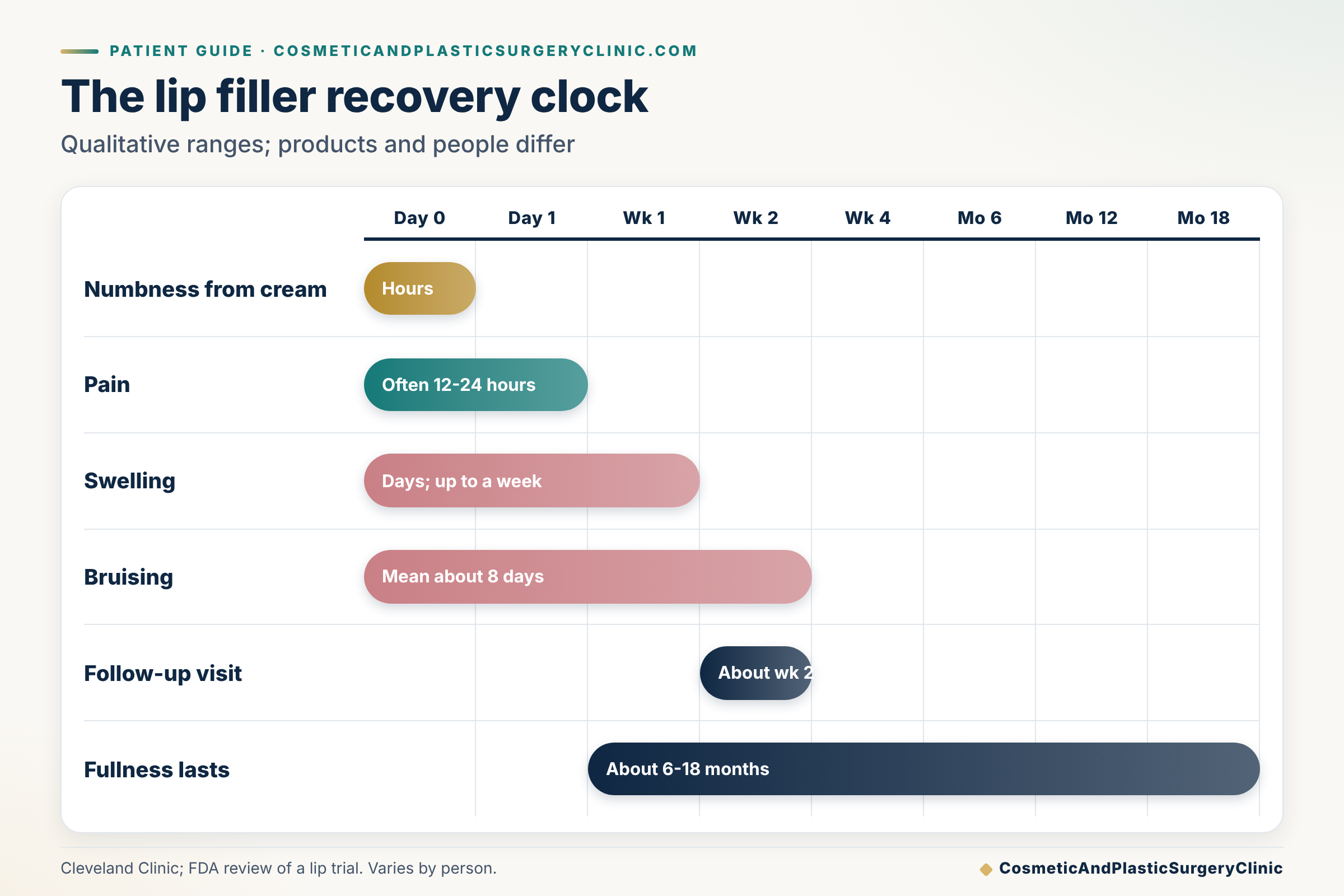
Recovery from lip filler is mostly a swelling story with a bruising subplot. The numbers depend on whether they come from trial diaries or clinic summaries, and the gap between the two is itself useful information.
The first two days
Swelling, bruising and bumps: trial diaries versus clinic summaries
In the FDA review of the Restylane Silk lip trial, people kept diaries after the first treatment. Lip swelling was reported by 43 percent, lasting a mean of 7.3 days among those affected. Bruising was reported by 44 percent, with a mean of 8.4 days, and lip pain by 10 percent, with a mean of 10.6 days. Most diary symptoms resolved within two to seven days, and 85 percent of treatment-emergent events were rated mild.
Cleveland Clinic describes a gentler typical course: pain usually gone in 12 to 24 hours, swelling mostly settled in 24 to 48 hours but sometimes lasting up to a week. A diary study counts anyone who notices anything and averages durations over the people affected, while a clinic page describes a usual case. Neither is your forecast. The trial summary also noted that 11 percent of people for the upper lip and 7 percent for the lower lip reported symptoms classed as disabling after the first treatment, without detail in the portion I read.
Eating, drinking and lip products
Cleveland Clinic advises waiting until the numbness wears off before eating so you do not bite the lips. For at least 24 hours it lists avoiding messy foods, drinking straws, smoking and alcohol, which can worsen bruising, along with lip products, touching or puckering, and exercise. It also describes ice for up to 10 minutes at a time, plenty of water and careful tooth brushing.
The 2025 narrative review gives somewhat different windows, at least 12 hours without lip balms or lipstick and at least 24 hours without intense exercise or alcohol, plus avoiding pursing, licking and kissing. Differences like that are normal across sources. Your injector’s written instructions are the ones to follow, and asking for them before the visit means you can plan the first day’s meals and meetings.
Weeks one to four: settling and the first review
When the shape can be judged
Cleveland Clinic describes a follow-up visit about two weeks after treatment, and that timing fits the swelling data above. The Restylane Silk trial set its main evaluation at week 8, not week 1. Judging lip filler on day two is like judging a haircut while the stylist is still holding the towel.
Photograph your lips in the same light, at rest and smiling, on day 14 and again later, and compare those images with each other rather than with the swollen first days. How photos change with timing is the subject of the dermal filler photos guide, and it applies to your own pictures as much as to a clinic’s gallery.
Lumps and uneven swelling at two weeks
Small bumps are common early, and the Silk review recorded them in about 5 percent of people after the first treatment, with the longest mean duration of any diary symptom at 49.1 days. That makes a lump at week one unremarkable and a lump at week six worth a conversation. Early unevenness often reflects swelling that is itself uneven.
Ask the injector how they distinguish swelling from placement problems, what they do at the review visit, and whether a persistent lump is checked in person rather than by photo. Massaging the lips is something the injector may do right after treatment; do not start on your own without being told how.
A lip filler safety map: expected effects, problems and emergencies
Almost everyone who gets lip filler has swelling, so swelling alone says little. What separates a routine week from a problem is its timing, its severity and what accompanies it. The broader taxonomy lives in filler complications, and general risk literacy in plastic surgery risks; this section keeps to the lips.
Sorting what you notice into three groups
Expected effects and problems to report
The FDA groups filler risks by how often they occur. Common effects include bruising, redness, swelling, pain, tenderness, itching and rash. Less common ones include delayed inflammation, nodules or granulomas, infection, open or draining wounds, allergic reaction and tissue death. Rare ones include anaphylactic shock, filler migration, leakage or rupture, hard nodules, injury to the blood supply and death. ASPS says severe complications from fillers are uncommon.
Between “expected” and “emergency” sits a middle group to report to the injector the same day or the next business day: a lump that persists or grows, lips that look clearly uneven after the swelling has settled, new blisters or a cold sore, itching or hives, fever, pus, or redness that spreads. These are not 911 events on their own, but they deserve a human look, not a wait-and-see of unlimited length.
Blocked blood flow, the emergency to know by heart
The FDA calls unintentional injection into a blood vessel the most concerning filler risk, with possible tissue death, vision loss including blindness, and stroke. ASPS calls such events very rare. In the lips the vessels in question are the labial arteries described earlier, and Mehta and colleagues suggest limiting lip injections to roughly 3 millimeters of depth because the vessels run superficially near the midline and the Cupid’s bow.
Their review also lists early signs, including pain out of proportion to the injection and blanching followed by a lacy, mottled look, sometimes appearing a day or two later. It cites an incidence of up to 3 in 1,000 injections, drawn from a 12-case report across facial sites, and adds that many cases go unreported so the true figure is unknown. That is not a lip-specific rate and not a personal forecast. Hyaluronidase is the key treatment for gel-related blockage, which is why the fifth question above matters.
Reasons surgeons and injectors ask people to wait
Infection, cold sores and skin that is not intact
Cleveland Clinic says candidates should not have an active oral infection, naming cold sores, and lists cold sore reactivation among the risks. The Restylane Silk review shows why: nine people reported oral herpes events, all mild, and six had an outbreak within five days of treatment, five of the nine with a prior herpes history. Investigators attributed some to the product or the injection itself.
The Restylane Kysse safety information tells people to postpone treatment at sites with skin sores, pimples, rashes, hives, cysts or infections until they heal. If you get cold sores, say so when you book, not in the chair. Whether any preventive medicine makes sense is a prescriber’s decision that no article can settle.
Pregnancy, age, allergies and medicines
Cleveland Clinic states that the FDA has not approved lip filler during pregnancy and that no studies exist, and the Kysse safety information says the effects of pregnancy and breastfeeding have not been studied. Both describe missing evidence, so tell the injector about pregnancy plans at the first visit. Treatment is also not approved under 21.
The labels read for this article list reasons not to use the products: a history of severe allergy or anaphylaxis, bleeding disorders, allergy to certain bacterial proteins used in manufacturing, and lidocaine allergy. The Kysse information also asks people to report medicines that affect bleeding, naming aspirin and warfarin. Do not stop a prescribed medicine on your own; ask the prescriber and the injector together.

How long lip filler lasts, and how to keep goals realistic
Lip filler duration is where marketing and evidence drift furthest apart. Nearly every number comes from a manufacturer trial, a clinic page or a society overview, and none of the sources opened compares products head to head.
Duration: what the sources actually say
Published ranges and why they disagree
ASPS describes typical filler durations of about six to 12 months, with some products longer, and notes that the FDA label states how long a given filler lasts. The manufacturer of Restylane Kysse reports an effect lasting up to one year in its trial. Cleveland Clinic gives 12 to 18 months for lip filler, depending on metabolism, and says it is not permanent and may need touch-ups.
The Restylane Silk trial offers a data point of its own: 58.8 percent of treated people were still responders at week 24, about five and a half months, and the study re-treated at that point. Taken together the sources describe a wide band of roughly six to 18 months. Ask for the labeled duration of the specific product, then ask what the injector’s own patients typically retain at six and twelve months.
What shifts the timeline
Cleveland Clinic ties lip filler duration to metabolism. Reasoning from how the gel works, the product, the amount, the depth of placement and how much the lips move probably matter too, and a few earlier visits may leave gel that overlaps with new treatment. No source opened ranks these factors or quantifies them for lips, so treat them as questions to ask, not predictions.
One practical consequence is that the interval between visits is individual. The table turns the main variables into a planning aid, with the review point that should prompt a call.
| Factor | Effect on the result | Maintenance or revision implication | Warning sign or review point |
|---|---|---|---|
| Product and labeled duration | Sets the expected fade window | Ask for the label figure and the injector’s own experience | Fullness gone much sooner than described |
| Amount placed per visit | More gel means more swelling and more chance of overshoot | A trial review linked 3 mL or more per session to more injection-site reactions | Lips larger than planned once swelling settles |
| Depth and plane of placement | Shapes contour, border and migration risk | Corrections depend on where the gel sits | Ridge, shelf or visible product beyond the border |
| Your metabolism and lip movement | Changes how quickly fullness fades | Your interval may differ from any average | Fading in weeks instead of months |
| Earlier fillers and their dates | Leftover gel may add to new gel (reasoning, not a measured effect) | Give the injector products and dates | Unexpected firmness or bulk |
| A history of dissolving | The enzyme also removes native hyaluronic acid for a time | One source advises waiting at least 14 days before re-filling | Thin, lined lips after dissolving |
Building volume in steps, and knowing when to stop
Smaller steps and the volume question
Lip filler volume per session varies across the sources, and none is a recipe for you. Cleveland Clinic gives an average of about 1 mL. The 2026 systematic review found most protocols used 1 to 2 mL per session. The Restylane Silk review linked injections of 3 mL or more to more reactions and advises a follow-up treatment if more volume is needed. For thin or older lips, the 2025 narrative review describes a gradual approach of about 0.5 mL per session at intervals of four to eight weeks.
These are study and technique contexts, not doses. They do show a common logic: smaller first steps, a review once swelling has settled, and then a decision about more. That sequence trades speed for control, and it also makes the cost question easier to manage; lip filler cost covers how to compare quotes.
Overfilled, migrated or uneven: when to pause
Cleveland Clinic lists asymmetry and migration of filler, usually toward the nose, among the risks of lip filler, and the FDA lists migration among rare risks. The 2025 narrative review describes upper-lip migration, a “duck lips” look associated with certain styling methods, and a swollen, bee-stung appearance after injection near the inner lining. Descriptions like these are what “overfilled” means in practice.
Pausing is a legitimate response: no more gel until the swelling has settled and someone has examined your lips at rest and in motion. If the result is not what you intended, the choice about dissolving is better made after a calm review than in the first week. If perioral lines and volume loss reach well beyond the lips, the broader choices are laid out in facelift alternatives.
Frequently asked questions
Is there an age limit for lip filler?
The FDA lists lip augmentation for adults over 21, and Cleveland Clinic says use under 21 is not approved. Sources opened give no upper age limit for lip filler. The Restylane Silk trial enrolled people aged 18 to 65 with an average age of 45.5, and people over 65 were not studied, so evidence for older adults is thinner. For thin or older lips, one review describes smaller, gradual sessions. A clinician who examines your lips decides what fits.
Does lip filler work the same on every skin tone?
No source opened compares results across skin tones. In the Restylane Silk trial, about 95 percent of participants were White and 24 percent had Fitzpatrick skin types IV to VI, so the evidence base is narrower than the population that seeks treatment. A 2025 narrative review lists post-inflammatory hyperpigmentation in skin of color as a possible complication. Ask the injector about experience with your skin tone and look for gallery examples that include it.
Does lip filler stretch the lips or create a need for more?
None of the sources opened reports stretching. They describe hyaluronic acid gel as temporary: ASPS says most fillers dissipate and ongoing treatment is needed to keep results, and Cleveland Clinic says it is not permanent and touch-ups may be needed. People return because the gel fades or their preferences change. Ask the injector what happens if you stop, and whether a longer gap between visits is reasonable.
Do I need to stop medicines or supplements before lip filler?
No source opened gives a stopping schedule. The Restylane Kysse safety information asks people to tell the doctor about medicines that affect bleeding, naming aspirin and warfarin, and lists bleeding disorders as a reason not to use the product. Stopping a prescribed medicine is a decision for the prescriber. Bring a full list, including supplements, and ask the injector and the prescriber to agree on a plan.
How far ahead of a wedding or photo shoot should lip filler be done?
The trial diaries above show swelling averaging about a week and bruising about eight days among people affected, and a few reported bumps lasting weeks. Cleveland Clinic schedules a review at about two weeks. Those figures suggest leaving at least that long, and longer for a first treatment so there is room for a touch-up decision. Ask the injector for a timeline, and avoid first-time lip filler in the days before a big event.
Can lip filler be done on only the upper or lower lip?
Plans vary, and sources opened do not rank them. The Restylane Silk trial counted improvement in both lips, and the 2017 proportion study found an upper-heavy 2:1 ratio ranked last, so ask how a one-lip plan changes the balance between the two. Some people need more help in one lip because of natural shape, which the assessment at rest and in motion should show. Ask what the plan would look like at one, two and three visits.
What if I want my lips back the way they were?
Hyaluronic acid fillers can be dissolved with hyaluronidase, an enzyme. Cleveland Clinic says most people need one to two visits, full results can take up to two weeks, and the enzyme also removes the lips’ own hyaluronic acid for a time. People with a bee-sting allergy should not receive it. Other filler materials cannot be dissolved this way. The dissolving lip filler article covers timing and questions in detail.
Sources and further reading
- U.S. FDA — Dermal fillers (soft tissue fillers), content current 07/06/2023 (accessed 2026-11-12) — approved lip use, age wording, risk tiers, vascular occlusion, counterfeit and online-purchase warnings, reporting
- U.S. FDA — Summary of safety and effectiveness data, Restylane Silk P040024/S072 (accessed 2026-11-12) — 2014 lip approval, randomized trial, diary effects, herpes events, volume note, contraindications, participant profile
- Galderma — FDA approval announcement for Restylane Kysse, May 6, 2020 (accessed 2026-11-12) — lip indication, manufacturer duration claim, safety information on pregnancy, sores and bleeding medicines
- Drugs.com — Juvederm FDA approval history (accessed 2026-11-12) — Ultra XC and Volbella XC lip approval dates
- Popenko NA et al. — A quantitative approach to determining the ideal female lip aesthetic and its effect on facial attractiveness, JAMA Facial Plastic Surgery 2017 (accessed 2026-11-12) — lip ratio and surface-area preferences, limitations
- Cleveland Clinic — Lip fillers (last updated 12/01/2021; accessed 2026-11-12) — procedure steps, numbing, swelling timeline, aftercare, duration, who should wait, risks
- Cleveland Clinic — Dissolving lip filler (last updated 03/13/2024; accessed 2026-11-12) — hyaluronidase scope, visits, allergy, waiting before re-filling
- Samizadeh S, Pirayesh A, Bertossi D — Anatomical variations in the course of labial arteries: a literature review, Aesthetic Surgery Journal 2019 (accessed 2026-11-12) — vessel layers and depth, variability, cannula and hyaluronidase recommendations
- Sharad J, Singh S — A comprehensive narrative review on lip filler techniques, Journal of Cutaneous and Aesthetic Surgery, in press 2025 (accessed 2026-11-12) — landmarks, techniques, volumes, aftercare windows, migration, skin-of-color note
- The Aesthetic Society — summary of Miranda Cerna, systematic review of hyaluronic acid lip injection techniques, ASJ Open Forum 2026 (accessed 2026-11-12) — 16 studies, 3,692 patients, comparable needle and cannula safety
- Cooper H, Gray T, Fronek L, Witfill K — Lip augmentation with hyaluronic acid fillers: a review of considerations and techniques, Journal of Drugs in Dermatology 2023 (abstract and introduction; accessed 2026-11-12) — landmarks, reversibility
- Mehta P, Kaplan JB, Zhang-Nunes S — Ischemic complications of dermal fillers, Plastic and Aesthetic Research 2022 (accessed 2026-11-12) — lip vessels, early signs, incidence caveat, prevention, hyaluronidase
- American Society of Plastic Surgeons — Dermal fillers (accessed 2026-11-12) — lips, temporary nature, typical durations
- American Society of Plastic Surgeons — Dermal fillers safety (accessed 2026-11-12) — risk list, very rare vascular events, board-certified injector advice
- American Society of Plastic Surgeons — Dermal fillers cost (accessed 2026-11-12) — insurance statement only; fee data are covered in the cost article