A heavy upper eyelid is among the most common reasons people start looking at surgery, and one of the easiest complaints to misread. The fold resting on the lashes may be skin that has stretched, a brow that has slipped below the bony rim above the eye, or both at once. Sorting out which one is the whole blepharoplasty vs brow lift question, because the two operations treat different tissue and one cannot stand in for the other.
This page owns that single decision. It does not repeat eyelid anatomy or full recovery plans; the blepharoplasty overview covers the lid side, and the blepharoplasty candidate article describes what surgeons examine. What follows is general education, not a verdict on any face. It explains how blepharoplasty vs brow lift differ in tissue, route and risk, how clinicians tell the problems apart, what happens when the wrong operation is chosen, and what to ask before agreeing to a plan.
Blepharoplasty vs brow lift: one hooded look, three possible causes
Picture the upper eye area as three stacked parts: the brow and forehead above the bony orbital rim, the strip of lid skin between brow and lashes, and the lid margin with the muscle that opens the eye. Hooding appears when the middle strip gets crowded, and either neighbor can crowd it. A blepharoplasty vs brow lift comparison is therefore a question of which neighbor is at fault, or whether the skin itself has simply stretched.
Where the heaviness comes from
Skin that has stretched: dermatochalasis
Dermatochalasis is the medical term for redundant upper-lid skin. The American Society of Plastic Surgeons (ASPS) lists loose or sagging upper-lid skin that forms folds or disrupts the lid’s natural contour, sometimes impairing vision, among the problems eyelid surgery treats. The American Society of Ophthalmic Plastic and Reconstructive Surgery (ASOPRS) says the operation removes excess skin, sometimes with a little fat, through an incision in the natural lid crease.
The crease incision explains both the appeal and the limit of the operation: the scar sits where the lid already folds, but nothing in it touches the brow. In a blepharoplasty vs brow lift decision, skin that has stretched on its own points toward the lid; if the brow is contributing, the skin may be only part of the story.
A brow that has settled: brow ptosis
Brow ptosis is generally defined as a brow that has descended below the superior orbital rim, the bony ridge above the eye, a definition used by the 2015 ASOPRS white paper and a 2017 review by Yang and colleagues in Seminars in Plastic Surgery. The StatPearls chapter on endoscopic brow lift (updated June 2025) says brow descent plays a fundamental role in facial aging, with gravity, descent of the galeal fat pad and instability of the superficial temporal fascia among the contributors, and that lateral brow ptosis can cause upper-lid hooding, sometimes with visual field deficits.
What counts as “low” depends on a target. AAO EyeWiki describes a typical female brow as arched and positioned above the orbital rim, and a typical male brow as flatter and sitting on the rim. The same height can therefore be unremarkable on one face and heavy on another, which is one reason a photograph and a measurement beat a mirror impression in any blepharoplasty vs brow lift discussion.
How the brow and the lid trade places
The forehead muscle can hold the brow up and hide the problem
Many people with heavy lids lift the brow without noticing, to keep the visual axis clear. A 2021 narrative review by Williams and Allen in Seminars in Plastic Surgery states that the vast majority of patients presenting with upper-lid dermatochalasis have some component of brow ptosis, and that patients can mask it by contracting the frontalis, the forehead muscle that raises the brow. Yang and colleagues make the related point that compensatory brow elevation should be looked for and documented in every blepharoplasty patient.
A 2018 Aesthetic Surgery Journal report shows how seriously some surgeons take this. Its authors described a protocol, used in 521 patients from 2002 to 2016, in which a neuromodulator was given to an overactive frontalis before surgery, after any earlier brow-depressor treatment had worn off, so that the resting brow position would show. Evaluation found brow ptosis in 131 patients and upper-lid ptosis in 39. It is one practice’s method, but it illustrates how easily a lifted brow can disguise what a blepharoplasty vs brow lift decision turns on.
Heavy lids that are neither skin nor brow: eyelid ptosis
Eyelid ptosis means the lid margin itself sits low because the muscle that lifts it, the levator, has stretched or weakened. ASOPRS lists aging, cataract surgery, injury and muscle or nerve conditions among adult causes, and symptoms that include forehead tension or eye fatigue from lifting the lids and blurry vision while reading. The 2015 ASOPRS white paper states plainly that ptosis repair is a separate and distinct procedure from upper-lid blepharoplasty.
The same paper shows a case in which lifting the brow alone left the lid obstructing the view, and it treats a margin reflex distance of 2 mm or less as a functionally low lid. Only an examination can say whether this third cause is present, so a blepharoplasty vs brow lift discussion should always include a question about the lid margin.
| Factor | Upper blepharoplasty | Brow lift | Basis |
|---|---|---|---|
| Main target | Redundant upper-lid skin, sometimes with fat or muscle; does not move the brow | Brow position and forehead tissue; raises brows that hood the lids | ASPS; ASOPRS; StatPearls 2025 |
| Route | One incision in the natural lid crease | Endoscopic, temporal, coronal, hairline, direct, or through the upper lid | ASOPRS; Mayo Clinic; ASPS |
| Anesthesia | Local anesthetic injected under the skin in EyeWiki’s description; ASPS lists anesthesia risks | ASPS lists IV sedation or general; some surgeons prefer sedation or local | AAO EyeWiki; ASPS 2024 article |
| Downtime | Most return to normal activity in about 1 to 2 weeks | 10 to 14 days to work in ASPS and Cleveland Clinic pages; full healing takes months | ASOPRS; ASPS; Cleveland Clinic |
| Reversibility | Not reversible; revision surgery is a listed possibility | Not reversible; scars sit in the hairline, at the brow or in the lid, by route; revision is a listed possibility | ASPS safety pages |
| Durability | Aging continues; no source opened gives one durability range | Mayo says results are not permanent; StatPearls estimates about 5 mm relapse after endoscopic fixation | Mayo Clinic; StatPearls 2025 |
| Risk profile | Dry eyes, trouble closing the eyes, asymmetry, vision changes and, very rarely, blindness | Numbness, hair loss at incisions, brow asymmetry, facial-nerve injury with weakness | ASPS safety pages |
| Cost logic | ASPS 2024 projected surgeon fee: $3,000 to $5,500 for upper lids | ASPS 2024 projected surgeon fee: $4,000 to $7,500 for forehead lift | ASPS 2024 report; surgeon fees only |

Why a wrong label costs more than a wrong word
Misdiagnosis in this area rarely means a missed disease. It means a reasonable operation aimed at the wrong tissue, so the result looks incomplete or, occasionally, worse. The risk runs in both directions, and the blepharoplasty vs brow lift literature describes each one.
The ASPS 2025 statistics report estimates 118,978 eyelid surgeries and 15,506 forehead (brow) lifts nationally, extrapolated from member-surgeon, CosmetAssure and claims data, roughly eight eyelid operations for each brow lift. The totals say nothing about how many eyelid patients also had brow ptosis, so they describe popularity, not suitability.
When the eyelid operation is asked to do the brow’s job
Hooding that returns because the brow never moved
AAO EyeWiki puts the problem bluntly: if an aging brow contributes to the droop, an isolated blepharoplasty’s outcome will likely not meet the patient’s expectations. Williams and Allen add a diagnostic wrinkle. Unrecognized brow ptosis can look like skin undercorrection after surgery, and manually positioning the brows helps separate true undercorrection from brow ptosis that the operation unmasked or worsened.
A surgeon quoted in a May 2025 ASPS article on brow lifts and toxin said that when the brow has fallen to or below the orbital rim it can push eyelid skin onto the lashes, and that repositioning the brow can reduce the need for blepharoplasty. That is one clinician’s view, not a measured rate, but it matches the mechanism: skin and brow compete for the same small space, which is why the blepharoplasty vs brow lift question cannot be skipped.
A brow that drops further after the lids are opened
Some evidence suggests that the brow can move down after eyelid surgery. A 2012 study in Orbit by Prado and colleagues compared photographs of 45 people (90 brows) before and after upper blepharoplasty and found the brow tended to move down, most at the lateral end, on both sides; it reported angles, not millimeters. Yang and colleagues explain a possible mechanism: once the visual axis is clear, the person no longer needs to recruit the forehead muscle.
The evidence is not unanimous. A 2015 Orbit chart review by Dar and colleagues measured 19 patients, mean age 73.2, and found insufficient evidence of a change in brow height; with so few patients, that is not proof of no effect. Williams and Allen conclude that descent is common enough that patients should be counseled about it even without obvious brow ptosis beforehand. Photographs from before surgery, taken with the brow at rest, are what make later questions answerable in a blepharoplasty vs brow lift plan.
When the brow operation is asked to do the lid’s job
Skin that remains after the brow is repositioned
The Aesthetic Society says a brow lift is often combined with eyelid surgery because a brow lift alone does not fix baggy lids or significant upper-lid skin excess. Cleveland Clinic says a brow lift does not change eye shape or fix baggy eyelids. Yet StatPearls notes that raising the brow reduces upper-lid skin redundancy, so less skin needs to be excised if a blepharoplasty follows.
Both statements hold. Raising the brow can shrink the skin question without removing it, and the amount of leftover skin cannot be known until the brow has been moved or tested by hand. In a blepharoplasty vs brow lift discussion, the honest answer is often “possibly both, and the order matters,” which the section on sequencing covers below.
Lid position and lower-lid concerns need their own answer
A brow lift cannot correct a lid margin that sits low because of a stretched levator, and it does not treat puffiness or bags below the eye. ASPS describes lower-lid fat deposits, bags and loose lower-lid skin as eyelid-surgery concerns, and the upper vs lower blepharoplasty article explains how those differ from upper-lid hooding.
If the complaint is a tired look, three separate explanations can coexist: brow position, lid skin and lid height. Naming which of them is present, rather than asking for a single procedure, keeps a blepharoplasty vs brow lift choice from missing the mark.
How surgeons sort blepharoplasty vs brow lift, with five hypothetical patterns
No article can replace an examination, but the logic behind a blepharoplasty vs brow lift exam is easy to follow. The surgeon’s task is to find out how much of the hooding survives when the brow is held in a better position, and whether the lid margin itself is low. Everything below is education about that process, not a self-test.
The consultation exam
Brow at rest first, then brow placed by hand
Williams and Allen advise having patients relax the brows during the preoperative exam so that frontalis compensation shows up, and then manually positioning the brows to see what changes. If hooding largely clears when the brow is supported, the brow is a major contributor; if a fold of lid skin still overhangs the lashes, the lids are. Most real faces land between those poles.
Photographs taken at rest serve the same purpose after surgery: a brow lifted for the camera makes a before picture look better than the face was. The blepharoplasty photos article covers how to read eyelid images with this in mind.
A mirror preview is a preview, not a promise
Patients often lift the brow with a finger in the mirror and ask whether that is what surgery would produce. A surgeon quoted by ASPS in 2025 described the same maneuver, manually placing the brow where it should be, as the way to assess a possible result. It is a useful picture of direction, not of the final height: surgery adds swelling, fixation limits, healing and later settling.
A hand-placed brow also says nothing about the lid margin or the surface of the eye. In a blepharoplasty vs brow lift consult, treat the preview as a conversation starter and ask what the surgeon expects to differ from it.
Measurements that carry weight
Where the brow sits against the orbital rim
An ASPS article from July 2025 quotes a surgeon who considers the ideal brow-lift patient to be someone whose brow sits below the superior orbital rim, and warns that lifting a brow that is already high can make a person look worse. The same article notes that a lift may remove masculine features in men, while a higher brow can be an attractive option for some women. StatPearls lists brow height asymmetry greater than 3 to 4 mm among the reasons an endoscopic lift may be unsuitable.
So the measurement is taken against the rim, the opposite side and the person’s sex and goals, not a single ideal. The blepharoplasty vs brow lift choice is partly a decision about position, and position has a target range, not a target number.
Lid height, visual fields and photographs
When heavy lids affect function, a blepharoplasty vs brow lift evaluation adds measurements. The 2015 ASOPRS white paper describes margin reflex distance as the lid-margin height relative to the light reflex on the cornea, with 2 mm or less indicating a functionally low lid, and visual-field testing in which the field is repeated with the brow or lid elevated or taped. It cites a baseline upper field of 30 degrees or less with improvement of at least 12 degrees as documenting functional loss, and calls for resting-brow photographs so a lifted brow does not falsely improve the apparent lid position.
Five invented patterns that show the reasoning
The table below turns that logic into five invented blepharoplasty vs brow lift patterns. They illustrate how reasoning moves; they are not a way to place yourself. Each row names a finding that could overturn the usual lean, because the exam, not the pattern, decides.
| Hypothetical pattern | Option usually discussed | Reason | Finding that could reverse it |
|---|---|---|---|
| Brow at or above the rim; skin folds over the lashes | Upper blepharoplasty | The skin, not the brow, crowds the lid | With the forehead truly relaxed, the brow turns out to sit below the rim |
| Brow below the rim; lids look full; deep forehead lines | Brow lift first, lids reassessed | Lifting the brow may shrink the lid-skin question | Hand-lifting the brow barely changes the hooding |
| Low brow and clear excess lid skin | Brow lift plus blepharoplasty, in a planned order | Each operation treats a different tissue | Dry eye or trouble closing the eyes points toward staging or a smaller plan |
| Lid margin sits low; forehead strain; tired eyes | Evaluation for eyelid ptosis | The problem is lid height, not skin or brow | Normal margin reflex distance on measurement |
| Mild outer-brow droop; little lid skin; wants a softer look | Toxin or temporal lift discussed | Small, lateral change with limited tissue descent | Heavier descent or skin excess found at the exam |
Patterns that lean toward eyelid surgery
Lean toward the eyelids when the brow already sits at or above the rim, lid skin visibly overhangs and the lid margin measures normally. Yang and colleagues note that female brows are usually higher and more arched, so a woman’s brow at rim level may deserve a closer look, while a man’s brow at the rim may simply be his normal shape.
The caution from earlier still applies: in some series the brow settles after eyelid surgery, so ask whether the plan accounts for that.
Patterns that lean toward a brow lift, or both
Lean toward brow work, alone or with the lids, when the brow sits below the rim, lateral hooding dominates, or deep forehead lines suggest the forehead is working to hold the brow up. “Both” is a common answer in blepharoplasty vs brow lift discussions for people who have each problem. ASPS lists upper or lower eyelid surgery among the procedures that may be performed with a brow lift, and Mayo Clinic says a surgeon can sometimes do a brow lift with eyelid surgery or a facelift.
Rows three and four of the table show where simple pairing stops. If dry eye, trouble closing the eyes or a low lid margin is present, the plan changes, which is the point of the exam: the diagnosis shapes the operation, not the other way around.
What a brow lift involves: six routes to a higher brow
Eyelid surgery uses one route, the lid crease; in a blepharoplasty vs brow lift comparison, the brow side has several, chosen by hairline, forehead height, brow shape, hair density, sex and how much change is wanted. ASPS, Mayo Clinic, ASOPRS and AAO EyeWiki list them with different names, which is a good reason to ask which route is planned instead of which label a quote uses.
Brow lift routes hidden in or behind the hair
Endoscopic and temporal lifts
Mayo Clinic describes the endoscopic lift as small incisions behind the hairline, with a camera and instruments used to lift and anchor forehead tissue, and the temporal lift as raising the outer brows through incisions near the temples, hidden by hair. The StatPearls chapter describes three frontal incisions about 1 cm behind the hairline, typically under 2 cm long, plus two temporal incisions, and lists a short forehead (under 6 cm from brow to hairline) as a good fit for the endoscopic approach.
One ASPS surgeon says a temporal lift suits reshaping the tails of the brows without affecting the central brow or forehead, with downtime typically one to two weeks. Another surgeon in the same 2024 article says a targeted lift is probably more common than a classic coronal lift, even more so in men.
Coronal and hairline (pretrichial) lifts
ASPS describes the coronal incision as running from ear to ear across the top of the head within hair-bearing skin, and the anterior hairline route as recommended for women with very high foreheads, because the brow can be lifted without raising the front hairline. The hairline scar is more visible but can often be hidden with bangs. Mayo Clinic adds that a coronal incision may be avoided with a high hairline or thinning hair.
Sources disagree on durability. ASOPRS says coronal scars are hidden but the lift may be less durable over time, while the StatPearls chapter notes that open approaches may give a more durable lift, though data are limited. When a surgeon cites durability as the reason for a route, ask what experience and follow-up photographs back it.
Routes placed at the brow or the lid
Direct lift: a visible scar in exchange for a plainer procedure
Mayo Clinic says the direct lift removes skin above the brows, is usually used for bushy brows, and is a shorter procedure often done with sedation. An ASPS surgeon says it allows significant and durable results with less invasive surgery, while AAO EyeWiki notes that open approaches leave a conspicuous scar and that a direct lift may suit severe brow ptosis in someone who values functional peripheral vision and accepts a visible scar.
A July 2025 ASPS article quotes a surgeon who warns that a small outer-brow skin incision can result in a heavy brow, so opinions are not uniform. Ask how the surgeon expects the brow to hold.
The internal lift through the upper-lid incision
ASOPRS describes an internal brow lift performed through an upper-lid incision and calls it best for mild drooping. It is the route that most closely overlaps blepharoplasty, because the brow is supported through the same crease incision. A surgeon quoted by ASPS in 2025 says that after a browpexy the brow may start to fall after a few years, which suggests a role for modest changes more than for major descent.
In a blepharoplasty vs brow lift conversation, this route can blur the line in a helpful way: a surgeon may offer a small brow-support step during lid surgery for a mildly low brow. Whether that fits depends on how much descent is present, which is back to the exam.
Doing both: order, staging and the neighbors
Many people who start with a blepharoplasty vs brow lift question end up discussing both operations. A combined plan raises three practical questions: which comes first, whether to stage them, and how the plan relates to a facelift or to injectables.
Why the brow usually goes first
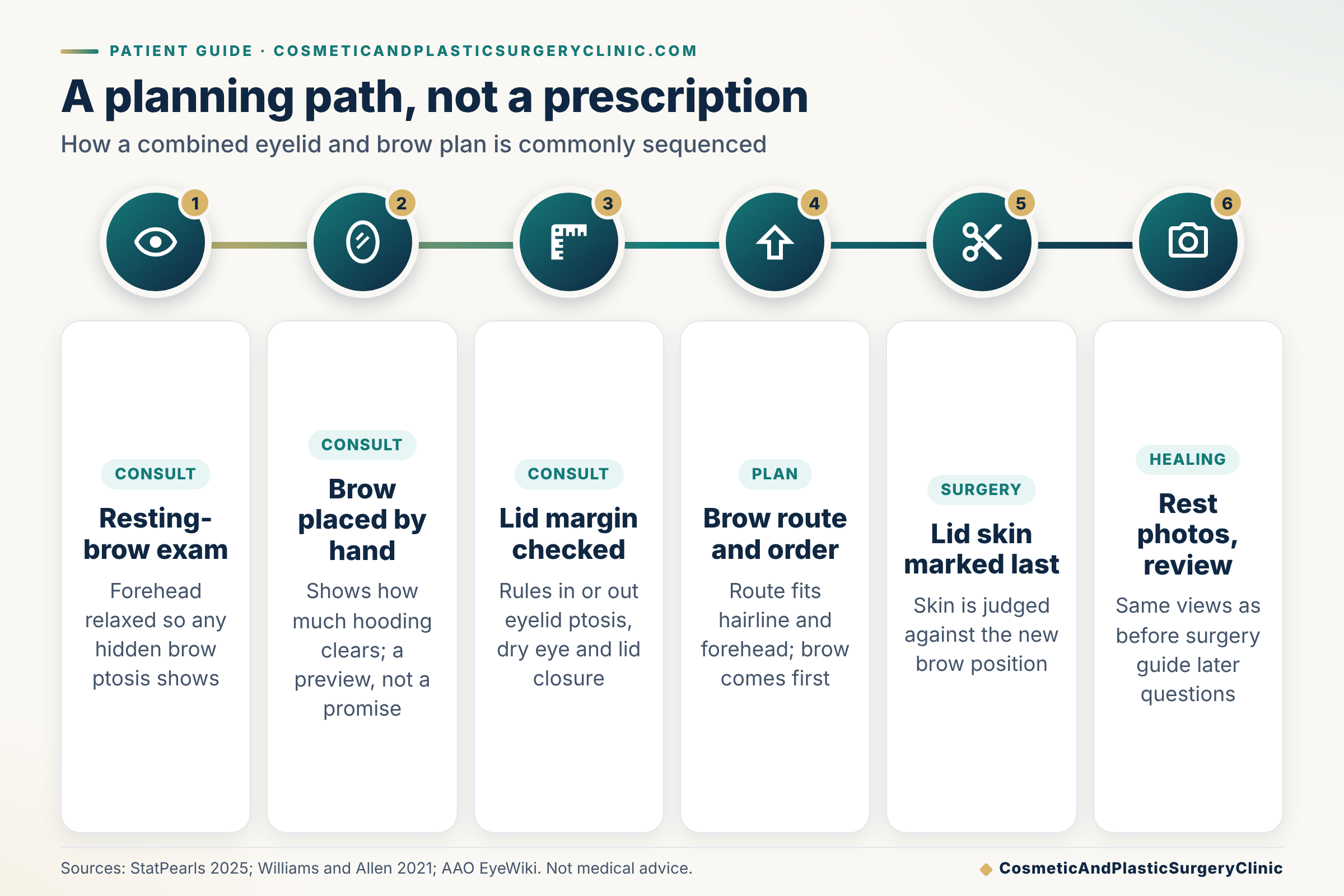
Lid skin is marked after the brow is set
The StatPearls chapter states the sequence directly: if an upper blepharoplasty is planned, it is performed after the brow lift, because lifting the brow reduces upper-lid skin redundancy and less skin then needs excision. The logic is mechanical. Skin removed while the brow is still low is skin that the lifted brow would have used, so the lid can end up short of tissue, a central point in any blepharoplasty vs brow lift sequence.
AAO EyeWiki and Yang and colleagues both describe leaving at least 20 mm of skin between the lid margin and the lower border of the brow, which Yang and colleagues tie to avoiding a skin deficit and lagophthalmos, incomplete eyelid closure. That figure is a surgeon’s working reference, not a target to measure at home, but it explains why the brow position has to be known before the lid skin is cut.
Blepharoplasty vs brow lift together: same day or staged
Williams and Allen note that staging the procedures may reduce the risk of lagophthalmos and exposure keratopathy, while adding that most surgeons perform them concurrently. StatPearls lists prior blepharoplasty among the factors that raise lagophthalmos risk when an endoscopic brow lift follows, which shows the order matters from both directions.
Staging means two recoveries, in exchange for letting the brow show where it settles before lid skin is marked. A combined operation means one recovery; an ASPS surgeon quoted in 2024 advises planning at least a month of social downtime for combined eye and brow surgery, because facial changes are harder to hide than body ones. No source opened compares outcomes of same-day and staged blepharoplasty vs brow lift plans directly, so the choice is judgment, not data.
Neighbors: facelift, toxin and fillers
A brow lift beside a facelift
An ASPS surgeon describes a brow lift as rejuvenating the upper third of the face, with a facelift addressing the lower two-thirds, and says a temporal lift is often performed with a deep plane face and neck lift. The same surgeon puts coronal-lift downtime at about two weeks, matching facelift recovery, so combining does not generally need more time. A second surgeon in that 2024 article says brow lifts are typically performed at the time of a facelift or as a standalone procedure.
A brow lift added to a facelift still adds incisions, operating time and its own risks. The facelift overview explains the lower-face side; the question here is whether the upper face is part of the plan or deliberately left out.
Toxin and fillers: bridge, test or fine-tuning
Toxin sits at the edge of the blepharoplasty vs brow lift question. A May 2025 ASPS article describes toxin as selectively relaxing the muscles that pull the brow down, giving a gentle lift, but one that cannot reposition tissue structurally. It also says most people who have a brow lift still need toxin afterward, and that an endoscopic lift can help toxin avoid dropping the brows. An August 2024 ASPS article frames combined eye and brow surgery as an alternative for people tired of repeated injections, while acknowledging higher cost and longer recovery.
Tell the surgeon when and where any toxin was given. As the 2018 Aesthetic Surgery Journal report shows, prior brow-depressor treatment can falsely elevate the brows and mask the real position. The facelift alternatives article covers nonsurgical routes for the face more broadly.
Recovery, risk, scars and cost side by side
Published sources are most uneven here. Brow lift recovery ranges differ by technique and by author, eyelid pages often give no timelines, and no source opened compares blepharoplasty vs brow lift head to head. The ranges below describe groups and sources, not any one person’s course.
Recovery windows
Brow lift: ranges that do not match
The ASPS recovery page says initial wound healing may take 10 to 14 days, return to work after 10 to 14 days, and complete recovery several months. Cleveland Clinic gives a similar return-to-work window and says full healing can take up to six months. Mayo Clinic says stitches usually come out within 7 to 10 days and swelling can last many weeks. An ASPS surgeon in 2025 says an isolated lift may allow a return to public life within a few days, while another in 2024 says temporal lifts typically need one to two weeks.
Those figures conflict because techniques, incision length and individual healing differ. Ask for a range tied to the planned route, and treat the shorter ranges as best cases.
Eyelid surgery: early windows and what the pages leave out
The ASOPRS patient page says most people return to normal activities in one to two weeks after upper blepharoplasty. AAO EyeWiki describes ice compresses for the first three days, then warm compresses, and avoiding lifting, bending, straining and exercise for the first ten days. The ASPS eyelid recovery page gives no timeline and tells readers to ask, adding that darkly tinted sunglasses and sun protection should continue until healing is complete.
The blepharoplasty recovery article gives the week-by-week lid side in detail; no source opened quantifies the window for both operations done together.
Risk profiles that overlap and diverge
What a brow lift adds: sensation, hair and nerves
The ASPS safety page lists, for brow lift, bleeding, an elevated hairline, eye irritation or dryness, facial asymmetry, facial nerve injury with weakness or paralysis, infection, hair loss around the incisions, numbness or intense itching, poor wound healing, unfavorable scarring and the possibility of revision. Mayo Clinic says numbness often fades within weeks but some loss may last a long time, and that one or both brows can sit too high.
A 2013 Aesthetic Surgery Journal systematic review by Byun and colleagues pooled 82 studies. For coronal lifts it reported hematoma in 0.5% of patients and infection in 0.2%; for endoscopic lifts, paresthesia 6.2%, asymmetry 3.6%, alopecia 3.0% and lagophthalmos 2.7%; and for anterior hairline lifts, alopecia 8.5%. The evidence comes from case series, and the authors called for a comparative study. StatPearls adds that temporary facial-nerve weakness is far more common than permanent injury.
What eyelid surgery adds: the surface of the eye
ASPS lists for eyelid surgery bleeding, numbness around the lashes, trouble fully closing the eyes, dry eyes, outward turning of the lower lid, infection, temporary lid lag, sensitivity to light, scarring, the possibility of revision, and vision changes with a very rare risk of blindness. Dry eye and lagophthalmos are the overlap with brow surgery: AAO EyeWiki notes that raising the brow could worsen dry eye, lagophthalmos or exposure keratopathy, and StatPearls treats lagophthalmos and dry-eye history as contraindications to an endoscopic lift.

Cost and coverage
Fee ranges and what they leave out
For blepharoplasty vs brow lift budgeting, the 2024 ASPS statistics report gives projected surgeon-fee ranges from surveyed members: $3,000 to $5,500 for upper blepharoplasty, $3,709 to $6,500 for lower blepharoplasty and $4,000 to $7,500 for forehead lift. The report does not state what the ranges exclude. The separate ASPS brow lift cost page shows an average of $5,460 without a year, and says it excludes anesthesia, facility and related expenses.
Adding the upper-lid and forehead ranges gives $7,000 to $13,000, but that is arithmetic only; no source opened says how combined fees are set, and anesthesia and facility charges come on top, so line-by-line quotes matter. The blepharoplasty cost article and the plastic surgery cost page show how to compare quotes like for like.
When insurance enters the picture
ASPS states that most health plans do not cover brow lift surgery or its complications. Functional criteria differ. The 2015 ASOPRS white paper says brow ptosis repair is covered when it contributes to skin-fold overlap or eyelid ptosis that meets blepharoplasty or ptosis criteria, and treats forehead rhytidectomy as cosmetic. One Medicare contractor policy, Palmetto GBA’s (CMS LCD ID 34411, revision effective May 20, 2021), says brow ptosis repair may be required in place of or in addition to upper blepharoplasty, and that benefits go to the covered procedure only when a cosmetic one is done in the same session.
Contractor rules differ. The Palmetto policy says visual fields are not required, while the 2015 ASOPRS paper describes field testing as part of documentation. A Noridian page updated September 2025 lists photos, notes on reduced peripheral vision and patient complaints. Rules change and plans vary, so blepharoplasty vs brow lift coverage is never assumed; the blepharoplasty insurance article covers the documentation steps.
Six blepharoplasty vs brow lift questions that keep the label from choosing for you
A quote that says “eyelid surgery” or “brow lift” names a procedure, not a diagnosis. The six questions below test whether the diagnosis behind the label is sound and whether the plan follows from it. They fit a blepharoplasty vs brow lift consultation with either a plastic surgeon or an oculoplastic surgeon.
| Question to ask | A specific answer sounds like | Be wary if |
|---|---|---|
| Where does my brow sit against the orbital rim at rest, and how did you measure it? | Names a position, mentions resting photographs and compares the two sides | The answer is only a label, such as “you just need your eyes done” |
| When you lift my brow by hand, how much of the hooding changes? | Describes what clears and what remains, in terms of skin and brow | Dismisses the maneuver or promises the same result in surgery |
| Is my lid margin height normal, and is ptosis part of this? | Mentions lid-margin measurement and says whether the lid itself sits low | The lid margin is never examined or discussed |
| Which brow route would you use, and why for my hairline and forehead? | Ties the route to hairline, forehead height, scar position and expected relapse | Recommends only the technique the practice performs most |
| In what order would you do both, and what would make you stage them? | Brow first; names dry eye, lid closure or healing as reasons to stage | Marks lid skin before the brow plan is settled, or cannot explain the order |
| What happens to my brow if only the lids are done, and how would we tell? | Says the brow may move, plans a rest photograph and a review time | States that the brow never changes |
Blepharoplasty vs brow lift questions that test the diagnosis
Brow height and the hand test
The first two rows ask for evidence that the surgeon has looked at the brow itself. A useful blepharoplasty vs brow lift answer sounds like anatomy: the brow sits at, above or below the rim, one side differs from the other, and supporting the brow by hand clears a certain amount of the fold. An unhelpful answer is a conclusion without a finding.
Bring a photograph taken straight on with the forehead as relaxed as you can make it, and a second one with the brow as you usually carry it. The difference between them is information the surgeon can use, and it also records your baseline for later comparison.
Lid height, dry eye and other contributors
The third row asks about the part of the picture people rarely raise. A low lid margin, a history of dry eye or trouble closing the eyes, and earlier eyelid surgery all change the plan, and StatPearls and AAO EyeWiki both treat them as matters to check before surgery. Mention any eye history, contact lens use, previous eye operations and any recent toxin or filler without being asked.
A surgeon confident in a diagnosis should welcome a second examination, which is most useful when the first surgeon’s findings are shared with the second.
Questions that test the plan
Route, order and staging
Rows four and five turn the diagnosis into a plan. The route should follow the hairline, the forehead height, the sex and shape of the brow and tolerance for a visible scar, as the ASPS, Mayo and AAO sources describe. The order should be brow first when both are planned, and a surgeon who departs from that should be able to explain why in tissue terms.
Ask what would make the surgeon stage the operations; a good answer names findings, such as how the eyes close or how dry they are. The plastic surgery consultation article covers the rest of the visit: what to bring, how to judge answers and how consent works.
After surgery: brow height, touch-ups and the option to wait
The sixth row addresses what happens if the lids are done and the brow is not. A surgeon who plans a resting photograph and a review is treating brow movement as a known possibility. Mayo Clinic notes that uneven brows often even out during healing but lasting problems may need toxin or more surgery, and ASPS lists revision surgery among the risks, so ask how revisions are handled and priced.
Waiting is also a legitimate answer: if findings are mixed and the complaint is mild, a surgeon can document the baseline and revisit later. The choosing a plastic surgeon article explains how to verify credentials before booking either operation, whether with a plastic surgeon or an oculoplastic specialist.
Frequently asked questions
Does the blepharoplasty vs brow lift decision differ for men?
The blepharoplasty vs brow lift anatomy question is the same, but the target differs. AAO EyeWiki describes a typical male brow as flatter and sitting on the orbital rim, and a 2025 ASPS article warns that a lift may remove masculine features in men. A 2024 ASPS article says targeted lifts are probably more common than coronal lifts, even more so in men, and Mayo Clinic notes a coronal incision may be avoided with thinning hair. A surgeon can say how these general points apply to a particular brow and hairline.
How long does each last in a blepharoplasty vs brow lift comparison?
Sources conflict on brow lifts. Mayo Clinic says results are not permanent, Cleveland Clinic says they could last a lifetime while wrinkles can return, and an ASPS surgeon says a browpexy may start to fall after a few years. A 2025 meta-analysis of 12 endoscopic studies calls recurrent ptosis one of the most debated topics and asks for more objective long-term data. No source opened gives a durability figure for upper blepharoplasty; aging continues either way.
Will a brow lift change my hairline or hair?
It can. Mayo Clinic says incisions can raise the hairline or cause hair loss, and ASPS lists elevated hairline and loss of hair around incisions among the risks. StatPearls says an endoscopic lift may raise the hairline slightly and lists excessive hairline recession as a reason to avoid it, while the anterior hairline route is described by ASPS as an option for very high foreheads. Pooled alopecia rates in a 2013 review of case series were 3.0% for endoscopic and 8.5% for anterior hairline lifts.
Does dry eye change the blepharoplasty vs brow lift decision?
Not automatically, but it changes the conversation. StatPearls lists a dry-eye history, lagophthalmos and prior blepharoplasty among factors that raise lagophthalmos risk or argue against an endoscopic lift, and AAO EyeWiki says tear film quality and corneal sensation are assessed before upper-lid surgery. Surgeons usually leave the orbicularis muscle intact in upper-lid surgery to lower dry-eye risk. Tell the surgeon about dryness, gritty eyes or trouble closing the eyes before any plan is made.
Does a brow lift treat forehead lines and crow’s feet, which blepharoplasty does not?
ASPS lists horizontal forehead wrinkles and frown lines among the concerns a brow lift treats, and Cleveland Clinic says a limited-incision technique reduces crow’s feet but does not correct the center of the forehead. An ASPS surgeon says most people who have a brow lift still need toxin afterward. The ASPS eyelid page lists lid skin, fat and lower-lid wrinkles as eyelid-surgery targets, and none of the pages opened names forehead lines as a target of blepharoplasty.
Which surgeon performs a blepharoplasty vs brow lift?
The sources opened name two groups for blepharoplasty vs brow lift surgery. ASPS advises choosing a board-certified plastic surgeon and reviewing before-and-after photographs, and the ASOPRS patient pages point to an oculofacial plastic surgeon, who performs tests to decide whether functional surgery applies. Either way, verify board certification, hospital or accredited-facility privileges and experience with the exact operation planned. The credential check itself is covered in the surgeon-selection article linked above.
Sources and further reading
- American Society of Plastic Surgeons (ASPS) — Brow lift overview (accessed 2026-11-12) — what a brow lift treats, procedures combined with it
- ASPS — Brow lift procedure (accessed 2026-11-12) — anesthesia, endoscopic, coronal and anterior hairline incisions
- ASPS — Brow lift cost (accessed 2026-11-12) — average fee without a year, exclusions, insurance statement
- ASPS — Brow lift recovery (accessed 2026-11-12) — 10 to 14 day healing and work window, dressings, drains
- ASPS — Brow lift risks and safety (accessed 2026-11-12) — list of brow lift risks
- ASPS — Brow lift candidates (accessed 2026-11-12) — candidacy considerations, eyelid surgery versus brow lift
- ASPS — Eyelid surgery overview (accessed 2026-11-12) — what eyelid surgery treats
- ASPS — Eyelid surgery recovery (accessed 2026-11-12) — dressings, sun protection, no stated timeline
- ASPS — Eyelid surgery risks and safety (accessed 2026-11-12) — list of eyelid surgery risks
- ASPS — Brow lift vs forehead lift (October 18, 2024; accessed 2026-11-12) — temporal, coronal, endoscopic and direct lifts, downtime, anesthesia
- ASPS — What you need to know about brow lifts (July 16, 2025; accessed 2026-11-12) — brow position and candidacy, sex differences, recovery
- ASPS — Combination eye and brow lifts (August 30, 2024; accessed 2026-11-12) — combined surgery, social downtime
- ASPS — Brow lifts vs Botox (May 27, 2025; accessed 2026-11-12) — toxin limits, brow descent and lid skin, longevity comments
- ASPS — 2025 Plastic Surgery Statistics Report (accessed 2026-11-12) — extrapolated 2025 eyelid surgery and forehead lift counts, methodology
- ASPS — 2024 Plastic Surgery Statistics Report (accessed 2026-11-12) — projected 2024 surgeon-fee ranges
- Mayo Clinic — Brow lift (accessed 2026-11-12) — techniques, risks, preparation, results not permanent
- Cleveland Clinic — Brow lift (accessed 2026-11-12) — types, versus eyelid surgery, recovery, longevity statement
- The Aesthetic Society — Brow lift (accessed 2026-11-12) — combined with eyelid surgery, recovery, risks
- StatPearls — Endoscopic brow lift, Raggio and Winters (updated June 19, 2025; accessed 2026-11-12) — indications, contraindications, technique, sequence with blepharoplasty
- American Academy of Ophthalmology EyeWiki — Endoscopic brow lift (accessed 2026-11-12) — brow position by sex, brow ptosis and blepharoplasty, complications
- AAO EyeWiki — Upper eyelid blepharoplasty (accessed 2026-11-12) — brow assessment, 20 mm skin reference, recovery
- Williams and Allen — Eyelid malposition after blepharoplasty: an ounce of prevention, Seminars in Plastic Surgery 2021 (accessed 2026-11-12) — brow ptosis prevalence, masking, staging
- Yang, Ko, Kikkawa and Korn — Upper eyelid blepharoplasty: evaluation, treatment, and complication minimization, Seminars in Plastic Surgery 2017 (accessed 2026-11-12) — brow ptosis definition, compensation, post-operative descent
- Prado and colleagues — Assessment of eyebrow position before and after upper eyelid blepharoplasty, Orbit 2012 (accessed 2026-11-12) — 45 patients, brow descent
- Dar, Rubinstein and Perry — Eyebrow position following upper blepharoplasty, Orbit 2015 (abstract summary; accessed 2026-11-12) — 19 patients, no significant change
- Byun, Mukovozov, Farrokhyar and Thoma — Complications of browlift techniques: a systematic review, Aesthetic Surgery Journal 2013 (abstract summary; accessed 2026-11-12) — pooled complication rates
- Aesthetic Surgery Journal 2018 — Preoperative use of neuromodulators to optimize outcomes in upper blepharoplasty and brow lift (PubMed abstract; accessed 2026-11-12) — 521 patients, masked brow position
- Aesthetic Surgery Journal 2025 — Long-term stability in endoscopic brow lift: systematic review and meta-analysis (PubMed abstract; accessed 2026-11-12) — 12 studies, recurrence debated
- Mellington and Khooshabeh — Brow ptosis: are we measuring the right thing?, Eye 2012 (abstract; accessed 2026-11-12) — 15 patients, predictors of improvement
- ASOPRS — White paper on blepharoplasty, ptosis and brow ptosis repair (January 2015; accessed 2026-11-12) — definitions, functional criteria, documentation
- ASOPRS — Droopy eyebrows and brow lift patient page (2025; accessed 2026-11-12) — brow lift routes, risks, recovery
- ASOPRS — Excess eyelid skin and droopy brows patient page (2025; accessed 2026-11-12) — upper blepharoplasty, recovery, functional versus cosmetic
- ASOPRS — Droopy eyelids (ptosis) patient page (2025; accessed 2026-11-12) — ptosis causes and symptoms
- Centers for Medicare and Medicaid Services — Palmetto GBA local coverage determination 34411, blepharoplasty and related services (accessed 2026-11-12) — brow ptosis repair, documentation, cosmetic exclusion
- Noridian Healthcare Solutions — Blepharoplasty, JE Part B (updated September 17, 2025; accessed 2026-11-12) — documentation requirements, brow ptosis repair code