Most Botox side effects are small and brief: a tender spot, a bruise, a headache that fades by evening. A smaller group comes from onabotulinumtoxinA (Botox), or another botulinum toxin, reaching a muscle nobody meant to relax. That is how an eyelid ends up lower than its partner, or a smile slightly off. A very small group involves toxin traveling farther and needs emergency care.
The American Society of Plastic Surgeons (ASPS) reports that neuromodulator injections made up roughly half of all minimally invasive procedures in 2025, so these questions come up for a great many people. This page sorts Botox side effects into expected, uncommon and urgent, shows the published numbers and their limits, and ends with questions to ask an injector. How the treatment works is covered in the Botox overview. Nothing here predicts what will happen to you.
Sorting Botox side effects into expected, uncommon and urgent
The same face can show a normal early effect and a warning sign on the same afternoon, and they can look alike. Two things separate them: how much function is affected, and which way the change is heading. The sorting of Botox side effects here is general education from the product label, patient pages and published reviews. The written instructions from your injector take precedence.
What causes injection-related Botox side effects
Botox side effects at the needle sites: pain, redness and bruising
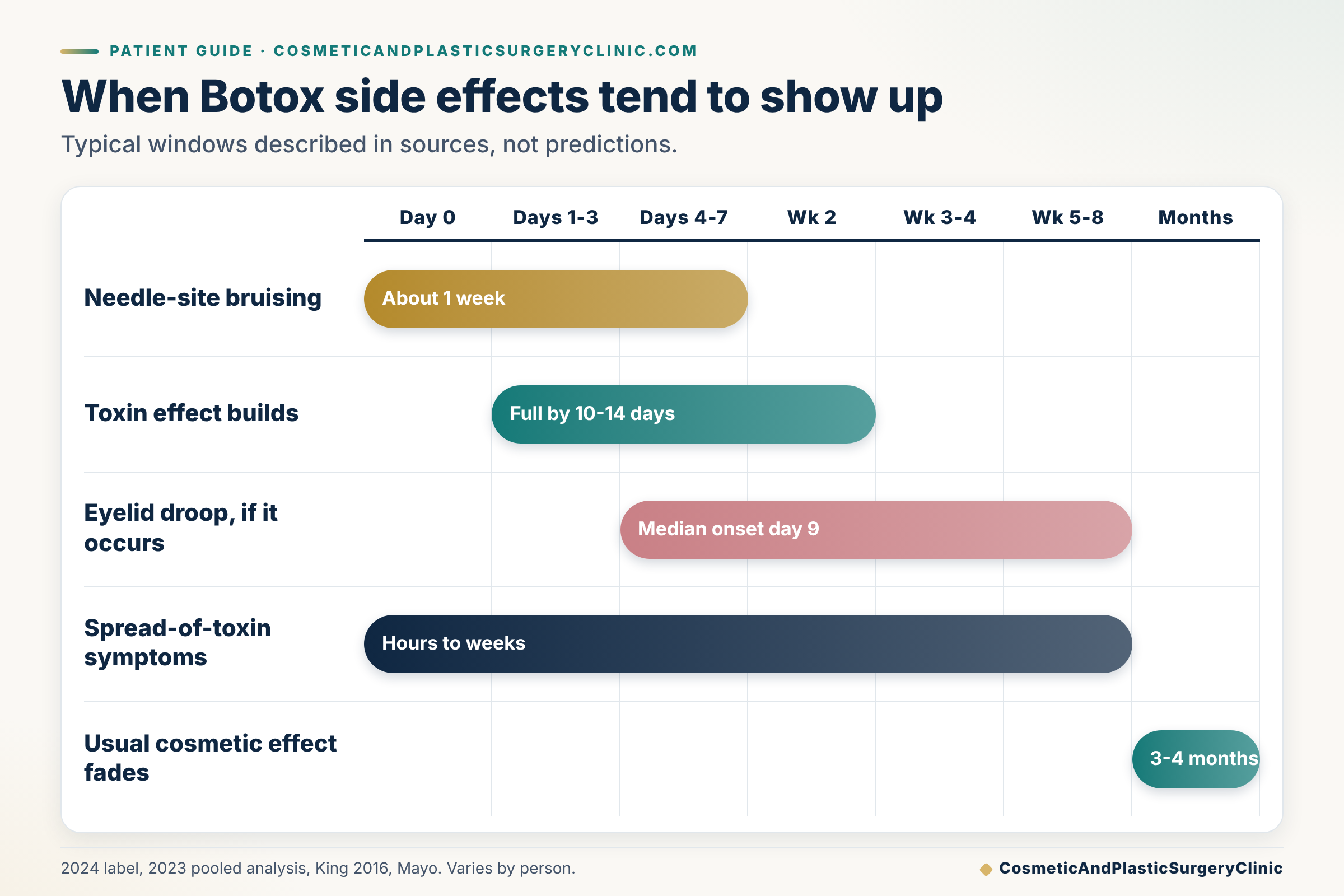
Mayo Clinic lists pain, swelling or bruising at the injection site among the possible Botox side effects, and the American Academy of Dermatology (AAD) says most of the mild ones come from the injections themselves and not from the toxin. The AAD puts the duration of a bruise at about one week. The Botox Cosmetic label, revised in October 2024, says localized pain and bleeding or bruising may be associated with the injection, but it does not tabulate them.
A pooled analysis of 18 registration studies of onabotulinumtoxinA for upper facial lines, published in 2023 in JAAD International, does give a figure: injection-site bruising in 3.1% of treated participants and 1.9% of those given placebo. The authors call bruising and hematoma likely procedure-related, which fits the pattern that a saline injection can bruise too. That analysis was funded by the manufacturer and covered mostly women with a median age of 47, so it describes trial conditions, not every clinic.
Headache and flu-like feelings as Botox side effects
In the label’s trial of forehead lines treated together with frown lines, headache was reported by 9% of 665 people given Botox Cosmetic and 5% of 315 given placebo. Cleveland Clinic and ASPS also list flu-like symptoms and nausea among Botox side effects, and MedlinePlus adds tiredness and neck pain. The numbers are small and so is the gap from placebo, which matters when deciding whether a headache belongs on the list of Botox side effects.
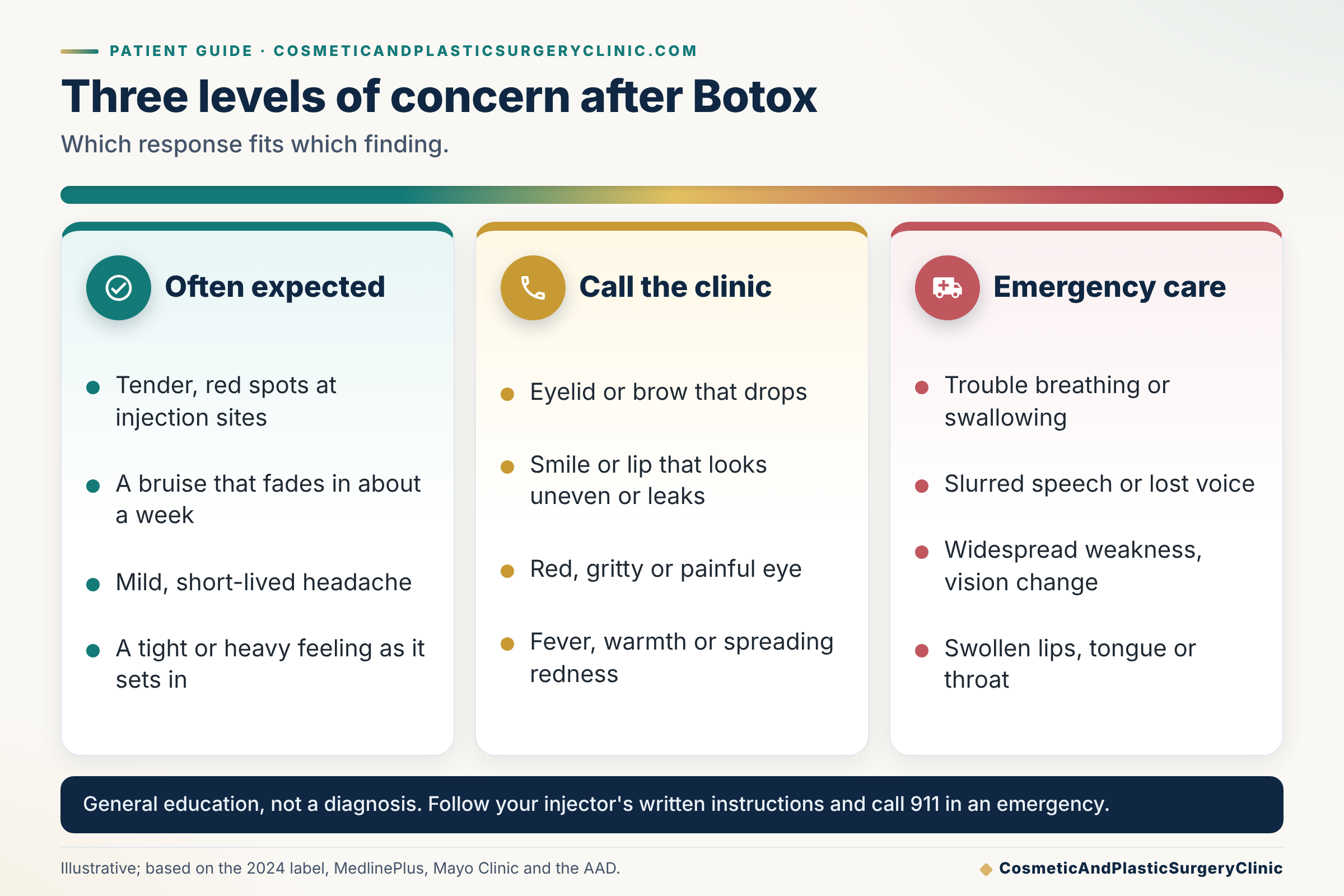
A headache that is mild and short-lived fits the expected pattern. One that is sudden and severe, or that arrives with vision changes, weakness or trouble speaking, is a different matter and belongs in the warning-sign column further down. If you are unsure which describes you, call the clinic and say what you feel in plain words.
What the toxin itself changes that you may notice
A heavy, tight or stiff feeling
Weakening a muscle on purpose feels like something. In the label’s forehead trial, skin tightness was reported by 2% of treated people and none of the placebo group, and the frown-line trial recorded facial pain in 1% and muscular weakness in 1%. Whether that heaviness is a side effect or simply the intended effect depends on how much movement you wanted to keep. Both can be true at once.
The term “frozen” is not a label term and no sourced frequency exists for it among Botox side effects, so the honest answer is that it depends on where, how much and for whom. The conversation to have before treatment is about how much expression you want left. How to read Botox photos explains why photos taken at rest and at full expression tell different stories.
Uneven results and the waiting period
Botox takes time to work. Mayo Clinic says injections usually begin working 1 to 3 days after treatment and that full results can take a week or more; Cleveland Clinic says most people notice effects around day 3 or 4, with full results by 10 to 14 days. A brow that looks different from the other side on day two may simply be earlier or later in that curve.
Three features matter more than the mirror on a single day: severity, one-sidedness and trend. A small asymmetry that stays small is a conversation for a follow-up visit, and among Botox side effects it is one of the easier ones to monitor. A droop that is growing, or one that interferes with seeing, closing an eye or chewing, is not. Ask in advance whether the practice schedules a review at about two weeks, and who decides on any adjustment.
| What you notice | Often expected when | Call the clinic when | Emergency care when | Sources |
|---|---|---|---|---|
| Needle-site pain, redness, bruise | Mild, fading over days; a bruise lasts about a week | Swelling or warmth that grows, or a lump that keeps enlarging | Fever with spreading redness, or severe pain | AAD; Mayo Clinic; 2024 label |
| Headache | Mild and short-lived in the first days | Persistent or worsening | Sudden and severe, or with vision or speech change | 2024 label; Cleveland Clinic |
| Heavy or tight feeling | Matches the muscles treated; builds over 1 to 2 weeks | Stronger than discussed, or painful | Not usually an emergency by itself | 2024 label; Mayo Clinic |
| Eyelid or brow droop | Not expected; seen in a minority | Any lid or brow that drops or blocks vision | With double vision, trouble breathing or swallowing | 2024 label; AAD; 2023 pooled analysis |
| Uneven smile, lip or cheek | Slight unevenness early in the onset window | Drooling, trouble drinking or speaking | With facial weakness spreading or speech change | Mayo Clinic; MedlinePlus |
| Dry, watery or irritated eye | Mild, brief | Red, painful or light-sensitive eye | Vision loss or severe eye pain | 2024 label; MedlinePlus |
| Hives, rash, facial swelling | None | Localized itching or rash | Swelling of lips, tongue or throat; breathing trouble | 2024 label (hypersensitivity) |
| Swallowing, breathing or speech trouble; widespread weakness | None | Not a phone-and-wait situation | Call 911 or go to emergency care now | Boxed warning; MedlinePlus; CDC |
Eyelid droop, heavy brows and uneven smiles
Droop and asymmetry are the Botox side effects people recognize in the mirror, and the ones they ask about most. They are also the ones with the best published numbers, because the label’s trials and later pooled analyses counted them. The pattern is consistent across sources: uncommon, mostly mild, and temporary, with a timeline that is longer than most people expect.
Why Botox side effects sometimes land in the wrong muscle
Eyelid ptosis: how often, how soon, how long
In the label’s frown-line trial, eyelid ptosis (a drooping upper lid) was reported by 13 of 405 people given Botox Cosmetic, or 3%, and by none of the 130 given placebo. The 2023 pooled analysis of 18 registration studies found it in 1.1% of 3,431 treated participants against 0.1% of 1,359 on placebo. Of the 37 cases it examined, 81.1% were mild, the median onset was 9 days after treatment and the median duration was 28 days.
Older and clinic-based figures run higher. A 2016 expert review in the Journal of Clinical and Aesthetic Dermatology by Martyn King cites 5.4% (12 of 263) in one manufacturer multicenter study, and estimates that experienced injectors see it in well under 1% of treatments. That estimate is the author’s opinion, not a measured rate. The sources agree on the mechanism: toxin diffuses through the orbital septum and weakens the levator muscle that lifts the lid.
Brow ptosis and forehead-only treatment
The forehead muscle, the frontalis, is the only muscle that lifts the brows. Weaken it, and the brows can sag, which crowds the upper lids and feels like heaviness. In the label’s trial that combined forehead and frown-line treatment, brow ptosis was reported by 13 of 665 people given Botox Cosmetic (2%) and none of 315 on placebo. The 2016 review calls brow ptosis the main side effect of forehead treatment and says the frown muscles should be treated at the same visit, not the frontalis alone.
Planning to avoid brow heaviness, one of the more visible Botox side effects, is its own topic, with forehead height and brow position covered in the forehead Botox article. For people who already have hooded lids, blepharoplasty versus brow lift explains what surgery changes that a neuromodulator cannot. Droop is also why the label tells injectors to use caution when ptosis or excessive weakness is already present in the target muscle.
What happens to Botox side effects while the effect wears off
Time, eye doctors and the limits of eye drops
All About Vision, a consumer eye-care site, says toxin-related drooping typically resolves within four to six weeks but can take as long as three to seven months. It also describes apraclonidine eye drops, which can raise the lid by about 1 to 2 millimeters. King’s review adds that apraclonidine can cause pupil constriction and, in susceptible people, closed-angle glaucoma, and that evidence for it is stronger in Horner syndrome than in toxin droop.
That is why the drops are a prescriber’s decision. Consider a hypothetical person who notices on day 8 that one upper lid sits lower than the other. A sensible sequence is to photograph both eyes in even light, call the clinic that day, and ask for an assessment, possibly by an eye doctor. If the lid is blocking vision, or the eye will not close, the call should not wait for a convenient appointment. More injections are not a standard fix for a drooping lid.
Smile, lip and lower-face changes
Mayo Clinic lists “droopy eyelids or crooked eyebrows” and “a crooked smile or drooling” among possible Botox side effects. Muscles around the mouth help with smiling, drinking and speaking, so even small spread there can be felt. The adverse-reaction tables in the 2024 label cover frown lines, crow’s feet and forehead lines; none covers the lips, smile muscles or jaw.
The label also says safety and effectiveness for unapproved uses have not been established, and serious reactions with unapproved uses have been reported. Treatment of the lips or jaw is common but off-label, and Botox side effects in those areas have a thinner evidence base. The sources reviewed for this page gave no pooled rates for lower-face problems, so none is quoted. See masseter Botox and lip flip versus lip filler for those areas.
Rare Botox side effects and the signs that should not wait
Serious reactions are uncommon, and the label says so plainly. They still deserve their own section, because they are the Botox side effects where timing matters most and where a reader is least likely to know what to look for. The two groups are toxin effect beyond the injection area and allergic or eye-surface reactions.
Spread of toxin effect and the boxed warning
What the boxed warning says and what the cosmetic label reports
Botox Cosmetic carries a boxed warning titled “Distant spread of toxin effect.” It says toxin effects can appear away from the injection area, with symptoms starting hours to weeks later, and that swallowing and breathing difficulties can be life threatening, with reports of death. The warning adds that risk is probably greatest in children treated for muscle spasticity, though adults with predisposing conditions can also be affected. The FDA required the boxed warning and a Risk Evaluation and Mitigation Strategy, including a Medication Guide, in 2009.
For cosmetic use, the 2024 label states that no serious distant-spread events have been reported with dermatologic use at the labeled doses. That is reassuring and it is also a statement about labeled doses of an approved product. It says nothing about products of unknown origin, which is the subject of a later section. The FDA also states that botulinum toxin products cannot be interchanged, one reason doses from one brand cannot be copied onto another.
Symptoms that mean emergency care now
Unlike a bruise, these rare Botox side effects do not follow a predictable curve, and they do not necessarily appear in the first hour. People sometimes expect that a problem would show up while still in the chair. The Centers for Disease Control and Prevention (CDC) reported a median of 3 days between injection and symptom onset in the counterfeit-product investigation described later, with a range of 0 to 20 days. Have a plan for the first few weeks, not just the first day.
Allergy, the eye surface and other uncommon Botox side effects
Hypersensitivity and infection at the site
Among Botox side effects, allergy is the one the label treats most formally. It lists serious or immediate hypersensitivity reactions, including anaphylaxis, serum sickness, hives, soft-tissue swelling and shortness of breath, and says injection should stop if one occurs. It also records a fatal anaphylaxis case in which lidocaine had been used as the diluent, so the cause could not be separated. Known allergy to any botulinum toxin preparation or its ingredients is a contraindication, as is infection at the proposed injection site.
This is the reason a good intake asks about past reactions to any toxin product, not just allergies in general. Mayo Clinic also lists infection at the injection site among possible side effects. Fever, warmth, spreading redness or a draining spot after a visit is a same-day call. Rashes that stay local and itchy are worth reporting but differ from swelling of the lips, tongue or throat, which is an emergency.
Dry eye, swollen lids and corneal concerns
Botox near the eye can reduce blinking, and the label discusses corneal exposure and ulceration after injection into or near the orbicularis oculi muscle, most clearly in people treated for eyelid spasm, and reports of dry eye with cosmetic use. In the crow’s-feet trials, eyelid swelling was recorded in 5 of 526 treated people (1%) and none of 530 on placebo. MedlinePlus lists dry, irritated or painful eyes, eyelid swelling and changes in vision among serious symptoms to report.
For everyday purposes, this means a red, gritty or light-sensitive eye after treatment near the eyes deserves a call, not a wait. People who already have dry eye or have had eye or eyelid surgery should say so at intake. MedlinePlus separately asks patients to report past eye or face surgery, and the label advises caution when the treated muscle is already weak.
Why Botox side effects differ from person to person
A percentage from a trial is an average across people with very different faces, medicines and injectors. It can describe a group but not predict any one result. What can be said about Botox side effects is which factors the label and reviews connect to higher odds of a problem, and which of those you can discuss before a needle is picked up.
Patient and health factors behind Botox side effects
Conditions, medicines and pregnancy
The label says people with neuromuscular disorders, including amyotrophic lateral sclerosis and conditions that affect the nerve-muscle junction such as myasthenia gravis or Lambert-Eaton syndrome, may be at increased risk of clinically significant effects and should be monitored. It also advises caution with inflammation at the injection site and with ptosis or weakness already present in the target muscle. MedlinePlus asks patients to report bleeding problems, seizures, thyroid disease, diabetes, lung or heart disease and any past reaction to botulinum toxin.
On pregnancy and breastfeeding, the label says there are no adequate human data on developmental risk and no data on the toxin in breast milk. Mayo Clinic says providers generally do not recommend Botox during either, and Cleveland Clinic advises avoiding it. The sources differ in tone but share the reason: the absence of safety data, not a demonstrated harm. Anyone pregnant, planning pregnancy or breastfeeding should raise it before booking.
Blood thinners, alcohol and bruising
Of all Botox side effects, bruising is the one most open to planning. Cleveland Clinic notes that blood thinners such as warfarin and anti-inflammatory medicines raise bruising risk, and that alcohol makes redness and bruising more likely. Mayo Clinic says a patient may need to stop blood thinners several days beforehand and adds the condition that matters most: check with the prescribing provider first.
Do not stop or change a prescribed anticoagulant or any other medicine to avoid a bruise. A bruise is a cosmetic inconvenience, while the reason for the medicine may be a clot risk. The decision belongs to whoever prescribes it. A supplement list belongs on the intake form too, since some supplements affect bleeding, and the injector cannot weigh what the form does not show.
Injector, product and dose factors
Placement, dilution and anatomy
King’s 2016 review lists injection technique and placement, dose, product dilution and quality, and prior frontal facial surgery as contributors to ptosis. It is an expert review, not a guideline, and many of its recommendations rest on single studies or the author’s practice. A 2022 systematic review of cosmetic upper-face injections in Aesthetic Surgery Journal pooled 24 studies and 4,268 injection sessions, found an overall complication rate of 16%, and concluded most were mild and transient.
The same review also notes that complication reporting was inconsistent and that injector training was unreported in 70% of the included studies. Put plainly, the literature cannot tell how much training changes the odds. It is not evidence that training does not matter, and the sources name placement as the route to droop. Credential checks are the subject of how to choose a plastic surgeon; the setting questions come later on this page.
Repeat treatment and antibodies
Botulinum toxin is a protein, and the immune system can form antibodies against it. The Botox Cosmetic label reports that 14 of 916 people tested across three crow’s-feet trials (1.5%) developed binding antibodies and none developed neutralizing antibodies, and warns that assay differences make comparisons across studies misleading. A 2022 narrative review in Clinical, Cosmetic and Investigational Dermatology cites a pooled 2.1% neutralizing-antibody rate across 5,811 people treated for medical and cosmetic reasons.
That review calls antibodies the leading but controversial explanation for treatment failure, and notes that bigger doses per session, higher total doses and more frequent treatment have been associated with more antibodies. Not everyone with antibodies stops responding, and not everyone who stops responding has antibodies. The practical link to Botox side effects is indirect: a toxin that stops working leads to dose and interval questions. See how long Botox lasts for why effects fade.
| Factor | Why it matters | Question to ask | What is uncertain |
|---|---|---|---|
| Neuromuscular disease | The label links it to stronger-than-expected toxin effects | Does my diagnosis change whether treatment is appropriate? | No cosmetic-specific rates in the sources reviewed |
| Existing droopy lid or heavy brow | Weakening the lifting muscles can worsen it | How will you check my lid and brow position first? | No sourced rate for people with pre-existing ptosis |
| Blood thinners, supplements, alcohol | Raise bruising and bleeding risk | Which items on my list matter, and who decides about stopping? | Stop-intervals vary by source; prescriber decides |
| Pregnancy or breastfeeding | Label has no adequate human data | What does the label say about my situation? | Absence of data, not proof of harm |
| Prior eye, eyelid or forehead surgery | Changes lid support and muscle function | Does my surgical history change where you inject? | Evidence is mainly expert opinion |
| Injector training and technique | Placement is the stated route to droop and asymmetry | Who will inject, and how many of these do they do? | Training unreported in 70% of reviewed studies |
| Product source and handling | Dilution, quality and counterfeits are named risk factors | Which product will you use, and where did it come from? | Handling effects are poorly quantified |
| Frequency and cumulative dose | Linked to antibody formation in some studies | What interval do you plan, and what is the reason? | Antibody theory remains controversial |
Counterfeit toxin, discount injections and the setting: Botox side effects with a preventable cause
Most of the risks above belong to approved product used in medical settings. A separate category of Botox side effects comes from product whose origin nobody can verify and from people not licensed to inject it. Unlike dose or anatomy, this one can be screened for before the appointment, and public-health agencies have said so in writing.
What the 2023 to 2024 CDC investigation found
The numbers, and why they changed
On April 23, 2024, the CDC issued a Health Alert Network notice describing 22 people with adverse effects after cosmetic or other injections of what was reported as botulinum toxin, with symptom onset between November 4, 2023 and March 31, 2024. Eleven of the 20 people with available information had been hospitalized, six received botulism antitoxin, and none of the 22 met the case definition for botulism. Reported symptoms included blurred vision, drooping lids, dry mouth, slurred speech, shortness of breath and widespread weakness. Symptoms began a median of 3 days after injection.
The final CDC update, on a page dated December 17, 2024, with data current to June 24, 2024, supersedes those early figures: 17 people in 9 states, 13 hospitalized (76%), 7 tested for botulism and all negative, all women aged 25 to 67, and 15 (88%) injected for cosmetic reasons. Counts in a developing outbreak often change as cases are reviewed, and the pages opened here do not itemize every change, so the early number should not be quoted as the result.
What it says, and does not say, about genuine product
The CDC attributed the cases to counterfeit product, product from unverified sources, or injections given by people not following state or local requirements. News reports quoted the FDA as saying nothing indicated a link to FDA-approved Botox, and the investigation page itself says to get injections only if the product comes from an authorized supplier. In November 2025, an FDA alert reported 18 warning letters over illegal marketing of unapproved and misbranded botulinum toxin products.
The counterfeit cluster is a reminder that Botox side effects depend on what is actually in the syringe. That lines up with the label statement that serious distant spread has not been reported at labeled cosmetic doses. It does not mean any needle in any room is equally safe. The CDC’s advice is blunt: if in doubt, do not get the injection. Cost questions, including why a price far below others deserves a pause, are covered in the Botox cost article.
Checking the person, the product and the place
Credentials and scope of practice
The CDC says botulinum toxin should be given only by licensed, trained providers, using recommended doses of FDA-approved products, preferably in a licensed or accredited health care setting. The AAD went further in an April 2024 statement, saying the procedure should be performed in a medical office by board-certified dermatologists, or by appropriately trained non-physician clinicians under direct on-site supervision. That is a specialty society’s position, and state rules on who may inject and how supervision works vary.
A practical reading is to confirm that the person holds an active license, ask what their training is for this specific treatment, and ask who supervises if they are not a physician. The lookup steps are laid out in choosing a plastic surgeon, and why a title is not a credential is in the cosmetic surgeon credentials guide.
Questions about the product and the place
The FDA’s 2024 advice, as listed in its alerts, is to confirm with the health care professional that the product comes from an authorized source, to confirm that the provider is licensed and trained, and to report suspected counterfeit product to the FDA and adverse events through MedWatch. The AAD describes injections at spas, parties, salons and homes as extremely dangerous, and says cases of long-term muscle paralysis, Bell’s palsy and eye damage have followed products bought without a medical license.
Those are strong words from a society with an interest in who injects, so weigh them with the CDC’s more neutral guidance. Both point the same way. Ask which product is being used, ask to see the packaging, and ask where it was bought. A clinic that is confident in its supply will answer without irritation. A “party,” a pop-up or a price that seems too low to be real are reasons to stop and ask more questions.
Turning Botox side effects into consultation questions
A risk list is only useful if it changes what you ask and arrange. The questions below turn the findings on Botox side effects into a short plan. They apply to a plastic surgeon, dermatologist, facial plastic surgeon or another licensed clinician working within their scope. They are meant to be asked, not answered by an article, and a consultation is the place to do it; see the consultation guide for the wider process.
Questions that turn a risk list into a plan
Before the first injection
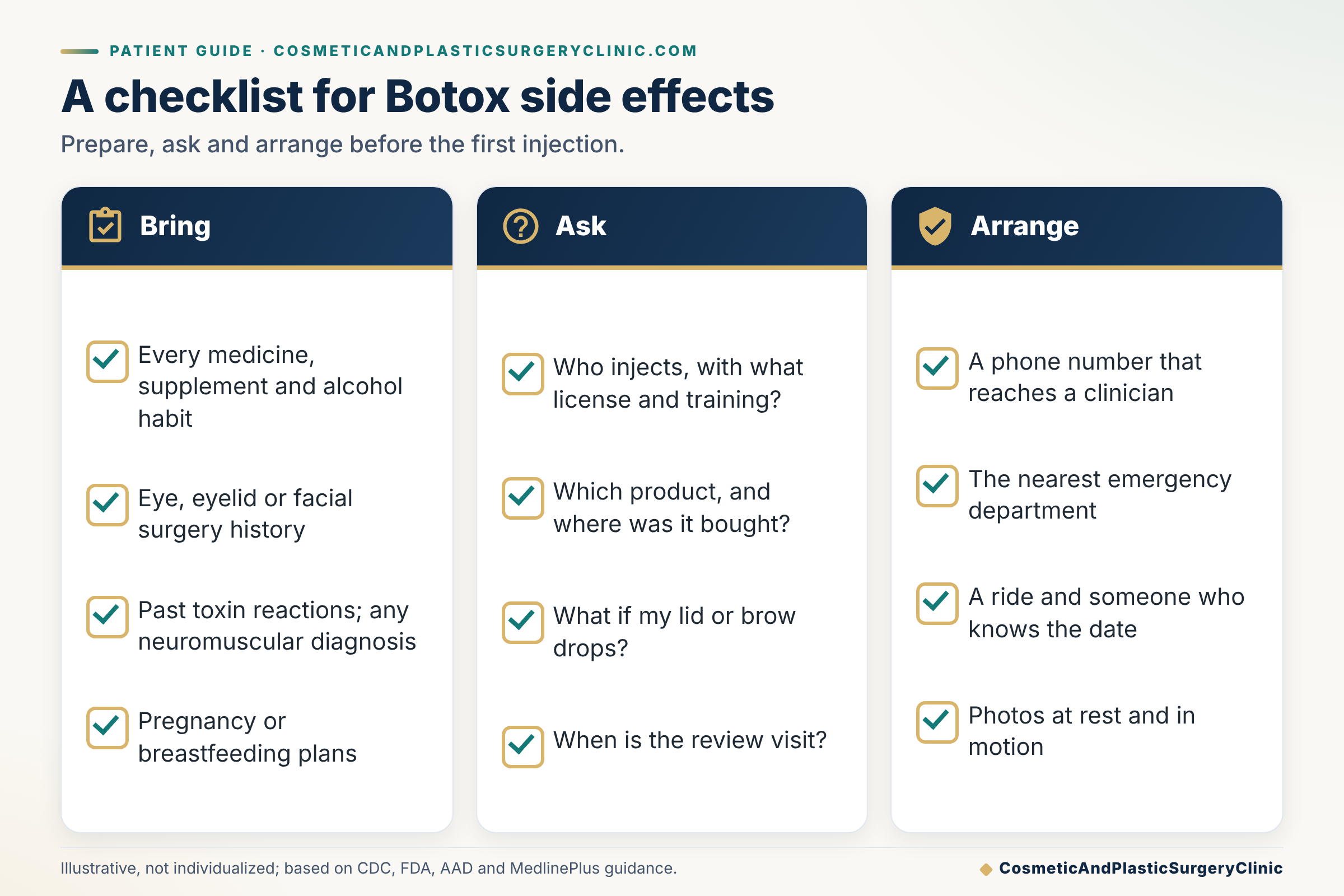
Bring a written list of every medicine, supplement and alcohol habit, any eye, eyelid or facial surgery, any past reaction to a toxin, any neuromuscular diagnosis and any pregnancy or breastfeeding plans. Ask which product will be used and why, and ask for the written aftercare in advance so it is not first read in a parking lot. Ask what the consent form says about droop and asymmetry specifically.
Ask for a photograph at rest and another at full expression before treatment, since these allow a fair comparison later and help sort a new asymmetry from a pre-existing one. The photo-reading article explains how. Then ask the question that exposes the most: if my eyelid or brow drops, what will you do, and how soon can I be seen?
| Topic | A clear answer sounds like | Slow down if |
|---|---|---|
| Who injects | Names the person, license and training for this treatment | “Our team handles it” with no name or credential |
| Product and source | Names the product, shows packaging, explains the supplier | Cannot say what is in the syringe or where it came from |
| Risks for my case | Mentions droop, asymmetry and spread in plain terms, tied to my history | “There are no risks” or only a generic list |
| If a lid or brow drops | Offers a prompt assessment and explains the options and their limits | Promises a quick reversal or a touch-up as the standard fix |
| Review visit | States when and by whom, and what a touch-up policy covers | No follow-up planned, or follow-up only by text |
| After-hours access | Gives a number that reaches a clinician, and the nearest emergency room | Voicemail only, or “go to urgent care” |
| Pressure and pricing | Lets me decide later; pricing explained line by line | Countdown deals, packages, or “today only” offers |
After-hours access and the first two weeks
Find out who answers the clinic’s phone after hours and whether that person can assess a droopy lid or a swallowing problem. Decide ahead of time which emergency department you would go to, and have someone who can drive you. Write down the date and time of treatment and the product used, because emergency staff will want it. After-treatment instructions differ between sources: ASPS says not to rub the area, Cleveland Clinic gives 12 hours of no rubbing or pressure, and Mayo Clinic says 24 hours. Your injector’s written instructions come first.
Report Botox side effects even if they seem small. The FDA asks that suspected counterfeit product and adverse events be reported through MedWatch, and a clinic that tracks results is better placed to adjust technique. Keep photographs from several points in the first two weeks if something changes. Findings that fall into the warning-sign paragraph above are not a reason to wait for a review visit.
When to wait, get a second opinion or choose not to inject
Pressure, vague answers and bundled discounts
Pressure takes small forms: an offer that expires at the end of the visit, a package priced per session rather than per treatment, a clinician who dismisses a question about droop as unlikely. Waiting a week costs nothing but a booking. If a person has a drooping lid or another unresolved change from a previous visit, a second opinion before the next injection makes sense, ideally from a clinician who did not do the first one.
Second opinions are routine in medicine and a good practice will not take offense. Vague answers about product or training are the most common reason to look elsewhere. If an offer sounds time-limited, the better question is why a medical decision would be, and the general risk-literacy article covers how to read risk numbers without being rushed by them.
Choosing no treatment is a legitimate decision
Lines that move with expression are not a medical condition, and many people choose not to treat them. Another reasonable decision is to wait until a health condition, medicine change or pregnancy plan is settled. A key trade-off to weigh is that the pages reviewed describe waiting for the effect to fade when a result is unwanted, and describe no quick reversal.
That asymmetry is a reason some people choose a cautious first session, and a reason to start with a clear picture of what an acceptable result looks like. Whether to begin early in life is a separate question, covered in the preventative Botox article. Nothing about declining injections, or pausing, closes the door later.
Frequently asked questions
How long do Botox side effects last?
It depends on the effect. The AAD puts a bruise at about one week. In the 2023 pooled analysis, eyelid ptosis had a median duration of 28 days, while All About Vision says drooping typically resolves in four to six weeks and occasionally takes three to seven months. Effects tied to the toxin’s action on a muscle fade as the toxin does, and Mayo Clinic describes the usual cosmetic effect as lasting 3 to 4 months. Any symptom that is getting worse, not better, should be reported.
Can Botox side effects show up weeks after the injection?
Some can. The boxed warning says symptoms of distant spread may begin hours to weeks after treatment. In the pooled analysis, eyelid ptosis began a median of 9 days after injection. In the CDC’s counterfeit-product investigation, symptoms began a median of 3 days after injection, with a range of 0 to 20 days. A new swallowing, breathing, voice or vision problem in week two or three still deserves a same-day call, and emergency care if it is severe.
Do Botox side effects differ for frown lines, crow’s feet and the forehead?
The label’s trials hint at different patterns but were not head-to-head. Frown-line trial (405 treated): eyelid ptosis 3%, facial pain 1%, muscle weakness 1%. Crow’s-feet trials (526 treated): eyelid swelling 1%. Forehead plus frown-line trial (665 treated): headache 9%, eyelid ptosis 2%, brow ptosis 2%, skin tightness 2%. Doses, populations and designs differ, so compare the areas qualitatively, and ask your injector which findings are most relevant to the area you are considering.
Are Botox side effects more likely during pregnancy or breastfeeding?
The honest answer is that it is unknown. The label says there are no adequate human data on developmental risk, and no data on whether the toxin enters breast milk or affects a breastfed child. Animal studies showed reduced fetal weight and skeletal ossification at the two highest doses, in the context of maternal toxicity. Mayo Clinic says providers generally do not recommend it during either period. Raise pregnancy plans and breastfeeding with the injector and your own clinician before booking.
Do I need to avoid rubbing or lying down to prevent Botox side effects?
Sources agree on not rubbing but differ on duration. ASPS says not to rub or massage, warning that toxin might migrate and cause temporary weakness or drooping. Cleveland Clinic gives 12 hours of no rubbing or pressure and 3 to 4 hours upright. Mayo Clinic says 24 hours without rubbing and 2 to 4 hours without lying down. The AAD advises waiting two hours before strenuous activity. Because the intervals differ, follow the written instructions from the person who injected you.
Does a bruise mean the injection was done badly?
Not on its own. In the 2023 pooled analysis, injection-site bruising occurred in 3.1% of treated participants and 1.9% of those given placebo, so injections bruise even without the toxin. Cleveland Clinic says blood thinners, anti-inflammatory medicines and alcohol raise the chance. A bruise that stays small and fades over about a week fits the usual pattern. A lump that keeps enlarging, firm swelling or severe pain is a reason to call the clinic the same day.
If my eyelid droops as one of the Botox side effects, can more Botox fix it?
More injections are not the standard answer for a drooping upper lid. King’s 2016 review describes waiting, sometimes with prescription apraclonidine eye drops that lift the lid by about 1 to 2 millimeters, and notes cautions including glaucoma risk in susceptible people. For a heavy brow, the same review says small compensating doses may help in experienced hands. Both are decisions for a clinician who has examined you, and a lid that blocks vision should be seen promptly.
Do Botox side effects ever include long-term nerve or muscle damage?
For approved product given by a trained injector, sources describe the cosmetic effects as temporary. The label notes that swallowing difficulty from toxin spread can last several months and may need a feeding tube, and that no serious distant-spread events have been reported with dermatologic use at labeled doses. The AAD says cases of long-term muscle paralysis, Bell’s palsy and eye damage have followed products bought without a medical license. Source and setting are therefore the main safeguards.
Sources and further reading
- AbbVie/Allergan — BOTOX Cosmetic prescribing information, revised 10/2024 (accessed 2026-11-12) — boxed warning, warnings and precautions, contraindications, trial adverse reactions, antibodies, pregnancy and lactation
- MedlinePlus — OnabotulinumtoxinA injection (revised 2025-02-15; accessed 2026-11-12) — precautions, side effects, symptoms needing immediate action
- Mayo Clinic — Botox injections (accessed 2026-11-12) — risks, when to seek help, onset and duration, medicines, aftercare
- Cleveland Clinic — Botulinum toxin injections (accessed 2026-11-12) — common and serious side effects, alcohol and blood thinners, aftercare, onset
- American Society of Plastic Surgeons — Botulinum toxin safety (accessed 2026-11-12) — risk list, rubbing caution, botulism-like signs
- American Society of Plastic Surgeons — Botulinum toxin overview (accessed 2026-11-12) — definition and brands; no side-effect detail
- American Society of Plastic Surgeons — 2025 plastic surgery by the numbers (accessed 2026-11-12) — neuromodulators about half of minimally invasive procedures
- American Academy of Dermatology — Botulinum toxin therapy: FAQs (accessed 2026-11-12) — side effects, bruise duration, non-medical settings, aftercare
- American Academy of Dermatology Association — Statement on reports on counterfeit injectables (2024-04-11; accessed 2026-11-12) — setting and provider position
- Centers for Disease Control and Prevention — Health Alert Network 00507 (2024-04-23; accessed 2026-11-12) — provisional case counts, onset, recommendations
- Centers for Disease Control and Prevention — Investigation update: harmful reactions linked to counterfeit Botox (2024-12-17; accessed 2026-11-12) — final counts and advice
- Drugs.com — FDA alerts on botulinum toxin (compilation, 2009 to 2025; accessed 2026-11-12) — 2009 boxed warning and REMS, units not interchangeable, 2024 advice, 2025 warning letters
- CBS News — Counterfeit Botox blamed in multistate outbreak (updated 2024-04-23; accessed 2026-11-12) — news report of the FDA statement on approved product
- Brin MF, De Boulle K, Liew S, et al. — Safety and tolerability of onabotulinumtoxinA in upper facial lines, 5298 participants, JAAD International (2023; accessed 2026-11-12) — pooled rates for ptosis, bruising, headache; manufacturer-funded
- Zargaran D, Zoller F, Zargaran A, et al. — Complications of cosmetic botulinum toxin A injections to the upper face, Aesthetic Surgery Journal (2022; abstract record, accessed 2026-11-12) — 24 studies, overall 16%, reporting limits
- King M — Management of ptosis, Journal of Clinical and Aesthetic Dermatology (2016; accessed 2026-11-12) — causes, timing, apraclonidine cautions; expert review
- All About Vision — Drooping eyelids after botulinum toxin (updated 2026-05-22; accessed 2026-11-12) — duration, drops, vision caveats
- Shtefan V, Fletcher J, Duclos OA — Causes of botulinum toxin treatment failure, Clinical, Cosmetic and Investigational Dermatology (2022; accessed 2026-11-12) — antibodies, dose and frequency association, evidence limits