Facelift alternatives are the treatments people weigh against surgery when the face has changed but an operation feels too large, too early or simply unnecessary. The list is long: injected fillers, fat grafting, neuromodulator injections, ultrasound and radiofrequency devices, absorbable threads, laser resurfacing, a narrower operation on the neck or eyelids, and the deliberate choice to wait. They are not smaller versions of one thing. Each acts on a different tissue, lasts a different length of time and goes wrong in its own way.
Interest in the surgery itself is rising, which makes the comparison timely. The American Society of Plastic Surgeons (ASPS) reported that facelifts rose 13 percent in 2025 and neck lifts 21 percent, while neuromodulators and fillers made up 80 percent of minimally invasive procedures. Those are volume shares, not a measure of what suits any one face.
This article handles a single decision: which of the facelift alternatives, if any, matches what is actually bothering you, and what each costs in upkeep, risk and later options. The operation is mapped in the facelift guide, and the factors surgeons weigh are covered in facelift candidate.
Facelift alternatives begin with the tissue that changed
Sorting the concern into volume, skin, structure and neck
Four things that age differently
ASPS describes what a facelift is meant to address as a cluster: skin that has relaxed and sags, deepening lines between the nose and the corner of the mouth, fat that has fallen or disappeared, jowls along the cheek and jaw, and loose skin or excess fat in the neck. Read closely, that is at least four separate problems. Volume is the first, as fat pads in the cheeks, temples and under the eyes thin or shift. Skin quality is the second, meaning wrinkling, pigment and texture after years of sun.
Structure is the third. The supporting layers beneath the skin loosen, so tissue that once sat high on the cheekbone settles toward the jaw and creates jowls. The neck is the fourth, where muscle banding, loose skin and fat beneath the chin combine in different proportions from person to person. Before comparing any of the facelift alternatives, it helps to say which of the four is actually the complaint, because the tools below act on different ones.
Why one tool rarely covers two problems
A filler adds volume and does nothing for skin texture. A resurfacing laser changes texture and does not reposition tissue. A thread pulls tissue a short distance and does not replace lost fat. When someone expects one of the facelift alternatives to solve a combined problem, disappointment is common and avoidable. A face with hollow cheeks, soft jowls and sun-damaged skin has three problems, and a plan that names which tool is meant for which one is far more honest than a single package sold as a lift.

What surgery does that no alternative reproduces
Repositioning, adding, stimulating and resurfacing are different verbs
A facelift repositions and tightens deeper tissue and removes or redrapes skin, which is why ASPS says it can only be performed surgically and that minimally invasive rejuvenation treatments cannot achieve the same results. Facelift alternatives mostly do something else. Fillers and fat add. Ultrasound and radiofrequency heat tissue in the hope of tightening it. Threads suspend a small amount of tissue temporarily. Lasers remove or heat the skin surface. None of these verbs is “reposition and secure,” and that gap explains most of the difference in how long results last.
None of this makes facelift alternatives inferior in every case. Matching the verb to the problem is the point. A person whose main concern is mild volume loss in the cheeks may be better served by adding volume than by an operation built to reposition tissue. The mismatch only appears when a verb is asked to do a job it was not built for.
Where a facelift falls short too
ASPS is equally direct about the limits of surgery: a facelift does not change fundamental appearance and cannot stop the aging process. It also does not address everything that lines the face. Volume that has been lost, skin texture and sun damage, brow position and the eyelids are handled by other treatments, which is why the ASPS facelift page itself mentions fat transfer or fillers to replace lost fatty volume and skin treatments such as peels and lasers for quality and texture.
The practical reading is that many facelift alternatives are not rivals of the operation but companions to it, or stand-ins for it only when the main problem is something a surgeon would also treat that way. How the operation fits together is in the facelift guide; the rest of this page asks what each of the facelift alternatives can reach by itself.
| Situation | Pathway to discuss | Benefit | Trade-off | Key question |
|---|---|---|---|---|
| Flattened cheeks, hollow temples or tear troughs | Hyaluronic acid or other filler | Adds volume without an operation | Wears off; vascular risk; can overfill | Which areas is this product approved for? |
| Volume loss, treatment during an operation | Fat grafting | Uses your own tissue | Variable survival; donor site | How is graft survival judged? |
| Vertical neck bands | Neuromodulator for platysma bands | Approved indication since 2024 | Wears off; boxed warning on toxin spread | Who injects, and what is the plan if weakness appears? |
| Mild laxity, wants a small change | Ultrasound or radiofrequency | No incision | Modest, variable effect | What measured change did comparable patients show? |
| Early sagging in someone avoiding surgery | Absorbable threads | Subtle lift, short recovery | Months to a few years; dimpling, swelling | How long does this brand last in your hands? |
| Fine lines, sun damage, uneven tone | Resurfacing, retinoids, sunscreen | Targets skin quality | Does not lift or fill | What is the downtime and the pigment risk? |
| Neck out of step with a good upper face, or heavy lids | Neck lift, eyelid or brow surgery alone | Narrower operation | Leaves the rest of the face as it is | Will the untreated area look mismatched? |
| Recent change, uncertain goal, or distress about one feature | Waiting, a second opinion, support | Keeps every later option open | Aging continues meanwhile | What exactly would change my mind? |
Injectables: fillers, fat and toxin for volume, bands and chin fullness
Injected facelift alternatives share a limit: they add volume, relax muscle or dissolve fat, and none of them repositions tissue. That does not make them poor choices; it defines the problems they suit.
Fillers and the liquid facelift among facelift alternatives
What fillers add, and what the FDA has approved them for
The U.S. Food and Drug Administration (FDA) says dermal fillers are approved for adults 22 and older, with approved uses that include augmenting volume in the lips, cheeks, chin and back of the hand, and, for absorbable products, treating moderate to severe facial wrinkles and folds such as the lines beside the nose and around the mouth. Cheek volume is the use most relevant to aging faces: restoring it can soften the transition between cheek and lower eyelid and reduce how pronounced the folds look.
The FDA is equally specific about what it does not endorse. It advises against injecting the area between the eyebrows, the nose, the area around the eyes, the forehead or the neck, and says those uses are not approved. It also states that having filler injected should be considered a medical procedure, not a cosmetic treatment. In the ASPS blog literature, hyaluronic acid and collagen-stimulating fillers are described as lasting up to about two years, so upkeep is part of the decision. That figure is an upper bound from a 2015 surgeon-authored post, and individual results vary.
Overfilling and the proportions problem
ASPS published a 2026 article in which a plastic surgeon described the liquid facelift, meaning fillers or fat used to restore volume, as falling short of what surgical lifting achieves and as capable of distorting facial proportions, especially in the upper face and mid-cheek. He called it a helpful adjunct to surgery but not a substitute. The mechanism is easy to picture. Volume added to a face whose real issue is descent can make the face fuller rather than lifted.
Consider a hypothetical person with soft jowls and mild cheek flattening who asks for fillers alone. Cheek volume may help the mid-face, but filler in the lower face can add weight to tissue that is already drooping. A surgeon who examines the face in motion and at rest can say which part of the picture is volume and which is descent, and that distinction decides whether filler is among the suitable facelift alternatives. The photo-reading skills in dermal filler before-and-after photos apply here.
Know the warning signs of a vascular filler complication
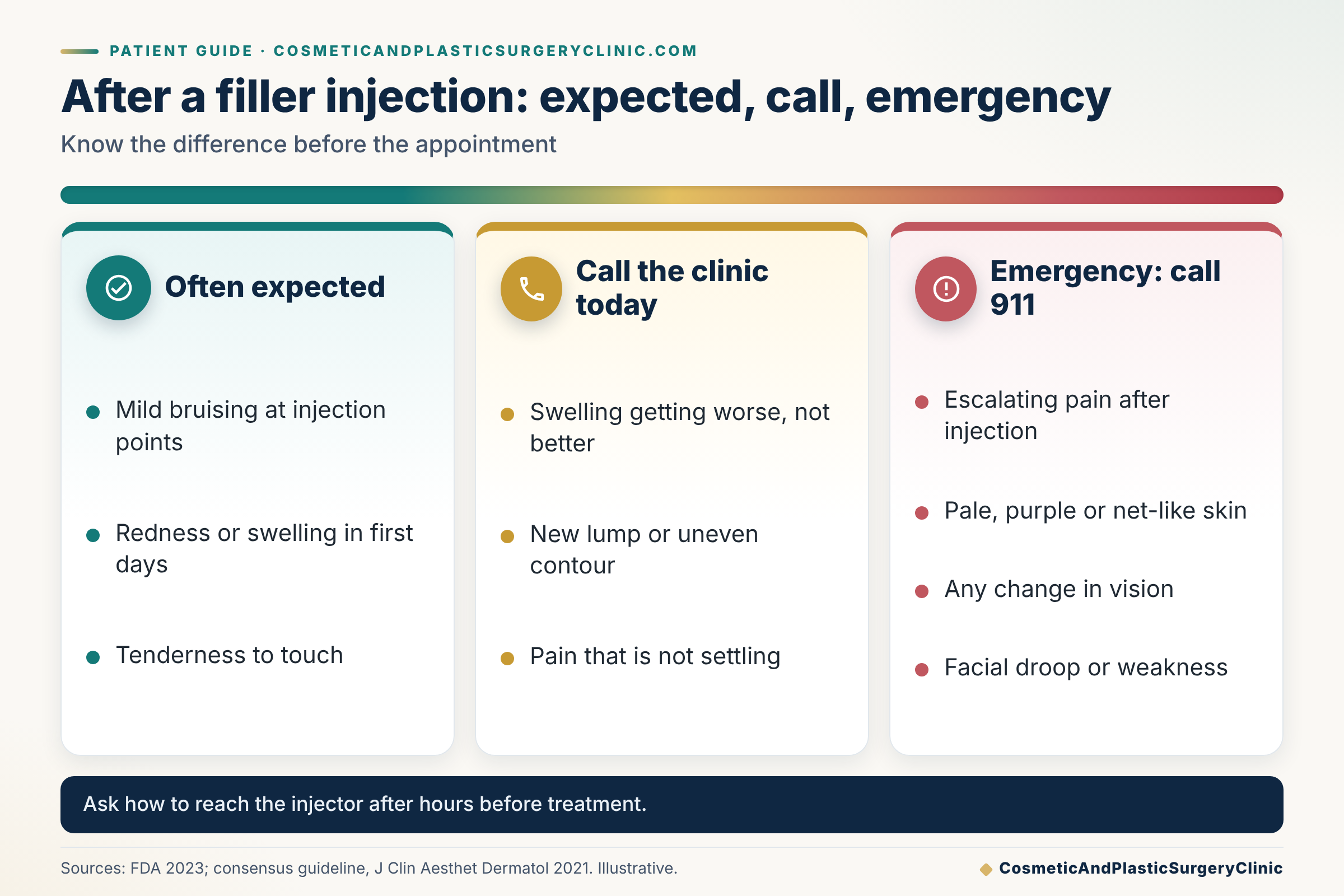
Any change in vision, severe or spreading pain, or pale or mottled skin after an injection is an emergency: call 911 or go to an emergency department, and tell the clinic at once.
For hyaluronic acid products, the guideline describes the enzyme hyaluronidase as the mainstay of treatment and says clinics should have a management plan in place. Ask before treatment whether the injector keeps it on hand and how you can reach someone after hours. Those two answers say more about a clinic’s preparedness than any before-and-after album.
Fat grafting: your own tissue as the filler
What is known about how much fat stays
Fat grafting harvests fat, usually by liposuction from the abdomen or thighs, and reinjects it into the face. One ASPS surgeon-authored post called it more technically demanding and unforgiving than fillers, and noted that the harvest adds a donor site. An ASPS article from January 2024 quotes a surgeon saying that the average volume that survives is 50 percent, but it gives no study behind the figure, so it is best read as one clinician’s working estimate rather than a measured rate.
The same article says lasting volume is judged around six months, that direct pressure on treated areas should be avoided for at least six weeks, and that weight loss after grafting could jeopardize the result. Those are one surgeon’s instructions, and your own surgeon’s will govern. The honest summary is that fat grafting can add durable volume, that how much stays is uncertain and varies between people, and that results can be hard to predict at the time of the procedure.
Fat as an ingredient of surgery, not only a rival
The overlap matters to a reader because the choice is rarely surgery versus fat. It is often a question of whether volume is added during an operation, with the repositioning, or alone. ASPS surgeons writing on the subject describe the choice between fat and manufactured fillers as case by case, and some prefer fat when the patient is already under anesthesia for a face or neck lift. Ask which is planned and why.
Neuromodulators and chin-fat injections
Platysma bands: a muscle target, not a skin or jowl target
In October 2024, according to the manufacturer’s announcement, the FDA approved a botulinum toxin product for the temporary improvement of moderate to severe vertical platysma bands, the cords that run between the jaw and the neck. The release describes two phase III trials in which, at day 14, 65 percent and 62 percent of treated participants were satisfied with neck and jawline definition, compared with 12 percent on placebo. That is a company-reported result in a short window, and it measures satisfaction, not lifted tissue.
The approved indication is the bands. It does not cover loose neck skin, jowls or the jawline in general. The label carries a boxed warning that the toxin can spread beyond the injection site, causing generalized weakness and swallowing or breathing difficulty that can be life-threatening. That risk is uncommon and applies to the whole product family, but it is the reason to want an experienced injector. For neck skin that has loosened, the sections on devices and neck lift below are more relevant.
Fullness under the chin: deoxycholic acid and its limits
Deoxycholic acid injection was approved by the FDA in 2015 to improve the appearance of moderate to severe fullness from fat beneath the chin in adults. A 2026 FDA drug safety communication added labeling warnings: the drug is not approved for fat outside that region, serious neuromuscular adverse events may occur if it is used elsewhere, and injection-site nodules or masses may not resolve and may need medical care. Nerve injury around the lower lip, tongue and jaw was already listed in the labeling.
Fat beneath the chin is only one cause of a soft neckline; muscle banding and skin laxity are others, and injections reach only the first. For help sorting those causes, see chin liposuction versus neck lift. The point for this comparison is narrow: among the facelift alternatives, this one addresses fat, not sag.
Energy devices and threads: what the studies can and cannot show
Devices and threads are the facelift alternatives most often described as a lift without surgery, so they deserve the closest look at the evidence. The sources below separate what regulators have cleared from what studies have measured.
Ultrasound and radiofrequency as facelift alternatives
What a device clearance does and does not mean
Public FDA records show that a microfocused ultrasound system received 510(k) clearance on May 4, 2018, with indications that include lifting the eyebrow, lifting lax tissue beneath the chin and in the neck, and improving lines and wrinkles of the décolleté. A 510(k) decision means the agency found a device substantially equivalent to one already marketed. It is a statement about the device and its labeled use, not a measurement of how closely the result resembles surgical lift.
That distinction is worth holding when a clinic advertises “FDA-cleared” facelift alternatives. Clearance usually tells you the device may be marketed for a stated purpose. How large the effect is, for whom and for how long, has to come from the studies, and the studies are more modest than the advertising.
What the systematic reviews report on these facelift alternatives
A 2023 systematic review of microfocused ultrasound for facial skin tightening, in the International Journal of Environmental Research and Public Health, screened 693 records and found 16 eligible studies. It concluded the treatment is effective for mildly to moderately lax facial skin, with a mild to moderate effect: investigators scored improvement in about 92 percent of patients at day 90, while patient-reported improvement was lower, rising from 42 to 53 percent between days 90 and 360. The authors noted weaker results with excessive laxity or a body mass index above 30, and called for studies with objective measurements.
A 2025 meta-analysis in Aesthetic Surgery Journal pooled 42 studies of the same technology. Investigators rated 89 percent of patients as improved and 84 percent reported improvement; satisfaction was 84 percent, but 62 percent in studies that offered a neutral response. No serious adverse events were reported. The authors flagged limits that matter: many studies had no control group, few randomized or blinded, and publication bias was detected for investigator-rated improvement and satisfaction.
For radiofrequency, a 2022 systematic review in Lasers in Surgery and Medicine identified 121 articles on face and neck rejuvenation. Most reported positive subjective ratings, with reports of improved laxity and elasticity, and the authors described the technique as safe apart from one patient who developed a neck fistula. The abstract gives no overall quality grade, so the strength of that evidence is unclear.
Setting an honest expectation: modest, variable, uneven
Taken together, the reviews of these facelift alternatives support a cautious reading. In most studies, many patients and clinicians report some improvement; the size is usually small, often judged by the same people who sold or performed the treatment, and rarely measured with objective tools. Longer follow-up is thin. A person with mild laxity who wants a subtle change may find that acceptable. A person hoping to avoid a facelift because the jowls are already pronounced is, on this evidence, likely to be disappointed.
Marketing language also tends to hide recovery. Treatments described as having minimal recovery still produce redness, swelling, bruising and tenderness; the 2025 meta-analysis found those effects common and typically mild to moderate, with a mean pain score of 4.85 out of 10. Ask how many treatments are planned, how far apart, and what the clinic counts as success.
| Claim | What the sources read here support | What they do not show | Question to ask |
|---|---|---|---|
| “A lift without surgery” | Mild to moderate skin tightening in reviews of ultrasound | Results equal to an operation; ASPS says treatments cannot achieve the same | What measured change, in whom, at what follow-up? |
| “Stimulates your own collagen” | Tissue-repair findings reported in a radiofrequency review | That the new collagen produces a visible, lasting lift | Is there objective measurement, not only photos? |
| “Results last for years” | Thread sources range from months to about three years; filler up to about two | Long-term data; a 2025 review says it is lacking for threads | When do patients typically return for repeat treatment? |
| “Minimal recovery” | Swelling, bruising and tenderness are common but usually mild | That nothing can go wrong; filler and toxin have serious rare risks | What are the emergency signs, and who answers the phone? |
| “Natural and safe” | Serious events are uncommon in the reviews read | Equal safety across products and injectors | What is this product approved for, in this area? |
| “Everyone is a candidate” | Reviews exclude or find weaker response with marked laxity | That heavy jowls or neck laxity respond | Why do you think my anatomy suits this? |
Absorbable threads as facelift alternatives
How long threads are said to last
Thread lifts place temporary sutures under the skin to suspend tissue and prompt the body’s healing response. The duration claims in the sources disagree, which is itself informative. A 2018 ASPS-hosted post by a surgeon and a Cleveland Clinic page updated in 2023 both give one to three years, while an ASPS article from April 2026 describes a subtle lift lasting roughly three to nine months that does not replicate surgical results.
A 2025 systematic review of 12 studies and 818 patients in Dermatologic Surgery found threads immediately effective in appropriate patients but stated that long-term efficacy data are lacking; the longest follow-up was two years.
Those sources also describe who threads suit: mild to moderate laxity, commonly people in their late thirties to early fifties, and sometimes people who cannot have an operation for medical reasons. One of them notes that specific products have FDA authorization for lifting facial tissue, an attribute of a device, not of the technique in general. Ask which product is used and how long its results typically hold in that clinician’s patients.
What complication data show
The 2018 post says there is virtually no risk of scarring, severe bruising or bleeding, and the Cleveland Clinic page calls complications uncommon. A 2021 meta-analysis in Aesthetic Plastic Surgery of 26 studies gives a more detailed picture: pooled incidences were about 35 percent for swelling, 10 percent for skin dimpling, 6 percent for altered sensation, 4 percent for visible or palpable threads, 2 percent for infection and 2 percent for thread extrusion, on an evidence level the authors rated III.
Most of these are minor and often temporary, but they are not zero, and they are more common than casual descriptions imply.
Threads can be removed if needed, according to the ASPS post, and the 2025 review described the risk of dangerous complications as low. That is reassuring but it does not mean the procedure is without consequence. The surgical risk list is covered in facelift risks; the two lists deserve to be read side by side, not as a safe option set against a risky one.
Skin care, resurfacing and smaller operations
Two groups of facelift alternatives sit apart from the injected and device-based ones: treatments for the skin surface, and narrower operations that treat one region of the face and leave the rest.
Resurfacing, retinoids and sunscreen: texture and prevention
Lasers and peels treat the surface, not the sag
ASPS lists laser skin resurfacing as a treatment for fine lines around the eyes, forehead and mouth, acne and chickenpox scars, aged or sun-damaged skin, and even “non-responsive skin after a facelift.” It explains that the laser removes the outer skin layer and heats the layer beneath, which stimulates new collagen. The page lists skin-quality concerns, not sagging, which matches the logic of the opening section: texture and tone are one problem, descent is another.
The ASPS facelift page likewise names intense pulsed light, dermabrasion, peels and lasers as treatments that may improve the quality and texture of the skin. These can be sensible facelift alternatives for someone whose main complaint is surface aging. They are not a substitute for repositioning, and the pigment, healing and downtime risks vary with depth, so ask which depth is proposed.
Retinoids and daily sunscreen: slow, modest, evidence-backed
A 2022 systematic review in the International Journal of Women’s Dermatology identified seven randomized trials of topical tretinoin for photoaging. It reported improved wrinkling, mottled hyperpigmentation, sallowness and sun-related spots, with effects appearing as early as one month and lasting up to 24 months in the trials. The authors noted that formulations and outcome measures differed. Tretinoin is a prescription product, so a clinician decides whether and how to use it.
For prevention, a randomized trial of 903 adults under 55 in Nambour, Australia, published in the Annals of Internal Medicine in 2013, followed participants for about 4.5 years. Those assigned to daily broad-spectrum sunscreen showed no detectable increase in skin aging, and their skin aging scores were 24 percent lower than the discretionary-use group. The trial measured skin aging, not sagging of deeper tissue, so it supports sun protection as skin care and not as a lift. ASPS also names daily sun protection as a way to extend facelift results.
Narrower operations as facelift alternatives: neck, eyelids and brows
A neck lift when the neck is the mismatch
ASPS describes neck lift as addressing excess fat and skin relaxation in the lower face that creates jowls, excess fat under the chin, and loose skin and muscle banding in the neck. It notes that some people skip a full facelift because the upper face still looks good and the neck is the part that does not match. Like a facelift, a neck lift is surgery, so it carries surgical risks, but it is a narrower operation, and for the right anatomy it can be the more proportionate choice.
The decision between a limited neck procedure and a larger one depends on what lies beneath the skin, which an examination answers. The neck lift guide covers the operation, and the next question after that is whether shorter-scar approaches fit; the comparison is in mini facelift versus facelift, where the shortcuts are still facelifts, not alternatives to one.
Eyelid and brow surgery when the upper face is the problem
A facelift generally does not treat the eyelids or the brows. ASPS describes eyelid surgery for loose upper-lid skin that creates folds or sometimes impairs vision, for fat deposits that cause puffiness, and for lower-lid changes, and describes brow lift as raising sagging brows that hood the upper lids, most often as a complement to a facelift. The choice between them turns on whether the brow has dropped or the lid has extra skin, which is an examination question.
For a tired-looking upper face, either can be a more direct route than the injected facelift alternatives. Cost and healing are covered in blepharoplasty cost. Because the lower face and neck remain untouched, ask a surgeon how the result will look next to the rest of the face as it continues to change.
Waiting and clarifying the goal are facelift alternatives too
Waiting as an active, reversible choice
What continues while you wait, and what stays open
Waiting is the one entry among the facelift alternatives that costs nothing and closes nothing. Aging continues meanwhile, and ASPS says plainly that a facelift cannot stop it either. What waiting preserves is the ability to decide with more information: a clearer goal, a second consultation, savings set aside, or time to see whether a recent change settles. The ASPS facelift page notes that minimally invasive treatments may delay the point at which a facelift becomes appropriate, so a person who tries them first is generally not giving up the operation.
Waiting should be a decision, not avoidance of one. A useful practice is to name a review date and a trigger, such as “revisit after another season of photographs” or “revisit if the jawline bothers me in video calls as well as photos.” That turns a vague hesitation into something that can be tested. It also protects against the pressure that comes with short-deadline promotions or booking deadlines, which have no clinical meaning.
When worry about appearance starts to take over
Some concern about one feature is ordinary. Concern that fills hours of each day, focuses on a flaw others barely notice, and returns after each treatment is a different matter. Mayo Clinic describes body dysmorphic disorder as an inability to stop thinking about a perceived flaw, notes that people with it often pursue numerous cosmetic procedures, and says the relief tends to be short-lived.
Raising this is not a diagnosis. It is a recognition that some questions are better answered by a health care provider or mental health professional than by any injection or operation, and that treatment exists. If distress ever includes thoughts of self-harm, Mayo advises calling 911 or the 988 Suicide & Crisis Lifeline in the United States right away. A careful surgeon will ask about expectations for the same reason, and being asked is not a rejection.
Writing the goal down before comparing options
A one-sentence goal test
Most disappointment with facelift alternatives traces back to a goal that was never stated precisely. “I want to look less tired” could mean lids, cheeks, skin tone or the lower face. “I want a firmer jawline” could mean fat under the chin, jowls, platysma bands or loose skin. Try writing one sentence for each concern that names the area, the change and the setting in which you notice it, such as photographs, video calls or the bathroom mirror.
Then check each sentence against the verbs from the opening section. If the sentence calls for removing, repositioning or tightening deep tissue, most injected and device-based options are unlikely to reach it. If it calls for adding volume or improving texture, they may. The exercise often shows that the goal is smaller than the operation or larger than the injection, and that is useful to learn before spending money on either.
Mirrors, cameras and the problem of comparing yourself with edited faces
How a face looks depends on lighting, angle, expression and, increasingly, filters. Differences that seem striking in a phone photo taken from below can disappear in a mirror at eye level. Before concluding that something has changed, look at the face in several settings, and compare with older photographs taken in similar conditions, not with images that have been smoothed or retouched.
The same caution applies to the albums used to sell treatments. Photographs of injectables are especially prone to differences in lighting and timing, which is why standardized views and dates matter; the reading skills are the ones used for filler photographs. Ask whether the people shown had a similar starting point to yours, and how long after treatment the photographs were taken.
Planning the years: upkeep, stacking and who does the work
Facelift alternatives are usually chosen one visit at a time, but they work out over years. The questions below treat them as a plan, not a purchase.
Upkeep and revision across facelift alternatives
Repeat treatments versus one operation
Most nonsurgical options are temporary by design. Fillers wear off over months to about two years, threads over months to a few years, toxin over months, and device-based tightening is typically delivered as a course with uncertain durability. Temporary suits people who prefer that nothing is final, but it means the real comparison is cumulative upkeep over several years against a single operation with a longer-lasting but not endless effect. Facelift surgery has its own longevity questions, taken up in how long a facelift lasts.
Consider a hypothetical person who starts with filler and an occasional device course, repeats them for several years, and then has a facelift once the volume treatments are no longer enough. Over that span they may have paid for many visits and carried the risks of each. Another person goes straight to surgery and pays once, with a longer recovery and the risks of anesthesia and an operation. Neither path is wrong. The comparison only works if both are priced and risk-adjusted honestly, and the cost side of surgery is itemized in facelift cost.
| Factor | Effect on outcome | Upkeep or revision implication | Review point |
|---|---|---|---|
| Sun exposure and skin quality | Influences wrinkling, tone and how skin responds to treatment | Daily sun protection supports every option; skin treatments repeat | Reassess skin at each visit |
| Degree of tissue descent | The more descent, the less volume, threads or devices can offset | Marked descent usually returns to the question of surgery | Ask again if jowls deepen |
| Weight change | Changes facial fullness; can undo filler or graft planning | Volume plans may need revision after large changes | Mention any planned weight change |
| Product, device and injector | Different products last different times and carry different risks | Record names and amounts for every treatment | Keep a treatment log |
| Number of stacked treatments | Added volume can alter proportions over time | May change what a later surgeon plans | Pause and reassess before adding more |
| Unexpected change or lump | May be a complication, not a result | Needs evaluation by the treating clinician | Call the clinic early |
Stacking treatments can change the surgical plan
Layering injectables, devices and threads over years can make the face harder to read at a later consultation. Filler can mask or alter shape, and ASPS surgeons writing on fat grafting and fillers describe the choice as case by case. A surgeon who knows what was injected, when, and in what amounts can plan around it. Bring the dates, the product names and the amounts, and say so if anything was done elsewhere.
Choosing the clinician and the questions
Who should be doing each treatment
The FDA advises patients to seek a licensed provider with dermatology or plastic surgery experience for fillers, and says injecting without appropriate training or experience should be avoided. The same logic extends to all of the facelift alternatives on this page: the product matters less than the person selecting it, judging anatomy and handling complications. Verification mechanics, such as board certification and state license lookup, are laid out in how to choose a plastic surgeon, and what titles mean is a separate question.
For injectables and devices, add two practical checks: ask who will actually perform the treatment on the day, and who is available if something goes wrong. A clinic that cannot answer both clearly has told you something.
Questions that expose overselling of facelift alternatives
Good answers to these questions are specific, name limits and invite comparison. Evasive answers promise comparable-to-surgery results, avoid naming products or discount for quick decisions. A consultation where the clinician describes both what a treatment would change and what it would leave alone is a good sign, and the structure of such a visit is covered in plastic surgery consultation questions.

Frequently asked questions
Do any facelift alternatives deliver the same lift as surgery?
On the sources read for this article, no. ASPS states that minimally invasive rejuvenation treatments cannot achieve the same results as a facelift, and a 2026 ASPS article describes threads as a subtle lift that does not replicate surgical results. Reviews of ultrasound and radiofrequency report mostly subjective, modest improvement. That does not make them useless for mild concerns. It means the honest comparison is between a small change with little recovery and a larger change that requires an operation.
Which facelift alternatives target the jowls and jawline?
Several touch the area, none replace repositioning. Filler in the chin or cheeks can change how the jawline reads, deoxycholic acid reduces fat beneath the chin, threads offer a subtle lift in mild cases, and ultrasound may tighten mildly lax skin. Heavy jowls reflect descent, which these facelift alternatives reach least well. A surgeon can say whether the jowl is fat, skin, descent or a mix, and that answer decides whether any of the facelift alternatives is worth trying.
Can facelift alternatives delay a facelift, and does starting early close any doors?
ASPS says minimally invasive treatments may delay when a facelift becomes appropriate and can complement surgery. Starting early does not rule out surgery later, but stacked treatments can change how a face looks at consultation, so keep a log of products and dates and share it. Some people find repeated treatments eventually cost more than one operation would have; others prefer the flexibility.
Which facelift alternatives help the neck?
It depends on the cause. A botulinum toxin product is approved for moderate to severe vertical platysma bands, deoxycholic acid is approved for fat beneath the chin, and microfocused ultrasound is cleared for lifting lax tissue under the chin and in the neck, with modest results in studies. Loose neck skin with banding and jowls is usually discussed as a neck lift, a surgical procedure. The neck lift article lays out the operation.
What should I tell a surgeon about filler, threads or toxin I had before comparing facelift alternatives?
Share the product names, the areas, the amounts and the dates, plus any reactions or lumps, and note whether the treatment was done at another clinic. Filler can change shape and mask what lies beneath, and threads leave material under the skin. A surgeon who knows the history can plan around it and may suggest waiting or dissolving certain products before an operation. Do not stop any prescribed medicine on your own; list your medications and ask the surgeon what applies to you.
Will insurance pay for facelift alternatives?
Most are elective cosmetic treatments, and coverage depends on the plan and on how the insurer classifies the service. Eyelid surgery is the one worth asking about, since ASPS says it can address functional concerns, such as loose upper-lid skin that sometimes impairs vision. In that case an insurer may ask for documentation or prior approval. Ask the insurer in writing how it classifies the specific procedure and code before scheduling, and keep the reply. For cosmetic treatments, expect to pay out of pocket and see the facelift cost article for how surgery is itemized.
What if I regret one of the facelift alternatives, such as a thread or filler?
Contact the treating clinic first. Threads can be removed if needed according to an ASPS-hosted surgeon post, and a hyaluronic acid filler can be dissolved with an enzyme, a medical step that should be done by a trained clinician. Some filler types behave differently, and nodules or lumps after treatment need evaluation, not home remedies. If a change is sudden, painful or accompanied by a vision change, treat it as urgent and seek emergency care.
Sources and further reading
- American Society of Plastic Surgeons — Facelift (rhytidectomy) overview (accessed 2026-11-12) — what a facelift addresses and cannot do; nonsurgical treatments may delay or complement
- American Society of Plastic Surgeons — Facelift risks and safety (accessed 2026-11-12) — surgical risk list for comparison
- American Society of Plastic Surgeons — Facelift results (accessed 2026-11-12) — sun protection, no guarantee
- American Society of Plastic Surgeons — Lift procedures led growth in 2025 (2025 procedural statistics press release; accessed 2026-11-12) — facelift and neck lift growth, minimally invasive shares
- American Society of Plastic Surgeons — Facelift roulette (April 2, 2026; accessed 2026-11-12) — liquid facelift and thread lift limits
- U.S. Food and Drug Administration — Dermal Fillers (Soft Tissue Fillers) (content current as of 2023-07-06; accessed 2026-11-12) — approved uses, areas not approved, vascular risk, provider advice
- Murray, Convery, Walker and Davies — Guideline for the Management of Hyaluronic Acid Filler-induced Vascular Occlusion, Journal of Clinical and Aesthetic Dermatology, 2021 (accessed 2026-11-12) — recognition, hyaluronidase, urgency
- American Society of Plastic Surgeons — Facial fat grafting vs facial fillers (blog, December 2, 2015; accessed 2026-11-12) — filler duration, fat grafting trade-offs
- American Society of Plastic Surgeons — The future of facial augmentation (January 18, 2024; accessed 2026-11-12) — fat survival estimate, aftercare
- American Society of Plastic Surgeons — Most plastic surgeons now use fat grafting as part of facelift surgery (2015 survey press release; accessed 2026-11-12) — 309 respondents, 85 percent
- AbbVie/Allergan Aesthetics — Botox Cosmetic receives FDA approval for platysma bands (manufacturer press release, October 18, 2024; accessed 2026-11-12) — trial results, boxed warning
- U.S. Food and Drug Administration — Drug Safety Communication on deoxycholic acid injection (2026; accessed 2026-11-12) — approved use, unapproved-use warnings, nerve injury, nodules
- U.S. Food and Drug Administration — 510(k) record K180623, decision date May 4, 2018 (accessed 2026-11-12) — clearance record for an ultrasound system
- Innolitics — public mirror of FDA 510(k) K180623 (accessed 2026-11-12) — indications for use as listed
- A Systematic Review of the Efficacy of Microfocused Ultrasound for Facial Skin Tightening, International Journal of Environmental Research and Public Health, 2023 (accessed 2026-11-12) — 16 eligible studies, mild to moderate effect
- Microfocused Ultrasound With Visualization Effectiveness and Safety: A Systematic Review and Meta-Analysis, Aesthetic Surgery Journal, 2025 (accessed 2026-11-12) — 42 studies, satisfaction, limits
- Evaluating the effectiveness and safety of radiofrequency for face and neck rejuvenation: A systematic review, Lasers in Surgery and Medicine, 2022 (accessed 2026-11-12) — 121 articles, subjective improvement
- American Society of Plastic Surgeons — What you need to know about thread lifts (blog by a surgeon, July 31, 2018; accessed 2026-11-12) — duration, candidates, removal
- Cleveland Clinic — Thread lift (last updated 2023-01-07; accessed 2026-11-12) — duration, complications, candidates
- A Meta-Analysis and Systematic Review of the Incidences of Complications Following Facial Thread-Lifting, Aesthetic Plastic Surgery, 2021 (accessed 2026-11-12) — pooled complication incidences
- Update on Absorbable Facial Thread Lifts, Dermatologic Surgery, 2025 (accessed 2026-11-12) — 12 studies, 818 patients, long-term data lacking
- American Society of Plastic Surgeons — Laser skin resurfacing (accessed 2026-11-12) — what resurfacing treats
- Topical tretinoin for treating photoaging: A systematic review of randomized controlled trials, International Journal of Women’s Dermatology, 2022 (accessed 2026-11-12) — seven trials, durations, limits
- Hughes and colleagues — Sunscreen and Prevention of Skin Aging: A Randomized Trial, Annals of Internal Medicine, 2013 (abstract; accessed 2026-11-12) — 903 adults, about 4.5 years
- American Society of Plastic Surgeons — Neck lift (accessed 2026-11-12) — what a neck lift addresses
- American Society of Plastic Surgeons — Eyelid surgery (accessed 2026-11-12) — what eyelid surgery addresses
- American Society of Plastic Surgeons — Brow lift (accessed 2026-11-12) — brow lift and relation to facelift
- Mayo Clinic — Body dysmorphic disorder: symptoms and causes (accessed 2026-11-12) — appearance preoccupation, cosmetic procedures, when to seek help