People who ask how long does Botox last usually want two numbers: when they will see a change and when they should book again. Published sources give both, but each figure belongs to a particular product, facial area and way of measuring, and none of them is a forecast for one person’s face. The timeline has a start, a plateau and a slope, and the slope is where most of the confusion lives.
Botox is the brand name of onabotulinumtoxinA, one of several botulinum toxin type A products sold as neuromodulators. The American Society of Plastic Surgeons (ASPS) reported in its 2025 statistics article that these injections made up roughly half of all minimally invasive procedures. Popularity says nothing about how any one treatment will wear off. This page treats how long does Botox last as a planning decision: how to read the timeline and schedule visits around it. What the injections do and cannot do is mapped in the Botox and neuromodulator guide.
How long does Botox last on paper: what labels and trials measure
Behind almost every answer to how long does Botox last sits one kind of study: adults with moderate to severe frown lines between the eyebrows, called glabellar lines, rated by a clinician at maximum frown. Other areas have their own trials with their own yardsticks. Knowing what was measured is the fastest way to tell a careful statement from a marketing one.
What the FDA labels say about duration
Botox Cosmetic: three to four months, with a visible slope
The Botox Cosmetic prescribing information (revised October 2024) says the duration of effect for glabellar lines is approximately three to four months. Its pooled trial tables show how that average hides a slope. Clinicians rated lines as none or mild in 74 percent of treated people at day 7, 80 percent at day 30, 70 percent at day 60, 48 percent at day 90 and 25 percent at day 120, among 405 treated subjects at the start.
The same label lists patient ratings, which run higher at every visit because the bar is lower: at least moderate improvement in 63 percent at day 90 and 39 percent at day 120. Neither column says everyone’s effect ended on a given day. They describe how many people met a threshold at a given visit.
| Study day | Botox Cosmetic: clinician rating | Botox Cosmetic: patient rating | Dysport: clinician rating, two studies |
|---|---|---|---|
| Day 7 | 74% | 82% | Not reported |
| Day 14 | Not reported | Not reported | 90% and 83% |
| Day 30 | 80% | 89% | 88% and 86% |
| Day 60 | 70% | 82% | 64% and 75% |
| Day 90 | 48% | 63% | 43% and 51% |
| Day 120 | 25% | 39% | 23% and 29% |
| Day 150 | Not reported | Not reported | 9% and 16% |
Table note: Botox Cosmetic clinician rating means none or mild lines at maximum frown; patient rating means at least moderate improvement. Dysport figures are clinician-rated none or mild severity in studies GL-1 and GL-3, from the January 2023 label. Frown lines only; the products were not compared head to head.
Other brands: what the labels leave unsaid
Labels differ in how much they say. Dysport’s label says the effect on glabellar lines may last up to four months. Xeomin’s says the typical duration is up to 12 to 16 weeks and that median onset falls within two to seven days. Daxxify’s label text gives no duration figure, only that people were followed for at least 24 weeks. The Jeuveau and Letybo documents report results at day 30 and week 4 and stop there.
| Product (document date) | Duration wording | Onset wording | Retreatment interval |
|---|---|---|---|
| Botox Cosmetic (label, 10/2024) | “Approximately 3-4 months” for glabellar lines | Muscle effect 1 to 2 days after injection, growing over the first week | Dosing more often than every 3 months not clinically evaluated |
| Dysport (label, 1/2023) | Reduced severity “for up to four months” | No onset statement; earliest listed visit is day 14 | No more often than every three months |
| Xeomin (label, 2/2026) | “Typical duration” up to 12 to 16 weeks | Median onset within 2 to 7 days | No more often than every three months |
| Daxxify (label, 9/2022) | No duration figure in the text; follow-up at least 24 weeks | Not stated in the text | No more often than every three months |
| Jeuveau (label, 2/2019) | Not stated; efficacy reported at day 30 | Not stated | No more often than every three months |
| Letybo (FDA trial summary, 2024 approval) | Not stated; results reported at week 4 | Not stated | Not more often than every three months |
One rule is shared by every document in the table: units are specific to each product and cannot be converted to another brand’s units. That is why a neighbor’s dose, or last year’s dose of a different product, tells you little. How the products differ is the subject of Botox vs Dysport vs Xeomin.
How a trial becomes a duration claim
How long does Botox last in median terms: responders and the day-30 filter
A 2012 meta-analysis in Dermatologic Surgery pooled four phase III trials of 621 people treated with 20 units of onabotulinumtoxinA for glabellar lines. Of those, 523 (84.2 percent) were responders at day 30. Among them, the pooled median duration was 120 days judged at maximum frown and 131 days judged at rest, which the authors summarized as about four months for more than half of responders.
Two details matter. A median means half of responders lasted longer and half shorter, so it is a midpoint, not a minimum. And the calculation only counted people who responded at day 30, so someone who never reached the threshold is outside the number. Treat 120 days as a typical answer to how long does Botox last for people who respond, not as a promise.
Why a maker’s comparison deserves caution
Manufacturer-funded trials sometimes place their results beside competitors’. In the 2020 report of the two SAKURA trials of daxibotulinumtoxinA, 609 adults were followed for at least 24 weeks, and lines stayed none or mild for a median of about 24 weeks. The authors set that beside figures from other studies of onabotulinumtoxinA (a median of 17.1 weeks) and abobotulinumtoxinA (12.1 to 16.7 weeks).
Those were cross-trial comparisons, not head-to-head tests, and the SAKURA study was sponsored by the maker, Revance, which also employed several authors. Different studies enroll different people, use different rating moments and apply different thresholds. A longer number for how long does Botox last on a brochure is a reason to ask which trial it came from, not a reason to switch products.
Onset and peak: the first two weeks after the injection visit
The timeline starts at the injection visit, but the first days are quiet. The toxin has to reach the nerve endings and block their signal before the muscle weakens, so the mirror lags the needle by a few days, and the full effect arrives later still.
Days 1 to 7: the first signs of change
What changes first
Any answer to how long does Botox last begins with onset. The Botox Cosmetic label says chemical denervation of the injected muscles occurs one to two days after injection and grows stronger over the first week. Cleveland Clinic says most people notice the desired effect around the third or fourth day, and an ASPS surgeon’s blog post puts it at three to five days. Those statements agree on days, not weeks.
Other products read similarly. Xeomin’s label gives a median onset of two to seven days, and in the SAKURA trials the median time to a clinically meaningful response with daxibotulinumtoxinA was three days. In this window the muscle is losing force before the skin visibly softens, which is why an early look in the mirror understates what is coming.
Why onset differs between people and products
A 2013 randomized trial in Clinical, Cosmetic and Investigational Dermatology followed 180 adults aged 20 to 60 for 180 days after a single treatment of frown lines with incobotulinumtoxinA, onabotulinumtoxinA or abobotulinumtoxinA. In women, mean onset was 3.02 days with incobotulinumtoxinA against about 5.3 days for each of the other two. Onset was earlier and duration longer in women than in men across all three products.
The most useful finding is a negative one for anyone trying to predict how long does Botox last from the first week: how fast the effect started did not predict how long it lasted. A quick start is not evidence of a long finish. This was one trial in one area with 2013-era doses, so read it as a caution against shortcuts, not as a ranking.
Days 7 to 14: reaching full effect and checking it
Why judging how long does Botox last at day 4 misleads
Cleveland Clinic says full results are visible within 10 to 14 days, and the ASPS blog post says seven to ten days. At day 4 the muscle is still on its way down. In the Botox Cosmetic label trial, clinician-rated responders were 74 percent at day 7 and 80 percent at day 30, so the strongest response came after the first week.
A photo taken at day 4 and another at day 20 can look like two different treatments. For judging results, take them at the same distance and light, at rest and at maximum expression, as described in how to read Botox before-and-after photos.
What a two-week check can and cannot settle
A two-week visit is too early to settle how long does Botox last, but it has a job. The ASPS blog’s author waits two weeks before deciding whether a touch-up is needed, and offices differ on their own policies. A visit at this point is useful because the full effect is visible and any uneven response can be seen while it is easy to describe.
What a check cannot settle is whether more product is wise. The Botox Cosmetic label says dosing more often than every three months has not been clinically evaluated. A 2025 narrative review in JMIR Dermatology lists booster injections within three weeks, and sessions less than three months apart, among factors that may contribute to later loss of response. It is a narrative review, not a systematic one, but the pattern is worth a question: what is the office’s touch-up policy, what does it cost, and what is it based on?

Wearing off: why movement returns and what the fade looks like
Wearing off is the least dramatic phase, and it is where how long does Botox last becomes something you can see. It is also the one people watch most closely. It is also where the label data, the clinician blogs and the lab research fit together best.
What is happening as movement returns
The nerve ending recovers, not the skin
Botulinum toxin type A blocks the release of acetylcholine, the chemical messenger a motor nerve uses to tell a muscle to contract. The muscle weakens while the block lasts. ASPS describes the fade as nerves regaining the ability to signal the muscle, and the lines return because the muscle is moving again, not because the skin has changed.
A review by Lebeda and colleagues in Expert Review of Neurotherapeutics (2010) says duration depends on how fast the toxin clears from circulation, how long its active part persists inside the nerve ending, and how long the cell takes to rebuild the cleaved protein, SNAP-25. The authors noted that several of these quantities had not been measured in humans. In other words, duration is the biology of a nerve cell recovering, which is why how long does Botox last cannot be tuned to a precise day with a syringe.
How long does Botox last at the end: gradual loss, not a switch
Cleveland Clinic cosmetic surgeon James Zins calls the loss of effect gradual, and the label curve agrees. Clinician-rated responders in the Botox Cosmetic trial fell from 70 percent at day 60 to 48 percent at day 90 and 25 percent at day 120. That is a slope with people leaving the responder group at different times, not a cliff on one date.
The 2012 meta-analysis found that lines at rest and lines at maximum frown fade on slightly different schedules, with pooled medians of 131 and 120 days. So the answer to how long does Botox last has no single date attached; there is no one day the treatment stops working. There is a day you decide the remaining effect is no longer worth keeping, and that choice is yours and your injector’s.
Reading your own fade
Three dates worth writing down
A vague report such as “it wore off fast” gives an injector little to work with. Three dates turn how long does Botox last from a guess into a measurement: the injection date, the day you first notice stronger movement than a few weeks before, and the day you would call the effect mostly gone.
Add same-light photos at rest and while frowning at around two weeks, eight weeks and the time you call it faded. Those dates and photos let a clinician see whether your pattern is short, ordinary or just uneven, which is the starting point for deciding what to change.
Three to four months is a midpoint, not a promise
Any single answer to how long does Botox last is a midpoint. Respectable sources disagree in range, not in kind. The Botox Cosmetic label says approximately three to four months for frown lines, Dysport’s says up to four months, and Xeomin’s says up to 12 to 16 weeks. An ASPS staff article from 2023 says about three to six months, and the ASPS blog says typically three to four, some four to six and others about two.
Those ranges blend different products, doses, areas and people, so they read less like contradictions than like variation. If your effect fades at the short end of a range, it is worth a conversation about dose, placement and handling rather than an assumption that the product failed. If it fades at the long end, that is also within what sources describe.
Why the same injection lasts different lengths of time in different people
If two people receive the same product and dose and differ by a month on how long does Botox last, the usual explanations are dose, muscle, biology, handling and measurement. Some have data behind them and some are popular beliefs that nobody has tested well.
Factors with measurable evidence
Dose, product and muscle
Cleveland Clinic’s 2024 article says higher doses tend to last longer. A small incobotulinumtoxinA study presented at the 2018 American Society for Dermatologic Surgery meeting points the same way: among 50 adults enrolled with frown lines, mean time to return to baseline was 126 days at 20 units, 198 at 60 units and 271 at 100 units. Only 36 completed it, the 20-unit group had eight people, and the report was a conference summary with an unexplained inconsistency in its response figures.
Evidence is not one-directional. The SAKURA authors cite an earlier onabotulinumtoxinA study that found no added efficacy or duration above 20 units in women. So dose is a judgment call about the muscle in front of the injector, not a dial to turn up for longevity. Units are brand-specific, so the numbers above cannot be carried from one product to another.
Sex, age and who was studied
The 2013 three-product trial found longer duration in women than in men for every product. The pivotal trials behind labels also enrolled mostly women: in the SAKURA studies, most of the 609 participants were women with mean ages of about 49 to 51. So the published answers to how long does Botox last describe that group best, and men or much younger or older adults may be underrepresented in the data behind a number.
That is not a reason to expect a different result. It is a reason to hold the quoted months loosely and to rely on your own record of how the first and second cycles behaved.
Popular explanations with thin evidence
Metabolism, workouts and “I burn through it”
Online explanations of how long does Botox last often credit fast metabolism or frequent exercise for early wearing off. None of the labels, ASPS pages, Cleveland Clinic articles or trials reviewed for this page reports a controlled finding that exercise or metabolic rate changes duration. The recovery biology in the Lebeda review is a nerve and protein process, and the review notes that some of its variables have not been measured in people.
Plausible is not proven. If an injector offers a metabolic explanation, ask what the claim rests on and whether anything else, such as dose, placement or product handling, has been ruled out first.
Area treated: frown lines, forehead, crow’s feet and jaw
Each indication on the Botox Cosmetic label was studied separately, so no single figure for how long does Botox last in the forehead versus between the brows exists. Frown-line, crow’s-feet and forehead results cannot be lined up to rank areas by duration, because the thresholds differ: day-30 success for crow’s feet was 26.1 and 20.3 percent in the two studies, a stricter composite than the 80 percent clinician rating for frown lines. The forehead trials followed people for 12 months over three treatment cycles and reported that response was similar across cycles.
Masseter treatment for jaw width is not among the four indications on the Botox Cosmetic label, and its duration data are thinner. In a 2024 randomized trial in Aesthetic Plastic Surgery, 22 women with masseter hypertrophy received 75 units of abobotulinumtoxinA per side, and half then got a second injection at three months. At six months, masseter prominence did not differ between groups, and the repeat group showed changes in the temporalis muscle. Details are in the masseter Botox guide, and forehead timing is in Botox forehead.
First cycle, regular cycle: how long does Botox last for you?
First treatment versus an established pattern of how long does Botox last
The ASPS blog says first-time patients may see shorter results initially and longer ones after a second treatment, though it is one physician’s view, not an ASPS position. The label trials mostly followed a single treatment, so they cannot confirm or refute it. What you can do is treat the first cycle as a trial run and compare the second against your own notes.
Consider a hypothetical: a first treatment feels fully faded at about ten weeks, and a second, with the same injector and product, at about thirteen. The difference could be dose, mapping or chance, and one pair of cycles cannot tell which. A third data point is what turns an impression into a pattern.
Using situations, not averages, to plan
Planning works better around situations than around one answer to how long does Botox last. The table pairs common situations with a pathway, what it buys you, what it costs and a question to bring to the injector. It describes decision logic, not dosing or candidacy.
| Situation | Pathway | Benefit | Trade-off | Key question |
|---|---|---|---|---|
| Event in three weeks | Book early enough for the 10 to 14 day build to finish | Time to judge the result before the event | Booking too late leaves no room to see uneven response | How many days before an event should I come in? |
| Fading at about two months | Review dose, mapping and product handling before re-injecting | May find a fixable cause | A wait while the cause is checked | What could explain a short response, and how was the product stored and mixed? |
| Wanting fewer visits | Test a longer gap between sessions | Fewer visits and units over a year | Movement and lines fully return between sessions | How will we judge whether a longer gap is working? |
| Switching brands | Discuss unit conversion and a fresh baseline | May suit your response better | Units are not interchangeable, so the first cycle is a new trial | How will you set the dose, and what is the plan if round one differs? |
| Stopping treatment | Expect gradual return of muscle activity | No ongoing visits or cost | Your baseline pattern comes back | What changes should I expect over the next months? |
Booking the next visit: spacing, repeat treatment and what lasting means
The planning question after the first cycle is not only how long does Botox last but how to space the next injections. Evidence helps with the minimum gap and is thin on the optimal one.
Spacing and the three-month floor
What labels say about minimum intervals
Across the six documents in the table above, the minimum is consistent. The Botox Cosmetic label says dosing more frequently than every three months has not been clinically evaluated, and the Dysport, Xeomin, Jeuveau and Daxxify labels say to give treatment no more often than every three months. The FDA summary for Letybo says the same.
The 2025 JMIR Dermatology review cites the same pattern as a precaution: most experts recommend the smallest dose that achieves the desired effect and at least three months between treatments. A wish to keep lines continuously flat is therefore a reason to ask about strategy, not to shorten the gap that decides how long does Botox last between visits.
Before it fades or after it fades
Cleveland Clinic recommends repeating treatment every three to six months, and says muscles may adapt and contract less over time so that visits can be spaced further apart. None of the sources reviewed here tests whether re-treating just before full return of movement beats waiting until it is complete. Offices differ, and cost is part of the discussion; see Botox cost for how pricing is structured.
Visits per year are simple arithmetic. Consider a hypothetical: re-treating at month 3 means four visits a year, month 4 means three, and month 6 means two. A one-month difference in interval changes a year’s visits and units by a third, which is why an honest estimate of how long does Botox last for you matters.
What repeat treatment does over the years
What the evidence says about how long does Botox last after years of treatment
Cleveland Clinic’s Zins says effects may last longer with chronic use but adds that there is not strong data to support it. He also says prolonged use can cause some muscle atrophy, with muscle strength returning if injections stop. Both statements are an expert’s observation rather than a trial result.
A 2026 randomized study in Aesthetic Surgery Journal gives a measured glimpse. Twenty-one women with frown lines received 20 units every 6, 9 or 12 weeks for 108 weeks, then were followed 48 weeks without treatment. Electrical activity of the frown muscle stayed below baseline at 156 weeks in all groups, though it had begun to rise again. The study measured muscle electrical activity, not wrinkle appearance or muscle size, and was small.
Durable is not the same as permanent
Read together, those sources support a modest conclusion: repeated treatment may leave the muscle quieter for longer, and the effect still wears off. Nothing reviewed for this page shows lines permanently improved after treatment stops, and the 2026 study itself reports partial recovery.
That distinction matters when comparing options. A procedure that changes structure, such as a facelift, has a different time scale, discussed in how long a facelift lasts, and facelift alternatives compares non-surgical paths. Whether to start early to prevent lines is a separate question, taken up in preventative Botox.
Tolerance, antibodies and what to check first
When people say that Botox stopped working, reviews separate primary non-response, little effect from the first injection, from secondary non-response, when a treatment that once worked stops working. The 2025 JMIR Dermatology review estimates neutralizing antibodies at about 0.2 to 0.4 percent in aesthetic use. Label trials agree it is rare: the Botox Cosmetic label reports binding antibodies in 1.5 percent of trial subjects and neutralizing antibodies in none, and Dysport’s 1,554-person set over up to nine cycles found no neutralizing antibodies.
The review adds three cautions. There is no commercially available test, aesthetic follow-up in studies is short at 4 to 16 months while antibodies often develop over years, and handling problems should be ruled out first: improper dilution, long storage, insufficient dose or placement in the wrong muscle. Before blaming antibodies, ask about those.
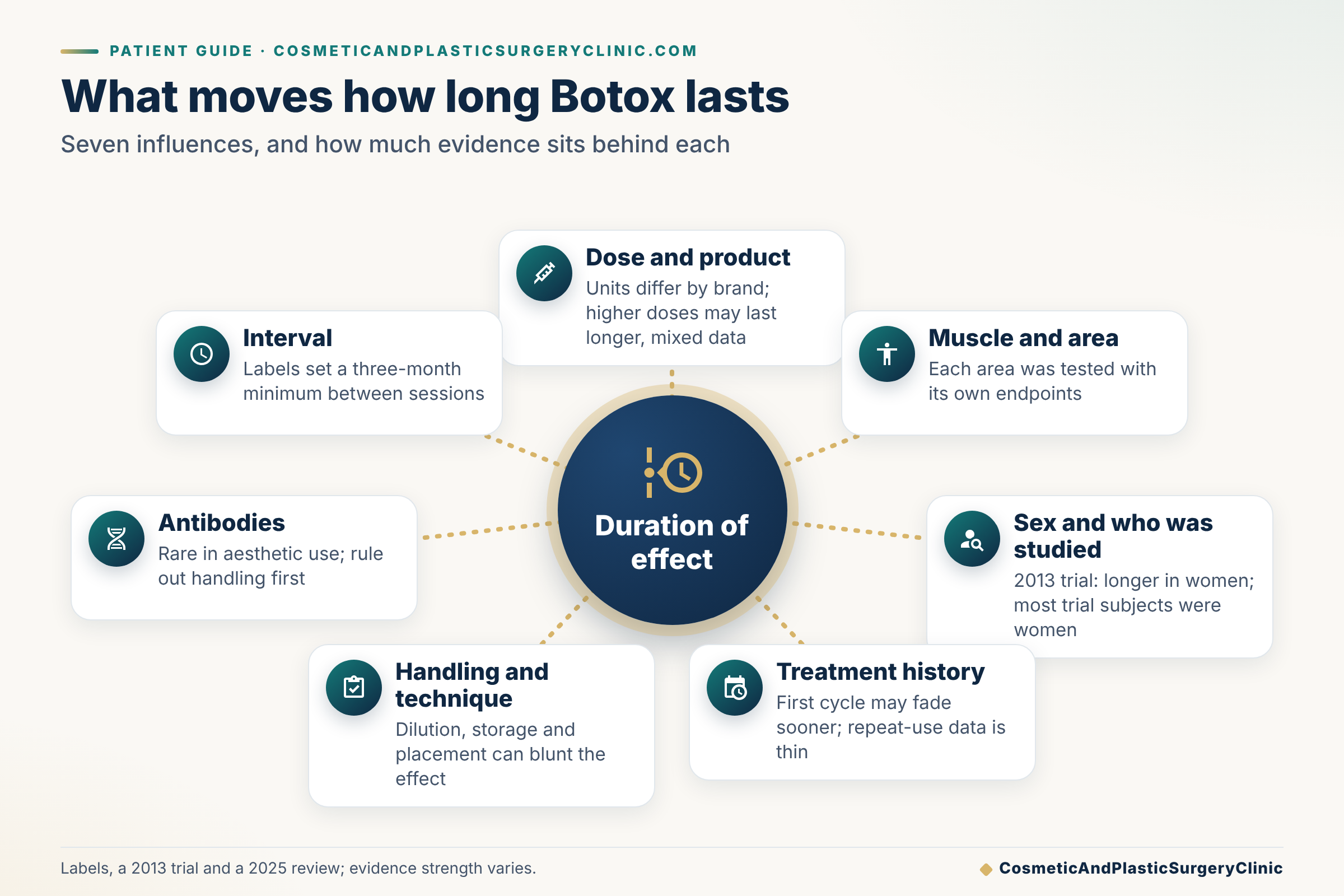
| Factor | Effect on timing | Maintenance implication | Review point |
|---|---|---|---|
| Dose in units | Higher doses tend to last longer in some studies; evidence mixed | Smallest effective dose is the usual aim | Whether dose or placement changed between cycles |
| Product and brand | Labels report different onset and duration wording; no clean head-to-head ranking | Units do not convert between brands | First cycle after any switch |
| Muscle and area | Each area was tested with its own endpoints; masseter data are thinner | Plan area by area, not one schedule for all | Different fade dates in different areas |
| Interval and boosters | Labels set a three-month floor; short gaps linked to non-response in reviews | Avoid re-injecting sooner on impulse | Any plan that shortens gaps |
| Years of treatment | Possible quieter muscle; expert opinion more than trial data | Reassess dose and goals at intervals | Change in how you look at rest |
| Handling and source | Dilution, storage and counterfeit product can blunt or distort effect | Consistent injector and verified product | Sudden shorter response or odd symptoms |
When the timeline stops being routine: warning signs, short effects and questions to ask
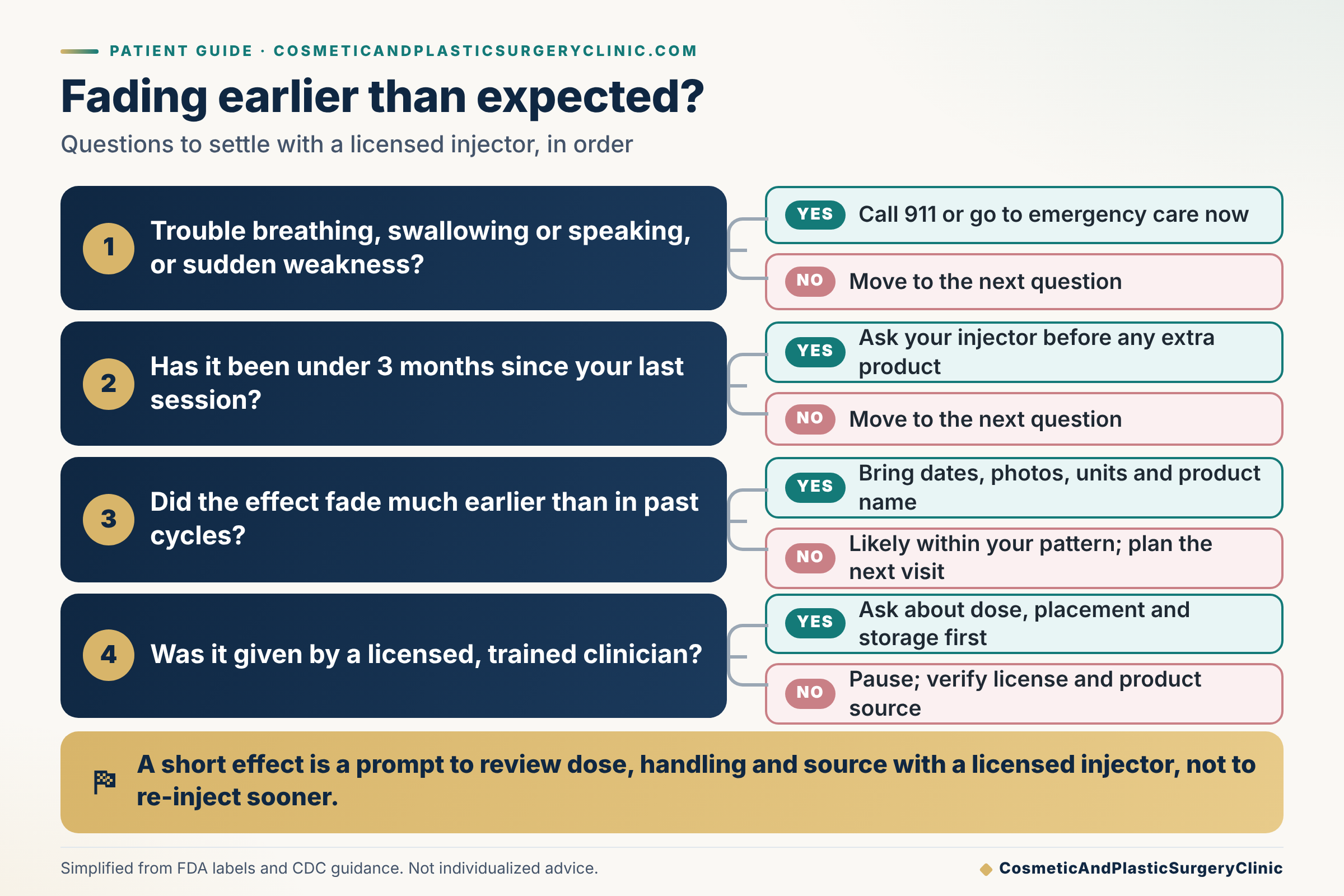
Most of the variation in how long does Botox last is ordinary. A few patterns are not, and they fall into two groups: symptoms that need emergency care at any point after an injection, and results that are shorter or stranger than expected and deserve a call to the injector.
Warning signs and who to call
Emergency care: breathing, swallowing, speech, vision and widespread weakness
If a filler was injected at the same visit, severe pain or skin that turns pale or dusky is also an emergency, and the same urgency applies.
Same-week calls: asymmetry, droop and heaviness
Less urgent but still worth a prompt call are an uneven smile or brow, a heavy forehead, or a drooping eyelid. In the SAKURA trials of one product used for frown lines, eyelid ptosis was reported in 2.5 and 2.0 percent of treated people and headache in 7.0 and 5.9 percent. Those are figures for one product and one area, not predictions.
Ask the office what to expect and when to be rechecked. Side effects and what is expected, uncommon or an emergency are covered in Botox side effects, and general risk reasoning in plastic surgery risks.
Short or missing results, and the questions that sort them out
An unusually short effect: handling, dose and product source
The 2025 JMIR Dermatology review lists causes to consider before blaming antibodies: improper dilution, prolonged storage, insufficient dose, injection into the wrong muscle and poor technique. The sources reviewed here do not link price to duration, but they do show why where the product comes from matters.
The CDC counted 17 cases across nine states, with 13 hospitalizations, linked to counterfeit botulinum toxin or injections by people not following state or local rules; its investigation closed in December 2024. Its advice is to ask whether the provider is licensed and trained, whether the product is FDA-approved and from a reliable source, and to use the state license lookup. Its summary is blunt: if in doubt, do not get the injection. Verification steps are in how to choose a plastic surgeon and cosmetic surgeon credentials.
Questions to bring to the next appointment
Specific questions make the next visit more useful than a general sense that results seem short, and they are the practical way to find out how long does Botox last for you. These are the ones that tend to produce informative answers, and the consultation basics are in plastic surgery consultation questions.
- Which product and how many units did I receive in each area, and how was that recorded?
- What onset and duration did you expect, and what would count as shorter than expected?
- What is your touch-up policy, what does it cost, and what is it based on?
- If the effect fades early, what do you check first?
- How long should I wait before the next session, and why that interval?
- What would make you suggest a different product, a different dose or a longer gap?
- Whom do I call after hours if something seems wrong?
Frequently asked questions
Can you tell Botox is wearing off before the lines come back?
The sources reviewed do not say which sign people notice first, so when you ask how long does Botox last, do not assume. Trials rate lines at maximum frown and at rest separately, and the 2012 pooled analysis found medians of 120 days at maximum frown and 131 days at rest, so the two views fade on slightly different schedules. Checking both, in photos taken in the same light, gives your injector more to work with than a general impression that the effect is fading. Note the date you first see stronger movement, not only the date lines reappear.
How long does Botox last in the forehead compared with between the brows?
The labels do not rank areas. Each was tested in separate trials with separate endpoints: the Botox Cosmetic label reports an 80 percent clinician-rated response at day 30 for frown lines, while its forehead trials followed people for 12 months over three cycles and reported a similar response across cycles. Those numbers cannot be lined up against one another. Because the forehead muscle lifts the brows, plans are usually balanced against the frown area.
Is it okay to get Botox again before three months if it wore off early?
That is a question for your injector, not a rule from an article. What the sources show is that the Botox Cosmetic label says more frequent dosing has not been clinically evaluated, other labels say no more often than every three months, and a 2025 review lists short intervals and booster injections among factors linked with later loss of response. An early fade is better treated as a prompt to review dose, placement and product handling than as a reason to shorten the gap.
How long does Botox last until it has worn off completely?
Complete return is gradual and individual, so how long does Botox last is better answered as a range. In label trials most people no longer met the responder threshold by about day 120 to 150: Dysport’s label lists 9 and 16 percent of clinician ratings at day 150. In the SAKURA trials of daxibotulinumtoxinA, median return to baseline was 27.7 and 26.0 weeks. ASPS pages give a general span of about two to six months. Muscle electrical activity in a 2026 study stayed lower than baseline for months after long treatment, though that is not the same as visible lines.
How long does Botox last for men compared with women?
A 2013 randomized trial of three products, which bears on how long does Botox last in each sex, found longer duration and earlier onset in women than in men for each product. The pivotal trials behind labels also enrolled mostly women: in the SAKURA studies, most participants were women with average ages around 49 to 51. So the published curves describe women in midlife best, and data for men are thinner. This does not predict your own result, and the best guide is how your first cycles actually behaved.
How long does Botox last compared with Dysport, Xeomin or Daxxify?
Labels word duration differently, so a direct comparison is unreliable: Botox Cosmetic says approximately three to four months, Dysport up to four months, Xeomin up to 12 to 16 weeks, and Daxxify’s label gives no figure, although a sponsor-funded trial reported a median of about 24 weeks. A 2013 randomized three-product trial reported longer duration with incobotulinumtoxinA, though its abstract gives no figures in days. Units are not interchangeable, which is one more reason not to compare brands by months alone.
What happens to the lines if I stop Botox after several years?
Cleveland Clinic’s Zins says the effect goes away once treatments stop, and that muscles gradually regain strength. ASPS pages likewise describe movement and wrinkles returning as the effect wears off. The sources reviewed do not address whether lines end up looking worse than they would have without treatment, and nothing reviewed for this page shows a lasting change after stopping. If you are weighing stopping or pausing, ask your injector what to expect in your specific areas over the following months.
Do discounted injections change how long Botox lasts?
No study reviewed for this page links price to duration, so the honest answer is that nobody can say from price alone. What the sources do show is that dilution, storage and technique can blunt an effect, and that counterfeit or mishandled product has caused hospitalizations, according to the CDC’s 2024 investigation. A low price is therefore a reason to ask who is injecting, where the product came from and how it was stored.
Sources and further reading
- AbbVie / U.S. FDA-approved labeling — Botox Cosmetic prescribing information (revised October 2024; accessed 2026-11-12) — indications, onset, duration, responder tables, retreatment interval, antibodies, boxed warning
- U.S. Food and Drug Administration — Dysport prescribing information (revised January 2023; accessed 2026-11-12) — duration wording, responders by day, retreatment interval, antibodies
- U.S. Food and Drug Administration — Xeomin prescribing information (revised February 2026; accessed 2026-11-12) — onset, typical duration, retreatment interval, antibodies, units
- U.S. Food and Drug Administration — Daxxify prescribing information (revised September 2022; accessed 2026-11-12) — follow-up length, retreatment interval, antibodies, boxed warning timing
- U.S. Food and Drug Administration — Jeuveau prescribing information (revised February 2019; accessed 2026-11-12) — day-30 results, retreatment interval
- U.S. Food and Drug Administration — Drug Trials Snapshots: Letybo (2024 approval; accessed 2026-11-12) — week-4 results, retreatment interval
- American Society of Plastic Surgeons — How long does Botox last? (blog post, November 12, 2019; one surgeon’s views; accessed 2026-11-12) — onset, ranges, first-treatment observation, two-week check
- American Society of Plastic Surgeons — Botulinum toxin results (undated; accessed 2026-11-12) — onset and typical duration
- American Society of Plastic Surgeons — All of your common Botox questions answered (February 9, 2023; accessed 2026-11-12) — general duration range, mechanism
- American Society of Plastic Surgeons — 2025 plastic surgery by the numbers (September 2, 2026; accessed 2026-11-12) — neuromodulators roughly half of minimally invasive procedures
- Cleveland Clinic — Botox (botulinum toxin) (reviewed April 6, 2022; accessed 2026-11-12) — onset, full effect, duration, retreatment spacing
- Cleveland Clinic — What are the long-term effects of Botox? (March 18, 2024; accessed 2026-11-12) — atrophy, repeat use, higher doses, stopping
- Europe PMC record of Glogau et al., Dermatologic Surgery 2012 — OnabotulinumtoxinA: a meta-analysis of duration of effect in the treatment of glabellar lines (abstract; accessed 2026-11-12) — 621 subjects, pooled medians
- Carruthers et al., Plastic and Reconstructive Surgery 2020 — DaxibotulinumtoxinA for glabellar lines, SAKURA 1 and 2 (accessed 2026-11-12) — onset, median duration, sponsor, comparison caveats
- Rappl et al., Clinical, Cosmetic and Investigational Dermatology 2013 — Onset and duration of effect of three botulinum toxin products (abstract; accessed 2026-11-12) — onset, sex differences
- Lebeda et al. — Temporal characteristics of botulinum neurotoxin therapy, Expert Review of Neurotherapeutics (c. 2010; accessed 2026-11-12) — determinants of duration, recovery biology
- de Paiva et al., Proceedings of the National Academy of Sciences 1999 — Functional repair of motor endplates after botulinum neurotoxin type A poisoning (abstract summary; accessed 2026-11-12) — nerve sprouting in mice
- Dermatology Times — Higher doses of neurotoxin last longer (October 17, 2018; accessed 2026-11-12) — conference report on dose and duration, small sample
- Kroumpouzos and Silikovich, JMIR Dermatology 2025 — Exploring nonresponse to botulinum toxin in aesthetics (narrative review; accessed 2026-11-12) — non-response causes, antibodies, interval precautions
- The Aesthetic Society — Effect of botulinum toxin injection intervals on irreversibility of targeted muscle paralysis, Aesthetic Surgery Journal 2026 (accessed 2026-11-12) — 21-person electromyography study
- Nobre et al., Aesthetic Plastic Surgery 2024 — Temporalis muscle changes after botulinum toxin in masseter hypertrophy (accessed 2026-11-12) — 22-woman randomized masseter trial
- Centers for Disease Control and Prevention — Harmful reactions linked to counterfeit Botox or mishandled botulinum toxin injections (updated December 17, 2024; accessed 2026-11-12) — cases, symptoms, provider and product questions