Botox cost is quoted three different ways, and the three do not convert into one another. One practice posts a price per unit. Another sells an area, such as the forehead or the outer corners of the eyes. A third quotes a flat visit. The same injection can look cheap in one format and expensive in another, and the difference sometimes sits in the dose, the product or the follow-up rather than the price.
This page is about reading a Botox cost estimate: what published averages measure, how units, areas and visits are priced, which lines belong on a written quote, and how to turn two quotes into one yearly figure. What the treatment does to muscles and lines is covered in the Botox overview. Nothing here predicts what a given practice will charge you, and every dollar figure in the worked examples is an invented illustration.
What published Botox cost figures measure, and what they leave out
Search results for Botox cost offer a long list of national averages, most of them unsourced. Two professional societies publish figures, and they differ in ways that matter before any number goes into a budget.
Two societies, two definitions of Botox cost
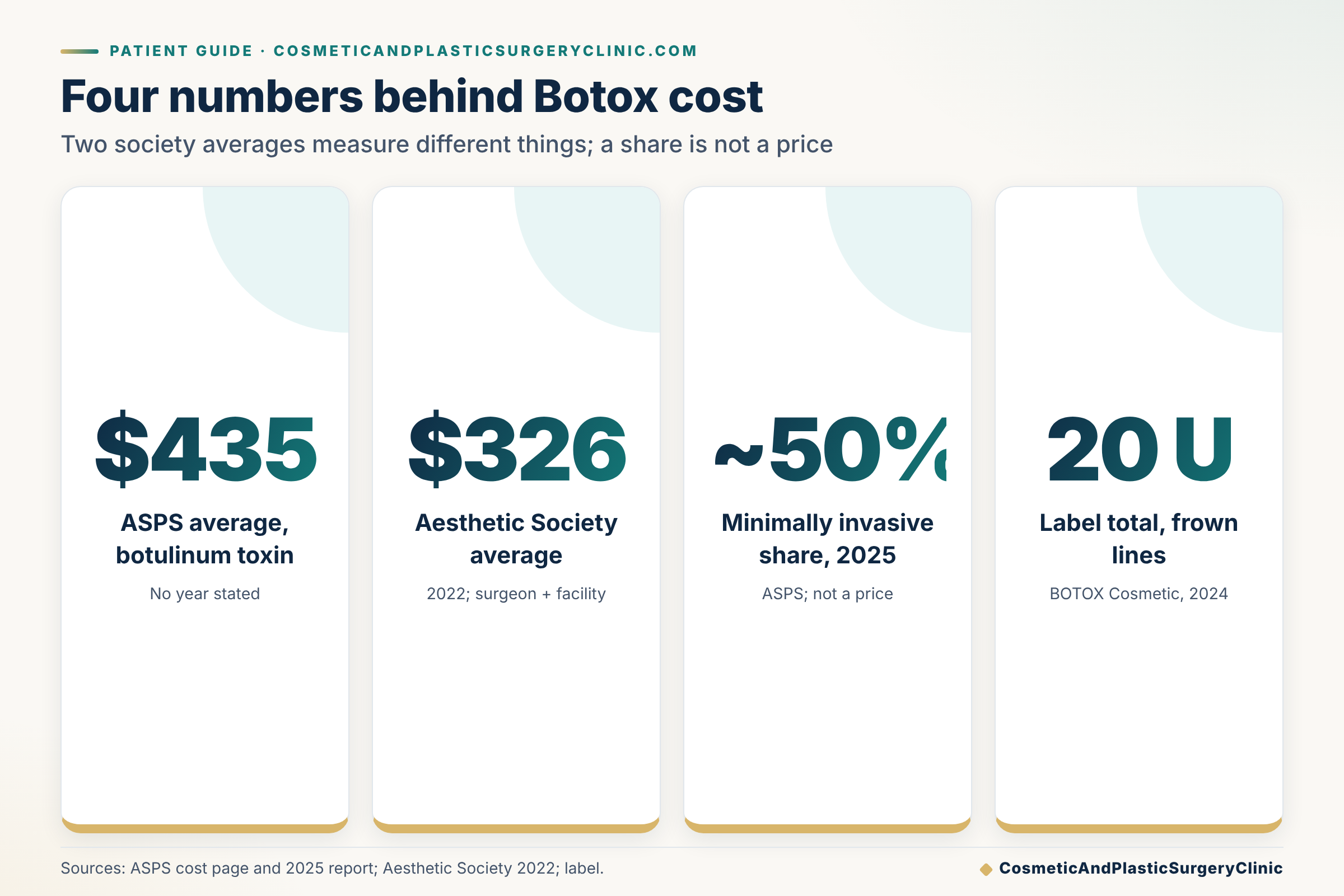
ASPS: a $435 Botox cost average with no year attached
The ASPS botulinum toxin cost page states that the average cost of botulinum toxin injections is $435, attributed to the society’s latest statistics. It gives no year. It names Botox, Dysport, Xeomin, Jeuveau and Daxxify as common examples, and it does not say whether the figure covers a consultation, follow-up or a per-unit price.
The ASPS 2024 projected-range fee document, which gives surgeon-fee ranges for many procedures, has no neuromodulator line at all. So the $435 stands alone, undated, and it is best read as a rough marker of a single treatment, not as a Botox cost you can expect to see on your own estimate.
The Aesthetic Society: $326 for 2022, including a facility share
The Aesthetic Society lists $326 for botulinum toxin, drawn from its 2022 national databank. The page says the figure reflects standard procedure costs, meaning surgeon and facility fees, and may leave out anesthesia, medical tests, prescriptions and other costs. It adds that cost varies by surgeon, geography and the number and location of areas treated.
The two societies are $109 apart, and that gap should not be read as inflation. The surveys differ in year, membership and definition, so the numbers cannot be subtracted, averaged or stacked into a typical Botox cost. Neither society publishes a price per unit.
Why a national average cannot predict your Botox cost
Demand is high, which says nothing about price
The ASPS 2025 statistics report says neuromodulators accounted for roughly half of all minimally invasive procedures performed in 2025, with hyaluronic acid fillers second at 30 percent. ASPS built those estimates from member surgeon responses, an endorsed partner and a national claims-based dataset, then extrapolated to national totals. The report did not give a neuromodulator procedure count.
Popularity tells you the treatment is routine. It does not tell you whether a quote is reasonable, and the report does not say who performed the injections or what they charged.
The five drivers ASPS names
ASPS lists five things that move the price of botulinum toxin: how severe the lines are, how aggressively the areas are treated (which sets the amount of product used), the surgeon’s expertise and qualifications, the time and effort the treatment takes, and the geographic location of the office. A December 2023 ASPS article adds that prices run higher where living costs are higher and that a clinician in high demand will charge more.
Notice what is missing: nothing on that list is the brand name on the vial. The brand matters to the quote, as a later section shows, but the first-order drivers are dose, skill, time and place. The plastic surgery cost overview explains how those drivers work for operations.
Units, areas and visits: three ways to price the same injection
A practice has to turn a vial of powder into a price. How it does that decides whether you can compare its Botox cost with the practice across town.
Per-unit Botox cost: the arithmetic and the label
What a unit is, and why units do not travel between products
A unit is a measure of biological activity, not a volume. The BOTOX Cosmetic prescribing information says the product is not equivalent to other preparations of botulinum toxin and that its units cannot be compared to or converted into the units of any other product. Two Botox cost quotes, “$12 per unit” and “$4 per unit” for a different brand, are therefore not comparable until you know how many units each plan uses.
This is the reason the brand belongs on every written estimate. The comparison of Botox, Dysport and Xeomin covers how the products differ; for pricing, the rule is that a per-unit figure is only meaningful next to a named product.
Label totals as arithmetic anchors, never as a plan for you
The BOTOX Cosmetic label (revised October 2024) lists recommended total doses per session for its four approved indications: 20 Units for moderate to severe glabellar (frown) lines, 24 Units for lateral canthal lines (crow’s feet), 40 Units for forehead lines when treated together with frown lines, and 26, 31 or 36 Units for platysma bands, depending on the number of bands. The label also says not to exceed the maximum recommended cumulative dose in a session.
Those totals are useful for one thing: checking that a quote’s units are in the neighborhood of the label for the indicated area. Your own dose is a clinical decision made by the injector after examining you. A quote that assumes far more units than the label total for the area is worth a question, and one that assumes far fewer is too.
Per-area and per-visit pricing
What a flat area fee assumes about dose
A flat fee for “forehead” or “crow’s feet” can be a fair convenience, because it removes the unit arithmetic. But a flat fee carries a hidden unit assumption. Ask how many units the fee covers, what happens if the injector judges that more are needed, and whether a heavier muscle or a second round counts as an extra charge.
The ASPS page says how aggressively an area is treated determines the amount of product, and the Aesthetic Society says larger areas, such as the underarms, need much more medication than the face and cost more. A flat Botox cost for an area is therefore a statement about a typical dose in a typical case, not about yours.
Minimums, vial logic and the 24-hour clock
Some practices set a minimum charge per visit, and some sell by the vial. The label offers one reason these policies exist: BOTOX Cosmetic comes in single-dose vials of 50 or 100 Units, and the label directs that it be administered within 24 hours after reconstitution. An opened vial cannot wait for next month’s patient.
That explains why a practice might set a minimum Botox cost per visit or schedule several treatments close together. It does not make any particular minimum fair. Ask whether the minimum is per visit or per area and whether unused units from your own vial are credited or simply lost.
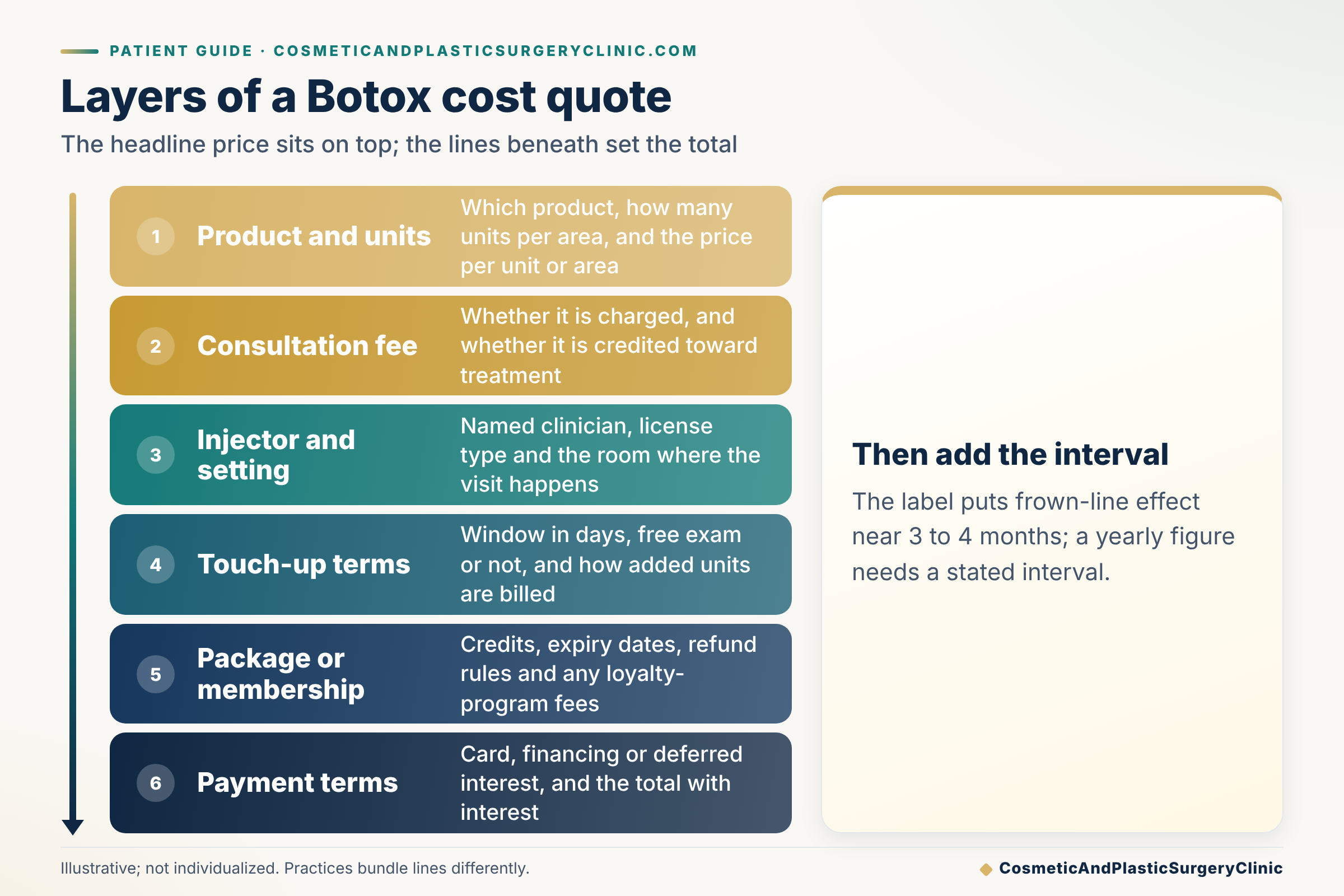
| Line item | Why it may be charged | What changes it | Billed separately? | Question to ask |
|---|---|---|---|---|
| Product and units | The toxin itself, priced per unit or built into an area fee | Product named, units used, treatment areas | Usually the core line | Which product, and how many units does this price assume? |
| Consultation or exam | Time spent assessing and mapping before any injection | New versus existing patient; who examines you | Sometimes, sometimes credited | Is the fee credited toward treatment if I proceed? |
| Injector and setting | Training, supervision and the medical office’s overhead | Clinician type, location, practice setting | Built into the rate | Who will inject me, and what is their license? |
| Touch-up visit | A second look to adjust asymmetry or an area under-treated | Window length, whether added units are billed | Often, after a free exam | What is the touch-up window, and are extra units charged? |
| Membership or package | Prepaid units, credits or loyalty pricing | Term length, expiry, refund rules | Yes, as a purchase | Do unused credits expire, and can I get a refund? |
Injector, product and setting: what a higher or lower Botox cost may reflect
Two quotes for the same number of units can still differ by a wide margin, and the gap usually comes from who is holding the syringe, what is in it and where the visit takes place.
The injector and the room
Credentials, scope of practice and why state rules matter
Botulinum toxin is a prescription medicine, and who may inject it depends on state law, which varies. Board-certified plastic surgeons, dermatologists, facial plastic surgeons and other licensed clinicians within their scope of practice all appear in cosmetic injection practices. The CDC’s 2024 report on counterfeit-product cases recommends injections by licensed and trained providers, using FDA-approved products, preferably in a licensed or accredited health care setting.
A difference in Botox cost can therefore reflect training and supervision, and it is fair to ask for the injector’s name and license type. The steps for confirming credentials are in choosing a plastic surgeon, and cosmetic surgeon credentials explains what titles do and do not mean.
A higher fee is not proof of skill, and a lower one is not proof of risk
A December 2023 ASPS article quotes a plastic surgeon saying that paying a lot does not necessarily mean getting the best quality, and that some high-priced providers are known mainly for social media rather than board certification. The same article says an unusually cheap quote ought to raise an eyebrow. Both statements point the same way: price alone is a weak signal in either direction.
Use the Botox cost quote to start a conversation. A practice that explains its pricing, names its product and injector, and describes its follow-up policy is giving you information that a lone number never will. If you want to meet the clinician before paying, the consultation questions page lists what to ask.
The product named on the quote
Brand names, generic terms and what a Botox cost quote should say
Botox is the brand name of onabotulinumtoxinA, and people often use it as a generic word for any botulinum toxin injection. A quote that says “neurotoxin” or “wrinkle relaxer” without a product leaves out the one fact that makes a per-unit price comparable. The label for BOTOX Cosmetic states that its dosing units are not interchangeable with other products, so a named brand is a basic transparency item.
The FDA warns that counterfeit Botox has been found in the United States, and it advises asking your provider to confirm that the product comes from an authorized source. Naming the product on paper is a reasonable first step toward that confirmation.
Loyalty programs, brand days and what they change
Manufacturers run loyalty programs that practices can join. Allergan Aesthetics’ program, Allē, awards points that can be redeemed for its own products; in a September 2024 FAQ the American Med Spa Association said the threshold for up to 50 units of BOTOX Cosmetic was 1,200 points, that in-office redemptions carry an injection fee the provider sets, and that providers may choose not to take part. The terms are subject to change.
So a reward is not a discount on whatever a practice charges. It is credit toward one manufacturer’s products at a participating office, and the fee for the visit may still apply. Ask what a loyalty offer covers before a coupon changes which quote you pick.
When a very low price deserves questions
What counterfeit and mishandled product has cost patients
In April 2024 the CDC reported 22 people with adverse effects in 11 jurisdictions after botulinum toxin injections, all given by unlicensed or untrained people or in non-health-care settings such as homes or spas. Eleven of the 20 people with available information were hospitalized. A July 2024 CDC report on seven of those patients said FDA determined the Tennessee and Kentucky product was counterfeit; its packaging showed a 150-unit dose, which the manufacturer does not make.
The same report noted that one New York City patient paid less than the U.S. wholesale acquisition cost for the product. That is one data point, not a rule, but it shows why a price far below what a licensed practice could pay for the vial deserves an explanation before an appointment is made.
Four questions to ask before a low price convinces you
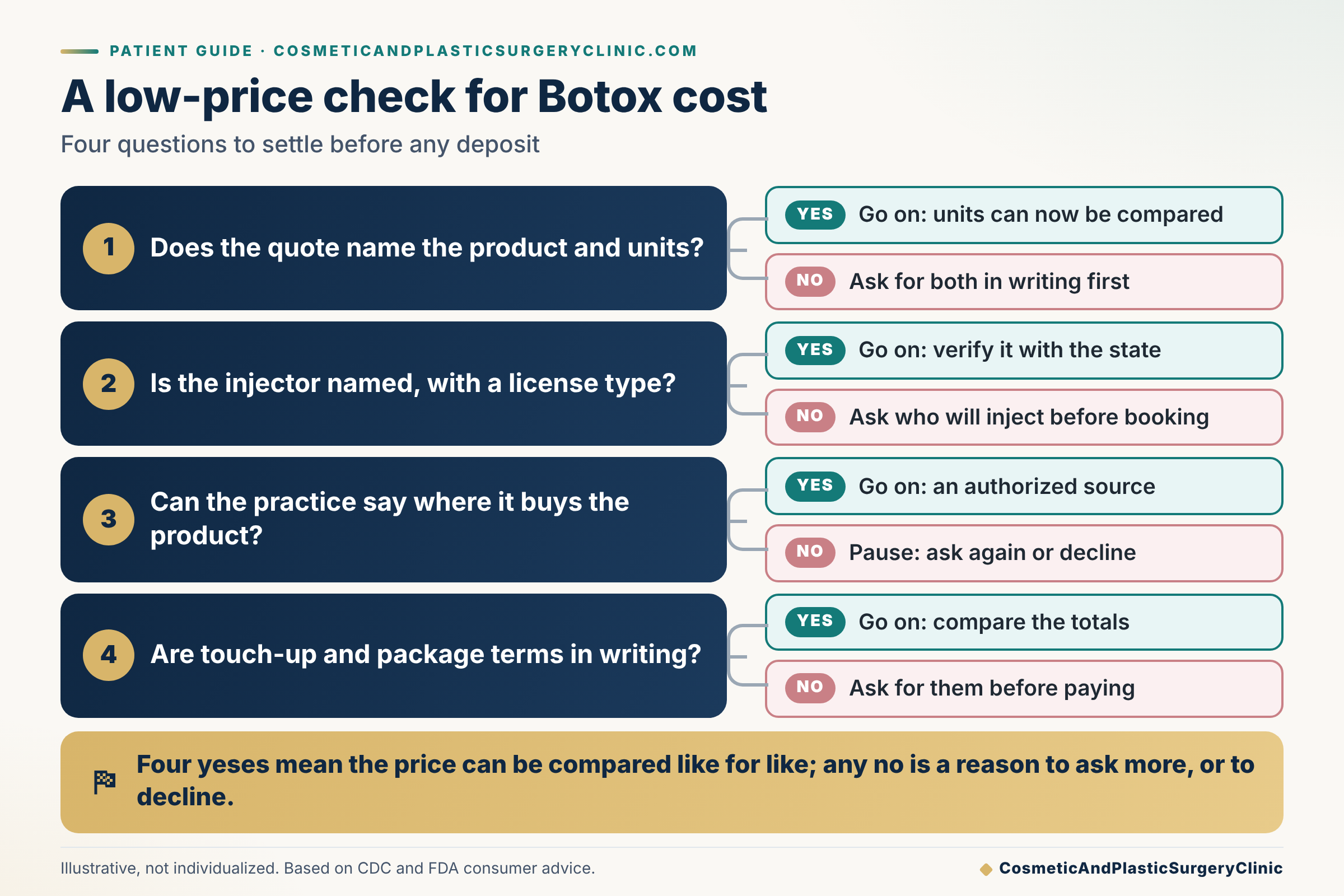
Ask who will inject and what their license is. Ask which product is in the syringe and where the practice buys it. Ask where the visit takes place and what happens if you have a reaction afterward. Ask what the price includes. The FDA’s guidance to consumers is the same: confirm that the product comes from an authorized source and that the provider is licensed and trained to give the injection.
Discount events and coupons deserve the same calm. The Aesthetic Society says coupons are often a plot to encourage impulse buys and that a deal that seems too good to be true probably is. Nothing about a deadline changes the injection, so you can let one lapse. For bargains offered abroad, medical tourism adds follow-up and travel costs to the comparison.
From one visit to a year: the maintenance math behind Botox cost
Because the effect fades, a single price tells you less than a yearly figure. The yearly figure depends on a repeat interval that no quote can set for you.
How often the label allows repeat treatment
Fading, intervals and what the label says
The BOTOX Cosmetic label says the duration of effect for glabellar lines is approximately 3 to 4 months. It also says the safety and effectiveness of dosing more frequently than every 3 months have not been clinically evaluated. Those two statements bracket the arithmetic: a cap near four visits a year for that area, and a figure that individual response can move either way.
Why effects fade, and what changes the timing for the forehead or the jaw, is covered in how long Botox lasts. For Botox cost, the practical point is that the interval is an assumption, and you should state it in any yearly calculation.
Touch-ups, follow-up windows and who pays for added units
The Aesthetic Society advises asking about the practice’s policy on touch-up costs in the first few weeks after the initial injection. The answer varies. Some practices include a free check and adjust at no charge. Others bill added units at the usual rate. A touch-up policy can move the first-visit Botox cost more than a small difference in the price per unit.
Ask for the window in days, whether the examination is free, whether added units are charged, and whether a touch-up resets your repeat clock. Write the answer on the estimate.
A worked example, with assumed prices dated 2026-11-12
Two hypothetical quotes for the same plan
Consider a hypothetical plan using the label totals for frown lines and crow’s feet, 44 Units in all. It is arithmetic, not a recommendation; a real plan comes from an injector’s examination. Quote A advertises $10 per unit. Quote B advertises $12 per unit. The prices are invented for this illustration and are not drawn from any practice.
Quote A adds a $75 consultation fee that is not credited, and charges for touch-up units at $10 each. Quote B credits its exam, includes the touch-up examination and covers up to four added units in the first two weeks. Assume one touch-up of four units is needed at the first visit only.
| Line | Quote A | Quote B | What it shows |
|---|---|---|---|
| Headline price | $10 per unit | $12 per unit | A has the lower headline |
| 44 units | $440 | $528 | Product line only |
| Consultation | $75, not credited | $0, credited | A conditional or missing item |
| Touch-up, 4 units | $40 | $0, included | Follow-up terms differ |
| First-visit total | $555 | $528 | B is lower for visit one |
| Three visits in a year | $1,435 | $1,584 | A is lower over the year |
| Safety note | Product and injector unnamed | Product and injector named | Price is not the only line |
How the ranking flips twice
On the headline, Quote A looks cheaper. On the first visit it is $27 more, because the consultation fee and the touch-up units land on it. Over a year with three visits, it comes out $149 lower, because the consultation and the touch-up do not recur. Quote A: $555 plus two visits at $440 equals $1,435. Quote B: three visits at $528 equals $1,584.
Neither answer is “the cheaper practice.” The lesson is to compare both horizons, the first visit and twelve months, and to treat a quote that names neither its product nor its injector as incomplete, whatever its total. A fourth visit or a longer interval changes the result again, which is why the interval belongs on the page.
Totals over several years
Visits per year multiplied by an assumed price
Multiplying a visit total by an assumed number of visits gives a yearly number, and the same arithmetic over several years shows why a small unit-price difference can matter. At an assumed $528 per visit, three visits cost $1,584 a year and four cost $2,112. These are illustrations of the method, not typical figures.
Maintenance is a choice, and so is stopping. When effects fade, the earlier appearance returns gradually. If the yearly Botox cost does not fit a budget, a longer interval, fewer areas or no treatment are all reasonable outcomes, and preventative Botox looks at the question of starting earlier.
Add areas carefully
Each added area adds units. On the label, frown lines alone are 20 Units, while forehead lines treated together with frown lines are 40 and crow’s feet add 24, so a session covering all three reaches 64 Units. A quote that adds “just one more area” can change the yearly figure more than it appears to. Treatment of the forehead has its own planning questions, covered in Botox for the forehead, and areas beyond the label, such as the jaw muscle, are covered in masseter Botox.
Insurance, taxes and financing: when Botox cost is cosmetic and when it is medical
The same product is prescribed for appearance and for medical conditions, and the payment rules differ sharply. Mixing the two up leads to the most avoidable billing surprises.
Cosmetic use is self-pay; medical uses follow plan rules
What the cosmetic exclusion says
The Aesthetic Society says that, as an elective cosmetic treatment, insurance typically does not cover botulinum toxin injections. One Medicare contractor’s coverage policy (Novitas LCD L38809, revised for services on or after November 9, 2025) states that treatment of wrinkles, including glabellar lines, crow’s feet, laugh lines and the aging neck, is considered cosmetic and not covered under Medicare. It cites the federal exclusion for cosmetic surgery.
That is one Medicare region’s policy, and private plans write their own. The practical reading is simple: plan to pay out of pocket for a cosmetic Botox cost, and treat any statement that insurance might help as a question for the plan, not a promise from a front desk.
Migraine, underarm sweating and other medical uses
The therapeutic BOTOX label (revised November 2023) lists several medical indications. For chronic migraine prevention in adults it gives 155 Units across 31 sites with re-treatment every 12 weeks. For severe primary axillary hyperhidrosis that topical agents have not managed adequately, it gives 50 Units per axilla. The Aesthetic Society notes that coverage may apply when injections are prescribed for perspiration, migraine or muscle spasticity.
These are different treatments with different goals, doses and paperwork. Whether a plan pays depends on its criteria and often on prior authorization. A cosmetic area treated during the same appointment is billed to the patient. Ask for two separated estimates, and do not assume coverage without it in writing from the plan.
| Purpose of the injection | Who usually pays | What the source says | What to confirm in writing |
|---|---|---|---|
| Cosmetic lines (frown, forehead, crow’s feet, neck bands) | The patient | Aesthetic Society: typically not covered; Novitas LCD: cosmetic, not covered by Medicare | The quote’s units, product, injector and follow-up terms |
| Chronic migraine prevention | Plan rules decide | BOTOX label: 155 Units, 31 sites, every 12 weeks, adults | Prior authorization, plan criteria and the billing office used |
| Severe underarm sweating | Plan rules decide | BOTOX label: 50 Units per axilla after topical agents fall short | Documented prior treatment and the plan’s coverage criteria |
| Cosmetic and medical in one visit | Split between plan and patient | Cosmetic portion is generally self-pay | Two separate estimates, one per purpose |
Tax rules, savings accounts and financing
What the IRS says about cosmetic procedures
IRS Publication 502 (2025) says that, generally, you cannot include in medical expenses the amount you pay for cosmetic surgery. It defines that as procedures that improve appearance without meaningfully promoting proper function or treating illness, and it allows an exception where the procedure corrects a deformity from a congenital abnormality, an accident or trauma, or a disfiguring disease. The passage does not name Botox.
Publication 969 (2025) defines qualified expenses for a health savings account as amounts paid for medical care under section 213(d), and describes a health flexible spending account as reimbursing employees for medical expenses. Do not assume a cosmetic injection qualifies. Ask the account administrator in writing before paying, and keep the answer with the estimate.
Medical credit cards and what they do to a small, repeated cost
ASPS’s botulinum toxin cost page shows a medical credit card offer, and a small recurring treatment is easy to put on one. The CFPB’s May 2023 report puts the typical medical credit card APR at 26.99 percent, against about 16 percent for general-purpose cards. Under deferred interest, a balance not cleared by the end of the promotion owes interest on the full purchase amount, charged back to the original date.
The CFPB says about 20 percent of the healthcare deferred-interest purchases in its data were assessed interest, and that in 2020 those borrowers paid about 23 percent of the initial purchase in deferred interest. Repeating a charge every few months multiplies the chances of missing a promotional date. Plastic surgery financing covers the mechanics in depth.
Turning a Botox cost comparison into a decision you can defend
Once the quotes are in, the work is converting them into the same format and noticing what is absent. A short method keeps that from turning into a spreadsheet project.
Pressure, packages and the written estimate
Deadlines, prepaid packages and vague terms
Pressure tends to arrive as a deadline, a package or a limited supply. A prepaid package is a purchase of future treatments, so ask whether credits expire, whether unused credits are refundable, and what happens if the practice closes or you move. The Aesthetic Society’s warning about coupons applies here too: a discount is only useful to someone who has already done the research.
Under the federal No Surprises rules, CMS says uninsured or self-pay patients usually must be given a good faith estimate when they schedule care at least three business days ahead or ask for one, and that a bill at least $400 above the estimate may be disputable. Whether a small cosmetic injection falls within that process is worth asking, and a written estimate is useful either way.
The written-estimate checklist for Botox cost
Before paying, ask the practice to write down the product name, the units each area assumes, the price per unit or per area, the consultation fee and whether it is credited, the injector’s name and license type, the touch-up window and what it costs, the repeat interval the yearly figure assumes, and any package or membership terms. If a line is missing, ask rather than guess.
Waiting, comparing a second practice and choosing not to treat are all legitimate results of this exercise. Some people decide the yearly figure is not worth it, and others find the right practice at a higher price because the line items were clear.
Where cost sits among the other decisions
Botox cost is one input beside the plan and the alternatives
A Botox cost estimate answers only the money question. Whether neuromodulators suit your goals, what they cannot change and how they compare with other options is a separate conversation, started in the Botox overview and the facelift alternatives page, which places injections beside other approaches. Treatment of lines that come from volume loss, sun damage or laxity is a different problem from muscle activity.
When the price stops being the main question
If a quote is far above others, ask what is in it before assuming it is padded. If it is far below, ask the same. If either practice cannot or will not answer, that tells you something that the dollar amount does not. The goal is a decision you could explain to a friend: this injector, this product, these areas, this interval, this total.
Frequently asked questions
How many units do I need, and does that change Botox cost?
It changes it directly, because units drive the product line. ASPS says severity and how aggressively an area is treated set the amount of product used. The BOTOX Cosmetic label lists recommended totals for each approved area, such as 20 Units for frown lines, but your own dose is the injector’s decision after examining you. Ask the practice to write down the units it plans per area and the reason for any difference from the label total.
Is Botox cost lower at a med spa than at a plastic surgeon’s office?
No source reviewed for this page shows a consistent difference. Prices depend on the product, the units, the injector’s training, the setting and the local market. What matters more is who injects and under what supervision: the CDC recommends licensed and trained providers using FDA-approved products, preferably in a licensed or accredited setting. Ask each practice the same questions and compare written estimates, not the type of building.
Why does Botox cost differ between two people at the same practice?
Because the plans differ. Muscle strength, the number of areas, the dose the injector judges appropriate and whether a touch-up is needed all change the units, and units set the price. ASPS lists severity of the lines and aggressiveness of treatment among its cost factors. A neighbor’s Botox cost tells you what her plan cost, not what yours will, so ask for an estimate after your own assessment.
Will insurance pay for Botox, and how does that affect the cost?
For cosmetic Botox cost, generally not. The Aesthetic Society says insurance typically does not cover it, and a Medicare contractor policy calls treatment of wrinkles cosmetic and not covered. Medical uses, such as chronic migraine prevention or severe underarm sweating, are different treatments with their own label doses, and plans decide coverage by their own criteria, often with prior authorization. Ask the plan in writing before the visit.
Can I deduct Botox cost or pay with an HSA or FSA?
Do not assume so. IRS Publication 502 (2025) says you generally cannot include cosmetic surgery in medical expenses, with an exception for correcting certain deformities, and the passage does not name Botox. Publication 969 (2025) ties HSA spending to medical care under section 213(d). Plans differ, so ask the account administrator in writing before paying, and ask a tax professional about your own situation.
Does a very low Botox cost mean the product is counterfeit?
Not by itself, and a low price is not proof of anything. But the CDC’s 2024 reports tie adverse effects to counterfeit or mishandled product given by unlicensed people or outside health care settings, and one New York City patient paid below the U.S. wholesale acquisition cost. A big gap from other quotes is a reason to ask who injects, which product is used and where it was bought. If answers are vague, you can decline.
Should I buy a package or join a membership to lower Botox cost?
Only if the terms hold up. A package is prepaid treatment, so ask whether credits expire, whether unused credits are refundable and what happens if the practice closes. Manufacturer loyalty programs, such as Allē, give points redeemable for that manufacturer’s products at participating offices, and the provider may add an injection fee. The Aesthetic Society warns that coupons are often meant to encourage impulse buys. If you are unsure, pay per visit.
Is it a good idea to finance Botox cost with a medical credit card?
It is rarely the simplest choice for a small, repeated cost. The CFPB’s May 2023 report puts the typical medical credit card APR at 26.99 percent, and deferred interest charges interest on the full original amount if the balance is not cleared in time. If a cost does not fit your budget as cash, consider a longer interval or fewer areas first. If you finance, calculate the total including interest and fees.
Sources and further reading
- ASPS — Botulinum toxin cost (accessed 2026-11-12) — $435 average (no year), products named, five cost factors, credit card offer
- ASPS — 2024 average surgeon/physician fees (accessed 2026-11-12) — no neuromodulator line; projected-range method
- ASPS — Plastic surgery statistics report 2025 (accessed 2026-11-12) — neuromodulators about half of minimally invasive procedures, fillers 30 percent, data sources
- ASPS — Botulinum toxin overview (accessed 2026-11-12) — commonly treated areas, products named, temporary effect
- ASPS — Botulinum toxin safety (accessed 2026-11-12) — side effects and the rare spread of toxin
- ASPS — Understanding plastic surgery costs in the United States (December 2023; accessed 2026-11-12) — cost components, region, demand, price and quality, low-price caution
- The Aesthetic Society — Average plastic surgery costs (accessed 2026-11-12) — $326 botulinum toxin average from the 2022 databank, inclusions and exclusions
- The Aesthetic Society — Botox associated costs (accessed 2026-11-12) — cost factors, larger areas, insurance and medical uses, touch-up policy
- The Aesthetic Society — Plastic surgery costs (accessed 2026-11-12) — consultation fees, coupons, too-good-to-be-true pricing
- AbbVie — BOTOX Cosmetic prescribing information (revised October 2024; accessed 2026-11-12) — indications, label doses, vial sizes, 24-hour use, duration, boxed warning
- FDA — BOTOX and BOTOX Cosmetic label (2024; accessed 2026-11-12) — units not convertible, interval not evaluated more often than every 3 months, contraindications
- AbbVie — BOTOX prescribing information (revised November 2023; accessed 2026-11-12) — chronic migraine and axillary hyperhidrosis indications and doses
- CDC — MMWR 73(27), adverse events after counterfeit or mishandled botulinum toxin injections (July 11, 2024; accessed 2026-11-12) — cases, settings, counterfeit determination, recommendations
- CDC — Health Alert Network 00507 (April 23, 2024; accessed 2026-11-12) — 22 people in 11 jurisdictions, setting, advice for licensed providers
- FDA — Counterfeit version of Botox found in multiple states (April 2024, updated May 2024; accessed 2026-11-12) — identification features, advice to consumers
- AbbVie — BOTOX Cosmetic Day announcement (October 28, 2026; accessed 2026-11-12) — date, eighth year, Allē offers
- American Med Spa Association — Allē loyalty program changes FAQ (September 27, 2024; accessed 2026-11-12) — points, injection fee, provider opt-out
- CMS — Local Coverage Determination L38809, Botulinum Toxins (revised effective 2025-11-09; accessed 2026-11-12) — wrinkle treatment is cosmetic and not covered by Medicare
- IRS — Publication 502 (2025), Medical and Dental Expenses (accessed 2026-11-12) — cosmetic surgery exclusion and exception
- IRS — Publication 969 (2025), Health Savings Accounts and Other Tax-Favored Health Plans (accessed 2026-11-12) — HSA qualified expenses, FSA description
- CFPB — Medical credit cards and financing plans (May 2023; accessed 2026-11-12) — typical APR, deferred-interest terms, share assessed interest
- CMS — Understanding costs in advance: good faith estimates (accessed 2026-11-12) — estimate timing and the $400 dispute threshold