Most people who search for Botox forehead treatment want one thing: fewer horizontal creases when they raise their eyebrows. The catch is that the muscle producing those creases is also the only muscle that lifts the brows. A Botox forehead plan therefore trades some expression and some brow support for smoother skin, and the quality of the trade depends on where your brows already sit, how your eyelids look and how the plan is mapped.
This article explains that trade in plain terms. It covers the anatomy, what the FDA label for onabotulinumtoxinA (Botox) says about Botox forehead lines, why dose is a balance and not a score, who should pause for an exam first, what the first weeks look like and how to compare toxin with other routes. It is general education, not a verdict on any individual. The Botox overview covers how neuromodulators work in general.
What a Botox forehead plan actually decides
A Botox forehead appointment looks like a wrinkle treatment, but it is really a decision about muscle balance. Before any needle, the useful questions are which muscles hold the brow where it is, which of those you are willing to weaken, and what you expect the skin to do afterward. The answers differ from face to face, which is why a template plan is the first thing to question.
The treatment is common. The American Society of Plastic Surgeons (ASPS) 2025 statistics report says neuromodulator injections made up roughly half of all minimally invasive procedures that year, but popularity shows how routine the visit is, not whether it suits a particular face.
The frontalis lifts the brow, and several muscles pull it down
One elevator, a group of depressors
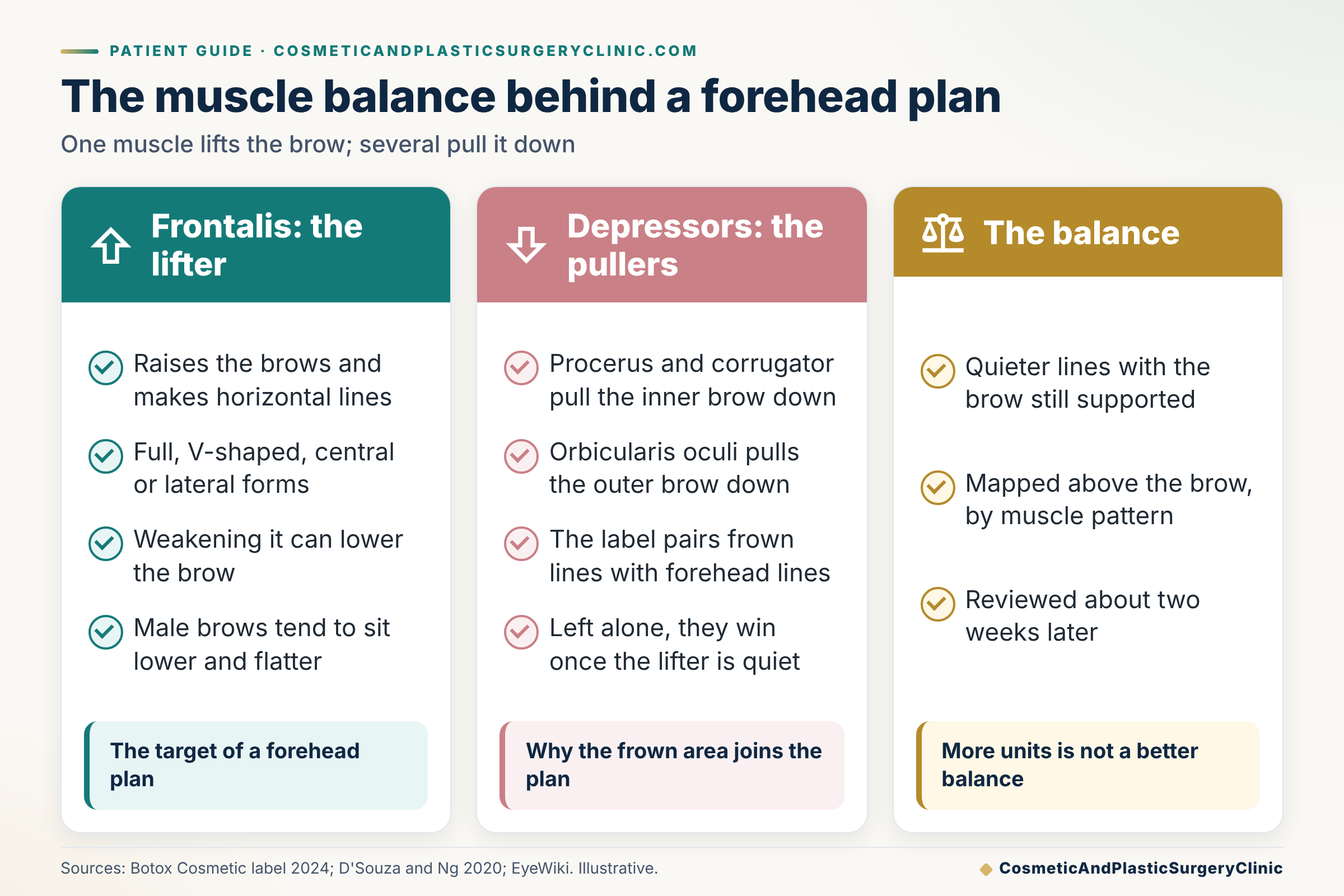
The frontalis is a paired sheet of muscle that runs from the scalp up into the forehead skin. When it contracts it raises the eyebrows and bunches the skin into horizontal lines. The American Academy of Ophthalmology (AAO) EyeWiki page on brow ptosis describes it as responsible for elevating the inner two thirds of the brow, powered by the frontal branch of the facial nerve.
Pulling the other way are the procerus, the corrugator supercilii and the depressor supercilii, which lower the inner brow, and the orbicularis oculi, the ring muscle around the eye, which lowers the outer brow. A 2020 anatomical review by D’Souza and Ng in Current Otorhinolaryngology Reports states the consequence directly: weakening the frontalis will lead to brow ptosis, which is why frontalis injections are usually balanced with treatment of the depressors. The review combines the literature with the authors’ cadaver dissections, so it is anatomy teaching, not trial evidence.
Four forehead shapes, so one pattern does not fit all
The same review describes four configurations of the frontalis. In the full form the two bellies meet in the midline and cover the whole forehead. In the V-shaped form a wedge of the scalp’s fibrous sheet separates them, which produces gull-wing creases. In the central form the muscle covers only the middle of the forehead, and in the lateral form it sits in two side columns with an unlined middle.
The authors advise noting the configuration before treatment and avoiding injection into areas where muscle is thin or absent, which would add asymmetry without adding benefit. In practice that means two people with similar-looking lines can need different maps. When a clinic describes a fixed grid of injection points for every Botox forehead patient, ask how the grid accounts for your pattern.
What you are optimizing, and where the goals collide
Lines, brow height, expression, cost and upkeep
A Botox forehead plan has at least five variables that compete. Smoother skin is one. Brow height and shape are another, and so is how much you want your face to move when you talk. Cost and upkeep come next, since the effect is temporary and the plan repeats. Reversibility is the fifth: unlike surgery, the muscle effect fades, which makes a first conservative plan easy to adjust but also means a heavy-feeling brow will not resolve on the day you notice it.
Writing your priorities in order before the visit helps. If brow position matters more to you than line depth, say so; it changes how an injector approaches the lower part of a Botox forehead map. The Botox cost article explains how pricing by unit or by area can shape the plan, and upkeep returns in the planning section below.
When the goals pull in opposite directions
Deep horizontal lines at rest are the classic collision. Mayo Clinic notes that repeated squinting, smiling and frowning etch grooves that can deepen as skin loses elasticity, and a Cleveland Clinic Health Essentials piece from March 2024 says neuromodulators work less well once frown lines are present at rest, often around age 60, when fillers may help. A muscle relaxant can soften movement, but it cannot fill a groove that is already etched.
Low or heavy brows are the second collision. The ASPS article on brow lifts and Botox, published in May 2025, quotes plastic surgeons saying toxin can give a gentle lift in younger people or mild descent, but cannot reposition tissue structurally. If your brows already rest low, the same relaxation that softens Botox forehead lines can take away the lift you rely on.
What the FDA label says about Botox forehead lines, and what it leaves out
The label is the one document every injector is expected to know, and it is more specific than most websites. Professional societies describe the treatment in broader terms: the ASPS botulinum toxin page lists forehead furrows among common uses and calls the effect temporary. It also leaves several questions open, which is a useful thing to see before you accept anyone’s confident promise about a Botox forehead result.
Which products carry a forehead indication
Botox Cosmetic: the 2017 indication
According to Drugs.com’s approval history, the FDA approved Botox Cosmetic for moderate to severe forehead lines on October 3, 2017, after the 2013 approval for crow’s feet and the original 2002 approval. The current label, revised October 2024, describes the indication as temporary improvement in the appearance of moderate to severe forehead lines associated with frontalis muscle activity in adults.
For that indication the label lists 20 Units divided across five injection sites in the frontalis, given together with 20 Units for frown lines, for a total of 40 Units. It adds that forehead lines should be treated in conjunction with frown lines to minimize the potential for brow ptosis, and its lower treatment row is described as at least 2 cm above the eyebrow. Those are label figures for the indicated use, not a dose for any person. The same label says its Units are not equivalent to those of other botulinum toxin products.
Xeomin’s 2024 expansion and the frown-line-only products
Forehead lines were long a Botox-only label claim. A 2024 review table by Gupta and colleagues in Plastic and Aesthetic Research listed forehead lines for Botox Cosmetic and only glabellar lines for Dysport, Xeomin, Jeuveau and Daxxify. That changed for one product in July 2024, when Pharmaceutical Executive reported FDA approval of Xeomin (incobotulinumtoxinA) for simultaneous treatment of upper facial lines: frown lines, horizontal forehead lines and crow’s feet, supported by two placebo-controlled trials in 730 adults.
Product labels change, so confirm the current indication for whichever brand your injector plans to use. Off-label use is legal and common in medicine, but it should be disclosed, not assumed. The Botox vs Dysport vs Xeomin comparison goes through the brands without ranking them.
What the label trials measured, and what they did not
Grading at maximum eyebrow elevation
The Botox forehead trials in the label enrolled healthy adults with moderate to severe lines at maximum eyebrow elevation. Severity was scored on a four-point photonumeric scale, from none to severe, by the investigator and the participant independently. That detail matters for photo reading: a forehead graded while the brows are raised high is a test of movement lines, not a judgment of the resting face.
The 2019 version of the label describes about 921 participants randomized to a Botox Cosmetic arm and 257 to placebo across two 12-month studies. The label’s pooled adverse-reaction table adds a safety signal worth knowing; it is covered next.
Headache, brow ptosis and eyelid ptosis in the Botox forehead studies
The label’s adverse-reaction table for the forehead studies pools 665 treated participants against 315 on placebo. Headache occurred in 9 percent against 5 percent, brow ptosis in 2 percent against none, eyelid ptosis in 2 percent against under 1 percent, and skin tightness in 2 percent against none. These are trial figures from supervised studies in one product’s labeled dose; they do not predict an individual’s risk and they do not describe what happens with other doses or products.
Brow ptosis here means a lowered eyebrow, while eyelid ptosis means the upper lid edge droops. They look alike in a mirror but have different causes, which the Botox side effects article separates in more detail.
Brow position and dose strategy: why more is not always better in a Botox forehead plan
Unit counts are easy to compare, which makes them tempting to treat as quality. For Botox forehead work they mislead, because the goal is not the weakest possible frontalis. It is a muscle that is quieter than before but still able to hold the brows where you want them.
Why the frown muscles are part of a Botox forehead plan
The label pairing and the expert-panel view
The label’s instruction to treat forehead lines in conjunction with frown lines is the plainest statement of the balance principle. Treating the lifter alone leaves the depressors pulling at full strength. A 2017 consensus from twelve Spanish aesthetic physicians in Clinical, Cosmetic and Investigational Dermatology goes further and says the forehead should not be treated without treating the corrugator supercilii.
That panel worked with incobotulinumtoxinA, met four times between 2014 and 2015, and acknowledges that its recommendations are the authors’ opinions and that the meetings were funded by Merz Pharma España, the product’s regional maker. It is a useful description of how experienced injectors reason, not proof of outcomes.
What can happen when the depressors are left alone
When a relaxed frontalis meets untreated depressors, the brow can settle lower, and a brow that was already low can come to rest on the upper lid. Martyn King’s 2016 review in the Journal of Clinical and Aesthetic Dermatology lists treating the forehead without the frown area as a risk factor for brow drop, alongside injecting too low, heavy or short brows, previous frontal surgery, and age-related skin changes.
The same review describes a simple observation an injector can make: with the person sitting upright, looking forward and closing the eyes, a brow that visibly descends suggests the frontalis is doing hidden work, and the author advises against treating the forehead in that case. It is an exam finding, not a home test, and it is the sort of thing worth asking about.
Mapping: distance above the brow, spacing, and who differs
Safe-zone distances and the lower-frontalis trade-off
Published guidance clusters around keeping injection points well above the brow. The 2024 Gupta review advises sites 1.5 to 2 cm above the eyebrow, or 2 to 3 cm above the supraorbital margin, to spare the lowest frontalis fibers. The Spanish consensus describes zones starting 1.5 to 2.0 cm above the brow, spaced roughly 1.5 to 2.0 cm apart across the midline.
The trade-off is that sparing the lowest fibers can leave fine lines just above the brows. A 2019 Aesthetic Surgery Journal paper by Zhang and colleagues describes a refined pattern that adds very small superficial doses in the lower forehead after treating the upper area with a safe-zone approach. Of 330 treatments followed in clinic, 213 were evaluated two to four weeks later, and brow heights were unchanged. The abstract-level reading available here does not give a comparison group, so treat it as a reasonable report, not a head-to-head result.
Men, women and muscle tone: how a Botox forehead map differs
The AAO EyeWiki page notes that male eyebrows tend to be lower and flatter than female eyebrows. The Spanish panel adds that the point where the two frontalis muscles diverge is generally lower in men, and that men typically have more muscle mass and a larger forehead surface, so the panel recommended separate protocols for men and women. It further sorted people by muscle tone: kinetic, hyperkinetic or hypertonic, with hypertonic patients considered especially prone to brow ptosis.
These are tendencies, not rules. A man with high brows and a short forehead and a woman with low, heavy brows both exist, and an examiner should be looking at the person, not the category.
Less can be more, and how strong the evidence is
Microdosing patterns and what the published reports show
Lower-dose, finely spaced techniques are sometimes marketed as a gentler way to approach Botox forehead treatment. The reports opened for this article describe such approaches, including the Zhang pattern above and a 2020 paper by Carla de Sanctis Pecora describing a customizable protocol called One21. The published reasoning is consistent: spare the lower frontalis, add small superficial doses where needed, and treat the depressors so the brow stays balanced.
What the reports support is the logic of tailoring. The Spanish panel states outright that no single injection protocol suits all patients, and nothing here sets a dose for anyone.
Weighing expert opinion, funded consensus and single-case reports
The strength of these sources is modest. The Pecora paper is labeled expert opinion, illustrates its technique with one 36-year-old woman, and discloses consulting work for the product’s manufacturer. The Spanish consensus is an opinion panel. The Zhang paper is an uncontrolled clinical series. The label trials are the strongest evidence for one product at one dose, and they are silent on many of the fine points injectors debate.
When an advertisement says a technique is gentler or safer for the brow, ask what evidence exists, who funded it and how many people it followed. Because the label says dosing more often than every three months has not been clinically evaluated, a plan that calls for much more frequent retreatment deserves a clear explanation. Mayo Clinic’s patient page likewise describes follow-up injections at least three months apart.
Heavy brows, hooded lids and other reasons to rethink Botox forehead injections
Not every forehead line is a good target. Some findings argue for waiting, some for a different route, and a few for medical review before any cosmetic treatment. The point of listing them is to help you notice which questions to raise, not to decide your case.
Who should get an examination before agreeing to a Botox forehead plan
Low or heavy brows, and brows that work overtime at rest
People whose brows rest at or below the bony rim above the eye, or who feel their forehead working constantly to keep their eyes open, are the ones most likely to notice a drop. EyeWiki notes that a normal eyebrow sits at or above the superior orbital rim and that prolonged frontalis contraction can itself cause tension headache, especially with reading or computer work. Raised brows can be a habit, a compensation or both.
If you are not sure which applies, a plastic surgeon, dermatologist, facial plastic surgeon or oculoplastic surgeon can examine the brows at rest, held manually and during movement. The blepharoplasty vs brow lift article explains how clinicians separate low brows from excess lid skin.
Lid droop, lid hooding and thyroid or surgical history
Three different problems can make the upper eye area look heavy. A low brow adds to hooding. Excess lid skin, called dermatochalasis, hangs over the lash line. True ptosis means the lid edge itself sits low; EyeWiki defines it as an abnormally low upper lid margin with the eye in primary gaze and lists a recent botulinum injection as a history item when working out the cause. A Botox forehead plan does not fix any of these and may worsen some.
Mention thyroid eye disease, prior eyelid or forehead surgery, glaucoma and dry eye. The blepharoplasty candidate article lists how surgeons weigh these conditions, and much of it applies to injections near the eye.

Label contraindications and medical cautions
Allergy, infection, nerve and muscle conditions, and interacting medicines
The Botox Cosmetic label lists two contraindications: known hypersensitivity to any botulinum toxin product or its ingredients, and infection at the proposed injection site. Cleveland Clinic’s drug page adds conditions to report before treatment, including breathing or heart problems, thyroid problems, neurologic disease such as myasthenia gravis, and recent surgery at the treatment site. Aminoglycoside antibiotics and other agents that interfere with nerve-muscle signaling can increase the toxin’s effect, according to the label, which advises caution.
The label also carries a boxed warning that effects can spread from the injection area, and says swallowing and breathing difficulties can be life threatening. Bring a full medicine and supplement list, and mention blood thinners, since Mayo Clinic notes that some people are asked to pause them before injections. Do not stop a prescribed medicine on your own.
Pregnancy and breastfeeding, as the sources state it
The label says there are no adequate human data on use in pregnancy and no data on whether the product passes into milk, and it notes animal findings at doses that also caused maternal toxicity. Mayo Clinic says health care providers generally do not recommend Botox during pregnancy or breastfeeding. Beyond that, the sources opened here give no timing rule, so this is a question for your own clinician, ideally before you book.
| Situation | Pathway a clinician may discuss | Possible benefit | Trade-off | Key question |
|---|---|---|---|---|
| Movement lines, brows at or above the orbital rim, no hooding | Frontalis treatment balanced with the frown area | Softer lines when raising the brows | Temporary; brow drop possible if mapped too low | How far above my brow will you inject, and why? |
| Low or heavy brows; brow drops with eyes closed | Lower-dose plan, depressor-focused plan, skip the forehead, or discuss a surgical lift | Protects brow support or treats the cause | Fewer line changes; surgery adds scars and recovery | What will my brow do if the forehead is relaxed? |
| Lids look hooded, with excess lid skin | Eyelid evaluation; toxin may not help | Treats the actual source of the heaviness | Different operation; toxin can worsen hooding | Is my hooding from the brow, the lid skin or both? |
| Lines visible with a relaxed face | Skin care, filler, resurfacing, with or without toxin | Addresses etched lines toxin cannot fill | More visits; filler carries its own risks | Which of my lines are movement and which are etched? |
| Mild lines, undecided | Sun protection and skin care first, or no treatment | No injection risk; keeps options open | Lines may deepen with time and expression | What would you do if you were me, and what would you watch? |
The injection visit, the first weeks and the review appointment
A Botox forehead treatment takes minutes, but the plan around it has a clear sequence: history and examination, mapping, injection, then a review once the effect has settled. Knowing the sequence helps you spot a visit that skips a step.
What happens at a Botox forehead appointment
Mapping a Botox forehead plan while you raise and relax
A careful visit starts with questions about your medical history, medicines, prior toxin treatments and goals, then an examination of the brows and lids at rest and in motion. Photographs at rest and with the brows raised give a record to compare against later; the Botox before and after article explains how to read such photos. The injector then maps points while you raise and relax, so the marks follow your muscle, not a template.
Mayo Clinic’s patient page describes injections given with a thin needle in a medical office, with numbing options such as ice, a topical anesthetic or vibration, though many people feel little pain. You can reasonably ask which product is being used, how many Units are planned and where each will go. The label itself tells users not to use the product if the carton, vial or license details do not match its description, which is one reason to ask to see the packaging.
Aftercare instructions and what the sources say
Mayo Clinic advises avoiding rubbing or massaging the treated area for 24 hours and avoiding lying down for two to four hours, and says most people resume normal activities, with a reminder to check with your provider. King’s review lists sun exposure, saunas and massage soon after treatment as possible contributors to toxin spread, framed as possibilities rather than proven causes.
Your injector’s written Botox forehead aftercare instructions override general guidance. Ask in advance about exercise, headwear, skincare products and when to expect a review visit, because the sources opened here do not address those details.
Weeks one to six: what changes, and the window for a droop
Onset, review and fading after Botox forehead treatment
Mayo Clinic says effects usually begin within one to three days and full results may take a week or more, that some people do not get a noticeable benefit, and that results typically last three to four months. The label gives the three-to-four-month figure for frown lines and gives no forehead-specific duration, so treat it as a rough frame for Botox forehead results, not a promise. The how long Botox lasts article goes through the fade in detail.
King’s review suggests reassessing around two weeks, which is when asymmetry, a peaked outer brow or a heavy feeling can be judged properly. A touch-up before then can add to an effect that has not finished developing.
Telling a lowered brow from a drooping eyelid
If something looks heavier after treatment, the first question is which structure moved. King’s review says patients typically present within three to seven days with a drooping brow or lid, that eyelid ptosis often settles within three to four weeks, and that brow ptosis often settles within about six weeks, though either can last as long as the toxin effect. The table sets out the differences.
| Feature | Lowered brow (brow ptosis) | Drooping eyelid (eyelid ptosis) |
|---|---|---|
| What sits lower | The eyebrow itself, sometimes with more skin resting on the lid | The edge of the upper lid, so the eye opens less |
| How it arises | Weakened frontalis with untreated depressors, or injections placed too low | Toxin reaching the lid-lifting muscle, per King’s review |
| What you may notice | Heavy forehead, tired look, brows resting lower | Trouble opening the eye fully, difficulty with eye makeup, restricted view |
| Usual course | Often settles within about six weeks, per King’s review | Often settles within three to four weeks, per King’s review |
| What a clinician looks at | Brow position at rest, with eyes closed and held manually | Lid margin height; EyeWiki defines the measure MRD1 |

King’s review mentions that some clinicians use prescription eye drops for lid droop, which can lift the lid by a millimeter or two, and notes risks including angle-closure glaucoma in susceptible people. That is a clinician decision, not a home remedy. Whatever the cause, the practical step is to call the injector early, not to wait out the weeks in silence.
Know when a problem is urgent
Symptoms that need emergency care
Call 911 or go to emergency care for any breathing or swallowing difficulty, widespread weakness, or sudden vision change. If filler was added in the same visit, skin that turns white or dusky, or severe pain, is also an emergency.
Problems that deserve a prompt call
Other problems should prompt a call to the injector the same day or the next: a brow that feels heavy, a lid that droops, one brow clearly higher than the other, a peaked outer brow, a new headache that does not settle, redness or swelling at a site that is worsening, or a rash. Headache was more common than placebo in the label’s Botox forehead trials, and a new, severe or unusual headache should be discussed with a clinician, not assumed to be routine. Bring photos from before, which help the injector compare.
Comparing toxin, surgery, skin care and waiting, and planning the long run
The honest answer to “which Botox forehead route is best” is that the options address different problems, so they are not interchangeable and none wins for everyone. A good plan names which problem each option treats and how long each one lasts.
Realistic paths side by side
Toxin, filler, skin care and resurfacing: what each addresses
Mayo Clinic’s wrinkle treatment page says Botox works well on frown lines between the brows, across the forehead and on crow’s feet, with effects lasting a few months. It lists prescription retinoids for fine lines, fillers that plump creases with repeat injections about every six months, and laser resurfacing that can smooth skin but cannot fix sagging. Sun protection with a broad-spectrum sunscreen of SPF 30 or higher is its basic prevention advice.
In practical terms, toxin targets movement, filler and resurfacing target etched lines or texture, and skin care shapes how the surface ages. When lines are present at rest, the Botox forehead question becomes whether to combine routes. For how filler results are read, see dermal filler before and after photos; for starting early, see the preventative Botox article.
Surgical brow lift and eyelid surgery: when structure is the problem
The ASPS brow-lift page lists horizontal forehead wrinkles, frown lines and sagging brows that hood the upper eyelids among the problems a brow lift treats. The ASPS article on brow lifts and Botox describes surgery as the better fit for significant tissue descent, deep static lines or functional concerns, lists techniques with different trade-offs, and quotes a surgeon saying most people who undergo brow lifts still need Botox afterward.
Eyelid surgery addresses excess lid skin and fat, and the same ASPS article notes that for some people with fallen brows, repositioning the brow may reduce the need for eyelid surgery. Weighing a lift against other facial options is covered in facelift alternatives. Surgery adds anesthesia, scars and recovery, so it answers a different question than a few units of toxin.
Planning a Botox forehead routine for the long run
Maintenance, records and a revision plan for Botox forehead treatment
A Botox forehead plan repeats, which makes records useful. Keep a note of the product, the Units, the areas and the date, and take comparable photos at rest and raised. The label says its Units are not equivalent to those of other products, so if you ever switch brands, a new plan, not a conversion, is the sensible starting point.
| Factor | Effect on the outcome | Maintenance or revision implication | Warning sign or review point |
|---|---|---|---|
| Frontalis shape and forehead height | Decides where movement lines remain | Map may need adjusting at the review visit | Peaked outer brow or uneven lines after two weeks |
| Brow position and skin changes with age | King’s review lists age, sun damage and lost elasticity among brow-drop risk factors | A plan that suited you once may need revisiting | Heaviness or a changed sense of eyelid hooding |
| Interval between visits | Effect fades over months | Mayo Clinic: follow-up at least three months apart | Pressure to return sooner than the label evaluated |
| Etched lines and sun damage | Toxin softens movement but not grooves at rest | May need skin care, filler or resurfacing too | Lines at rest that do not change after a full cycle |
| Product and injector changes | Units differ between products | Share records; expect a fresh starting plan | No records, or a plan that ignores your history |
| Pregnancy, breastfeeding and new medicines | Label data are limited; interactions exist | Pause and ask before the next visit | Any plans to conceive or a new prescription |
No universal winner
Some people are happiest with a light forehead plan, some with none, some with a lift. Cleveland Clinic’s March 2024 piece says long-term evidence is limited, that prolonged use can weaken the treated muscle through disuse and that the muscle regains strength if injections stop, and that no scientific data proves a belief that repeated injections thin the skin. Evidence on years of repeated Botox forehead treatment is thin, which argues for modest plans reviewed regularly, not a fixed schedule.
A consultation framework: cases, six checks and a slow-down rule
Two hypothetical cases and the facts that would change them
Consider a hypothetical adult in their early 40s whose brows sit above the bony rim, whose lids show no hooding, and whose horizontal lines appear mostly when they raise their brows. Their brows stay in place when they close their eyes and relax. A conservative frontalis plan balanced with the frown area is a reasonable thing to discuss, and the main questions are spacing, review timing and what a touch-up would involve.
Now consider a hypothetical adult in their late 50s whose brows rest low, whose lid skin touches the lashes, and whose brows visibly sink when the eyes close. Relaxing the frontalis could remove support they depend on, so the discussion shifts toward which structure is the cause, whether a lower-dose plan, a skip, eyelid surgery or a brow lift fits better.
- If the second person’s brows held steady when they closed their eyes, a Botox forehead plan becomes a more ordinary conversation.
- If the first person felt heavy after a first visit, they should wait for a review before any repeat.
- If either person is planning a pregnancy or is breastfeeding, the question goes to their clinician first.
- If either has lines visible at rest, toxin alone may not deliver what they hope.
- If either notices new vision changes, the cosmetic plan waits for medical care.
Six checks before the needle
These six questions turn unresolved variables into things an examiner can answer. Together they form a short checklist for any Botox forehead consultation, and the plastic surgery consultation article covers how to judge the answers.
- Where do my brows sit at rest, and what do they do when I close my eyes and relax?
- Is my heavy look from the brow, from excess lid skin or from true lid droop?
- What is my frontalis pattern and forehead height, and how does the map reflect them?
- Is the frown area part of the plan, and if not, why not?
- What is the starting dose logic, when is the review visit and what will a touch-up involve?
- Who is injecting, in what setting, with which product, and what records will I receive?
On who should inject, titles differ by state, and the credentials guides explain what each one means: see how to choose a plastic surgeon for verification steps. A licensed clinician within their scope of practice, working in a medical setting, is the baseline.
A slow-down rule for uncertainty or pressure
Pause if anyone offers a package of Units before examining your brows, discourages questions, tells you a discount ends today, or cannot say what they would do if your brow dropped. Nothing about a temporary treatment needs a same-day commitment. Waiting, asking for a second opinion or choosing no treatment is a legitimate outcome of a consultation, and a good clinic will treat it that way.
Frequently asked questions
Does Botox forehead treatment lift the brows?
Treating the forehead muscle does not lift the brows; if anything it removes lift. A lift effect comes from relaxing the muscles that pull the brow down, which an ASPS article from May 2025 describes as allowing the elevator muscle to act without opposition. Plastic surgeons quoted there describe it as a gentle effect that cannot reposition tissue. A plan aimed at brow shape is a different map from a plan aimed at forehead lines, so ask which one you are being offered.
What if my forehead lines are there even when my face is relaxed?
Lines visible at rest are partly etched into the skin, and toxin only softens movement. Cleveland Clinic’s 2024 article says neuromodulators work less well on frown lines present at rest and suggests fillers may help; Mayo Clinic lists fillers, retinoids and resurfacing among other options. The label trials also graded lines at maximum eyebrow elevation, so a success there says little about resting lines. Ask an examiner which of your lines are movement and which are etched.
Can I exercise, wear a hat or lie down after Botox forehead injections?
Mayo Clinic’s patient page advises avoiding rubbing or massaging the area for 24 hours and avoiding lying down for two to four hours, and says to check with your provider. The sources opened for this article do not address hats, headbands, helmets or workouts, so there is no verified rule to give. Ask your injector for written aftercare, and mention anything that presses on the forehead in your daily routine so they can advise.
How soon can I have a Botox forehead touch-up if one brow looks different?
A review around two weeks is commonly suggested in King’s 2016 clinical review, because the effect takes time to settle. Whether to adjust is a decision for your injector after examining you. The label says dosing more often than every three months has not been clinically evaluated, so a clinic that proposes frequent corrections should explain its reasoning. Photos taken at rest and raised, before and after treatment, make the conversation more specific.
Who is qualified to give Botox forehead injections?
Rules vary by state, and a title alone does not tell you how many foreheads someone has treated. Plastic surgeons, dermatologists, facial plastic surgeons and other licensed clinicians inject neuromodulators, and the setting and supervision requirements differ. Ask for the injector’s license and training, whether a physician is on site, how complications are handled and which product is used. The credentials guides on this site explain how to read titles.
If my injector uses Xeomin instead of Botox on the forehead, is that on-label?
It can be, depending on the current label. Merz announced in July 2024 an FDA approval of Xeomin for upper facial lines including horizontal forehead lines, and the company’s page describes the indication for adults. Labels change, and older materials may show forehead lines only for Botox Cosmetic. Both labels say their Units cannot be compared or converted to those of other products, so a plan written for one cannot be copied to the other.
Do lines get worse after Botox forehead treatment wears off?
The sources opened for this article do not show lines becoming worse than they would have been. Cleveland Clinic says muscles regain strength if injections stop and that no scientific data proves repeated injections thin the skin, while also describing long-term evidence as limited. Mayo Clinic notes that repeated expressions etch grooves over time. Lines changing again as movement returns is expected; worsening beyond that is a question for an examiner, with your before photos.
Sources and further reading
- AbbVie/Allergan — Botox Cosmetic (onabotulinumtoxinA) prescribing information, revised October 2024 (accessed 2026-11-12) — forehead indication, label doses for the indicated use, brow-ptosis pairing, trial responder rates, adverse reactions, boxed warning, contraindications, pregnancy and lactation text
- U.S. Food and Drug Administration — Botox Cosmetic label, revised 11/2019 (accessed 2026-11-12) — forehead studies design and size (921 treated, 257 placebo), four-point scale
- Drugs.com — Botox Cosmetic FDA approval history (accessed 2026-11-12) — forehead lines approval October 3, 2017; crow’s feet 2013
- Pharmaceutical Executive — FDA approves Merz Aesthetics’ Xeomin for simultaneous treatment of upper facial lines (July 23, 2024; accessed 2026-11-12) — Xeomin upper facial lines approval and trial size (trade press on a company release)
- Merz North America — Xeomin Aesthetic prescribing and safety information page (accessed 2026-11-12) — indication wording, boxed warning, units not convertible
- Gupta and colleagues, Plastic and Aesthetic Research 2024 — Updated review on neuromodulators (accessed 2026-11-12) — indications table by product; injection distance above the brow
- D’Souza and Ng, Current Otorhinolaryngology Reports 2020 — Applied anatomy for botulinum toxin injection in cosmetic interventions (accessed 2026-11-12) — frontalis configurations, brow elevators and depressors, ptosis
- Anido and colleagues, Clinical, Cosmetic and Investigational Dermatology 2017 — Tailored botulinum toxin type A injections: consensus panel recommendations for the forehead (accessed 2026-11-12) — expert-panel tailoring by sex and muscle tone; manufacturer funding
- Pecora, Clinical, Cosmetic and Investigational Dermatology 2020 — One21: a customizable injection protocol for the forehead with incobotulinumtoxinA (accessed 2026-11-12) — expert opinion, single-patient illustration, disclosures
- Zhang and colleagues, Aesthetic Surgery Journal 2019 — Botulinum toxin to treat horizontal forehead lines: a refined injection pattern accommodating the lower frontalis (record page; accessed 2026-11-12) — refined pattern, treatments followed, brow height unchanged
- American Academy of Ophthalmology EyeWiki — Brow ptosis and repair (accessed 2026-11-12) — frontalis function, male versus female brow position, manual brow elevation, frontalis tension headache
- American Academy of Ophthalmology EyeWiki — Blepharoptosis (accessed 2026-11-12) — ptosis definition, MRD1, recent botulinum injection as a history item
- King, Journal of Clinical and Aesthetic Dermatology 2016 — Management of ptosis (accessed 2026-11-12) — brow versus eyelid ptosis, risk factors, timelines, review at two weeks, eye drops and cautions
- American Society of Plastic Surgeons — 2025 Plastic Surgery Statistics Report (accessed 2026-11-12) — neuromodulators roughly half of minimally invasive procedures; no count or fee reported
- American Society of Plastic Surgeons — Brow lifts vs Botox: do you need one or both? (May 27, 2025; accessed 2026-11-12) — depressor relaxation, limits of toxin, surgical techniques
- American Society of Plastic Surgeons — Brow lift (accessed 2026-11-12) — what a brow lift treats
- American Society of Plastic Surgeons — Botulinum toxin (accessed 2026-11-12) — uses including forehead furrows; temporary effect
- Mayo Clinic — Botox (accessed 2026-11-12) — onset, duration, side effects, aftercare, when to call, pregnancy and breastfeeding
- Mayo Clinic — Wrinkles: diagnosis and treatment (published December 12, 2023; accessed 2026-11-12) — retinoids, Botox, fillers, resurfacing
- Mayo Clinic — Wrinkles: symptoms and causes (updated December 12, 2023; accessed 2026-11-12) — expression lines, sun, prevention basics
- Cleveland Clinic — Botox Cosmetic: uses and side effects (accessed 2026-11-12) — conditions to report, interacting medicines, urgent signs
- Cleveland Clinic Health Essentials — What are the long-term effects of Botox? (March 18, 2024; accessed 2026-11-12) — disuse atrophy, skin-thinning claim, static lines at rest, evidence limits