Most people who search Botox vs Dysport vs Xeomin are trying to settle a practical question before an appointment: is the product in the syringe something to choose, or something to leave to the injector? The honest answer starts with what the products share. Each is a purified botulinum toxin type A, each carries the same boxed warning, and each works by temporarily weakening the muscle that is injected. The differences sit in labeled treatment areas, formulation, how units are counted, and how strong the evidence is behind claims about speed and staying power.
This page owns that one decision. It also covers Jeuveau, Daxxify and Letybo, because the American Society of Plastic Surgeons (ASPS) now lists six brands under the neuromodulator heading. Cost mechanics, side-effect detail and duration each have their own pages (Botox cost, Botox side effects, how long Botox lasts), and the umbrella explanation lives in the Botox overview. Nothing in this Botox vs Dysport vs Xeomin comparison ranks products or says which one suits a particular face.
Botox vs Dysport vs Xeomin: what the six FDA-approved products share
Before comparing Botox vs Dysport vs Xeomin line by line, it helps to see how much of the label text is identical. A patient who knows the shared ground can tell a real product difference from a sales difference.
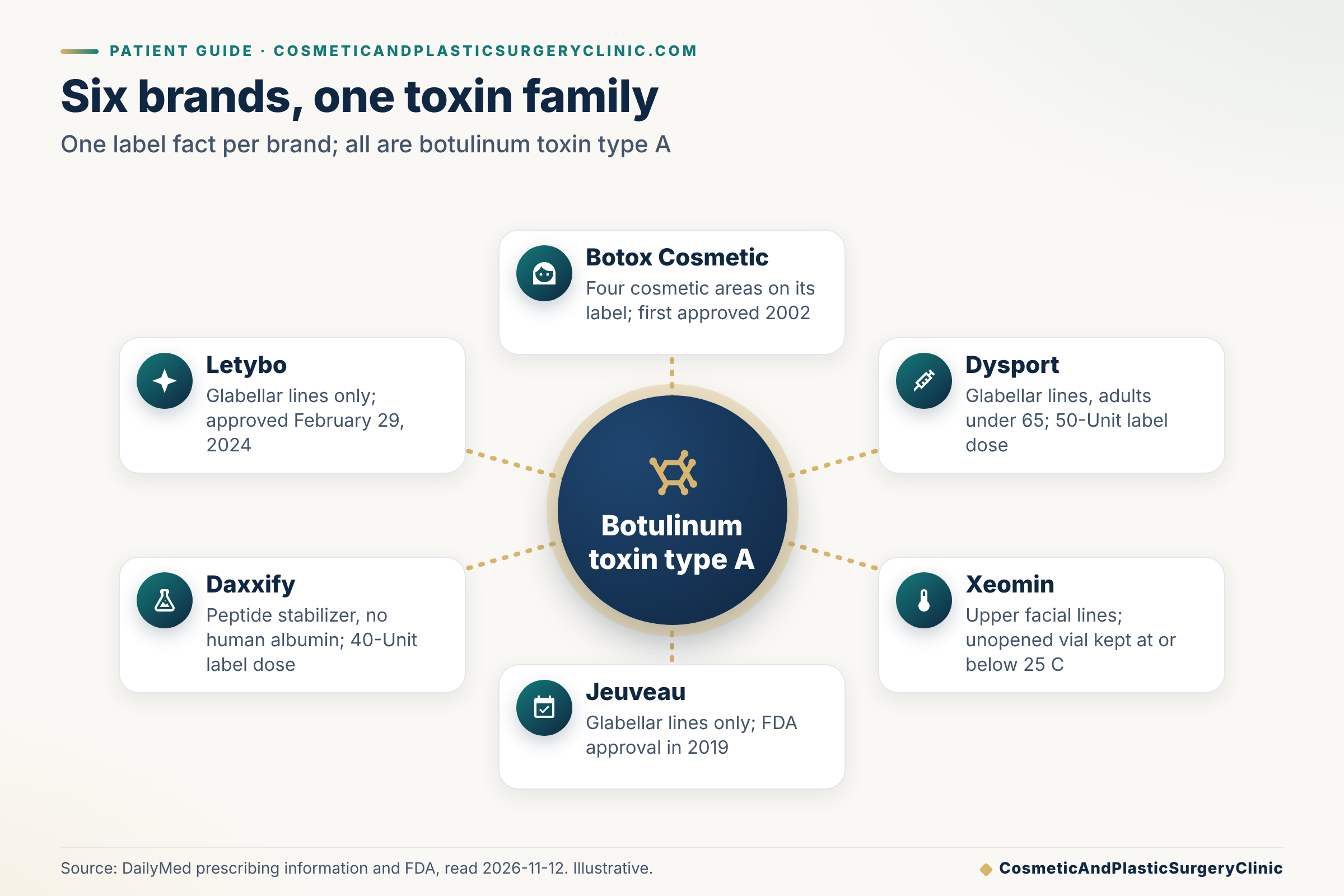
Botox vs Dysport vs Xeomin: one toxin family, six prescribing labels
The shared mechanism and the shared boxed warning
ASPS describes botulinum toxin as a purified substance derived from bacteria; injected into a muscle, it blocks the nerve signals that make the muscle contract, which softens the lines that movement creates. That mechanism is the same whether the vial says Botox, Dysport, Xeomin, Jeuveau, Daxxify or Letybo.
So is the warning. The DailyMed labels I opened for all six products carry a boxed warning titled distant spread of toxin effect. It says effects may spread from the injection area and that swallowing and breathing difficulties can be life threatening, with deaths reported. The Letybo label adds that symptoms have appeared hours to weeks after injection. No answer to Botox vs Dysport vs Xeomin removes that class-level warning.
Pregnancy, breastfeeding and re-treatment limits
The labels are candid about gaps. Botox Cosmetic states there are no studies or adequate postmarketing data on developmental risk, Daxxify says there are no available data in pregnant women, and the Jeuveau and Letybo labels call their data insufficient. Dysport and Xeomin say to use the product in pregnancy only if the potential benefit justifies the potential risk to the fetus. For breastfeeding, every label I read says there are no data on the toxin in human milk.
Re-treatment limits also match. The Dysport, Xeomin, Jeuveau and Letybo labels each say not to treat more often than every three months. Those lines describe what the manufacturers have and have not studied; they are not a verdict for any person, and a clinician has to weigh them against individual history.
Which areas each label covers, and when each product arrived
Approval dates across Botox vs Dysport vs Xeomin and the newer brands
Botox Cosmetic received its first FDA approval on April 12, 2002, according to the Drugs.com approval history, and later added crow’s feet in 2013, forehead lines in 2017 and platysma bands on October 18, 2024. Dysport followed in April 2009, approved the same day for cervical dystonia and glabellar lines. Xeomin was first approved in 2010 for neurological uses and received its glabellar-line approval on July 21, 2011.
The newer entries are Jeuveau (2019, made by Daewoong for Evolus), Daxxify (September 7, 2022) and Letybo (February 29, 2024). A longer market history means more years of postmarketing experience; it is not evidence of better results. Cleveland Clinic notes only that some patients stay with Botox because they already know how they respond to it, which is a reason about familiarity, not superiority.
Where the labels differ on treated areas
In a Botox vs Dysport vs Xeomin vs Daxxify comparison, the label list is the cleanest difference to check. Botox Cosmetic has the widest label: glabellar lines, lateral canthal lines, forehead lines and platysma bands. Xeomin’s current label covers upper facial lines, meaning glabellar, forehead and lateral canthal lines. Dysport, Jeuveau, Daxxify and Letybo list moderate to severe glabellar lines only, and the Dysport indication is limited to adults under 65. Daxxify also carries a cervical dystonia indication, which is not cosmetic.
Plenty of treatments fall outside those lists. ASPS names lip lines, chin dimpling, a square jawline and a gummy smile among the uses of botulinum toxin, and none of those appears in the cosmetic indications I read. Using a product outside its label is called off-label use; it is common in medicine but deserves a direct conversation. Two sibling pages cover the largest examples: Botox for the forehead and masseter Botox.
| Product (generic name) | Cosmetic indications on the label | Label dose, glabellar lines | Unopened-vial storage | Human albumin in vial |
|---|---|---|---|---|
| Botox Cosmetic (onabotulinumtoxinA) | Glabellar, lateral canthal and forehead lines; platysma bands | 20 Units total | Refrigerator, 2°C to 8°C | Yes, 0.25 mg per 50-Unit vial |
| Dysport (abobotulinumtoxinA) | Glabellar lines, adults under 65 | 50 Units total | Refrigerator, 2°C to 8°C | Yes; trace cow’s milk protein possible |
| Xeomin (incobotulinumtoxinA) | Glabellar, forehead and lateral canthal lines | 20 Units total (glabellar alone) | At or below 25°C; refrigeration not required | Yes, 1 mg per vial |
| Jeuveau (prabotulinumtoxinA) | Glabellar lines | 20 Units total | Refrigerator, 2°C to 8°C | Yes, 0.5 mg per vial |
| Daxxify (daxibotulinumtoxinA) | Glabellar lines | 40 Units total | Room temperature or refrigerator | No; uses a stabilizing peptide |
| Letybo (letibotulinumtoxinA) | Glabellar lines | 20 Units total | Refrigerator, 2°C to 8°C | Yes, 0.25 mg per 50-Unit vial |
Botox vs Dysport vs Xeomin formulation: proteins, units and the vial itself
Beneath the shared mechanism of Botox vs Dysport vs Xeomin sit real manufacturing differences: what else is in the vial, how potency is counted, and how the product must be stored and used. Some of those differences matter to a patient with an allergy or a question about sourcing. Others matter mainly to the clinic.
Proteins and stabilizers inside the vial
Complexed toxin, “naked” toxin and a debate that is mostly theoretical
A 2018 review in Clinical, Cosmetic and Investigational Dermatology by Samizadeh and De Boulle describes onabotulinumtoxinA (Botox) as a 900 kDa complex, says the complex size of abobotulinumtoxinA (Dysport) is unknown, and says incobotulinumtoxinA (Xeomin) contains only the 150 kDa neurotoxin with no complexing proteins. The FDA review file describes Jeuveau as a 900 kDa toxin as well.
The same authors note that once a product is diluted, the toxin separates from its complexing proteins, and that those proteins do not appear to add to diffusion or to the therapeutic effect. They call for more study of whether complexing proteins raise antibody formation. Cleveland Clinic says Xeomin is believed to carry a lower risk of allergic reaction but adds that no comparative studies show fewer side effects such as swelling or headache. The formulation difference is real; a clinical advantage from it is unproven.
Albumin, milk protein and a peptide: ingredients worth asking about
Across the Botox vs Dysport vs Xeomin vs Daxxify lineup, five of the six labels list human albumin as a stabilizer: 0.25 mg per 50-Unit vial for Botox Cosmetic and Letybo, 0.5 mg for Jeuveau, 1 mg for Xeomin, and an albumin component in Dysport, which its label describes as a derivative of human blood. The Letybo label calls the transmission risk of viral disease and Creutzfeldt-Jakob disease remote. Daxxify’s label lists no albumin; its stabilizers are histidine, polysorbate 20, trehalose and a 35-amino-acid peptide called RTP004.
One ingredient is a hard stop for some people. The Dysport label says the product may contain trace amounts of cow’s milk protein and lists hypersensitivity to it as a contraindication. Anyone with a milk allergy, a past reaction to any botulinum toxin, or a preference about blood-derived ingredients should say so at the first visit, because the answer can change which product is discussed.
How units work in Botox vs Dysport vs Xeomin, and why they cannot be swapped
Six labels, six dose scales for the same frown
The Botox Cosmetic label is blunt: its units cannot be compared to, nor converted into, units of any other botulinum toxin product. The Dysport, Xeomin, Jeuveau, Daxxify and Letybo labels carry the same kind of statement. Each manufacturer defines a unit with its own assay, so the number on the syringe means something only inside one brand.
The glabellar-line doses show the problem in any Botox vs Dysport vs Xeomin vs Daxxify comparison. The labels give 20 Units for Botox Cosmetic, Xeomin, Jeuveau and Letybo, 40 Units for Daxxify and 50 Units for Dysport, all for the same cluster of frown muscles. A clinic that advertises a low price per unit has told you almost nothing; the comparable figure is the price of a whole treatment area with the product named, a point the Botox cost article takes further. This page gives label totals only to show the scales differ, not as dosing guidance for anyone.
What this means when you change products or injectors
No label gives a conversion table, so any dose adjustment between products rests on a clinician’s experience and published reports, not on a manufacturer rule. That is why a record matters. Ask the clinic to note the product, the areas treated, the units used, the date and the lot number each time, and keep a copy.
With that record, a new injector can start from what actually happened rather than from memory. Without it, “I had Botox before” tells the next clinic very little. If a result was disappointing, the record is also the only way to separate a product question from a dose or placement question.
Storage, mixing and shelf time
Unopened vials: refrigerator or room temperature
Botox Cosmetic, Dysport, Jeuveau and Letybo vials are stored refrigerated at 2°C to 8°C. The Xeomin label says unopened vials can be kept at or below 25°C, and the Daxxify label allows either room temperature (20°C to 25°C) or the refrigerator. Samizadeh and De Boulle call correct storage temperature critical for the products that need it.
For a patient this is a question about the clinic’s routines, not a reason to prefer a brand. A product that tolerates room temperature is not a license for casual handling, and a refrigerated one is not riskier when a clinic follows its label. Asking where and how vials are kept is a fair question at a medical practice.
After mixing: 24 hours, 72 hours and one patient
Reconstituted Botox Cosmetic, Dysport, Xeomin and Letybo are labeled for use within 24 hours of mixing, kept refrigerated in the meantime. The Daxxify label allows 72 hours refrigerated. The Xeomin and Letybo labels also say a vial is for one patient and one session only.
These limits have a plain consequence: a vial mixed on Monday is not meant for Friday’s appointments. A clinic that says it mixed a vial more than a day ago (more than three days for Daxxify) is describing a practice that does not match the labels I read. Asking when the vial was reconstituted is reasonable and takes ten seconds.
Onset and duration in Botox vs Dysport vs Xeomin: trial endpoints versus marketing claims
Speed and staying power are the two claims that most often separate one product’s advertising from another’s in Botox vs Dysport vs Xeomin discussions. Each claim needs a measure behind it, and the measures used by the pivotal trials were not designed to rank products against one another.
How soon does each one start working?
What the pivotal trials measured: day 30 and week 4
The pivotal trials behind the labels did not measure onset. Botox Cosmetic, Dysport, Xeomin and Jeuveau judged success at day 30, and Daxxify and Letybo at week 4, all after a single treatment. Each used a different scale, a different success definition and a different population, so lining up the percentages would imply a ranking the data cannot carry.
The same product gives different numbers in different trials. Letybo’s composite success was 47%, 49% and 65% across its three studies. Xeomin’s glabellar-line success was 60% in one trial and 48% in another. Botox Cosmetic’s forehead-line response was 61% in one study and 46% in the other. If one product varies that much against itself, cross-product comparisons deserve little weight.
Onset reports from reviews and clinic pages
A 2020 systematic review of Dysport in the Journal of Clinical and Aesthetic Dermatology (Nestor and colleagues, sponsored by Ipsen) found that median onset was most often reported at two to three days, and that methods for measuring onset varied widely. One study in that review found incobotulinumtoxinA acted at a median of about three days against five to six days for the other two. Cleveland Clinic’s 2023 page puts Botox at about two weeks and Xeomin at three to five days; the Xeomin label says two to seven days.
Those statements do not agree because they measure different things in different groups. For anyone weighing Botox vs Dysport vs Xeomin, the practical reading is modest: onset takes days, full effect can take longer, and a clinic’s advice on when to judge the result should come from its own experience and not from a brand slogan.
How long do the effects last?
Label statements, and the one product with long median data
The Botox Cosmetic label says glabellar-line effects last approximately three to four months, with 25% of subjects still rated none or mild by the investigator at day 120. Dysport’s label says up to four months, and its first study showed 43% at day 90 and 23% at day 120. Xeomin’s label says up to 12 to 16 weeks. The Jeuveau and Letybo labels give no duration beyond their primary endpoints.
Within Botox vs Dysport vs Xeomin vs Daxxify, Daxxify is the outlier. In the two SAKURA trials (Carruthers and colleagues, Plastic and Reconstructive Surgery, 2020; 609 adults), median duration of none-or-mild severity was 24.0 and 23.9 weeks, and severity took a median of 27.7 and 26.0 weeks to return to baseline. The trials compared 40 Units with placebo, not with another toxin, and used their own definition of response. More on duration is in how long Botox lasts.
Why a longer-lasting product is not automatically a better fit
Duration depends on the muscle, the dose and the person, which is why the same product can behave differently in a forehead and in a frown. A longer response means fewer appointments, but it also means a result that is less to a patient’s taste takes longer to fade. The Letybo label calls adverse effects generally transient but says they may last several months or longer, and eyelid or brow droop appears in the adverse-reaction tables of every label I read.
When choosing among Botox vs Dysport vs Xeomin for a first treatment, some people reasonably prefer a product with a more familiar track record and a shorter commitment, then adjust. Others value fewer visits. Neither preference is wrong; the choice only needs to be made knowingly, with the three-month minimum re-treatment interval on four of the labels in mind.
Head-to-head evidence: what trials comparing Botox vs Dysport vs Xeomin show
Direct comparisons are the strongest way to ask whether one product outperforms another in Botox vs Dysport vs Xeomin terms, and they are scarcer than advertising suggests. The ones I could open compare a newer product with Botox at a fixed dose, and each tells a narrower story than its headline.
The Botox vs Dysport vs Xeomin comparisons that exist
Dysport against Botox in 520 adults
Wu and colleagues (Aesthetic Plastic Surgery, published online December 2022) randomized 520 Chinese adults aged 18 to 65 with moderate or severe glabellar lines to Dysport 50 Units, Botox 20 Units or matching placebo, at 10 centers. At day 29, investigator-assessed responders were 94.7% for Dysport and 97.0% for Botox, a difference of minus 2.4 percentage points with a 95% confidence interval of minus 6.7 to 1.9. That met the study’s noninferiority standard.
Median time to re-treatment after Dysport in the first cycle was 140 days, or about 4.5 months. The sponsor was Ipsen, which makes Dysport, and 92% of participants had never had a botulinum toxin before. The trial speaks to adults of one country at those doses; it does not turn a close result into a tie for every face.
Xeomin and Jeuveau against Botox
A 2015 trial in Dermatologic Surgery compared 20 Units of Xeomin with 20 Units of Botox Cosmetic in 250 patients with glabellar lines. A trade-press summary reports that the two were equivalent at one month, remained similar through four months, and produced satisfaction above 90% in both groups. Merz, which makes Xeomin, sponsored it. I could read only that secondary summary, not the paper.
For Jeuveau, the sponsor Evolus announced a European and Canadian phase 3 study (EVB-003) in 540 people: day 30 responder rates were 87.2% for prabotulinumtoxinA, 82.8% for onabotulinumtoxinA and 4.2% for placebo, and the primary noninferiority endpoint was met. I opened the sponsor announcement of the data, not the full paper. No head-to-head trial for Daxxify or Letybo against another toxin turned up in what I opened.
| Comparison | Design and size | Result reported | Caveat |
|---|---|---|---|
| Dysport vs Botox | Randomized, double-blind; 520 Chinese adults aged 18 to 65; 50 vs 20 Units | Day 29 responders 94.7% vs 97.0%; noninferior | Funded by Dysport’s maker; one country |
| Xeomin vs Botox | Blinded, randomized; 250 patients; 20 vs 20 Units (2015) | Equivalent at one month; similar to month four | Merz-sponsored; read via trade-press summary |
| Jeuveau vs Botox | Phase 3, three arms; 540 people; 20 vs 20 Units | Day 30 responders 87.2% vs 82.8%; noninferior | Sponsor announcement only; no full paper opened |
| Daxxify vs any toxin | Pivotal trials used placebo comparators | Week 4 success 74%; median duration about 24 weeks | No head-to-head trial found in sources opened |
| Letybo vs any toxin | Pivotal BLESS trials used placebo comparators | Week 4 success 47% to 65% by trial | No head-to-head trial found in sources opened |
What the comparisons cannot tell you
Noninferior is not the same as identical
A noninferiority trial asks whether a new product is no worse than a reference by more than a chosen margin. In the Dysport study, the lower end of the interval reached minus 6.7 points, so the data allow a small gap in either direction. Passing the test supports using both products; it does not show they feel, spread or fade the same way for a given person.
None of the Botox vs Dysport vs Xeomin comparisons I opened found one product superior to Botox. They also say little about fine points that patients care about, such as how natural expression looks at rest and in motion, because the primary endpoints were investigator and patient ratings of line severity at maximum frown.
Funding, populations and short follow-up
In the Botox vs Dysport vs Xeomin evidence the funding pattern is consistent: manufacturers sponsored the Dysport, Xeomin and Jeuveau comparisons and the Dysport onset-and-duration review. That does not make the results false, but it is a reason to read conclusions as supportive rather than neutral. Populations are narrow too. The FDA snapshots for Daxxify and Letybo report that 87% and 91% of trial participants were women, and the Dysport comparison enrolled Chinese adults only.
Follow-up is brief. Most primary endpoints sit at day 29, day 30 or week 4. The FDA snapshot for Daxxify also notes a larger observed effect in people 45 or younger than in older participants, while cautioning that this may be due to chance. Group averages like these help set expectations but cannot forecast one person’s response.
Choosing among Botox vs Dysport vs Xeomin: scenarios and the facts that could reverse them
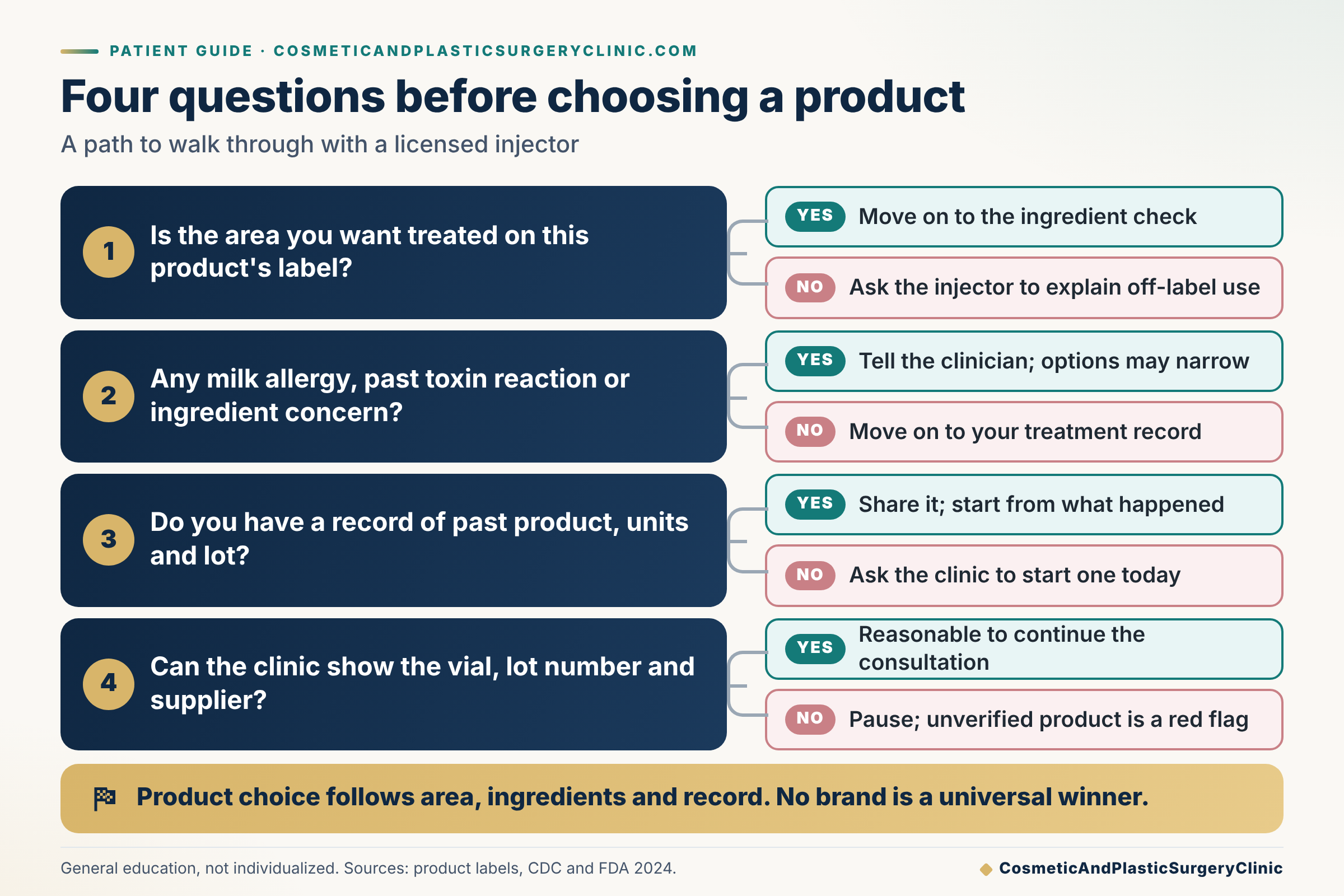
Because no source supports a universal winner in Botox vs Dysport vs Xeomin, scenarios are a more honest frame than a ranking. Each situation below names what tends to matter and what would change the thinking. None is a recommendation for a particular person.
Four situations where the product question changes
Frown lines only, first treatment
For glabellar lines, all six products carry a label, so the Botox vs Dysport vs Xeomin choice rests on factors outside the label: the injector’s experience with that product, its availability at the practice, and the patient’s ingredient concerns. The Dysport indication is limited to adults under 65, a boundary worth knowing but not a personal verdict. Whatever is chosen, note the product and units so the next visit starts from a record.
The fact that could change the plan is anything outside the frown area. If the real concern is the forehead or the outer eye, the label list narrows quickly.
Forehead lines or crow’s feet
Among the six, only Botox Cosmetic and Xeomin carry forehead and lateral canthal lines on their labels. Treating the forehead alone can change brow position, because the frontalis is the muscle that lifts the brow; the label for Botox Cosmetic lists a combined forehead and glabellar total, and Xeomin’s lists a combined maximum, so the areas are planned together. The Botox forehead article covers that balance.
Droop appears in the tables: eyelid ptosis in 2% and brow ptosis in 2% of forehead-line subjects on Botox Cosmetic, and brow ptosis in 0.7% of upper-facial-line subjects on Xeomin. Those come from different trials and are not a comparison. People who already have heavy upper lids may want that conversation first; the blepharoplasty vs brow lift page explains how lid and brow position interact.
A past result that disappointed
When a treatment faded fast or looked uneven, the cause could be dose, placement, muscle strength, handling or the product, and from outside there is no way to tell which. Switching from one of these brands to another is not a documented fix; none of the sources I opened shows that switching improves outcomes. The first useful step is the treatment record, then a conversation with the same or a second qualified injector about what to change.
Antibody-related loss of response is uncommon in the label data: 14 of 916 subjects (1.5%) developed binding antibodies in Botox Cosmetic’s lateral canthal trials and none developed neutralizing antibodies; Dysport’s glabellar trials found none neutralizing in 1,554 tested; Xeomin’s label reports neutralizing antibodies in 9 of 2,649 patients (0.3%, baseline unknown) and 4 more (0.2%) after treatment, with no secondary non-response from them; Letybo found antibodies in 4 of 1,195 (0.3%); Daxxify, 0.8% for the toxin and none neutralizing. Trial populations and assays differ, so these are not rankings.
Allergy, ingredients and sourcing preferences
Ingredient-based reasons are the most concrete reasons a clinician might steer between products. The Dysport label’s cow’s milk protein contraindication is one. A prior hypersensitivity reaction to any botulinum toxin is a contraindication on the Daxxify label. A person who prefers to avoid human-derived albumin may ask whether the Daxxify formulation is an option, while remembering that the Letybo label calls the viral-transmission risk of albumin remote.
These are conversations for a licensed clinician with the person’s full history, not decisions to make from a table.
| Goal or anatomy | Product question | Why it matters | Fact that could reverse it |
|---|---|---|---|
| Frown lines, first treatment | Any of six; injector familiarity leads | All six labels cover glabellar lines | Milk allergy, age 65 or older, or a prior reaction |
| Forehead lines | Botox Cosmetic or Xeomin discussed first | Only these two list forehead lines on the label | Low or heavy brows; plan may shift or wait |
| Crow’s feet | Botox Cosmetic or Xeomin discussed first | Only these two list lateral canthal lines | Dry eyes or eyelid concerns raise caution |
| Wanting fewer visits | Longer-lasting data (Daxxify) may be raised | Median response near 24 weeks in its trials | Longer effect also means slower fade of an unwanted result |
| Disappointing past result | Review the record before changing product | Dose, placement or handling may explain it | Complete lack of response over repeated visits |
| Ingredient or sourcing concern | Ask about albumin and milk protein | Labels list different stabilizers | A clinician’s review of full medical history |
Questions that make the product decision concrete
Five things to ask the injector
Specific questions about Botox vs Dysport vs Xeomin get specific answers. Which product will be used, and why for this area? Is that area on the product’s label, or would it be off-label? How many units and what dilution will be recorded? Can I see the vial and its lot number? What happens if I am unhappy at the follow-up, and is a touch-up included?
The consultation questions article covers the wider visit, and the surgeon verification steps apply to anyone who will hold the syringe. A clinician who answers these plainly, in writing if asked, is giving the same signal as one who explains risks without being pushed.
When “my injector uses one brand” is a reasonable answer
Many practices standardize on one or two of the Botox vs Dysport vs Xeomin options, and that can be a sound reason. Knowing how a product behaves at a given dose in a given muscle is information no label or review supplies, and Cleveland Clinic’s observation that some patients stay with Botox because they know how they respond holds just as well for injectors.
A one-brand answer becomes a concern only when it replaces an explanation, when the area is off-label and nobody says so, or when the clinic cannot show what is in the vial. If a change of product is wanted, a deliberate trial with notes on product, units and result is easier to judge than an unplanned switch.
Source, setting and safety: what holds for every brand in Botox vs Dysport vs Xeomin
Product names matter less than where the product came from and who is injecting it. The safety points below apply whichever brand is on the label.
Counterfeit and unauthorized product
What CDC and FDA reported in 2024
In April 2024 the Food and Drug Administration (FDA) warned that counterfeit Botox had been found in multiple states and given for cosmetic purposes. The Centers for Disease Control and Prevention (CDC) investigation had, as of June 24, 2024, 17 people from 9 states reporting harmful reactions between November 4, 2023 and April 11, 2024. Thirteen (76%) were hospitalized and six (35%) received botulism antitoxin. All were women aged 25 to 67, and 15 received injections for cosmetic reasons.
Early CDC updates said the reactions followed injections from unlicensed or untrained people or in non-healthcare settings such as homes and spas. FDA reported no events linked to FDA-approved Botox. Reported symptoms included blurry or double vision, drooping eyelids, trouble swallowing, slurred speech, trouble breathing and generalized weakness.
Authorized supply and a licensed, trained injector
CDC’s advice is short: get botulinum toxin injections only if the product is obtained from an authorized supplier, and if in doubt, do not get the injection. FDA adds that consumers should ask whether the provider is licensed and trained. For that specific counterfeit, FDA listed a carton reading “Botulinum Toxin Type A” instead of “OnabotulinumtoxinA,” 150-unit doses that the genuine manufacturer does not make, and non-English text.
The ASPS policy statement on administering botulinum toxin (adopted 2002, reaffirmed 2016) says injection is a medical procedure that calls for a qualified physician who understands neuromuscular and facial anatomy. It allows a trained nurse or physician assistant to inject under the physician’s supervision within state rules, and it names private homes, work events and social gatherings as settings that may be inappropriate. State rules on who may inject differ, so see cosmetic surgeon credentials for how titles and training are checked. A price far below the going rate is a reason to ask where the product came from.
Side effects and emergencies across Botox vs Dysport vs Xeomin
Expected effects and what the label tables show
After a Botox vs Dysport vs Xeomin injection visit, bruising, soreness and mild headache are the effects most often described. In glabellar-line trials, headache was reported by 9% of Dysport subjects against 5% on placebo, 6% against 2% for Daxxify, 5% against 2% for Xeomin, 2% against 1% for Letybo and 12% against 13% for Jeuveau. For Botox Cosmetic, headache was 9% against 5% in forehead-line trials.
Eyelid droop (ptosis) was reported in about 2% to 3% of glabellar-line subjects on Botox Cosmetic, Dysport, Daxxify and Jeuveau, and in under 1% on Letybo. The trials differed in size, design and wording, so these figures describe each label, not a ranking. The Botox side effects page sorts expected, uncommon and urgent effects, and plastic surgery risks covers general risk literacy.
Warning signs that need care the same day
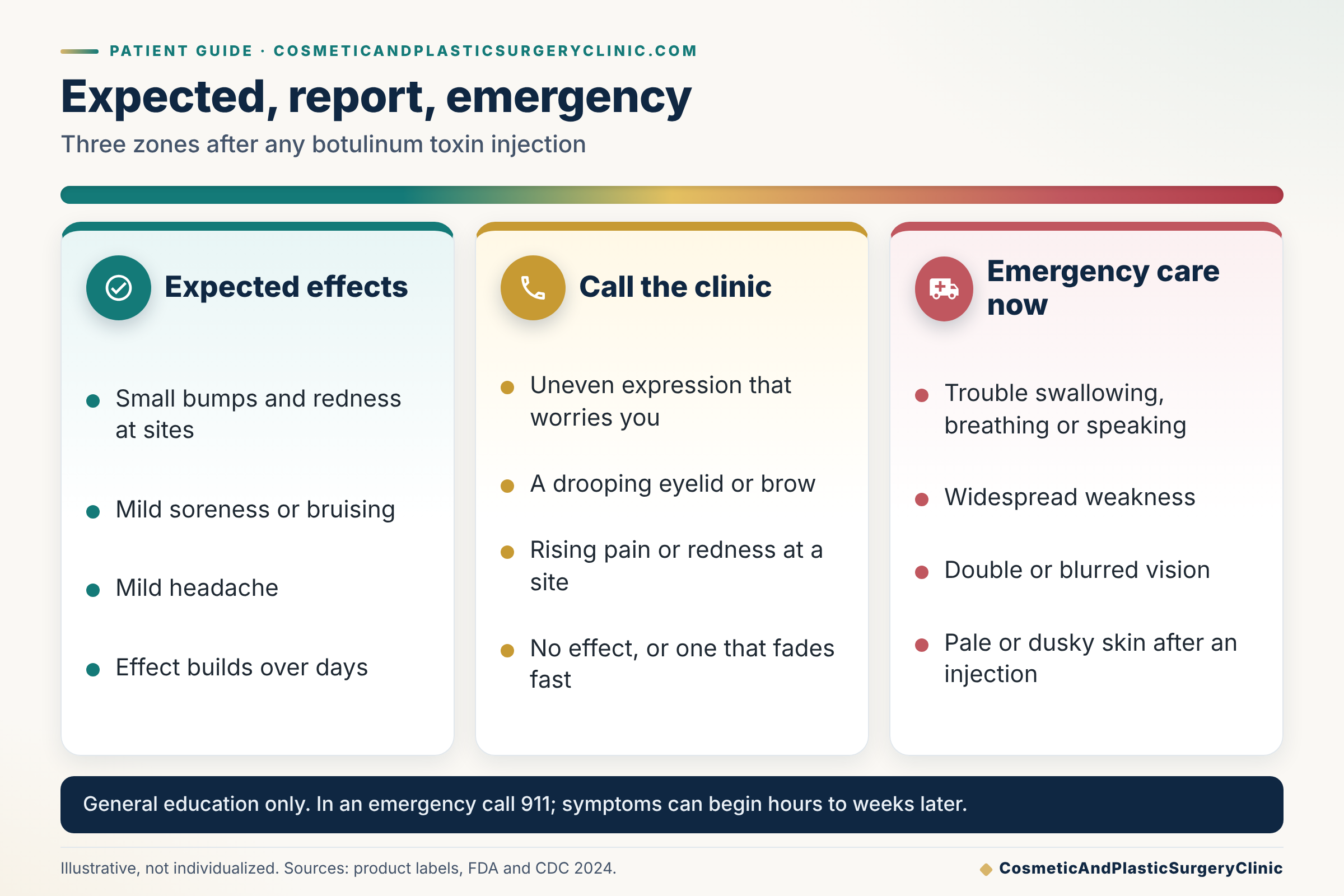
Mild, short-lived effects at the injection site are expected. Anything that is worsening, asymmetric enough to worry you, or still changing after a couple of weeks should go back to the clinic that treated you, and a record of the product and units helps them respond.
Frequently asked questions
Is choosing Botox vs Dysport vs Xeomin mainly about price?
Price is part of it, but unit prices in Botox vs Dysport vs Xeomin quotes cannot be compared because each manufacturer counts units differently; glabellar-line label doses range from 20 to 50 Units. A fair comparison is the total price for a named product and named areas, including any touch-up policy. Cheaper does not mean unsafe, and costlier does not mean better, but a price far below the local norm deserves a question about where the product came from. The cost article for Botox walks through quotes line by line.
Can I switch between Botox vs Dysport vs Xeomin if I am unhappy with a result?
People do switch, but no label gives a conversion, and none of the sources I opened shows that switching improves outcomes. Dose, placement, muscle strength and handling can all explain a poor result, so start with the treatment record and ask the injector what they would change. A clinician choosing a new product has to estimate a starting dose from experience, which is one reason to stay with an injector who knows your history while you decide.
Does a “naked” toxin like Xeomin mean fewer antibodies or allergic reactions?
In Botox vs Dysport vs Xeomin comparisons, Xeomin is the one without complexing proteins, and that is a real formulation difference. Whether it produces a clinical advantage is not established: Cleveland Clinic says it is believed to carry a lower allergic risk but that no comparative studies show fewer side effects, and Samizadeh and De Boulle call for more research on antibody formation. Label antibody figures are low for every product and come from different trials. If you have had a reaction before, tell the clinician rather than choosing on the nickname.
In Botox vs Dysport vs Xeomin vs Daxxify, do Daxxify results really last twice as long?
Daxxify’s median response of about 24 weeks in two placebo-controlled trials is longer than the three to four months stated on Botox Cosmetic’s label. It is not a doubling that has been proven head to head, because trial designs, endpoints and populations differ and no direct comparison turned up. Duration also depends on the area treated and the person. A longer effect means fewer visits but also a slower fade if you dislike a result, so it is a trade-off, not an upgrade.
What do Jeuveau and Letybo add to the Botox vs Dysport vs Xeomin question?
Both are newer, both list glabellar lines only, and both carry the same boxed warning and a three-month minimum re-treatment interval. Jeuveau was approved in 2019 and uses a 900 kDa toxin; Letybo was approved on February 29, 2024. Their labels give day 30 or week 4 results and no duration data. In practice, availability and an injector’s experience often decide which of the six is on offer, so asking what the clinic stocks and why is reasonable.
Is Dysport only for people under 65?
The Dysport label limits its glabellar-line indication to adults under 65. Its trials enrolled people aged 19 to 75 but only eight were 65 or older, and the label notes that none of the older Dysport subjects reached treatment success at day 30. That is a statement about thin trial data, not a finding that older skin cannot respond, and it says nothing about any individual. Age is one more fact to share with the clinician, who can explain how the label applies.
How can I tell whether a clinic is using genuine product?
Whichever of the Botox vs Dysport vs Xeomin products is used, ask to see the vial or carton, the product name and the lot number, and ask which supplier the clinic buys from; authorized suppliers are what CDC and FDA tell providers and consumers to look for. FDA’s 2024 alert showed what one counterfeit looked like: wrong generic wording, 150-unit doses and non-English text. Pressure to book fast, a discount party in a home or office, or a refusal to name the product are red flags. When in doubt, CDC’s advice is not to get the injection.
Is one of Botox vs Dysport vs Xeomin safer than the others?
No source I opened ranks them on safety. All three carry the same boxed warning, and the adverse-reaction tables in their labels come from different trials, so the percentages cannot be lined up. In the 2023 Dysport and Botox comparison, any treatment-emergent adverse event occurred in 46.6% of the Dysport group and 44.9% of the Botox group, and treatment-related events in 15.6% and 12.1%, with eyelid ptosis the most common and no new safety signals reported. Injector skill, product handling and a person’s own history likely matter at least as much as the brand.
Sources and further reading
- DailyMed — BOTOX Cosmetic (onabotulinumtoxinA) prescribing information, revised 10/2024 (accessed 2026-11-12) — indications, boxed warning, units statement, doses, albumin, storage, trial results, antibodies
- DailyMed — DYSPORT (abobotulinumtoxinA) prescribing information, Galderma (accessed 2026-11-12) — glabellar indication under 65, dose, cow’s milk protein, trial results, antibodies
- DailyMed — XEOMIN (incobotulinumtoxinA) prescribing information, Merz Pharmaceuticals (accessed 2026-11-12) — upper facial lines, doses, storage, trial results, antibodies
- DailyMed — JEUVEAU (prabotulinumtoxinA-xvfs) prescribing information (accessed 2026-11-12) — glabellar indication, dose, albumin, trial results, adverse reactions
- DailyMed — DAXXIFY (daxibotulinumtoxinA-lanm) prescribing information (accessed 2026-11-12) — peptide excipient, 72-hour reconstitution, dose, trial results, antibodies
- DailyMed — LETYBO (letibotulinumtoxinA-wlbg) prescribing information (accessed 2026-11-12) — dose, albumin, single-patient use, trial results, antibodies
- FDA — Drug Trials Snapshots: Letybo (accessed 2026-11-12) — approval date, 1,271 participants, demographics, efficacy
- FDA — Drug Trials Snapshot: Daxxify (accessed 2026-11-12) — approval, 609 participants, demographics, week 4 results, age subgroups
- FDA — Novel Drug Approvals for 2022 (accessed 2026-11-12) — Daxxify approval date
- FDA — Jeuveau (BLA 761085) review documents, 2019 (accessed 2026-11-12) — 900 kDa toxin, manufacturer, pivotal trial results
- FDA — Counterfeit Version of Botox Found in Multiple States (April 2024, updated May 2024; accessed 2026-11-12) — carton features, advice for providers and consumers, symptoms
- CDC — Investigation update on harmful reactions linked to counterfeit “Botox” (accessed 2026-11-12) — case counts, hospitalizations, injector settings, advice
- Samizadeh S, De Boulle K — Botulinum neurotoxin formulations: overcoming the confusion, Clinical, Cosmetic and Investigational Dermatology 2018 (accessed 2026-11-12) — complexing proteins, units, conversion ratios, storage
- Wu Y et al. — AbobotulinumtoxinA for glabellar lines in Chinese patients, Aesthetic Plastic Surgery 2023 (accessed 2026-11-12) — Dysport vs Botox noninferiority, onset, retreatment timing
- Nestor M et al. — Onset and duration of abobotulinumtoxinA for upper-face aesthetic use: a systematic literature review, J Clin Aesthet Dermatol 2020 (accessed 2026-11-12) — onset ranges, comparator studies, methods limits, sponsor
- Carruthers JD et al. — DaxibotulinumtoxinA for injection for glabellar lines, Plastic and Reconstructive Surgery 2020 (publication record; accessed 2026-11-12) — SAKURA 1 and 2, median duration
- Plastic Surgery Practice — Xeomin vs Botox study draw (trade-press summary of a 2015 Dermatologic Surgery trial; accessed 2026-11-12) — 250-patient head-to-head, sponsor
- Medthority — European and Canadian phase III study shows DWP-450 non-inferior to onabotulinumtoxinA (Evolus announcement, 2018; accessed 2026-11-12) — EVB-003 results
- Cleveland Clinic — Xeomin vs. Botox, and what to know about both (February 2023; accessed 2026-11-12) — formulation nickname, onset and duration statements, interchangeability
- American Society of Plastic Surgeons — Botulinum toxin (accessed 2026-11-12) — brands listed, mechanism, uses
- ASPS — Plastic Surgery Statistics Report 2025 (accessed 2026-11-12) — six neuromodulator brands listed
- ASPS — Policy statement on administration of botulinum toxin neuromodulators (2002, reaffirmed 2016; accessed 2026-11-12) — who should inject, settings, supervision
- Drugs.com — Botox Cosmetic FDA approval history (accessed 2026-11-12) — approval dates 2002 to 2024
- Drugs.com — Dysport FDA approval history (accessed 2026-11-12) — 2009 approval
- Drugs.com — Xeomin FDA approval history (accessed 2026-11-12) — 2010, 2011 and 2024 approvals
- AbbVie — Botox Cosmetic receives FDA approval for platysma bands (October 18, 2024; accessed 2026-11-12) — fourth aesthetic indication