Search for plastic surgery before and after photos and you will find thousands, nearly all arranged to make one point: this operation works. Some of that is fair. A well-made photograph is the closest a patient can get to seeing a surgeon’s work without sitting in a waiting room. But every picture is also a set of choices someone else made about the angle, the light, the day, the patient and the single frame out of hundreds that got published.
This article treats a gallery the way a careful reader treats any advertisement that happens to contain real evidence: useful, partial and open to cross-examination. It covers how to match a photo to your own situation, which parts of the image to audit, what researchers found when they graded public galleries, what consent and privacy rules do and do not ensure, and how to convert all of it into questions for a consultation.
Whether to have surgery at all is a different decision, covered in the guide to weighing an elective operation. This page is only about plastic surgery before and after photos.
What before and after photos represent, and what they leave out
A pair of before and after photos records one person, one operation, one surgeon’s technique and two moments in time. Each of those four details can differ from your situation, and a caption that says only “tummy tuck” or “rhinoplasty, 3 months” hides most of them.
Matching before and after photos to your own situation
Confirm the exact operation, the starting anatomy and the history behind it
Procedure names cover a lot of ground. A rhinoplasty can mean narrowing the tip, reducing a bump, rebuilding cartilage after an earlier operation, or several of those at once. A breast lift may or may not include an implant. A tummy tuck can differ in how much skin is removed and whether the abdominal wall is tightened. If a caption lists only the headline name, you are comparing your plan with an unknown quantity. Ask the practice for the full procedure list behind each case.
Starting anatomy matters just as much. In its advice on reading breast augmentation galleries (2018), the American Society of Plastic Surgeons (ASPS) tells readers to pay most attention to patients who resemble them in body type and starting breast shape. The principle extends to every procedure: skin quality, prior surgery, weight history, pregnancies and age all shape what a surgeon can do and what the photo can show.
Consider a hypothetical reader who has thin nasal skin and had a rhinoplasty years ago. She browses a gallery of well-lit, carefully photographed first-time operations on thicker skin. The images may be entirely honest and still not answer her question. A useful gallery for her would include revision cases like hers, or the surgeon would say plainly that the gallery doesn’t.
Why a combined operation cannot be compared with a single-procedure plan
Many before and after photos show several procedures done in one session, such as breast, abdomen and liposuction, or a facelift paired with eyelid and neck work. The photo shows the total change in proportion, and you cannot subtract the pieces. If you are considering only one of those steps, ask which part of the visible change came from which step, what the surgeon would separate and why, and whether the combined cases had different anesthesia time or recovery.
The same caution runs the other way. A single-procedure photo set may look modest next to a combined one, yet the smaller plan can be the more sensible fit. For one worked example of how combined-procedure images are best read, see the site’s page on mommy makeover before and after photos.
Reading the clock: when the “after” was taken
Swelling, scars and settling run on different schedules
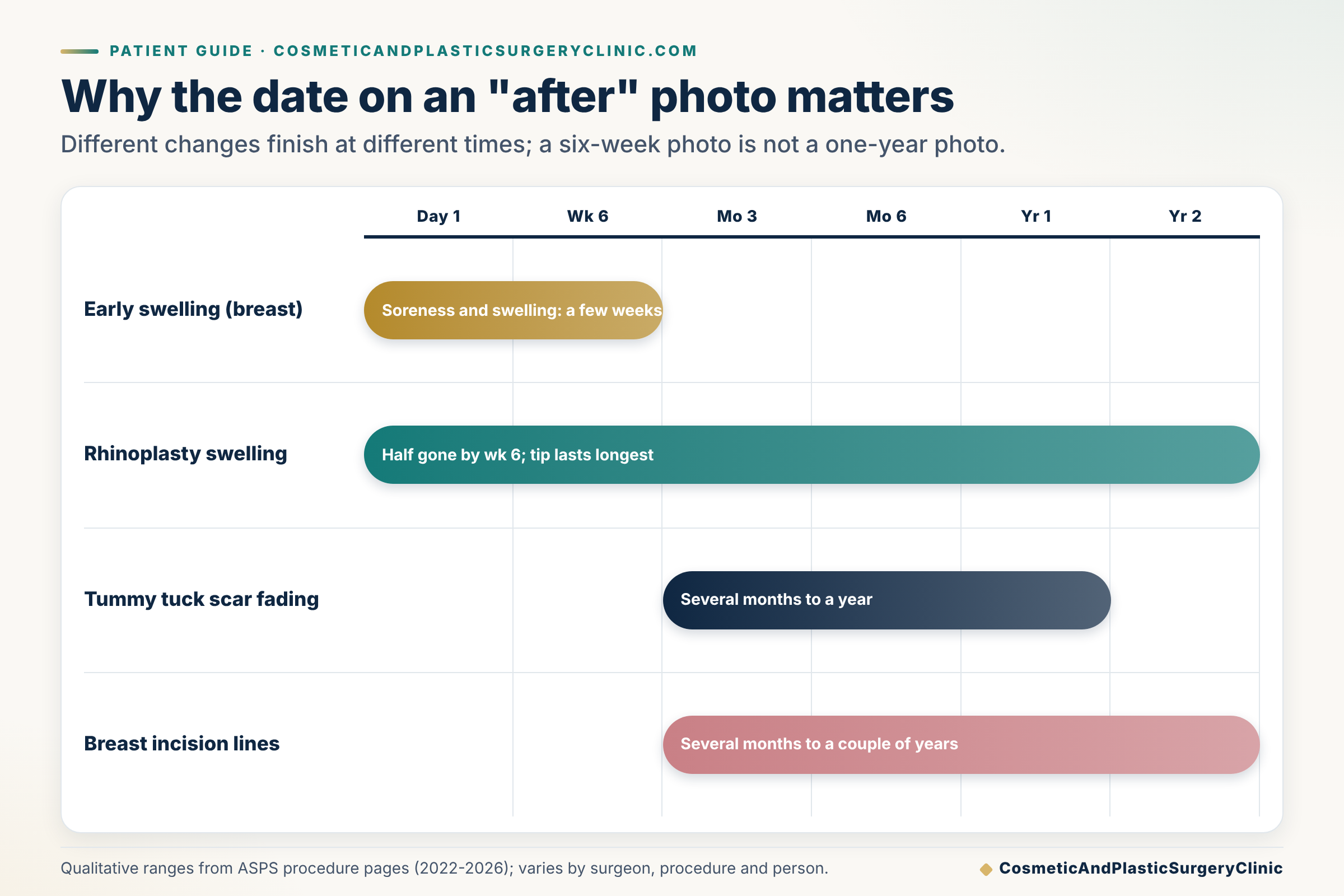
Like all before and after photos, an “after” image has an age, and that age changes what you are looking at. ASPS describes the rhinoplasty timeline this way: about half of the swelling is gone after six weeks, the final result takes about a year and may take two, and the tip of the nose stays swollen longest, particularly after an open approach (ASPS, 2022). A nose photographed at week six is therefore a progress report, not a result. (For what the operation itself involves, see the overview of rhinoplasty.)
Scars follow their own clock. ASPS says a tummy tuck scar “may take several months to a year to fade as much as it will,” and that early results may be obscured by swelling (ASPS tummy tuck results page). For breast augmentation it says final results may take a few weeks while swelling subsides, and incision lines can take several months, even a couple of years, to fade (ASPS breast augmentation results page). Those are population-level descriptions without individual predictions; your own timeline may run shorter or longer.
One practical corollary: a gallery in which no scar is visible a few weeks after an operation that leaves incisions deserves a question. A plastic surgeon quoted by ASPS in 2025 puts it plainly, saying incisions are often visible for a year or two before they fade (ASPS, 2025). The photo may be cropped, edited or taken from an angle that hides the line. Or the practice may simply label timing loosely.
Prefer several dated views over one dramatic pair
“A result at six weeks is different from a result at one year,” one surgeon told ASPS in an October 2026 article on reading photos in the age of AI. The same piece suggests looking at frontal, profile and three-quarter views rather than one flattering angle, and favoring a surgeon whose body of work looks consistent over time.
Public plastic surgery before and after photos often fall short of this. When researchers scored 510 Instagram posts from 102 U.S. physician accounts on nine photo standards, only 16 percent of posts met the standard for timing and 24 percent showed multiple views (Soares and colleagues, Plastic and Reconstructive Surgery Global Open, 2022; more on that study below). Photos taken right after treatment were the most common reason a post scored zero.
What you want instead is a short series of the same patient: an early image, one at a mid-point, and one at or beyond the interval the surgeon says is when the result settles. Ask what the latest follow-up in the gallery is. A one-year image still cannot show year ten, so ask separately how results are expected to age and what maintenance or revision some patients choose later. ASPS notes, for instance, that breast implants are not considered lifetime devices and may need to be replaced.
Is the camera telling the same story twice in before and after photos?
ASPS points out that there is no industry-wide standard for taking these photos, so differences in background, clothing and makeup are common and not always deliberate (ASPS, 2024). The working ideal comes from clinical documentation: the same standard views, the same setup, every visit. Plastic surgeon Lara Devgan states the principle concisely in the 2026 ASPS article: a photograph “should document, not perform.”
How the camera shapes plastic surgery before and after photos
Compare distance, angle, posture, lighting, clothing, expression and makeup
Open a pair of before and after photos at the same size and flip between them. Start with things surgery cannot change: the spacing of the ears or shoulders, the position of the background, a mole, a tattoo, the edge of a doorframe. If those shift, the camera or the patient moved, and part of the apparent change is geometry rather than anatomy.
Then walk through the variables in the table below. The 2026 ASPS article lists posture, chin position, neck extension, body rotation, lighting and expression among the factors that can make an “after” look better without any surgical difference. Treat the exercise as a set of questions, not a pass-fail test. Even careful practices vary a little from visit to visit, and one mismatch is a question. Several mismatches in the same direction are an answer.
How each variable can exaggerate or hide change
| Variable | How it can change appearance | What to compare | Question for the practice |
|---|---|---|---|
| Camera distance and lens | Close shots enlarge whatever is nearest the lens; longer distances flatten features | Frame size, apparent head or torso width, perspective of the background | Were both taken from the same marked distance with the same lens? |
| Camera height and angle | A slightly lower or higher view can lengthen or shorten a nose, jawline or torso | Ear, shoulder or hip position within the frame; horizon line | Is each view shot at a fixed height and angle? |
| Posture and body position | Raised arms, a lifted chin, a straighter back or a rotated hip reshape contours | Chin level, shoulder height, arm position, which leg bears weight | Do patients get the same pose instructions every time? |
| Lighting direction and brightness | Steep or side light deepens folds and shadows; soft frontal light smooths them | Shadow direction under the chin, nose or breasts; overall skin brightness | Is the same light setup used at every visit? |
| Facial expression | A smile lifts the cheeks and changes the jowl line; a frown does the reverse | Mouth, brow and cheek position in every view | Are patients asked to hold a neutral expression? |
| Clothing, makeup, hair, tan | Fitted attire, makeup, a new haircut or a tan can mask or highlight areas | Gown or underwear, tan lines, hair, jewelry, overall skin tone | Are “after” sessions dressed and styled like “before” sessions? |
Posture is the quiet one in before and after photos. ASPS quotes a surgeon observing that “everybody looks better with their arms up,” which means an arms-raised “after” next to an arms-down “before” can overstate a change. Styling works the same way. Another surgeon quoted by ASPS in 2025 describes “before” photos with poor light, a hospital gown and an unhappy expression paired with “after” photos that have makeup, nice clothing and a professional shoot.
None of this requires bad intent. A patient who feels good at the six-month visit may dress up and smile on her own. The effect on the picture is the same, which is why a practice with a fixed photo station and a written pose script is easier to trust than one that photographs wherever there is space.
What researchers found when they measured the quality of before and after photos
An audit of public galleries
Two research teams have graded public plastic surgery before and after photos. Soares, von Haven and Yi searched Instagram in early 2022 and took the five most recent eligible posts from each of 102 U.S. MD or DO accounts offering facial cosmetic procedures. They scored the resulting 510 posts, containing 2,020 clinical photos, with a nine-item tool they call SEPIA: subject positioning, facial expression, lighting, background, zoom, makeup and jewelry, multiple views, timing and procedure description.
Selfies, digital filters, mismatched comparisons and photos taken immediately after treatment counted as major violations (Plastic and Reconstructive Surgery Global Open, 2022).
The average score was 4 out of 9. About 35 percent of posts (179 of 510) scored zero, and 27 percent were rated high quality. More than 95 percent of practitioners gave no disclaimer about substandard photos. Rhinoplasty and lip filler posts had the most low-quality images. Scores did not track follower counts or likes in a statistically meaningful way, so popularity is no proxy for quality. The limits are real: one platform, facial procedures only, scoring by the study authors, and only moderate agreement between scorers. SEPIA is a research instrument, not an official standard.
A separate team, Vaca and colleagues, examined top posts under 19 facial-surgery hashtags in May 2020 (Aesthetic Surgery Journal, 2021, abstract). By their scoring, 282 of the 291 posts analyzed had photographic conditions that favored a better-looking postoperative result, and accounts with more followers had higher bias scores. That link is correlational. It does not show that biased photos cause growth, only that the two went together. Neither study tells you how the before and after photos on a particular surgeon’s own website compare, but together they show how wide the range is.

Lighting and expression under controlled conditions
Controlled experiments show how little it takes. Hernandez and colleagues photographed 51 patients at three light angles (0, 30 and 60 degrees) with the camera, lens and exposure held constant, then had 27 blinded raters score the images. At 60 degrees raters judged the same faces less attractive and the nasolabial folds more severe than at 0 degrees, and estimated body mass index category rose at both 30 and 60 degrees. Perceived age did not change significantly (Aesthetic Plastic Surgery, 2021).
The authors flag low reliability for some of the regional ratings, so the exact numbers matter less than the direction.
Expression has measurable effects as well. A 2019 study in Plastic and Reconstructive Surgery using 3D images of 20 people found that smiling raised average mid-cheek volume by 13.4 mL and lowered jowl volume by 1.2 mL, while frowning raised jowl volume by 3.3 mL (as summarized by Dermatology Times; the full paper was not reviewed for this article). A face can change shape within a second, with no surgeon involved.
When your own consultation photos are taken, notice the setup. A marked spot on the floor, a fixed light and a neutral-expression instruction are small signs that the practice takes comparability seriously.
Retouching, selection and consent: what before and after photos cannot show
Editing, generated images and selective galleries
Retouching, warping and generated images
Editing runs from mild to invented: skin smoothing, contour warping in a face-editing app, a morphing tool that blends a “before” toward a target look, or an image generated from scratch. ASPS articles from 2025 and 2026 list possible tells: unnatural skin texture, warped backgrounds, inconsistent shadows, wavy lines or pixelation near the face or body, proportions that look too good, and physics errors such as an earring that doesn’t hang.
A 2026 study by Olabiran, Kim and Rohrich tried to put a number on the problem. Running an AI authenticity model over the first 600 consecutive postoperative rhinoplasty photos in a public RealSelf gallery (October 2025), they estimated that 19.5 percent (117 of 600) showed suspicious edits in the nose area. The false-positive rate on 200 presumed-unedited clinical photos was 1.5 percent, and the model caught all 50 images deliberately warped with one editing app (abstract via CiteDrive).
Read that figure with care. It covers one platform, one procedure and one editing app in validation, and the “unedited” controls were presumed rather than proven. It estimates suspicious images, not misconduct by whoever posted them.
Spotting edited before and after photos by eye is a weak defense. Devgan cautions against relying on visual cues alone, and another surgeon quoted by ASPS in 2025 expects AI images to become hard to distinguish from real ones within about a year. Provenance works better than detection. Ask who took the photo, where and on what date, and whether anything beyond cropping and color balance was changed. Look for the same patient across several images. If the practice offers a past patient who has agreed to talk with you, take the offer.
Mirroring, duplicates and cherry-picking
In a gallery of before and after photos, a mirrored image can make one result look like two cases. The check takes ten seconds: find a fixed mark such as a mole, tattoo, birthmark or scar, and see whether it appears on the opposite side in another image of the gallery. A cropped copy under a new file name does the same. Duplicates prove nothing alone, but they shrink a gallery’s true size, and a true size of eight cases is a different thing from forty.
Selection is the larger problem with plastic surgery before and after photos. “Everyone, of course, puts their best before and after pictures forward,” ASPS observes, and it advises asking whether the photos are representative of typical outcomes.
Consent adds a second filter, because it is reasonable to assume that patients who are unhappy with a result seldom agree to publish it. So ask how the gallery is built. Is it every case of this procedure in a given period, or the cases the surgeon likes best? Are there results the practice would not post? A candid answer is informative either way.
Consent, privacy and money behind the picture
Written consent, HIPAA and what a recognizable photo requires
Plastic surgery before and after photos begin as clinical photographs, and clinical photographs are health information. The federal HIPAA de-identification standard lists “full-face photographs and any comparable images” among identifiers (HHS), and HHS’s marketing guidance says a covered entity generally needs written authorization before using protected health information for marketing, with narrow exceptions such as face-to-face communication and gifts of nominal value.
The marketing page does not mention photographs by name, so applying it to a gallery image combines the two rules. Most practices read them that way, but this is general information, not legal advice, and state law may add requirements.
A cropped face does not settle the question either; a distinctive tattoo or scar can identify a person too.
The regulation describes what an authorization must contain: an expiration date or event, the individual’s signature and date, and notice of the right to revoke in writing. Revoking does not undo uses the practice has already made in reliance on the authorization (45 CFR 164.508).
In practice, a printed brochure cannot be recalled. For your own decision, ask what the consent form covers (website, social media, print, advertising; face, body or both), whether it expires, how a patient withdraws, and what happens to images already published. Ask the same about your own consultation photos: where they are stored, who sees them, and whether permission to use them in marketing is separate from, and optional alongside, the consent for treatment.
Material connections: discounts, paid models and testimonials
The Federal Trade Commission’s endorsement guidance says an endorsement must reflect the endorser’s honest opinion, and that a paid endorser, or one given something of value, has a connection that should be disclosed clearly and conspicuously. For free or discounted services the disclosure belongs wherever the endorsement appears (FTC, Endorsement Guides Q&A; the Guides were revised in 2023).
A patient who received a reduced fee in exchange for sharing before and after photos is such an endorser, and a gallery that never mentions the arrangement has left out something relevant. A discount tied to photo rights also changes what the quoted fee represents, so compare quotes like for like using the breakdown of surgical cost components.
FTC guidance written for health products adds that testimonials reporting more dramatic results than users can generally expect are likely to be deceptive, and that a statement like “results not typical” does not cure the problem (FTC, December 2022). That text is about health products, not a ruling on any plastic surgery practice, but the logic transfers to readers: a small “results vary” caption does not turn an exceptional result into a typical one. Ask directly what most patients with your anatomy can expect.
The agency also finalized a rule in August 2024 against fake reviews and testimonials, including those produced with artificial intelligence, as well as reviews and testimonials by a company’s own officers, managers, employees or agents that do not clearly disclose the connection (FTC press release, August 14, 2024). A staff member posing as a patient is the textbook example. If testimonials sit beside a gallery, they deserve the same scrutiny as the pictures.
Turning before and after photos into questions instead of a forecast
Judge the range, not the standout
Count comparable plastic surgery before and after photos, then look for ordinary results
Count how many of the plastic surgery before and after photos in a gallery show cases that resemble you in the ways that matter: procedure, starting anatomy, age range, history. A gallery of sixty abdominal cases that contains five like yours gives you five cases to study, not sixty. Consider a hypothetical reader who finds that all five were photographed at different time points and two lack side views. Her evidence base is now closer to three usable cases, and she knows exactly what to ask for.
Then look at the spread. Real practices treat varied bodies, and varied bodies produce varied outcomes: some strong, some modest, some that needed a second step. ASPS’s advice on breast augmentation galleries warns that results that all look the same may mean the surgeon cannot tailor the approach, and notes that nude photos, which most such galleries include, show whether incisions sit where clothing can conceal them. Uniformity can also come from selection or editing. Which one it is makes a fair question.
| Evidence element | Stronger sign | Weaker sign | Interpretation limit |
|---|---|---|---|
| Case similarity | Starting anatomy, age range and history resemble yours | Only the headline procedure is named | Even close matches differ in tissue quality and healing |
| Time point | Dated series from early weeks to a year or more | One undated image, or a photo taken days after surgery | A single date cannot show how a result ages |
| Procedure list | Every component stated, including combined steps | “Face rejuvenation” or “tummy tuck” with no detail | Your plan may differ in technique or scope |
| Edits and consent | No edits beyond crop and color; documented authorization; connections disclosed | Visible smoothing or warping; discount or paid model not mentioned | Cannot be verified from the image alone; ask in writing |
| Revision disclosure | Policy explained; some touch-up cases shown and discussed | No imperfect or revised cases in a large gallery | Policy wording varies; read it before you pay |
| Range of cases | Many cases, varied bodies and varied outcomes | Few cases, all strikingly alike | A gallery is a sample chosen by the practice |
Ask about revisions and slow-healing cases
No surgeon’s results are uniform, so a large gallery without a single modest or revised case is information in itself. Ask what share of patients having this procedure go on to a revision, how the practice defines one, and what the written revision policy says about surgeon fees, facility fees and anesthesia. Don’t expect a precise number on the spot. Published revision rates vary by procedure, definition and study population, and any figure you are offered should name its source.
A surgeon who can show a case that needed a touch-up and explain what happened is giving you more than one who shows only clean outcomes.
Ask about slower healing as well: what the practice does when a wound heals late, who answers after hours, and how follow-up visits are scheduled. The page on surgical risks explains how complications differ from expected effects.
A related warning matters after surgery rather than before it. Swelling, bruising and some asymmetry are expected in early recovery, and a gallery’s polished month-three photo is not your yardstick. Your yardstick is the written list your surgeon gives you of what to report. Chest pain, sudden shortness of breath or fainting call for 911 or emergency care, not a message to the office. For the logistics of those first weeks, see planning your recovery.
Using pictures in the consultation room
Choose a few cases and ask what drove each result
Before the visit, pick three or four cases from the before and after photos: the closest match to your anatomy, one with a modest result and, if the practice shows them, one revision. Ask the surgeon to walk through each. What was planned, which technique was used, what limited the result, and how long was the follow-up? Surgeons use photographs to document anatomy and to track their own outcomes, as ASPS notes, so a thoughtful one can discuss a case in detail rather than point at the image.
The conversation also shows you a surgeon’s aesthetic. Devgan told ASPS that photos reveal a surgeon’s aesthetic and consistency, and that is worth noticing if you prefer a subtle change and every case in the gallery looks dramatic. Keep notes, and bring them to the next consultation if you get a second opinion. The wider checklist is in the guide to consultation questions.
Handle inspiration photos and filtered images carefully
Bringing a picture of a result you like is common and useful, provided it is a real result. A surgeon quoted by ASPS in 2025 notes that patients who bring filtered images or edited contours may hold expectations that no surgeon can meet. Ask whether your reference is an actual postoperative photo, whose anatomy it shows and how that anatomy differs from yours.
Describe what you like in words as well: a straighter profile, a smaller but proportionate breast, a flatter abdomen without a visible high scar. “Make me look like this” gives the surgeon a target that may not exist. If a surgeon tells you something in your reference is unlikely for your anatomy, that is useful candor, not rejection. A second opinion is reasonable, and so is deciding to wait.
Where before and after photos fit among the other safety checks
Verification that no gallery can replace
Check the surgeon and the facility independently of the gallery
A gallery of before and after photos shows what a practice chose to publish. It does not verify the surgeon’s training, the license or the operating facility. The American Board of Plastic Surgery (ABPS) runs a public lookup and describes itself as the primary source for the records on it.
Its public page also states that certification is a voluntary credential, that an active, unrestricted license is required for it, and that a physician may be certified by a different board (ABPS, public verification page). So a certification badge in a photo caption is a claim to check, not a fact to accept.
ASPS suggests that before and after photos from an ASPS member’s practice website carry more weight than heavily filtered social posts. That is a reasonable rule of thumb, though membership, board certification, state license and facility accreditation are four separate checks. The step-by-step lookup is in the guide on verifying a plastic surgeon. Galleries from clinics in other countries add another question, namely who treats a complication after you fly home, which the page on medical tourism takes up.
How much weight each kind of photo source deserves
| Where you see it | Typical blind spot | Verification step | Weight to give it |
|---|---|---|---|
| Social-media post or hashtag | Filters, selfies and same-day photos; engagement can reward polish | Open the account; confirm who performed the work and their credentials | Low: a pointer to a practice, not evidence |
| Review-platform gallery | Mixed standards; one 2026 sample of rhinoplasty photos found suspicious edits | Cross-check against the surgeon’s own site and license record | Low to moderate |
| Practice website gallery | Selected by the practice; consent and editing policy often unstated | Ask how cases are chosen, dated and edited; look for full series | Moderate if dated series are shown |
| Binder or tablet at the consultation | Best cases first; time point sometimes unlabeled | Ask for similar anatomy, revision cases and dates | Moderate; best used for discussion |
| Past patient arranged by the practice | Self-selected and willing; privacy limits what can be shared | Ask about timing since surgery and what they would do differently | One person’s experience, valuable but narrow |
The weights are editorial judgment, not measured values. Even the strongest gallery answers one question only: what do this surgeon’s healed, consenting patients look like? It says nothing about who gives the anesthesia, how the facility is accredited, how patients are selected, or what happens when something goes wrong. People who had a difficult recovery are also less likely to appear in the gallery at all. Strong plastic surgery before and after photos can earn a consultation. They should not shorten the other checks.
A photo-review worksheet to carry into the consultation
Score each gallery on seven lines before you book
- Write the procedure list and your own starting-anatomy notes at the top of the page.
- For each gallery, count the cases that resemble yours and note the date of every “after.”
- Run the side-by-side check from the first table on two or three of them: background, fixed marks, pose, light, expression, styling.
- Record whether you saw several views, and whether any revision or modest-result cases are shown.
- List what you cannot verify: edits, consent, any connection between the patient and the practice, how the gallery was assembled.
- Check the surgeon’s certification, license and facility on independent sites.
- Turn each gap into one question and bring the page to the visit.

Deciding what the answers mean: proceed, pause or look elsewhere
If the answers are clear and the gaps are small, a consultation is a sensible next step. If gaps remain, put the questions in writing and see whether the practice answers plainly. If a practice resists simple questions about dates, edits or consent, that response is data about how it will handle harder questions later. Pausing, choosing another practice, or deciding against surgery are all legitimate outcomes, and no photo should create urgency.
For procedure-specific examples of what to look for, the site’s pages on breast lift before and after photos and, for a nonsurgical comparison with a much shorter timeline, dermal filler before and after photos go deeper on individual operations.
Frequently asked questions
What should I check on a consent form for before and after photos before I sign?
Look at where images may appear (website, social media, print, advertising), whether your face would be shown, whether permission expires, and how you can withdraw it. Under the federal rule, a valid authorization includes an expiration date or event and notice of the right to revoke in writing, but revoking does not recall images already used. Ask whether you receive any discount or payment, and whether photo permission is optional and separate from your treatment consent. Request a copy. This is general information, not legal advice; for a specific form, a qualified attorney can read it with you.
How many before and after photos should a surgeon be able to show for my procedure?
The sources reviewed for this article give no verified minimum number, and ASPS speaks of a credible body of work rather than a number. What matters is how many cases resemble yours, not the total. Ask for cases with your starting anatomy at several time points. If the practice has few examples of your specific operation, ask how often the surgeon performs it and what training supports it. A small gallery can be honest, but then the other checks, including credentials and facility, carry more of the load.
Why might my own result look different from before and after photos at the same time point?
ASPS notes that age, skin type, health and aftercare all affect results, so one person’s photos may not predict yours. Swelling speed, the exact technique and plan, and how the photo was taken also differ. If you are worried at a follow-up visit, say so to your surgeon instead of waiting for a gallery milestone, and ask what is expected at your stage of healing. The gallery shows a few outcomes. It does not define a normal range for your recovery.
Is a photo taken in the operating room right after surgery a problem?
Surgeons commonly take immediate photographs for the medical record, and that is ordinary documentation. The concern arises when such an image is shown in advertising as a result. Early images carry swelling and bruising and can show a shape the body will not keep. The 2022 Instagram audit counted photos taken immediately after treatment as a major violation, and they accounted for most of the zero scores. If an “after” photo looks very recent, ask for its date and for later images of the same patient.
Can I speak with a past patient?
ASPS lists talking to past patients as one way to research a surgeon. Some practices arrange references with the patient’s agreement, though privacy rules and personal choice limit what is shared, and a practice may reasonably decline. Treat a reference as one self-selected person’s experience. Useful questions are how long ago the surgery was, what recovery was like compared with expectations, and how responsive the office was. Do not try to contact people you find through a gallery unless they have invited contact.
Should I take my own before photos?
Many practices take clinical photos at the consultation. Taking your own neutral images is a reasonable way to compare later: same spot, same light, same distance, same pose, with the date noted. Use a tripod or a helper rather than an arm’s-length selfie, since short distances distort proportions. Store the files privately and think twice before posting them. Your pictures do not replace the practice’s clinical record or any instruction from your surgeon, and they are for your reference, not for judging whether healing is on track.
Are before and after photos with no visible scars a red flag?
It depends on the procedure and the time point. One surgeon quoted by ASPS says incisions are often visible for a year or two, and ASPS says a tummy tuck scar may take several months to a year to fade as much as it will. A scar-free image could be cropped, angled, edited or taken long after the operation, or the incision may sit somewhere hidden. Ask where the incisions are placed, and ask to see that area in photos from several dates.
Sources and further reading
- ASPS — Can you trust that transformation? Reading before and after photos in the age of AI (October 13, 2026; accessed 2026-11-12) — standard views, posture and lighting effects, timing, body of work
- ASPS — What is reality? Determining if a before and after is too good to be true (March 11, 2025; accessed 2026-11-12) — editing tells, scar timing, mismatched styling, filtered references
- ASPS — Can you trust before and after photos? (March 1, 2024; accessed 2026-11-12) — best-case selection, posture, lack of an industry standard, patient variation
- ASPS — What to look for in breast augmentation before and after photos (November 20, 2018; accessed 2026-11-12) — matching starting anatomy, uniform results, scar placement
- ASPS — What to expect from your rhinoplasty recovery (February 23, 2022; accessed 2026-11-12) — swelling and final-result timeline
- ASPS — Tummy tuck results (accessed 2026-11-12) — swelling obscuring early results, scar fading
- ASPS — Breast augmentation results (accessed 2026-11-12) — settling time, incision lines, implants not lifetime devices
- Soares, von Haven and Yi — #TheUglyTruth? A qualitative evaluation of outcomes photography on Instagram: introducing the SEPIA scoring system, Plast Reconstr Surg Glob Open (2022; accessed 2026-11-12) — audit of 510 posts
- Vaca et al. — Photographic misrepresentation in Instagram before-and-after posts, Aesthet Surg J (2021; abstract, accessed 2026-11-12) — bias scoring of 291 posts
- Hernandez et al. — The influence of different light angles during standardized patient photographic assessment, Aesthetic Plast Surg (2021; accessed 2026-11-12) — lighting experiment
- Dermatology Times — Facial expressions affect photo comparability (report on a 2019 Plast Reconstr Surg study; accessed 2026-11-12) — expression and facial volume
- ScienceDaily — summary of Ward et al., Nasal distortion in short-distance photographs: the selfie effect, JAMA Facial Plast Surg (2018; accessed 2026-11-12) — camera-distance fact
- Olabiran, Kim and Rohrich — Detecting manipulated online rhinoplasty images using an AI facial authenticity localization model (2026; abstract, accessed 2026-11-12) — estimated editing prevalence
- HHS — Guidance regarding methods for de-identification of protected health information (accessed 2026-11-12) — full-face photographs as identifiers
- HHS — Marketing under the HIPAA Privacy Rule (accessed 2026-11-12) — authorization for marketing uses
- Legal Information Institute — 45 CFR 164.508, uses and disclosures for which an authorization is required (accessed 2026-11-12) — authorization elements and revocation
- FTC — The FTC’s Endorsement Guides: What people are asking (accessed 2026-11-12) — honest opinion and material-connection disclosure
- FTC — Health Products Compliance Guidance (December 2022; accessed 2026-11-12) — testimonials and “results not typical”
- FTC — Final rule banning fake reviews and testimonials (August 14, 2024; accessed 2026-11-12) — fake and insider testimonials
- American Board of Plastic Surgery — Is your surgeon certified? (accessed 2026-11-12) — public verification and credential notes