Neck tightening vs neck lift is a comparison between two different ideas of what is wrong with an aging neck. Nonsurgical neck tightening works without cutting: it relaxes bands with injections, dissolves small pockets of fat, heats skin to prompt collagen, or places a few absorbable threads. A neck lift is an operation that can remove fat, tighten or repair the platysma muscle and redrape skin, usually through small incisions under the chin and around the ears. Both are sold as a “lift,” which hides how differently they work.
Interest in the operation is climbing. The American Society of Plastic Surgeons (ASPS) reported that neck lift volume rose 21 percent in 2025 compared with the previous year, while neuromodulators and fillers made up 80 percent of minimally invasive procedures. Those are national volume figures. They say nothing about where a particular neck falls in the neck tightening vs neck lift decision.
This article handles one decision within neck tightening vs neck lift: whether nonsurgical neck tightening is enough for the problem you actually have, or whether the evidence points toward surgery. It does not re-teach the operation, which is mapped in the neck lift guide, or repeat the broader filler-and-device tour in facelift alternatives. It adds what those pages leave out: what studies measured in the neck itself, how long they followed people, and where the evidence stops.
Neck tightening vs neck lift begins with the layer that changed
A neck is not one tissue. Skin, fat, muscle, glands and bone each age on their own schedule, and each responds to different tools. Sorting a neck tightening vs neck lift question by layer is the fastest way to see why one person is well served by an injection and another is not.
Four layers, four different complaints
Skin: the crepey drape and the pinch test
Neck skin differs from facial skin. A 2026 review in the Journal of Clinical and Aesthetic Dermatology notes a thinner dermis and fewer sebaceous glands in the neck, with sun exposure adding laxity, texture change and fine lines. Skin complaints look like crepey texture, horizontal lines and a drape that folds when you look down.
A gentle pinch under the chin in a mirror gives a rough sense of how much loose skin there is. It is not a diagnosis; a surgeon assesses the skin with the head in several positions and at rest versus in motion.
Fat: fullness that sits above or below the muscle
Submental fat is the soft fullness under the chin. The same 2026 review says it is interwoven with the platysmal bands, which is one reason fullness is not always only fat. A layered description of the neck by Weinstein and Nahai (Plastic and Aesthetic Research, 2021) separates superficial fat, directly under the skin, from interplatysmal fat and fat beneath the muscle.
Injections and heat or cold devices aim at the superficial pad. Fat below the muscle is reached surgically, so a treatment aimed at the visible pad can leave deeper fullness untouched.
Platysma and the deep layer: bands, glands and the hyoid
The platysma is a thin sheet of muscle running from the jaw down over the neck. When it separates at the midline or tightens into cords, vertical bands appear. Deeper lie the digastric muscles and the submandibular glands, and the position of the hyoid bone and the projection of the chin help set the angle between chin and neck.
Weinstein and Nahai describe a surgical step for each of these layers, from plication of the platysma to partial resection of an enlarged gland. No device or injection discussed later does that work.

What each treatment actually does to tissue
Relax, dissolve, heat, suspend and resurface
Nonsurgical neck tightening is a family of different actions. Toxin relaxes a muscle. Deoxycholic acid dissolves fat cells. Ultrasound, radiofrequency and plasma devices heat tissue to prompt tightening over weeks. Threads suspend a small amount of tissue on dissolvable sutures. Lasers and microneedling wound the skin surface so it remodels.
Each verb matches one layer from the previous section. In any neck tightening vs neck lift conversation, when a clinic bundles several into a “non-surgical neck lift,” ask which action is aimed at which layer of your neck, and which layer is left alone.
Reposition, remove and secure
A neck lift uses different verbs: remove fat, tighten or divide the platysma, excise skin and secure the result with sutures. ASPS says a neck lift does not change fundamental appearance and cannot stop aging, yet it also says the operation can only be performed surgically and that nonsurgical rejuvenation cannot achieve the same results.
The operation is itself a menu of techniques, covered in neck lift techniques. What matters in neck tightening vs neck lift is the gap between stimulating tissue to tighten and physically repositioning it.
| Situation | Pathway to discuss | Benefit | Trade-off | Key question |
|---|---|---|---|---|
| Crepey texture, fine lines, mild skin looseness | Resurfacing, microneedling, ultrasound or radiofrequency | No incision; short downtime | Modest change; repeat sessions | What measured change did similar people show? |
| Bands that show only when talking or clenching | Platysma toxin injections | Approved indication since 2024 | Wears off; swallowing warning | What is the plan if swallowing is affected? |
| Small fat pad under the chin, skin snaps back | Deoxycholic acid, or liposuction | Targets fat directly | Swelling, numbness, nerve risk | What if the skin stays loose afterward? |
| Bands at rest, folded skin, lost jaw edge | Neck lift, sometimes with a lower facelift | Addresses muscle, fat and skin together | Incisions; surgical recovery and risk | Which techniques fit my anatomy? |
| Mild laxity, strong wish to avoid surgery | Absorbable threads, mild cases only | Subtle lift, brief recovery | Short follow-up; dimpling, swelling | How long do these threads last in your practice? |
| Neck changed after major weight loss | Surgical assessment first | Reaches skin excess devices cannot | Scars; timing matters | Should weight settle before any plan? |
| Recent change, unclear goal, distress about one feature | Waiting, second opinion | Keeps every option open | Aging continues meanwhile | What would change my mind? |
What studies show about nonsurgical neck tightening vs neck lift outcomes
Three questions cut through most neck tightening vs neck lift claims. What was measured? How long were people followed? Was there a comparison group? Keep them in mind through the evidence below, because the honest answer to the third is often “no.”
Energy devices: ultrasound, radiofrequency and helium plasma
Microfocused ultrasound and the 33 percent figure
Microfocused ultrasound with visualization is cleared by the U.S. Food and Drug Administration (FDA) as a non-invasive treatment to lift the eyebrow, lift lax tissue beneath the chin and in the neck, and improve décolleté lines. The clearance letters opened for this article date from 2014 and 2018. A clearance describes intended use. It does not state how large or how durable the change is, or that it matches surgery.
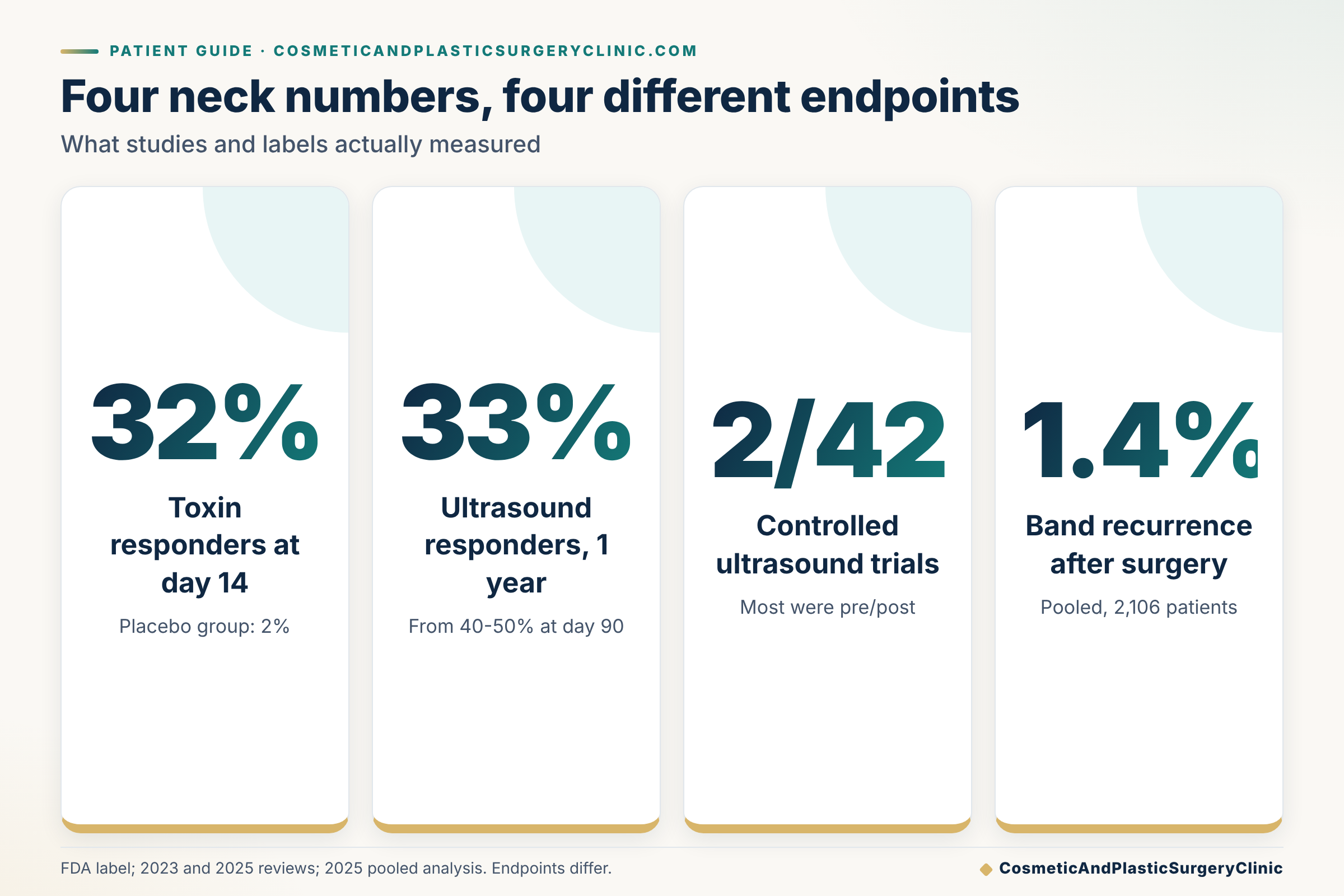
Measured results are modest. A 2023 systematic review in the International Journal of Environmental Research and Public Health (16 studies, mostly facial) reports one study of 78 patients with an average submental area reduction of about 45 square millimeters at three months, with lift in 71.8 percent. Another study found 40 to 50 percent of patients reached at least a 20 square millimeter improvement at day 90, falling to 33 percent at one year. A third, using a different device in 43 patients, found improvement in only nine people, all with slight sagging.
The 2023 review adds that benefit declined with greater laxity and higher body mass index, and that most patients were adult women, so data for men are lacking. Less common effects, in about 2 percent of 573 patients, included two skin burns under the jaw and two cases of neck striations.
A 2025 meta-analysis in Aesthetic Surgery Journal (42 studies) found that only 2 were controlled trials, 31 were before-and-after designs, and about 80 percent followed patients for six months or less. Its three neck-only studies covered 102 patients with a median follow-up of 180 days. It reported no serious adverse events, with redness, swelling, bruising and tenderness the usual effects. A device maker funded it, and the authors detected publication bias.
Radiofrequency and subdermal helium plasma
A 2022 systematic review in Lasers in Surgery and Medicine covered 121 studies of radiofrequency on the face and neck. Its abstract concludes that radiofrequency improved laxity, elasticity and skin appearance, that patients wanting modest rejuvenation were more satisfied, and that the only serious adverse event reported was a neck fistula in one patient. It does not report how study quality was graded, and face and neck results are pooled, so neck-specific size and durability remain unclear.
Helium plasma delivered beneath the skin blurs the neck tightening vs neck lift boundary, sitting between nonsurgical and surgical care. A prospective, evaluator-blinded, single-arm trial in Aesthetic Surgery Journal (2023) found 82.5 percent (52 of 63) of patients judged improved by blinded photo reviewers at day 180, against a 55 percent performance goal, with an average 41 square millimeter reduction in submental area. The paper reports that the study supported a 2022 FDA clearance.
Swelling (92.3 percent), temporary sensory change (86.2 percent) and bruising (55.4 percent) were common, and temporary motor nerve changes occurred in 6.2 percent and hematoma in 4.6 percent. There was no control group, follow-up ended at six months, and the device maker funded the trial.
Injections: toxin for bands, deoxycholic acid for fat, fillers for volume
Botulinum toxin for platysma bands
In October 2024 the FDA approved one onabotulinumtoxinA product for temporary improvement in the appearance of moderate to severe platysma bands in adults. The prescribing information describes two randomized, placebo-controlled trials with 408 treated and 426 placebo participants (mean age 49; 94 percent women). The composite primary endpoint required a post-treatment grade of 1 or 2 together with at least a two-grade improvement, by both investigator and participant, at day 14. By that bar, 32 percent and 31 percent responded, against 2 percent and 0 percent with placebo.
That is a demanding endpoint, not a count of people who noticed anything: the manufacturer reports that 65 and 62 percent were satisfied or very satisfied at day 14, against 12 percent with placebo. Neither source opened states how long the effect lasts.
The label says dosing more often than every three months has not been clinically evaluated. Weinstein and Nahai write that band treatment needs repeating every three to four months and does not correct platysma laxity, and the 2026 review adds that neuromodulators do not address submental fullness or skin laxity.
The label carries a boxed warning about distant spread of toxin effect: swallowing and breathing difficulties can be life threatening, and the label notes reports of death. Symptoms can appear hours to weeks after injection, and people with existing swallowing or breathing difficulty may be more susceptible.
Deoxycholic acid under the chin
Deoxycholic acid injection is approved for moderate to severe fullness associated with submental fat in adults. The original 2015 label describes two trials with 514 treated and 508 placebo participants aged 19 to 65, with up to six sessions at least one month apart. Response depends on the bar. A two-grade improvement on the combined clinician and patient scale was reached by 13.4 and 18.6 percent in the two trials, against under 0.1 and 3.0 percent with placebo. A one-grade improvement was reached by 70.0 and 66.5 percent.
On MRI in a subset of 449, 43 percent had at least a 10 percent reduction in fat volume, against 5 percent with placebo. Side effects were frequent: swelling 87 percent, bruising 72, pain 70 and numbness 66, against 43, 70, 32 and 6 with placebo. Weakness of the nerve that moves the lower lip (marginal mandibular nerve paresis) occurred in 4 percent and trouble swallowing in 2 percent.
In September 2026 the FDA added warnings about injection-site nodules of 3 centimeters or smaller and larger masses that may not resolve and may need medical care, and said use outside the submental area risks serious neuromuscular events. Fat reduction is not skin tightening: the 2026 review says some tightening may occur but is not assured.
Why filler rarely belongs in neck tightening vs neck lift planning
Fillers add volume; they do not tighten. The FDA lists the neck among areas where it recommends against filler and states that neck injection is not an approved use. It names accidental injection into a blood vessel as the most serious risk, with tissue death, vision problems and stroke reported.
The 2026 dermatology review discusses hyaluronic acid and calcium hydroxylapatite for the jawline and chin, where lost volume changes contour. That is a different target from neck skin. Anyone offering neck filler should be able to explain why, and what the plan is if blood flow is blocked.
Threads, lasers and microneedling
Threads: short follow-up, mild laxity
A 2025 systematic review in Dermatologic Surgery pooled 12 studies (818 patients) of absorbable threads in the mid and lower face. Scores improved immediately, complications were described as mild, and the longest follow-up was two years, with the authors stating that long-term efficacy data are lacking. The review is facial, so neck-specific numbers are thin.
The 2026 dermatology review describes threads as suited to mild laxity, with bruising, swelling and transient dimpling common and infection or thread extrusion rare. Seen through neck tightening vs neck lift, a neck with banding and heavy skin falls outside that description.
Resurfacing treats texture, not structure
Fractionated lasers, microneedling and radiofrequency microneedling act on the skin surface and the dermis. ASPS lists fractionated laser for skin texture and radiofrequency with microneedling for collagen. They suit crepey texture and fine lines. The 2026 review notes that risks grow with depth: ablative CO2 laser can cause scarring and pigment change, microcoring carries a higher adverse-event rate than microneedling, and plasma exeresis was linked to severe scarring in up to 1.5 percent of neck patients. None changes a platysma band.
| Option | Strongest source opened | Follow-up reported | Main limit |
|---|---|---|---|
| Microfocused ultrasound | Systematic reviews, 2023 (16 studies) and 2025 (42) | Mostly 90 to 180 days; a few to one year | Only 2 of 42 controlled; device-maker funding |
| Radiofrequency | Systematic review, 2022 (121 studies) | Not stated in abstract | Face and neck pooled; quality grading not reported |
| Subdermal helium plasma | Single-arm trial, 2023 (65 in main phase) | 180 days | No control group; device-maker funding |
| Platysma toxin | Two randomized, placebo-controlled trials (834 participants) | Primary endpoint at day 14 | Duration not stated in sources opened; boxed warning |
| Deoxycholic acid | Two randomized trials, 2015 label (1,022 participants) | 12 weeks after last session | Treats fat only; side effects common |
| Absorbable threads | Systematic review, 2025 (12 studies, 818 patients) | Up to two years | Facial focus; weak long-term data |
| Neck lift with platysma work | Pooled analysis, 2025 (12 articles, 2,106 patients) | Varies by study | Level III evidence; complication reporting not standardized |
Where neck tightening vs neck lift stops being a close call
For mild changes the two sides of neck tightening vs neck lift overlap, and a reasonable person can choose either. As the layers involved multiply and the amount of change grows, the overlap shrinks. The signs below describe when surgeons commonly start to discuss an operation, not a verdict on any neck.
Signs the problem is structural
Bands at rest and fullness that is more than fat
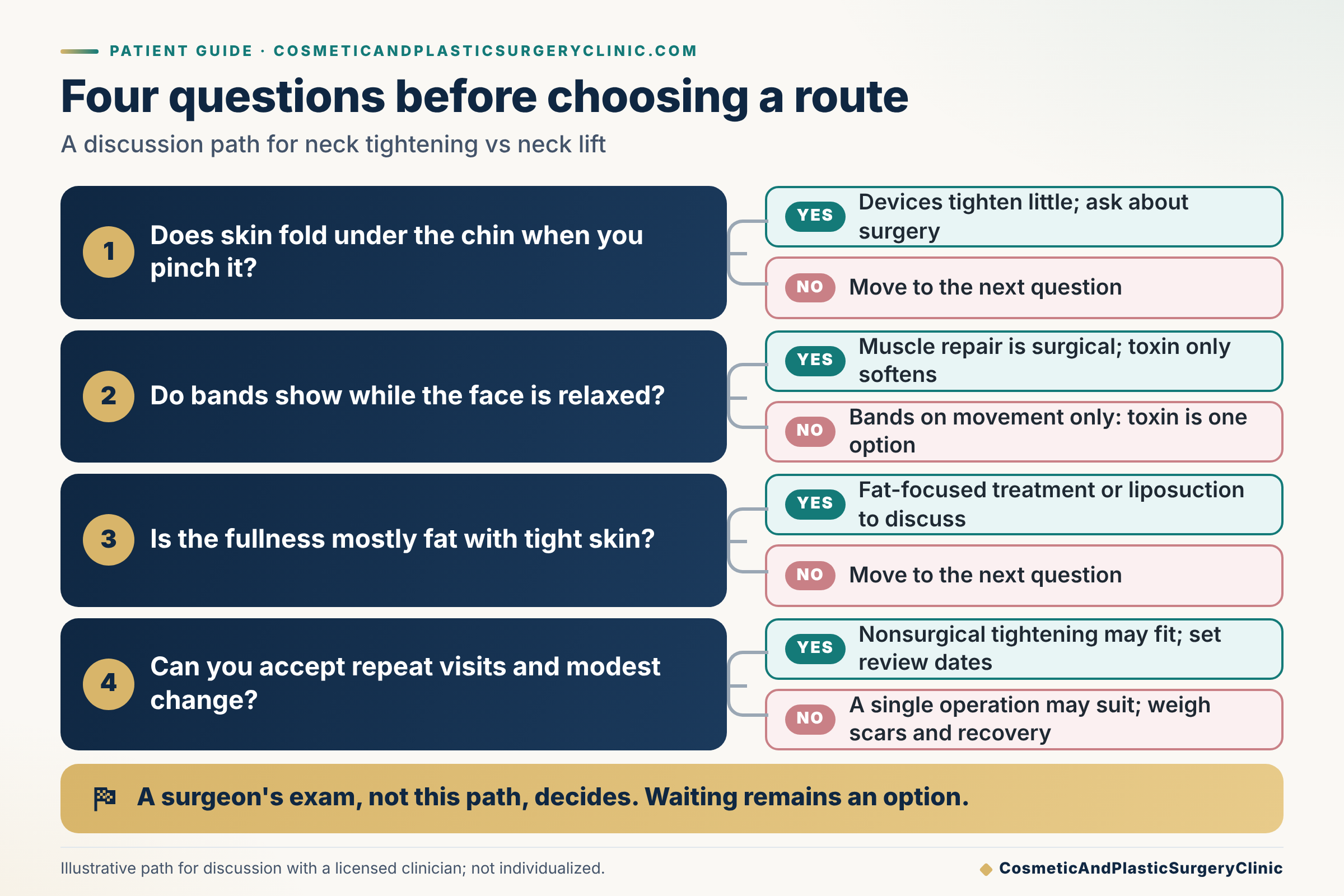
Bands that stay visible when the face is relaxed suggest the muscle itself has separated or tightened, which toxin only softens during movement. Fullness under the chin that persists when weight is stable may include fat beneath the platysma, enlarged glands or a low hyoid. The 2026 dermatology review says surgery remains a cornerstone for significant submental fat and advanced laxity.
Suspicion is not diagnosis. A surgeon feels the tissue and assesses it in several head positions. The factors a surgeon weighs are laid out in neck lift candidate.
Loose skin and a jawline that has lost its edge
When skin hangs in a fold that does not snap back, energy devices tend to disappoint because they tighten by small amounts. The 2023 ultrasound review found benefit declined with greater laxity. The 2026 review describes tumescent liposuction as an option for pronounced submental fullness and poorly defined jawlines when other treatments fall short.
Liposuction in the wrong neck can backfire, though. Weinstein and Nahai write that it can worsen skin redundancy and expose bands and glands. The fat-versus-muscle-versus-skin triage is the subject of chin liposuction vs neck lift.
What a neck lift adds, and what it can still miss
Incisions, anesthesia and recovery in brief
Cleveland Clinic describes incisions near the sideburn and around the ear plus under the chin, with some patients needing only the ear incisions. The operation is usually outpatient. Swelling, bruising and sometimes small drains are expected, and neck tightness can last several months.
Those trade-offs are why the neck tightening vs neck lift question arises at all. Week-by-week detail is in neck lift recovery and fee structure in neck lift cost. For this comparison, the contrast is one larger event versus several small ones.
Recurrence and nerve injury: what pooled data show
Surgery has limits, and the data are uneven. A 2025 pooled analysis in Facial Plastic Surgery covered 12 articles and 2,106 patients who had neck lifts involving the platysma. Band recurrence occurred in 26 patients (1.4 percent), nerve damage in 0.9 percent, hematoma in 1.8 percent and a salivary-gland fluid collection (sialoma) in 0.3 percent. It is level III evidence, and the authors call for longer follow-up and standardized complication reporting.
Other sources are less reassuring on bands. Weinstein and Nahai cite a study in which recurrence occurred in over one-third of cases despite complete muscle transection. Differences in definition, technique and follow-up length may explain the spread, which is a reason to ask any surgeon how recurrence is defined and tracked in their own practice.
Expected effects, complications and emergencies are separated in neck lift risks.
| Factor | Effect on outcome | Maintenance or revision implication | Review point |
|---|---|---|---|
| Skin quality and sun exposure | Shapes texture and how much tissue responds; Cleveland Clinic lists sun and smoking as influences on surgical results | Sun protection applies to every route | Is sun damage the main complaint? |
| Platysma activity | Bands return as the muscle keeps moving | Toxin repeats every few months; surgical recurrence is possible | Bands at rest, or only in motion? |
| Fat pad | Fat reduction treats the pad, not skin or muscle | Up to six sessions in the 2015 label; surgery later if skin stays loose | Did the skin retract? |
| Weight change | Shifts fullness and skin drape after any treatment | Reassess the plan after large changes | Is weight steady enough to judge? |
| Stacked treatments | Heat, threads and filler alter tissue before surgery | Radiofrequency scarring may complicate later surgery | Is there a dated list of everything done? |
| Follow-up evidence | Most nonsurgical data end within about one year | You judge durability yourself | What follow-up time backs the claim? |
Sequencing in neck tightening vs neck lift: first, later or never
Nonsurgical treatment first and surgery later is a common path through neck tightening vs neck lift decisions, and ASPS says these options may help delay the time at which a neck lift becomes appropriate. Delay is a legitimate aim. It differs from avoiding surgery altogether, and confusing the two is how people end up paying for several rounds of treatment that were never going to reach the problem.
Neck tightening vs neck lift in three hypothetical profiles
Early crepey skin with mild bands on movement
Consider a hypothetical adult in their early forties whose neck skin looks crepey and whose bands appear only when speaking. Skin does not fold. A toxin, a resurfacing or device-based plan and daily sun protection are matched to the layers involved, with a review date built in at three or six months. A surgeon may say surgery is unnecessary, which is a useful answer in itself.
Full bands, loose drape and a softened jawline
Consider a hypothetical person in their late fifties whose bands show at rest, whose skin folds under the chin and who feels the jaw has lost its edge. Every layer is involved. A device may tighten skin slightly and toxin may soften bands in motion, but neither addresses muscle position or redundant skin.
This is the profile where a surgeon is likely to discuss a neck lift, sometimes with a lower facelift, which neck lift vs facelift compares. The nonsurgical route can still serve as a bridge if surgery is not yet wanted, as long as it is called that.
Fullness under the chin with taut skin
Consider a hypothetical younger adult whose neck skin is elastic but who has a soft pad under the chin. Fat is the problem. Deoxycholic acid, or liposuction as the surgical alternative, matches it, while a neck lift would add steps this person may not need.
The open question is skin retraction: ask what happens if the skin does not tighten after fat is reduced. Staging fat treatment first and a neck lift later is examined in neck lift vs chin liposuction.
Counting cost in sessions, not in one price
Lifetime sessions versus one operation
A single nonsurgical neck tightening treatment costs less than an operation, and the neck tightening vs neck lift comparison usually stops there. A better comparison counts repeats: toxin that wears off and is not tested more often than every three months, deoxycholic acid in up to six sessions, devices that Weinstein and Nahai say often need multiple treatments for modest effects, and threads that dissolve.
No verified U.S. prices for these treatments were found, so none are given here. The structure of surgical fees is in plastic surgery cost. Ask for a written plan that lists every anticipated session over two years, then compare that total, plus time away from normal routines, with a quote for surgery.
When repeated nonsurgical treatment can complicate later surgery
Weinstein and Nahai note that radiofrequency may cause scarring that complicates later surgery, and they list burns and nerve injury among risks of energy devices and injections. Threads leave material under the skin, and filler can mask anatomy. None of this rules out surgery later.
It does mean the surgeon should see a dated list of everything done. If surgery is a likely destination, saying so at the first nonsurgical visit lets the clinician weigh whether another round is worth it.
Reading the claims behind a “non-surgical neck lift”
Words that overpromise
“Lift” and “tighten” versus measured square millimeters
Marketing blurs neck tightening vs neck lift by using “lift” for any visible improvement. Studies usually report smaller, narrower things: a change in submental area in square millimeters, a clinician’s global rating, a satisfaction score. The 2023 ultrasound review noted that most outcomes were subjective and objective measurements limited.
Ask what was measured, in whom and how long afterward, then compare that with what you hope to see in the mirror. ASPS says nonsurgical options offer quicker recovery and fewer risks, and also that they cannot match surgery. Both statements hold at once.
Clearance wording is not comparative proof
An FDA 510(k) clearance means a device may be marketed for stated uses after review against an earlier device; the 2014 ultrasound clearance names a predicate. It does not rank the device against surgery in any neck tightening vs neck lift comparison. “Non-invasive” in the indication describes the route, not the size or length of the effect.
Satisfaction figures also deserve care. The 2025 meta-analysis found satisfaction fell from 84 to 62 percent when a “neutral” answer was offered, and the authors suspected that neutral replies inflated the estimates.
Photos and credentials
Photos that mislead on the neck
The neck is easy to photograph misleadingly, so neck tightening vs neck lift galleries need careful reading. Chin position, head tilt, shirt collar, lighting and whether the platysma is tensed all change the apparent angle and bands, and swelling soon after a procedure makes early photos unreliable. Ask for images taken the same way, at the same distance, at 3, 6 and 12 months.
Neck-specific viewing skills are in neck lift before and after, and the general ethics of image use in before-and-after photos.
Who should perform the treatment
For fillers, the FDA advises seeking a licensed provider with experience in dermatology or plastic surgery, asking about training in the specific area, and confirming a plan for vascular complications. The same questions fit toxin near the neck, deoxycholic acid under the chin and energy devices near the jaw.
Ask who treats you on the day and who handles complications. A practice that offers both routes can compare them for you. Verifying credentials is covered in choosing a plastic surgeon.
Questions that sort out neck tightening vs neck lift in a consultation
A neck tightening vs neck lift consultation goes better with written questions. The lists below are split by who is answering.
Questions for the clinician offering nonsurgical treatment
About the evidence and the plan
- Which layer of my neck is this treatment aimed at, and which layers will it leave alone?
- What did comparable patients show, measured how, and followed for how long?
- How many sessions do you expect over two years, and what is the total?
- What will we do if I see no change by the review date?
About safety and a later operation
- Who performs the treatment, and what is their training in this area?
- What should I do, and whom do I call, if swallowing, breathing or vision changes?
- How will my records show every product and device used, with dates?
- How would this treatment affect a neck lift if I choose one later?
Questions for the surgeon about a neck lift
About technique and anatomy
- Which layers would you treat in my neck, and why those?
- Do fat beneath the muscle, gland size or hyoid position matter in my case?
- How do you define band recurrence, and how do you track it in your own patients?
- Would a lower facelift change the result in my neck?
About trade-offs and alternatives
Ask where the incisions would sit, what recovery looks like for your work and family, and what would make the surgeon advise waiting. A good answer names limits and invites comparison. The structure of a useful visit is described in plastic surgery consultation questions, and the same-day logistics of a decision can wait until you have a written plan and time to review it.
Frequently asked questions
Is neck tightening vs neck lift a real either-or choice?
For mild changes it can be, and some people move from one route to the other over time. For a neck with bands at rest, folded skin and a softened jawline, the sources opened suggest the routes reach different problems, so the question becomes which layers matter most to you. A surgeon who treats both can lay out what each would change and leave unchanged. Waiting for a few months to watch the neck, with photos taken the same way each time, is also a legitimate choice.
Does neck tightening vs neck lift change a “turkey neck” differently?
It depends on what the term describes. If it means crepey skin and mild looseness, devices, resurfacing and sun protection may soften it modestly. If it means vertical bands plus hanging skin, studies show toxin relaxes bands in motion and devices tighten by small amounts, while ASPS says a neck lift can only be performed surgically. Heavy folds are the case where nonsurgical results are least likely to match expectations, so ask for measured results in similar necks.
How long do results last in neck tightening vs neck lift comparisons?
No head-to-head study was found. In the sources opened, platysma toxin is repeated every three to four months, one ultrasound study reported 33 percent of patients still improved at one year, and threads were followed for up to two years. Cleveland Clinic says neck lift results can last years and depend on genetics, smoking, sun exposure and healing. Aging continues after either route, so ask each clinician what upkeep they expect.
Do at-home neck devices count as nonsurgical neck tightening?
They are a separate category, and no evidence for them was opened for this article; the 2022 radiofrequency review excluded home-use devices. Professional devices were studied with set energy levels, training and technique, so a result in a clinic study may not transfer to a consumer product. If you try one, protect the skin, stop at any burn, blister or numbness, and ask a clinician before combining it with other treatments.
Is pain different in neck tightening vs neck lift?
The sources opened do not compare them directly. The 2023 ultrasound review reports average pain of about 3.8 out of 10 after topical numbing, and the 2025 meta-analysis about 4.6 out of 10 for face and neck, with high variation between studies. Neck lift pain is managed with anesthesia and afterward with prescribed medicine, and Cleveland Clinic lists pain among surgical risks. Ask each clinician what to expect and what pain control they use.
Do the findings on neck tightening vs neck lift apply to men?
Less is known. The 2023 ultrasound review says most patients were women and data for men are lacking, and the 2025 meta-analysis neck studies were 93 percent female. Male necks differ in skin thickness, hair and fat distribution, so results and the choice of technique may differ. A man asking about neck tightening vs neck lift can ask the clinician how many men they treat and what they have seen at six and twelve months.
What should I do about a new lump in my neck before any treatment?
See a clinician first. A lump is not always fat or a band; thyroid, lymph node and salivary gland conditions can also cause neck swelling, and cosmetic treatment should not delay an evaluation. The FDA notes that nodules and masses can follow deoxycholic acid injections and may need medical care, so tell any cosmetic clinician about a new or changing lump before neck tightening vs neck lift planning begins. Sudden swelling with trouble breathing or swallowing is an emergency: call 911.
Sources and further reading
- American Society of Plastic Surgeons — Neck lift (accessed 2026-11-12) — what a neck lift addresses, nonsurgical options, surgery-only statement
- American Society of Plastic Surgeons — Lift procedures led growth in 2025 (press release dated 2026-09-01; accessed 2026-11-12) — neck lift and minimally invasive volume shares
- Contini et al. — A Systematic Review of the Efficacy of Microfocused Ultrasound for Facial Skin Tightening, International Journal of Environmental Research and Public Health, 2023 (accessed 2026-11-12) — submental and neck results, adverse events, limits
- Microfocused Ultrasound With Visualization Effectiveness and Safety: Systematic Review and Meta-Analysis, Aesthetic Surgery Journal, 2025 (accessed 2026-11-12) — 42 studies, study design, follow-up, funding
- U.S. Food and Drug Administration 510(k) K134032, Ulthera System (decision 2014-06-20; record mirror; accessed 2026-11-12) — indications for use, predicate
- U.S. Food and Drug Administration 510(k) K180623, Ulthera System (letter dated 2018-05-04; accessed 2026-11-12) — neck and submental indication wording
- Evaluating the effectiveness and safety of radiofrequency for face and neck rejuvenation: a systematic review, Lasers in Surgery and Medicine, 2022 (abstract; accessed 2026-11-12) — 121 studies, effects, neck fistula
- Safety and Efficacy of Renuvion Helium Plasma to Improve the Appearance of Loose Skin in the Neck and Submental Region, Aesthetic Surgery Journal, 2023 (accessed 2026-11-12) — single-arm trial results and adverse events
- Allergan/AbbVie — Botox Cosmetic prescribing information (platysma bands; accessed 2026-11-12) — indication, trials, dosing interval, boxed warning
- AbbVie — FDA approval for platysma bands (press release, 2024-10-18; accessed 2026-11-12) — approval date, satisfaction results, symptom timing
- MDedge Dermatology News — Nefertiti lift using Botox sculpts skin around jawline, chin (April 1, 2008; accessed 2026-11-12) — Levy 2007 series of 130 women
- Levy PM — Neurotoxins, Plastic and Reconstructive Surgery, 2015 (abstract record; accessed 2026-11-12) — jawline, neck band and necklace-line uses of toxin
- U.S. Food and Drug Administration — deoxycholic acid injection original labeling (2015; accessed 2026-11-12) — indication, trials, adverse reactions, regimen
- U.S. Food and Drug Administration — Drug Safety Communication on deoxycholic acid injection labeling (content current as of 2026-09-15; accessed 2026-11-12) — nodules, masses, use outside submental area
- U.S. Food and Drug Administration — Dermal Fillers (Soft Tissue Fillers) (content current as of 2023-07-06; accessed 2026-11-12) — neck not approved, vascular risk, provider advice
- Nadir et al. — A Dermatologist’s Guide to Nonsurgical Rejuvenation of the Neck and Jawline, Journal of Clinical and Aesthetic Dermatology, 2026 (accessed 2026-11-12) — neck aging components, option-by-option limits and adverse events
- Weinstein and Nahai — A layered approach to neck lift, Plastic and Aesthetic Research, 2021 (accessed 2026-11-12) — layers, surgical steps, limits of nonsurgical options
- Cambiaso-Daniel et al. — Neck Lift to Treat Platysma Bands and Defining Cervical Angle: A Systematic Review and Pooled Analysis, Facial Plastic Surgery, 2025 (Europe PMC record; accessed 2026-11-12) — 2,106 patients, recurrence and complication rates
- Update on Absorbable Facial Thread Lifts, Dermatologic Surgery, 2025 (abstract; accessed 2026-11-12) — 12 studies, follow-up up to two years
- Cleveland Clinic — Neck lift (platysmaplasty) (updated 2022-06-28; accessed 2026-11-12) — incisions, recovery, result duration, nonsurgical alternatives