No website can tell you that you are a blepharoplasty candidate, and the people who search the phrase usually want something more specific: is the heaviness around my eyes the kind of problem an operation changes, and are my eyes and my health a good match for surgery? A surgeon answers that by examining the brow, the skin and fat of each lid, the height of the lid edge, the tear film and your medical history. Then the surgeon asks whether your goals match what eyelid surgery actually does.
This article walks through that evaluation so a consultation does not feel like a pop quiz. It covers what separates a blepharoplasty candidate from a near-miss: the anatomical look-alikes, dry eye, thyroid disease and other eye conditions, medicines and nicotine, expectations, and the situations where waiting or another route fits better. It is education, not a verdict on any individual. The blepharoplasty overview explains the operation itself.
What makes someone a blepharoplasty candidate, and who decides
Whether someone is a blepharoplasty candidate is a clinical judgment built from three linked questions. Is there a problem here that eyelid surgery can change? Is this person healthy enough, in body and in eyes, to heal from it? Do the person’s goals match what the operation delivers? Yes to all three leads to a plan. Anything else leads to more testing, a different procedure or a later date.
What professional criteria say about a blepharoplasty candidate
Health, nonsmoking, eye health and realistic goals
The American Society of Plastic Surgeons (ASPS) lists four general traits for a blepharoplasty candidate: no medical conditions that impair healing, not smoking, a positive outlook with realistic goals, and no serious eye conditions. The same page reminds readers that the eyelids are part of the face, so a drooping upper lid may come from forehead and eyebrow changes, or from a stretched lid muscle that needs a different operation.
Mayo Clinic’s blepharoplasty page, published in April 2025, does not give a pass-fail list. It says the surgical team will ask about dry eyes, glaucoma, allergies, circulatory problems, thyroid problems and diabetes, and will discuss whether the procedure is likely to work well for you. Cleveland Clinic’s page, last updated in September 2026, adds that you will need an eye exam and a general checkup first.
The American Society of Ophthalmic Plastic and Reconstructive Surgery (ASOPRS) publishes no formal candidacy criteria on its eye-and-brow-lift page. It describes situations instead: excess skin that blocks vision, drooping brows, deep frown lines or hooding at the outer lid. Those are starting points for a conversation, not entry tickets.
What the 2025 procedure counts do and do not show
ASPS counted 118,978 eyelid surgery procedures in the United States in 2025, up 19 percent from 100,185 in 2024, ranking fifth among cosmetic surgical procedures and first among facial surgeries. By age, 2025 counts were 366 at 18 to 25, 2,676 at 26 to 35, 10,290 at 36 to 45, 24,657 at 46 to 55, 43,126 at 56 to 65 and 37,862 at 66 and older. Women accounted for 104,652 and men for 14,327, a 1 percent decline for men.
Adding the two oldest bands gives 80,988 procedures, about 68 percent of the total (a calculation from the reported counts). These are procedure counts, so they show who chose surgery, not who was well advised to. Popularity is not suitability. The numbers do show that eyelid surgery spans adult ages, and that a 40-year-old with inherited puffiness and a 70-year-old with hooded lids can each be an ordinary blepharoplasty candidate, not an edge case.
Why an exam, not a photo or a quiz, decides who is a blepharoplasty candidate
What a surgeon measures that a mirror cannot
Several of the deciding measurements are millimeters. An American Academy of Ophthalmology (AAO) EyeWiki review of upper-lid surgery lists the skin and fat, crease symmetry, the margin reflex distance (the gap between the light reflex on the pupil and the upper lid edge), levator muscle function, crease height, lower lid laxity, the strength of the orbicularis muscle that closes the lids, and whether the lids close fully. It also lists the Bell’s phenomenon, the upward roll of the eye when you shut your lids, which protects the cornea.
Visual field testing is often part of the picture when vision is a concern. The EyeWiki review describes testing with the lids untaped and then taped up, and a StatPearls review of blepharoplasty describes the same comparison using standard perimetry. Photographs from set angles are taken before surgery. None of this can be reproduced from a selfie, which is why the evaluation is not a download.

Who should be doing the evaluation
Eyelid surgery is performed by plastic surgeons, facial plastic surgeons, oculoplastic surgeons (ophthalmologists with additional training in the eyelids and orbit) and others. A title alone does not tell you who has examined enough eyelids to notice a subtle ptosis or a lax lower lid. The steps for checking credentials, hospital privileges and the operating facility are laid out in how to choose a plastic surgeon, and the meaning of different titles in cosmetic surgeon credentials.
For a blepharoplasty candidate with a complicated eye history, such as thyroid eye disease or glaucoma, a reasonable question is whether the surgeon will coordinate with the ophthalmologist who already treats the condition. The answer says something about how the practice handles medical complexity.
Sorting hooded skin, low brows and a drooping lid in a blepharoplasty candidate
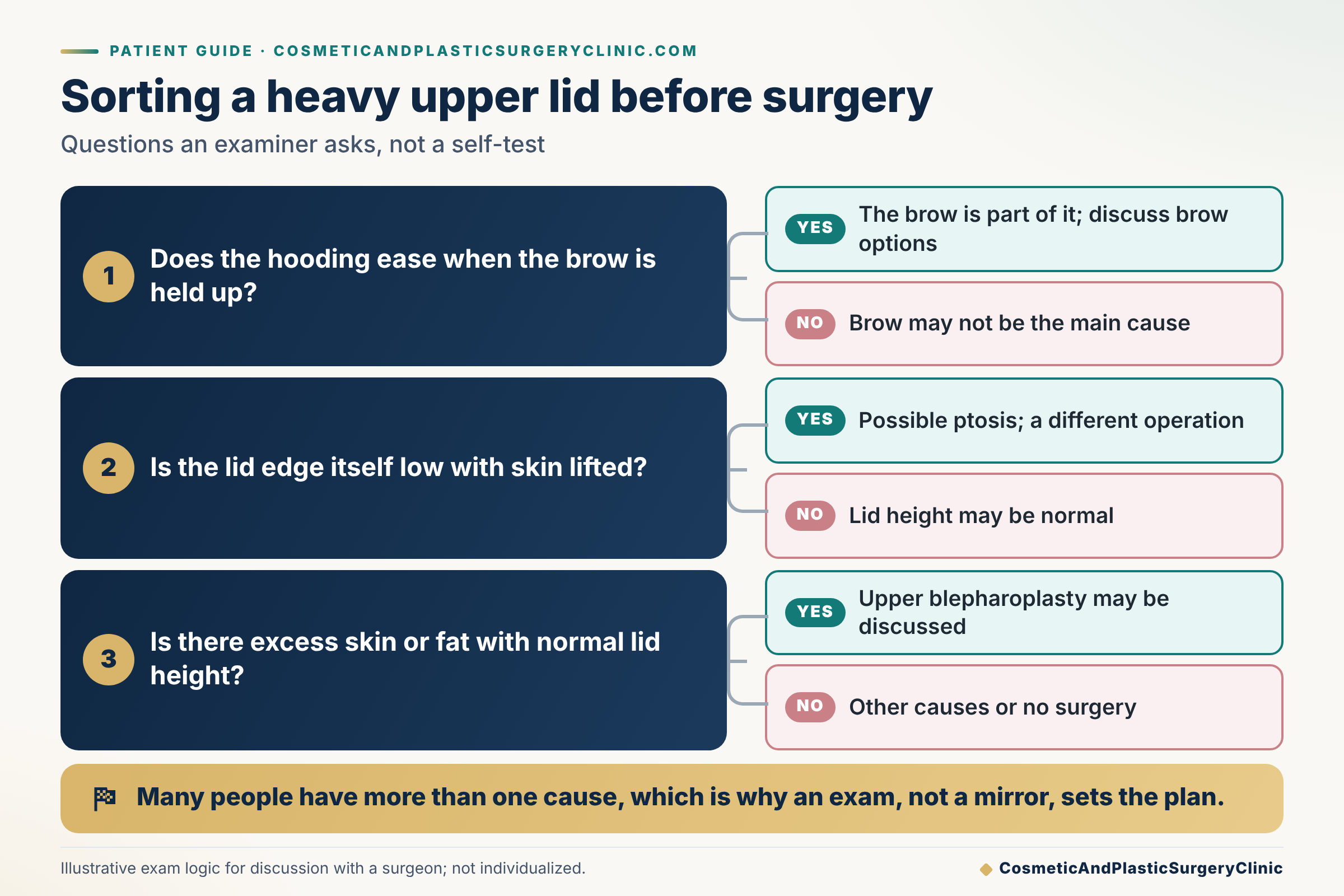
The most common mistake in self-assessment is assuming that a heavy upper lid means too much eyelid skin. Three different problems can produce the same tired, hooded look, and they are treated differently. Sorting them is the single most useful thing an exam does for a blepharoplasty candidate.
Three problems behind a heavy upper eyelid
Excess skin and fat: dermatochalasis and its relatives
Dermatochalasis is the medical term for redundant, lax eyelid skin. ASOPRS says eyelid skin thins and loses elasticity with age, fat can begin to bulge forward, and age, heredity and sun exposure all contribute. Fat that bulges through the lid’s supporting membrane is called steatoblepharon. The EyeWiki review lists both among the main indications, with the reason for surgery being either functional visual symptoms or cosmetic concerns.
The excess can sit across the whole lid or mainly at the outer corner, where it is called lateral hooding. Skin that rests on the lashes or blocks the upper field of vision is a different conversation from a cosmetic wish for a smoother lid, a distinction the blepharoplasty insurance article explains.
Brow position: when the eyebrow is part of the problem
An AAO EyeWiki review on brow ptosis warns that a prominent low brow can give the appearance of significant dermatochalasis. Surgeons separate the two by lifting the brow into a normal position by hand and watching what the lid does. If the hooding largely disappears, the brow is contributing. The same review says all patients considering blepharoplasty should be evaluated for brow repositioning.
Cleveland Clinic’s comparison page makes the practical point: eyelid surgery removes eyelid skin, while a brow lift works above the eye and does not remove lid skin, though it can reduce some upper-lid bagginess. If both are present, the order and the combination matter. That decision has its own article, blepharoplasty versus brow lift.
True lid droop: ptosis is a different diagnosis
Ptosis means the upper lid edge sits too low. EyeWiki’s review defines it as an abnormally low-lying lid margin with the eye looking straight ahead, most often, in adults, from stretching or detachment of the levator tendon. It lists brow ptosis and dermatochalasis among the conditions that can mimic it, and says skin redundancy is a separate finding that may coexist with ptosis. ASPS notes that a stretched lid muscle requires a different surgical treatment.
StatPearls gives 4 mm as the normal margin reflex distance and says patients at about 1 to 2 mm are often considered for levator advancement. A blepharoplasty candidate whose lid edge is low has an extra operation to think about, and may need it instead of, or in addition to, skin removal.
When fixing one lid reveals a droop in the other
Surgeons also look at the second eye. In some people one low lid is working so hard that it pulls the other lid up through a shared nerve signal, a pattern called Hering’s law. Lifting the droopy lid can let the other one fall. EyeWiki’s ptosis review describes lifting the affected lid and watching the other for masked ptosis as part of the exam.
A 2023 Plastic and Reconstructive Surgery series of 26 patients who developed a drooping second lid after one-sided ptosis surgery found Hering dependency before surgery in 13 of them. That sample was selected because of the problem, so it cannot give a general rate. Its practical lesson is to ask: have both lids been checked against each other?
Lower eyelids: bags, hollows and lid tone
Fat pads, the tear trough and the lid-cheek junction
EyeWiki’s lower-lid review lists the findings that bring people to lower-lid surgery: lower-lid skin laxity and fine wrinkling, prominent fat pads, a pronounced groove between lid and cheek (the nasojugal groove or tear trough), cheek fat loss and cheek mounds. The same review lists, as exam findings, the relationship between the eye and the cheekbone, which surgeons call the vector.
A negative vector means the eyeball sits farther forward than the cheek. It is one of the findings assessed before surgery, and what it means for your plan is a fair question to ask. Volume loss in the cheek and tear trough is a different anatomy from a fat bag, so the answer may involve repositioning fat, adding volume or addressing the cheek rather than simply taking tissue out. The technique options sit in lower eyelid surgery.
The snap-back test and why lid tone steers the plan
The StatPearls review describes the lower lid snap-back test: pull the lid gently away from the eye and release it. A healthy lid snaps back quickly, while a lax lid is slow to return or does not return. Slow return suggests the surgeon may plan a tightening step at the outer corner, called a canthopexy or canthoplasty.
This matters because the EyeWiki lower-lid review links ectropion, a lid edge that turns outward, to a lax lower lid that is left uncorrected. It also lists retraction and shortage of skin as complications when too much skin is removed. For a blepharoplasty candidate, the snap test is one of the few small findings that can reshape the whole plan.
| Situation | Pathway a surgeon may discuss | Possible benefit | Trade-off | Key question |
|---|---|---|---|---|
| Excess upper lid skin, brow in normal position | Upper blepharoplasty alone | Removes redundant skin; may widen the upper visual field | Scar in the lid crease; dry eye risk | How much skin will be removed, and why that amount? |
| Low brow adds to the hooding | Brow lift, blepharoplasty or both | Treats the true source of the heaviness | More incisions; longer recovery | What does my hooding look like with the brow held up? |
| Low lid edge (ptosis) | Ptosis repair, with or without skin removal | Raises the lid edge itself | Different operation; lid height can need adjusting | Is my lid margin height normal when the skin is lifted? |
| Lower lid bags with a lax lid | Lower blepharoplasty plus lid tightening | Addresses both the bag and the support | Added step; lid position needs monitoring | What did my snap-back test show? |
| Lower lid hollows, little fat bulge | Fat repositioning, volume restoration or no surgery | Targets volume loss rather than bags | Results depend on the method; some options are temporary | Is my problem a bag, a hollow or both? |
Dry eye, thyroid eye disease and other eye conditions that change the plan
Eyelid surgery changes how the lids sit, close and spread tears over the eye, so the health of the eye itself belongs in any blepharoplasty candidate evaluation. This is the part of candidacy that people searching for “am I a candidate” often have not considered, and it is where an eye history can move the date or change the operation.
Why the surface of the eye is checked first
Dry eye history and the tear tests
Dry eye is common, and surgeons ask about it directly. The StatPearls blepharoplasty review describes the Schirmer test, in which a paper strip measures tear production: 15 mm or more is considered normal and under 5 mm indicates deficient production, and the test helps identify patients at risk of dry eye after surgery. Mayo Clinic says the eye exam before surgery may test tear production, and the EyeWiki upper-lid review adds an assessment of the tear film.
The EyeWiki lower-lid review names uncontrolled dry eye syndrome as a contraindication. The word “uncontrolled” leaves room for judgment on dry eye that is treated and stable, which is a conversation for the surgeon and, often, the treating eye doctor. A blepharoplasty candidate who has stopped mentioning gritty or burning eyes because they have learned to live with them should bring it up anyway.
What happens to the eye after upper-lid surgery has been measured in small studies. A 2021 Frontiers in Medicine study followed 55 young women (110 eyes, ages 19 to 31) treated by one surgeon.
A standard dry-eye symptom score rose from 6.58 before surgery to 8.89 at one week and 11.95 at one month, while one tear-stability measure returned to baseline by one month. The authors cite published estimates of dry-eye symptoms after blepharoplasty ranging from 0 to 26.5 percent of patients. Follow-up was only a month and there was no control group, so these numbers show that change is common and variable, not what yours will be.
Lid closure, blinking and the protective roll of the eye
ASPS lists trouble fully closing the eyes, dry eyes and a lower lid that pulls down (lid lag) among the recognized risks, with lid lag often temporary. How well the lids close at rest, how strongly the eyes blink and whether the Bell’s phenomenon is intact are therefore part of the exam for every blepharoplasty candidate. If the lids do not close fully, the protective upward roll of the eye matters more.
The EyeWiki review of double-eyelid surgery adds that creating a new crease may unmask ocular surface disorders and that a lid that was drooping before surgery may have been partly protecting the eye. This is a reason to describe your eyes honestly at the consultation, including contact lens use, eyedrop habits and any sensitivity to wind or screens.
Thyroid eye disease, glaucoma and other eye history
Thyroid eye disease: timing matters more than eligibility
Thyroid eye disease is an autoimmune inflammation of the tissues around the eye, and it can look like a surprising eyelid problem. A University of Iowa EyeRounds patient summary says lid retraction, in which the lid is pulled away from its resting position and gives a startled look, affects up to 90 percent of patients, and bulging of the eyeball affects up to 60 percent. The active phase can wax and wane for months to years before the disease settles into a stable phase.
The EyeRounds summary says most eyelid surgery in thyroid eye disease takes place after the stable phase has lasted at least six months, because disease is then less likely to recur or progress, with the main exception being urgent protection of the cornea. The EyeWiki lower-lid review lists active thyroid ophthalmopathy as a relative contraindication to lower-lid blepharoplasty. For a blepharoplasty candidate with thyroid eye disease, the question is rarely “yes or no” but “after what point, and with whom coordinating?”
Glaucoma, retinal disease and what an eye doctor adds
ASPS lists “no serious eye conditions” as a trait of a good candidate, and Mayo Clinic names glaucoma among the topics the team will ask about. The StatPearls review describes a full eye examination before surgery, including a retinal exam, and flags thyroid disease, diabetes, hypertension and bleeding disorders as systemic conditions to check.
Rare problems explain why.
A Dermatology Times report in January 2020 on a surgeon’s talk at the Cosmetic Surgery Forum described acute angle-closure glaucoma after blepharoplasty, using a 2018 case report of a 64-year-old woman who developed stinging, blurred vision and a headache two days after surgery. She was first treated for suspected conjunctivitis, and regained sight about a year after an iridectomy. The report gives no incidence figure. The lesson for a blepharoplasty candidate is practical: tell the surgeon about every eye diagnosis and eye drop, and keep your eye doctor in the loop.
Medicines, blood pressure, nicotine and skin: health factors that move the date
General health does not decide whether the eyelids are a good target, but it largely decides when and how safely surgery can happen. These are the factors that most often turn a blepharoplasty candidate’s “yes” into “yes, after some preparation.”
Bleeding risk: medicines, blood pressure and clotting
Aspirin, anti-inflammatories, supplements and blood thinners
ASPS asks patients to avoid aspirin, anti-inflammatory drugs and herbal supplements before eyelid surgery because they can increase bleeding and bruising. Mayo Clinic names aspirin, ibuprofen and naproxen, says to ask how far ahead of surgery to stop, and says to take only drugs the surgeon approves. The EyeWiki upper-lid review lists blood thinners and herbal supplements among the first items in the history.
The intervals are the surgeon’s to set, and the sources opened for this article give no single number. A prescribed blood thinner is a different matter from an over-the-counter pill: it was started for a reason, and stopping it is a decision for the prescriber together with the surgeon. Do not stop any prescribed medicine on your own because of an article.
Blood pressure, diabetes and why the history is long
The StatPearls review lists hypertension, diabetes and bleeding or clotting disorders among the conditions to check before surgery, and a chapter on treating blepharoplasty complications says diabetes, hypertension, clotting disorders and anticoagulant use call for detailed evaluation. These are checked because StatPearls calls bleeding behind the eye (retrobulbar hematoma) the most feared complication of blepharoplasty.
That chapter (Lisman and Lelli, in Plastic Surgery Key) cites 0.04 percent for bleeding behind the eye in plastic surgery literature and, from an epidemiologic study of more than 250,000 blepharoplasties by oculoplastic specialists, 0.05 percent for hemorrhage and 0.0045 percent for permanent visual loss. These are secondhand figures from a book chapter and the original studies were not reviewed, so treat them as order-of-magnitude context. Blepharoplasty risks covers the full list.
Nicotine, skin quality and healing
Nicotine and the weeks before surgery
ASPS lists nonsmoking as a trait of a good blepharoplasty candidate and asks patients to stop smoking before eyelid surgery. Mayo Clinic says to quit several weeks before surgery because smoking slows healing. The sources opened here give no exact smoke-free interval, and surgeons differ, so ask for the rule in writing, including whether it covers vaping, patches and gum.
Eyelid incisions sit in a small, highly visible area, so healing quality shows. If you are working on quitting, say so at the consultation. A surgeon who hears “I am cutting down” will make a different plan from one who hears “I do not smoke” and later finds out otherwise.
Skin quality, sun and scar maturation
ASOPRS says age, heredity and sun exposure all contribute to loose eyelid skin, and the EyeWiki exams list skin quality and quantity, crease symmetry and skin type as things recorded before surgery. The upper-lid review also notes that dermatitis of redundant skin folds can itself be an indication for surgery, a reminder that some blepharoplasty candidates come in with skin irritation rather than appearance concerns.
Mayo Clinic says bruising and swelling generally ease over about 10 to 14 days, that scars may take months to fade and that protecting eyelid skin from the sun is advised. ASPS adds that a surgeon may suggest a laser or chemical peel for discoloration of the lower lids. The blepharoplasty recovery article covers the timeline in detail.
| Factor | Possible effect on outcome | Maintenance or revision implication | Review point or warning sign |
|---|---|---|---|
| Nicotine use | Slows healing, according to Mayo Clinic | May delay surgery until the smoke-free window is met | Ask for the written interval and what it covers |
| Dry eye | May worsen for weeks after surgery; uncontrolled dry eye is a named contraindication | Ongoing drops or ointment may be needed | Gritty, burning or watery eyes before surgery; share with the surgeon |
| Thyroid eye disease | Active inflammation can change lid position and bulging | Surgery is usually timed after a stable phase | New redness, pain or bulging; call the treating eye doctor |
| Lower lid laxity | Affects lid position after lower-lid work | May need a tightening step now or later | Slow snap-back; lid edge pulling down after surgery |
| Brow position | A low brow can keep the upper lid looking heavy after skin removal | Brow lift may be added now or considered later | Hooding that persists with the brow held up |
| Skin quality and sun | Thin, sun-damaged skin heals and scars differently | Skin may continue to age after surgery | Redness or lumps along the scar after healing |

Goals, anatomy and ethnic variation: testing expectations against the operation
A blepharoplasty candidate can have ideal anatomy and still be a poor match if the goal is something eyelid surgery does not do. Surgeons are trained to listen for that gap, and you can listen for it too before you book.
What a realistic goal sounds like
Specific goals a blepharoplasty candidate can name
Useful goals are tied to something the operation changes: skin that no longer rests on the lashes, upper lids that look less heavy in photographs, less puffiness along the lower lid, a clearer upper field of vision. Mayo Clinic says many people who have blepharoplasty report feeling more self-confident and often feel they look younger and more rested. Cleveland Clinic advises being realistic: the surgery can alter appearance but should not be expected to drastically change how you look.
Consider a hypothetical 52-year-old who says she wants to look less tired. That sentence can mean hooded skin, a low brow, a lax lower lid, hollows under the eyes or simply poor sleep. A surgeon who asks her to point to what she sees, and who examines the brow and lids before offering a procedure, is doing the sorting this article describes. A surgeon who names a procedure and a price from a photo is skipping it.
Goals that call for a longer conversation
The EyeWiki lower-lid review lists unachievable goals or unrealistic expectations as a contraindication, and the upper-lid review says surgeons assess motivation and expectations in cosmetic cases. ASOPRS states that no promises can be made about a successful outcome and that some patients may be dissatisfied or need further treatment. A goal like “make my eyes a different shape” or “look like a specific person” belongs in that category.
Surgeons also screen for body dysmorphic disorder, a condition in which a person is preoccupied with a perceived flaw that others barely notice. In a 2015 JAMA Facial Plastic Surgery study of 234 consecutive adult patients, the disorder was confirmed in 13.1 percent of cosmetic surgery patients and 1.8 percent of reconstructive patients, and the authors recommended systematic screening. If a surgeon asks screening questions, that is care, not an accusation, and treatment for the underlying condition is a legitimate first step.
Eyelid anatomy differs, and so do the right goals
Crease, epicanthal fold and fat in Asian eyelids
Eyelid anatomy varies across people, and the EyeWiki review on Asian blepharoplasty (double-eyelid surgery) describes why one template does not fit all. Many people of Asian descent lack an upper-lid crease because the levator tendon fuses with the septum lower down, and the eyelids can carry more fat. The review says the epicanthal fold, the skin fold at the inner corner, is present in up to 90 percent of Asian adults.
These features change what surgeons examine: crease height, fold shape, lash direction, lid tone and brow position. The review also says the evaluation should include tear function and ocular surface health, and that checking brow position matters because correcting a droop can lower the brow. A blepharoplasty candidate seeking a crease for the first time is making a different decision from one seeking to remove aging skin, and the consent conversation should reflect it.
Choosing a crease height and shape that fits the face
The review gives a generally accepted crease height of 6 to 8 mm above the lid margin, within a wider range of 3 to 10 mm that it describes as aesthetically acceptable, and says the crease should parallel the curve of the lid margin. It stresses that a double eyelid is not synonymous with creating a Western eyelid: the aim is balance with the person’s own anatomy, identity and goals.
Looking at a surgeon’s photographs with this in mind is useful. Do the creases in their examples differ from person to person, or do they look alike? That observation helps judge whether a surgeon plans for the individual. Blepharoplasty photos explains how to read eyelid results step by step.
What eyelid surgery cannot control
Aging continues after surgery
Mayo Clinic says that for some people blepharoplasty results may last a lifetime, while for others droopy eyelids can recur. The operation addresses the tissue present at the time, and the brow, cheek and skin continue to change. A blepharoplasty candidate who expects a fixed result may be disappointed, and one who expects a better starting point may not be.
The brow is the clearest example. If a low brow is part of the heaviness and is not addressed, the lids can look heavy again as aging continues. That is a reason to discuss brow position now, whether or not you act on it, and to read blepharoplasty versus brow lift before the consultation.
Scars, asymmetry, dryness and why photos cannot settle candidacy
ASPS lists unfavorable scarring, dry eyes, trouble closing the eyes, altered skin sensation, vision changes and the possible need for revision among the recognized risks, and says these will be discussed before consent. Asymmetry is among the cosmetic complications in the EyeWiki upper-lid review. Surgeons place incisions to hide scars in natural lid structures, but healing is partly individual.
Photos cannot establish whether you are a blepharoplasty candidate. A before-and-after pair shows someone else’s brow, lid tone, tear film and healing, none of which can be read from a photograph, and the best result in a gallery says little about how your own anatomy will respond. Photos are useful as conversation tools; the exam is the evidence.
Preparing for the consultation: questions, alternatives and when to wait
The decision a blepharoplasty candidate actually faces is whether to proceed now, prepare first or choose another path. The consultation is where those options become concrete, and a little preparation makes the visit more productive. The general framework is in plastic surgery consultation questions; this section covers what is specific to the eyelids.
Questions a blepharoplasty candidate should ask that need an exam
Anatomy, technique, risk and alternative questions
Bring a list of medicines and supplements exactly as you take them, any eye diagnoses and drops, previous eyelid or brow procedures with dates, and a note on how your eyes feel by the end of the day. Then ask the questions in the table below. They cannot be answered without an examination, which is the point: a good answer should refer to your own lids.
| Topic | Question to ask | What a clear answer includes | Warning sign in the answer |
|---|---|---|---|
| Diagnosis | Is my heaviness skin, fat, brow, lid droop or a mix? | Names each contributor and shows how it was tested | A procedure named before the exam |
| Brow and lid height | What does my upper lid look like with the brow held up, and is my lid edge height normal? | Explains brow findings and lid-edge height in your own measurements | No mention of the brow or of ptosis |
| Eye health | Do my tear tests, lid closure and eye history change the plan or the timing? | Refers to specific findings; offers to coordinate with my eye doctor | Dry eye or thyroid history waved off |
| Technique | Which technique for each lid, and what would a smaller step do? | Links the technique to my anatomy; names a conservative alternative | One method for every patient |
| Safety | What are my own risk factors, and who handles a problem after hours? | Gives a named contact, a written plan and emergency instructions | Risk described only as “very rare” |
Questions about incision placement and combining upper and lower lids are covered in upper versus lower blepharoplasty, so you can arrive with a first view of which lids are involved.
What photos, video calls and quizzes cannot answer
Video consultations and online quizzes can start a conversation, but several candidacy findings need hands and instruments: the snap-back test, the margin reflex distance, levator function, visual field testing, tear tests and the fat and skin pinch. Mayo Clinic and EyeWiki both describe photographs as part of documentation, not as a substitute for examination.
If a clinic offers to quote a price and book surgery from photographs alone, treat that as a signal to ask how candidacy will be judged. A pressured timeline, a deposit tied to a “limited” date or a refusal to put the plan in writing are reasons to slow down, not to hurry.
When to wait, get a second opinion or choose another route
Unresolved workup, timing and pressure
Waiting is the right call for a blepharoplasty candidate more often than people expect. Common reasons include a thyroid eye disease phase that has not stabilized, dry eye that is not yet controlled, blood pressure that needs adjustment, nicotine use that has not yet stopped long enough, or a major life event that would complicate recovery. Each is a solvable problem, not a rejection.
A second opinion is reasonable when two surgeons describe different diagnoses, when one recommends a larger operation than the other, or when something in the exam seems rushed. Bring the first surgeon’s findings and ask the second to examine independently. If the concern is mainly functional, a surgeon’s documentation matters for coverage, which blepharoplasty insurance explains.
Other routes: brow lift, ptosis repair, fillers, a facelift or nothing
If the exam shows that the brow is the main problem for a blepharoplasty candidate, a brow lift may fit better than eyelid skin removal. If the lid edge is low, ptosis repair addresses the cause. ASOPRS says mild to moderate brow loss may be treated through the same incision as an upper blepharoplasty or with hyaluronic acid injections, while more severe cases need surgery above the brow.
For lower-lid hollows from volume loss, options other than removing fat may fit, and a facelift or mid-face procedure addresses structures that eyelid surgery cannot reach. The broader menu is in facelift alternatives, and dermal filler before-and-after photos shows how to read injectable results. Doing nothing, and revisiting the question in a year, is also a legitimate outcome of a consultation.
Frequently asked questions
Can a blepharoplasty candidate be in their 20s or 30s?
Yes, a blepharoplasty candidate can be young, though it is uncommon. ASPS counted 366 eyelid procedures in the 18 to 25 band and 2,676 in the 26 to 35 band in 2025, together about 2.6 percent of the 118,978 total (a calculation from the reported counts). ASOPRS notes that heredity contributes to eyelid changes, so inherited fat pads or a low crease can be present early. The exam still decides whether surgery fits, and surgeons may discuss waiting or nonsurgical steps when the anatomy is mild.
Are men a blepharoplasty candidate group too?
Yes. ASPS counted 14,327 eyelid procedures in men in 2025, against 104,652 in women. The male count was down 1 percent from 2024, while the female count rose 22 percent. The sources opened for this article do not explain the difference, and none suggests that candidacy criteria differ by sex. Anatomy, health history and goals are evaluated the same way for every blepharoplasty candidate; brow position and skin can differ, which the surgeon assesses individually.
Does a blepharoplasty candidate need a visual field test if the concern is only cosmetic?
Not necessarily. Mayo Clinic says visual field testing checks for blind spots in peripheral vision and notes that it is needed to support an insurance claim. EyeWiki describes testing with the lids untaped and taped to quantify obstruction. If vision is part of your concern, ask whether a test is useful for your plan, and ask who would document it. The rules payers use are covered in the blepharoplasty insurance article; coverage is never assured.
What if a surgeon says a blepharoplasty candidate needs ptosis repair instead?
For a blepharoplasty candidate, that is a different diagnosis, not a rejection. ASPS says a stretched lid muscle requires a different surgical treatment, and EyeWiki describes ptosis as a low lid edge that differs from excess skin. Ask how the lid edge height was measured, whether both eyes were compared, what the operation involves and who performs it. Some surgeons repair ptosis and remove skin in one session, while others stage them; the reasoning is worth hearing before you decide.
Does earlier eyelid surgery change who counts as a blepharoplasty candidate?
It can change the plan for a blepharoplasty candidate. The EyeWiki lower-lid review lists shortage of skin after overly aggressive removal, lid retraction and ectropion among complications, so a surgeon examining a revision case checks how much skin and support remain. Bring the operative report if you have it, along with dates and the name of the earlier surgeon. ASPS lists possible revision among the risks of eyelid surgery in general, which is why records matter.
Does health history affect the anesthesia offered to a blepharoplasty candidate?
It can. ASPS says medication for comfort is given as intravenous sedation or general anesthesia, and that your surgeon recommends the best option; ASOPRS says most procedures can be done under mild sedation or local anesthesia. The choice depends on the procedure, your health and the facility. Share every diagnosis and medicine with the surgeon and the anesthesia provider, and ask who administers it and in what setting.
Can nonsurgical steps replace surgery for a blepharoplasty candidate who is not ready?
Sometimes they help, but they treat different problems. ASOPRS says hyaluronic acid injections can address mild to moderate brow volume loss, and the lower-lid review lists volume deficiency as its own finding from fat bulge. Injectables and energy treatments do not remove excess skin. Ask which of your findings a nonsurgical step could address and which it could not.
Sources and further reading
- American Society of Plastic Surgeons — Eyelid surgery overview (accessed 2026-11-12) — upper, lower or both; what eyelid surgery treats
- American Society of Plastic Surgeons — Eyelid surgery candidates (accessed 2026-11-12) — health, nonsmoking, realistic goals, no serious eye conditions, brow and ptosis caveats
- American Society of Plastic Surgeons — Eyelid surgery safety (accessed 2026-11-12) — recognized risks and consent
- American Society of Plastic Surgeons — Eyelid surgery procedure (accessed 2026-11-12) — anesthesia, incision types, peel or laser for lower-lid discoloration
- American Society of Plastic Surgeons — Eyelid surgery preparation (accessed 2026-11-12) — medical evaluation, medicines, smoking
- American Society of Plastic Surgeons — 2025 Plastic Surgery Statistics Report (accessed 2026-11-12) — eyelid surgery counts by year, age and sex
- Mayo Clinic — Blepharoplasty (published April 29, 2025; accessed 2026-11-12) — preparation, eye exam, smoking, results and recurrence
- American Academy of Ophthalmology EyeWiki — Upper eyelid blepharoplasty (accessed 2026-11-12) — indications, pre-operative evaluation, complications
- American Academy of Ophthalmology EyeWiki — Lower eyelid blepharoplasty (accessed 2026-11-12) — indications, exam findings, contraindications, complications
- American Society of Ophthalmic Plastic and Reconstructive Surgery — Eye and brow lift (accessed 2026-11-12) — dermatochalasis, brow ptosis, what to expect
- Rebowe and Runyan — Blepharoplasty, StatPearls (updated July 24, 2023; accessed 2026-11-12) — margin reflex distance, snap-back test, Schirmer test, systemic conditions
- Cahill and colleagues, Ophthalmology 2011 — Functional indications for upper eyelid ptosis and blepharoplasty surgery (AAO Ophthalmic Technology Assessment; accessed 2026-11-12) — functional measures
- Liaboe and colleagues, University of Iowa EyeRounds — Thyroid eye disease: a summary of information for patients (updated 2020; accessed 2026-11-12) — lid retraction, bulging, smoking, active and stable phases, surgery timing
- Zhang and colleagues, Frontiers in Medicine 2021 — Effect of transcutaneous upper eyelid blepharoplasty on blink parameters and lipid layer thickness (accessed 2026-11-12) — dry-eye symptom scores after surgery, literature range
- American Academy of Ophthalmology EyeWiki — Blepharoptosis (accessed 2026-11-12) — ptosis definition, mimics, exam, Hering phenomenon
- Mangan and colleagues, Plastic and Reconstructive Surgery 2023 — Mueller muscle-conjunctival resection for contralateral ptosis after unilateral external levator advancement (PubMed abstract; accessed 2026-11-12) — Hering dependency in a 26-patient series
- Dey and colleagues, JAMA Facial Plastic Surgery 2015 — Body dysmorphic disorder in a facial plastic and reconstructive surgery clinic (record page; accessed 2026-11-12) — screening and prevalence
- American Academy of Ophthalmology EyeWiki — Asian blepharoplasty (double eyelid procedure) (accessed 2026-11-12) — crease, epicanthal fold, crease height, preoperative considerations
- Lisman and Lelli — Treatment of blepharoplasty complications, chapter 34, Plastic Surgery Key (accessed 2026-11-12) — anticoagulants, retrobulbar hemorrhage figures (secondhand)
- Dermatology Times — Rare post-bleph complications (published January 6, 2020; accessed 2026-11-12) — acute angle-closure glaucoma case report
- American Academy of Ophthalmology EyeWiki — Brow ptosis and repair (accessed 2026-11-12) — manual brow elevation, brow evaluation before blepharoplasty
- Cleveland Clinic — Blepharoplasty (eyelid surgery) (last updated September 13, 2026; accessed 2026-11-12) — eye exam, realistic expectations, dry eyes
- Cleveland Clinic — Blepharoplasty vs. brow lift (published February 14, 2024; accessed 2026-11-12) — eyelid skin versus brow