
Many people ask for masseter Botox before anyone has checked what is making the jaw look wide. The masseter is the thick chewing muscle at the angle of the jaw, and a botulinum toxin injection can weaken it. If muscle is the main reason for a square lower face, the contour may narrow a little over a few months. If bone, teeth or fat are the reason, a muscle treatment has less to work with.
This page covers the anatomy, the off-label status of masseter Botox, what controlled trials found, trade-offs for chewing, smile and bone, clenching, and how to choose an injector. Botox is a brand name, onabotulinumtoxinA (Botox), one of several botulinum toxin type A products; the general treatment is explained in our overview of Botox and other neuromodulators. In 2024 the American Society of Plastic Surgeons (ASPS) counted 9,883,711 neuromodulator injections across all treated areas, a figure that does not separate out the jaw. Only an examination can say whether your jaw is a fit.
Why a wide lower face is not always a muscle problem
Before any needle, the useful question is what the width is made of. Muscle is one answer among several, and the answer decides whether masseter Botox has anything to change.
The masseter, layer by layer
The masseter is a short, powerful muscle that sits on the side of the face between the cheekbone and the lower jaw. Knowing its shape explains both what an injection can reach and why chewing is affected.
Two portions, one job
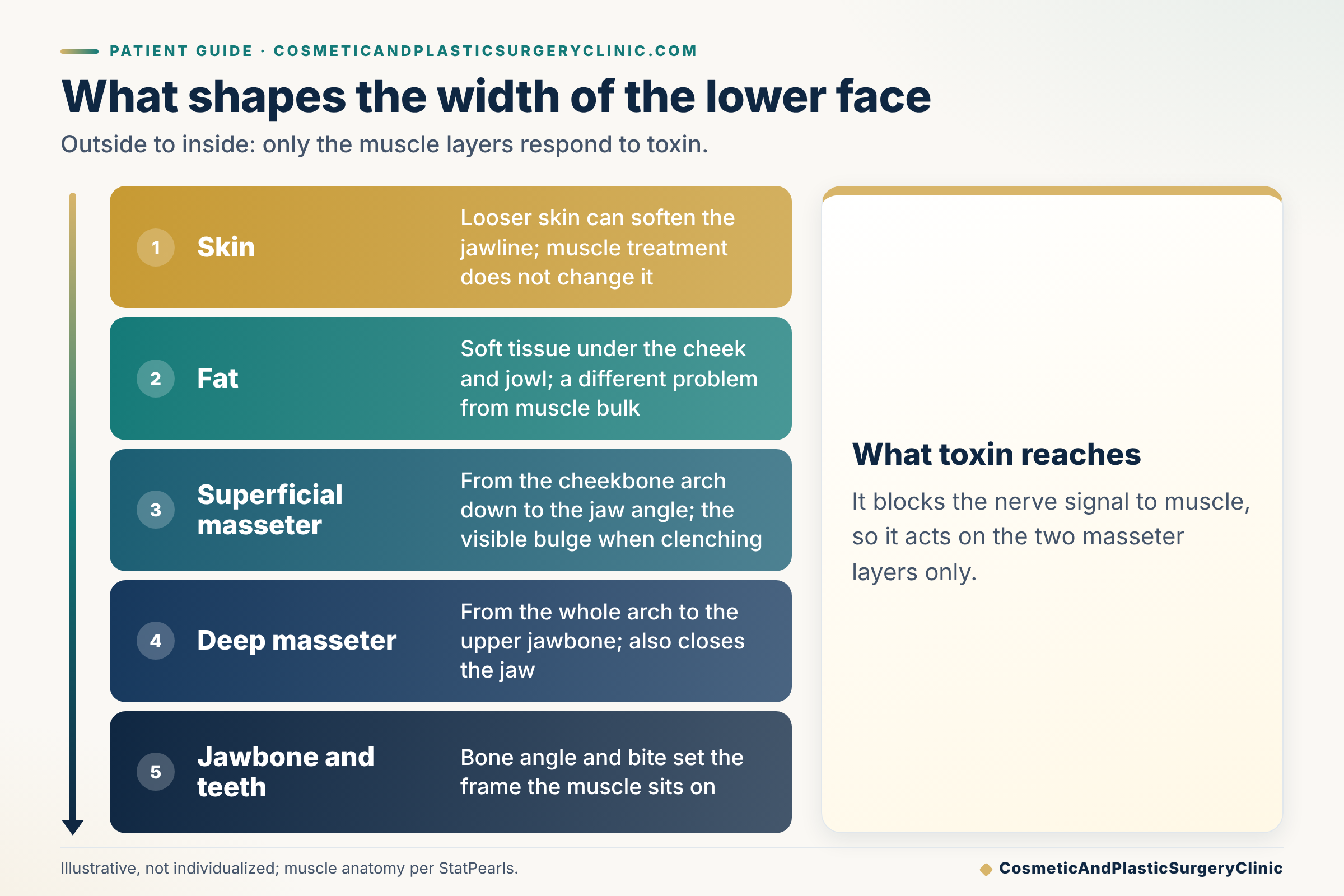
StatPearls describes a superficial portion and a deep portion. The superficial fibers start from the zygomatic arch (the cheekbone’s bridge toward the ear) and run down and back to the angle and lower side of the mandible. The deep portion starts from the whole arch and attaches higher up the ramus, the vertical part of the jawbone. Its main job is to lift the lower jaw and close the mouth, and it is supplied by the masseteric nerve, a branch of the trigeminal nerve.
What masseter Botox can and cannot reach
Botulinum toxin blocks the signal that tells a muscle to contract, so it acts on muscle and not on bone, skin or fat. That is why masseter Botox can only change the part of lower-face width that comes from muscle bulk, and why weakening a muscle used for chewing has functional consequences. StatPearls notes that benign masseter enlargement is described most often in people of Asian descent and is a common target of cosmetic requests.
Four things that can widen a jawline
A clinician sorts the contributors by looking, feeling the muscle while you clench, and sometimes reviewing the teeth and bite. Several can be present at once.
Muscle bulk and clenching habits
A muscle that is used hard tends to be bulkier. People who clench or grind, or who chew heavily on one side, may show a firm bulge near the jaw angle when they bite down. That bulge is the kind of finding a masseter Botox plan is built around. A jaw that looks wide only at rest, with little bulge on clenching, points elsewhere.
Bone, teeth and bite
The shape of the mandible, how the teeth meet and the position of the jaw all affect width and are unaffected by a muscle relaxant. If the angle of the bone itself flares outward, weakening the muscle in front of it will narrow the contour only slightly, if at all. This is why a dentist or an oral and maxillofacial specialist is sometimes part of the assessment.
Fat and skin in the lower face
A fuller lower face can also come from soft tissue: fat under the cheek, jowl tissue, or looser skin that drops toward the jawline. Muscle treatment does nothing for these, and they are handled by other options such as those compared in facelift alternatives. A reasonable consultation names which of the four is likely dominant before suggesting any treatment, including masseter Botox.
Where masseter Botox stands: off-label use, trials and a pending FDA decision
Masseter treatment is common in practice and still thinly regulated on paper. That gap shapes what an informed conversation sounds like.
What off-label means for this treatment
Off-label use is legal and widespread in medicine, but it carries a different kind of assurance than an approved use. It helps to know exactly what the label does and does not say.
The label covers four areas, none of them the jaw
The Botox Cosmetic prescribing information, revised October 2024, lists four adult indications: glabellar (frown) lines, lateral canthal lines (crow’s-feet), forehead lines and platysma bands in the neck. The label does not mention the masseter, so it gives no masseter dose, no expected duration for the jaw and no jaw-specific safety data. Using the product there is off-label.
Questions FDA suggests asking
FDA’s consumer page on off-label use explains that approval reflects a review of a specific use and that FDA has not determined an unapproved use to be safe and effective. Clinicians generally may prescribe a drug for an unapproved use when they judge it appropriate. FDA suggests asking what the drug is approved for, what studies support the proposed use, what the benefits and risks are, and whether an approved alternative exists. Those questions fit masseter Botox well.
What the studies show, and what they leave open
Evidence on masseter Botox has two eras: a long stretch of mixed, mostly uncontrolled work, and a newer set of sponsored controlled trials.
Mixed protocols and uncontrolled series
A 2022 systematic review in the Journal of Cranio-Maxillofacial Surgery pooled 28 studies of masseter Botox and similar toxin injections, with 748 masseter patients. Most used three injection sites per side. Average thinning of the muscle at three months ranged from roughly 12% to 31% depending on protocol, but the authors flagged heterogeneous results, high risk of bias and selective reporting, and suggested using the fewest injection sites possible until better evidence exists. The take-away is that muscle thinning is well documented, while comparisons between techniques are not.
The 2025 placebo-controlled trial
Liew and colleagues reported a randomized, double-blind Phase 2b trial in Aesthetic Surgery Journal in 2025: 150 adults with marked masseter prominence at 14 US sites, funded by Allergan Aesthetics. At day 90, about 91% of onabotulinumtoxinA-treated participants had an investigator-rated improvement to a milder grade, versus 21.7% with placebo. Lower-face width fell by about 4 to 5 mm against almost none with placebo. By day 180 the share with a two-grade improvement was 36% to 48%, versus 11%. The authors noted a fairly high placebo response and a population that was mostly White and female.
| Situation | Pathway often discussed | What it may offer | Trade-off | Key question |
|---|---|---|---|---|
| Visible muscle bulge when clenching | Masseter Botox after an examination | Gradual thinning and a slimmer lower-face contour in trial data | Weaker bite, repeat visits, off-label use | How much of my width is muscle? |
| Wide jaw at rest, firm bony angle | Dental or jaw-structure assessment first | A clearer picture of the cause | A muscle injection may change little | Could bone be the main driver? |
| Sore, tired jaw muscles from clenching | Dentist or orofacial pain review, self-care and splints before toxin | Toxin is studied for sleep bruxism in small trials | Limited evidence; chewing effects | What was tried before an injection? |
| Full lower face with little muscle bulk | Discussion of fat, skin and lower-face support instead | A plan matched to the likely cause | Muscle weakening would not address the cause | How did you judge muscle versus fat? |
| Unsure about a lasting commitment | Waiting, or one treatment with a plan to observe | Effects fade on their own | Recovery of muscle size varies between people | What is my plan if I dislike it? |
Two regulatory timelines
The regulatory picture differs by country, and the difference is worth understanding before a headline persuades anyone that the jaw is an approved use here.
China’s 2024 approval
Allergan Aesthetics announced in September 2024 that China’s National Medical Products Administration had approved Botox Cosmetic for masseter muscle prominence in adults, describing it as the first neurotoxin approved for that purpose. The trade report on the announcement describes dosing about every six months. That approval concerns one product, one indication and one country; it does not change the US label.
The FDA application accepted in August 2026
On August 4, 2026, AbbVie announced that FDA had accepted a supplemental biologics license application for Botox Cosmetic for marked to very marked masseter muscle prominence in adults. Two Phase 3 trials, M21-416 and M21-417, met their primary endpoints versus placebo according to the company; enrollment numbers and doses were not disclosed, and no decision date was stated. As of the sources checked on November 12, 2026, it is not approved.
The injection visit and how masseter Botox plays out over months
A masseter Botox visit is short, but the decisions around it are not. What happens before the needle, during it and across the following six months determines whether the treatment suits the goal.
Assessment before any needle
A careful visit is mostly looking, touching and asking. The injection itself is the shortest part of the appointment.
Clench test, bite and dental history
The clinician usually feels the muscle at rest and while you bite down, compares the two sides, and asks about grinding, jaw pain, clicking and recent dental work. Photos from the front and sides, and from slightly below, help document the starting point. Expect questions about habits such as gum chewing or favoring one side, because they change how the plan is explained.
Medicines, pregnancy and other screening points
The label for Botox Cosmetic lists infection at the injection site and known allergy to any botulinum toxin product as contraindications. It also cautions about aminoglycoside antibiotics and similar agents that affect nerve-to-muscle signaling, because the toxin’s effect may be increased. Bring a full medication and supplement list, and say if you are pregnant, planning pregnancy or breastfeeding; the label says data are lacking for both situations.
Injection plan: points, depth and the dose question
Masseter Botox is planned as a map over the muscle, not as one injection. The dose question is where numbers circulate that do not transfer between people or products.
How many sites, and why the pattern matters
The 2022 review found three sites per side to be the most common choice but no clear winner among protocols. A 2024 international consensus on one abobotulinumtoxinA product, written by ten clinicians with industry funding and labeled expert opinion, describes a pyramid-shaped pattern and warns that injecting just beneath the cheekbone can affect smile muscles. Treat that as one panel’s view, not a standard.
Reading dose numbers without chasing them
The Botox Cosmetic label gives 20 units for frown lines. The two dose levels in the 2025 Phase 2b masseter trial were each more than double that, which tells you the jaw is a high-unit area, and the label states that its units cannot be converted to another brand’s. Dose is therefore a clinician’s decision after examination, and a quoted number from one clinic or product says little about another. Our guide to Botox, Dysport and Xeomin explains why units differ.
A timeline measured in weeks and months
Botulinum toxin works gradually, and a bulky chewing muscle thins even more gradually. Early photos mislead; judging too soon is a common reason for disappointment.
Onset and the slow slimming curve
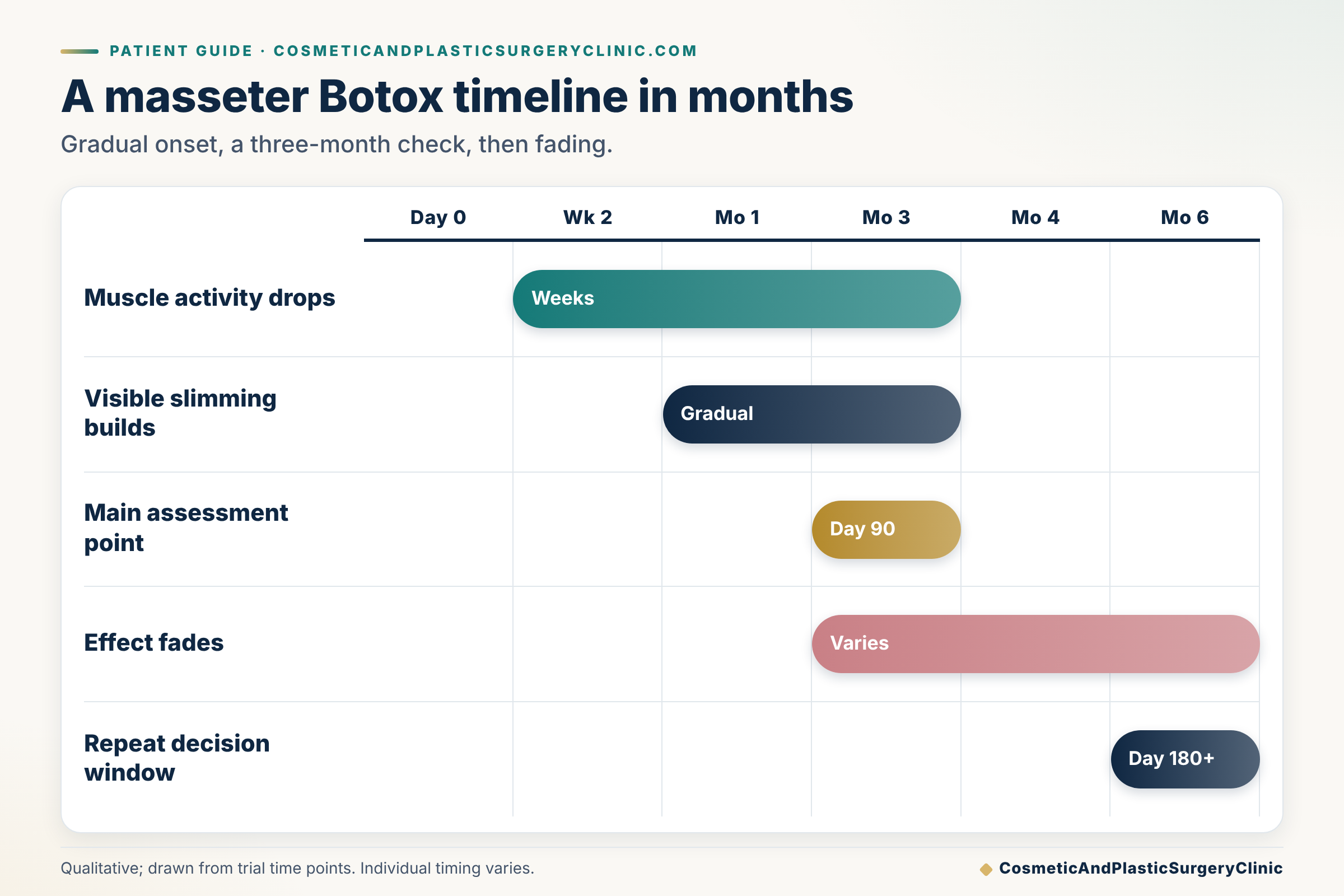
In a 2024 randomized trial of masseter treatment in 26 women, published in Scientific Reports and using abobotulinumtoxinA, ultrasound showed the masseter already thinner at one month and electrical activity of the muscle sharply reduced. In the Phase 2b trial the primary comparison came at day 90. Visible change in the lower face therefore tends to build over weeks and is judged at around three months, though individual timing varies and neither trial promises a particular result for a given person.
Fading, repeat visits and the maintenance bill
Effects wear off. In the Phase 2b trial the share of participants with at least a two-grade improvement dropped from 66% to 72% at day 90 to 36% to 48% at day 180. The Phase 3 registry entry describes optional retreatment between days 180 and 270. Because masseter Botox is rarely a one-time plan, think of it as a recurring treatment with a recurring cost; the pricing logic is in Botox cost.
| Factor | Effect on outcome | Maintenance implication | Review point |
|---|---|---|---|
| Starting prominence | The 2025 trial enrolled only marked prominence (grades 4 or 5); milder cases are less studied | Smaller visible change may be easier to over- or under-read | Ask which grade of prominence you have and why |
| Time since injection | Responder share fell between day 90 and day 180 in the Phase 2b trial | Plan the next visit around fading, not a calendar habit | Photograph at the same angles at each visit |
| Number of sessions | In the 2024 Brazilian trial, a second injection left the left masseter thinner at six months and reduced muscle activity | Repeat sessions extend the weakness; the authors report functional effects | Ask how bite strength is checked between visits |
| Jaw and bone health | Studies disagree on bone density changes after repeated injections | Repeated treatment adds exposure to an unsettled question | Report new joint pain, clicking or locking |
| Smile and neighboring muscles | Three participants in the 2025 trial had smile-related effects that resolved over roughly two to three months | Placement can be adjusted at the next visit | Report an uneven or odd smile promptly |
| Product and units | Units are specific to each brand, per the label | Keep a record of product, dilution and units used | Re-plan when switching products or clinics |
Chewing, smile and bone: the functional trade-offs of masseter Botox
Every effect of masseter Botox follows from one mechanism: a weaker chewing muscle. The slimming and the side effects come from the same change, so the trade-off cannot be negotiated away.
Weaker bite is the mechanism, not a side issue
Patients are sometimes told that chewing will not change after masseter Botox. The trials describe it differently, and a clear-eyed plan starts with that.
What the 2024 Brazilian trial measured
The Scientific Reports trial randomized 26 women with masseter hypertrophy and measured muscle thickness, muscle electrical activity and masticatory performance. Masticatory performance was significantly lower than baseline in both groups at every follow-up through six months, and the authors concluded that repeated injections cause functional adverse effects. The trial was small, with 22 completers and women only, and its masseter-thickness findings were mixed between sides.
Hard foods, gum and jaw fatigue
In everyday terms, expect a muscle that tires sooner. Tough meat, chewy bread and gum can feel like more work for a period after treatment. The 2024 consensus panel tells injectors to assess muscle mass and adjust doses because crunching power and chewing ability may be affected. That is the reason to ask in advance how you will be checked, and what a plan would look like if chewing bothers you.
Smile changes and neighboring muscles
The masseter sits close to muscles that shape the smile. Unwanted spread to them is uncommon in the trials opened, but it is the most face-visible functional effect.
Why placement near the cheekbone matters
The zygomatic muscles, which help lift the corners of the mouth when you smile, lie near the upper front edge of the masseter. The consensus panel warns that injecting just under the cheekbone can affect them and create an awkward expression when smiling. Placement depth and distance from that area are technique questions worth asking about directly.
How long smile effects lasted in the 2025 trial
In the Phase 2b trial, smile-related effects occurred in three of the toxin-treated participants and resolved over 60 to 101 days. Overall, 31.4% of treated participants reported any adverse event versus 25% with placebo, most commonly colds, and none stopped because of one. Small numbers cannot rule out rarer problems; the full list of effects is in Botox side effects.
The bone question, with studies that disagree
A muscle that does less work can lead to thinner bone where it attaches. Whether that happens meaningfully after cosmetic masseter Botox injections is unresolved, and the available studies point in different directions.
Retrospective data from patients with jaw-muscle pain
Hong and Kang reported in Scientific Reports in 2020 a retrospective study of 77 women with myofascial temporomandibular disorder, using CT at baseline and 12 months after toxin injections at baseline and six months. Post-menopausal women showed decreases in bone density at the ramus and coronoid process, while younger women did not at those sites; condyle changes appeared in both ages. The authors cited limits: one center, group choice by patients, no systemic bone density data.
A sponsored CT analysis and animal work
A 2025 Aesthetic Surgery Journal analysis by Kostenuik and colleagues, funded by Allergan Aesthetics, examined CT scans of 123 participants, mostly Asian women averaging about 35 years old, and found bone density changes within the variation seen with placebo after one or two rounds. People with a history of temporomandibular disorders were excluded, and the method cannot give absolute bone density. A 2011 study in growing rats, in European Journal of Orthodontics, found thinner cortical bone after toxin injection into chewing muscles. Neither settles the question for an adult considering a cosmetic injection.
Clenching, bruxism and jaw pain: when the goal is function, not contour
Some people come to masseter Botox for a sore, tight jaw rather than a slimmer one. The evidence for that goal is separate from the cosmetic evidence, and a different clinician often belongs in the conversation.
What the bruxism trials can support
Bruxism means grinding or clenching the teeth, awake or asleep. Masseter Botox and related injections have been tested for it in small studies, with encouraging but limited results.
Sleep bruxism: small trials, mixed measures
Ondo and colleagues reported a randomized trial in Neurology in 2018: 23 adults randomized, treated in the masseter and temporalis muscles, with global impression and pain scores favoring toxin at four to eight weeks. Counts of grinding episodes did not change significantly, and two treated participants noticed a change in their smile. A 2017 systematic review in Clinical Oral Investigations found three randomized and two uncontrolled studies, all small. Objective measures showed no fall in the number of episodes, but weaker muscle contractions.
Awake clenching has almost no trial data
None of the five studies in that 2017 review addressed awake bruxism, the daytime clenching that many people notice while concentrating or driving. A jaw that aches from daytime clenching may respond to habit awareness, relaxation work or a splint, none of which involve a needle. Calling a cosmetic masseter Botox plan a treatment for clenching stretches what the trials support.
Why a dentist or orofacial pain clinician comes first
Jaw pain has many causes, and an injection can mask or complicate a diagnosis made later. A dental review before treatment keeps options open.
TMD care before any injection
The National Institute of Dental and Craniofacial Research (NIDCR) says temporomandibular disorders, a group of more than 30 conditions of the jaw joints and chewing muscles, affect about 5% of US adults and are about twice as common in women. Many are temporary. NIDCR lists soft foods, heat or cold with gentle stretching, and reducing clenching and gum chewing as first steps, with physical therapy, behavioral approaches and nightguards beyond that.
Reversible steps ahead of irreversible ones
NIDCR’s page, last reviewed in September 2026, says botulinum toxin is not FDA-approved for temporomandibular disorders and that studies have had mixed results. It advises trying simpler treatments first and getting a second opinion before any procedure that changes the joints, teeth or bite. A masseter injection is reversible in time, but a plan to treat pain should still be weighed against those simpler options.
Reasons to hold off or ask more questions
Waiting is a legitimate outcome of a masseter Botox consultation. Several situations argue for it, and a few are written into the label.
Label cautions worth hearing aloud
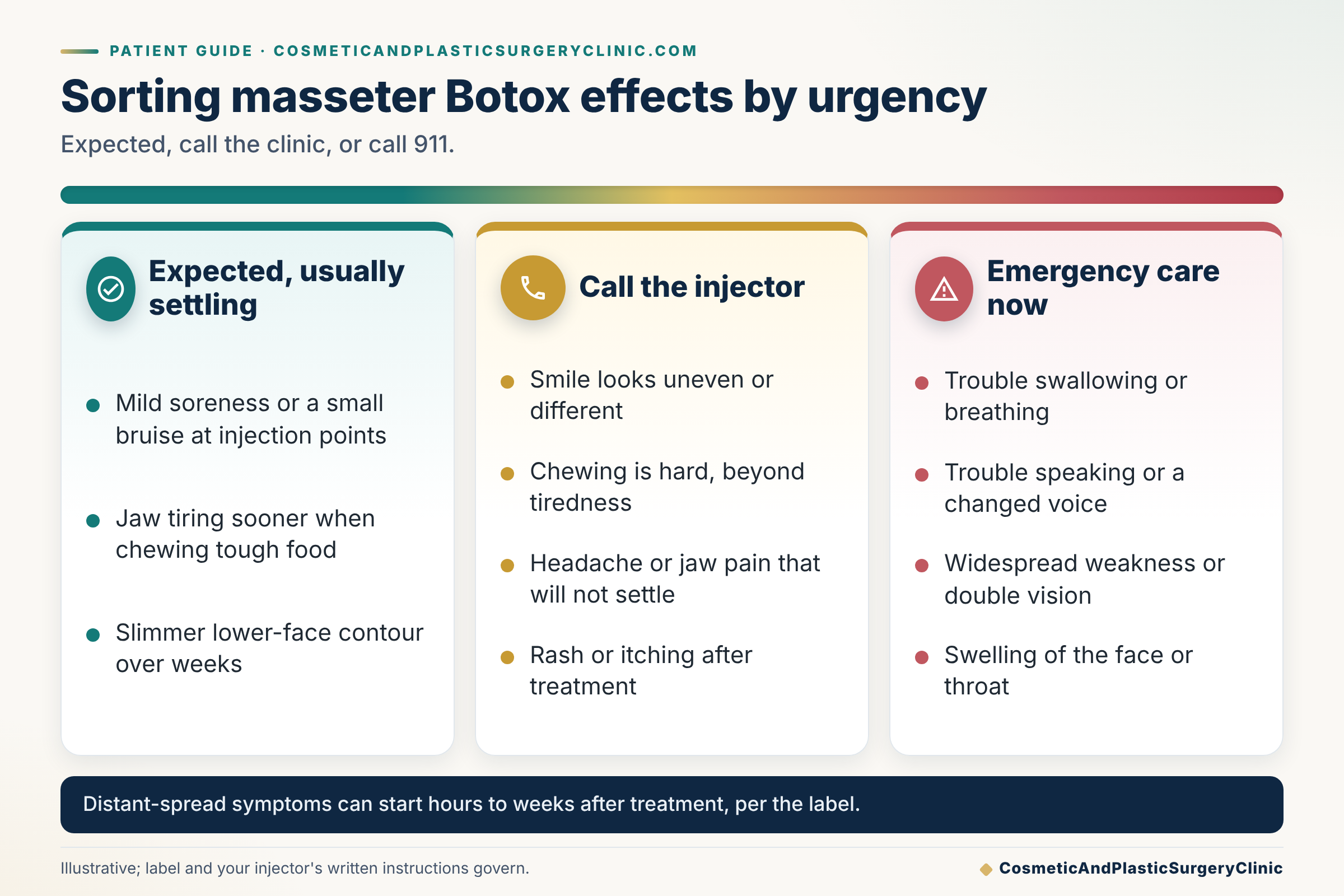
The boxed warning says people with predisposing conditions can be affected by distant spread, and that people with existing swallowing or breathing difficulties may be more susceptible to those complications. Infection at the injection site and known allergy to botulinum toxins rule treatment out. Any history of reactions to a past botulinum toxin injection should be shared with the clinician. For the general safety picture across procedures, see plastic surgery risks.
Goals the muscle cannot meet
Masseter Botox is a poor match for a jaw that is wide from bone, a lower face that is soft from fat or skin, or a deadline measured in days. Results are judged around three months, and the trials enrolled people with marked prominence, so a subtle difference may be hard to see in photos. Hoping to look different for an event in two weeks is a reason to wait, not to rush.
Choosing who injects, what it costs and what else could help
Most of the avoidable disappointment with masseter Botox traces back to a few choices: who examines you, how the price is built, and whether the cause was identified at all.
Credentials, setting and consent
Botulinum toxin is a prescription biologic, and rules about who may inject it vary by state. For masseter Botox, a licensed, trained clinician working in a medical setting is the baseline; the specialty matters less than experience with the lower face and with problems that arise.
Questions for the injector
Bring a short list. How do you tell muscle from bone and fat in my face, and what did you find? Which product do you plan to use, and how many injection sites? How will you check my bite and smile after treatment, and what is the plan if either changes? What is your approach to repeat visits? The first visit can be a conversation only, as described in plastic surgery consultation questions.
Off-label consent in plain words
A good consent conversation states that the product is not approved for the masseter in the United States, what evidence supports the use, which effects are expected, and which would be reasons to call. You should be able to ask for it in writing. For help confirming training and licensing, see how to choose a plastic surgeon and cosmetic surgeon credentials.
| Claim you may hear | What the sources say | A better question |
|---|---|---|
| “It is FDA-approved for jaw slimming.” | The 10/2024 label lists four other areas; an application for masseter prominence was accepted in August 2026 but is not approved | Is this use off-label, and what studies support it? |
| “The muscle shrinks for good.” | Trial responder rates fell between day 90 and day 180; recovery of thickness varied in a small 2024 trial | How long should I expect results, and what happens as they fade? |
| “Chewing will not change.” | A 2024 randomized trial found lower masticatory performance at every follow-up; a 2024 consensus advises checking chewing ability | How will you check my bite before and after? |
| “It is proven safe for the jawbone.” | A 2020 retrospective study and a 2025 sponsored CT analysis point in different directions; neither settles the question | Which studies do you rely on for bone, and what are their limits? |
| “It treats TMJ pain and grinding.” | NIDCR says it is not approved for temporomandibular disorders and effectiveness is unclear; bruxism trials are small | Has a dentist or pain clinician assessed my jaw first? |
| “Everyone gets the same dose.” | Units are brand-specific per the label; the consensus dosing is expert opinion tied to one product | What determines my units and sites, and why? |
How masseter Botox is priced
No national average masseter Botox price is offered here. The ASPS 2024 statistics report, as opened for this page, counts neuromodulator procedures but gives no fee for them, and no other source opened here gave a masseter price.
Units, visits and the yearly total
Clinics price by unit, by area or by visit. Because the jaw is a high-unit area, a unit-based quote for it will tend to exceed a quote for frown lines, all else equal. The yearly total depends on how often treatment is repeated, which depends on how long effects last for you; how long Botox lasts covers the fading logic. Ask for a written estimate that names the product, the units and the visit schedule.
Why the cheapest quote deserves questions
A low price can reflect fewer units, a different product, a less experienced injector or a setting without medical oversight. None of those is visible in the quote. Ask what product and how many units are included, who injects, and what happens if the result is uneven. A lower price for fewer units may not be a lower price for the same plan.
Alternatives and neighboring options in the lower face
Doing nothing is an option, and so is treating something other than the muscle. A consultation that only offers a single path is a reason to seek a second opinion.
No treatment, or care for the jaw first
For clenching and soreness, NIDCR’s first steps cost little and reverse easily. For width alone, many people decide that a square jaw is simply their face. Many people also start with habit changes and a dental review before committing to a recurring injection.
Other lower-face options and reading photos
Fat, skin and jowling call for different tools, summarized in facelift alternatives. Neck bands are a separate muscle, and neck tightening vs neck lift covers that choice. When judging photos from a clinic, ask for clenched and relaxed views taken at the same angle and distance, and read them with the help of Botox before and after photos and before-and-after photo basics.
Frequently asked questions
Do the masseter Botox trial results apply to me?
Possibly, but check who was studied in the masseter Botox trials. The 2025 Phase 2b trial enrolled adults with marked prominence and a body mass index of 30 or lower, and about 90% were women. The 2025 bone analysis was mostly Asian women with an average age near 35, and the 2024 Brazilian trial enrolled women only. Men, people with milder prominence and people with jaw disorders are less represented. Ask the injector which studies they rely on and how those participants compare with you.
Can masseter Botox be used during pregnancy or breastfeeding?
The Botox Cosmetic label says there are no adequate human data on use in pregnancy, and animal studies showed reduced fetal body weight and skeletal ossification at doses that also caused maternal toxicity. For breastfeeding it says there are no data on the presence of the product in milk and advises weighing the benefits of nursing against the mother’s clinical need. Because masseter treatment is elective and off-label, many people reasonably wait. Raise any pregnancy plans before treatment, not after.
Will the muscle return to its old size if I stop masseter Botox?
Evidence is limited and varies. In the 2024 Brazilian trial, the group that received a saline booster saw masseter thickness recover between one and six months, while the group given a second toxin injection did not recover by six months. The trial was small and the effect differed between sides. Expect effects to fade, but do not expect a precise timeline; how fast bulk returns for any one person is uncertain.
Does insurance ever cover masseter Botox?
Coverage rules differ by plan, and no authoritative coverage data were found for this page. Cosmetic jaw slimming is generally elective, and NIDCR notes that botulinum toxin is not FDA-approved for temporomandibular disorders. If pain is the goal, ask your insurer about prior authorization in writing before treatment, and ask the clinician which diagnosis would be documented.
Does China’s approval of masseter Botox make treatment abroad safer?
No. A regulator’s approval of masseter Botox covers a particular product, indication and set of instructions in that country, and it says little about a particular clinic’s training, setting or follow-up. A product made for one market may also differ in labeling and units from the one used at home. If you travel for treatment, plan for who will manage problems after you return; our guide to medical tourism covers continuity of care.
What does “responder” mean in masseter Botox trials?
It means a participant whose rating met a preset improvement threshold, not someone who is pleased with a photo. In the Phase 2b trial, an investigator scored prominence on a five-grade scale, and a responder was rated at grade 3 or lower. Placebo response was fairly high, 21.7% by the investigator and 47.8% by participants, which the authors partly attributed to the difficulty of judging three-dimensional change on a two-dimensional scale. Judge any gallery photo with that scale in mind.
How often can masseter Botox be repeated?
No US label sets a masseter interval. The Botox Cosmetic label says safety and effectiveness of dosing more often than every three months have not been clinically evaluated for its approved areas, and the Phase 3 registry entry describes optional retreatment from day 180 to day 270. A trade report on China’s approval describes dosing about every six months. These are context, not a schedule; your injector sets timing after examining the muscle and your response.
What is distant spread, and why does it matter for masseter Botox?
Distant spread means the toxin’s effect reaches muscles away from the injection site. The Botox Cosmetic boxed warning lists generalized weakness, double vision, drooping eyelids, speech and voice changes, loss of bladder control and swallowing or breathing difficulty, which can start hours to weeks after treatment. The label says the risk is probably greatest in children treated for spasticity, though adults with predisposing conditions can also be affected. The 2025 Phase 2b trial reported no evidence of distant spread, in a trial of 150 people.
Sources and further reading
- AbbVie / Allergan Aesthetics — FDA acceptance of supplemental biologics license application for BOTOX Cosmetic for masseter muscle prominence, Aug 4, 2026 (accessed 2026-11-12) — sBLA accepted, not approved; Phase 3 results; no decision date
- Dermatology Times — FDA accepts sBLA for onabotulinumtoxinA in masseter muscle (accessed 2026-11-12) — independent report; enrollment and dosing not disclosed
- Plastic Surgery Practice — FDA accepts application for Botox to treat masseter muscle prominence, Aug 2026 (accessed 2026-11-12) — status and fifth-indication context
- Modern Aesthetics — Allergan Aesthetics launches Botox for masseter muscle prominence in China, Sept 2024 (accessed 2026-11-12) — China approval; not FDA-approved for this use
- AbbVie — BOTOX Cosmetic prescribing information, revised 10/2024 (accessed 2026-11-12) — indications, boxed warning, contraindications, pregnancy and lactation, 20-unit glabellar dose, units not interchangeable
- Cochrane Database of Systematic Reviews — Botulinum toxin for masseter hypertrophy, 2013 (PubMed record, accessed 2026-11-12) — no controlled trials found as of April 2013
- Liew et al., Aesthetic Surgery Journal 2025 — Controlled Phase 2b trial of onabotulinumtoxinA for masseter muscle prominence (accessed 2026-11-12) — responder rates, width change, smile effects, adverse events; Allergan-funded
- Kostenuik et al., Aesthetic Surgery Journal 2025 — Longitudinal CT of mandibular bone density after onabotulinumtoxinA in masseter muscle prominence (accessed 2026-11-12) — bone density within placebo variation; sponsor-funded; limits
- Hong and Kang, Scientific Reports 2020 — Decreased mandibular cortical bone quality after botulinum toxin injections in masticatory muscles in female adults (accessed 2026-11-12) — retrospective TMD cohort with CT bone changes
- Tsai et al., European Journal of Orthodontics 2011 — Bone changes in the mandible following botulinum neurotoxin injections (abstract record, accessed 2026-11-12) — growing-rat study; animal evidence only
- Scientific Reports 2024 — Exploring botulinum toxin’s impact on masseter hypertrophy: a randomized, triple-blinded clinical trial (accessed 2026-11-12) — thickness, muscle activity, masticatory performance; small sample
- Journal of Cranio-Maxillofacial Surgery 2022 — Botulinum toxin type A injections for masticatory muscles hypertrophy: a systematic review (database record, accessed 2026-11-12) — 28 studies, injection-site protocols, bias and heterogeneity
- Ascher et al., Aesthetic Surgery Journal 2024 — International consensus recommendations on aesthetic use of ready-to-use abobotulinumtoxinA (accessed 2026-11-12) — expert-opinion masseter section: smile muscles and chewing; industry-funded
- Ondo et al., Neurology 2018 — Onabotulinum toxin-A injections for sleep bruxism: a double-blind, placebo-controlled study (record, accessed 2026-11-12) — small randomized trial in sleep bruxism
- Clinical Oral Investigations 2017 — Is there enough evidence to use botulinum toxin injections for bruxism management? A systematic literature review (PubMed record, accessed 2026-11-12) — three randomized and two uncontrolled studies, all sleep bruxism
- NIDCR — TMD (temporomandibular disorders), last reviewed September 2026 (accessed 2026-11-12) — prevalence, conservative care, botulinum toxin not approved for TMD
- StatPearls — Anatomy, Head and Neck, Masseter Muscle (accessed 2026-11-12) — layers, attachments, function, innervation
- FDA — Understanding unapproved use of approved drugs “off label” (accessed 2026-11-12) — meaning of off-label use and questions to ask
- ASPS — 2024 procedural statistics press release (accessed 2026-11-12) — 9,883,711 neuromodulator injections, up 4%
- ASPS — Plastic Surgery Statistics Report 2024 (accessed 2026-11-12) — procedure counts; includes non-member dermatologists and otolaryngologists; no neuromodulator fee
- AbbVie Clinical Trials — Study M21-416, BOTOX for masseter muscle prominence (accessed 2026-11-12) — Phase 3 design, US sites, optional retreatment window


