
Anyone researching facelift cost quickly runs into a problem: the published numbers don’t agree with each other, and the quotes that practices give don’t line up with the published numbers. One national survey reports an average near $9,000, another reports a projected range that starts at $12,000, and a practice down the road may quote a single package figure that is higher than both. A facelift (rhytidectomy, the surgical lifting and repositioning of sagging tissue in the lower face and neck) is priced in layers, and different sources count different layers.
This guide is written for the cost-conscious researcher who wants to read those numbers correctly. It explains what the surgeon’s fee does and doesn’t include, why the technique and the extent of the operation move the price, how the facility and anesthesia arrangement changes the bill, what financing and tax rules look like for an elective procedure, and how to line up two or three quotes so the comparison is honest. It does not predict what you would pay, because no article can. That requires an examination, a surgical plan, and a written quote.
If you are still deciding whether the operation itself fits your goals, start with the broader facelift guide, which covers what the surgery changes and what it leaves alone. Here the question is narrower and more practical: what will you be asked to pay, to whom, and when?
A note on how numbers are used below. Dollar figures appear only where a source gives a year and describes what it measured. Where a fact could not be verified, the article says so in words and flags it for editorial follow-up. Where an example is invented to illustrate a decision, it is labeled illustrative and carries no prices.
One more framing point. Wanting to understand cost carefully before surgery is not shallow; it is part of making a sound decision. It is also true that price is the easiest variable to compare and the hardest to compare fairly, because the quote that looks cheaper may leave out the very item the more expensive quote includes. The sections that follow aim to make the comparison accurate, not to nudge you toward the highest or the lowest number.
What a Facelift Quote Is Actually Pricing
A facelift isn’t a single purchase. It is a bundle of professional services, a physical space, equipment, medications and aftercare, supplied by several parties who may or may not send separate bills. Before any national figure makes sense, it helps to pull the bundle apart. Every confusing facelift quote is confusing in the same way: it shows some pieces and leaves others for later.
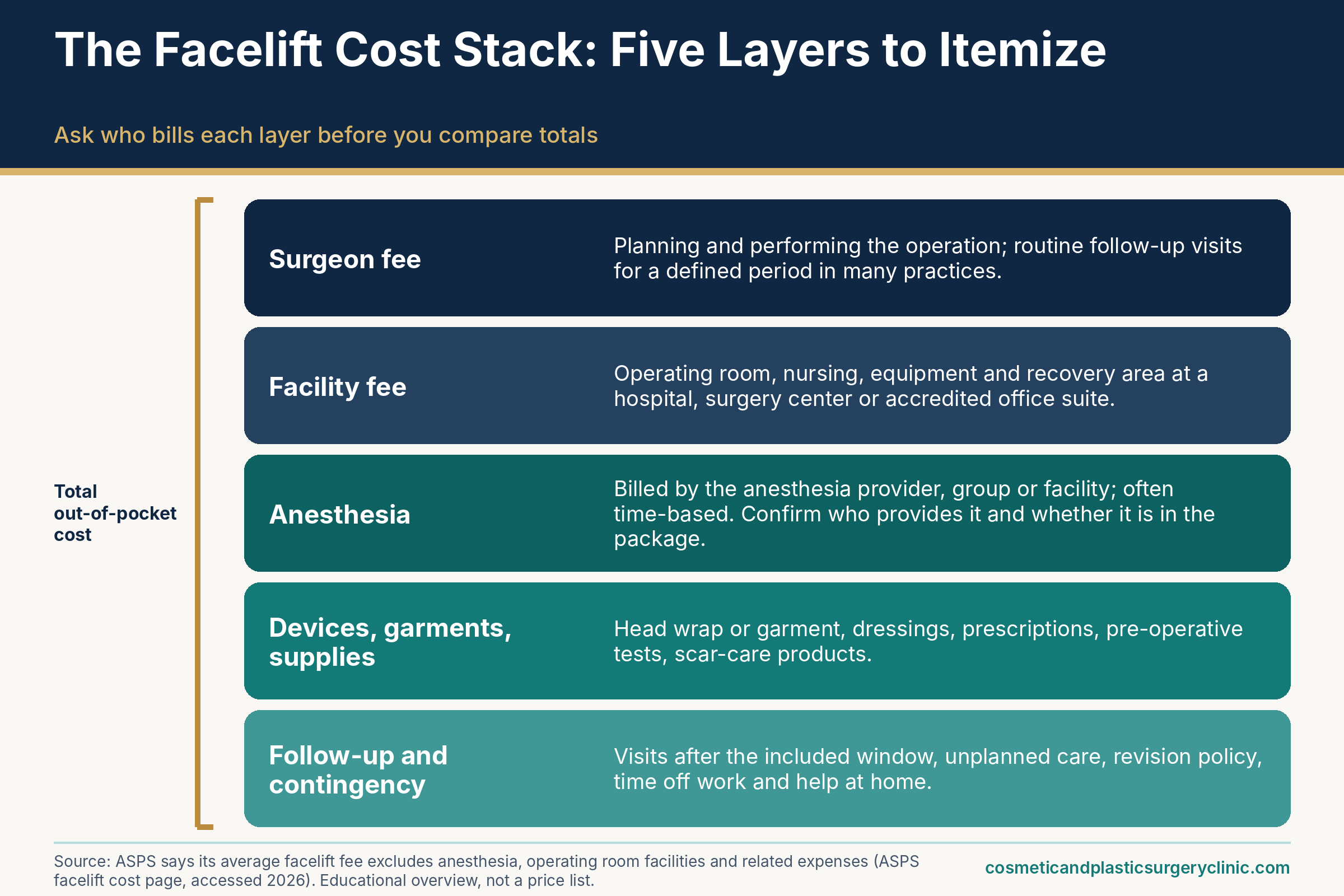
The Facelift Cost Stack, Layer by Layer
Think of the total as a stack of five layers: the surgeon’s fee, the facility, anesthesia, devices and supplies, and the follow-up and contingency layer. Each has a different payee, a different pricing logic and a different set of questions to ask.
The surgeon’s fee and what it usually buys
The surgeon’s fee pays for the surgeon’s professional work: evaluating you, planning the operation, performing it, and, in most practices, a defined run of routine postoperative visits. It doesn’t pay for the room, the anesthesia team or the garment you’ll wear afterward. ASPS states on its facelift cost page that a surgeon’s fee for facelift surgery is based on the surgeon’s experience, the type of procedure used and the geographic location of the office. Those three drivers show up again and again in this guide, and none of them is a quality score. Experience and technique can justify a higher fee. A high-rent location can raise a fee without saying anything about the care you’d receive.
What the fee covers in practice differs from one office to the next. Some practices fold the first few weeks of dressing changes, suture removal and check-ups into one number. Others charge for visits beyond a set window. A few price the “facelift” and the neck portion separately, and a few treat the neck as part of the base operation. None of these arrangements is wrong, but they make a two-line comparison unreliable until you know which one you’re looking at.
The same fee also usually assumes a particular plan. If the plan changes in the operating room, say the surgeon decides a different technique or an added step is warranted, ask whether the fee is fixed or adjusts. That single question, answered in writing before you pay a deposit, prevents most mid-process surprises.
Facility, anesthesia, supplies and aftercare
The facility fee pays for the operating room and the people and equipment around it: nurses, sterile instruments, monitoring equipment and the recovery area. Facilities calculate it in different ways, including by reserved block of time, as a flat case rate, or as part of a package. Because a facelift is a multi-hour operation and the length depends on what’s being done, facility charges commonly track the scope of the surgery.
Anesthesia is a separate professional service. ASPS says the choices for a facelift are intravenous sedation and general anesthesia, and who delivers it varies by practice and setting, so the arrangement deserves a direct question. The anesthesia bill may come from a group, from an individual provider or through the facility, and it is often time-based.
The supply layer is the one patients most often forget. It can include a head wrap or compression garment, dressings, prescriptions, pre-operative laboratory work or a medical clearance visit, and sometimes scar-care products. ASPS notes that a bandage is typically applied after a facelift and that small tubes may be present to draw off excess blood or fluid, so these are ordinary parts of the process and not exotic add-ons. ASPS also lists medical tests, post-surgery garments and prescriptions among the components of total cost.
Finally there’s the contingency layer: visits beyond the included window, wound care, any unplanned treatment and the practice’s revision policy. ASPS says most health insurance plans don’t cover facelift surgery or its complications, so for a cosmetic facelift the realistic planning assumption is that you carry that layer yourself unless the practice’s written policy says otherwise.
Reading Published Facelift Cost Figures Without Being Misled
Published averages are useful and easy to misuse. Two habits make them safer: ask what each number measured, and refuse to compare numbers that measured different things.
Four published numbers, four different questions
When this guide was prepared, four U.S. facelift figures from professional societies were findable and checkable. They look like they should line up. They don’t, and the reasons are mostly about definitions rather than about prices changing.
| Source and year | Figure | What the source says it covers | How to use it |
|---|---|---|---|
| ASPS average surgeon/physician fees, 2022 | $9,281 average | Excludes anesthesia, operating room facilities and related expenses | Older single-number benchmark for the surgeon’s fee layer only |
| Aesthetic Society databank statistics, 2022 | $9,679 average | Described as standard procedure costs (surgeon and facility fees); excludes anesthesia, tests, prescriptions, garments, miscellaneous | A second society’s view; its scope is not the same as ASPS’s |
| ASPS facelift cost page, no year shown | $11,395 average | Excludes anesthesia, operating room facilities and related expenses | Undated, so it can’t be tied to a reporting period; treat as context |
| ASPS average surgeon/physician fees, 2024 | $12,000 to $19,000 projected range | Aggregate projection from averages submitted by surveyed ASPS member surgeons; reflects geography and practice setting | Latest dated fee figure verified for this guide; a range, not an average |
Read the table from the bottom up for the most current picture. The 2024 ASPS fee document is the most recent dated source, and it presents a projected range rather than one price. ASPS says it changed the presentation to reflect the varied geography and practice settings of its members. The report doesn’t state whether anesthesia or facility charges are inside the range, so this guide treats it as a surgeon-and-physician fee benchmark, consistent with how ASPS describes its other cost figures.
Why you can’t add, subtract or trend these numbers casually
It is tempting to line up $9,281 in 2022 and a range starting at $12,000 in 2024 and call it a price increase. That inference isn’t safe. The earlier figure is a single average and the later one is a projected range from a changed method; they are different instruments. The Aesthetic Society’s 2022 number comes from a different databank and, by the way its page describes it, includes facility fees that the ASPS 2022 figure leaves out. And the undated $11,395 average could come from any recent reporting period.
The sources also reflect who answered the survey. These are member surveys of two professional societies, so they describe surgeons who belong to those groups and chose to report. They say nothing about practitioners outside the societies, and none of them can capture a bundled package price that folds in the facility and anesthesia. Third-party “average cost” articles and online calculators are a different category again. Many don’t disclose a year, a sample or a method, which is why this guide doesn’t rely on them.
How a practice presents its price adds another layer of variation. Some itemize every line, some quote one all-inclusive package, some advertise a “starting at” figure that applies to the simplest version of the plan, and some give a price only after an in-person consultation. Each model is legitimate, and each answers a different question. An itemized estimate shows you the parts but invites you to add up bills from several parties. A package shows you a total but can hide which parts are inside. A “starting at” figure tells you the floor, not the likely total. Only the consultation-based estimate reflects your anatomy and plan, which is why a number seen on a website is best read as an invitation to ask, not as a price.
Market size is useful context. The ASPS 2025 statistics report counted 77,933 facelifts in 2025, up 13 percent from 69,097 in 2024, and 27,315 neck lifts, up 21 percent from 22,592. That is a busy field with practices that specialize, package and price in different ways, which helps explain why quotes for the same procedure name can look so different. The 2025 report sections reviewed for this guide did not include a fee table, and the 2025 and 2023 fee documents could not be located, so 2024 is the newest dated fee figure confirmed here.
Finally, remember what an average erases. A range built from a small single-surgeon practice and a large multi-site center in an expensive city may match neither. The practical use of a national figure is to spot an outlier in your own quotes, a number far above or far below the field that deserves a question, not to decide that a quote is fair or unfair.
Technique, Extent and Added Procedures: Why Two Facelift Quotes Describe Different Operations
Ask three practices for a facelift price and you may get three quotes for three different operations that share a name. The word “facelift” covers a family of techniques, a variable amount of neck work and, often, procedures that happen alongside it. Normalizing scope is the single most useful thing you can do to make quotes comparable, and it usually explains more of a price gap than anything else.
How Technique and Extent Change a Facelift Quote
Technique and extent determine how long the operation takes, how much of the face and neck is treated and what the surgeon’s training and experience contribute. Those variables feed the surgeon’s fee, the facility charge and the anesthesia bill at the same time.
Technique names and what they imply for operating time
ASPS describes a traditional facelift incision that begins in the hairline at the temples, continues around the ear and ends in the lower scalp, with an additional incision under the chin sometimes used for the neck. It describes a limited-incision approach with shorter incisions at the temples and around the ear, suited to people with minimal skin laxity and producing a less dramatic change. That distinction alone can change the scale of the operation.
Clinical literature uses more specific names. A StatPearls review of cervicofacial rhytidectomy describes SMAS techniques, which address the superficial musculoaponeurotic system, the layer of tissue beneath facial skin, by folding, overlapping or advancing it. It describes deep-plane techniques, introduced in 1990, which dissect beneath that layer; composite techniques, described in 1991, which pair a deep-plane approach with repositioning of a fat pad beneath the muscle that rings the eye (the SOOF); the minimal access cranial suspension (MACS) lift, developed in 2007, which uses purse-string sutures and shorter incisions; and preservation or “S-lift” approaches that limit skin elevation. For the technique-by-technique comparison, see the guides to facelift techniques and deep plane facelift techniques. Readers whose goals suit a lighter operation may also want the overview of the mini facelift.
Here is the cost logic, stated carefully. More extensive dissection and more components generally mean a longer operation, and a longer operation means more minutes of operating room time and more minutes of anesthesia. What this guide could not find is a verified, published price comparison between named techniques. Statements such as “deep plane costs more than SMAS” circulate widely online, but no authoritative source reviewed here quantifies them. If a practice prices a technique at a premium, the reasonable follow-up is to ask what the premium represents: additional operating time, additional surgeon training, a different facility, or simply the practice’s positioning.
The same caution applies in the other direction. A shorter operation isn’t automatically a better value. ASPS notes that the limited-incision approach suits minimal laxity and produces a less dramatic change. If your anatomy and goals call for more, a lower-priced operation that doesn’t address them can end up costing more once a second procedure is added.
Two illustrative cases show how this works. These are invented for explanation and carry no prices, and they are not suggestions about what anyone should have done. In the first, a person in their mid-forties notices early jowling and a little looseness along the jaw but little skin excess in the neck. A surgeon might discuss a limited-incision or shorter-scar approach, which is a smaller operation with fewer components and less operating time. In the second, a person in their sixties has significant skin excess in the neck, descent of the cheeks and visible bands under the chin. That plan could involve a more extensive technique and a neck component, with longer operating and anesthesia time. If both people receive quotes of the same nominal type, “facelift,” the quotes might still look very different, and each might be reasonable for the plan it describes. The only way to tell is to compare the plans first.
The neck, the midface and the scope of the word “facelift”
ASPS says a facelift addresses sagging skin, deepened fold lines, lost facial fat, jowls and loose neck skin, and it lists the neck lift as a separate procedure with its own page and its own fee line. In the 2024 fee document, a neck lift appears as a distinct entry. That separation is a reminder to ask whether your quote’s “facelift” already includes neck work, and what kind: tightening and redraping of neck skin only, or work on the underlying neck muscle, or a small incision under the chin.
Practices also differ in how they treat the midface, the region of the cheeks beneath the eyes. Some operations include repositioning of midface tissue as part of the base technique, while others treat it as an extra step. Whether a given plan includes it depends on your anatomy and your surgeon’s approach, so the cost question and the clinical question can’t be separated. The table below lists the components that most often decide what a facelift quote contains.
| Component | Why it affects price | Question to ask the practice |
|---|---|---|
| Lower face and jowls | Core of most facelift plans; technique sets operating time | Which technique is planned, and why does it suit my anatomy? |
| Neck skin and contour | May be part of the base operation or billed as a separate neck lift | Is neck work in this quote, and what exactly does it involve? |
| Under-chin incision or fat removal | An extra incision or liposuction adds a step and time | Is a submental incision planned, and is it priced in? |
| Midface repositioning | Additional dissection in some techniques | Is the midface addressed in this plan or left for later? |
| Facial fat grafting | Involves harvesting fat from another site and injecting it; often a separate line | Is fat transfer included, and where is fat harvested from? |
| Skin surface treatments | Energy-based or chemical resurfacing may be priced separately | Is any resurfacing planned the same day, and at what price? |
If the answers to these six questions live only in a conversation, ask the practice to put them into the written estimate. A line that reads “facelift” and nothing else leaves too much room for misunderstanding on both sides.
Added Procedures, Combined Surgery and Staging
Many people who ask about facelift cost are also weighing eyelid surgery, a brow lift or volume restoration, because aging rarely affects only one zone. How those procedures are combined, or deliberately separated, has a larger effect on the budget than most readers expect.
Upper-face and skin procedures that often travel with a facelift
ASPS states that a facelift can be combined with brow lifts, eyelid surgery, fat transfer or skin treatments. Each of those procedures has its own fee when performed alone. The 2024 ASPS surgeon-fee ranges below give a sense of the scale of each added line. They are stand-alone surgeon-fee ranges from the same survey as the facelift range, and they say nothing about how a practice prices the procedures when they are done together.
| Procedure | 2024 projected range | What to ask when it is combined |
|---|---|---|
| Facelift (rhytidectomy) | $12,000 to $19,000 | Is the neck in the base fee? |
| Neck lift | $7,500 to $13,000 | Is it priced separately or inside the facelift quote? |
| Forehead lift | $4,000 to $7,500 | Is there a combined-procedure fee, and does the facility charge change? |
| Upper eyelid surgery | $3,000 to $5,500 | Is it done in the same session, with the same anesthesia? |
| Lower eyelid surgery | $3,709 to $6,500 | Is the technique and fee different when combined? |
| Facial fat grafting | $3,000 to $5,500 | Where is fat taken from, and is liposuction billed as well? |
Notice what the table doesn’t allow: adding the lines together to get a combined price. Practices that perform several procedures in one session sometimes charge a combined fee that reflects shared anesthesia and a single facility booking, and others bill each component at its usual rate. Neither approach is inherently better, but the difference can be substantial. For procedure-specific detail, see the guides to neck lift cost, eyelid surgery cost, brow lift cost and facial fat grafting cost.
Combining versus staging: what changes on the bill and in the plan
Doing everything at once has real logistical appeal. You have one recovery, one block of time off and often one set of anesthesia and facility charges. The trade-off is a longer operation, and longer anesthesia and operating time are variables that a surgeon weighs against your health and the combination in question. Whether a particular combination is appropriate for you is a medical judgment, not a budget decision, and it should come from your surgeon after an examination. The guide to facelift combined procedures covers that side of the decision.
Staging is the opposite strategy. An ASPS article on managing costs suggests, for example, completing a facelift first and adding a brow lift or laser treatment later, and it mentions less expensive nonsurgical treatments as starting points when a full surgical plan isn’t affordable yet. Staging spreads cost over time and can let you judge your result before deciding what else you want. The downsides are a second recovery period, a second set of facility and anesthesia charges, and the possibility that sequencing affects the final outcome. Ask your surgeon whether sequencing matters for your plan.
A third category deserves a short mention: device-based add-ons, such as energy-based skin tightening or resurfacing, that practices sometimes add to a facelift quote as a line item. If a quote includes one, ask which specific device is used, whether it is FDA-cleared, and whether it is cleared for the area and purpose being discussed. The FDA explains that a 510(k) clearance rests on a showing of substantial equivalence to a legally marketed device, which is not the same thing as the agency approving a device through the premarket approval pathway. “Cleared” isn’t a quality seal, and an off-label use isn’t necessarily improper, but you’re entitled to know which situation applies and what the practice’s evidence for the add-on is.
Setting, Anesthesia, Surgeon Training and Geography
After scope, the next set of price drivers is about where the operation happens, who puts you to sleep or sedates you, who operates and where in the country the practice sits. These factors are easy to treat as background details. They are better understood as the places where cost and safety questions overlap, which is why a low quote deserves a closer look at all four.
Where Surgery Happens and How Anesthesia Is Billed
A facelift is generally an outpatient operation, but “outpatient” covers several kinds of buildings with different rules, staffing and billing habits.
Hospital, surgery center or accredited office: what changes for the patient
Facelifts are performed in hospital operating rooms, freestanding ambulatory surgery centers and, in many practices, accredited office-based surgical suites. ASPS says its members must operate in facilities that are accredited by recognized organizations, certified to participate in Medicare, or licensed by the state where they operate; the recognized accreditors it lists include the Accreditation Association for Ambulatory Health Care (AAAHC), the American Association for Accreditation of Ambulatory Surgery Facilities (AAAASF) and the Joint Commission. Quad A and AAAHC both state that they accredit ambulatory surgery centers and office-based surgical practices, and each offers a searchable directory of accredited organizations.
For cost purposes the key point is that the facility fee reflects the building’s overhead, staffing and the length of your case, and that different settings present the charge differently. A hospital or surgery center may bill separately from the surgeon. An office-based practice may fold its facility charge into one quoted number. Because no authoritative source reviewed here publishes a dollar comparison of facelift facility fees by setting, this guide doesn’t claim that one setting is cheaper. Ask each practice what the facility charge is, what it includes, and how overtime is handled if the case runs long.
Another element of setting is what happens if something goes wrong. An ASPS article on board certification points out that if a complication requires hospital admission, the operating surgeon needs privileges at that hospital to keep treating you. It’s reasonable to ask where you would be taken in an emergency, who would accompany your records and whether your surgeon has privileges there. The guide on how to verify a surgery center walks through the lookup steps.
| Setting | Oversight to look for | How the facility charge may appear | Question to ask |
|---|---|---|---|
| Hospital operating room | State licensure; Joint Commission accreditation or Medicare certification | Often a separate hospital bill alongside the surgeon’s and anesthesia bills | Who sends each bill, and when will I see the facility amount? |
| Ambulatory surgery center | State licensure; Medicare certification or accreditation by a recognized body | Frequently a separate facility fee, billed by time or as a case rate | Is the fee time-based, and what happens if the case runs long? |
| Accredited office-based surgical suite | Accreditation such as Quad A or AAAHC; state rules for office surgery vary | May be folded into a single quoted package or itemized | Which accreditor, current status, and what is the emergency transfer plan? |
Anesthesia: sedation or general, and why minutes matter
ASPS lists intravenous sedation and general anesthesia as the options for a facelift. The StatPearls rhytidectomy review describes general anesthesia as the standard approach, with some MACS-type operations possible under local anesthesia. Medical encyclopedia entries describe either conscious sedation or general anesthesia. In other words, the choice depends on the technique, the plan and your health, and your surgical team should explain why they favor one approach.
The terminology matters for cost and for safety. The American Society of Anesthesiologists distinguishes monitored anesthesia care, delivered by a qualified anesthesia provider who is prepared to manage any depth of sedation up to general anesthesia, from moderate sedation, which the proceduralist may supervise while also performing the procedure. A quote that says “IV sedation” can therefore describe two quite different staffing models. In the ASA’s statement on office-based anesthesia, reaffirmed in October 2024, the society says anesthesiologist participation is the best way to achieve safe anesthesia care in office-based surgery, while acknowledging that nonphysician anesthesia providers also deliver care under physician direction. Ask who will provide your anesthesia, what training they have and whether they will be dedicated to you throughout the operation.
Anesthesia is commonly billed by time. As an illustration of how that works, Medicare’s anesthesia payment rules add base units to time units, with one time unit equal to 15 minutes, then multiply the total by a conversion factor. Medicare excludes cosmetic surgery, so this isn’t a facelift price source. It simply shows why the length of the operation matters to the bill: more minutes, more units.
How long does a facelift take? The answer varies with the technique and the extras. In a retrospective series of 241 facelift patients treated between 2004 and 2019 at one accredited facility, published in Aesthetic Surgery Journal Open Forum in 2021, patients who had the SMASectomy technique averaged about 153 minutes of operating time and about 175 minutes of anesthesia time. That is one surgeon’s technique at one facility, and the study is a case series, so it isn’t a prediction for any individual. It does show the order of magnitude: hours, not minutes, and anesthesia time running longer than skin-to-skin time.
One more data point puts minutes in context, with caveats. A study of California hospital financial reports from 2005 to 2014, summarized in the American Journal of Managed Care, estimated that operating room time cost hospitals roughly $36 to $37 per minute. That figure measures hospital costs, not what a patient is billed, it is more than a decade old, and it concerns general hospital surgery rather than aesthetic surgery. Its only use here is to illustrate why practices and facilities care about the length of a case. The practical takeaway is to ask whether the facility and anesthesia lines are fixed or time-based, and what happens to them if your operation is longer than planned. The anesthesia checklist for plastic surgery offers a fuller question list.
Who Operates and Where: Credentials and Geography
The surgeon’s training and the practice’s location both show up in the fee. They also both tempt shoppers into shortcuts, so it helps to be precise about what each does and doesn’t tell you.
Surgeon training, board certification and what the fee reflects
ASPS ties a facelift fee to the surgeon’s experience, and experience is a legitimate reason for a higher fee when the experience is relevant: years of performing the specific operation you’re considering, familiarity with its complications and a track record of managing them. What a fee can’t do is verify that experience. A high price doesn’t prove credentials, and a low price doesn’t disprove them. You have to check.
In plastic surgery, the American Board of Plastic Surgery (ABPS) is the American Board of Medical Specialties member board for the specialty. ASPS says its members must be ABPS-certified, that the pathway includes at least six years of surgical training after medical school including a minimum three-year plastic surgery residency, and that there is no ABMS-recognized “cosmetic surgery” board. ASPS also warns that some non-ABMS cosmetic boards accept applicants from unrelated specialties. The ABPS verification page lets you search by name or location. ABPS stresses that certification is voluntary and distinct from licensure: an active, unrestricted medical license is a requirement for certification, and the page displays an alert directing you to the Federation of State Medical Boards (FSMB) when state board action has been taken.
Facelifts are also performed by facial plastic surgeons. The American Board of Facial Plastic and Reconstructive Surgery (ABFPRS) states that it certifies surgeons exclusively in facial plastic and reconstructive surgery, was established in 1986 and offers a surgeon finder for verification. This guide could not confirm from the ABFPRS website how that board relates to the ABMS, so if you encounter that credential, ask the surgeon about the training pathway behind it and verify it on the board’s own tool. Whatever the credential, verify it independently rather than relying on a practice website. The guides to verifying ABPS board certification and to the plastic surgeon credential checklist walk through it.
Geography, overhead and the cost of getting there
Geography matters because practices in expensive real estate and labor markets carry higher overhead, and ASPS lists office location among the drivers of a facelift fee. An ASPS article about managing costs gives a plain illustration: space in New York City or San Francisco costs more than space in Houston, so procedures can cost less in lower-cost regions. The same article suggests regional travel to a board-certified surgeon as an alternative to going overseas, but tells readers to add up travel, recovery time and follow-up frequency before assuming the savings are real.
That last point applies strongly to a facelift. Early recovery involves bandage removal (MedlinePlus describes bandages coming off after one to five days), suture removal (typically around a week, according to StatPearls), and swelling and bruising that can last ten to fourteen days or longer. If you travel for surgery, you may need lodging near the surgeon for the first visits, a companion, and time off beyond the surgery date. Flying home soon after a major operation adds its own considerations; for general medical travel the CDC suggests delaying flights for 10 to 14 days after major surgery, and your surgeon should give you specific timing. The guide to traveling after a facelift covers those logistics.
This guide did not find a verified, published set of regional facelift prices by city or state, and it has not invented one. If you want a local read, the only reliable method is the one that works everywhere: collect itemized written quotes from several credentialed practices in the areas you’re willing to use. A 2024 survey study in Plastic and Reconstructive Surgery Global Open found that most surveyed providers don’t share their costs online, while patients who used online price estimators reported final costs close to, or even below, the estimates they received. That suggests asking for a written estimate early is worthwhile even if a practice’s website shows no prices.
Paying for a Facelift: Insurance, Taxes and Financing
Once you know roughly what a quote contains, the next question is how people actually pay for it. For a cosmetic facelift the answer is mostly self-pay, which puts weight on understanding insurance exclusions, tax rules and the fine print of any financing offer before a deposit is paid.
Insurance, Medicare and Tax Rules
Coverage and tax treatment follow definitions, and the definitions are narrow. It pays to know them before you assume that an account, a plan or a deduction will help.
Why a cosmetic facelift is usually self-pay
ASPS states that most health insurance plans do not cover facelift surgery or its complications. The Aesthetic Society’s cost page says much the same: because a facelift is elective cosmetic surgery, insurance doesn’t cover these costs. Medicare’s national coverage determination for cosmetic surgery excludes procedures aimed at improving appearance, with two narrow exceptions: prompt repair of an accidental injury and surgery to improve a malformed body member. A facelift sought for appearance doesn’t fit either exception.
Two practical consequences follow. First, the full price, including the facility, anesthesia and supplies, is yours to arrange, and no insurer will negotiate rates on your behalf. An ASPS article on board certification observes that cosmetic surgery is cash-pay and that insurers do not vet credentials the way they do for covered specialist care, which shifts the checking job onto you. Second, the phrase “or its complications” in the ASPS statement deserves attention. If a complication occurs after a cosmetic operation, your health plan may treat the follow-up care as related to a non-covered service. Plans differ, and this guide can’t tell you how yours would respond. The practical step is to ask the practice, before surgery, what its written policy says about who pays for treating complications and for how long.
If a facial operation is being considered for reasons other than appearance, such as reconstruction after an injury or a medical condition, a plan may evaluate it under different rules. That is a conversation to have with the surgeon’s office and the insurer, ideally with pre-authorization in writing. It is separate from a purely cosmetic facelift and shouldn’t be assumed.
HSA, FSA and what the IRS says about face lifts
Many readers ask whether a health savings account (HSA) or flexible spending account (FSA) can pay for a facelift. The answer starts with the Internal Revenue Service’s definition of medical care. IRS Publication 502 for 2025 says you generally can’t include the cost of cosmetic surgery in deductible medical expenses, and it defines cosmetic surgery as any procedure directed at improving appearance that doesn’t meaningfully promote the proper function of the body or prevent or treat illness or disease. It lists face lifts among its examples of procedures that generally don’t qualify.
Publication 502 also describes an exception: cosmetic surgery qualifies if it is necessary to improve a deformity arising from a congenital abnormality, a personal injury resulting from an accident or trauma, or a disfiguring disease. Its illustration is breast reconstruction after cancer treatment. Separately, medical expenses are deductible only to the extent they exceed 7.5 percent of adjusted gross income, which is a high bar even when an expense qualifies. Publication 969 ties HSA qualified expenses to the same tax-code definition of medical care and adds that the expense must not be reimbursed by insurance.
This is general information, not tax advice. Account administrators apply their own plan rules, and a facelift that follows trauma or a disfiguring condition could raise a different question from an age-related one. If you intend to use account funds, ask the plan administrator for written confirmation of eligibility before you pay, and ask a tax professional how your situation is treated. It’s also a reminder that a practice’s front-desk staff can’t determine tax or plan eligibility for you.
Financing a Facelift: Terms, Math and Alternatives
Most practices that offer cosmetic surgery also offer some form of patient financing. ASPS says many plastic surgeons offer financing plans, and a recent ASPS article says most practices have a financing package, sometimes including zero-interest periods of six to twelve months through patient-financing companies. Whether financing helps or hurts depends entirely on the terms.
Medical credit cards, deferred interest and what the CFPB found
The Consumer Financial Protection Bureau (CFPB) examined medical credit cards and financing plans in a May 2023 report. Its findings are worth knowing before you sign anything at the front desk. The bureau reported that medical credit cards commonly come with promotional periods of six to eighteen months, that the typical medical card had a 26.99 percent APR while the mean for general-purpose credit cards was about 16 percent, and that 65 percent of medical credit cards are signed in providers’ offices. It also found that, between 2015 and 2020, about 20 percent of healthcare purchases on deferred-interest cards ended up incurring interest, and that, in 2018 through 2020, people paid about $1 billion in deferred interest. The report notes that these products are used for services ranging from elective care to emergency care, and that cosmetic surgery is among them.
The mechanism is what matters. With a deferred-interest promotion, interest accrues quietly during the promotional period. If you pay the full balance before the period ends, the interest is waived. If you don’t, interest may be charged retroactively on the original amount, not just on what remains. A true zero percent APR offer works differently: interest begins only on the remaining balance once the promotion ends. The two can look identical in a brochure. Ask which one you’re being offered, and ask where it says so in the agreement.
The CFPB report also describes financing companies offering providers marketing and sales training, and the fact that the enrollment often happens at the point of care, when someone is excited, anxious or both. None of that makes financing a bad choice. It does make a case for taking the paperwork home, reading the deferred-interest language, and comparing one outside option before you enroll. The longer discussion in the plastic surgery financing guide covers loans, cards and plans across procedures.
Comparing options by total cost: prepayment, loans, staging and savings
The most useful habit in comparing financing is to compare the total cost of each option, not the monthly payment. A low monthly payment on a long loan can cost more overall than a larger payment on a short one. Four questions cover most of the ground: what is the APR, what fees apply, when does any promotional period end, and what happens if a payment is late or the balance remains at the end of the promotion?
For a promotional offer, a short piece of arithmetic keeps you honest. Divide the financed balance by the number of months in the promotional period; that quotient is the monthly payment needed to clear the balance in time. If the statement’s minimum payment is smaller, the minimum will not get you there, and the difference becomes the risk. You can run the same calculation for any amount without needing a practice’s number.
Alternatives exist, and ASPS names several. Some practices let patients prepay in installments over one to two years, a layaway-style approach that avoids interest altogether, as long as the practice’s refund terms are clear. Staging a plan, such as performing the facelift first and adding other procedures later, spreads cost across time. Saving toward the procedure and delaying the date is also a legitimate choice. An outside personal loan or a card you already hold may or may not be cheaper than in-office financing, which is exactly why one comparison is worth the effort. Whichever route you take, be wary of choosing a larger operation, a different surgeon or a less experienced team merely because a financing offer makes a bigger number feel smaller.
| Pathway | How it works | Main risk or limit | Verify before choosing |
|---|---|---|---|
| Savings or practice prepayment plan | You pay in installments before the surgery date, often over a year or two | Money is committed before surgery; refund terms matter | Refund and rescheduling terms in writing |
| In-office medical credit card or plan | A lender offers a promotional period, often with deferred interest | Retroactive interest if the balance isn’t cleared in time; higher typical APR after promotion | Deferred interest or true 0 percent; APR after promotion; payoff amount needed |
| Outside personal loan or general credit card | You borrow from a lender you choose and pay the practice in full | Interest and fees run from day one; card APRs vary | APR, fees, term and total repayment cost |
| HSA or FSA funds | Account money pays for qualified medical care | Cosmetic facelifts generally don’t qualify under IRS definitions | Written confirmation from the plan administrator |
| Health insurance | Plan pays for covered medical services | Cosmetic facelift and its complications are generally excluded | Written pre-authorization if any non-cosmetic component is discussed |
Costs Beyond the Quote: Recovery, Complication Policies and Cost Over Time
A quote describes the operation. A budget has to describe the whole episode: the weeks before surgery, the recovery, the possibility that something needs extra attention and the years afterward. Readers who plan only for the number on the estimate tend to be surprised by the items around it, and not because anyone concealed them.
Costs Around the Operation
Most of the extra costs of a facelift fall into two groups: the ones attached to follow-up care and the ones attached to your life while you recover.
Follow-up visits, supplies and who pays when something goes wrong
ASPS’s recovery guidance tells patients to expect a bandage, possibly small tubes that carry off excess blood or fluid, prescribed medications and specific aftercare instructions, and it suggests questions to ask the surgeon about recovery location, dressing and suture timing, face washing and makeup, hair care and the return to exercise. Each of those answers carries a logistical cost: a visit, a supply, a prescription fill. Ask the practice which visits are included in the fee and at what point visits become billable.
The other piece is policy for the unexpected. ASPS lists the risks of facelift surgery in its safety information: anesthesia risks, bleeding, blood clots and cardiac or pulmonary complications, facial nerve injury with weakness, fluid collections, infection, numbness, persistent pain, poor wound healing and skin loss, prolonged swelling, visible sutures, hair loss at incision sites, unfavorable scarring and asymmetry. A StatPearls clinical review reports that hematoma, a collection of blood under the skin, has been reported in a range of 0.2 percent to 8 percent of facelifts across the literature it reviewed, nerve injury in 0.7 to 2.5 percent, and skin necrosis in under 1 percent, with smokers facing a much higher risk of skin sloughing (7.5 percent versus 2.7 percent in nonsmokers in the figures it cites). A 2025 meta-analysis of deep-plane facelifts, covering 31 studies and 8,841 patients, summarized in a news report of the findings, reported a pooled overall hematoma rate of 2.7 percent and a major hematoma rate of 0.97 percent. These are ranges drawn from published series that differ in technique, surgeon and patient group, and they aren’t predictions for any individual. The full picture is in the guide to facelift risks and complications.
Why do these numbers belong in a cost article? Because a complication is a cost event as well as a medical event. A hematoma can require surgical drainage, which may mean a return to the operating room and therefore a facility charge, anesthesia and surgeon time, none of which a cosmetic fee schedule automatically covers. ASPS states that most health insurance does not cover facelift complications, so the practice’s written policy is what determines your exposure. Ask whether the surgeon’s fee, the facility charge and the anesthesia charge are treated differently for an unplanned return to surgery, for how long after the operation any coverage lasts, and whether the policy changes if the complication is linked to something outside the surgeon’s control, such as smoking.
Nicotine deserves a specific note because it affects both risk and scheduling. The StatPearls review recommends stopping nicotine at least two to four weeks before surgery and staying off it for a month afterward, and MedlinePlus advises stopping at least four weeks before surgery, with ten weeks being better. A date that has to move because tobacco or nicotine use wasn’t addressed in time can mean rescheduling charges or a forfeited deposit, depending on the practice’s terms.
Time off, help at home and lodging: the costs that never appear on a quote
The first two weeks of facelift recovery are visible to other people. MedlinePlus says swelling and bruising can last ten to fourteen days or longer, and that the face generally looks normal at four to six weeks. The StatPearls review describes head elevation and a support garment during the first one to two weeks and avoidance of heavy lifting and strenuous exercise for four to six weeks. Those are general descriptions, and your surgeon’s instructions govern. For cost planning they translate into three questions: how many days of work you can afford to miss, who can help at home, and where you will actually sleep and recover.
Time off work is often the largest uncounted cost, particularly for people paid hourly, self-employed or in jobs that involve being seen. Federal law offers less protection than many people assume. Under the Family and Medical Leave Act regulations, treatments done for cosmetic reasons, with plastic surgery as an example, are not serious health conditions unless inpatient hospital care is required or complications develop. That doesn’t mean your employer won’t grant leave, only that job-protected leave under that law shouldn’t be assumed. Read your employer’s sick leave and personal leave policies in advance. The guides to returning to work after a facelift and facelift recovery cover timelines in more detail.
An illustrative contrast helps with budgeting. Consider two people with the same operation. One works at a desk with flexible remote hours and has a partner who can take a few days off. The other has a public-facing job, little paid leave and no one at home to help. The surgical fees could be identical, yet the second person’s true cost includes unpaid time away, paid help and perhaps a longer wait before returning to a role where appearance matters. Neither situation is better or worse in a medical sense, but they call for different savings targets and different timelines. Planning for your situation, rather than the average one, is what keeps the budget honest.
Help at home matters for practical and safety reasons. Practices commonly have rules about who must drive you home and who should stay with you the first night, and asking for those rules early lets you price a caregiver’s time, or paid help, into the budget. If you are traveling for the operation, include lodging near the surgeon for the early visits, meals, ground transportation and a flexible return date. A cheaper quote in another city can lose its advantage quickly once a week of lodging and a travel companion are added.
| Category | Examples | Usually paid to | When it arises |
|---|---|---|---|
| Before surgery | Medical clearance, lab work, nicotine-cessation support, skin care or medications the surgeon recommends | Physician, laboratory, pharmacy | Weeks before the date |
| Supplies and medications | Garment or head wrap, dressings, prescriptions, scar-care products | Practice, pharmacy | Surgery day and first weeks |
| Follow-up beyond the window | Extra visits, suture or wound care, photographs | Practice | Weeks to months after |
| Time off and household help | Lost wages, unpaid leave, caregiver, childcare, pet care | Employer (lost pay), caregivers | First one to several weeks |
| Travel and lodging | Flights, hotel near the surgeon, ground transport, companion | Airlines, hotels, you | Days around surgery and early visits |
| Unplanned care | Treating a complication, return to the operating room, specialist referral | Facility, anesthesia, surgeon, other clinicians | Any time; policy-dependent |
Cost Over Time: Longevity, Revision and Maintenance
A facelift is a one-time operation, but it doesn’t stop time. How you think about the price depends partly on how long you expect the result to matter, and the honest answer is that nobody can promise that.
What is known about how long results last, and the cost-per-year idea
ASPS states that a facelift does not change your fundamental appearance and cannot stop the aging process. Published descriptions of how long results hold are expert opinion and case-series based. The StatPearls review says that after a well-performed initial operation, many patients do not need a repeat facelift for five to ten years. A 2013 study in Plastic and Reconstructive Surgery of 60 secondary facelifts performed by one surgeon, summarized by ASPS, found that initial facelifts had lasted an average of nine years before patients sought another operation, and that the second operations lasted about seven and a half years before a third. Those are averages in a small series that only includes people who came back for another operation, so they say nothing about people who didn’t.
Some readers like to divide the total cost by a number of years to see an annual cost. That can be a useful way to frame the decision, but it needs guardrails. The number of years is an assumption, not a measurement. Aging continues after surgery at its own pace, so a result that looks very good at one year will look different at ten, and people judge that difference differently. Weight changes, lifestyle and individual healing may all influence it. If you use a cost-per-year frame, use a wide range of years and treat the result as one input among several. The article on how long a facelift lasts discusses the evidence on longevity in more depth.
Revision policies and the cost of maintenance
Revision means a further operation to adjust a result. The StatPearls review notes that minor revision procedures are commonly performed within one to two years of a facelift. Whether a given revision is considered part of the surgeon’s care or a new billable procedure depends on the practice’s policy, the reason for the revision and the timeline. A written policy should say which charges it covers (the surgeon’s fee, the facility charge, the anesthesia charge, or some mix), which it doesn’t, and the window in which it applies. See the guide to facelift revision for a fuller discussion of when a second procedure is considered.
Maintenance is the quieter budget line. People who have a facelift often continue with sun protection, skincare and, for some, nonsurgical treatments to maintain skin quality or address areas the operation doesn’t change. ASPS says minimally invasive treatments cannot achieve results equivalent to surgery, though some may delay the need for it. Whether you want those add-ons is personal, but it is worth deciding in advance whether your budget includes them, so the initial operation doesn’t use up money you’d planned to spend on maintaining the result. For readers weighing surgery against lighter options, the guide to alternatives to facelift compares them.
Deposits, Written Estimates and Price Shopping
The mechanics of getting a price, paying a deposit and comparing offers are where many cost problems begin. None of them requires special expertise, only some preparation and a willingness to ask for terms in writing.
Consultations, Deposits and Good Faith Estimates
The money questions start at the consultation, often before you have decided anything. Knowing what to expect can keep the early steps from turning into commitments you didn’t intend to make.
What a deposit buys and what to read before paying one
Most practices charge a consultation fee, a surgery deposit or both. A consultation fee pays for the surgeon’s time evaluating you, and some practices credit it toward surgery if you proceed while others do not. A deposit typically reserves a date and operating room time. Neither arrangement is unusual. What varies, and matters, is what happens if plans change.
Before paying, read the terms for four situations. What is refundable, and until when, if you cancel? What happens if you need to reschedule, for instance because of an illness or an unresolved nicotine issue? What happens if the surgeon decides, after examining you or after pre-operative testing, that surgery should be delayed or changed? And when is the balance due: at booking, a set number of days before surgery, or on the day? Ask who holds the funds, and ask for the terms in the same document as the estimate so there is one record.
Be wary of time-limited discounts, “book today” pricing, or any approach that makes the decision feel urgent. A facelift is elective surgery. A reputable practice can tell you its fee and give you time to think. If a price is only available if you commit during the consultation, that fact is itself information about the practice. The guide to facelift consultation questions lists what to bring and what to ask so that you can leave the appointment without deciding.
Financing applications deserve their own pause. The CFPB report found that most medical credit cards are signed in providers’ offices, and the same atmosphere that makes a consultation exciting can make an application feel routine. Ask whether you can review the full agreement at home before applying, whether the application involves a credit inquiry, and who to contact if the terms differ from what you were told. Sequence matters too: it is usually better to settle the surgical plan, the surgeon and the written estimate first, and then choose how to pay, than to let a financing offer shape the plan.
The good faith estimate for self-pay patients
The Centers for Medicare & Medicaid Services (CMS) describes a consumer protection called the good faith estimate for people who don’t have or don’t use health insurance. On its consumer page, CMS says you can get an estimate of what your care will cost by asking for one or by scheduling care at least three business days ahead, and that you may be able to dispute a bill that is at least $400 more than the estimate. Because cosmetic facelifts are normally self-pay, the page is relevant to the way you plan.
Two cautions apply. First, this guide cannot determine how the federal estimate rules apply to every practice, facility and anesthesia provider involved in a cosmetic case, and several different parties may each owe or provide an estimate for their own part of the bill. Second, a good faith estimate is only as useful as it is specific. Ask the surgeon’s office, the facility and the anesthesia provider whether each will provide an estimate, and ask which line items each estimate includes. Then compare the combined total against the practice’s own itemized quote. The dispute right is a backstop. The better outcome is a clear estimate that makes a dispute unnecessary.
| Stage | Money and paperwork tasks | Why it matters |
|---|---|---|
| Early research | Read national figures as context, list your goals and questions, set a rough budget ceiling | Prevents anchoring on a single number |
| Consultations | Verify credentials first, ask for itemized written estimates, request the facility and anesthesia details | Makes quotes comparable |
| After choosing a plan | Read deposit, refund and revision terms; decide how you will pay; compare one outside financing option | Locks in terms before money moves |
| Weeks before surgery | Complete tests and clearance, address nicotine, arrange leave, help at home and lodging | Avoids date changes and surprise costs |
| Surgery and first weeks | Keep receipts, confirm what visits are covered, note questions for follow-up | Creates a record if a billing question arises |
| Months afterward | Review the revision window, plan maintenance spending, check final balances and statements | Closes the loop on the total cost |
Price Shopping Without Cutting Corners
Comparing prices is reasonable. The risk lies in letting price decide who operates on you before the credentials, the facility and the plan have been checked.
A sensible way to gather and compare estimates
Start with credentials, not prices. Build a short list of surgeons whose board certification and license you have verified yourself, then consult with two or three of them. A fair price comparison only exists between practitioners you’d be willing to hire at any of the prices on the table. Otherwise you are comparing a certified surgeon’s plan against a quote from someone whose training you haven’t confirmed, and the price gap can mean anything.
Next, ask each practice for an itemized estimate against the same plan. This is harder than it sounds, because each surgeon may recommend a different technique or extent after examining you. When plans differ, don’t force them into one comparison. Note the differences in the plan, ask each surgeon to explain their rationale, and compare the plans before comparing the prices. A practice that recommends a larger operation than another isn’t necessarily upselling, and one that recommends less isn’t necessarily cutting corners. Your job is to understand why.
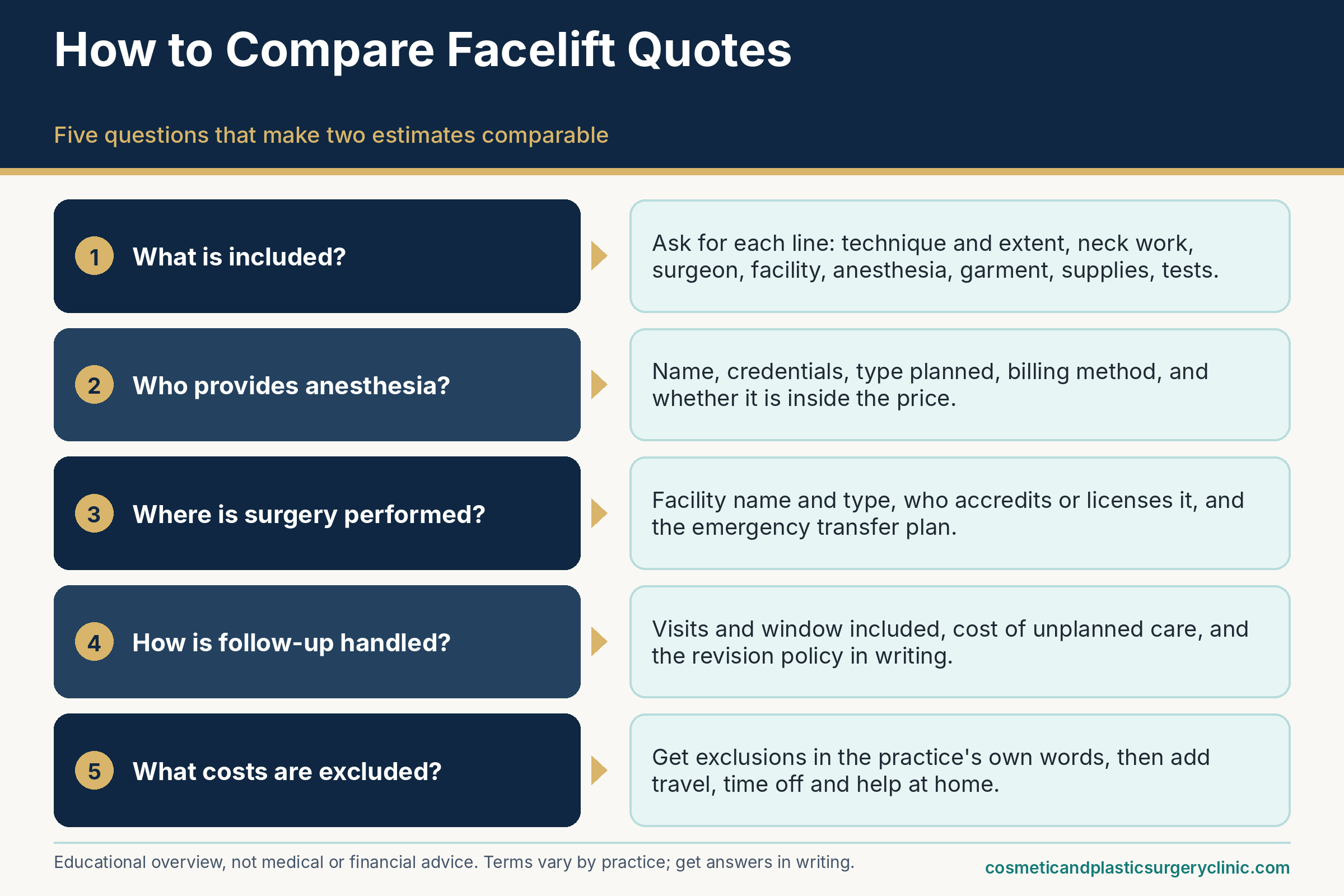
Finally, use a written worksheet. The infographic earlier in this guide summarizes the five questions that make two quotes comparable, and the worksheet in the final section of this guide turns them into a table you can fill in for each practice.
Cheaper elsewhere? What agencies say about cost-driven travel
Some readers consider traveling abroad because the quoted price is lower. The agencies that have looked at this urge caution. An ASPS briefing paper on cosmetic surgery tourism says that surgery combined with travel can raise the risk of complications, that revision and complication treatment can add costs that may total more than the original operation would have cost in the United States, that surgeon and facility qualifications can be difficult to verify, that packages often include limited follow-up once the patient is home, and that there may be no U.S. legal protection or recourse if something goes wrong.
The Centers for Disease Control and Prevention (CDC) gives complementary travel-health guidance. It advises talking with a health care provider at least four to six weeks before a medical trip, notes that follow-up care for complications may be expensive and may not be covered by insurance, suggests delaying flights for 10 to 14 days after major surgery to reduce clot risk, and observes that accreditation of a foreign facility does not ensure a good outcome. An ASPS article on stretching the dollar closer to home recommends calculating total cost, meaning travel, recovery time and follow-up visits, before comparing prices, and it describes prices that look too good to be true as a warning.
For a facelift, where bandage changes and suture removal fall within roughly the first week, the logistics of being far from your surgeon are not trivial. This doesn’t mean every overseas surgeon is unqualified or every domestic one is excellent. It means the lower price has to be compared against a longer list of risks and a longer list of costs than the quote shows. For the broader guide to this topic, see plastic surgery abroad and medical tourism.
Comparing Facelift Quotes and Deciding With Confidence
Everything above comes down to a practical task: taking two or three estimates and turning them into a decision you can defend to yourself later. This section gives you the tools to do that, along with a way to read quotes that look unusually high or low.
Comparing Quotes Line by Line
A quote is an offer to perform a defined plan for a defined set of charges. To compare two of them, you need both the plan and the charges laid out the same way.
The normalizing worksheet
The worksheet below lists what to record from each practice. It deliberately mirrors the structure of this guide: scope first, then each layer of the cost stack, then the terms that govern what happens if things change. Fill it in from the written estimate, not from memory of a conversation, and leave a line blank only if the practice truly can’t answer it yet. A blank is information too.
| Line item | What to record | Watch for |
|---|---|---|
| Plan and technique | Named technique, neck and midface work, any added procedures, fat grafting or resurfacing | Quotes that name only “facelift” with no scope |
| Surgeon’s fee | Amount, visits and months of follow-up included, what happens if the plan changes | A fee that excludes routine visits, or changes without notice |
| Facility | Name, type, accreditation or licensure, fee, how time is billed | No facility named; fee described as “estimated” with no basis |
| Anesthesia | Provider type and name, anesthesia planned, billing method, whether included | Vague “sedation” with no named provider |
| Supplies and medications | Garment, dressings, prescriptions, tests, scar-care products | Items listed as “extra” without prices |
| Contingency terms | Revision policy, coverage for unplanned care and return to surgery, time limits | Verbal-only policies or terms that appear after payment |
| Deposit and payment | Deposit, refund and rescheduling terms, balance due date, financing offered | Pressure to pay or finance on the spot |
| Exclusions | The practice’s own list of what is not included | No exclusions listed at all |
Once the worksheet is filled in, add the costs that sit outside the quotes: travel and lodging if relevant, lost wages, help at home and the cost of any financing. The practice with the lowest surgeon’s fee is not always the lowest total, and the highest quote sometimes includes items the others will bill later.
Here is an illustrative example of why normalizing matters, again without prices. Practice A sends a one-page estimate labeled “facelift” that lists a surgeon’s fee and says facility and anesthesia will be billed separately. Practice B sends an itemized estimate that includes the surgeon’s fee, a named accredited facility, a named anesthesia provider, the garment, standard prescriptions and visits for a defined period, plus a written revision policy. Practice A’s headline number may be smaller, but it is not yet a total. Until the facility, anesthesia, supplies and follow-up terms are added, the two can’t be compared. If Practice A can’t or won’t supply those details, that gap is itself a data point. If it can, the result may be closer than the first glance suggested, or it may favor either practice.
The comparison also needs to cover the plan. If Practice B’s estimate describes neck work and a midface component while Practice A’s does not mention them, you may be comparing two different operations. Ask Practice A whether the neck is included, and ask Practice B why it recommends the added components. A good answer usually refers to your anatomy and goals rather than to a package.
Questions to ask, in plain scripts
Many patients find it awkward to ask about money. A few ready-made phrases help. These are educational scripts to adapt, not legal or medical advice.
- “Could you walk me through each line of this estimate, including anything billed by someone other than your practice?”
- “Which technique is planned for me, and what, specifically, does the plan include for the neck and midface?”
- “Where will the surgery be performed, who accredits or licenses that facility, and what is the plan if I need emergency care?”
- “Who will provide anesthesia, what type is planned, and is it billed separately?”
- “How many follow-up visits and how many months are included, and what do visits after that cost?”
- “If I need a revision, or a return to the operating room for a complication, what would I owe, and where is that written?”
- “What is refundable if I change my mind or if the surgeon recommends delaying, and until when?”
- “What isn’t included in this price that other patients are sometimes surprised to pay for?”
The last question is the most revealing. A practice that has thought carefully about hidden costs will answer it directly. If the answer is “nothing,” ask again, with an example, such as garments, prescriptions or anesthesia time beyond the planned duration.
Value, Safety and the Decision Itself
Value in surgery isn’t the lowest number or the highest number. It is the combination of an appropriate plan, a qualified team, a safe setting and clear terms, at a price you can pay without strain.
Reading outliers and red flags
A quote far from the others is a prompt for questions, not a verdict. The table below sets out common patterns, plausible explanations and the follow-up that tends to resolve each one.
| What you see | Possible explanations | What to ask or check |
|---|---|---|
| Much lower than the others | Surgeon’s fee only; smaller operation; different facility or anesthesia model; promotional pricing | Which layers are missing? Who is the anesthesia provider? Which facility, and is it accredited or licensed? |
| Much higher than the others | All-inclusive package; more extensive plan; high-overhead market; added procedures | What is bundled? Is the plan larger than the others? Can the package be itemized? |
| Single “all-in” number with no breakdown | Package pricing; practice preference | Can I see the same figure split into surgeon, facility, anesthesia and supplies? |
| Price only valid if booked now | Sales tactic; scheduling pressure | Can I take the written estimate home? Does the price change next week, and why? |
| No named facility or anesthesia provider | Details not finalized; or details the practice prefers not to discuss | Please name both before I pay a deposit. |
A theme runs through every credible source in this guide: ASPS tells readers that the surgeon’s experience and your comfort with that surgeon are just as important as the final cost. The Aesthetic Society’s cost page urges patients to choose a surgeon on quality, training and experience, not cost. Those statements come from professional societies, which have their own interests, but the underlying logic is simple. If something goes wrong, the price you saved is the least of the costs.
Is this the right time? Budget readiness, alternatives and next steps
Not being ready to pay for a facelift is an entirely reasonable place to be, and it doesn’t mean your interest was misplaced. A realistic budget includes the quote, the costs around it, a cushion for the unexpected and the ability to take the time off without financial stress. If financing is the only way the numbers work, make sure the total cost of that financing is one you’d accept if the operation went as planned and if it needed extra care.
When the budget doesn’t fit, you have options short of giving up. You can wait and save, ask whether a staged plan or a lighter operation might suit your goals, or explore nonsurgical approaches while you decide. ASPS notes that minimally invasive treatments cannot match a facelift’s results, though some can delay the need for surgery, so they are different tools with different limits. The guide to facelift alternatives compares them. Whether any of these is appropriate for your face and your goals is a question only an in-person consultation can answer, and the decision not to proceed is as legitimate as the decision to go ahead.
If you do move forward, the earlier sections give you the order of operations: verify credentials, gather itemized estimates for comparable plans, read the deposit and revision terms, compare financing on total cost, budget for time off and help, and keep every agreement in writing. None of it is complicated, but all of it is easier before you’ve paid.
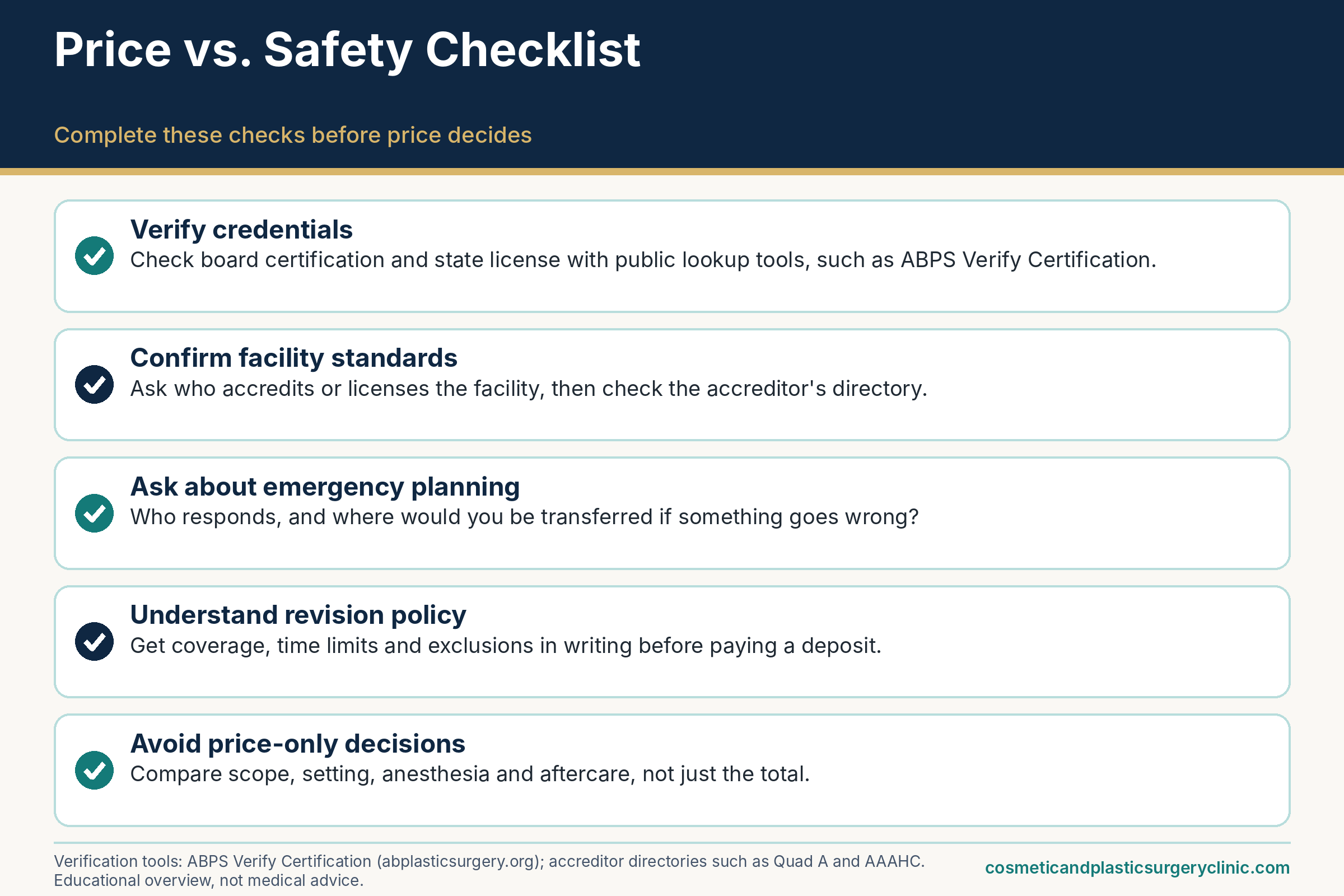
Frequently asked questions about facelift cost
How much does a facelift cost in the United States?
No single figure applies to everyone. ASPS reported a 2024 projected surgeon-fee range of $12,000 to $19,000 for a facelift, based on averages from surveyed member surgeons, and an earlier 2022 average of $9,281 that excluded anesthesia and the operating room facility. Add facility, anesthesia, garments, prescriptions, tests and follow-up to reach a total, and expect the result to move with the technique, added procedures, setting and location. A realistic number for you exists only on an itemized written quote from a surgeon who has examined you.
Does the published surgeon’s fee include anesthesia and the surgical facility?
For ASPS’s facelift cost page and its 2022 fee document, no: both say the figure leaves out anesthesia, operating room facilities and related expenses. The 2024 document doesn’t itemize what is inside its range, so treat it as a surgeon-fee benchmark. The Aesthetic Society describes its 2022 figure as covering surgeon and facility fees but not anesthesia, tests, prescriptions or garments. Because definitions differ, ask any practice quoting a number to say line by line what that number contains.
Why do published facelift cost figures disagree with each other?
They answer different questions. Two come from different professional societies using different databases, one is an average and another is a projected range, and one has no stated year. They also cover different layers of cost, with one including facility fees and others excluding them. Each reflects surveyed member surgeons rather than every practitioner in the country. A gap between a published figure and your quote is a reason to ask what the quote contains, not evidence that the quote is high, low, fair or unfair.
Is a mini facelift cheaper than a traditional facelift?
Often the operation is smaller, which can mean less operating and anesthesia time, but this guide found no authoritative published price comparison between techniques, so it can’t say by how much. ASPS notes that a limited-incision approach suits people with minimal skin laxity and gives a less dramatic change. Practices also price by procedure name, not always by time. The better question than which costs less is which plan matches your anatomy and goals, because a mismatched smaller operation can lead to a second procedure and a second bill.
Does adding a neck lift or eyelid surgery change the price?
Usually yes, though how depends on the practice. ASPS’s 2024 stand-alone surgeon-fee ranges include $7,500 to $13,000 for a neck lift, $3,000 to $5,500 for upper eyelid surgery and $4,000 to $7,500 for a forehead lift. Some practices charge a combined fee reflecting shared anesthesia and one facility booking, while others bill each procedure at its usual rate. Whether combining is appropriate is a medical judgment for your surgeon, and the quote should show each component and how it is priced.
Does health insurance ever pay for a facelift?
For a cosmetic facelift, generally no. ASPS says most health insurance plans don’t cover facelift surgery or its complications, and Medicare’s cosmetic surgery exclusion has only narrow exceptions, such as prompt repair of an accidental injury. If a facial operation is being considered for a medical or reconstructive reason, a plan may review it under its own criteria, so ask the practice about written pre-authorization. Don’t rely on a verbal assurance from either the practice or the insurer, and ask how complications would be handled.
Can I pay for a facelift with an HSA or FSA?
Probably not for a purely cosmetic one. IRS Publication 502 for 2025 says cosmetic surgery generally can’t be counted as a medical expense and names face lifts among its examples, with an exception for correcting a deformity from a congenital abnormality, an accident or trauma, or a disfiguring disease. Publication 969 ties HSA qualified expenses to the same definition of medical care. Your plan administrator makes the eligibility call, and a tax professional can address your situation, so get written confirmation before you spend account funds.
What is deferred interest, and why does it matter for facelift financing?
With deferred interest, interest builds in the background during a promotional period and is waived only if the whole balance is paid before the period ends. The CFPB found that such promotions on medical cards commonly run six to eighteen months. If a balance remains, interest can be charged from the original purchase date. A true zero percent offer instead starts charging only on what is left after the promotion. To clear a balance in time, divide the amount by the promotional months and compare that payment with the statement minimum.
If I need a revision or have a complication, who pays?
That depends on the practice’s written policy and, sometimes, the reason for the problem. Policies may address the surgeon’s fee, the facility charge and the anesthesia charge differently, and they usually have time limits. Because ASPS says most insurance doesn’t cover facelift complications, assume you carry unplanned costs unless the policy says otherwise. Before paying a deposit, ask for the policy in writing, including how an unplanned return to the operating room would be billed and for how long after surgery the terms apply.
Is it cheaper to have a facelift abroad?
The quoted price can be lower, but the comparison is incomplete without travel, lodging, time away and the cost of follow-up or complications. An ASPS briefing paper says treatment of complications and revisions can add costs that may total more than the original operation would have cost in the United States, that credentials can be hard to verify and that follow-up is often limited. The CDC adds that follow-up for complications may be expensive and uninsured, and that flights are best delayed 10 to 14 days after major surgery.
Does a facelift last long enough to justify the cost?
Whether it is worthwhile is a personal judgment, and the evidence on longevity is limited. A StatPearls review says many patients don’t need another facelift for five to ten years after a well-performed first operation. A small 2013 series of 60 secondary facelifts found initial operations had lasted nine years on average before patients returned. Those figures come from selected patients and individual results vary, so treat any cost-per-year calculation as a rough frame, using a wide range of years rather than one number.
Can I get a good faith estimate for a facelift?
If you don’t have or don’t use health insurance, CMS says you can ask for a good faith estimate, or you may receive one by scheduling care at least three business days ahead. You may be able to dispute a bill that is at least $400 more than the estimate. For a cosmetic case, several parties may be involved, including the surgeon, facility and anesthesia provider, so ask each whether it will provide an estimate and which items it covers. Then compare the estimates with the practice’s itemized quote.
How does smoking or nicotine use affect facelift planning and cost?
Nicotine impairs wound healing, and facelift skin flaps are vulnerable. A StatPearls review reports skin necrosis in 7.5 percent of smokers versus 2.7 percent of nonsmokers in the figures it cites, and recommends stopping nicotine at least two to four weeks before surgery and for a month afterward. MedlinePlus advises at least four weeks, with ten being better. Cost effects are indirect: a surgery date may need to move, which can trigger rescheduling terms, and complications can bring unplanned charges. Tell your surgeon the truth about nicotine use.
Sources and further reading
- American Society of Plastic Surgeons — Facelift cost (accessed 2026-10-04) — average figure with no year shown; what it excludes; cost components; insurance and financing statements
- American Society of Plastic Surgeons — 2024 Average Surgeon/Physician Fees (accessed 2026-10-04) — projected fee ranges for facelift, neck lift, eyelid, forehead lift and fat grafting; methodology note
- American Society of Plastic Surgeons — 2022 Average Surgeon/Physician Fees (accessed 2026-10-04) — 2022 facelift and neck lift averages and exclusions
- The Aesthetic Society — How much does a facelift cost? (accessed 2026-10-04) — 2022 databank average and its scope; insurance and financing statements
- The Aesthetic Society — Average plastic surgery costs (accessed 2026-10-04) — 2022 facelift and neck lift figures and exclusions
- American Society of Plastic Surgeons — Plastic Surgery Statistics Report 2025 (accessed 2026-10-04) — facelift and neck lift procedure counts for 2025 and 2024
- American Society of Plastic Surgeons — Facelift (accessed 2026-10-04) — what a facelift addresses and cannot do; combination with other procedures
- American Society of Plastic Surgeons — Facelift procedure (accessed 2026-10-04) — anesthesia choices; traditional and limited incisions
- American Society of Plastic Surgeons — Facelift safety (accessed 2026-10-04) — list of risks and complications
- American Society of Plastic Surgeons — Facelift recovery (accessed 2026-10-04) — bandages, drain tubes and recovery questions to ask the surgeon
- StatPearls — Cervicofacial Rhytidectomy (accessed 2026-10-04) — techniques; complication ranges; smoking; recovery milestones; longevity and revision statements
- MedlinePlus — Facelift (accessed 2026-10-04) — anesthesia, bandage and suture timing, swelling duration, nerve effects
- MedlinePlus — Smoking and surgery (accessed 2026-10-04) — stopping nicotine before surgery
- ReachMD — Systematic review examines hematoma reduction techniques in facelifts (2025 meta-analysis in Facial Plastic Surgery & Aesthetic Medicine; accessed 2026-10-04) — pooled hematoma rates after deep plane facelift (news summary of the study)
- Aesthetic Surgery Journal Open Forum (August 2021) via DOAJ — SMASectomy facelift complications, 15-year single-center experience (accessed 2026-10-04) — operative and anesthesia times in a 241-patient case series
- American Society of Plastic Surgeons — Secondary facelift press release on a March 2013 Plastic and Reconstructive Surgery study (accessed 2026-10-04) — interval between facelifts in a 60-patient series
- American Society of Plastic Surgeons — Accredited facilities (accessed 2026-10-04) — recognized accreditors and facility standards for ASPS members
- American Society of Plastic Surgeons — Member qualifications (accessed 2026-10-04) — board certification, training and facility requirements; no ABMS cosmetic surgery board
- American Society of Plastic Surgeons — Why board certification matters for plastic surgery (accessed 2026-10-04) — ABMS framework; verification tools; non-ABMS cosmetic boards
- American Society of Plastic Surgeons — Is your plastic surgeon board certified? (accessed 2026-10-04) — cash-pay context; hospital privileges
- American Board of Plastic Surgery — Verify Certification (accessed 2026-10-04) — public certification lookup; license versus certification
- American Board of Facial Plastic and Reconstructive Surgery (accessed 2026-10-04) — board description and surgeon finder
- Quad A — About us and accredited facilities directory (accessed 2026-10-04) — accreditation of ambulatory surgery and office-based surgical practices
- AAAHC — Accreditation (accessed 2026-10-04) — accreditation of ambulatory surgery centers and office-based surgery centers
- American Society of Anesthesiologists — Statement on qualifications of anesthesia providers in the office-based setting (reaffirmed October 2024; accessed 2026-10-04) — who provides anesthesia in office surgery
- American Society of Anesthesiologists — Statement distinguishing monitored anesthesia care from moderate sedation (October 2023; accessed 2026-10-04) — differences in staffing and responsibilities
- Legal Information Institute — 42 CFR 414.46, anesthesia payment (accessed 2026-10-04) — base units plus 15-minute time units in Medicare anesthesia payment
- American Journal of Managed Care — Implications of the costs of operating room time (accessed 2026-10-04) — summary of a 2005 to 2014 California hospital cost study (hospital cost, not patient price)
- Consumer Financial Protection Bureau — Medical Credit Cards and Financing Plans (May 2023; accessed 2026-10-04) — deferred interest, typical APR, point-of-care enrollment
- Centers for Medicare & Medicaid Services — Good faith estimate (accessed 2026-10-04) — estimate eligibility, timing and dispute threshold
- Internal Revenue Service — Publication 502 (2025), Medical and Dental Expenses (accessed 2026-10-04) — cosmetic surgery definition, face lifts, deformity exception, 7.5 percent threshold
- Internal Revenue Service — Publication 969 (2025) (accessed 2026-10-04) — HSA qualified medical expenses defined by reference to medical care
- Centers for Medicare & Medicaid Services — National Coverage Determination 140.4, Plastic surgery to improve the appearance (accessed 2026-10-04) — Medicare cosmetic surgery exclusion and exceptions
- Electronic Code of Federal Regulations — 29 CFR 825.113, Serious health condition (accessed 2026-10-04) — cosmetic treatments and job-protected leave
- American Society of Plastic Surgeons — Briefing paper: Cosmetic surgery tourism (accessed 2026-10-04) — risks, revision costs and recourse
- American Society of Plastic Surgeons — Plastic surgery abroad versus home: what to consider (June 2025; accessed 2026-10-04) — financing, prepayment, staging and regional travel
- Centers for Disease Control and Prevention — Medical tourism (accessed 2026-10-04) — pre-travel planning, flights after surgery, follow-up costs
- Plastic and Reconstructive Surgery Global Open (October 2024) via DOAJ — The Controversy over Price Transparency: Patients and Plastic Surgeons Disagree (accessed 2026-10-04) — survey on online price disclosure and estimate accuracy
- U.S. Food and Drug Administration — Premarket notification 510(k) (accessed 2026-10-04) — what clearance means compared with premarket approval