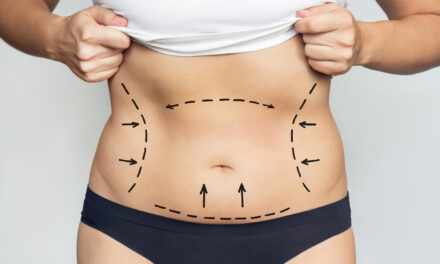
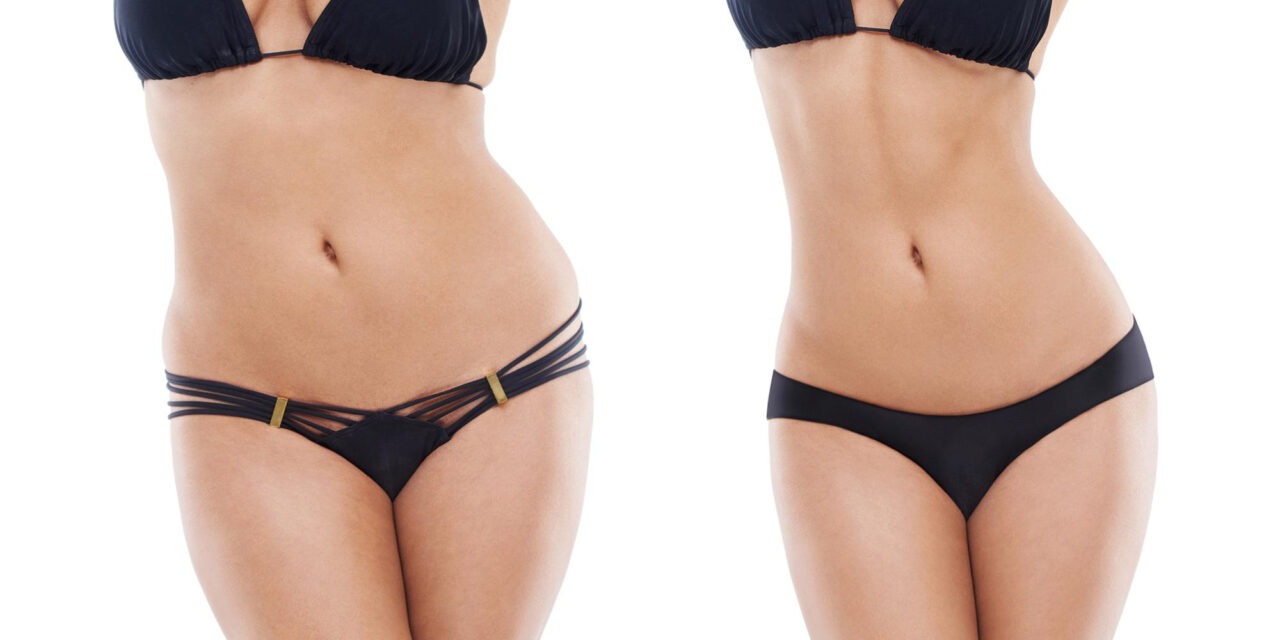
If you are searching for mommy makeover before and after photos, you are probably trying to answer a practical question: what could my body look like, and how would I know whether a photo is telling me the truth? This page has no patient photos and no invented cases. It teaches you how to read the pictures you will find on clinic websites, social media and in a consultation room, and how to separate useful evidence from persuasion.
Mommy makeover photos are harder to read than almost any other before-and-after gallery, and the reason is built into the name. A mommy makeover is not one operation. It is a label for a customized set of procedures, commonly breast surgery together with abdominal contouring, and the exact mix changes from person to person. So the woman in a gallery photo may have had a different combination than the one you are considering, at a different point in healing, with a different pregnancy history, photographed under different conditions. Each of those differences can change what the picture shows.
The sections below follow the order in which a careful reader might work. First comes the combination itself, because you cannot compare results until you know which operations a photo represents. Next come timing and pregnancy history, then separate guides for reading the abdomen, the breasts, and the flanks and back. After that the article turns to photo standardization and editing, how to ask a practice for comparable cases, consent and advertising rules, and finally the safety context of combined surgery and a consultation framework. For the broader picture of what the combination involves, see the complete mommy makeover guide; for photo-reading skills specific to single procedures, the series also includes pages on tummy tuck photos, breast augmentation photos and liposuction photos.
Two caveats frame everything that follows. This is general education, not a personal assessment, and nothing here tells you whether you are an appropriate candidate for any procedure. And photographs are a supporting tool rather than a verdict: they cannot show comfort, sensation, core strength, how a person feels about her body, or how a result changes across years. They are one input alongside a surgeon’s verified training, a frank discussion of risk, and your own goals.
What a Mommy Makeover Photo Is Really Showing
Before reading any single image, it helps to settle what the words on the gallery page mean. The phrase “mommy makeover” is a marketing and patient-language term rather than a surgical procedure name, and it can cover a surprisingly wide range of operations.
A Label for a Customized Combination
What ASPS Materials Say About the Combination
The American Society of Plastic Surgeons (ASPS) frames the goal of a mommy makeover as restoring the shape and appearance of a woman’s body after childbearing, and its patient pages describe the operation as typically done in a single stage. The same pages list the procedures that may be part of it: breast augmentation, breast lift, buttock augmentation, labiaplasty, liposuction and tummy tuck. The procedure page speaks of an “individualized” mommy makeover, and an ASPS member-authored blog post describes it as a combination of two or more procedures performed at the same time. Another ASPS blog post says plainly that it is not a one-size-fits-all procedure and that the plan depends on anatomy, lifestyle and what pregnancy, breastfeeding and aging have changed.
Notice what that wording implies for photo-reading. There is no standard menu with a fixed price and a fixed set of steps. Two women can both truthfully say they had a mommy makeover, and one may have had an implant and a full tummy tuck while the other had a breast lift, a mini tummy tuck and liposuction of the flanks. The photographs would look different, the scars would sit in different places, and the recovery would not have been the same.
The ASPS statistics report for 2025 does not publish a count for mommy makeovers as a category. It does report counts for the component operations: 304,234 breast augmentations, 173,251 tummy tucks, 317,196 liposuction procedures and 156,131 breast lifts in the United States in 2025, estimated from surgeon, claims and insurer-partner data that the society says represents more than 3,000 board-certified plastic surgeons and then extrapolated nationally. Those numbers count procedures, not patients, and they cannot tell you how often any two procedures were done in the same operation. They are useful mainly as a reminder that each component is a common operation in its own right.
Why One Label Can Hide Several Different Operations
Think of the label as a folder name. Inside the folder, a gallery might place photos of very different operations, and the caption rarely tells you which. At least five choices can vary behind the same title.
The first is the breast operation. A breast lift (mastopexy) repositions the breast and nipple and removes excess skin; ASPS notes that a lift does not significantly change breast size or round out the upper breast. An augmentation adds volume with an implant, and a lift with augmentation does both. Breast reduction appears in some descriptions as well. A photo of an augmentation alone and a photo of a lift with augmentation can look alike at a glance, yet they involve different incisions, different tissue handling and different follow-up needs.
The second is the abdominal operation. A tummy tuck (abdominoplasty) is not one fixed technique: ASPS describes a horizontal incision whose length depends on how much skin must be removed, with or without a second incision around the navel, and a mini or a full version is chosen based on anatomy. The third is the use of liposuction, which may be added to the abdomen, to the waist and flanks, to the back or to other areas, and which changes contour but, as ASPS puts it, cannot improve lax skin tone. The fourth is the add-on list: buttock augmentation, thigh or arm lift, or labiaplasty, none of which a torso photo may show. The fifth is timing, since the same set of procedures can be done in one operation or divided into stages, a question the second half of this article returns to.
The practical consequence is simple. Treat the words “mommy makeover” under a photo as an incomplete caption. A useful caption lists every procedure performed, notes the date of surgery and the date of the photo, and says whether the operation was done in one session. If a gallery omits those details, you can still learn something from the picture, but you cannot compare it with your own plan until you have asked.
Matching Combinations in Mommy Makeover Before and After Galleries
A Component-Matching Worksheet in Plain Terms
Matching starts with writing down your own candidate plan in component form, even if it is only a draft you expect to change. For example: “breast lift or augmentation or both, abdominoplasty full or mini or none, liposuction of waist and flanks yes or no, anything else.” Then look for gallery cases whose components match as closely as possible. A match on two of four components is a partial match, and you should say so to yourself when drawing conclusions.
The table below turns each common component into a short guide: what a photo can reasonably show about it, and what can mislead you. It is a reading aid, not a statement about any individual’s outcome, and the descriptions of procedures rely on ASPS patient pages.
| Component | What a photo can reasonably show | What a photo cannot show or can mislead about | Caption detail to ask for |
|---|---|---|---|
| Breast lift | Nipple height and direction, breast shape, scar pattern, symmetry in the pictured pose | Sensation, how the shape changes over years; a lift can look fuller if an implant was added | Lift alone, or lift with implant or fat |
| Breast augmentation | Overall volume change, upper-breast fullness, scar location if visible | Implant size, profile and placement are hard to read from outside; swelling and posture alter the look | Implant type, size, placement, incision site |
| Tummy tuck, full or mini | Waist and abdominal profile, scar length and position, navel shape | Muscle repair, core strength, internal healing; posture and swelling can flatter or hide | Full or mini, whether muscles were repaired, whether liposuction was added |
| Liposuction of waist, flanks, back | Contour change in the pictured view, smoothness of the surface | Skin laxity limits; weight change since surgery; lighting that hides or creates ripples | Areas treated, technique if known, months since surgery |
| Add-ons such as buttock augmentation, thigh or arm lift, labiaplasty | Only what the camera frames; many add-ons are outside a standard torso view | Whether the pictured result came from the whole set or from one part | Complete procedure list, in writing |
The worksheet idea matters most when you compare galleries from two practices. One may show only operations done in a single session, and another may mix single-session and staged cases. Without the caption details above, side-by-side comparison of their results is not reliable.
When Your Plan Is Rarely Shown in Galleries
Some plans will not appear often in any gallery. A woman who wants a breast reduction with an abdominal procedure, or a combination with a less common add-on, may find few matches. A surgeon’s website cannot show what the practice has not done, and a practice is also limited by what patients consent to share. Scarcity is information, but it is not automatically a warning sign.
What you can do is look for photos of each component separately and treat them as pieces rather than a forecast of the whole. The companion pages on breast lift photo evaluation, tummy tuck photos and liposuction photos are written for that kind of component-level reading. Be careful, though, about mentally stitching a breast photo from one patient to an abdomen photo from another. The healing demands of a combined operation, from the amount of tissue handled to the time spent under anesthesia, are not the sum of two separate cases, and a surgeon may plan a different sequence or a staged approach for an unusual combination.
If your plan is uncommon in the practice’s gallery, ask directly. A candid answer such as “I have done this combination a limited number of times” tells you more than a reassuring reply that avoids the question. You can then decide whether to ask for the surgeon’s reasoning, seek a second consultation, or ask whether a staged plan would change what the photos should look like. The mommy makeover techniques guide covers how surgeons approach and sequence different component choices, which is helpful background before you ask.
The Clock and the History Behind Every Photo
Two invisible facts sit behind every before-and-after pair: how many months separate the photos, and what that body had been through before the first picture. Both can shift what a result looks like more than the surgeon’s technique does, which is why they come before any attempt to read individual features.
When the Photo Was Taken Changes What It Shows
The First Weeks to About Three Months: Swelling, Garments and Fresh Scars
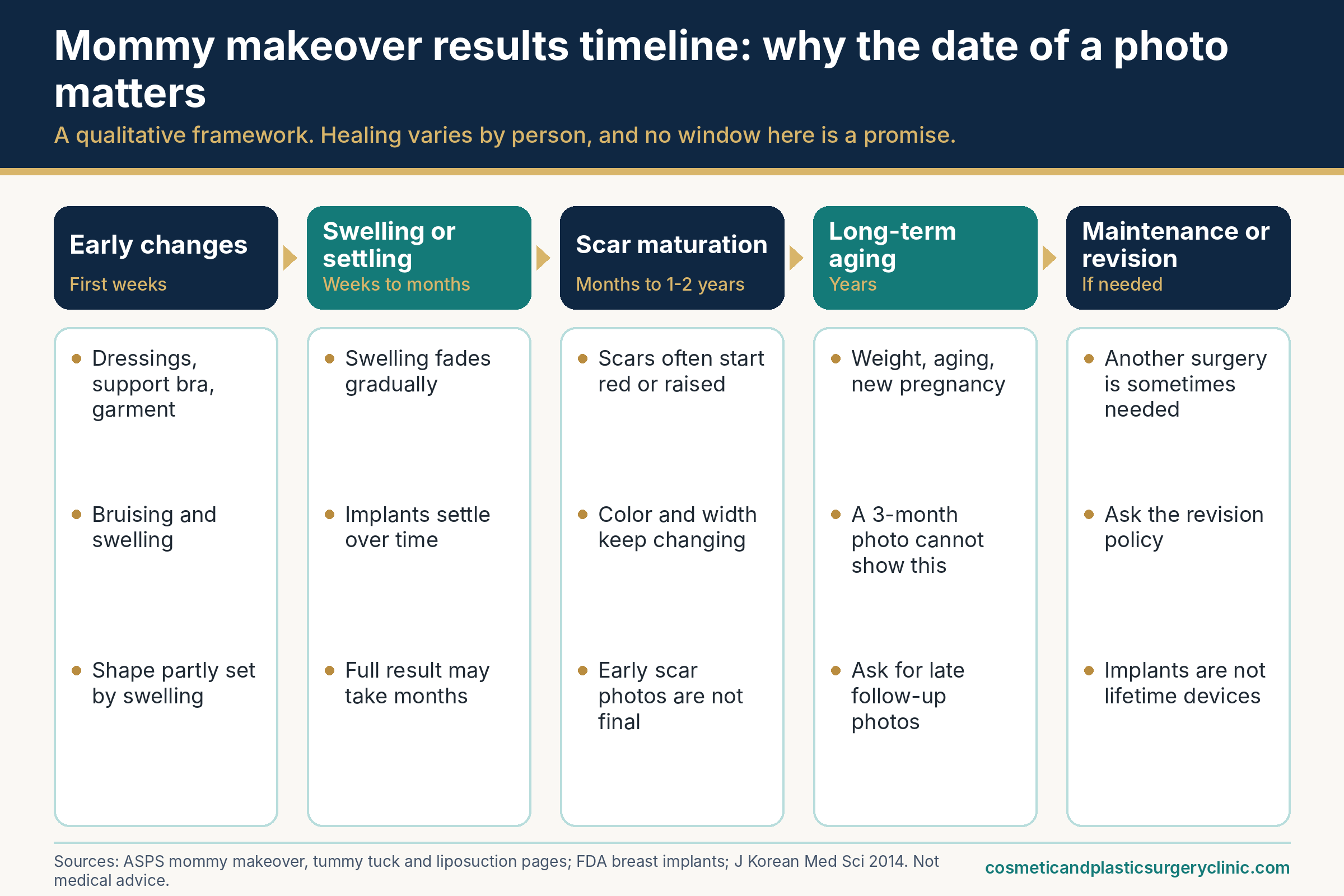
Early photos are the most common ones on social media, because patients often feel excited and share their progress soon after surgery. They are also the least stable. ASPS describes the immediate recovery from a mommy makeover as involving gauze or bandages, an elastic bandage or support bra over the breasts, and sometimes a compression garment over the abdomen, waist and buttocks, with healing continuing for several weeks as swelling decreases. A photo taken during that window shows a body that is still healing, wearing a shape partly supplied by swelling and by the garment.
For the abdomen, ASPS notes that within a week or two many tummy tuck patients are standing taller, but that early results can be obscured by swelling and by an inability to stand fully upright. A person who is walking slightly bent forward because the skin feels tight will look different in profile than she will months later. In a photograph, that posture can make the lower abdomen look flatter or fuller than it will be, and it can make the waist appear shorter. The breasts also change. ASPS observes that implants settle over time, so an early photo of an augmentation may show a breast that sits higher or looks tighter than the later shape.
Scars at this stage deserve special caution. A 2014 review of surgical scar management in the Journal of Korean Medical Science explains that scar remodeling begins a few weeks after injury and continues for roughly six months, and that hypertrophic scars are often red and may grow for the first three to six months before gradually flattening, a process that can run to about two years. A scar that looks pink, raised or wide at three months is therefore not a final scar. The reverse is also true: a scar that looks thin and pale in an early photo may still change. If you see a gallery that shows mostly early photos, it is telling you about the healing phase, not about what the result looks like once settled.
None of this makes early photos useless. They show what the patient looked like at that moment and can help you understand what the first weeks involve. The mistake is to compare one patient’s three-month photo with another patient’s one-year photo and conclude that the second surgeon achieved more.
Six Months, Twelve Months and Beyond: Which Photo Is the Fair Comparison
ASPS says the final results of a mommy makeover may not be apparent for several months, and an ASPS blog post by a member surgeon puts full results at six months to a year as swelling subsides. The ASPS tummy tuck results page adds that the scar may take several months to a year to fade as much as it will, and the liposuction results page says it may take several months for swelling to fully dissipate. Taken together, these statements describe a window rather than a date, and individual healing can run faster or slower. When a photo caption says “6 months post-op,” it is describing a point inside that window, not the finish line.
A fair comparison therefore pairs photos from similar months, ideally from the same patient. If a gallery shows one patient at six weeks, six months and a year, you can watch swelling recede, the scar settle and the waist line change, and you learn something about how the surgeon’s results age. If it shows each patient only once at an unlabeled time, you are comparing different stages of healing without knowing it.
Beyond the first year the picture keeps changing, though more slowly. Weight gain or loss, further pregnancy, aging and ordinary life all act on the result. ASPS advises women who may be considering future pregnancies to postpone a tummy tuck, and a surgeon-authored ASPS blog post says a new pregnancy can reverse the effects of the surgery. A photo taken two years after surgery is more informative about durability than one taken at three months, but it still cannot predict what the next two years will do to your body.
| Photo timing | What the image commonly reflects | Main caution | What to ask the practice |
|---|---|---|---|
| First weeks | Dressings, support bra, compression garment, swelling, bruising | Shape is partly supplied by swelling and garments; posture may be guarded | Is the garment worn in this photo, and when was it taken exactly? |
| About 3 months | Early shape, swelling reduced but not gone, scars often still red or raised | Implants may not have settled; scars are not final; waist can still be swollen | Do you have this patient at 6 and 12 months? |
| About 6 months | Many patients are well into settling; scars in the remodeling phase | Still inside the several-months to a year window ASPS describes | How much further change do you see after this point in patients like me? |
| About 12 months | A closer view of settled shape; tummy tuck scar closer to its eventual look | Hypertrophic scars can keep flattening for longer; life events since surgery may matter | Has weight or pregnancy status changed since surgery? |
| Two years and later | Evidence of how the result holds in everyday life | Aging, weight and pregnancy act on the result; far fewer galleries show these photos | Can I see late follow-up photos of this combination? |
The Life History Behind the Body in the Photo
Pregnancies, Breastfeeding, Diastasis and Weight History: Why They Change the Starting Point
No two postpartum bodies begin from the same place, and a before photo captures only the outcome of that history, not the history itself. ASPS lists pregnancy, breastfeeding, weight fluctuations, aging, gravity and heredity among the reasons breasts lose shape or volume. Those factors apply in different amounts to different women, so two before photos that look alike can come from very different backgrounds.
The abdomen adds its own variable. During and after pregnancy the rectus abdominis muscles, the paired “six-pack” muscles on the front of the abdomen, can separate along the connective tissue between them, a condition called diastasis recti. In a prospective study of 300 first-time pregnant women, published in 2016 in the British Journal of Sports Medicine, researchers who defined separation by palpation found it in 33.1% of the women at 21 weeks of pregnancy, 60.0% at six weeks after birth, 45.4% at six months and 32.6% at twelve months. These percentages describe one group of first-time mothers measured by one method, so they are not predictions for any one person. They do show that the timing of a photograph relative to delivery matters, since the same woman may have a very different abdominal wall at six months than at six years. The Cleveland Clinic notes that physical therapy and targeted exercise are generally tried first for diastasis, and that surgery with muscle repair, as part of an abdominoplasty, is one option when a person wants it addressed surgically.
Weight history belongs here too. ASPS states that significant weight changes can substantially diminish tummy tuck results. A photo of a patient who has been at a stable weight for years says something different than a photo of a patient who lost weight after delivery and was still losing it at the time of surgery. Captions seldom mention this, which is one reason the number of pregnancies, the time since the last delivery, whether breastfeeding has ended and the weight trajectory are all fair questions to put to the practice. Cesarean history also affects the abdominal scar: ASPS says an existing cesarean scar may be incorporated into the new surgical scar, which can change how the lower abdomen looks compared with someone who has had no prior abdominal surgery.
ASPS candidate guidance for the mommy makeover mentions being in good health, being at a stable and ideal body weight, having realistic expectations and having finished childbearing. A 2015 ASPS press release that quotes surgeons adds that the first postpartum year can be an emotionally vulnerable time and that careful evaluation matters. None of that tells you when you should operate, and it is not a personal recommendation. It does explain why a gallery of recent postpartum patients and a gallery of patients several years past delivery are not interchangeable.
One Session or Staged, and What Happens After the “After” Photo
ASPS describes the mommy makeover as typically a single-stage procedure, but a surgeon-authored ASPS blog post notes that the work can be staged three to six months apart if needed, and an ASPS news article describes surgeons dividing regions, for example breasts and arms in one operation and abdomen, back and thighs in another. That has a direct consequence for photos: an image labeled “after mommy makeover” may show a patient who has completed only the first stage. Her breasts may be settled while her abdomen is still scheduled for later. Or the reverse.
If a practice shows both single-session and staged cases, ask for the label on each. The staging choice reflects safety planning, the patient’s needs and the surgeon’s judgment, so a staged result and a single-session result should not be treated as competing quality scores. They are different plans with different timelines. The staging question also affects planning for work, childcare and travel, which the mommy makeover recovery guide covers in detail.
Finally, remember what an after photo cannot say about the future. Another surgery may be needed in some situations; ASPS says this directly on its results pages, noting that it may not be possible to achieve optimal results with a single operation. Whether that happened to any patient in a gallery is almost never shown. A practice that is open about revision policy, and about how many photos in the gallery are from patients who needed a second procedure, is giving you information that a photograph never will. If you are planning around a possible later pregnancy, read the page on mommy makeover after pregnancy before you interpret any result as permanent.
Reading the Abdomen: Waist, Navel, Scar, Muscle Repair and Skin
For many readers the abdominal photo is the centerpiece of the gallery. It is also the part of a mommy makeover photo where a small difference in pose, light or timing can change the apparent result the most. The abdomen has a surface you can see and an internal layer you cannot, and a good reading separates the two.
What the Surface Shows: Waist, Profile, Navel and Scar
Waist, Flanks and the Side Profile
Start with the view the gallery chooses to lead with, then ask for the others. A front-facing photo is good at showing waist width and the line of the hips. It is poor at showing how far the lower abdomen protrudes, and that is often the feature a person is most concerned about. Side and oblique views tell you about projection, while a back view shows the flanks and whether the contour continues smoothly around the waist. If a practice only displays front views, you are seeing a partial picture by choice or by habit, and it is reasonable to ask whether other angles exist.
Waist shape is the product of several things at once: the skin and fat removed, any liposuction of the waist and flanks, the position of the ribs and pelvis, and the way the person happens to be standing. The skeleton does not change with these operations, so a rib cage that flares widely or a pelvis that is wide will keep setting limits on how narrow the waist can look. When you compare your own proportions with a gallery patient’s, look at the frame as well as the soft tissue. Two women can lose the same amount of excess tissue and end up with different silhouettes because the structure beneath is different.
Posture deserves attention, and so does breathing. A person who arches her lower back pushes the abdomen forward; one who tucks the pelvis flattens it. A held breath can change the look of the waist in a way that a relaxed stance does not. A 2020 paper in the Journal of Biocommunication that described a highly controlled torso photography protocol took pictures at gentle exhalation, with the arms in set positions, specifically to reduce this kind of variation. Most clinic photographs are not made under that kind of protocol, so it is wise to assume some posture variation between before and after images and to look for signs of it: a shoulder dropped on one side, a hip pushed out, a change in the angle of the head or the arms.
The Navel and the Scar: Position, Length and Shape
A full tummy tuck involves a horizontal incision between the pubic hairline and the navel. ASPS says the length of that incision depends on how much skin needs to be removed, and that a second incision around the navel may be needed when upper abdominal skin is removed too. The navel is then brought out through a new opening in the repositioned skin and sutured in place. In a photograph this means that the navel you see afterward has been recreated, and its shape and position are part of the surgical result rather than simply the original one.
When you evaluate navel appearance, compare its shape across several patients in the gallery rather than studying one. A consistent, natural-looking shape across many cases suggests technique that is repeated and refined. Marked variation, or a navel that appears to differ in position from patient to patient without an obvious reason, is worth a question. Judgment of what looks natural is partly personal, so decide what you consider acceptable before you look, and ask the surgeon to explain how navel position and shape are planned.
Scar position and length are the most commonly misread features. A scar that rests low on the abdomen may be easy to cover with underwear or a swimsuit bottom, while a scar that rises higher or extends toward the hips is harder to conceal. As noted above, ASPS ties incision length to the amount of skin that needs to be removed. A short scar in a photo may therefore reflect a smaller operation, such as a mini version, rather than superior technique. Check the ends of the scar in an oblique or side view, since the front view can hide how far the line continues. Also remember that photos of the lower abdomen in garments make it hard to see the scar at all, which is why a few photos without a garment covering the area, taken with consent and appropriate privacy, are far more informative than a cropped image.
Timing matters again. ASPS says the tummy tuck scar may take several months to a year to fade as much as it will, and it also notes that an existing cesarean scar may be incorporated into the new one. If the gallery caption does not tell you how long after surgery the scar was photographed, you cannot judge whether a red, raised line is typical early healing or something that is not fading as expected. The mommy makeover scars page describes common scar locations and how scars change.
What Lies Under the Skin: Muscle Repair, Skin Excess and Swelling
Muscle Repair and the Limits of a Photograph
ASPS describes the tummy tuck as including repair of weakened abdominal muscles, drawn together before the skin is redraped. A photograph can show flatness, and flatness is a good clue that the abdominal wall is holding the contents in. What it cannot show is whether the repair is intact, how strong the core is, or whether any bulge returns when the person coughs, lifts or sits up from lying down.
The Cleveland Clinic describes diastasis recti as having both a cosmetic and a functional side: a visible bulge above or below the navel, and in some people difficulty with lifting or everyday tasks and back pain. A before-and-after photo captures the cosmetic side. Function is another matter, and the usual photo does not speak to it. The Cleveland Clinic also notes that many people can improve diastasis with physical therapy and targeted exercises before surgery is considered, which means a photo of a surgical result says nothing about whether an alternative approach could have helped that person.
If core function matters to you, move the conversation beyond the picture. Ask the surgeon how muscle repair is performed, whether a hernia was present and repaired in gallery cases, and what to expect for activity during healing. Ask whether the practice has any photographs taken in a different position, such as leaning forward or with the arms raised, because those can reveal a bulge that a relaxed standing pose hides. This is a reasonable question rather than a recognized standard; practices differ in what they photograph, and photographs are limited in any case.
Residual Skin, Lower-Abdominal Fullness, Swelling and Posture
Fullness in the lower abdomen after a combined operation can come from several sources, and a photograph rarely tells you which. It may be swelling, which fades over months. It may be residual fat that liposuction did not target, skin laxity that remains despite treatment, or tissue pulled down into the lower abdomen by the way the skin was redraped. ASPS describes the upper abdominal skin as being pulled down “like a window shade” and the excess trimmed, which means the skin lying just above the scar has been moved from higher on the abdomen. If the caption says the patient is eight weeks out, a small shelf above the scar may still soften with time. If the same shelf appears at twelve months, it is a more meaningful finding and a good question for the surgeon.
Liposuction and skin tone are a related issue. ASPS states that liposuction cannot improve lax skin tone, so a smooth contour after fat removal depends on how well the skin retracts. In photographs, this appears as a gentle softness or fine rippling that may only be visible under certain lights. Overhead light and strong side light exaggerate texture; flat, frontal light hides it. A fair comparison needs similar light on both images, a point returned to in the standardization section later.
Stretch marks are another frequent source of disappointment that photos can disclose if you look. ASPS says a tummy tuck does not eliminate stretch marks, although some are removed when the excess skin that carries them is excised. In a good photo you can find stretch marks above the navel and compare their number before and after. If the after image is smooth in a way the before image was not, and the lighting differs, consider whether the change comes from the surgery or from the editing and the lighting.
| Feature | What to look at | Common confusion | Better evidence to request |
|---|---|---|---|
| Waist and flanks | Front, oblique, side and back views; continuity of contour around the waist | A narrow waist in a front view may come from posture, a held breath or a garment | Matched views of the same patient with relaxed posture |
| Lower abdominal profile | Side view projection below the navel | Swelling, residual fat, skin laxity and standing posture look similar | Photos at several months for the same patient |
| Navel | Shape, position and consistency across several patients | A navel is recreated in surgery, so it is part of the result | Close-up photos of the navel at one year |
| Scar | Position, length and the ends of the line in an oblique view | Short scar may mean a smaller operation; red scar may be early healing; cesarean scar may be incorporated | Dated scar photos without garment coverage, with consent |
| Upper abdomen and stretch marks | Skin quality above the navel and above the scar | Retouching or soft light can hide stretch marks | Unedited originals viewed in the office |
| Muscle repair and function | Flatness at rest only | Photos cannot show strength, bulging on effort or hernia status | A discussion of technique, plus photos in leaning or raised-arm positions if available |
For a deeper treatment of tummy tuck photos on their own, including technique-specific cues, the series includes a separate page on tummy tuck photo evaluation, linked in the introduction. This section’s emphasis is on how the abdomen interacts with the other components of a combined operation: the same swelling, posture and timing issues apply, with the added complication that the breasts and abdomen are healing together.
Reading Breast, Flank and Back Photos in a Combined Result
The breast photos in a mommy makeover gallery answer a different set of questions than the abdominal ones, and the flanks and back raise a third set. Because the single-procedure pages in this series already teach detailed breast and liposuction reading, this section concentrates on what changes when those operations are part of a combination.
Breast Photos: Lift, Implant or Both
Telling Position From Volume: Nipple Height, Upper Fullness and the Lower Pole
The central question for any breast photo in a combined result is whether the change you see came from moving tissue, adding volume, or both. ASPS is clear that the two operations do different jobs. A breast lift repositions the nipple and areola to what it calls a more youthful height and removes excess skin, but it does not significantly change breast size or round out the upper part of the breast. For a woman who wants fuller-looking breasts, ASPS suggests considering a lift together with augmentation. The ASPS breast augmentation candidate page, for its part, names loss of shape and volume after pregnancy, weight loss or aging as a common reason women seek augmentation.
That distinction gives you a few cues, though none is certain. If the nipple sits higher and the breast looks more compact but not noticeably fuller at the top, the picture is consistent with a lift alone. If the upper chest looks fuller with a visible slope from collarbone to nipple, volume was probably added. If both position and volume have changed, the combination of lift and augmentation is the likely explanation. These are hints, not diagnoses, because swelling, bra support, posture, lighting and the way a person holds her shoulders can all mimic these changes. The reliable source is the caption and the surgeon’s explanation.
Pregnancy and breastfeeding add one more reason to ask. Breast tissue may have lost volume, stretched, or both, and a photo of a woman with a given starting shape can only be matched to your situation if your starting shape is similar. The page on breast lift photo evaluation works through nipple position, areola shape and ptosis vocabulary in more detail, and the page on breast augmentation photos covers implant-specific cues. The point to carry into a mommy makeover gallery is narrower: ask which of the three breast operations is on display, and be skeptical of any conclusion about size or shape that rests on a photo with no label.
Symmetry deserves a measured reading. Natural breast asymmetry is common, and no operation can be counted on to remove it. ASPS lists asymmetry among the risks of breast lift and of mommy makeover surgery. Check whether the before photo already shows a difference between sides, then see whether it persists, narrows or has changed in character after surgery. A gallery of carefully matched, sensibly framed images lets you do that; a cropped image of one breast does not.
Breast Scars, Implant Details and Risks a Photo Cannot Show
Breast scars vary with the operation. ASPS describes three common lift incision patterns: around the areola, around the areola with a vertical line down to the breast crease, and an inverted-T pattern that adds a horizontal line along the crease. It adds that some incision lines are hidden in natural contours while others are visible on the breast surface, that the lines are permanent, and that in most cases they fade and improve over time. For augmentation, ASPS describes incisions around the areolar edge, in the fold under the breast, or in the armpit. In a photo, the visible scar location can therefore suggest which operation was performed, with the caveat that scars from a lift and from an augmentation may overlap when both are done.
Implant details are largely invisible. ASPS says implants can be placed under the pectoral muscle or directly behind the breast tissue over the muscle, and the choice depends on implant type, desired enlargement, body type and the surgeon’s recommendation. A photo from the outside does not reliably tell you the size, profile, fill type or placement. Treat any confident guess about implant volume made from a photo, including your own, as a guess. The conversation with the surgeon is where those specifics are settled.
Several important risks cannot be photographed at all. ASPS lists loss of nipple sensation, inability to breastfeed, implant leak, capsular contracture, fat necrosis and persistent pain among the possible risks of mommy makeover surgery. The U.S. Food and Drug Administration (FDA) states that breast implants are not considered lifetime devices and that the longer they are in place the greater the chance of complications; many people need additional surgery during their lifetimes. It also lists asymmetry, implant displacement, sagging, wrinkling and visibility of the implant among the cosmetic concerns reported. FDA labeling recommendations from 2020 include a boxed warning and a patient decision checklist, and the agency’s page was most recently listed as current as of December 15, 2023. A before-and-after photo is never a substitute for reading those materials, and the guide to FDA breast implant safety information explains how to find and use them.
Flanks, Back and the Rest of the Body
Liposuction Contour: Smoothness, Back Views and Skin Response
Liposuction often supplies the finishing contour in a combined operation. The ASPS 2025 statistics report describes liposuction as frequently a complementary procedure used alongside other plastic surgeries, and an ASPS blog post lists the waist, hips and thighs among areas treated as part of a mommy makeover. Because liposuction contour lives at the sides and back, a standard front view often shows the least of it. A back view and an oblique view are the useful ones for judging the transition from the waist to the hip, the line of the bra strap and the smoothness of the surface.
What to look for is continuity. A smooth curve from ribs to hip, with no abrupt step, suggests balanced treatment. An unnatural dent or ridge may indicate contour irregularity; ASPS lists contour deformity among the possible risks of mommy makeover surgery. Be aware that light direction matters enormously here. Light from above and from the side casts shadows in any small surface change, whereas flat frontal light erases them. If the before photo was taken with one light and the after photo with another, the surface comparison tells you more about the light than the body.
The skin’s response matters too. ASPS says it may take several months for swelling from liposuction to fully dissipate and that liposuction cannot improve lax skin tone. The result is described as long lasting if weight stays stable. A back or flank photo from the first weeks will look different from one at six months, and one after a significant weight change will not mean what the caption implies. For liposuction-specific reading, see the page on liposuction before and after photos.
Add-On Procedures and What Stays Out of the Frame
ASPS lists buttock augmentation and labiaplasty among procedures that may be part of a mommy makeover, and a member-authored ASPS blog post lists thigh lifts, arm lifts and circumferential abdominoplasty as options too. Many of these appear in a different part of the body than the standard torso photo. A practice may show a flattering front torso and omit the buttocks, thighs or arms entirely, even though they were part of the same operation. If an add-on is part of your plan, ask for photos of that area from the same patients.
Buttock augmentation with the patient’s own fat deserves a specific mention because fat placement depth matters for safety. A 2018 advisory from an inter-society task force that included ASPS and other major plastic surgery organizations recommended placing fat in the superficial subcutaneous plane rather than into or beneath the gluteal muscle, after reviewing deaths in which autopsies found fat in or beneath the gluteal muscle. A photograph of a rounded buttock cannot show how deep the fat was placed or what technique was used. If this is part of your plan, ask about technique and safety measures in the consultation, and treat any gallery image of this area with the same caution described elsewhere in this article.
Finally, much of what matters after a mommy makeover never appears in an image: how the abdomen feels, whether the breasts have normal sensation, how the person sleeps, whether pain persists, how she functions at work and with her children. ASPS lists persistent pain and sensation changes among the possible risks. Photographs are strong on appearance and silent on experience, so a result that looks pleasing in pictures says nothing about whether the person who lived it would choose it again. That is why asking how a practice measures and tracks patient-reported outcomes is a reasonable consultation question.
Photo Standardization, Retouching and AI-Generated Images
Whatever the procedures and the timing, two photos are only comparable if they were made under similar conditions and have not been altered. Combined-procedure photos raise the stakes, because the frame often has to hold breasts, abdomen, waist and hips at the same time, and every variable gets multiplied across those regions.
Standardization Across a Whole Torso
Views, Posture, Distance and Lighting When Several Regions Share One Frame
The American Society of Plastic Surgeons publishes photographic guidelines for plastic surgery that cover the breasts, abdomen and other regions. According to the publicly visible description, their purpose is to record the relevant anatomy without distraction or distortion so that before and after images can be compared meaningfully. The detailed specifications sit behind a purchase, so this article cannot summarize them. The published literature gives a flavor of what standardization means, though most of it addresses reconstructive or research settings rather than cosmetic marketing galleries.
A 2017 paper in the journal Mastology, written for oncoplastic and breast reconstructive surgery, recommends six standard views: front, back, both profiles and both oblique views. It suggests a lens near 50 millimeters, a plain light-to-medium blue background, a set distance between the patient and the backdrop, and, importantly, the same camera settings, background and patient positioning in the before and after sets for the photos to be considered comparable. A 2020 paper in the Journal of Biocommunication described a specialized torso photography setup with a fixed camera distance, lighting angled from 45 degrees, images made at gentle exhalation and a camera aligned with the height of the navel, and reported very small image variance. You are not going to find that level of control in most clinic galleries, and you should not expect to. But the principles transfer: same distance, same camera height, same relaxed breath, same posture, same lighting.
Distance and lens matter more for the torso than people expect. A phone held close and used at a wide setting exaggerates whatever is nearest to the lens, so the waist may look narrower or the hips wider than they appear at a longer distance. If the before photo was taken at arm’s length and the after photo from a few feet back, the proportions will shift. Camera height has a similar effect: a camera held high tends to look down on the abdomen and shorten it, while a camera held low tends to lengthen it. These are ordinary optical effects, not signs of dishonesty, but they can make a modest result look larger or a large one look smaller.
Lighting changes the apparent surface of the skin. A 2021 study in Aesthetic Plastic Surgery photographed 51 people at light angles of 0, 30 and 60 degrees and asked raters to judge their faces. The raters saw no significant difference between 0 and 30 degrees but judged faces at 60 degrees as less attractive and with higher body mass index. That was a facial study, so it should not be read as a measurement for abdomens, but it supports the simple idea that a steeper light angle changes what viewers perceive. Strong side light on a torso deepens every fold and ripple; soft front light flattens them. Check that shadows fall in the same direction in the before and after images, and treat a mismatch as a reason to hold your conclusions loosely.
Garments, Tan Lines, Body Makeup and Everyday Variation
On a body, clothing is a variable that has no real counterpart on a face. High-waisted underwear can hide or reveal a lower abdominal scar. A bra with an underwire can lift and shape a breast, while a sports bra compresses it. A compression garment worn in the after photo and absent in the before photo can contribute to the apparent smoothness of the waist. When you compare images, look at what the person is wearing and whether it is similar in both pictures. A before photo in loose clothing and an after photo in fitted shapewear is not a fair pair.
Tan lines and tanning deserve attention too. A spray tan or self-tanner can even out skin tone and visually blur a scar, stretch marks and surface texture. A tan can darken a scar relative to the surrounding skin or alter how it catches the light. Body makeup, including contouring makeup to sculpt the waist, is easy to apply and hard to detect on a small screen. If the skin color or tone of the before and after photos differs, ask yourself what else might differ.
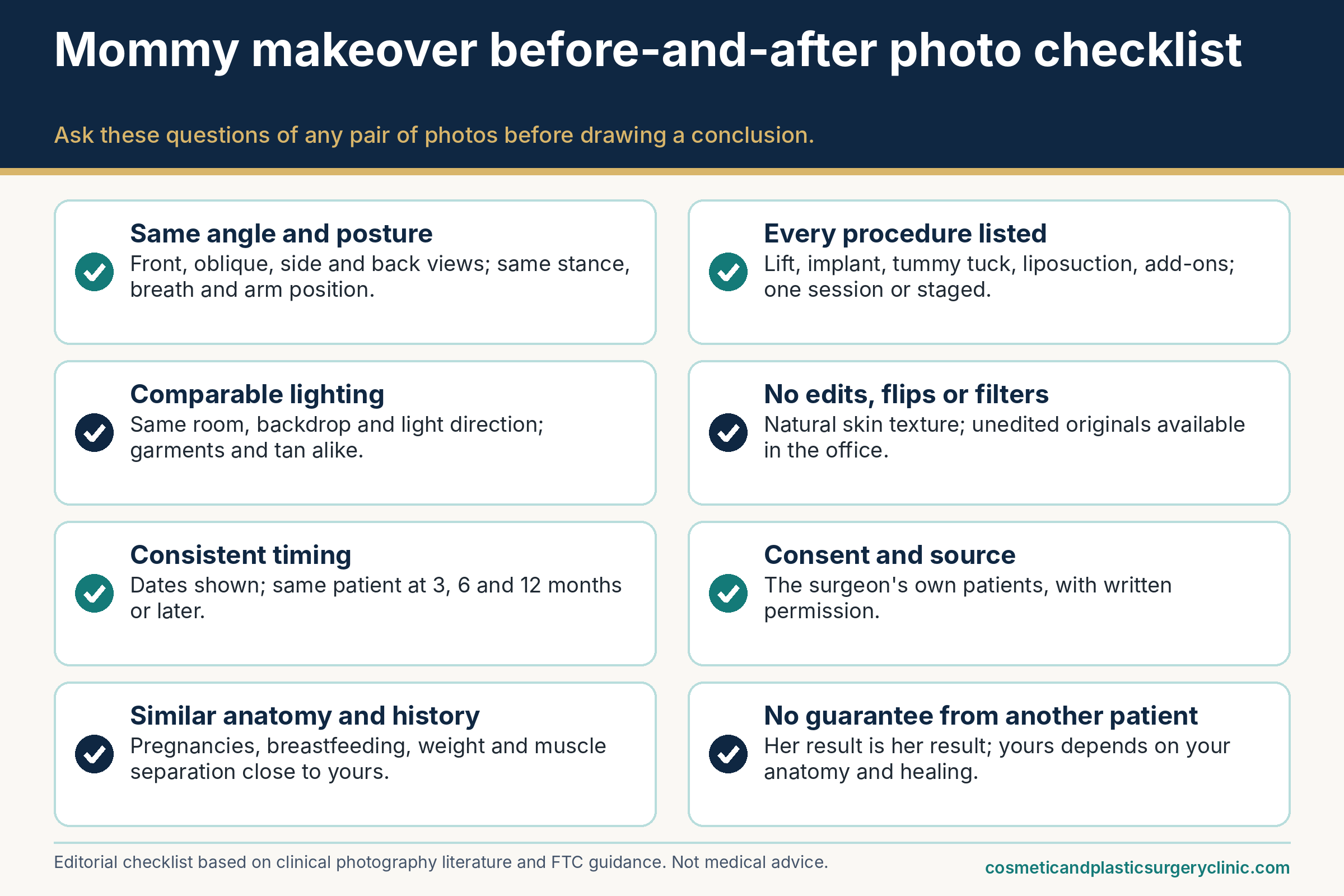
Everyday variation is real and is not the patient’s fault. The abdomen can look different depending on time of day, recent meals or bloating, hydration and whether a person is relaxed or tense. Jewelry, piercings and tattoos also matter, since they help reveal whether a photo was flipped or reused. The practical conclusion is not to distrust every image but to prefer galleries in which each patient’s set shows consistent posture, clothing, light and background, because those galleries make fewer excuses necessary. The checklist graphic below condenses these points into questions you can put to any pair of images.
Edited, Filtered and AI-Generated Images
What Retouching, Flipping and AI Tools Can Do to a Body Photo
Editing a photo of a torso is technically easy. Common phone filters smooth skin, and warping tools can narrow a waist, lift a breast line or erase a scar, often with a few swipes. Mirroring an image can make a result look as though it belongs to another patient, and an AI image generator can produce a plausible torso that never existed. The ethics of those practices are not subtle: a clinic that alters an outcome photo is misrepresenting what the surgery did. The harder issue for you as a reader is that these alterations are often undetectable on a phone screen.
Exposure to enhanced images can also shape expectations even when the images are not about surgery. A 2025 survey study in Aesthetic Plastic Surgery by Taritsa and colleagues questioned 426 online participants and found that those with prior experience of AI photo-enhancing filters reported significantly higher expectations for surgical outcomes, including expectations about appearance, complications and scarring. The participants were not patients, and the study captured attitudes, not results, so the findings should be read with care. The authors concluded that exposure to AI enhancement may raise expectations and could predispose people to lower satisfaction after surgery, which is a reason to compare any filtered image you see with unedited ones.
The Federal Trade Commission (FTC) has addressed one adjacent problem. Its final rule on fake reviews and testimonials, announced August 14, 2024, bans fake or false consumer reviews and testimonials, including AI-generated reviews that misrepresent that they are by someone who does not exist, and also bans the trade in fake social media indicators such as bot-generated followers or views. The rule targets reviews and testimonials rather than photographs as such, so it should not be read as a ruling on retouched photos. Still, it signals that fabricated testimonial content, including content generated by AI, is an enforcement priority. A before-and-after image presented as a patient’s result when it is not real would raise separate questions under truthful-advertising rules.
Practical Checks for Edited Images
You cannot verify an image with certainty from a screen, but a few checks reduce the odds of being misled. Look at straight lines in the background, such as door frames, tile joints, counters and the horizon. Warping tools that reshape a waist often bend adjacent lines. Compare the background in the before and after images: if they are different rooms, ask whether the pair is from the same session setup, and if the backgrounds are identical in a suspiciously clean way, consider whether one was composited.
Check landmarks that should not change. A mole, a tattoo, a piercing, a birthmark or an old scar should stay on the same side of the body across images. If they swap sides, the image may have been mirrored. A reverse image search can reveal whether the same photo appears on other accounts, or under another name. Skin texture is a further clue: skin that looks uniformly smooth, with no pores or fine variation, suggests smoothing filters.
The most dependable check is simply to ask. A reputable practice should be able to show unedited originals in the office, explain how its photos are made, and state that it does not retouch outcomes. If a practice declines to show originals, answers evasively, or says that “everyone edits a little,” that response is itself informative. It does not prove wrongdoing, but you are entitled to weigh it when choosing among surgeons.
Galleries, Comparable Cases, Consent and Advertising Rules
A single photograph is a data point. A gallery is a selection, and a selection can be made honestly or otherwise. This section turns the earlier reading skills into a method for judging a whole portfolio, asking a practice for the right cases, and understanding the consent and advertising rules that sit behind the images you see.
How to Ask a Practice for Comparable Cases
Cherry-Picking and What a Consistent Gallery Looks Like
Every practice chooses which patients to show. That is normal: nobody expects a website to feature every case, and some patients decline to share their photos. The question is whether the selection gives you a representative sense of the surgeon’s work or only a highlight reel. A gallery can mislead without a single edited pixel, simply by showing the best cases in the best light at the best time.
An ASPS blog post on breast augmentation photos, written by a member surgeon, offers a practical framing: look for results that are balanced and natural-looking across a variety of body types rather than a repeated template, and treat galleries as a starting point that cannot replace an in-person consultation. A related ASPS release on choosing a surgeon cautions that every surgeon has an individual aesthetic sense, so you should check that your idea of a good result matches theirs. For a mommy makeover, that can mean noticing whether every breast looks the same size and shape regardless of the patient’s frame, or whether results appear tailored to the person.
Signs of a more trustworthy gallery are mostly about transparency. Captions list every procedure performed and the date of surgery. Several views of each patient are shown, not just the flattering one. Photos for a given patient are taken at consistent angle, distance and background. The gallery includes patients with different body sizes, skin qualities and pregnancy histories. The same patient sometimes appears at more than one time point. And there are cases that are visibly modest alongside the dramatic ones. A gallery composed solely of the same slim body type, all photographed at one month, is giving you less than it appears to.
There are signs to treat cautiously as well: before photos taken in unflattering posture and after photos in polished poses, photos with no dates, results labeled as mommy makeover without a list of procedures, and images that appear on several websites under different names. None of these proves bad faith. Together, though, they suggest that the gallery is designed to impress, not to inform.
What to Request: How Many Cases, Which Time Points and Which Combinations
This article did not find a professional standard that says how many photos a patient should review before surgery, so any number is a judgment call. A reasonable aim is enough cases to see a pattern: several patients whose combination and history resemble yours, each shown from multiple angles at multiple time points. Many readers find that studying a handful of closely matched cases teaches more than skimming hundreds of loosely related ones.
When you ask, be specific about what you want and why. You are not asking the practice to promise that your result will match anyone else’s; you are asking to understand the range of results the surgeon’s approach produces in people like you. The table below suggests wording and shows how to read the response. It is a conversation aid, not a legal script.
| What to request | Why it matters | Sample wording | What a helpful answer sounds like |
|---|---|---|---|
| Same combination of procedures | Different mixes of breast and body procedures produce different looks and recoveries | “Can I see patients who had the same procedures I am considering?” | Names the procedures and says how many similar cases the surgeon has done, or admits there are few |
| Similar history | Pregnancy count, breastfeeding, weight history and abdominal muscle separation change the starting point | “Do you have examples with a similar pregnancy and weight history?” | Explains what is comparable and what is not, without implying a promised match |
| Multiple time points per patient | Swelling, scars and settling change over months to a year or more | “Can I see the same patients at 3, 6 and 12 months or later?” | Shows dated sets, or explains why later photos are limited |
| All views, unedited | Front views alone hide projection, flanks and back contour | “Can I see side, oblique and back views, and the unedited originals?” | Shows originals in the office and states that outcome photos are not retouched |
| Cases that needed revision or healed slowly | A gallery of only smooth recoveries understates real-world variation | “Do you show any cases that needed revision, and how common is that?” | Discusses revision policy and cost candidly |
| Staged versus single-session cases | The label “after” may mean after one stage of a plan | “Were these done in one operation or in stages?” | Labels each case and explains why one approach was chosen |
Practices may have good reasons for limiting what they show. Consent may cover only certain images, some patients may have asked that only specific views be shared, and some practices keep a fuller album for in-person viewing. If an answer is no, ask what the reason is and whether another way exists to see comparable results, such as a second consultation. For help preparing a fuller list of questions, see the guide to plastic surgery consultation questions to ask.
Consent, Privacy and Advertising Rules Behind Patient Photos
Patient Consent and Your Own Photos
A mommy makeover photo shows an intimate part of a person’s body, and the person in the photo deserves a clear consent process. A careful consent process would normally include written permission that says where the images may appear (website, social media, print, presentations), for how long, whether the face or identifying marks are visible, and how the patient can withdraw permission. Whether a patient received a discount, a free service or other benefit for permitting photos matters as well, because of advertising rules described below.
Privacy law in this area is more specific than most readers expect. The U.S. Department of Health and Human Services (HHS), in its guidance on de-identifying health information under the HIPAA Privacy Rule, lists full-face photographs and any comparable images among the identifiers that must be removed under the Safe Harbor method, and it includes a catch-all for any other unique identifying characteristic. HHS guidance on marketing says that covered entities generally need an individual’s authorization to use protected health information for marketing, with limited exceptions. That guidance does not mention photographs by name, and this article is not a legal analysis of how HIPAA or state law applies to any specific clinic. What it does tell you is that a cropped photo is not automatically anonymous: a tattoo, a birthmark, jewelry or the room itself can identify a person. It is fair to ask a practice how it obtains and documents consent for the images it publishes.
Your own photos deserve the same care. When you prepare for a consultation, you may be asked to send photos of your torso or breasts by email or an online portal. Ask how the practice stores them, who can see them and how long they are kept. Be cautious about posting body photos to open social media groups or forums, where images can be copied, reused or stripped of context. If you do want feedback, a private conversation with a qualified clinician is a better setting than a comment thread, and strangers cannot diagnose your anatomy from a photo.
What FTC Principles Say About Before-and-After Claims
The Federal Trade Commission requires advertising to be truthful and not misleading, and its health product guidance states that testimonials and endorsements can convey claims that the advertiser must be able to substantiate. The FTC’s Health Products Compliance Guidance says that a disclaimer like “results not typical” does not cure the deception of a dramatic testimonial, and that when an endorsement reflects unusual results the advertiser should clearly disclose what consumers can generally expect. The FTC’s endorsement guides question-and-answer page, last modified July 15, 2025, repeats the principle for endorsements with atypical results and explains that material connections, such as payments, free products or services or other benefits, should be disclosed when they might affect how people weigh an endorsement.
These are federal advertising principles written for health products and endorsements in general. They are not a plastic surgery rulebook, and this article cannot tell you whether a given clinic complies. They do give you practical benchmarks. A gallery that says “results vary” in small print beneath only exceptional images does not meet the spirit of the guidance. An influencer post that promotes a clinic without disclosing a discount or sponsorship raises a material-connection question. Reviews that appear fabricated, including AI-generated ones, run into the FTC’s 2024 rule on fake reviews and testimonials.
As a reader, translate these principles into red flags. Be cautious when a practice promises or implies that you will look like a photographed patient, uses countdown timers or limited-time offers alongside outcome photos, or presents a single standout case as typical. Be cautious when it offers a discount for posting photos or reviews, or when its images carry no dates and no procedure list. None of these on its own settles whether a practice is trustworthy, but each is a reason to slow down and ask questions.
From Photos to Decisions: Safety, Surgeon Selection and Realistic Expectations
Pictures can start a conversation, but the decision rests on information that photographs never carry: how long the operation takes, what could go wrong, who performs it and where, and how your own body and life differ from the women in the gallery. This final section connects the photo-reading skills to those larger questions.
The Safety Context That Photos Leave Out
What the Evidence Says About Combining Procedures
ASPS lists a long set of possible risks for mommy makeover surgery, among them bleeding, infection, poor healing of incisions, hematoma, seroma, loss of nipple sensation, implant leak, capsular contracture, unfavorable scarring, recurrent looseness of skin, fat necrosis, deep venous thrombosis, cardiac and pulmonary complications, asymmetry, persistent pain, contour deformity, fat embolization and anesthesia risks. That list is long because the combination touches several areas at once. An ASPS news article on combination procedures notes that doing multiple surgeries in one operation increases the number of healing sites and the intensity of recovery, and that concerns include blood clots, reduced mobility afterward and longer anesthesia time.
Surgeons commonly limit total operative time as a safety measure, but they do not agree on one number. A 2015 ASPS press release quoting surgeons describes keeping operative time under four hours. A 2017 ASPS blog post by a member surgeon says total surgical time should not exceed five hours and that procedures may be staged three to six months apart. A 2023 ASPS article quotes individual surgeons who limit combined procedures to under six hours and, in another case, to four to five hours. These are individual practice statements rather than an official standard, and they are good reason to ask what limit your surgeon follows and what happens if the plan runs long.
Studies give some numbers, with real limits. A 2015 study in Plastic and Reconstructive Surgery used the CosmetAssure insurance database, which tracks complications in insured aesthetic procedures, and examined 25,478 abdominoplasties performed between 2008 and 2013. Its overall rate of major complications was 4.0%, and the rates changed with what was added to the abdominoplasty, as the table shows. Hematoma was the most common major complication. The study identified combined procedures, male sex, age 55 or older and obesity as risk factors, and office-based surgical settings had lower complication rates than other settings in that dataset, a finding that may reflect which patients are treated where rather than the safety of the setting itself.
| What was done with the abdominoplasty | Major complication rate | How to read it |
|---|---|---|
| Abdominoplasty alone | 3.1% | Baseline within this dataset |
| With liposuction | 3.8% | Modestly higher than the baseline |
| With a breast procedure | 4.3% | The breast-plus-abdomen pairing at the core of many mommy makeovers |
| With liposuction and a breast procedure | 4.6% | Closest to a typical multi-component mommy makeover |
| With another body-contouring procedure | 6.8% | Rates rise as more regions are treated |
| With liposuction and another body-contouring procedure | 10.4% | Highest category in the study |
Other studies point in somewhat different directions, which is typical of this area. A 2010 study in the same journal, combining a literature review with an institutional chart review, estimated venous thromboembolism (blood clot) rates of 0.35% after abdominoplasty alone, 0.79% when combined with another plastic surgery procedure, 2.17% when combined with an intra-abdominal procedure and 3.40% after circumferential abdominoplasty. By contrast, a 2025 retrospective study of 726 patients in the Israel Medical Association Journal found no significant difference in adverse events between abdominoplasty with breast surgery and abdominoplasty alone after accounting for confounders, with 15% of the patients having had the combined operation. This article read that study only at abstract level, and it comes from a single setting, so it is one input among several.
What can you responsibly conclude? Combined operations are common, and many are performed without major complications, but the risk is not zero, it appears to increase when more regions are treated, and it depends on patient factors, surgical planning, anesthesia and the facility. Nothing in a photograph reveals any of that, which is why the gallery cannot be the main basis of a safety judgment. The mommy makeover risks and complications guide provides a fuller treatment.
Verifying the Surgeon and the Facility
Photos tell you what a surgeon’s work can look like; they do not tell you whether the surgeon is trained and credentialed for the operation. The American Board of Plastic Surgery (ABPS) maintains a public verification tool, and describes certification as a voluntary credential indicating that a surgeon has completed the appropriate training and passed comprehensive written and oral examinations. The tool searches by name or by location, and a status entry can direct you to the Federation of State Medical Boards (FSMB) when state medical board actions exist. ASPS has pointed out that, legally, any licensed physician can perform surgery and advertise as a “cosmetic surgeon,” so the label by itself says little. You can verify a surgeon’s certification on the ABPS verification page, and the page on ABPS board certification explains what to look for.
ASPS safety advice for patients consistently names the same items: board certification, an accredited ambulatory facility or hospital with emergency equipment, a qualified anesthesia provider (a physician anesthesiologist or a certified registered nurse anesthetist), hospital privileges where relevant, and experience with the specific procedure. Combined operations call for particular care on two of them. Ask who provides anesthesia for a longer operation and how clot prevention and post-operative monitoring are arranged. And ask how often the surgeon performs the exact combination you are considering, as opposed to each component separately.
Finally, confirm that the photos are of the surgeon’s own patients. Gallery images that came from a device manufacturer, a stock library or another practice are not evidence of this surgeon’s results. You can ask directly: “Are all of these your patients, operated on by you?” For more help choosing, the guide to how to choose a plastic surgeon walks through credentials, facilities and red flags.
Expectations and the Consultation
An Expectation-Setting Map for Combined Results
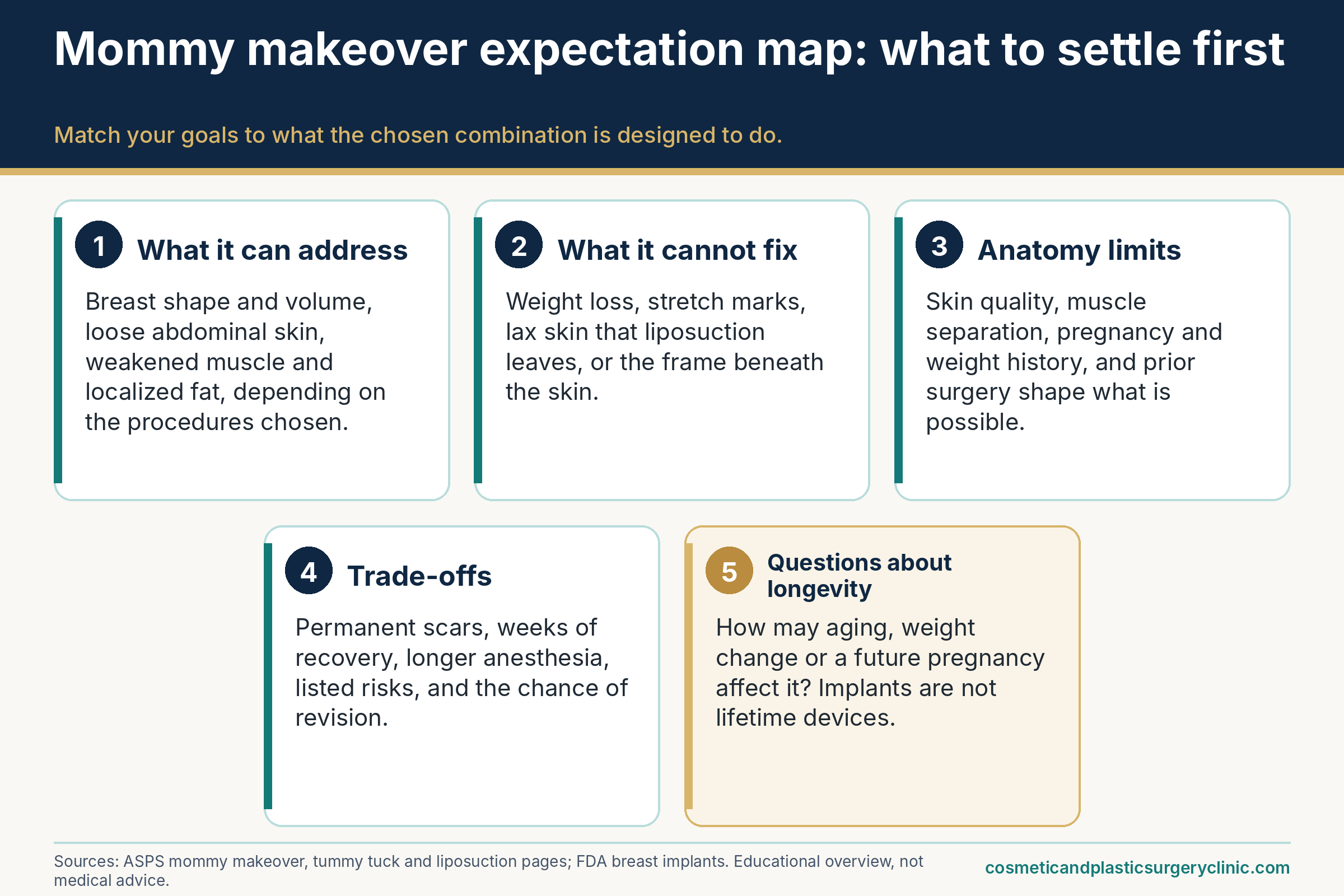
An honest expectation map has five parts, and each is a question to settle with a surgeon rather than a promise from this article. The first is what the combined operation can address. ASPS describes the aim as restoring the shape and appearance of a woman’s body after childbearing, and the components can address breast shape and volume, excess abdominal skin and weakened muscle, and localized fat. The second is what it cannot fix. A tummy tuck is not a substitute for weight loss or an exercise program, it does not eliminate stretch marks, liposuction cannot improve lax skin tone, and nothing in these operations changes the skeleton beneath.
The third part is anatomy limits: your starting skin quality, muscle separation, breast tissue, weight history, prior abdominal surgery (which ASPS says may limit tummy tuck results) and how many pregnancies you have had. The fourth is trade-offs. ASPS says the scar lines of a mommy makeover improve over time but never disappear completely, recovery runs for weeks, the list of risks above applies, and a second operation may sometimes be needed. The mommy makeover cost page covers the financial side, and the recovery guide covers the practical side. The fifth is longevity. FDA states that breast implants are not lifetime devices, aging and weight change continue to act on the body, and a future pregnancy can undo some of the work.
Photos can help you put your goals into words. A useful exercise is to pick a few images that capture what you hope for and a few that you would not want, then write one sentence about each: waist, breast shape, scar position, overall proportion. Take that list to the consultation instead of the images alone. Surgeons can then tell you which of those features your anatomy allows and which it does not, which is a far more reliable guide than assuming a stranger’s result will transfer.
A Consultation Script: Turning Photos Into Questions
You can use a simple sequence in the room. Begin by showing the photos you selected and saying what you notice in each. Ask the surgeon to tell you, for your anatomy, what is realistic, what is unlikely and what would depend on how you heal. Then ask the plan questions: which procedures are proposed and why, whether they would be done in one session or in stages, how long the operation is expected to last, where it would be performed, who provides anesthesia, and how blood clot prevention and monitoring are handled.
Move on to recovery and support: what the first days and weeks involve, what help you will need at home, especially with young children, and when you can lift, drive, work and exercise. Ask what scars you should expect and where they will sit, how the practice handles revisions and who pays for them. Ask for a written, itemized estimate that lists the surgeon’s fee, facility, anesthesia and any garments or follow-up, and keep in mind that a national average is not a quote. Finally, ask whether the surgeon would be comfortable with you seeking a second opinion. A good answer is yes.
You are never required to decide on the day of a consultation. If a practice presses for a deposit or a date while you still have unanswered questions, that is information too. Take your notes home, verify credentials independently, compare at least one other qualified surgeon if you can, and decide at your own pace. The complete mommy makeover guide collects the broader decision points in one place.
Frequently asked questions about mommy makeover before and after photos
How many months after surgery should an “after” photo be taken before I trust it?
No single month works for every person, because healing varies. ASPS says the final results of a mommy makeover may not be apparent for several months, and a member surgeon’s ASPS blog post places full results between six months and a year. Treat photos from the first few months as snapshots of healing, treat six months to a year as a more informative window, and give extra weight to a patient shown at more than one time point. Always check that the caption gives the date of surgery and the date of the photo.
Why do some galleries show only front-facing photos?
Sometimes it is a habit or a layout choice, and sometimes it is selective. A front view is the easiest to make flattering, because it hides projection of the lower abdomen, the contour of the flanks and the line of the back. It is reasonable to ask for side, oblique and back views of the same patients. A practice that routinely photographs all of them usually says so on its gallery pages, and one that cannot produce them may simply not have standardized its photography. Either answer tells you something about how the images were made.
Do photos taken after a staged plan look different from single-session results?
They can. ASPS describes a mommy makeover as typically a single-stage procedure, while member surgeons say work can be divided into stages three to six months apart, or by region, when needed. A photo labeled “after” may then show only the first stage, with the second still to come. Ask whether each gallery case was done in one session or in stages, and how far along the plan the patient was when the photo was taken. A staged result and a single-session result are different plans, not competing scores.
I have had more than one pregnancy or a cesarean. Do gallery photos still apply to me?
They may, if you can find patients with a similar history, but you should not assume it. Pregnancy count, time since the last delivery, breastfeeding, weight history and abdominal muscle separation all change the starting point. ASPS notes that an existing cesarean scar may be incorporated into a new tummy tuck scar, so your scar may look different from that of someone without prior abdominal surgery. Ask the practice for examples with comparable histories, and ask the surgeon what in your history could move your result away from the photos.
Are mommy makeover photos on social media reliable?
They are useful for learning what questions to ask and weak as evidence of what a procedure typically does. Social feeds favor striking images, often omit the procedure list and the timing, and are easy to filter or edit. A post that names a surgeon, lists the procedures, gives the date and shows consistent angles is more informative than one that does not. Whatever you see, verify the surgeon’s credentials independently and ask to see unedited original photos in person. Treat social posts as a starting point for a conversation, not as proof.
Can photos show whether abdominal muscles were repaired and whether the repair held?
Not directly. ASPS describes muscle repair as a step in the tummy tuck, and a flat abdomen at rest suggests that the wall is holding, but a photo cannot show strength, hernia status or whether a bulge appears when you strain. The Cleveland Clinic describes diastasis recti as having both cosmetic and functional aspects, including back pain and difficulty with lifting in some people. If function matters to you, ask the surgeon about technique and expected activity limits, and ask whether the practice has any photos taken leaning forward or with the arms raised.
Is it safe to combine a breast procedure with a tummy tuck?
No one can answer that for you from an article, and the word safe needs qualification. Studies suggest that major complication rates rise somewhat as more procedures are combined: a 2015 insurance-database study reported 3.1% for abdominoplasty alone and 4.3% with a breast procedure, and a 2025 single-setting study reported no significant difference in adverse events between the two groups after adjustment. Risk depends on your health, the extent of surgery, operative time, anesthesia and the facility. Ask your surgeon how those apply to you, and how the plan limits risk.
Should I send my own body photos to a practice before a consultation?
Some practices request them to plan a consultation; others prefer an in-person exam, and a photo is never a substitute for one. Before you send anything, ask how the images are transmitted and stored, who can view them and how long they are kept. Avoid emailing them to addresses you cannot verify, and avoid posting them in open groups, where they can be copied or reused. If you do want a second opinion, consider a private consultation with another board-certified plastic surgeon instead of a comment thread.
Does a practice need my permission to publish my before-and-after photos?
A careful practice obtains written consent that says where photos will appear and for how long. HHS guidance on HIPAA de-identification lists full-face photographs and comparable images among identifiers, and HHS marketing guidance generally requires authorization to use protected health information for marketing, with exceptions. This is general information, not legal advice, and state rules may add requirements. If you are asked to sign a photo release, read the scope, ask whether you can withdraw it later, and ask whether any discount or benefit is tied to permitting the images.
How can I compare two surgeons’ galleries fairly?
Compare like with like. Pick the same combination of procedures, look at cases at the same time point, and note body type, pregnancy history and photo quality. Count how many cases each gallery shows, whether captions list the procedures, and whether more than one view of each patient is provided. Then set the photos aside and compare the things photos cannot show: credentials, facility, anesthesia arrangements, how each surgeon explains risks, and how comfortable you feel asking questions. A more polished gallery does not necessarily mean a better surgeon.
How much do results keep changing after the first year?
Change slows after the first year, but it does not stop. ASPS says scar lines improve over time without disappearing completely, and hypertrophic scars can continue to flatten for as long as about two years according to a 2014 scar review. Weight changes, aging, and any further pregnancy can also alter the result, and ASPS advises postponing a tummy tuck if future pregnancies are planned. Implants are not lifetime devices according to the FDA. Ask the practice for late follow-up photos and how it handles changes that happen years later.
If you are comparing surgeons, bring a short list of questions, check credentials independently, and give yourself time. Nothing about this decision requires speed.
Sources and further reading
- American Society of Plastic Surgeons — Mommy makeover overview (accessed 2026-10-03) — goal, typical single-stage performance, procedures that may be included
- American Society of Plastic Surgeons — Mommy makeover candidates (accessed 2026-10-03) — health, weight, expectations and completed childbearing
- American Society of Plastic Surgeons — Mommy makeover procedure (accessed 2026-10-03) — anesthesia options; individualized combinations
- American Society of Plastic Surgeons — Mommy makeover risks and safety (accessed 2026-10-03) — listed risks of mommy makeover surgery
- American Society of Plastic Surgeons — Mommy makeover recovery (accessed 2026-10-03) — dressings, support bra, compression garment, healing over several weeks
- American Society of Plastic Surgeons — Mommy makeover results (accessed 2026-10-03) — results may take several months; scars improve but do not disappear; another surgery may be needed
- American Society of Plastic Surgeons — What is included in a mommy makeover? (member blog, 2018; accessed 2026-10-03) — customized combination, components, six months to a year for full results
- American Society of Plastic Surgeons — Five things to know about a mommy makeover (member blog, 2020; accessed 2026-10-03) — not one-size-fits-all; full versus mini tummy tuck
- American Society of Plastic Surgeons — Most common procedures in a mommy makeover (member blog, 2017; accessed 2026-10-03) — combination performed at the same time; surgeon-stated time limit; staging
- American Society of Plastic Surgeons — Mommy makeover combines procedures for postpartum body contouring (2015; accessed 2026-10-03) — surgeon-stated operative time limit; first postpartum year
- American Society of Plastic Surgeons — Two procedures in one (2023; accessed 2026-10-03) — surgeon-stated time limits; clot concerns with combinations
- American Society of Plastic Surgeons — For patients seeking combination procedures, time is precious (2023; accessed 2026-10-03) — healing sites, clot and anesthesia concerns; regional staging
- American Society of Plastic Surgeons — Tummy tuck overview (accessed 2026-10-03) — scope, stretch marks, weight fluctuation and future pregnancy
- American Society of Plastic Surgeons — Tummy tuck procedure (accessed 2026-10-03) — horizontal incision, navel handling, muscle repair
- American Society of Plastic Surgeons — Tummy tuck results (accessed 2026-10-03) — early swelling, scar fading, cesarean scar incorporation
- American Society of Plastic Surgeons — Liposuction results (accessed 2026-10-03) — swelling over months; lax skin tone not improved; weight stability
- American Society of Plastic Surgeons — Breast lift procedure (accessed 2026-10-03) — incision patterns, nipple repositioning, permanent scar lines
- American Society of Plastic Surgeons — Breast lift candidates (accessed 2026-10-03) — causes of breast shape change; lift does not change size; lift with augmentation
- American Society of Plastic Surgeons — Breast augmentation procedure (accessed 2026-10-03) — implant placement and incision sites
- American Society of Plastic Surgeons — 2025 Plastic Surgery Statistics Report (accessed 2026-10-03) — United States 2025 counts for breast augmentation, tummy tuck, liposuction and breast lift; methodology
- American Society of Plastic Surgeons — Photographic guidelines (public description, accessed 2026-10-03) — purpose of standardized clinical photographs
- American Society of Plastic Surgeons — What to look for in breast augmentation before-and-after photos (member blog, 2018; accessed 2026-10-03) — comparable patients; galleries as a starting point
- American Society of Plastic Surgeons — How to avoid common mistakes when selecting your plastic surgeon (accessed 2026-10-03) — “cosmetic surgeon” title; board certification; accreditation
- American Society of Plastic Surgeons — Ten things to ask before having plastic surgery (member blog, 2017; accessed 2026-10-03) — credentials, facility, anesthesia, photos, second opinion
- American Society of Plastic Surgeons — How to ensure your plastic surgery is safe (member blog, 2017; accessed 2026-10-03) — board certification, accredited facility, anesthesia provider
- American Board of Plastic Surgery — Verify certification (accessed 2026-10-03) — public verification; certification is voluntary; FSMB alert
- Winocour et al. — Abdominoplasty: risk factors, complication rates, and safety of combined procedures, Plastic and Reconstructive Surgery (2015; accessed 2026-10-03) — complication rates by combination; risk factors
- American Society of Plastic Surgeons — Tummy tuck complications: study looks at rates and risk factors (accessed 2026-10-03) — CosmetAssure data 2008–2013; hematoma most common
- Hatef et al. — Procedural risk for venous thromboembolism in abdominal contouring surgery, Plastic and Reconstructive Surgery (2010; accessed 2026-10-03) — venous thromboembolism rates by combination
- Wolf et al. — A comparative analysis of the complication rate in mommy makeover procedures and abdominoplasty, Israel Medical Association Journal (2025; accessed 2026-10-03) — 726 patients; no significant difference after confounders (abstract-level reading)
- Sperstad et al. — Diastasis recti abdominis during pregnancy and 12 months after childbirth, British Journal of Sports Medicine (2016; accessed 2026-10-03) — prevalence by time point in 300 first-time mothers
- Cleveland Clinic — Diastasis recti (accessed 2026-10-03) — cosmetic and functional aspects; physical therapy first; surgery option
- Son and Harijan — Overview of surgical scar prevention and management, Journal of Korean Medical Science (2014; accessed 2026-10-03) — scar remodeling and hypertrophic scar course
- Soares et al. — Standardization of photographic records for oncoplastic and breast reconstructive surgery, Mastology (2017; accessed 2026-10-03) — standard views and conditions for comparable photos
- Teplica et al. — Highly standardized rotational photography of the torso, Journal of Biocommunication (2020; accessed 2026-10-03) — controlled torso photography protocol
- Hernandez et al. — Influence of light angles on aesthetic perception of the face, Aesthetic Plastic Surgery (2021; accessed 2026-10-03) — light angle affects perception (facial study)
- Taritsa et al. — Impact of AI image-enhancing filters on expectations of plastic surgery outcomes, Aesthetic Plastic Surgery (2025; accessed 2026-10-03) — survey of 426 online participants
- U.S. Food and Drug Administration — Breast implants (accessed 2026-10-03) — labeling recommendations, boxed warning, patient decision checklist
- U.S. Food and Drug Administration — Risks and complications of breast implants (accessed 2026-10-03) — not lifetime devices; reoperation; complications
- Inter-Society Gluteal Fat Grafting Task Force — Safety advisory (January 31, 2018; accessed 2026-10-03) — fat placement in the subcutaneous plane
- Federal Trade Commission — Health Products Compliance Guidance (accessed 2026-10-03) — testimonials, substantiation, “results not typical”
- Federal Trade Commission — FTC’s Endorsement Guides: What people are asking (modified July 15, 2025; accessed 2026-10-03) — atypical results; material connections
- Federal Trade Commission — Final rule banning fake reviews and testimonials (August 14, 2024; accessed 2026-10-03) — fake and AI-generated reviews; fake social indicators
- U.S. Department of Health and Human Services — Methods for de-identification of PHI (page modified March 20, 2026; accessed 2026-10-03) — full-face photographs and comparable images as identifiers
- U.S. Department of Health and Human Services — HIPAA marketing guidance (reviewed July 26, 2013; accessed 2026-10-03) — authorization for marketing uses of protected health information