

BBL recovery is unusual among cosmetic operations because the area you most want to look at is the area you are asked not to lean on. BBL, short for Brazilian butt lift and also called gluteal fat grafting, moves fat from liposuction sites into the buttocks, so two separate surgical areas have to heal at once, and one of them contains living tissue that is still finding a blood supply.
This page covers BBL recovery itself: what changes over the first days, weeks and months, which restrictions sources describe and why they disagree, how work, driving, exercise and flights fit in, and which symptoms mean you should stop waiting. What the operation is lies in the Brazilian butt lift overview. The ranges below are drawn from society pages and are not instructions; your own surgeon’s written plan outranks every number here.
What BBL recovery is protecting: a graft that is still settling and a donor site that is healing
Most operations have one wound to look after. A BBL has at least three zones: the grafted buttocks, the areas where fat was suctioned, and the small incisions that connect them. Each zone produces different sensations, and mixing them up is the commonest source of needless worry. BBL recovery is easier to manage once each zone has its own checklist.
The graft zone and the donor zone follow different rules
Transferred fat is not a stitched-in implant. It is a collection of living cells placed into the tissue under the skin, and the ones that survive do so by growing a new blood supply from the surrounding tissue. The American Society of Plastic Surgeons (ASPS) says that on average patients keep about 60 to 80 percent of the transferred fat, with more or less in some cases, and that final results may take up to a year as the fat takes.
That biology explains why BBL recovery restrictions focus on pressure. An ASPS recovery page states that prolonged sitting damages the fat, and a 2022 ASPS article quotes a surgeon explaining that fat is vulnerable to pressure injury while it establishes a new blood supply. The donor zones obey ordinary liposuction rules instead: garment support, swelling that fades over weeks, and numbness that comes and goes. The liposuction recovery timeline covers that half in more detail.
Why the sitting rules aim at the buttocks and the garment aims at the donor sites
An ASPS blog post from 2016 describes a garment with the rear cut out so the material does not compress the grafted area, while the rest of the garment supports the harvest sites. Seen that way, the two rules are not contradictory. One removes pressure from the graft; the other limits swelling where fat was taken.
A practical consequence: a garment that rolls, bunches or presses on the buttocks defeats its purpose in BBL recovery even when it is worn for the right number of hours. Ask the team how the garment should sit and who checks the fit at the first visit.
Swelling, bruising, tightness, numbness and fatigue: what each usually represents
Swelling and bruising are expected during BBL recovery after both liposuction and fat injection. The Aesthetic Society says they begin to subside after days or weeks and that swelling may last weeks or even months, while its page on butt lift recovery adds that incisions stay red or pink for months. Tightness is the sensation of swollen tissue under a garment. Fatigue and a “not like myself” feeling commonly last one to two weeks, according to the same page.
Numbness deserves its own line. ASPS lists changes in skin sensation among the risks of buttock enhancement and says they may be lasting, so a patch of reduced feeling that is slowly shrinking is a question for follow-up visits, not an emergency. What is not routine in BBL recovery is covered in the final section of this page.
Why published BBL recovery advice disagrees, and what to do about it
Ranges differ because the evidence is thin
Read three society pages on BBL recovery and you will find three different sitting rules, two or three different garment durations and several different return-to-exercise dates. A later section puts the sitting numbers side by side. The disagreement is not a sign that someone is wrong. None of the sources opened for this article cites a controlled comparison of different sitting rules, garment durations or pillow designs, so each author is describing what their practice found reasonable.
That leaves a patient with a useful principle: treat published ranges as a way to check whether a plan looks unusually short or unusually long, not as a standard to demand. A surgeon who asks for more weeks than a website lists is following a protocol; a plan with no sitting restriction at all is worth asking about.
What a written BBL recovery plan should contain
Verbal instructions given while sedated or tired do not survive the car ride home, and a BBL recovery plan that is not written down is easy to misremember. Ask for a document that names the sitting rule (how long, how often, what counts as pressure), the sleeping position, the garment schedule, drain care if drains are used, the activities that are off limits and the date each is reviewed, the follow-up visit dates, and a phone number answered at night.
It should also say who to call and where to go if something goes wrong, in plain words and in order: the surgical team first for routine concerns, emergency services for the symptoms listed in the final section. If the answer to “who looks after me at 2 a.m.” is unclear before surgery, that is useful information about the practice.
Building a BBL recovery plan before the surgery date
BBL recovery planning is mostly logistics, and the logistics of a BBL differ from a breast or facial operation because lying on your back and sitting are both limited. General planning for any operation is on the plastic surgery recovery planning page; the points below are specific to gluteal fat grafting.
People, place and equipment
The first week: a helper, a bed that works face down, and a bathroom plan
An ASPS article from 2022 quotes a surgeon advising patients to stay home for the first four to five days and to walk only around the home or the immediate neighborhood. The Aesthetic Society suggests lying on your stomach in the car on the way home and for the first three days when maneuvering and standing, and advises having someone else take full charge of small children for two weeks.
Translate that into setup. Decide where you will sleep face down or on your side, how you will get out of that bed without sitting up onto the buttocks, where the pillow lives, and how toileting works when sitting is limited. A raised toilet seat, a step stool and a spare garment in the next size are boring details that decide whether the first week is calm.
Pillows, foam and garments: what the sources actually recommend
ASPS recommends a pillow or cushion placed behind the legs so the buttocks hang free and pressure shifts to the thighs, and a 2022 ASPS article quotes its then-president recommending foam or egg-crate padding. A 2016 ASPS post describes a donut-style or inflatable pillow placed behind the legs, not under the buttocks. Surgeons’ preferences differ on design, so buy after asking, not before.
For garments, ask about two sizes and about the rear opening. Swelling changes size over the first weeks, and a garment that fit on day one may not on day ten. Ask what to do if it rolls, digs in or leaves marks.
| Situation | Planning issue | Question for the surgical team |
|---|---|---|
| Lives alone | Getting in and out of bed, meals and toileting without sitting on the buttocks | Can a helper stay the first days, and what can I manage alone? |
| Small children at home | Lifting, carrying and floor play are limited; the Aesthetic Society suggests two weeks of full help | What weight limit applies, and for how many weeks? |
| Desk job | Sitting for hours is the opposite of the plan | Which chair setup, break interval and return date do you accept? |
| Job on your feet or behind a wheel | Lifting, driving and standing all compete with early healing | Is a staged or modified return acceptable, and with what note? |
| Traveling for surgery | Flights, hotel recovery and local follow-up if something changes | Who treats complications at home, and will you speak to them? |
| Combined with another procedure | Two or more healing zones, each with its own rules | How do the rules reconcile, and what does the written plan say? |
Choices that change BBL recovery before it starts
Nicotine and weight: the two modifiable factors the sources name
MedlinePlus says most health care providers advise stopping cigarettes and tobacco at least four weeks before surgery, that stopping at least ten weeks before lowers complications further, and that nicotine gum around the time of surgery is not encouraged because nicotine still interferes with wound healing. It also says smoking raises the chance of leg clots. For the graft specifically, ASPS notes that weight gain or loss changes results because transferred fat behaves like other body fat.
These are conversations to have at the consultation, not after. The BBL candidate page covers how surgeons weigh them; if either is a concern, a longer lead time is itself part of BBL recovery planning.
Who treats you afterward: the credential, facility and follow-up questions
A joint statement issued in August 2022 by ASPS, the Plastic Surgery Foundation, The Aesthetic Society and the Aesthetic Surgery Education and Research Foundation says office-based gluteal fat grafting should be performed only by surgeons with privileges for the procedure at a state-approved or licensed ambulatory surgery center or hospital. It adds that surgeons should manage standard postoperative care and be available for complications, including for patients who travel for surgery. The statement was later published in Aesthetic Plastic Surgery (2023) with endorsements from ISAPS and other bodies.
For BBL recovery that translates into three checks: verify board certification on the American Board of Plastic Surgery lookup, which also flags state medical board actions; confirm where the operation takes place and who monitors you afterward; and ask how complications are handled after discharge. The guide to choosing a plastic surgeon walks through verification, and the consultation questions page covers what to ask in the room.
A 2023 survey of Aesthetic Society member surgeons, published in Aesthetic Surgery Journal in 2024, offers one more planning question. About 10 percent of invited surgeons responded, and among the 128 who performed BBLs, 29 percent said they always used ultrasound during injection and 9 percent said they used it sometimes. Self-reported and low-response, the survey cannot describe all surgeons, but it shows why asking is reasonable: ultrasound guidance is supported by the societies yet not universal.
A BBL recovery timeline in ranges, from the first night to month twelve
Every date below is a range reported by society pages or by surgeons quoted in them. Individual BBL recovery depends on how much fat was moved, whether another procedure was combined, the person’s health and the surgeon’s protocol, so the table is a checking tool for BBL recovery and not a calendar.
| Phase | Common changes | Practical restrictions | Planning issue | Red flag |
|---|---|---|---|---|
| Day 0 to 3 | Garment, dressings, soreness, swelling building; possible drains | Face-down or side positions; short walks; no sitting on the buttocks | Driver, helper, first-night bed and bathroom plan | Chest pain, breathlessness, fainting, racing heartbeat, confusion |
| Days 4 to 14 | Peak bruising, drain output tapering, energy low | Mostly at home; sitting limited or avoided; no lifting | Childcare, work arrangements, follow-up visit dates | Fever, spreading redness, rapidly tightening swelling, calf pain |
| Weeks 3 to 8 | Bruising gone, swelling easing unevenly, donor areas still firm | Pillow-supported sitting in steps; garment hours may taper | Desk return, driving clearance, hours-per-day garment plan | Skin turning dusky, wound opening, new numbness or shooting leg pain |
| Months 3 to 6 | Early fat loss largely over; shape refining | Exercise usually resumed in stages; pressure rules relaxing | Weight stability, flight plans, photo comparison timing | Firm tender lump, asymmetry that is increasing |
| Months 6 to 12 | Swelling mostly resolved; scars maturing | Normal activity unless surgeon says otherwise | Deciding whether a touch-up is worth discussing | Persistent pain, drainage or a lump that returns |
The first week: discharge, walking and the days when most things happen
Going home, the first night and the case for walking
ASPS says you may go home a few hours after being watched in a recovery area, which means the first night is spent in your own bed with whatever setup you built. The Aesthetic Society says patients should be able to get up and walk after the second postoperative day; the 2022 ASPS article describes short walks around the home from the start. Sources vary on how early, so ask what your surgeon wants on day one.
The reason walking appears in every BBL recovery plan is blood flow. The Centers for Disease Control and Prevention (CDC) lists slow blood flow from limited movement, such as being confined to bed after surgery, as a risk factor for clots. Walking short distances at regular intervals is the usual counterweight, and it is not a substitute for any medicine or stocking your surgeon prescribes.
Drains, dressings and the first follow-up visit
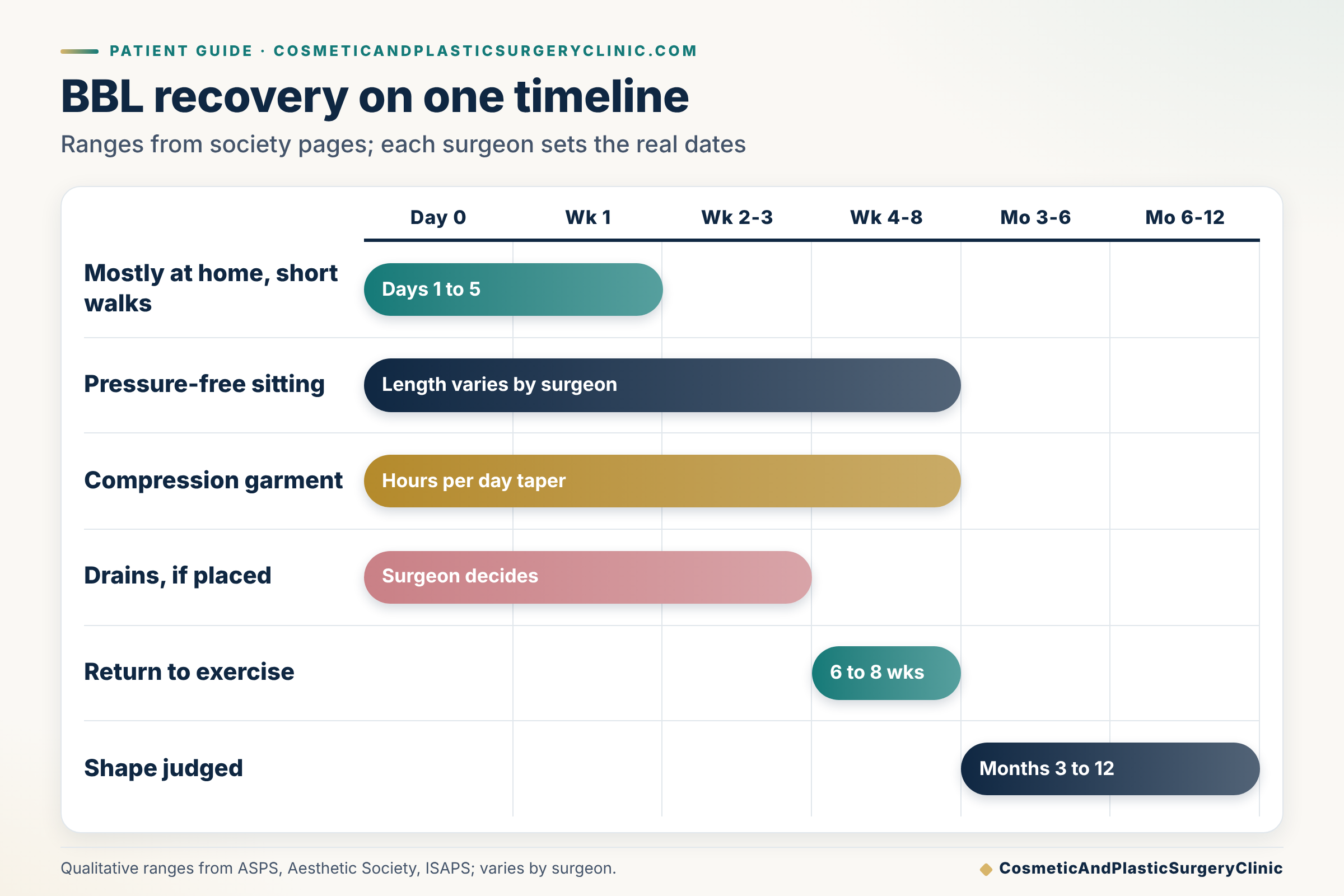
ASPS says small thin tubes may be placed temporarily under the skin to drain blood or fluid, and the Aesthetic Society says drains typically stay two to three weeks but may stay longer, with output measured daily. Not every BBL uses drains, so the question is whether yours will and who removes them.
Follow-up schedules differ too. One single-center series of 1,815 ultrasound-guided patients, published in 2024, reports visits at 24 hours, one week, six weeks, three months and two years, but that describes one practice’s protocol, not a standard. What matters is that dates exist and are written down before you leave.
Weeks two to eight: restrictions loosen in steps
The usual order in which BBL recovery restrictions ease
Sources tend to relax things in a recognizable order. Desk work and short car trips come first, with a pillow; the Aesthetic Society places work and driving at ten to fourteen days, while a surgeon quoted by ASPS describes returning to desk work between days seven and ten with cushioning. Lifting and strenuous activity wait longer; the Aesthetic Society says to avoid them for four to six weeks and to avoid direct pressure on the buttocks for at least eight.
Exercise returns last. ASPS says you can generally resume exercise after six to eight weeks, and the Aesthetic Society says eight, with high-impact or lower-body work typically at the end of the queue. For comparison, the Aesthetic Society’s page lists gluteal implants at eight to ten weeks, which the comparison of BBL and butt implants places in context.
Why feeling better in week two is not the same as being ready
By the second week of BBL recovery bruising is fading and energy is returning, and that is exactly when sitting on the buttocks starts to feel harmless. Feeling is a poor measure of graft health, because pressure on newly transferred fat does not hurt in a way that warns you. A 2023 ASPS article quotes a surgeon saying prolonged sitting risks killing the cells and eliminating the surgical result.
Donor areas run on a slower clock than energy does. ASPS’s liposuction recovery page says swelling should start to subside around weeks four to five and keeps improving from week six onward, so a firm, swollen waist at week three is ordinary.
Months three to twelve: when the shape can be read
Fat-graft survival: what the quoted figures measure
The retention numbers quoted in BBL recovery articles come from different measurements. ASPS’s procedure page gives 60 to 80 percent average retention; the society’s president at the time estimated, in a 2022 article, that 20 to 40 percent is absorbed during healing; a 2016 ASPS post says up to 40 percent may not survive whether or not the patient sits; a 2023 article quotes about 30 percent. They overlap because they are estimates, not trial results.
A measured example exists. A 2019 prospective study in Plastic and Reconstructive Surgery followed 50 women who had subcutaneous-only gluteal grafting and used ultrasound to track fat thickness. Thickness rose an average of 56.5 percent immediately and was down an average of 18.2 percent at 12 months, within a range of 6.8 to 24.8 percent. It measured thickness, not volume; it was a single-center, Level IV study; and it does not predict your result. How these figures translate into outcomes is covered in what BBL results look like over time.
Swelling, scars and the long tail of BBL recovery
ASPS says around month three the risk of further significant fat loss subsides and the shape becomes a good indicator of the lasting result, with refinement through month six. The Aesthetic Society says final shape becomes clearer as swelling subsides, sometimes taking three to six months, and ISAPS says results can take upwards of six months. ASPS’s procedure page allows up to a year for the fat to take.
Scars from the small incisions stay red or pink for months before fading. The Aesthetic Society adds a line about shopping that is worth taking literally: it advises against buying new clothes for at least three months, since the shape is still moving.
Sitting, sleeping, garments and massage: the four habits that shape BBL recovery
These four habits take up most of a patient’s attention during BBL recovery, and they are also where published advice is least settled. The sections below separate what sources agree on from what they leave to the surgeon.
Sitting: the rule everyone cites and nobody has put to a trial
Every source opened for this page tells patients to limit sitting during BBL recovery. The disagreement is over how long: the shorter rules are counted in days and the longer ones in weeks.
How a BBL pillow is meant to work, and where that idea runs out
The design logic is offloading. A pillow or cushion placed behind the thighs lifts the buttocks off the seat so body weight rests on the hamstrings, which is why ASPS says to place it behind your legs and not under the buttocks. A triangular “BBL pillow,” described in a 2022 ASPS article, applies the same idea in a wedge shape.
What the sources do not report is any measurement of how much pressure reaches the graft with each design, or whether pillow sitting for 10 minutes differs from not sitting. The mechanism is plausible, and surgeons recommend it, but no pressure study turned up in the pages read. Treat the pillow as risk reduction, not proof of safety, and follow your surgeon’s interval.
Cars, toilets, meals and desks: where sitting sneaks back in
Plans fail at the margins. The Aesthetic Society’s version of the rule makes explicit exceptions for the toilet and for eating, and a surgeon quoted by ASPS counts bathroom trips inside the 10-minute allowance. A car ride home, a family dinner and a video call are all sitting.
Consider a hypothetical: a patient plans to return to a desk job at day ten. The useful questions are whether the chair can be raised with a cushion behind the thighs, whether a standing arrangement is possible, whether breaks every ten minutes are realistic, and whether the surgeon will release her earlier or later than a website suggests. Answering them before surgery is easier than improvising on day nine.
Sleeping: stomach, side, and the habit of rolling over
What the sources say about positions
ASPS says to sleep face down or on your side. The 2016 ASPS post says to avoid sleeping on the back for the first eight weeks, and ISAPS says to sleep on the stomach or side and mentions a tennis ball in a small backpack to discourage rolling over. A 2022 ASPS article quotes a surgeon who has patients sleep on their stomachs the first night until the surgeon clears them, and describes a donut-style float, open at the back, for those who cannot manage that.
Position advice in BBL recovery is as much about habit as about anatomy. People roll in their sleep, which is why practical tricks appear in so many sources, and why a helper checking in during the first nights is useful.
When the position itself is the problem
Face-down sleeping is uncomfortable for people with neck, shoulder or breathing issues, and none of the sources opened tailors position advice to those conditions. That is a reason to raise them at the consultation and not to improvise a workaround alone. The right answer depends on your anatomy and the surgeon’s plan, and it can be written into your recovery document.
Garments and massage in BBL recovery: support with thinner evidence than the marketing implies
How long the garment stays on, according to different sources
ASPS says to wear a support garment around the clock and leaves duration to the surgeon. ISAPS says up to eight weeks, the Aesthetic Society says six to eight weeks, and the 2016 ASPS post says eight. A 2022 ASPS article quotes a surgeon advising nearly constant wear for the first month with removal only to shower, then at least 12 hours a day, usually overnight, in the second month.
The sources agree that a garment limits swelling and supports the donor sites, but none cites a trial comparing durations or designs. Two practical points are not in dispute: the rear should not compress the graft, and a garment that no longer fits needs to be replaced and not tolerated.
Lymphatic massage: an optional add-on with low-grade evidence
ASPS says your surgeon may recommend lymphatic massage from a licensed massage therapist after a BBL. The evidence base is thin: a 2023 review of lymphatic massage in cosmetic procedures, published in Aesthetic Surgery Journal Open Forum, is graded Level of Evidence 5, the lowest tier, in its abstract.
That does not make massage harmful or useless in BBL recovery; it means the benefit has not been demonstrated well. Ask whether your surgeon wants it, when to start, and whether the therapist should avoid the grafted area. Devices, creams and supplements marketed for swelling are a separate question that belongs to the surgeon, not a social media feed.

Returning to ordinary life after a BBL: work, driving, exercise, flights and help at home
In BBL recovery the calendar dates matter less than the sequence. Light, short, supported activity comes first; sitting on the buttocks, lifting and lower-body exercise return last. The table collects what sources report, with the question that belongs beside each row.
| Activity | Range reported | Reported by | Question to ask your surgeon |
|---|---|---|---|
| Desk work | Day 7 to 10 with cushioning, or 10 to 14 days with a pillow | Surgeon quoted by ASPS (2022); Aesthetic Society | Which chair setup, break interval and standing option? |
| Driving | About 10 to 14 days with a pillow; off narcotic pain medicine first | Aesthetic Society; ASPS (2016) | Which medicines count, and who clears me? |
| Lifting and strenuous activity | Avoid for 4 to 6 weeks; heavy exercise avoided for at least a month | Aesthetic Society; ISAPS (2017) | What weight limit applies to children and groceries? |
| Exercise | Light activity after one month; general resumption at 6 to 8 weeks | ASPS (2016 and recovery page); Aesthetic Society | Which types first, and when may lower-body work start? |
| Direct pressure on buttocks | At least 8 weeks | Aesthetic Society | Do sofas, bicycle seats and car seats count? |
| Shopping for new clothes | Wait at least 3 months | Aesthetic Society | When will the shape be settled enough to measure? |
Work, driving and daily tasks
Work: the job matters more than the calendar
Sources that give a return-to-work date describe desk work: day seven to ten with cushioning in a surgeon’s quote reported by ASPS in 2022, ten to fourteen days in the Aesthetic Society’s version. No source opened gives a date for jobs that involve lifting, long standing or driving, and that silence is informative. These jobs depend on the surgeon’s judgment and on whether the employer can offer modified duties.
Practical arrangements for BBL recovery help whichever date applies: a cushion that stays at the office, permission to stand or walk every few minutes, and a note from the surgeon if the employer asks. Ask whether a staged return, such as reduced hours first, is acceptable.
Driving: medication and reaction time, not just seating
The Aesthetic Society places driving at ten to fourteen days, using a pillow, and a 2016 ASPS post says pain medication should be switched from narcotics to over-the-counter acetaminophen before driving. Those are reported guides. Your surgeon decides which medicines you take and when you may drive, so ask what criteria they use, for example comfortable movement, no sedating medicine and the ability to react quickly.
Until you are cleared, someone else drives. Ask about the ride home before surgery, since the Aesthetic Society suggests lying on your stomach in the car going home.
Exercise, lifting and the gradual return
A sensible order for returning to exercise
Walking is first, and it never fully stops. The sources opened do not set a full sequence, but the pattern in them is walking, then light activity, with lower-body and high-impact work later. The 2016 ASPS post allows light activity such as brisk walking after one month, and says vigorous activity like jogging can resume once the fat has stabilized. ASPS’s recovery page says exercise can generally resume after six to eight weeks.
The ordering rule is simple: anything that squeezes, bounces or loads the buttocks waits longer than anything that does not. Ask for your own sequence in writing, including which gym machines and which yoga poses fall into each stage.
Weight stability and why it shapes the rest of BBL recovery
ASPS says weight gain or loss can change results because transferred fat grows or shrinks like other body fat. For recovery, that means the first year is a poor time to start an aggressive diet or a rapid bulk, and a poor time to compare yourself with a photo from a different weight. Stable weight also makes the three-to-six-month shape easier to judge fairly.
Surgeons differ on how much weight change they consider acceptable, and no source opened gives a number. It belongs on the list of questions about your own plan.
Flying and staying near your surgeon
What CDC and ASPS say about flights after surgery
CDC’s travel pages say flying after surgery can raise the risk of blood clots and advise delaying air travel for ten to fourteen days after major surgeries. That guidance is general, not BBL-specific. For long trips, CDC’s clot page recommends getting up and walking every one to two hours when traveling more than four hours.
A 2023 ASPS article adds BBL-specific detail: prolonged sitting can kill fat cells, passengers cannot lie down while the seat-belt sign is on, and surgeons quoted suggest walking five to ten minutes each hour, compression stockings and hydration, and staying near the surgeon for four to five days. Whether and when you fly is your surgeon’s call, not a website’s.
If you travel for the operation: the aftercare chain
The August 2022 joint statement says surgeons should be available for complications even for patients who travel, and that surgeons treating patients at a distance need comprehensive pre- and postoperative protocols. CDC adds that follow-up care for complications can be expensive and might not be covered by health insurance, and that travelers may need care at home if problems appear after returning.
Before booking, ask who will examine you at home, whether the surgeon will talk to that clinician, and whether your records travel with you. The medical tourism page covers the wider decision, and the questions above belong in it.
When BBL recovery stops being routine: emergencies, same-day calls and slower problems
Most days of BBL recovery are uncomfortable and uneventful. The skill is telling ordinary swelling and soreness from the small set of symptoms that cannot wait. The other article in this cluster, BBL risks, explains the mechanisms; this section is about what to do.
Emergency services first: symptoms that should not wait
The list and the reasoning behind it
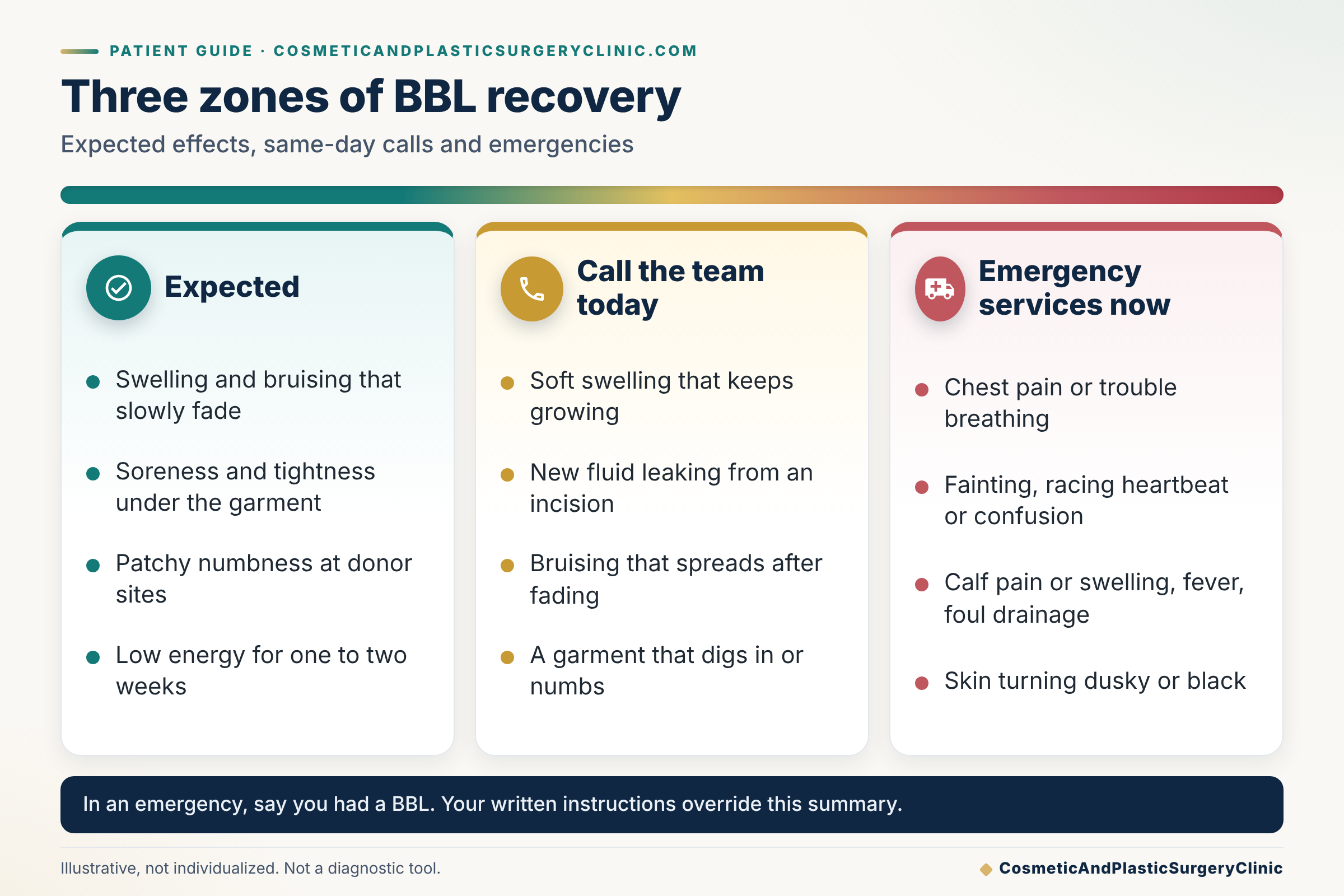
ASPS’s recovery page says to seek medical attention immediately for shortness of breath, chest pain or unusual heartbeats, and warns you may need hospitalization. CDC lists the symptoms of a clot in the lung as difficulty breathing, a faster or irregular heartbeat, chest pain that is often worse with a deep breath, coughing blood, and lightheadedness or fainting, and says to seek medical help immediately.
A calf that is swollen, painful, warm or red can signal a clot in a leg vein. CDC says about half of people with such a clot have no symptoms at all, so the absence of leg pain is not reassurance. Walking, the surgeon’s instructions and a low threshold for calling matter more than self-diagnosis.
Timing: why early hours matter most, and why clots can come later
An ASPS article from 2022 says severe, life-threatening complications tend to occur during surgery or within hours afterward, and that a serious systemic complication is less likely about a week out. CDC and a 2023 ASPS article add that clots can form in the days or even weeks after sitting for long periods or traveling. So the early period carries the highest concentration of dangerous events, and the later weeks still deserve attention.
Published death-rate figures are contested. ASPS’s 2018 warning said mortality was estimated as high as 1 in 3,000 without naming a source, and a 2022 ASPS article quotes its president putting the current rate nearer 1 in 15,000. The August 2022 joint statement says statistics are difficult to obtain and describes fat-embolism deaths occurring with disturbing frequency. Details are in the BBL risks article.
The surgical team the same day: signs that something has changed
Fluid, drains and seromas
Cleveland Clinic says a seroma, a pocket of clear fluid that collects under the skin, typically shows up around seven to ten days after surgery, with small ones resolving in a little over a week and larger ones taking up to six weeks. Treatment ranges from watching to needle drainage or a temporary drain. A soft, growing swelling, new fluid leaking from an incision, or a drain whose output suddenly changes warrants a same-day call.
The same page says to call the surgeon if drainage looks like pus or signs of infection appear, including discoloration, severe pain or fever. Fever, severe pain and foul drainage are on the emergency list above for that reason. If the team cannot be reached promptly, go to an emergency department.
Skin, wound and garment problems
ASPS lists slow wound healing, skin loss, infection and fat necrosis among the risks of buttock enhancement. A 2024 single-center review of 1,815 ultrasound-guided BBLs, performed by two surgeons, reported local skin ischemia in 1.2 percent, surgical-site infection in 0.8 percent, seroma in 1.2 percent and fat necrosis in 0.3 percent, with no macroscopic fat embolism or deaths. It was retrospective and is not a forecast for anyone else.
A surgeon quoted by ASPS in 2023 notes that infections typically occur within three to five days, though that is one surgeon’s observation. Call the same day for an incision that opens, a patch of skin that changes color, a garment that leaves deep marks or numbs a limb, or bruising that expands after it should be fading.
Slower problems: asymmetry, firm areas and volume that settles lower than hoped
What the later weeks can show
A firm, tender area weeks after surgery may be swelling, fluid or fat that did not survive, and examination is the only way to tell. ASPS lists fat necrosis and uneven results as recognized risks. Asymmetry that is obvious in week two is usually swelling; asymmetry that persists or grows at month three is a conversation for the next visit.
A 2022 ASPS article describes some patients returning to correct asymmetry or irregularities and others wanting more volume, and says surgeons overfill intentionally to compensate for fat loss. That is a reason to wait until the shape stabilizes before judging, not a reason to hide a concern.
Revision timing and the questions that frame it
Revision talk before the three-to-six-month mark is premature by most sources’ timelines, because swelling and early fat loss are still changing the shape. When the time comes, revision BBL covers the options and the trade-offs, including waiting.
Ask before surgery what the practice’s revision policy is, whether any fee applies, and who performs it. Keep your own records: operative report, photographs from a standard set of angles taken at the same distance, and the dates of every visit. They make a second opinion faster and fairer.
Frequently asked questions
When can I sit normally again during BBL recovery?
Sources use different words: avoid prolonged sitting for about two weeks (ASPS recovery page), at least eight weeks of direct pressure (Aesthetic Society), or ten-minute intervals for six weeks (a 2022 ASPS article). “Normally” is rarely defined, so ask what counts as normal: a soft sofa, a car seat for an hour, a desk day. A staged answer with dates, written down at the follow-up visit, is more useful than a single number.
Why do the buttocks look larger at first and then shrink during BBL recovery?
Early size includes swelling in the grafted tissue and fat that has not yet survived. ASPS sources describe 20 to 40 percent absorption during healing, and surgeons may intentionally overfill to compensate. A larger-looking shape in the first weeks is not a measure of the final result, and a shrinking one is not by itself a sign of a problem. Ask your surgeon how overfill was planned for you and when the first fair comparison can be made.
Can I take a long drive or a flight home early in BBL recovery?
That depends on your surgeon and the distance. CDC advises delaying air travel for ten to fourteen days after major surgeries and walking every one to two hours on trips over four hours. A 2023 ASPS article quotes a surgeon suggesting a four-to-five-day stay near the practice. Ask for a written plan that includes where you will be examined if something changes on the road and who you call.
Does BBL recovery change when it is combined with a tummy tuck?
It adds a second healing zone with its own rules. No source opened compares combined recovery directly, so the details come from your surgeon. Expect questions about how to sleep and move when both the abdomen and buttocks are protected, how garments are layered, and how helpers fit in. The tummy tuck recovery page describes the abdominal side, and a combined plan should reconcile the two.
How long does numbness last in BBL recovery?
ASPS lists changes in skin sensation among the risks and says they may be lasting. Altered sensation is a listed risk, and the sources opened give no timetable. A patch that is shrinking is usually discussed at follow-up, while numbness together with a swollen limb, shooting pain or a tight garment should prompt a same-day call. Raise it at each visit so it is documented.
Can I use any donut pillow, or do I need a BBL-specific one?
Sources describe more than one shape: a donut-style or inflatable pillow placed behind the legs (ASPS 2016), a triangular wedge (ASPS 2022), and foam or egg-crate padding (ASPS 2022). The consistent point is where it goes, behind the thighs so the buttocks hang free. No pressure comparison of designs was found, so ask which kind your surgeon prefers and whether it suits your seat height.
What should I tell an emergency room during BBL recovery?
Say plainly that you had a BBL, the date, and any procedures done at the same time. Bring your discharge papers, medication list and the surgeon’s phone number, and ask staff to contact the surgeon. The August 2022 joint statement says surgeons should be available for complications, including for patients who traveled. Clear, early information helps clinicians who did not do the operation recognize what they are seeing.
Will I need a second procedure after BBL recovery to get the shape I want?
A second procedure is not automatic. A 2022 ASPS article says some return to correct asymmetry or irregularities and others want more volume, and that fat survival varies. Judging at three to six months, when the shape is steadier, avoids deciding on swelling. The results article covers how to read the shape over time, and a revision conversation can include waiting.
Sources and further reading
- ASPS — Buttock enhancement recovery (accessed 2026-11-12) — sitting, exercise, garment, positioning, drains, massage, warning signs
- ASPS — Six things you need to know about recovering from a Brazilian butt lift (Clark, August 2022; accessed 2026-11-12) — first days, garment schedule, sitting intervals, return to work, sleeping, month-three and month-six milestones
- ASPS — Seven things you need to know about a Brazilian butt lift (Clark, March 2022; accessed 2026-11-12) — mortality estimates, timing of complications, fat absorption, padding
- ASPS — Recovering from a Brazilian butt lift (Azad, May 2016; accessed 2026-11-12) — older sitting, sleeping and garment guidance, driving and activity
- ASPS — Boarding groups: added complications from traveling after a Brazilian butt lift (Freeman, June 2023; accessed 2026-11-12) — flying, staying near the surgeon, clot prevention
- ASPS — Buttock enhancement procedure (accessed 2026-11-12) — average fat retention, time for results, effect of weight change
- ASPS — Buttock enhancement safety (accessed 2026-11-12) — recognized risks
- ASPS — Liposuction recovery (accessed 2026-11-12) — donor-site swelling and activity timeline
- ASPS — Plastic surgery societies issue urgent warning about the risks associated with Brazilian butt lifts (August 2018; accessed 2026-11-12) — mortality estimate and board-certification advice
- ASPS, PSF, The Aesthetic Society and ASERF — Gluteal fat grafting safety advisory and joint statement (August 2022; accessed 2026-11-12) — privileges, ultrasound, postoperative availability, Florida rules
- ISAPS and partner societies — Endorsed patient safety statement on gluteal fat grafting (Aesthetic Plastic Surgery, 2023; accessed 2026-11-12) — endorsement and recommendations
- The Aesthetic Society — Butt lift aftercare and recovery (accessed 2026-11-12) — sitting, pressure, drains, work, driving, exercise, shape timing
- ISAPS — Brazilian butt lift recovery tips (September 2017; accessed 2026-11-12) — sitting, sleeping, garment, walking, exercise
- CDC — About blood clots (accessed 2026-11-12) — symptoms of leg and lung clots, risk factors, travel advice
- CDC — Medical tourism: travel to another country for medical care (accessed 2026-11-12) — delaying air travel after surgery, care after returning
- Cleveland Clinic — Seroma (accessed 2026-11-12) — timing, duration, treatment, when to call
- MedlinePlus — Smoking and surgery (accessed 2026-11-12) — stopping nicotine before surgery, clot and wound-healing effects
- American Board of Plastic Surgery — Verify certification (accessed 2026-11-12) — certification lookup, state board alerts
- Cansancao et al. — Subcutaneous-only gluteal fat grafting: a prospective study of long-term results with ultrasound analysis (Plastic and Reconstructive Surgery, 2019; catalog abstract, accessed 2026-11-12) — 50 patients, fat thickness at 12 months
- Vidal-Laureano et al. — Augmented safety profile of ultrasound-guided gluteal fat transfer: retrospective study with 1815 patients (Aesthetic Surgery Journal, 2024; accessed 2026-11-12) — complication rates, follow-up schedule, limits
- Finkelstein et al. — The Brazilian butt lift remains the deadliest aesthetic surgery procedure (Aesthetic Surgery Journal, 2024; accessed 2026-11-12) — 2023 surgeon survey on ultrasound use
- Aesthetic Surgery Journal Open Forum — The utility of lymphatic massage in cosmetic procedures (February 2023; abstract record, accessed 2026-11-12) — review, Level of Evidence 5


