A consent form for abdominoplasty lists tummy tuck risks in one even-toned column: bleeding, infection, fluid, clots, tissue loss, scars. It doesn’t say which line belongs to an ordinary second week of recovery and which one belongs in an emergency department. This page sorts them by what is happening in the tissue, puts a source, a year and a population next to every number, and ends with questions you can carry into a consultation.
The American Society of Plastic Surgeons (ASPS) counted 173,251 tummy tucks in its 2025 statistics report, up from 170,544 the year before, so the operation is common. Common doesn’t mean low-risk for any one person, and nothing here predicts your outcome. For what the operation changes and what it can’t, see the main tummy tuck guide; for risk-reading skills that apply to every procedure, see the general plastic surgery risks page.
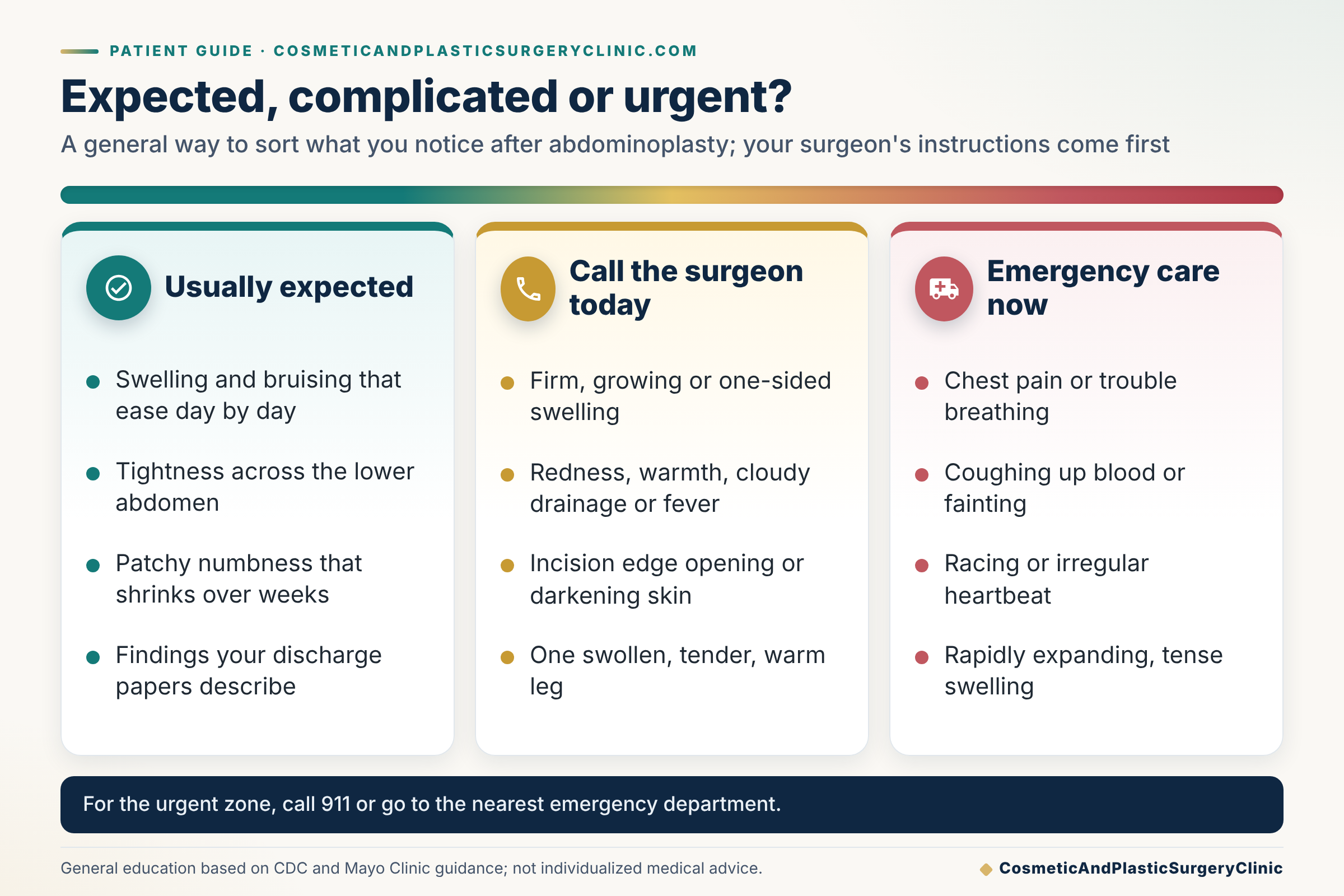
Sorting tummy tuck risks into expected, complicated and urgent
What the operation does to the tissue
A lifted flap swells, bruises and loses feeling
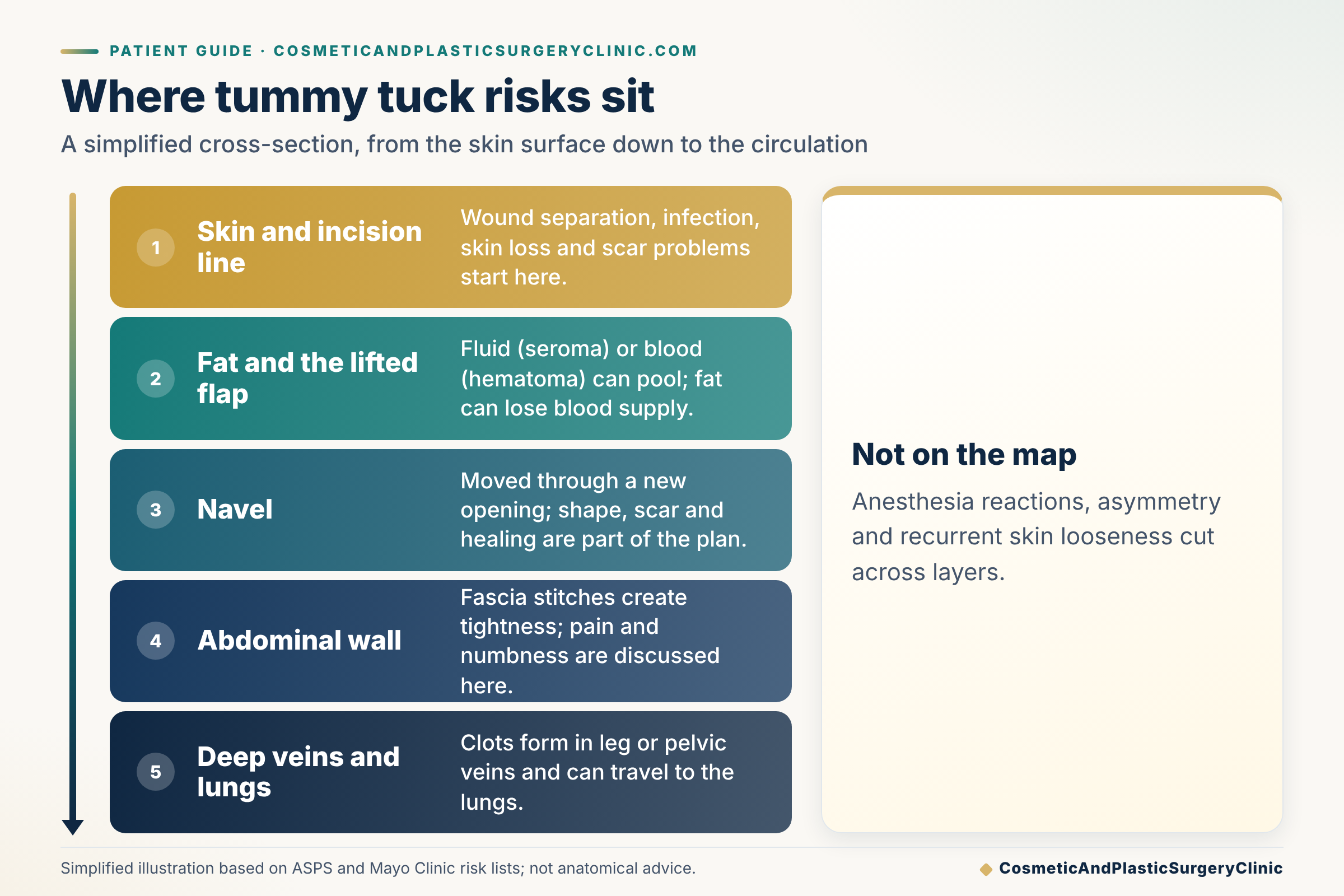
Mayo Clinic describes the operation this way: most of the skin and fat between the navel and the pubic hair is removed, the fascia over the abdominal muscles is tightened with stitches, and the navel is brought out through a new opening and stitched back in place. To do that, the surgeon lifts the upper skin and fat off the abdominal wall, which cuts many small blood vessels and sensory nerves along the way.
That lifted layer is why swelling, bruising and a tight, numb feeling are baseline effects rather than reportable tummy tuck risks. Mayo notes that nerves of the abdomen, and less often the upper thighs, may be affected, and that numbness usually improves within months. The useful question is whether the numb area is shrinking over time, not whether it exists.
Fluid, blood and blood supply drive most problems
Most tummy tuck risks trace back to one of three mechanisms. Fluid can collect in the space under the lifted flap, which is a seroma. Blood can collect there too, which is a hematoma. Or the skin and fat at the edges of the flap can receive too little blood, which shows up as slow healing, wound separation or tissue death.
Clots in the leg veins are a fourth category with a different cause, and anesthesia reactions and infection cut across all of these. Knowing which mechanism a symptom points to makes your questions more precise: “how do you prevent fluid pockets?” is a better consultation question than “is it safe?”
Where an expected effect becomes a complication
The trend test: easing, even and described in your discharge papers
Expected effects tend to ease from one day to the next, affect both sides about equally and match what your written instructions describe. Findings that deserve a call tend to do the opposite: they are firm, growing, one-sided, hot, draining or getting worse. Your surgeon’s instructions override any general rule on this page, including the one in the table below.
Severity matters as much as direction. A bruise that spreads slowly across the lower abdomen and flanks is common after this operation. A bulge that tightens over hours, or a pain that rises when it should be falling, is a different pattern and belongs in a phone call that day.
Why the definition of “complication” moves the number
Published figures depend on what a study counted. The largest data set reviewed below, an analysis of the CosmetAssure insurance database published in Plastic and Reconstructive Surgery in 2015, counted “major” complications. According to the ASPS summary of that study, less serious problems managed in the clinic were not included.
So a low figure tells you about serious early events in one group of insured patients. It says less about a seroma drained in the office, a wound edge that needed extra dressing visits, or a scar you dislike at month nine.
| What you notice | Usual category | General action level | Basis |
|---|---|---|---|
| Swelling, bruising and tightness that ease day by day; patchy numbness | Expected effect | Follow written instructions; keep notes | Mayo Clinic; discharge guidance |
| Swelling that is firm, growing or one side only; a bruise that keeps spreading | Possible hematoma or seroma | Same-day call to the surgeon’s office | ASPS risk list; Plastic and Reconstructive Surgery 2015 |
| Redness, warmth, cloudy drainage or fever | Possible infection | Call the provider right away | CDC surgical site infection guidance |
| Incision edge opening, or skin turning dark, blue or blistered | Wound problem or tissue loss | Same-day call; do not wait for the next visit | ASPS and Mayo Clinic risk lists |
| One leg swollen, tender, warm or red | Possible deep vein clot | Seek medical care promptly | CDC blood clot guidance |
| Chest pain, trouble breathing, coughing blood, fainting | Possible pulmonary embolism | Call 911 or go to the nearest emergency department | CDC blood clot guidance |
The complications one by one: what each is and what the evidence says
Fluid and blood collections among tummy tuck risks
Seroma: a tummy tuck risk common enough to have its own prevention research
A seroma is fluid that gathers in the space where the flap was lifted. Mayo Clinic says drains can lower the risk of this complication and that fluid may be removed with a needle and syringe. Reported rates for this tummy tuck risk are wide because techniques differ: a 2017 systematic review of nine prospective controlled studies (664 patients) found seroma in 7.5% of patients who had a prevention method versus 19.5% of controls.
A 2023 systematic review in Aesthetic Surgery Journal pooled eight studies and 846 patients, mostly women, with many having had weight-loss surgery. Seroma occurred in 5.3% when Scarpa’s fascia (a thin layer inside the fat) was preserved and in 15.1% when it was not. Both reviews are limited by small studies and mixed designs, so read them as a direction, not a personal forecast.
The 2017 review’s subgroup analysis suggested that preserving Scarpa’s fascia and using tissue adhesives each lowered seroma on their own, and that quilting-type progressive tension sutures possibly did. Surgeons differ on which of these they use, so ask how your surgeon prevents this tummy tuck risk rather than assuming one method is standard.
Hematoma: the early tummy tuck risk that can’t be left alone
A hematoma is blood trapped under the flap. Among tummy tuck risks in the CosmetAssure analysis of 25,478 abdominoplasties (2008 to 2013), hematomas made up 31.5% of the 1,012 major complications, the largest share of any category. The study’s summary gives shares rather than a separate hematoma rate, so no per-patient figure is quoted here.
The pattern to know is a tense, enlarging, often one-sided swelling with pain that is rising rather than easing. Some hematomas are drained in the operating room, and one in a 2025 single-surgeon series of 333 patients required a return to the operating room. The earlier you call, the more options the team has, which is why this finding sits in the “same-day” row of the table above.
Skin, fat, scar and navel problems
Wound separation, infection and tissue loss as tummy tuck risks
The lower edge of the lifted flap sits farthest from its blood supply, and that is where trouble tends to show first. ASPS lists poor wound healing, fat necrosis (fatty tissue that dies), skin loss and infection among tummy tuck risks. Mayo Clinic adds that incisions can heal poorly or come apart, and that fatty tissue can be damaged or die, with a higher chance in smokers and sometimes a need for more surgery.
Infections were 27.2% of the major complications in the CosmetAssure analysis, again reported as a share rather than a per-patient rate. In a 2025 single-surgeon series of 333 patients using a protocol with no drains, 3.6% had a wound infection and 1.5% a seroma. CDC lists redness, pain, cloudy drainage and fever as the signs to report right away.
Scars, the navel and the contour you can see
Scarring is among the tummy tuck risks that last by design: the incision is usually placed along the swimsuit line, and Mayo says it can take up to a year to fade as much as it will. ASPS lists unfavorable scarring, asymmetry, skin discoloration, prolonged swelling and recurrent looseness of skin as possible outcomes, none of which are emergencies, all of which can matter for months.
The navel is moved through a new opening and sewn back, so its shape, scar and healing are part of the risk discussion. The sources opened for this page contain no reliable published complication rate for the navel, only single-surgeon technique reports, so none is offered here. A scar diagram and a photo of the surgeon’s own healed navels, covered in the tummy tuck photo-reading guide, are better questions than a percentage.
Sensation, pain and the possibility of revision
Numbness and persistent pain
Numbness is the most predictable of the nerve effects and usually improves within months, per Mayo Clinic, though ASPS lists “numbness or other changes in skin sensation” and “persistent pain” among the tummy tuck risks, which means recovery isn’t assured. Persistent pain, meaning pain that has not faded on the surgeon’s expected schedule, warrants an appointment, not endurance.
Tightness across the lower abdomen is also common while swelling settles, and the fascia repair is a deliberate tightening. What separates tightness from a problem is the trend and the company it keeps: improving tightness is expected; tightness plus fever, redness or a one-sided bulge is not.
Revision: what it is, when it is considered and what it costs
ASPS lists “possibility of revisional surgery” among tummy tuck risks, so it belongs in the plan from the start. Reasons discussed in consultations can include a widened scar, a navel concern, a residual fluid pocket, contour irregularity or loose skin that returned. Contour is generally judged only after swelling settles, which takes months, and the sources opened contain no verified revision rate for abdominoplasty, so none is given here.
Revision fees, facility charges and whether the practice covers any of them are contract questions, and they are easier to settle before surgery than after. The tummy tuck cost guide covers how quotes treat revision, and asking for the revision policy in writing before you sign is a reasonable step.
Blood clots after abdominoplasty: the tummy tuck risk that doesn’t look surgical
What the published numbers say about clot risk in a tummy tuck
Rare, but over-represented in this operation
Deep vein thrombosis (DVT) is a clot in a leg or pelvic vein, and pulmonary embolism (PE) is a clot, usually from a leg vein, that lodges in the lungs. The ASPS list of tummy tuck risks includes deep vein thrombosis and cardiac and pulmonary complications. In the CosmetAssure analysis, suspected or confirmed venous thromboembolism (VTE) accounted for 20.2% of the major complications, and that count includes suspected cases. Like the other shares, it isn’t a per-patient rate.
That same paper reported age over 40 and a body mass index over 25 as predictors, and called for research into why abdominoplasty carries more clot risk than other aesthetic operations. The abstract doesn’t give an abdominoplasty-specific rate, so the 58% describes where clots clustered, not how likely one is for a given patient.
Why a risk score is a starting point, not a result
The Caprini score is a point system built from factors such as age, body mass, the planned surgery and clot history. It sorts patients into risk groups, and surgeons use those groups to choose prevention steps. The 2018 finding shows the limit: nearly all the patients who developed a clot scored below the level at which the guidance the authors cited recommends medication.
A 2025 report from one surgeon’s practice in Aesthetic Surgery Journal Open Forum shows the same limit from the other side. Among 333 patients having abdominoplasty or related procedures from 2017 to 2024 with a layered prevention protocol, two (0.6%) had a pulmonary embolism, and both were in the low-to-moderate group with a score of 4. The authors list the small, single-center, no-control design as limits, so the figure is an example, not a benchmark.
Prevention layers and recognizing the signs
What prevention of tummy tuck blood clots can look like
Prevention of this tummy tuck risk is usually a stack, not a single step. Mayo Clinic says people may walk as early as the first day, which lowers clot risk, and may take a blood thinner for a short time. The 2025 single-surgeon protocol combined leg compression devices before, during and for at least two weeks after surgery with heparin and enoxaparin, and extended the medication for patients with scores of 6 or higher. That protocol is an example of one team’s approach, not advice for you.
Whether medication is used, for how long and what to do about bleeding risk are surgeon and anesthesia-team decisions that depend on your history. Tell the team about prior clots, family clot history, hormone therapy and any blood thinner you already take, because those items change the plan. Mayo lists needing blood-thinning medicines or being at high risk of clots as reasons a surgeon may advise against the operation.
Symptoms to know, including the quiet ones
CDC lists swelling, pain or tenderness, warmth, and redness or discoloration in one leg as DVT symptoms. For PE, it lists difficulty breathing, a fast or irregular heartbeat, chest pain that usually worsens with a deep breath or cough, coughing up blood, and very low blood pressure, lightheadedness or fainting. PE can occur with no leg symptoms at all, and roughly half of people with DVT have no symptoms, so absence of a swollen leg isn’t reassurance.
CDC advises moving around as soon as possible after surgery or illness to help prevent clots. After an abdominoplasty, abdominal tightness can make walking feel awkward, which is worth discussing before surgery rather than on day two; the tummy tuck recovery guide covers the practical arc.
Why tummy tuck risks differ from one person to the next
Patient and anatomy factors
Nicotine: the clearest of the patient-level tummy tuck risks
Mayo Clinic notes that smoking reduces blood flow to the skin, which is exactly the tissue a tummy tuck stretches thin at the flap’s edge. A 2003 Plastic and Reconstructive Surgery study of 132 full abdominoplasties found wound-healing problems needing treatment in 47.9% of smokers and 14.8% of nonsmokers before discharge. Patients with diabetes or other systemic disease were excluded, and only 14.7% of the smokers had quit before surgery.
A 2015 meta-analysis of 60 observational studies reported higher odds in smokers of delayed wound healing (odds ratio 2.5) and surgical site infection (2.3) in cosmetic surgery, and of skin necrosis (3.1) in patients having surgery after major weight loss. The CosmetAssure study, by contrast, found no significant link between smoking and major complications, and its authors attributed that to surgeons requiring smokers to stop for at least four weeks before and after surgery. Those two findings don’t conflict; they show what stopping does.
The studies opened for this page concern cigarettes. Whether nicotine patches, gum or vaping carry the same wound risk is a question for your surgeon, since policies differ and no source here settles it.
Body mass, age, sex, diabetes and medicines
In the CosmetAssure analysis, after adjustment, male sex (relative risk 1.8), age 55 or older (1.4) and a body mass index of 30 or higher (1.3) were each linked to more major complications. Relative risk compares groups: a value of 1.4 means 1.4 times the rate of the comparison group, not a 40-point chance.
Mayo Clinic adds that a surgeon may advise against the operation or ask you to wait if you have a serious long-term condition such as heart disease or diabetes, need blood thinners, plan to lose a large amount of weight or have had abdominal surgery that left a lot of scar tissue.
Weight history changes tummy tuck risks too. Mayo says weight should ideally be stable for 6 to 12 months beforehand. After massive weight loss, studies often analyze patients as a separate group, and the 2023 seroma review notes that many of its patients were post-bariatric, so its figures may not carry over to other patients. The after-weight-loss guide covers that group, and the candidacy guide covers what surgeons evaluate before agreeing to operate.
| Factor | Why it matters | Question to ask | Uncertainty |
|---|---|---|---|
| Nicotine use | Less blood reaches the flap edge, so slower healing and more tissue loss | How long before and after surgery must I be nicotine-free, and how do you test? | Studies cover cigarettes; patches and vaping are less studied |
| Body mass index 30 or higher | Linked to more major complications (relative risk 1.3 in one data set) | At my weight, which of these risks rises, and would you wait? | Cutoffs vary by surgeon and study |
| Prior clots, hormones, blood thinners | Raise clot risk and change the bleeding trade-off | How will you assess my clot risk, and who decides on medication? | Scores miss many clots |
| Combined procedures | Rates rose with each added operation in one data set | Would staging the operations lower my risk? | Data are observational |
| Recent or expected weight change | Unstable weight changes results and wound tension | How stable should my weight be, and for how long? | Guidance ranges; 6 to 12 months is common |
| Prior abdominal scars or hernia | Heavy scar tissue is a reason Mayo Clinic lists for advising against surgery | Do my scars change the incision or the risk? | Individual; needs an exam |
Procedure, team and setting factors
Combining operations adds tummy tuck risks in steps
The CosmetAssure data, covering 2008 to 2013, show how tummy tuck risks climbed with what else was done in the same session. Major complications occurred in 3.1% of abdominoplasty alone, 3.8% with liposuction, 4.3% with a breast procedure, 4.6% with both, 6.8% with another body-contouring operation and 10.4% with liposuction plus another body-contouring operation. Multiple procedures carried a relative risk of 1.5.
These are observational numbers, so some of the difference may reflect who chose combinations. The authors suggested that higher-risk patients may be better served by staged operations. A tummy tuck paired with breast and body procedures is the usual structure of a mommy makeover, which is a reason to ask which pieces are essential and which could wait.
Setting, anesthesia and what “experience” means
Mayo Clinic says the operation is usually done in a hospital or surgical center under general anesthesia and often takes under four hours. Anesthesia risk is listed by ASPS as its own item, and operative time interacts with clot risk. Longer operations aren’t a verdict on a surgeon, but they are a reason to ask how long yours is expected to run.
The CosmetAssure analysis found a higher relative risk (1.6) in hospitals and surgical centers than in office-based surgical suites. That should not be read as “offices are safer”: hospitals and centers may receive more complex or higher-risk patients, and an observational analysis can’t separate those effects. Facility safety, and with it the tummy tuck risks tied to setting, is better judged by accreditation, anesthesia provider, emergency transfer plans and the surgeon’s training, as the surgeon-verification guide explains; ASPS stresses board certification and researching the facility.
Reading tummy tuck risks as numbers without over- or under-reacting
What each published figure actually measures
Absolute and relative tummy tuck risks answer different questions
The CosmetAssure study reported 4.0% major complications after abdominoplasty versus 1.4% after other aesthetic procedures. That is an absolute rate: about 4 patients in 100 over the study’s definition and period. Relative risks such as 1.5 for multiple procedures describe how much that rate shifts between groups.
As an illustration only, a relative risk of 1.5 applied to the 3.1% rate for abdominoplasty alone would be about 4.7%, close to the reported 4.6% for abdominoplasty with liposuction and a breast procedure. Your own baseline depends on factors no table captures, so use these numbers to frame questions, not to score yourself.
Why one surgeon’s series and a database can both be true
A single-surgeon series reports what one team did with its own patients and protocol; a database pools many surgeons whose practices vary. The 2025 series reported an overall complication rate of 10.2% (infection 3.6%, hematoma 1.8%, seroma 1.5%) and a PE rate of 0.6%. It reports overall complications while the database counts major ones, so the two aren’t a like-for-like comparison.
Neither is “the” rate for tummy tuck risks. A figure from a practice you’re considering, with its definition attached, is more useful than any national number, and it is a fair thing to ask for.
| Source and year | Population | Headline figure | Limit |
|---|---|---|---|
| Plastic and Reconstructive Surgery, 2015 (CosmetAssure) | 25,478 abdominoplasties, 2008 to 2013, insured cosmetic patients | 4.0% major complications; 3.1% alone, 10.4% with lipo plus body contouring | Follow-up window and “major” definition not on the abstract page |
| Aesthetic Surgery Journal, 2018 (IBQAP) | Outpatient aesthetic surgery, 2001 to 2011 | 240 of 414 VTE events followed abdominoplasty (58%) | No abdominoplasty-specific rate in the abstract |
| Aesthetic Surgery Journal, 2023 (systematic review) | 846 patients in 8 studies, mostly women, many post-bariatric | Seroma 5.3% with Scarpa’s fascia kept versus 15.1% | Small studies, mixed designs |
| Plastic and Reconstructive Surgery, 2003 | 132 full abdominoplasties; systemic disease excluded | Wound problems 47.9% in smokers versus 14.8% | Older, retrospective, one center |
| Aesthetic Surgery Journal Open Forum, 2025 | 333 patients, one surgeon, 2017 to 2024 | 10.2% overall complications; PE 0.6% | No control group; not generalizable |
Putting the ranges in proportion
When a range sounds alarming or too reassuring
Seroma figures from about 5% to nearly 20% look contradictory until you see that they compare different techniques, drains, fascia handling and definitions. Clot figures below 1 in 100, such as the 0.6% pulmonary embolism rate in the 2025 single-surgeon series, sound small and still describe a serious event for the person it happens to. Both framings are accurate, which is why a rate is a prompt for a conversation rather than a decision rule.
What no number captures
Published figures for tummy tuck risks mostly miss scar quality, navel shape, contour, recovery time and how the first weeks feel, because those outcomes are hard to count. They also say little about your own anatomy. The final section turns the figures into questions.
Turning tummy tuck risks into questions and a decision
Questions that test the prevention plan
Fluid, wound and clot questions for the surgeon
Ask how the surgeon reduces this tummy tuck risk: which techniques they use, whether drains are placed, and for how long. The evidence above favors preserving Scarpa’s fascia and, less firmly, tension sutures, and the tummy tuck techniques guide explains those choices. Ask how clot risk is assessed in your case, what is done during and after surgery, and who decides on medication.
Then ask for numbers from the practice itself: how many tummy tucks a year, how often a patient has needed a return to the operating room, and how the practice defines a complication. A good answer is specific and includes a definition. An evasive one says the surgeon has never had a problem or that risks are very low without a number or a date.
Setting, anesthesia and after-hours questions
Ask where the operation will take place, whether the facility is accredited, who gives the anesthesia and what the plan is if you need to be transferred to a hospital. Ask what number to call at 2 a.m. in week one, who answers it, and where you would be seen if your surgeon is unavailable. Serious problems don’t keep office hours.
If you plan to travel for surgery, add the question of who would treat a complication at home. The consultation questions guide covers the full conversation, including informed consent and how to compare two answers.

When to pause, get a second opinion or say not yet
Pressure, vague answers and circumstances that raise tummy tuck risks
Reasons to slow down include a deadline that makes you decide before you have written answers, a quote that is built to bundle more operations than you asked about, and a reply to the question about complications that amounts to “you’ll be fine.” Another is a circumstance that changes the risk itself: a weight that is still moving, a pregnancy you may want in the future, or a smoking habit you haven’t stopped. ASPS advises postponing for people planning substantial weight loss or women who may become pregnant.
A second opinion from another board-certified plastic surgeon is ordinary practice. If two surgeons give you different pictures of the same risk, ask each to explain the difference; the disagreement is information.
Keeping no surgery, or not yet, as a real option
Choosing not to operate, or to wait, is a legitimate result of a conversation about tummy tuck risks. A narrower operation or a different approach may address part of the concern with a different risk profile, and a surgeon who offers only one path deserves a second question. Nothing on this page requires a decision this week, and no single risk figure decides it for you.
Frequently asked questions
Are tummy tuck risks higher than liposuction risks?
The studies don’t compare the two directly in the sources opened for this page. The CosmetAssure analysis found abdominoplasty had a higher major-complication rate (4.0%) than other aesthetic procedures in the same database (1.4%), but liposuction data come from different populations and years. Abdominoplasty also involves a lifted flap, fascia repair and a longer incision, which is why fluid, wound and clot problems feature so prominently in the data. For the liposuction side, see the liposuction risks page; the figures can’t be set side by side as a ranking.
Does needing drains mean something went wrong?
No. Mayo Clinic and ASPS both describe small drain tubes as a possible part of an ordinary recovery, to carry off blood or fluid, and the surgeon explains their care. Some surgeons use tension sutures to reduce or avoid drains, and which approach fits depends on the patient and the technique. Questions about a drain’s output or appearance belong with the surgical team, who should give you specific criteria.
Do nicotine patches, gum or vaping count before a tummy tuck?
That depends on the surgeon, and the evidence opened for this page doesn’t settle it. The studies cited here measured cigarette smoking, and Mayo Clinic frames the issue as smoking reducing blood flow to the skin. Practices vary on nicotine in any form and on whether they test for it. Ask what is permitted, how long before and after surgery, and what happens to the surgery date if a test is positive.
How long do tummy tuck risks last after surgery?
They differ by type. The CosmetAssure abstract page does not state the follow-up window it used, so no single “danger period” can be quoted from it. Mayo Clinic says numbness usually improves within months and that the scar can take up to a year to fade as much as it will. Seroma, hematoma and infection tend to be concerns of the early weeks, and your surgeon’s written schedule defines the watch period for your case.
Do a C-section scar or past abdominal surgery change tummy tuck risks?
They can change the plan. Mayo Clinic lists abdominal surgery that left a lot of scar tissue among the reasons a surgeon may advise against a tummy tuck, and a prior scar can affect where the new incision goes. A hernia is a separate question from muscle separation, and the diastasis recti guide explains the difference. Bring operative reports or a list of past procedures to the consultation, because only an examination can answer this.
Are tummy tuck risks higher after major weight loss?
Studies often analyze this group separately. A 2023 review of Scarpa’s fascia preservation included many post-bariatric patients, and a 2015 meta-analysis reported its smoking findings for that group separately. Nutrition, weight stability and the pattern of excess skin all matter, and the dedicated guide linked earlier covers them.
What is fat necrosis, and will I feel it?
Fat necrosis means a portion of fatty tissue under the skin loses enough blood supply to die. ASPS lists it among tummy tuck risks, and Mayo Clinic says smoking raises the chance and that more surgery may be needed. The sources opened don’t describe how it feels, and presentations vary, so the practical rule is to report any firm, draining or slow-healing area to your surgeon rather than waiting to see if it settles.
Sources and further reading
- American Society of Plastic Surgeons — Tummy tuck safety and risks (accessed 2026-11-12) — the list of tummy tuck risks and consent statements
- American Society of Plastic Surgeons — Tummy tuck (abdominoplasty) overview (accessed 2026-11-12) — what the operation does, limits, postponing for weight loss or pregnancy
- American Society of Plastic Surgeons — Tummy tuck recovery (accessed 2026-11-12) — drains, garments and questions about warning signs
- American Society of Plastic Surgeons — 2025 Plastic Surgery Statistics Report (accessed 2026-11-12) — tummy tuck volume, 2025 and 2024
- American Society of Plastic Surgeons — Tummy tuck complications: study looks at rates and risk factors, news release (accessed 2026-11-12) — population, period, definitions and limits of the CosmetAssure analysis
- Plastic and Reconstructive Surgery (2015) — Abdominoplasty: Risk Factors, Complication Rates, and Safety of Combined Procedures, abstract via QxMD (accessed 2026-11-12) — complication rates by procedure combination and relative risks
- Aesthetic Surgery Journal (2023) — Scarpa’s fascia preservation in abdominoplasty and seroma: systematic review (accessed 2026-11-12) — seroma and other outcomes across 846 patients
- PubMed record 28158391 — Systematic review and meta-analysis of seroma prevention in abdominoplasty, 2017 (accessed 2026-11-12) — 664 patients in nine prospective controlled studies; seroma 7.5% versus 19.5%
- Aesthetic Surgery Journal (2018) — Incidence and Predictors of Venous Thromboembolism in Abdominoplasty (accessed 2026-11-12) — IBQAP 2001 to 2011, share of VTE in abdominoplasty, Caprini findings
- Aesthetic Surgery Journal Open Forum (2025) — A Comprehensive Mechanical and Chemoprophylaxis Algorithm for Prevention of Venous Thromboembolism in Lipoabdominoplasty (accessed 2026-11-12) — single-surgeon series, 333 patients, protocol and complication rates
- Plastic and Reconstructive Surgery (2003) — Wound healing problems in smokers and nonsmokers after 132 abdominoplasties, abstract via QxMD (accessed 2026-11-12) — smoker versus nonsmoker wound problems
- Annales de Chirurgie Plastique Esthétique (2015) — Smoking and plastic surgery, part II: systematic review with meta-analysis, abstract (accessed 2026-11-12) — pooled odds ratios for wound healing, infection and necrosis
- Mayo Clinic — Abdominoplasty (tummy tuck) (accessed 2026-11-12) — risks, who may be advised against, preparation, what to expect
- Centers for Disease Control and Prevention — About blood clots (accessed 2026-11-12) — DVT and PE symptoms, moving after surgery
- Centers for Disease Control and Prevention — About surgical site infections (accessed 2026-11-12) — infection signs and when to call
- American Society of Plastic Surgeons — Patient safety (accessed 2026-11-12) — board certification and researching the facility