
BBL surgery results are harder to describe than the results of most cosmetic operations, because a Brazilian butt lift (gluteal fat grafting) is a transfer of living tissue. Fat is removed from other areas of your body by liposuction and placed into the buttocks, and the body decides how much of it stays. That single fact explains why the buttocks can look fuller in the first weeks than they do months later, why published retention figures span a wide range, and why two people with the same surgeon and the same plan can end up with different shapes. This guide explains what the results are, when they tend to become visible, how long they may last, and how to set expectations you can defend in a consultation.
Safety belongs in an article about results, not only in an article about recovery. Plastic surgery societies in the United States have warned since 2017 that gluteal fat grafting carries a rare but life-threatening risk of fat embolism, and they have changed their technique recommendations in response. A result is only worth discussing if you reach it safely, so this page treats the risk context honestly, separates what is well documented from what is expert opinion, and sends you to the dedicated articles on BBL risks and complications and BBL recovery for the full detail.
The article follows the order most readers need. The first section defines what a BBL result is and how strong the evidence behind it is. The second lays out a timeline of ranges, the third looks at longevity, and the fourth shows how to read before-and-after photos without over-trusting them. The fifth covers anatomy, goals, and the limits of what the operation can do. The sixth deals with complications and revision, and the last turns everything into questions for a consultation. If you are still comparing procedures, the complete guide to Brazilian butt lift covers the broader decision, and this page stays focused on results.
What BBL Surgery Results Are: Volume, Shape and the Limits of the Evidence
Before talking about timelines, it helps to be precise about what is being measured. When people ask about BBL surgery results, they may mean the number of milliliters of fat that stayed, the way the buttocks and waist look from the side, the way clothes fit, or how they feel about their body a year later. Those are related but different questions, and the answers do not always move together.
What a BBL Changes and What It Leaves Alone
Added volume, projection and the contour around it
The American Society of Plastic Surgeons (ASPS) describes buttock augmentation with fat grafting as moving fat from one area of the body into the tissues of the buttocks. It lists increased fullness, roundness and projection as the intended changes, along with a better balance of the figure. Projection is the word surgeons use for how far the buttocks extend backward from the body when you are viewed from the side. Roundness describes the upper and lateral fullness seen from behind and at an angle. Both depend on where the fat is placed and on how much of it survives.
The operation is really two contour changes at once. The areas where fat is removed, often the abdomen, flanks, back or thighs, are thinned by liposuction, and that thinning is part of the visual result. A smaller waist or a flatter lower back can change how the buttocks read from the side even if the amount of added volume is modest. This is why a good consultation talks about proportion across the whole torso and pelvis rather than only about the buttocks. For readers who want to understand what the donor-site half of the result involves, the article on liposuction results covers that side in detail, and the article on how BBL techniques differ covers how fat is harvested and placed.
ASPS also states that a BBL is sometimes combined with other buttock procedures. Its overview distinguishes fat grafting from silicone buttock implants and notes that a combination of the two is possible. That matters for expectations because the look people associate with a particular silhouette may come from a different operation than the one they are considering. Asking which approach a photo represents is one of the most useful questions you can bring to a consultation.
What the operation does not do
A fat graft adds volume. It does not, on its own, remove loose skin, tighten tissue, or reposition sagging tissue. ASPS draws this line in its own materials: a buttock lift is described as a separate procedure that improves the shape and tone of the tissue and does not make the buttocks larger. If your main concern is loose or lowered tissue, a volume procedure alone may not change how the loose tissue sits. Whether a lift, a combination, or a different approach fits your anatomy is a surgeon-level judgment.
The operation also does not change the skeleton or the muscles underneath. The bony framework of the pelvis and the shape of the gluteal muscles set the overall outline, and surgeons who place fat only in the layer under the skin, which current society guidance recommends, are adding to the surface of that framework rather than rebuilding it. Where a person has a visible depression, a narrow pelvis, or a flat lower back that comes from bone and muscle shape, fat can change the look but may not erase the underlying structure. No authoritative source on that specific point was available to quote here, so treat it as a question for your own surgeon, who can examine your frame in person.
Finally, the operation does not control what your body does afterward. The fat that survives behaves like the rest of your fat, which is why ASPS notes that weight gain or loss can change a result. A BBL is not a way to lose weight or to change body-fat distribution permanently, and it is not a substitute for a stable weight before and after surgery. The article on weight stability before body contouring explains why surgeons ask about this.
Three Ways to Measure a Result: Surgical, Aesthetic and Patient-Reported
Surgical outcome, aesthetic outcome and patient-reported outcome
A surgical outcome is what happened to the tissue: how much fat was transferred, how much remained, whether wounds healed, and whether a complication occurred. An aesthetic outcome is how the result looks to an observer, which depends on lighting, angle, posture, clothing and taste. A patient-reported outcome is how the person rates the result and their own satisfaction, ideally with a validated questionnaire that asks the same questions before and after surgery. A result can be strong on one measure and weak on another. Someone with good retention and a technically even contour may still feel the shape does not match what they pictured, and someone with a modest volume change may be very satisfied because it matched their goal.
This distinction matters when you read claims. A statement such as “most of the fat stays” is a surgical-outcome claim. A statement such as “patients were satisfied” is a patient-reported claim, and it depends on how and when satisfaction was asked. A statement such as “natural-looking” is an aesthetic judgment that cannot be measured at all without agreeing on what natural means. The article on natural-looking BBL results takes up that last question separately.
For your own planning, it is worth writing down which of the three matters most to you. If your priority is a modest change in proportion, a smaller transfer with a lower risk profile may fit better than a larger one. If your priority is a specific silhouette, you need to know in advance whether that silhouette is achievable with your available fat and your frame, and whether achieving it would require volumes or staging that raise risk. That conversation is easier when the goal is defined as a range of acceptable outcomes rather than a single picture.
What the research can and cannot tell you about BBL results
The honest summary is that the research on BBL outcomes is thinner than its popularity suggests. A 2024 bibliometric analysis in Aesthetic Surgery Journal Open Forum looked at the 100 most-cited papers on gluteal augmentation. Of those, 55 were the lowest level of evidence, which is mostly case series and case reports, and only one was a randomized controlled trial. The authors also found that only 20 papers used patient-reported outcome measures, and most of those used generic scales that were not designed for gluteal surgery. Their conclusion was that the field needs higher-quality research, including randomized and multicenter studies and validated questionnaires for gluteoplasty.
The literature appears to lean toward complications and safety rather than long-term appearance or satisfaction, which is understandable given the mortality concerns, and it means that “how long do results last” is answered mostly by expert description and small studies. Where this article gives a figure, it names the source, the year, and the design, and it says when a number comes from a patient-education page, a surgeon interview, or a ten-patient imaging study. Those are not the same kind of evidence, and the differences are part of what you are being asked to weigh.
Recent pooled analyses of ultrasound-guided gluteal fat grafting have reported low complication rates and no serious adverse events in the included studies. A 2025 meta-analysis in Aesthetic Surgery Journal combined four studies and 6,235 patients, but the studies were observational, had no comparison groups, and were likely performed by surgeons with advanced training in the technique, which the authors acknowledge could flatter the numbers. So the reasonable reading is cautious: encouraging signals from experienced centers, but not proof that every practice using any technique will see the same results or the same safety profile.
BBL Surgery Results Timeline: From the First Weeks to Year Two
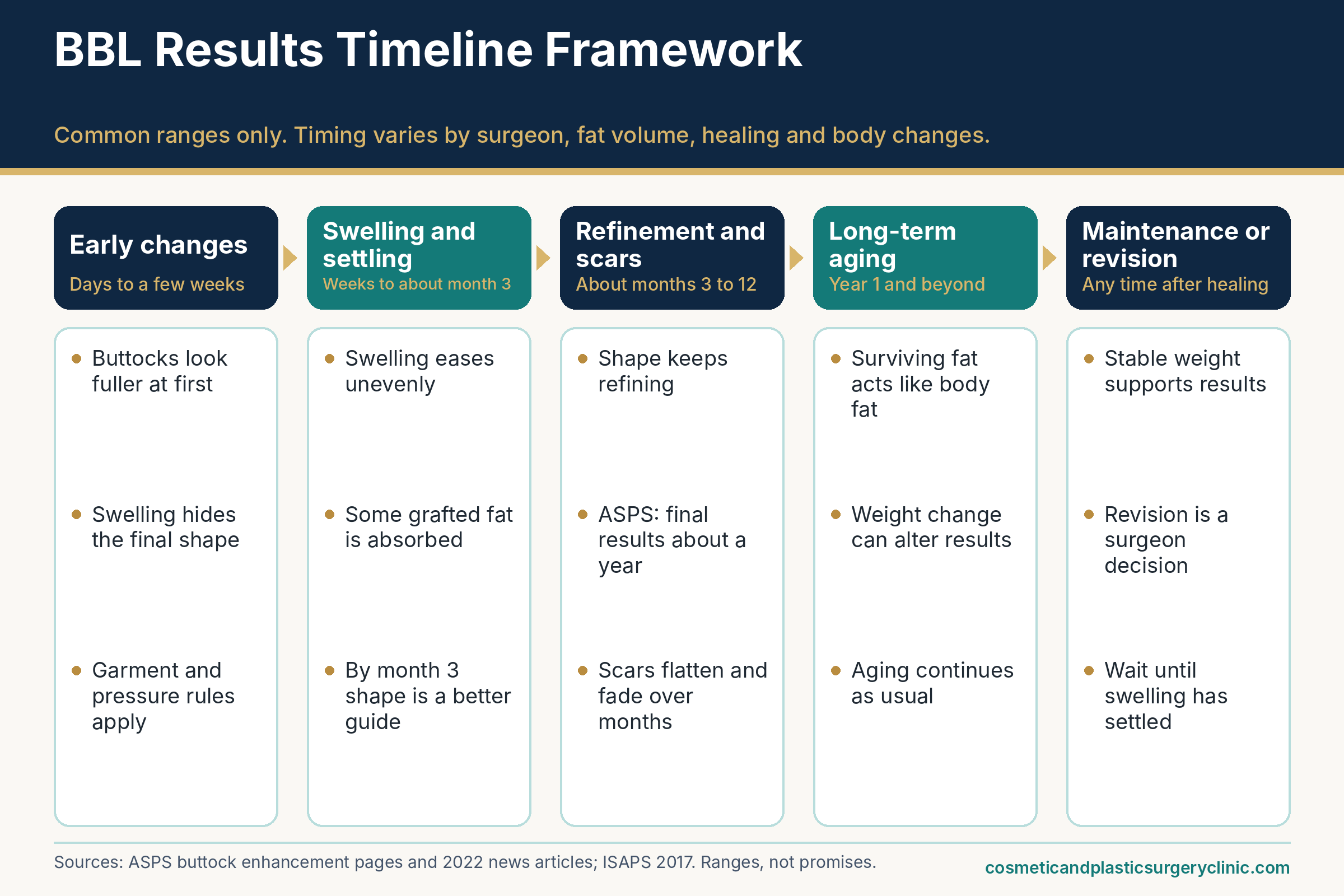
A BBL results timeline is a set of ranges that organize questions, not a calendar you can hold your body to. The phases below stretch or compress with the amount of fat moved, how much was harvested, whether other procedures were done the same day, your health, your anatomy, and your surgeon’s protocol. Two people can have the same operation and be at different stages at month four, and that is not by itself a sign that something is wrong.
The First Three Months: Swelling, Early Fullness and Fat That Does Not Stay
The first weeks: why the first look is not the result
ASPS says the results of buttock augmentation are visible immediately, but that you will not see the final result until about a year after surgery. Both halves of that sentence are important. The immediate change is real, and many people see a clear difference in the mirror within days. It is also temporary in a particular way: it includes swelling, fluid and the fat that has been placed but has not yet been tested by the body.
Swelling affects both zones. The donor areas, such as the abdomen and flanks, often look more swollen than the buttocks early on, and bruising can drift downward over days. The buttocks themselves can look high, tight and round for a period, and that early shape is easy to mistake for the destination. A surgeon interviewed in an ASPS news article in 2022 described a share of the injected fat being absorbed during healing, which implies that the early look is fuller than the later one. The practical lesson is to avoid judging the result against the first-week mirror, and to be careful about photos taken at that stage, which show the swollen version.
Aftercare rules in this window exist partly to protect the graft. ASPS recommends a support garment around the clock, avoiding prolonged sitting for roughly two weeks with some surgeons preferring longer, and sleeping face down or on the side, with a pillow or cushion placed behind the legs when sitting. The details differ widely between sources and surgeons, and the full comparison belongs in the BBL recovery timeline. For results, the point is simpler: those instructions are part of the plan to keep as much of the early volume as possible, but no instruction can promise how much stays.
Weeks to month three: the window when retention is decided
Most of the fat loss that surgeons talk about happens early. In the 2022 ASPS article, a surgeon said that around month three the risk of losing more fat from the buttocks declines, so that the size and shape at that point are a fairly good indicator of what will remain. Another 2022 ASPS article, drawing on a different interview, said that anywhere from 20 to 40 percent of the injected fat is absorbed as the area heals. These are expert descriptions in patient-education articles and not measured findings from a controlled study, but they match the broader idea that the first few months are when the body sorts out which transplanted cells survive.
There is one small imaging study that gives the same picture with measurements, though it is old and tiny. A 2006 study in Aesthetic Plastic Surgery used magnetic resonance imaging in 10 patients who received an average of about 350 milliliters of fat. Gluteal volume peaked around two weeks after the injection and had declined by three months. The authors calculated that between roughly a quarter and a third of the volume had been reabsorbed over that period, and the extra circumference seen at two weeks had returned toward its earlier values by three months. With 10 patients and three months of follow-up, it cannot tell you what will happen to you, and the technique has changed since 2006. It does show why surgeons are cautious about early photos and why many say that the first months matter most.
During this window you will also feel your body change. Tightness and tenderness ease, drainage stops, the garment schedule usually steps down, and everyday activity expands. People often feel recovered long before the shape has settled. That gap between feeling better and looking finished is normal, and the article on swelling after plastic surgery describes how uneven and slow it can be. If the buttocks seem to flatten noticeably in these weeks, it does not necessarily mean the procedure failed, because some loss is expected. What it does mean is that you should keep your follow-up visits, since that is when your surgeon can compare what they see against what they planned.
| Phase (range) | What people commonly see | What is still changing | Useful question to ask |
|---|---|---|---|
| Days to a few weeks | Fuller, rounder buttocks; swollen donor areas; bruising | Swelling, fluid, fat survival begins to be tested | Which photos will you take, and when? |
| Weeks to about month 3 | Swelling eases unevenly; volume may drop from the early peak | Absorption of some grafted fat | What change from the early look is expected? |
| Months 3 to 6 | Shape becomes a better guide to what will remain | Residual swelling, firmness, contour refinement | When will you judge symmetry and contour? |
| Months 6 to 12 | Most swelling gone; scars flattening and fading | Fine contour, scar color, sensation | When is a touch-up discussion appropriate? |
| After year one | The settled result that your body maintains | Weight changes, aging, hormonal or lifestyle shifts | What should I monitor and report? |
Months Three to Twenty-Four: Refinement, Scars and the Final Judgment
Months three to twelve: refinement and the one-year mark
After the first three months, the story changes from loss to refinement. The 2022 ASPS recovery article says the shape continues to refine between months three and six and the curve becomes more apparent. An older ISAPS blog post from 2017 said it can take upwards of six months to see final results. ASPS’s current procedure page says final results are not seen until about a year after surgery, because it takes a while for the fat to establish itself. Those three statements are consistent with one another if you read them as a tapering process: the biggest change is early, the visible shape is a reasonable preview by about month three, and the last details, including the softening of residual firmness, continue toward the one-year mark.
For planning, that means avoiding two mistakes. The first is judging the result too early and deciding to go back for more fat at month two, before swelling has resolved and before the body has shown how much will remain. A surgeon may prefer to wait, and the exact interval is their call. The second is waiting passively for a year when something specific is bothering you. If you notice a firm area that is growing, a lump that is painful, a persistent asymmetry that is large, or a wound that is not healing, contact your surgical team rather than waiting for the one-year mark. The point of the timeline is to tell you when to wait, not to tell you to ignore symptoms.
Follow-up schedules vary by practice, and a sensible plan includes visits at several points through the first year rather than only in the first few weeks. Treat those visits as part of the result. They are when baseline and follow-up photos are compared in the same poses, when asymmetry or irregularity is evaluated, and when a second procedure is either ruled out or discussed. If a practice has no structured follow-up after the first few weeks, or if you are traveling for surgery and cannot attend, that is worth raising before you book.
Year one and beyond: scars, sensation and what “final” means
Scars from a BBL are small, because both the liposuction harvest and the fat injection are done through small incisions, but they follow the same maturation pattern as other surgical scars. An ASPS news article from June 2026 describes three phases: the first two weeks, when the advice is to leave the incision alone and covered; the next few months, when scars typically look red; and the period from six months to a year after surgery, when collagen flattens and the redness recedes. The same article advises avoiding direct sun on the scar for the first six months and, when sun cannot be avoided, using a mineral sunscreen with an SPF of 50 or higher. Details of scar care are a surgeon-specific decision, and the broader article on plastic surgery scar care covers what to ask.
Sensation can take as long as scars. ASPS lists numbness or other changes in skin sensation among the risks of buttock enhancement, and the donor areas are treated with liposuction, so altered sensation there is something to ask about in advance. Most people see improvement over months, but speed and completeness vary, and some change can be lasting. If numbness comes with pain, weakness or a burning feeling, that belongs with your surgeon rather than in a waiting game.
“Final” is also a softer word than it sounds. Even after a year, the result is a snapshot of a living tissue that will respond to weight, aging, hormones and life events. Surgeons use “final” to mean “settled enough that further change is gradual and a revision decision can be made fairly.” That is a helpful milestone, and it is also why a good plan names a time at which you and your surgeon will formally judge the result, rather than leaving it open-ended.
| Source and date | Type of source | Timing statement | Reading it carefully |
|---|---|---|---|
| ASPS buttock enhancement procedure page (undated) | Professional society patient education | Visible immediately; final results about a year after surgery | General statement; no study cited on the page |
| ASPS news article, Aug. 11, 2022 | Surgeon interview | Around month 3 the risk of further fat loss declines; shape refines through month 6 | Expert opinion, one surgeon’s experience |
| ISAPS blog, Sept. 4, 2017 | Society blog post | Upwards of six months to see final results | Older; shorter than the ASPS one-year statement |
| Wolf et al., Aesthetic Plastic Surgery, 2006 | Prospective imaging study, 10 patients | Volume peaked at 2 weeks and declined by 3 months | Tiny sample; 3 months of follow-up; older technique |
| ASPS scar article, June 5, 2026 | Society news article | Scars mature between about 6 months and 1 year | General plastic surgery scar guidance, not BBL-specific |
How Long BBL Results Last: Fat Retention, Weight Change and Aging
“How long does a BBL last” is really two questions. The first is how much of the transferred fat survives the first year, which determines the result you start with. The second is what happens to that result across the following years, which depends mostly on what happens to your body. The dedicated article on how long a Brazilian butt lift lasts focuses on maintenance and aging. This section gives the core logic so that this page can stand on its own.
Fat Retention: What the Published Numbers Do and Do Not Say
The retention figures in circulation, and why they are not interchangeable
If you search for BBL retention, you will find numbers that look like they disagree. They do disagree somewhat, but most of the apparent conflict comes from what each number is measuring and who produced it. The ASPS procedure page says patients typically retain 60 to 80 percent of the transferred fat, in some cases more and in others less. One 2022 ASPS news article quotes a surgeon saying that anywhere from 20 to 40 percent of the injected fat is absorbed, which is the same range viewed from the other side, and a second 2022 ASPS article quotes a surgeon saying the average fat take is about 60 percent. A 2006 imaging study estimated 24 to 36 percent reabsorption at three months in 10 patients. A 2014 systematic review of fat grafting in general, not limited to the buttocks, noted that reported retention rates range from 20 to 80 percent at one year.
Several things make these hard to compare. The time points differ: three months, one year, and unspecified. The methods differ: surgeon impression, an imaging study, or a literature summary. The populations differ: gluteal patients in some cases and fat grafting anywhere in the body in others. And the sources differ in kind: a patient-education page, interviews with surgeons, a small prospective study, and a review. None of these is a large, long-term, controlled measurement of gluteal fat retention across many practices, and the 2024 bibliometric analysis found that most of the field’s most-cited papers are low-level evidence such as case series, so a study of that kind would be a notable exception.
| Source (year) | Figure stated | Time point and setting | Limits to keep in mind |
|---|---|---|---|
| ASPS procedure page (undated) | Typically retain 60 to 80 percent | Not specified; buttock fat grafting | Patient-education statement; no study cited |
| ASPS news article (Mar. 28, 2022) | 20 to 40 percent absorbed | During healing; surgeon interview | Expert opinion; period not defined |
| ASPS news article (Aug. 11, 2022) | Average fat take about 60 percent | Overall; surgeon interview | Expert opinion; one surgeon’s experience |
| Wolf et al. (2006) | 24 to 36 percent reabsorbed (calculated) | 3 months; MRI in 10 patients | Very small; short; older technique |
| Gause et al. systematic review (2014) | 20 to 80 percent retention reported | 1 year; fat grafting generally, not only gluteal | Wide range; not buttock-specific |
One way to make the arithmetic concrete, purely as an illustration and not a prediction, is to apply the ranges to an invented volume. If a hypothetical 400 milliliters of fat were placed on one side and the 60 to 80 percent retention figure applied, about 240 to 320 milliliters would remain. The 20 to 40 percent absorption range gives the identical answer, because the two ASPS statements are mirror images of each other. If the wider one-year range from the general fat grafting review applied, the remaining amount would span 80 to 320 milliliters. The width of that last range is the real message: individual outcomes are uncertain, and a surgeon who tells you a single exact figure for how much will stay is claiming more than the literature supports.
Why retention varies from person to person
Fat survives in its new location only if enough of it gets a blood supply. Beyond that basic idea, the factors that influence the outcome are partly understood and partly assumed. The 2014 review in Adipocyte, which looked at fat grafting broadly, concluded that harvesting and handling choices matter. It reported that larger cannulas and gentler harvesting methods appeared to protect fat cells better, and it noted that there is no agreement on the ideal particle size. That is general fat grafting science, and it does not tell you how a particular surgeon’s gluteal technique performs, but it explains why surgeons vary in how they harvest and process fat and why you can reasonably ask about their method.
The volume placed relative to the tissue’s capacity is another consideration. The British Association of Aesthetic Plastic Surgeons review published in 2023 listed staging, meaning dividing the work into more than one operation, among its recommendations when the volume wanted exceeds what the tissue can accept. The underlying idea is that any given area can accommodate only so much fat. It is worth treating that as expert guidance rather than a proven rule, and it is a good reason to be wary of any plan that treats volume as a number to be maximized.
Your own health also plays a role. Smoking and nicotine slow wound healing and raise the risk of infection and blood clots, according to MedlinePlus, which notes that nicotine from gum or patches still interferes with healing. Many surgeons ask patients to stop nicotine well before and after surgery, and the exact timeline is theirs to set. The article on smoking and plastic surgery covers that planning. Pressure on the graft in the early weeks is the other commonly cited factor, but, as the recovery article explains, no controlled study identifies how many weeks of sitting restrictions best protect fat survival. The honest conclusion is that you can influence the conditions, but you cannot control the number.
After Year One: Aging, Weight Change and Life Events
Weight change, aging and the “just like any other fat” principle
ASPS puts the long-term principle plainly: as you gain or lose weight, your results may change, because the transferred fat can grow or shrink like any other fat in your body. This is probably the single most useful sentence for thinking about longevity. Fat that survives the first year has established its own blood supply and behaves as a part of you. It does not carry a built-in memory of the size it was on the day of surgery. If your weight rises meaningfully, fat cells in the buttocks may enlarge along with the rest; if your weight falls meaningfully, they may shrink. How uniformly that happens, and whether the buttocks change more or less than other areas, differs from person to person and is not something this article can predict.
The same weight logic applies to the donor sites. ASPS says liposuction results are long lasting provided a stable weight and general fitness are maintained, and that liposuction cannot improve lax skin. Combining those two statements gives a reasonable expectation: the contour changes at the donor areas and the added volume at the buttocks are both durable in the sense that the cells are gone or added, but the shape you see depends on what your overall body composition does afterward.
Ordinary aging adds a second, slower process. Skin loses some elasticity over the years, and the position of tissues can shift. A buttock augmentation is not designed to stop that process, and no study that follows BBL patients across decades was found for this article, so the effect of aging on a BBL result is a general expectation rather than a measured one. Compare that with the way ASPS describes silicone buttock implants, whose results it calls permanent in the sense that the device does not shrink, though implants have their own risks and are a different operation. The article on alternatives to Brazilian butt lift compares the options in more detail.
Pregnancy, medications and other life events: where evidence is thin
Many readers want to know what a pregnancy, a major weight-loss program, or a new medication will do to a BBL result. The honest answer is that no BBL-specific study of those questions was found among the sources reviewed for this article. The general principles still apply: weight and fat distribution can change in pregnancy and with weight-loss treatments, and the transferred fat can be affected like other fat. Beyond that, any guidance about timing a procedure around a pregnancy plan or around a weight-loss medication is individual medical advice, which belongs to your surgeon and your primary clinician.
What you can do is bring the question to the consultation in specific terms. If you plan a pregnancy in the next few years, say so, and ask how your surgeon would view the timing. If you are currently losing weight or taking a medication that affects weight, ask whether a stable weight should be reached first. The planning logic in the article on weight stability before body contouring applies here, and it explains why surgeons often prefer a settled baseline before they measure, plan and operate.
It is also reasonable to ask how the plan would change if something unexpected happens afterward, such as an illness that causes weight loss or a period of significant weight gain. A surgeon cannot answer every hypothetical, but their willingness to discuss the possibility, and to describe what a revision would involve and whether there is any fee or policy attached, tells you a good deal about how the practice thinks about long-term results.
Reading BBL Before-and-After Photos Without Over-Trusting Them
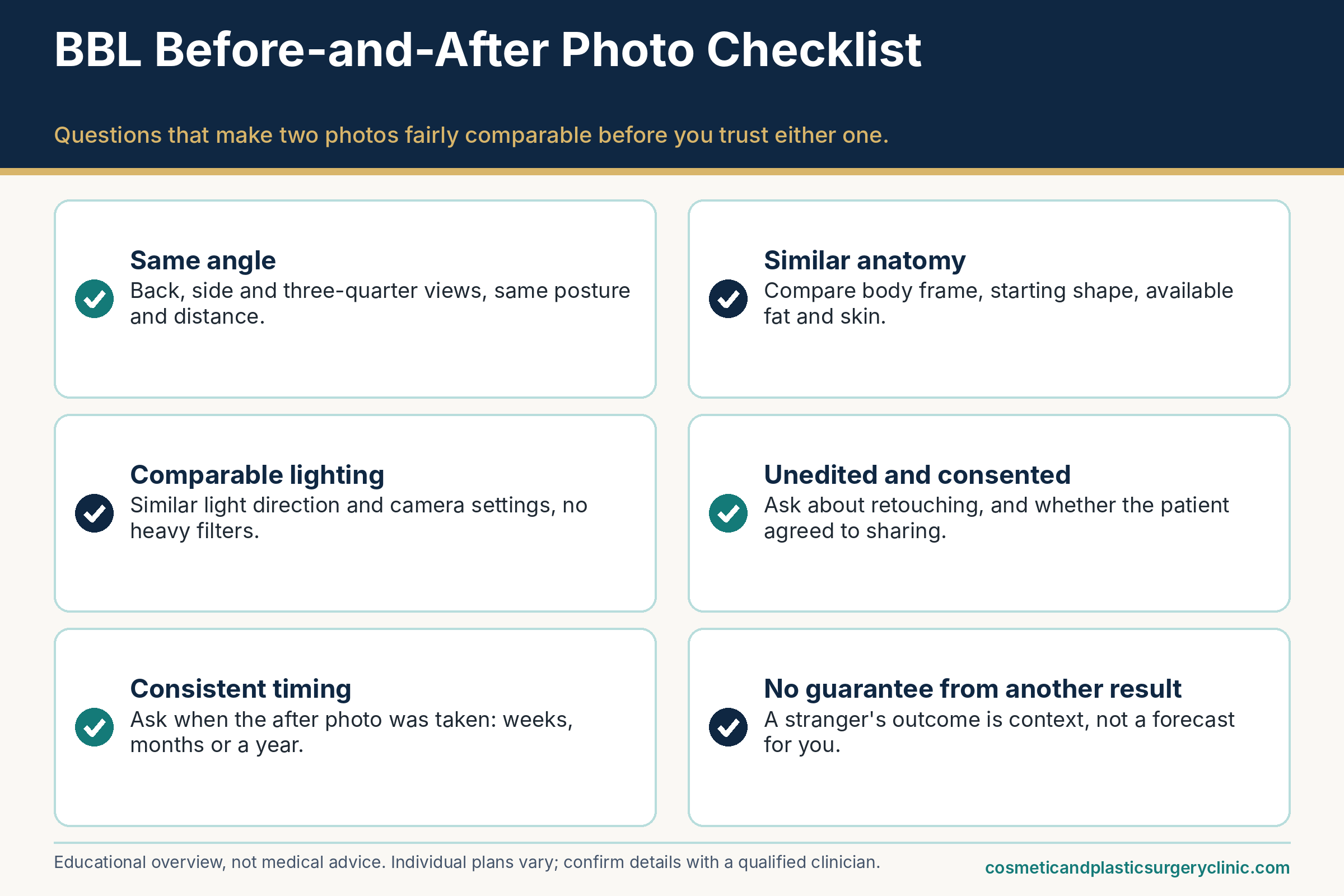
Photos are the most common way people try to judge BBL surgery results before surgery, and they are also the easiest to misread. A buttock photo is unusually sensitive to posture, camera position, lighting and timing, and the buttocks are a body part where small changes in stance change the apparent shape. This section gives BBL-specific reading habits. The full treatment, including galleries, consent and advertising rules, is the subject of the article on BBL before-and-after photos and how to evaluate them safely, so the goal here is a working checklist rather than a complete guide.
What Makes Two BBL Photos Fairly Comparable
Angles, posture, lighting and timing
Start with the angle. A fair comparison uses the same views before and after: directly from behind, from each side, and from the three-quarter positions. Side views matter most for projection, because a rear view can make a shape look fuller without any change in how far it extends backward. If a gallery shows only rear views, or shows different views before and after, the comparison is incomplete.
Posture comes next. Standing with the lower back arched, leaning forward, rising onto the toes, tensing the muscles, or shifting weight to one leg all change how the buttocks look. Clothing matters too: underwear lines, a bikini bottom, a compression garment edge, or a tan line can shape the visible outline. None of that is deceptive on its own, but if the before photo and the after photo are posed differently, part of what you are seeing is the pose and not the surgery. Ask yourself whether the person is standing the same way, with feet in the same place and the camera at the same height.
Lighting creates shadows that define contour. Light from the side emphasizes projection and dimples, light from above flattens or exaggerates depending on the angle, and heavy filters smooth skin texture. Consistent lighting and camera distance are as important as consistent angle. When a pair of photos has obviously different light, color balance or background, treat it as a hint that conditions were not controlled.
Timing is the BBL-specific trap. Because the buttocks may be fuller early and then change as swelling resolves and some fat is absorbed, an after photo taken two or three weeks out can look different from one taken at six or twelve months. The ASPS description of results as visible immediately but not final for about a year makes this explicit. Ask for the interval on every after photo. A gallery that never states the time elapsed is hiding the single most relevant detail.
Anatomy, starting point, other procedures and edits
A fair comparison also requires a similar starting point. Body frame, pelvic width, how much fat the person had available to harvest, skin quality, and baseline buttock shape all influence what is possible. A very slender person and a person with substantial donor fat are not facing the same set of options, and a photo of one is a weak guide to the other. ASPS’s list of candidate considerations includes available fat for liposuction, buttock size and shape, skin quality and elasticity, and activity level, which are exactly the variables that make two patients comparable or not.
Ask what else was done. A BBL photo may include liposuction of the waist and back, a tummy tuck, an implant, or a buttock lift, and many “after” photos reflect the combination rather than the fat transfer alone. If the caption does not say, the viewer cannot know how much of the contour came from each step. The article on combining BBL with other procedures explains why surgeons treat combinations as a separate planning question.
Weight is another hidden variable. Photos taken months apart can reflect weight gain or loss rather than the operation. Ask whether weight was stable between the photos. And ask about retouching: skin smoothing, reshaping, flipping and AI-generated images are now common enough that a polished picture should be treated as unverified until the practice can show unedited originals with consent. Raising the question is not rude, and a confident practice should be able to answer it plainly.
| What to check | Why it changes how the buttocks look | What to ask the practice |
|---|---|---|
| View and posture | Arched back, toe-rise, muscle tension or weight shift alters projection and roundness | Are before and after taken in the same pose and views? |
| Lighting and filters | Side light deepens shadows; filters smooth texture and outline | Are these unedited originals under similar light? |
| Time since surgery | Early photos include swelling and fat that may later be absorbed | How many weeks or months after surgery was this taken? |
| Other procedures | Waist liposuction, tummy tuck, implants or lift change the whole silhouette | What operations does this patient’s result include? |
| Starting anatomy | Frame, donor fat and skin quality set the range of what is possible | Can you show patients whose build and goals resemble mine? |
Galleries, Advertising Rules and Asking for Comparable Cases
Cherry-picking, consent and what the FTC says about atypical results
Any gallery is a selection. A practice naturally shows its strongest cases, and social media amplifies the most dramatic images. That does not make a gallery dishonest, but it does mean the gallery is a statement of what the practice can achieve at best, not what a typical patient should expect. A more informative gallery shows a range: different body types, different time points, including long-term follow-up, and results that are subtle as well as striking.
The U.S. Federal Trade Commission has addressed this problem in its health products compliance guidance, dated December 2022. It says that testimonials do not substitute for evidence, that testimonials reporting results more dramatic than people can generally expect are likely to be deceptive, and that a disclaimer such as “results not typical” does not cure the problem. The agency’s alternative is a clear disclosure of what a typical consumer can expect. The guidance is aimed at advertisers of health products broadly, but the principle is useful to readers: a dramatic photo with a small disclaimer does not tell you what is typical, and a practice that cannot say what a typical result looks like is withholding the information you most need.
Consent matters here as well. Photos of intimate or near-intimate body areas involve privacy, and patients should have agreed to their use. You can ask whether the practice has written consent for the images it shows. If photos appear to be from another practice, from a stock library, or from a different patient than the caption implies, that is a red flag for a deceptive gallery, and it is a legitimate reason to leave.
Asking for comparable cases and documenting your own starting point
The most productive request is not “show me your best results” but “show me patients whose body type and goals resemble mine, at several time points, including one year or later.” The ASPS patient-safety question list includes asking whether the surgeon has before-and-after photos for the procedure, and a related question about what your options are if you are dissatisfied with the outcome. Pair them: look at the photos, then ask what happened when the result was not what the patient wanted.
Ask about the whole portfolio, not only the highlights. How many BBL patients does the surgeon treat in a typical month? What proportion needed a second procedure? What does the surgeon do when a result is asymmetric? Answers of that kind will not give you a statistic you can verify, and they should not be treated as a complication rate. They do tell you whether the surgeon has thought about the less glamorous side of results, and whether the practice is comfortable talking about it.
Finally, document your own starting point. Take clear, consistent photos from the same angles before any procedure, ideally in the poses the surgeon uses, with similar lighting and clothing. Date them, note your weight, and store them privately. If you later need to discuss revision, or if you need to explain to another surgeon what changed, those baseline photos are far more useful than memory. Bring them to a consultation if the surgeon wants them, and keep copies of whatever the practice takes. Never rely on a gallery image of someone else as a stand-in for what your own surgeon agreed to try.
Realistic Expectations: Anatomy, Goals, Trends and What a BBL Cannot Promise
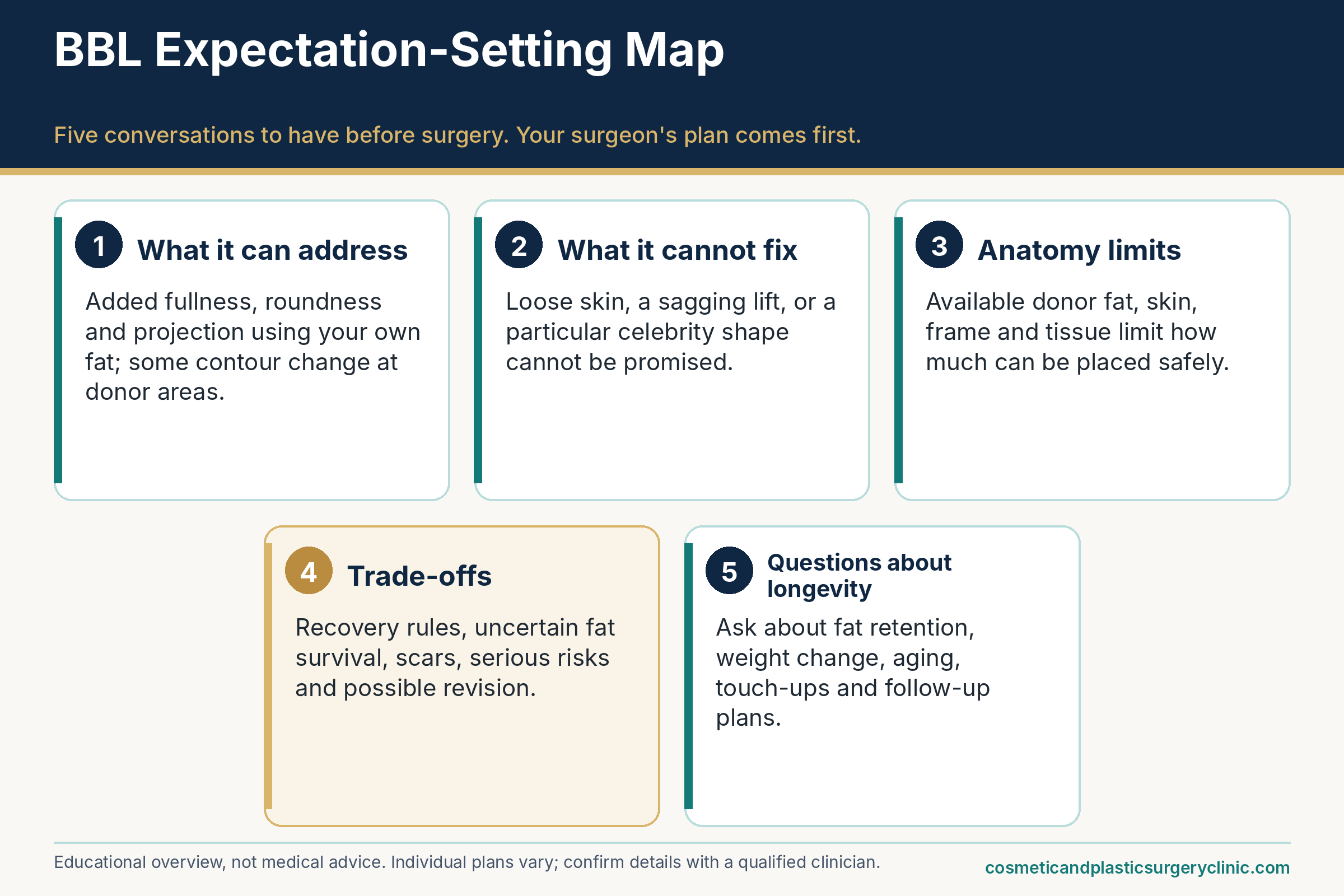
Realistic expectations are not low expectations. They are expectations that fit your anatomy, your goals, the way fat grafting works, and the trade-offs you are willing to accept. This section covers the anatomical limits that shape a result, the way ideals of shape change over time, and a few questions about motivation and alternatives that tend to surface only after the decision is made.
Anatomy and Proportion: What Limits a Result
Donor fat, skin quality and frame
The first limit is simple: a BBL uses your own fat. ASPS lists available fat for liposuction as one of the factors that determine candidacy, along with the size and shape of the buttocks, your goals and activity level, and the quality, elasticity and amount of your skin. A person with little harvestable fat cannot receive a large transfer, and trying to harvest more than the body offers is not a safe workaround. If your goal requires more volume than your donor areas can provide, a sensible surgeon will say so, and may raise other options such as implants or a combination approach.
The second limit is the skin and soft tissue that covers the result. ASPS says fat grafting increases fullness, roundness and projection, and describes a lift as the procedure that improves the shape and tone of the tissue. If the skin is loose or the tissue is lowered, adding volume addresses a different problem from the one a lift addresses, and the two can be discussed together. The ASPS candidacy criteria for buttock augmentation also include good general health and realistic expectations, and they emphasize doing the procedure for yourself rather than to meet someone else’s wishes or to match an ideal image.
The third limit is frame. The pelvis, the hip width, the length of the torso and the shape of the lower back vary naturally, and they affect how any volume reads from behind and from the side. A volume that looks proportionate on one frame may look different on another. This is why photos of other people’s results, even when honest, are a limited guide. In a consultation, a surgeon who examines you standing and from several angles, and who explains what they expect to be able to change and what they do not, is giving you something a gallery cannot.
Patient profile also matters for safety. In the 2022 ASPS article, the interviewed surgeon described the ideal candidate as someone with realistic expectations who is relatively close to their ideal weight, in good health, and a nonsmoker, and the surgeon stressed that appropriate patient selection is extremely important because of the procedure’s comparative risk. The article on whether you may be a candidate for BBL covers candidacy and timing in more depth; here the point is that candidacy and expectations are connected, because the people for whom a given result is realistic are not the same as everyone who wants it.
Shape ideals, changing trends and the rise of reversal requests
Preferences for buttock shape are not fixed. What looks desirable in one decade can look dated in the next, and social media accelerates the cycle. That matters for results because fat grafting is not trivially reversible. Removing fat that has been grafted is a different operation with its own limits, and a result chosen to match a current trend may feel different in a few years.
A 2025 retrospective chart review in Aesthetic Surgery Journal Open Forum gives a glimpse of this. A plastic surgeon and a physician assistant described 123 patients who underwent buttock reduction between 2018 and 2023 in one practice and reported that requests rose after 2020. The patients’ stated reasons included excess fat placement producing a poor shape, weight gain since the original BBL, and a shift toward a leaner look. About three quarters said they were satisfied with the reduction. The authors acknowledged major limits: a single surgeon, short follow-up of 3 to 24 months, varied devices, and subjective aesthetic outcomes. It is one practice’s experience and not a measure of how often people regret a BBL, and the study cannot show how common reversal is. It does show that tastes change and that people sometimes want to undo or soften a prior result.
National counts tell a similar story about demand without explaining satisfaction. ASPS’s 2025 statistics report estimates 25,662 buttock augmentations with fat grafting in the United States in 2025, down 5 percent from an estimated 27,059 in 2024. The 2024 report had given a different 2024 figure of 29,466 counted among ASPS member surgeons only, which shows that methods changed between reports. Neither figure says whether patients are satisfied, and falling or rising counts should not be read as a verdict on the procedure.
Motivation, Alternatives and Combined Plans
Goals, body image and when to pause
It helps to be able to finish the sentence “I want my result to …” in specific, personal terms. A goal such as “I want my jeans to fit differently and my profile to look more balanced” can be discussed, measured in photos and revisited. A goal such as “I want to look like a particular person” cannot be promised and may set up disappointment, because no surgeon can transfer another person’s frame, skin and fat distribution to yours. Consider this invented example, offered only as an illustration: one person wants a modest change in side-view projection and a smaller waist, and another wants a dramatic increase in volume that their available fat cannot supply. The first goal is easy to define as a range; the second needs a frank discussion about whether surgery is the right tool.
Surgeons and patients also have to consider persistent distress about appearance. Body dysmorphic disorder, as the Mayo Clinic describes it, is a mental health condition in which a person cannot stop thinking about perceived flaws in their appearance, flaws that are minor or not visible to others. The Mayo Clinic notes that people with the condition may seek cosmetic procedures hoping for relief, and that the relief is often temporary while the anxiety returns. It advises anyone with symptoms to see a health care provider or mental health professional. This is not a statement about anyone who wants a BBL. It is a reason to take seriously the difference between wanting a change and feeling that your body is unbearable, and a reason to value a surgeon who asks about your motivations instead of going straight to the schedule.
If you are making this decision during a period of acute stress, after a major life change, or under pressure from a partner or an online community, it is reasonable to pause. Nothing about a BBL requires speed, and any plan that creates urgency, such as a time-limited price or a promised opening that closes, is a reason for more caution rather than less.
Alternatives, combinations and staging
Fat grafting is one of several ways to add buttock volume or reshape the area, and it is worth knowing what else exists even if you stay with it. Silicone buttock implants are a surgical alternative. ASPS describes the results of implant surgery as permanent, with swelling that resolves over time. Older systematic reviews reported a higher overall complication rate for implants than for fat grafting. A 2016 review in Plastic and Reconstructive Surgery covering 44 articles reported overall complication rates of 21.6 percent for implants and 9.9 percent for fat. A 2017 review in Aesthetic Surgery Journal of 52 studies reported 30.5 percent and 10.5 percent. Both reviews pooled studies with different methods, both predate the safety warnings about fat embolism, and neither is a comparison of the current techniques, so they cannot settle which option is better for you. The article on alternatives to BBL compares them properly.
Injectable options deserve a particular caution. The U.S. Food and Drug Administration warned in November 2017 that injectable silicone used for body contouring is not FDA-approved, and that it can cause serious injuries including scarring, tissue death, disfigurement, blood vessel blockage, stroke, infection and death, sometimes weeks, months or years later. If someone offers buttock “fillers” or injections that are not clearly identified and approved for that use, that is a safety question, not a bargain.
| If your goal is | Fat grafting alone may be discussed when | Other approaches a surgeon may raise | Question to ask |
|---|---|---|---|
| More fullness or projection | You have enough donor fat and good skin quality | Implants, or implants with fat | How much can be placed safely in my case? |
| A lifted, firmer look | Volume is also a goal and tissue is not very loose | Buttock lift, with or without volume | Which part of my concern is volume and which is laxity? |
| Correcting asymmetry | The difference is mainly volume | Staged grafting; revision techniques | How much asymmetry is expected to remain? |
| A smaller or softer result | Fat grafting is not the tool | Buttock reduction, liposuction | What is the recovery and what are the limits? |
| A refined waist and hips | Donor liposuction is part of the plan | Combined contouring, staged operations | Is combining safer than staging in my case? |
Combination and staging questions come up often. Doing more than one procedure at once can reduce the number of recoveries but increases operative time and risk, and the right balance is individual. The BAAPS review from 2023 recommended staged procedures when the volume wanted exceeds what the tissue can accept, and the article on combining BBL with other procedures explains the trade-offs. A staged plan takes longer and costs more in time, but it can be a reasonable way to approach a goal that a single operation could not reach safely.
Complications, Safety and Revision: What Results Photos Do Not Show
Every BBL result in a gallery belongs to someone who made it through surgery and healing. A photo cannot show the people who had a wound problem, a lasting contour irregularity, a second operation, or a serious complication. This section does not repeat the full risk article. It explains how risk shapes results, why the safety numbers you may have seen disagree, and how revision fits into a realistic plan.
The Safety Backdrop That Shapes Every BBL Result
What the plastic surgery societies have said since 2017
Fat embolism is the complication that distinguishes gluteal fat grafting from most other cosmetic operations. It occurs when fat enters the bloodstream and travels to the lungs or other organs, where it can block blood flow. In an August 2018 press release, ASPS and four other societies, including the Aesthetic Society, ISAPS, and two international regenerative and fat-therapy groups, said the procedure had resulted in an alarming mortality rate, estimated to be as high as 1 in 3,000, which they described as far greater than any other cosmetic surgery. The same release said about 20,300 fat-grafting buttock procedures were performed in 2017, more than double the number five years earlier, and advised patients to seek board-certified plastic surgeons and to discuss the risks in depth with them.
On August 18, 2022, ASPS, the Plastic Surgery Foundation, the Aesthetic Society and the Aesthetic Surgery Education and Research Foundation issued a joint statement that called the situation a patient safety emergency. It recommended that fat be injected only into the subcutaneous space above the gluteal fascia, the thin sheet that covers the muscle, and it supported real-time ultrasound imaging during injection and a limit of three gluteal fat grafting procedures per surgeon per day. It also said procedures should be performed by surgeons who hold privileges at a state-approved or licensed surgical center or hospital, and that the operating surgeon should establish a doctor-patient relationship and remain available to manage complications.
The statement is also frank about its own evidence base. The recommendations come from expert consensus and common-sense measures adopted by society leadership, not from randomized trials, and the societies called for further research through a registry. Florida’s administrative code for office surgery, which the societies have referred to, says fat may only be injected into the subcutaneous space and must never cross the gluteal fascia, and it prohibits intramuscular or submuscular injection. The version of the rule opened for this article was most recently amended in September 2024. It did not contain the ultrasound or daily-case-limit requirements, so what is in force in a given state is something to verify rather than assume.
Contested numbers: what the mortality estimates and newer studies do and do not show
If you try to find “the” BBL death rate, you will find several. A task force survey in 2017 produced an estimate of 1 in 2,351, which a 2023 review by the British Association of Aesthetic Plastic Surgeons called erroneously derived and potentially misleading. The 2018 society press release used 1 in 3,000. A 2022 ASPS article quotes the society’s then-president as saying that mortality had fallen to approximately that of a tummy tuck, about 1 in 15,000, and the BAAPS review says the risk was later estimated nearer to 1 in 15,000. Those figures come from surveys and expert estimates, not from a national registry that counts every case, and the denominators are uncertain.
A 2023 survey study in Aesthetic Surgery Journal, titled as a statement that the BBL remains the deadliest aesthetic surgery procedure, asked board-certified plastic surgeons about their practices. Of 178 respondents, which was a response rate of about 10 percent, 62 percent said they did not use ultrasound, 9 percent used it occasionally and 29 percent used it consistently. The authors cited a historical estimate of about 1 in 4,000. The low response rate and voluntary design limit how far the survey can be generalized, but it suggests that recommended practices were not universally adopted as of that survey.
On the other side, two reports of ultrasound-guided gluteal fat grafting are encouraging. A retrospective review of 1,815 patients treated by two surgeons found a 4 percent overall complication rate and no macroscopic fat embolism or deaths. A 2025 meta-analysis of four studies with 6,235 patients reported no serious adverse events, such as death or fat embolism, in the included data. Both are observational, neither has a control group, and the authors point to selection and surgeon experience as possible influences. A fair reading: experienced teams that follow current guidance report low rates, the estimates for the field as a whole remain uncertain, and no technique removes the risk entirely.
Problems That Change a Result, and When Revision Enters the Picture
Asymmetry, contour irregularity, firm areas, fluid and wound problems
ASPS lists the risks of buttock enhancement as anesthesia risks, asymmetries, bleeding, deep vein thrombosis and cardiac and pulmonary complications, fat necrosis, fluid accumulation, infection, numbness or other sensation changes, persistent pain, poor wound healing, a possible need for revisionary surgery, recurrent looseness of skin, skin discoloration and prolonged swelling, skin loss and unfavorable scarring. For results, the ones that matter most are those that are visible or palpable months later.
Asymmetry means one side differs from the other in volume, height or shape. Some asymmetry exists naturally before surgery, and some is introduced by uneven swelling or uneven fat survival. Contour irregularities include dimpling, waviness or a step between areas, and can occur in the donor sites as well as the buttocks. Fat necrosis, as the Cleveland Clinic describes it, is the death of fat tissue after injury or loss of blood supply. It can feel like a fatty lump or a hard nodule, may form oil cysts, and often resolves over months to years, though the clinic advises seeing a provider if it causes pain, grows or changes. A seroma is a pocket of clear fluid under the skin, which typically shows up about 7 to 10 days after surgery and is usually harmless, but the clinic says to call if it enlarges, shows signs of infection or fails to improve after several weeks.
Not every irregularity is a complication in the strict sense. Much of what looks irregular in the first weeks is swelling, and surgeons usually avoid judging contour until it has had time to settle. What matters is that you know which findings are expected, which need a call, and who is available to look at them. If you are away from the surgeon’s home city, this is where follow-up access becomes a result issue, not just a convenience.
| Issue | How it can show up | Typical timing | What to do |
|---|---|---|---|
| Asymmetry | One side fuller, higher or differently shaped | Judged after swelling settles | Document with photos; discuss at follow-up |
| Contour irregularity | Waviness, dimpling or steps between areas | Visible as swelling resolves | Ask when and how it would be assessed |
| Fat necrosis | Firm lump, possible oil cyst, sometimes tenderness | Weeks to months; may take longer to resolve | Report pain, growth or change |
| Seroma | Soft, fluid-filled swelling | Often about 7 to 10 days; may last weeks | Call if it enlarges, hurts or looks infected |
| Wound or skin problems | Redness, drainage, delayed closure, skin loss | Early weeks | Call promptly; do not wait for the next visit |
Revision, touch-ups and reduction: realistic timing and expectations
No verified national figure for how often BBL patients have a second procedure was found for this article, and a number from a single practice or a marketing page would not be reliable. What can be said is that ASPS includes a possible need for revisionary surgery among the listed risks, which means the possibility should be part of the plan from the start. Ask the surgeon how they define a revision, how they decide it is warranted, how long they would wait, and what you would owe in fees, facility charges, anesthesia and garments if it happened. A written policy is more useful than a verbal reassurance.
Timing matters. Because swelling and early fat loss can obscure the result, a surgeon may wait until the shape is settled before deciding on any additional fat transfer, and the interval is their judgment. A touch-up is a new surgery with its own anesthesia and recovery. If it involves fat grafting again, it carries the same category of risks as the first one, including those described in the safety guidance, and the same attention to technique and facility applies. Revision for a specific problem, such as a localized contour irregularity, may be smaller in scope, but even that is the surgeon’s call.
Revision can also mean reducing rather than adding. The 2025 buttock reduction series described above reported that fat was removed from the buttocks in operations that usually included other procedures, and that about three quarters of patients were satisfied, though the report is from a single practice with short follow-up. A second opinion can be valuable whenever you are unhappy with a result and are considering another operation. The article on second opinions in plastic surgery explains what to bring and ask. If you are unhappy early, the wise first step is to talk to your original surgeon, keep your photos and records, and avoid acting while swelling is still resolving.
Planning for Results: Surgeon, Facility, Follow-Up and Consultation Questions
The outcome of a BBL depends on decisions made long before the operating room: who does the work, where, with what technique, and with what plan for the months afterward. This section turns the earlier material into practical checks and questions. None of it replaces your own surgeon’s advice, and none of it is a promise that asking the right questions produces a particular result.
Choosing Who Performs the Surgery and Where
Credentials, privileges and the facility
Start with credentials, and verify them yourself. Certification by the American Board of Plastic Surgery (ABPS) is a voluntary credential, and the board offers a public verification tool that searches by name or location. The same page directs people to the Federation of State Medical Boards for license verification and complaint information, and it notes that an active, unrestricted license is a requirement for certification. Board certification and a state license are separate things, and a license alone does not mean a physician is trained in plastic surgery. The article on what ABPS board certification means walks through the distinction.
The ASPS question list adds several checks that bear directly on BBL results. It asks whether the surgeon has hospital privileges to perform the procedure and where, whether an office-based facility is accredited by a nationally or state-recognized agency, how many procedures of this type the surgeon has performed, and how complications are handled. The 2022 joint statement from the societies makes a similar point specifically for gluteal fat grafting, recommending that surgeons hold privileges at a state-approved or licensed surgical center or hospital. Privileges matter because they generally mean a hospital or licensed center has credentialed the surgeon for the procedure, and because that relationship gives the team somewhere to go if a problem requires admission.
Ask who does each step. In the 2023 Aesthetic Surgery Journal survey of surgeons, most respondents said they personally performed both the fat harvest and the injection, which implies that some did not. The societies’ statement opposes untrained or under-trained personnel performing critical portions of the operation. A reasonable question is simply, “Who will harvest the fat, who will inject it, and who will be in the room?” Also ask about the anesthesia provider, the technique used to confirm where the fat is placed, and whether the practice follows the current society recommendations on subcutaneous placement and ultrasound. You are not auditing the surgeon; you are hearing how they think about the part of the operation that determines both safety and shape.
Traveling for surgery and keeping follow-up access
Results are a long game, and follow-up access shapes how well problems are caught. The 2022 joint statement from the societies says surgeons should establish a real doctor-patient relationship and be available to manage complications for their patients, including patients who travel. If you plan to travel for surgery, the Centers for Disease Control and Prevention advises making sure you can get any needed follow-up care in the United States, bringing copies of your medical records, and seeing your own health care provider or a travel medicine clinician at least four to six weeks before the trip. It also notes that delaying air travel for 10 to 14 days after major surgery can reduce risk and that flying after surgery can raise the risk of blood clots. Those are general travel statements rather than BBL-specific rules, and your surgeon’s instructions come first.
For results specifically, ask how follow-up photos and checks will be handled if you live far away. Will the surgeon see you in person at one month, three months, six months and a year? If not, who will examine you if you notice asymmetry or a firm area? What will a local clinician need from the surgical team, such as an operative report, to treat you? A practice with a clear plan is at least thinking about the months after you leave. The article on plastic surgery medical tourism covers the extra planning needed when surgery is not close to home.
One more practical matter is weight. If you expect to move, change jobs, start a weight-loss program, or plan a pregnancy in the coming year, mention it during the consultation. Stability does not have to be exact, but a surgeon can plan better if they know what is likely to change, and you will be better prepared for how the result evolves.
The Consultation and the Decision
Results-focused questions to bring to a consultation
A good consultation is two-way. The surgeon examines you and describes what they think is possible, and you describe your goals and ask how those goals fit. The table below groups results-focused questions by theme. Use it as a script, write the answers down, and ask for any key figures or policies in writing. If an answer is vague, you can ask a follow-up or simply note that the surgeon did not give one. The full question set for this procedure is in the article on questions to ask before a BBL consultation.
| Theme | Question to ask | What a useful answer includes |
|---|---|---|
| Goals and fit | Based on my body, what range of change is realistic? | A range, the limiting factors, and anything you should not expect |
| Photos | Can you show patients like me at several time points, including a year or more? | Consented, unedited cases with stated intervals and other procedures |
| Retention and timing | How much of the transferred fat do you expect to stay, and when will we judge the result? | An honest range and a scheduled review, not a single exact figure |
| Technique and safety | Where will the fat be placed, and how will you confirm it? | Subcutaneous placement, how placement is monitored, who performs each step |
| Facility and emergencies | What is your plan if a serious problem occurs? | Named facility, privileges, transfer or admission process |
| Revision | What happens if I am unhappy or need a second procedure? | Written revision policy, timing, likely fees, and who decides |
| Weight and life events | How would weight change, pregnancy or aging affect my result? | A candid description of uncertainty and what to monitor |
Listen for the quality of the answers as much as the content. A surgeon who says “I can’t promise a number, but here is the range I usually expect and here is what changes it” is describing the real uncertainty. A surgeon who promises a specific shape, dismisses safety questions, or pushes you to book quickly is giving you information about how the practice handles risk. It is entirely reasonable to compare more than one consultation before deciding, and a second opinion is a standard part of careful planning.
A decision frame: what would change your mind
Before you commit, write down three things: the result you hope for, the trade-offs you are willing to accept, and the facts that would make you stop. The first is your goal in plain words. The second might include a recovery period with sitting limits, a garment, uncertain fat survival, scars, the chance of revision, and a small but serious risk of life-threatening complications. The third is your set of deal-breakers, such as a surgeon who cannot show credentials, a facility without privileges or an emergency plan, a plan whose volume seems out of proportion to your frame, or a practice that will not give you the revision policy in writing.
Consider three invented readers, offered purely as illustrations. The first has a stable weight, a modest goal of better side-view balance, and a surgeon who describes a range and a review date; the pieces line up and the remaining question is whether the safety trade-offs are acceptable to them. The second wants a very large change that their available fat cannot supply and is being told by a practice that the result is achievable; here the mismatch is the signal to slow down and seek a second opinion. The third is losing weight at the moment and wants surgery soon; the useful move is to ask the surgeon whether waiting for a stable baseline would change the plan. None of these is a recommendation. They show that readiness is a match between goal, anatomy, safety and logistics, not a feeling about being ready.
Frequently asked questions about BBL results
When will I see my final BBL results?
ASPS says the results are visible immediately but that you will not see the final result until about a year after surgery. Other sources describe shorter windows: a 2017 ISAPS post said upwards of six months, and a surgeon quoted by ASPS in 2022 said the shape at about three months is a fairly good indicator of what will remain. Read those as stages of one process, not conflicting rules. The biggest changes happen early, and the finer details settle later. Your surgeon should name the date when you will review the result together.
Why does my BBL look smaller than it did in the first few weeks?
Early fullness includes swelling and fat that has not yet been tested by the body. Surgeons quoted by ASPS describe a share of the transferred fat being absorbed during healing, and a 2006 imaging study in 10 patients found the volume peaked around two weeks and was lower by three months. Some reduction from the early look is therefore expected, and it does not by itself mean something went wrong. A change that seems sudden, painful or one-sided is different, and it is a reason to call your surgical team rather than wait.
Will gaining or losing weight change my BBL?
It can. ASPS says that as you gain or lose weight your results may change, because the transferred fat can grow or shrink like any other fat in your body. How much the buttocks change compared with the rest of your body differs between people, and no study reviewed for this article could predict it for an individual. If you expect a major weight change, whether planned or not, raise it before surgery. A surgeon may prefer a stable baseline first, and the reasoning is explained in the article on weight stability before body contouring.
Can a BBL be reversed or reduced if I change my mind?
Fat that has survived cannot simply be switched off, but buttock reduction operations exist. A 2025 retrospective review in Aesthetic Surgery Journal Open Forum described 123 patients treated by one practice between 2018 and 2023, mostly in procedures that included other operations, with about three quarters reporting satisfaction. The authors listed single-surgeon bias and short follow-up as limits. Reduction is its own surgery with its own recovery and risks, so it is worth seeking a second opinion and waiting until swelling has settled before deciding. Ask the original surgeon what they offer.
How common is a second procedure after a BBL?
No reliable national figure was found for this article, and numbers quoted by individual practices are not independent evidence. What can be said is that ASPS lists a possible need for revisionary surgery among the risks of buttock enhancement and that asymmetry and contour irregularities are recognized issues. Instead of looking for a statistic, ask the surgeon how they define a revision, how long they would wait, what it would cost, and whether the policy is in writing. A candid answer about what the practice does when a result misses the goal is more useful than a reassuring number.
Does exercise affect BBL results?
ASPS says patients can typically resume physical activity after about six to eight weeks, and your surgeon may stage lower-body and high-impact work later. Whether particular exercises change the amount of surviving fat or the shape of a healed result was not established in the sources reviewed, so a confident claim either way would go beyond the evidence. Exercise does affect overall body weight and composition, which ASPS says can change results. Ask for a written activity ladder and follow it rather than guessing, and see the article on exercise after BBL for typical staging.
Can I trust BBL before-and-after photos on social media?
Treat them as unverified. Posture, lighting, filters, timing and other procedures can change how the buttocks look, and the FTC’s health products guidance says that testimonials showing results more dramatic than people can generally expect are likely to be deceptive, and that a “results not typical” disclaimer does not fix that. Look for photos with stated time intervals, matching views and consent, ideally from the practice itself, and ask how typical the cases are. A photo of another person is context for a conversation with your surgeon, not a forecast for you.
Is it normal for the grafted area to feel firm or lumpy?
Some firmness is common while swelling resolves, but you cannot judge your own lump from an article. The Cleveland Clinic describes fat necrosis as fat tissue dying after injury or loss of blood supply, which can feel like a hard nodule or a fatty lump and often resolves over months to years. It advises seeing a provider if the area causes pain, grows or changes. ASPS lists fat necrosis among the risks of buttock enhancement. Tell your surgeon about any firm area, particularly one that is tender, enlarging, red or warm, so they can examine it.
Is the BBL still considered the riskiest cosmetic surgery?
Estimates conflict. A 2018 society press release said mortality might be as high as 1 in 3,000, while a 2022 ASPS article and a 2023 BAAPS review cite approximately 1 in 15,000 after technique changes, and a 2023 survey study titled itself as saying the procedure remains the deadliest aesthetic surgery. Observational reports of ultrasound-guided grafting describe no deaths, but they lack control groups. Sources agree that serious risk exists and that technique, training and facility matter. Ask any surgeon you consult to explain exactly how they place fat and what emergency plan is in place.
Can I plan a pregnancy after a BBL?
No BBL-specific study on pregnancy and graft outcomes was found among the sources reviewed, so there is no evidence-based answer to give here. In general, pregnancy changes weight and fat distribution, and ASPS notes that weight changes can alter results because transferred fat behaves like other fat. Whether to time surgery around a pregnancy, and how a pregnancy might affect your result, are individual questions for your surgeon and your obstetric clinician. If a pregnancy is possible in the next few years, say so at the consultation so it can be part of the plan.
Sources and further reading
- American Society of Plastic Surgeons — Buttock enhancement overview (accessed 2026-10-04) — fat grafting versus implants; intended changes
- ASPS — Buttock enhancement procedure and results (accessed 2026-10-04) — final results about a year; 60 to 80 percent retention; weight change; implants permanent
- ASPS — Buttock enhancement candidates (accessed 2026-10-04) — candidacy and expectations
- ASPS — Buttock enhancement risks and safety (accessed 2026-10-04) — listed risks including asymmetry, fat necrosis, revision
- ASPS — Buttock enhancement recovery (accessed 2026-10-04) — garment, sitting, exercise, urgent symptoms
- ASPS news — Seven things you need to know about a Brazilian butt lift (Mar. 28, 2022; accessed 2026-10-04) — 20 to 40 percent absorbed; mortality discussion; candidate profile
- ASPS news — Six things you need to know about recovering from a BBL (Aug. 11, 2022; accessed 2026-10-04) — about 60 percent fat take; month-3 and months 3 to 6 statements
- ISAPS — Brazilian butt lift recovery tips (Sept. 4, 2017; accessed 2026-10-04) — about six months for final results
- ASPS — Societies issue urgent warning about the risks of Brazilian butt lifts (Aug. 6, 2018; accessed 2026-10-04) — mortality estimate; 2017 procedure count
- ASPS, PSF, Aesthetic Society, ASERF — Gluteal fat grafting joint statement (Aug. 18, 2022; accessed 2026-10-04) — subcutaneous placement, ultrasound, case limits, privileges
- Tillo, Nassab, Pacifico — BAAPS gluteal fat grafting safety review and recommendations, Aesthetic Surgery Journal (2023; accessed 2026-10-04) — mortality estimate revisions; staging
- Finkelstein et al. — The Brazilian butt lift remains the deadliest aesthetic surgery procedure, Aesthetic Surgery Journal (2023; accessed 2026-10-04) — survey of 178 surgeons; ultrasound use
- Milani Reis et al. — Ultrasound-guided gluteal fat grafting: systematic review and meta-analysis, Aesthetic Surgery Journal (2025; accessed 2026-10-04) — four observational studies, 6,235 patients
- Vidal-Laureano et al. — Ultrasound-guided gluteal fat transfer, 1,815 patients, Aesthetic Surgery Journal (2024; accessed 2026-10-04) — retrospective complication data
- Daneshi et al. — Bibliometric analysis of the top 100 papers on gluteal augmentation, Aesthetic Surgery Journal Open Forum (July 2024; accessed 2026-10-04) — evidence levels and outcome-measure gaps
- Okoro and Lamb — Brazilian buttock lift reversal and buttock reduction, Aesthetic Surgery Journal Open Forum (2025; accessed 2026-10-04) — 123-patient single-practice review
- Wolf et al. — Magnetic resonance imaging assessment of gluteal fat grafts, Aesthetic Plastic Surgery (2006; accessed 2026-10-04) — 10-patient imaging study
- Gause et al. — Particle size in fat graft retention, Adipocyte (2014; accessed 2026-10-04) — reported retention 20 to 80 percent at one year, fat grafting generally
- Sinno et al. — Safety and efficacy of gluteal augmentation: systematic review, Plastic and Reconstructive Surgery (2016; accessed 2026-10-04) — implants versus fat complication rates
- Oranges et al. — Gluteal augmentation techniques: comprehensive literature review, Aesthetic Surgery Journal (2017; accessed 2026-10-04) — 52-study review
- ASPS — Plastic surgery statistics report 2025 (accessed 2026-10-04) — estimated BBL counts and methodology
- ASPS — 2024 cosmetic procedure statistics (accessed 2026-10-04) — member-surgeon counts
- U.S. Food and Drug Administration — FDA warns about illegal use of injectable silicone for body contouring (Nov. 13, 2017; accessed 2026-10-04) — not FDA-approved for body contouring
- Florida Administrative Code Rule 64B8-9.009 via Cornell LII (accessed 2026-10-04) — subcutaneous-only gluteal fat injection in office surgery
- Mayo Clinic — Body dysmorphic disorder (accessed 2026-10-04) — symptoms and when to seek help
- ASPS — Liposuction results (accessed 2026-10-04) — swelling, stable weight, lax skin
- ASPS news — What to expect as a scar heals (June 5, 2026; accessed 2026-10-04) — scar phases and sun protection
- Cleveland Clinic — Fat necrosis (accessed 2026-10-04) — what it is and when to seek care
- Cleveland Clinic — Seroma (accessed 2026-10-04) — timeline and when to call
- Centers for Disease Control and Prevention — About venous thromboembolism (accessed 2026-10-04) — DVT and pulmonary embolism symptoms
- CDC Travelers’ Health — Medical tourism (accessed 2026-10-04) — follow-up care, records, air travel timing
- MedlinePlus — Smoking and surgery (accessed 2026-10-04) — wound healing and nicotine
- Federal Trade Commission — Health products compliance guidance (Dec. 20, 2022; accessed 2026-10-04) — testimonials and atypical results
- ASPS — Questions to ask your plastic surgeon (accessed 2026-10-04) — credential, facility and revision questions
- American Board of Plastic Surgery — Verify certification (accessed 2026-10-04) — public certification lookup