Arm lift after weight loss is surgery that removes the loose, hanging skin of the upper arm, and often some fat beneath it, once a large drop in weight has left more skin than the arm can use. The thigh lift is the same idea applied to the inner or outer thigh. Both are skin-excision operations, not weight-loss treatments, and both exchange a long scar for a smoother outline.
This page handles arm lift after weight loss and thigh lift together because the same decisions come up for both: how much excess skin there is, how long weight should hold steady, whether nutrition can support healing, how long the scars run and in what order to operate. It does not tell any reader whether to have surgery, and it never advises starting, stopping or changing a medication. The trunk story is on the body lift after weight loss page.
Measuring the problem: how loose skin is graded before an arm lift after weight loss
Two people with the same weight history can have very different arms, so planning arm lift after weight loss starts with the skin itself. Surgeons look at it usually standing, and many use a grading scale to describe it. Grades make a consultation easier to talk through, but they are a vocabulary, not a verdict.
The Pittsburgh Rating Scale and arm lift after weight loss
How the 0-to-3 grades work
The Pittsburgh Rating Scale was described by Song and colleagues in Plastic and Reconstructive Surgery in 2005. The authors reviewed full-body photographs of more than 300 female patients seen between October 2002 and May 2004 and built a system of 10 body regions where skin laxity and drooping most often occur. Each region is graded from 0, normal, to 3, the most severe deformity, with descriptions of the common deformities in that region.
To test it, twelve trained observers graded photographs of 25 patients twice, two weeks apart. Agreement measured by weighted kappa was 0.6 or higher in every region, averaging 0.68, and the authors proposed the scale for preoperative planning and for judging results. A surgeon who calls an arm “grade 3” is placing it at the severe end of that range. The grade does not choose the operation, the incision or the timing.
Where agreement between raters thins out
Later work shows how much room for disagreement remains. A 2020 study in Plastic and Reconstructive Surgery Global Open (de Vries and colleagues) had 10 plastic surgeons, 7 insurance medical advisors and 10 laypeople grade 200 photographs on a simplified one-to-three scale. Agreement between raters was moderate to good for arms (0.678) and medial thighs (0.658) and poor for breasts (0.368). Every arm and thigh photograph in that set showed a woman.
A 2013 Dutch study (van der Beek and colleagues, Journal of Plastic, Reconstructive and Aesthetic Surgery) concluded that the original scale was not entirely suitable for its classification purpose, according to a journal review of the paper. The practical reading for arm lift after weight loss is simple: two examiners may land one grade apart, and insurers apply their own criteria, so a grade on a consultation form is a starting point for questions.
Why skin from major weight loss differs from age-related laxity
Skin that stayed stretched
The Aesthetic Society puts the mechanism bluntly: when fat is lost, skin that stretched to cover it will likely remain stretched. The American Society of Plastic Surgeons (ASPS) lists aging, sun damage, pregnancy, significant weight fluctuations and genetic factors as causes of poor tissue elasticity, without ranking them. Neither page measures how much each factor contributes in a given person.
The size of the problem is well documented. The 2020 study above summarizes earlier research reporting that 80% to 90% of patients after bariatric surgery describe problems with excess skin and that 62% to 90% want additional reconstructive surgery. An ASPS article from March 2026 quotes a surgeon saying excess skin often spreads from the trunk to the arms and then the thighs, which is one reason arm lift after weight loss is rarely the first thing people ask about.
Looseness that can return
Surgery removes skin, but it does not stop the clock. ASPS lists recurrent looseness of skin among thigh lift risks, and its March 2026 article says some looseness may return as swelling resolves and may not be fully corrected by surgery. The Aesthetic Society adds that skin continues to sag with normal aging afterward and that weight gain after a thigh lift may affect the result.
Two planning questions follow. First, how much of the early smoothness is swelling and how much is lasting change. Second, what the surgeon’s policy is if looseness returns: a touch-up, a fee, or nothing. Arm lift after weight loss is a durable change in outline, not a fixed one, and the revision policy is worth reading in writing before the date is set.
Timing: when arm lift after weight loss is usually discussed
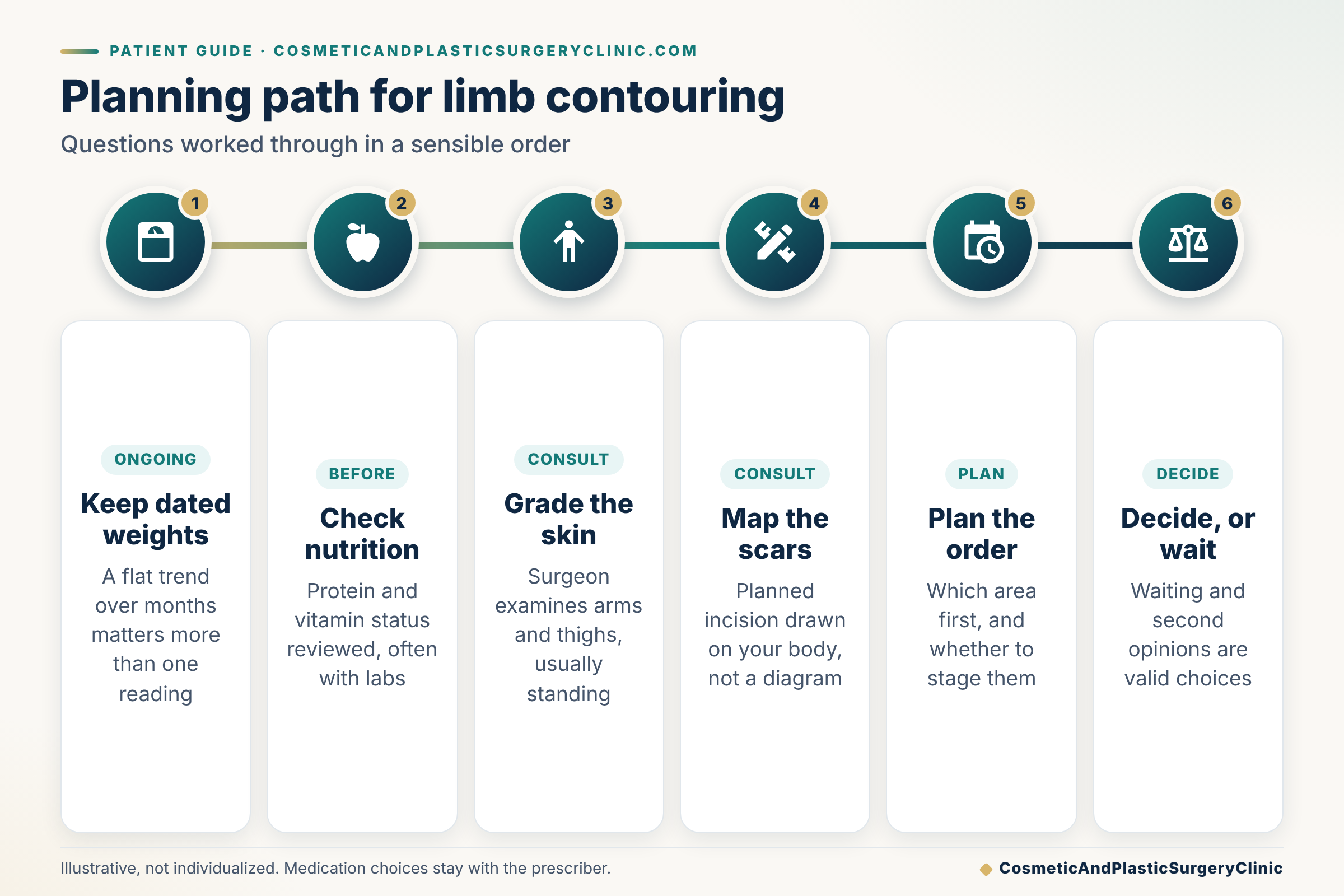
Timing is the question with the least precise answer. What exists comes from general post-weight-loss advice, an insurer’s written rules and surgeons’ own habits, so each interval below is a reference point and not a schedule for anyone.
What stable weight means for arm lift after weight loss
Intervals that published sources state
The Aesthetic Society says weight should be stable for at least six months with no further loss expected, and suggests waiting about two years after the start of a dramatic weight-loss program for the best result. An ASPS article from March 2026 says many surgeons want a stable weight for at least three to six months. An ASPS blog from 2018 gives no number but says significant fluctuations can hurt the outcome and advises giving the body time to adjust after bariatric surgery.
Insurers write intervals down, though not usually for limbs. One commercial policy (Blue Cross NC, reviewed 2026) addresses only abdominal surgery: six months of stable weight for a panniculectomy, and at least 18 months after bariatric surgery with the most recent six months stable. It does not mention arm or thigh lifts, and other plans differ. The pattern to take from it is that a date, a record of weights and a written criterion matter.
Why a falling scale changes the plan for arm lift after weight loss
The March 2026 ASPS article notes that additional surgery may be needed if weight loss continues after an operation. That is the core problem with an arm lift after weight loss done too early: a lift fitted to a body that is still shrinking can leave new looseness. The reverse also matters, since weight gain after surgery may alter the contour, according to the Aesthetic Society’s thigh lift page.
Dated weights help more than a single reading. A log kept over several months, with the method of loss noted, lets a surgeon see whether the trend is flat, still falling or drifting up. Anyone whose weight is still moving can use the waiting time on the other items in this article: nutrition, nicotine, a grading conversation and the staging question.
When medication was part of the weight loss
Questions that belong to the prescriber
This article does not suggest continuing, pausing, lowering or stopping any medication, and no surgeon’s article can replace the prescriber’s judgment. Sources differ. Multisociety guidance from October 2024 (American Society of Anesthesiologists with gastroenterology, bariatric, perioperative and endoscopic surgery groups) said most patients can continue GLP-1 drugs before elective surgery, named the dose-escalation phase and active stomach symptoms as higher-risk situations, and said stopping is not automatically the lowest-risk choice.
That guidance leaves the decision to the patient’s team, including the anesthesiologist, the surgeon and the prescribing clinician. ASPS’s March 2026 article describes surgeon-specific preferences about medication around surgery that vary from one practice to the next. The safe reading is to follow written instructions from your own team and to ask who is responsible for each decision. The full evidence is on the skin removal after GLP-1 page.
What the surgeon and anesthesia team need to know
Bring the drug name, dose, start date, any recent dose change and any stomach symptoms to the first arm lift after weight loss visit, plus the prescriber’s contact details. An ASPS nutrition article from August 2026 also says patients should tell the surgeon how they lost weight, whether by medication, bariatric surgery or both, and describe their eating habits.
Outcome data by weight-loss method are thin for limbs. A 2026 single-center study of 373 abdominal panniculectomy patients (Koenig and colleagues, Plastic and Reconstructive Surgery) found delayed wound healing in 18.5% of GLP-1 users versus 7.5% of others, and seroma in 4.9% versus 14.0%. That is trunk surgery at one hospital, not arm or thigh surgery, and none of the sources opened reports limb-specific results by weight-loss method.
| Situation | Path often discussed | Benefit | Trade-off | Key question |
|---|---|---|---|---|
| Weight still falling | Wait, keep dated weights, review nutrition | Avoids operating on a changing body | Living with loose skin longer | What trend would count as stable here? |
| Weight steady for months, arms bother most | Consultation about an arm lift | Single focused recovery | Long arm scar, thighs untouched | Where exactly will the scar run? |
| Arms and thighs both loose | Prioritize one area, consider separate operations | Smaller recoveries, one at a time | Two anesthetics, more total time | Which area first, and why? |
| Recent bariatric surgery | Allow time for nutrition and weight to settle | Lower chance of nutrient gaps at surgery | A longer wait | Which labs do you want first? |
| Loss involved a GLP-1 drug | Surgeon, anesthesia team and prescriber coordinate | One shared plan | Several people to schedule | Who decides about the medication? |
| Skin irritation or rash in the folds | Treat the skin problem before any date is set | Cleaner wound-healing conditions | Delay | Who treats the rash first? |
Nutrition and healing before arm lift after weight loss and thigh surgery
An arm lift after weight loss is a wound-healing project, and the wounds are long. Healing needs raw material, and people who have lost a great deal of weight, whether by surgery, medication or diet, can be short of some of it. This section reports what a 2026 review summary and a 2021 narrative review say. It gives no diet or supplement plan, which belongs to the surgeon, a dietitian and the prescriber.
What recent reviews report
Protein and micronutrient gaps
A review by J. Peter Rubin’s group at the University of Pittsburgh, titled “Nutritional Challenges in Post-Massive Weight Loss Body Contouring: Guidance for Plastic Surgeons on GLP-1 Agonists and Sleeve Gastrectomy” and published in the September 2026 issue of Plastic and Reconstructive Surgery, is summarized in ASPS news items from August 2026. They describe protein as a major concern and name B vitamins and vitamin D as commonly deficient. They add that a standard multivitamin may not be enough for some people after bariatric surgery or GLP-1 treatment.
An earlier narrative review (Toninello and colleagues, Nutrients, 2021) put numbers on the gaps in post-bariatric patients: protein deficiency in about 13%, iron deficiency in 43.9% in one retrospective study of 379 patients, and low vitamin D in 68.1%. It also observed that people often stop taking supplements once their weight settles, which is often when contouring is planned. The authors noted that large, well-designed studies are scarce and that several dosing suggestions rest on expert opinion or animal work, so the figures describe a pattern, not a prediction for one person.
What nutrition can and cannot promise
The ASPS summaries report complication rates after body contouring following major weight loss of roughly 20% to 70%, with most being wound-healing problems that are often managed in the office. The release gives 20% as the low end and the news article gives 23%. Neither identifies the underlying studies or how complications were counted.
The same summaries present nutrition as a way to lower risk, and they do not quantify the effect or present it as a promise. For a reader weighing arm lift after weight loss, that is the honest scope: better nutrition probably helps healing, nobody has measured by how much for arm or thigh surgery specifically, and a good lab result does not remove the other risks described below.
Getting nutrition checked without self-prescribing
Labs, dietitians and the surgeon’s call
The 2026 review summaries advise that surgeons use laboratory tests to screen people who have lost significant weight, and they note that surgery may be delayed if values are not ready. They also say supplementation should start several weeks before surgery and nutrition attention should continue afterward, when healing demands are highest, and that a dietitian may help build an individual plan.
Which tests, which thresholds and which supplements are individual decisions, so this page lists none. A useful consultation question is: “What do you check before arm lift after weight loss, and what result would make you postpone?” A surgeon who has a concrete answer, and who involves the prescribing clinician or a dietitian when needed, is describing a process. A vague answer is information too.
Nicotine, chronic conditions and other healing factors
The Aesthetic Society says patients cannot smoke, vape or chew nicotine products, because nicotine slows healing and raises the risk of serious complications. ASPS lists good candidates for both operations as nonsmokers without conditions that impair healing or raise surgical risk. The Aesthetic Society adds that chronic conditions such as diabetes or heart disease can make someone a poor candidate and that clearance from a primary care physician is needed.
Pregnancy plans matter as well: the Aesthetic Society says pregnancy may stretch the skin and compromise the result, so surgery may need to wait if children are planned. None of this is a verdict. These are the topics a surgeon will ask about, and answering them accurately is part of reducing surprises after an arm lift after weight loss.
Scars: what long incisions mean on the arm and the thigh
Skin removal on limbs is limited by one fact: the skin has to be cut where it is loose, and the resulting scar is only as hidden as its position allows. The Aesthetic Society states plainly that these operations leave permanent scarring, with surgeons aiming to place scars in creases or less visible areas, and says most patients consider that an acceptable trade-off, which is a statement about group opinion and not about any one person. ASPS lists unfavorable scarring among the risks of both the arm lift and the thigh lift.
Arm lift after weight loss: scar position and quality
Where the line runs and how long it can be
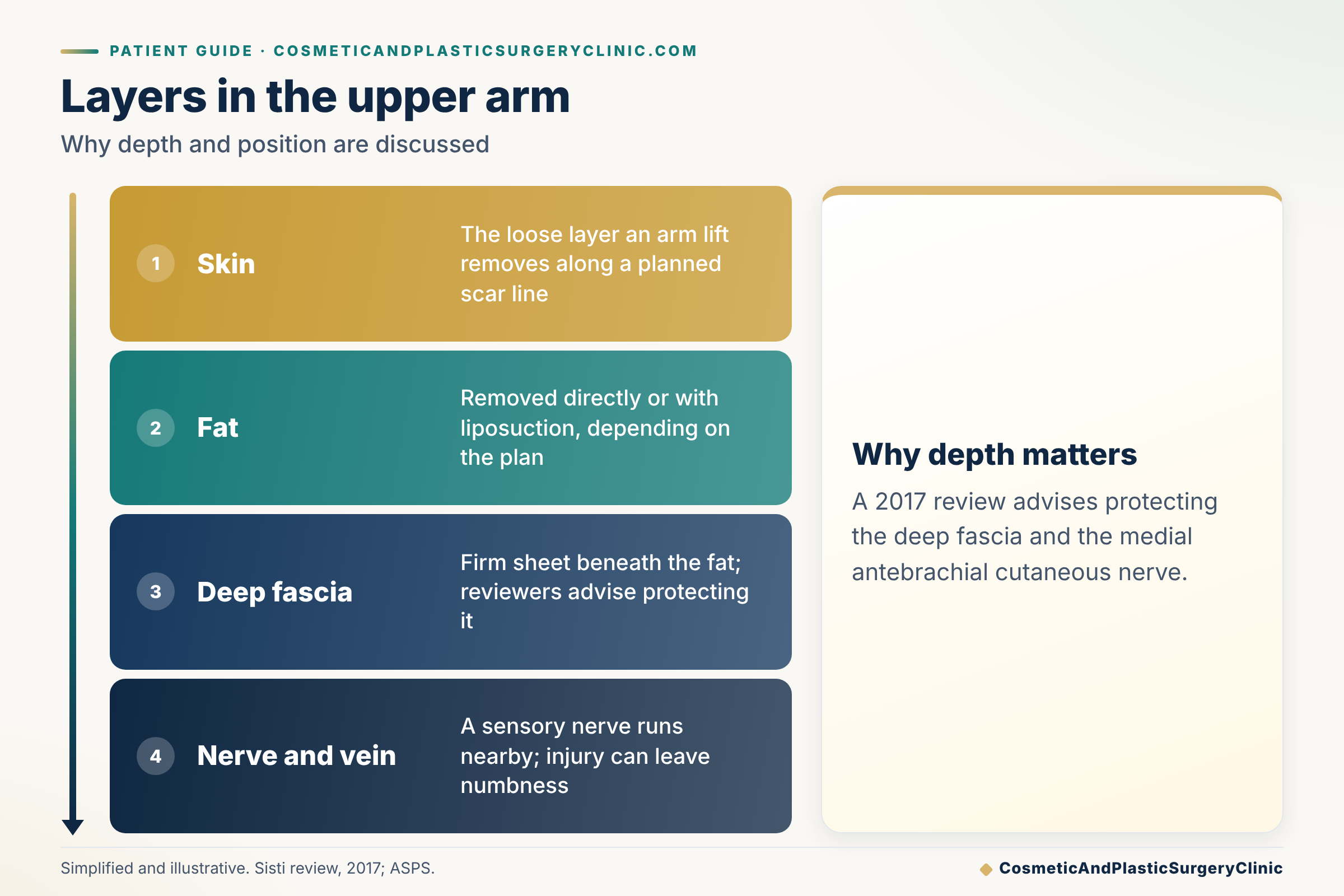
ASPS describes arm lift incisions on the inside or back of the arm, depending on surgeon preference, with length and pattern set by the amount and location of excess skin. They may run from the underarm to just above the elbow. For some people shorter, limited incisions are possible, with deeper tissue tightened by internal stitches. The ASPS page does not describe extending the incision onto the chest, so ask the surgeon to draw the planned line on you, not on a diagram.
The March 2026 ASPS article says arm scars are usually placed on the back of the arm or along its underside, show when reaching overhead and are hidden when the arms are at the sides. Because ASPS ties incision length to the amount and location of excess skin, a long stretch of loose skin leaves less room for a short scar. Whether a shorter scar is realistic is a question for an examination, not a website.
How often arm scars thicken after arm lift after weight loss
A 2017 literature review in Acta Bio Medica (Sisti and colleagues) pooled 27 studies of brachioplasty covering 1,065 patients. Hypertrophic scarring, meaning raised, thickened scars, was the most frequent complication at 10.79% of patients, which is 115 people. The same review reported nerve damage in 1.5%, and its authors recommend telling patients about the possibility of thick scars and nerve injury.
Limits apply. The studies used different techniques, only 13 of 27 followed patients beyond 12 months, and many did not use a standardized scar scale, so the 10.79% is a rough guide. A reader who wants to judge scar quality should ask for photographs of arms taken at least a year after surgery on people with a comparable starting grade, and the before and after photos page explains how to read them.
Thigh lift scars
Groin crease or the full inseam
ASPS describes three inner-thigh approaches: an incision from the groin that runs down and wraps around the back of the thigh, a long incision along the inseam from groin to knee, and a groin-only incision for the few people suited to it. An outer thigh lift runs from the groin around the hip and across the back. The page gives no measurements and notes that incisions may be extensive.
The March 2026 ASPS article says a groin-crease scar is ideal but that most people need a vertical scar as well, which is hidden when standing or sitting and visible with the legs extended. That trade-off is the central one for thigh lift after weight loss: the more skin that must go, the more likely the scar leaves the crease. The sources opened here do not address spreading of the scar toward the genital area, so ask about it directly.
Protecting the scar and judging it over time
The same ASPS article says silicone sheeting may help scars fade and mature and that ultraviolet exposure can darken them, so sun protection is advised. Any scar-care routine should come from the operating surgeon, because dressing, closure type and timing differ. ASPS says thigh incisions may be closed with sutures, adhesive tapes or clips, and that arm incisions are closed with absorbable stitches or stitches removed within one to two weeks.
No source opened gives a firm date at which an arm or thigh scar is considered mature, and the ASPS pages describe scarring only in general terms. A reasonable question for the consultation is when the surgeon judges the scar and the contour, and what options exist if the scar spreads or thickens.
Risks and healing: what the numbers say about arm lift after weight loss
Complications are the part of arm lift after weight loss that brochures tend to soften and forums tend to inflate. This section reads the published numbers for what they are. A full risk-by-risk treatment sits on the arm and thigh lift risks page, and general risk literacy on the plastic surgery risks page.
Reading complication numbers from published reviews
Why 29%, 43% and 68% can all be accurate
The three figures in the table below answer different questions. The brachioplasty review pooled mostly small retrospective series from many surgeons and techniques. The medial thigh review did the same for thigh lifts. The third source followed 106 people with massive weight loss, mostly after bariatric surgery, at one university program (Gusenoff and colleagues, Plastic and Reconstructive Surgery, published online December 2014), and, according to the summary, most of its complications were minor wound-healing problems, which helps explain the higher total.
The Pittsburgh series also shows how extent matters. Overall complications were 43% after a horizontal thigh lift, 64% after a short-scar lift and 74% after a full-length vertical lift, and leg swelling appeared in 22% of patients, mostly after the most extensive operation. Seromas were linked to high blood pressure, and infections to older age, low thyroid function and liposuction done at the same time. These are associations in one series, not predictions, and the series was read here only through a press summary.
| Measure | Arm lift, 2017 review | Medial thigh lift, 2015 review | Thigh lift, 2014 series |
|---|---|---|---|
| Who was studied | 27 studies, 1,065 patients | 16 studies, 447 patients | 106 massive-weight-loss patients at one program |
| Any complication | 28.9% (308 patients) | 42.72% (191 patients) | 68% overall |
| Wound separation or slow healing | 5.72% | 18.34% | Mostly minor wound problems, managed without surgery |
| Fluid under the skin or swelling | Seroma or lymphedema 6.94% | Seroma 8.05% | Leg swelling 22% |
| Other findings | Thick scars 10.79%, nerve damage 1.5% | No clots or sepsis reported | Extra surgery for complications 6%, for refinement 14% |
What the reviews did not measure
The arm review’s authors list its limits: very different techniques, inconsistent follow-up, little data on diabetes or smoking, no standardized scar scales and some technique papers written by surgeons promoting their own methods. Neither review reported clots or sepsis, but small retrospective series cannot rule out rare events, and ASPS lists deep vein thrombosis and cardiac and pulmonary complications among thigh lift risks.
Revision rates in the arm review ranged from 0% to 21% across studies. A plain-language reading is that minor problems are frequent, serious ones are uncommon but not excluded, and a second small operation is a realistic possibility. Ask any surgeon for their own complication and revision numbers for arm and thigh lifts in people who lost similar amounts of weight, and how they define each.
Expected effects, calls to the surgeon, and emergencies
Ordinary after-effects
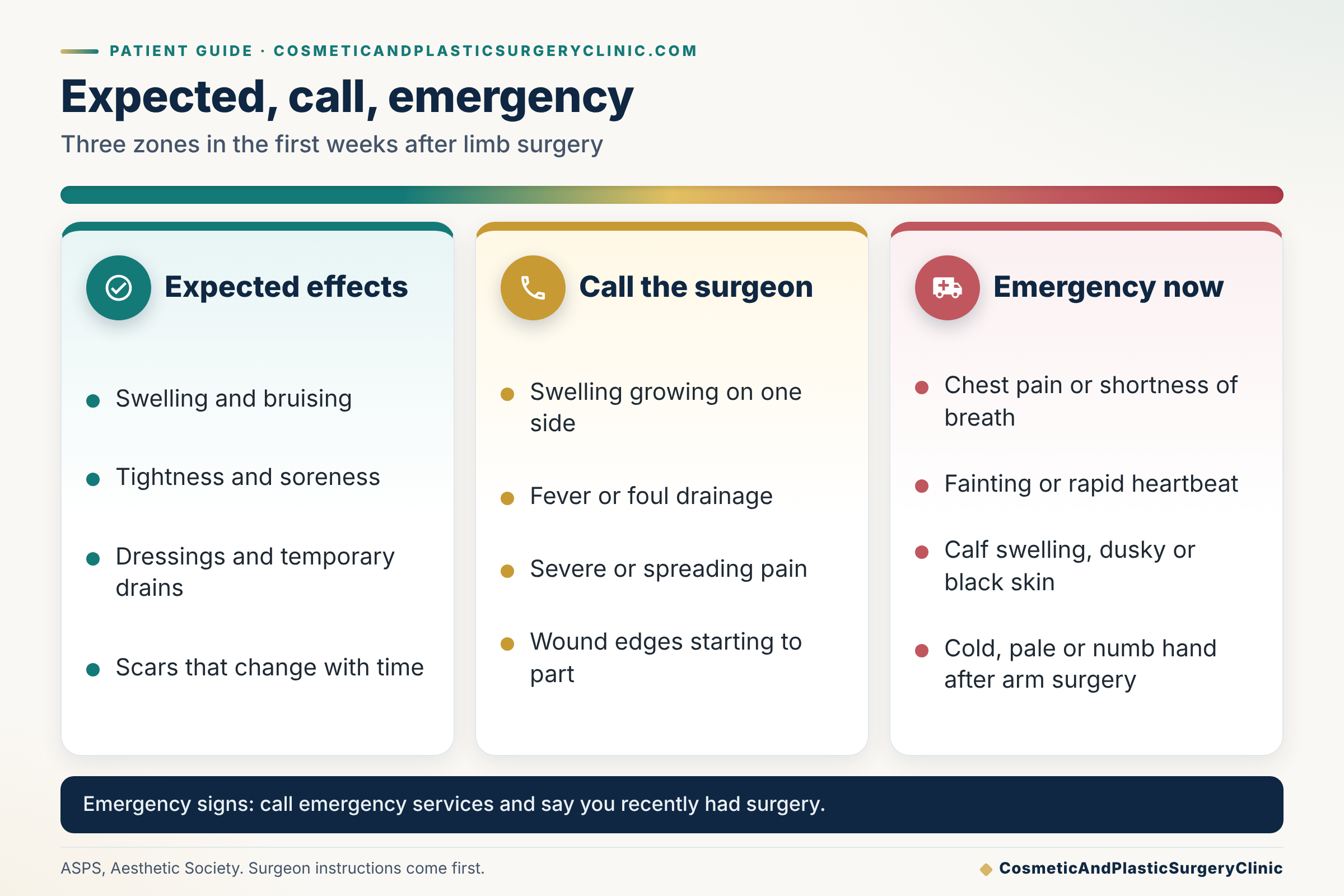
ASPS says smoother, tighter contours are apparent almost immediately after an arm lift, though swelling and bruising are likely. The thigh lift recovery page says small tubes may be placed temporarily to drain fluid or blood, that dressings may be applied, and that incisions should not face excessive force, swelling, abrasion or motion while healing. The Aesthetic Society says recovery takes at least two weeks and possibly longer, depending on the procedure.
ASPS lists numbness or changes in skin sensation among the risks of both operations, and the sources opened do not say how long it lasts. What counts as ordinary for one person is set by the surgeon’s own instructions, and recovery details for each limb are on the arm lift recovery and thigh lift recovery pages.
Warning signs and who to call
The ASPS thigh lift recovery page tells patients to seek medical attention immediately for shortness of breath, chest pains or unusual heartbeats. Who answers the phone at night, and which hospital handles problems, should be settled before surgery. The choosing a plastic surgeon page covers verification, and the American Board of Plastic Surgery publishes a certification lookup for the public.
Staging, coverage and a consultation plan for arm lift after weight loss
The last decisions are practical ones: which area goes first, what insurance will and will not pay, and what to put on paper before agreeing to anything. Each is easier with the facts above in hand.
Order of operations and what else is on the table
Why arm and thigh lifts are seldom stacked
An ASPS article from March 2026 quotes one surgeon, Dr. Katerina Gallus, who typically has patients name their most bothersome area first and then builds a plan. She avoids combining a thigh lift with an upper arm lift, or an arm lift with a tummy tuck, because recovery would be too hard. The same article notes that some operations are paired when they suit a single recovery, citing breast surgery with a tummy tuck.
That is one surgeon’s practice, not a rule, and other surgeons plan differently. It does show what drives staging: the length of anesthesia, how each recovery limits the next, and the ability to care for yourself with sore arms or tight thighs. The logic is laid out on the staged body contouring page, and the trunk options are on the tummy tuck after weight loss page.
When liposuction alone is part of the conversation
ASPS says thigh lifts are not intended strictly for the removal of excess fat. It adds that liposuction alone may work where skin is elastic enough to adapt to the new contours, and that when elasticity is poor a thigh lift combined with liposuction may be recommended. For arms, ASPS says excess fat may be removed directly or with liposuction while the skin is smoothed over the new contour.
After major weight loss, skin elasticity is the deciding question, and a surgeon judges it by examination, not by photographs. The tissue-by-tissue comparisons are on the arm lift vs arm liposuction and thigh lift vs liposuction pages. Note that in the Pittsburgh thigh series, same-day liposuction was among the factors linked with infection.
Coverage and cost for limb contouring
What insurers usually say about arm and thigh lifts
Aetna’s Cosmetic Surgery and Procedures policy (CPB 0031, last reviewed June 2026) lists excision of excessive skin of the thigh (thigh lift, thighplasty) and arm (arm lift, brachioplasty) among procedures it considers cosmetic. The ASPS cost pages for both operations say most health insurance plans do not cover the surgery or its complications. Abdominal panniculectomy is handled separately and may be covered when a plan’s criteria are met.
These are examples, not a forecast for any plan. Policies differ, and documentation requirements vary by insurer. The practical step is to ask the plan, in writing, whether the specific procedure code is covered, what documentation it requires and whether treatment of a complication is covered, before paying a deposit.
Costs beyond the surgeon’s fee
The ASPS cost pages show averages of $6,192 for an arm lift and $7,641 for a thigh lift, with no year given, and say the figures exclude anesthesia, operating room facilities and related expenses such as tests, garments and prescriptions. They are national averages, not local quotes, and a staged plan means separate facility and anesthesia charges for each stage.
Because insurers often decline to pay for complications, the revision policy is a cost item. Ask whether a touch-up or wound treatment is billed, and for how long. Itemized quote comparison is covered on the arm lift cost and thigh lift cost pages, and payment mechanics on the plastic surgery financing page.
A consultation framework for arm lift after weight loss
Two hypothetical cases
Consider a hypothetical person whose weight has held for about eight months after a two-year loss and whose main concern is the inner arm. A surgeon would grade the arm, draw the planned scar, ask about nicotine and lab results, and consider whether liposuction alone could address any of it. The facts that would change the plan are a rising or falling weight trend, a low protein or vitamin result, or a skin rash in the arm folds.
Now consider a hypothetical person two months past bariatric surgery who wants arms and thighs done in one stay. Here the questions are different: has weight stopped changing, are nutrient levels known, and does the surgeon propose splitting the plan into stages? The same request leads to a different answer because the weight and nutrition facts differ, which is the point of treating arm lift after weight loss as a planning problem and not a purchase.
Six checks to avoid surprises
The plastic surgery consultation page has a full question list. For arm lift after weight loss, these six checks cover the points most likely to cause surprises:
- Weight trend. Dated weights show a flat line, not a slope, and the surgeon agrees that it counts as stable.
- Nutrition. Laboratory checks have been reviewed, and one named person owns the nutrition plan.
- Skin and scars. The skin grade has been discussed, and the planned incision has been drawn on your body.
- Staging. The order of areas is written down with the reason for it.
- Healing risks. Nicotine use, medical conditions and the emergency pathway are settled.
- Money and policy. An itemized quote, the revision policy and the insurer’s answer are in writing.
| Factor | Effect on the outcome | Maintenance or revision implication | Review point or warning sign |
|---|---|---|---|
| Weight after surgery | Gain or further loss can change the contour | Touch-up may be considered if looseness returns | Weight moves by a noticeable amount |
| Nutrition and labs | Affects wound healing | Ongoing attention advised in the 2026 review summaries | Slow-healing wound; call the surgeon |
| Scar behavior | Scars may widen or thicken | Surgeon-directed scar care; revision is possible | Raised, spreading or painful scar |
| Skin aging | Skin keeps sagging with age | Results are not fixed in time | Changes noticed over the years |
| Staging plan | Later areas can change what earlier ones look like | Allow for another recovery period | New concern in an untreated area |
| Coverage and fees | Complications are often not covered | Budget for a possible touch-up | Revision terms unclear in the quote |
If a practice presses for a date, a deposit deadline or a bundle before weight, labs and coverage are settled, that is the cue to slow down. A second opinion costs a consultation fee and can be a clear way to compare one plan against another.
Frequently asked questions
Does arm lift after weight loss fix flabby arms caused by muscle loss?
An arm lift removes loose skin and, often, some fat; it is not a muscle treatment. ASPS says drooping upper-arm skin linked to weight changes, aging and heredity cannot be corrected through exercise, and that the operation also tightens supportive tissue under the skin. Strength and tone are separate goals that depend on training and, where relevant, medical advice from a prescriber or physiotherapist. A surgeon can examine the arm and say how much of what bothers you is skin, fat or muscle, which changes whether a lift is the right tool.
Can arm lift after weight loss and thigh lift be done on the same day?
For arm lift after weight loss, it depends on the surgeon, the facility and the person. An ASPS article from March 2026 quotes one surgeon who avoids combining a thigh lift with an upper arm lift because recovery would be too hard, while other practices plan differently. The main factors are total anesthesia time, how well you could care for yourself with both limbs sore, and your health. Ask any surgeon who proposes combining them what the longest planned operating time is and what the alternative staged plan would look like.
Will arm lift after weight loss scars show in short sleeves?
Often some part of the scar can show. ASPS describes arm scars as usually placed on the back of the arm or along its underside, visible when reaching overhead and hidden when the arms hang at the sides. How far the scar runs toward the elbow and underarm depends on the amount and location of loose skin. Ask to see the planned line drawn on your arm in a mirror, and ask for photographs taken a year or more after surgery on arms graded similarly to yours.
What happens if I regain weight after a thigh lift?
The Aesthetic Society warns that weight gain after a thigh lift may affect the result, and ASPS lists recurrent looseness of skin among its risks. A change in weight can alter the contour either way, and a touch-up is sometimes considered. Whether it is offered, when and at what cost is a matter of the surgeon’s own revision policy, so read it before surgery. Surgeons ask for dated weights beforehand for this reason.
Do I need blood tests before arm lift after weight loss?
For arm lift after weight loss, no source opened sets a standard test list, and the decision belongs to the operating surgeon and, where relevant, the prescriber. ASPS summaries of a 2026 review say surgeons should use laboratory tests to screen people who have lost significant weight and that surgery may be delayed if values are not ready. Common topics are protein and vitamins such as B vitamins and vitamin D. If a practice schedules surgery without asking about nutrition at all, that is a fair question to raise.
Is a panniculectomy covered when arm lift after weight loss is not?
Sometimes. Panniculectomy removes the apron of abdominal skin, and insurers may cover it when written criteria are met, such as a period of stable weight. Aetna’s policy lists arm lifts and thigh lifts among procedures it considers cosmetic, and ASPS says most plans do not cover them. Policies vary a great deal, so a covered abdominal operation says nothing about a limb operation. Ask the insurer which procedure code and documentation apply to each operation, and what the appeal process is if a request is denied.
Can liposuction alone replace arm lift after weight loss?
It may for some people. ASPS says liposuction alone may work where skin is elastic enough to adapt to the new contour, and that thigh lifts are not intended strictly for removing fat. After major weight loss the skin often lacks that elasticity, which is why surgeons assess it by examination before suggesting lipo alone, a lift, or both. The risk of leaving looseness behind is one reason the decision deserves an in-person opinion.
How do I check a surgeon’s experience with arm lift after weight loss?
Start with certification: the American Board of Plastic Surgery runs a public lookup. Then ask how many arm and thigh lifts the surgeon performs after major weight loss, what their wound-healing and revision numbers are, which facility they operate in and who handles after-hours problems. Ask to see standardized photographs, ideally at least a year out, of people with a comparable starting grade, and ask what the typical scar looks like on the worst and best cases in the album.
Sources and further reading
- American Society of Plastic Surgeons — Arm lift (accessed 2026-11-13) — what the operation treats; weight changes, aging and heredity
- American Society of Plastic Surgeons — Arm lift procedure (accessed 2026-11-13) — incision placement and length; liposuction; closure
- American Society of Plastic Surgeons — Arm lift risks and safety (accessed 2026-11-13) — listed risks
- American Society of Plastic Surgeons — Arm lift candidates (accessed 2026-11-13) — stable weight, nonsmoker, healing
- American Society of Plastic Surgeons — Arm lift cost (accessed 2026-11-13) — average figure, exclusions, insurance statement
- American Society of Plastic Surgeons — Thigh lift (accessed 2026-11-13) — liposuction alone versus lift
- American Society of Plastic Surgeons — Thigh lift procedure (accessed 2026-11-13) — inner and outer incision patterns
- American Society of Plastic Surgeons — Thigh lift risks and safety (accessed 2026-11-13) — listed risks including recurrent looseness
- American Society of Plastic Surgeons — Thigh lift candidates (accessed 2026-11-13) — stable weight, nonsmoker
- American Society of Plastic Surgeons — Thigh lift cost (accessed 2026-11-13) — average figure, exclusions, insurance statement
- American Society of Plastic Surgeons — Thigh lift recovery (accessed 2026-11-13) — drains, dressings, urgent symptoms
- American Society of Plastic Surgeons — Body lift (accessed 2026-11-13) — causes of poor skin elasticity
- American Society of Plastic Surgeons — Plastic Surgery Statistics Report 2025 (accessed 2026-11-13) — GLP-1 consultation survey by procedure
- American Society of Plastic Surgeons — Lifts after weight loss (30 March 2026; accessed 2026-11-13) — stability, scars, staging, returning looseness
- American Society of Plastic Surgeons — New nutrition recommendations after major weight loss (31 August 2026; accessed 2026-11-13) — nutrition, labs, complication range
- American Society of Plastic Surgeons — Nutrition recommendations support healing (26 August 2026; accessed 2026-11-13) — review title and recommendations
- American Society of Plastic Surgeons — Weight-loss medications and panniculectomy complications (25 March 2026; accessed 2026-11-13) — Koenig study
- American Society of Plastic Surgeons — When is the time right for body contouring (2018; accessed 2026-11-13) — weight fluctuations and timing
- The Aesthetic Society — Plastic surgery after weight loss (accessed 2026-11-13) — stability, nutrition, nicotine, scarring
- The Aesthetic Society — Thigh lift (accessed 2026-11-13) — weight gain after surgery, recovery
- PubMed — Song et al., Pittsburgh Rating Scale, Plastic and Reconstructive Surgery 2005 (accessed 2026-11-13) — grading method and validation
- PubMed Central — de Vries et al., PRS Rainbow Classification, PRS Global Open 2020 (accessed 2026-11-13) — rater agreement; excess-skin prevalence background
- PMFA Journal — review of van der Beek et al. 2013 (accessed 2026-11-13) — scale suitability
- PubMed Central — Sisti et al., complications associated with brachioplasty, Acta Bio Medica 2017 (accessed 2026-11-13) — arm lift complication review
- PubMed — Sisti et al., complications associated with medial thigh lift, 2015 (accessed 2026-11-13) — thigh lift complication review
- ScienceDaily — Complications after thigh lift surgery common, but usually minor (29 December 2014; accessed 2026-11-13) — Gusenoff series summary
- Nutrients — Toninello et al., Nutritional support for bariatric surgery patients (2021; accessed 2026-11-13) — nutrient gaps, limits
- EurekAlert — Multisociety GLP-1 guidance release (29 October 2024; accessed 2026-11-13) — perioperative GLP-1 guidance
- Aetna — Clinical Policy Bulletin 0031, Cosmetic surgery and procedures (reviewed 2026-06-25; accessed 2026-11-13) — arm and thigh lifts listed as cosmetic
- Blue Cross NC — Abdominoplasty and panniculectomy policy (reviewed 08/2026; accessed 2026-11-13) — stable-weight intervals for panniculectomy
- American Board of Plastic Surgery — home page (accessed 2026-11-13) — certification verification