

Breast implant revision is any operation done after the first one to change, repair or take out the implants or the tissue around them. It can be as limited as exchanging an implant through the old scar, or as involved as removing the scar capsule, rebuilding the pocket and lifting the breast in one sitting. People reach it for very different reasons: a breast that has hardened, an implant that has deflated, a change in size preference, a body altered by pregnancy or weight loss, or a worry about safety.
This page is the hub for everything that comes after an implant. It covers why implants get revised, which operations exist, what a surgeon checks first, what published numbers do and do not show, what a second operation risks, how timing, recovery and cost fit together, and which questions to ask. Each narrower decision has its own article, linked where you need it. Nothing here can tell you whether you need surgery; that takes an examination and your records.
Why breast implant revision happens: a lifespan problem and three families of reasons
A first augmentation is often described as a single operation. The device label tells a different story, and the reasons people return are more varied than “the implant wore out.” Sorting your own situation into the right family is the first useful step, because each family leads to a different operation and a different timetable.
Implants are devices with a lifespan, not fixtures
What the FDA tells patients about lifespan and reoperation
The FDA’s patient guidance is direct: breast implants are not lifetime devices, and the longer you have them, the more likely they are to be removed or replaced. It tells patients to assume they will need additional surgery, yet it gives no date, noting that an implant’s lifespan “varies by person and cannot be predicted.” Its list of possible reoperations is wider than most people expect: removing or replacing the implant, removing part or all of the scar capsule, revising a scar, draining a hematoma, repositioning the implant, and biopsy or cyst removal.
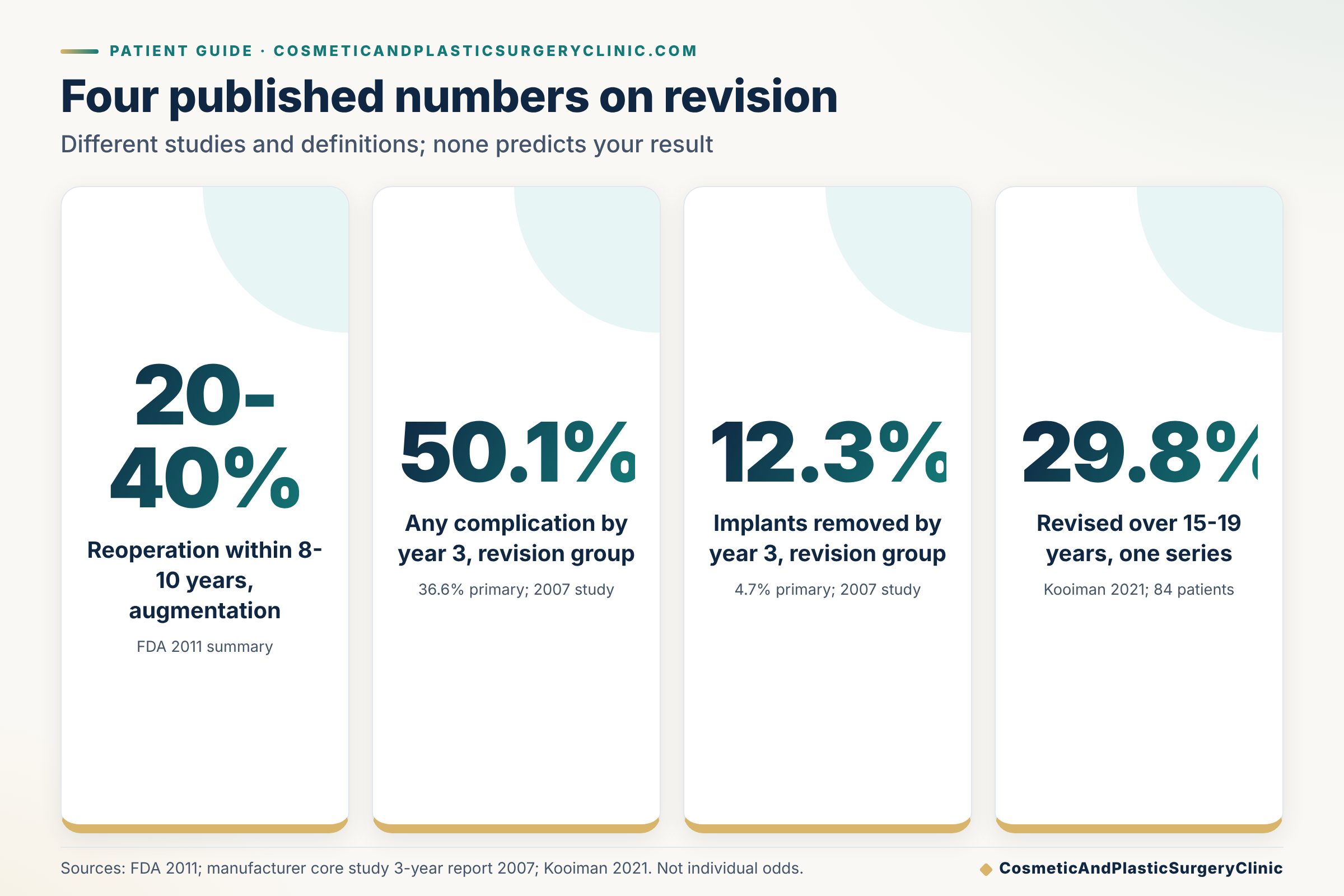
Numbers from the original device studies give a sense of scale. The FDA’s 2011 safety summary reported reoperation in 20 to 40 percent of primary augmentation patients and 40 to 70 percent of primary reconstruction patients during the first 8 to 10 years, and removal in as many as one in five augmentation patients within 10 years. Follow-up was incomplete, about 66 percent at 10 years in one manufacturer’s study and 58 percent at 8 years in the other, so those rates carry real uncertainty.
Why quoted lifespans disagree
Ask reputable sources how long implants last and the answers differ. An ASPS article from March 2025 quotes surgeons saying most implants need an exchange every 10 to 15 years. A February 2026 ASPS article says new models can last about 20 years. StatPearls gives 10 to 20 years before revision or replacement becomes necessary, Cleveland Clinic says new implants typically last about 10 years, and the FDA offers no number at all. None of these is a promise about your own device.
The spread is itself informative. Lifespan depends on the implant generation, the pocket, how the capsule behaves, the person’s tissue, and what someone wants at 45 compared with 25, while most published series follow one device for a limited period. One of the longest, a single-center series of 84 augmentation patients with one round textured gel implant followed 15 to 19 years, reported a 29.8 percent revision rate (Kooiman and colleagues, 2021). That describes one surgeon, one device and one center, not a clock for yours.
Three families of reasons that bring people back
Reasons that start with the implant
Some reasons begin with the device. Capsular contracture is tightening of the scar capsule around an implant; it can make the breast firm, painful or misshapen, and the FDA calls Baker grades III and IV severe and says they may need reoperation. Rupture is the second: saline implants deflate in a way you can see, while silicone implants often rupture without symptoms, which is why breast implant rupture has its own article.
Others are about position and surface. Implants can settle too low, drift toward the side, or sit too close together at the midline (symmastia), and a surgeon’s list of revision reasons also includes a “double bubble” fold and visible rippling, particularly with thin coverage. The FDA’s sample patient decision checklist lists wrinkling and shifting among long-term risks, with maximum reported rates of 20 percent and 11.5 percent.
Reasons that start with the tissue and the body
The breast around an implant keeps changing even when the implant does not. In an ASPS article published in March 2025, surgeons named weight loss, pregnancy and menopause as common triggers, and one said body change after surgery is the most common situation he sees. An older chart review presented at a 2012 meeting looked at 134 revision patients from one surgeon’s practice (1994 to 2009). Among the 120 revised after augmentation or augmentation-mastopexy, sagging accounted for 40 percent of cases, capsular contracture 29 percent, and a low-pole deformity or high-riding implant 19 percent.
Those percentages overlap because many patients had more than one problem, and the series is a single practice from another era. Its value is the pattern: tissue change is not a minor footnote to implant problems, and fixing the device alone will not fix a breast whose skin and tissue have moved.
Reasons that start with preference and safety worries
Some people want a different size or style. ASPS lists changing size and switching from saline to silicone or to another style among the reasons for breast implant revision. A first report from the Aesthetic Foundation’s ARISE registry, released in October 2025, was summarized in trade press as finding aesthetic reasons behind over 69 percent of augmentation revisions in 2024, with capsular contracture at 12.1 percent. Those figures come from trade-press summaries of the report, so check them against the report itself.
Others come with a safety question. The FDA says symptoms such as fatigue, memory loss, rash, “brain fog” and joint pain may be associated with breast implants, that the causes are poorly understood, and that some patients report improvement after removal without replacement. That is the territory of breast implant illness, which has its own article at the end of this page. A rarer concern, a lymphoma linked mostly to textured devices (BIA-ALCL), has one too. Both are best discussed with a clinician who has examined you.
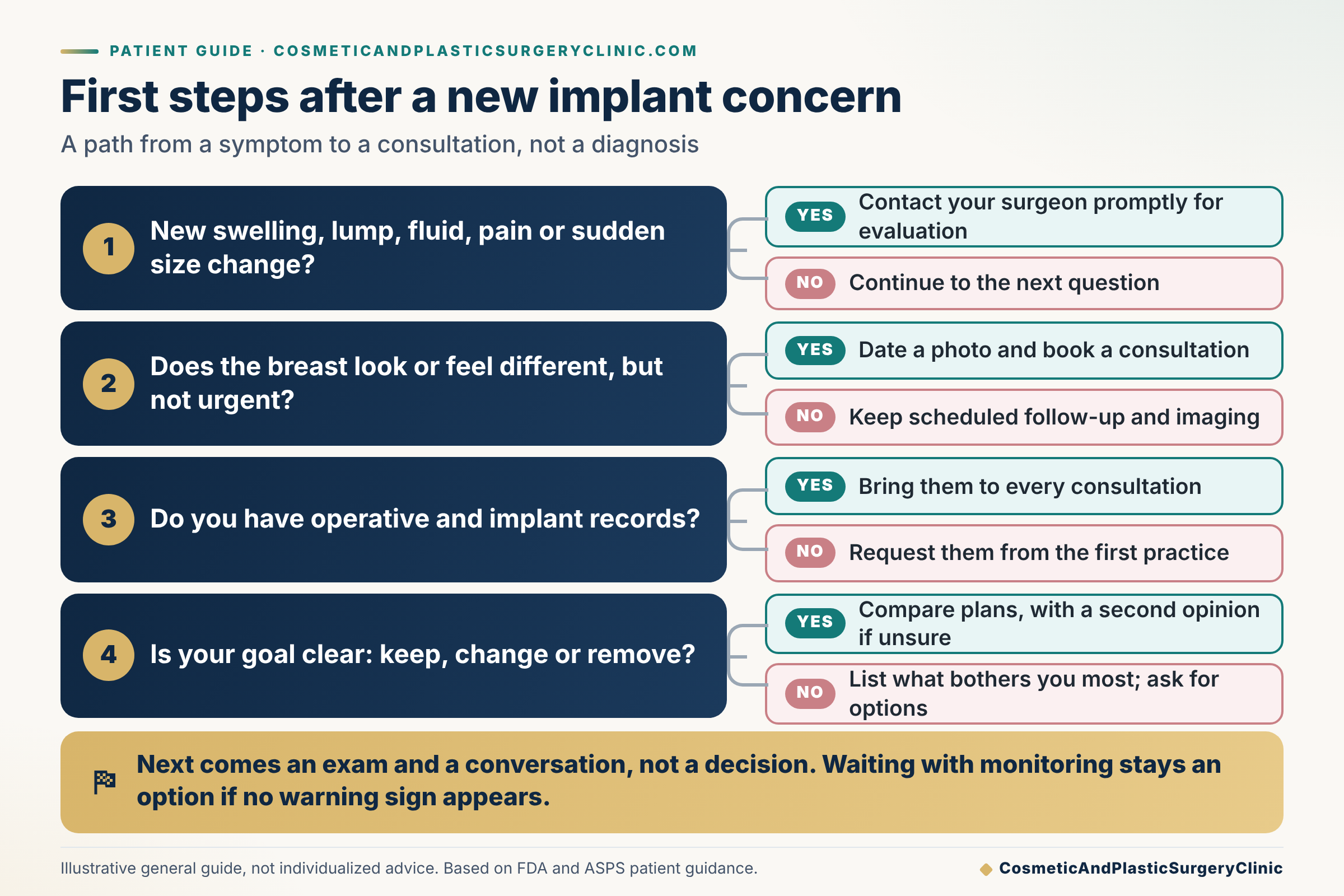
What a breast implant revision can change: five kinds of operation
“Revision” is a label, not a procedure. The operation behind it is built from a short list of parts that surgeons combine: work on the implant, work on the pocket and capsule, work on the soft tissue, and work on the skin envelope and nipple position. Understanding the parts makes quotes and consultations far easier to follow.
Operations on the implant: exchange and removal
Exchange: same pocket or a different one
An exchange takes out the old implant and places a new one. ASPS describes the goal of breast implant revision surgery as replacing old implants with new ones, often paired with a change in size, shape or style, a lift or a reshaped pocket. In the simplest case a surgeon reuses the original incision and the existing pocket; a 2025 ASPS article quotes one surgeon calling replacement potentially “as simple as” removing the old implant and placing a new one.
Complications change the plan. If the pocket is too large, too low or scarred, the new implant needs a smaller, repositioned or newly built space. The decisions specific to replacing implants, including size and fill changes and when a swap is enough, are covered in breast implant exchange, and the size question itself in breast implant size.
Size and fill often change during an exchange. ASPS notes that choosing smaller implants will likely require tightening the capsule, which turns a size preference into a pocket operation, and it lists switching from saline to silicone, or to another style, among the reasons people seek breast implant revision. Fill matters beyond appearance: the FDA recommends imaging for silicone gel implants, while a leaking saline implant deflates in a way you can see, so the choice changes how the new device is monitored.
Removal: implant alone, part of the capsule, or the whole capsule
Taking implants out without replacing them has its own vocabulary. The FDA describes removing the implant alone and leaving the capsule in place, or removing part or all of the capsule, with full removal called en bloc resection or capsulectomy, which is the more extensive operation. For a confirmed lymphoma linked to implants, the FDA says patients should generally have the implant and surrounding capsule removed.
The FDA also warns that some patients who do not replace implants may have dimpling, puckering, sagging or chest wall concavity. Whether removal, with or without capsule and lift, is the right fit is the subject of breast implant removal.
Operations on the pocket and soft tissue
Capsule and pocket repair
When the problem is hardening or malposition, the surgeon works on the space around the implant. StatPearls summarizes the usual approaches: capsulectomy with reaugmentation or a new pocket for capsular contracture, and pocket revision (a new pocket or conversion to a different plane) for implants that have shifted. Moving an implant above or below the muscle changes how it sits and how the breast moves.
The evidence base is thinner than the confidence of some marketing suggests. A 2016 systematic review in Plastic and Reconstructive Surgery (Wan and Rohrich) found no controlled trials among its 24 included articles, concluded that clinical evidence on surgical management of capsular contracture is limited, and judged that changing the pocket site and exchanging the implant likely help while evidence for capsulectomy is less conclusive. The capsular contracture article walks through that evidence in more detail.
Mesh, scaffolds and fat grafting as add-ons
Surgeons sometimes reinforce a weakened pocket with mesh or a scaffold, or graft fat to soften edges and cover thin areas. ASPS’s 2025 article describes mesh structures to restore the implant pocket, with one surgeon saying they may also lower the risk of capsular contracture; that is a surgeon’s opinion in an interview, not a trial result. The 2016 review called acellular dermal matrix a possibly useful adjunct that needs long-term data.
A 2020 Aesthetic Surgery Journal series (Auclair and colleagues) followed 148 patients whose revisions combined fat grafting with implants, at a mean of 8.7 years after the first augmentation. Within two years, 13 patients, about 9 percent, had a further operation for more fat grafting; of 45 with capsular contracture before revision, 8 had recurrence within three years. It is a retrospective series from one surgeon’s practice, so it shows what is possible rather than what is typical.
Operations on the skin envelope and the volume
When a lift joins the plan
Implants do not lift a breast. If skin has stretched or the nipple has dropped, replacing the implant alone can leave the same sag with a different device inside it. ASPS says breast implant revision often includes a concurrent breast lift or reduction, and the Aesthetic Society says a lift may be recommended when implants alone are unlikely to meet the goals. The combined operation is the subject of breast lift with implants; a lift done as the implants come out is a different plan, covered in the map at the end of this page.
If you already had a lift and it did not hold, a separate article on revision breast lift covers that second-look decision from the lift side.
Fat transfer and other ways to avoid a new implant
Some people use breast implant revision as the moment to leave implants behind. ASPS lists removal with a natural-looking breast rebuilt from soft tissue, and fat transfer with mesh support, among revision options. Fat adds soft volume and contour but not structure, and in the combined fat-and-implant series above about 9 percent of patients returned for more grafting. The trade-offs are laid out in fat transfer vs implants and the wider options in breast implant alternatives.
| Situation | Common pathway | What it can do | Trade-off | Question that decides it |
|---|---|---|---|---|
| Saline implant has deflated | Replace through the existing incision, or remove | Often a short operation on a known problem | The other implant is the same age, so both may be discussed | Replace one side or both? |
| Silicone implant suspected to be ruptured | Imaging, then removal with exchange or without replacement | Takes out the failed device | Gel outside the capsule can widen the operation | Is the gel inside the capsule on imaging? |
| Firm, tight or painful breast | Capsule removal, exchange, or a new pocket | May relieve tightness and distortion | Can return; evidence for each step is limited | Which capsule step, and why that one? |
| Implant too low, wide or close to the midline | Pocket repair or a new pocket, often with exchange | Repositions the implant | Thin tissue may not hold the repair | What supports the repair long term? |
| Sagging with implants in place | Lift, with or without exchange | Raises the nipple and tightens the envelope | Extra scars and a longer operation | Will a lift change the look more than a new implant? |
| Wanting implants out | Removal, with or without capsule, lift or fat | Ends the device decision | Dimpling, sagging or a flatter chest can result | What will my breasts look like without replacement? |

Planning a breast implant revision: records, imaging and honest goals
The quality of a breast implant revision plan depends heavily on what is known before the first incision. Three things are worth assembling first: the paper trail from your original surgery, an assessment of what the implants and capsule are doing now, and a clear statement of what you want the result to be.
Records that change the plan
What to request from the first surgeon and facility
Ask the original practice for the operative report, the implant type, size and identification details, the date and facility, your pre-surgery photographs, and any imaging done since. Current FDA labeling requires a patient device card alongside the patient decision checklist, so a card may have been issued at your surgery; the checklist itself is signed by both patient and implanting surgeon, which means a copy should exist somewhere. ASPS advises making sure a new surgeon has your full breast surgical history.
If the original surgeon has retired, the practice has closed or the surgery took place abroad, say so at the first visit and ask how missing details will be handled. Surgery done in another country raises its own continuity-of-care questions, discussed in medical tourism and surgery abroad.
The FDA’s labeling guidance mentions two registries, the National Breast Implant Registry and PROFILE, and the Aesthetic Foundation’s ARISE registry began collecting device data in 2021. Ask whether your implants were entered in any of them and what it would take to obtain that record. A registry entry can help confirm details when paper records are thin before a breast implant revision.
Why the implant’s details matter
The implant’s fill and surface change both the monitoring and the risk conversation. Silicone gel implants carry an FDA-recommended imaging schedule; saline implants announce a leak by deflating. The FDA says lymphoma linked to implants appears more often with textured shells, so the surface matters if swelling or a mass ever appears. Size and the plane above or below the muscle shape how much room a new implant has, and the Aesthetic Society says a surgeon will need the details of the original augmentation.
Examination and imaging
What a physical exam can and cannot show
An exam can reveal firmness, asymmetry, position, a visibly deflated saline implant, tenderness and skin changes. It cannot reliably see a silicone implant that has quietly ruptured. The FDA says silicone implants often rupture silently and that the risk grows the longer they are in place. That limit is the reason the exam is paired with imaging when a decision depends on what is inside the capsule.
If swelling, a lump or pain appears long after healing, the FDA says evaluation may include a physical exam, imaging, and assessment of fluid or tissue around the implant. A delayed fluid collection is handled differently from ordinary swelling, so it should be reported and not watched at home.
Where MRI and ultrasound fit
The FDA calls MRI the most effective method for detecting silent rupture and ultrasound an acceptable alternative for people without symptoms. Its labeling guidance recommends a first ultrasound or MRI 5 to 6 years after silicone gel implant surgery, then every 2 to 3 years, with MRI recommended when there are symptoms or an unclear ultrasound. ASPS adds that mammograms cannot always detect a rupture.
Older sources quote other intervals; the FDA’s 2011 summary, for example, said MRI at 3 years and every 2 years after, and one clinical reference lists two different schedules on the same page. The FDA’s checklist adds that implants can interfere with mammography, so mention them when scheduling any breast imaging. Use the manufacturer’s current labeling and your surgeon’s advice. What imaging can and cannot show, and how it is paid for, is the subject of breast implant screening.
Goals, timing and health factors
Turning a wish into a goal a surgeon can plan around
“Make them look better” is hard to plan for. A usable goal names what bothers you most and what would count as improvement: a smaller profile, a higher or lower position, less firmness, more symmetry, fewer visits for monitoring, or no implant at all. Bring photographs of how you looked before the first surgery and of shapes you like, and say which problem would bother you most if only one could be fixed.
The FDA’s own question list for patients is a good template: how easy it is to remove the implants, how the breasts would look if the implants were removed and not replaced, how easy it is to change size later, and what the options are if you are dissatisfied. ASPS notes that choosing smaller implants will likely require tightening the capsule, which turns a size preference into a pocket operation.
Health factors surgeons weigh
The FDA’s sample patient decision checklist lists situations that call for caution with breast implant surgery in general: an active infection anywhere in the body, untreated breast cancer or precancer, and pregnancy or nursing; and a higher risk of a poor outcome with conditions that impair healing or clotting, current or former smoking, immune-suppressing drugs, chemotherapy or radiation, and reduced blood supply to breast tissue. These are screening questions, not a verdict on anyone.
Your surgeon applies them to your history, and it is worth raising pregnancy plans, medications and nicotine use early, because they affect both timing and risk. General risk concepts are explained in plastic surgery risks.

What the numbers say about breast implant revision, and what they cannot say
Breast implant revision statistics are easy to quote and hard to compare. The figures below come from different devices, years, definitions and populations. Read them as orientation, not as odds for your own breasts.
Published reoperation and removal figures side by side
Device studies, registries and single practices
Premarket device studies follow patients for years but lose people over time. Registries capture many devices but depend on what surgeons choose to enter. National counts, such as ASPS’s, count procedures by member surgeons and do not say why they were done. The table puts the main sources beside each other with what each cannot tell you.
| Source | Population or period | What it reported | Limits to keep in mind |
|---|---|---|---|
| FDA update on silicone gel implants, 2011 | Premarket core studies, first 8 to 10 years | Reoperation in 20 to 40 percent of primary augmentation patients; removal in as many as one in five | Follow-up 66 percent at 10 years in one study, 58 percent at 8 years in the other |
| Silicone gel core study, 3-year report, 2007 | 551 primary and 146 revision augmentation patients | Any complication including reoperation 36.6 percent primary, 50.1 percent revision; implants removed 4.7 and 12.3 percent | Manufacturer study; revision patients began with different problems; only three years |
| Kooiman and colleagues, Aesthetic Surgery Journal, 2021 | 84 augmentation patients, one device, 15 to 19 years | Revision rate 29.8 percent; no difference by pocket plane | One surgeon, one center, level 4 evidence |
| ASPS statistics report, 2025 | ASPS member surgeons, United States | 304,234 augmentation procedures including revisions; 45,773 implant removals in 2025 and 45,780 in 2024 | Counts procedures, not people; removals cover augmentation patients; no separate revision count |
| ARISE registry first report, October 2025 | Over 120,000 devices registered since 2021 | Reported in trade press: aesthetic reasons over 69 percent of augmentation revisions in 2024 | Summaries only; participation depends on surgeons entering data |
National counts add a different kind of context. The ASPS 2025 statistics report shows 45,773 implant removals among augmentation patients, essentially unchanged from 45,780 the year before, next to 304,234 augmentation procedures that include revisions. An ASPS article on 2025 breast surgery trends reads the flat removal count as a sign that growing interest in moderate implant sizes is not coming mainly from existing patients reversing earlier decisions, and reports that 36 percent of surveyed member surgeons saw a drift toward smaller implants. Because primary augmentations and revisions are lumped together, the counts cannot say how many breast implant revision operations took place.
How to read a rate before you repeat it
Four questions sort most of the confusion. What counts: reoperation, revision and removal are different events, and one patient can have several. Out of whom: a device study follows its enrolled patients, a national count has no denominator at all. For how long: three years, ten years and nineteen years answer different questions. And with which device: older and newer implant generations may behave differently, so a long series can describe devices no longer sold.
The FDA’s sample checklist lists “maximum reported rates,” including 59.7 percent for reoperation, 51.7 percent for capsular contracture and 31.2 percent for rupture or leak. They are ceilings across devices and uses, not typical values, and should not be read as the expected course for any one patient. The same checklist says as many as 20 percent of augmentation patients have their implants removed within 8 to 10 years.
Why a second operation is not a repeat of the first
Breast implant revision patients have fared differently in device studies
In the three-year report of one silicone gel core study, 551 primary augmentation patients and 146 revision-augmentation patients were followed. Any complication, counting reoperation, occurred in 36.6 percent of the first group and 50.1 percent of the second; implants had been removed in 4.7 and 12.3 percent. The revision group started with problems the primary group did not, so the gap says something about difficulty, not about anyone’s skill.
ASPS says a breast implant revision can often be more challenging than the original augmentation. The FDA states that a satisfactory cosmetic outcome is not assured from any reoperation. Scar tissue, thinner coverage and older tissue all change what a surgeon can do, which is why the same operation can be easier on a first visit than on a third.
Why the same problem can return
Capsular contracture is the best-known example. The FDA says infection, hematoma and seroma may raise the risk but the cause is unknown, and that no device has been cleared to treat or reduce it. In the Auclair series, 8 of 45 patients with capsular contracture before revision had it again within three years. The 2016 systematic review concluded the clinical evidence for surgical treatments is limited.
A fair reading is that surgeons have sensible, widely used steps for recurrence, yet none comes with proof of prevention. That honesty belongs in the consultation: ask what your surgeon does to lower the chance of recurrence, and what the plan is if it returns.
What no one can predict
When the next operation will be needed
An exchange resets the device’s clock, but not the body’s. Revised implants can again need attention, and the FDA’s own wording is that lifespan cannot be predicted. ASPS’s February 2026 article advises budgeting so that funds for a revision are available when needed, and the Aesthetic Society’s cost page lists simple removal as the least costly option and a capsulectomy with lift and new implants as the most costly. Planning, not dread, is the intended response.
| Factor | Effect on outcome | Maintenance or revision implication | Review point |
|---|---|---|---|
| Years since surgery | FDA: complications, rupture and removal become more likely the longer implants stay | Follow-up continues for as long as the implants remain | Any new change in size, shape, firmness or comfort |
| Fill type | Saline deflation is visible; silicone rupture is often silent | Silicone: imaging on the labeled schedule, usually first at 5 to 6 years | Schedule set with your surgeon; earlier if symptoms appear |
| Shell surface | FDA: lymphoma linked to implants appears more often with textured shells | Know which surface you have; keep the device record | Late swelling, a mass or pain: prompt evaluation |
| Body change | Pregnancy, weight change, menopause and aging alter the breast around the implant | May bring a lift, a size change or a pocket revision | After major weight or life changes |
| Prior capsule problems | Contracture returned in 8 of 45 patients within three years in one series | Closer attention to firmness and shape; plan for possible reoperation | New tightness, pain or distortion |
| Smoking and healing | FDA lists smoking and healing-impairing conditions as higher-risk factors | Raise before surgery; affects timing and risk | Before any planned operation |
What the result will look like
ASPS says the final results of breast implant revision are initially obscured by swelling, so early photographs mislead in both directions. The FDA’s checklist lists maximum reported rates for asymmetry (28 percent), sensation changes (35 percent) and breast pain (36.5 percent) after implant surgery, and no one can say where on that range a given person will fall. Ask for photographs of patients with a starting problem like yours, taken at a stated interval after surgery.
Risks of a second operation and signs that should not wait
Every operation has expected effects, possible complications and rare emergencies, and it helps to keep the three apart. Swelling, bruising and tightness after surgery are expected. Infection, bleeding, wound problems and a poor cosmetic result are complications. Some situations need care the same day. This section covers all three for breast implant revision.
The risks that come with surgery itself
Risks shared with the first operation
The FDA’s sample patient decision checklist, which is written for implant surgery in general, gives maximum reported rates for several of them: infection requiring possible implant removal (9 percent), swelling (9 percent), scarring (7 percent), seroma (6.5 percent), hematoma (2.8 percent), tissue death of breast skin or nipple (2 percent) and anesthesia complications (1 percent). These are ceilings across devices, not forecasts for any one person or for a revision in particular.
Anesthesia for breast implant revision is usually intravenous sedation or general anesthesia, according to ASPS, and the FDA says most women receive general anesthesia for implant surgery. Operating time ranges from one hour to several depending on the work involved. General concepts such as how risk is expressed are in the guide to plastic surgery risks.
Risks that change in a second operation
A second operation meets tissue that has already been cut, stretched and scarred, and the surgeon works around a capsule that may be thickened or tight. ASPS says revisions can be more challenging than the first surgery. Adding a lift or a new pocket adds incisions, operating time and places where healing can be slow.
Some risks are specific to the combination chosen. Removing a thick capsule is a larger operation than removing only the implant; fat grafting adds a donor site; mesh adds a material. Each add-on should come with a stated reason, and you can ask what the operation would look like without it.
Warning signs and who to call
Symptoms that deserve prompt evaluation
The FDA lists persistent swelling or pain, and other changes around the implant, as reasons to be evaluated, and says such signs can appear years after surgery. ASPS says in a patient video that a rupture found on imaging is not an emergency, and that a ruptured silicone implant is usually replaced within six months of being identified.
Reporting a problem and keeping a record
Write down when a change began, photograph it with the date, and keep imaging reports and visit notes together. The FDA invites patients to report symptoms with implants through MedWatch, its adverse-event reporting program, or by phone at 1-800-FDA-1088. Reports help the agency spot patterns; they are not a substitute for being seen.
Safety questions that attract strong opinions
A lymphoma linked to textured implants
The FDA describes breast implant-associated anaplastic large cell lymphoma (BIA-ALCL) as a type of non-Hodgkin lymphoma, a cancer of the immune system, not breast cancer. It occurs more often with textured implants, usually presents as persistent swelling, a mass or pain years after surgery, and when confirmed is generally treated with removal of the implant and surrounding capsule. The FDA also says it is not recommending routine removal of textured or other implants in people with no symptoms. The full facts are in the article on BIA-ALCL breast implants, linked at the end of this page.
Systemic symptoms and breast implant illness
Some people with implants report fatigue, joint pain, rash, memory problems and “brain fog.” The FDA states these symptoms and their causes are poorly understood, that it has not found an association with connective tissue disease, breast cancer or reproductive problems but that larger, longer studies are needed, and that some patients report improvement or full resolution after implants are removed without replacement. The symptoms are real to the people who have them; whether implants cause them is not established.
For a decision, that uncertainty cuts both ways. Neither “your implants are the cause” nor “your implants are irrelevant” is supported by current evidence. A clinician can look for other causes first and then talk through options, which is what the article on breast implant illness describes.
Timing, recovery and cost of breast implant revision
Most of the practical questions about breast implant revision come down to three: how soon, how long it takes to heal, and what it costs. The honest answers are ranges, and the right range depends on the operation your surgeon actually proposes.
How soon, and how long to wait
Urgent, soon and elective
Think in three bands. Urgent: new swelling, a mass, fever, spreading redness or sudden changes, covered above. Soon: a confirmed rupture, severe capsular contracture or a symptom pattern that is affecting daily life, usually planned within weeks to months in consultation with your surgeon. Elective: a change in size or shape preference, mild asymmetry or tissue changes, where waiting costs nothing but time.
Elective does not mean trivial. It means the timing is yours to shape around work, family, finances and health, and that a second opinion is easy to fit in. Waiting is a legitimate choice as long as monitoring continues and warning signs are acted on.
Pregnancy, breastfeeding and weight change
The FDA’s checklist lists pregnancy or nursing among situations where implant surgery is not advised, and says implants and breast surgery may interfere with breastfeeding, with ability varying after augmentation. ASPS notes that pregnancy, weight loss and menopause change breast shape and tissue. If you may become pregnant or lose or gain significant weight, ask whether the plan would change if you waited, because a result built on today’s tissue may not match tomorrow’s.
Three hypothetical timelines
Consider a hypothetical person with silicone gel implants placed twelve years ago and no symptoms, whose scheduled MRI suggests a rupture. Her surgeon explains the finding and offers a planning window of weeks to months, consistent with ASPS’s description of such a finding as not an emergency. She uses the time to request her original records, get a second opinion and compare replacement with removal. Her breast implant revision is booked around her work, with an itemized quote and a written plan for the capsule.
Consider another hypothetical person, four years after augmentation, who finds her implants too large after weight loss and notices mild sagging. Nothing is urgent. Downsizing may need capsule tightening and a lift may enter the discussion, so the operation is larger than a swap. Her surgeon asks whether her weight has settled and whether pregnancy is likely, because either would change the plan.
A third hypothetical person, eight years after surgery, notices one breast swelling over two weeks with no injury. This is not a wait-and-see situation. She calls her surgeon, who arranges evaluation that may include imaging and sampling of any fluid, as the FDA describes. Any operation is planned only after those results are back.
Recovery compared with a first augmentation
A typical arc, and why yours may differ
The Aesthetic Society describes recovery from breast implant revision as typically around one to two weeks. Cleveland Clinic’s description of recovery from breast implant surgery is longer: pain easing after five to seven days, light desk work at one to two weeks, full recovery around six to eight weeks, and a return to work at two to six weeks, with physically demanding jobs needing at least six weeks. Both note that timelines vary.
The gap between those two descriptions is a clue: “recovery” can mean being back at a desk or being cleared for everything. A breast implant revision with a capsulectomy and a lift is a larger operation than a simple exchange, so ask for ranges for your specific plan. Practical planning is covered in breast augmentation recovery, and general logistics in the guide to plastic surgery recovery.
Setting, anesthesia and follow-up
Breast implant revision can take place in a hospital or a surgical facility, and patients may go home the same day or stay overnight, according to FDA patient guidance. Expect several follow-up visits: Cleveland Clinic lists checkups at one to two weeks, four to six weeks, three months and six months after implant surgery. Ask which of these you would attend in person, particularly if you are traveling for surgery.
What a breast implant revision quote should include
The anatomy of a breast implant revision cost
ASPS says costs may include the surgeon’s fee, hospital or facility costs, implants, anesthesia, medication, garments and medical tests, and may vary with the surgeon’s experience. The Aesthetic Society orders them by complexity: simple removal is the least costly and a total capsulectomy with a lift and new implants the most. It also ranks implant types from saline to cohesive silicone gel.
For orientation only, the ASPS 2024 statistics report lists average surgeon fees of $3,650 to $6,500 for implant removal in augmentation patients and $4,575 to $8,000 for augmentation. Those exclude facility and anesthesia fees, and the sources opened gave no ASPS fee line specific to revision; another ASPS page gives an undated average of $3,979 for removal. Worked examples and the full cost breakdown are in the article on breast implant revision cost.
| Line item | What drives it | What to ask the practice |
|---|---|---|
| Surgeon fee | Operation chosen, capsule work, combined lift or fat grafting, surgeon experience | Which procedures does this fee include, and which are extra if findings change? |
| Facility and anesthesia | Hospital or surgical center, operating time, anesthesia type | Are both separate from the surgeon’s fee, and is the facility accredited? |
| Devices and add-ons | New implants or none, mesh or scaffold, any warranty coverage | What is the device cost, and what does the manufacturer’s warranty cover? |
| Imaging and pathology | MRI or ultrasound before surgery, pathology of capsule or fluid if sent | Who orders imaging, and who pays for tests the surgeon requests? |
| Garments, medications, follow-up | Supplies and visits for the recovery period | How long are follow-up visits included, and what if a problem needs another operation? |
Two quotes for a breast implant revision are comparable only if they describe the same operation. Line up the procedures named in each: which capsule step, whether a lift, fat grafting or mesh is included, whether new implants are supplied and whether anesthesia and facility fees sit inside the total. A lower price may simply mean a smaller operation. Ask how each practice handles a complication or a second operation, because the answer to that question tells you more about a quote than the headline number does.
Insurance and warranty: statements that disagree
Sources do not agree on insurance. The FDA says some insurers do not cover removal or replacement, even when complications occurred. ASPS says health insurance may cover breast implant revision in some instances and that an implant warranty may cover some costs. The Aesthetic Society’s cost page says revision is elective cosmetic surgery and insurance does not cover it. All three can be true for different people and different reasons for surgery.
Ask your insurer in writing what documentation they would need, and ask the manufacturer or practice what your warranty covers, for how long and whether registration was completed. Compare quotes like for like using the guide to plastic surgery cost, and treat any financing offer as a separate decision.
Choosing who plans the operation, and eight questions to ask
A breast implant revision plan reflects the surgeon’s judgment as much as the implant’s condition. The right match is a surgeon who does this work regularly, explains the reasons for each step, and is comfortable with you asking for a second opinion.
Who is qualified to plan a breast implant revision
Credentials and breast implant revision experience
ASPS recommends a board-certified plastic surgeon experienced in all types of breast surgery, and says to review credentials and before-and-after photographs and make sure the surgeon has your full surgical history. The verification steps, from board certification to state license and facility accreditation, are in the guide to choosing a plastic surgeon. Ask how many revisions like yours the surgeon performs in a year, not just how long they have practiced.
Be cautious about any practice that predicts how a particular symptom will respond. The FDA says some patients report improvement after removal without replacement but that not all do, so a surgeon who promises a symptom outcome from breast implant revision is promising something the evidence cannot support.
Reading breast implant revision photographs
Photographs of a breast implant revision need extra care. Look for patients whose starting problem resembles yours, with the same angles, lighting and posture before and after, and a stated time since surgery, since swelling hides the result early on. Ask whether any photographs show the problem you hope to fix coming back later. The general rules for reading galleries are in before-and-after photos.
Eight questions that make a consultation productive
Questions about the diagnosis and the plan
These first four turn a vague recommendation into reasons you can evaluate.
- What exactly is the problem, and what exam or imaging finding supports that?
- Which operations could address it, including waiting, and why do you favor this one?
- What will you do to the capsule, the pocket and the implant, and why each step?
- How many additional operations should I expect over my lifetime with implants?
Questions about risk, results and cost
The last four cover what could go wrong, what the result may look like and what you will be asked to pay. Questions 4, 5 and 7 echo ones the FDA suggests patients ask.
- What is your reoperation rate for breast implant revisions like mine, and the most common reason?
- Which complications matter most for my history, and what is the plan if one occurs?
- How will my breasts look at the end of this operation and a year later, and what if I choose removal without replacement?
- What does the quote include, and what happens to the price if findings change in surgery?
Second opinions and the option to wait
When waiting is reasonable
For many situations without warning signs, watching and scheduled monitoring are reasonable. The FDA says it is not recommending routine removal of implants in patients who have no symptoms, and ASPS says a rupture seen on imaging is not an emergency. Waiting is not neglect, provided it comes with a plan: a date to reassess, symptoms that would shorten it and a clinician who knows your history.
When a second opinion helps
Get one when the plan is large, when records are missing, when two clinicians’ explanations do not match, or when you feel pressure to book. A good consultation welcomes it. The structure of a productive first visit, including what to bring and how to judge answers, is in the article on plastic surgery consultation questions.
A map of breast implant revision decisions: where each question leads
This page is deliberately broad. Each of the questions below has its own article that goes further than a section here can, so use this map to jump to the one that matches your situation.
If the question is about the implant itself
A firm, painful or misshapen breast
Start with capsular contracture, which covers the Baker grades, what is and is not known about causes, treatment options and the evidence behind them. If the implant is the thing you want changed, breast implant exchange covers replacing it, including same-pocket and new-pocket choices.
A possible rupture or imaging questions
For deflation, a suspected silent leak or the consequences of gel outside the capsule, read breast implant rupture. For how MRI and ultrasound are used, at what intervals and with what limits, read breast implant screening.
If the question is about taking implants out
Removal on its own
When the goal is no implants, breast implant removal explains implant-only, partial and en bloc approaches, what the breast looks like afterward and what recovery involves. Insurance and documents for removal are handled there as well.
Removal combined with a lift
When skin has stretched, the question becomes whether to reshape the breast in the same operation. Implant removal with lift compares combining and staging, scar patterns and how the skin envelope changes once the volume is gone.
If the question is about safety, symptoms or money
Symptoms and safety concerns
For systemic symptoms people attribute to implants, read breast implant illness. For the lymphoma associated mostly with textured devices, read BIA ALCL breast implants. Both articles keep to what regulators and peer-reviewed studies actually say.
Budgeting for the operation
For how a quote is built, how to compare two of them and what warranty and insurance may and may not cover, read breast implant revision cost.
Real situations overlap. A hardened breast may also have sagged, and a possible rupture may arrive alongside a wish for a different size. Start with the question that is most pressing, since it sets the sequence: safety signs first, then what is inside the capsule, then what you want the breast to look like. A well-planned breast implant revision answers them in that order and says so in writing.

Frequently asked questions
Do I have to replace my implants every 10 years?
No source opened sets a mandatory replacement date. The FDA’s 2011 summary said routine replacement is not necessary, though many women will need additional surgery to modify, remove or replace implants, and the FDA now says lifespan cannot be predicted. Clinical advice usually centers on monitoring, such as the labeled imaging schedule for silicone gel implants, and on acting when a problem or a preference arises. Ask your surgeon how your device and tissue change the plan.
Is breast implant revision harder or more painful than the first surgery?
ASPS says revisions can often be more challenging than the original augmentation, mostly because of scar tissue, capsule work and changed anatomy. Pain depends on what is done: an exchange through the old incision differs from a capsulectomy with a lift. The Aesthetic Society describes recovery as typically around one to two weeks, while Cleveland Clinic’s description for implant surgery runs longer. Ask your surgeon for ranges for your specific plan.
Does breast implant revision mean new scars?
Not always. An ASPS article says original augmentation incisions can often be reused for revision, and that additional incisions may be needed, for example for a lift, particularly when breast tissue has changed. ASPS lists inframammary, vertical or Wise-pattern lift, and peri-areolar incisions as possibilities depending on the procedures. Ask your surgeon where each incision would sit and which procedure requires it, and compare with your current scars.
Can I switch from saline to silicone, or the reverse, during a revision?
ASPS lists switching from saline to silicone, or to a different implant style, among the reasons people seek breast implant revision. Fill choice changes monitoring: the FDA recommends imaging for silicone gel implants, while saline deflation is usually visible. The FDA’s device descriptions also note age limits for augmentation, 18 or older for saline and 22 or older for silicone gel. Discuss how each choice fits your tissue, goals and follow-up.
What happens if a silicone implant is ruptured and I wait?
An ASPS patient video says a rupture found on imaging is not an emergency and that a ruptured silicone implant is usually replaced within six months of being identified. The FDA notes that gel may stay within the scar capsule or spread beyond it and can be hard to remove, and that rupture risk rises with implant age. The right timing is a matter for your surgeon, who can see your imaging.
How many breast implant revisions can someone have?
None of the sources opened sets a numerical limit. The FDA tells patients to ask how many additional operations to expect over a lifetime and notes there is no assurance of a satisfactory outcome from any reoperation. Each operation works on tissue that has been operated on before, and ASPS says revisions can be more challenging. A surgeon can describe how the condition of your tissue affects what is realistic.
Do I need imaging after an exchange?
The FDA recommends ongoing follow-up for as long as implants remain, and, for silicone gel implants, a first ultrasound or MRI 5 to 6 years after implant surgery and every 2 to 3 years after that. Saline implants have no equivalent imaging recommendation in the sources opened. Whether the clock restarts after an exchange depends on the new device’s labeling, so ask your surgeon to put the schedule in writing.
What if my records for a breast implant revision are missing?
Many people face this. Contact the facility’s medical records department and the manufacturer’s patient support, and ask any imaging center for your reports. If details remain missing, tell the new surgeon at the first visit; ASPS emphasizes giving the surgeon your full breast surgical history, and a clinician can discuss how unknown details, such as implant type or size, would be handled in the plan and the consent.
Sources and further reading
- FDA — Risks and complications of breast implants (content current December 2023; accessed 2026-11-12) — lifespan, reoperation list, capsulectomy and en bloc removal, rupture, imaging, BIA-ALCL, systemic symptoms
- FDA — Things to consider before getting breast implants (accessed 2026-11-12) — assume additional surgery, decision checklist signed, insurer note
- FDA — Breast implants: certain labeling recommendations to improve patient communication (guidance with boxed warning and patient decision checklist; accessed 2026-11-12) — maximum reported rates, screening schedule, health factors
- FDA — Update on the safety of silicone gel-filled breast implants (2011), executive summary (accessed 2026-11-12) — reoperation and removal in core studies, follow-up rates
- FDA — Breast implant surgery (accessed 2026-11-12) — questions to ask, anesthesia, surgery duration
- FDA — What to know about breast implants, consumer update (content current January 2025; accessed 2026-11-12) — lifespan cannot be predicted, device card, screening, symptoms to report
- FDA — Questions and answers about BIA-ALCL (content current October 2019; accessed 2026-11-12) — definition, textured implants, no routine removal without symptoms
- FDA — Types of breast implants (accessed 2026-11-12) — saline and silicone age limits for augmentation
- FDA — Breast implants hub page (accessed 2026-11-12) — dates of labeling guidance and safety communications
- ASPS — Breast implant revision (accessed 2026-11-12) — goal, reasons, concurrent lift or reduction
- ASPS — Breast implant revision: procedure steps (accessed 2026-11-12) — anesthesia choices, incisions, swelling obscuring results
- ASPS — Breast implant revision cost (accessed 2026-11-12) — cost components, insurance and warranty statements
- ASPS — Implant removal and revision video page (accessed 2026-11-12) — rupture timing and “not an emergency”
- ASPS — What you need to know about breast implant revisions (March 12, 2025; accessed 2026-11-12) — reasons, exchange interval, mesh, fat transfer, incisions
- ASPS — The top 10 things plastic surgeons want you to know about breast implants (February 26, 2026; accessed 2026-11-12) — lifespan statements, screening, budgeting for revision
- ASPS — Plastic surgery statistics report 2025 (accessed 2026-11-12) — augmentation and implant removal counts
- ASPS — Plastic surgery statistics report 2024 (accessed 2026-11-12) — 2024 average surgeon fee ranges
- ASPS — Breast implant removal cost (accessed 2026-11-12) — undated average and exclusions
- The Aesthetic Society — Breast revision (accessed 2026-11-12) — definition, reasons, recovery estimate
- The Aesthetic Society — Breast revision associated costs (page dated October 2021; accessed 2026-11-12) — cost ordering, insurance statement
- The Aesthetic Foundation — Inaugural ARISE annual report press release (October 1, 2025; accessed 2026-11-12) — registry size and cohorts
- MedEsthetics — New ARISE report highlights aesthetic concerns as top reason for breast implant revisions (October 2025; accessed 2026-11-12) — reasons for revision, 2024 data (trade press)
- MedEsthetics — More patients returning for breast implant revisions (October 2025; accessed 2026-11-12) — capsular contracture share, trend (trade press, internally inconsistent)
- The Mentor Core Study on Silicone MemoryGel Breast Implants, Plastic and Reconstructive Surgery, 2007 (abstract record, accessed 2026-11-12) — 3-year complication, removal and suspected rupture figures, primary vs revision
- Grewal and Fisher — Why do patients seek revisionary breast surgery? The Aesthetic Meeting 2012 abstract (accessed 2026-11-12) — reasons in 134 revision patients
- Kooiman and colleagues — Long-term (15-19 years) patient satisfaction and revision rate of round textured implants, Aesthetic Surgery Journal, 2021 (abstract, accessed 2026-11-12) — long-term revision rate
- Wan and Rohrich — Revisiting the management of capsular contracture in breast augmentation: a systematic review, Plastic and Reconstructive Surgery, 2016 (abstract record, accessed 2026-11-12) — evidence limits for surgical management
- Auclair, Marchac and Kerfant — Secondary composite breast augmentation, Aesthetic Surgery Journal, 2020 (abstract, accessed 2026-11-12) — fat grafting with implants in revision, recurrence figures
- Patel, Szymanski and Schaffner — Breast implants, StatPearls, NCBI Bookshelf (updated November 7, 2025; accessed 2026-11-12) — management of rupture, contracture, malposition, rippling
- Cleveland Clinic — Breast implants: types, surgery, recovery and risks (reviewed August 2021; accessed 2026-11-12) — lifespan, recovery timeline, follow-up visits
- Grant — Top reasons for breast implant revision surgery, HCPLive (December 2013; accessed 2026-11-12) — surgeon’s list of revision reasons including synmastia and double bubble


