

Breast implant removal looks like the simplest operation in the implant story: take the device out and close the incision. In practice three separate decisions sit inside it. What happens to the scar capsule the body built around each implant? What will the breast look like once the volume is gone? And does the skin envelope need help from fat grafting or a lift? Each answer changes the length of the operation, the bill and the shape at six months.
This article treats breast implant removal as a decision of its own, apart from replacing or revising implants. It is general education, not a verdict on any individual: keeping, replacing or removing implants is a conversation with a board-certified plastic surgeon, and monitoring while you wait is a legitimate answer. The wider map of options sits in the breast implant revision overview.
Why breast implant removal comes up, and what the operation covers
The reasons people give, and the ones surgeons record
Device and pocket problems
The American Society of Plastic Surgeons (ASPS) page on breast implant removal names two mechanical reasons. The scar capsule that forms around an implant is often soft and needs no treatment, but it can harden and cause pain. In some cases the implant shell breaks down, silicone leaks and the capsule hardens around it. The FDA’s list of local complications adds severe capsular contracture (Baker grades III and IV), which may require reoperation, and rupture, which in silicone implants is often silent. Those problems have their own pages: capsular contracture and breast implant rupture.
A 28-year review from three Chinese medical centers (Zhang and colleagues, Aesthetic Plastic Surgery, 2023) covered 522 patients and 1,004 explanted breasts. Problems the authors classed as objective accounted for 34.0% of removals after a first augmentation and 47.6% after a revision. Among implants worn more than 10 years, 43.5% came out for objective reasons. The most common complaint overall was dissatisfaction with how the breast looked. It is a retrospective series from one country, and the abstract does not say how “objective” was judged.
Changes in the body or in what you want
ASPS’s 2025 patient blog lists the cosmetic reasons: dissatisfaction with how implants look from the start or as breasts change with age or weight, a size that interferes with workouts or adds to back pain, and the feeling that check-ups and replacements are more commitment than expected. Whether that adds up to a wider trend is unsettled. In a 2023 ASPS article the writer concluded it was too early to say, and one surgeon quoted did not see removal as an aesthetic trend.
The numbers are steadier than the commentary. ASPS’s 2024 statistics report counts 41,271 cosmetic implant removals in augmentation patients, against 41,115 in 2023, a change it lists as 0%. The same report lists 306,196 augmentations, but the two figures describe different patients and should not be turned into a removal rate.

Symptoms and safety worries
Some people seek breast implant removal because of symptoms they attribute to their implants, or because of worry about BIA-ALCL, a rare lymphoma (a cancer of immune cells) linked to some textured implants. The FDA says the symptoms patients call breast implant illness are poorly understood and that some people report relief after removal without replacement; the breast implant illness article weighs the evidence. On BIA-ALCL, the FDA states it is not recommending routine removal of implants in people who have no symptoms, while confirmed cases generally need implant and capsule removal. See BIA ALCL breast implants for the details.
What “removal” can mean in practice
Three versions of the same visit
Breast implant removal alone ends the device. Removal with replacement is really an exchange, with its own decisions about size, fill and pocket; see breast implant exchange. Removal with reshaping adds fat grafting, a lift or both, and the lift question has its own page on breast implant removal with lift. ASPS notes that removal applies both to people who had cosmetic augmentation and to people who had reconstruction.
How often each version is chosen depends on who is asked. In a single-center series of 133 revision patients in Wuhan (Chen and colleagues, 2025), 70.7% had implants removed and 29.3% replaced. Replacement was chosen by 31% of the group with medical reasons, 28% of the aesthetic group and 12% of eight patients with psychological reasons. Most had their original surgery elsewhere, so treat the split as one hospital’s experience rather than a benchmark.
Why “every 10 to 15 years” is a rule of thumb
ASPS’s removal page says implants are not lifelong and should be exchanged or removed about every 10 to 15 years, then adds that the decision rests on the individual. The FDA is less specific: lifespan varies and cannot be predicted, complications become more likely the longer implants stay in, and patients should assume they will need more surgery at some point.
Neither statement is a countdown. A rule of thumb tells you when to start asking questions, not when an implant has to come out. Time in the body raises the odds of a problem, and the Zhang series fits that pattern, but nothing in these sources sets a date for an implant that is intact and comfortable.
How much scar capsule comes out during breast implant removal
The vocabulary, and why it matters at a consultation
Four definitions from a 2024 consensus statement
In June 2024 the Breast Surgery Collaborative Community, a group of patient advocates and board-certified plastic surgeons that includes representatives of ASPS and The Aesthetic Society, published a consensus statement defining capsulectomy terms. They had been used loosely enough that a patient could hear “total capsulectomy” and picture something different from what the surgeon planned. The table sets the four definitions beside the FDA’s plainer description of breast implant removal with the implant alone coming out.
| Approach | Definition | When it is usually raised | Main trade-off |
|---|---|---|---|
| Implant-only removal | FDA wording: the implant is removed alone; the scar capsule stays | Soft capsule, no leakage, no contracture (ASPS says capsules are often soft and need no treatment) | Shortest dissection; the retained capsule’s long-term fate was not assessed in the 2024 study |
| Partial capsulectomy | Capsule removed, but some is left behind (consensus statement) | Contracture, or where full removal risks the chest wall | Residual capsule remains by design |
| Total capsulectomy | All capsule removed, not necessarily in one piece (“total precise”) | Contracture, silicone leakage, or a patient preference to remove all scar tissue | More dissection; higher hematoma and adverse-event rates than partial in one registry |
| Total intact capsulectomy | All capsule removed as a single unit | Same reasons as total, when anatomy allows | May not be possible if the capsule is thin or stuck to the ribs |
| En bloc capsulectomy | Capsule removed with a margin of uninvolved tissue | Suspected or established breast implant-associated cancer, after workup | Called lengthy, complex and expensive; not needed in other cases |
When the plan on paper cannot be carried out
Breastcancer.org, in a page updated in May 2026, notes that surgeons often cannot promise an intact or en bloc capsule until the operation is under way. If the capsule is very thin or adherent to the ribs or chest wall, it may not come out in one piece. A surgeon may also leave a small amount of capsule if removing it risks a hole in the chest wall, which could collapse the lung, or if healthy tissue is needed to support a later reconstruction.
That gives you a useful consultation question: what will you do if the capsule is thin or stuck, and what did I consent to in that case? A plan that names a fallback is easier to judge afterward than one that says only “capsulectomy.” Total capsulectomy can also mean a longer incision, and the chest muscle may need to be reattached afterward.
What studies show about removing more capsule
Complication rates in a national registry
The best-sized comparison is a 2024 analysis in Aesthetic Surgery Journal (Xu and colleagues) of the ASPS-overseen TOPS registry, 2008 to 2019. It compared 5,042 patients with complete capsulectomy, 2,444 with partial capsulectomy or capsulotomy and 2,248 with implant exchange only. At 30 days, any adverse event occurred in 5.79%, 4.50% and 4.40% of patients. Hematoma per breast was 1.00%, 0.56% and 0.48%; seroma 0.83%, 0.56% and 0.23%. Unplanned return to the operating room was 1.88%, 1.60% and 2.00%.
The authors called these procedures generally safe, with small absolute differences. The limits matter. Surgeons reported the data themselves, only 30 days were tracked, the study did not stratify by whether implants were removed, and partial capsulectomy and capsulotomy share one billing code. Read it as a comparison of capsule work, not as a risk figure for your own surgery.
Symptoms and cancer questions: what is known and what is not
Two prospective studies funded by the Aesthetic Surgery Education and Research Foundation (Glicksman and colleagues, 2021; McGuire and colleagues, 2024) asked whether capsule handling changes symptom relief in women with self-reported systemic symptoms. In the 2024 study, 86.7% of women with no capsulectomy had at least a 50% symptom reduction at six months, against 90% after partial, 73.1% after total and 69.2% after intact total capsulectomy; the differences were not statistically significant. Both papers describe small groups, self-reported symptoms and, in the later one, historic comparison data.
On cancer, the evidence is thinner. A 2021 Plastic and Reconstructive Surgery review (Tanna and colleagues) found no evidence that partial or total capsulectomy lowers BIA-ALCL risk in people with textured implants and no disease, and said routine prophylactic capsulectomy should currently be discouraged. The 2024 consensus statement likewise says it is unknown whether removal, with or without capsulectomy, prevents future implant-associated cancer, and that a rare few people developed it after capsulectomy. It advises continued standard monitoring after capsulectomy, particularly with textured implants.
Situations where the capsule plan tends to be raised
Silicone leakage and thick, painful capsules
For a ruptured silicone implant, ASPS notes the surgeon may also remove leaked silicone and the capsule, and Breastcancer.org describes en bloc removal as an option some surgeons prefer to limit leakage. For a hard, painful capsule, one 2025 hospital series (Chen and colleagues) describes total capsulectomy as the preferred approach. These are tendencies reported by sources, not rules; an individual operation can differ for good anatomical reasons.
Confirmed or suspected BIA-ALCL is a different pathway
The consensus statement describes en bloc capsulectomy as the only indication for suspected or established implant-associated cancer after appropriate workup, and the FDA says confirmed BIA-ALCL generally calls for removal of the implant with the surrounding capsule. That route begins with diagnostic evaluation, not with an elective choice about capsule handling. Persistent swelling, a mass or pain around an implant, which the FDA lists as the main symptoms, deserve prompt evaluation rather than waiting for a scheduled check.

What the breasts look like after breast implant removal
Volume, skin and shape once the implant is gone
What the FDA and ASPS tell patients to expect
The FDA warns that removal without replacement may change the natural breast: dimpling, chest wall concavity, puckering, wrinkling and loss of breast tissue. It adds that large implants placed in front of the muscle can leave a major cosmetic deformity if they are not replaced or the breast is not reconstructed. ASPS puts it more plainly: the breast may look flatter or droopier than before surgery, with irregularities or indentations, and the amount of scar tissue around the implants affects how much the shape changes.
Those statements are cautions, not forecasts. Many people are content with the result, and the series described below reports high satisfaction in one surgeon’s practice. The sources agree on the direction of the risk, though, and that is why surgeons examine you standing, in good light, before saying what breast implant removal is likely to leave.
What surgeons are judging: skin, tissue and the starting point
The Ohio State Wexner Medical Center explant page names the variables: the size of the implant, the amount of skin laxity and other abnormalities. Your own photos from before augmentation, if you have them, show a baseline no one else can supply: natural volume, fold position and nipple position at that time. They do not predict the result, because pregnancy, weight change and years have intervened, but they tell the surgeon what the tissue started with.
A 2021 review of explant strategies (Tanna and colleagues) concluded that aesthetic outcomes vary, and asked for thorough counseling on expected appearance before surgery. A surgeon who describes the post-removal breast in specifics, such as where the fold will sit and what skin laxity is visible now, is giving you more than one who says only that you will look natural.
Fat transfer and lift: two ways to add or reposition tissue
Fat transfer at the time of removal
ASPS describes the idea simply: fat taken from another area by liposuction is placed in the breasts to add volume. In a 2023 series of 131 patients who had explantation, capsulectomy and lift (Messa and Messa, Aesthetic Surgery Journal), 47.3% also had fat grafting, and seven patients, 11.3% of those grafted, needed a second session. The authors reported complications in 3.8% of breasts, reoperations in 7.3% and satisfaction with breast appearance in 95.4% of patients.
Read those figures with the study’s limits in view: it was retrospective, from one surgeon in one office-based surgical center, used a questionnaire the practice created and had no comparison group. The second sessions are a reminder that volume from fat is something to review, not a fixed quantity. The mechanics and limits are covered in fat transfer vs implants.
Lift now, lift later, or no lift
ASPS says a lift can be combined with breast implant removal, especially for people comfortable with a smaller size, to address sagging skin that may follow. The trade-off is practical: one operation and one recovery, against two operations with the chance to judge the skin after swelling settles. The sources reviewed here do not show either order to be better for everyone, so ask which your surgeon advises and why.
Scar patterns, wound-healing considerations and who may reasonably skip a lift are the subject of implant removal with lift. Here the point is narrower: decide before the operation whether a lift is on the table, because it changes the time under anesthesia, the incisions and the quote.
Planning for the year after breast implant removal
Factors that keep moving the result
Several things influence how the breast settles and what follow-up is reasonable. The table lists them with the review question each raises. It is a planning aid for a consultation, not a prediction.
| Factor | Effect on outcome | Maintenance or revision implication | Review point to ask about |
|---|---|---|---|
| Skin laxity | Influences whether the breast looks flatter or droopier (ASPS, Ohio State) | A lift, now or later, may be discussed | Photos of similar skin quality at 6 and 12 months |
| Implant size and time in place | Implant size and scar tissue both affect how much the shape changes (Ohio State, ASPS) | A thin or adherent capsule can change the capsule plan | What shape the surgeon expects for your implant |
| Capsule left or removed | Retained capsule: long-term fate not assessed beyond one year in the 2024 study | Standard breast monitoring continues (consensus statement) | Which follow-up applies to your device history |
| Fat grafting | Adds volume; some patients needed a second session in one series | Touch-up sessions and extra donor-site scars are possible | How volume will be reviewed and what a repeat costs |
| Weight, pregnancy, aging | Breasts keep changing with age and weight (ASPS) | Shape can shift after the first result settles | Which changes would reopen the discussion |
| Scars and sensation | ASPS lists scarring and numbness among possible risks of removal | Cannot be forecast; reviewed as healing proceeds | When the first full re-evaluation happens |
Further surgery after removal is common enough to plan for
In the Wuhan series of 133 revision patients, 5% of the group with medical reasons and 16% of the aesthetic group needed further procedures after implant removal. In the Messa series, 9.2% of patients had a reoperation. Those are different hospitals, different goals and different definitions, so they are no forecast, but they support asking early what the practice’s revision policy covers and what it charges. The cost side is detailed in breast implant revision cost.
Records, coverage and cost before breast implant removal
Documents worth gathering before the first visit
The implant card and the original operative report
The FDA’s 2019 statement notes that it recommended implant identification cards back in 2006, listing style, size and serial number. The 2021 labeling guidance, as summarized by the patient group FORCE, added the lot number, a unique device identifier and a web link to the current checklist and boxed warning. If you kept your card, bring it. If not, the original surgeon’s operative report and the facility’s records usually carry the same details, and they tell the new surgeon what is on each side.
Imaging reports, pathology and a symptom log
Bring any MRI, ultrasound or mammogram reports. For silicone gel implants the FDA calls MRI the most effective way to detect silent rupture and ultrasound an acceptable alternative in people without symptoms, and a payer may want imaging that confirms a rupture before it approves removal. Also write down symptoms with dates: pain, firmness, a change in shape, swelling. A dated log helps the surgeon, and it is the kind of documentation an insurer asks for.
Ask whether the capsule or any fluid will go to pathology and who pays for that. Breastcancer.org notes that pathology tests may not be covered, so a line that looks routine in the operating plan can turn into a separate bill.
Who pays: cosmetic versus medically necessary
How insurers draw the line
The FDA says plainly that the cost of removal or replacement may not be covered by insurance, even when the original surgery was. Policies differ by plan. Cigna’s Medical Coverage Policy 0048, effective April 15, 2026, treats breast implant removal as medically necessary for imaging-confirmed silicone gel rupture, infection that persists despite treatment, an exposed implant, Baker grade IV contracture, tissue necrosis caused by the implant and confirmed BIA-ALCL, among other listed indications.
The same policy does not cover removing an intact silicone implant solely for suspected autoimmune disease or breast implant illness, removing a ruptured saline implant without another qualifying reason, or removal solely to change appearance or because an implant has shifted. Replacement implants and a lift after removal are covered only when tied to reconstruction. A nonprofit consumer-health page last modified in 2019 describes a similar pattern, advises documenting local problems such as contracture, pain or rupture, and says pre-authorization is usually required and does not itself promise payment. Your plan document, not this article, decides your case.
Reconstruction implants follow different rules
Why the implant was placed matters for breast implant removal coverage. If yours went in during or after mastectomy or lumpectomy, federal rules treat the coverage question differently from implants placed for cosmetic augmentation. Ask the insurer which category your claim falls into, and get any pre-authorization in writing before the date is set.
What a price quote should show
National figures and what they leave out
ASPS’s procedure page gives $3,979 as the average cost of breast implant removal, with no year attached, and says it excludes anesthesia, operating room facilities and related expenses. ASPS’s 2024 statistics report lists a projected range of $3,650 to $6,500 as the average surgeon fee, an aggregate of averages submitted by surveyed members. Neither is a local quote, and neither says whether the capsule is removed, a lift is added or fat is grafted, each of which changes the work.
Line items that change the total
Ask for a written quote that separates the surgeon fee, facility fee, anesthesia, pathology, garments and drains, follow-up visits and revision terms. Then ask how the number moves if any of four things happens:
- A total or en bloc capsulectomy replaces implant-only removal.
- A lift or fat grafting is added at the same operation.
- New implants are placed instead of leaving the pocket empty.
- The surgeon finds more capsule or leaked silicone than imaging suggested.
Get the quote dated, and compare two of them line by line rather than by the bottom number.
Surgery day, recovery and risks of breast implant removal
What the day itself involves
Anesthesia, incisions and operating time
For breast implant removal, ASPS says the options are intravenous sedation or general anesthesia, chosen with the anesthesiologist. Incisions typically follow the lower breast fold or run around or below the areola, and ASPS’s 2025 blog says the original augmentation incision is often reused to limit new scarring. Time depends on the plan: Breastcancer.org gives 1 to 3 hours under general anesthesia, longer if flat closure or flap reconstruction is added, and the Ohio State page describes an outpatient procedure.
Ask your surgeon for the expected operating time for your own plan, with and without add-ons. Capsulectomy, a lift and fat grafting each add steps, and the facility and anesthesia charges follow the clock. Choosing an accredited facility and a qualified anesthesia provider is covered in how to choose a plastic surgeon.
Dressings, drains and garments
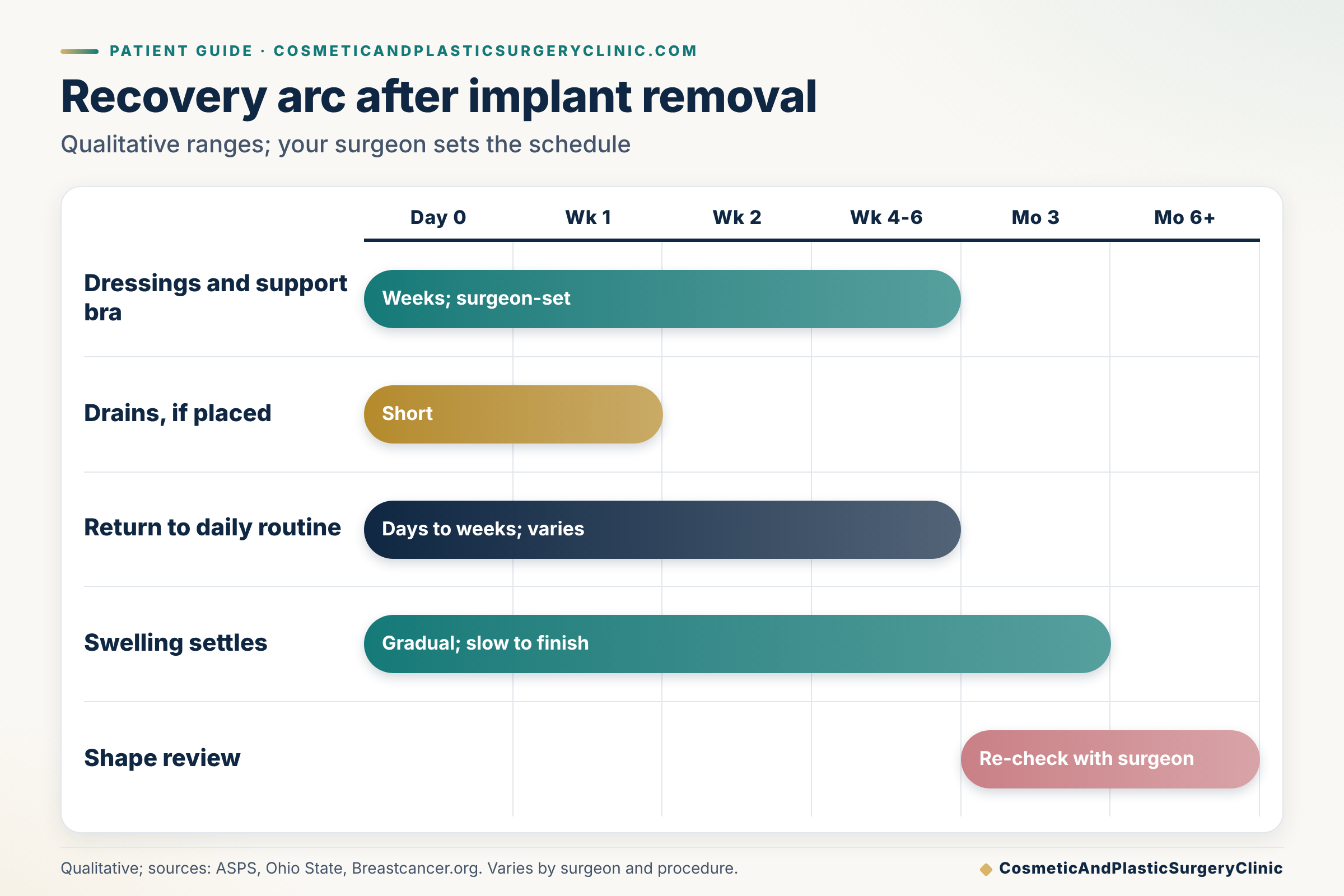
Afterward you may have gauze dressings, a support bra or a compression garment, and possibly drains: thin temporary tubes under the skin that remove excess blood or fluid. ASPS says to ask how long drains will stay and when dressings come off. The Ohio State page says a supportive bra is typically worn for 4 to 6 weeks, with follow-up visits typically at 1, 3, 6 and 12 weeks. Those are one center’s habits, and your surgeon’s schedule may differ.
A recovery arc, in broad strokes
The first days and weeks
ASPS’s 2025 blog says most patients return to regular daily activities within a few days, with some restrictions. Breastcancer.org, on a page written largely for reconstruction patients, says recovery can take 2 to 6 weeks or longer. ASPS’s procedure pages are vaguer: healing continues for several weeks as swelling decreases, and you should ask when to bathe, exercise and resume normal activity.
The ranges differ because the operations do. Implant-only removal is a smaller operation than total capsulectomy with a lift and fat grafting. The practical planning ideas in breast augmentation recovery, such as help at home and time off, carry over, and a combined operation may call for more of them.
When the shape can be judged
Swelling goes down gradually, so early photos show a breast that is still changing. Ask when your surgeon will re-evaluate and what they look for at that visit. If fat was grafted or a lift was done, the breast may keep changing as tissue settles, so photos at six months and at one year may not match. Ask to be photographed at the same angle and in the same lighting at each visit, so any comparison is fair.
Risks, and how to tell expected from urgent
What the risk lists and the data say
ASPS’s list of possible risks of breast implant removal includes anesthesia risks, bleeding, hematoma, seroma, infection, poor healing of incisions, skin loss, fat necrosis, numbness or changes in nipple and skin sensation, persistent pain, asymmetry, scarring, recurrent looseness of skin, blood clots with cardiac or pulmonary complications, and the possibility of revision surgery. The list is broad on purpose; it tells you what to ask about, not how likely each item is.
Numbers help a little. In the registry analysis described earlier, hematoma was 1.00% per breast after complete capsulectomy and any adverse event occurred in 5.79% of patients within 30 days. The Messa series reported complications in 3.8% of breasts. The designs differ and the figures are not interchangeable. Pneumothorax, a collapsed lung, is a recognized risk of capsule work near the chest wall, especially with implants under the muscle, but no rate turned up in the sources reviewed here.
Expected effects, complications and emergencies
Swelling that eases over weeks and tenderness around the incisions are expected parts of healing. A complication is something that departs from that course: swelling that keeps growing on one side, fluid that builds up, a wound that opens or drains, a fever. Those call for the surgeon’s emergency line the same day rather than the next scheduled visit. ASPS notes your instructions will say which concerns to watch for, so ask for them in writing.
Choosing breast implant removal, replacement or waiting
Side by side: the main paths
Matching a situation to a path
The table lays out common situations in breast implant removal planning and what each tends to involve. It is a way to organize questions, not a way to decide: two people in the same row can reasonably choose differently, and a surgeon’s examination can move you to another row.
| Situation | Pathway | Benefit | Trade-off | Key question |
|---|---|---|---|---|
| Implants without symptoms; no wish to change | Keep and monitor | No operation now | Chance of reoperation rises with time (FDA) | What exam or imaging schedule fits my implants? |
| Wants no implants; skin and tissue look settled | Removal, implant-only or with capsulectomy | Ends device-related upkeep | May leave dimpling, flatness or sagging (FDA, ASPS) | What will my breast look like standing, and what is the capsule plan? |
| Wants no implants; visible skin laxity | Removal with a lift, same day or staged | Addresses skin as well as the device | Longer operation and added scars, or two operations | Which order do you advise for my anatomy, and why? |
| Wants fullness without implants | Removal with fat grafting | Uses your own tissue | A second session may be needed; donor-site scars | How much volume do you expect to last, and what does a repeat cost? |
| Wants a different size or shape of implant | Exchange instead of removal | Keeps an implant look with a new device | A new device brings its own future reoperation chance | What changes about the pocket and the capsule? |
| Rupture, severe contracture or suspected BIA-ALCL | Surgeon-directed removal; capsule plan follows the diagnosis | Treats the underlying problem | May be more extensive, such as en bloc for suspected cancer | What workup comes first, and what will my plan cover? |
When waiting or a second opinion is reasonable
The FDA states that it is not recommending routine removal of breast implants in people without symptoms. The 2024 consensus statement frames capsulectomy as a shared decision that is the patient’s choice once the risks are clearly understood, and it asks that discussions cover systemic symptoms, implant-associated cancer risk and the risks of the surgery itself. Because the evidence on capsule handling is thin and sometimes divided, a second opinion on the capsule plan is a sensible step, not a sign of distrust.
Waiting is not the same as ignoring. Persistent swelling, a mass or pain around an implant, the main symptoms the FDA lists for BIA-ALCL, and any sudden change in shape or firmness deserve prompt evaluation. A consultation is also the place to ask about your plan’s rules; plastic surgery consultation covers what to bring and how to judge the answers.
Six checks to bring to the consultation
Checks about the operation
- The reason. Ask the surgeon to state in a sentence why removal fits your situation, and what they would advise if you waited.
- The capsule plan. Ask which approach is planned, why, and what happens if the capsule turns out thin or stuck to the chest wall.
- The reshaping plan. Ask whether a lift or fat grafting will happen now, later or not at all, and what each adds in time, scars and cost.
Checks about the result and the paperwork
- The expected look. Ask for standing photos, shared with consent, of patients with similar implant size and skin, taken at several months after surgery, and what the surgeon expects for you.
- The money and the coverage. Ask for a dated, itemized quote that shows facility, anesthesia and pathology, and ask your insurer in writing how it classifies your claim.
- The records and follow-up. Bring your device card and operative report, and ask who monitors your breasts afterward, for how long, and what the practice’s revision policy covers.
Frequently asked questions
Will breast implant removal leave a new scar?
ASPS says incisions typically follow the lower breast fold or run around or below the areola, and its 2025 blog says the original augmentation incision is often reused. The Ohio State page likewise describes an incision along the previous scar line. A total capsulectomy can call for a longer incision, and adding a lift introduces a different scar pattern. Ask the surgeon to mark the planned incisions on you at the consultation, so the discussion is about your anatomy and not a diagram.
How long does breast implant removal take?
No ASPS page gives a standard figure. Breastcancer.org says 1 to 3 hours under general anesthesia, longer when flat closure or flap reconstruction is added, and the Ohio State page describes an outpatient procedure. Capsulectomy, a lift or fat grafting each add steps, and facility and anesthesia charges usually follow the clock. Ask for the expected time for your own plan, with and without add-ons, and whether it will be done at an accredited facility.
Does insurance cover breast implant removal if my silicone implant has ruptured?
It may. Cigna’s 2026 policy covers removal of a silicone gel implant when imaging confirms rupture or extrusion, but not removal of a ruptured saline implant without another qualifying reason. Other insurers differ, and the FDA notes removal may not be covered even when the original surgery was. A nonprofit consumer-health page advises getting pre-authorization first, since skipping it can leave a claim unpaid even for a necessary operation. Read the plan’s definition of medically necessary and ask in writing.
Do I need an MRI before breast implant removal?
None of the sources reviewed states a universal requirement. The FDA calls MRI the most effective way to detect silent rupture in silicone gel implants and accepts ultrasound as an alternative in people without symptoms. Some insurers want imaging that confirms a rupture before approving removal, and a surgeon may order it to plan the operation or investigate a symptom. Ask what your surgeon wants and why, and whether your plan will pay for it.
Can breast implant removal change nipple sensation?
ASPS lists numbness or other changes in nipple and areola sensation, and in skin sensation, among the possible risks of removal. The sources reviewed here do not say how often it happens or how long it lasts after removal alone, so no rate is given. Incision placement, capsule work and any lift or fat grafting may all play a role. Ask your surgeon what they have observed in their own patients and how they would document your sensation before surgery.
What if I only want one implant removed?
Taking out one implant and keeping the other can leave a visible difference in volume and shape between the sides, and ASPS lists asymmetry among the risks of removal. A surgeon can explain how they would plan symmetry in your case. Coverage can also change: Cigna’s policy does not cover removing the implant from the opposite breast unless that breast independently meets its criteria. Ask both questions before choosing a one-sided plan.
Can I have new implants later after breast implant removal?
New implants can be placed at the same operation, which is an exchange, or at a later one. The FDA treats removal with or without replacement as part of ordinary implant care and advises assuming more surgery over a lifetime with any implants. Cigna’s policy treats replacement implants as cosmetic unless tied to reconstruction. The decision rests on what the surgeon finds, your skin and your goals, and an exchange brings its own device decisions.
How soon can I exercise after breast implant removal?
There is no standard answer. ASPS says to ask your surgeon when you can bathe, resume normal activity and exercise, and its 2025 blog says most people return to regular daily activities within a few days with some restrictions. Breastcancer.org says to follow the surgeon’s instructions on activity limits. A combined operation with a lift or fat grafting usually brings stricter limits than implant-only removal, so ask for the schedule that matches your plan.
Sources and further reading
- U.S. Food and Drug Administration — Risks and Complications of Breast Implants (accessed 2026-11-12) — not lifetime devices, removal methods, post-removal changes, complications, insurance note
- U.S. Food and Drug Administration — Things to Consider Before Getting Breast Implants (accessed 2026-11-12) — reoperation expectation, effects of removal without replacement, cost may not be covered
- U.S. Food and Drug Administration — Breast Implant-Associated Anaplastic Large Cell Lymphoma (page marked current as of 2019-10-23; accessed 2026-11-12) — no routine removal without symptoms, treatment, symptoms
- U.S. Food and Drug Administration — Saline-Filled Breast Implants (page marked 2019-10-23; accessed 2026-11-12) — removal likelihood over time, MRI for silent rupture
- U.S. Food and Drug Administration — Statement on continued efforts to protect women’s health and enhance safety information for breast implants (2019-10-23; accessed 2026-11-12) — device identification cards, draft boxed warning
- American Society of Plastic Surgeons — Breast implant removal (accessed 2026-11-12) — reasons for removal, the 10 to 15 year rule of thumb
- American Society of Plastic Surgeons — Breast implant removal procedure (accessed 2026-11-12) — anesthesia, incisions, resulting breast shape
- American Society of Plastic Surgeons — Breast implant removal recovery (accessed 2026-11-12) — dressings, garments, drains, follow-up
- American Society of Plastic Surgeons — Breast implant removal safety (accessed 2026-11-12) — listed risks
- American Society of Plastic Surgeons — Breast implant removal cost (accessed 2026-11-12) — average cost figure, what it excludes
- American Society of Plastic Surgeons — 2024 Plastic Surgery Statistics Report (accessed 2026-11-12) — removal and augmentation counts, projected fee range
- American Society of Plastic Surgeons — Breast Surgery Collaborative Community consensus statement on capsulectomy definitions and management (2024-06-12; accessed 2026-11-12) — four capsulectomy definitions, evidence limits
- American Society of Plastic Surgeons — Is breast explant surgery right for you? (2025-02-12; accessed 2026-11-12) — reasons, lift, fat transfer, return to activity
- American Society of Plastic Surgeons — Trend watch: are more patients getting explants? (2023-08-14; accessed 2026-11-12) — reasons, trend uncertainty
- Messa and Messa — Breast explantation with simultaneous mastopexy and volume restoration, Aesthetic Surgery Journal, 2023 (accessed 2026-11-12) — 131 patients, fat grafting, complications, limits
- Glicksman and colleagues — Impact of capsulectomy type on post-explantation systemic symptom improvement, Aesthetic Surgery Journal, 2021 (accessed 2026-11-12) — capsulectomy type and symptom change
- McGuire and colleagues — Symptom improvement after explantation with no capsulectomy, Aesthetic Surgery Journal, 2024 (clinic-hosted copy; accessed 2026-11-12) — no-capsulectomy cohort and comparison
- Xu and colleagues — Complications of aesthetic and reconstructive breast implant capsulectomy, Aesthetic Surgery Journal, 2024 (accessed 2026-11-12) — TOPS registry complication rates
- Zhang and colleagues — What can we learn from breast implant explantation, Aesthetic Plastic Surgery, 2023 (abstract; accessed 2026-11-12) — 1,004 explanted breasts, reasons
- Chen and colleagues — Motivations and strategies in implant management for breast augmentation revision surgery, Aesthetic Plastic Surgery, 2025 (accessed 2026-11-12) — removal versus replacement, further procedures
- Tanna and colleagues — Not all breast explants are equal, Plastic and Reconstructive Surgery, 2021 (abstract record; accessed 2026-11-12) — prophylactic capsulectomy not established
- Breastcancer.org — Breast implant removal (explant surgery) (updated 2026-05-16; accessed 2026-11-12) — capsule options, limits of en bloc, recovery range, pathology
- Ohio State University Wexner Medical Center — Breast implant removal (2023-01-25; accessed 2026-11-12) — outpatient surgery, support bra, follow-up visits, variables affecting appearance
- Cigna — Medical Coverage Policy 0048, Breast Implant Removal (effective 2026-04-15; accessed 2026-11-12) — one insurer’s coverage criteria
- National Center for Health Research — Insurance coverage information for breast implant removal (2016, modified 2019; accessed 2026-11-12) — pre-authorization and typical covered conditions
- U.S. Department of Labor — Your Rights After a Mastectomy (Women’s Health and Cancer Rights Act of 1998; accessed 2026-11-12) — required reconstruction coverage
- FORCE — Update: stronger guidance about breast implant safety (2021-12-14; accessed 2026-11-12) — 2021 device card contents


