

Breast implant exchange means taking out existing implants and placing new ones, and the word “exchange” hides how many different operations that can be. For one person it is a swap of two devices through the old incision. For another it also means rebuilding the pocket, removing scar capsule, or lifting skin that the old implants stretched. A breast implant exchange is therefore less a single procedure than a bundle of decisions about size, profile, surface, pocket and capsule.
This page walks through those decisions in the order a surgeon tends to raise them, with the evidence behind each one and its limits. It does not tell anyone whether to exchange, remove or keep implants, and it cannot assess a particular breast. The wider picture of reoperation after augmentation sits in the breast implant revision guide; this article stays with replacement.
What a breast implant exchange changes and what it leaves alone
The skin, nipple position and breast tissue after an exchange are the same ones that lived with the old implants for years. What changes is what sits inside the pocket and, depending on the plan, the shape of the pocket itself. A breast implant exchange does not return the breast to its pre-implant state, and it does not restart the clock on tissue stretch that has already happened.
One name, several operations
Four layers: device, capsule, pocket and skin
The American Society of Plastic Surgeons (ASPS) says the incision used in revision surgery depends on which procedures are performed, and lists the inframammary crease, a lift pattern (vertical or anchor-shaped) or a cut around the areola. That tells you something: the operation is built from parts. In practice a surgeon planning a breast implant exchange sorts the work into four layers: the device, the capsule of scar tissue the body has formed around it, the pocket and its boundaries, and the skin envelope.
Each layer can be left alone or reworked. Each one reworked usually adds operating time, recovery and cost, which is why the same words, “breast implant exchange,” can describe quotes that differ widely. Many exchanges touch only the first one or two layers, and a plain breast implant exchange of that kind is the simplest version.

Where breast implant exchange ends and revision or removal begin
Breast implant exchange is one branch of revision. Revision is the umbrella term for any later operation on an implanted breast, including pocket repair, capsule work, lift and removal, and the full map of those branches lives in the revision guide linked above. Removal without replacement is its own decision with its own consequences; the FDA notes that without replacement some people have dimpling, chest wall concavity, puckering or sagging, and the breast implant removal guide covers that path.
The practical line is simple. If new implants go in during the same operation, it is a breast implant exchange. If none go in, it is removal, and the planning questions change.
Why people choose a breast implant exchange
Planned exchanges: device age, new preferences, imaging findings
Mayo Clinic says breast implants do not last a lifetime and that they last about 10 years; an ASPS blog says patients are expected to replace implants after 10 to 20 years. The FDA is less specific, stating that an implant’s life varies by person and cannot be predicted. Published series agree on the long gap: the mean time from first augmentation to exchange was 10 years in a 2018 review of 245 women and about 97 months in a 2019 series of 110 patients.
Preference matters too. In the 10-year core study of one anatomical silicone device (Maxwell and colleagues, 2015), the most common reason for explantation was a request for a size or style change. For silicone gel devices, FDA labeling guidance also sets an imaging schedule, and a finding there can start the conversation; see breast implant screening for how that works.
Problem-driven exchanges: contracture, rupture, position, visibility
ASPS lists seven signs that revision may be needed: persistent pain, rupture, bottoming out, moving or rotating implants, changed shape, grade III or IV capsular contracture, and dissatisfaction with size. The FDA says grades III and IV are considered severe and may require reoperation, and that treatment usually means implant removal with or without replacement. The capsular contracture guide and the breast implant rupture guide cover diagnosis; here the question is what happens to the replacement.
A 2021 German single-center review (Kühn and colleagues) of 946 breasts in 591 patients found capsular contracture was the most common finding before reoperation. It led to replacement more often than to removal, while infection with implant exposure led more often to removal. Nearly two-thirds of those patients had reconstructive rather than cosmetic implants, so the pattern may not carry over to augmentation.
| Situation | Pathway often discussed | Benefit | Trade-off | Key question |
|---|---|---|---|---|
| Older implants, no symptoms, interest in a refresh | Planned exchange, same or modified size | Replaces an aging device on a schedule you choose | New device, new reoperation risk; cost likely out of pocket | What does my imaging show, and what is the plan if the pocket looks fine? |
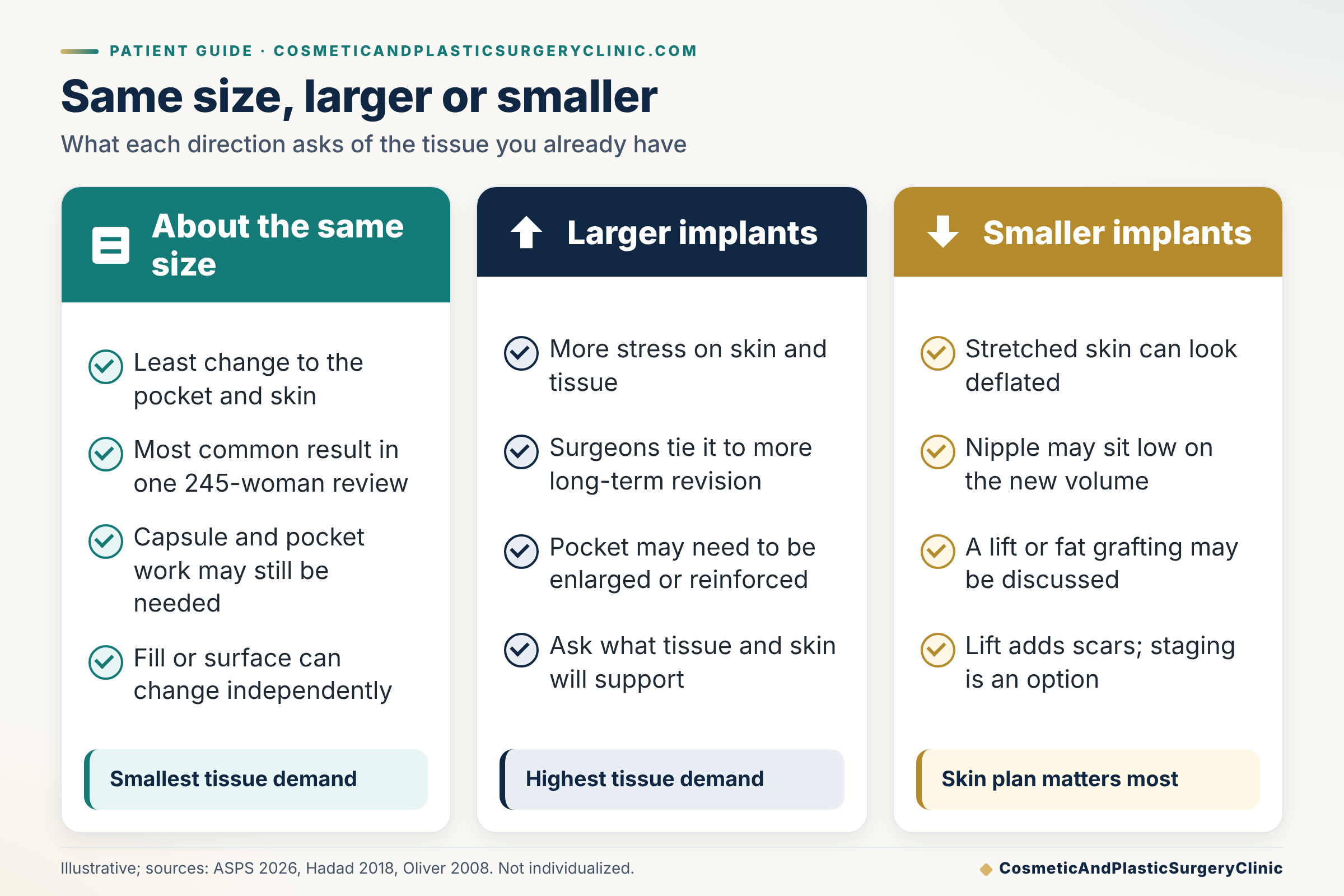
| Wants larger implants | Exchange to more volume, sometimes with pocket work | Fuller look that matches current goals | More stress on tissue; surgeons link larger implants to more long-term revision | How much volume will my tissue support, and what if I change my mind? |
| Wants smaller implants | Downsized exchange, possibly with a lift or fat grafting | Lighter breast, balance with frame | Stretched skin can look deflated; a lift adds scars | Where will my nipples sit, and is a lift part of the plan? |
| Hard, painful or distorted breast (grade III or IV) | Exchange with capsule removal or a pocket change | Addresses the scar tissue, not only the device | Contracture can come back after repair | Which capsule technique, and what evidence supports it? |
| Silicone rupture on imaging | Removal of the ruptured device, with replacement or not | Deals with a failed shell | One small series linked replacement after rupture to higher recurrence | How will free gel and capsule be handled? |
| Textured implants, no symptoms | Monitoring, or an individual choice to exchange | FDA does not recommend routine removal | Extra surgery and cost; coverage may not apply | What is my implant surface, and which symptoms mean I call? |
Size, profile and fill: choosing what goes into the pocket
Choosing the new implant is the part people picture first, and it is also the part with the least certainty. The breast has spent years adapting to one specific volume. A breast implant exchange asks that tissue to adapt again, in whichever direction the new size points.
Bigger, the same, or smaller: what breast implant exchange patients pick
Two published series point in opposite directions
In a 2019 Aesthetic Plastic Surgery series (Montemurro, Fischer, Hager and Hedén), 110 consecutive revision patients operated on by one surgeon between 2013 and 2017 were reviewed. About 86 percent received larger implants, and a wish for bigger implants, with or without a complication, accounted for most of the revisions. Those patients were also younger and reached revision sooner.
An ASPS article dated July 2026 describes the opposite pull: surgeons say more patients with implants placed 10 or more years ago ask to go smaller, favoring proportion, balance and longevity. It gives no numbers. The two sources do not conflict so much as describe different practices and time periods, and neither predicts what you will want.
Why pocket and skin set limits on size
Surgeon Robert Oliver, writing in Plastic Surgery Practice in 2008, described patients with minimal ptosis, soft pockets and good tissue who might be satisfied with a 15 to 20 percent upsize plus minor capsular scoring. He warned that larger implants combined with lowering the fold tend toward recurrent ptosis and inferior malposition, and that after a prior subglandular augmentation, staging or downsizing can be the prudent route. Oversized pockets, he wrote, lead to progressive deformity.
The ASPS 2026 article adds that heavier implants can stretch skin and breast tissue, and quotes one surgeon saying larger implants are associated with higher rates of long-term revision, tissue thinning and malposition. That is a clinical opinion, not a trial result. The mechanics of choosing a volume are covered in the breast implant size guide; at a breast implant exchange the added variable is that the tissue has already adapted to a specific device.
Going smaller, and the skin the old implants leave behind
When a smaller implant looks deflated
The ASPS 2026 article says removing volume without addressing stretched tissue can leave the breast looking deflated, and describes a nipple sitting too low relative to the implant as a “waterfall deformity.” Weight change, pregnancy and aging add to the stretch. The same article says a lift is often needed to remove skin and reposition the nipple when implants are reduced or removed, but not for every patient, such as those making small size changes with firm tissue.
Where a lift or fat grafting enters the plan
A lift adds scars, which the ASPS surgeons describe as a trade-off for balance. If the implants are coming out entirely, the lift question has its own page: implant removal with lift. For exchange, ask whether a lift is proposed in the same operation or staged, and what the nipple position will be after each choice.
Fat transfer is the other add-on. The ASPS article says it can soften implant edges and restore upper fullness when going smaller, but presents it as a refinement and not a substitute for dealing with tissue changes. An ASPS education summary also lists fat grafting, with better pocket selection, as a way to manage visible rippling, which is more common in thin patients or after weight loss.
Surface, shape and fill: the quieter choices
Saline or silicone at the second operation
The FDA says two types are approved in the United States, saline-filled and silicone gel-filled, both with a silicone shell. The choice changes follow-up as much as feel. FDA labeling guidance recommends an ultrasound or MRI at 5 to 6 years after surgery for silicone gel implants and every 2 to 3 years after that, and no routine screening for saline implants, because a rupture shows itself as deflation.
The same guidance’s example checklist says imaging may not detect all ruptures or leaks, may be costly, and may not be covered by insurance. The saline versus silicone comparison covers feel, appearance and rupture behavior; for a breast implant exchange the new question is whether you are willing to take on, or give up, an imaging schedule.
Textured surfaces and the BIA-ALCL question
The FDA describes breast implant-associated anaplastic large cell lymphoma (BIA-ALCL) as a type of non-Hodgkin lymphoma, not breast cancer, found most often in scar tissue and fluid near the implant. It reports higher risk with textured-surface implants than smooth ones, calls an individual’s risk low, and says it is not recommending routine removal of implants in people with no symptoms. Symptoms to watch for are persistent swelling, a mass or pain around the implant.
That context is the reason surface belongs in the exchange conversation. Ask which surface you have now, which is proposed and why, and read the BIA ALCL breast implants page before deciding. Nothing here suggests that keeping or exchanging textured implants is the right call for any one person.
Same pocket or a new one: what happens to the capsule
Every implant becomes wrapped in a capsule of scar tissue; that is normal. When the capsule tightens, the FDA calls it capsular contracture, the hardening of the breast around the implant. At a breast implant exchange the surgeon decides what to do with that tissue and with the space it defines, and this is where plans differ most from one surgeon to the next.
The capsule: leave it, release it, or remove it
Capsulotomy, capsulectomy and en bloc: terms to pin down
The FDA describes two broad ways to take implants out: remove the implant alone and leave the scar capsule, or remove part or all of the capsule, called en bloc resection or total or partial capsulectomy, with the surgeon choosing the method. A capsulotomy releases or opens the capsule without removing it. Oliver’s 2008 article says revisional surgery for high-grade contracture will usually need total or near-total capsulectomy, and that reshaping existing capsules is one of the most useful ways to correct malposition.
Terms matter because quotes use them loosely. Ask the surgeon to say, in writing, which of these is planned for each side and what the plan becomes if the capsule looks different once the pocket is open.
What the evidence can and cannot support
A 2016 systematic review in Plastic and Reconstructive Surgery (Wan and Rohrich) found 24 articles on managing capsular contracture, none of them controlled trials, and described limited clinical evidence. Implant exchange and pocket change were linked to fewer recurrences; the data on capsulectomy were less conclusive, and acellular dermal matrix (ADM) was called a possible adjunct that still needs long-term data.
A 2016 single-surgeon series of 75 women with Baker III or IV contracture treated by open capsulotomy (Swanson) found recurrence of 12.5 percent when intact implants were reinserted and 18.2 percent when they were replaced, a difference that was not significant. Replacing ruptured or leaking silicone implants was linked to significantly higher recurrence, in 9 of 13 patients. The author questioned whether exchange lowers risk at all, since the pocket is not sterile.
The FDA adds two plain statements: contracture could occur again after surgery to correct it, and the agency has not cleared or approved any device to treat or reduce its incidence. Read together, no source opened for this breast implant exchange guide supports a promise that a given capsule technique will prevent a return.
Pocket position and boundaries
Moving the implant up, down or to a different plane
Oliver lists alternatives to capsulectomy: a site change over or under the pectoralis major, or a new subpectoral pocket. The ASPS education summary describes animation deformity, where the implant moves with chest muscle contraction, as correctable by moving the implant to a more superficial plane, often by subfascial conversion. Whether a plane change fits depends on tissue thickness and the first operation’s plane. The tradeoffs of each plane are laid out in over versus under the muscle implants.
Repairing stretched, displaced or oversized pockets
ASPS describes bottoming out as an implant dropping below the breast crease while the nipple rises, and lists implants that move or rotate as a sign of revision. The ASPS education summary says malposition is corrected by restoring pocket boundaries through capsulorrhaphy (tightening or stitching the capsule), pocket reconstruction or pocket conversion, sometimes with an inferior muscular sling, and that recurrent cases may need ADM reinforcement.
Oliver noted in 2008 that biologic implants were limited in practice by their high cost. If a plan includes ADM, treat it as its own line on the quote and ask why this breast needs it.
| Factor | Effect on outcome | Maintenance or revision implication | Review point |
|---|---|---|---|
| Age of the current implants | Wear and rupture risk rise with time, per the FDA | The new devices start their own clock; replacement may come again | Imaging report and device records before surgery |
| Volume chosen | Heavier implants stress tissue, in surgeon commentary | Larger volume may bring thinning or malposition later | Ask what tissue and skin allow at this age |
| Capsule handling | Affects softness and whether contracture returns | Recurrence is possible after any repair | Written plan for each side |
| Pocket plane and boundaries | Shapes position, rippling and motion with the muscle | Stretched pockets can drift again | Ask what holds the implant in place |
| Skin envelope | Decides whether a smaller implant looks full | Lift or fat grafting may be needed now or later | Nipple position, standing, before deciding on size |
| Fill and surface | Sets feel, imaging needs and warning symptoms | Silicone gel carries a screening schedule | Written implant type, style and surface |
Risks of a second operation: what breast implant exchange data can and cannot say
Reoperation is the one risk that every implant label spells out in the first lines. It deserves attention before any individual complication, because it frames what a breast implant exchange is for: a stage in the life of a device, not an end point.
Reoperation is built into the plan
What the FDA’s labeling examples show
The FDA says breast implants are not considered lifetime devices, and that the longer people have them, the greater the chance of complications. The agency’s September 2020 labeling guidance includes an example checklist in which patients acknowledge that as many as 20 percent of augmentation patients may have implants removed within 8 to 10 years, and lists reoperation “in up to 59.7% of patients” and rupture or leakage in up to 31.2%.
Those numbers are examples. The guidance says manufacturers should use current figures for their own devices, so treat them as the scale of what a label can print, not as your odds. The same checklist has patients acknowledge that additional surgeries for augmentation will likely be at their own expense.
Replacement patients start from a different baseline
A 2007 report in Plastic and Reconstructive Surgery on one manufacturer’s silicone gel core study, read here through an abstract summary, gave three-year figures. Implants were removed in 4.7 percent of primary augmentation patients and 12.3 percent of revision-augmentation patients, and suspected rupture on MRI appeared in 0.5 percent and 7.7 percent. Patient choice and severe capsular contracture were the most common reasons for removal.
That does not predict anyone’s course, and devices and techniques have changed since 2007. It does suggest that a person already on a second set of implants joins a group with more complications in trial data than a first-time patient. Ask your surgeon how that applies to your case and why.
Risks that belong to a breast implant exchange
Expected effects versus complications
Swelling, bruising and tightness that settle over several weeks are expected; ASPS says healing continues for several weeks as swelling decreases. Complications are different. ASPS lists anesthesia risks, asymmetry, bleeding, infection, hematoma, seroma, persistent pain, poor wound healing, skin loss, unfavorable scarring and a suboptimal aesthetic result, along with blood clots, fat necrosis, numbness or other sensation changes, and recurrent looseness of skin.
The ASPS list also includes BIA-ALCL and other very rare cancers around the implant capsule. Mayo Clinic notes that studies have not shown implants cause systemic symptoms such as fatigue or joint pain, while the FDA’s recommended boxed warning says implants are associated with systemic symptoms; both are part of what a surgeon should walk through with you.
Warning signs after surgery, and later
Timing, recovery and cost of a breast implant exchange
A breast implant exchange is usually scheduled, not rushed, which gives you room to plan. The practical questions are when to do it, how long to expect recovery to run, and who pays, and the sources are thinner on the last two than on the first.
How soon is too soon, and when not to wait
Waiting after a first augmentation for a size change
For dissatisfaction with size, an ASPS blog says most doctors recommend waiting about a year after the initial surgery before proceeding. The published series show how rarely exchange happens early: the average interval to reoperation for augmentation was 8.9 years in a 1994 to 2009 review of one surgeon’s charts presented at The Aesthetic Meeting in 2012, and about 97 months in the 2019 series cited above.
These are averages from selected surgical practices. They describe who came back for surgery, not how long implants last for everyone.
Reasons that shorten the wait for a breast implant exchange
Some findings do not call for waiting. Persistent pain, a hard or distorted breast, sudden deflation of a saline implant, or a new swelling, mass or pain around an implant deserve a prompt visit; the FDA names persistent swelling, a mass or pain as the main BIA-ALCL symptoms. A suspected silicone rupture is less urgent than people fear: an ASPS video summary says a ruptured silicone implant found on imaging is not automatically an emergency and is typically replaced within the first six months after it is identified.
That is a general statement from one page, not an instruction. Your surgeon sets timing from the imaging and your symptoms.
Recovery after a breast implant exchange compared with a first augmentation
What the sources do and do not say
The ASPS revision recovery page says gauze dressings or bandages may cover incisions, a support bra may or may not be used, drains are used only in some cases, and healing continues for several weeks as swelling decreases. It gives no day counts. It lists when to resume normal activity and exercise as a question for your surgeon.
No source opened for this page compares recovery after a breast implant exchange with recovery after a first augmentation. Claims that it is “easier the second time” are plausible for a simple swap, but they are not backed here. The general recovery arc is laid out in the breast augmentation recovery article.
What can lengthen or shorten it
Recovery tends to track how many layers were reworked. A device-only swap through the old incision asks less of tissue than a capsulectomy, a pocket reconstruction or a lift done in the same sitting. ASPS lists both IV sedation and general anesthesia as choices for revision, and the surgeon selects between them. Work demands, lifting at home and caregiving all change what “back to normal” means, so plan the calendar around the surgeon’s written instructions.
| Stage | What to gather or decide | Question to settle |
|---|---|---|
| Before any consult | Implant card, operative report, prior imaging reports, early photos | Do I know the device type, size, surface and plane? |
| Consultation | Goals in words and photos; symptoms; weight and pregnancy plans | What is the actual problem: device, capsule, pocket or skin? |
| Planning the operation | Size, surface, fill, capsule and pocket plan, add-ons | What changes if the tissue looks different once opened? |
| Money and paperwork | Itemized quote, warranty claim steps, insurance position | What is claimed before surgery, and by whom? |
| First weeks | Surgeon’s written instructions, follow-up dates, help at home | Which signs mean I call the same day? |
| Months to years | Imaging schedule, new device records, symptom awareness | When is my next scheduled check, and who owns it? |
Money: quote lines, warranties and who pays
What a quote for a breast implant exchange should itemize
ASPS lists the cost components of implant revision as the surgeon’s fee, hospital or surgical facility costs, implant costs, anesthesia fees, medication prescriptions, post-surgery garments, and medical tests and x-rays. Its page states that costs vary by surgeon experience and geographic location and gives no average. Capsule work, ADM, fat grafting and a lift would each appear as extra lines or a larger fee.
The breast implant revision cost article compares quotes in depth. On coverage, the FDA says some insurance companies do not cover implant removal or replacement even with complications, while ASPS says health insurance may cover revision in some instances. Settle which category your case falls into before surgery, not after the bill.
What manufacturer warranties usually leave out
Warranty documents differ. One manufacturer’s terms, revised in 2023, list lifetime product reimbursement for rupture and 10 years for capsular contracture, with fixed-dollar financial assistance, and exclude size or appearance dissatisfaction, elective or preventive removal and rippling. Another manufacturer’s patient brochure lists 20 years for capsular contracture replacement and financial assistance of up to $2,000 for 2 years; it does not address size change or rippling.
Both documents attach conditions, such as claim steps before surgery and, in one, returning the removed device within 90 days or photographing it. Neither says whether replacement implants receive a fresh warranty period. Ask for that answer in writing, and compare the rest of the quote line by line.
Deciding between breast implant exchange, removal and leaving implants alone
A breast implant exchange is one of three reasonable-sounding paths, and the other two deserve a fair hearing. Which one fits depends on symptoms, imaging, tissue, goals and tolerance for another operation, none of which an article can judge.
Three paths and who tends to consider each
Leaving implants in place and monitoring
Without symptoms or an imaging finding, the FDA is not recommending routine removal of textured or other implants, and its risk page says an implant’s life varies by person and cannot be predicted. For silicone gel devices, the FDA labeling schedule of imaging at 5 to 6 years and then every 2 to 3 years is the monitoring plan. Saline implants have no routine imaging. Staying put, with a plan for symptoms, is a legitimate choice for some people.
Removing without replacing, or replacing with something different
Removal, with or without a lift, ends the implant question but opens a tissue one: the FDA lists dimpling, concavity, puckering and sagging as possible changes without replacement, and Mayo Clinic says removal may call for a lift or other procedures. Some people who consider removal do so because of symptoms they attribute to implants; the evidence on that is covered in the breast implant illness page, and the decision belongs to you and your clinicians.

Six questions to settle before booking a breast implant exchange
Records and images to gather first
Bring the implant identification card, the first operative report and any imaging reports. They say what is in the breast now, which affects the plan and any warranty claim. Revision is where experience matters most, one ASPS surgeon told the society in 2026, so use the surgeon selection steps and ask how often the surgeon performs this exact operation.
The consultation question guide covers the general ground; the list below is specific to exchange.
The six questions to ask
- What exactly is changing or failing: the device, the capsule, the pocket or the skin?
- Which size, shape, surface and fill do you propose, and what are the trade-offs in my tissue?
- What will you do with the capsule and the pocket, and what is the plan if contracture returns?
- Will a lift, fat grafting or ADM be added, now or later, and how does each change the quote?
- What imaging and follow-up schedule comes with the new implants, and which symptoms mean I call?
- What do the quote, the warranty and my insurance cover in writing, including revision policy?
Frequently asked questions
Can a breast implant exchange be done with local anesthesia only?
The ASPS revision page lists intravenous sedation and general anesthesia as the choices and says the surgeon selects the one best suited to the patient. Local anesthesia alone is not listed there. Which one is used depends on how many layers are being reworked, your health and the facility, and the anesthesia provider will set the details. Ask who will give the anesthesia, what their credentials are, and where the operation will take place, since facility and anesthesia are safety topics as well as cost lines.
How long should I wait after my first augmentation before a breast implant exchange for size?
An ASPS blog says most doctors recommend waiting about a year after the initial surgery before proceeding on a size change. That is advice about dissatisfaction with size, not a rule for complications, which can need earlier attention. The surgeon will also want your breast shape and swelling to have settled so the decision rests on the stable result. Use the wait to collect records and photographs and to write down what specifically you would change.
Does a breast implant exchange come with a new warranty?
None of the warranty documents opened for this article says whether replacement implants receive a new warranty period, so no answer is safe to assume. Warranty terms vary by manufacturer and by year of surgery, and some require a claim to be made before the operation and the removed device to be returned or photographed. Ask the practice to state in writing which program applies to the new implants, what it covers, what it excludes and who files the claim.
Will a breast implant exchange fix rippling?
Not always on its own. An ASPS education summary says implant visibility and rippling are more common in thin patients or after weight loss and are managed with better pocket selection and fat grafting, and that soft tissue management is often more important than exchanging the implant alone. One manufacturer’s warranty terms list rippling as an exclusion. Ask whether the plan changes the pocket plane, adds fat transfer or covers the implant with additional tissue, and what is realistic.
Is replacing a ruptured silicone implant the same as a routine breast implant exchange?
The operation can look similar, but the rupture changes the planning. A ruptured silicone device may leave gel around it, and in one small series replacing ruptured or leaking silicone implants was linked to a higher recurrence of capsular contracture. ASPS says a ruptured silicone implant found on imaging is not automatically an emergency. How the capsule and any free gel are handled is a question for the surgeon, and the rupture article explains what imaging can and cannot show.
Do I need an MRI before a breast implant exchange?
Not necessarily as a universal step. For silicone gel implants the FDA labeling guidance recommends ultrasound or MRI at 5 to 6 years and every 2 to 3 years afterward, and an MRI at any time if you have symptoms or an unclear ultrasound. One warranty document asks for MRI or ultrasound reports for suspected rupture before revision. Whether your surgeon wants imaging before planning depends on your implant type, age and symptoms.
Can a breast implant exchange swap textured implants for smooth ones if I have no symptoms?
People do ask this, and it is an individual decision with a surgeon. The FDA says it is not recommending routine removal of textured or other implants in patients without symptoms, and it advises watching for persistent swelling, a mass or pain. An elective exchange means another operation with its own risks, and some warranty programs exclude elective or preventive removal. Ask what your records say about your current surface and which factors drive the recommendation.
Sources and further reading
- U.S. Food and Drug Administration — Risks and complications of breast implants (accessed 2026-11-12) — not lifetime devices, reoperation, removal methods, capsular contracture, rupture, insurance statement
- U.S. Food and Drug Administration — Breast implants: certain labeling recommendations to improve patient communication, guidance (September 2020, accessed 2026-11-12) — boxed warning, decision checklist examples, silicone gel imaging schedule
- U.S. Food and Drug Administration — Guidance landing page, final guidance docket FDA-2019-D-4467 (accessed 2026-11-12) — guidance date and purpose
- U.S. Food and Drug Administration — Breast implants (accessed 2026-11-12) — implant types, 2020 guidance, October 2021 sale and distribution orders
- U.S. Food and Drug Administration — Questions and answers about BIA-ALCL (page dated 2019-10-23, accessed 2026-11-12) — definition, textured risk, no routine removal, symptoms
- American Society of Plastic Surgeons — Breast implant revision recovery (accessed 2026-11-12) — dressings, drains, healing over weeks
- American Society of Plastic Surgeons — Breast implant revision procedure (accessed 2026-11-12) — anesthesia choices, incision options
- American Society of Plastic Surgeons — Breast implant revision safety (accessed 2026-11-12) — listed risks, future surgery statement
- American Society of Plastic Surgeons — Breast implant revision cost (accessed 2026-11-12) — cost components, insurance and warranty statements
- American Society of Plastic Surgeons — Seven signs you need a breast implant revision (accessed 2026-11-12) — signs, wait of about a year, 10 to 20 year replacement expectation
- American Society of Plastic Surgeons — The ballerina breast: why some augmentation patients are going smaller (July 2026, accessed 2026-11-12) — downsizing, lift, fat grafting, tissue stretch
- American Society of Plastic Surgeons — Breast augmentation, video summary on ruptured implants (accessed 2026-11-12) — replacement within six months after rupture is identified
- Mayo Clinic — Breast augmentation (accessed 2026-11-12) — implants about 10 years, risks, screening interval, removal and lift
- American Society of Plastic Surgeons Education Network — Principles of aesthetic breast revision surgery, journal CME article summary (accessed 2026-11-12) — pocket conversion, capsulorrhaphy, ADM, rippling and fat grafting
- Oliver R — Solid strategies in revisional breast surgery, Plastic Surgery Practice (2008, accessed 2026-11-12) — capsule and pocket strategies, upsizing limits
- Wan D, Rohrich RJ — Revisiting the management of capsular contracture in breast augmentation: a systematic review, Plastic and Reconstructive Surgery (2016, abstract record, accessed 2026-11-12) — 24 studies, exchange and site change, capsulectomy evidence
- Swanson E — Open capsulotomy: an effective but overlooked treatment for capsular contracture after breast augmentation, Plastic and Reconstructive Surgery Global Open (2016, accessed 2026-11-12) — recurrence with reinserted versus replaced implants
- Hadad E and colleagues — Preoperative implant size is strongly associated with alterations of implant size during secondary breast augmentation, Annals of Plastic Surgery (2018, abstract record, accessed 2026-11-12) — 245 women, size direction at exchange
- Montemurro P, Fischer S, Hager S, Hedén P — Secondary breast augmentation: is there a trend for bigger implants? Aesthetic Plastic Surgery (2019, abstract record, accessed 2026-11-12) — 110 revision patients, larger implants chosen
- Kühn S and colleagues — Implant replacement or removal: what happens after capsular contracture? Breast Care (2021, accessed 2026-11-12) — 946 breasts, replacement versus removal
- Aesthetic Society (ASAPS) — Why do patients seek revisionary breast surgery? The Aesthetic Meeting 2012 abstract (accessed 2026-11-12) — interval to reoperation, reasons for revision
- Plastic and Reconstructive Surgery — The Mentor core study on silicone MemoryGel breast implants (2007, abstract record, accessed 2026-11-12) — three-year removal and suspected-rupture figures, primary versus revision
- Maxwell GP and colleagues — Ten-year results from the Natrelle 410 anatomical form-stable silicone breast implant core study, Aesthetic Surgery Journal (2015, abstract record, accessed 2026-11-12) — most common explantation reason was size or style request
- Allergan Aesthetics — Breast implant warranty terms and conditions (revised May 2023, accessed 2026-11-12) — coverage periods, claim conditions, exclusions
- Sientra — Platinum20 warranty patient brochure (2025 file, accessed 2026-11-12) — coverage periods, financial assistance, surgeon condition


