Breast implant rupture sounds like an event, a moment when something gives way. For most people it is nothing of the kind. A saline implant that fails usually shrinks in plain view, while a silicone gel implant that fails often changes nothing you can see or feel, and the only clue may be a line in an imaging report years later. That difference shapes everything else: who notices, how it is found and how urgent the next step is.
This page explains breast implant rupture by implant type: what fails, what you might notice, how it is detected and what the treatment choices look like. It is general education built from FDA documents and published studies, and it cannot say whether any particular implant has ruptured. Replacing, repositioning and removing implants more broadly is covered in the breast implant revision overview; this page stays with failure of the device itself.
Breast implant rupture explained: where the shell fails and where the filler goes
An implant is a shell holding a filler, either saltwater or silicone gel. Rupture means the shell no longer contains it. What happens next depends on what the filler is and on a third structure most people do not think about: the scar tissue the body builds around every implant.
Three parts decide what a failure looks like: shell, filler and scar capsule
The scar capsule works as a second container
Every implant ends up wrapped in a layer of scar tissue formed by the body. The FDA uses that layer to separate the two kinds of silicone leak. In an intracapsular rupture, the gel escapes through a tear or hole in the shell but stays confined within the scar tissue. In an extracapsular rupture, gel migrates beyond the scar tissue around the implant.
A capsule that holds the gel is the reason a silicone breast implant rupture can go unnoticed for years. It is also why imaging, not a clinic exam, is the tool for finding one.
What “rupture” and “deflation” mean in FDA language
The FDA defines rupture as a tear or hole in the outer shell and says the word applies to all types of breast implants. Deflation is the saline-only term: leakage of the saltwater solution, often because of a valve leak. A valve problem therefore counts as deflation even when the shell is intact.
The agency lists breast implant rupture among local complications that occur in at least 1 percent of breast implant patients at any time. It also states that implants are not considered lifetime devices and that the life of an implant varies by person and cannot be predicted (FDA risks page, updated 2023).

Saline and silicone breast implant rupture look nothing alike
Saline: the change is visible within days
For saline implants the FDA says you will notice that the implant loses its original size or shape, because the saltwater leaks out immediately or over several days. Breastcancer.org adds that the body absorbs the saline, so the leak itself is not the concern; the lost volume and the need for a plan are.
The saline filler is why the FDA’s imaging schedule, discussed below, is written for silicone gel implants. A deflated saline implant announces itself. The practical questions are how soon to see a surgeon and whether to replace the implant, covered later on this page and in the saline vs silicone implants comparison.
Silicone: slow, quiet and often unnoticed
Gel is thick, so it does not drain away the way saltwater does, and it is not absorbed. The FDA states that most silicone implant ruptures are without symptoms, that a silent rupture usually does not change the way an implant looks or feels, and that a surgeon may not be able to detect one by physical examination alone.
How many silicone breast implant rupture cases are silent depends on the source. The FDA’s 2011 summary said up to 35 percent of ruptures in one manufacturer’s core study may have been silent. An ASPS release in 2022 said up to half of women with ruptured implants have no symptoms. A 2025 single-surgeon reconstruction abstract found 38 percent of silicone ruptures were asymptomatic. The honest range is roughly one-third to one-half.
How common is breast implant rupture, and why do the published numbers disagree?
Anyone who has searched for a breast implant rupture rate has met figures from 1 percent to over 30 percent. Both ends can be accurate, because they describe different implants, different follow-up lengths, different people and different ways of looking.
What the manufacturer core studies reported
FDA’s 2011 summary of the early core studies
The FDA’s June 2011 update on silicone gel implants summarized the manufacturers’ core studies in participants who had MRI. For primary augmentation, one manufacturer reported a cumulative rupture rate of 10.1 percent at 10 years and the other 13.6 percent at 8 years. For primary reconstruction the figures were 27.2 percent at 10 years and 14.0 percent at 8 years, with wide confidence intervals in both.
Early on, breast implant rupture rates were far lower. In the larger post-approval studies, one manufacturer reported 0.5 percent silicone ruptures at 2 years, against 2.5 percent saline deflations; the other reported 0.2 percent after 3 years in primary augmentation. The table below sets these beside later sources and states each limit.
Later and independent figures
A 2017 review in Gland Surgery (Hillard and colleagues), whose lead author disclosed industry consulting and university grants from implant makers, reports a Danish cohort in which rupture-free survival for newer-generation implants was 98 percent at 5 years and 83 to 85 percent at 10 years. A 2023 industry-funded core study of one saline design cited ten-year silicone core-study rupture rates from 8.7 to 24.2 percent.
A 2022 multicenter study in Plastic and Reconstructive Surgery used ultrasound in 584 women with 1,153 silicone implants placed since 2000. It found rupture signs in 14.0 percent of women and 8.0 percent of implants. Of 40 women with suspect scans who had surgery, 30 had ruptures confirmed. The abstract does not show who was invited to screen, so the rate should not be read as a population figure.
| Source and year | Who and how measured | Reported result | Main limit |
|---|---|---|---|
| FDA update, 2011: Allergan core study | Silicone gel implants, MRI cohort, 10 years | Primary augmentation 10.1% (95% CI 7.4 to 13.7); primary reconstruction 27.2% | Manufacturer-run; follow-up losses; later published summaries cite slightly different figures |
| FDA update, 2011: Mentor core study | Silicone gel implants, MRI cohort, 8 years | Primary augmentation 13.6% (95% CI 7.6 to 23.6); primary reconstruction 14.0% | Different device and time point from the row above, so not directly comparable |
| FDA update, 2011: large studies | Early follow-up, 2 years (Allergan) or 3 years (Mentor) | Allergan 0.5% silicone vs 2.5% saline deflation; Mentor 0.2% in primary augmentation | Short follow-up; risk rises after the first years |
| Danish cohort, via Hillard review, 2017 | Newer-generation (generation 3 and later) implants | Rupture-free survival 98% at 5 years, 83 to 85% at 10 years | Second-hand figures in a review whose lead author disclosed industry ties |
| Ultrasound study, 2022 | 584 women, 1,153 silicone implants placed since 2000, nine practices | Rupture signs in 14.0% of women and 8.0% of implants | Selection of participants not shown in the abstract; 30 of 40 suspect scans confirmed at surgery |
| Single-surgeon series, 2025 abstract | 376 reconstruction patients, at least 5 years of follow-up | 26 ruptures (7%); mean 5.9 years after placement | Retrospective; only 28% had a routine MRI; conference abstract |
Why a breast implant rupture rate cannot predict your own implant
Risk is low early and climbs with time
The Hillard review says breast implant rupture rates are initially very low and begin to increase after 6 to 8 years of implantation. The 2025 abstract’s mean of 5.9 years to rupture sits in the same neighborhood. The FDA puts the pattern in one sentence: the longer an implant is in place, the greater the possibility it may rupture.
For a person with 12-year-old implants, a five-year figure says little. For a person with two-year-old implants, a ten-year figure overstates the near-term picture. The question “what is my risk” has to be asked with the implant’s age attached.
Why comparing one study with another fails
The studies differ in who was screened and how. Some count only women who had MRI, some rely on ultrasound, some include reconstruction patients, whose rates ran higher in one manufacturer’s FDA table, and some lose a large share of participants before the final visit. Unscreened silent ruptures never enter a count at all: a 2022 ASPS survey of 109 women found only 5.9 percent had an MRI within the then-recommended timeframe.
Even the FDA’s own patient checklist example, which says rupture or leaking has been reported in up to 31.2 percent of patients, is labeled illustrative and pooled from approved devices’ public summaries. It describes the highest figure reported, not a typical one.
What causes breast implant rupture, and what probably does not
The FDA lists several possible causes of breast implant rupture: capsular contracture, compression during a mammogram, damage from surgical instruments or from procedures such as biopsies and fluid drainage, normal aging of the implant, overfilling or underfilling of saline implants, physical stresses such as trauma, placement through a non-approved incision site such as the navel, and excessive handling during surgery. The list is a catalog of ways a breast implant rupture can start, not a ranking. Retrieval studies supply the ranking.
Causes that FDA and device-retrieval studies point to
Damage at the time of surgery
Age and accidents usually get the blame, but retrieval studies point first to the operating room. A review of manufacturer explant data, summarized in the 2017 Hillard review, put the share of ruptured implants reported as damaged by surgical instruments at 50 to 64 percent. The figures come from manufacturers and from implants that were sent back, so they describe retrieved devices, not every rupture.
Retrieval data cannot show how any single operation went, and no surgeon can promise an undamaged shell. What the finding supports is a question worth asking at the consult: how the team protects the shell during placement, and why that incision was chosen. The FDA specifically cautions against placement through a non-approved incision site.
Compression, trauma, a hardened capsule and plain aging
The remaining FDA causes are slower or rarer. Implants wear with time. A mammogram presses the breast, and the American Cancer Society says that very rarely the process can rupture an implant; the FDA names mammogram compression as a possible cause, too. Biopsies and fluid drainage can nick a shell. Blunt trauma, such as a car crash, can do the same.
A firm, scarred capsule is on the FDA’s list as well, and the Hillard review notes that fold-related shell failure is felt to be more common with long-standing capsular contracture. The relationship runs both ways: breastcancer.org says rupture can itself lead to contracture. The capsular contracture article covers that condition on its own terms.
Lifestyle claims and how much weight they deserve
Underwire bras, seat belts and heavy lifting: one small study
Internet lists of breast implant rupture triggers often include underwire bras, seat belts and gym work. The best-known source is a 2023 retrospective study in Aesthetic Plastic Surgery by Paolini and colleagues of 763 reconstruction patients operated on between 2003 and 2019, mostly with macrotextured implants. Of 191 patients with complete questionnaire data, underwire bra use, seat belt use, prior mammography and longer implant time were associated with rupture. Weightlifting and carrying heavy bags were not.
The limits are large. Only about a quarter of patients answered the questionnaire, 88 percent were reconstruction cases, and the authors acknowledged a small population. They still advise seat belts and mammography because the benefits outweigh the rupture risk. The study generates a question; it does not justify changing what you wear or skipping a mammogram.
Pocket and placement: no clear signal so far
In the same study, placement above or below the muscle, age, body mass index, capsular contracture and radiotherapy were not significant, though only 33 implants sat above the muscle, too few for a firm comparison. The trade-offs of pocket choice are real but sit elsewhere: see over versus under muscle implants.
The takeaway is cautious. No habit or anatomy has been shown to make breast implant rupture reliably predictable, and the one factor every source agrees on is time.
| Factor | Why it matters | Question to bring | Uncertainty |
|---|---|---|---|
| Implant age | FDA: the longer an implant is in place, the greater the chance of rupture | How old are mine, and what imaging schedule fits their age? | Rates differ by device line and study; no age makes failure certain |
| Surgical handling (team factor) | Retrieval studies most often link rupture to damage during placement | How do you protect the shell, and which incision will you use? | Manufacturer data cannot show how one operation went |
| Hardened capsule | On FDA’s cause list; fold failure reported with long-standing contracture | If a breast firms up, how soon should I be seen? | Rupture can also cause contracture, so cause and effect blur |
| Compression or trauma | Mammogram compression, biopsies and blunt injury are listed causes | Which views will the imaging center use for implants? | Mammogram-related rupture is described as very rare |
| Older shell generation | Hillard review: second-generation thin-shell implants had rates as high as 60% | Which manufacturer and model do I have? | Old-device figures may not apply to current models |
| Bras and seat belts | One small study flagged both | Is there any reason to change daily habits? | Retrospective, about 25% response; authors still advise seat belts |
Spotting a breast implant rupture: signs, exams and imaging
What you might notice, saline versus silicone
Changes that deserve a call
For a saline implant the sign is loss of size or shape in one breast, over hours or days. For silicone, the FDA lists a decrease in breast size, a change in implant shape and hard lumps over the implant, plus pain or tenderness, tingling, swelling, numbness, burning or changes in sensation. Any of these is reason to contact the surgeon who placed the implants, or another plastic surgeon, to arrange an evaluation.

Why symptoms alone cannot confirm a breast implant rupture
Mayo Clinic describes the problems a ruptured silicone implant can cause as pain, soreness or swelling, changes in size or shape, lumps and hardening. Those overlap with capsular contracture, fluid collections and other causes, so a symptom narrows the question without answering it. Imaging does the answering, which is why the FDA recommends MRI for symptomatic patients.
Why a normal exam does not rule out a silicone rupture
What FDA recommends: ultrasound or MRI on a schedule
The FDA’s final 2020 guidance on breast implant labeling says that for silicone gel implants the first ultrasound or MRI should come 5 to 6 years after the initial surgery, then every 2 to 3 years. For symptoms at any time, or an uncertain ultrasound, MRI is recommended. This replaced an earlier schedule of MRI at 3 years and every 2 years after. The agency’s risks page calls MRI the most effective method for finding silent rupture and ultrasound an acceptable alternative for people without symptoms.
The same checklist says imaging may not detect all ruptures and may be costly. Intervals, modality choice and what a result can and cannot show are the subject of the breast implant screening article.
What mammography and other tests add, and where they fall short
Mammograms were never built for this. The FDA’s 2011 update says only 10 to 22 percent of ruptures are extracapsular, so mammograms will miss most of them; CT helps for intracapsular rupture but adds radiation and is limited for extracapsular gel. The Hillard review adds that ultrasound depends on the operator and loses sensitivity when a capsule has hardened.
If you have implants, the American Cancer Society suggests saying so when you book a mammogram and again to the technologist. Implant patients typically receive four extra images, two per breast, that push the implant back against the chest wall.
Sorting expected findings, problems and emergencies
How to use the matrix without diagnosing yourself
The table groups common situations by what the sources say about urgency. It is not a triage tool, because the same symptom can mean different things in different people. Its job is to show that most rupture findings call for a prompt appointment, not a rush to the emergency room, and that a few situations are different.
| What you notice | Category | Typical action level | Source basis |
|---|---|---|---|
| Implants look and feel as usual; scheduled imaging is due | Expected | Keep follow-up; FDA silicone schedule is 5 to 6 years, then every 2 to 3 | FDA 2020 guidance |
| Saline implant loses size or shape over hours to days | Complication (deflation) | Tell the surgeon right away and plan; usually obvious | FDA risks page; Breastcancer.org |
| Imaging report names a possible or definite silicone rupture; no symptoms | Complication, often silent | Discuss observation, replacement or removal; MRI if ultrasound was unclear | FDA 2020 guidance; Mayo Clinic 2022 |
| New firmness, lump, shape change, pain or numbness with a silicone implant | Possible rupture or other problem | Arrange an evaluation; MRI recommended for symptoms | FDA risks page; FDA 2020 guidance |
| Persistent swelling, fluid or a mass, often years after surgery | Needs prompt work-up, not only rupture | Prompt evaluation; do not wait for the next scheduled scan | FDA BIA-ALCL page |
| Major chest trauma, chest pain, breathing trouble, fever with spreading redness | Emergency until proven otherwise | Call 911 or go to emergency care and mention implants | General emergency guidance |
When to skip the phone tree
Breast implant rupture alone is rarely an emergency. In an ASPS video transcript, a surgeon asked whether a rupture seen on imaging is an emergency answers with a plain no. The emergency rows in the table are about trauma, breathing, chest pain and infection, which are emergencies whether or not implants are present.
After a breast implant rupture is found: observe, replace or remove
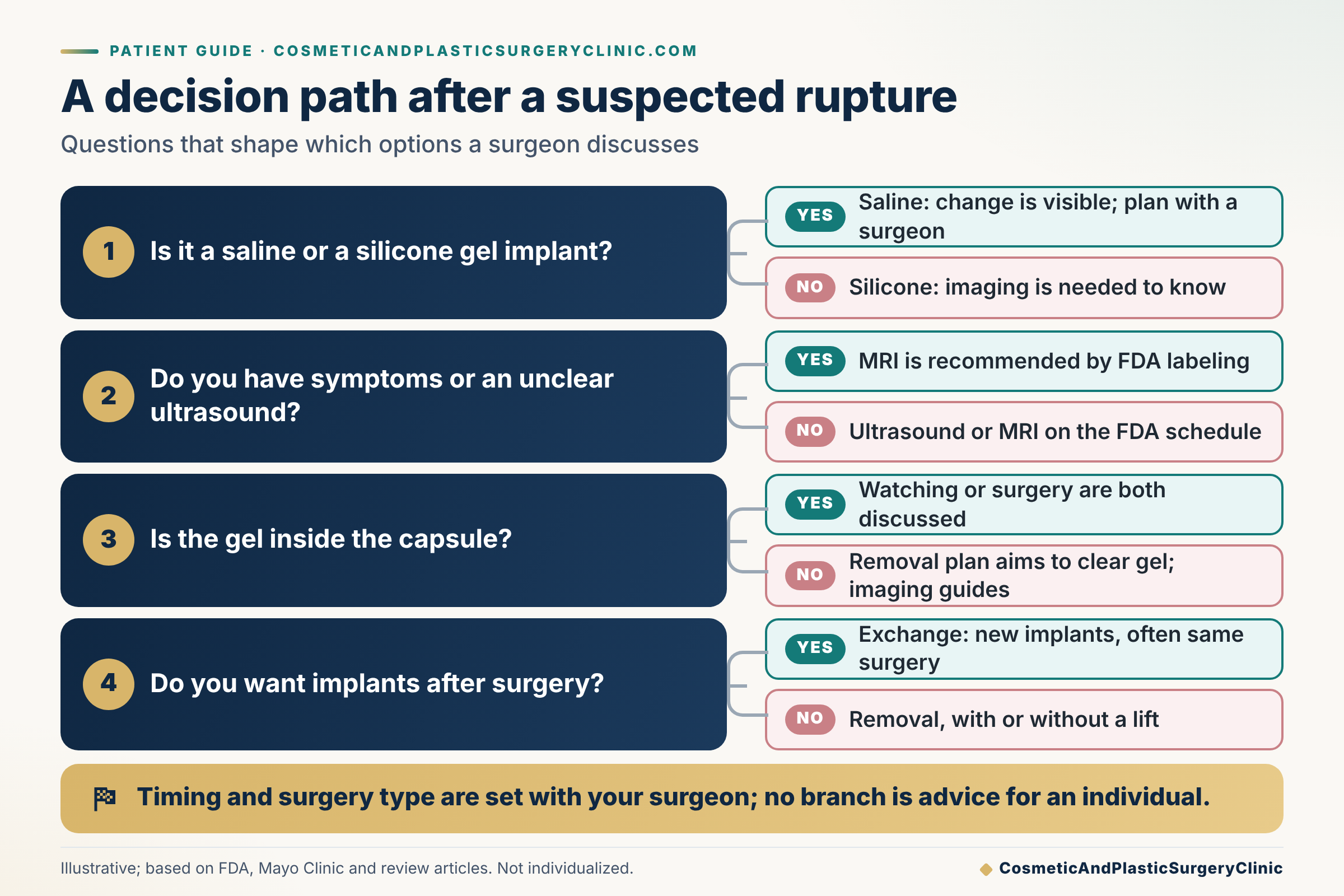
Finding a breast implant rupture starts a decision, not a countdown. The sources agree that a ruptured implant is a reason to talk with a surgeon, and they disagree, mildly, about how fast. Part of the reason is that a leaking saline implant, an intact-capsule silicone leak and gel outside the capsule are three different situations that share one name.
How urgent is it? The sources give different answers
What the sources say about timing
Mayo Clinic’s 2022 expert answer says that for a silent silicone rupture, options include watching or removing or replacing the implant, and that a rupture causing symptoms will likely lead the surgeon to recommend removal. Breastcancer.org says ruptured silicone implants should be removed promptly when possible. In an ASPS video transcript, one surgeon says a rupture on imaging is not an emergency and suggests replacing silicone implants within about six months of identification.
Real-world timing is similarly loose. A 2025 single-surgeon reconstruction abstract reported a median of 3 months from rupture to removal or replacement, with a range from two weeks to 21 months. The FDA pages opened for this article set no deadline. Treat the spread as information: reasonable surgeons plan this on a schedule that suits the findings and the person.
Why saline and silicone are separate questions
With a ruptured saline implant there is no leftover filler to remove, since the saltwater is absorbed. Breastcancer.org notes that surgeons may leave a ruptured saline implant in place until surgery is safe or the patient is ready. The practical issue is a breast that looks deflated, which is a quality-of-life reason to schedule surgery, not a safety one.
Silicone is different because the gel is not absorbed, and the FDA says it may be difficult to remove after a rupture. That is the stated reason many surgeons prefer not to wait indefinitely, though Mayo Clinic and the Hillard review both describe observation with interval imaging as an option for a silent rupture.
The operations a surgeon may describe
Removal of the implant, with or without its capsule
The FDA says surgeons may remove an implant alone or take out the scar capsule too, which the FDA calls en bloc resection. Cleveland Clinic Florida’s removal page lists capsulectomy and removal of leaked silicone among its options. In the Hillard review, the approach for a diagnosed or symptomatic breast implant rupture is removal, generally including a complete capsulectomy.
For an intracapsular breast implant rupture, that means taking out the implant, the free gel and the capsule. No source opened here compares complete capsule removal with implant-only removal head to head for rupture, so the choice rests on surgeon judgment and imaging findings. The breast implant removal article explains the terms and what the breast can look like afterward.
Exchange, removal without replacement and the lift question
Mayo Clinic says a new implant can often be placed during the same operation, and that a breast lift or other corrective surgery is an option for people who no longer want implants. Breastcancer.org adds that the new implants can be a different type. In the 2025 abstract, every saline patient chose new saline implants, 88 percent of silicone patients chose new silicone, and 23 percent of all rupture patients chose removal without replacement.
Those proportions come from one surgeon’s reconstruction practice and should not be read as typical. Choices that depend on the skin and nipple position left after implants come out are covered in the implant removal with lift article, and the planning questions for new implants in the breast implant exchange article. The general recovery stages after implant surgery are outlined in the breast augmentation recovery guide, though your surgeon sets the plan for a revision.
When gel has left the capsule
What is known about migration
The FDA says gel that migrates beyond the scar tissue is an extracapsular rupture and may move to areas around the body. A 2021 case report and literature review in the European Journal of Plastic Surgery states that, after rupture, silicone can reach the chest wall, the axillae and the arms, and travel through lymphatics to axillary lymph nodes, sometimes forming granulomas or siliconomas. Spread into the chest cavity was described as extremely rare.
The Danish natural-history data summarized in the Hillard review are reassuring about progression: about three-quarters of ruptures were intracapsular, only about 10 percent of intracapsular ruptures progressed to extracapsular over two years of MRI follow-up, and 84 percent of extracapsular ruptures stayed stable. Mayo Clinic says the silicone tends to remain trapped in surrounding tissue.
How extracapsular gel changes the operation
When gel has escaped, the aim becomes removing as much as can reasonably be removed. Breastcancer.org says surgeons try to take out as much as possible, and the Hillard review adds resection of visible or palpable granulomas in the breast tissue. Imaging before surgery helps a surgeon plan, so it is fair to ask whether MRI was done and what it showed.
The 2021 case report describes a rare chest-cavity migration managed by a team spanning plastic, thoracic and radiology specialists. For most people the question is simpler, but the principle stands: the more widely gel has traveled, the more the plan depends on imaging and on surgeon experience with revision.
| Option | What it involves | What it keeps or gives up | Question to settle |
|---|---|---|---|
| Observation with interval imaging | No surgery now; repeat imaging; mentioned for silent, intracapsular rupture | Keeps the implant; accepts the chance of progression or new symptoms | What findings would change the plan? |
| Remove and replace | New implants, often in the same operation; capsule handling varies | Keeps implants and fullness; keeps future device risks, including another rupture | Same pocket or a new one, and which implant type? |
| Remove without replacement | Implant and gel removed, often with the capsule; no new device | Ends device risks; volume and skin shape change | What will my breasts look like, and is a staged plan wise? |
| Remove with a lift | Implant removal combined with skin tightening and nipple repositioning | Reshapes the breast; adds incisions and scars | Combined or staged, and who performs both parts? |
Leaked silicone, illness and lymphoma: three questions that get mixed up
Breast implant rupture is a mechanical event. Whether leaked gel harms health, whether implants can be linked to systemic symptoms, and whether late swelling means lymphoma are separate questions with separate evidence. Treating them as one is how a calm topic becomes a frightening one.
What research says about ruptured gel and disease
Connective tissue disease and cancer
The FDA’s 2011 update found no apparent association between silicone gel implants and connective tissue disease or breast cancer, with anaplastic large cell lymphoma as the exception, and it cautioned that rare or slow-developing associations might not be detected with current data. Mayo Clinic’s 2022 answer says ruptured silicone implants are not thought to cause breast cancer, reproductive problems or connective tissue disease.
The Hillard review states that the consensus of the literature is that rupture carries no health risks, but its lead author disclosed industry ties, and “no association found” is weaker than “proven harmless.” The FDA’s own caveat is the safer reading: reassuring evidence, with stated limits.
Where breast implant illness fits
Some people with implants report symptoms such as joint pain, muscle aches, confusion and chronic fatigue. The FDA’s example boxed-warning text says patients have reported such systemic symptoms, that individual risk has not been well established, and that some patients report complete resolution when implants are removed without replacement. The example does not tie those symptoms to rupture.
The symptoms are real to the people who have them, and the cause is not settled. The breast implant illness article covers what research does and does not show; this page only notes that rupture is not required for the conversation.
Late swelling is a different warning from a leak
Fluid or a mass years after surgery
The FDA lists the main symptoms of BIA-ALCL, a lymphoma of immune cells linked to some textured implants, as persistent swelling, a mass or pain around the implant, often appearing years after the incision healed. Fluid collection around the implant, called a seroma, can be a finding. The agency does not recommend removing implants in people without symptoms.
That is why the warning-sign callout above puts persistent swelling in its own row. The BIA ALCL breast implants article covers diagnosis and treatment.
Why symptoms alone cannot sort a leak from something else
Lumps, firmness, size change and pain can come from rupture, capsular contracture, fluid or other conditions. Evaluation, usually imaging and sometimes sampling of fluid, separates them. The FDA notes that confirming the diagnosis matters because it can change the operation needed, which is a practical reason not to rely on a guess from home.
Using breast implant rupture facts in a consultation
Breast implant rupture facts help most when they become questions. A consult about implants you already have, or implants you are considering, is the place to turn the numbers above into specifics about your device, your imaging and your options. The plastic surgery consultation guide covers the visit itself; these are the rupture-specific additions.
Six questions that turn breast implant rupture facts into a plan
If you have implants and no symptoms
- Which manufacturer, model, fill and size do I have, and can I get that in writing for future imaging and surgery?
- Which imaging, ultrasound or MRI, fits my implants and my age of implants, who reads it, and what does it cost?
- What findings on a routine scan would make you recommend surgery rather than watching?
If a rupture is suspected or confirmed
- Is the gel inside the capsule, and how do you know: ultrasound, MRI or both?
- What operation do you recommend for my findings, how much capsule would be removed, and why that approach?
- What happens if I want to replace implants, remove them or combine removal with a lift, and what does each cost, including any manufacturer replacement or warranty coverage?
Second opinions, pressure and the option to wait
Signs to slow down
Be cautious if an answer is vague about which implant you have, if a surgery date is pushed before imaging confirms anything, if one plan is presented as the only plan, or if you are urged to decide the same day. A second opinion from another board-certified plastic surgeon is routine in revision decisions; the checks in how to choose a plastic surgeon apply as much to a revision as to a first operation.
Money, coverage and the choice to wait
The FDA warns that some insurers do not cover removal or replacement even when complications occur, so ask for written coverage details before scheduling. Manufacturer replacement programs and their conditions vary, and the breast implant revision cost article breaks down what a revision quote contains. For a silent rupture, observation with interval imaging is an option that Mayo Clinic and the Hillard review both describe; choosing to wait, with a plan, is not neglect.
Frequently asked questions
Can exercise or a hard impact cause breast implant rupture?
The FDA lists physical stresses such as trauma among possible causes of breast implant rupture, so a significant blow to the chest, such as a car crash, deserves evaluation. Routine exercise is less clear. In the 2023 retrospective study of reconstruction patients, weightlifting and carrying heavy bags were not associated with higher rupture risk, though that study had a low response rate. No source opened for this page gives a safe or unsafe activity list, so ask your surgeon about your own restrictions.
Does breast implant rupture always mean replacing the implant with a new one?
No. Mayo Clinic notes that a new implant can often be placed in the same operation, and that a breast lift or other corrective surgery is an option for those who no longer want implants. In one surgeon’s 2025 reconstruction series, 23 percent of patients with a rupture chose removal without replacement. Whether replacement, removal or a lift fits depends on tissue, goals and health. A surgeon can lay out what each choice leaves you with before you commit.
How long can a silicone breast implant rupture go untreated before it becomes a problem?
No source opened sets a universal deadline. The Danish follow-up data in the Hillard review found only about 10 percent of intracapsular ruptures progressed to extracapsular over two years, which supports watching in some cases. Other sources favor removal promptly or within several months. Gel the body does not absorb is the reason timing matters. Your surgeon weighs imaging, symptoms and your preferences, so the answer is individual.
Is the saltwater from a ruptured saline implant harmful?
Breastcancer.org says the body absorbs the saline that leaks from a ruptured implant, and the FDA describes the visible result as a loss of the implant’s size or shape. The concern is the change in the breast and the need for a plan, not the fluid. Surgeons may leave a ruptured saline implant in for a time if surgery is not yet safe or desired. Call your surgeon rather than waiting to see whether the change settles.
Can an MRI or ultrasound miss a ruptured silicone implant?
Yes, sometimes. The FDA’s patient checklist states that imaging may not detect all ruptures or leaks. The Hillard review says ultrasound depends on the operator and loses sensitivity when a capsule is hard, and in a 2022 ultrasound study 30 of 40 women with suspect scans who went to surgery had ruptures confirmed, so scans can also over-call. An uncertain ultrasound is the situation where the FDA recommends MRI. Ask who reads the scan and how often they read implant imaging.
Will insurance pay for imaging or surgery after breast implant rupture?
It varies by plan and by why the implants were placed. The FDA says some insurers do not cover removal or replacement even when complications occur, and the patient checklist notes that imaging may be costly. Ask the insurer, in writing, whether screening imaging and a rupture-related operation are covered, and request a pre-authorization decision before surgery. If coverage is denied, the revision cost article shows how to compare cash quotes.
If one side shows breast implant rupture, should both implants be replaced?
Often both are discussed. Breastcancer.org says that if one breast ruptures, both implants may be removed, and Mayo Clinic calls for a conversation about the pros and cons with your surgeon. A surgeon may raise reasons such as matching implant age or how a new implant will sit beside an old one. Those are discussion points, not a rule. The right answer depends on the other implant’s imaging and your goals.
Sources and further reading
- U.S. Food and Drug Administration — Risks and Complications of Breast Implants (page updated 2023, accessed 2026-11-12) — rupture and deflation definitions, silent rupture, symptoms, causes list, removal options, insurance note
- U.S. FDA — Breast Implants: Certain Labeling Recommendations to Improve Patient Communication, final guidance (September 29, 2020, accessed 2026-11-12) — 5 to 6 year first ultrasound or MRI, every 2 to 3 years, patient decision checklist, example boxed warning
- U.S. FDA — Statement on continued efforts to protect women’s health and enhance safety information for breast implants (October 23, 2019, accessed 2026-11-12) — draft guidance replacing the earlier 3-year and 2-year MRI schedule
- U.S. FDA — Update on the Safety of Silicone Gel-Filled Breast Implants (June 2011, accessed 2026-11-12) — core-study rupture rates, device-retrieval causes, detection, no apparent connective tissue disease or breast cancer association
- U.S. FDA — Breast Implant-Associated Anaplastic Large Cell Lymphoma (BIA-ALCL) (accessed 2026-11-12) — symptoms, timing, advice for people without symptoms
- Hillard, Fowler, Barta and Cunningham — Silicone breast implant rupture: a review, Gland Surgery, 2017 (accessed 2026-11-12) — incidence by study, causes, imaging, management, Danish natural history, disclosures
- Nichter, Hardesty and Zimmerman — Ideal Implant structured breast implants: core study results through 10 years, Plastic and Reconstructive Surgery, 2023 (accessed 2026-11-12) — ten-year deflation context, cited silicone core ranges, funding and design limits
- Silent rupture of silicone gel breast implants: high-resolution ultrasound scans and surveys of 584 women, Plastic and Reconstructive Surgery, 2022 (PubMed abstract, accessed 2026-11-12) — rupture signs in 14.0% of women and 8.0% of implants
- Paolini, Firmani, Briganti and colleagues — Assessment of risk factors for rupture in breast reconstruction patients with macrotextured breast implants, Aesthetic Plastic Surgery, 2023 (accessed 2026-11-12) — risk-factor odds ratios and study limits
- Mehta, De La Cruz and colleagues — routine MRI screening and implant rupture, Plastic and Reconstructive Surgery Global Open, 2025 conference abstract (accessed 2026-11-12) — single-surgeon series: 7% ruptures, silent share, timing to surgery, patient choices
- American Society of Plastic Surgeons — Few patients undergo recommended MRI screening after silicone implant breast surgery (press release, July 27, 2022, accessed 2026-11-12) — 109-woman survey, screening uptake, silent rupture share
- American Society of Plastic Surgeons — Breast implant removal (video transcript, accessed 2026-11-12) — surgeon comment that a rupture on imaging is not an emergency; replacement timing
- Mayo Clinic — Silicone breast implants: what happens if they rupture? Expert answer by Sandhya Pruthi, M.D. (December 7, 2022, accessed 2026-11-12) — consequences, options for silent and symptomatic rupture
- Breastcancer.org — Breast implant rupture: signs and treatments (updated November 2, 2026, accessed 2026-11-12) — saline absorption, treatment options, both implants discussion; no medical reviewer named on the page
- American Cancer Society — Mammograms with breast implants (last revised July 23, 2026, accessed 2026-11-12) — telling the facility, four extra images, rare rupture during mammography
- Fanelli, Marcasciano, Lovero and colleagues — Thoracic migration of silicone gel after breast implant rupture: a case report and literature review, European Journal of Plastic Surgery, 2021 (accessed 2026-11-12) — migration to chest wall, axillae and lymph nodes; extremely rare chest-cavity spread
- Cleveland Clinic Florida — Silicone breast implant removal (accessed 2026-11-12) — capsulectomy, en bloc, leaked silicone, removal with lift or reduction