Breast augmentation recovery is shorter than most people expect for the first few weeks and longer than most people expect for the last few details. You may be back at a desk within a week, yet the implants can keep settling for months, sensation can keep changing for most of a year, and scars keep maturing after that. Knowing which clock a given symptom belongs to makes the whole process less alarming.
This article covers the recovery period itself: the first week, returning to work, driving, lifting and exercise, how implants settle, what massage evidence says, and which changes are expected versus worth a call. Whether the operation suits you is a separate question, covered in the breast augmentation candidate article, and the overview of the operation lives in the breast augmentation guide. Here, the focus is simply what breast augmentation recovery looks like in real life.
Why breast augmentation recovery has no single timetable
What published ranges actually say
Four sources, four different breast augmentation recovery timelines
Read four reputable pages on breast augmentation recovery and you get four timelines. The Aesthetic Society says it typically takes one to two weeks and that recovery varies greatly between individuals. An ASPS blog by a Seattle surgeon says full recovery averages about six weeks and that most patients are cleared for all normal activities after two months. Cleveland Clinic gives six to eight weeks. Mayo Clinic says soreness and swelling are likely for a few weeks.
These are not contradictions. “Back to the routine of a desk job” and “fully cleared for everything” are different finish lines, and each source is drawing the line in a different place. When you read a number, ask which finish line it describes.
Surgeon-written pages are views, not standards
Several of the most specific statements online come from individual surgeons writing for a professional-society blog, and the societies say so. A surgeon who tells patients to start working out at about three weeks, limited to legs and arms, is describing her own protocol. Another practice may allow a gentle walk on a stationary bike sooner or hold off longer.
That is why this article keeps attributing each range to its source instead of blending them into one tidy schedule. A blended schedule would look authoritative and describe nobody’s actual instructions. The only timeline that governs your breast augmentation recovery is the one your own surgeon hands you.
What moves your own timetable
Pocket position, incision and what else is done in the same operation
The biggest published difference is where the implant sits. An ASPS article quotes a San Francisco surgeon putting recovery at about three weeks when implants go over the muscle (subglandular) and about three months when they go under it (submuscular), and describing the under-muscle pocket as more painful. The Aesthetic Society likewise says pain tends to be stronger when implants sit under the pectoral muscle. The trade-offs of each pocket belong to the over vs under muscle implants article.
Other operations change the picture too. The same ASPS article says a revision involving the muscle takes longer than a first-time operation. If a breast lift or a body procedure is added in the same session, the recovery is no longer only a breast augmentation recovery; the mommy makeover recovery article covers how multiple incisions stack up.
How your job, household and history shape breast augmentation recovery
Recovery is also a logistics problem. A desk worker and a hairdresser who holds both arms up all day face different restrictions after the same operation. A parent of a toddler has a lifting problem that someone without children never sees. Someone who has had a hard time with anesthesia or pain medicine in the past should say so at the consultation, because that history changes the plan.
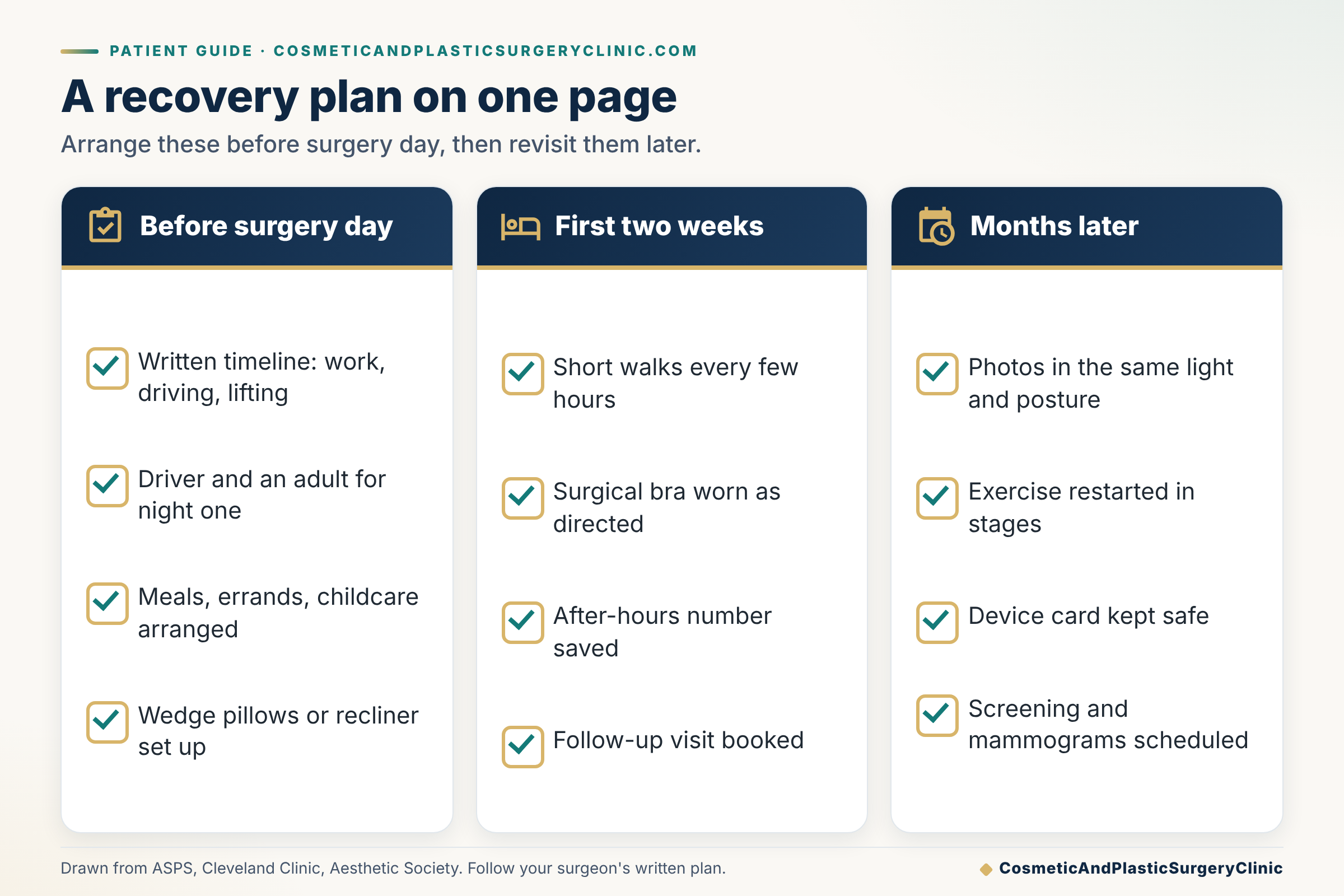
Cleveland Clinic and ASPS both suggest arranging a driver and someone to stay the first night, and ASPS adds preparing meals, errands and childcare before surgery because the first week is the hardest. Those are small items, but they are the difference between a calm recovery week and a scramble.

The first week of breast augmentation recovery
Surgery day through day three
Going home with a bra, dressings and possibly drains
Most people go home the same day. The Aesthetic Society says to expect bandages or a compression garment such as a surgical bra, and possibly surgical drains; ASPS says most breast augmentations do not need drains. Cleveland Clinic says you may go home in a surgical bra with gauze over the breasts, and that your surgeon will say when to take the gauze off. Mayo Clinic describes closure with stitches, skin adhesive and surgical tape.
Plan for a driver home and an adult who stays the first night; that advice appears on both the Cleveland Clinic page and the ASPS blog. If drains are placed, a visit to remove them is part of the plan, so ask at the consultation whether yours is a drain-likely operation.
What pain usually feels like in the first 48 hours
The Aesthetic Society says pain is usually worst in the first 48 hours and eases each day. An ASPS article quotes a surgeon comparing it to the soreness after a hard workout, often worst the morning after surgery, with chest soreness when you move or raise your arms. A burning feeling along the incisions is common early and tends to fade fairly quickly, and itching around the incisions can appear in the first day or two.
The ASPS blog says the first three to five days are the most uncomfortable and mentions that some surgeons offer a pain injection or pain pump for the first 72 hours. Whatever your surgeon prescribes, take it as directed, and call if pain is extreme or not easing; the Aesthetic Society specifically asks patients to contact the surgeon in that case.
Days four to seven
Sleeping inclined, walking short bouts and avoiding strain
The Aesthetic Society recommends sleeping on your back, inclined at roughly 25 to 45 degrees with wedge pillows or a recliner, and walking short bouts every few hours, which also lowers the risk of leg clots. It advises against straining, bending and lifting in the early days because they can increase swelling or cause bleeding. An ASPS surgeon likewise discourages strict bed rest and encourages walking so blood keeps moving.
One ASPS patient account, written in 2022 about a single surgeon’s protocol, describes using five pillows to prop up at first and two by day 20, still unable to sleep on her side at that point. It is one person’s experience, not an instruction, but it shows how long awkward sleeping can last.
Showers, stitches, tape and the first follow-up
The Aesthetic Society gives ranges for the small milestones: showering is allowed somewhere between one and seven days after surgery, external stitches typically come out in about a week, and tape or tissue glue falls off on its own in one to two weeks. Cleveland Clinic also puts stitch removal at about one week. Your visit schedule and what you may do with the incisions are set by your surgeon, and they vary.
Chest stiffness and soreness can last two to five days according to the Aesthetic Society, and most people begin to feel like themselves again by the end of the first week, though not necessarily ready for full activity. The ASPS blog notes that many women feel fine after about a week while still being nowhere near cleared for everything.
| Phase | Commonly reported changes | Typical restrictions mentioned | Planning issue | Call the surgeon about |
|---|---|---|---|---|
| Days 0 to 3 | Soreness peaks in the first 48 hours; tightness, itching, warm breasts | No bending, straining or lifting; short walks | Driver, overnight adult, medication schedule | Pain that is extreme or not easing; one breast swelling much faster |
| Days 4 to 14 | Stiffness fades; stitches out around week 1; tape and glue fall off | Arm movement kept gentle; no strenuous activity; sex not before about 2 weeks | Desk return possible for some at 3 to 7 days; first follow-up visit | Fever, spreading redness, pus, opening incision |
| Weeks 3 to 6 | Swelling mostly down by about a month; implants may still sit high | Heavy lifting about 4 weeks or more; chest exercise held back | Physical jobs often need about 3 weeks or more | Increasing firmness or enlargement of one breast |
| Months 2 to 3 | Final position approached around 2 months per one ASPS account; drop and fluff 3 to 6 months | Underwires often avoided 2 to 3 months in one ASPS article | Bra shopping, exercise rebuild | Implants that have not dropped by 3 to 6 months |
| Months 4 to 12 | Sensation shifts settle for most; scars fade over about a year | Usually none long term, surgeon-specific | Photos at set intervals; scar care plan | Persistent swelling, pain or a new mass near an implant at any time |
Weeks two to twelve: work, driving, lifting, exercise and bras
Work, driving and lifting
Desk work versus physical work in breast augmentation recovery
Return-to-work estimates are the most variable numbers in breast augmentation recovery guidance. One ASPS surgeon says desk workers can typically return within three to five days; another recommends a week off after an over-the-muscle operation, and longer after revision surgery that involves the muscle or for physically demanding jobs. The ASPS blog from Seattle says desk jobs at about one week and at least three weeks for labor-intensive work. Cleveland Clinic says at least three days, and at least three weeks for labor-intensive jobs.
Mayo Clinic is more conservative, saying people whose jobs do not involve much movement might return within a few weeks. A fair planning range for a desk job in breast augmentation recovery is therefore several days to a few weeks, and the honest way to narrow it is to describe your actual day to the surgeon: how much reaching overhead, carrying, typing posture and standing it involves.
Driving, children and everyday lifting
None of the pages opened for this article gives a driving date; they say only that someone else should drive you home. Ask for the date in writing, and ask what the surgeon wants to be true before you drive: comfortable steering, the ability to check over your shoulder and brake hard, and a medication plan that does not conflict with driving.
Lifting guidance for breast augmentation recovery is easier to find. Cleveland Clinic says no heavy lifting for at least four weeks, Mayo Clinic says nothing that strains or raises your pulse or blood pressure for at least two weeks, and the ASPS blog says not to pick up small children for a few weeks. If you have a baby or toddler, ask for a limit in pounds with an end date, and arrange who handles lifting until then; the plastic surgery recovery planning article covers household logistics more broadly.
Exercise, bras and the return to normal
A staged return to exercise
The surgeon-authored ranges are staged rather than all-or-nothing. One ASPS surgeon says she usually lets patients start working out about three weeks after surgery, limited to legs and arms, with no chest exercise. Cleveland Clinic expects light exercise to resume after the first week and says sports may take up to six weeks, with running, horseback riding and heavy lifting held back until fully recovered.
The 2022 ASPS patient account shows what one surgeon’s staged breast augmentation recovery looked like: lower-body weights and light cardio from day 14, a stationary bike at day 15, and a first modified training session at day 22 with arms avoided entirely. The article also quotes a surgeon saying there are generally no long-term restrictions, though some advise against pectoral-muscle exercises when implants are under the muscle. That last point is a good question for a consult.
Underwires, sports bras and what “support” means in the first months
Bra advice follows a similar staging. An ASPS article says to wear a surgical bra for about two weeks, then a sports bra or a bra without underwire, avoiding underwires for about two to three months until the implants settle. The ASPS blog says to wear a bra at all times and suggests one or two recovery bras with breathable fabric, a design without seams and adjustable straps. Mayo Clinic mentions a compression bandage or sports bra for support.
Bouncy exercise is a separate issue. One ASPS surgeon notes that cardio with impact may feel uncomfortable early on and suggests wearing two bras. If you have a favorite high-impact class, ask when your surgeon expects to clear it, rather than discovering the answer on the floor.
| Activity | Ranges reported by source | Why it waits | Ask your surgeon |
|---|---|---|---|
| Desk work | 3 to 5 days (ASPS surgeon); about 1 week (ASPS blog); a few weeks (Mayo) | Soreness, medication, arm reach | Can I start part-time or remotely? |
| Physical work | At least 3 weeks (Cleveland Clinic, ASPS blog) | Lifting and arm strain on the pocket | What is my limit in pounds? |
| Driving | No date given in the pages opened | Steering, braking, medication | What must be true before I drive? |
| Heavy lifting | At least 4 weeks (Cleveland Clinic); strain avoided 2 weeks (Mayo) | Bleeding and swelling risk | Does carrying a toddler count? |
| Legs and light cardio | After week 1 (Cleveland Clinic); about 3 weeks, legs and arms only (ASPS surgeon) | Raised pulse and pressure, bounce | Is walking enough until week 3? |
| Chest and arm training | Sports up to 6 weeks (Cleveland Clinic); varies by surgeon | Muscle movement, pocket healing | When may I train chest, and does my pocket matter? |
| Sexual activity | Avoid at least 2 weeks; gentle with breasts at least 1 month (Aesthetic Society) | Pressure, soreness, swelling | What contact with the breasts is acceptable? |
Dropping, fluffing, massage and sensation: the slower changes in breast augmentation recovery
How implants settle
Why implants start high and look flat
“Drop and fluff” is slang for implants moving into their final position. An ASPS surgeon writing in 2022 says right after surgery implants may sit high on the chest, look flatter than expected or appear slightly square, because tight skin and muscle hold them there. As tissues relax and adapt, the implants descend and fill out the lower breast, giving a softer, rounder shape.
The same article says swelling and bruising usually subside in about one to two weeks, while the full drop-and-fluff process can take three to six months. It adds that smaller, lighter implants may take longer because heavier ones get more help from gravity, and that textured implants may drop more gradually than smooth ones. Another ASPS article puts final position at about two months, which shows how loosely these numbers are used.
When an implant that has not dropped is worth a question
Normal early findings, according to the ASPS drop-and-fluff article, include high or flat placement, changes in size or shape over several months, and implants that still feel tight after swelling has mostly resolved. Implants that have not dropped after three to six months, or unusual pain, bleeding or swelling that does not improve or gets worse, are reasons to contact the surgeon promptly.
The size and shape you see at two weeks is therefore a poor judge of the final result. Photos taken at that stage can mislead in both directions, which is a reason to compare like with like when reading breast augmentation photos.
Massage and displacement exercises: what the evidence supports
What the pooled studies found
Some surgeons ask patients to massage or move the implants inside the pocket in the weeks after surgery, in the hope of preventing capsular contracture, the tightening of scar tissue around an implant. FDA describes capsular contracture on a four-grade Baker scale, from soft to hard and painful, and says grades III and IV are considered severe and may require reoperation. Whether massage prevents it is a separate question, and the published evidence is thin.
Surgeon-directed, not improvised
The review also notes that technique, timing and frequency varied widely, that two of the four studies were small (40 and 12 patients), and that one study combined exercises with a steroid, so their effects cannot be separated. That does not make massage useless; it means the question is open. Some surgeons prescribe it, others do not, and the instructions differ. The 2022 ASPS patient account describes displacement exercises four times a day, reduced to twice a day at one month.
Practical rule for breast augmentation recovery: do exactly what your surgeon instructs, and ask why. If one surgeon says to massage and another says not to, that is not a contradiction you must resolve alone; it reflects an unsettled evidence base, and your surgeon knows your pocket, implant type and incision.
Sensation and symmetry
Numbness, tingling and heightened sensation
Changes in nipple and breast sensation are expected enough that Mayo Clinic lists them as a risk and ASPS says nipple sensation may be heightened for weeks to months, usually subsiding afterward. A 2026 systematic review in JPRAS Open of 26 studies and 9,190 patients, read at abstract level, reports that most sensory changes were transient, typically recovering within six to twelve months, with periareolar incisions showing higher rates of early nipple-areola numbness.
A 2026 scoping review of 37 studies and more than 13,000 patients in Aesthetic Plastic Surgery found persistent nipple sensory change was generally under 5%, with periareolar incisions carrying roughly three times the risk of reduced sensation and pain compared with inframammary ones in large cohorts. The scoping review’s authors note that differences between studies limited comparisons. Incision choice is worth a direct question at your consultation.
Why asymmetry looks larger in the first weeks
Swelling rarely resolves at the same speed on both sides, one implant may settle faster, and pre-existing asymmetry in the chest wall or breasts does not disappear because an implant is added. A hypothetical example: someone whose left breast sat slightly lower before surgery may notice that difference more at three weeks, when one side is still high and swollen, than at six months.
Cleveland Clinic lists increasing enlargement or firmness of one breast, with pain and pressure, among reasons to contact the provider, so the useful distinction is between a difference that is gradually narrowing and one that is growing quickly or painfully. Photograph both sides in the same light and posture at fixed intervals to see the trend.
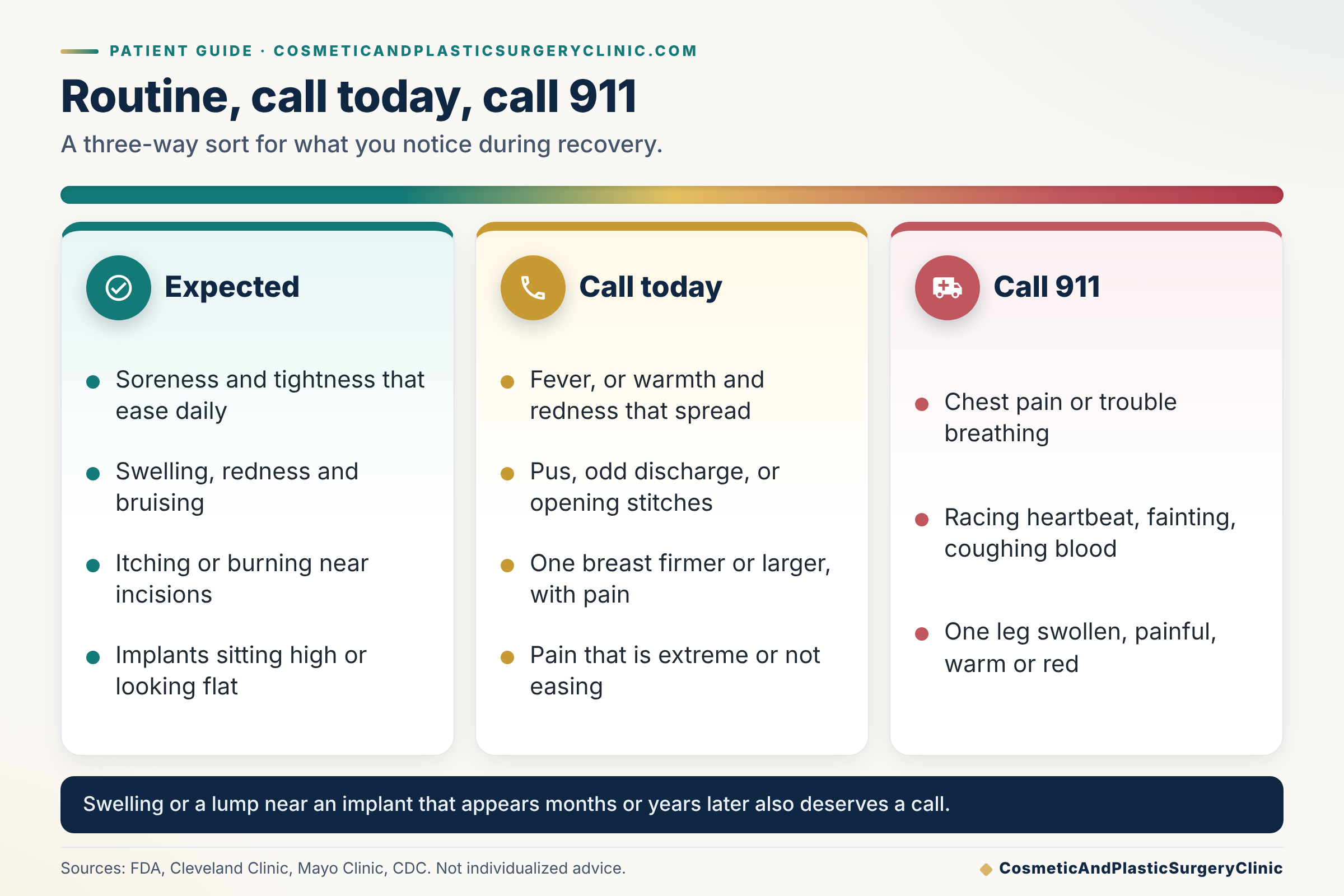
Warning signs during breast augmentation recovery: expected, call today, call 911
Effects that are expected
Soreness, swelling, bruising and itching
Most of what you will feel is on the expected list. The Aesthetic Society says breasts may feel tight, sensitive, warm or itchy and that raising your arms may be difficult. FDA describes redness and bruising as expected, likely temporary results of surgery. ASPS mentions burning along the incisions early on and itching in the first day or two. Mayo Clinic says your breasts will be sensitive to touch and to jarring movements while they heal.
The pattern that reassures is direction: soreness easing a little each day, swelling gradually narrowing, bruises changing color and fading. A bad day does not mean a complication, but a trend in the wrong direction deserves a call.
Tiredness and mood in the first weeks
Fatigue after anesthesia and an uncomfortable week of sleeping inclined is common, and a low or anxious stretch when the swelling makes the result look unfinished is understandable. The sources opened for this article do not quantify either, so treat this as a planning note rather than a statistic: build in rest, and tell the surgeon’s office if low mood lasts or deepens.
Problems that need a same-day call
Hematoma, seroma and early infection
FDA says a hematoma, a collection of blood, usually occurs soon after surgery; small ones may be absorbed while large ones may need surgical draining. A seroma, a fluid collection, may also be absorbed if small, while a large one requires a drain. FDA adds that most infections resulting from surgery appear within a few days to a week, although an infection is possible at any time, and that if antibiotics do not work the implant may need to be removed.
Cleveland Clinic lists the reasons to contact your provider immediately as fever, abnormal discharge such as pus from an incision, stitches that open, and increasing enlargement or firmness of one or both breasts with pain and pressure. Mayo Clinic adds warmth or redness in the breast, which could mean infection, and asks you to report any change in your breasts or implants.
What to do with an after-hours problem
Save your surgeon’s after-hours number before surgery, and ask what the office treats as urgent. If you cannot reach anyone and the symptom is on the list above, go to urgent or emergency care and say you recently had implant surgery. Do not wait for a morning appointment because a swelling pattern looks like it might ease; hematomas and infections are time-sensitive, and an early call is never a wasted call.
Changes that can appear months or years later
Persistent swelling, a lump or pain near an implant
FDA says symptoms of breast implant-associated anaplastic large cell lymphoma (BIA-ALCL) are persistent swelling, a mass or pain around the implant, and that they may occur well after the incision has healed, often years after placement. Providers frequently find a fluid collection around the implant. The FDA says it does not recommend routine removal of implants in patients without symptoms, and that confirmed BIA-ALCL typically requires removing the implant and the surrounding scar capsule.
This is not a recovery-period worry, but it belongs in a recovery article because the rule is simple: a swelling or pain that appears long after your breast augmentation recovery has ended is a reason to call, not to wait out.
Rupture and why some are silent
Saline implants that rupture deflate, which is visible; silicone implants often rupture silently with no obvious symptoms, according to FDA, which calls MRI the most effective method for detecting a silent rupture and ultrasound an acceptable alternative for people without symptoms. How this affects your choice of implant is a topic for the saline vs silicone implants article, and the general risk picture is in the plastic surgery risks article.
Months three to twelve and beyond: breast augmentation recovery, scars and follow-up
When the result is judged
Three checkpoints: about 3 months, 6 months and 1 year
An ASPS surgeon quoted in 2021 says recovery from any surgery takes six months to a year before you feel fully back to normal. Combine that with the three-to-six-month drop-and-fluff estimate and the six-to-twelve-month sensory window from the 2026 review, and the practical reading is that three months shows shape, six months shows most of the settling, and a year is the fairer judgment point for sensation and scars. Hold major conclusions about size or symmetry until then, and ask your surgeon when each follow-up visit will occur.
How scars mature
ASPS says incisions start as fine lines, pass through a red inflammatory stage and then fade, with most scars fading by about one year. Mayo Clinic says scars fade over time but will not go away completely. How visible they end up depends on incision location, your skin, and how the wound heals, and a surgeon may give specific scar-care instructions. Ask which products or techniques they want you to use, and when to start.
Long-term follow-up after breast augmentation recovery
Screening and mammograms
For silicone gel implants, FDA’s labeling guidance says people without symptoms should have a first ultrasound or MRI at five to six years after surgery and then every two to three years, with MRI recommended at any time if symptoms appear or an ultrasound is uncertain. The Aesthetic Society says to keep up routine mammograms at the frequency recommended for your age and to continue breast self-exams.
The American Cancer Society says people with implants should still get regular screening mammograms, should mention the implants when booking and again to the technologist, and may have four extra images, called implant displacement views, which can be uncomfortable if capsular contracture has formed. It also notes that, very rarely, mammography can rupture an implant. The page gives no timing advice for the first mammogram after surgery, so ask your surgeon and your imaging center.
Implants are not lifetime devices
FDA’s boxed warning says breast implants are not considered lifetime devices and that the longer people have them, the greater the chance of complications. Its illustrative decision checklist lists reoperation reported in up to 59.7% of patients, capsular contracture in up to 51.7% and rupture or leaking in up to 31.2%, and states that these percentages are for illustration only and that manufacturers should use rates for their own implants. These are not forecasts for you.
An ASPS article, by contrast, says implants do not need routine replacement unless there is a problem. Both statements can be true: no scheduled swap, but a real chance of future surgery. The cost side of that trade-off is covered in the breast augmentation cost article, and implant volume decisions in the breast implant size article.
Six checks before surgery day to avoid surprises in breast augmentation recovery
Build the plan before you book
What to ask for, in writing
Most breast augmentation recovery surprises come from vague instructions rather than from the operation. The six checks below turn the ranges in this article into questions that produce a usable plan. Bring them to a consultation; the plastic surgery consultation questions article covers the rest of that visit, and how to choose a plastic surgeon covers verifying credentials and facility.
| Check | What to ask | Why it matters |
|---|---|---|
| 1. Written timeline | Dates or ranges for work, driving, lifting in pounds and exercise | Published ranges vary widely between practices |
| 2. Pocket and incision | How do my pocket and incision change pain, restrictions and sensation? | Reported recovery differs by pocket; incision affects early numbness |
| 3. Help at home | Who drives, stays the first night and lifts children or pets? | Sources advise a driver, overnight adult and prepared meals |
| 4. Bras and supplies | Which bra, how many, how long, and when is underwire allowed? | Support rules differ from about 2 weeks to 3 months |
| 5. Follow-up and urgent care | Visit schedule, after-hours number, what counts as urgent | Hematoma and infection are time-sensitive |
| 6. Long-term plan | Device card, screening schedule, who monitors implants | FDA says implants are not lifetime devices |
How to judge the answers you get
A surgeon who answers each check with specifics, such as days, pounds and phone numbers, is giving you a plan. One who answers with “you’ll be fine” is not, and you can reasonably ask again or get a second opinion.
Make the home and the calendar match the plan
The first-week setup
ASPS suggests finishing housework, shopping and meal prep before surgery and arranging help from a friend or partner, especially if you have children. The Aesthetic Society’s sleep advice implies wedge pillows or a recliner. Fill prescriptions ahead of time if your surgeon agrees, keep easy food and water within reach, and set the bed up for sleeping inclined before you leave for surgery rather than after you return.
When to wait or decide differently
If the calendar does not fit, for example a heavy-lifting job, a baby who cannot be put down, or a major trip soon after the surgery date, moving the date is a legitimate plan. So is a second opinion, and so is deciding not to operate. The breast lift pages are worth a look if the main concern is droop rather than volume, since a lift has a different recovery pattern from implants alone.
Frequently asked questions
Can I sleep on my side during breast augmentation recovery?
The Aesthetic Society recommends sleeping on your back, inclined about 25 to 45 degrees, in the early days. One ASPS patient account says she still could not sleep on her side at about three weeks and was down from five pillows to two. No opened source gives a universal date for side sleeping in breast augmentation recovery, and it may depend on your pocket and incisions. Ask your surgeon for a date, and ask whether stomach sleeping is off the table for longer.
When should I schedule my first mammogram after breast augmentation recovery?
The American Cancer Society says people with implants should keep getting screening mammograms, but its page does not say how soon after surgery the first one should happen. Tell the imaging center about your implants when you book and again before the exam, because extra implant displacement views are common. Ask your surgeon how long to wait after surgery, and keep the device card from your operation so the facility knows the implant type.
Is itching around my incisions normal in breast augmentation recovery?
ASPS says itchiness around the incisions may occur in the first 24 to 48 hours, and the Aesthetic Society lists itching among normal early sensations. Tape and glue fall off on their own in one to two weeks of breast augmentation recovery. Itching that comes with spreading redness, warmth, pus, a fever or an opening incision is different, and Cleveland Clinic and Mayo Clinic both list those as reasons to contact your provider. Do not apply creams to the wounds without asking the surgeon.
When can I be intimate during breast augmentation recovery?
The Aesthetic Society says to avoid sexual activity for at least two weeks and to be very gentle with your breasts for at least one month. Individual surgeons may set longer limits, particularly after an under-the-muscle pocket or revision surgery. Because pressure on the chest and strain on the arms can cause pain, a good question for your surgeon is which positions and kinds of contact are acceptable at which stage, and when swelling or soreness should change that answer.
Is breast augmentation recovery longer after revision or implant replacement?
An ASPS article quotes a surgeon saying revision surgery involving the muscle, or a physically demanding job, calls for more than a week off. No opened source gives a standard revision timeline, because revisions vary from a simple implant exchange to repositioning a pocket or removing scar tissue. Ask your surgeon how your planned operation compares to your first one, and whether an exchange of the same size and pocket would be lighter or heavier.
Should I stop certain medicines or supplements around surgery?
During breast augmentation recovery planning, an ASPS article reports that some surgeons ask patients to avoid anti-inflammatories such as aspirin and ibuprofen, plus supplements like vitamin E, fish oil, ginkgo and garlic, for two weeks before and after surgery. That is one article’s summary of what some surgeons do, not an instruction for you. Give your surgeon a complete list of everything you take, including supplements, and follow the written plan you receive, because the right list depends on your health and the operation.
Can I travel or fly during breast augmentation recovery?
No opened breast augmentation source gives a flying date, so ask your surgeon before you book anything. CDC lists limited movement as something that slows blood flow, and advises moving around as soon as possible after surgery or illness. Long trips early in breast augmentation recovery mean long periods of sitting, and a trip also separates you from your surgeon if a problem develops. If travel is unavoidable, ask about earliest dates, movement breaks, and where you would go for care.
Sources and further reading
- ASPS — What to expect after your breast augmentation surgery (Shacknai, 2021; accessed 2026-11-12) — recovery ranges quoted from two surgeons, bras, settling, scars
- The Aesthetic Society — How long does it take to recover from a breast augmentation? (accessed 2026-11-12) — first days, sleep, stitches, activity, mammograms
- ASPS blog — Breast augmentation recovery: what you need to know (Salemy, 2018; accessed 2026-11-12) — timeline, bra, work, preparation
- ASPS — What you can really expect during a breast augmentation recovery, part 2 (Clark, 2022; accessed 2026-11-12) — one patient’s account of days 8 to 30
- ASPS blog — What does “drop and fluff” mean after breast augmentation? (Mariotti, 2022; accessed 2026-11-12) — settling timeline and signs of a problem
- Mayo Clinic — Breast augmentation (accessed 2026-11-12) — recovery, risks, when to contact your doctor
- Cleveland Clinic — Breast augmentation (accessed 2026-11-12) — recovery time, lifting, work, urgent signs
- FDA — Risks and complications of breast implants (accessed 2026-11-12) — hematoma, seroma, infection, capsular contracture, rupture, BIA-ALCL, not lifetime devices
- FDA — Breast Implants: Certain Labeling Recommendations to Improve Patient Communication, final guidance (2020; accessed 2026-11-12) — boxed warning, decision checklist, rupture screening schedule
- FDA — Breast implants (accessed 2026-11-12) — labeling guidance and approval dates
- FDA — Questions and answers about BIA-ALCL (accessed 2026-11-12) — symptoms, timing, what to do
- Sood A et al. — Breast massage, implant displacement, and prevention of capsular contracture after breast augmentation with implants: a review of the literature, ePlasty 2017 (abstract page; accessed 2026-11-12) — four studies, 587 patients
- CDC — About blood clots (accessed 2026-11-12) — DVT and PE symptoms, moving after surgery
- American Cancer Society — Mammograms for women with breast implants (accessed 2026-11-12) — extra views, telling the facility
- Europe PMC — records for Ghadban E et al., JPRAS Open 2026, and Tulimat B et al., Aesthetic Plastic Surgery 2026 (abstract level; accessed 2026-11-12) — sensory recovery and incision type