Every nose operation starts with a choice that most patients never see being made: how the surgeon gets in. The open vs closed rhinoplasty question sounds like a choice between a scar and no scar, yet the incision is the smallest part of it. The approach decides how much of the nasal framework the surgeon can see, how far the skin is lifted, how long the operation tends to run, and which parts of healing you are likely to notice.
This article handles one decision: what open vs closed rhinoplasty changes, what published evidence says about the difference, and which questions to ask a surgeon who recommends one door over the other. It is education, not a verdict on any person’s nose. The broader map of nasal anatomy, planning and healing sits in the rhinoplasty overview; this page stays with the approach.
What open vs closed rhinoplasty changes inside the operation
Two doors into the same nose
The closed route: incisions that stay inside the nostrils
The American Society of Plastic Surgeons (ASPS) describes a closed procedure as one where the incisions are hidden inside the nose. Through those openings the surgeon works on the bone and cartilage while the skin stays mostly attached to the framework. One university clinic’s patient FAQ describes the cartilage as being delivered out through the internal incisions for shaping and then returned.
The practical consequence is limited sight. The surgeon feels and palpates more than sees, and relies on a trained mental map of the structures underneath. In the open vs closed rhinoplasty debate, a closed approach is not a lesser operation; it is the same anatomy approached with less exposure. That distinction matters later, when we compare what each route can reach.
The open route: the columellar incision and the lifted skin envelope
In an open approach, ASPS says an incision is made across the columella. It joins the internal incisions, and the skin and soft tissue of the nasal tip and dorsum are then folded upward like a hood, exposing the cartilage and bone directly. A 2005 survey of 178 rhinoplasty surgeons in the Archives of Facial Plastic Surgery found that the most common open incision was an inverted V, sometimes called a gull wing, favored by 58 percent of those asked.
Open access gives a direct, two-handed view of the tip cartilages and the place where grafts will sit. It also means a longer skin dissection, an external incision that has to heal, and a tip that is typically swollen for a while. Medscape’s clinical reference lists a visible columellar scar, a small risk to the columellar skin flap, more extensive dissection and longer operating time among the open approach’s disadvantages.
What does not depend on the door
Reshaping choices belong to the plan, not the approach
Whether a hump is lowered, a tip is narrowed, a deviated septum is straightened or cartilage is added are separate decisions from the route used. ASPS notes that the skin is raised through either approach, that grafts most often come from the septum, occasionally from the ear and rarely from the rib, and that septal correction can be done in the same operation to improve breathing. A closed approach can include grafts and an open approach can be limited to small changes.
Newer techniques that preserve more of the existing dorsum are another variable again. They describe how much structure is altered, not where the incisions go, so they are best discussed as a separate question with the surgeon rather than folded into the open vs closed rhinoplasty choice.
Anesthesia, splints and the first week look alike
According to ASPS, medication for comfort is intravenous sedation or general anesthesia, chosen by the surgeon for each patient, and splints or gauze packing may support the nose for a few days. Mayo Clinic describes internal splints that usually stay 1 to 7 days and an external splint taped on for about a week. None of that is specific to the approach. What differs between open vs closed rhinoplasty here is the extra external incision after an open operation, which usually has its own stitches and its own follow-up check.
For a week-by-week picture of splints, swelling and activity limits, the rhinoplasty recovery article covers the whole arc without regard to approach.

Where the evidence on open vs closed rhinoplasty outcomes stands
What the two newest systematic reviews found
A 2022 review: twenty studies, no randomized trials
A systematic review in Archives of Plastic Surgery (Gupta and colleagues, 2022) searched four databases, screened 243 articles and included 20. They were mostly case series and retrospective cohorts of modest quality; none was a randomized trial. The authors reported high patient and surgeon satisfaction with both approaches and concluded that they could not say which one is preferable.
They also flagged why the evidence is thin. Few studies used validated breathing or appearance scores, few surgeons are equally skilled at both routes, and the cosmetic comparison was lopsided: of 143 cosmetic patients, 128 had an open operation. Ten patients had complications such as nostril scar contracture, supratip depression or tip widening, all in the open group, but with only 15 closed patients that number cannot be read as a rate difference.
A 2025 meta-analysis: 1,067 patients, no significant differences
A meta-analysis in Plastic and Reconstructive Surgery Global Open (Abi Zeid Daou and colleagues, 2025) pooled 12 of 20 comparison studies covering 1,067 adults, 539 open and 528 closed. It found no significant difference in appearance-outcome scores, breathing scores, swelling, bruising, operative time, satisfaction or complication rates. Heterogeneity was very high for the appearance and breathing scores, and study quality was rated moderate, which limits what the open vs closed rhinoplasty literature can promise.
Read that carefully. No significant difference between groups is not the same as proof that the approaches are interchangeable for every nose. Averages across mixed problems can hide cases where one route is clearly better. The authors’ own conclusion was that the choice should follow patient needs and surgeon expertise.
| Source and year | Design | What it reported | Main limit |
|---|---|---|---|
| Gupta et al., 2022 | Systematic review, 20 studies | High satisfaction both ways; no overall advantage | No randomized trials; few validated scores |
| Abi Zeid Daou et al., 2025 | Meta-analysis, 1,067 adults | No significant difference in scores, swelling, time or complications | Very high heterogeneity; moderate quality |
| Kiliç et al., 2015 | Retrospective, 120 patients, one surgeon | Less early swelling and bruising after closed in two comparisons | Single center; abstract gives P-values only |
| Talmadge et al., 2018 | Retrospective, spreader grafts, 50 with follow-up | Same breathing-score gain; open took longer | One surgeon; abstract has no minutes or costs |
| Okur et al., 2016 | Prospective, 30 patients | Upper columella numbness worse after open at one week; recovered by one month | Small groups of 15 |
Single-study signals worth knowing, with caution
Early swelling and bruising: a retrospective signal favoring closed
In a 2015 Journal of Craniofacial Surgery series of 120 patients operated on by one surgeon, Kiliç and colleagues found that on day 2 swelling and bruising were significantly lower after the endonasal route than after open when comparing groups with the same osteotomy type. They also noted the tip was more flexible after closed surgery. The abstract does not give average scores, and the pooled 2025 analysis found no overall swelling difference, so this is a hint, not a rule.
It agrees with what one clinic FAQ tells patients about open vs closed rhinoplasty, that closed surgery generally brings less postoperative swelling. If early swelling matters to you for work or events, ask how the surgeon manages it, but do not expect the route alone to settle how your nose will look at three months.
Operating time and spreader grafts
Spreader grafts support the middle of the nose and are used when breathing is a goal. A 2018 Annals of Plastic Surgery review compared open and endonasal placement and found no significant difference in improvement on the Nasal Obstruction Symptom Evaluation (NOSE) scale, with open operations taking significantly longer. The authors suggested that endonasal placement could save money in suitable patients.
The study was retrospective, from one surgeon, and the abstract reports neither minutes nor dollars. It does show that a more exposed route is not automatically a better functional result, which is the central lesson of the functional rhinoplasty article as well.
What surgeons actually do
Practice surveys show open used most for complex work
The same 2005 survey found open approaches were used most often for difficult tip surgery (74 percent of respondents), revision (73 percent) and grafting (68 percent), while closed was commonly chosen for simple tip (65 percent) and simple dorsal (73 percent) work. Some 53 percent said they used open more than half the time, and 23 percent used it for 90 to 100 percent of cases.
Training shaped habit. Respondents learned open techniques mainly in residency (56 percent) and in courses (51 percent), and closed techniques mostly in residency (75 percent). A surgeon’s comfort is therefore a real clinical variable, and an honest one to ask about.
Why preference, not proof, drives much of the choice
When trials are absent and the reviews of open vs closed rhinoplasty find no difference, habit, training and case mix fill the gap. A surgeon who does hundreds of open operations will be better at them than at closed ones, and the reverse is also true. A hypothetical patient who hears the open approach recommended for a revision and the closed approach for a small hump would be hearing the pattern the surveys describe, not an arbitrary preference.
The warning sign in open vs closed rhinoplasty advice is not a preference but an absolute: a surgeon who says one approach is right for every nose, or who cannot explain what the chosen route allows for your specific anatomy. The guide to choosing a plastic surgeon covers how to verify who is actually operating.
Visibility, access and case complexity: when each approach tends to fit
Because the studies cannot crown a winner, the practical open vs closed rhinoplasty question becomes which problems each route is suited to. The pattern below comes from surgeon surveys and clinical references, and it describes tendencies. Plenty of capable surgeons draw the lines differently.
Where the open approach tends to fit
Anatomy and goals that favor open access in open vs closed rhinoplasty
Medscape’s reference article lists the indications surgeons commonly cite when they choose open over closed rhinoplasty: internal nasal valve dysfunction, thick nasal skin, major augmentation with grafts, post-traumatic deformity with septal or dorsal deviation, cleft-related nasal deformity, secondary (revision) surgery, and cases where thin skin makes accurate sculpting important. It also notes the value of the open view as a teaching tool.
The logic of open vs closed rhinoplasty here is mechanical. When the work involves suturing cartilage into new positions, fixing a graft precisely or rebuilding a framework that earlier surgery altered, seeing everything at once reduces guesswork. That is why the survey respondents leaned open for difficult tips and revisions. A person whose goal is mainly a better-shaped tip with added support might hear open recommended for that reason alone, which is a common open vs closed rhinoplasty pattern.
The limit that keeps open from being universally superior
More exposure comes with more dissection. The skin envelope is lifted off the whole tip and dorsum, the external incision must heal, and the tip tends to hold swelling longer. The 2022 review noted that open surgery also appeared in its complication reports, including nostril-scar contracture, though the groups were unbalanced.
Exposure also does not substitute for judgment. A surgeon with a clear view can still over-resect or mis-position a graft. For small, well-defined changes, the extra dissection may add recovery burden without adding precision, which is the reason closed surgery has survived through decades of open-approach enthusiasm.
Where the closed approach tends to fit
Anatomy and goals that favor closed access in open vs closed rhinoplasty
In the 2005 survey, closed access was the common choice for simple tip and simple dorsal work. Limited changes, such as reducing a modest dorsal hump or refining a tip that needs little rearrangement, can often be done through internal incisions with less dissection, no external scar and, in some series, less early swelling.
Closed surgery can also do more than its reputation in open vs closed rhinoplasty discussions suggests. The 2018 spreader-graft comparison found similar breathing improvement through the endonasal route. Surgeons who have trained extensively in closed methods can place grafts and reposition cartilage without lifting the skin, though it takes practice that not every surgeon has.
The limit that keeps closed from being universally superior
Limited visibility is the central trade in open vs closed rhinoplasty. The 2022 review noted that closed techniques may make tip rotation and projection harder to achieve, and a clinic FAQ rates visualization as variable. When the problem is complex, asymmetrical or the result of earlier surgery, working partly by feel can be harder to defend.
Another trade is flexibility during the operation. If the surgeon finds something unexpected, a closed operation can in principle be converted to open. A surgeon who plans for that possibility is not being indecisive; asking whether conversion is possible, and how it would be explained in the consent form, is a fair question.
| Factor | Closed approach | Open approach |
|---|---|---|
| Typical indications | Limited dorsal or tip changes; less rearrangement | Complex tip, grafting, revision, thick or thin skin work |
| Incisions | All inside the nostrils | Internal plus one across the columella |
| Surgeon’s view | Limited; relies on touch and experience | Direct view of framework and grafts |
| Visible scar | None outside the nose | A small line under the tip; 13% reported a scar in one study |
| Early swelling | Often less in single studies | Often more; tip swelling can linger |
| Reversibility | Surgery is not reversible in either case; revision depends on the findings | Same; the external incision is closed with stitches |
| Operating time | Shorter in some single studies | Longer in some; pooled data show no significant gap |
| Cost logic | Lower facility time may follow | Longer time may raise facility and anesthesia charges |
Scars, swelling, numbness and revision: the open vs closed rhinoplasty trade-off ledger
The columellar scar, measured instead of imagined
What a 91-patient questionnaire found
Fear of the columellar scar is a common reason people hesitate over open vs closed rhinoplasty, so it helps to look at data on how patients actually experience it. A 2017 study in Aesthetic Plastic Surgery questioned 91 people after open rhinoplasty. Only 12 of them, 13 percent, said they had a scar at all, and satisfaction did not differ significantly between those who noticed one and those who did not.
The picture was not entirely simple. People who reported a scar scored lower on a body-image scale, and nine of them made an effort to hide it. The authors concluded that awareness of the scar was linked to how people feel about their bodies, not to satisfaction with the nose. It is one study from one center, but it reframes the question from does a scar exist to how will I relate to it.
How to judge scar claims in a consult album
Scar healing is slow and individual, and a photo taken at two weeks says little. Ask to see columella views from below at six and twelve months or later, of patients with skin similar to yours. The rhinoplasty before and after article explains how standard views, lighting and timing change what a photo shows, and the general before and after photos page covers consent and advertising rules.
A surgeon who describes the open incision as invisible should be asked what happens when it is not. The honest answer includes a small number of people with a visible line, notching or contracture, and a plan for what is done about it.
Swelling, sensation and the healing curve
Tip swelling and the year-long arc
Mayo Clinic says eyelid swelling or discoloration can last two to three weeks and that nasal swelling can last up to a year, though most settles within that time. ASPS adds that swelling may come and go and be worse in the morning during the first year, and that the contour can take up to a year to fully refine. That arc applies to both routes of open vs closed rhinoplasty; what open surgery adds, according to surgical references, is a tendency for tip swelling to hang on longer.
For a person planning around a wedding, a work event or a photo date, that swelling arc matters more in open vs closed rhinoplasty than the scar. Ask the surgeon how long their open patients usually take before the tip looks settled and what, if anything, is done about prolonged swelling.
Numbness and when feeling returns
A prospective study of 30 patients in the Turkish Journal of Medical Sciences (Okur and colleagues, 2016) tested sensation at nine nasal sites. Both groups had reduced sensation one week after surgery. The upper columella was more affected after open surgery, and by about a month the differences were no longer significant. The 2022 review also noted a report of tip numbness in 17 patients across both groups, with no significant link to technique.
Mayo Clinic lists numbness among rhinoplasty risks in general. Numbness that lingers well beyond the first weeks is worth raising with the surgeon, whichever route was used.

How revisions differ between the two approaches
Why revision surgery leans open
Both the 2005 and 2013 surveys show open vs closed rhinoplasty tilting toward open for revision work more than for primary surgery. Earlier operations leave scar tissue, altered cartilage and sometimes missing support, and a direct view helps the surgeon find and rebuild what is left. Graft material may need to come from the ear or rib, and grafts are easier to secure under direct sight.
That does not mean a first operation done closed forecloses anything in open vs closed rhinoplasty, or that an open first operation makes revision riskier. It means the approach for a later operation is chosen again for that situation. The revision rhinoplasty article covers reasons, timing and surgeon selection for second operations.
What carries over when the first operation used a different route
If the first operation was open, there is already a healed columellar line, and a later open operation may reuse that line. If it was closed, a revision may add the external incision for the first time. Neither history is a reason to avoid a particular approach, but both are facts to give the new surgeon along with operative records, graft sources used and any imaging taken.
Bring the operative report if you can obtain it. It records the approach, any grafts taken and from where, and what was done to the septum. Those details can change which route a revision surgeon prefers.
Cost, risk and predictability without declaring a winner
How the quote reflects the approach
Why the approach rarely shows up as its own line item
ASPS gives an average rhinoplasty surgeon fee of $7,637 on its cost page. The page does not state which year the figure covers, and it excludes anesthesia, the operating room and related expenses. ASPS says the fee varies with the surgeon’s experience, the procedure used and the office location, which is as close as that page comes to the question. No source opened for this article reports a separate price for open vs closed rhinoplasty.
What can differ between open vs closed rhinoplasty is time. If an open operation runs longer, as some single studies suggest and the pooled analysis does not confirm, facility and anesthesia charges that are billed by the hour may move with it. Ask whether the quote assumes a particular approach and what changes if the plan changes on the day. The rhinoplasty cost article breaks quotes into components, and the plastic surgery cost page covers like-for-like comparison.
The breathing component and insurance
ASPS states that rhinoplasty done to improve breathing, usually for an obstructed airway, is considered reconstructive and may be covered by insurance, alone or combined with a cosmetic rhinoplasty. Coverage requires a detailed examination confirming the cause and prior authorization from the insurer. Nothing in that description depends on open vs closed rhinoplasty.
Billing for a combined operation can be complicated, because the breathing portion and the cosmetic portion are handled differently. Ask the office how it separates them before surgery, not after.
Risk: what the routes share and where they tilt
Material risks in open vs closed rhinoplasty and the few that differ
Mayo Clinic lists general surgical risks of bleeding, infection and a bad reaction to anesthesia, and rhinoplasty-specific ones including breathing problems, numbness, an uneven-looking nose, lasting pain, discoloration or swelling, scarring, a hole in the septum, possible need for more surgery and changes in smell. Those apply to either approach.
The open-specific entries in surgical references are a visible columellar scar and a small chance of columellar flap necrosis, meaning poor blood supply to the skin bridge. The 2022 review also suggested that closed access may make tip rotation and projection harder to achieve. The rhinoplasty risks article goes through each complication, and general surgical risk literacy explains how to read a risk number.
Avoiding the trap of turning group averages into personal forecasts
A pooled finding that complication rates were similar describes groups of patients treated by many surgeons for different problems. It does not tell you the chance of a complication after your operation, by your surgeon, with your skin. Equally, a single study showing less early swelling after closed surgery describes one surgeon’s patients over a limited period.
Use the evidence to ask better questions, not to predict. Ask the surgeon what proportion of their primary cases are done each way, what they see most often in their own open and closed patients, and which findings on your exam pushed the recommendation.
Scenarios, not a winner: using open vs closed rhinoplasty logic with your own surgeon
The open vs closed rhinoplasty scenarios below are hypothetical teaching examples, not predictions or recommendations. They show how one changed fact can reverse the preferred route, which is how surgeons describe the choice in practice.
Scenario one: a modest change to a nose that is otherwise in balance
Why closed access may fit this profile
Consider a hypothetical adult who wants a small reduction of a bump on the bridge, with a symmetrical tip, adequate support and no breathing complaint. Survey data suggest closed access is a common open vs closed rhinoplasty choice for simple dorsal work, and the single-study signals on early swelling and operative time lean that way. The surgeon may plan internal incisions only.
For this person the argument is proportion: a limited change may not need the whole tip exposed. A surgeon who offers closed surgery here is describing a recognized, reasoned option, not a shortcut.
The fact that could reverse the decision
If the examination shows that the tip cartilages are asymmetrical, that support is weak or that the skin is thick enough to make precision difficult, the same patient might be offered open access, because tip work rather than the bump becomes the main task. Anything that raises the need for grafts or suture-based reshaping pushes toward open exposure for many surgeons.
A change in goals does it too. A person who adds a request to narrow the tip, or to improve breathing on one side with a graft, has changed the operation more than the first scenario describes.
Scenario two: a second operation on a nose that has already been changed
Changing one variable: how the original surgeon’s involvement alters the choice
Now consider a hypothetical person whose first operation left a pinched tip and a breathing complaint. The surveys suggest revision work is more often done open, particularly by a new surgeon who needs to see what earlier surgery left behind. If the original surgeon is willing to revise their own work, the 2013 survey suggests that surgeon may lean closed more often.
That is not a recommendation to choose either route or either surgeon. It shows why a different surgeon may propose a different approach and why a second opinion is reasonable. If cartilage is thin or missing, the plan may also need a graft from the ear or rib, which can shift the discussion again.
Questions that need a clinician, not an article
Only an examination can say what remains of the septum, whether the internal valve is weak, how thick the skin is and what the operative records show. An article cannot weigh those facts. The questions below are meant to make that conversation concrete, and the consultation questions guide covers the visit as a whole.
| Goal or anatomy | Option often favored | Reason | Fact that could reverse it |
|---|---|---|---|
| Small dorsal hump, balanced tip | Closed | Limited change; less dissection | Tip asymmetry or weak support found on exam |
| Wide or drooping tip needing rebuilding | Open | Direct view for sutures and grafts | Surgeon expertise lies in a closed method that reaches the same goals |
| Breathing complaint with weak middle vault | Either | Similar breathing gains reported in one comparison | Need for extensive graft fixation or a wide external deformity |
| Prior surgery with lost support | Often open | Scar tissue and altered anatomy need visibility | Same surgeon, limited problem, familiar anatomy |
| Strong worry about any visible scar | Closed, if the goals allow | No external incision | Goals that need exposure to reach them safely |
How to put the question to a surgeon
Questions that show whether the recommendation is reasoned
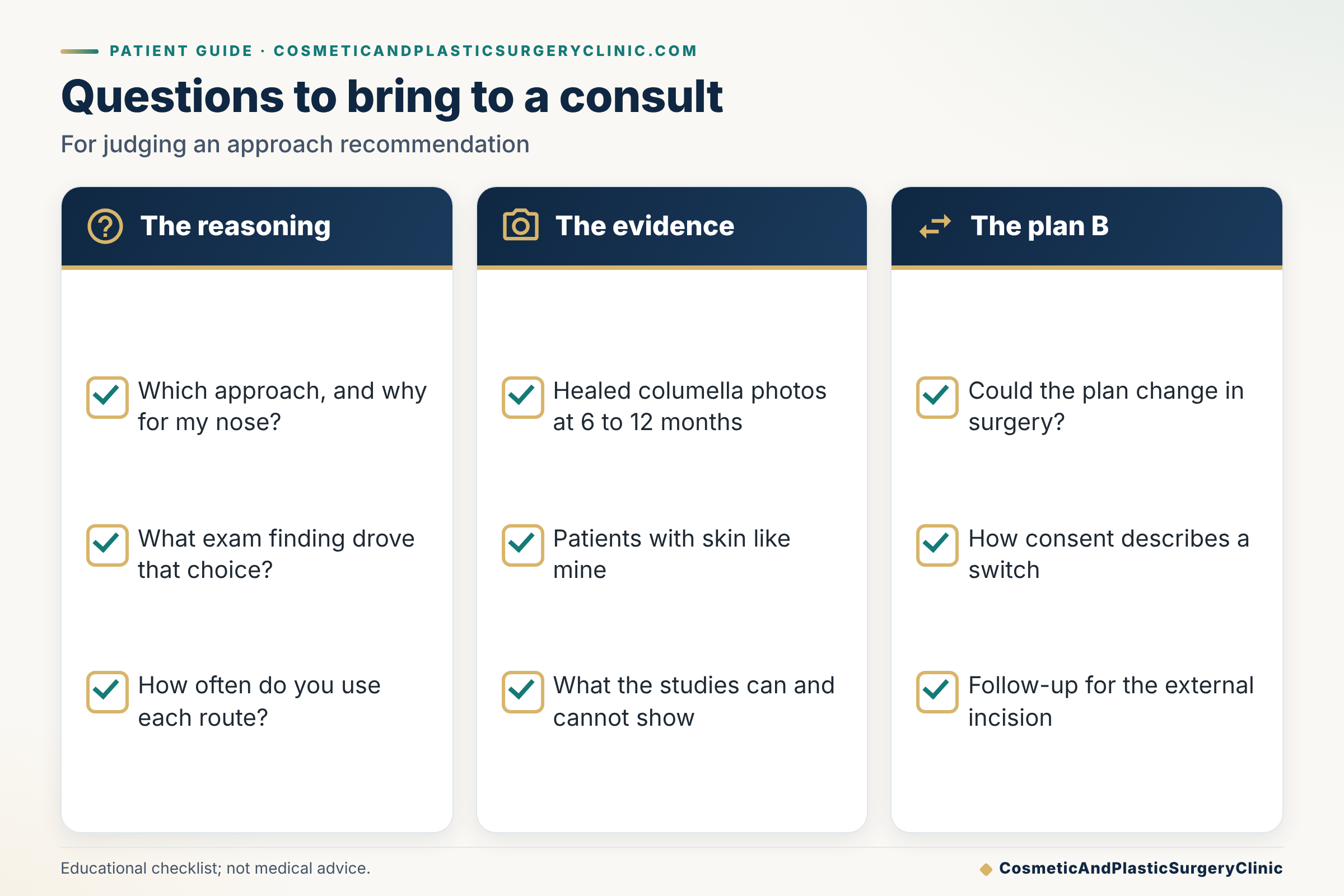
Ask which approach the surgeon recommends for you, and what finding on your exam led to the open vs closed rhinoplasty recommendation. Ask what share of their primary operations are done each way, whether they can show columella views from six to twelve months after open surgery, and what would make them change plans in the operating room. Ask how the consent form describes conversion from one route to the other and what the follow-up schedule is for the external incision.
Ask also about board certification and operating privileges; the cosmetic surgeon credentials page explains what different titles do and do not tell you. For candidacy factors such as skin thickness and goals, see the rhinoplasty candidate article.
What a good answer sounds like, and what an evasive one sounds like
A reasoned answer about open vs closed rhinoplasty ties the approach to your anatomy and goals, names a trade-off, and admits where evidence is limited. For example: closed would keep everything inside the nostrils, but the tip support you want probably needs grafts I can place more precisely with a direct view. An evasive answer is generic, relies on a slogan such as scar-free or the best technique, or treats the choice as obvious for every nose.
If the explanation does not satisfy you, a second opinion is a normal step. Two surgeons recommending different routes is not by itself a red flag; it becomes one when neither can say what their route would let them do that the other would not.
Frequently asked questions
Does open vs closed rhinoplasty change how natural the nose looks?
In open vs closed rhinoplasty, the approach is not what determines the shape. The plan for the bone, cartilage and tip does, along with skin thickness and how the tissue heals. Surveys and reviews describe route as access, not as a style. If a surgeon says one approach gives a more natural result in general, ask which finding on your exam supports that, and ask to see healed photos of patients with anatomy similar to yours.
Can I choose open vs closed rhinoplasty myself?
You can state a preference and the reason for it, such as worry about a visible scar or about swelling before an event. The surgeon then weighs it against what the operation needs. A surgeon should be able to explain what each route would allow for your anatomy. If the answer is that your goals need exposure, you can ask whether the goals themselves could be adjusted, or seek a second opinion.
Is open vs closed rhinoplasty a question of safety?
Published reviews have not found that. The 2025 meta-analysis found no significant difference in complication rates, and the 2022 review found no overall advantage. Both caution that the studies are mixed in quality. Risk depends heavily on the surgeon, the facility, anesthesia and the specific changes planned. Neither label makes an operation low-risk, which is why the questions above matter more than the term.
Will insurance treat open vs closed rhinoplasty differently?
The ASPS cost page ties coverage to whether the surgery improves breathing for an obstructed airway, which it calls reconstructive, and to a detailed examination and prior authorization, not to the approach. Cosmetic changes are generally billed separately. Policies vary, so ask the surgeon’s office what it would submit, and ask your insurer what it requires before surgery rather than after.
Could my open vs closed rhinoplasty plan change during the operation?
It is worth asking before the day. Some surgeons plan for that possibility and cover it in the consent discussion; others plan a single approach. Ask what would trigger a change, how it would affect the incision and healing, and whether the quote assumes it. A plan that has been thought through should come with a clear answer, not a shrug.
After a first closed operation, must a second open vs closed rhinoplasty decision favor open?
No. Surveys show revisions are more often done open, particularly by a surgeon new to the case, but that is a tendency and not a rule. The route depends on what the new surgeon finds, such as scar tissue, missing support and what grafts are needed. Operative records from the first surgery help, and the revision rhinoplasty article covers how to gather them.
When does the nose look settled after open vs closed rhinoplasty?
ASPS says it can take up to a year for the contour to fully refine, with swelling that may come and go and be worse in the morning during the first year. Mayo Clinic describes eyelid swelling lasting two to three weeks and nasal swelling lasting up to a year. If an open operation was done, ask separately how the columellar line is expected to look at six and twelve months.
Sources and further reading
- American Society of Plastic Surgeons — Rhinoplasty procedure steps (accessed 2026-11-12) — open and closed definitions, anesthesia, grafts, splints
- American Society of Plastic Surgeons — Rhinoplasty cost (accessed 2026-11-12) — average surgeon fee, exclusions, insurance for breathing-related surgery
- American Society of Plastic Surgeons — Rhinoplasty recovery (accessed 2026-11-12) — swelling in the first year, time to refine
- American Society of Plastic Surgeons — Rhinoplasty overview (accessed 2026-11-12) — purpose and the asymmetry caveat
- Mayo Clinic — Rhinoplasty (accessed 2026-11-12) — inside or external incision, risks, splints, healing ranges
- Gupta et al. — Outcomes of closed vs open rhinoplasty: a systematic review, Archives of Plastic Surgery 2022 (accessed 2026-11-12) — 20 studies, no randomized trials, no overall advantage
- Abi Zeid Daou et al. — Outcomes of open versus closed rhinoplasty, systematic review and meta-analysis, Plastic and Reconstructive Surgery Global Open 2025 (indexed record, accessed 2026-11-12) — 1,067 patients, no significant differences
- Kiliç et al. — Rhinoplasty technique and lateral osteotomy on periorbital edema and ecchymosis, Journal of Craniofacial Surgery 2015 (abstract record, accessed 2026-11-12) — early swelling and bruising
- Comparative outcomes in functional rhinoplasty with open vs endonasal spreader graft placement, Annals of Plastic Surgery 2018 (abstract record, accessed 2026-11-12) — breathing scores, operative time
- Yağmur et al. — Columellar scar perception in open rhinoplasty, Aesthetic Plastic Surgery 2017 (accessed 2026-11-12) — 91 patients, scar awareness and satisfaction
- Okur et al. — Comparison of nasal senses following open and closed rhinoplasty, Turkish Journal of Medical Sciences 2016 (accessed 2026-11-12) — sensation recovery
- Lee, Unger, Gryskiewicz and Rohrich — Current clinical practices of the Rhinoplasty Society members, Annals of Plastic Surgery 2013 (abstract record, accessed 2026-11-12) — approach choice in primary and secondary surgery
- Adamson and Galli — Rhinoplasty approaches: current state of the art, Archives of Facial Plastic Surgery 2005 (abstract record, accessed 2026-11-12) — 178-surgeon survey of indications and incisions
- Medscape — Basic open rhinoplasty (Arneja, updated 2023; accessed 2026-11-12) — indications, advantages, disadvantages, history
- Washington University West County Plastic Surgeons — Differences between open and closed rhinoplasty (clinic FAQ, accessed 2026-11-12) — patient-facing description of incisions and swelling
- Kosins, Roostaeian and Stubenitsky — Reflections on the evolution of rhinoplasty, Aesthetic Surgery Journal 2026 (accessed 2026-11-12) — brief history of the external approach