Capsular contracture is one of the most common reasons a breast implant ends up needing more surgery, and one of the harder complications to predict. The FDA describes it as hardening of the breast around the implant: the breast can feel firm, look rounder or sit higher on the chest, and in its more severe forms it hurts. Some people notice it within months of surgery, others years later, and many never do.
This article handles one decision: understanding capsular contracture well enough to ask a surgeon good questions. It explains how the Baker scale works and where it falls short, what ten-year data from two FDA core studies show, which risk factors have support, what nonsurgical and surgical treatments are used, and how to plan for cost and coverage. It is general education, not a diagnosis. The wider picture of life after implants, including exchange, removal and repair, sits in the breast implant revision overview.
What capsular contracture is and how surgeons grade it
How a normal scar capsule becomes a tight one
Every implant gets a capsule; capsular contracture is the tightening
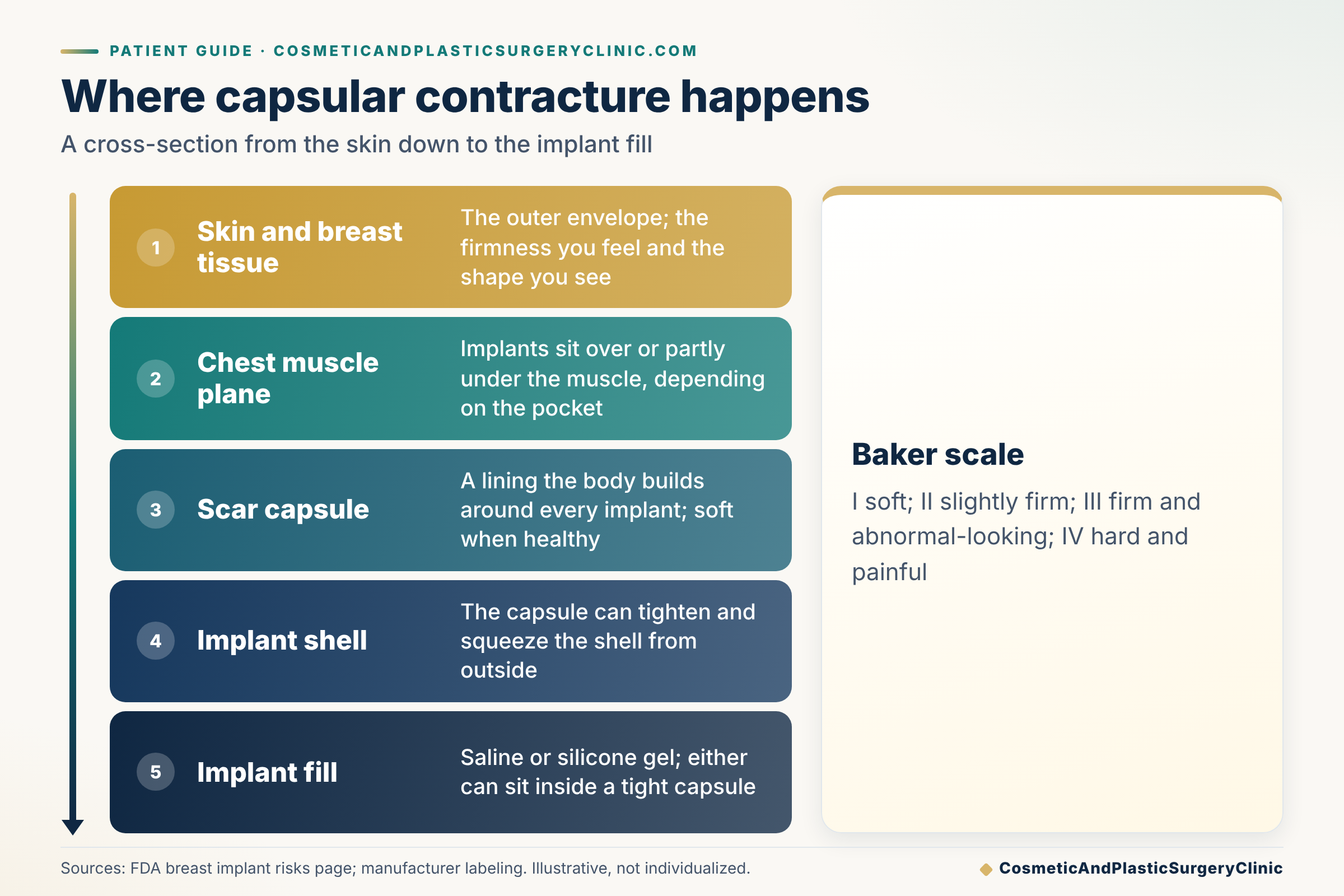
The body treats a breast implant as a foreign object and walls it off with a thin lining of scar tissue called a capsule. In most people that lining stays soft and does its job quietly, helping hold the implant in place. Capsular contracture is what happens when the lining tightens. The FDA describes it as tightening of the tissue capsule that causes firmness and, if severe, squeezes the implant. It can affect one breast or both.
A squeezed implant changes how the breast looks and feels. The breast may turn firmer and rounder, ride higher, lose its natural drape, or become tender. Capsular contracture is a problem of the scar lining, not of the implant shell, and it is not the same thing as a rupture, although the two can overlap. One manufacturer’s FDA-reviewed patient labeling lists capsular contracture as a risk factor for rupture, which is one reason a surgeon will think about both when a breast changes. The breast implant rupture article covers the other half of that pairing.
What is and is not known about why capsular contracture forms
The FDA states plainly that the cause of capsular contracture is not known. Its patient page adds that the complication may be more common after infection, hematoma (a collection of blood) or seroma (a collection of fluid). That is an association, not a recipe: many people have a hematoma and never develop capsular contracture, and many develop it with no such event.
The explanation most often offered is a thin, low-grade bacterial film on the implant surface that keeps the tissue chronically inflamed. A 2023 review in Aesthetic Plastic Surgery lists biofilm, surgical site infection, earlier contracture or fibrosis, radiation and implant characteristics among the factors discussed.
A 2016 paper in Plastic and Reconstructive Surgery Global Open by Eric Swanson argues the biofilm story is incomplete: cultures are often positive in women without contracture, contracture can appear years after surgery, and it is more frequent after reconstruction. He points to mechanical theories involving abnormal collagen and scar cells instead. The practical lesson is humility. Advice built on a single theory of capsular contracture may not fit every patient.
The Baker scale in plain language
Four grades of capsular contracture and what each means for next steps
The grading system the FDA lists is the Baker scale. It sorts capsular contracture by how the breast feels and looks, from soft and natural (grade I) to hard, painful and abnormal-looking (grade IV). The FDA calls grades III and IV severe and says they may require reoperation, which usually means removing the implant with or without replacing it.
| Baker grade | How the breast feels and looks | What the FDA says | What it usually prompts |
|---|---|---|---|
| I | Soft and natural-looking | Described as normally soft | Routine follow-up |
| II | A little firm but looks normal | Not classed as severe | Watching for change; surgeon discussion if it bothers you |
| III | Firm and looks abnormal | Severe; may require reoperation | A surgical consultation about options |
| IV | Hard, painful and looks abnormal | Severe; may require reoperation | A surgical consultation; pain is a reason not to wait |
Why a grade is a starting point rather than a verdict
The Baker scale is a clinical description, judged by looking and feeling. It gives surgeons and patients a shared vocabulary, but it is a snapshot. Two breasts with the same grade can differ in pain, shape and how much the person is bothered, and a grade II breast that is tender or visibly changing may deserve a different conversation than a stable one.
Decisions about capsular contracture therefore rest on several things together: symptoms, trajectory over time, what a surgeon finds on examination, and what you want your breasts to look and feel like. The scale also has measurable limits as an instrument, which the research note later in this article describes.
How common capsular contracture is, and how often it returns
Ten-year numbers from two FDA core studies
Primary augmentation: about 12% and 19% in two different studies
Silicone gel implants from two manufacturers were approved in November 2006 on the strength of core studies that followed patients for ten years. Those studies remain the best-documented source on how often capsular contracture develops. A 2021 report in Plastic and Reconstructive Surgery (Caplin and colleagues) followed 1,008 patients with 1,898 implants. Using Kaplan-Meier estimates per patient, grade III or IV capsular contracture reached 12.1% at ten years among the 552 primary augmentation patients.
A 2014 report in the same journal (Spear and Murphy) covered 715 patients enrolled from 1999 to 2000 in a different manufacturer’s core study. Its ten-year estimate for primary augmentation, based on 455 patients, was 18.9%.
The two numbers should not be read as one device beating another. The devices, study designs and populations differ, they were not tested head to head, and follow-up was incomplete: 62% overall at ten years in the first, 66.6% in the second. The first was sponsored by its manufacturer, and two of its authors are company employees; the second was reported on behalf of the other manufacturer’s core study group. Who stays in a long study can nudge estimates in either direction.
Rates climb with time, and contracture is a leading reason for reoperation
A single ten-year figure hides a slope. The patient labeling for the second study’s device reports grade III or IV capsular contracture in primary augmentation of 10.7% at year 3, 13.0% at year 5, 16.2% at year 7 and 18.9% at year 10. A 2015 report on a different, form-stable gel implant noted that rates rose about 1% per year from the six-year figures. A low early number for capsular contracture is therefore not a final number, and any quoted rate should come with its years attached.
The same labeling tallies why patients went back to the operating room. Of 221 reoperations in primary augmentation through year 10, 55 (24.9%) were for capsular contracture, the most common single reason, ahead of suspected rupture (29), biopsy (28) and malposition (27). The FDA’s 2011 safety update said that in the core studies 20 to 40 percent of augmentation patients had a reoperation within eight to ten years, and the FDA’s patient page adds that implants are not lifetime devices.
Revision, reconstruction and recurrence
Higher rates after revision surgery and after mastectomy
Both core studies reported separate cohorts, and capsular contracture ran higher outside first-time cosmetic augmentation. The patient labeling says so directly: contracture occurs more commonly in revision augmentation than in primary augmentation. Reconstruction cohorts differ from augmentation cohorts in tissue quality and treatment history, including radiotherapy for some patients, and a 2015 review lists earlier radiotherapy among its risk factors.
| Cohort | Study A (Caplin 2021) | Study B (Spear 2014) | How to read it |
|---|---|---|---|
| Primary augmentation | 12.1% (552 patients) | 18.9% (455 patients) | Different devices and designs; not head to head |
| Revision augmentation | 24.4% (145 patients) | 28.7% (147 patients) | Higher than the primary rate in both studies, by about 1.5 to 2 times |
| Primary reconstruction | 20.5% (251 patients) | 24.6% (98 patients) | Different tissue and treatment history |
| Revision reconstruction | 36.9% (60 patients) | Too few patients (15) to analyze | Small cohort; wide uncertainty |
What recurrence data exist, and how to read them
The FDA and the manufacturer labeling both warn that capsular contracture can happen again after corrective surgery. How often is harder to pin down. A 2016 systematic review by Dinah Wan and Rod Rohrich found 24 usable articles on surgical treatment and none were controlled trials. Its conclusion was that site change and implant exchange appear to lower recurrence, that evidence for capsulectomy is less conclusive, and that clinical evidence overall is limited. A 2015 narrative review of 82 studies made a similar point: nearly all treatment approaches have a significant recurrence rate.
Single-surgeon series fill part of the gap, with limits. In Swanson’s review of 75 women treated with open capsulotomy between 1996 and 2016, contracture returned in 22.7% and a second time in 2.7%. It returned more often when a ruptured silicone gel implant was present. It was retrospective, from one surgeon, with no control group. For your own planning, a reasonable question is what recurrence a surgeon has seen with the specific approach being proposed, framed as experience and not as a promise.
One more reading tip. A ten-year estimate of 12.1% does not mean 12.1% each year, and it is not your personal probability. It describes a group followed over a decade, and individual risk depends on implant, pocket, history and chance.

Capsular contracture symptoms, warning signs and what an evaluation looks at
What people notice, and what should not wait
Gradual changes that usually call for a scheduled visit
Capsular contracture tends to announce itself slowly. People describe a breast that feels firmer than its partner, looks rounder or more “stuck on,” sits higher over time, or has lost the natural movement it once had. Tenderness can appear, and in grade IV pain is part of the definition. Some people with grade II or III changes feel little or no pain, according to one plastic surgeon’s description on an ASPS blog, so the absence of pain does not rule anything out.
Firmness in the first weeks after surgery is expected as swelling settles, and the breast augmentation recovery article describes that arc. What deserves a scheduled visit is firmness that is new after the breast had settled, that is getting worse, or that differs noticeably between sides. Bring dated photos if you have them. Comparing today against an earlier picture is often the clearest evidence of change that a surgeon can get.
| What you notice | Usual category | Level of response | Basis |
|---|---|---|---|
| Tightness, swelling and firmness in the first weeks after surgery | Expected effect | Follow your surgeon’s recovery instructions; mention if it worsens | General recovery pattern |
| Firmness or shape change developing over months, one side or both | Possible capsular contracture | Schedule an examination with your surgeon | FDA description; Baker scale |
| Hard, painful breast that looks distorted | Complication (Baker grade IV) | Prompt consultation about options | FDA grade definitions |
| Sudden swelling, warmth, redness or fever | Possible infection or fluid collection | Same-day call to your surgeon | Mayo Clinic infection signs |
| New fluid around an implant years after surgery | Needs prompt evaluation | Contact your surgeon quickly; see the BIA-ALCL article | FDA BIA-ALCL page |
| Chest pain or shortness of breath | Emergency | Call 911 or go to emergency care | Mayo Clinic |
Know the warning signs that should not wait
A breast that has changed abruptly after years of stability, or any suspicion that an implant has ruptured, also warrants prompt evaluation. These are separate problems from gradual capsular contracture even when they feel similar at first.
How a surgeon evaluates a firm breast
History, examination and baseline photos
A good evaluation starts with questions: when the change began, which side, whether it is steady or worsening, and what happened around the original surgery, such as a hematoma, an infection, drain problems or radiation. The surgeon will want the implant type, size, pocket and incision from your operative record. Then comes an examination, often standing and lying, comparing both breasts for firmness, position, shape and tenderness, followed by a Baker grade.
Consider a hypothetical patient, four years after augmentation, who notices her left breast has become firmer and sits higher than the right over about six months. Her phone holds a photo from the one-year check. That picture, her operative record and an examination give a surgeon far more to work with than her description alone. The result is a grade and a shortlist of explanations, not an automatic recommendation to operate.
When imaging enters, and which other problems can look alike
Assigning a Baker grade is an examination task, not an imaging one. Ultrasound or MRI comes in when the question is something else: a possible rupture, fluid around the implant, or a lump. Separately, for silicone gel implants the FDA recommends imaging to look for silent rupture five to six years after placement and every two to three years thereafter, as Mayo Clinic and ASPS both summarize. The breast implant screening article explains what those scans can and cannot show.
Firmness is not automatically capsular contracture. A hematoma or seroma, an infection, an implant that has shifted position, and a rupture can all change how a breast feels. They matter because treatment differs, and because they interact: the labeling links contracture and rupture, and Swanson’s series found recurrence higher when a ruptured silicone implant was present. Sorting out which problem is present is the surgeon’s first job, and a reason to be wary of anyone who offers a treatment before examining you.
Capsular contracture risk factors, and what the evidence says about lowering them
Factors with the most consistent signals
Implant surface, pocket plane and fill type
A 2025 systematic review and meta-analysis in Aesthetic Surgery Journal Open Forum (Haas and colleagues) pooled 24 studies. Smooth implants had higher odds of grade III or IV capsular contracture than textured ones (odds ratio 2.80, 95% confidence interval 1.92 to 4.08, from 16 studies). Subpectoral placement (under the chest muscle) had lower odds than prepectoral placement (over it) (odds ratio 0.35, 0.25 to 0.50, from 11 studies). Saline versus silicone showed no significant difference, but the estimate was too imprecise to rely on (0.39, 0.02 to 6.69, from 3 studies).
The authors are candid about the evidence. It is low level, with few large randomized trials, most studies at high risk of bias, half from the 1980s and 1990s, and wide differences between studies. The direction matches the second core study, where ten-year grade III or IV capsular contracture in augmentation was 15.7% for submuscular placement versus 26.3% for subglandular (p = 0.023). A 2015 review also listed smooth surfaces, subglandular placement, silicone fill and earlier radiotherapy as risk factors. The over versus under the muscle comparison covers the trade-offs of each pocket, and saline versus silicone implants covers fill.
Surface choice is not free of other consequences. The FDA reports that, as of June 30, 2024, 1,010 of 1,380 BIA-ALCL cases (73%) in its device reports involved textured implants, while noting that these passive reports cannot establish incidence or cause. The labeling also records that the textured device used in that core study was recalled in July 2019. A lower contracture signal with texture therefore has to be weighed against a separate safety question, covered in the BIA ALCL breast implants article.
Infection, hematoma, seroma and radiation
The FDA names infection, hematoma and seroma as events after which capsular contracture may be more common. One surgeon’s ASPS blog post suggests hematomas and seromas may raise risk by feeding bacterial biofilm, a plausible mechanism but not a proven one. Earlier radiotherapy appears in the 2015 review’s list. These factors share a theme: anything that leaves blood, fluid or bacteria in the pocket is treated as a threat to a quiet, soft capsule.
| Factor | Why it may matter | Question to ask | How firm is the evidence |
|---|---|---|---|
| Smooth versus textured surface | Pooled studies show higher odds with smooth devices | Which surface do you advise for me, and what does it trade away? | Consistent in pooled data but heterogeneous; BIA-ALCL context applies |
| Pocket plane | Placement under the muscle linked to lower odds | Why this pocket for my tissue and goals? | Consistent direction in two sources; low-level studies |
| Infection or biofilm | Leading but contested explanation | How do you limit bacteria in the pocket? | Association; causation debated |
| Hematoma or seroma | FDA links them to more contracture | What is your plan if blood or fluid collects? | Association; no recipe |
| Earlier radiotherapy | Listed in a 2015 review | How does my treatment history change the plan? | Review-level; mostly reconstruction |
| Earlier contracture or revision | Rates higher in revision cohorts | What changes this time to avoid repeating it? | Consistent in both core studies |
What surgeons do to lower risk, and how much proof exists
Pocket irrigation, handling and technique
Surgeons commonly rinse the implant pocket with an antimicrobial solution and minimize contact between the implant and skin. The proof behind the details is thinner than the confidence with which they are sometimes described. A 2023 review by Giuzio and colleagues found no universally accepted guideline for pocket irrigation and called the evidence inconsistent, noting that a survey of ASPS members had identified more than 35 different solutions.
A 2025 meta-analysis of 27 studies compared irrigation solutions. It reported that povidone-iodine had the lowest infection frequency and a triple antibiotic solution had the lowest capsular contracture frequency, while saline and the triple solution had the highest infection frequencies and saline and povidone-iodine had higher contracture frequencies.
The triple solution in those studies contained bacitracin, which is no longer available in solution form, so the authors called for research on alternatives. The 2023 review adds that practice has shifted over time: the FDA’s warning against povidone-iodine pocket irrigation was in place from 2000 until 2017. Ask which solution your surgeon uses and why, and treat any answer that sounds certain as a red flag.
Massage and other prevention claims
Post-operative breast massage is among the most repeated prevention tips. A 2017 review in ePlasty (Sood and colleagues) searched literature from 1975 to 2017 and found only four small studies with 587 patients in total, mostly published between 1976 and 1990, with steroid use clouding the results. The authors concluded that the available data do not support massage to prevent capsular contracture. That does not make massage harmful in every case, and some surgeons still recommend it. It means you should follow your own surgeon’s instructions and not start manipulating the breast without permission.
Prevention claims for supplements, devices or creams deserve the same skepticism. No device is FDA-cleared to reduce the incidence of capsular contracture, and the evidence on medications is discussed under treatment below. The honest summary is that technique, pocket choice and avoiding hematoma and infection are sensible, while no step is known to eliminate capsular contracture. The plastic surgery risks article explains how to read that kind of uncertainty.
Treating capsular contracture: what is tried and how well it holds
Nonsurgical approaches and their limits
Medication and energy-based devices
The FDA states that it has not cleared or approved any device to treat or reduce the incidence of capsular contracture. That sentence is worth keeping in mind when a practice advertises a noninvasive fix. A 2018 ASPS blog post by one surgeon described an ultrasound-based therapy for grade II and III capsular contracture, alongside a note that the views were the author’s own and did not necessarily reflect ASPS. It did not cite studies for its effectiveness claims. An energy treatment may or may not help, but the burden of proof sits with whoever is selling it.
Medication is the other nonsurgical route. Leukotriene receptor antagonists such as montelukast are asthma and allergy drugs that have been tried off label for capsular contracture. A 2026 systematic review in Aesthetic Plastic Surgery (Prosenz and colleagues) found five studies with 1,343 patients, with follow-up from five months to two years. For prevention, montelukast lowered contracture rates, mainly in grade I and II breasts; in one study contracture developed in 9.5% of treated breasts versus 21% of untreated.
For established grade III or IV capsular contracture, the effect was limited: in one study 63% of patients improved and 3% resolved completely, and most still needed surgery. The review was a narrative synthesis without pooled effect sizes, and the authors called for randomized trials.
There is a safety footnote. In March 2020 the FDA required a boxed warning for montelukast about serious neuropsychiatric events and advised prescribers to avoid it for patients with mild symptoms, particularly allergic rhinitis. That does not settle whether the drug has a role after breast surgery, but it is a reason the decision belongs in a prescriber-led risk and benefit conversation, not in an online forum.
Why squeezing the breast is not a home remedy
Forceful manual squeezing to break the capsule is called closed capsulotomy. The manufacturer’s FDA-reviewed patient labeling is blunt about it: the method does not require surgery but may rupture the implant, and it is contraindicated. The same document lists excessive force to the chest, with closed capsulotomy as the example, as a possible cause of rupture.
That is a different thing from the gentle displacement massage some surgeons prescribe after surgery, and from a surgeon’s open procedure. If someone offers to “pop” or crush a firm capsule by hand, or you are tempted to do it yourself, the labeling gives you a clear reason to decline.
Surgical options and what each trades off
Capsulotomy, capsulectomy, pocket change and exchange
Surgical treatment of capsular contracture covers a range. The labeling describes it as running from removal of the capsule tissue to removal and possible replacement of the implant itself. In practice surgeons combine a few building blocks, set out in the table below. None is certain to work, and the labeling says capsular contracture may happen again after these additional operations.
| Option | What is done | Why it may be chosen | Main trade-off |
|---|---|---|---|
| Capsulotomy | The tight capsule is cut open (released) and the implant is reinserted or replaced | Less dissection than removing the capsule | Reported recurrence of 22.7% in one single-surgeon series |
| Capsulectomy | Part or all of the capsule is removed | Removes scarred tissue; tissue can be examined | More dissection, bleeding and operating time; evidence for lower recurrence is inconclusive |
| Site change (new pocket) | The implant moves to a different plane, for example from over to under the muscle | A fresh pocket with healthier tissue | Longer operation; the implant sits differently afterward |
| Implant exchange | The old implant is replaced, often combined with the steps above | Swaps a device that may be part of the problem | Added device cost; uncertainty over recurrence persists |
| Removal without replacement | The implant is taken out, with or without removing the capsule | Ends the cycle of further implant surgery | The breast looks different afterward; lift or fat grafting may be discussed |
The best summary of the evidence remains the 2016 systematic review: no controlled trials, site change and implant exchange associated with lower recurrence, capsulectomy less conclusive. Swanson argues that open capsulotomy deserves reconsideration because capsulectomy adds morbidity and cost; in his series it corrected the problem with one operation in 77.3% of patients and two in 97.3%. Both views come from observational data. They show why two reasonable surgeons can propose different operations, and why asking each to explain the choice is worth the time. For what each path involves in detail, see breast implant exchange and breast implant removal.
Dermal matrix, fat grafting and the limits of the data
Surgeons sometimes add acellular dermal matrix, a processed tissue sheet, to reinforce the pocket during revision. A 2013 retrospective review in Aesthetic Surgery Journal covered 197 revisions in 197 patients between 2005 and 2011; capsular contracture was the reason for revision in 61.8%. After a mean follow-up of 3.1 years, 98% were judged successful with no recurrence of the presenting complaint, and grade III or IV contracture appeared in 1.6%. That is encouraging but uncontrolled, and the 2016 review called matrix a possibly useful adjunct needing long-term data. A 2015 review described fat grafting as emerging.
Waiting is also an option for stable, mild changes, as is a second opinion before any operation. The more operations an implant history already contains, the more a clear written plan helps, and the cornerstone revision overview describes how surgeons build one. Every additional operation carries its own anesthesia and healing risks, and the trade-off between another attempt to preserve implants and a different route is a personal one.
Planning for capsular contracture: cost, coverage and six questions for your surgeon
Money, coverage and warranty paperwork
What drives the cost of treating capsular contracture
A bill for capsular contracture surgery is built from the same parts as other implant operations, and the scope decides most of the total: the surgeon’s fee, the facility, anesthesia time, new implants if they are being replaced, a dermal matrix if one is used, and pathology if the capsule is sent to a laboratory. A release of the capsule with the same implant is a different operation from a full capsule removal with a new pocket and new devices, and the quotes will differ accordingly.
This article gives no dollar figures because no verified current national average for contracture-specific revision turned up in the sources reviewed, and an unrelated average would mislead. The breast implant revision cost article breaks a quote down line by line and shows what to compare between two of them.
Insurance and manufacturer warranty programs
The FDA warns that some insurers do not cover implant removal or replacement even when complications occur, so coverage for capsular contracture is something to confirm, not assume. Ask for a written coverage determination before scheduling, and keep dated photos, exam notes and records of any pain, because coverage rules often turn on documented symptoms. Plans often draw a line between cosmetic and medically indicated surgery, and the definitions are the plan’s own, so what your plan says is the only answer that counts.
Manufacturers also run warranty or replacement programs, and their terms vary by device, by date of surgery and by what they pay for. Some cover only the device; some contribute to costs of the operation for a set period. Read the current terms in writing, ask whether capsular contracture qualifies and for how long, and find out what documentation you must hold, such as your implant identification details from the operative record. Terms change, so use the manufacturer’s current document and not a forum summary.
Six questions to bring to a consultation
If you are choosing implants and want to lower the odds
These first three apply before a first or replacement operation. Written answers, or notes you make during the visit, are easier to compare across surgeons than memory. The plastic surgery consultation article covers the visit more broadly, and choosing a plastic surgeon covers verification.
- Which implant surface and pocket do you recommend for my tissue, and what do I give up with each choice, including the BIA-ALCL question for textured devices?
- What do you do in the pocket to limit bacteria and bleeding, such as irrigation solution and handling, and what is your plan if blood or fluid collects?
- What contracture and reoperation experience do you have with this plan, and over how many years of follow-up?
If a breast already feels firm or looks different
These three apply once something has changed. They steer a surgeon away from a one-size answer and toward the particular breast in front of them.
- What grade do you assign, and what else, such as rupture, fluid or infection, do you need to rule out and with which test?
- If we wait, which changes would make you recommend treatment; if we operate, which option do you propose, why that one, and what recurrence do you expect based on what?
- What will the total cost be, including pathology, new devices, facility and anesthesia, what do my insurance and manufacturer warranty cover, and what does your revision policy say if it returns?

Frequently asked questions
Does capsular contracture always need surgery?
Not necessarily. The FDA says grades III and IV are considered severe and may require reoperation, which leaves room for judgment. Milder changes may be watched over time, and a surgeon may suggest treatment earlier if the breast is tender, visibly changing or bothering you. The decision rests on symptoms, how fast things are changing and your goals, plus what an examination shows. Waiting for a stable, mild change and asking for a second opinion are both reasonable, and neither commits you to an operation.
Can capsular contracture happen with saline implants too?
Yes. Capsular contracture is a reaction of the scar lining and is described for both saline and silicone gel implants. The 2025 meta-analysis found no significant difference between the two fills, though its estimate was too imprecise to draw firm conclusions, with a very wide confidence interval from only three studies. The core-study numbers cited here come from silicone gel devices, so they should not be read across to saline. If you have saline implants, the same symptoms and the same urgency rules apply.
Can capsular contracture affect only one breast?
Yes. The FDA notes that it can affect the tissue around one or both implants, and one-sided changes are common enough that comparing the two breasts is part of an examination. Because the sides can differ, a surgeon looks at firmness, position and shape side by side, and may ask when the difference began. A one-sided change is also a reason not to assume the cause: a collection of fluid, an infection or a rupture can look similar, so an examination matters before anyone chooses a treatment.
Do I need an MRI or ultrasound to confirm capsular contracture?
Usually the grading itself is based on examination, since the Baker scale describes how the breast feels and looks. Imaging comes in for different questions, such as a possible rupture, fluid around the implant or a lump, and for the routine rupture screening the FDA recommends for silicone gel implants five to six years after placement and every two to three years afterward. Whether imaging helps in your case is your surgeon’s call. The screening article in this series explains what each scan can and cannot show.
Does capsular contracture mean something is wrong with my health overall?
The FDA lists capsular contracture as a local complication, a change in the tissue around the implant, not a sign of systemic illness. It is separate from the other implant questions people raise, such as BIA-ALCL, a rare lymphoma associated mostly with textured devices, or whole-body symptoms some patients report, which have their own articles. If you have new whole-body symptoms, mention them to a clinician along with any breast changes, because the right evaluation differs.
Will a different implant stop capsular contracture from coming back?
Nobody can promise that. The FDA and the manufacturer labeling both say it can happen again after corrective surgery. The 2016 systematic review suggests site change and implant exchange are associated with lower recurrence than some other approaches, but it found no controlled trials, so the evidence is limited. A reasonable approach is to ask a surgeon what they plan to change this time, such as pocket, surface or technique, and what recurrence they have seen with that plan.
How should I document symptoms for a surgeon or an insurer?
Keep it simple and dated. Take photos from the front and sides in the same lighting every few weeks, write down when firmness, pain or position changes began, and note which side. Keep your operative record, implant details and any earlier exam notes together. Because the Baker scale is subjective, a clear timeline helps a surgeon see change and gives an insurer concrete records. It does not replace an examination, and sudden swelling, fever or chest pain should prompt a call to your surgeon or emergency care, not a photo.
Sources and further reading
- U.S. Food and Drug Administration — Risks and Complications of Breast Implants (accessed 2026-11-12) — definition, Baker grades, no cleared treatment device, insurer coverage note
- U.S. Food and Drug Administration — Update on the Safety of Silicone Gel-Filled Breast Implants, 2011 executive summary (accessed 2026-11-12) — core study sizes and reoperation ranges
- U.S. Food and Drug Administration — Medical Device Reports of Breast Implant-Associated Anaplastic Large Cell Lymphoma (accessed 2026-11-12) — textured-implant share of reported BIA-ALCL cases as of 2024-06-30
- Allergan (AbbVie) — Silicone gel breast implants patient labeling for augmentation (accessed 2026-11-12) — Baker III/IV by year, reasons for reoperation, closed capsulotomy, recurrence statements
- Spear and Murphy — Natrelle round silicone breast implants: Core Study results at 10 years, Plastic and Reconstructive Surgery, 2014 (accessed 2026-11-12) — ten-year contracture and reoperation by cohort
- Caplin, Calobrace, Wixtrom, Estes and Canady — MemoryGel breast implants: final safety and efficacy results after 10 years of follow-up, Plastic and Reconstructive Surgery, 2021 (accessed 2026-11-12) — ten-year contracture and reoperation by cohort, follow-up and sponsor
- Maxwell, Van Natta, Bengtson and Murphy — Ten-year results from the Natrelle 410 anatomical form-stable silicone breast implant core study, Aesthetic Surgery Journal, 2015 (abstract record, accessed 2026-11-12) — contracture rising about 1% per year
- de Bakker and colleagues — The Baker classification for capsular contracture in breast implant surgery is unreliable as a diagnostic tool, Plastic and Reconstructive Surgery, 2020 (abstract record, accessed 2026-11-12) — observer agreement, kappa 0.55
- Haas and colleagues — Capsular contracture after breast augmentation: a systematic review and meta-analysis, Aesthetic Surgery Journal Open Forum, 2025 (accessed 2026-11-12) — surface, plane and fill odds ratios, evidence caveats
- Headon, Kasem and Mokbel — Capsular contracture after breast augmentation: an update for clinical practice, Archives of Plastic Surgery, 2015 (abstract record, accessed 2026-11-12) — risk factors, treatment overview, recurrence
- Wan and Rohrich — Revisiting the management of capsular contracture in breast augmentation: a systematic review, Plastic and Reconstructive Surgery, 2016 (abstract record, accessed 2026-11-12) — limited evidence, site change and exchange, matrix
- Swanson — Open capsulotomy: an effective but overlooked treatment for capsular contracture after breast augmentation, Plastic and Reconstructive Surgery Global Open, 2016 (accessed 2026-11-12) — biofilm theory critique, recurrence in a single-surgeon series
- Giuzio and colleagues — Use of antimicrobial irrigation and incidence of capsular contracture in breast augmentation and immediate implant-based breast reconstruction, Aesthetic Plastic Surgery, 2023 (abstract and article page, accessed 2026-11-12) — irrigation evidence, risk factors
- Engels and colleagues — A meta-analysis of breast implant irrigation solutions’ effect on infection and capsular contracture frequencies, 2025 (abstract record, accessed 2026-11-12) — comparison of irrigation solutions
- Sood and colleagues — Breast massage, implant displacement, and prevention of capsular contracture after breast augmentation with implants: a review of the literature, ePlasty, 2017 (accessed 2026-11-12) — massage evidence
- Prosenz and colleagues — The role of montelukast in the prevention and treatment of capsular contracture (Baker grade III-IV): a systematic review and case analysis, Aesthetic Plastic Surgery, 2026 (abstract, accessed 2026-11-12) — medication evidence and limits
- U.S. Food and Drug Administration, as reproduced by Drugs.com — Montelukast boxed warning for serious mental health side effects, March 4, 2020 (accessed 2026-11-12) — neuropsychiatric boxed warning
- Aesthetic Surgery Journal — Efficacy of acellular dermal matrices in revisionary aesthetic breast surgery: a 6-year experience, 2013 (abstract record, accessed 2026-11-12) — 197 revisions, outcomes and limits
- American Society of Plastic Surgeons blog (Tehrani) — What is capsular contracture and how can it be treated? 2018 (accessed 2026-11-12) — one surgeon’s description; author’s views, not ASPS policy
- American Society of Plastic Surgeons — Breast augmentation safety (accessed 2026-11-12) — FDA-recommended screening timeline, advice to consult a board-certified surgeon
- Mayo Clinic — Breast augmentation, about (accessed 2026-11-12) — infection signs, urgent symptoms, imaging schedule