

Breast implant revision cost does not come from a price list, because “revision” covers operations that range from taking implants out to rebuilding the pocket, replacing the devices and adding a lift. Two quotes that share a name can describe different surgery, different facilities and different gaps in what is billed. Add a manufacturer warranty that pays for some events and not others, plus a health plan that may treat the same operation as covered or as cosmetic, and no single national average can tell you what you will owe.
This page is about reading a breast implant revision cost estimate: the line items, the planning choices that move them, what warranty documents and two 2026 insurer policies actually say, and how to set two quotes side by side. Why implants get revised at all is covered in the breast implant revision overview. This article is about money, not about whether to operate, and it cannot predict what any practice or plan will charge you.
What a breast implant revision cost estimate has to add up
An estimate is only as useful as the operation it describes. Before comparing totals, it helps to know which version of “revision” a quote assumes and which pieces a national figure leaves out.
One name, several different operations
From removal only to capsule work, new implants and a lift
The Aesthetic Society describes breast revision as surgery to remove implants, replace them or correct problems after augmentation, and says cost varies with the specific concern, the procedure and the implant type. In its framing, minimal procedures such as simple implant removal cost the least, while a total capsulectomy combined with a breast lift and reaugmentation sits at the expensive end.
ASPS lists the building blocks: exchanging old implants for new ones, reshaping the implant pocket, changing size, shape or style, and combining the exchange with a lift or reduction. Each block adds operating time, supplies or a second skill set. The sibling pages on breast implant removal and breast implant exchange explain the operations themselves; here the point is that a quote should name which blocks it includes.
The question that decides how to read every number
Ask each practice to write one sentence describing the operation it priced: implants out only, implants out with capsule removal, implants replaced in the same pocket, or any of those with a lift. Then ask what would change that plan once the surgeon sees the tissue during surgery, and what the change would cost.
A written plan with a contingency price is worth more than a low headline number. When the plan is vague, the breast implant revision cost on the invoice can differ from the quote for reasons that were never discussed.
What the national sources publish about breast implant revision cost
Printed fee figures: one for removal, none for revision
The ASPS revision cost page gives no dollar figure. It lists the pieces that may be billed (surgeon’s fee, hospital or surgical facility charges, implants, anesthesia, prescriptions, post-surgery garments, medical tests and x-rays) and says the implant warranty may cover some costs in some instances. The ASPS removal page gives $3,979 as the average cost, attributed to “the latest statistics,” with no year, and says it excludes anesthesia, operating room facilities and other related expenses.
The 2024 ASPS fee release, titled as average surgeon and physician fees, shows a projected range of $3,650 to $6,500 for implant removals in augmentation patients only, built from averages submitted by surveyed members. Its augmentation range of $4,575 to $8,000 covers “primary and/or revisions,” so even that row blends first-time and repeat operations. Primary pricing is covered in breast augmentation cost.
Why the Aesthetic Society page cannot fill the gap
The Aesthetic Society’s revision cost page lists no dollar amounts or averages at all. It ranks implant types from least to most expensive (saline, silicone gel, structured saline, cohesive silicone gel) and tells readers to ask the surgeon for an approximate cost. Its separate augmentation page reports $4,617 from 2022 databank statistics, covering surgeon and facility fees for primary surgery, and says nothing about revision, warranties or replacement.
The two societies also differ on insurance. The Aesthetic Society says insurance does not cover revision because it is elective cosmetic surgery, while ASPS says health insurance may cover it “in some instances.” The insurer policies later in this article show why both statements can be true for different patients.
One volume figure gives context without pricing anything. ASPS’s 2025 statistics report counts 45,773 implant removals in augmentation patients in 2025 and 45,780 in 2024, estimated from member surgeons, a complications-insurance partner and a claims dataset covering more than 3,000 surgeons. Many people face this decision, but that says nothing about whether any single quote is reasonable.
The lines on a complete quote
Surgeon, facility and anesthesia: three lines that follow the clock
ASPS says a surgeon’s fee may vary with experience and geographic location. The facility charge pays for the operating room, nursing, instruments and recovery space, and anesthesia is billed by the provider, sometimes as a separate invoice. Capsule work or a lift lengthens the case, and both facility and anesthesia lines usually track the clock.
A 2018 JAMA Surgery analysis of California hospital financial reports, summarized by the American Journal of Managed Care, put operating room cost at about $36 to $37 a minute across 302 facilities (reports from 2005 to 2014). That is a facility’s cost, not a patient charge, and earlier reports ranged from about $7 to over $100 a minute. It still shows scale: thirty extra minutes is on the order of $1,100 of cost behind the scenes.
An AORN Outpatient Surgery explainer describes anesthesia billing as base units fixed for the type of operation plus time units counted in 15-minute blocks, from the moment the provider enters the room until report is given to the recovery nurse. Its examples ran about $50 a unit for a private payer and about $22 for Medicare. It does not address self-pay prices, so ask whether anesthesia is a flat sum or an hourly rate with a base fee.
Devices, tests, garments and the follow-up that comes with them
New implants are often the single largest non-surgeon line, and they are absent when the plan is removal only. One advocacy-run information site, the National Center for Health Research’s Breast Implant Information page, estimated replacement implants at an additional $2,500 to $3,500 and total removal at $5,000 to $8,000, based on its review of practice websites; the page was last modified in 2022, so treat the figures as a rough, dated range rather than a survey.
Garments, prescriptions and medical tests appear on ASPS’s list of possible costs. FDA adds one that is easy to miss: regular MRI or ultrasound exams for rupture screening may not be covered by insurance. Ask whether pre-operative imaging is expected, whether removed tissue goes to a laboratory, who bills for each, and how many months of visits the fee includes. Breast implant screening explains the imaging itself.
| Quote line | Why it may be charged | What tends to change it | Billed separately? | Ask before paying |
|---|---|---|---|---|
| 1. Surgeon’s fee | Planning, the operation, routine visits | Scope, experience, region, added procedures | Sometimes bundled | Which operation and extras does this fee assume? |
| 2. Facility | Operating room, nursing, supplies, recovery | Hospital, surgery center or office suite; booked time | Often | Which facility, flat fee or hourly? |
| 3. Anesthesia | Provider’s time and drugs | Type of anesthesia, case length, provider group | Often | Who is the provider, and what if the case runs long? |
| 4. Implants or device | New implants, if the plan replaces them | Fill type, style, warranty replacement | Sometimes | Is the device included, or replaced under a warranty? |
| 5. Capsule work and add-ons | Capsulectomy, dermal matrix, fat grafting, lift | Findings during surgery, surgeon’s plan | Often “if needed” | What is the price if each add-on is used? |
| 6. Tests, pathology, garments | Imaging, laboratory review, bra, prescriptions | Practice protocol, plan rules | Often | Which are expected, and who sends the bills? |
| 7. Follow-up and revision terms | Visits and any later correction | Written policy, time window, cause of the problem | Rarely listed | Which fees does a correction waive, and for how long? |

Planning choices that raise or lower the bill
Most of the spread between two breast implant revision cost quotes comes from decisions made before the operating room: what is done to the capsule, what is added to support tissue, whether new implants go in and whether a lift joins the plan. None of the national fee sources read for this page prices these choices separately within breast implant revision cost, so the reasoning below is qualitative.
Capsule work, tissue support and fat
Why the scar capsule can change the price
A capsule is the scar tissue the body forms around an implant. Whether it is left alone, released, partly removed or removed in full is a surgical decision tied to the reason for revision, discussed in capsular contracture. For breast implant revision cost purposes, the practical effect is time: more dissection means a longer case, more facility and anesthesia minutes, and possibly a laboratory charge.
The NCHR page put en bloc removal, where capsule and implant come out together, at about $8,000 on average, again from website review and again dated 2022. Whatever the plan, ask for the capsule line in writing: partial, total or none, and what price applies if the surgeon decides during surgery to do more or less.
Dermal matrix and fat grafting as optional extras
Surgeons sometimes add an acellular dermal matrix, a processed tissue sheet, to reinforce weak tissue in revision surgery. A 2013 Aesthetic Surgery Journal review of 197 revisional augmentations and augmentation-mastopexies using matrix reported about 98 percent without recurrence of the presenting problem over a mean 3.1 years; it was a single-group retrospective series without a comparison group, and its abstract says nothing about cost.
A 2019 review in Seminars in Plastic Surgery listed matrix prices of roughly $22 to $35 per square centimeter, taken from an earlier source and written about reconstruction, so every 100 square centimeters of matrix could add something like $2,200 to $3,500 of device cost at those listing prices. ASPS’s separate average for augmentation with fat grafting is $5,719, undated, surgeon fee only. Ask whether each add-on is part of the plan for a stated reason or an optional upgrade; implant fill choices are a different question.
Size, shape and the lift question
Replacing implants, changing them or leaving them out
Removal without replacement lowers the device line of a breast implant revision cost estimate, but FDA’s risk page cautions that some women who choose not to replace implants may have cosmetically undesirable dimpling, chest wall concavity, puckering or sagging, and that a major deformity is possible after large implants placed over the chest muscle. A removal-only quote can therefore be followed by a second operation, such as a lift or fat grafting, with its own bill.
If you are weighing removal against replacement, budget both paths over the next few years, not just this operation. The removal page linked above covers what the breast typically looks like afterward.
Adding a lift or reduction to the same operation
ASPS says a lift or reduction may be combined with an implant exchange, and the Aesthetic Society says a lift may be recommended when new implants alone are unlikely to reach the desired result. A lift adds incisions, time and sometimes a separate surgeon fee line to the breast implant revision cost, so ask for it as its own priced item.
The 2024 ASPS release lists a surgeon-fee range of $6,500 to $11,000 for a stand-alone breast lift; a lift done alongside revision is priced differently, as breast lift cost explains. The NCHR page estimated about $5,000, from older web pricing. How removal and lift decisions interact is the subject of implant removal with lift.
What manufacturer warranties pay toward a revision
A warranty is the one source of money toward breast implant revision cost that exists because of the device itself rather than because of a plan or a practice. It is also narrower than most people expect, and its terms depend on the manufacturer, the implant, the date of surgery and the event that led to revision.
Two different promises: replacement devices and financial assistance
What three written programs say about breast implant revision cost
Most US programs separate two benefits. Product replacement supplies a new implant at no charge after a covered event. Financial assistance reimburses part of the out-of-pocket cost of the operation, up to a stated cap, for a stated number of years. The table summarizes documents read on 2026-11-12; each manufacturer can change its terms, so confirm the version that applies to your implants and surgery date. Naming a program here is not an endorsement.
| Program and document | Rupture | Capsular contracture (Baker III/IV) | BIA-ALCL | Conditions noted |
|---|---|---|---|---|
| Allergan ConfidencePlus, gel implants (brochure, November 2021 update) | Lifetime replacement of both implants; up to $3,500 out-of-pocket assistance for 10 years | Replacement of both implants for 10 years; up to $2,000 for 2 years, augmentation patients only, one incident per patient | Up to $7,500 toward removal and capsulectomy, plus replacement implants | Contact Product Surveillance before surgery; return explants within 3 months; photos may be requested |
| Mentor, included tier (US warranty page) | Replacement in any style for life; up to $3,500 for 10 years | Up to $2,000 for two years; replacement for 10 years | Not stated on the page read | “Conditions and limitations apply” |
| Mentor, enhanced plan ($300 within 45 days of surgery) | Up to $3,500 for 10 years | Up to $3,500 for 10 years, also for double capsule and late seroma | Not stated on the page read | Paid upgrade; primary or revision surgery |
| Platinum20, Tiger Aesthetics (patient brochure) | Lifetime free replacement; up to $5,000 for 20 years | Free replacement for 20 years; up to $2,000 for 2 years | Textured implants only: up to $7,500 for 20 years, plus replacement | Replacement surgery by a board-certified or board-eligible plastic surgeon |
Read the numbers as ceilings, not payouts. The Allergan brochure describes “out-of-pocket” assistance and does not say it covers surgeon fees specifically, so a capped amount may be applied to facility, anesthesia or other costs depending on how the claim is processed. Ask the practice how it usually files claims under the program, not just what the brochure says.
What the programs leave out
The Allergan brochure excludes dissatisfaction with size or aesthetics, adverse reactions other than the listed events, removal for capsular contracture with saline implants, loss of product integrity from cosmetic revision or capsulotomy, other manufacturers’ products, and reimbursement for another manufacturer’s replacement in place of the original style. The Mentor page lists no exclusions beyond saying that conditions apply.
Time limits matter too. ASPS notes that after ten years the costs of replacing implants are no longer covered by the warranty, and several benefits above expire at two years. A size change is a revision goal that no program in these documents funds, so that part of the breast implant revision cost is self-pay.
Keeping a warranty claim alive
Records to find before the first consultation
Claims against a warranty or a plan are built from paperwork, and the paperwork can decide how much of the breast implant revision cost is reimbursed. The documents read describe steps such as contacting the manufacturer before surgery, returning the explanted device within a set window, signing a release and supplying supporting reports such as imaging or photographs. You cannot do those steps without knowing what you have.
Before a consultation, look for the implant identification card, the operative report from the original surgery, the surgery date, the manufacturer and style, and the contact details of the original surgeon or facility. If any are missing, ask that office for copies; a practice evaluating a revision will ask for them anyway.
When the plan changes after the consultation
A surgeon may propose a different device or a pocket change that the warranty does not recognize. Under the Allergan terms, for example, reimbursement does not extend to a different manufacturer’s replacement for the original style of implant, and the same brochure excludes damage to the product from capsulotomy during cosmetic revision.
That does not make the surgeon’s plan wrong; it changes who pays. Ask the practice to state in writing which warranty benefits it expects to use, which it expects to lose by following the plan, and what the difference adds to the total. A surgeon who has done this before can usually answer in a sentence.
Insurance, tax rules and federal protections
Whether health insurance responds to breast implant revision cost is decided by the plan document, not by how the operation is described in a brochure. The written policies below are two examples from 2026, read as of 2026-11-12; other plans differ.
What two 2026 insurer policies say
Reconstructive implants and cosmetic implants are treated differently
Premera Blue Cross’s policy 7.01.533, effective July 2, 2026, may consider removal medically necessary when the original implant was placed for reconstructive purposes and the patient has Baker class III or IV contracture, a documented rupture after a medically necessary mastectomy, extrusion, infection, surgical treatment of breast cancer or BIA-ALCL. For cosmetic implants, explantation is covered only if breast cancer has developed in the interval; otherwise later removal is treated as a complication of a non-covered service and “contractually excluded in most cases.”
Blue Cross and Blue Shield of Illinois policy SUR716.009, effective January 1, 2026, uses a table. For implants placed after breast cancer surgery or for reconstruction, Baker III or IV contracture, imaging evidence of rupture or extrusion, and recurrent infection are mandated benefits, while Baker I and II are not medically necessary. For cosmetic implants the table mostly says to check the contract, except that BIA-ALCL removal is medically necessary and replacement depends on the contract. The policy adds that the member’s benefit contract governs if it conflicts.
Documentation and the limits of “medical necessity”
Both policies lean on records. Premera requires imaging to document a rupture and says pain as an isolated symptom is an inadequate indication; BCBS Illinois asks for at least two items among photographs, imaging, consultations, operative or hospital records and treating-provider notes. See breast implant rupture for what imaging can and cannot show.
Both also list reasons that do not meet their criteria: anxiety about rupture or cancer risk, pain unrelated to contracture or rupture, and, in Premera’s wording, systemic symptoms attributed to connective tissue or autoimmune disease. Those are coverage rules, not medical judgments, and they do not mean symptoms are unreal. A patient in that situation may face a larger share of the breast implant revision cost out of pocket, which is worth knowing before a deposit.
Federal rules, tax treatment and self-pay estimates
Narrow paths: reconstruction law and the IRS
The Department of Labor’s page on the Women’s Health and Cancer Rights Act says plans that cover mastectomy must also cover reconstructive surgery and treatment of mastectomy complications, with lymphedema as an example. The page does not address deductibles or whether a later implant replacement falls inside the benefit, so ask the plan directly.
IRS Publication 502 (2025) generally excludes cosmetic surgery from medical expenses, with exceptions for deformity from a congenital abnormality, an accident or trauma, or a disfiguring disease, and it includes breast reconstruction and prostheses after a mastectomy for cancer. The part read does not address implant removal, and only the portion of medical expenses above 7.5 percent of adjusted gross income is deductible, so a tax professional should answer any question about your return.
Good faith estimates and financing add-ons
CMS says that if you do not have or use health insurance, providers usually must give you a good faith estimate, and you may be able to dispute a bill that is at least $400 above it. Ask for that estimate in writing and compare it with the itemized invoice afterward. Plastic surgery cost explains general fee mechanics.
Financing changes the total. A 2023 CFPB release said patients paid $1 billion in deferred interest from 2018 to 2020 on medical credit cards and plans, and that these products are typically offered in the provider’s office. Read the terms before signing; plastic surgery financing goes through APRs, fees and the point at which deferred interest comes due.
| Reason for revision | Plan policies read (2026) | Warranty documents read | Budget note |
|---|---|---|---|
| Rupture, implants placed for reconstruction | Premera: covered with imaging after medically necessary mastectomy; BCBS Illinois: mandated benefit | Replacement and capped assistance for rupture | Plan first; warranty may offset what the plan leaves |
| Rupture, cosmetic implants | Premera: later removal mostly excluded; BCBS Illinois: check contract | Replacement and capped assistance, within time limits | Often self-pay, with a warranty offset |
| Baker III or IV contracture | Covered for reconstructive implants; cosmetic implants depend on the contract | Replacement and capped assistance, mostly for 2 to 10 years | Check dates; assistance windows can be short |
| BIA-ALCL diagnosis | BCBS Illinois: removal medically necessary; Premera lists it for reconstructive implants | Up to $7,500 where the program covers it | Ask plan and manufacturer in parallel |
| Size or style change, pain without a covered finding, anxiety | Cosmetic, or not medically necessary, under the criteria read | Size dissatisfaction excluded in the Allergan brochure | Plan on self-pay for the full breast implant revision cost |

Setting two quotes side by side
A breast implant revision cost comparison only works if both quotes describe the same operation. The usual problem is that one lists what the surgeon assumes and the other lists what the patient will pay, and the difference appears later as a surprise.
A worked example with invented numbers
Quote A and Quote B as written
Consider a hypothetical patient dated 2026-11-12 who wants implants replaced and the capsules removed in full. Every figure below is invented for illustration and is not a market price. Quote A reads: surgeon’s fee $6,200 including total capsulectomy, facility $2,600, anesthesia $1,100, implants $3,200 for the pair, follow-up visits for three months. Nothing is said about pathology, garments or a correction policy.
Quote B reads: surgeon’s fee $5,400 for implant exchange, facility $2,800, a garment included, twelve months of visits, and a written policy that waives the surgeon’s fee, but not facility or anesthesia charges, for a covered correction. It adds that capsulectomy is “if needed” at $1,800, anesthesia is billed by a separate group, and implants are not included.
The same two quotes after normalizing
Quote A lists $13,100. Quote B’s headline is $8,200 (surgeon plus facility), which looks $4,900 lower. Once the breast implant revision cost in B is restated for the same scope, the surgeon’s fee rises by the $1,800 capsulectomy, anesthesia adds an estimated $1,200 and implants add $3,200, for $14,400, or $1,300 above A. A still has two blanks (pathology and correction terms) that need answers.
| Item | Quote A | Quote B | Normalized note |
|---|---|---|---|
| Surgeon’s fee | $6,200, total capsulectomy included | $5,400, capsulectomy “if needed” $1,800 | B becomes $7,200 for the same scope |
| Facility | $2,600 | $2,800 | Ask each how booked time is set |
| Anesthesia | $1,100, included | Separate group, about $1,200 | B’s invoice arrives separately |
| Implants | $3,200 for the pair | Not included, $3,200 if bought | Both drop if a covered warranty event applies |
| Tests, pathology, garments | Not listed | Garment included; pathology not listed | Missing line on both quotes |
| Follow-up and correction terms | 3 months of visits; correction policy not stated | 12 months; surgeon’s fee waived for a correction | B states more, but facility and anesthesia would still be billed |
| Total on the same scope | $13,100 listed | $8,200 headline, $14,400 normalized | Difference reverses after normalizing |
Questions that belong before a deposit
Scope and contingency questions for a breast implant revision cost estimate
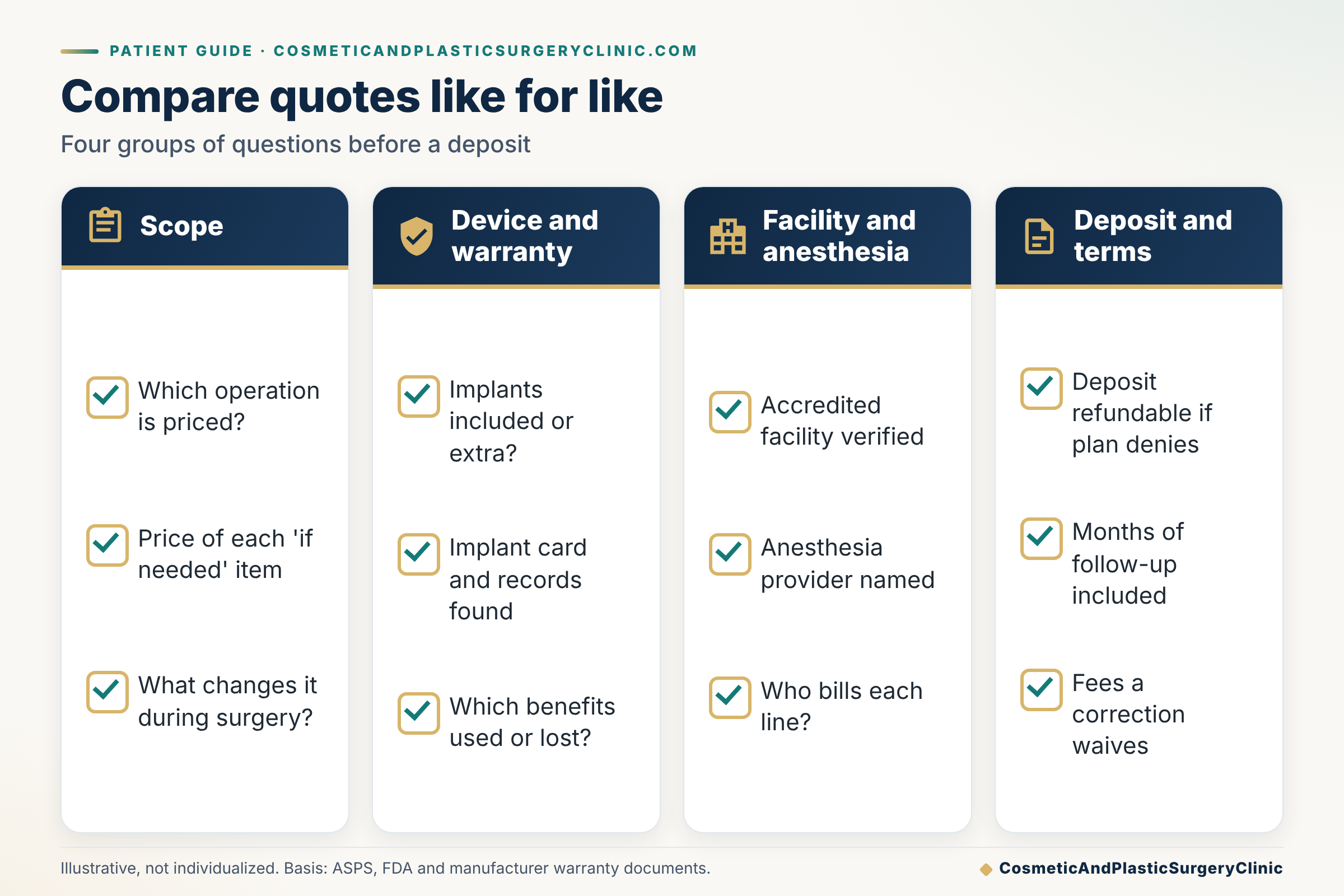
Take the following to each consultation and write the answers next to the quote.
- Which operation does this price assume, and which findings would change it?
- What is the price of each “if needed” item, such as capsule removal, dermal matrix or a lift?
- Is the implant included, and which warranty benefits do you expect to use or lose?
- Who bills facility, anesthesia and pathology, and are those figures in this estimate?
- What does a correction cost in the first year, and which fees does it waive?
- Is the deposit refundable if insurance approval fails or I decide against surgery?
Practices sometimes cannot price a contingency exactly. A range with the assumptions stated is still better than silence, and a surgeon who explains why a number depends on findings is giving you information, not dodging.
Safety checks that outrank the lowest price
ASPS requires member surgeons to use facilities accredited by AAAASF, AAAHC or the Joint Commission, certified for Medicare or state licensed, except when only local anesthesia or mild oral sedation is used. It says to verify accreditation with the accrediting organization, and that accreditation standards generally call for anesthesia by a board-certified or board-eligible anesthesiologist or a certified nurse anesthetist.
Credential checks work the same way: ask the board, not the brochure. The steps are in choosing a plastic surgeon. A lower breast implant revision cost is not a reason to skip them; ASPS says revision surgery is not a standard or routine procedure, needs to be tailored to the patient and should be done by a board-certified plastic surgeon trained in all types of breast surgery.
Budgeting past the operation itself
A revision addresses the problem that prompted it. It does not turn the implants into lifetime devices, and a plan for breast implant revision cost should assume that more than one operation is possible.
Why one revision is not always the last
What reoperation data show, and what they do not
FDA’s patient guidance says implants are not considered lifetime devices, advises patients to assume they will need additional surgeries, and states that there is no assurance of a satisfactory cosmetic outcome from any reoperation. How often that happens depends on the device, the reason and the follow-up time.
A 2018 systematic review and cost model in the Australasian Journal of Plastic Surgery pooled 39 studies with no randomized trials and mostly retrospective and case-series data. It reported re-operation at 10 years of about 24 percent after primary silicone augmentation, about 44 percent after primary saline augmentation and about 47 percent after revision silicone augmentation; the paper’s text and table differ by under one percentage point. The authors advised preparing for at least a 20 percent re-operation rate within ten years. Pooled figures describe groups of patients, not any one person.
The cost of watching: imaging and follow-up visits
FDA says MRI is the most effective method for detecting silent rupture of silicone gel-filled implants and that ultrasound is an acceptable alternative for screening asymptomatic patients, and it notes that silent ruptures often cannot be found by physical exam alone. It also warns that regular MRI or ultrasound exams may not be covered by insurance.
That makes screening a recurring line in the breast implant revision cost over the years, not a one-time test. Ask the practice for its recommended interval and where it sends patients for imaging, then ask your plan how it handles it. The timing recommendations belong to the screening page, not to a cost article.
Paying for it without adding avoidable cost
Deposits, refunds and correction terms in writing
A deposit should have a written purpose: what it is applied to, whether it is refundable, and what happens if a plan denies authorization, a facility reschedules or you decide to wait. Waiting, getting a second opinion and choosing not to operate are all legitimate outcomes, and a quote that cannot survive a few days of review is a reason to slow down.
Correction terms deserve the same scrutiny. If a problem after surgery needs another operation, which of the surgeon, facility, anesthesia and device lines are waived, and for how many months? The answer is often the biggest difference between two otherwise similar breast implant revision cost estimates.
Spreading breast implant revision cost without paying more for it
If you finance, compare the total repaid, not the monthly payment, and find out when deferred interest would be charged. If a warranty or plan may reimburse part of the cost, ask whether reimbursement arrives before or after you pay, since that decides how much you must front.
HSA and FSA rules depend on the account administrator and the reason for surgery, so ask in writing before relying on one. A tax professional can address any deduction question; the IRS publication read does not settle implant removal.
Frequently asked questions
Is there a national average for breast implant revision cost?
Not in the sources read. The ASPS revision page gives no figure, and the Aesthetic Society’s revision page lists none either. ASPS does publish an average for implant removal, $3,979 without a year, and a 2024 range of $3,650 to $6,500 for removals in augmentation patients. Those are surgeon fees only, and removal differs from exchange, capsule work or a lift, so use them as a floor for one piece, not a forecast.
Will insurance pay for breast implant revision cost if my implants ruptured?
It depends on why the implants were placed and on your contract. In the two 2026 policies read, rupture in implants placed for reconstruction is covered when imaging documents it, while cosmetic implants are mostly sent to the member contract or excluded. FDA also warns that removal or replacement may not be covered even with complications. Ask for the plan’s written criteria and any prior-approval requirement before scheduling.
Does a manufacturer warranty cover breast implant revision cost if I want a different size?
In the documents read, no. The Allergan brochure excludes dissatisfaction with size or aesthetics, and the other programs read list only specific events such as rupture, capsular contracture and BIA-ALCL. A warranty can still matter if a covered event is found at the same time, so give the surgeon your implant records before the consultation.
Why might a quote with a lower breast implant revision cost end up higher?
Because the cover figure may leave out items the other quote includes: implants, anesthesia, a capsule line marked “if needed,” pathology, garments or follow-up. The worked example in this article shows a quote that looked $4,900 lower becoming $1,300 higher once the scope matched. Ask each practice to restate its figure for the same operation before you compare totals.
Does breast implant revision cost include an MRI beforehand?
Not necessarily, but surgeons may want imaging to document the implant’s condition, and some plans ask for it as part of medical-necessity documentation. FDA says regular MRI or ultrasound screening exams may not be covered by insurance. Ask the practice whether imaging is expected, where it should be done, and whether the facility bills it separately.
Can I use an HSA or FSA for breast implant revision cost?
That depends on the account administrator and the reason for surgery. IRS Publication 502 generally excludes cosmetic surgery from medical expenses, with exceptions for deformity from a congenital abnormality, injury or disfiguring disease, and includes reconstruction after mastectomy for cancer. The part read does not mention implant removal. Ask the administrator in writing before paying, and ask a tax professional about any deduction.
What if the final breast implant revision cost is higher than the estimate?
For self-pay patients, CMS says a bill at least $400 above a good faith estimate may be disputable. Start by asking the billing office to explain each difference against your itemized estimate and keep every signed document. Contingencies such as capsule work are the usual reason, which is why asking for their prices up front is the best protection.
Sources and further reading
- ASPS — Breast implant revision cost (accessed 2026-11-12) — possible cost components, insurance and warranty statements, no dollar figure
- ASPS — Breast implant removal cost (accessed 2026-11-12) — $3,979 average, exclusions, financing
- ASPS — Breast augmentation cost (accessed 2026-11-12) — fee averages with implants and fat grafting, exclusions, insurance statements
- ASPS — Cosmetic procedures average cost, 2024 (accessed 2026-11-12) — projected surgeon-fee ranges for implant removal, augmentation and lift
- ASPS — Plastic surgery statistics report, 2025 (accessed 2026-11-12) — implant removal counts for 2025 and 2024, methodology
- ASPS — Breast surgery in 2025: evolving aesthetics (accessed 2026-11-12) — removal volume described as relatively unchanged
- ASPS — Breast implant revision (accessed 2026-11-12) — components of revision, tailoring, warranty timing
- ASPS — Accredited facilities (accessed 2026-11-12) — accreditation requirement and verification advice
- The Aesthetic Society — Breast revision costs (accessed 2026-11-12) — cost factors, complexity ordering, insurance statement
- The Aesthetic Society — Breast augmentation costs (accessed 2026-11-12) — 2022 databank average, inclusions, implant-type ordering
- The Aesthetic Society — Breast revision (accessed 2026-11-12) — reasons for revision and lift discussion
- FDA — Risks and complications of breast implants (accessed 2026-11-12) — not lifetime devices, reoperation, insurance coverage, removal without replacement, MRI and ultrasound
- FDA — Things to consider before getting breast implants (accessed 2026-11-12) — assume additional surgeries; costs may not be covered; imaging exams may not be covered
- Premera Blue Cross — Reconstructive breast surgery/management of breast implants, policy 7.01.533, effective 2026-07-02 (accessed 2026-11-12) — explantation criteria, cosmetic exclusions
- Blue Cross and Blue Shield of Illinois — Reconstructive breast surgery/management of breast implants, SUR716.009, effective 2026-01-01 (accessed 2026-11-12) — coverage table, documentation, contract governs
- Allergan — Natrelle ConfidencePlus warranty brochure, November 2021 update (accessed 2026-11-12) — replacement and financial assistance terms, conditions, exclusions
- Mentor — US warranty summary (accessed 2026-11-12) — included and enhanced tiers, rupture and contracture assistance
- Sientra/Tiger Aesthetics — Platinum20 warranty patient brochure (accessed 2026-11-12) — rupture, contracture and BIA-ALCL terms
- National Center for Health Research, Breast Implant Information — The costs of revising or removing breast implants (last modified 2022; accessed 2026-11-12) — dated website-based price estimates
- Miller et al., Australasian Journal of Plastic Surgery 2018 — Cosmetic breast augmentation in Australia: a cost of complication study (accessed 2026-11-12) — re-operation rates, modeled costs, limitations
- Gravina et al., Seminars in Plastic Surgery 2019 — Evidence for the use of acellular dermal matrix in implant-based breast reconstruction (accessed 2026-11-12) — matrix listing prices per square centimeter
- Aesthetic Surgery Journal 2013 — Efficacy of acellular dermal matrices in revisionary aesthetic breast surgery: a 6-year experience (PubMed abstract, accessed 2026-11-12) — 197-patient retrospective series
- AORN Outpatient Surgery — How anesthesia gets paid (accessed 2026-11-12) — base units, time units, payer-dependent rates
- American Journal of Managed Care — Implications of the costs of operating room time (accessed 2026-11-12) — 2018 JAMA Surgery operating room cost per minute
- U.S. Department of Labor — Women’s Health and Cancer Rights Act (accessed 2026-11-12) — reconstruction and complications coverage
- IRS — Publication 502, Medical and Dental Expenses (2025) (accessed 2026-11-12) — cosmetic surgery exclusion, exceptions, 7.5 percent threshold
- CMS — No Surprises Act: understand your rights (accessed 2026-11-12) — good faith estimate, $400 dispute threshold
- CFPB — Report highlights costly credit cards and loans pushed on patients, May 4, 2023 (accessed 2026-11-12) — deferred interest and point-of-care enrollment


