

BIA ALCL breast implants is a phrase that puts a frightening word, lymphoma, next to a device that millions of people live with every day. The condition is real, it is rare, and in most people it is treated successfully when it is found early. It is also easy to misread. It is not breast cancer, it is not a reason to act in a hurry, and no article can tell you whether it applies to you.
BIA-ALCL stands for breast implant-associated anaplastic large cell lymphoma. This page explains what the FDA, ASPS and the published research say about BIA ALCL breast implants: which implants are involved, how the numbers were produced and where they stop being reliable, what the symptoms and tests look like, and what a person with implants can sensibly do. Fill, pocket and size are covered in the breast augmentation guide, and the saline-or-silicone choice is in saline vs silicone implants.
What BIA ALCL breast implants are: a lymphoma, not breast cancer
The first step is vocabulary, because the name sounds like a breast cancer diagnosis and is not one. Getting the category right changes which doctors are involved, which tests are used and what the treatment looks like.
A cancer of immune cells that grows beside the implant
Reading the name one word at a time
“Breast implant-associated” says the disease has been linked to the device, without saying the device is the only factor. “Anaplastic large cell” describes how the abnormal cells look under a microscope. “Lymphoma” means the cancer starts in lymphocytes, white blood cells that belong to the immune system. The FDA calls BIA-ALCL a type of non-Hodgkin lymphoma and says plainly that it is not breast cancer, and it notes that the World Health Organization recognized it in 2016 as a T-cell lymphoma that can develop after breast implants.
The distinction matters in practice. Breast cancer starts in breast tissue and is screened for with mammograms. ASPS states that mammograms are not useful for evaluating this lymphoma, although they remain important for breast cancer screening, so one test does not substitute for the other.
Where it grows: the capsule and the fluid around it
After any implant is placed, the body builds a thin layer of scar tissue around it. That layer is called the capsule, and it is normal. ASPS says BIA ALCL breast implants are associated with disease that forms in the scar capsule around the device, not in the breast tissue itself, and the FDA says most cases are found in the scar tissue and fluid near the implant, with spread to other parts of the body possible in some.
The fluid matters because it is usually how the problem announces itself. Many patients first present with a collection of fluid, called a seroma, that appears long after the original surgery has healed. The diagram below shows the layers involved.

How the link with implants was found, and what regulators did
From a single case report to a WHO category
The first case in the medical literature was described in 1997, according to an FDA-authored review in American Family Physician. For years afterward the cases were isolated and the connection was uncertain. The FDA identified a possible association between breast implants and anaplastic large cell lymphoma in 2011, and in 2016 the WHO listed BIA-ALCL as its own entity. As case reports accumulated, the pattern that mattered most emerged: nearly all cases of BIA ALCL breast implants involved textured devices.
The 2019 recall and the 2021 boxed warning
On July 24, 2019 the FDA asked Allergan to recall its BIOCELL textured breast implants and tissue expanders worldwide, after counting 573 unique cases and 33 deaths. The FDA said it was still assessing whether the risk was limited to specific Allergan models or applied to all textured implants. On October 27, 2021 it approved new labeling for all legally marketed breast implants, including a boxed warning and a patient decision checklist that the patient and the implanting physician both sign. Regulators elsewhere did not all act alike, as the table shows.
| Date | Who | What happened | Why it matters to a reader |
|---|---|---|---|
| 1997 | Medical literature | First case described | The condition is recent in medical terms |
| 2011 | FDA | Identified a possible association with ALCL | Start of formal case tracking |
| 2016 | WHO | Listed BIA-ALCL as a T-cell lymphoma entity | Gave doctors a shared diagnosis |
| April 4, 2019 | France, ANSM | Macro-textured and polyurethane-coated implants no longer supplied | Went beyond a single product line |
| May to June 2019 | Health Canada | Suspended, then recalled, specific BIOCELL styles | Product-specific rather than all textured |
| 2019 | Germany, BfArM | No device action; stressed informed decisions | Regulators weighed the same evidence differently |
| July 24, 2019 | FDA | Asked for a worldwide recall of BIOCELL textured implants and expanders | Smooth implants were not part of the recall |
| October 27, 2021 | FDA | Boxed warning and signed decision checklist required in labeling | Risk discussion became a documented step |
Two lessons come out of the timeline. The first is that the action on BIA ALCL breast implants followed the data on one specific product line, not a blanket judgment on every device. The second is that “recalled” describes unused stock: the FDA said its recall targeted products held by suppliers and doctors’ offices, and it did not recommend removing implants from people without symptoms.
Textured versus smooth: where the BIA ALCL breast implants risk sits
Almost every discussion of BIA ALCL breast implants comes back to surface texture, and it is also where the loosest language appears. “Textured” is a spectrum, not a switch, and the evidence for smooth implants is stated with more care than headlines suggest.
What the shell surface changes
Texture in plain terms
Implant shells are made with surfaces that range from smooth to noticeably rough, and the roughness differs by manufacturer. The FDA says the risk is higher with textured implants than with smooth ones. ASPS adds that the association may relate to the larger surface area of textured shells, but that this is not definitively proven, and that because texturing varies by manufacturer, risk may vary too.
A 2023 review in the journal Pathogens makes a related point: the current international classification of surfaces rests on roughness and area, which its authors consider too limited to describe what actually differs between devices. For a patient, the practical consequence is that “textured” alone is not enough information. The manufacturer and model name are what a surgeon needs to look anything up.
What the FDA’s reports say about smooth implants
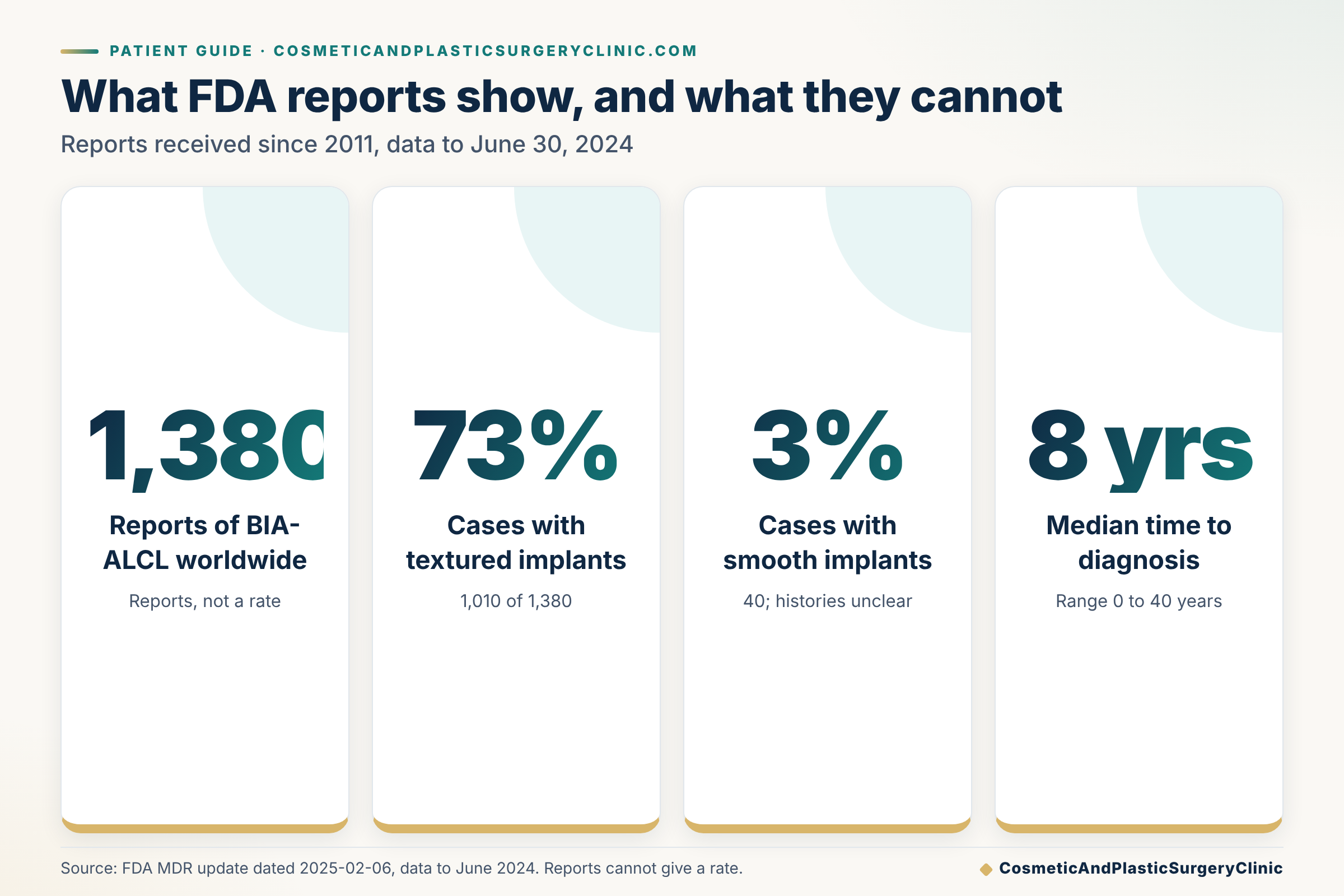
In its update with data through June 30, 2024, the FDA described 1,010 cases of BIA ALCL breast implants (73 percent) in people with textured implants, 40 (3 percent) with smooth implants and 330 (24 percent) with the texture not specified. Those 40 smooth-implant cases need careful reading. In 18 the implant history was unknown, 8 involved at least one earlier textured implant, 13 involved earlier implants of unknown texture, and 1 involved a single smooth implant with no known textured device.
ASPS words its own position cautiously: it reports no cases in people with only smooth implants in the series, case reports and registries it reviewed, while saying a link to smooth implants cannot be excluded. That is the honest state of the evidence. Smooth devices have not been shown to be free of the risk, and no one has shown that they carry the same one.
Fill, reconstruction and tissue expanders
Silicone and saline: no difference identified, with a caveat
Among the FDA’s cases of BIA ALCL breast implants, 922 involved silicone implants (67 percent) and 352 saline (26 percent). Those proportions largely reflect which implants were in use, not which are riskier. The FDA says fill does not appear to be a risk factor but adds that this has not been tested in a large, well-designed epidemiologic study, and ASPS says risk does not appear to differ between saline and silicone. If you are weighing fill, the trade-offs that matter more are in saline vs silicone implants.
Reconstruction patients and tissue expanders
Cases of BIA ALCL breast implants have occurred in both cosmetic and reconstructive patients, and ASPS says risk does not appear to differ between them. Tissue expanders are a separate point. The FDA says certain textured tissue expanders should not be used, and that expanders are intended to stay in place for about six months, with limited data on how temporary exposure affects risk. People having breast cancer reconstruction are advised by ASPS to discuss implant type, surface and shape with their surgeons and weigh the textured-implant risk.
What is suspected about the cause, and related cancers
Cause: a leading hypothesis, not a settled answer
Nobody has established why BIA ALCL breast implants develop in a small number of people. A 2023 review by Alessandri-Bonetti and colleagues describes the disease as probably multifactorial. The hypothesis with the most attention is that bacterial biofilm grows more easily on rougher surfaces, causing chronic inflammation that, in a person with an inherited susceptibility, may lead to lymphoma. The same review lists immune responses to silicone and genetic variation as other candidates.
The authors also say what is missing: no specific organism has been identified, results on the capsule microbiome conflict, and much of the data comes from retrospective case series. They note that no studies have shown antiseptic irrigation protocols to lower the lymphoma risk. Treat any claim of a single proven cause, or a proven way to prevent it, as ahead of the evidence.
Squamous cell carcinoma and other lymphomas in the capsule
BIA ALCL breast implants are not the only capsule-related cancers the FDA tracks. In a March 2023 update, the agency reported 19 cases of squamous cell carcinoma in the literature through January 2023 and 24 medical device reports as of January 15, 2023, which it said may not be unique cases. It also said various lymphomas other than BIA-ALCL have been reported and are different diseases. Its advice stayed the same: keep up routine follow-up and report any change in the breast or implant.
| Factor | Why it matters | Question to ask your surgeon | What is uncertain |
|---|---|---|---|
| Textured shell | Most reported cases involve a textured device | Were my implants textured, and which model? | Mechanism unproven; texture varies by maker |
| One recalled product line | FDA estimated about six times the risk of other textured devices in 2019 | Was my implant in the 2019 recall? | Whether other lines differ is still being studied |
| Years since placement | FDA median from last implant to diagnosis is 8 years | What changes should make me call before my next visit? | Range runs from months to about 40 years |
| Inherited or immune susceptibility | Proposed as a co-factor in reviews | Does my family history change anything? | No test can say who is at risk |
| Fill or reason for implants | No clear difference reported by FDA or ASPS | Does my reason for implants change the advice? | No large controlled study |
| Delay before evaluation | Diagnosis is needed before surgery is planned | Who sees me, and how fast? | Individual course varies |
How common is BIA ALCL breast implants risk? Counts, estimates and their limits
Two kinds of numbers circulate about BIA ALCL breast implants, and they answer different questions. Counts tell you how many cases have been reported. Risk estimates try to say how many cases to expect among everyone who has a given implant. Only the second kind is a rate, and it is the harder one to produce.
FDA reports: what 1,380 does and does not mean
What the June 2024 tally shows
The FDA’s most recent public tally, published February 6, 2025 with data through June 30, 2024, lists 1,380 reports of BIA ALCL breast implants cases from the U.S. and abroad since 2011, and 64 deaths. The median time from the last implant to diagnosis was 8 years, with a range of 0 to 40 years, though 507 reports did not state it. The median age at diagnosis was 53, with a range of 24 to 90. The FDA lists 1,182 of the cases (86 percent) as involving one manufacturer, the manufacturer behind the recalled BIOCELL line.
Why a bigger count is not a bigger rate
The tally has grown from 573 in July 2019 to 733 in January 2020, 1,130 in April 2022, 1,264 in June 2023 and 1,380 in June 2024. It is tempting to read that growth in BIA ALCL breast implants reports as a spreading problem. The FDA warns against it: the page states that the incidence, prevalence or cause of an event cannot be determined from the reporting system alone. A 2020 pathology guideline in the Journal of Clinical Oncology says the same thing from the other side, noting that device reports lack denominators and so cannot yield a true incidence.
Lifetime risk estimates and why they disagree
The ranges ASPS and ASAPS publish
To turn counts into a rate, someone has to estimate how many implants of each kind were sold or are in use. Different datasets give different answers, so the published ranges are wide. A joint ASPS and Aesthetic Society advisory with data to June 30, 2021 put the lifetime risk of BIA ALCL breast implants in people with textured devices at about 1 in 355 to 1 in 30,000, adding that risk may be higher with rougher surfaces. Another undated ASPS summary page gives 1 in 2,207 to 1 in 86,029 for the same group.
The ASPS data page, last updated October 1, 2020, explains where the extremes come from. The higher-risk figures come from one recalled textured line, in two regional datasets (1 in 2,207 and 1 in 3,345), while the lowest, 1 in 86,029, comes from a different textured line. Collett and colleagues, reading the global literature in 2019, gave a current estimate of about 1 in 2,832 for the highest-risk implants, against roughly 1 in 1 million in early reports. That figure was taken from the abstract, and the full paper may qualify it.
| Figure | Source and date | What it measures | Main limit |
|---|---|---|---|
| 1,380 cases, 64 deaths | FDA, data to June 30, 2024 | Reports received since 2011 | No denominator; not a rate |
| 1 in 355 to 1 in 30,000 | ASPS and Aesthetic Society advisory, data to June 30, 2021 | Lifetime risk with textured implants | Wide span; depends on device and dataset |
| 1 in 2,207 to 1 in 86,029 | ASPS summary page, undated | Lifetime risk, textured implants | No publication year given |
| About 1 in 2,832 | Collett et al., Plast Reconstr Surg, 2019 | Current estimate, highest-risk implants | Abstract-level reading; underreporting |
| About six times | FDA news release, July 24, 2019 | One recalled line versus other U.S. textured lines | Relative risk, not a lifetime figure |
What the six-times statement means
The FDA’s 2019 comparison is a relative number: the risk with the recalled textured line was about six times that of textured implants from other manufacturers sold in the United States. A relative risk says nothing about the starting point. If the baseline is low, six times a low number can still be low, which is why the FDA describes the overall risk as low while treating the specific product as a reason for action. The agency also noted that macro-textured implants of the kind involved made up less than 5 percent of U.S. implant sales at the time.
Taken together, the most defensible reading of the numbers on BIA ALCL breast implants is qualitative. The disease is uncommon, concentrated in textured devices, and more concentrated still in the recalled line. The exact odds for your implant depend on a model name your surgeon’s records can supply, which is a reason to ask for them. The same records help in a conversation about breast implant removal or replacement, should that ever come up.
Symptoms, diagnosis and treatment of BIA ALCL breast implants
What a person with BIA ALCL breast implants notices is usually ordinary-looking: a breast that has changed size or feel. That is why the useful skill is not diagnosis at home but knowing which changes deserve an appointment, and what the appointment should include.
What people notice, and when it shows up
Late swelling and fluid
The FDA lists persistent swelling, a mass or pain near the implant as the main symptoms, appearing years after placement and well after the incision has healed. ASPS reports an average of about 8 years from implant to symptoms in its 2021 advisory, with a range of 2 to 28 years; the FDA’s 2024 data give a median of 8 with a wider range. The Australian regulator reports cases from right after surgery up to 37 years later. A seroma is the most common finding when the area is examined.
Delayed swelling is not specific to lymphoma. Fluid around an implant can have other causes, and ASPS says testing by a pathologist is what confirms or rules out BIA-ALCL, which is why the approach is to check and not to assume.
Lumps, skin changes and other signs
ASPS lists these signs of BIA ALCL breast implants: breast enlargement, pain, asymmetry, a lump in the breast or armpit, a rash over the implant, hardening of the breast or a large fluid collection. The FDA adds that some patients had a lump or capsular contracture, which is also a common implant problem treated in its own right (see capsular contracture). ASPS also lists fever, night sweats and swollen lymph nodes among less common presentations. None of these signs proves anything on its own, and all of them are reasons to be seen.
| What you notice | Category | What it may mean | Action level |
|---|---|---|---|
| Swelling and bruising in the first weeks after surgery | Expected effect | Normal healing; this lymphoma usually appears years later | Follow your surgeon’s written instructions |
| New swelling or fluid after the first year | Possible complication | Several causes; late fluid is the classic first sign here | Prompt appointment; ask about ultrasound and fluid testing |
| A lump in the breast or armpit, a rash or hardening | Possible complication | Capsule problem, other benign cause or lymphoma | Prompt evaluation; do not wait for a routine visit |
| Fever, spreading redness or severe pain | Urgent problem | Often infection or another acute cause | Same-day care; emergency services if breathing is affected |
| No symptoms, implants in place for years | Expected situation | FDA does not advise removal; no special lymphoma test | Know your device and symptoms; routine follow-up |
How the diagnosis is made
Imaging and fluid sampling
Evaluation of suspected BIA ALCL breast implants starts with an examination and then ultrasound or MRI to look for fluid or a mass, according to ASPS. If fluid is present, a needle draws it off for testing. The ASAPS document built on NCCN guidance (June 2018) says the sample should go to the laboratory fresh, in a sterile cup with no formalin, and be examined for CD30, a protein found on the abnormal cells, with cytology and cultures. If lymphoma is suspected the pathologist adds flow cytometry and a test for ALK, which is negative in BIA-ALCL.
Pathology matters because specimens not tested for CD30 may miss the diagnosis, ASPS warns. Imaging has limits as well: the 2020 JCO guideline cites an ultrasound sensitivity of 46 percent for masses around implants, so a normal scan alone may not settle the question when symptoms persist. After a positive result, a PET/CT scan looks for spread, and the care team usually includes a lymphoma or oncology specialist.

Why testing comes before surgery
The FDA-authored review in American Family Physician states that the diagnostic assessment should happen before the implant is removed, so the right operation is chosen. This is the one part of the pathway that can be spoiled by good intentions. If an implant is taken out quickly because of swelling, without fluid or capsule being sent for the right tests, a confirmed diagnosis can mean a second, larger operation. The FDA says confirmed cases require a more extensive operation than implant removal alone.
For that reason, a person with late swelling who is also thinking about removal or replacement should say so at the first visit. The practical details of breast implant removal do not change, but the order of steps does.
Treatment and outlook
Surgery: the implant and the whole capsule
For BIA ALCL breast implants disease limited to the area around the implant, the standard treatment is removal of the implant together with the surrounding scar capsule, called a total capsulectomy. The evidence for doing it completely is the strongest in the field. In a 2016 Journal of Clinical Oncology series of 87 patients, those treated with total capsulectomy and implant removal had better overall and event-free survival than those who had partial capsulectomy, chemotherapy or radiation alone, and ASPS says incomplete capsule removal is associated with recurrence and lower survival.
The same series reported overall survival of 93 percent at three years and 89 percent at five, with a median follow-up of 45 months. It was retrospective and the follow-up modest, so those figures describe the people studied, not a promise for any individual. ASPS calls the condition curable in most patients when it is caught early, and reports that recurrence after surgery for early disease is rare.
Chemotherapy, radiation and follow-up
Some people need more than surgery. ASPS says advanced cases may need chemotherapy, and that radiation or stem cell transplant is rare. The FDA likewise notes that some patients received chemotherapy or radiation, and the ASAPS NCCN summary reserves radiation for disease that cannot be removed surgically. Lymph node testing may be part of the staging. After treatment, ASPS says patients are commonly followed for about two years with imaging such as PET/CT every three to six months.
The FDA-authored review describes a confirmed diagnosis as serious, with a risk of death, particularly if treatment is delayed or inadequate. The reported death toll, 64 in the FDA’s data through mid-2024, is small next to the number of reported cases but it is not zero, and it is the reason the guidance puts evaluation first.
If you have implants: monitoring, records and the removal question
Most readers with implants have no symptoms and a practical question about BIA ALCL breast implants: is there anything I should be doing? The agencies’ answer is more modest than the internet’s, and it is worth separating what is recommended from what is merely possible.
When there are no symptoms
What the FDA and ASPS recommend, and what they do not
On BIA ALCL breast implants, the FDA does not recommend routine removal of textured or other breast implants in people without symptoms, a position stated in its 2019 news release and repeated in later communications. ASPS and the Aesthetic Society say there are no guidelines for BIA-ALCL-specific testing, and that women with implants and no symptoms need routine follow-up, not special tests for the lymphoma. The FDA asks patients to know the symptoms and watch for changes, and its review in American Family Physician says implants need monitoring for as long as they are in place.
Separate from this, silicone gel implants have their own imaging schedule, aimed at silent rupture and not at lymphoma. ASPS cites the FDA’s advice of an MRI or ultrasound about five years after surgery and every two to three years afterward, and the FDA says ultrasound became an accepted alternative to MRI for screening in a December 2023 update. Those scans answer a different question; details are in breast implant screening, and the rupture side is in breast implant rupture.
Know your device: the records worth keeping
The FDA tells patients to keep a record of the implant manufacturer and model name. That sounds clerical until the day it matters, because texture, recall status and the right estimate of risk all hang on that one line. Surgeons who placed the implants should have the information, but practices close, move and change systems, and implant cards can be lost.
A useful file holds the operative report, the implant ID card or label stickers, the date and place of surgery, the signed patient decision checklist if you received one, and the name of the practice that holds the chart. Request copies now. Recovering them after a symptom appears, or after a surgeon retires, is slower and sometimes impossible.
When removal or replacement is on the table
Textured implants and the decision to remove
For someone with textured implants, the absence of a removal recommendation does not mean removal is wrong. It means the decision is individual, not a standard. Some people choose to remove or replace implants because of what they have learned about BIA ALCL breast implants, or for unrelated reasons such as comfort, shape, device age or a capsule problem. Others keep them and stay alert. The FDA’s director of device review put it in 2019 as not recommending removal for patients without symptoms because of potential risks. The FDA also says implants are not lifetime devices.
If you are weighing a change, the surgical options are laid out in breast implant exchange and in the broader breast implant revision guide. A surgeon can also explain which device would replace the old one and whether its surface is smooth or textured.
When implants come out for another reason: pathology questions
Imagine a patient who has her implants removed for a capsule problem. Whether fluid or capsule tissue is sent for laboratory review is a reasonable question to ask beforehand, along with who would be told if the result is unexpected and what the plan would be. The sources reviewed here do not set a universal rule for it, so the answer comes from your surgeon’s practice. Asking costs nothing and prevents surprises.
When you are choosing implants now
What the boxed warning and decision checklist add
Since the 2021 labeling change, implant labeling carries a boxed warning, and the provider must review a decision checklist with anyone considering implants; the patient initials and signs it, and so does the implanting physician. Ask where BIA ALCL breast implants appear in what you are given. The FDA also says to assume you will need additional surgeries over time. Read the checklist as a conversation guide, not a hurdle, and ask which items the surgeon thinks matter most for your situation.
Choosing a surgeon with a verifiable board certification and an accredited facility is covered in how to choose a plastic surgeon, and the consultation checklist in plastic surgery consultation applies directly here.
Smooth devices, other options and reconstruction
Smooth implants are the usual alternative when the concern is texture, with the caveat noted earlier that no device is known to carry zero risk. People who want to avoid implants altogether have other routes, described in breast implant alternatives, each with its own trade-offs. For reconstruction after breast cancer, ASPS advises discussing smooth versus textured, shape and fill with the surgical team, and the oncology plan can change what is practical.
Eight questions to bring to your surgeon or clinician
A good appointment about BIA ALCL breast implants is built on specific questions, not general worry. The eight below are written so that a vague answer is easy to spot. Bring your records, and write the answers down.
The questions, in two groups
Four about the implants you have
- What are the manufacturer, model and surface of each implant, and where is that written?
- Were any of them part of the 2019 recall or another market action?
- Do you advise anything different for me than the FDA’s general position of routine follow-up without symptoms?
- If I want to change or remove them, how would that affect a later evaluation?
Four about symptoms and follow-up
- Which changes should make me call you before my next scheduled visit?
- If I develop late swelling, who evaluates it, how quickly, and where do the fluid samples go?
- Does your practice send fluid or capsule tissue to pathology, and does that include CD30 testing?
- If a lymphoma were found, who would coordinate care with an oncology team?
Two hypothetical situations
Textured implants, no symptoms
Consider a hypothetical 44-year-old whose implants were placed twelve years ago. She finds out the shells are textured and reads about BIA ALCL breast implants and the lymphoma linked to them. She has no swelling, lumps or pain. Under the FDA’s position she does not need special tests or removal, but she does need her records, a clear list of symptoms and, if the implants are silicone, a plan for rupture imaging. She might still choose an exchange later for other reasons. Nothing in her situation calls for an emergency visit.
Swelling years after surgery
Now consider a hypothetical 51-year-old whose left breast has grown larger over three weeks, nine years after surgery, with no injury. The sensible step is an appointment within days, with ultrasound and a conversation about fluid sampling. She should say that she has implants and that she is considering removal, so the tests are done first. The cause may turn out to be something other than lymphoma, but that is a conclusion for the test results, not for guessing.
Frequently asked questions
Can BIA ALCL breast implants develop in people with smooth implants?
The FDA’s June 2024 data list 40 cases among 1,380 involving smooth implants, but in most of them the history was unknown, earlier textured implants were present, or the texture of earlier devices was not recorded. Only one involved a single smooth implant with no known textured device. ASPS says it knows of no confirmed case with only smooth implants but cannot exclude a link. Smooth implants have not been shown to carry zero risk, and the reports show far fewer cases.
Is BIA-ALCL the same thing as breast implant illness?
No. BIA-ALCL is a specific, biopsy-confirmed lymphoma found in the capsule and fluid around an implant. Breast implant illness refers to a pattern of symptoms such as fatigue, joint pain and memory problems that some people report, and the FDA says those symptoms and their causes are poorly understood. They are separate topics with different evidence; the second is covered in breast implant illness.
Does a mammogram find BIA ALCL breast implants?
ASPS says mammograms are not useful for evaluating this lymphoma, though they remain important for breast cancer screening. The tools used when it is suspected are ultrasound or MRI to look for fluid or a mass, then needle sampling of fluid with CD30 testing. If you have implants, tell the imaging team that you have implants, and do not treat a normal mammogram as an all-clear for new swelling.
How long after surgery can BIA ALCL breast implants symptoms appear?
Usually years. The FDA’s June 2024 data give a median of 8 years from the last implant to diagnosis and a range of 0 to 40; ASPS’s 2021 advisory gives an average of about 8 years with a range of 2 to 28. Very early cases have been reported, which is why new swelling is worth checking at any time, but most arise long after the incisions have healed.
Do BIA ALCL breast implants mean textured implants should come out?
The FDA does not recommend removal in people without symptoms and cites potential risks in explaining why. Some people still choose removal or exchange, for this reason or others. It is a personal decision to make with your surgeon after reviewing your device, your history and your preferences, not something an article can settle. Whatever you decide, the evaluation path for any new symptom stays the same.
Is treatment for BIA ALCL breast implants covered by insurance?
Coverage depends on your plan and cannot be answered in general. BIA-ALCL is a cancer diagnosis treated by oncology and surgical teams, which is different from elective implant surgery, and plans can treat the two differently. The FDA notes that some insurers do not cover implant removal or replacement. Ask your plan about coverage before surgery, and ask the surgeon’s office to document the medical reason for the operation. Cost pointers for revision procedures are in breast implant revision cost.
How do I report a case of BIA ALCL breast implants?
Clinicians are asked to report confirmed cases to the PROFILE registry, a joint effort of the FDA and the Plastic Surgery Foundation, and to the FDA’s MedWatch system. Patients can also report problems to MedWatch themselves. ASPS says patients who want to report directly can contact the foundation, which can connect them with a participating physician. If you have been diagnosed, ask whether your case has been reported to PROFILE.
Sources and further reading
- U.S. Food and Drug Administration — Medical device reports of breast implant-associated anaplastic large cell lymphoma (page updated 2025-02-06; accessed 2026-11-12) — 1,380 reports and 64 deaths through June 30, 2024; texture, fill, latency and age data; limits of the reporting system
- U.S. Food and Drug Administration — Questions and answers about BIA-ALCL (accessed 2026-11-12) — definition, symptoms, diagnostic testing, treatment, patient and provider recommendations
- U.S. Food and Drug Administration — News release, July 24, 2019 (accessed 2026-11-12) — 573 cases and 33 deaths, recall scope, six-times comparison, no removal advice without symptoms
- U.S. Food and Drug Administration — Things to consider before getting breast implants (accessed 2026-11-12) — October 2021 boxed warning, signed decision checklist, implants not lifetime devices
- U.S. Food and Drug Administration — Risks and complications of breast implants (accessed 2026-11-12) — reoperation, rupture screening, December 2023 ultrasound update
- U.S. Food and Drug Administration — Update: Reports of squamous cell carcinoma in the capsule around breast implants (accessed 2026-11-12) — case counts, other lymphomas, patient advice
- U.S. Food and Drug Administration — Breast implant postmarket safety information (accessed 2026-11-12) — recall scope, surveillance methods
- U.S. Food and Drug Administration — Breast implants hub page (accessed 2026-11-12) — dates of 2019 to 2023 actions
- American Society of Plastic Surgeons — BIA-ALCL summary for patients (accessed 2026-11-12) — symptoms, diagnosis, treatment, follow-up, PROFILE
- ASPS and The Aesthetic Society — BIA-ALCL patient advisory, data as of June 30, 2021 (accessed 2026-11-12) — lifetime risk range, timing, no special tests without symptoms
- ASPS — BIA-ALCL by the numbers (updated 2020-10-01; accessed 2026-11-12) — risk estimates by device, outcomes, report history
- ASPS — BIA-ALCL summary and quick facts (updated 2020-02-24; accessed 2026-11-12) — mammography, capsulectomy, textured versus smooth statements
- The Aesthetic Society — Diagnostic evaluation based on NCCN guidelines (June 2018; accessed 2026-11-12) — fluid handling, CD30 and ALK testing, PET/CT, treatment steps
- Ashar BS, Yoon SW, Nagel S — Breast implant-associated anaplastic large cell lymphoma, American Family Physician 2020 (accessed 2026-11-12) — first case in 1997, diagnosis before removal, monitoring
- Jaffe ES et al. — Best practices guideline for the pathologic diagnosis of BIA-ALCL, Journal of Clinical Oncology 2020 (accessed 2026-11-12) — pathology, ultrasound sensitivity, limits of report counts
- Clemens MW et al. — Complete surgical excision is essential for the management of patients with BIA-ALCL, Journal of Clinical Oncology 2016 (accessed 2026-11-12) — 87-patient series, survival, total capsulectomy
- Collett DJ et al. — Current risk estimate of BIA-ALCL in textured breast implants, Plastic and Reconstructive Surgery 2019 (abstract; accessed 2026-11-12) — risk estimate and limits of registries
- Alessandri-Bonetti M et al. — The role of microorganisms in the development of BIA-ALCL, Pathogens 2023 (accessed 2026-11-12) — hypotheses about cause and the evidence gaps
- Therapeutic Goods Administration (Australia) — Breast implant associated cancer, consumer information (accessed 2026-11-12) — onset range and average time to diagnosis
- Therapeutic Goods Administration — International regulatory actions for breast implants (accessed 2026-11-12) — actions by France, Canada, Germany and others in 2019


