An implant does two jobs at once. It adds volume, and it holds the skin of the breast out at a certain size. Take the implant away and the skin stays where it is, which is why breast implant removal with lift comes up so often in the very first consultation about removal. The skin may be larger than the tissue left inside it, and the nipple may sit lower than it did before.
This page covers one decision: whether a lift belongs in the same operation as the implants coming out, in a second operation, or not at all. The mechanics of removal itself (capsule choices, anesthesia, drains) are in the breast implant removal guide, and the wider menu of operations after an implant is in the breast implant revision overview. Nothing here can say what your breasts need. That takes an in-person examination.
Why taking out an implant changes what the skin has to do
The reasons for removal differ: a hardened capsule, a rupture, symptoms, a change of mind, or simply the age of the device. The reason for removal and the reason for a lift are separate questions, and the second is purely about the shape of what remains. Breast implant removal with lift is an answer to that second question. For scale, ASPS counted 156,131 breast lifts and 45,773 implant removals in augmentation patients in its 2025 statistics report, and the removal count was essentially unchanged from 45,780 in 2024.
What the implant was doing to the skin envelope
Volume, skin and nipple position move separately
It helps to treat three things as independent. The first is volume: how much breast tissue sits inside the skin. The second is the skin envelope: how much skin there is and how well it recoils. The third is where the nipple and areola sit, usually judged against the breast fold. An implant adds to the first and, over the years, may change the second. When it comes out, the volume drops at once, while the skin may recoil a little, a lot, or hardly at all. No test reliably tells which.
Elliot Hirsch, MD, writing in Aesthetic Surgery Journal Open Forum in 2021, notes that removal typically shortens the vertical skin envelope and may raise the breast fold, by an amount he calls unpredictable. That is one surgeon’s observation, but it explains why surgeons plan for two views of the same breast: as it looks now, and as it may look once the implant is out.
What is left behind after removal
What remains is the natural breast tissue, the skin, the fold and, unless it is removed too, the scar capsule the body formed around the implant. The U.S. Food and Drug Administration (FDA) lists what some patients are left with after removal without replacement: dimpling, chest wall concavity, puckering or sagging of the natural breast. Its risk page adds that women with large implants placed over the chest muscle may have major cosmetic deformity if they neither replace the implants nor pursue reconstruction, and that breast tissue atrophy, described as thinning and shrinking of the skin, is a listed complication.
The American Society of Plastic Surgeons (ASPS) says the breast may look flatter or droopier than before the operation and that the amount of scar tissue around the implant affects the shape. An ASPS blog by Scot Martin, MD (February 2025) says that in many cases a surgeon can give well-sculpted breasts simply by removing the implants. Both statements are true for different anatomies, which is why the examination matters more than either sentence.
Where breast implant removal with lift sits among the options
Removal alone, and what it leaves to chance
Removal alone is the smallest operation. ASPS notes that the incision is placed along the breast fold or around or below the areola, and Martin adds that the original augmentation incision is often reused. The trade-off is that the skin is left to do whatever it will do. Some surgeons plan removal first and judge the shape afterward, keeping a lift as a possible second step. The breast implant exchange guide covers the other path, replacing the device.
Lift, own tissue, fat or new implants
Four add-ons come up. A lift (mastopexy) trims skin and reshapes tissue so the nipple sits higher. Own-tissue rearrangement, sometimes called auto-augmentation, repositions existing lower-breast tissue to add central or upper fullness. Fat grafting adds volume taken from elsewhere on the body. New implants restore device volume. This page stays with the lift and the own-tissue and fat options around it; a lift paired with new implants is a different operation, covered in breast lift with implants.

Combined or staged: when implant removal with lift happens in one operation
Timing is the part of breast implant removal with lift that most affects cost, recovery and risk. No comparison of the two approaches was found among the sources opened for this page, so what follows is the reasoning surgeons give, not a ranked answer.
What a single combined operation offers
One anesthetic, one recovery, one set of fees
For implant removal with lift, the practical case is simple: one anesthetic, one healing period, and one facility and anesthesia charge. For people with little time off work or caregiving help, that can decide the question. ASPS says removal is done under intravenous sedation or general anesthesia, and a combined operation is likely to mean more time under anesthesia than removal alone. Ask your surgeon how long the combined plan is expected to take and where it will be done.
A lift the surgeon can adjust to what is found
For implant removal with lift, Hirsch’s technique, described in two case series, marks only the width of the tissue pedicle (the strip that keeps the nipple attached) and the nipple’s relative position before surgery, leaving the vertical limb length to be set during the operation. He argues that a fixed pre-drawn pattern is a poor fit because the skin envelope changes unpredictably once the implant is out. That is his reasoning from his own cases, and other surgeons draw differently. The question for you: how will the plan adapt to what the surgeon sees on the table?
What staging offers instead
Blood supply and wound-healing questions
The nipple and areola depend on a blood supply that a lift temporarily rearranges. ASPS lists partial or total loss of the nipple and areola, poor incision healing, changed sensation and fat necrosis among breast lift risks. Hirsch (2021) notes that earlier surgery can leave the nipple’s perfusion tenuous and hard to judge before the operation, and that other authors propose staging based on the degree of sagging. He defends single-stage surgery with his own technique. Neither position has been tested head to head in anything opened here.
For perspective, none of the four single-surgeon series in the evidence section below reported loss of the nipple and areola. They are selected cases from experienced surgeons, which is a reason to ask any surgeon how many combined cases they do and how they protect the blood supply.
Letting the breast show what it will do
Staging implant removal with lift means removal first and a lift only if the result calls for one. Rozbeh Torabi, MD, in a 2026 Plastic Surgery Practice interview, says explantation should be planned from the anticipated post-explant anatomy backward, and the interview lists a staged approach as one option, depending on what remains once the implant is gone. The cost is a second operation, a second recovery and a period of living with the in-between shape. The sources reviewed give no standard waiting interval, so that is a question for the surgeon.
| Situation | Pathway to discuss | Possible benefit | Trade-off | Key question |
|---|---|---|---|---|
| Nipple expected to sit well above the fold; skin looks in proportion to the tissue | Removal alone | Smallest operation; original incision may be reused | Skin may not recoil as hoped | What happens if the skin looks loose once swelling settles? |
| Visible skin excess or a low nipple now | Removal with lift in one operation | One recovery; plan adjusted to findings | Longer operation; more incisions; blood-supply planning | How is the nipple’s blood supply protected? |
| Earlier lifts, extensive scars or blood-supply concerns | Staged: removal first, lift later | Skin decision made on the settled shape | Two operations, two sets of costs, interim shape | What would make you change the staged plan? |
| Wants fullness back, not only position | Lift plus own-tissue shifts or fat | Volume without a device | Extra procedure; grafted fat may need touch-ups | How much fullness can my own tissue realistically give? |
| Wants a device again | Exchange or lift with new implants | Volume and position in one plan | A different operation with its own reoperation risks | Which operation am I actually comparing? |
What gets examined before a plan for implant removal with lift is made
A surgeon deciding between removal alone and implant removal with lift is looking at tissue, not at a number of cup sizes. The list below describes what surgeons commonly weigh, drawn from published surgical series and trade-press interviews. It is a map of the conversation, not a way to score yourself.
Reading the breast with the implant in and imagining it out
Nipple position, areola and fold
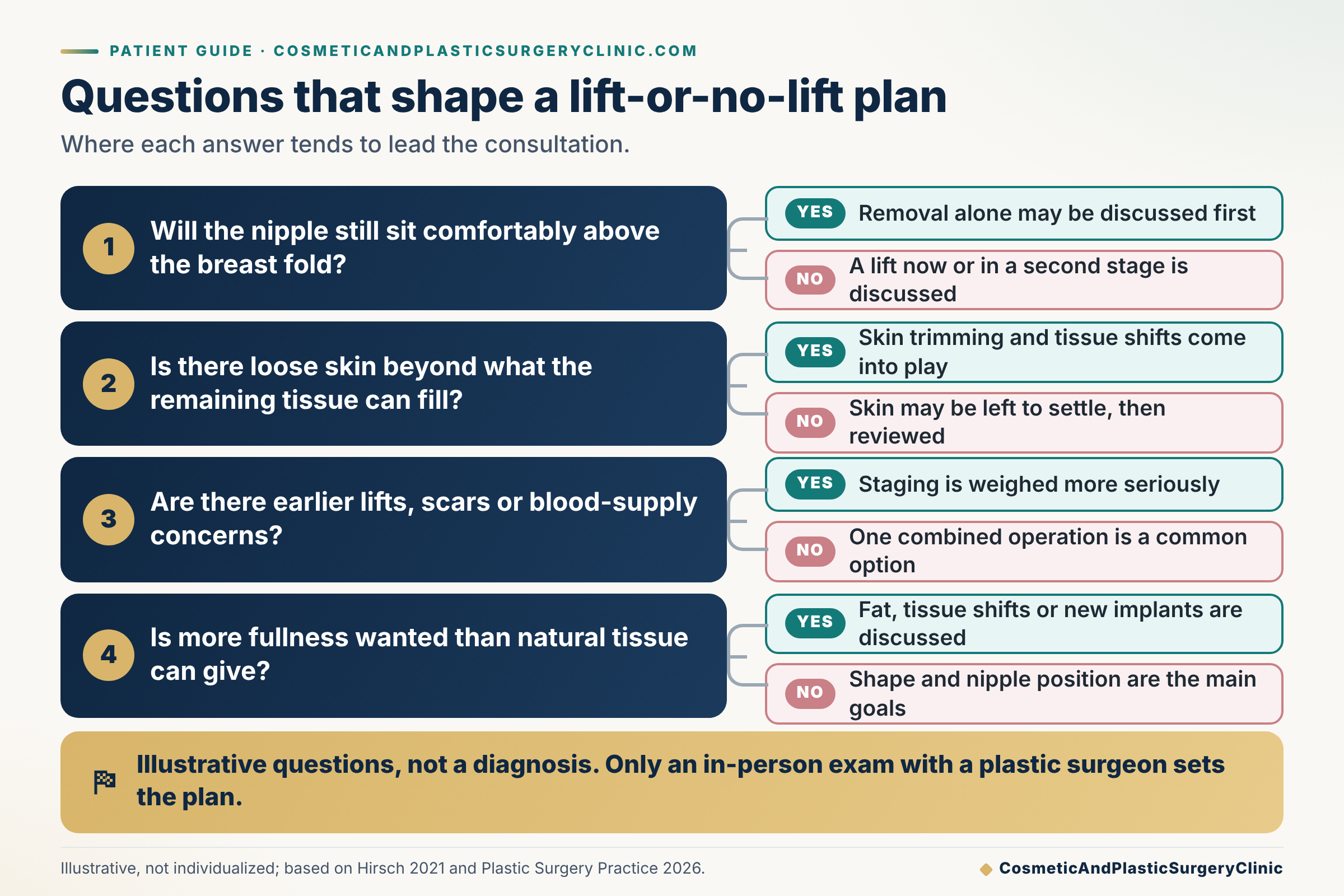
The 2026 Plastic Surgery Practice interview with Rozbeh and Radbeh Torabi, MD, lists the nipple’s position relative to the inframammary fold, fold stability and the degree of sagging among the factors that steer the plan. ASPS adds that the areola sometimes becomes enlarged over time and that a lift will reduce it. Ask whether you will be examined standing as well as lying down, since gravity changes how a breast sits.
Skin quality, thickness and prior stretch
The same interview names skin elasticity, redundancy and the thickness of the envelope, along with how much natural breast tissue remains. Radbeh Torabi says explantation alone can be an elegant solution in a well-selected patient with favorable skin quality, while simple removal may result in significant deflation, sagging or loss of projection. Rozbeh Torabi cautions that surgery can reshape and redistribute tissue but cannot completely reverse decades of tissue expansion. If you have photographs from before the implants, bring them. They do not predict the result, but they show the tissue you started with.
History that changes the plan
Implant, capsule and earlier operations
Your surgeon will ask how long the implants have been in, where they sit relative to the muscle, whether there was a rupture or hard capsule, and whether you have had earlier lifts or other breast surgery. Earlier operations matter for blood supply and because scars limit how tissue can move. The capsule is a separate decision. The FDA notes that implant-only removal leaves the capsule in place and involves less dissection, while en bloc removal takes part or all of it and is more extensive. Whatever is chosen shapes what implant removal with lift has to work with.
If your implants have a textured surface, ask your surgeon about it. A 2021 review in Plastic and Reconstructive Surgery by Neil Tanna and colleagues states that no evidence yet shows whether partial or total capsulectomy lowers the risk of breast implant-associated lymphoma in people with textured implants and no disease, and the authors advise against routine prophylactic capsulectomy. The topic is covered calmly in BIA ALCL breast implants.
Nicotine, weight and general health
In Hirsch’s 2021 series, smokers were asked to stop for three months before surgery and were otherwise excluded. In his 2026 series, patients with substantial breast tissue and a body mass index above 30 were asked to lose weight first, which means the higher-BMI patients in that data were a selected group. Smoking was not analyzed as a variable. Surgeons set their own rules, and the general effects of nicotine, weight and medical conditions on healing are covered in plastic surgery risks. Tell your surgeon about every nicotine product you use.
What a lift at the time of implant removal changes, and what the case series show
Implant removal with lift reshapes what is already there. It does not add the volume the implant supplied, and it does not turn a deflated breast into a full one. Knowing where the line sits keeps expectations level before the first consultation.
The work a lift does
Moving the nipple, trimming skin, reshaping tissue
ASPS describes a lift as raising the breasts by removing excess skin and tightening the surrounding tissue, and says it does not significantly change breast size or round out the upper part of the breast. Radbeh Torabi frames the aim for explant patients as repositioning the nipple and areola and redistributing the patient’s own tissue, not just taking skin away. For the broader operation, see breast lift.
Borrowing volume from your own tissue or from fat
Two ways to restore some fullness without a device appear in the published series. In Charles Messa’s 2023 series of 131 patients, every patient had a lift combined with auto-augmentation, meaning the surgeon repositioned breast tissue to add central or upper fullness. Fat grafting is the other route, and the series reported secondary fat grafting in 11.3% of those who had fat grafted at the first operation. Hirsch’s 2026 series excluded patients who had fat grafting, so its numbers do not describe that combination. The comparison of fat and devices is in fat transfer vs implants.
Scars, techniques and the published series
Scars, and why marking is harder after removal
In implant removal with lift, the scar pattern follows the lift, not the implant, and the options (around the areola, vertical, anchor-shaped) are laid out in breast lift scars. What is specific to explant is the marking, because the final skin envelope is not fully knowable beforehand. In his 2026 series Hirsch reported dog-ear revision as the most common revision, in 13 patients (1.55%), and attributes the drop in dog-ears over the series to lengthening the lateral incision. That is the trade-off in miniature: a longer scar for fewer skin bunches at its end.
What four published series report and what they cannot say
Four case series describe breast implant removal with lift in detail. All are retrospective, from a single practice or surgeon, and none has a comparison group, so none can say whether combining is safer or riskier than staging. Mean follow-up was under a year in three of them. Satisfaction was measured only in Messa’s series, with an unvalidated questionnaire from the authors’ own practice. The numbers below are worth reading as a description of what some experienced surgeons report, not as a rate for the average operation.
| Series | Who and how many | Reported outcomes | Main limits |
|---|---|---|---|
| Hirsch, 2021 (ASJ Open Forum) | 86 patients; implants out with lift, capsulectomy; mean follow-up 10.2 months | No partial or total loss of nipple and areola | Retrospective; no control group; outcomes not quantified |
| Messa, 2023 (Aesthetic Surgery Journal) | 131 patients (262 breasts); lift plus auto-augmentation; mean follow-up 23 months | Complications in 6.9% of patients; reoperations in 9.2%; no infections or hematomas | Unvalidated questionnaire; no comparison; one practice |
| Lampert and colleagues, 2023 (ASJ Open Forum) | 64 patients; total intact capsulectomy with tissue-overlap lift; mean follow-up 6.5 months | Scar irregularity in 4 patients (6.2%); other complications in 1 patient each | Short follow-up; no formal satisfaction survey reported |
| Hirsch, 2026 (ASJ Open Forum) | 841 patients (1,682 breasts); mean follow-up 5.5 months | Complications in 4.76%; revisions in 4.63%; no nipple-areola necrosis | Unadjusted; short follow-up; no patient-reported outcomes |
One pattern across the table is the absence of nipple loss. Another is the selection that sits behind it: smokers excluded or asked to stop, higher-BMI patients asked to lose weight, and surgeons who developed and published their own refined techniques. A reasonable way to use this evidence is as a list of questions for your surgeon, not as a promise.
Risks, recovery and the long view of implant removal with lift
Breast implant removal with lift adds the healing demands of two operations together. Removal opens the implant pocket and, depending on the plan, takes out some or all of the capsule. A lift then adds incisions, rearranges tissue and moves the nipple on its attachments. The risks below are the ones ASPS and the case series name; your surgeon can say which apply to your plan.
Risks that come from the operation, the lift and the combination
Healing, nipple blood supply and sensation
ASPS lists these risks for removal: poor healing of incisions, skin loss, recurrent looseness of skin, fat necrosis, seroma, hematoma, infection, persistent pain, asymmetry, numbness of the skin or nipple and areola, unfavorable scarring, a suboptimal aesthetic result and the possibility of revision surgery. For a lift it adds potential partial or total loss of the nipple and areola and changes in sensation that may be temporary or permanent. Blood-clot and cardiac or lung complications are on the same list.
Reported complications and revisions after breast implant removal with lift
In Hirsch’s 2026 series, 40 of 841 patients (4.76%) had at least one complication and 39 (4.63%) had a revision, with no loss of the nipple and areola. The most common complications were infection treated with oral antibiotics (1.78%), delayed healing (1.43%), seroma needing drainage (1.19%) and hematoma (0.71%). Revisions were mostly dog-ear corrections (1.55%), cosmetic touch-ups (1.19%), hypertrophic scar treatment (1.07%) and removal of residual areola (0.95%). Messa’s series found complications in 6.9% of patients and reoperations in 9.2%.
Read those as the experience of two surgeons who do this operation often, with mean follow-up of 5.5 and 23 months. About one in twenty to one in ten patients needing something further is a reasonable mental picture, and it is also a reason to ask what the revision policy covers. The FDA adds that a satisfactory cosmetic outcome cannot be assured after reoperation on breast implants.
Recovery and results over time
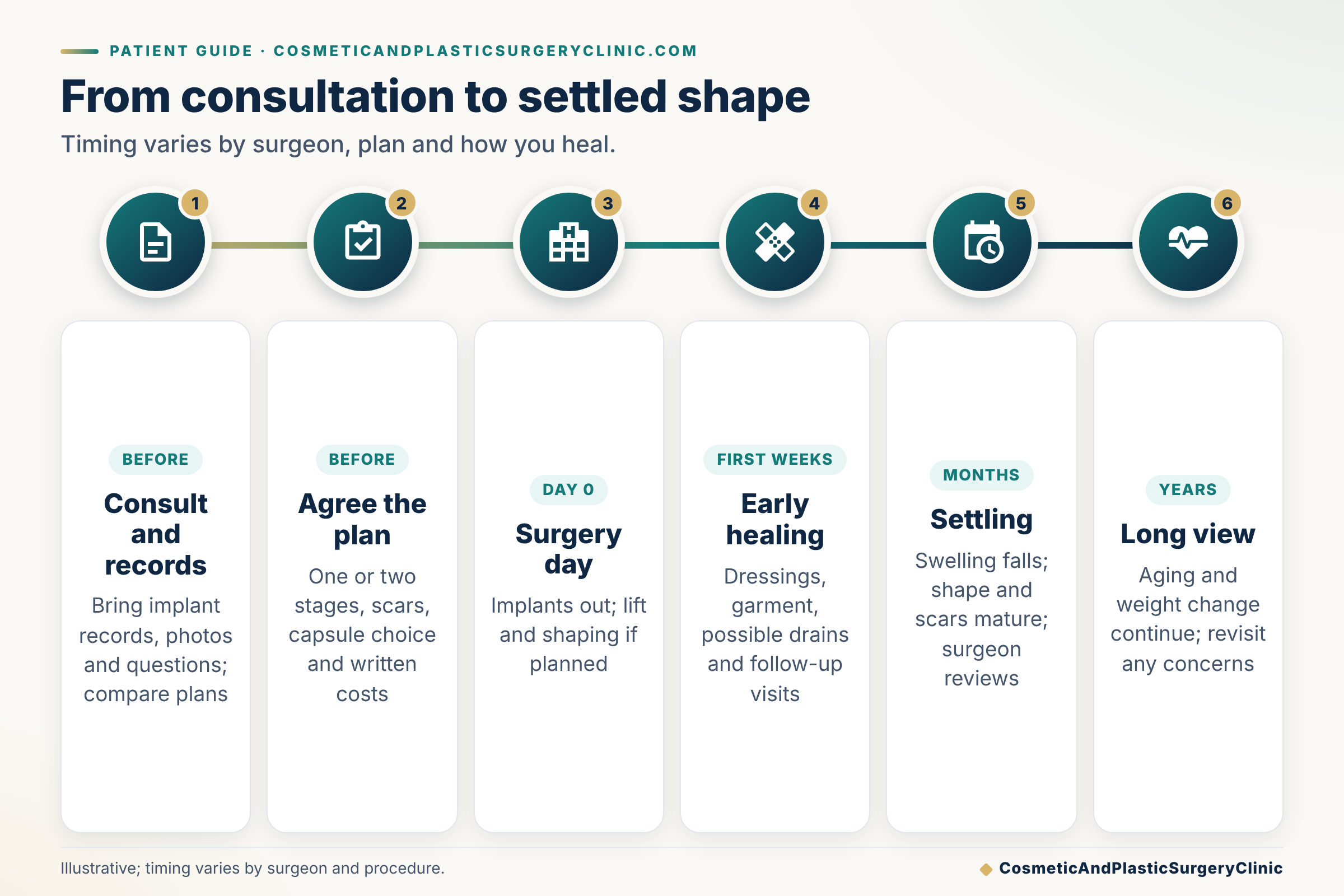
The first weeks: dressings, drains and garments
ASPS describes gauze dressings or bandages after removal, possibly drains (small thin tubes placed within the pocket), and a support bra or compression garment. Healing continues for several weeks as swelling falls. After a lift, ASPS mentions an elastic bandage or support bra and a temporary drain. Neither page gives timelines for work, bathing or exercise; both tell you to ask your surgeon.
That is sound advice, because a combined operation changes the dates. Martin’s blog says most people having removal alone return to regular daily activities within a few days, with restrictions. A lift is likely to change that, so ask for dates in writing.
Months and years: settling, scars and change
Swelling can hide the shape for a while, scars mature over many months, and a breast keeps changing with age, weight and gravity. ASPS lists pregnancy, breastfeeding, weight fluctuations, aging, gravity and heredity among the causes of lost firmness and elasticity, and those do not stop because implant removal with lift was done. How long a lift holds is its own question, covered in how long a breast lift lasts. The case series here followed patients for months to two years on average, so they say little about the shape at five or ten years.
| Factor | Effect on the outcome | Maintenance or revision implication | Review point |
|---|---|---|---|
| Skin recoil | Skin may tighten little or a lot after removal, and cannot be predicted beforehand | A later skin-tightening or lift step may be discussed | Looseness or a low nipple once swelling settles |
| Weight change | Gain or loss alters breast volume and skin tension | Large changes may reopen the shape question | Ask what weight range the plan assumes |
| Nicotine exposure | Surgeons in the published series asked smokers to stop or excluded them | May affect timing of any later operation | Disclose all nicotine products before surgery |
| Scars | Hypertrophic scars and dog-ears were the commonest reasons for revision in one series | Scar treatment or minor correction can follow | Scars that thicken, widen or stay red |
| Grafted fat or shifted tissue | Added fullness may be less than hoped | One series reported secondary fat grafting in 11.3% of those grafted | Ask how many touch-ups are typical in the practice |
| Areola and nipple position | Areola size can drift larger over time (ASPS) | Rarely a reason alone for revision; surgeon-specific | Position change you notice on photos |
Cost, insurance and consultation questions for breast implant removal with lift
Implant removal with lift is quoted as one fee, but it is built from several pieces. Seeing the pieces is the only way to compare two quotes fairly, or to compare a combined plan with a staged one.
What a combined quote contains
Line items, and why one operation is not automatically cheaper
ASPS’s 2024 fee release gives projected surgeon-fee ranges, built from averages that member surgeons reported: $6,500 to $11,000 for a breast lift and $3,650 to $6,500 for implant removal in augmentation patients. Those are surgeon fees only. ASPS’s procedure cost pages show single averages ($6,816 for a lift and $3,979 for removal, with no year given) and state that they do not include anesthesia, operating room facilities or related expenses. Adding the two ranges is not a quote, because many practices price a combined operation differently from the sum.
The table below is a hypothetical worked example dated November 12, 2026. The figures are invented to show structure and are not real quotes or averages. In this example the combined route costs less mainly because it avoids a second facility day and a second anesthetic; a different practice could price it the other way. Fat grafting, new implants or a pathology review would each be a separate line. See the breast implant revision cost guide for the full anatomy of these quotes.
| Line item | One combined operation | Staged: removal, then lift | What to ask |
|---|---|---|---|
| Surgeon fee | $9,000 | $4,500 + $6,500 = $11,000 | Is the second stage priced in advance? |
| Facility fee | $4,500 | $3,500 + $3,500 = $7,000 | Accredited facility; time-based or flat? |
| Anesthesia | $1,800 | $1,400 + $1,400 = $2,800 | Who is the anesthesia provider? |
| Pathology, garments, medications | $550 | $300 + $250 = $550 | Is a pathology review of the capsule included? |
| Hypothetical total | $15,850 | $21,350 | Which revision costs are covered? |
Insurance: what is medical and what is cosmetic
Coverage depends on why the implants come out and on the plan. Aetna’s policy on implant removal, last reviewed March 19, 2026, lists medically necessary removal for conditions such as BIA-ALCL, implant extrusion, recurrent infection, severe Baker IV contracture with pain and rupture of silicone gel implants. It treats fat grafting after removal as cosmetic when the implants were placed for cosmetic reasons. It does not address a lift at the time of removal.
ASPS says most health plans do not cover a breast lift or its complications, and the FDA notes some insurers do not cover removal or replacement even when complications occur.
That suggests a practical rule: ask the surgeon’s office and your insurer, in writing, how each part of the plan will be treated before any date is set for implant removal with lift. Other plans, such as Molina’s, publish different criteria. The breast implant removal guide goes through the medical reasons in more detail.
Questions to bring to the consultation
Questions about the plan and timing
Bring these questions to a board-certified plastic surgeon, and expect specific answers rather than reassurance:
- What do you expect my skin and nipple position to look like without the implant, and how sure are you?
- Would you do implant removal with lift in one operation or stage it, and why for my anatomy?
- How will you protect the blood supply to my nipple and areola, given my earlier surgery?
- What happens to the capsule, and is it sent for pathology?
- If I want to start with removal alone, what is the plan if I later want a lift?
Questions about records, photos and revision policy
Bring any implant records and photographs from before your augmentation. Ask to see photographs of patients who had implant removal with lift at the same stage, with similar anatomy and the same follow-up time, and ask how many such operations the surgeon performs a year. Ask what the fee covers if a revision is needed, and who treats complications if you travel for surgery. The consultation questions guide has a longer list, and the general rules for before and after galleries apply.
Frequently asked questions
Can a lift be done later if I choose implant removal alone?
Yes, a lift can be a second operation, and staging is a recognized approach. The advantage is that the surgeon and you judge the settled shape before deciding on skin. The cost is a second anesthetic, a second recovery and a second set of fees. Earlier surgery can also leave scars that shape the later plan. If you start with removal alone, ask your surgeon how a later lift would be planned and priced so the option is not a surprise.
Will breast implant removal with lift make my breasts smaller?
The removal is what reduces volume, because the device is taken out. ASPS says a lift does not significantly change breast size or round out the upper breast. Surgeons may shift your own tissue or use fat to restore some fullness, but those options have limits. A fair question for your consultation is what size and shape the surgeon expects without the implant, and what the plan does if you want more fullness than your tissue provides.
Do the scars from implant removal with lift differ from a standard lift?
The scar pattern follows the lift technique chosen, so the patterns are the same families. What differs is the planning: with the implant out, the final skin envelope is not fully known beforehand, and in one series the author lengthened the side incision to cut dog-ear revisions. Removal alone may reuse the earlier augmentation incision, as an ASPS blog notes. Ask to see where each scar would sit and how it would be adjusted during surgery.
Can implant removal with lift be combined with new implants?
It can be discussed, but it is a different operation with different risks and costs. Putting in new implants during a lift is covered in the breast lift with implants guide, and replacing implants without a lift is covered in the exchange guide. ASPS says implants can be placed at the same time as a lift or as a second procedure, depending on the surgeon’s experience. Ask which operation you are comparing and how often your surgeon performs it.
Does a ruptured implant change the plan for implant removal with lift?
A rupture is a reason for removal, not a reason for a lift. It can change how the capsule is handled, because silicone from a leak may need to be removed along with it, as ASPS notes. The authors of one 2023 series describe total intact capsulectomy, taking implant and capsule out together, as useful when silicone implants have ruptured. Whether a lift follows depends on the skin and nipple position, the same as in other cases. The rupture guide in this series covers detection and options.
How do I find a surgeon who performs implant removal with lift often?
Start by verifying board certification and training, then ask directly how many implant removals with lift the surgeon performs and how they handle revisions. Ask for photographs that match your history. The guide to choosing a plastic surgeon walks through certification, license and facility checks, so you can confirm credentials before you compare cases.
What if my surgeon recommends a lift and I would rather start with removal alone?
That is a legitimate choice to raise. Ask what the surgeon expects if you remove the implants only: how the skin and nipple may look, how likely a later lift is in your case, and what a second operation would involve. A second opinion from another board-certified plastic surgeon is reasonable. Surgeons differ in how they plan, and a clear explanation of the trade-offs should help you decide, not press you to commit.
How is recovery different from removal alone?
Implant removal with lift involves more incisions and more tissue rearrangement, so expect more instructions about garments, drains and activity than for removal alone. ASPS pages for both operations give no fixed timelines and tell patients to ask their surgeon, and the case series do not report detailed recovery milestones. Ask for dates in writing for driving, work, lifting and exercise, and ask whether a caregiver is needed in the first days.
Sources and further reading
- American Society of Plastic Surgeons — Breast implant removal (accessed 2026-11-12) — reasons for removal, capsule and silicone leaks
- ASPS — Breast implant removal: procedure steps (accessed 2026-11-12) — anesthesia, incisions, breast shape after removal
- ASPS — Breast implant removal: risks and safety (accessed 2026-11-12) — listed risks including skin loss and poor healing
- ASPS — Breast implant removal: recovery (accessed 2026-11-12) — dressings, drains, garments
- ASPS — Breast implant removal: cost (accessed 2026-11-12) — average fee with undated exclusions note
- ASPS — Breast lift (accessed 2026-11-12) — what a lift does and does not change
- ASPS — Breast lift: risks and safety (accessed 2026-11-12) — nipple and areola loss, healing, sensation, fat necrosis
- ASPS — Breast lift: recovery (accessed 2026-11-12) — dressings, support bra, drain
- ASPS — Breast lift: cost (accessed 2026-11-12) — average fee, exclusions, insurance statement
- ASPS — 2024 average surgeon/physician fees (accessed 2026-11-12) — projected fee ranges for lift and removal
- ASPS — 2025 Plastic Surgery Statistics Report (accessed 2026-11-12) — procedure counts for removal, lift and augmentation
- ASPS — Is breast explant surgery right for you? Scot A. Martin, MD (Feb 12, 2025; accessed 2026-11-12) — lift at removal, incision reuse, daily activity
- U.S. Food and Drug Administration — Risks and complications of breast implants (accessed 2026-11-12) — not lifetime devices, outcomes after removal, capsule options, insurance
- FDA — Breast implants: certain labeling recommendations to improve patient communication (guidance, Sept 29, 2020; accessed 2026-11-12) — boxed warning and decision checklist wording
- Messa CA IV, Messa CA III — Breast explantation with simultaneous mastopexy and volume restoration, Aesthetic Surgery Journal (2023; accessed 2026-11-12) — 131 patients, complications, reoperations
- Hirsch EM — Simultaneous mastopexy explantation with a vertical bipedicle and novel open pattern marking technique, ASJ Open Forum (2021; accessed 2026-11-12) — 86 patients, skin envelope, perfusion, staging
- Hirsch EM — Outcomes of mastopexy explantation: a consecutive series of 841 patients, ASJ Open Forum (2026; accessed 2026-11-12) — complication, revision and predictor data
- Aesthetic Surgery Journal Open Forum (April 2023) — Implant removal and total intact capsulectomy with the mammary imbrication lift and fixation technique, abstract (accessed 2026-11-12) — 64 patients, complications
- South Florida Hospital News — Research shows new breast explant technique (May 2023; accessed 2026-11-12) — authors of the 2023 series; press summary, not independent review
- Tanna N et al. — Not all breast explants are equal, Plastic and Reconstructive Surgery (2021; accessed 2026-11-12) — capsulectomy and BIA-ALCL, counseling (abstract record)
- Plastic Surgery Practice — How long-term breast augmentation shapes the explantation approach (Sept 3, 2026; accessed 2026-11-12) — surgeon interview on skin, nipple position and staging
- Aetna — Clinical policy bulletin 0142: breast implant removal (reviewed Mar 19, 2026; accessed 2026-11-12) — medical criteria, cosmetic exclusions
- ASPS — Coverage criteria: BIA-ALCL (2017, re-approved 2020; accessed 2026-11-12) — insurer removal policies summarized
- Molina Healthcare — Clinical policy 315: breast implant removal (approved Apr 10, 2024; accessed 2026-11-12) — example of differing plan criteria