
A revision breast lift is a second operation on breasts that have already been lifted once. It exists because a first mastopexy does not always keep its shape, its scars do not always settle neatly, and an implant, if there is one, can change what the breast does over the years. Wanting a second look at the result is common. It is not a verdict on you or on the surgeon who did the first operation.
This page takes the decision in order: what problem you are actually describing, how long surgeons tend to wait, which steps come before any new incision, what a second operation involves in general terms, and what it costs. It does not repeat how the first operation works, which is covered in the breast lift overview, and it cannot say whether you need surgery. Only an examination, together with the records of your first operation, can answer that.
What a revision breast lift is asked to fix
People rarely arrive at a revision breast lift with a diagnosis. They arrive with an impression: the breasts look low again, or unequal, or a scar looks worse than expected. Turning that impression into a specific anatomical problem comes first, because each problem has a different remedy and a different timetable.
Why a first lift sometimes needs a second operation
Natural change and technical shortfall are different things
The American Society of Plastic Surgeons (ASPS) describes breast lift results as long-lasting, yet says aging and gravity keep acting on the breasts, that pregnancy can minimize or reverse the improvement, and that significant weight loss afterward can hurt the appearance. A lift sets the position of the breast on the day of surgery. It does not freeze the tissue. A revision breast lift may therefore answer change that happened after a sound first result, not anything that went wrong in the operating room.
Technique still matters. A 2022 systematic review in JPRAS Open by Wagner, Lisiecki, Chiodo and Rohrich covered 24 studies, 1,235 patients and 2,235 breasts, and noted that ptosis, or the look of it, does not stay corrected in every patient. In the analytical studies, operations that fed the nipple from above or from the inner side held position better than those fed from below. Meshes, dermal flaps and muscular slings seemed to add support. Two-thirds of the studies were case series and only one was a randomized trial, so these findings are leads, not rules.
What published revision numbers can and cannot tell you
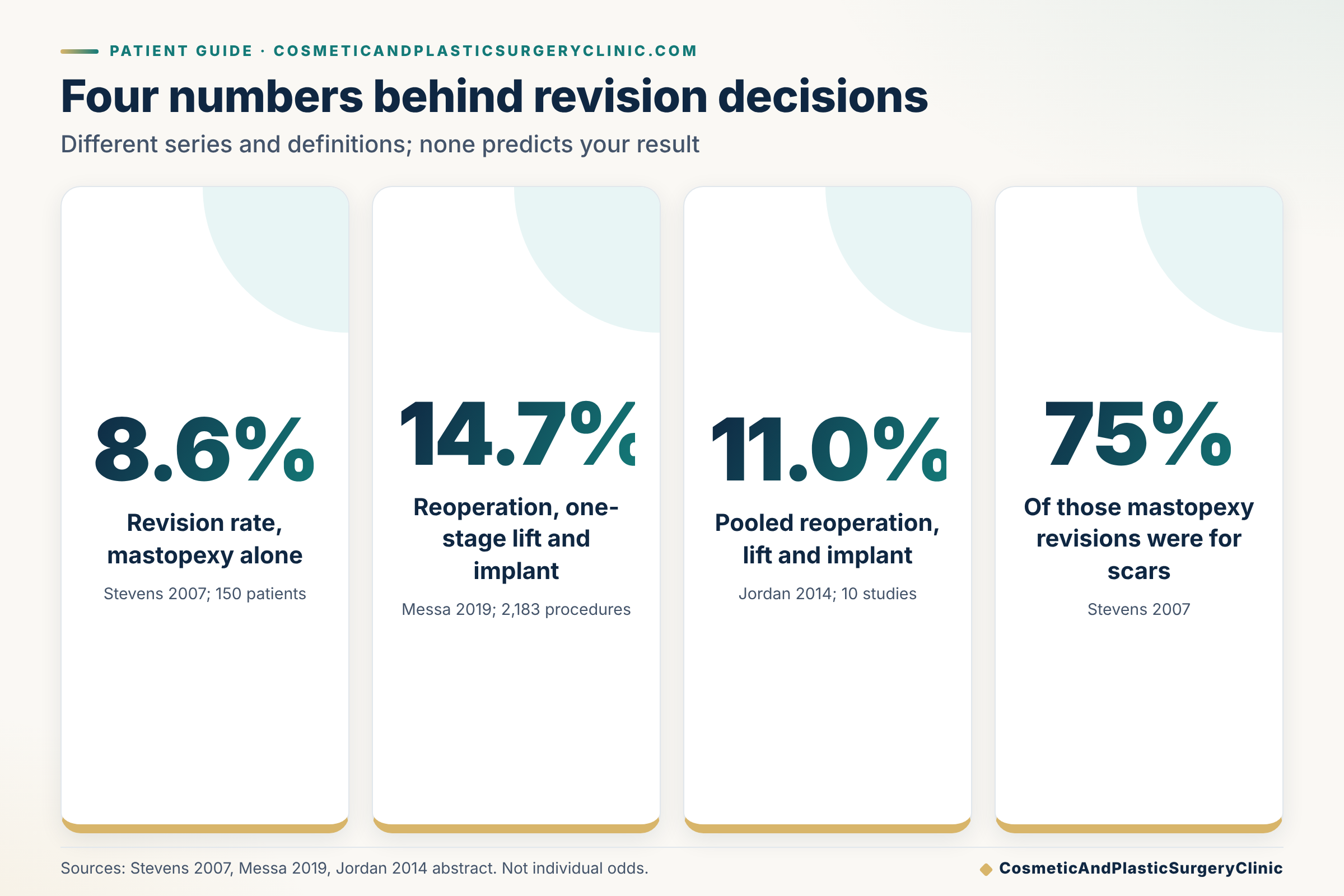
Several surgical series report how often patients went back to the operating room. The table lines them up, and the first thing to notice is how much the word “revision” covers. In one mastopexy series, three-quarters of the revisions were for scars, and some were done under local anesthesia, so a revision there could be a short procedure and not a second lift.
| Study | Population | What it reported | Limits to keep in mind |
|---|---|---|---|
| Stevens and colleagues, Aesthetic Surgery Journal, 2007 | 150 mastopexy patients (298 breasts), two surgeons, one center; average follow-up 36 months | Revision rate 8.6 percent, three-quarters of it for poor scarring; recurrent ptosis in 0.7 percent | Retrospective, single center; some counts in the abstract do not agree |
| Messa, Aesthetic Surgery Journal, 2019 | 1,131 patients, 2,183 one-stage augmentation-mastopexy procedures; mean follow-up 43 months | Reoperation 14.7 percent; recurrent ptosis the top reason (3.5 percent), implant size change next (3.2 percent) | One surgeon’s practice; level 4 evidence |
| Jordan and colleagues, Aesthetic Meeting abstract, 2014 | Pooled studies covering 4,856 augmentation-mastopexies | Reoperation 11.0 percent; recurrent ptosis 4.0 percent, the most common complication | Conference abstract; very high heterogeneity between studies |
| di Summa and colleagues, JPRAS, 2019 | 34 studies, 1,888 patients, mastopexy without implants | Overall complications 10.4 percent; scar-related 3 percent; nipple-areola 2.9 percent | No reoperation or recurrence rate given |
| Van Boeckel and colleagues, PRS Global Open, 2026 | 198 women, one technique, three Belgian centers; follow-up about 12 months on average | Aesthetic scar revision under local anesthesia in 8.58 percent; no nipple-areola necrosis | One author’s series; no outcomes beyond 2 years |
Read across the rows and a pattern appears: reoperation or revision counted at roughly 9 to 15 percent, scars leading after mastopexy alone, and recurrent ptosis and implant changes leading once an implant is added. None of this forecasts whether you would need a revision breast lift. The series differ in technique, follow-up and in what counts as a revision, and they come mostly from single practices that chose to publish.
Sorting the concern: position, shape, scar or volume
Sagging that returns versus sagging that was never fully corrected
Two different stories can both end with “it looks low.” In recurrent ptosis the lift worked and the tissue later descended. In pseudoptosis, a term Wagner and colleagues use alongside ptosis, the nipple may sit at a reasonable height while breast tissue hangs below it. StatPearls lists bottoming out, where lower-pole tissue or an implant settles downward, among the most common nonmajor problems after mastopexy, with suture spitting and excess scarring. Which story applies changes the plan.
A surgeon makes that call, but you can prepare for it. Compare your before-and-after photos from the same angle and note where the nipple sits relative to the crease under the breast. If it has not moved, the issue may be the tissue below the nipple. If it has dropped to the crease or below, the lift has lost ground. How photos are read is covered in the article on breast lift before and after photos.
Volume loss that looks like sagging
ASPS says a breast lift does not significantly change breast size or round out the upper part of the breast. If the real complaint is an empty upper breast, a second lift may move the nipple again and leave the same hollow. Volume has to come from somewhere: an implant, fat transfer, or a combined plan. The trade-offs are weighed in breast lift vs implants, and fat as a source is covered in fat transfer vs implants.
A breast that has lost volume after weight change or pregnancy can pair a stretched skin envelope with little tissue inside it, which is why neither a lift nor added volume alone always answers it. Telling these situations apart is a large part of what the first consultation for a revision breast lift is for.
Common reasons for a revision breast lift, problem by problem
Most requests for a revision breast lift fall into four groups: position, symmetry, areola and scars. Each group below says what the problem usually looks like, what the sources report about it, and what a surgeon will want to know.
Position problems: sagging, bottoming out and nipple height
Recurrent ptosis and bottoming out
Reported rates of recurrent ptosis depend on how it is defined and how long patients were followed. Stevens and colleagues found it in 0.7 percent of 150 mastopexy patients over about three years. Messa recorded it in 2.1 percent of one-stage augmentation-mastopexy procedures, and the 2014 pooled analysis by Jordan and colleagues put it at 4.0 percent. StatPearls cites a higher pooled figure of 5.2 percent for the combined operation.
That spread is a reminder that the numbers are not interchangeable. Follow-up of one to three years will miss sagging that appears later, and a single surgeon’s series may not match typical practice. For how results age in general, see how long a breast lift lasts.
Nipples that sit too high, too low or off-center
In Spear and colleagues’ 2003 review of 20 patients who needed revision after combined augmentation and mastopexy, 11 had nipple ptosis and 2 had nipple malposition, among several overlapping reasons. Surgeons answering a patient’s question in 2016 on the Aesthetic Society site, about a vertical breast reduction, a closely related operation, gave general replies and not examinations. One noted that a vertical pattern may need converting to an anchor pattern to correct high nipples and bottoming out. Another warned that taking tissue from along the bottom of the breast would lower the nipple and also make the breast smaller.
The point of that second remark is that every adjustment moves something else. Raise a nipple and the lower pole changes; shorten the lower breast and the nipple drops. A surgeon should be able to show, on photos or a simulation of your own breasts, what each option changes, while accepting that a simulation is not a promise.
Symmetry and areola problems
Asymmetry that remains after settling
ASPS lists breast asymmetry and contour or shape irregularities among the risks of a breast lift. The di Summa review of 34 non-implant mastopexy studies called asymmetry a significant issue but gave no separate rate, and Jordan’s pooled analysis put postoperative asymmetry at 2.7 percent after combined augmentation-mastopexy. Few breasts match exactly before surgery, so the useful comparison is with your own preoperative photographs, taken at the same angle, not with an idea of identical breasts.
Swelling can differ from side to side while it resolves. StatPearls notes that reoperations are typically delayed until the breast tissue has fully settled, which is why a difference noticed at three weeks is rarely the one judged at a revision breast lift consultation.
Stretched or widened areolas
ASPS says a breast lift can reduce an enlarged areola. Incisions around the areola carry their own trade-off. StatPearls says periareolar mastopexy has a high rate of patient dissatisfaction and revision, and lists periareolar widening and pleating among the drawbacks of one named technique. In Messa’s one-stage series the circumareolar technique had a reoperation rate of 25.7 percent, against 14.7 percent overall.
If an areola has widened, a revision breast lift may repeat the same pattern or move to one with longer scars. That choice is the scar trade-off explained in breast lift scars, and it should be made knowingly.
Scar problems after a lift
Wide, pale, raised or uneven: which kind of scar is it?
Scars are the most common reason for a limited revision breast lift. In the Stevens mastopexy series, poor scarring was the leading complication at 6 percent and accounted for three-quarters of revisions. Messa reported hypertrophic scarring in 2.5 percent of one-stage augmentation-mastopexy procedures, Jordan’s pooled figure for poor scarring was 1.8 percent, and di Summa found scar-related complications in 3 percent. “Poor scarring” is a judgment call, and each study defined it in its own way.
An immature scar is not yet a final scar
ASPS says incision lines are permanent but continue to fade over time. A scar that is red, firm or conspicuous at three months can look quite different at a year, which is why surgeons separate a scar that is still maturing from one that has matured badly. Patterns, lengths and the maturation timeline are covered in the scars article; here the point is that timing matters before anyone cuts a scar out.
| Situation | Pathway often discussed | What it may offer | Trade-off | Question to ask |
|---|---|---|---|---|
| Sagging has returned and the nipple has dropped | Repeat mastopexy, sometimes with added support | Restores nipple position and trims skin | More scars; durability still uncertain | What did the first operation use for support, and what will differ? |
| Nipple sits high with tissue hanging below | Reshaping the lower breast, possibly a new incision pattern | Rebalances nipple and lower pole | May lower the nipple or reduce size | What will this change in size and nipple height? |
| Scar is wide, raised or itchy | Scar care first; injection or excision once matured | Smaller procedure, sometimes local anesthesia | Scars can widen or thicken again | Has the scar finished maturing, and what care comes first? |
| Upper breast looks empty | Volume from an implant or fat, with or without a lift | Fills the upper pole | Device upkeep, or fat that partly fades | Is this a volume problem or a position problem? |
| Breasts are unequal after settling | Targeted reshaping, usually on one side | Narrows the difference | Cannot make breasts identical | How much of this difference existed before surgery? |
| Implant has hardened or moved | Capsule or pocket work, exchange or removal, plus a lift if needed | Addresses implant and lift in one plan | Longer operation; insurance gaps | What happens if the pocket and the lift conflict? |
Revision breast lift when an implant is in the picture
An implant, whether placed with the lift or earlier, adds a second set of possible problems. The device can harden, shift or need replacing, and any revision breast lift has to be reconsidered around whatever is decided about it. The original combination is explained in breast lift with implants; this section covers what changes when it needs revising.
How an implant changes the problem
Capsule, position and stretch
An ASPS journal CME article on aesthetic breast revision lists common reasons for reoperation after augmentation or augmentation-mastopexy as size change, capsular contracture, implant malposition and soft-tissue stretching. It describes secondary mastopexy and reduction as technically demanding. In Spear’s review, capsular contracture and nipple ptosis each affected 11 of 20 revision patients, implant malposition 7 and dissatisfaction with size 6, with an average of 7 years between operations.
Messa’s much larger series showed the same themes in smaller proportions: capsular contracture of Baker grade III or IV in 2.8 percent, recurrent ptosis as the top reason for reoperation at 3.5 percent and a wish to change implant size at 3.2 percent. Size and lift are therefore often decided in the same conversation; breast implant size explains how size is chosen.
Exchange, remove or leave in place
The FDA says breast implants are not considered lifetime devices, that the longer a person has them the more likely complications become, and that you should assume additional surgery will be needed. Reoperation options include removal with or without replacement, capsule removal and scar revision. The agency adds that a satisfactory cosmetic result is not assured from any reoperation, that some insurers do not cover removal or replacement, and that a confirmed implant-associated lymphoma (BIA-ALCL) may change the operation.
Three decisions follow in a revision breast lift with an implant: whether the implant stays, whether it is exchanged for another size or type, and whether the lift is repeated. In Spear’s series the implant type was unchanged in 65 percent of revisions and the pocket moved to a subpectoral or dual-plane position in 40 percent; that pocket choice is explained in the over vs under muscle implants article. Ask for each decision to be priced separately.
When an implant comes out without a new one
What the FDA says can happen to the natural breast
After removal without replacement, the FDA says some women may have cosmetically undesirable dimpling, chest wall concavity, puckering or sagging. A lift may be discussed alongside removal or considered afterward. The sources opened for this article do not say which sequence works better, so ask the surgeon why they favor one.
Whether a lift is warranted depends on how much skin remains and where the nipple sits, which only an examination shows. Removal also changes the cost conversation, since the FDA warns that removal or replacement may not be covered even when complications occur.
Keep the device paperwork
The FDA’s 2021 labeling changes include a patient device card and a device description listing the specific materials in the implant. If you were given a card, bring it. If not, ask the original practice for the implant type and size. The FDA also says implants need monitoring for as long as you have them, so a revision is a natural moment to confirm what screening applies to yours.
Timing a revision breast lift: why surgeons wait and what comes first
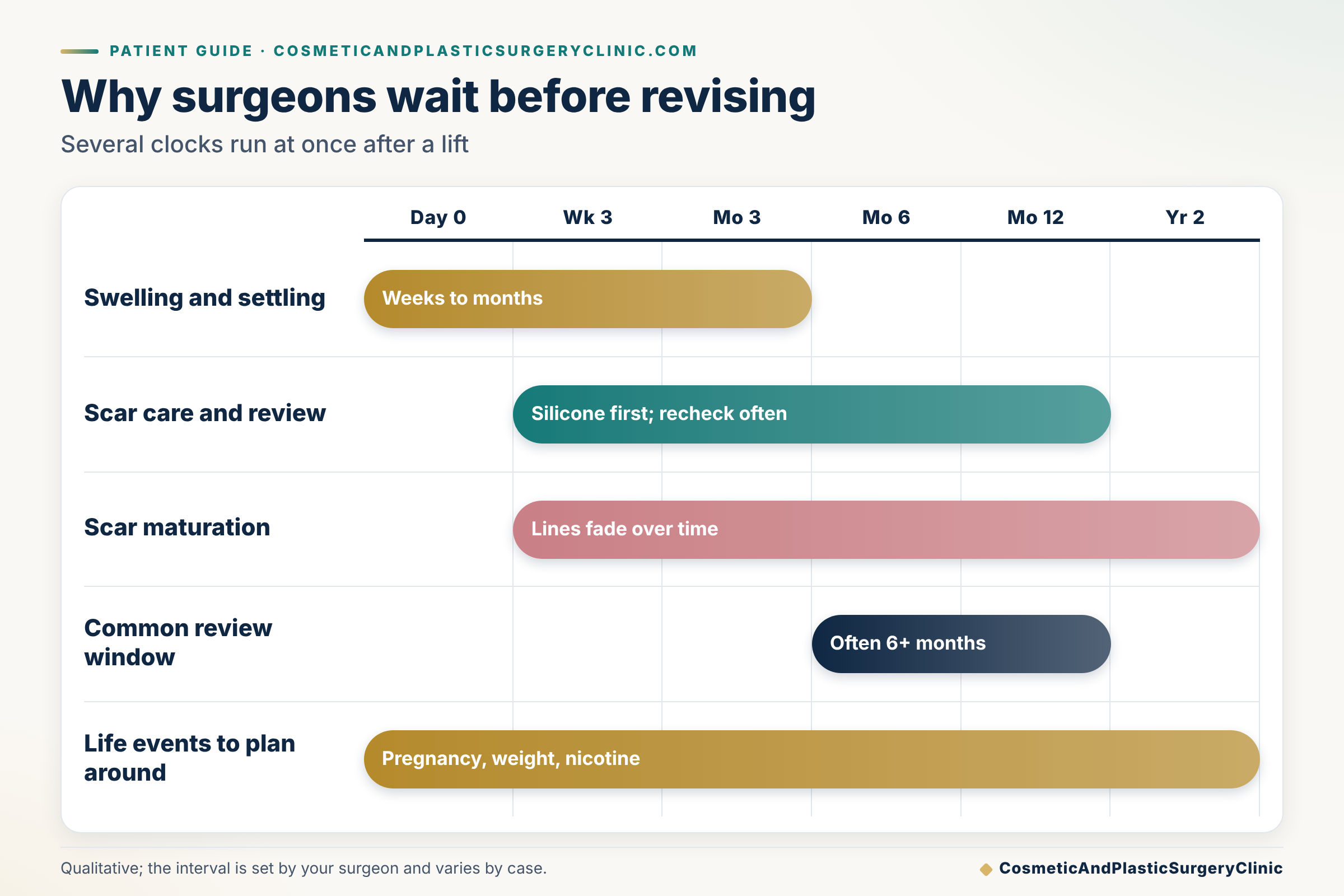
The most common advice about a revision breast lift is to wait, and the reasons are anatomical, not procrastination. A revision planned on swollen or immature tissue risks correcting a problem that was going to change anyway, or missing one that had not yet appeared.
How long surgeons usually wait
Swelling, settling and scars take months
ASPS says the final results of a breast lift appear over the next few months as the breasts settle and swelling resolves. StatPearls says reoperations are typically delayed until the tissue has fully settled, and that scar treatment routinely begins after three weeks. No source opened for this article sets one required interval.
The closest thing to a range comes from six surgeons who answered a patient’s 2016 question about revising a breast reduction on the Aesthetic Society site. Of the four who gave a number, three said six months or more, one of them closer to a year, and one said at least two to three months. One added that small lower-pole scar revisions can come sooner. Treat those replies as opinions, not rules. For a revision breast lift, months, not weeks, is the usual order of magnitude, and your own surgeon decides when your tissue has stopped changing.
Pregnancy, weight and nicotine can restart the clock
ASPS says breast surgery should be considered after childbearing is complete, since changes during pregnancy can minimize or reverse a lift, and that significant weight loss after breast surgery can affect appearance. A revision breast lift done before a planned pregnancy or a large weight change may need repeating. What surgeons weigh about those plans is described in breast lift candidate.
Nicotine matters for healing. StatPearls states that active smokers are contraindicated for mastopexy and advises encouraging patients to quit before elective surgery. In Messa’s series smokers had higher complication (26.1 percent) and reoperation (22.5 percent) rates than the series overall (15.3 and 14.7 percent). In the 2026 Belgian series, smokers were asked to quit one month before surgery. Ask your surgeon exactly what is required and whether it covers every nicotine product.
| Factor | What the sources say | Planning implication | Review point |
|---|---|---|---|
| Pregnancy and breastfeeding | ASPS: changes can minimize or reverse a lift | Consider timing around childbearing | Ask what happens to the result if pregnancy follows |
| Weight change | ASPS: significant loss afterward can hurt appearance | Aim for a stable weight before any operation | Ask what range of change the plan assumes |
| Nicotine | StatPearls: smokers contraindicated; Messa: higher complication rates | Quit well before surgery | Ask how long before and after, and which products count |
| Scar care and sun | 2014 expert panel: silicone first-line; avoid sun exposure | Follow the surgeon’s scar plan | Reassess a raised scar every four to eight weeks |
| Implant age | FDA: complications more likely the longer implants stay | Plan monitoring and possible replacement | Ask which screening schedule applies to your implant |
| Aging and gravity | ASPS: both keep changing breasts after a lift | Expect gradual change after any lift | Ask which changes are normal in each year |
Steps that often come before another operation
Scar care with evidence behind it
A 2002 international expert panel review in Plastic and Reconstructive Surgery concluded that silicone gel sheeting and injected corticosteroids were the only scar treatments with enough evidence for evidence-based recommendations; other therapies were accepted practice. A 2014 panel of 24 experts in the European Journal of Dermatology, led by Meaume, called silicone sheets and gels the gold-standard first-line non-invasive option and advised re-evaluating every four to eight weeks, with sun avoidance, taping, compression and moisturizers as general measures.
The 2014 paper lists escalation options: corticosteroid or 5-fluorouracil injections, cryotherapy, radiotherapy, laser and surgical excision, alone or combined. Which suits a particular breast scar is a surgical and dermatologic decision. Do not start products on fresh incisions without your surgeon’s approval.
Small fixes versus a second full lift
Some revisions are modest. In Stevens’ series, some scar revisions were done under local anesthesia or during an unrelated later operation, and in the 2026 Belgian series 17 of 198 patients had an aesthetic scar revision under local anesthesia. Repositioning a nipple or reshaping the gland is a larger operation than excising a scar, with a different recovery; the recovery article for a first lift describes what lift recovery generally involves.
What a revision breast lift involves and where the risk rises
A revision is rarely a copy of the first operation. The surgeon works through scarred tissue, with a blood supply that the first operation may already have changed, to fix a problem the first plan did not prevent. An ASPS journal article describes secondary mastopexy as technically demanding, and that is a fair way to think of it: a distinct operation with its own planning, not a touch-up.
How surgeons approach the second operation
Reshaping skin and gland, sometimes with a new pattern
In Spear’s revision series the most common procedure was a repeat mastopexy, and the mastopexy type stayed the same in 18 of 20 patients. Changing the incision pattern is possible, but it changes where scars lie. The 2016 replies cited above mention converting a vertical pattern to an anchor pattern to correct a high nipple, which adds a scar along the fold.
Adding support: mesh, flaps, fat and the pocket
The ASPS CME article describes soft-tissue management in revision using capsular flaps, acellular dermal matrix, mesh or fat grafting. Wagner’s review found that mesh, dermal suspension flaps and muscular slings seemed to add support, though its evidence was mostly case series. Ask which support your surgeon proposes, what it is made of, why your tissue needs it and what would happen if it caused a problem.
Techniques keep being proposed. A 2026 retrospective series of 198 women in three Belgian centers described using a deep flap of the patient’s own breast tissue to restore upper-pole fullness. It reported a 13 percent overall complication rate, 9 percent delayed wound healing and no nipple-areola necrosis, with follow-up averaging about a year. The authors acknowledge there are no outcomes beyond two years, which is the usual state of evidence for a new method.
Where the risk rises in a second operation
Blood supply to the nipple and wound healing
A 2021 review and international survey in Aesthetic Plastic Surgery by Broer and colleagues concerned secondary breast reduction, not lifts. It states that complication rates exceed those of primary reduction, often because of impaired blood supply to the nipple and areola, and that evidence on which pedicle to choose is scarce and conflicting. The ASPS CME article recommends perfusion assessment, such as indocyanine green angiography, for secondary mastopexy and reduction.
Evidence on lifts specifically is more reassuring and more limited. Stevens and colleagues reported no major complications in 100 secondary augmentation-mastopexies, with minor complications in 13 patients and no significant effect from smoking, BMI or incision type. Messa saw no significant skin flap necrosis in 2,183 procedures. Both are single-practice series from experienced surgeons. ASPS lists partial or total loss of the nipple and areola, and poor incision healing, among the risks of any breast lift.
Sensation, symmetry and the limit of what a repeat can do
ASPS lists changes in nipple or breast sensation, which may be temporary or permanent, along with asymmetry and the possibility of revisional surgery. Each operation, a revision breast lift included, adds another round of these risks to tissue that has already been operated on. The FDA’s statement that a satisfactory cosmetic outcome is not assured from any reoperation was written about implants, but it is a fair reminder for any repeat operation. General risk literacy is covered in plastic surgery risks.
Cost, paperwork and surgeon choice for a revision breast lift
The practical questions come last here, but they are worth asking early. A revision breast lift can price differently from the first operation, may fall under a different policy and depends on records that exist only if someone kept them.
What a revision breast lift can cost
Fee lines and what national figures leave out
ASPS’s 2024 average-fee document lists breast lift at $6,500 to $11,000, a projected range built from averages submitted by surveyed ASPS member surgeons. The ASPS cost page gives an average cost of $6,816 with no year and says it excludes anesthesia, operating-room facility and related expenses. Neither source has a separate line for a revision breast lift.
The Aesthetic Society says breast revision costs rise with complexity, citing a total capsulectomy combined with a lift and reaugmentation as the costliest example, and that insurance does not cover revisions because they are elective cosmetic surgery. The FDA adds that implant removal or replacement may not be covered even when complications occur. General cost mechanics are in plastic surgery cost, and pricing of the first operation is in breast lift cost.
Ask the original practice, in writing, whether its revision policy applies to your situation and what it covers: the surgeon’s fee only, or facility and anesthesia too.
Three hypothetical quotes to compare line by line
The table describes three invented plans, dated 2026-11-12. It carries no prices on purpose, because the sources opened here give none for revisions; its job is to show which lines to ask about. None is a recommendation and none describes a real patient.
| Cost line | Plan A: scar revision | Plan B: repeat lift | Plan C: lift with implant exchange |
|---|---|---|---|
| Surgeon fee | Ask whether a limited procedure carries a smaller fee | Separate fee; ask about any credit from the first practice | One fee covering lift and implant work, or two; ask which |
| Facility | Possibly an office or minor-procedure room | Operating-room time billed | Longer operating-room time billed |
| Anesthesia | Local, perhaps with sedation; ask who provides it | Ask what type and who provides it | Ask what type and who provides it |
| Devices and materials | Scar products, if any | Mesh or other support, if proposed | Implants, plus mesh if proposed |
| Follow-up and garments | Few visits; ask about scar-care follow-up | Visits and a support bra | Visits, bra and an implant monitoring plan |
| Insurance and gaps | Elective; usually not covered | Elective; usually not covered | Removal or replacement may not be covered (FDA) |
Compare any two revision breast lift quotes line by line using this structure, and treat a quote that gives one figure for “revision” without naming facility, anesthesia and devices as incomplete.
Preparing for the consultation
The records that shorten the first visit
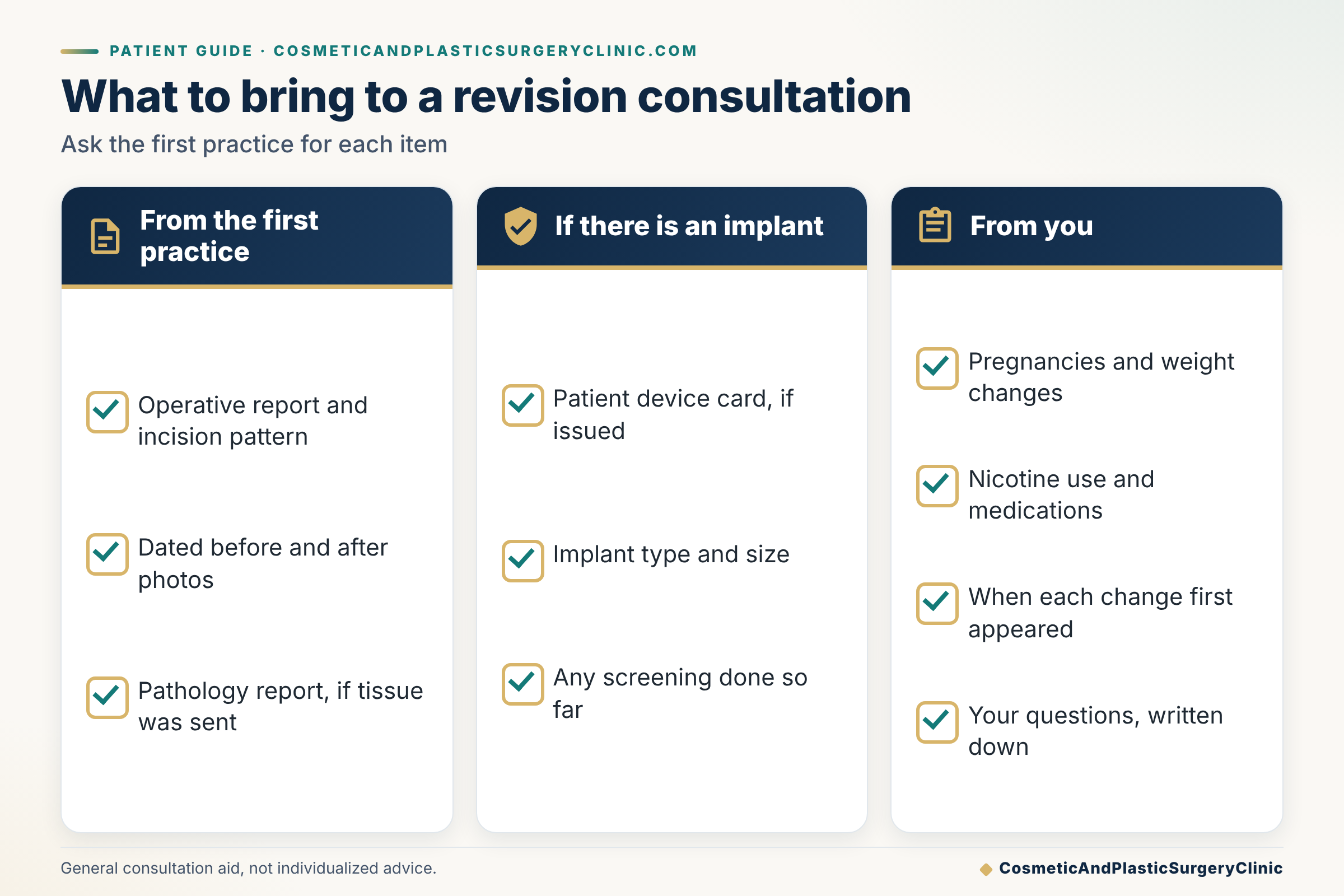
A revision breast lift is easier to plan when the surgeon knows what was done. The operative report describes the incision pattern, how the nipple’s blood supply was maintained, whether support material or an implant was used and how much tissue was removed. Ask the original practice for it, together with dated before-and-after photographs, pathology reports if tissue was sent, and your implant details or device card. If the first surgeon is no longer available, request the records anyway.
Add your own notes: pregnancies, weight changes, nicotine use, medications, and when each change in the breasts was first noticed. A photo taken monthly in the same light and pose is more useful than a single dramatic angle.
Six questions to ask before agreeing to a revision breast lift
These are prompts for a conversation, not a screening. The plastic surgery consultation article covers the rest of the visit, and how to choose a plastic surgeon explains how to verify certification and facility accreditation, which matters more when the case is complicated.
- Diagnosis: which problem is this, position, volume, scar or implant, and what did the first operation do or not do?
- Timing: how many months from now, and what will you check to confirm my tissue has settled?
- Method: what will be done differently from the first operation, and why would that change the outcome?
- Blood supply and healing: what is the plan for the nipple’s blood supply, and how do my history and nicotine use affect it?
- Experience: how many revision breast lifts do you perform, and can I see similar cases at similar follow-up times?
- Money and policy: what is included in writing, what happens if a third operation is needed, and what do I pay for facility, anesthesia and devices?
Frequently asked questions
Will insurance pay for a revision breast lift?
Usually not for a cosmetic result. The Aesthetic Society says breast revision costs are not covered because revisions are elective cosmetic surgery, and ASPS says most plans do not cover breast lift surgery or its complications. The FDA warns that implant removal or replacement may not be covered even with complications. Policies differ, so ask your insurer in writing before surgery, and ask the surgeon’s office what billing codes it would use and what you would owe if coverage is refused.
Does the original surgeon have to perform the revision breast lift?
Nothing in the sources opened requires it. Among the six surgeons who replied to a 2016 patient question on the Aesthetic Society site, two advised staying with the original surgeon, one noting that this surgeon knows the pedicle anatomy. Others did not say. A second opinion is reasonable either way. What matters is that whoever operates has your operative report and photographs, and can explain what the first operation did.
How soon can a scar be fixed after a lift?
There is no single date in the sources. ASPS says incision lines fade over time, and the 2014 scar panel advised re-evaluating a scar every four to eight weeks to decide whether more treatment is needed. A small scar revision can be done under local anesthesia, as in a 2026 series where 17 of 198 patients had one, but surgeons often prefer to let a scar mature first. Your surgeon judges maturity from how the scar looks and feels.
Should I have a revision breast lift before or after another pregnancy?
ASPS advises considering breast surgery after childbearing is complete, because pregnancy changes can minimize or reverse a lift. That suggests waiting where the plan is flexible, though a distressing scar or implant problem is a separate question to raise with your surgeon. Ask what would likely happen to a revision breast lift if pregnancy followed, and whether breastfeeding plans change the technique. The article on how long a breast lift lasts covers aging and pregnancy effects.
How much asymmetry justifies a revision breast lift?
No threshold appears in the sources opened. ASPS lists asymmetry as a risk of any lift, and many breasts differ before surgery, so the starting point is your own preoperative photos. Settling matters too, since StatPearls says reoperations are typically delayed until tissue has fully settled. A difference that is stable after several months, bothers you, and was not present before surgery is the kind of question to bring to a consultation with photos.
Will I need a lift if I have my implants removed?
Not necessarily, and the sources do not say how often it is needed. The FDA says that after removal without replacement, some women develop dimpling, chest wall concavity, puckering or sagging. Whether a lift is advisable depends on how much skin remains, where the nipple sits and how your breast tissue looks once the implant is gone. Ask a surgeon to describe what your breasts might look like without implants before you decide on any revision breast lift.
Can fat transfer replace a second lift for an empty upper breast?
Fat adds volume, while a lift changes position, so they answer different problems. ASPS says a lift does not round out the upper breast, and its CME article lists fat grafting among tools used in revision for soft-tissue problems. Fat can partly fade, so ask how much your surgeon expects to stay. The fat transfer vs implants article compares fat with devices.
Sources and further reading
- American Society of Plastic Surgeons — Breast lift (accessed 2026-11-12) — what a lift does and does not change; areola reduction
- American Society of Plastic Surgeons — Breast lift risks and safety (accessed 2026-11-12) — risk list including asymmetry, sensation, nipple loss, revisional surgery
- American Society of Plastic Surgeons — Breast lift results (accessed 2026-11-12) — settling, scars, pregnancy, weight and aging effects
- American Society of Plastic Surgeons — Breast lift cost (accessed 2026-11-12) — average cost, exclusions, insurance; no year stated
- American Society of Plastic Surgeons — Cosmetic procedures average cost, 2024 (accessed 2026-11-12) — breast lift fee range; no revision row
- American Society of Plastic Surgeons — Principles of Aesthetic Breast Revision Surgery, journal CME article (summary page, accessed 2026-11-12) — reasons for reoperation, support materials, perfusion assessment
- U.S. Food and Drug Administration — Risks and complications of breast implants (content current as of 12/15/2023, accessed 2026-11-12) — reoperation, removal, capsular contracture, changes after removal
- U.S. Food and Drug Administration — Things to consider before getting breast implants (current as of 03/08/2023, accessed 2026-11-12) — assume reoperations, insurance caveat, patient device card
- Spear, Low and Ducic — Revision augmentation mastopexy: indications, operations, and outcomes, Annals of Plastic Surgery, 2003 (abstract record, accessed 2026-11-12) — 20 revision patients, indications, techniques
- Grewal and Fisher — Why do patients seek revisionary breast surgery? Aesthetic Meeting 2012 abstract (accessed 2026-11-12) — 134 reoperations, time to reoperation, natural progression
- Jordan, Khavanin, Rambachan and Kim — A systematic review and meta-analysis of single-stage augmentation-mastopexy, Aesthetic Meeting 2014 abstract (accessed 2026-11-12) — pooled complications and reoperation
- Messa — One-stage augmentation mastopexy: a retrospective ten-year review of 2,183 consecutive procedures, Aesthetic Surgery Journal, 2019 (abstract record, accessed 2026-11-12) — reoperation, recurrent ptosis, circumareolar technique, smokers
- Stevens and colleagues — Mastopexy revisited: a review of 150 consecutive cases for complication and revision rates, Aesthetic Surgery Journal, 2007 (hosted copy, accessed 2026-11-12) — revision rate, scars, recurrent ptosis
- Stevens and colleagues — A review of 100 consecutive secondary augmentation/mastopexies, Aesthetic Surgery Journal (abstract record, accessed 2026-11-12) — secondary combined operations, complications
- Wagner, Lisiecki, Chiodo and Rohrich — Longevity of ptosis correction in mastopexy and reduction mammaplasty: a systematic review of techniques, JPRAS Open, 2022 (abstract record, accessed 2026-11-12) — pedicles, mesh, evidence quality
- di Summa and colleagues — Systematic review of outcomes and complications in nonimplant-based mastopexy surgery, JPRAS, 2019 (abstract record, accessed 2026-11-12) — complication, scar and nipple-areola rates
- Van Boeckel and colleagues — Retrospective multicenter review of mastopexy using the “mushroom” auto-augmentation flap technique, PRS Global Open, 2026 (accessed 2026-11-12) — complications, scar revisions, follow-up limits
- Broer and colleagues — How to approach secondary breast reduction: international trends and a systematic review, Aesthetic Plastic Surgery, 2021 (abstract record, accessed 2026-11-12) — secondary reduction complications and nipple blood supply
- Martinez and Chung — Breast ptosis, StatPearls, NCBI Bookshelf (updated November 12, 2023, accessed 2026-11-12) — nonmajor complications, delayed reoperation, smoking, hematoma
- International clinical recommendations on scar management, Plastic and Reconstructive Surgery, 2002 (abstract record, accessed 2026-11-12) — silicone sheeting and corticosteroid evidence
- Meaume and colleagues — Management of scars: updated practical guidelines and use of silicones, European Journal of Dermatology, 2014 (abstract record, accessed 2026-11-12) — silicone first-line, re-evaluation interval, escalation options
- The Aesthetic Society — Breast revision surgery, patient question and surgeon replies (January 2016, accessed 2026-11-12) — general waiting times and pattern-conversion remarks
- The Aesthetic Society — How much does breast revision surgery cost? (accessed 2026-11-12) — cost drivers, insurance statement


