Blepharoplasty is eyelid surgery: an operation that removes or repositions skin, fat and sometimes a strip of muscle from the upper lids, the lower lids or both. The American Society of Plastic Surgeons (ASPS) notes that it can serve a cosmetic goal, a functional one, or a mix of the two. Despite the single name, blepharoplasty is not one standard operation. What a surgeon does depends on which structure is responsible for the heaviness, the bags or the hooding you notice.
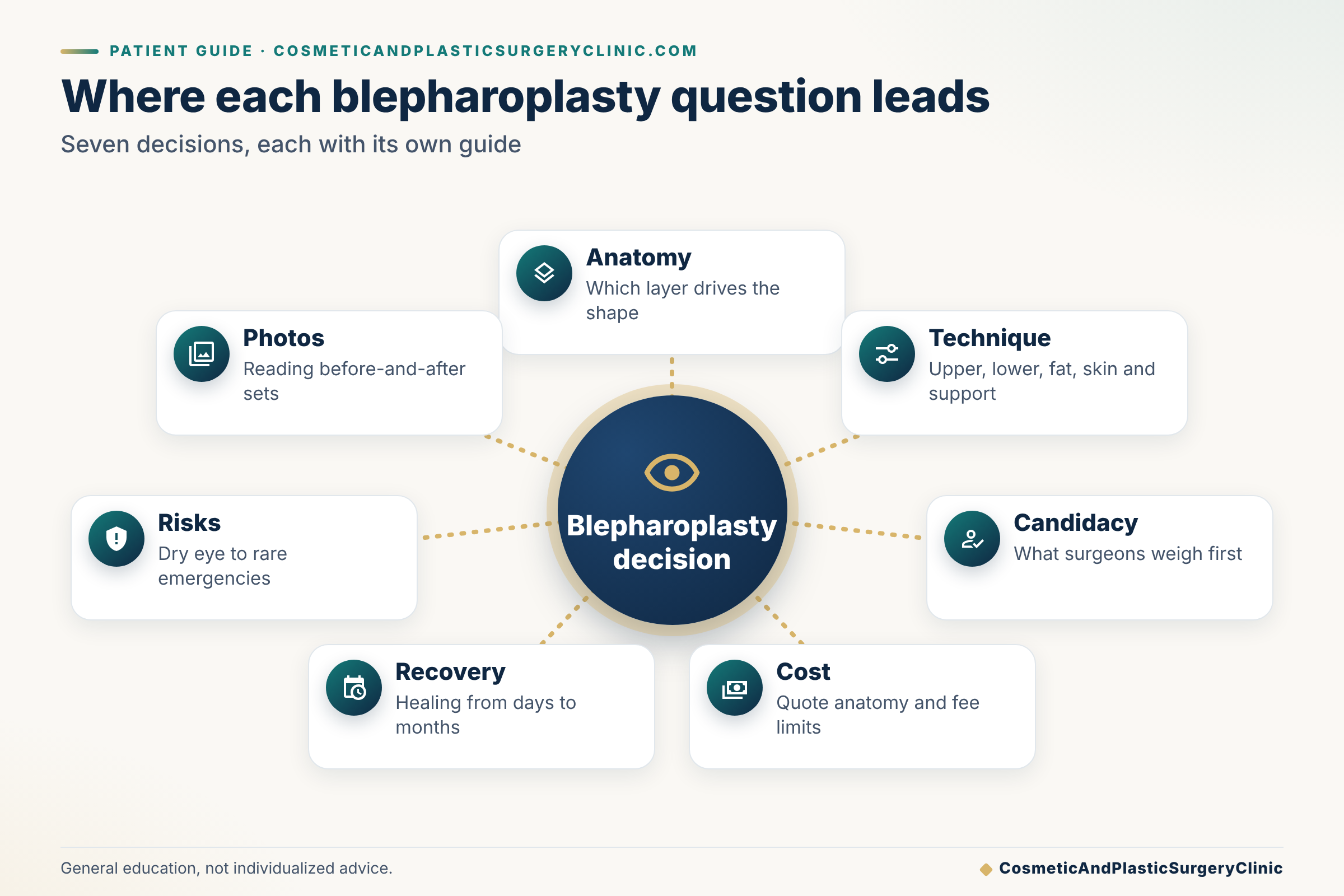
This page is the hub for the topic. It covers eyelid anatomy, why lids change with age, what blepharoplasty changes and what it leaves alone, technique families, planning, healing, risks, alternatives, cost and choosing a surgeon. Detailed pages on cost, recovery, risks, candidacy, upper versus lower surgery, photographs, insurance, lower-lid techniques and brow lifts are linked where you would need them next. Nothing here can say whether surgery suits your eyes; that takes an examination.
How the eyelid is built: the layers a surgeon works through
In its 2025 statistics report, the ASPS counted an estimated 118,978 eyelid surgeries, up 19 percent from 100,185 in 2024, and ranked the operation fifth in its cosmetic-procedure listing. Women accounted for 104,652 of the 2025 total and men for 14,327. The largest age group was 56 to 65 (43,126), followed by people 66 and older (37,862), and the report calls eyelid surgery the highest-volume procedure in that older group.
Popularity says nothing about whether a given lid needs surgery. What the numbers do show is that blepharoplasty is common enough to deserve an hour of reading before a consultation, starting with what is actually inside a lid.
The layers, from skin to the inner lining
Skin, the blink muscle and the septum
The StatPearls anatomy entry on the eyelid calls eyelid skin the thinnest on the body and notes that it has no subcutaneous fat. Beneath it lies the orbicularis oculi, the muscle that closes the lid. Its pretarsal and preseptal parts drive the involuntary blink, and its outer, orbital part drives forced closure.
Behind the muscle is the orbital septum, a thin fibrous sheet that separates the lid from the contents of the eye socket. A second StatPearls entry describes the lid as two layers: an anterior lamella of skin and muscle, and a posterior lamella of tarsal plate and conjunctiva. Almost every step of a blepharoplasty is a decision about how much of the front layer to trim and whether to open the septum.
Fat pads: two above, three below
Orbital fat sits behind the septum. The upper lid holds two compartments, a central pad (often called the preaponeurotic pad) and a nasal pad, and StatPearls notes that the nasal pad looks distinctly white next to its neighbors. The lower lid holds three: nasal, central and lateral. The inferior oblique muscle runs between the nasal and central lower pads, which makes it a landmark that surgeons avoid injuring.
Where these pads bulge, a lid looks puffy. Where they are removed too aggressively, the lid can look hollow. That trade-off is the reason modern plans often talk about repositioning or conserving fat rather than simply taking it out, a point the sections on technique return to.
The lifting muscles, the tarsus and the corner tendons
The levator muscle opens the upper lid. According to StatPearls, it arises at the back of the socket and divides into the levator aponeurosis, which forms the upper-lid crease and attaches to the tarsal plate, and Müller’s muscle, which is driven by the sympathetic nervous system and adds about 2 mm of lift. The lower lid has a weaker parallel arrangement built on a structure called the capsulopalpebral fascia.
The tarsal plates are the stiff frames of the lids. StatPearls gives the upper plate as 10 to 12 mm tall at its center and the lower as up to 4 mm. The medial and lateral canthal tendons anchor both plates to the bony socket. When surgeons talk about lid “support” or “tone,” they mean how well these tendons and plates hold the lower lid against the eye.

Neighbors that change a blepharoplasty result
The brow above the lid
Upper-lid skin does not hang in isolation. A brow that has settled low pushes skin down over the lid, and removing lid skin can let the brow settle further. A 2012 study in the journal Orbit measured brow position on photographs of 45 people before and after upper blepharoplasty, excluding anyone with ptosis or prior brow surgery, and concluded the operation causes secondary changes in brow position, largest at the outer brow.
A 2016 series of 70 patients in the World Journal of Plastic Surgery found brow depression in 24 (34.2 percent), mostly under 2 mm, and more often in men than in women. These are small studies, not forecasts for any one person. They explain why surgeons examine the brow first and why StatPearls advises leaving at least 10 mm between the lid incision and the brow. The choice between lids and brow has its own page, blepharoplasty vs brow lift.
The tear film and the surface of the eye
Lids spread tears across the eye with every blink. A 2021 review in Annals of Eye Science explains that removing orbicularis muscle can reduce blink rate and cause incomplete blinks, which raises tear evaporation. That is why a surgeon will ask about gritty eyes, artificial tears and contact lens comfort long before discussing incision lines.
The Aesthetic Society notes that when a person has dry eyes, less tissue is removed because greater exposure of the eye can make symptoms worse. Published dry-eye figures appear in the risk section below. For now, hold one idea: the lid is a working part of the eye, so a good plan protects the eye surface first and the appearance second.
Why eyelids change with age, and which change is yours
People use “droopy,” “tired” and “puffy” for very different structural problems. Skin can loosen and fold, fat pads can push forward, the lifting muscle can weaken, the brow can descend, and the lower lid can lose the tone that holds it up. Several of these often coexist, and each one points to a different operation or to none. The ASPS lists loose skin, fatty puffiness, bags, a lower lid that reveals white below the iris, and fine lower-lid wrinkles as concerns eyelid surgery can address.
Three look-alike causes of heavy upper lids
Dermatochalasis: skin that has outgrown its frame
Dermatochalasis is the medical term for excess, sagging eyelid skin. StatPearls describes the functional version as excess skin with outer-corner hooding that limits upward and side vision, giving trouble seeing traffic lights while driving as an example. It also lists frontal headaches from constantly lifting the brow, lashes irritating the eye, skin-on-skin dermatitis and downward-gaze ptosis that interferes with reading.
The cosmetic version is usually a wish for a more defined crease and less fullness in the upper lid. Both versions can be present in the same person, which matters for the insurance question covered in the planning section.
Ptosis: when the lifting muscle is the problem
True ptosis means the upper lid margin sits too low because the levator mechanism is stretched or weak. The ASPS candidates page states that drooping from a stretched upper-lid muscle needs a different surgical treatment than skin removal. Surgeons measure it: margin reflex distance 1 (MRD1), the gap between the pupil’s light reflex and the upper lid edge, is normally about 3.5 to 4 mm, and StatPearls says a value under 3 mm or a difference between sides should prompt measurement and correction of ptosis.
A StatPearls overview adds that an MRD1 of 1 to 2 mm often points toward levator advancement. Removing skin from a ptotic lid can leave the underlying droop untouched, so this is one of the most important distinctions in the whole consultation.
Brow ptosis: a lid problem that starts above the lid
The ASPS candidates page notes that a drooping upper lid can also come from forehead skin or eyebrow relaxation. In that case the heaviness is a brow position issue, and lid surgery alone may remove skin that the brow would still push back down. Surgeons may address the brow first, at the same time, or not at all, depending on goals and anatomy.
You can describe what you see in a mirror, but you cannot sort these causes reliably yourself. Looking straight ahead with your forehead relaxed, then again with your brow lifted by hand, tells you something about how much the brow contributes. It does not replace measurement, and it is one reason a surgeon examines both brow and lid together.
Bags, hollows and the lower lid’s support
Fat that protrudes and grooves that deepen
StatPearls uses the term steatoblepharon for fat that protrudes in the upper or lower lids. Lower-lid bags often sit just above a groove, the tear trough, which StatPearls says is formed by the orbital retaining ligament running from the inner corner of the eye toward the edge of the cornea. The Aesthetic Society lists bags, puffiness and deep grooves below the eyes as the lower-lid concerns surgery addresses.
Bag and groove are one contour, not two problems. Removing fat from the bag can make the groove look deeper, while moving fat down over the groove can soften both. Which approach fits depends on how much volume is present, how firm the lid is and what the cheek below is doing.
Laxity: the part a photograph does not show
A lower lid that is loose behaves differently after surgery. StatPearls describes the lower-lid snap-back test: the examiner pulls the lid away from the eye and watches how quickly it returns, and a slow or absent snap suggests a lateral canthopexy or canthoplasty, a procedure that tightens the outer corner, may be needed. The Patel and Malhotra entry adds a distraction test for the same purpose.
Laxity matters because skin removal from a lax lid can pull it downward, and the ASPS safety page lists ectropion (the lid rolling outward) and lid lag among the risks. The long answer on lower-lid technique choices is on lower eyelid surgery; the short answer is that support is assessed before skin is touched.
| Situation | Likely pathway | Benefit | Trade-off | Key question |
|---|---|---|---|---|
| Excess upper-lid skin, normal lid height, level brow | Upper blepharoplasty through the crease | Removes hooding; can improve upward view | Scar in the crease; dryness risk | How much skin stays, and why? |
| Low lid margin with a measurable droop | Ptosis repair, with or without skin removal | Treats the lifting mechanism itself | Different operation, different risks | What is my MRD1 and levator function? |
| Hooding with a low or descended brow | Brow work, lid work, or both in sequence | Avoids removing skin the brow still needs | More than one procedure or incision | Does lid surgery change my brow position? |
| Lower-lid bags, firm lid, little loose skin | Transconjunctival fat removal or repositioning | No skin incision on the lid surface | Does not remove skin; groove may shift | Will fat be removed or moved? |
| Lower-lid skin excess with a slow snap-back | Skin removal plus lid support | Addresses both skin and tone | Higher ectropion and lid-lag concern | How will the lid be supported? |
| Hollow under the eye, little extra skin | Volume options, surgical or nonsurgical | Adds rather than removes | Filler has its own risks and limits | Is this hollow or a bag? |
Read the table as a map of questions, not a verdict. Real lids rarely fit one row: someone may have hooded skin, a slightly low brow and a lower-lid bag at once, and the sequence in which those are addressed is part of the plan. Bring the table’s last column to a consultation and note which questions the surgeon answers with measurements and which with generalities.
What blepharoplasty changes, and what it leaves alone
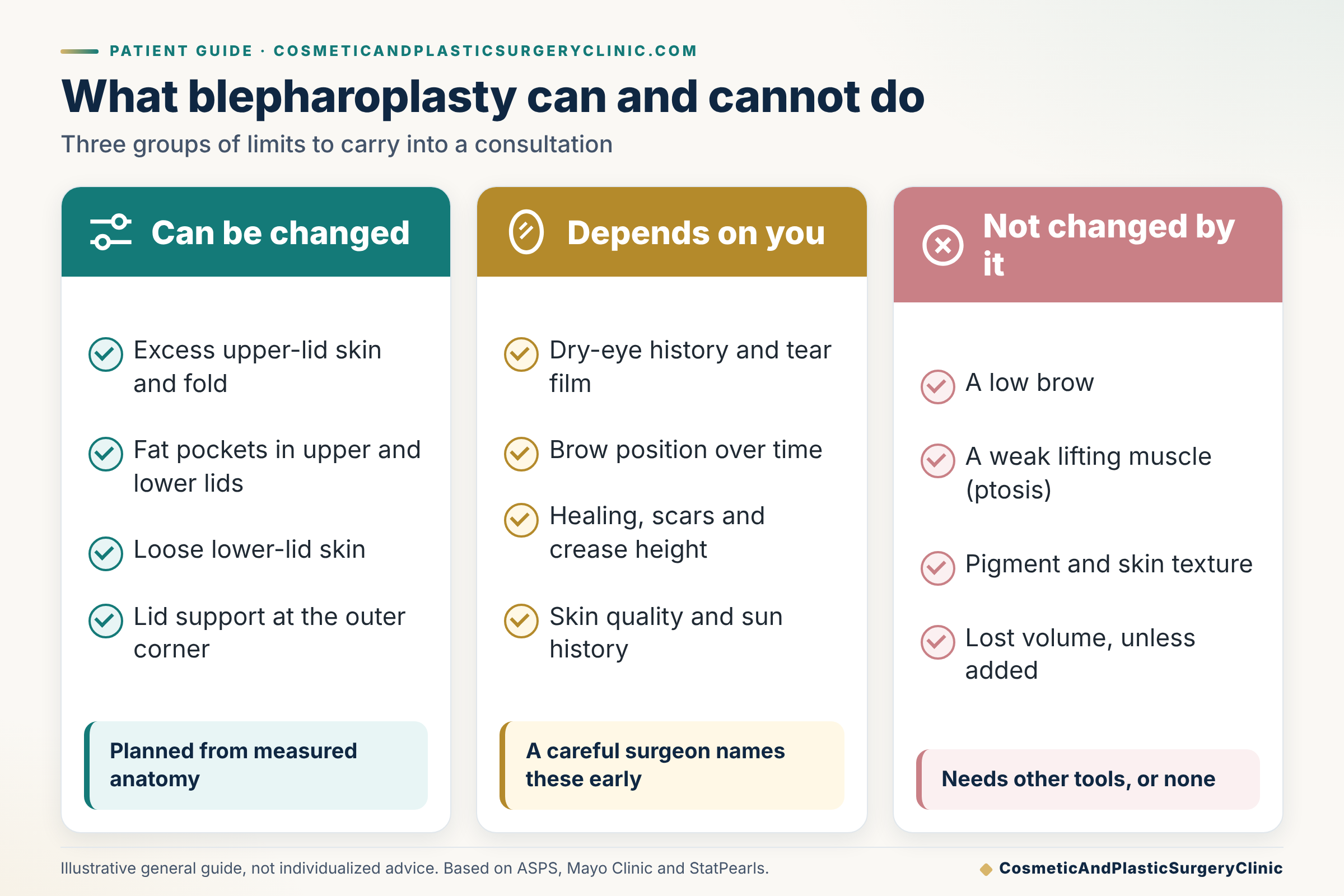
Blepharoplasty alters only the tissues it touches: skin, a strip of muscle, fat and, in some plans, the support of the lower lid. Everything outside those tissues stays where it was. Knowing that boundary before a blepharoplasty consultation prevents the most common mismatch, which is wanting a change that the operation was never designed to make. The ASPS says results appear gradually as swelling and bruising subside, and that the area looks smoother and better defined; it does not claim anything more specific, and neither should a plan.
The changes the operation makes
Upper lid: a crease incision, skin, selected muscle and fat
According to the ASPS procedure page, the upper-lid incision sits within the natural eyelid crease so the scar is concealed in the lid’s own fold. Through it, surgeons remove excess skin, may tighten muscle, and remove or reposition fat deposits. Mayo Clinic describes the core goal simply as removing excess eyelid skin.
The StatPearls entry on upper blepharoplasty adds details that show how conservative the work is meant to be. Markings are made with the patient sitting up, excision is greatest toward the outer corner, and the central fat pad is removed cautiously to avoid an A-shaped hollow. The same entry notes that the final crease often sits about 2 mm higher than marked, and that lowering a high crease is difficult and unpredictable, which is a good reason to ask where your crease will be placed and why.
Lower lid: fat, skin and support in different proportions
The ASPS describes two entry routes: an incision just below the lower lash line, or a transconjunctival incision on the inside of the lid with no skin removed. Through the lash-line route, excess skin is taken out and fat is repositioned or removed. The Aesthetic Society adds that a traditional approach may also tighten the lower-lid muscle, and that a skin-pinch variation removes only a small amount of skin when lid support is good.
The lower lid is held in place by a thin plate and tendons rather than lifted by a strong muscle. That is why the amount of skin removed, and whether the outer corner is supported, receives so much attention. The comparison between the two lids has its own page, upper vs lower blepharoplasty.
What stays outside the operation
Brow position, true ptosis and thyroid-related change
A blepharoplasty does not raise a low brow, and it does not fix a weak levator unless that muscle is specifically addressed. StatPearls lists thyroid orbitopathy with bulging of the eye as a relative contraindication to upper blepharoplasty because it may cause incomplete lid closure, which is a reminder that eyelid appearance can be a sign of a medical condition rather than simply of age.
If your lids look different from a few years ago, or only one side has changed, tell the surgeon when it started. Sudden or one-sided change calls for a medical evaluation before any cosmetic plan. Questions about brow versus lid also belong on the blepharoplasty candidate page, which covers what surgeons weigh about health and anatomy.
Pigment, skin texture and lost volume
Dark under-eye color from pigment, fine wrinkles in thin skin and a hollow from lost volume are not the same problem as a bag. The ASPS procedure page notes that a surgeon may suggest a laser or chemical peel to reduce discoloration of the lower lids, and the Aesthetic Society says laser resurfacing may be added to smooth wrinkles. Both are treated as extra steps, not as effects of removing fat or skin.
Volume is handled differently again. Fat can be moved from a bag to a groove during surgery, and the Aesthetic Society lists hyaluronic acid fillers as a nonsurgical option in the tear trough. Whether the hollow, the bag or the pigment is your main concern changes which option is relevant, so say which one bothers you most.
Eye shape and ethnicity-specific lid features
Eyelid anatomy varies among people, and the variation affects planning. A 2019 article by William Chen in Plastic and Reconstructive Surgery Global Open describes lids without an upper crease as typically thicker, with fat in more spaces and fewer levator fibers reaching the skin, compared with lids that have a crease. Those comparisons are background discussion rather than a controlled study.
The same article stresses that crease height is a deliberate choice: too high risks incomplete lid closure and secondary ptosis, too low can let the crease fade. Anyone who wants to keep their natural lid shape, or to create or change a crease, should say so explicitly. A surgeon experienced with the specific features you have, and willing to show examples on similar anatomy, is a reasonable thing to ask for.
Technique families at a glance, upper and lower
The detail behind each approach belongs on the pages for each lid, but the logic fits in a few paragraphs: surgeons pair the layer causing the contour with the step that reaches it. Because the two lids are built differently, the operations are separate planning problems, even when they are done in the same sitting.
Upper lid choices
Skin only, or skin with muscle and fat
The simplest upper blepharoplasty removes a wedge of skin along the crease. More involved plans also trim a strip of orbicularis muscle and open the septum to reach fat. StatPearls advises preserving the pretarsal muscle and removing only conservative amounts of muscle elsewhere, and says the inner fat pad generally needs more debulking than the central pad.
The right amount depends on what the person has. More removal is not better: a lid with too little skin and muscle can fail to close completely, and StatPearls notes that nearly all patients have some early incomplete closure that usually resolves within days. Ask which tissues are planned for removal and which are meant to be left.
Adding ptosis repair or brow work
When a lid margin sits low, the plan may combine skin removal with levator advancement, a step that tightens the lifting mechanism. StatPearls notes that upper blepharoplasty is often combined with a brow lift, and the Aesthetic Society says eyelid surgery may be paired with a brow lift or facelift. These combinations lengthen the operation and add their own risks.
The facelift context is in facelift, and the middle-ground options are on facelift alternatives. Neither replaces a lid-specific examination, and a surgeon who proposes combining steps should be able to say what each one adds for your particular anatomy.
Lower lid choices
Transconjunctival: fat without a skin incision
The transconjunctival route enters through the inner surface of the lower lid. The Aesthetic Society says it removes excess fat but not skin, and that a laser may be used to tighten skin. A StatPearls overview notes that patients without skin removal may have fat taken out this way, and a Thieme chapter on blepharoplasty complications calls lower-lid retraction “well-recognized” after the transcutaneous route and “very rare” after transconjunctival surgery.
The approach suits a lower lid with bags but little loose skin and good support. It does not suit a lid with significant skin excess, because skin cannot be trimmed from inside. Which route fits is a measurement question, not a preference.
Skin-muscle and skin-pinch approaches
When the lower lid also has loose skin, the incision runs just below the lash line, and skin is removed through it. A skin-pinch variation takes only a small strip and, per the Aesthetic Society, suits good lid support with little excess skin. Laser resurfacing may be added for texture.
The trade-off is mechanical. Removing too much skin, or operating on a lax lid, can pull it downward and expose the white of the eye below the iris, which the ASPS lists as lid lag or ectropion. Surgeons who use this route should be able to explain how much they plan to remove and how they judge lid tone.
Fat repositioning and canthal support
Rather than removing a bulging pad, a surgeon can move fat over the lid-cheek junction to soften the transition. The ASPS says fat may be repositioned or removed in either lid. A StatPearls overview describes spreading postseptal fat over the lid-cheek angle to blend the contour.
For a lid with poor tone, canthopexy or canthoplasty tightens the outer corner. StatPearls describes it as typically involving a lateral canthotomy and inferior cantholysis, with a possible tarsal strip. It can be added to any lower-lid route, and it changes the operation enough that it should be named in the consent and the quote.
| Approach | Incision | Usually addresses | Main trade-off |
|---|---|---|---|
| Upper skin (and muscle, fat) removal | Natural upper-lid crease | Hooding, heavy skin fold, fat fullness | Crease placement and dryness risk |
| Upper blepharoplasty with ptosis repair | Crease, plus levator work | Low lid margin together with skin excess | Longer operation, more to heal |
| Lower transconjunctival | Inside the lower lid | Fat bags without loose skin | Skin cannot be removed this way |
| Lower skin-muscle or skin pinch | Just below the lash line | Bags together with loose skin | Lid lag or ectropion if lid is lax |
| Fat repositioning | Either route | Bag plus tear-trough groove | Less standardized; ask for examples |
| Canthopexy or canthoplasty add-on | Outer corner of the eye | Lax lower lid needing support | Extra step, different recovery |
Planning blepharoplasty: the eye examination, functional versus cosmetic, and who may wait
A consultation for blepharoplasty is closer to an eye examination than to a styling session. Mayo Clinic says to expect a physical exam, a complete eye exam including tear production and eyelid measurements, visual field testing and eyelid photography. The work done here decides whether surgery is advisable at all, which technique fits, and how the result is likely to hold up.
What a thorough eyelid evaluation measures
Eye history, dry eye and the tear film
The Aesthetic Society lists dry eyes, glaucoma, eye allergies and other eye problems among the first questions, along with circulatory, thyroid and diabetes history and every medicine and supplement you take. StatPearls adds prior eye or refractive surgery, blepharitis, meibomian gland problems, artificial tear use and contact lens habits, and notes that a patient may not remember a previous blepharoplasty.
Tear testing is less settled than it sounds. The Patel and Malhotra entry says Schirmer’s test, which measures tear production on a strip of paper, is often performed but no longer considered necessary because the results are not entirely reliable. The same entry has the surgeon assess the tear film and tear breakup time instead. Bring a clear account of how your eyes feel on an ordinary day.
Lid measurements, the snap test and Bell’s phenomenon
StatPearls lists the measurements that matter for an upper-lid plan: MRD1, normally 3.5 to 4 mm; levator function, normally more than 12 mm; lagophthalmos, meaning incomplete closure; and Bell’s phenomenon, the upward roll of the eye when the lids close. About 15 percent of people have a neutral or negative Bell’s response, and for them the same entry says a conservative blepharoplasty is indicated, because the eye is less protected if the lids close incompletely.
For the lower lid, the snap-back and distraction tests assess tone. None of these numbers is a pass or fail grade. They are inputs that tell a surgeon how much skin can safely come off and whether the lid will need support.
Photographs and visual field testing
Photographs taken from several angles serve two purposes, according to the Aesthetic Society: planning the operation and tracking its effects. They are also the baseline against which you will judge your own result, so ask to see the set. The photograph guide on this site, blepharoplasty photos, explains how to read before-and-after sets.
Visual field testing measures how much of your sight the upper lid blocks. A StatPearls overview describes performing it with the lids in their normal position and again with the excess skin taped up. Patel and Malhotra note that many surgeons consider formal testing a poor use of resources because it rarely changes management; Mayo Clinic notes, however, that insurers may require it, as the next section explains.
| Check | What it shows | Why it changes the plan |
|---|---|---|
| Dry-eye history and tear film | How well the eye surface tolerates exposure | Less tissue may be removed, or surgery may wait |
| MRD1 and levator function | Whether the lid margin is truly low | Separates skin excess from ptosis |
| Brow position and symmetry | How much the brow contributes to hooding | May call for brow work before or with the lids |
| Snap-back and distraction tests | Tone of the lower lid | Decides skin removal and need for canthal support |
| Bell’s phenomenon and lid closure | Corneal protection if closure is incomplete | A weak response favors conservative removal |
| Visual field testing, photographs | Functional blockage and a baseline record | Supports a functional claim and a fair comparison later |
| Medicines, supplements, smoking | Bleeding and healing risk | Timing of stops is set with your own physicians |
Functional or cosmetic: why the label matters
Symptoms and documentation
Mayo Clinic says coverage may depend on whether the surgery repairs a condition that harms vision, and that surgery done only to improve appearance probably will not be covered. It adds that visual field testing and eyelid photography may be needed to support a claim. The ASPS cost page states that most health insurance does not cover cosmetic surgery, though removing excess skin that covers the eyelashes may be covered, so the policy deserves a careful read.
Coverage rules differ by payer and by region, and no article can say whether yours applies. The documentation rules, appeals and common pitfalls are covered on blepharoplasty insurance. What belongs here is the principle: symptoms that are real and measurable are worth describing accurately, and honest documentation is the only kind that holds up.
Mixed cases, where one operation does two jobs
Many people have both a functional complaint and a cosmetic wish, such as heavy upper lids with a bag below. A single sitting may then include a part that a payer might consider functional and a part that is clearly cosmetic. How the work is billed is a conversation to have in advance, in writing, with both the surgeon’s office and the insurer.
Cost components for the cosmetic portion are covered in blepharoplasty cost, and the general mechanics of quotes and financing live in plastic surgery cost. Do not assume that a functional label lowers the fee for the cosmetic part, or that a cosmetic label rules out coverage for the functional part.
Who may be asked to wait or look elsewhere
Health and eye conditions that change the timing
The ASPS candidates page describes healthy people with no conditions that impair healing, nonsmokers, people with realistic goals and people without serious eye conditions. StatPearls lists severe dry eye, thyroid orbitopathy with bulging, clotting disorders and photophobia as relative contraindications to upper blepharoplasty, and says people with several prior blepharoplasties need careful checks of skin, muscle function and incomplete closure before more surgery.
The same entry recommends screening for body dysmorphic disorder and other psychiatric concerns, with referral when needed. That is a standard part of cosmetic planning, not a judgment about anyone. Blood pressure is also worth attention because hypertension was the most common risk factor in a survey of postoperative visual loss, discussed in the risk section.
Goals that another route may serve better
If the heaviness comes from a low brow, brow work may be the right first step. If the lid margin sits low, ptosis repair is a different procedure. If the main issue is a hollow under the eye with no extra skin, a volume option may fit better than subtracting tissue. Each of those possibilities can still be combined with blepharoplasty, but none is solved by it.
Consider a hypothetical person in their late fifties who feels the upper lids look heavy. A first visit might show skin excess, a brow that has settled lower than it was, and a lid margin at a normal height. The surgeon might suggest brow work, lid work or both, in a chosen order, and might also say that a few months of watching, or a second opinion, is reasonable. The point is that the answer comes from measurement, not from the wish.
Being told to wait, to see an eye specialist first or to try a smaller step is a legitimate result of a blepharoplasty consultation. The overall decision framework is in plastic surgery, and the questions to bring to the visit are in plastic surgery consultation.
The operating day and the healing arc
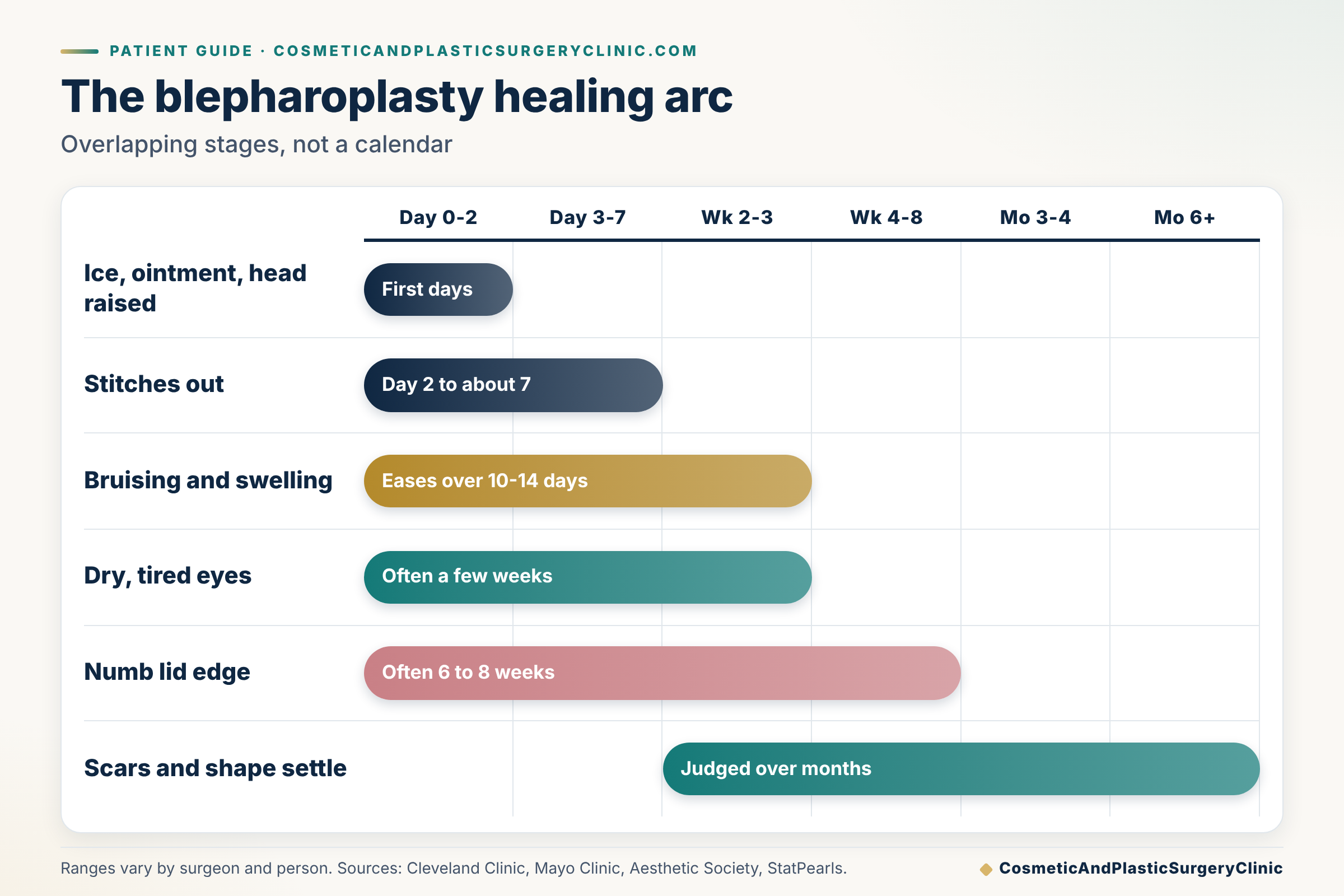
Blepharoplasty is usually done as an outpatient operation. Cleveland Clinic gives the operating time as 30 minutes to two hours, closer to two when upper and lower lids are done together, and longer if tissue is redistributed rather than only removed. Recovery lasts longer than the operation, and its stages overlap rather than following a calendar.
Where and how the operation is done
Anesthesia choices
Sources describe a range. The ASPS procedure page lists intravenous sedation or general anesthesia, and says the surgeon recommends the best choice for each patient. Cleveland Clinic describes local anesthetic around the eyes, numbing eye drops and a sedative through a vein. The Aesthetic Society describes local anesthetic for the upper lid, and StatPearls gives local lidocaine with epinephrine, about 1.5 mL per side, with optional sedation.
Which one is used depends on the plan, your health and the facility. The safety questions, such as who delivers anesthesia and how the facility is accredited, are covered in how to choose a plastic surgeon. Ask who will be monitoring you and what happens if something goes wrong.
The day itself: ride, rest and company
Mayo Clinic says to arrange a ride to and from outpatient surgery and to have someone stay with you the first night. You rest in a recovery room, then go home later that day. Expect blurred vision from ointment, watering eyes and light sensitivity, all of which Mayo lists as temporary effects.
The general logistics of time off, supplies and who helps are on plastic surgery recovery. For eyelids the practical points are narrow: someone to drive, somewhere to rest with your head raised, and a surgeon’s written instructions you have read before the day.
Healing in stages
The first days: cold, elevation and ointment
The ASPS says the eyes may be loosely covered with gauze and that lubricating ointment and cold compresses may be applied. Mayo Clinic describes ice for 10 minutes every hour the night after surgery, then four to five times through the next day, and keeping the head raised above the chest for a few days. StatPearls describes a surgeon protocol of ointment twice daily and artificial tears as needed.
Instructions differ between surgeons, so treat these as examples rather than a program. The Aesthetic Society advises avoiding aspirin and certain anti-inflammatory drugs because of bleeding risk and asking the surgeon which pain medicine to use. Never stop or start a prescribed medicine on your own.
Weeks one to three: stitches, bruises and restrictions
Cleveland Clinic says stitches stay in about a week unless dissolvable sutures are used, and most people return to usual routines after a week or two. The Aesthetic Society gives suture removal at 2 to 7 days, says significant bruising should resolve within two weeks, and advises avoiding straining, heavy lifting and strenuous exercise for 10 to 14 days. Mayo Clinic cites bruising and swelling easing over about 10 to 14 days.
Contact lenses and sunglasses follow similar logic. Mayo says to avoid lenses for about two weeks, the Aesthetic Society says the first several weeks, and both the ASPS and the Aesthetic Society recommend dark sunglasses, the latter for two weeks. The Aesthetic Society adds that eyes tire easily and dry out, and suggests limiting reading and screen time. The full week-by-week arc is on blepharoplasty recovery.
Months: numbness, scars and the final shape
StatPearls says reduced sensation along the lid margin can last 6 to 8 weeks, sometimes longer, and that eyelid adjustments are rarely made before two months. Cleveland Clinic gives full recovery as a few months, and Mayo says scars may take months to fade. These ranges describe typical courses, not promises, and they vary by technique and by person.
The question of how long the result lasts has no single answer. Mayo says results may last a lifetime for some people while droopy eyelids can recur for others. Aging continues after surgery, so the result is a point on a continuing curve, not a fixed state.
| Factor | Effect on the outcome | Maintenance or revision implication | Review point |
|---|---|---|---|
| Amount of skin and muscle removed | Sets lid closure and appearance | Too little may need a touch-up; too much is hard to reverse | Closure in the first weeks |
| Crease height or fold | Defines how the lid looks open | Adjustments are rarely made before about two months | Symmetry at two months |
| Fat removed versus moved | Controls hollowing or residual bag | Volume may later be added back | Contour at several months |
| Lower-lid support | Keeps the lid against the eye | Lid lag or ectropion may need support or a procedure | Lid position in weeks 1 to 8 |
| Brow descent over time | Can re-create hooding | May later prompt brow work | Annual photo comparison |
| Ongoing aging and sun | Skin and fat continue to change | Maintenance depends on the person and options chosen | Periodic review with the surgeon |
Blepharoplasty risks in proportion, and the signs that need a call or an ambulance
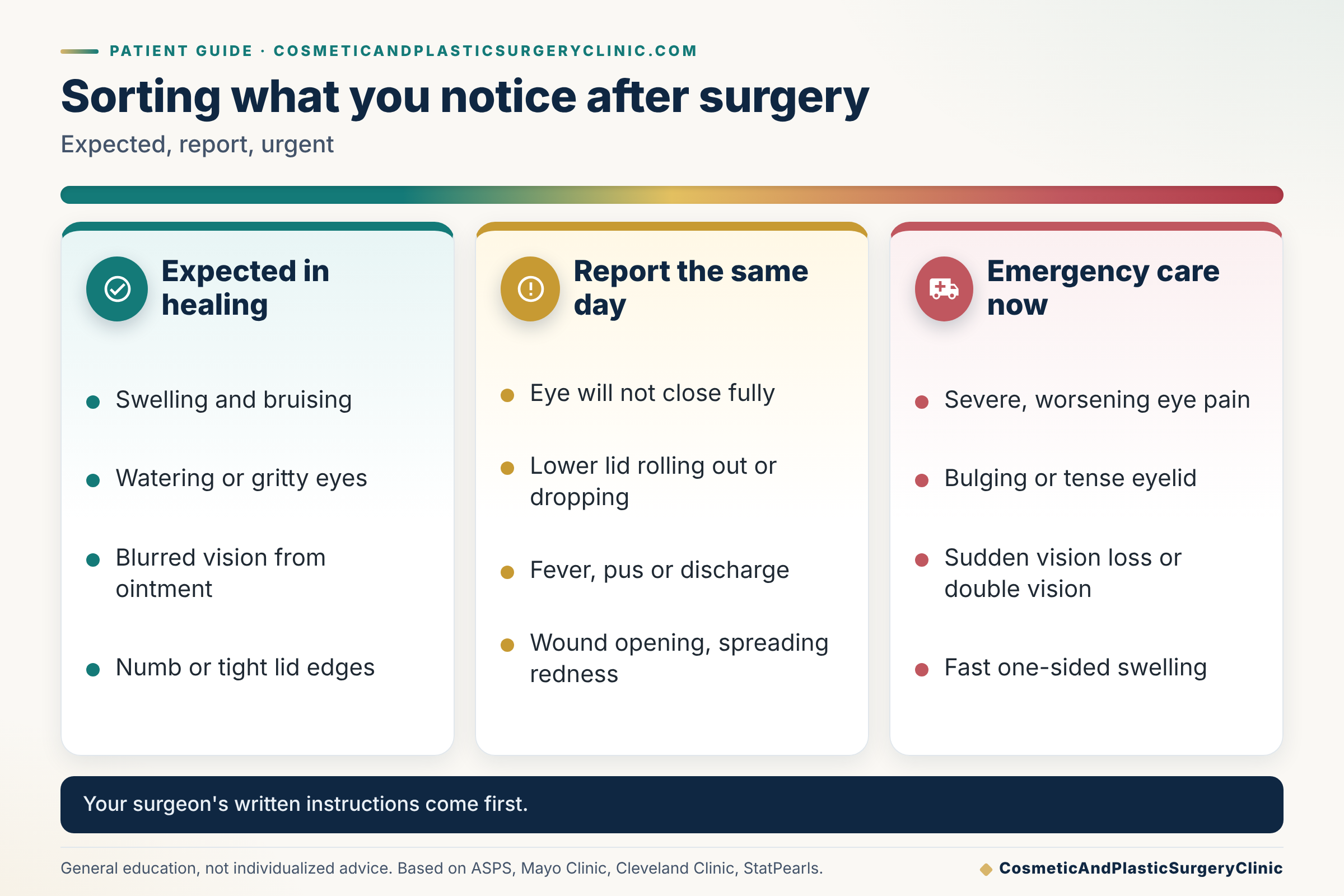
Every operation near the eye deserves a plain account of what can go wrong. The ASPS safety page lists anesthesia risks, bleeding, changes in skin sensation or numbness of the eyelashes, difficulty closing the eyes, dryness, ectropion, infection, lid lag, pain that may persist, sensitivity to sun or bright light, swelling and bruising, unfavorable scarring, the possible need for revision, and a temporary or even permanent change in vision with a very rare chance of blindness. The useful skill in judging blepharoplasty risks is sorting that list into three bins.
Effects, complications and emergencies are different things
Expected effects of healing
Swelling, bruising, tearing, blurred vision from ointment, light sensitivity, numb lid margins and some dryness are the normal footprint of surgery. Mayo Clinic lists most of them as temporary effects, Cleveland Clinic says dry eyes may last a few weeks, and StatPearls says bruising and swelling may last up to two weeks and that reactive tearing lasts a few days.
None of these is a reason for alarm on its own. The reason to know them is so that a sudden change stands out from the background. Ask your surgeon which of them to expect in your case, how long each usually lasts and what to do about gritty eyes at night.
Complications worth reporting the same day
Dry eye is the one with the most published data. A 2021 review in Annals of Eye Science found dry-eye incidence after blepharoplasty ranging from 0 to 26.5 percent across studies, with figures of 12.9 percent for upper-lid surgery alone, 21.4 percent for lower alone and 31.3 percent when both were done. The same review notes that the studies varied in methods and many were small, and that in two of the studies the measured changes returned to baseline by about three months.
A small 2021 study in Frontiers in Medicine followed 20 patients for six months. People with dry eye before surgery showed tear-film instability at every follow-up, while those without it recovered by six months. The authors conclude that preoperative dry eye is a larger risk factor for persistent surface damage, which is why the evaluation asks about it first.
Other problems to report promptly include difficulty closing the eye, a lower lid that rolls outward or drops, a wound that opens, signs of infection and new asymmetry. The detail on each, including how they are managed, is on blepharoplasty risks, and the cross-procedure view is in plastic surgery risks.
The rare emergency: bleeding behind the eye
What the published figures say, and what they cannot
Bleeding behind the eye, called retrobulbar hemorrhage, is the cause of the rare vision loss after blepharoplasty. In a 2011 survey in Aesthetic Surgery Journal, members of two aesthetic surgery societies reported 39 cases of visual loss, 25 permanent and 14 temporary, among about 752,816 blepharoplasties, or roughly 0.0052 percent, about 1 in 20,000. Symptoms appeared within 24 hours, with two peaks: during or just after surgery, and again 6 to 12 hours later.
A Thieme chapter on complications cites a different estimate: retrobulbar hemorrhage around 1 in 2,000, which it says is probably underreported, and permanent visual loss around 1 in 10,000. The numbers differ because they come from different sources, and surveys of surgeons rely on recall and on who responds. Treat them as orders of magnitude, not odds for any one person, and note that the Aesthetic Surgery Journal authors found hypertension the most common risk factor.
Know the warning signs and act at once
StatPearls describes this complication as an emergency treated by immediate opening of the wound, with or without a procedure called canthotomy and cantholysis to relieve pressure. Your surgeon’s written instructions, including the after-hours number, come first, and you should have read them before the day of surgery.
Alternatives, combinations, cost and choosing who operates
The last set of blepharoplasty decisions is practical: whether a smaller step could do, what else might be done at the same time, what the fee figures really cover, and what to look at in a surgeon’s training. None of them is urgent, and all of them are easier to settle with a written plan in hand.
Other routes and add-ons
Fillers for under-eye hollows
For a hollow rather than a bag, a nonsurgical route exists. The Aesthetic Society describes hyaluronic acid fillers placed in the tear trough, with results lasting approximately six months. In February 2022 one manufacturer announced FDA approval of a hyaluronic acid filler for under-eye hollows in adults over 21, and others have since announced approvals, the latest reported in August 2026 for adults 22 and older.
Trial figures cited by the manufacturers describe improvement lasting up to a year, which differs from the six-month figure above. Both come with caveats: the August 2026 report quotes a commentator who notes the trial was not powered to detect rare events such as vascular occlusion. The FDA label for one of the products warns that injection into a blood vessel can cause vision loss, stroke and skin damage, so the injector’s training matters. Photographs are explored in dermal fillers before and after photos.
Brow lift, facelift and neck lift alongside the eyelids
Mayo Clinic notes that blepharoplasty can be combined with a brow lift, facelift or skin resurfacing, and the Aesthetic Society says eyelid surgery may be paired with a brow lift or facelift. Combining shortens the number of recoveries but lengthens the operation, and each added step carries its own risks.
The lower face and neck follow different logic from the lids, so each has its own page: neck lift for the jawline and neck, and facelift alternatives for less extensive options. A surgeon who proposes a combination should be able to say what each part adds and what you would give up by choosing only the lids.
Money and credentials
What the published fee figures cover
The ASPS cost page lists average surgeon fees of $3,359 for an upper blepharoplasty and $3,876 for a lower, and it states that they do not include anesthesia, operating room facilities or other related expenses. The page gives no data year, so the figures are context, not a quote. It also says the fee depends on the surgeon’s experience, the procedure type and geographic location.
A fee for the lids alone is a fraction of the total, and a four-lid operation with fat repositioning or canthal support is not the sum of two averages. The anatomy of a quote is on blepharoplasty cost, and payment mechanics are on plastic surgery financing. Ask for an itemized written quote, the revision policy and the cancellation terms before paying a deposit.
Training pathways: plastic surgery, facial plastic surgery and oculoplastics
Eyelid surgery is performed by several kinds of specialist. The American Board of Plastic Surgery says certification is voluntary, requires an active unrestricted medical license, and can be verified through its public lookup. The American Board of Facial Plastic and Reconstructive Surgery lists residency in otolaryngology or plastic surgery, prior board certification and a minimum of 100 facial plastic surgeries among its requirements.
Oculoplastic surgeons are ophthalmologists with additional fellowship training in surgery of the eyelid, orbit and tear system; the University of Iowa, for example, describes a two-year fellowship approved by the American Society of Ophthalmic Plastic and Reconstructive Surgery covering functional and cosmetic cases. What a title does and does not tell you is explained in cosmetic surgeon credentials. Ask how many blepharoplasties the surgeon does each year and for photographs of patients with anatomy like yours.
Reading before-and-after sets for eyelid work
Eyelid photographs are easy to flatter and hard to compare: lighting, gaze angle, makeup and eyebrow position can change what the lids appear to do. Request frontal, side and upward-gaze views, with the time since surgery stated, and ask how many of the surgeon’s patients had a combination procedure.
The general rules on selection bias and consent are in before and after photos. A result that looks natural at two weeks, before final healing, says less than one photographed at several months.
Frequently asked questions
Is blepharoplasty the same as an eyelid lift?
In everyday use, yes. Cleveland Clinic notes that some people call blepharoplasty an eyelid lift, and the ASPS uses “eyelid surgery” and “blepharoplasty” interchangeably. The word “lift” can mislead, though: the operation mostly removes or repositions skin and fat rather than raising the lid or the brow. A procedure that raises a drooping lid margin, such as levator advancement, or one that raises the brow is a different operation, so ask which structures a plan actually changes.
How long do blepharoplasty results last?
No source reviewed gives a single figure. Mayo Clinic says results may last a lifetime for some people, while droopy eyelids can recur for others, and Cleveland Clinic does not address longevity. Aging, sun exposure and brow position keep changing after surgery, so the result is a starting point rather than a fixed state. If longevity is a priority, ask a surgeon how they judge your skin quality and brow, and what a later touch-up would involve.
Can blepharoplasty improve my vision?
It can when excess upper-lid skin blocks sight. Cleveland Clinic says an upper-lid procedure may be recommended to improve peripheral vision, and Mayo Clinic says surgery may help with excess skin that partly blocks it. StatPearls lists traffic-light visibility and downward-gaze ptosis as functional indications. If a drooping lid margin or brow is the cause, a different procedure may help more. Measurements and visual field testing, not a mirror, decide which applies.
Can I have blepharoplasty if I have dry eyes?
That is a question for your surgeon, ideally with an eye specialist’s input. StatPearls lists severe dry eye as a relative contraindication to upper blepharoplasty because even a small increase in corneal exposure can worsen it, and the Aesthetic Society says less tissue is removed when dry eyes are present. Mild dryness does not automatically rule surgery out, but testing and a conservative plan matter. Do not stop prescribed drops without advice.
Will blepharoplasty leave visible scars?
Incisions are placed to hide in the lid’s natural structures: the upper crease, just below the lower lash line, or inside the lower lid. The ASPS says scars should be well concealed within those structures, but its safety page lists unfavorable scarring as a risk, and Mayo Clinic says scars may take months to fade. Healing differs by person and technique, so ask where the incision will sit, how it will be closed and what scar care your surgeon advises.
When can I wear contact lenses, makeup or exercise after surgery?
Sources differ, which is why your surgeon’s instructions win. Mayo Clinic says to avoid lenses for about two weeks; the Aesthetic Society says the first several weeks and avoiding strenuous activity for 10 to 14 days, with bending restrictions lasting three to four weeks. Makeup timing is not covered by the sources reviewed. Ask for dates in writing for lenses, makeup near the incision, swimming and exercise, and ask what to do if your eyes feel dry.
Is there a best age for blepharoplasty?
No source reviewed sets one. The ASPS candidates page lists no age requirement, and its 2025 report counted 366 procedures in people aged 18 to 25 and 37,862 at 66 and older. Counts describe what happened, not who should have surgery. Surgeons look at anatomy, eye health, medical history and goals rather than birthdays, so someone with strong family hooding may ask earlier than someone whose lids changed late. A consultation, not an age, answers it.
Do medical conditions or medicines change the plan?
They can. StatPearls lists thyroid orbitopathy, clotting disorders, severe dry eye and photophobia as relative contraindications to upper blepharoplasty, and Mayo Clinic says people may be asked to stop blood-thinning drugs and supplements such as aspirin, ibuprofen and naproxen, and to quit smoking several weeks before surgery. Never stop a prescription on your own. Bring a complete list of medicines and supplements and discuss any change with the prescriber and the surgeon together.
Sources and further reading
- American Society of Plastic Surgeons — Eyelid surgery overview (accessed 2026-11-12) — definition, upper, lower or both, concerns addressed
- American Society of Plastic Surgeons — Eyelid surgery procedure steps (accessed 2026-11-12) — anesthesia, incisions, fat handling, closure, laser or peel
- American Society of Plastic Surgeons — Eyelid surgery recovery (accessed 2026-11-12) — gauze, ointment, cold compresses, sun protection
- American Society of Plastic Surgeons — Eyelid surgery safety (accessed 2026-11-12) — listed risks
- American Society of Plastic Surgeons — Eyelid surgery candidates (accessed 2026-11-12) — candidate traits, brow and ptosis note
- American Society of Plastic Surgeons — Eyelid surgery cost (accessed 2026-11-12) — average fees, exclusions, insurance statement
- American Society of Plastic Surgeons — 2025 Plastic Surgery Statistics Report (accessed 2026-11-12) — eyelid surgery counts, sex and age tables
- Cleveland Clinic — Eyelid surgery (blepharoplasty), updated 2026 (accessed 2026-11-12) — duration, anesthesia, recovery ranges, when to call
- Mayo Clinic — Blepharoplasty (accessed 2026-11-12) — preparation, risks, ice and recovery, insurance, results
- The Aesthetic Society — Eyelid surgery procedure information (accessed 2026-11-12) — upper and lower approaches, skin pinch, combinations, tear-trough filler
- The Aesthetic Society — Eyelid surgery aftercare and recovery (accessed 2026-11-12) — stitches, bruising, restrictions, contact lenses, sunglasses
- The Aesthetic Society — Preparing for eyelid surgery (accessed 2026-11-12) — evaluation, photographs, medicines
- StatPearls — Anatomy, Head and Neck: Eyelid, updated 2023 (accessed 2026-11-12) — layers, fat pads, tarsus, glands, innervation
- StatPearls — Blepharoplasty, Rebowe and Runyan, updated 2023 (accessed 2026-11-12) — lamellae, septum, fat compartments, tear trough
- StatPearls — Upper Eyelid Blepharoplasty, Patel and Malhotra, updated 2023 (accessed 2026-11-12) — indications, evaluation, technique, complications, aftercare
- StatPearls — Blepharoplasty overview (mirror page; authors and date not shown; accessed 2026-11-12) — snap-back test, field testing, canthopexy, fat repositioning
- Mejia, Egro and Nahai — Visual loss after blepharoplasty, Aesthetic Surgery Journal 2011 (abstract; accessed 2026-11-12) — survey incidence, timing, risk factor
- Plastic Surgery Key — Complications of blepharoplasty, Thieme chapter 16 (authors not shown; accessed 2026-11-12) — complication list, bleeding and vision-loss estimates
- Fan and colleagues — Ocular surface and tear film changes after eyelid surgery, Annals of Eye Science 2021 (accessed 2026-11-12) — dry-eye rates and mechanisms
- Review of Optometry — Dry eye ups risk for tear film issues post upper blepharoplasty, summarizing Zhao and colleagues, Frontiers in Medicine 2021 (accessed 2026-11-12) — 20-patient study
- Hassanpour and Kermani — Brow ptosis after upper blepharoplasty, World Journal of Plastic Surgery 2016 (accessed 2026-11-12) — 70 patients
- Assessment of eyebrow position before and after upper eyelid blepharoplasty, Orbit 2012 (abstract record; accessed 2026-11-12) — 45-person photographic study
- Chen — Techniques, principles and benchmarks in Asian blepharoplasty, Plastic and Reconstructive Surgery Global Open 2019 (accessed 2026-11-12) — anatomy variation and crease planning, single-surgeon series
- AbbVie — FDA approval for undereye hollows, news release 8 February 2022 (manufacturer source; accessed 2026-11-12) — indication, age, safety information
- American Board of Cosmetic Surgery — Under-eye filler FDA approval, manufacturer announcement (accessed 2026-11-12) — indication, age, trial figures
- Healio — FDA approves a filler for undereye hollowing, 27 August 2026 (accessed 2026-11-12) — indication, age, commentary on rare events
- American Board of Plastic Surgery — Verify certification (accessed 2026-11-12) — certification meaning, license requirement
- American Board of Facial Plastic and Reconstructive Surgery — Certification requirements (accessed 2026-11-12) — residency, exam, case requirements
- University of Iowa — Oculofacial plastics fellowship, about the program (accessed 2026-11-12) — fellowship scope and length
- Eyeplastics.com — What is an oculoplastic surgeon (a practice website; accessed 2026-11-12) — training path described by a practice