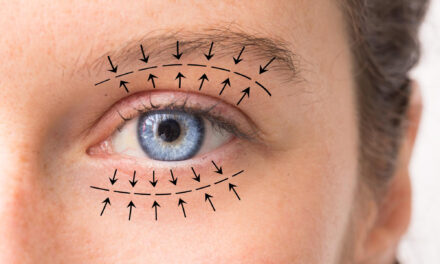
If you are searching for blepharoplasty cost, you have probably noticed that the numbers online do not agree with one another. One practice advertises a low-sounding figure for eyelid surgery, another quotes several times that amount, and a national average seems to match neither. This guide explains why. It breaks the price of eyelid surgery (an eye lift, or blepharoplasty) into the separate charges that make up a real bill, shows what moves each charge, and explains how to compare quotes without being misled by what is left off the page.
It also covers the parts of the cost conversation that tend to get skipped: when insurance may apply to functional upper-eyelid surgery, how health savings and flexible spending accounts work, what financing really costs, what a lower price can signal, and what to budget for recovery. Everything here is general education for U.S. readers, not a price offer and not medical advice.
Throughout the article, “surgeon’s fee” means the professional charge for the operation itself, while “total cost” means everything you pay out of pocket from the first consultation through the last follow-up visit. Keeping those two ideas apart is the single most useful habit in cost research. Related guides on this site cover the complete guide to eyelid surgery, the cost of lower eyelid surgery specifically, and the risks and complications of blepharoplasty, so this page stays focused on money.
What Published Blepharoplasty Cost Figures Do and Do Not Tell You
Cost research usually starts with a national number, and that is a reasonable place to begin as long as you know what the number measures. Most of the confusion around eyelid surgery pricing comes from people comparing figures that describe different things: a surgeon’s professional fee in one case, an all-in package in another, and an advertising “starting at” amount in a third.
What ASPS Publishes About Eyelid Surgery Fees
The surgeon-fee figures, their years, and their limits
The American Society of Plastic Surgeons is a widely cited U.S. source for cosmetic procedure fees, and it publishes two different kinds of figures that are easy to confuse. The eyelid surgery cost page on the ASPS website states an average cost of cosmetic eyelid surgery of $3,359 for an upper blepharoplasty and $3,876 for a lower blepharoplasty. That page does not give a statistics year, so treat it as a general reference rather than a dated benchmark.
The second source is ASPS’s 2024 average surgeon and physician fee table, which changed format. Instead of a single average, it reports a projected range, described as reflecting variation across geographic areas and practice settings. For 2024 the table lists $3,000 to $5,500 for upper eyelid surgery and $3,709 to $6,500 for lower eyelid surgery. Those are survey-based projections from ASPS member surgeons, not prices anyone is obliged to charge, and they describe fees from member surgeons only.
The most important limit appears on the ASPS cost page itself: the average is only part of the total price and does not include anesthesia, operating room or surgical facility costs, or other related expenses. In other words, every figure above is a surgeon-fee figure. Whatever your total turns out to be, it will be that fee plus the other components described in the next section.
There is also a gap worth naming. The ASPS statistics report for 2025, the most recent year published when this article was prepared, reports procedure volumes but no fee table. It counted 118,978 eyelid surgery procedures in 2025, compared with 100,185 in 2024, a 19 percent increase, and ranked eyelid surgery fifth among cosmetic surgical procedures. Those counts show that this is a common operation. They say nothing about what a given person will pay. If you see a 2025 or 2026 “average eyelid surgery cost” elsewhere, check whether it is a surgeon fee, a total, a median, or a clinic’s own advertised starting price.
Why a national figure is not a quote for your surgery
An average blends together very different operations. A quick, straightforward upper-lid skin removal and a lower-lid procedure that repositions fat and tightens the outer corner of the eyelid can both be filed under “eyelid surgery,” yet they take different amounts of time, involve different techniques, and carry different risks. Averages also blend regions. A practice in a high-cost metropolitan area pays different rent, staff wages, and malpractice premiums than a practice in a smaller market, and those costs flow into fees.
ASPS itself notes that a surgeon’s fee depends on the surgeon’s experience, the type of procedure, and the geographic location of the office. Add the facility and the anesthesia professional, and a single patient’s total can sit well above or below any published average without anything being wrong with the quote.
The practical rule is simple: use national numbers to calibrate your expectations, never to judge a specific quote as fair or unfair. A quote that falls inside a published range may omit anesthesia. A quote far below a range may describe a smaller operation, a less costly setting, or an arrangement that shifts expenses to later. Neither fact tells you the care is good or bad. What matters is whether you can see exactly what you would receive for the amount and what could be billed on top.
A related caution concerns the way averages are used in advertising. A “price starting at” banner is designed to attract inquiries, and the starting point often describes the smallest possible version of the procedure. That does not make the banner dishonest, but it does mean the figure is the beginning of a conversation, not the end. The same logic applies to cost calculators and online estimators: they are useful for orientation and unreliable for budgeting.
The Words That Appear on a Quote
Procedure names, functional versus cosmetic, and what the billing office sees
Blepharoplasty is the medical name for eyelid surgery. Upper blepharoplasty typically involves an incision in the natural crease of the upper lid, through which excess skin and sometimes fat or muscle is addressed. Lower blepharoplasty can be done through an incision just below the lash line (which allows skin to be removed) or through the inside of the lower lid, called the transconjunctival approach, which allows fat to be removed or repositioned but does not remove skin. The main eyelid surgery guide explains the techniques in detail; for cost purposes, what matters is that each approach can be described on a quote differently.
Quotes may also use terms such as “eyelid lift,” “eye bag removal,” “four-lid blepharoplasty,” “fat repositioning,” or “canthopexy.” Some are patient-friendly labels, others are specific techniques. If a term is unclear, ask what is actually being done to which lid, because the same label can mean different amounts of work at different practices.
The distinction that matters most for money is functional versus cosmetic. Insurers do not decide on the basis of what you call the surgery. They look at documentation: whether drooping upper-eyelid tissue measurably restricts vision, whether the eyelid margin itself sits low, and whether the clinical record supports that. When a payer concludes the surgery was done for appearance, the claim is treated as cosmetic and is generally not covered. The insurance section later in this article walks through how that works, and the guide to eyelid surgery candidacy covers who is typically evaluated for which kind of surgery.
Fee vocabulary: surgeon’s fee, facility fee, global fee, and self-pay
A few billing terms recur on estimates, and understanding them prevents unpleasant surprises. The surgeon’s fee is the professional charge for planning and performing the operation. Many practices include routine post-operative visits for a defined period inside that fee; this is sometimes called a global period. Whether yours does, and for how long, is something to ask rather than assume.
The facility fee covers the use of the operating room or procedure room, nursing and support staff, equipment, and consumable supplies. In a hospital or an ambulatory surgical center this is billed separately from the surgeon. In a practice-owned office-based operating room, the practice may fold it into a single price or list it as its own line.
The anesthesia fee is the charge for the anesthesia professional, who may be an anesthesiologist or a nurse anesthetist, and for the time they spend. It is often billed by a separate group even when the surgeon’s office collects it on their behalf. Practices that list a package or all-inclusive price are bundling these items; the question is which items are actually in the bundle.
Finally, self-pay means you are paying without insurance, which is the default for cosmetic eyelid surgery. Self-pay patients are often asked for a deposit to hold a surgery date, sometimes for the full balance before the day of surgery. Terms on deposits, cancellations, and refunds belong in writing and are covered in the section on comparing quotes.
The Anatomy of an Eyelid Surgery Bill
A total price for eyelid surgery is a stack of separate charges that happen to arrive together. Some are set by the surgeon, some by the facility, some by an anesthesia group, and some by pharmacies and labs. Seeing the stack clearly is what lets you compare two quotes honestly, because practices combine the pieces in different ways. The graphic below maps the main layers, and the table that follows describes who typically bills each one.
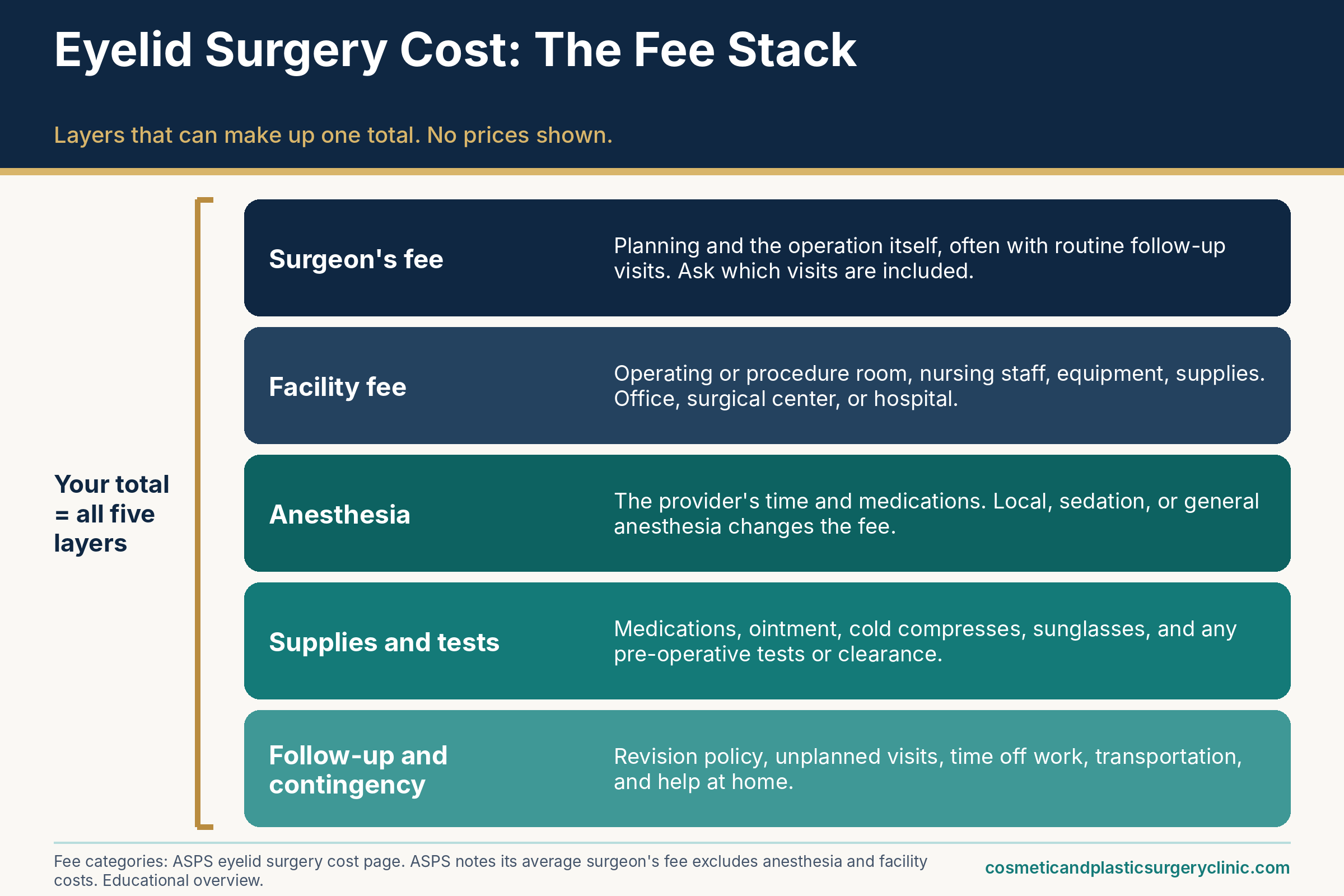
| Component | What it generally pays for | Who usually bills it | Question to ask |
|---|---|---|---|
| Surgeon’s fee | Planning, performing the operation, and often a defined set of routine follow-up visits | The surgeon or practice | Which visits and how long a follow-up period are included? |
| Facility fee | Operating or procedure room, nursing and support staff, equipment, sterile supplies | Hospital, surgical center, or practice-owned room | Is the facility accredited, and is the fee in the quote or billed separately? |
| Anesthesia fee | The anesthesia professional’s time, monitoring, and medications | Anesthesia group, or the practice on its behalf | Who is giving anesthesia and what is their credential? |
| Pre-operative testing | Medical clearance, labs, or an eye examination if the surgeon or anesthesia team requests it | Primary care office, lab, or eye clinic | Which tests are required and who pays for them? |
| Medications and supplies | Prescriptions, lubricating ointment, cold compresses, protective eyewear | Pharmacy or retail purchase | What will I need to buy before surgery day? |
| Revision or complication policy | What happens if an additional procedure or treatment is needed | Practice policy, facility, and anesthesia group each decide separately | Which of the three charges (surgeon, facility, anesthesia) would be waived or reduced? |
The Core Charges: Surgeon and Facility
The surgeon’s fee and what it usually covers
The surgeon’s fee is the line most patients focus on, and it is also the one national statistics describe. It pays for the surgeon’s time in the operating room, but it also pays for everything the surgeon does around the operation: examining you, planning the incisions, marking the lids, reviewing your medical history, writing the operative note, and managing early recovery. Most of the skill in eyelid surgery sits in the planning, because eyelids have little margin for error. Taking away slightly too much skin from an upper lid, or tightening a lower lid unevenly, can create problems that are difficult to reverse. A fee reflects that judgment as much as the minutes of surgery.
Fees typically vary with the scope of work. Upper-lid skin removal, lower-lid fat repositioning, tightening of the lower lid, and combined four-lid surgery are different operations in terms of time and complexity, which is why published figures separate upper from lower lids. ASPS also attributes variation to the surgeon’s experience and the geographic location of the practice. Experience can raise a fee, but a high fee does not by itself verify experience, which is why the section on credentials separates the two ideas.
Several practical points belong in any quote conversation. First, ask whether the consultation fee is credited toward surgery if you proceed; policies differ. Second, ask what the post-operative follow-up period includes: suture removal visits, early check-ins, and later review appointments. ASPS notes that stitches in eyelid surgery commonly come out within about a week, but your schedule will come from your own surgeon. Third, ask whether the fee changes if the plan changes on the day of surgery, for example if more work on the lower lids is needed than expected. A well-run practice explains this in advance rather than leaving it to a conversation during recovery.
The facility fee: office, surgical center, or hospital
The facility fee pays for the place where the operation happens and the people and equipment that make it possible. Eyelid surgery is commonly an outpatient procedure, which means you go home the same day. It may be performed in a hospital outpatient department, in a freestanding ambulatory surgical center, or in an operating room located in the surgeon’s own office. Each has a different cost structure. A hospital charges for the overhead of a large institution; a surgical center has narrower overhead but still bills for the room, staff, and supplies; an office-based operating room often costs less to run but still requires equipment, trained nursing staff, and compliance with safety standards.
Where the facility fee appears on your paperwork depends on the arrangement. At a hospital or surgical center it usually arrives as its own bill. At an office-based facility it may be built into one total. Neither format is better; what matters is that you know whether it is included. A quote that shows only the surgeon’s fee is incomplete if the operation happens somewhere that charges separately.
Accreditation is part of the cost conversation because meeting standards takes money and the standards matter for safety. ASPS recognizes accreditation by the American Association for Accreditation of Ambulatory Surgery Facilities, the Accreditation Association for Ambulatory Health Care, or the Joint Commission, as well as state licensure or Medicare certification, as ways a facility can show it meets recognized standards. A fee that looks low because a facility skips this oversight is not a bargain in the way that matters. The guide to accredited plastic surgery facilities explains how to verify a facility’s status.
The Supporting Charges: Anesthesia, Testing, and Follow-Up
The anesthesia fee and the choices behind it
Anesthesia is the line most often missing from advertised prices. ASPS describes sedation delivered through a vein or general anesthesia as the two options used in eyelid surgery, with the choice depending on the surgeon’s recommendation and the patient. Many upper-eyelid operations are also done under local anesthetic with light sedation. The cost implications follow from who is involved. A procedure done with local anesthetic alone may have no separate anesthesia professional. Sedation administered by a dedicated anesthesia professional, who watches your breathing and heart rate throughout and does nothing else, adds a professional fee. General anesthesia adds still more time and equipment.
The American Society of Anesthesiologists distinguishes monitored anesthesia care from moderate sedation: in monitored anesthesia care, a qualified anesthesia provider is devoted to managing the patient and prepared to handle any depth of sedation up to general anesthesia, while in moderate sedation the clinician performing the procedure divides attention between the procedure and the patient. That difference partly explains why the fee exists and why it varies. The anesthesia fee is often time-based, so longer operations such as four-lid surgery with added procedures generally cost more than short ones.
When a quote lists no anesthesia charge, find out which of these three situations applies: local anesthetic only, sedation provided by the surgeon’s own team with no dedicated provider, or an anesthesia professional billed separately. The eyelid surgery anesthesia guide compares the options and the safety questions in more depth.
Testing, medications, supplies, and the follow-up and revision policy
ASPS lists prescriptions and medical tests among the costs that may sit alongside the surgeon’s fee. Pre-operative tests depend on your health: some patients need nothing beyond an examination, while others need blood work, an electrocardiogram, or clearance from a primary care physician or specialist, especially if they have heart or lung conditions, take blood thinners, or have uncontrolled blood pressure. If your plan is functional upper-eyelid surgery for vision, there may also be visual field testing, which is typically billed through an eye clinic rather than the operating practice.
Medications and supplies are smaller items that add up. They commonly include prescribed or recommended eye drops and lubricating ointment, cold compresses, and protective sunglasses. ASPS advises diligent sun protection and darkly tinted sunglasses until healing is complete, and notes that lubricating ointment and cold compresses may be applied immediately after surgery. The recovery planning section later in this guide returns to these costs in more detail, and the eyelid surgery recovery timeline covers the healing process itself.
The least visible cost is the policy for what happens if you need more care. Surgeons differ widely in how they treat touch-ups and revisions. Some waive their own fee for a defined period but still charge for the facility and anesthesia; others charge in full; some limit revision coverage to specific, documented problems. The right time to learn this is before you pay a deposit, in writing. A clear revision policy has value even if you never use it, because it tells you how the practice thinks about responsibility when results or healing do not go as planned. The page on blepharoplasty risks and complications explains what problems can occur and why they matter financially.
What Moves the Price of Blepharoplasty Up or Down
Once the bill is broken into layers, the next question is why each layer changes from one patient to the next. Five influences do most of the work: how many lids are treated, what else is done in the same operation, who performs it, where it is performed, and what kind of anesthesia is used. Region sits underneath all five. None of these is a hidden trick. They are the ordinary mechanics of how surgical care is organized and billed in the United States.
The Scope of the Operation
Upper lids, lower lids, or all four
The largest single driver is which eyelids are being operated on. Upper blepharoplasty and lower blepharoplasty are priced separately in the ASPS data, and the lower-lid figures are higher in both the page averages and the 2024 range. That fits what the operations involve. The upper lid is usually approached through an incision hidden in the natural crease and addresses excess skin and sometimes fat or muscle. The lower lid is anatomically more delicate because the structure that supports the eyelid margin is close to the area being treated, and the approach may involve skin removal, fat removal or repositioning, and sometimes tightening of the outer corner.
Operating on all four lids in one session is common, and many practices price that as a combined procedure rather than the simple sum of two operations. Others add the two fees together. You cannot tell which model a practice uses from the headline figure, so ask for the four-lid price directly if that is what you are considering, and ask what, if anything, changes in the price if the surgeon ends up doing less than planned. The lower eyelid surgery cost guide goes deeper on the lower-lid side of the equation.
There is a second, less obvious scope question: the difference between a limited and a comprehensive plan. Some patients need only a small amount of upper-lid skin removed. Others have a combination of skin excess, fat prominence, and lid position changes. A quote built on the simplest assumption can rise sharply once an examination reveals the full picture. That is not a sign of a bait-and-switch by itself; it is often a sign the first quote was prepared without examining you. Whenever possible, base cost comparisons on quotes issued after an in-person evaluation.
Add-on procedures: brow lift, ptosis repair, fat repositioning, canthopexy, and laser resurfacing
Blepharoplasty is frequently combined with other procedures around the eye, and each addition changes the budget. A brow lift raises a drooping brow; when the brow sits low, removing upper-lid skin alone may not address the cause of the heaviness. Ptosis repair addresses an upper eyelid margin that sits too low, which is a different problem from excess skin even though the two can coexist. Fat repositioning moves lower-lid fat to smooth the transition between the lid and the cheek instead of removing it. Canthopexy or canthoplasty supports or tightens the outer corner of the lower eyelid. Laser resurfacing, including carbon dioxide laser, treats skin texture and fine lines and is generally a separate service from removing skin or fat.
| Add-on | What it addresses | Typical effect on the bill | Functional or cosmetic? |
|---|---|---|---|
| Brow lift | A low or drooping brow that adds weight to the upper lid | More operating time; often a separate surgeon line and sometimes a separate procedure code | Cosmetic in most cases; some payers cover brow ptosis when visual field loss is documented |
| Ptosis repair | An upper eyelid margin that sits too low | Adds a distinct procedure; may add anesthesia and facility time | Often evaluated under medical criteria, including eyelid-margin measurements |
| Fat repositioning | Under-eye bulges and hollows in the lower lid | Usually part of lower-lid technique; may be priced within the lower-lid fee or as an add-on | Typically cosmetic |
| Canthopexy or canthoplasty | Support or tightening at the outer corner of the lower lid | Adds time and technique; may be itemized | Typically cosmetic when combined with lower-lid surgery |
| Laser resurfacing | Skin texture and fine wrinkles of the eyelid skin | Often a separate service and separate fee, sometimes in the same session | Cosmetic |
Two cost patterns follow from the table. First, add-ons that are done through the same incisions or in the same session may reduce duplication of anesthesia and facility charges compared with doing them on separate days, but the total usually still rises because the surgeon’s fee for each component is added. Second, mixed functional and cosmetic work can be split on the bill. A payer might consider covering the upper-lid portion that meets its criteria while the cosmetic components remain self-pay. How that split is documented matters, and the surgeon’s office is the right place to ask. For a fuller look at pairing procedures, the guide to combining eyelid surgery with other procedures covers the trade-offs, and the brow lift cost guide covers that line item.
It is reasonable to ask why a given add-on is recommended and what the plan would look like without it. If the answer is that the operation can be staged, you may be able to spread costs over time, though staging has trade-offs in recovery time and additional anesthesia exposures.
Who Performs It, Where, and Under What Anesthesia
Surgeon training, specialty, and experience
Several kinds of physicians perform eyelid surgery in the United States, including plastic surgeons, ophthalmologists who focus on eyelid and orbital surgery, and facial plastic surgeons who trained in otolaryngology. Each route has its own training and its own certifying board. Training and certification are pieces of information, not rankings, and this guide does not claim that any one specialty or any one surgeon is superior. The practical point for cost is that fees often reflect, at least partly, training, case volume, demand for the surgeon, and the complexity of what the surgeon takes on.
Be careful with the logic in both directions. A higher fee does not prove higher skill, and a lower fee does not prove a lower standard. Some surgeons charge less because they have a high-volume practice, a lower-cost region, or a leaner overhead. Others charge more for reasons that have nothing to do with results. What you can verify is training, certification, state licensure, and the facility where the work will be done. ASPS notes that its members complete at least three years of plastic surgery residency after medical school, for six years of surgical training in total, and that board certification by the American Board of Plastic Surgery requires passing written and oral examinations. Certification is voluntary, so verifying it for the person who will actually operate on you is a worthwhile step.
Another question is how much experience the surgeon has with the specific operation you are considering. Eyelid surgery is common, but unusual anatomy, prior eyelid surgery, thyroid eye disease, or significant dry-eye symptoms can make a straightforward-looking case more complicated. Asking how often the surgeon performs the procedure you need, and what the surgeon would do differently in your situation, helps you understand what you are paying for. The checklist for verifying ABPS board certification shows how to confirm credentials step by step.
Setting, anesthesia type, and geography
Setting and anesthesia together shape the facility and anesthesia lines. The table compares the three common settings in terms of billing and verification, without putting prices on any of them.
| Setting | How it is commonly billed | Anesthesia often used | What to verify |
|---|---|---|---|
| Office-based operating room | Facility charge may be bundled into one practice price or listed as its own line | Local anesthetic with oral or IV sedation is common for eyelid work; general anesthesia is possible in properly equipped rooms | Accreditation or state licensure, who provides anesthesia, and the plan for transfer to a hospital in an emergency |
| Ambulatory surgical center | Separate facility bill, plus separate surgeon and anesthesia bills | IV sedation or general anesthesia delivered by an anesthesia professional | Accreditation or Medicare certification, and whether the center is in your plan’s network if insurance is involved |
| Hospital outpatient department | Separate hospital bill; surgeon and anesthesia bill separately | Full range, including general anesthesia | Whether the surgeon holds privileges there, and how a self-pay quote is calculated |
Local anesthetic with sedation generally involves a shorter recovery from the anesthetic itself than general anesthesia, but the right choice depends on the patient, the extent of surgery, and the surgeon and anesthesia team’s judgment. The ASA states that the more specialized training of the supervising physician matters particularly in office-based settings, because those settings typically lack the backup resources of a hospital. A smaller facility fee is not a benefit if it comes at the expense of those safeguards, which is why the verification column matters as much as the billing column.
Office-based eyelid surgery has a published track record. One study of patients who had blepharoplasty in an office-based setting with oral sedation plus local anesthetic, for example, reported no major complications among 86 selected, healthy patients and high satisfaction on mailed surveys, and its authors described the approach as both safe and cost-effective. That study dates from 2008, involved a single practice, and relied on a carefully selected group, so it supports the idea that office-based surgery can be a reasonable option for suitable patients rather than showing that it is right for everyone.
Geography is the background layer across all of this. ASPS reports that fee ranges reflect geographic variation, and an ASPS article on pricing notes that some patients lower their costs by traveling domestically to a lower cost-of-living region. That strategy has real trade-offs, because follow-up visits, a flight soon after surgery, and the need for local help during recovery all have costs of their own. Any saving on the fee should be set against those items.
How to Read and Compare Eyelid Surgery Quotes
Comparing quotes is where most of the real savings, and most of the real mistakes, happen. A fair comparison does not start with the bottom-line number. It starts with questions that put every quote on the same footing: what is included, who is providing anesthesia, where the surgery will be performed, how follow-up is handled, and what is excluded. The graphic below turns those questions into a quick reference, and the worksheet table after it gives you a place to record the answers.
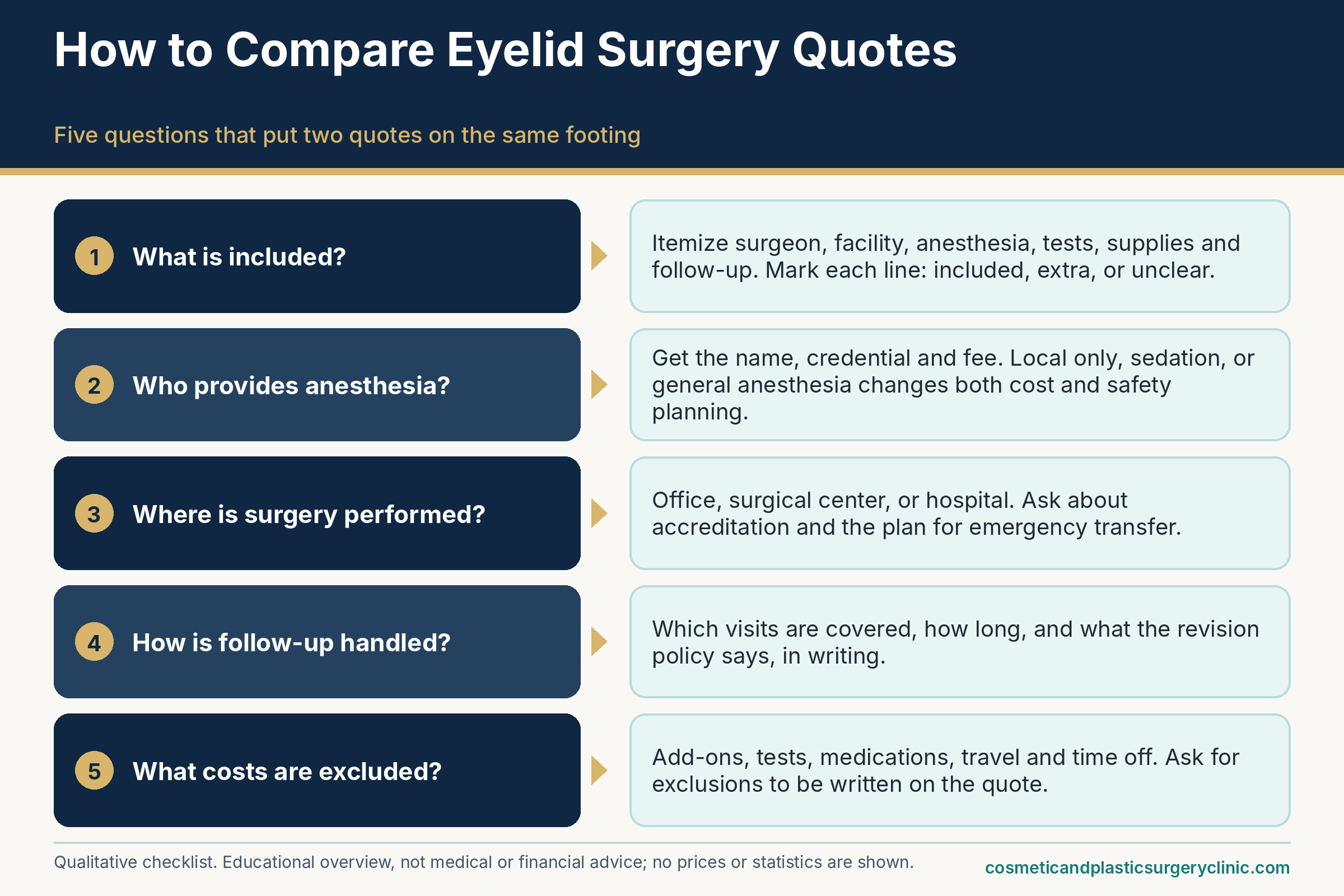
| Item to compare | What to write down | Quote A | Quote B |
|---|---|---|---|
| Procedure and lids | Upper, lower, or all four; skin only, fat removal or repositioning, canthal support | Details: ____ | Details: ____ |
| Add-ons listed | Brow lift, ptosis repair, laser resurfacing, or others, and whether each is priced separately | Included / extra / not planned | Included / extra / not planned |
| Surgeon’s fee | Whether pre- and post-operative visits are covered, and for how long | Included / extra / unclear | Included / extra / unclear |
| Facility fee | Name and type of facility, accreditation, and whether the fee is in the total | Included / extra / unclear | Included / extra / unclear |
| Anesthesia | Type, credential of the provider, and whether the fee is in the total | Included / extra / unclear | Included / extra / unclear |
| Tests, medications, supplies | Which items you purchase yourself and which the practice supplies | Included / extra / unclear | Included / extra / unclear |
| Revision policy | Which charges are waived or reduced, for how long, and under what conditions | In writing / verbal / none | In writing / verbal / none |
| Deposit and refund terms | Amount due when, cancellation window, and what is refundable | Terms: ____ | Terms: ____ |
| Quote date and expiry | When the quote was issued and how long the price holds | Dates: ____ | Dates: ____ |
What a Complete Quote Contains
The line items worth seeing in writing
A complete eyelid surgery quote should let someone who has never met you understand what is being purchased. That means it names the procedure specifically instead of using a vague label, and it separates or clearly accounts for the major charges. The following items are worth looking for, and absence of any one of them is a reason to ask a question, not a reason to walk away.
- The operation, stated by lid and technique: for example, upper blepharoplasty with skin removal, or lower blepharoplasty by the inner-lid approach with fat repositioning.
- Every planned add-on, such as brow lift, ptosis repair, or laser resurfacing, each with its own line or an explicit statement that it is included.
- The surgeon’s fee and the follow-up visits it covers, including suture removal and any later check-ups.
- The facility name, type, and whether its fee is included or billed separately.
- The anesthesia type, the credential of the provider, and whether the anesthesia fee is included.
- Pre-operative requirements, such as labs or medical clearance, and who pays for them.
- Medications and supplies you should plan to buy, or that the practice provides.
- The revision policy in plain language, naming which charges would change.
- The deposit schedule, cancellation terms, and the date through which the quote is valid.
It is also reasonable to ask whether the quote assumes a specific plan that could change. If the surgeon examined you and proposed upper lids only, the quote should say that. If it is a general estimate based on a photo or an online form, treat it as a rough indication that will be replaced after an examination. The guide to the eyelid surgery consultation lists questions that help produce a quote you can rely on.
Good faith estimates and the rules for self-pay patients
Federal rules give some patients a right to a written estimate. According to the Centers for Medicare & Medicaid Services, if you do not have or do not use health insurance, providers usually must give you a good faith estimate, either when you schedule care in advance or when you ask for one. The page describes this as applying when you request an estimate or schedule services at least three business days ahead, and it describes the estimate as covering the expected charges from providers and facilities. If the final bill is at least $400 more than the estimate, you may be able to dispute it.
That information appears on a consumer rights page and does not mention cosmetic surgery specifically, so it does not settle how every elective practice must handle estimates. What it gives you is a reasonable request to make. Ask whether the practice provides a good faith estimate for self-pay patients, whether it covers the surgeon, facility, and anesthesia together, and who to contact if the final charges differ. A practice that cannot explain how its estimate is built is giving you a data point about how it will handle billing questions later.
Estimates matter for another reason: they create a paper trail. If a quote mentions that anesthesia is included and the invoice later shows a separate anesthesia charge, a dated written estimate gives you something specific to refer to when you ask for an explanation. Keep copies of everything you are given, including emails and portal messages, and ask for changes to be put in writing.
Comparing Like With Like
Putting two different quotes on the same footing
Consider a realistic scenario. A person gets two quotes for upper-lid surgery. Quote A is noticeably lower than Quote B. Reading the details, Quote A lists a surgeon’s fee only, describes surgery in an office setting, and does not mention anesthesia. Quote B lists one total that includes the surgeon, an accredited surgical center, and an anesthesia professional, with two follow-up visits. On the surface, Quote A looks cheaper. Once the missing facility and anesthesia lines are added, whatever they turn out to be, the two quotes may be much closer, or they may still differ. Only after asking can you tell.
The method is to build a version of each quote that includes the same components. Use the worksheet above. For each quote, mark every line as included, extra, or unclear, then ask the practice to resolve the unclear ones in writing. You are not trying to force the lower quote to match the higher one. You are trying to learn what the real total is for each option, plus any risk of surprise charges.
After the numbers are aligned, compare what remains: the settings, the anesthesia approach, the surgeon’s training, the revision policy, and the practical details such as distance from home and how comfortable you felt asking questions. A person who weighs only price loses the ability to see these differences; a person who weighs only reputation can overpay for features that do not matter to them. A balanced decision uses both. If you are still unsure after comparing, a second consultation can be useful, and some patients find that a second opinion clarifies whether a recommendation is routine or unusual.
Deposits, refunds, cancellations, and how long a quote holds
The financial terms around a surgery date can matter as much as the price. Deposits are common, and holding a date for a surgeon who is booked far in advance is a legitimate reason to ask for one. What deserves attention is what happens if circumstances change. Ask whether the deposit is refundable if you decide not to proceed, if the surgeon decides surgery is not appropriate after a pre-operative review, or if the surgeon or facility must reschedule. Ask when the balance is due and whether it is due before the day of surgery.
Also ask how long the quote holds. Prices can change with the practice’s fee schedule, the facility’s rates, or the anesthesia group’s charges, so a quote that is valid for a defined period gives you time to plan. A quote with no date at all is harder to rely on.
Be cautious with pressure. A discount that disappears if you do not book during the visit, a countdown, or a claim that prices are about to rise are sales tactics, not medical considerations, and they work against the careful comparison this article recommends. A practice that is confident in its care can give you written terms to take home. If you feel rushed, you can say you will review it and respond within a few days. That is an ordinary request and a reasonable test of how the practice treats patients who take their time.
Insurance, HSA and FSA Accounts, and Financing for Eyelid Surgery
Because most eyelid surgery is elective, most patients pay for it themselves. A minority of patients have a medical reason for surgery, and for them insurance may become part of the picture. This section explains the difference carefully, because the stakes of getting it wrong are financial: a claim assumed to be covered and later denied can leave you with the full bill. After insurance, it covers the other ways people pay, including tax-advantaged accounts and financing, with their trade-offs.
When Insurance May Apply
Functional versus cosmetic: what payers look for
ASPS states plainly that most health insurance does not cover cosmetic surgery or its complications. It adds one exception for eyelid surgery: when surgery is performed to remove redundant skin that covers the eyelashes, it may be covered, and patients should review their policy carefully. In practice, that sentence compresses a detailed process.
Insurers and Medicare contractors generally separate eyelid surgery into two categories. If the purpose is to improve appearance in the absence of physical signs or symptoms, they treat it as cosmetic. If the purpose is to treat an eyelid condition that interferes with vision or eye function, they may treat it as reconstructive or medically necessary. ASPS’s own recommended coverage criteria, last approved in December 2020, list conditions such as ptosis, excess upper-lid skin that obstructs vision, and herniated orbital fat affecting vision as potentially functional, and they describe documentation that includes eyelid-margin measurements, photographs, and visual field testing that shows the obstruction improves when the lids are lifted or taped.
Medicare’s regional rules show the same logic. One local coverage determination from a Medicare contractor serving several western states, revised in October 2025, covers functional eyelid surgery when documented drooping skin or eyelid position produces a visually significant field restriction, with a margin reflex distance of 2.0 millimeters or less as one threshold. The same document describes lower-lid blepharoplasty as almost never functional and not covered, and it excludes purely cosmetic procedures. These local determinations apply to Medicare beneficiaries in the contractor’s jurisdiction. They are not national, and they are not the rules for commercial insurance, which sets its own policies.
A commercial example illustrates what those policies can look like. One health plan’s policy, revised in January 2025, requires prior authorization, requires formal visual field testing showing reproducible field loss, treats upper-lid hooding unrelated to visual field loss as cosmetic, and generally treats lower-lid surgery as cosmetic unless a specific condition such as ectropion or entropion applies. That example is not a rule for any other plan. A conference abstract that analyzed 70 U.S. insurance policies found that most covered blepharoplasty under some circumstances, that among plans covering vision-related drooping nearly all required visual field testing, and that criteria differed widely. The American Academy of Ophthalmology likewise notes that documentation requirements vary by payer and that surgery which fails to meet a payer’s specific criteria is reclassified as cosmetic.
The takeaway, stated carefully: coverage varies by plan; prior authorization, documentation, and visual field testing are commonly requested, and cosmetic eyelid surgery is generally not covered. Whether your situation qualifies is for your plan and your clinicians to determine, not for a general article.
What coverage does and does not change about the bill
Even when a payer approves functional upper-eyelid surgery, it does not make the whole bill disappear. Your deductible, coinsurance, copayments, and network status still apply, and the approval typically covers the medically necessary portion. Cosmetic extras, such as lower-lid work done in the same session or laser resurfacing, usually remain self-pay and may be billed separately. A surgeon’s office that handles both kinds of cases can explain how it divides the charges.
Prior authorization is the step where many cases stall. The practice typically submits clinical notes, measurements, photographs, and visual field results before surgery, and the payer approves or denies. If a plan denies, many plans allow an appeal, and the surgeon’s office may help with additional documentation. A denial is not necessarily the final word, but a surgery date should not be treated as final until the authorization is confirmed in writing.
A short walk-through shows how the pieces fit together. Imagine a person who notices that heavy upper-lid skin seems to cut into the top of their field of view and who sees an eye care professional about it. The usual sequence involves an examination, measurements of the eyelid position, photographs, and visual field testing with the lids in their natural position and sometimes lifted or taped. The surgeon’s office compiles those records and submits a prior authorization request. Three outcomes are possible: approval of the functional upper-lid surgery, denial because the documentation did not meet the plan’s criteria, or approval of only part of what was proposed. Each leads to a different bill. Approval means the plan’s cost-sharing rules apply to the covered portion. Denial means a self-pay quote, perhaps after an appeal. Partial approval means a split bill in which cosmetic components are paid separately. Knowing which of the three you are likely to face is the main reason to start the paperwork before choosing a surgery date.
Several questions help avoid surprises. Does the surgeon participate in your plan’s network? Will the facility and the anesthesia professional also be in network? Which specific documents does your plan require, and who obtains the visual field test? If the plan approves only part of the proposed surgery, what will the self-pay balance be? And if the answer is that the surgery will be treated as cosmetic, ask for a self-pay quote before deciding. The eyelid surgery candidacy guide and the overview of alternatives to eyelid surgery are useful if you are still deciding whether surgery is the right route.
Finally, remember that ASPS says insurance generally does not cover cosmetic surgery complications. If a cosmetic operation leads to a problem that needs treatment, the payer may or may not cover it, depending on the plan and the circumstances. Ask your plan how it handles complications of non-covered procedures before surgery rather than after.
Paying for the Part Insurance Does Not
HSA and FSA eligibility for cosmetic versus functional surgery
Health savings accounts and health flexible spending arrangements let you pay for qualified medical expenses with pre-tax money, and many patients ask whether eyelid surgery counts. The honest answer is that it depends on the purpose of the surgery and on your plan administrator.
IRS Publication 969 defines qualified medical expenses for these accounts by reference to medical care as defined in section 213(d) of the Internal Revenue Code, and it adds that amounts reimbursed by insurance do not qualify. IRS Publication 502 explains what counts as medical care in this context. It states that cosmetic surgery generally does not qualify when it is directed at improving appearance and does not promote the proper function of the body or treat illness, with facelifts, hair transplants, and liposuction listed as examples of expenses that generally cannot be included. It makes an exception for cosmetic surgery that corrects a deformity arising from a congenital abnormality, an accident or trauma, or a disfiguring disease.
Applied to the eyelids, this suggests two broad categories, with caution. Eyelid surgery done purely to change appearance generally does not appear to fit the definition. Surgery done to treat a documented functional problem, such as vision obstruction from drooping eyelid tissue, may fit it. The IRS publications reviewed for this article do not address blepharoplasty by name, so this article cannot say definitively that functional blepharoplasty qualifies for any particular account. The determination typically rests with your plan administrator, and a tax professional can advise on your individual situation.
Practical steps follow from that. Ask your plan administrator whether the account will reimburse the procedure and what documentation they require, such as a physician’s statement of medical necessity or the same records submitted to insurance. Ask before you pay, because some arrangements require substantiation. Also remember that an HSA or FSA usually covers only part of a bill, so it fits best alongside a payment plan or savings.
Patient financing, payment plans, and prepayment
For self-pay patients, financing options range from simple to complicated. ASPS notes that many plastic surgeons offer patient financing plans for cosmetic eyelid surgery, and an ASPS article on managing cost mentions interest-free promotional periods, prepayment plans in which a patient makes monthly deposits ahead of the surgery date, staged procedures spread over time, and regional travel as strategies some patients use. All of these are legitimate. What matters is understanding the terms.
The Consumer Financial Protection Bureau has studied medical credit cards and installment plans marketed through provider offices. Its 2023 report describes deferred-interest products that charge interest retroactively if the balance is not paid in full by the end of the promotional period, notes that financial companies market these products to providers who then offer them to patients at the point of care, and warns that they can increase the financial burden on patients. It also notes that these products were once concentrated in cosmetic and elective care. None of that means every financing plan is unsuitable, but it does mean you should read the contract and not just the promotional headline.
| Option | How it works | What to check | Main trade-off |
|---|---|---|---|
| Savings or prepayment plan | You pay in advance, sometimes through scheduled deposits with the practice | Refund terms if you cancel, and whether deposits are held securely or applied to the final bill | No interest, but it requires lead time |
| Practice payment plan | The practice allows installments directly or through a partner | Whether interest or fees apply, and what happens if a payment is missed | Convenient, but terms differ greatly between practices |
| Medical credit card with a promotional period | A card marketed for health care, often with an interest-free promotional period | Whether interest is deferred and charged retroactively, the standard rate after the promotion, and fees | Can be low cost if paid in full on time and expensive if not |
| Personal loan or general credit card | You borrow from a bank, credit union, or card issuer | Annual percentage rate, fees, term length, and total repayment amount | Flexible, but interest accumulates from the start |
| HSA or FSA funds | Pre-tax account money used for qualified medical expenses | Whether your administrator accepts the procedure and what documentation they require | Tax-advantaged, but may not apply to purely cosmetic surgery |
A sound approach is to decide how much you can comfortably pay and by when, then evaluate each option against that plan. Calculating the total you would repay, including any fees and interest under realistic scenarios, is more informative than the monthly payment. The guide to plastic surgery financing goes further into these questions, and the overview of plastic surgery costs places eyelid surgery in a broader context. Borrowing for elective surgery is a personal decision; it is fine to decide that you would rather wait than finance it.
When a Low Quote Raises Questions: Safety, Complications, Revision, and Travel for Surgery
Price matters, and wanting to pay a fair amount is not a character flaw. But eyelid surgery happens close to the eye, where problems can affect comfort, appearance, and vision, so the cost conversation cannot be separated from the safety conversation. This section explains what a low quote can mean, how to verify credentials and facilities, what it costs when something does not go as planned, and how to think about traveling for surgery.
Reading a Low Quote
Scope differences and what a lower number may leave out
The most common reason one quote is lower than another is that it describes less. It may cover one set of lids when you need two. It may list only the surgeon’s fee while the other quote bundles facility and anesthesia. It may assume a simpler technique, or put add-ons such as laser resurfacing on a separate line. It may include no follow-up beyond a first visit, or carry a revision policy that is narrower than another practice’s. These are differences of content, not necessarily differences of quality, and they are the first thing to rule out.
A second possibility is that the number is a marketing starting point. A banner price that applies only to the most limited version of the procedure serves a purpose for advertising, but it is not a quote. The only way to separate a starting point from a real figure is to ask: “What would my total be, including facility and anesthesia, for the exact operation you recommend after examining me?” If a practice declines to answer before a deposit, that is useful information.
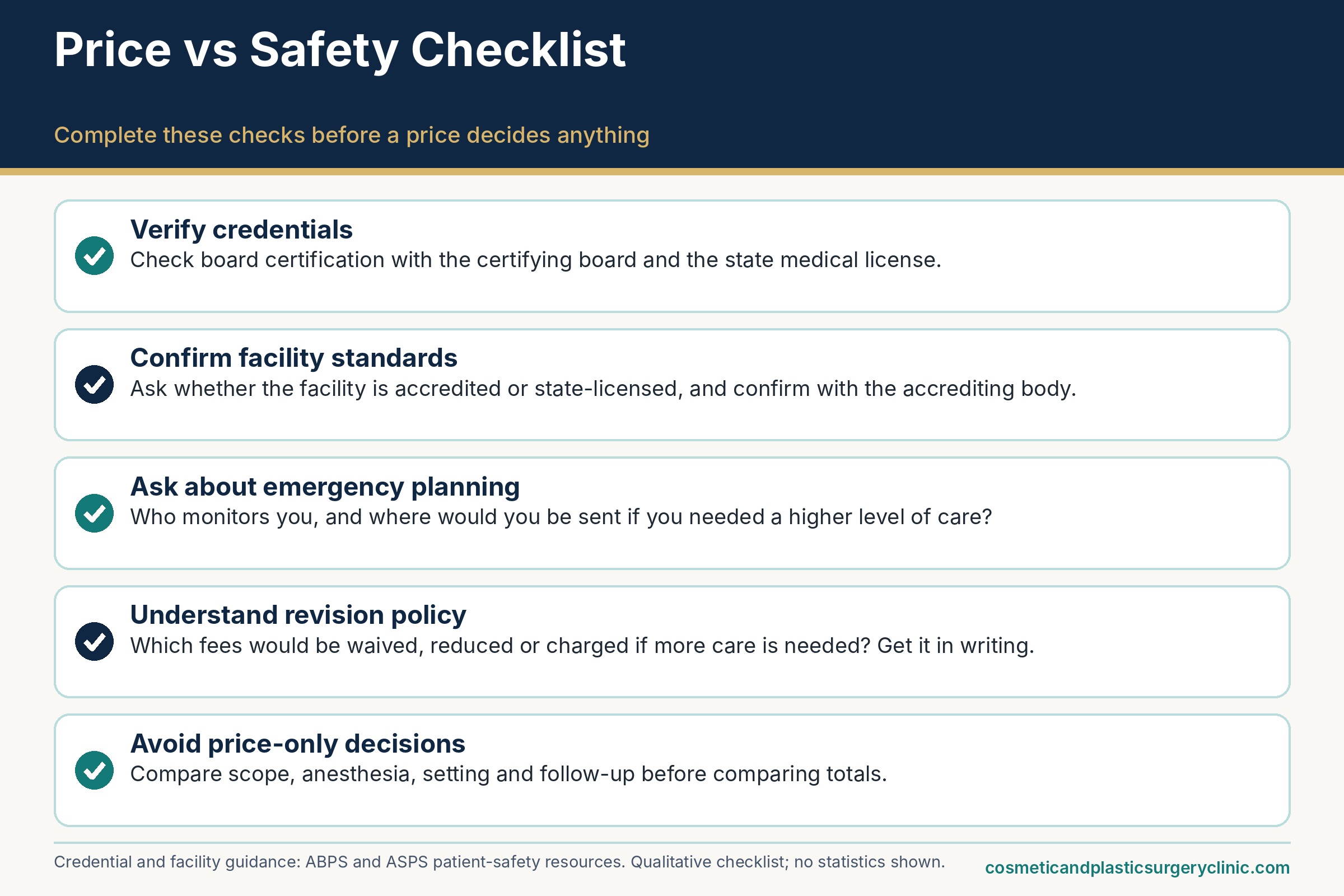
The third possibility is more concerning: a price is low because something that normally costs money is missing. Examples include an unaccredited facility, an anesthesia arrangement in which the surgeon also monitors the patient, provider credentials that cannot be verified, or an operation done by someone whose training does not match the work. ASPS says an accredited facility must meet national standards for equipment, operating room safety, personnel, and surgeon credentials, and recommends confirming accreditation directly with the accrediting body. When a lower price comes with an answer such as “we don’t need that,” it is worth stopping to check.
None of this implies that lower-priced care is unsafe. Many practices operate efficiently and charge less for legitimate reasons. The point is to ask the same questions of every quote, and to let the answers, not the number, decide whether it is a good value.
Verifying credentials, facility, and emergency planning
Verification takes minutes and is free. The American Board of Plastic Surgery offers a public verification tool at abplasticsurgery.org, where you can search by name or location to confirm whether a surgeon holds ABPS certification. ABPS describes certification as a voluntary credential and points patients to the Federation of State Medical Boards for state license verification and to check for any state board actions. The two checks answer different questions: board certification speaks to training and examination in a specialty, while a state license is the legal authority to practice medicine. Having one does not substitute for the other.
| What to verify | Where to look or whom to ask | What it tells you | What it does not tell you |
|---|---|---|---|
| Board certification | The certifying board’s public tool; for plastic surgery, the ABPS verification page | Whether the surgeon holds that board’s certification and its status | How many eyelid operations the surgeon has done, or how a given patient will heal |
| State medical license | The state medical board; ABPS refers patients to the Federation of State Medical Boards | Legal authority to practice and any public board actions | Whether the surgeon is trained in a surgical specialty |
| Facility accreditation | The accrediting body or the facility; ASPS lists AAAASF, AAAHC, the Joint Commission, state licensure, and Medicare certification | That the facility meets recognized equipment, safety, and personnel standards | The skill of any individual clinician |
| Anesthesia provider | Ask for the name and credential of the person giving anesthesia | Whether a dedicated, qualified professional is monitoring you | The fee, which is a separate question |
| Hospital privileges and emergency plan | Ask the surgeon about privileges and where you would be sent in an emergency | Whether there is a plan if something goes wrong | Whether the plan has ever been used or tested |
Facility and emergency planning deserve the same attention as the surgeon’s credentials. ASPS lists several recognized routes to facility standards, and the American Society of Anesthesiologists has stated that training in sedation, anesthesia, and rescue techniques is particularly important in office-based settings because those settings typically lack the backup resources found in hospitals. Ask who is monitoring you, what the plan is if you need a higher level of care, and where you would be transferred. A confident practice has ready answers. The guides to verifying board certification and to accredited plastic surgery facilities go through the steps.
Because eyelid surgery is performed by more than one kind of specialist, you may also meet surgeons whose credentials come from a different board, such as ophthalmology or otolaryngology. The principle is the same: verify the credential with its issuing organization, confirm the state license, and ask about training in eyelid surgery specifically. This article does not rank specialties against one another.
When Plans Change
What revision and complications can add to the bill
Eyelid surgery carries risks, as any operation does, and some of those risks have a cost attached. Reviews of blepharoplasty complications organize them by timing: early issues such as bleeding behind the eye or corneal injury, middle-period issues such as eyelid position changes, dry eyes, or excessive tearing, and later issues such as scarring or persistent changes in eyelid height. The authors of one review emphasized that many complications are avoidable through careful assessment and planning, and that prompt management reduces their impact. Another review recommended waiting three months or more, if possible, before addressing asymmetry or minor deformities, to allow swelling to settle and tissues to heal before drawing conclusions.
The waiting period has a budgeting implication: a revision is rarely an immediate expense, but it may be a real one months later, and it can mean more time off work, another anesthetic, and another facility charge. One published series of 200 lid operations reported complications in 9.5 percent, mostly lower-lid issues such as chemosis (swelling of the lining over the white of the eye) or lid malposition, and more than a third of the patients with complications needed revision surgery. That is a single study with its own population and technique, so it should not be read as a prediction of what will happen to you. Its value here is to illustrate that some patients do need further treatment, and that planning for the possibility is sensible.
No verified national figure for the cost of revision exists in the sources reviewed for this article, so none is given. The practical task is to learn the practice’s policy. Ask which fees would be waived, which would still apply, how long the policy lasts, and what happens if you need care from another clinician. ASPS says that most insurance does not cover cosmetic surgery complications, which means unexpected costs may fall on you.
Some symptoms are not budget questions at all. Sudden vision change, severe pain, or rapidly increasing swelling after eyelid surgery calls for immediate contact with the surgical team or emergency care. The full guide to eyelid surgery risks and complications explains the warning signs and the factors that influence risk.
Traveling for surgery: the cost trade-offs, stated evenly
Some patients consider surgery abroad or in a lower-cost region because the quoted procedure price is lower. That is a real consideration, and it deserves a balanced look at the total picture rather than a verdict. The Centers for Disease Control and Prevention lists cosmetic surgery among the procedures people travel for, and notes risks that include infections, a higher chance of blood clots with air travel soon after surgery, and follow-up care for complications that may be expensive and may not be covered by insurance. It recommends consulting a health care professional well in advance, checking that the facility is accredited by a recognized organization such as Joint Commission International, bringing medical records, and arranging insurance for emergency care and evacuation.
ASPS takes a more cautionary view. Its briefing on cosmetic surgery tourism states that credentials can be hard to assess, that follow-up care after a return home may be limited, and that costs for revisions and complications can exceed the cost of the original operation if it had been done in the United States. An ASPS article from 2025 adds that travel, lodging, and return trips can add up. Those points come from a professional society with an interest in domestic care, so read them as a perspective, though the underlying logistics are real for anyone who travels.
A balanced budget compares total expected spending in each scenario: procedure fee, facility and anesthesia, flights, lodging for the whole recovery window, time off work for both travel and healing, a companion if needed, medical records and translation, and the cost of local follow-up and possible treatment of complications at home. Some patients conclude that traveling makes sense for them; others find the savings shrink once everything is counted. Early follow-up visits also matter after eyelid surgery, so think through how you would reach your surgeon quickly if something looked or felt wrong. For more, see the guide to plastic surgery abroad and medical tourism.
Building a Complete Eyelid Surgery Budget and Decision Plan
The last step is to turn what you have learned into a plan that covers the whole experience, not just the day of surgery. A complete budget includes recovery costs and the value of your time. A complete decision includes the questions that surface problems before you pay a deposit. This section offers a practical structure for both.
Recovery-Related Costs and Time Off
The direct costs of getting through recovery
Recovery costs are individually small, which is why people forget them, but together they can add up. ASPS describes lubricating ointment and cold compresses as part of early care, and it describes swelling, bruising, irritation, dry eyes, and discomfort as expected early symptoms. Patients are also told to practice diligent sun protection and wear darkly tinted sunglasses until healing is complete. Your own surgeon will give specific instructions, and the list of supplies depends on them.
A practical list of items to price out includes prescription medications, lubricating eye drops and ointment, clean gauze or cold packs, a pair of protective sunglasses, a sleep setup that supports the head elevation your surgeon recommends, and easy-to-prepare food so that you are not cooking while your eyes are swollen. Add the cost of a follow-up visit you did not expect, in case your practice charges outside the global period, and the cost of any eye care you may need if dryness or irritation continues.
Transportation is another real line item. After sedation or general anesthesia you will need an adult to take you home, and many practices also ask that someone stay with you for at least the first night. Some practices recommend a longer period of help. If a friend or family member is not available, a paid caregiver, a private driver, or a recovery service has a cost. People who live alone, have young children, or care for an older relative should plan this early, because coverage for those responsibilities is often what makes a surgery date workable.
Finally, think about distance. If the surgeon is far away and you need to stay nearby for the first week or so, lodging and travel become part of the budget, and so does the cost of a second trip if something needs attention. The eyelid surgery recovery guide explains the healing process and what planning it requires, so you can match the money to the calendar.
Time-off math: three scenarios
Time away from work is often the largest recovery expense, and it varies enormously with the job and the person. This article does not give a number of days, because recovery varies and your surgeon will advise you. Instead, consider how each type of work interacts with a typical early recovery that includes swelling, bruising, light sensitivity, and dry or irritated eyes.
Take a person with a desk job and flexible hours. Their main concerns are screen use, which can aggravate dry eyes, and appearance in video meetings. They may be able to work part-time from home sooner, but only if their surgeon agrees and only if they have planned for the possibility that they need more rest than expected. Taking paid leave for the earliest days and negotiating a gradual return may protect income.
Now take someone whose work involves lifting, bending, or physical effort. Surgeons often limit strenuous activity after eyelid surgery, so a job that depends on it may require a longer break, a temporary change in duties, or unpaid time. This is also where cost becomes concrete: unpaid leave can exceed the surgeon’s fee in some households. Raising the question with an employer in advance, ideally in writing, helps avoid a bad surprise.
A third scenario is a caregiver, such as a parent of young children or someone who looks after an older relative. Their obstacle is not only time but substitutes: who handles lifting a toddler, driving to school, or giving medication to a relative. Budget for paid help or arrange mutual support from family and friends. A useful exercise is to write out one ordinary day and mark every task that needs good vision, bending, or lifting. Then decide who will do each one, and what it will cost if the answer is a paid service.
Whichever scenario fits you, give the plan some slack. Healing does not follow a calendar, and a date set for a major event or return to work can create pressure. Leaving buffer days is a way of respecting that uncertainty.
Questions to Ask and a Sensible Order of Steps
Cost questions to bring to a consultation
The following questions are designed to produce a quote you can compare. Bring them in writing, take notes, and ask for answers to be included in the written estimate. The eyelid surgery consultation guide offers a broader list that includes medical and results-related questions.
- Which lids and which techniques do you recommend for me, and what would the plan look like if I chose a more limited approach?
- What is your fee, and which pre- and post-operative visits does it cover?
- Is the consultation fee credited toward surgery if I proceed?
- Where will the surgery take place, and is the facility accredited or state-licensed?
- Who will provide anesthesia, what is their credential, and is their fee included in your total?
- What type of anesthesia do you plan to use, and what would change if I preferred a different option?
- Which tests, clearances, or eye examinations do I need beforehand, and who covers them?
- What medications and supplies should I buy, and which ones does the practice provide?
- If I need a touch-up or revision, which fees would be waived, reduced, or charged, and for how long does the policy apply?
- How are complications handled financially, and which bills could come from a hospital or another provider?
- What is your plan if I need urgent care after hours, and where would I be sent?
- Could any part of my surgery be considered functional, and if so, can your office help with documentation and prior authorization?
- What is the deposit, when is the balance due, and what is refundable if I cancel or you recommend against surgery?
- How long is this quote valid, and what could change the price before surgery?
- Do you offer a payment plan, and can I see the full terms before I agree?
- How many times have you performed this specific operation, and how do you handle outcomes that fall short of the plan?
Listen to how the questions are received as well as to what the answers say. A practice that welcomes cost questions and responds in specifics is communicating something about its culture. A practice that deflects, changes the subject to a promotion, or urges you to decide quickly may not be the best fit, even if the surgeon’s results are strong.
A step-by-step order for deciding
Sequence matters because each step produces information the next one needs. The order below keeps price from deciding things that credentials, safety, and fit should decide first.
- Clarify your goal and whether any part of it might be functional, such as drooping upper lids that affect your field of vision. If so, ask an eye care professional about documentation early.
- Verify the credentials of any surgeon you are considering, using the certifying board’s public tool and the state medical board.
- Book one or two consultations and bring your question list. Consider a second opinion if the recommendations differ significantly.
- Request itemized written quotes after an in-person evaluation, and fill in the comparison worksheet.
- If a functional component exists, ask the practice about prior authorization and confirm the plan’s response in writing before scheduling.
- Decide how you will pay, evaluating HSA or FSA eligibility with your administrator and reading the full terms of any financing.
- Add recovery costs, transportation, help at home, and time off to the total, with a buffer for the unexpected.
- Pause. Review everything away from the practice. If the plan still makes sense, schedule. If it does not, there is nothing wrong with waiting or choosing a nonsurgical or smaller option.
If the total comes out above what you can comfortably pay, there are ways to adjust the plan without cutting corners on safety. One is to reconsider scope: sometimes a more limited operation addresses the main concern, and a surgeon can explain what would be left unaddressed. Another is to stage the work, doing one set of lids first, with the trade-offs of an extra recovery and an extra anesthetic. A third is to allow more time to save or to use a prepayment plan. And a fourth is to compare quotes from properly credentialed surgeons in a nearby region, remembering the travel and follow-up costs described earlier. What should not be on the list is switching to a provider whose credentials, facility, or anesthesia arrangements you cannot verify just to reach a lower number. If the version of the plan with verified credentials and facility costs more than you can afford right now, waiting is an acceptable answer.
It is also reasonable to consider whether surgery is the right approach at all. For some people a less invasive option may address the concern, and for others surgery is the only approach that fits their goal. The guide to alternatives to eyelid surgery compares the choices. Whatever you decide, a decision made with a full set of costs in front of you is a decision you are less likely to regret.
Frequently asked questions about blepharoplasty cost
How much does upper eyelid surgery cost?
No single figure applies to everyone. ASPS publishes surgeon’s-fee data, which excludes anesthesia, the facility, and related expenses, so the amount you pay in total will be higher than the fee alone. The right way to find your number is to request a written, itemized quote after an in-person evaluation. Upper-lid surgery done for a documented vision problem may be handled differently by insurance than surgery done for appearance, so mention that goal at the consultation.
Is lower eyelid surgery more expensive than upper eyelid surgery?
In the ASPS data, lower-lid surgeon’s fees are higher than upper-lid fees, in both the cost-page averages and the 2024 projected ranges. The reasons are generally technical: lower-lid work can involve fat repositioning, skin removal, or support of the eyelid margin, and it takes careful planning. An individual quote may differ from that pattern depending on the plan, so compare itemized estimates, not categories. The lower eyelid cost guide covers this in more depth.
Does the surgeon’s fee include anesthesia and the operating room?
Not necessarily, and the ASPS cost page says outright that its published average excludes both. Some practices quote a single all-in price that includes the facility and anesthesia professional; others bill them separately, and the anesthesia group or hospital may send its own invoice. The only reliable approach is to ask for each charge by name and to get the answer in writing. If anything is described as “to be determined,” ask when you will learn the amount and whether you can see it before you commit.
Will insurance pay for under-eye bag removal?
Under-eye bag removal is generally considered cosmetic. A Medicare contractor’s local coverage policy describes lower-lid blepharoplasty as almost never functional and not covered, and a commercial plan example treats it as cosmetic unless a specific eyelid condition applies. Because policies differ, the plan’s own written criteria are what count. If you have a medical concern involving the lower lid, such as an eyelid that turns in or out, tell your clinician, since documentation of a medical condition is what payers look for.
Can I use an HSA or FSA for eyelid surgery?
It depends on whether the procedure qualifies as medical care under the tax code and on your plan administrator’s rules. IRS guidance says cosmetic surgery generally does not qualify unless it corrects certain deformities, which suggests purely cosmetic eyelid surgery may not be eligible, while surgery to treat a documented functional problem may be treated differently. Ask the administrator in advance what documentation they require. A tax professional can address your particular circumstances.
Do consultations cost money, and is the fee credited toward surgery?
Practices differ. Some charge for consultations, some offer them at no charge, and some credit the fee if you proceed with surgery. Consultation policies are worth checking when you schedule, because if you plan to see more than one surgeon, the fees can add up. A paid consultation is not a sign of quality or the lack of it. What matters is that you leave with an itemized quote, information about credentials, and a clear sense of the plan.
Are touch-ups after eyelid surgery free?
Sometimes the surgeon’s fee is reduced or waived for a defined period, but the facility and anesthesia charges often still apply, and many practices limit coverage to specific situations. There is no universal rule. Because minor asymmetries and swelling can resolve over time, reviews recommend waiting at least three months, when possible, before deciding on revision. Ask for the policy in writing, including how long it lasts and which costs it includes, before paying a deposit.
Is an office-based operating room cheaper than a surgical center or hospital?
It can be, because a practice-owned room may have different overhead and billing structure, but the answer depends on the quote. The more useful comparison is what each setting offers: accreditation or licensure, who gives anesthesia, and what the emergency plan is. A lower facility charge is a reasonable benefit only when those safeguards are in place. Ask the practice to identify the facility, state its accreditation status, and explain how it would arrange transfer to a hospital if a problem occurred.
Is financing a good idea for eyelid surgery?
For some people it is a workable way to spread payments, and for others it adds avoidable expense. The Consumer Financial Protection Bureau has cautioned about medical credit products with deferred interest, which can charge interest retroactively if the balance is not paid by the end of a promotional period. Compare the total repayment amount, not only the monthly payment, and read the contract before signing. Saving or using a prepayment plan avoids interest entirely, but it requires time.
How long should I take to decide after getting a quote?
As long as you need. There is no medical reason to book surgery on the day of a consultation, and a quote that disappears if you take it home deserves a second look. Many people compare two quotes, check credentials, review payment options, and sleep on the decision for a few days or weeks. If a practice offers a time-limited incentive, consider whether it is consistent with the careful, informed decision-making that elective surgery calls for.
Does having had eyelid surgery before change the price?
It can. A second operation on previously operated lids is often more complex because scar tissue and altered anatomy affect planning, and ASPS notes that revision surgeries tend to be more involved than original ones. Fees for revisions are set by the surgeon, so ask how a secondary procedure would be priced and whether any earlier records should be provided. If your first surgery was done elsewhere, bring operative reports and photographs if you have them.
Sources and further reading
- American Society of Plastic Surgeons — Eyelid surgery cost (accessed 2026) — average surgeon’s fee figures, exclusions, cost components, insurance and financing statements; the page does not state a statistics year.
- American Society of Plastic Surgeons — 2024 average surgeon/physician fees — 2024 projected fee ranges for upper and lower eyelid surgery.
- American Society of Plastic Surgeons — Plastic Surgery Statistics Report 2025 — eyelid surgery procedure counts and ranking for 2025 and 2024.
- American Society of Plastic Surgeons — Eyelid surgery procedure overview (accessed 2026) — anesthesia options, upper and lower approaches, fat repositioning, suture timing.
- American Society of Plastic Surgeons — Eyelid surgery recovery (accessed 2026) — early care items and sun protection guidance.
- American Society of Plastic Surgeons — Eyelid surgery risks and safety (accessed 2026) — listed risks of eyelid surgery.
- American Society of Plastic Surgeons — Recommended insurance coverage criteria: blepharoplasty (2020) — functional indications and documentation.
- Centers for Medicare & Medicaid Services — Local Coverage Determination L34194, Blepharoplasty, Eyelid Surgery, and Brow Lift (revision effective October 16, 2025) — example Medicare contractor criteria and exclusions.
- Geisinger Health Plan — Medical policy MP010, Blepharoplasty (revised January 2025) — one commercial plan’s criteria and prior authorization requirement.
- American Academy of Ophthalmology EyeNet — Documenting the need for functional blepharoplasty — payer variation and documentation elements.
- American Society for Aesthetic Plastic Surgery 2022 meeting — A cross-sectional analysis of American insurance coverage of upper and lower lid blepharoplasty (conference abstract) — variation among 70 policies.
- Internal Revenue Service — Publication 502, Medical and Dental Expenses (2025) — cosmetic surgery and the medical expense definition.
- Internal Revenue Service — Publication 969, Health Savings Accounts and Other Tax-Favored Health Plans (2025) — qualified medical expenses for HSAs and health FSAs.
- Consumer Financial Protection Bureau — Medical credit cards and financing plans (May 2023) — deferred-interest products and risks.
- Centers for Medicare & Medicaid Services — Good faith estimate (No Surprises Act consumer page) — estimates for patients who do not have or use insurance.
- Centers for Disease Control and Prevention — Medical tourism — risks and preparation for surgery abroad.
- American Society of Plastic Surgeons — Briefing paper: Cosmetic surgery tourism — credentials, follow-up, and complication cost concerns.
- American Society of Plastic Surgeons — Plastic surgery abroad versus at home (June 20, 2025) — hidden travel costs and cost-management strategies.
- American Society of Plastic Surgeons — Accredited facilities (accessed 2026) — recognized accreditation routes and verification advice.
- American Society of Plastic Surgeons — Why board certification matters for plastic surgery (March 26, 2025) — training and verification steps.
- American Board of Plastic Surgery — Verify certification — public board-certification verification; certification is voluntary; state license resources.
- American Society of Anesthesiologists — Statement distinguishing monitored anesthesia care from moderate sedation (October 2023) — what monitored anesthesia care involves.
- American Society of Anesthesiologists — Qualifications of anesthesia providers in the office-based setting (reaffirmed October 2024) — training needs in office settings.
- American Society of Plastic Surgeons — Office-based surgery position document (2002; dated) — facility standard expectations beyond minor local anesthesia.
- Lelli GJ, Lisman RD. Blepharoplasty complications. Plastic and Reconstructive Surgery, 2010 (PubMed record 20195127) — complications organized by timing and their prevention.
- Oestreicher J, Mehta S. Complications of blepharoplasty: prevention and management. Plastic Surgery International, 2012 — complications and the suggestion to delay revision for three months or more when possible.
- Patrocinio and colleagues — Complications in blepharoplasty: how to avoid and manage them. Brazilian Journal of Otorhinolaryngology (200-procedure retrospective series) — a single-series example of complication and revision frequency.
- Harley DH, Collins DR Jr. Patient satisfaction after blepharoplasty performed as office surgery. Aesthetic Plastic Surgery, 2008 — single-practice office-based series.