Blepharoplasty recovery is short compared with many cosmetic operations, but it is also unusually visible. Eyelid surgery (blepharoplasty, often called an eye lift) works on the thinnest skin on the body, right at the spot where people look at each other, so the first week or two can feel more public than the number of incisions would suggest. This guide walks through blepharoplasty recovery from the first hours to the one-year mark: what swelling and bruising commonly do, how vision and the surface of the eye behave, when people tend to return to work, driving, exercise, and contact lenses, which symptoms are ordinary and which are not, and how scars mature.
One caution runs through every section. The ranges below come from patient-education pages, hospital handouts, and published studies, and those sources disagree with each other on many details, sometimes by a full week. That disagreement is informative rather than alarming: it shows that surgeons set their own protocols. Your written instructions from your own surgical team always outrank anything in a general article, and nothing here is a diagnosis or a substitute for a conversation with a qualified clinician.
The sections that follow are built so you can jump to what you need. The first explains what shapes recovery before surgery day. The second gives the phase-by-phase timeline. Later sections cover what healing looks and feels like, how to plan work, driving, exercise, travel, sleep, and home help, which warning signs matter, how scars and follow-up work, and what the time off costs. If you are still deciding whether the operation fits your goals, start with the complete eyelid surgery guide and return here when recovery planning becomes the question. For a deeper look at one eyelid at a time, see the dedicated pages on upper eyelid surgery recovery and lower eyelid surgery recovery.
A note on numbers. Eyelid surgery is common in the United States: the American Society of Plastic Surgeons (ASPS) reported 118,978 eyelid surgery procedures in 2025, up from 100,185 in 2024, making it the fifth most common cosmetic surgical procedure in its statistics report (ASPS 2025 statistics report). Popularity says nothing about how any one person will heal, though, and it does not mean the recovery is trivial. The age groups with the most procedures in that report were people aged 56 to 65 and those 66 and older, which matters for planning: some people in those age groups may be managing blood pressure, blood-thinning medication, or dry eye alongside recovery, and each of those is discussed below.
What Shapes Blepharoplasty Recovery Before Surgery Day
Before any timeline makes sense, you need a working picture of which operation is planned and who is having it. “Eyelid surgery” covers several different procedures, and the healing curve for a quick upper-lid trim on a person with no eye problems looks different from a four-lid operation combined with a brow lift on a person with chronic dry eye. This section sets out the variables that move recovery up or down the range, so that when you read the timeline in the next section you can place yourself on it more honestly.
Which Operation You Are Having Sets the Recovery Map
The first question to settle with your surgeon is not “how long will I be out” but “what exactly will be done, and where.” Everything about dressings, symptoms, and visibility follows from the answer.
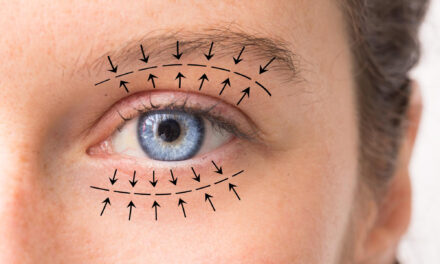
Upper, lower, and four-lid surgery: where the incisions sit and what that means for healing
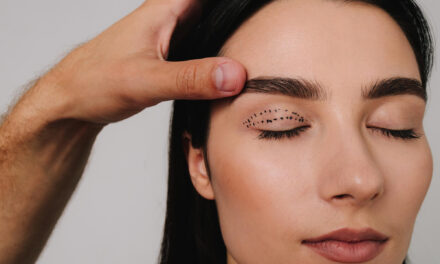
ASPS describes the upper eyelid incision as being made within the natural crease of the upper lid, which lets the surgeon remove or reposition fat, tighten muscle, and remove excess skin (ASPS eyelid surgery procedure page). Because the line sits in a fold, the early surface scar is partly tucked away when your eyes are open, though swelling can blur that advantage for the first week or two. Upper-lid surgery also tends to put the spotlight on the heavy, tight, or watery feeling of the lid itself, since that is the tissue that was worked on.
The lower eyelid offers two routes. A subciliary incision runs just below the lower lash line and allows skin removal along with fat repositioning or removal. A transconjunctival incision is made on the inside of the lower lid, and ASPS notes that with this technique no skin is removed. The practical differences for recovery are real: a subciliary approach leaves an external incision line to keep clean and, in many protocols, to have sutures removed, while an inside-the-lid approach leaves no skin incision to see, although it does not make swelling and bruising disappear. Closure also varies, since ASPS says incisions are typically closed with sutures or skin glue and that sutures are removed within a week.
When both upper and lower lids are treated in one operation, usually called four-lid surgery, the recovery tasks stack up. There are more lines to protect, ointment goes into more places, and swelling can involve the whole eye region, which affects how comfortable it is to read, drive, or look at a screen in the early days. A simple, illustrative example: a person having only upper lids may plan on a fairly quiet first week at home, while a person having all four lids may reasonably plan on more help with ointment and rides, because both blurred vision and swelling can last a little longer. Whether that holds for you is a question for your surgeon, who knows the extent of the plan.
Add-ons that stretch the timeline: ptosis repair, brow lift, fat repositioning, canthal support, and resurfacing
Eyelid surgery is often done alongside something else, and the something else can set the pace. ASPS points out that drooping upper lids may reflect relaxation of the forehead skin and eyebrow rather than excess eyelid tissue alone, and it separates ptosis, a stretching of the muscle that lifts the lid, as a condition that requires a different surgical treatment than standard blepharoplasty (ASPS eyelid surgery candidates page). A brow lift or ptosis repair performed in the same session adds incisions in other places, additional swelling zones, and its own list of instructions.
ASPS also notes that a surgeon may recommend a laser or chemical peel to reduce discoloration of the lower eyelids. Any resurfacing step layers a surface-healing process on top of the surgical one, with redness, flaking, or extra sun sensitivity that follow their own schedule. Other additions you may hear about in a consultation include repositioning fat rather than removing it, and tightening the outer corner of the lower lid to support its position. None of these are required parts of the operation, and whether any apply to you depends entirely on your anatomy and goals.
A workable rule of thumb is that recovery tends to follow the largest component of the plan rather than the smallest. If the eyelid work is paired with a brow lift or a facelift, the longer and more restrictive instructions usually win, and the date you can drive or exercise may be set by the bigger operation. The page on combining eyelid surgery with other procedures goes through the trade-offs of stacking operations. Anesthesia choice matters here too: ASPS lists intravenous sedation or general anesthesia, and the amount of drowsiness, nausea, and clearance time afterward depends on the choice (see eyelid surgery anesthesia options). Ask for a single written plan that covers every part of the operation, so you are not reconciling three sets of instructions at home.
Personal Factors That Move the Clock
Two people can have the same operation from the same surgeon and heal on different schedules. The reasons fall into health and eye factors on one side and habits and life context on the other. None of these can be judged from an article, but knowing they exist helps you raise the right points at your pre-operative visit.
Your eyes and your health: dry eye, blood pressure, bleeding, and other conditions
The surface of the eye is part of eyelid recovery, because the lids spread tears across it every time you blink. A small study in Frontiers in Medicine followed 20 patients (40 eyes) after upper blepharoplasty and compared those with and without existing dry eye at baseline and at one, three, and six months. In the group without dry eye, tear-film stability was shortened at one month and had returned to baseline by six months, while patients with pre-existing dry eye showed more persistent changes (Zhao et al., Frontiers in Medicine, 2021). It is a small study, so treat it as a pattern worth discussing rather than a prediction. The practical message is that existing dry eye, a history of other eye surgery, or glaucoma deserve a candid conversation before surgery, not after.
Mayo Clinic lists dry eyes, glaucoma, allergies, circulatory problems, thyroid problems, and diabetes among the topics to bring up with your surgeon, along with every drug, vitamin, herbal supplement, and alcohol or tobacco use (Mayo Clinic, blepharoplasty). The reason for such a long list is that several of these conditions affect bleeding, wound healing, or the eye surface. Mayo also names warfarin, aspirin, ibuprofen, naproxen, and herbal supplements that can increase bleeding as items to stop before surgery on the timeline your surgeon sets. Never stop or change a prescribed medicine on your own because of something you read; bring the full list to the pre-operative visit and ask which items to hold, for how long, and who to call with questions.
Blood pressure deserves its own mention because it ties directly to the most serious early complication. In a survey of members of the American Society of Ophthalmic Plastic and Reconstructive Surgery covering 269,433 cosmetic eyelid cases, the risk factors reported among patients who had orbital hemorrhage included hypertension, perioperative aspirin use, postoperative vomiting, and increased physical activity (Hass et al., Ophthalmic Plastic and Reconstructive Surgery, 2004, abstract). That is a surgeon-reported survey rather than a controlled trial, but the pattern is why recovery instructions so often emphasize calm blood pressure, no straining, and limited activity early on.
Habits and life context: nicotine, work, home help, and the four clocks of recovery
Tobacco and nicotine come up in almost every healing discussion. MedlinePlus explains that smoking decreases the oxygen that reaches the cells in a surgical wound, slowing healing and raising the chance of infection, and it advises stopping at least four weeks before surgery, with longer abstinence giving more benefit. It also cautions that nicotine gum still interferes with wound healing (MedlinePlus, smoking and surgery). ASPS lists nonsmokers among appropriate eyelid surgery candidates. If you use nicotine in any form, the planning page on smoking and plastic surgery explains why surgeons ask, and honest disclosure is far better than a surprise during recovery.
Life context matters just as much as biology. Your job, your home, and the people around you determine how easy it is to follow the instructions that protect healing. Mayo advises arranging a ride to and from surgery and having someone stay with you the first night. A person who lives alone, cares for small children, or works in a public-facing role faces a different recovery than a person with a flexible schedule and a helper at home, even if their eyelids heal identically.
It can help to separate recovery into four clocks that run at different speeds. The comfort clock covers pain, tightness, and irritation and is usually the fastest. The eye-surface clock covers vision clarity, dryness, tearing, and light sensitivity. The visibility clock covers bruising and swelling, which decide when you feel comfortable being seen. The tissue clock covers scar maturation and final contour, and it runs for months. When someone says they are “recovered,” ask which clock they mean, because the answer is rarely the same for all four.
The Blepharoplasty Recovery Timeline, Phase by Phase
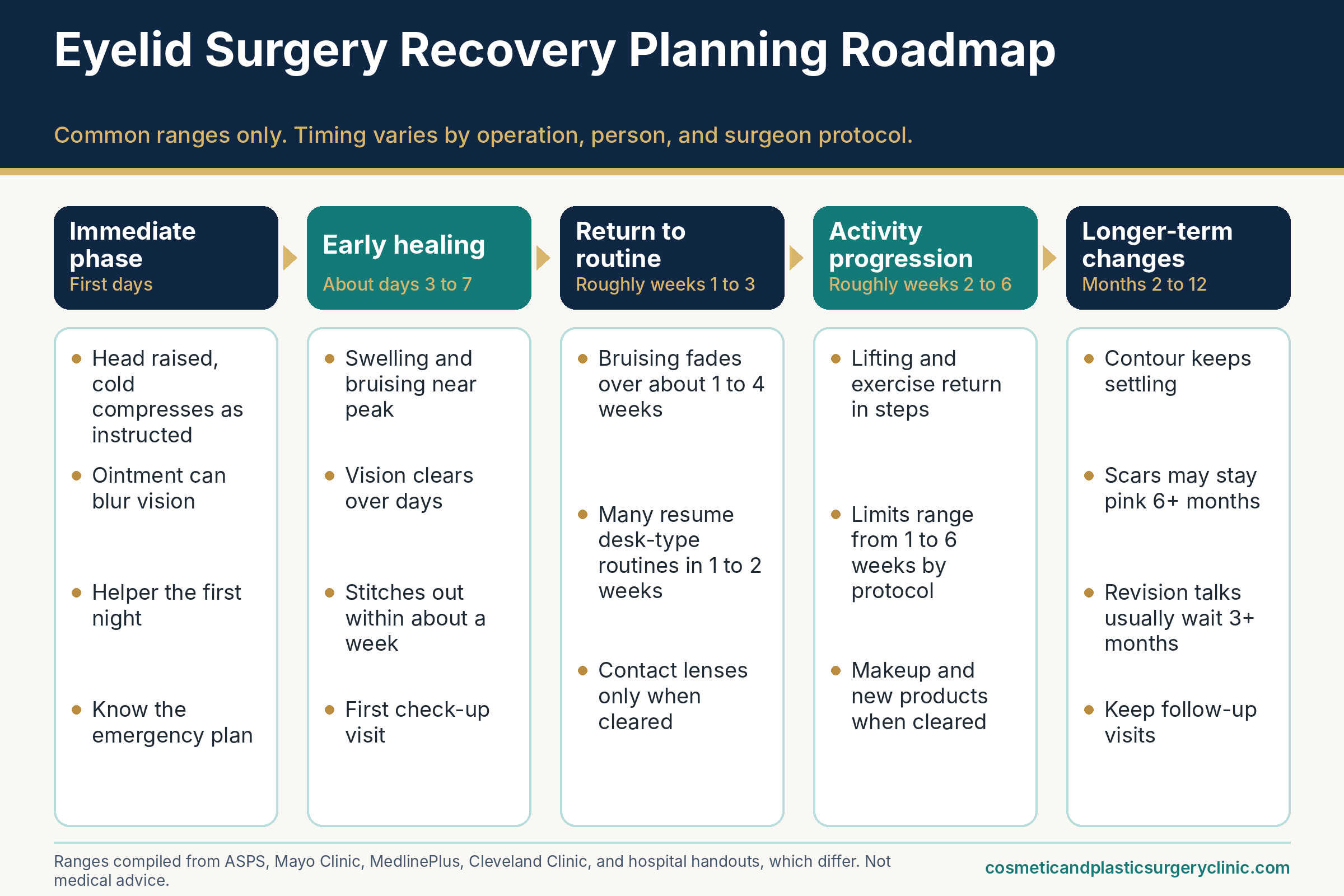
The phases below are common ranges assembled from several published sources, and they overlap. Most of the sources agree on the broad shape: a first week dominated by swelling, bruising, and an ointment-blurred view of the world; a second and third week in which the visible signs fade and everyday routines return; and a long tail of months in which contour, sensation, and scars finish changing. They disagree, sometimes by days and sometimes by weeks, on the exact numbers. Treat the ranges as a way to ask better questions, and expect your surgeon’s schedule to differ from any single page, including this one.
The First Week: Rest, Ointment, Peak Swelling, and Stitches
Almost everything people remember about blepharoplasty recovery happens in the first seven days. The goals of the week are simple to state: protect the eyes, keep swelling down, watch for the few things that need fast action, and get through the first check-up.
The day of surgery and the first 24 to 48 hours
ASPS lists intravenous sedation or general anesthesia as the anesthesia choices for eyelid surgery. Cleveland Clinic tells patients to arrange transportation because you cannot drive yourself home, and Mayo Clinic adds that someone should stay with you the first night. Sedatives can leave you slow and forgetful for hours without you noticing. A health-system explainer from Banner Health (2023) describes the usual advice to avoid driving for 24 to 48 hours after sedation, noting that vision can also be altered after eye procedures. Treat the first evening as a time for rest and for decisions to wait; do not sign contracts or make big choices on sedation.
What you will actually see when you first look in a mirror varies. ASPS notes that the eyes may be loosely covered with gauze and that lubricating ointment and cold compresses may be applied. Mayo lists blurred vision from the ointment, watering eyes, light sensitivity, double vision, puffy and numb eyelids, and pain as things that can happen temporarily, with swelling and bruising that can resemble black eyes. Sutures are usually still in place or glue is on the skin. Many surgeons also ask patients to sleep with the head raised, since gravity helps fluid drain away from the eyes (see sleeping after eyelid surgery).
This is also the period with the highest stakes for the rare, sight-threatening complication of bleeding behind the eye. EyeWiki, the American Academy of Ophthalmology’s clinical wiki, says retrobulbar hemorrhage usually occurs within the first 24 hours after eyelid or orbital surgery. In the ASOPRS survey cited earlier, most cases that occurred appeared within roughly the first three hours, and risk fell markedly after 24 hours. Oestreicher and Mehta (Plastic Surgery International, 2012) advise that patients be taught to check vision one eye at a time and to watch for unusual or one-sided pain, decreased vision, or a bulging eye. That is why your team will tell you precisely what to watch and whom to call tonight. The details are in the safety section later in this guide.
Double vision on the first day is usually due to the anesthetic. Oestreicher and Mehta describe anesthetic-related double vision as gone by the next day, while persistent double vision beyond that point is a reason to call. Ask your team in advance how they want to hear about vision changes, since the right response differs between mild blurriness from ointment and a sudden drop in sight.
Days 3 to 7: peak swelling, the first check-up, and stitch removal
Swelling and bruising do not peak the moment surgery ends. One hospital handout from Michigan Medicine (revised April 2020) says that maximum swelling and discoloration appear on the second day, while others describe a gradual easing starting in the first few days. This is the stretch that surprises people, because the eyes can look worse on day three than on day one even when everything is on track. Memorial Sloan Kettering’s instructions (updated August 2024) note that swelling tends to be worst in the morning and to improve through the day, which matches the experience of lying flat overnight.
Vision usually clears first. MedlinePlus (reviewed February 2025) says you should be able to see well after two to three days, and a University of Mississippi Medical Center handout expects blurring for two to three days. The ointment itself blurs your view for as long as you use it, and Oestreicher and Mehta suggest planning not to drive for about a week because of that blur. Tearing and sensitivity to light often hang around longer: MedlinePlus says tearing, light sensitivity, and blurred vision may persist for several weeks.
Stitch timing is the best-defined event of the week, and sources cluster around it. ASPS says sutures are removed within one week. MedlinePlus says the surgeon removes stitches five to seven days after surgery. Memorial Sloan Kettering describes removal at appointments between two and seven days. Michigan Medicine gives five to ten days for non-dissolvable stitches and ten days to three weeks for dissolvable ones, and Cleveland Clinic notes that stitches stay for about a week or that dissolvable stitches may be used. Which type you have is worth knowing in advance, because it decides how many appointments you need to schedule. A sensible plan is to treat the suture visit as the first real milestone: it is when many surgeons give a more specific picture of the next phase.
Bruise colors change as blood breaks down, which means purple and blue shade toward green and yellow in the following days. That progression is one ordinary sign of healing, but it is not a timetable. If the swelling suddenly gets tighter, more painful, or one-sided, or if sight changes, those are different signals. The first-week checklist in the safety section spells out which is which.
| Phase (approximate) | What people commonly notice | Planning question to settle | Range comes from |
|---|---|---|---|
| Day 0 to 2 | Sedation wearing off, ointment blur, puffy lids, cold compresses, head raised | Who stays the first night and how do I reach the surgeon after hours? | ASPS; Mayo Clinic; Banner Health |
| Days 3 to 7 | Swelling and bruising near peak, clearer vision, stitches out or glue loosening | When is the suture visit, and what does the surgeon check? | MedlinePlus; Michigan Medicine; ASPS |
| Weeks 2 to 3 | Bruising fading, tightness, tearing, light sensitivity; many resume light routines | When can I return to work and wear contact lenses? | Mayo; MedlinePlus; Cleveland Clinic |
| Weeks 4 to 6 | Most visible bruising gone; residual puffiness; eye surface settling | What exercise and lifting steps come next, and with whose clearance? | Frontiers in Medicine 2021; MedlinePlus |
| Months 2 to 6 | Contour refining, scars pink, sensation returning unevenly | What sun protection and scar care do I follow, and when is the next visit? | MedlinePlus; ASPS scar article; Cleveland Clinic |
| Months 6 to 12 | Scars maturing and flattening, eye surface at baseline for many | When is it reasonable to judge the result or discuss revision? | ASPS scar article; Oestreicher and Mehta |
Week Two and Beyond: From Social Comfort to Final Contour
After the first week, recovery turns from managing symptoms to returning to life in stages. The pace of that return depends on the clock you care about: comfort, eye surface, visibility, or tissue maturity.
Weeks 2 to 6: bruises fade, routines return, and the eye surface settles
Several sources converge on roughly two weeks for the bulk of visible change. Mayo Clinic says bruising and swelling generally lessen slowly in about 10 to 14 days. The Aesthetic Society, in a 2019 patient article, describes recovery as taking 10 to 14 days. MedlinePlus is more conservative, saying bruising may last two to four weeks. The Mississippi handout expects swelling and bruising to fade in seven to ten days. The spread, from about one week to about a month, is the honest range, and where you land depends on skin tone, tendency to bruise, the extent of surgery, and whether a combined procedure was done.
Cleveland Clinic states that most patients resume normal activities within one to two weeks and that it usually takes a few months to recover completely. Those two statements sit together comfortably once you separate the clocks: normal activity can come back long before the last bit of swelling and scar redness leaves. Contact lens advice sits in this window too, with sources ranging from about one week (the Aesthetic Society), through ten days (Mississippi), to at least two weeks (MedlinePlus, Mayo, Michigan Medicine, and Memorial Sloan Kettering). The variation again reflects surgeon protocols, so the right answer is the one your team gives you in writing.
The eye surface follows its own schedule. In a Frontiers in Medicine study of 55 young women (110 eyes) without dry eye disease who had upper blepharoplasty, blink frequency fell and partial blinks increased at one week, and those blink measures returned to baseline by one month. A lipid-layer measurement of the tear film was still elevated at one month, which the authors attributed possibly to residual eyelid swelling (Zhang et al., Frontiers in Medicine, 2021). The participants were ages 19 to 31, so the findings may not match an older person’s course, but the sequence of a rough first week, a mostly settled first month, and lingering fine changes is consistent with what patients are often told.
Exercise and lifting also start to reopen in this window, though protocols vary widely. MedlinePlus advises avoiding strenuous activities that raise blood pressure for about three weeks. Michigan Medicine restricts vigorous activity for two weeks and swimming, hot tubs, and saunas for three. Memorial Sloan Kettering limits lifting to under five pounds and bending at the waist for four to six weeks. The section on activity planning below turns those differences into questions you can ask.
Months 2 to 12: contour, scars, and the long tail of healing
By the second month, most people are no longer thinking about the surgery daily, but the tissue is still changing. MedlinePlus says scars may remain slightly pink for six months or more and fade to a thin, nearly invisible white line. Mayo Clinic says scars may take months to fade. ASPS describes scar healing in phases: a protection phase in roughly the first two weeks, a red phase that can last up to six months, and a maturation phase from about six months to a year in which redness recedes and the scar flattens (ASPS, what to expect as a scar heals).
A randomized trial in Medicina (2024) followed 348 patients, ages 49 to 87, who had upper blepharoplasty and compared two suturing methods. Using validated FACE-Q questionnaires at baseline and at three, six, and twelve months, the investigators found significant gains in satisfaction with the eyes and facial appearance at three and six months, and no difference between the two suture techniques. The authors reported that 76.7% of patients had no visible scar at three months and 89.1% at twelve months, and that dry eye, tearing, and difficulty closing the eyes were uncommon and improved over time (Medicina, 2024). That is a single trial using patient-reported measures, and individual scarring varies, but it gives a sense of the usual arc.
The six-month mark matters for the eye surface as well. In the Frontiers in Medicine dry-eye study described above, patients without existing dry eye had returned to baseline tear stability by six months. Planning-wise, the months after surgery are also when persistent issues declare themselves. Oestreicher and Mehta say a droopy lid caused by swelling is usually followed for about three months before repair is considered, since most cases resolve by then, and that revision surgery should usually be delayed for three months or more if possible. Anything that seems stuck should be raised at a follow-up visit rather than endured. For how long the result itself may last, see the page on how long eyelid surgery results last.
What Healing Feels and Looks Like: Swelling, Eyes, Vision, and Sensation
Recovery is easier to tolerate when you know which sensations belong to the normal script. This section describes the common ones in plain language, then looks at where published sources and hospital handouts disagree about how to care for them. For the formal list of complications and how often they occur, the companion guide on eyelid surgery risks and complications goes deeper; here the focus is on what ordinary healing tends to feel like and how to tell it apart from a problem.
Swelling, Bruising, and the Cold-Care Question
Swelling and bruising are the most visible parts of blepharoplasty recovery, and they generate the most advice, much of it conflicting. Separating established practice from folklore starts with what the sources actually say.
Swelling and bruising: the usual pattern, plus what trials say about arnica and tranexamic acid
ASPS lists swelling and bruising among the expected effects of eyelid surgery, and Mayo Clinic compares the look to black eyes. The pattern is usually uneven. One eye can swell more than the other, the lower lids can look puffier than the uppers, and swelling often looks worse in the morning after lying flat, as Memorial Sloan Kettering’s instructions note. The Aesthetic Society says dark circles may last a few days or up to a week. Many people find it helps to take a photo each day in the same light and from the same angle, because slow change is nearly impossible to see in a mirror, and a photo log gives you something to show the surgical team if you are unsure whether swelling is improving.
Because the visibility clock is the one most people want to speed up, supplements and drugs marketed for bruising attract attention. The evidence is mixed. For arnica, a placebo-controlled, double-blind trial summarized by the American Academy of Ophthalmology involved 30 men (57 eyelids) having upper blepharoplasty and compared four days of oral homeopathic arnica with placebo; the investigators found no statistically significant difference in the area or severity of bruising (AAO Editors’ Choice summary). A 2021 Dutch guideline module on periorbital surgery, prepared under the Dutch Association of Plastic Surgeons, reviewed two randomized trials, rated the evidence as low certainty, found that arnica appeared no more effective than placebo, and concluded that the working group neither recommends nor discourages its use (Dutch guideline module on arnica). A broader 2021 meta-analysis of homeopathic arnica across many kinds of surgery found a small effect that just missed statistical significance in placebo-controlled trials, with high variability between studies (Frontiers in Surgery, 2021). Mayo, meanwhile, lists bleeding-increasing supplements among things to avoid around surgery, so check with your surgeon before taking anything “natural.”
Tranexamic acid, a prescription medicine that reduces bleeding, has a newer and stronger research signal in eyelid surgery. A 2025 systematic review and meta-analysis in Aesthetic Plastic Surgery pooled five randomized trials covering 594 participants (1,154 eyes) having upper blepharoplasty and reported less bruising on postoperative days one and seven; the included studies reported no thromboembolic events, though the authors called for more work on dosing and risk (Aesthetic Plastic Surgery, 2025). A separate 2024 randomized, double-masked trial of 130 patients in Ophthalmic Plastic and Reconstructive Surgery reported reduced bruising on day zero and at one week but no effect on bleeding during the operation (trial listing). The editorial team could read only abstract-level summaries of these two papers, so dose, route, and exclusion criteria are not covered here. Whether a surgeon uses tranexamic acid, and by what route, is a medical decision made with the patient’s history in mind; it is not something to pursue or take on your own, and it is a fair question to raise at the consultation.
Cold compresses, head elevation, and gentle handling: why instructions differ so much
Nearly every source recommends cold early on and nearly every source recommends keeping the head raised. After that, the details diverge, as the table below shows. Mayo, for example, suggests ice packs for 10 minutes every hour the night after surgery and then four to five times through the following day. Memorial Sloan Kettering uses 10 to 15 minutes on and 10 to 15 off for the first 24 hours. UNC’s otolaryngology service uses saline-soaked ice gauze followed by frozen packs for 48 hours. Oestreicher and Mehta, writing for surgeons, describe continuous ice-water compresses for three days apart from meals and sleep, and caution against ice packs or frozen masks that are too heavy because they may damage eyelid tissue or strain the wounds.
The variation does not mean any of these is wrong. It reflects different surgeons, different operations, and a thin evidence base on the best cooling schedule. What it does mean is that two things matter: following your own schedule exactly, and never pressing hard on the eye. A light, clean cloth or gauze barrier, a gentle touch, and a ready supply of fresh cold compresses are usually safer than a heavy frozen item laid across the lids. Ask whether cooling is meant to stop at a set time and what to do for swelling after that point.
Head position follows the same logic. Mayo suggests several days with the head elevated, Michigan Medicine two to three pillows for the first two nights, the Mississippi handout 30 to 40 degrees, and Memorial Sloan Kettering two to three pillows for two weeks or as directed. Oestreicher and Mehta describe 45 to 60 degrees. A wedge pillow or a recliner can make that angle easier to hold if you are a restless sleeper; the planning section on sleep returns to this.
| Source | Cold compresses | Head elevation | Contact lenses | Activity limits stated |
|---|---|---|---|---|
| Mayo Clinic (patient page) | Ice packs 10 min each hour the night of surgery; 4 to 5 times the next day | Head raised for several days | About 2 weeks | No strenuous activity for 1 week |
| Michigan Medicine (handout, 2020) | Ice packs for swelling in the first 24 to 48 hours | 2 to 3 pillows for the first 2 nights | Avoid for 2 weeks | No heavy lifting or bending for 7 days; vigorous activity limited 2 weeks |
| Memorial Sloan Kettering (2024) | 10 to 15 min on, 10 to 15 off for the first 24 hours | 2 to 3 pillows for 2 weeks or as directed | At least 2 weeks | No bending at the waist or lifting over 5 lb for 4 to 6 weeks |
| UNC Otolaryngology | Saline ice gauze, then frozen packs, for 48 hours | Not stated | Not stated | No bending head-down or lifting over 15 lb until sutures out |
| University of Mississippi Medical Center | Cold compresses for 2 days, changed every 20 to 30 min | 30 to 40 degrees | Not for 10 days | No face washing around the eyes for 7 days |
| Oestreicher and Mehta (review for surgeons, 2012) | Continuous ice-water compresses for 3 days; avoid heavy ice packs | 45 to 60 degrees | Not addressed | Plan not to drive for about a week because of ointment blur |
Eyes, Vision, and Sensation
Beyond the visible swelling, the eye itself behaves differently for a while. These changes are mostly temporary, and mostly manageable, but they are also where the line between expected and concerning is hardest for patients to judge on their own.
Dryness, tearing, light sensitivity, and blurred vision
It sounds contradictory, but dry eye and watery eyes often coexist after blepharoplasty. When the surface is irritated or the lids do not distribute tears evenly, the eye can both feel gritty and overflow. ASPS lists dry eyes, light sensitivity, and difficulty closing the eyes among the recognized effects, and Cleveland Clinic says unmedicated ointment or drops help manage dry eyes that last a few weeks. Mayo adds that ointment itself causes blurred vision. If your vision is hazy right after you apply ointment and clears slowly, that is typically the lubricant rather than a problem with the eye, and the way to find out for sure is to ask your team what blur to expect and how long it should last.
The National Eye Institute describes dry eye symptoms as a scratchy feeling, stinging or burning, redness, light sensitivity, and blurred vision, and lists artificial tears as the most common first-line approach, along with taking screen breaks, using a humidifier, and wearing wraparound sunglasses outdoors (National Eye Institute, dry eye). Those are general measures for dry eye in general, not post-surgical instructions, so use them as a conversation starter rather than a plan. Ask which specific drops and ointments are acceptable for you, and in what order and spacing, rather than improvising with whatever is in the medicine cabinet.
The Aesthetic Society says to avoid eyestrain activities such as reading, television, or computer use during the first week and possibly for three to four weeks, a recommendation that may relate to blinking less during concentrated close work. The blink study described earlier is consistent with that idea: blink rate fell and partial blinks rose at one week after upper blepharoplasty. Short sessions with frequent breaks are a reasonable thing to ask about. Sun and wind are further irritants, which is why ASPS tells patients to wear darkly tinted sunglasses and practice diligent sun protection until healing is complete.
Tightness, numbness, itching, and the early look of the lids
Michigan Medicine’s handout lists watery eyes, burning, tightness, itching, tingling, puffiness, and red, bumpy incision lines as normal findings. ASPS lists changes in skin sensation or numbness of the eyelashes among the recognized effects, and Mayo mentions puffy, numb eyelids. Itching is a common cue that the skin is healing, and the urge to rub is strong, but Mayo specifically says not to rub the eyes. If itching is intense, spreading, or accompanied by a rash, mention it to the team, since reactions to ointments and adhesives happen.
Lid position can look slightly off in the early days. The eye may not close completely during sleep, a lid may look lower or higher than the other, and the crease may look uneven because of swelling. Oestreicher and Mehta note that postoperative ptosis often occurs because of edema and that persistent cases are usually followed for around three months before repair is considered, since the majority resolve in that time. The StatPearls entry on blepharoplasty says management of incomplete closure after surgery centers on corneal lubrication to protect the surface, which is why surgeons care so much about whether the eyes close. Report any inability to close the eyes, rather than waiting to see what happens.
A clear or pinkish swelling over the white of the eye is called chemosis, which means swelling of the conjunctiva, the thin membrane covering the eye. In a retrospective series of 200 patients who had transcutaneous blepharoplasty, chemosis was the most common complication at 6% and resolved spontaneously within three to four weeks with eye drops (Patrocinio et al., Brazilian Journal of Otorhinolaryngology). That is one surgeon’s series, not a rate to expect, and most of the chemosis cases in that series followed canthoplasty, a procedure that tightens the outer corner of the lid. The practical point is that the eye can look alarming while still following a benign course, and also that you should not decide for yourself which it is. Photographs, notes, and a quick call to the office let the team make that judgment.
Planning Work, Driving, Exercise, Travel, and Home Support Around Blepharoplasty Recovery
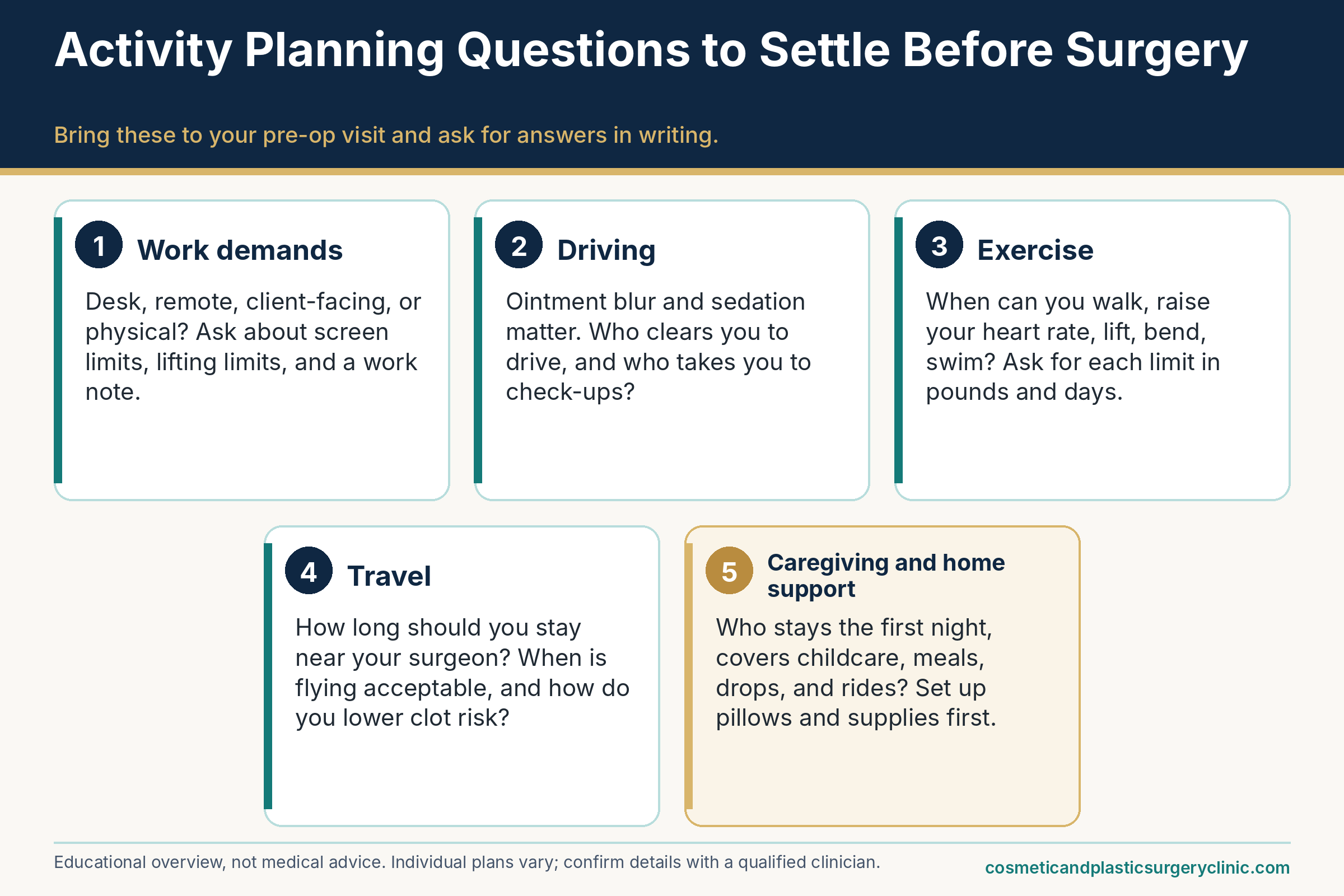
The reason to read about blepharoplasty recovery before surgery is logistics. Most of what goes wrong in recovery planning is not medical; it is a missed ride, a work deadline that assumed day-three energy, an exercise class booked for week two, or a flight that seemed fine on paper. The sections below turn the ranges from the timeline into questions you can put to your surgical team, and they use clearly labeled illustrative examples where a scenario helps.
Work, Driving, and Screens
These three areas share one underlying issue: the eyes are both the body part healing and the tool you use to do the job. That is why a person who would be comfortable at a desk after a different operation may find the first days of eyelid recovery harder than the incision count suggests.
Return to work: matching your job to the recovery clocks
Published ranges for returning to work after blepharoplasty cluster around one to two weeks, with a lot of spread. Michigan Medicine’s handout says return to work in five to seven days is typical, subject to the surgeon’s guidance. Cleveland Clinic states that most patients resume normal activities within one to two weeks. The Aesthetic Society frames recovery as 10 to 14 days, and MedlinePlus advises keeping activities to a minimum for three to five days. None of these says that you will be fully presentable by those dates, only that routine activity is commonly possible. The visibility clock and the comfort clock rarely match, which is the single most useful idea for planning work.
The table below turns that into a decision aid. The jobs and frictions are illustrative examples chosen to show the type of reasoning, not predictions for any particular person, and the right plan depends on the operation, your healing, and your surgeon’s clearance.
| Job type (illustrative) | Likely friction points | Questions for the surgeon | Planning idea |
|---|---|---|---|
| Remote desk work | Screen strain, dryness, blurred vision from ointment, video calls while bruised | When can I use screens for longer stretches? Can I turn the camera off for the first week or two? | Block calendar for early days; plan audio-only meetings |
| In-person office or client-facing role | Visible bruising, light sensitivity, fatigue, being seen before you feel ready | How visible might bruising be at the 2-week mark? Are tinted glasses or makeup allowed, and when? | Choose a start date with a buffer; consider a staggered return |
| Physical or lifting job | Bending, straining, dust, sweat, head-down work that can raise facial pressure | What lifting limit applies, and for how long? Is a temporary desk assignment possible? | Ask for written restrictions to share with the employer |
| Driving, machinery, or precision work | Blurred or double vision, depth perception, glare, ointment haze | Who decides when vision is safe for work? What check confirms it? | Arrange rides or leave until cleared |
| Caregiving for children or relatives | Lifting, picking up toddlers, bending, germs near the eyes, little rest | Which tasks are off-limits? How do I protect the incision lines from small hands? | Line up substitute help for the first days |
Time off is also a legal and paperwork question. The federal rule that defines serious health conditions for family and medical leave (29 CFR 825.113) says that conditions for which cosmetic treatments are administered are not serious health conditions unless inpatient hospital care is required or complications develop (eCFR, 29 CFR 825.113). In plain terms, you should not assume that job-protected leave will cover an elective eyelid operation, and you should check your employer’s sick leave, paid time off, and any state or local leave rules with human resources before booking. This is general information rather than legal advice, and employer policies vary. The wider planning page on returning to work after plastic surgery covers the conversation with an employer in more depth.
Driving and screen time: two rules that depend on your vision
Driving restrictions come from two overlapping sources. The first is anesthesia and medication. Banner Health’s explainer describes the usual advice of 24 to 48 hours without driving after sedation and says medical facilities generally want a verified driver present. Michigan Medicine’s handout says not to drive while taking narcotic pain medication. The second is the eye itself. Oestreicher and Mehta advise patients to plan not to drive for a week because of blurriness from ointment use, and Memorial Sloan Kettering says driving usually resumes about five to ten days after surgery once pain medication has stopped and vision is clear. MedlinePlus says people can see well after two to three days, which is not the same as clearance to drive.
The difference between “I can see” and “I can drive” is worth thinking about. Driving demands good peripheral vision, comfortable depth perception, tolerance of glare and headlights, and the ability to turn your head and check blind spots without discomfort. Swelling and ointment can interfere with each of those in ways that are subtle at home but significant at 65 miles an hour. A practical approach is to ask your surgeon at the first follow-up visit when driving is acceptable, and to line up rides to that visit in advance, since it is often the day sutures come out.
Screens deserve a plan rather than a ban. Concentrated close work reduces blinking, and early after surgery the surface of the eye may be least able to tolerate that. The Aesthetic Society suggests avoiding eyestrain activities such as reading, television, and computer use for the first week and possibly three to four weeks. The National Eye Institute recommends taking regular screen breaks as a general dry-eye measure. Some people use the early days for audio: podcasts, audiobooks, and phone calls. Large text settings and brightness control on a phone also help. Ask your team whether short, frequent screen sessions with breaks are acceptable or whether you should stay off screens altogether for a set period.
Exercise, Travel, Sleep, and the Home Setup
This group of tasks covers the hours when you are not working or driving. They matter because most complications that patients can influence, such as raised blood pressure, straining, rubbing, and infection, happen in ordinary moments at home.
Exercise, lifting, and bending: a staged return
Activity restrictions after blepharoplasty exist for a physical reason: exertion and straining raise blood pressure and facial pressure, which can increase bleeding and swelling. In the ASOPRS survey, increased physical activity was among the risk factors reported for orbital hemorrhage, along with hypertension, aspirin use, and postoperative vomiting. EyeWiki likewise lists postoperative straining such as vomiting or coughing, and hypertension, among risk factors for retrobulbar hemorrhage. The caution is therefore not arbitrary, and it is the reason so many handouts, as shown in Table 2, set a minimum period with no heavy lifting or bending.
After that minimum, sources give widely differing timelines. Mayo says to avoid strenuous activity for one week, including heavy lifting, swimming, jogging, and aerobics. Michigan Medicine says to avoid heavy lifting and bending for seven days, to restrict vigorous activity for two weeks, and to skip swimming, hot tubs, and saunas for three weeks, while also saying to begin walking immediately. MedlinePlus says to avoid strenuous activities that raise blood pressure for about three weeks. Memorial Sloan Kettering sets a lifting limit of five pounds and no bending at the waist for four to six weeks. That is a spread of one week to six weeks for what is, in principle, the same activity, which is a clear signal to ask for your surgeon’s own timeline in writing.
Think in steps rather than a single date. Many plans start with short walks, add light cardio, then add lifting, bending, and contact sports in stages, each with surgeon clearance. Questions worth asking: When may my heart rate go up? What is my lifting limit in pounds, and for how long? Which positions, such as yoga inversions or gardening, put my head below my heart? When can I swim, given chlorinated water near healing incisions? Can I wear a helmet or goggles? A short, illustrative example of the logic: someone who lifts weights four times a week may want a conversation about returning to a modified routine that avoids heavy sets and breath-holding first, since holding your breath under load raises pressure. Whether and when that applies to you is your surgeon’s call.
Travel, sleep, and building the home setup
Travel adds two issues: distance from your surgeon and clot risk. The Centers for Disease Control and Prevention describes venous thromboembolism, which covers deep vein thrombosis and pulmonary embolism, and notes that about half of deep vein clots cause no symptoms; its warning symptoms include swelling, pain or tenderness, warmth, and redness in a limb, and for pulmonary embolism, difficulty breathing, chest pain, a fast or irregular heartbeat, and coughing up blood (CDC, venous thromboembolism). Reduced movement is among the risk factors it names, and Michigan Medicine’s handout includes the instruction to begin walking immediately. If you have to travel for surgery, ask how many days to stay within reach of the team and how long you should wait before flying home; and write the answers down alongside your rides and lodging plans.
Sleep is a logistics problem more than a medical one. Sources suggest a raised head position for anywhere from the first two nights to two weeks, and it is worth asking which sleeping position your surgeon wants, since rolling onto your face or pressing a swollen lid into a pillow is the kind of habit instructions tend to address. Wedge pillows, stacked pillows, and recliners are all used; test your setup before surgery day, because discovering at midnight that your pillow stack slides is a rough way to start recovery. Consider the position of pets, partners, and phone chargers too.
A home-prep list is easier to complete in advance than on the day. Common items include clean washcloths or gauze for compresses, a way to keep compresses cold, the ointment and drops your surgeon prescribes, tinted wraparound sunglasses, extra pillows, easy meals that need no bending or chopping, a phone stand, a written medication schedule, and the surgical team’s after-hours number posted where you can find it. If you wear contact lenses, have current glasses ready, since the sources above ask you to stay out of lenses for roughly one to two weeks or longer. The Mississippi handout also says not to wash the face around the eyes for seven days and not to pluck eyebrows for two weeks, while Memorial Sloan Kettering suggests neck-down showers at first. Ask who washes your hair and how, since leaning over a sink is exactly the head-down position many handouts discourage.
Blepharoplasty Recovery Safety: Warning Signs, Emergencies, and What Can Slow Healing
Most blepharoplasty recoveries are uneventful, and the symptoms that fill the first weeks are expected ones. A recovery plan still needs a safety half, because a small number of problems are time-sensitive in a way that waiting overnight can make worse. This section separates what needs emergency attention, what deserves a same-day call, and what can wait for the next visit, then covers the factors that can slow healing. It is a general framework; your surgical team’s written thresholds replace it.
Emergency and Same-Day Warning Signs
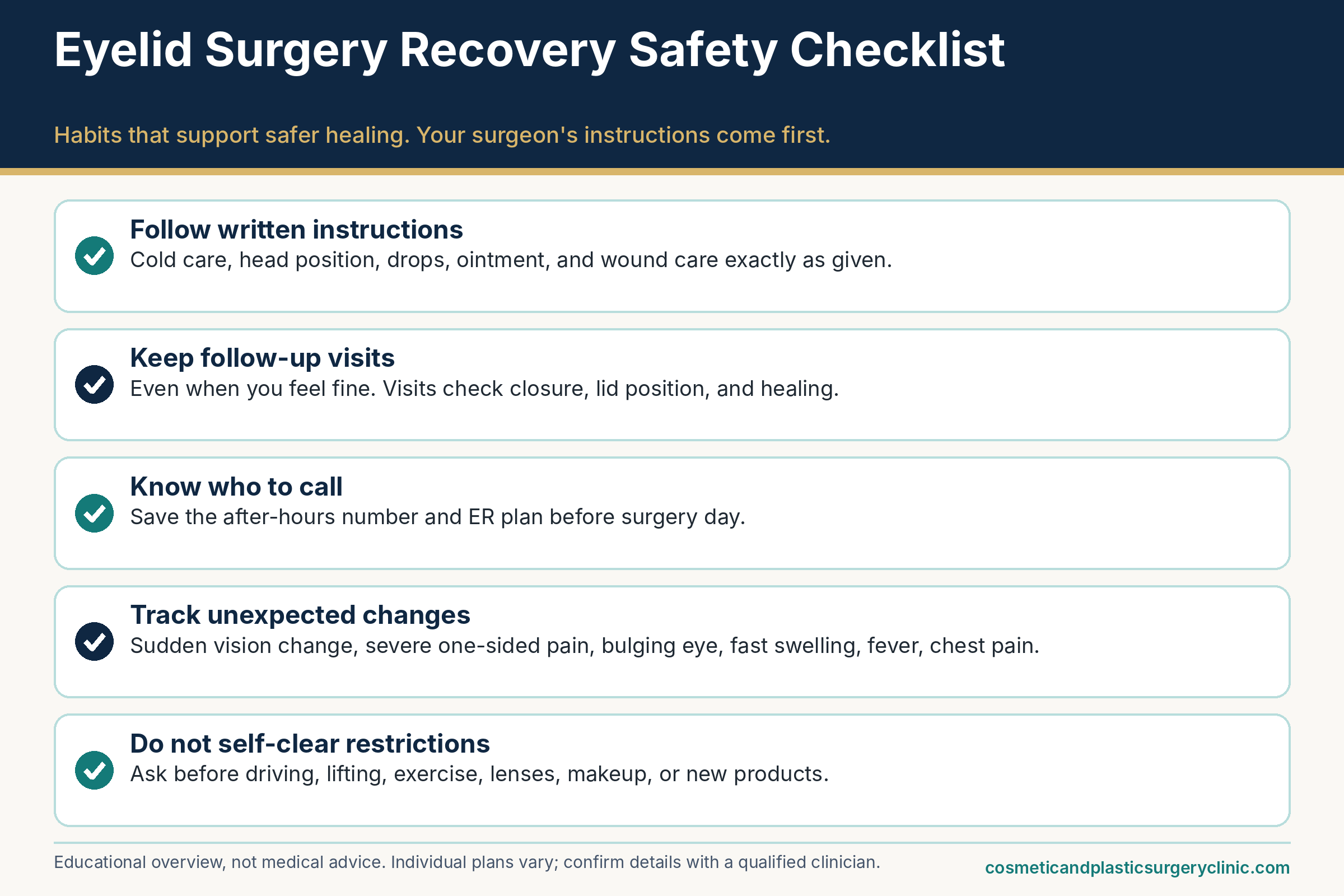
The most useful habit is to decide before surgery who you will call, what number you will use after hours, and where you would go if you could not reach anyone. That is a five-minute task that is almost impossible to do well at 2 a.m. with a swollen eye.
Sight-threatening bleeding behind the eye: what it looks like and why speed matters
Bleeding behind the eye, called retrobulbar or orbital hemorrhage, is rare, but it is the complication that recovery instructions are written around. As blood collects in the closed space around the eye, pressure rises, and that pressure can reduce blood flow to the optic nerve and retina. EyeWiki describes the picture as severe pain, double vision, difficulty opening the eyelids, a bulging or forward-displaced eye, and declining vision, sometimes with nausea or vomiting, and says it usually occurs within the first 24 hours after eyelid or orbital surgery. It calls the situation a compartment syndrome and describes lateral canthotomy with cantholysis, a rapid procedure that releases pressure at the outer corner of the eyelid, as the effective first-line treatment, to be done within about two hours of onset.
Numbers help put the risk in proportion without minimizing it. In the ASOPRS member survey (237 surgeons, 269,433 cosmetic eyelid cases), orbital hemorrhage was reported at 0.055%, or about 1 in 2,000, and permanent visual loss at 0.0045%, about 1 in 22,000; most hemorrhages in that survey appeared within the first three hours, with much lower risk after 24 hours (Hass et al., 2004, abstract). Those are surgeon-reported figures from a survey and may undercount or differ from current practice, so treat them as an order of magnitude rather than a precise rate. Oestreicher and Mehta emphasize recognition and a rapid response, and state that treatment beyond one to six hours of total or near-total vision loss is unlikely to be effective. The fuller risk discussion is in the page on eyelid surgery risks and complications.
Ordinary bruising and swelling can look dramatic without being this. The distinguishing pattern is pain that is disproportionate and one-sided plus a change in vision or eye movement, not just a puffy, purple eyelid. Oestreicher and Mehta advise teaching patients to check vision one eye at a time, a simple habit that can reveal a one-sided problem a person might miss with both eyes open. Ask your team how often they want you to check and what exactly to do if something seems off. Also mention beforehand if you tend to get nauseated after anesthesia, because vomiting and straining appear among the risk factors in both the survey and EyeWiki.
Whole-body signs, infection, and wound problems
ASPS lists infection among the recognized risks of eyelid surgery, and the handouts agree on the signs even though they differ on thresholds. Michigan Medicine’s list includes fever above 101 degrees Fahrenheit, severe pain not controlled by medication, yellowish or greenish drainage, and uncontrolled bleeding. Memorial Sloan Kettering uses a lower fever threshold of 100.4 degrees and adds chills, nausea, vomiting, worsening pain, swelling, or redness, continuous drainage, and suture separation. Cleveland Clinic lists bleeding, discharge or pus, severe swelling, severe pain, and vision changes as reasons to contact the care team. The takeaway is to use the number your team gives you and to call for the pattern: redness and warmth that are spreading, pain that is getting worse rather than better, discharge, or a wound that is opening.
It is common to wonder whether something is “bad enough” to call. Surgical offices expect these calls. Gentle self-observation is useful, but the decision about whether a finding is concerning belongs to the people who can examine you. A simple sorting guide appears in the table below; it describes levels of response, not diagnoses, and it cannot cover every situation.
| What you notice | Often part of ordinary healing? | Suggested level of response | Why it is sorted this way |
|---|---|---|---|
| Bruising that changes color or drifts down the cheek; both sides puffy but slowly improving | Yes, commonly | Mention at the next check-up | Pattern of gradual improvement across both sides fits normal healing |
| Blurry vision right after ointment that clears as it settles | Yes, commonly | Ask at the next visit if it persists longer than your team expected | Ointment itself blurs vision; Mayo and Oestreicher and Mehta both describe this |
| Gritty, burning, or watery eyes that are mild and steady; difficulty closing the eyes fully | Often, but closure problems need review | Use prescribed lubricants; call the office if worse or if the eyes do not close | Surface irritation is common, and incomplete closure can injure the cornea if untreated |
| Swelling that is increasing, tense, or much greater on one side, with pain | Not a wait-and-see pattern | Same-day call at minimum; emergency care if any vision change or bulging | Rapid one-sided change can signal bleeding or a collection |
| Sudden vision loss, new double vision, severe eye pain, or a bulging eye | No | Emergency now: follow your emergency plan or call 911 | Possible bleeding behind the eye, where timing affects outcome |
| Fever above your team’s threshold, spreading redness, pus-like drainage, or opening wound | No | Same-day call to the surgical team | Possible infection or wound problem needing examination |
| Chest pain, trouble breathing, fast or irregular heartbeat, or a painful swollen leg | No | Emergency care; call 911 for severe symptoms | Possible blood clot or other serious problem outside the eyes |
What Can Slow Healing or Cause Problems After the First Week
If the first week passes without an emergency, the remaining safety questions are slower and subtler: is the lid sitting where it should, is the eye surface protected, and are your habits helping or hurting?
Lid position, closure, and the eye surface
ASPS lists difficulty closing the eyes, dryness, ectropion (outward rolling of the lower lid), and lid lag, a temporary pulling down of the lower lid, among the recognized risks. The StatPearls blepharoplasty entry describes corneal lubrication as the mainstay for dry eye and for temporary incomplete closure after surgery. That is the reason ointment at night, taping instructions, or extra drops show up in some plans. The cornea is the clear front window of the eye, and when it is not covered and moistened well, it can develop scratches or ulcers that cause pain, light sensitivity, redness, and reduced vision.
Lid malposition is the bigger story in some lower-lid operations. In the 200-patient series by Patrocinio and colleagues, lower-eyelid malposition occurred in six patients (3%), five with retraction and one with ectropion, and the cases needed procedures such as canthoplasty or a tarsal strip, sometimes with skin grafting. A surgeons’ review by Oestreicher and Mehta notes that in the early postoperative period small interventions can make a large difference to the ultimate outcome, describing steps such as eliminating topical allergens, short-term steroid use, and upward massage. Those are surgeon-directed measures. Do not start massage, steroid drops, or taping on your own. If a lower lid appears to be pulling down, showing more white of the eye than before, or rolling outward, report it promptly so the team can decide whether it is swelling or a developing problem.
Another thing worth knowing is the language of waiting. Many problems in the first weeks are managed by watching, but the wait should be supervised. Oestreicher and Mehta suggest delaying revision for three months or more when possible, and Patrocinio and colleagues emphasize frequent follow-up. Waiting is a plan, not a lack of one, when it comes with scheduled visits and clear instructions for what to report in between. If you have thyroid eye disease, prominent eyes, or previous eye surgery, ask specifically about the lid-position risks that apply to your anatomy, and see the section on risk factors in the risks and complications guide linked earlier in this article.
Healing modifiers: nicotine, blood pressure, rubbing, sun, and slow recoveries
Habits matter most in the ordinary weeks. Nicotine in any form can interfere with wound healing, as MedlinePlus explains, and the same source notes that stopping at least four weeks before surgery helps and that nicotine gum still interferes. If you used nicotine and cannot stop, tell your surgeon rather than hiding it; the plan may change, but concealment removes the chance to adjust it. Blood pressure control is next. If you use home monitoring, ask your team what readings should prompt a call, since hypertension appears among the reported risk factors for postoperative hemorrhage in both the ASOPRS survey and EyeWiki.
Rubbing and pressing on the eyes are habits worth noticing. Mayo tells patients not to rub their eyes, and the reason is practical: it risks opening a healing wound, introducing germs, or irritating the surface. Sleep position, makeup, contact lenses, and hands that have not been washed are other routes to avoidable trouble. Sun and wind irritate thin eyelid skin, and ASPS tells patients to use diligent sun protection and darkly tinted sunglasses until healing is complete.
What if recovery just seems slow? Individual variation is wide. A person with thin, easily bruised skin, a combined procedure, a history of dry eye, or the use of blood-thinning medication may see swelling and bruising linger longer than the ranges suggest. The Frontiers in Medicine studies cited above show that eye-surface measures can take a month to six months to normalize even when nothing is wrong, particularly in people with preexisting dry eye. The useful question is not whether you are ahead of or behind a schedule but whether you are improving, whether you can follow the surgeon’s instructions comfortably, and whether any symptom is worsening. If the answer to the last question is yes, that is the moment to call.
Scars, Sun, Makeup, Follow-Up Visits, and the Emotional Side of Blepharoplasty Recovery
Once the swelling and the stitches are behind you, the second half of blepharoplasty recovery is mostly about the tissue clock. Scars mature, skin tolerates products again, and the question shifts from whether you are healing to whether you are done. This section covers scar care, sun and makeup, the follow-up schedule, and the mental side of watching your face change in small steps.
Scars, Sun Protection, Makeup, and Skin Care
Eyelid skin is thin and shows scars differently from skin elsewhere, which is part of why eyelid surgery has a reputation for discreet scarring. Reputation is not a promise, though, and sun, tension, and genetics can all change how a scar looks.
Where eyelid scars sit and how they mature
Scar location follows the technique. In upper-lid surgery the incision is made in the natural crease, so the healed line often sits in a fold. In lower-lid surgery a subciliary incision runs just below the lash line, while a transconjunctival incision inside the lid leaves no skin incision, according to ASPS. For the longer discussion of scar appearance and care, see the page on eyelid surgery scars. This article stays with the recovery timeline for scars.
Scars usually pass through recognizable stages. An ASPS article on scar healing describes roughly the first two weeks as a protection period in which dressings and gentle handling matter, then a phase lasting up to about six months in which scars look red and are prone to sunburn, and finally a maturation phase from about six months to a year in which collagen flattens, small vessels recede, and redness fades. MedlinePlus says eyelid scars may stay slightly pink for six months or more and fade to a thin, nearly invisible white line. Mayo says they may take months to fade. Taken together, these sources point to a pink to red scar through the first half-year and a gradual quieting through the first year.
Wound care principles are the same as for other surgical incisions. The American Academy of Dermatology advises keeping a wound clean, keeping it moist rather than letting a crust form, following your doctor’s instructions for stitches, protecting the healed scar with sunscreen, and getting medical care for signs of infection (AAD, minimizing scars). Handouts for eyelid surgery put those principles into specific schedules, such as cleaning suture lines with saline or diluted peroxide for a few days and applying ophthalmic ointment, and the schedules differ, so follow your own. The ASPS scar article also mentions silicone gel and tape, light-based treatments, and microneedling as options some surgeons use at certain stages. Whether any of those suits the delicate eyelid area is the surgeon’s decision; do not add products near healing incisions without asking.
The Medicina trial discussed earlier is reassuring about the typical outcome in upper-lid surgery, since most participants had no visible scar by three to twelve months. A few people, however, develop thick, red, or discolored scars; ASPS lists unfavorable scarring among the recognized risks of eyelid surgery. Bumpiness along the incision lines early on is described as normal in Michigan Medicine’s handout, but a bump that is growing, painful, or draining is a different matter. The practical advice is to flag anything unusual at follow-up rather than treat it yourself.
Sun, makeup, contact lenses, and skin-care products
Sun protection is the one instruction that every source agrees on, even where details differ. ASPS says to practice diligent sun protection and use darkly tinted sunglasses until healing is complete. The ASPS scar article advises avoiding direct sun on the scar for the first six months and mentions a broad-spectrum mineral sunscreen with a high sun protection factor, along with protective clothing and wide-brimmed hats. Michigan Medicine’s handout goes further, advising patients to avoid exposing scars to sun for at least 12 months and saying sunblock and makeup may resume around three weeks once the incisions are fully closed and healed. The AAD advises applying SPF 30 or higher sunscreen to a scar after it has healed. Those are different numbers, and the difference tells you where the guidance is conservative: the closer your skin is to a fresh wound, the more reason to rely on a hat, sunglasses, and shade rather than sunscreen, and to ask exactly when and what product can go near the lids.
Makeup timing is similarly varied. The Mississippi handout says no makeup around the incisions for the first seven days. UNC says to avoid makeup on incision sites until 24 hours after the sutures are removed. Memorial Sloan Kettering says no creams or makeup on the surgical sites for two weeks. Michigan Medicine says around three weeks, and also suggests that retinoid products can be restarted at one month. Those differences reflect when each surgeon is comfortable that the skin is sealed. Concealer for bruising is a separate question from mascara and eyeliner near the lash line, so ask about both.
The FDA’s eye-cosmetic guidance is a useful reference for hygiene near healing eyelids. It advises avoiding eye cosmetics if you have an eye infection or if the skin around the eye is inflamed, waiting until the area has healed, and discarding the products you were using when an infection started. It also advises against sharing cosmetics and mentions that manufacturers usually recommend discarding mascara two to four months after purchase (FDA, eye cosmetic safety). Ask your surgeon whether to use new makeup after surgery, and wash hands before touching the eye area. Contact lenses were covered above; the point to add is that lens solution, cases, and hands are infection routes, so ask before restarting wear and whether glasses are preferable for longer.
Follow-Up Visits, Emotional Recovery, and When Results Look Settled
The last piece of recovery involves two things that look unrelated: a schedule of appointments and the way you feel about what you see. They are related because follow-up is where the surgeon checks the measurable parts and where you get to ask about the rest.
Follow-up visits: what each one is for
Most surgeons build in a short sequence of visits. The first, within about a week, usually deals with stitches or glue and a check of the incisions, the lids, and the eye surface. A second visit at around two to four weeks commonly reviews bruising, lid position, closure, and comfort. Later visits at about three months and again at six to twelve months are where the tissue clock is read: scar quality, symmetry, lid height, and whether anything needs a second look. The exact schedule varies, and the point is to keep every visit even when you feel fine. Patrocinio and colleagues emphasized frequent postoperative follow-up as essential for managing complications and for patient satisfaction, and the risks guide explains that different problems tend to declare themselves at different times.
Arrive prepared. Bring a list of questions, your medication and drop schedule, and your own photos from the recovery log. Ask what the surgeon is checking at this visit, what would count as progress by the next one, and which findings would change the plan. It is also the time to ask about restrictions: the right moment to lift a lifting limit, add exercise, or return to lenses is usually after an examination. Revision decisions belong here too. Oestreicher and Mehta advise delaying revisions until at least three months after the primary operation when possible, so the early weeks are the wrong time to judge the final contour, however anxious they make you.
What does “settled” mean? There is no single date. Swelling continues to ease for months, scars take six to twelve months to mature, and sensation changes can last longer. ASPS describes results emerging gradually as inflammation and bruising resolve. Mayo says that for some people, results may last a lifetime, while for others droopy eyelids can recur. For what to expect from the result itself rather than the healing, the page on eyelid surgery results covers the timeline and expectations.
The mirror and the mind: swelling, unfamiliarity, and patience
Few people are prepared for how strange the first weeks of looking in the mirror can feel. ASPS published an article in 2025 about not recognizing yourself after surgery, in which surgeons note that swelling, bruising, distortion, numbness, and the normal emotional ups and downs after surgery can contribute to a “what have I done” feeling, and that an initial sense of unfamiliarity can occur even when the outcome is technically excellent (ASPS, postop recognition). A second ASPS article describes surgery as a real identity change for some people and quotes a surgeon saying it can take months for the mind to adjust, and it points to the disappointment of having to wait out the healing process as a common emotional challenge (ASPS, the emotional side of plastic surgery).
The eyes carry expression, so even small asymmetry during swelling is noticeable. That makes the early days a poor time to evaluate the result, and an equally poor time to make decisions about revision or to compare yourself with polished photos online. A few habits help: look at the photo log rather than the mirror when you want to see progress, schedule low-stakes social contact with people you trust, and give yourself deadlines for judging the result that are measured in months. If you find yourself struggling, tell someone. The same ASPS article warns about body dysmorphic disorder and recommends professional mental health support when negative thoughts become severe or disrupt daily life; if you ever have thoughts of harming yourself, contact emergency care or a crisis service such as the 988 Suicide & Crisis Lifeline in the United States right away.
The Cost of Recovery Time, Alternatives, and Questions to Bring to a Surgeon
Recovery has a price that does not appear on a surgical quote: the time, help, and supplies that make healing possible. This final section turns the earlier material into a budget, places the recovery profile alongside the alternatives people often consider, and ends with the credential checks and questions that connect a recovery plan to a real surgeon and facility.
The Cost of Recovery Time and How Alternatives Compare
Counting the cost of recovery is not about making surgery seem more expensive or less. It is about making the trade-offs visible so you can compare options on the same footing and avoid being surprised by costs you could have planned for.
Building a downtime ledger: time, help, supplies, and follow-up
Start with time, because it is the largest line for most people. Add up the days you expect to be away from work, the days you expect to work at reduced capacity, and the days when you will be available but not at your best. The ranges in this guide, roughly one to two weeks for a return to routine tasks and longer for exercise and heavy lifting, are a starting point, not a plan. Build in a buffer, because a schedule with no slack turns an ordinary slow week into a stressful one. Remember too that leave rules may not protect your job for an elective cosmetic procedure, as discussed above, so find out what paid time off or sick leave you have.
The ledger below lists the other lines. The items are not prices, because costs vary by region, practice, and plan; they are categories to ask about when you compare quotes. Surgeon fees, facility fees, anesthesia, and related charges are covered in the page on eyelid surgery cost, which also explains why a national average is never a local quote.
| Ledger line | What to ask or check | Why it matters |
|---|---|---|
| Time off and reduced capacity | How many days off, how many at partial capacity, and what paid leave covers | Often the largest cost; a buffer reduces the pressure to rush back |
| Ride and helper | Who drives to surgery and the first check-ups, and who stays the first night | Mayo advises arranging a ride, and facilities commonly require an escort after sedation; late arrangements can delay surgery |
| Supplies and prescriptions | Ointment, drops, compress materials, sunglasses, extra pillows, a current glasses prescription | Small items add up, and some are needed on day one |
| Follow-up visits | Which visits are included in the quoted fee, and what happens if extra visits are needed | Quotes differ on what follow-up they include |
| Complications and revision policy | What the practice charges for managing problems or revision, and who pays for facility and anesthesia | Cost of the unexpected is easier to discuss before surgery than after |
| Care away from home | Lodging, travel, and where follow-up happens if surgery is far from where you live | Distance complicates emergencies and follow-up visits |
One practical exercise is to build two versions of the ledger: a smooth-recovery version and a slower-recovery version. Neither is a prediction. The second simply shows what you could absorb if bruising lingers, if you need an extra week off, or if a follow-up visit is added. If the slower version is unaffordable, that is useful information about timing, and it may argue for choosing a quieter time of year or delaying surgery until you can arrange more support.
Alternatives and how their recovery profiles compare
People often ask whether a less invasive option could avoid the recovery altogether. The honest answer is that alternatives differ in what they can change, not only in how long they take to heal. A surgical eyelid operation removes or repositions tissue; nonsurgical approaches usually address a narrower problem, such as a hollow under the eye or a surface texture concern, and they carry their own recovery profile and their own risks. Which concern you actually have is a diagnosis that belongs to a clinician, not to a search engine. ASPS notes, for example, that drooping upper lids can come from the brow or from the lid muscle rather than from excess skin, which means that a treatment aimed at the wrong structure may disappoint.
A fair comparison asks the same questions of every option: what exactly it changes, what it cannot change, how long the visible downtime lasts, how long the effect lasts, what the main risks are, and what happens if you are unhappy. The dedicated guide to alternatives to eyelid surgery works through those questions, and a surgeon’s screening questions about your health, eyes, and goals shape which of them is even on the table. If you are considering a brow lift, ptosis repair, or a facelift alongside eyelid surgery, recovery tends to follow the largest component, so look at the combined-procedure trade-offs before booking.
Comparing downtime across options also means comparing what recovery asks of you. Some choices require little time off but repeated visits. Others require a single longer break. Neither pattern is better in general; what matters is which fits your calendar, your risk tolerance, and your goals. Write the comparison down, with the ledger from the previous section, and bring it to a consultation.
Choosing a Surgeon and Facility with Recovery in Mind
A recovery plan is only as good as the team that stands behind it. The credential and facility checks below are the same ones that apply to any cosmetic operation, but the recovery lens adds a specific test: can this team be reached quickly, and do they have a clear plan if something goes wrong?
Verifying credentials, the facility, and the emergency plan
The American Board of Plastic Surgery (ABPS) offers a public tool for verifying certification. It lets you search by surgeon name and location, notes that an active, unrestricted license is a requirement of certification, and shows an alert directing you to the Federation of State Medical Boards if the board has been notified of state medical board action. The tool also emphasizes that certification is a voluntary credential (ABPS, verify certification). ASPS describes the ABPS pathway as including medical school, several years of surgical training with at least a three-year plastic surgery residency, written and oral examinations, and continuing education, and it warns that not every impressive-sounding “board certification” is equivalent (ASPS, why board certification matters). The general checklist is in the page on how to choose a plastic surgeon.
Eyelid surgery is performed by clinicians from more than one specialty background. If the surgeon you are considering cites a board other than ABPS, verify that credential with the board that issued it, and ask how many eyelid operations they perform and what training they completed. That is a verification question, not a ranking, and this article does not claim one specialty path is better than another.
Next, the facility. ASPS lists three accrediting organizations for surgical facilities: AAAASF, AAAHC, and the Joint Commission, along with Medicare certification or state licensure as alternative qualifying standards. It says patients can verify accreditation by contacting the accrediting organization, and that facilities should have the equipment, medication, and a defined emergency plan, including transfer to a hospital if needed (ASPS, accredited facilities). For eyelid surgery, the emergency plan has a specific meaning: who can respond to a suspected bleed after hours, where would you be sent, and can that place manage an eye emergency? Ask about anesthesia as well, including who provides it and what monitoring is used; the earlier discussion of anesthesia options applies here too.
Recovery questions to bring to a consultation
Questions work best when they are specific. Bring this list, mark the ones that matter most, and ask the team to write the answers on your discharge instructions or in a patient portal message. A consultation question guide for eyelid surgery offers a wider list for the decision itself; these are the ones that focus on recovery.
About the plan
- Which eyelids and which structures will be treated, and which add-on procedures are part of my plan?
- Will my stitches dissolve or need removal, and when are the first two follow-up visits?
- What anesthesia will I have, and how long should I expect to be drowsy afterward?
- What is the usual timeline for bruising and swelling with this plan, and what makes it longer for some people?
About daily life
- When can I go back to work, drive, use screens for long stretches, and wear contact lenses?
- What exact lifting, bending, and exercise limits apply, and in what order do they lift?
- Which ointments, drops, and skin products should I use, in what order, and for how long?
- When can I wear makeup, wash my face and hair normally, and use sunscreen near the lids?
About safety
- Which symptoms should send me to an emergency department, and which should prompt a same-day call?
- What is the after-hours number, who answers, and how quickly do you expect to hear back?
- If I need urgent eye care, where would you want me to go, and will you be notified?
- How do you manage dry eye, incomplete closure, or lid position problems if they occur?
About cost and follow-up
- Which follow-up visits are included in the quoted fee, and what happens if I need extra visits?
- What is your policy for complications and revision, and what costs would fall to me?
- When would you be comfortable judging the result, and when would you consider a revision?
A good consultation leaves you with clear written answers, not just reassurance. If an answer is vague, ask a follow-up question. If you cannot get specific answers about emergency plans, follow-up, and credentials, that is useful information as well.
Frequently asked questions about blepharoplasty recovery
Is it normal for one eyelid to swell or bruise more than the other?
Some unevenness is common. Swelling follows gravity, sleep position, and the exact work done on each side, so one lid can look puffier or darker for days. What matters is the pattern. Gradual improvement on both sides, even at different speeds, usually fits ordinary healing, while swelling that is increasing quickly, feels tense, or comes with strong one-sided pain or any change in vision needs a prompt call to the surgical team, and emergency care if sight is affected. A daily photo in the same light makes it easier to tell slow progress from true change.
Why can my eyes feel dry and watery at the same time?
The tear film depends on blinking and on lids that spread tears evenly. After surgery, blink patterns change for a while, the lids can be swollen, and the surface may be irritated, so the eye can feel gritty while still overflowing with tears. In a small study of upper blepharoplasty, blink measures returned to baseline by one month, while tear-film changes lasted longer in people who already had dry eye. Your surgeon may prescribe or recommend lubricating drops and ointment. Report pain, redness, or reduced vision rather than assuming it is just dryness.
How soon after eyelid surgery will I be able to see clearly?
MedlinePlus says people should be able to see well after two to three days, and a University of Mississippi Medical Center handout expects blurring for two to three days. Ointment is a separate source of haze, because it coats the eye and blurs vision each time you apply it, and tearing and light sensitivity can last several weeks. Clear vision for reading is not the same as clearance to drive. If vision suddenly worsens, a dark area appears, or you see double, treat that as a reason to call your team immediately rather than waiting for the usual blur to pass.
Can I wear glasses or sunglasses right away?
Sunglasses are widely recommended: ASPS tells patients to use darkly tinted sunglasses and sun protection until healing is complete, and the Aesthetic Society suggests dark sunglasses for the first few weeks. Prescription glasses are a different question, because frames rest on the nose and cheeks near swollen tissue, and none of the sources read for this guide addresses frame pressure. Ask your surgeon whether regular glasses are fine, how long to wait, and whether lightweight frames are preferable. If you normally wear contact lenses, plan to use glasses for at least the period your surgeon specifies, and make sure the prescription is current.
When can I shower and wash my hair after blepharoplasty?
Instructions differ. Memorial Sloan Kettering describes neck-down showers at first and full showers around day five, UNC says patients may shower the day after surgery, and Michigan Medicine says a shower is allowed after 24 hours with incisions blotted rather than wiped. The Mississippi handout says not to wash the face around the eyes for seven days. Hair washing raises the head-down problem, since leaning over a sink strains the face. Ask whether someone can help rinse your hair, whether you should use lukewarm water, and how to keep soap and shampoo away from the eyes.
Can I fly soon after eyelid surgery?
No source read for this guide gives a universal waiting period, so the honest answer is to ask your surgeon. Two issues matter. The first is distance from your surgical team during the window when the most time-sensitive problems occur. The second is clot risk: the CDC lists reduced movement among risk factors for venous thromboembolism and describes warning symptoms in the legs and lungs. Some surgeons ask out-of-town patients to stay nearby for a few days. Get the plan in writing, including how to reach the team from another city.
How do I sleep if I normally sleep on my side or stomach?
Most published instructions emphasize a raised head for a period that ranges from the first two nights to two weeks, depending on the source. Beyond that, the sources read for this guide do not give a position rule, so ask your surgeon which positions to avoid and for how long. Habitual side or stomach sleepers often benefit from rehearsing the plan before surgery: a wedge pillow, stacked pillows, or a recliner, plus pillows arranged to make rolling over uncomfortable. Pressure on a swollen lid is the thing to avoid, so protect that side. A dedicated page covers sleep after eyelid surgery in more detail.
Does age change blepharoplasty recovery?
Age is linked to other factors that may matter for recovery, such as blood pressure, medications, dry eye, and skin thickness, but this guide found no source showing that age alone sets the pace. In ASPS 2025 statistics, the largest groups having eyelid surgery were people aged 56 to 65 and those 66 and older. A 2024 trial of upper blepharoplasty included patients aged 49 to 87 and reported improved satisfaction at three and six months. Individual health and the specific operation matter more than the number, which is why a thorough medical history and eye examination before surgery are part of planning.
What happens at the suture-removal visit?
The visit is mainly an examination. ASPS says sutures are removed within a week, and the sources read give windows from about two to ten days depending on stitch type and surgeon. The team looks at the incisions, the lids, how well the eyes close, and the surface of the eye, and often reviews your comfort and any swelling concerns. It is a good moment to ask about next steps: when to restart activities, how to care for the line, and when the next visit is. Bring someone to drive you and your list of questions.
If I wear contact lenses every day, what should I plan for?
Plan for glasses. Sources read for this guide advise avoiding contact lenses for about one week to at least two weeks, with Mayo Clinic, MedlinePlus, Michigan Medicine, and Memorial Sloan Kettering pointing to about two weeks or more. Dry eye is a related concern: a small study found that existing dry eye led to more persistent eye-surface changes after upper blepharoplasty, so mention any dryness you already have. Ask when you may restart lenses, whether your surgeon wants a new set or fresh solution and cases, and whether you should be re-fit or have the prescription rechecked.
Can bruising from eyelid surgery leave lasting discoloration?
Bruises from surgery usually clear as the body reabsorbs blood, though the time frame varies from about one week to about a month in the sources read. Skin discoloration is listed by Cleveland Clinic among possible risks of blepharoplasty, and ASPS mentions that a surgeon may recommend a laser or chemical peel to reduce discoloration of the lower eyelids. Sun exposure can darken healing skin, so sun protection matters. If an area of color change is not fading or seems to be deepening, ask your surgeon to examine it rather than treating it with products on your own.
Do I need to stay near my surgeon after surgery?
There is no universal rule, so ask. Mayo Clinic advises having someone stay with you the first night, and the early period is when the most time-sensitive problems are reported. If you live far away, ask how many days the team wants you within reach, which urgent-care or emergency facilities near your lodging can evaluate eye emergencies, and how the team will coordinate with them. Also ask where follow-up visits will happen and how photos or video calls are used. A plan that assumes an immediate drive home may not account for sedation, ointment blur, or swelling.
Sources and further reading
- American Society of Plastic Surgeons — Eyelid surgery recovery (accessed 2026-10-04) — ointment, cold compresses, expected swelling and bruising, sun protection and tinted sunglasses
- American Society of Plastic Surgeons — Eyelid surgery procedure (accessed 2026-10-04) — anesthesia options, incision locations, closure, suture removal within one week
- American Society of Plastic Surgeons — Eyelid surgery candidates (accessed 2026-10-04) — health factors, nonsmokers, brow contribution, ptosis as a different surgery
- American Society of Plastic Surgeons — Eyelid surgery safety (accessed 2026-10-04) — list of recognized risks
- American Society of Plastic Surgeons — 2025 Plastic Surgery Statistics Report (accessed 2026-10-04) — 118,978 eyelid surgery procedures in 2025 versus 100,185 in 2024; age groups
- Mayo Clinic — Blepharoplasty (accessed 2026-10-04) — symptoms, ice and elevation, activity, contact lenses, preparation, urgent symptoms
- MedlinePlus — Eyelid lift surgery (reviewed February 5, 2025; accessed 2026-10-04) — stitches, vision, bruising, activity, lenses, scars
- Cleveland Clinic — Eyelid surgery (blepharoplasty) (accessed 2026-10-04) — return to activity, stitches, dry eye care, when to contact the team
- Michigan Medicine — Blepharoplasty post-operative instructions (revised April 2020; accessed 2026-10-04) — example hospital protocol for pillows, activity, sutures, makeup, sun, warning signs
- Memorial Sloan Kettering Cancer Center — Instructions for care after blepharoplasty (updated August 2, 2024; accessed 2026-10-04) — example protocol for compresses, lifting limits, lenses, makeup, driving, fever threshold
- UNC Otolaryngology — Blepharoplasty postoperative instructions (accessed 2026-10-04) — cooling, activity, ointment, shower, makeup after suture removal
- University of Mississippi Medical Center — Postoperative care instructions for blepharoplasty (accessed 2026-10-04) — compresses, elevation, face washing, makeup, lenses, vision blur
- The Aesthetic Society — Blepharoplasty: 13 things to expect when recovering (2019; accessed 2026-10-04) — recovery range, sunglasses, lenses, eyestrain, stitches
- Oestreicher J, Mehta S — Complications of blepharoplasty: prevention and management, Plastic Surgery International 2012 (accessed 2026-10-04) — cooling and elevation, ptosis and revision timing, hemorrhage recognition, driving advice
- EyeWiki (American Academy of Ophthalmology) — Retrobulbar hemorrhage (accessed 2026-10-04) — symptoms, timing, risk factors, emergency treatment
- Hass AN et al. — Incidence of postblepharoplasty orbital hemorrhage and associated visual loss, Ophthalmic Plastic and Reconstructive Surgery 2004, abstract (accessed 2026-10-04) — surgeon survey figures and risk factors
- Patrocinio and colleagues — Complications in blepharoplasty, Brazilian Journal of Otorhinolaryngology (retrospective series of 200 patients; accessed 2026-10-04) — chemosis, lower-lid malposition, follow-up
- StatPearls — Blepharoplasty, Rebowe and Runyan (updated July 24, 2023; accessed 2026-10-04) — lubrication for lagophthalmos and dry eye after surgery
- Zhang et al. — Upper eyelid blepharoplasty, blink parameters and lipid layer thickness, Frontiers in Medicine 2021 (accessed 2026-10-04) — blink recovery at one month
- Zhao et al. — Dry-eye markers and tear cytokines after upper blepharoplasty, Frontiers in Medicine 2021 (accessed 2026-10-04) — six-month eye-surface course, effect of pre-existing dry eye
- Medicina 2024;60(3):500 — Quality of life after upper eyelid blepharoplasty, randomized trial of 348 patients (accessed 2026-10-04) — satisfaction and scar outcomes at 3, 6, and 12 months
- National Eye Institute — Dry eye (updated August 6, 2025; accessed 2026-10-04) — symptoms and self-care measures
- American Academy of Ophthalmology — Editors’ Choice: homeopathic treatment confers no benefit after upper blepharoplasty (accessed 2026-10-04) — placebo-controlled arnica trial summary
- Dutch Association of Plastic Surgeons — Guideline module on arnica after periorbital surgery (June 30, 2021; accessed 2026-10-04) — low-certainty evidence; neither recommended nor discouraged
- Frontiers in Surgery 2021 — Is homeopathic arnica effective for postoperative recovery? A meta-analysis (accessed 2026-10-04) — small, non-significant pooled effect with high heterogeneity
- Aesthetic Plastic Surgery 2025 — Tranexamic acid in upper eyelid blepharoplasty: systematic review and meta-analysis (accessed 2026-10-04) — five randomized trials; less bruising; abstract-level summary
- Ophthalmic Plastic and Reconstructive Surgery 2024 — Tranexamic acid in eyelid surgery randomized trial (listing; accessed 2026-10-04) — 130 patients; reduced bruising; abstract-level summary
- Centers for Disease Control and Prevention — Venous thromboembolism (reviewed March 5, 2025; accessed 2026-10-04) — DVT and pulmonary embolism symptoms
- MedlinePlus — Smoking and surgery (reviewed September 30, 2024; accessed 2026-10-04) — wound healing and timing of cessation
- American Society of Plastic Surgeons — What to expect as a scar heals following plastic surgery (June 2026; accessed 2026-10-04) — scar phases and sun protection
- American Academy of Dermatology — Wound care to minimize scars (updated July 2025; accessed 2026-10-04) — wound care and sunscreen on healed scars
- U.S. Food and Drug Administration — Eye cosmetic safety (accessed 2026-10-04) — hygiene and infection guidance for eye-area cosmetics
- Banner Health — When and why you need someone to drive you home after medical procedures (2023; accessed 2026-10-04) — driving after sedation (health-system explainer)
- Electronic Code of Federal Regulations — 29 CFR 825.113, serious health condition (accessed 2026-10-04) — cosmetic treatments and family and medical leave
- American Society of Plastic Surgeons — The emotional side of plastic surgery (May 2025; accessed 2026-10-04) — adjustment and patience
- American Society of Plastic Surgeons — Postop recognition and plastic surgery results (April 2025; accessed 2026-10-04) — unfamiliarity after surgery and when to seek mental health support
- American Board of Plastic Surgery — Verify certification (accessed 2026-10-04) — public certification lookup
- American Society of Plastic Surgeons — Why board certification matters (March 26, 2025; accessed 2026-10-04) — ABPS training path and misleading titles
- American Society of Plastic Surgeons — Accredited facilities (accessed 2026-10-04) — facility accreditation and emergency planning